My collection of 1/300 aircraft has been inactive. A pile of dead lead. That’s mostly because I did so much work with Daveshoe on plane projects. I was the painting dude and painted lots and painted them quickly. Dave was the game designer. Taking over that latter role is much more difficult than you might imagine.
But I have done a few things the past couple of months that have improved my air gaming situation. First, I’ve parted with a lot of my unpainted planes and narrowed my focus to two remaining projects. More about those shortly. Parting with the wretched excess really freed me to focus on the planes that were most important to me. Another thing I’ve done is sit down with my rules, the ones that Dave was so good with and begin figuring out what I’d need to do to run a game. I’ve even written some scenarios, designed some play cards like Dave had. I definitely have hope I could run a game soon.
I’ve also focused my plane building activities. One of those is a gradual build up to game the war in the Pacific from beginning to end. No that doesn’t mean I will have the Americans and Japanese on a 1:1 basis. But I will try to do lots of games that feature the major plane types from 1941-45. No laughing, I have the planes purchased for a Pearl Harbor game. They’ll be done this summer and perhaps a Museum of Flight game ready for November. The other period is Vietnam. I have the planes. I know what I want to do with them, it’s just a matter of painting them.
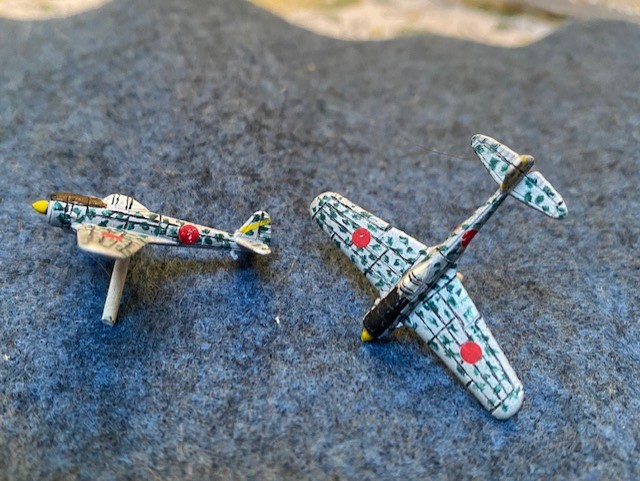
Ki-43 Hayabusa, or “Oscar.”
As I was painting my first raft of planes for WWII, the Marine aircraft at Henderson Field, I realized I didn’t have the proper U.S. markings and went to my favorite source for decals, Flight Deck Decals. I like their stuff and the way they are packaged to maximize the number of decals. The decals at I-94 Enterprises are actually better, but they’re a lot more costly with the way they are packaged. I’ve made a concession to cheap.
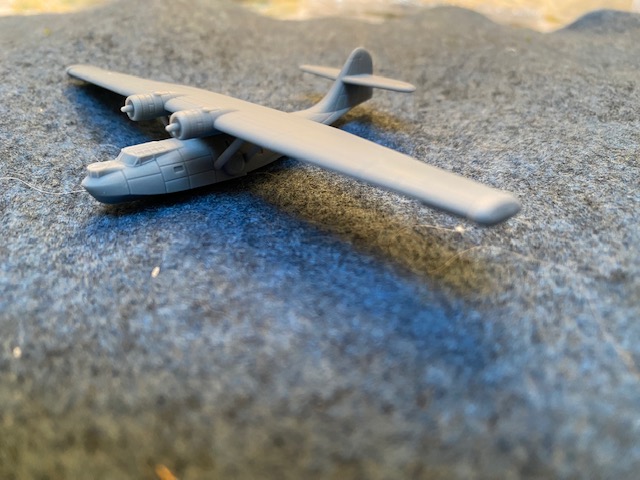
PBY-5 Catalina
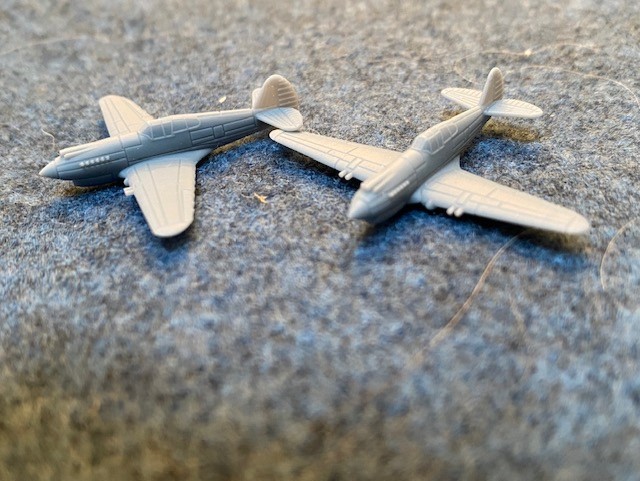
As I was selecting my U.S. star roundels without bars, I saw a new menu item for 3D printed planes. I checked it out and indeed here were piles of printed planes that could be made in 1/200 or 1/300. I chose two samples and gave them a try. I ordered two each of the Ki-43 Oscar fighters and P-40E Kittyhawks and anxiously awaited their arrival.
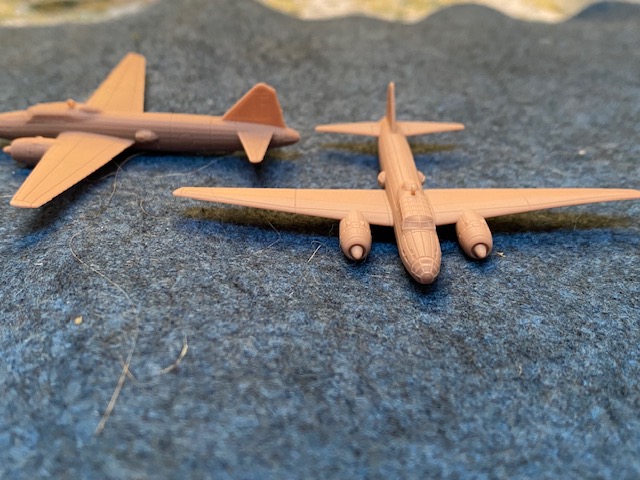
G4M “Betty.” This is the early war version. There is also a later war variant
When the order arrived I gave them a quick look-over. Very nicely detailed with lots of panel markings to paint (sigh,) very clean. I found no mold marks or print lines. Perhaps the best part was the engraved triangular marking I could drill out to put my brass pin. Note: not all planes have these holes. Some of the Vietnam-era American jets do not.
P-40B Tomahawk, suitable for the “Flying Tigers” in China.
In the how-do-they paint department, I did start with the Oscars and I really liked ’em. I have Ki-43’s by Scotia and MSD and I think these were the best of the lot. I painted the others in February, so I have a very recent basis for comparison.
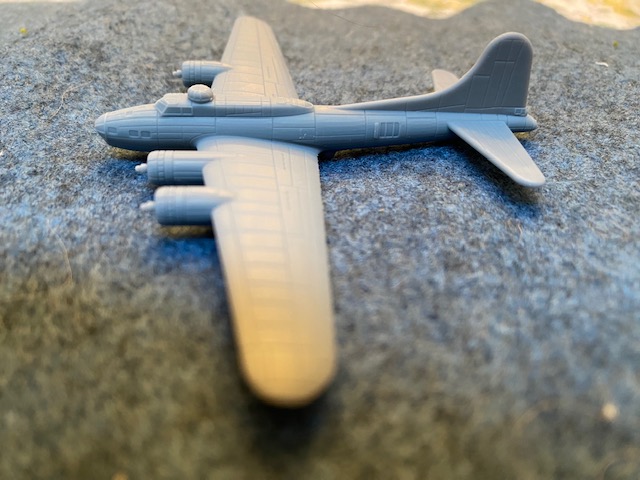
Unable to leave well enough alone, I ordered more planes for a couple of future scenarios. Among those I ordered were some B-17E’s, PBY-5 Catalinas, P40B’s, and some G4M Betty bombers. They were a tish less expensive than metal models. However, most of these were larger planes. I don’t know if you’ve done work with large metal planes and hoped they’d work well with brass pins in brass bases. Whether it’s the Cant 1007Z Italian bombers, or B-24’s, it’s really hard. The weight of the B-17’s I purchased is so much lighter, they should play much better.
I’m really impressed. I compare them favorably to the excellent Raiden planes from I-94. I see more in my future.
My first reaction was, no way. It would be a whole new project that took up a bunch of space. There were American ships, Japanese ships, British and Germans, a few French, and a few Italians. Yikes. Honestly, I also didn’t want to pay much for him. I offered him five bucks. He took it. Damn. What was I going to do now?
Well, it’s been almost two years and I’ve worked pretty hard to focus my plan for the ships. I parted with almost everything that wasn’t American and Japanese, and I’ve tried to focus my collection on the Solomons campaign. For surface actions in the Pacific, that’s where the action is. I’ve hung on to all the American and Japanese capital ships, as well as Richilieu and Dunkerque, and I’m beginning to think that’s a mistake. Really, all I need are two Japanese Kongo class and the American battleships South Dakota and Washington, and the rest could go. But, at heart, I’m still a miniature wargamer and it’s tough to let go of stuff. However, some if not all the models are missing things like cranes and catapults. Though I’ve fashioned some of these on my own, if that’s the way things are, I may find new homes for some.
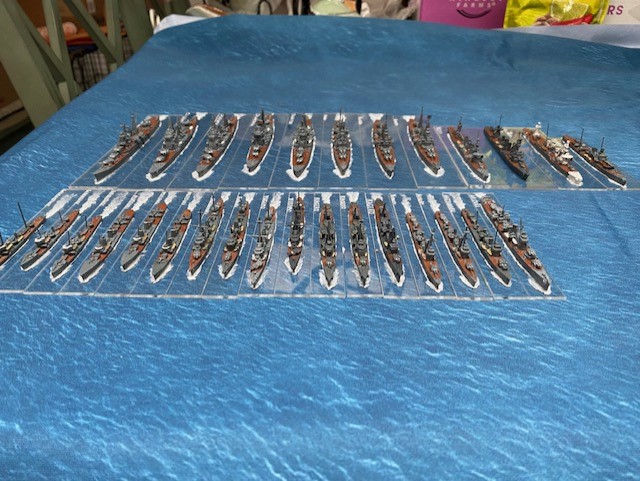
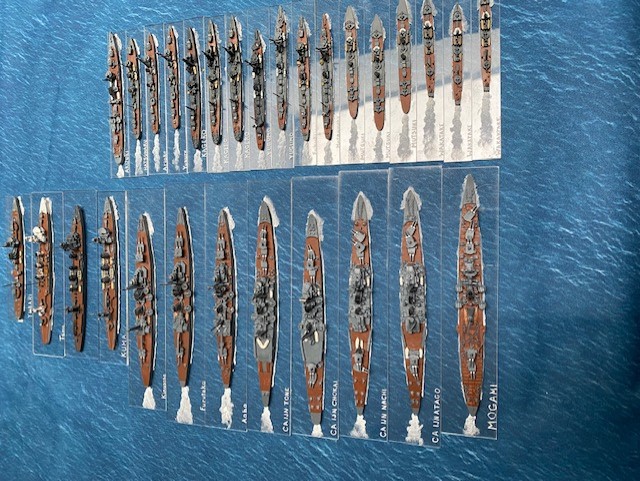
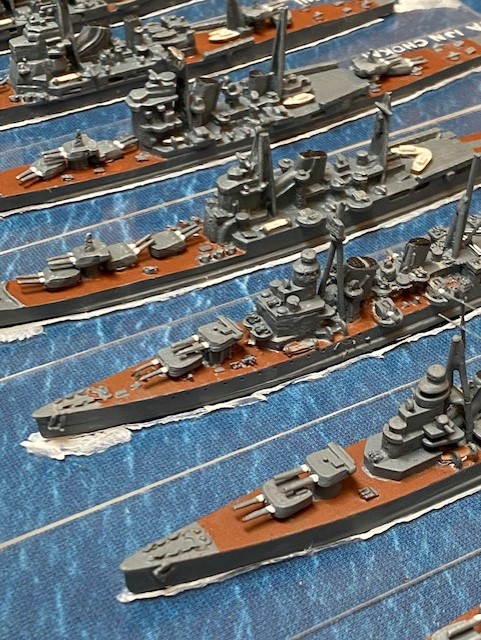
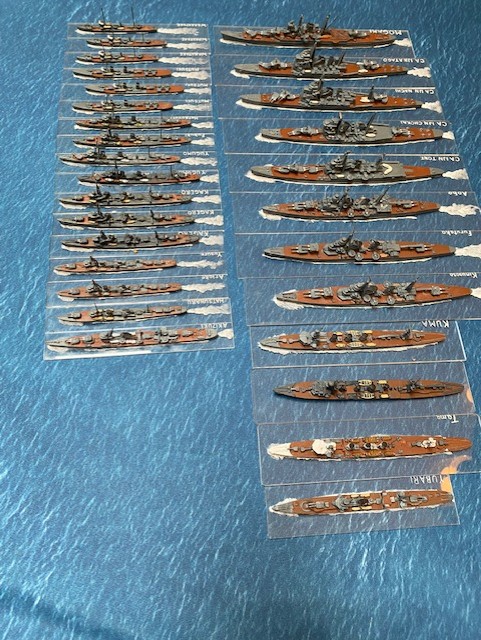
One view of my IJN ships IJN heavy cruisers One last shot of the Imperial Japanese Navy
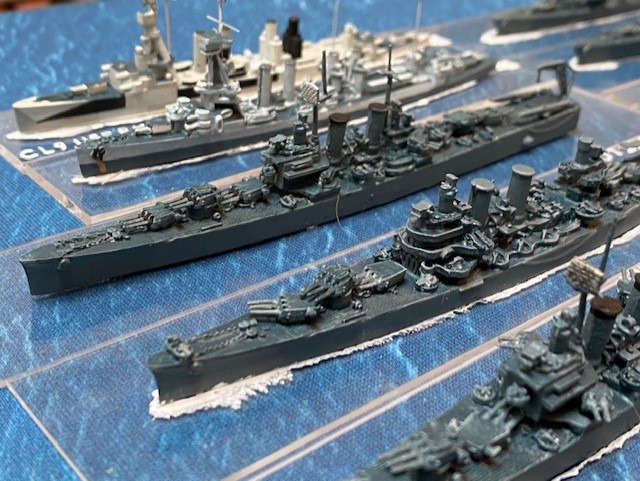
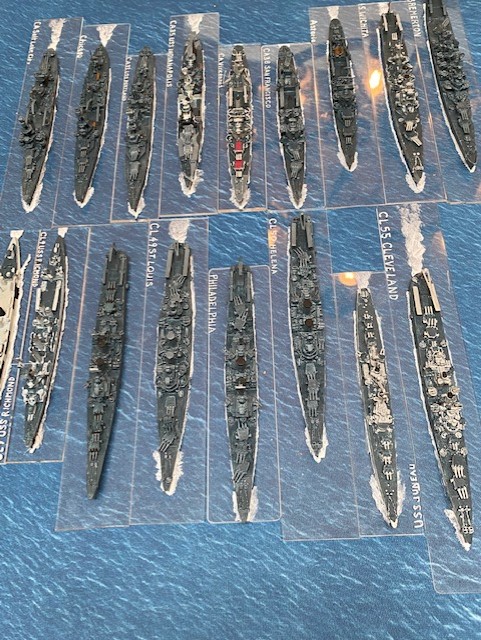
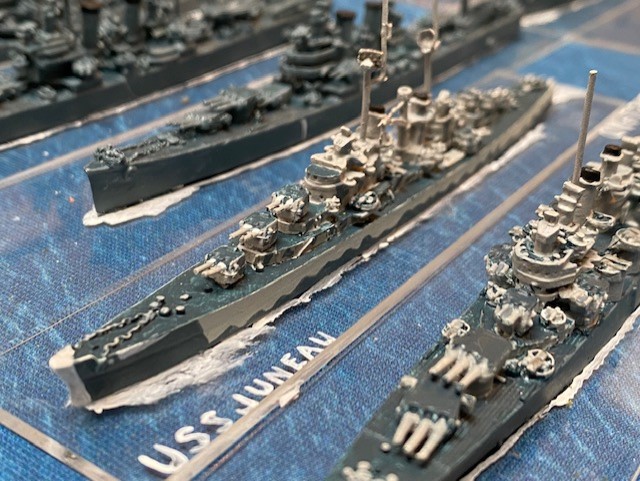
More important than wondering what to do with the ships, I’ve built and painted them. I confess, I’ve added plenty to the original pile. But I’ve only added what I needed for specific battles or to have a more varied ship mix. So, there are now several Aoba class cruisers for the Japanese, because I need three to do the Battle of Cape Esperance. I have four Brooklyn class cruisers and three New Orleans class, because they were so ubiquitous in the sea battles of 1942-43. Last night I finished the cruisers Astoria and Chicago. Neither had an illustrious career. Astoria sank in the disaster off Savo Island. The Chicago, damaged in that battle sank in January 1943 after an air attack near Rennell Island. That finishes my pile of cruisers for either side.
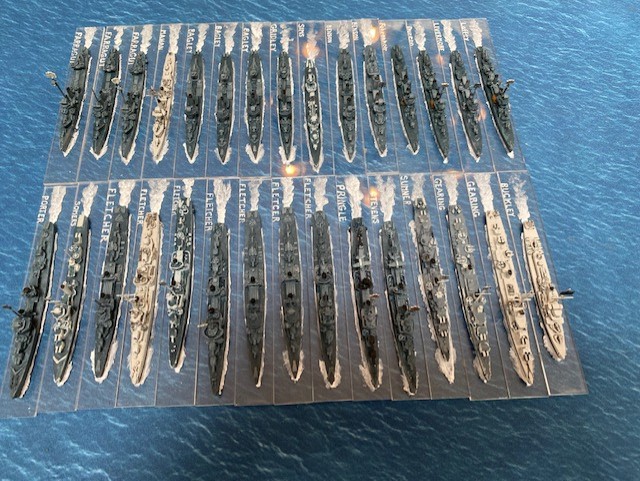
American cruisers All the American cruisers Another look at American cruisers All the American destroyers.
I recently added the Japanese light cruiser Tama to the IJN, and I wouldn’t mind adding a couple more CL’s just for variety. For the Americans, at least one more Northampton class would be nice, and I’d like one more Atlanta class CL. All I have left to paint for the period are the battleships. Well, that and 15 3D printed Fletcher class destroyers. Yes, War Times Journal is offering STLs of a bunch of different versions of the Fletcher which was by far the largest destroyer class built. I have five each of three different types.
At his moment here’s what I have painted:
Japanese
8 heavy cruisers-Mogami, Nachi, Chokai, Atago, Aoba, Furutaka and Kinugasa
4 Light cruisers-Sendai, Kuma, Tama and Yubari
17 destroyers-3 X Mutsuki, 3 X Wakatake, 3 X Hatsuharu, 2 X Fubuki, 2 X Yugumo, 3 X Kagero, 1 X Akizuki
The Hiei and Kirishima battlecruisers/battleships are next up on the painting stocks.
Americans
9 heavy cruisers- Salt Lake City, Chicago, Portland and Indianapolis, Vincennes, Astoria and San Francisco, Wichita and Bremerton
8 light cruisers-Richmond X 2, Philadelphia, Helena, Boise and St. Louis, Juneau, and Cleveland30 destroyers- 3 X Farraguts, 1 X Mahan, 4 X Bagley/Gridley, 1 X Sims, 6 X Benson/Livermore, 1 X Porter, 1 X Somers, 9 X Fletcher (including 2 of the 3 Fletchers that had seaplane catapults, go figure,) 1 X Sumner, 2 X Gearing and 1 X Buckley class DE.
Lots of Fletchers to come.
So 63 painted ships over the two years I’ve had them. Still more to do. I’ve never played a game with them and am still at sea about rules and how to play with 1/1200 ships on the tabletop. Working on it. The size of the ships, which I played with on a gymnasium floor when I was a high-schooler, create some scale problems on the tabletop. I have David Manley’s Find, Fire and Strike, Sam Mustafa’s Nimitz, and of course General Quarters 3. Time to get down to brass tacks and try them.
The French Adventure in Mexico is one of those semi-weird conflicts that might get you some weird looks. I did get the quizzical question “There were French in Mexico?” during my game on Saturday. The answer is yes. The French invaded Mexico in January of 1862. They established a ruling Emperor there headed by the Austrian Archduke Maximilian in 1864. The French forces left Mexico in March of 1867. Maximilian was captured and executed by Republican forces in June of 1867. That’s a simple time line, but the story is much more complicated.
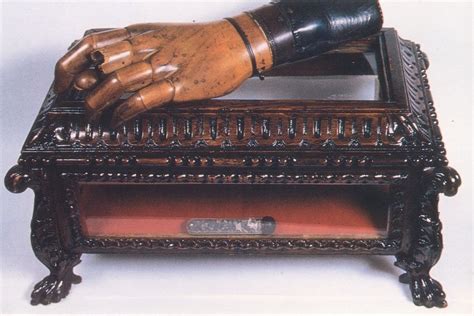
Here’s a couple of things you may know, sort of. Cinco De Mayo occurs during the French Adventure in Mexico. It celebrates the repulse of the first assault on Pubela on May 5, 1862. Puebla fell to the French in a second, better-prepared attack a year later. The French Foreign Legion remembers the action at Camerone where Captain Danjou, he of the wooden hand, led a doomed defense of a decrepit hacienda with 46 men, against 1,800 or so Mexican attackers. The Legion celebrates Danjou’s defense each year. That was April 30,1863.
Here’s what I hope to do in as few words as possible. 1) A little history-the whys and the whens. 2) Where can you read stuff. 3) Some minis, some rules, some advice.
A Little History.
What were the French doing in Mexico? It all begins with the end of a three years civil war in Mexico called The Reform War. This lasted for three years between forces advocating the end of peonage and for religious freedom versus large landowners and the church. It ended with the election of Benito Juarez as president. In Europe, those opposing Juarez began imploring Catholic monarchs including Napoleon III of France and Franz Josef of Austria-Hungary to invade Mexico, toss Juarez and establish a monarchy in the New World.
Though the pleas of the Mexican representatives go Napoleon’s attention, that was not the deciding factor in sending troops to Mexico. Another factor was money. Juarez’s predecessors borrowed large sums of money for dubious economic development activities. Juarez, seeing the size of the obligations refused to pay and sought better terms. This was not resolved by the time of the French invasion.
Finally, and probably most importantly, in April 1861, troops in Charleston Harbor fired on Fort Sumter. The United States, in the Monroe doctrine, declared that no European nation could intervene in the affairs of nations in the western hemisphere. For the next four years, the government of the United States would be otherwise occupied, leaving the French a free hand to A) send troops to Mexico, B) force the duly elected government of the country to flee for its life, C) Establish a foreign nobleman as monarch in Mexico City, D) capture most of the country, E) decide the cost in blood and treasure was too much and leave said monarch to sort it out as best he could and fail.
The French would go on to control Mexico City, Veracruz, Puebla and most of the large cities on the coasts and Mexican plateau. They were able to capture Oaxaca in a monumental campaign through the mountains against hero and future jefe, Porfirio Diaz in 1865. The French commander, Bazaine, was far less blood-thirsty than his conservative Mexican supporters desired, and Juarez and his forces were allowed to melt away into difficult terrain and gather strength. At the end of the American Civil War they were also able to gather surplus weapons from sympathetic American generals, gathering the latest rapid firing rifles and entire batteries of rifled cannon left for them south of the Rio Grande. Though the conflict had plenty of large battles, it was chiefly a conflict featuring raids and counter-raids by guerrillas and counter-guerillas reminiscent of our own more recent 20th and 21st century conflicts, tough on combatants and non-combatants alike.
When Maximilian ascended to his monarchy in June 1864 he set about building his own army. This was never large, but it had some interesting units and very cool uniforms. Some were foreign troops from Austria Hungary and Belgium. But most were either conscripts or entire units that changed sides during the conflict. Generally, they weren’t terribly dependable. But they did look good.
When the French pulled back to Mexico City and then exited Vera Cruz in the spring of 1867, they left Maximilian outnumbered, out gunned and out classed. The Emperor, a talented sailor but not much of a soldier, a lousy administrator, and author of a memorandum requiring that troops in arms against his reign and captured be executed, was himself captured at Queretaro. His own end was inevitable despite the pleas of most of the heads of Europe.
Where Can You Read Stuff?
This is a sticky question. You’d think a fascinating conflict like this would be full of great histories. Not so much, at least not in English. The big attraction to the French Adventure in Mexico is the tragedy of Maximilian and his wife Princess Charlotte of Belgium. Frankly it’s all pretty melodramatic. But there are at least three long books about them since 1972, including one during the pandemic.
But here are a few suggestions. There may be many more that I am simply unaware of so if you can help me out, let me know.
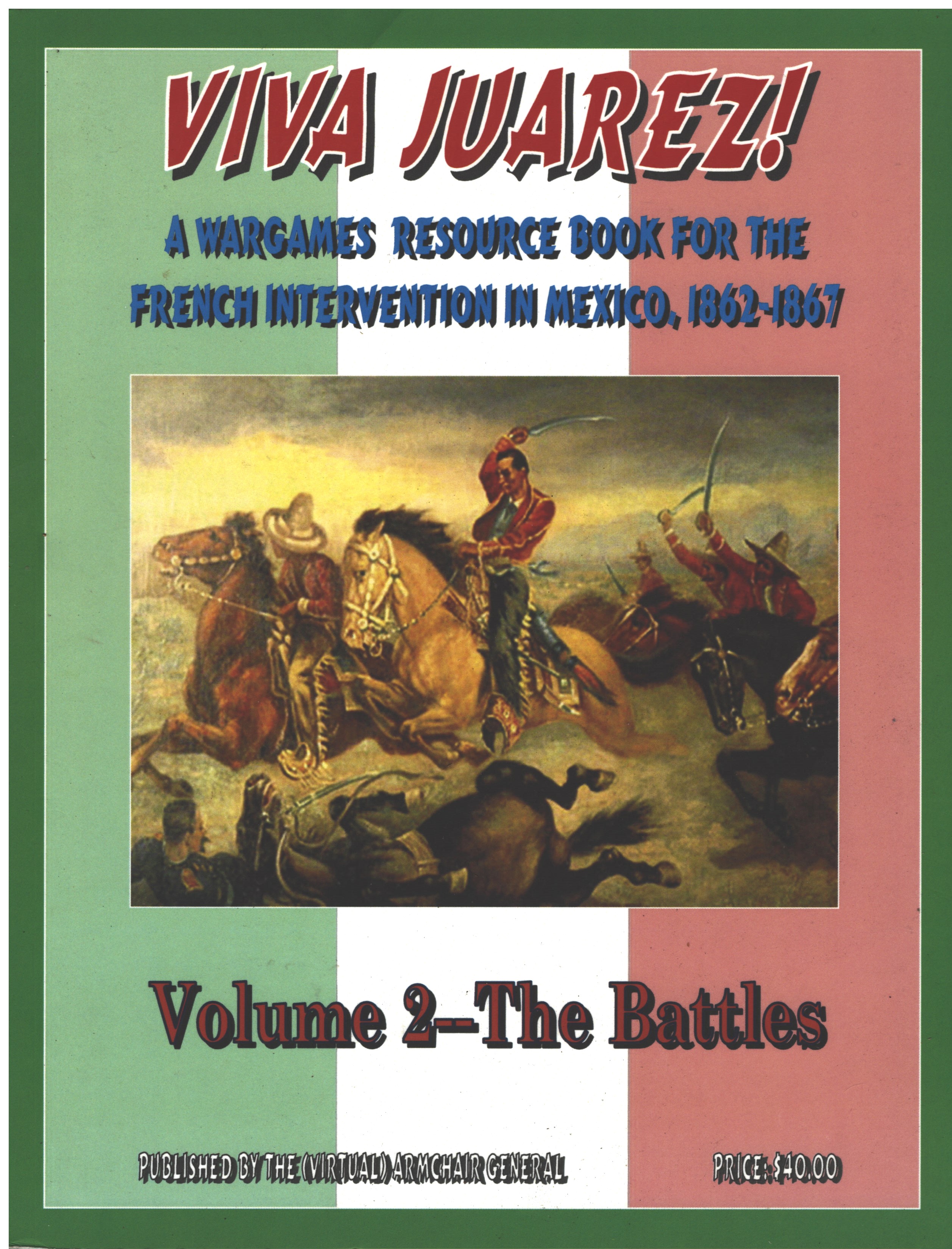
Viva Juarez! This is something you probably can’t live without. It’s actually two books. Volume 1 provides information, including color pictures, of the different troop types that fought during this conflict. Equal time is given to the Republican, Imperial, and French troops as well as those who are not easily categorized including early and later militias, guerrillas and bandits. Volume 2 is a gigantic compilation of information. There are great maps. There are army organizations and troop strengths. There’s a really useful timeline. There are orders of battle. It isn’t perfect, however. It really needs a narrative that tells the story and holds all the pieces together. This is published through The Virtual Armchair General and the estimable Patrick Wilson.
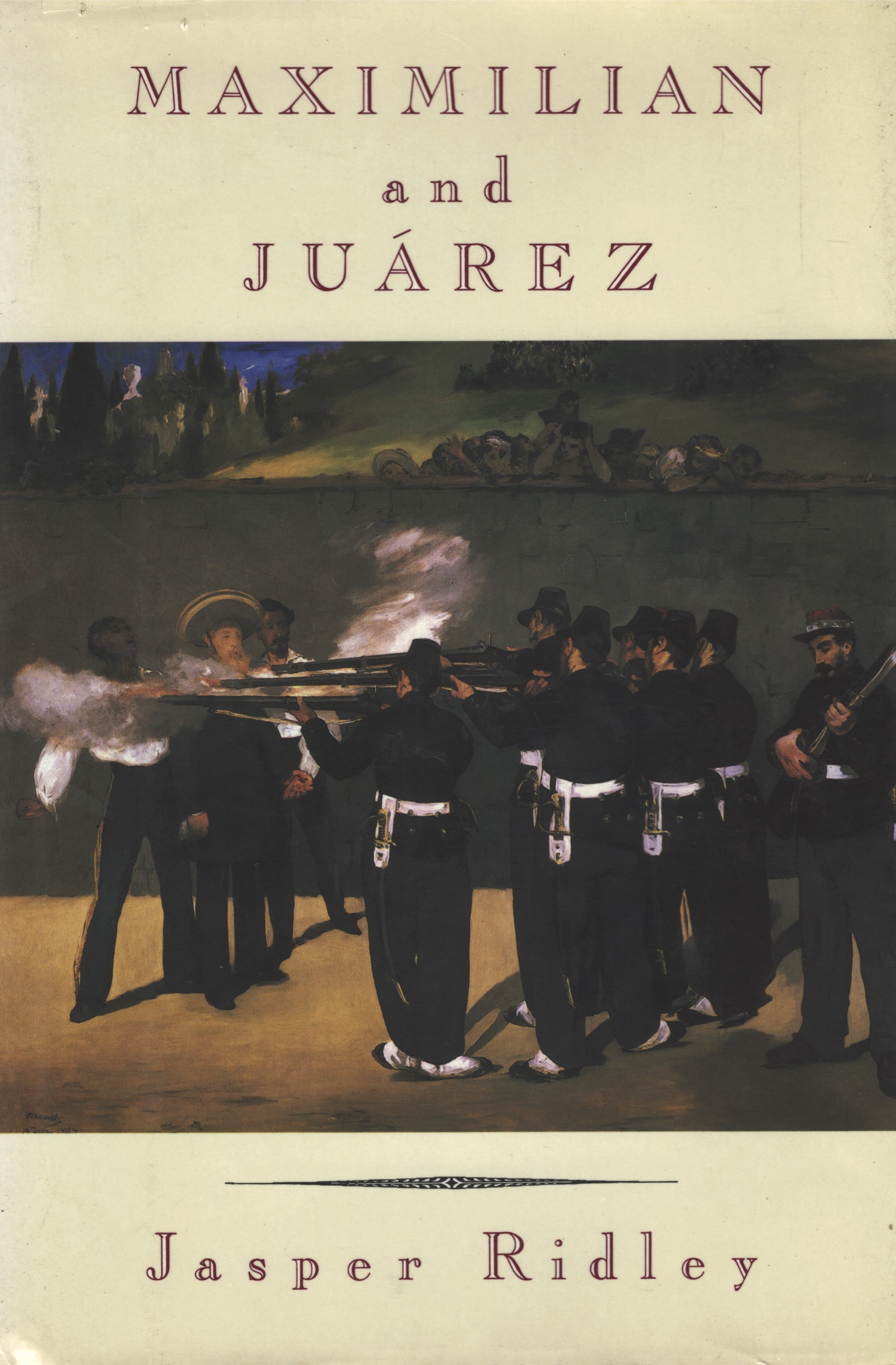
Maxmilian and Juarez by Jasper Ridley. This 1992 history is the closest I’ve found to a narrative of the French Adventure. It holds together the complicated narrative pieces of the earlier Mexican Civil War, cogently assembles the causes of the war, and follows the trials and tribulations of all the involved parties. It doesn’t get into the nitty gritty of individual battles, but it will fill in a lot of big picture blanks.
Camerone: The French Foreign Legion’s Greatest Battle by James W. Ryan. If you are interested in Camerone, this is the book you need. It’s a relatively short book about a relatively brief and bloody day, but it has all the detail about Camerone you will ever need.
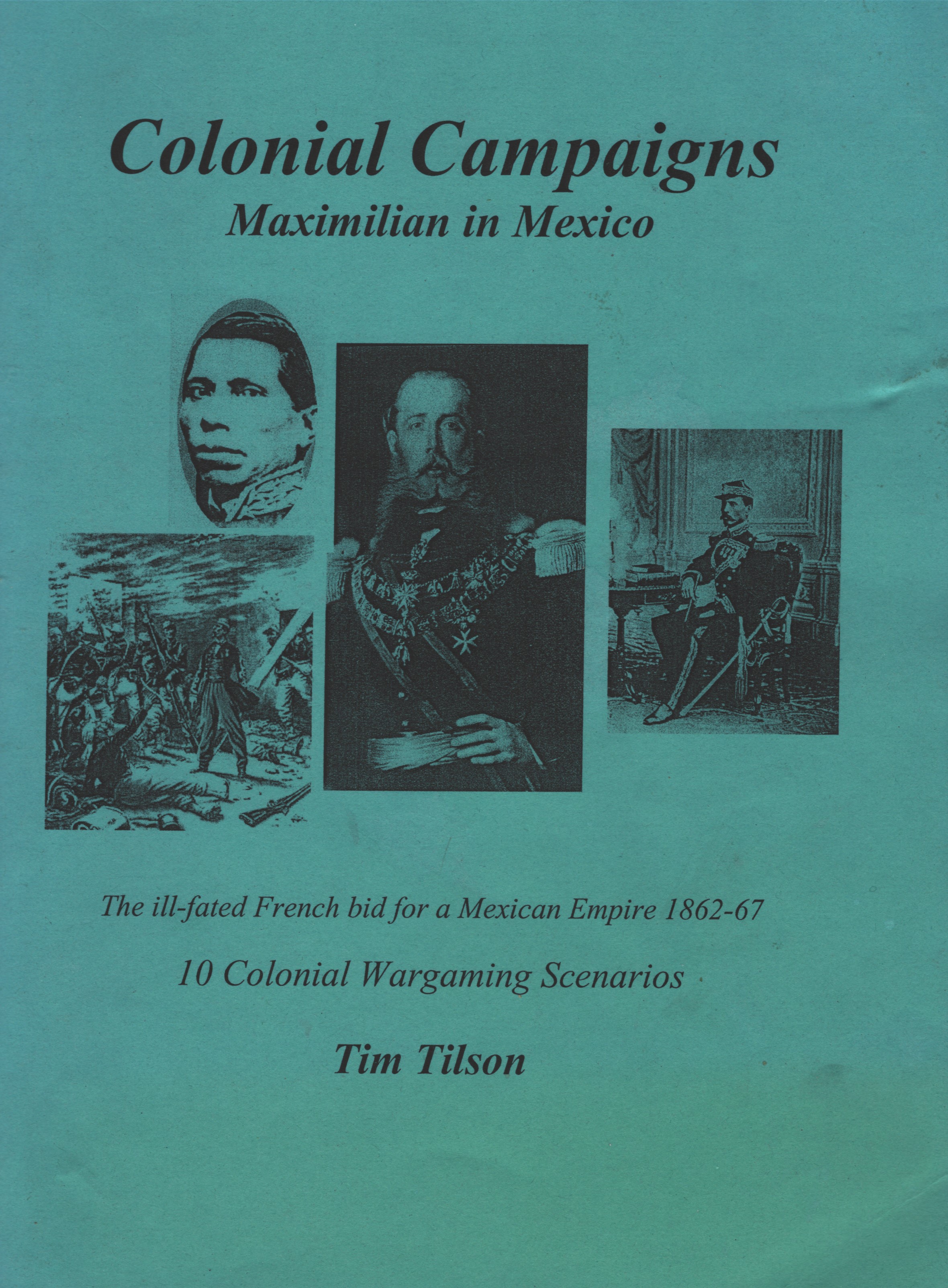
Colonial Campaigns: Maximilian in Mexico by Tim Tilson. This is a 1990’s guide for wargamers that was part of a series offering scenarios for The Sword and the Flame. Tilson provides ten scenarios. It’s pretty handy. A lot of the scenarios are actually pretty large battles scaled for TSATF or whatever rules you may be using. I ran Matehuala using Rebels and Patriots. There is a Major Dundee scenario. Long out of print, this is one to keep your eye out for at flea markets and Bring and Buys.
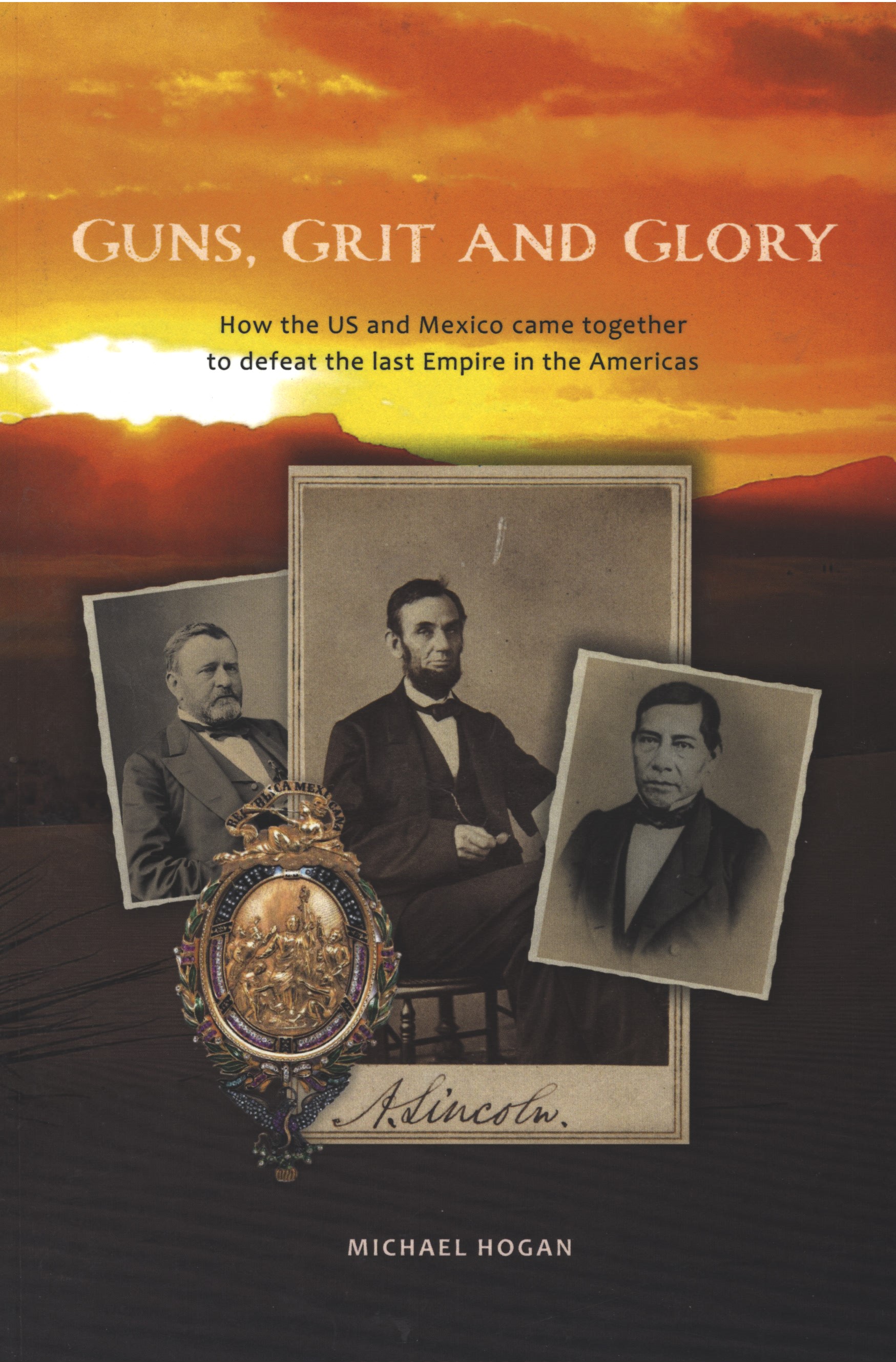
Bonus: Guns, Grit and Glory by Michael Hogan. This 2019 book is a handy look at how Juarez tried to work with the Lincoln and Johnson administrations to defeat the French and Maximilian. Very readable with lots of detail about weapons and the potential for American intervention in Mexico. A good, if somewhat improbable read.
Let me just add that there is a an Osprey Men At Arms book #272 “The Mexican Adventure 1861-67” by Rene Chartrand. Chartrand is reliable, and it is cheap, but it is pretty brief. I’m sure there must be other usable sources out there. In fact, I suspect that some time in Google Translate will get you into some very useful Mexican official sources.
Miniatures
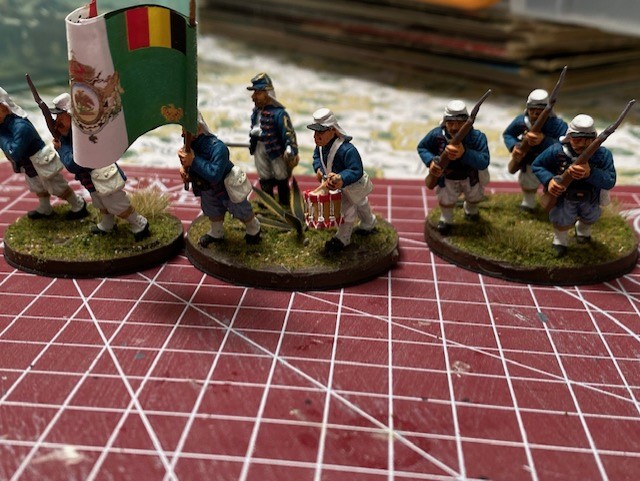
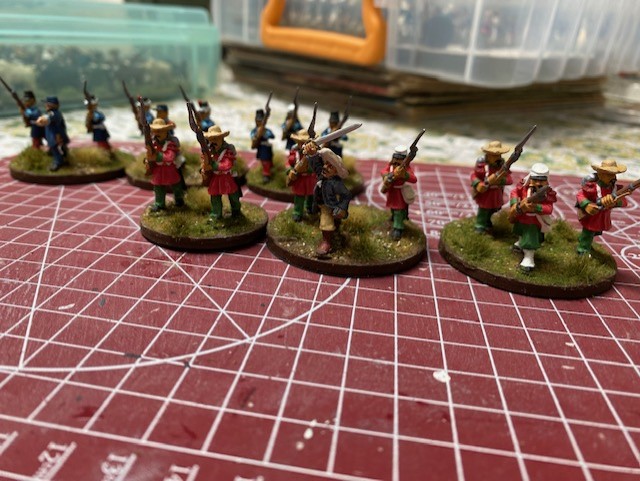
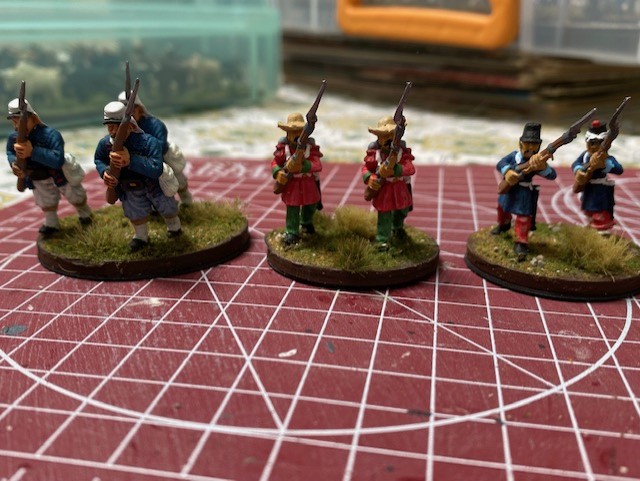
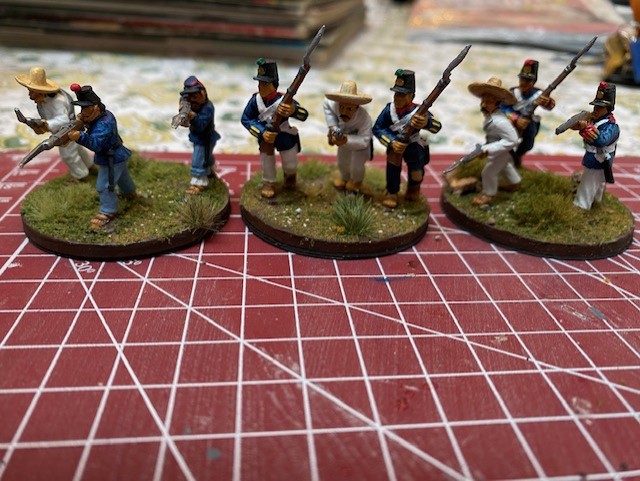
There are definitely some miniature choices out there. But let’s be real for just a moment. Maybe you want to try the period out but don’t want to make a big investment. You could definitely use some ACW figures for French and Mexican War figures for Mexicans, if you have those laying around instead. Red pants for the French instead of bleu. If you want to go a different direction, here are some suggestions in no particular order. I’ve included some photos for comparison
Gringo 40’s– Not much in the way of French to go with, just a few figs for Camerone. However, they have some very nice Republican infantry, lots of different poses. I love the Republican regular and irregular cavalry, though they are quite large. I have the Belgian Legion figures, and would love the Austrian Legion figures. More spendy than some and then there is the matter of postage.
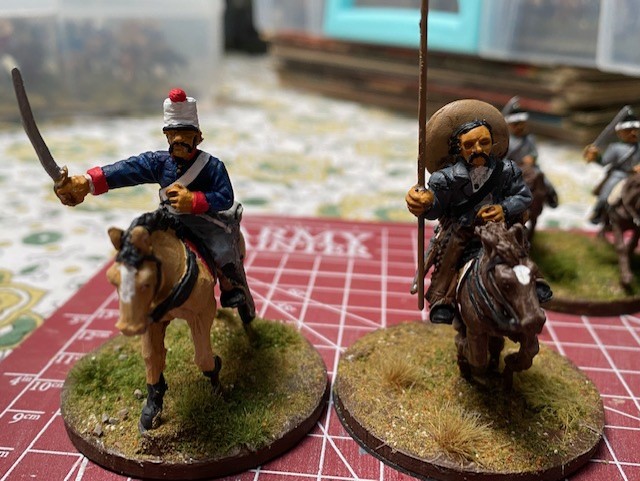
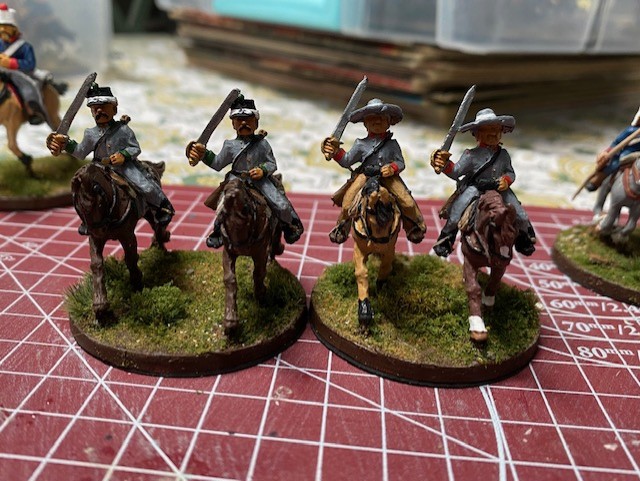
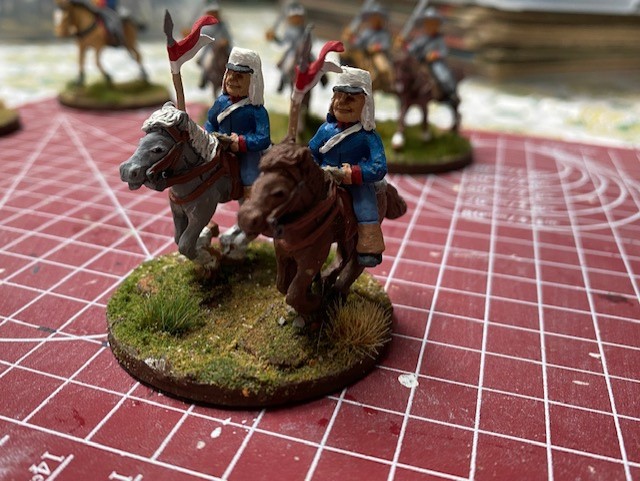
Gringo 40;s Republican regulars and irregulars. Very fun to paint Foundry Republican dragoon and RuralesTVAG Lancers For size comparison from left to right, Gringo 40’s, Foundry and TVAG.
The Virtual Armchair General-These are actually Richard Houston’s old Juarez range from the 80’s and there’s no getting around it, they are dated. However, let me offer a couple of suggestions. I like the cavalry figures. They are very representational of the conflict and very inexpensive. I have a bunch for the Imperialists. The Republican artillery is great because it comes with guns and ox limbers, again, quite inexpensive. Nobody else makes a Republican gunner though you could probably cobble something together with ACW figures. The TVAG figures are inexpensive, and the range is pretty complete and those are virtues. Infantry comes 20 per bag for $30. Cavalry are 12 per bag for $30. Artillery comes with gun, limber, draft animals for $14.00. Pretty good deal.
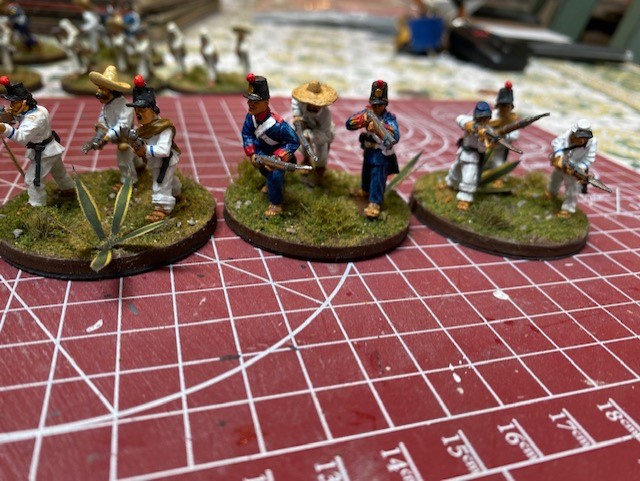
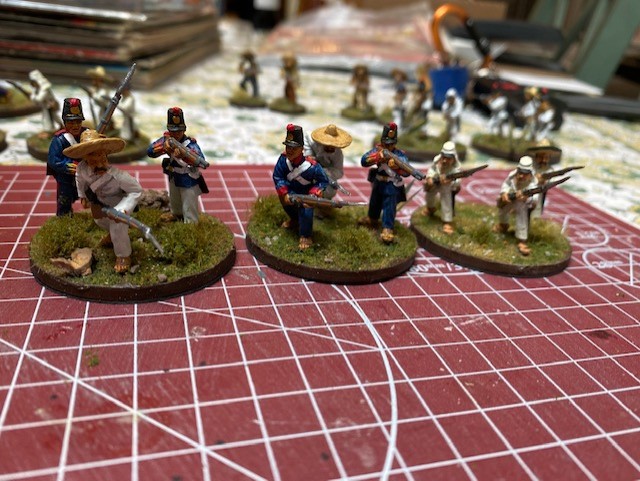
Gringo 40’s Belgian Legion Foundry Imperial infantry, their not best figures with crazy packagingSize comparison. The two right stands are Foundry figures.
These are Imperial infantry.
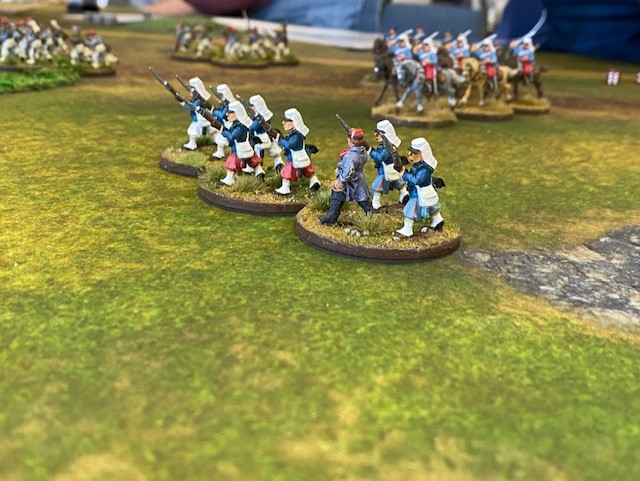
Wargames Foundry–Foundry has a bit of the Good, the Bad, and the Ugly. The original Wargames Foundry had a French in Mexico, range by sculptor Aly Morrison in the 90’s. Many of these figures still pass muster. A few don’t. The real challenge is in the packaging. I know the troops did not all dress the same, but this is ridiculous, particularly as it applies to cavalry. It took three packs of figures to make one six figure unit of Republican regular cavalry and two units of Rurales. That’s the ugly. They are big 25’s but smaller than 28’s. I have a lot of these figures from when I began with the French Adventure in the 1990’s. I would suggest using the French from the Franco Prussian War range. These are sculpted by the Perry Bros. and are quite nice. They are robust 25’s , but avoid the troops in overcoats and full kit. In Mexico they dressed as lightly as possible. Unfortunately the French in sombreros and havelocks are no longer available.
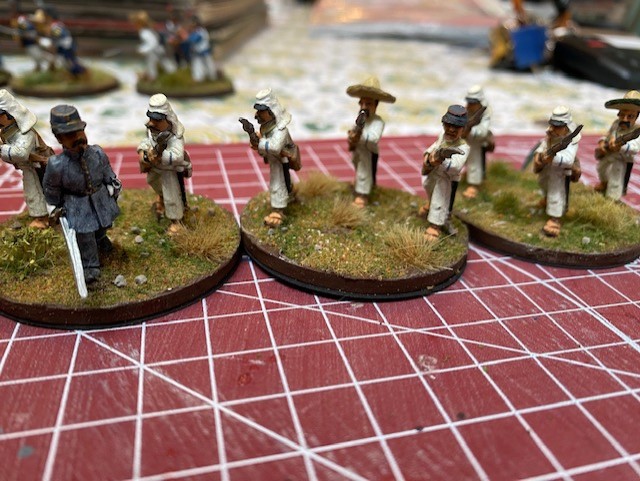
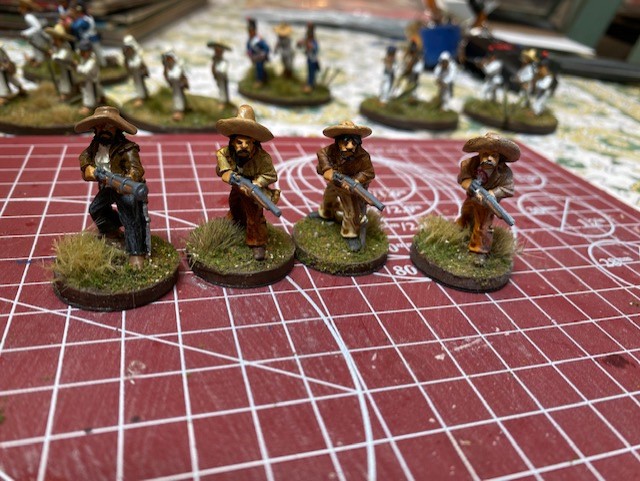
Gringo 40’s Republican Infantry Foundry Republican Infantry Foundry Old West Republican InfantyrFoundry Old West Republican IrregularsSize Comparison-Gringo 40’s, Old West, Foundry
The 25’s are nice, but there are some hidden treasures are in the Old West ranges. First, there are four packs of French Foreign Legion and Filibusters. These are very nice figures that match up very well with the Gringo 40’s figures. Lots of life. There are ten sets of Mexican regulars, irregulars, armed peasants, plus command and villagers. Again, large, well-sculpted figures. The Old West range is also available through Badger Games in Wisconsin, so not necessarily an overseas mail exercise.
Foundry Franco-Prussian War figuresFoundry French Foreign Legion/Filibusters from Old West range Size Comparison
Perry Figures-I’m reluctant to mention these but what the heck. The Perrys have been working on a Franco-Prussian range. The French infantry figures in their full kit are great for 1870 Europe, not so good for sun drenched Mexico. But the cavalry figures seem very nice. I have the artillery pieces and I can vouch for their quality. Very good stuff.
Rules
Rules are such a matter of personal preference, but here are a few thoughts.
The Sword and the Flame
If you’re old school, you might want to consider this venerable set of rules. First, Mark Stevens has written an expansion called The Sword in Mexico, though you may have to do some searching for this out-of-print version. Caution: it isn’t my favorite. I find it a bit fiddly and a person can only run a couple of units, so big battles are out. But it does have a certain amount of charm and it is a hobby standard.
Rebels and Patriots
It is one of my favorites and to be truthful it’s the rules set that got this project out of the garage and on to the gaming table. The rules are logical and simple and do seem to represent the period.
One Hour Skirmish Games
This is a true set of skirmish rules. But there are tons of small skirmishes between irregular troops and regulars. The French organized Contra-Guerrilla units to fight bandits and irregulars. French convoys to ambush, hostages to take. Lots of possibilities. No dice, played with cards. Quick and dirty. Few figures required.
Just a couple of quick pieces of advice. . The most important advice I have is to enjoy the obscurity and do whatever suits you and your budget.
Your obedient servant manipulating his Mexican forces to their doom.
I actually do play games. I know I often write about my interests and what I’m painting, but I do like to run and play games. Yesterday I ran a Rebels and Patriots game at Wizard’s Keep in Kent. This is a monthly event, and what a wonderful day in great venue. This event is organized by Ralph Holloway and if you’re interested in playing a game or meeting new gamers, I can’t think of a better place.
I can’t make every event, but I was available for March 30th and I decided to run a Rebels and Patriots game. It needed to be big enough for a fair number of players. I thought Maximilian in Mexico would work. I have a lot of figures and all that was left for me to do was cobble together a decent scenario.
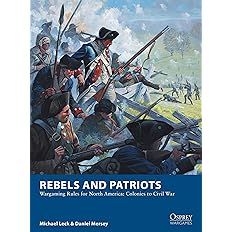
Rebels and Patriots by Daniel Mersey. 16 bucks on Amazon. Just do it. I’ll teach ya how to play.
For those of you not in the know, Rebels and Patriots is an Osprey set of rules by Daniel Mersey. Mersey has written several sets of rules Osprey has published. They all have a similar game engine, requiring a successful activation die roll. The mechanics are simple, easy to learn and teach, and allows games to move pretty quickly. Each side in yesterday’s game, “The Long Retreat, Vol. III” had four or five units per player, at least half had not played the rules before and we reached a conclusion in nine turns and about 2 1/2 hours. Highly recommended, it’s the best twenty bucks you will ever spend on a set of horse and musket rules.
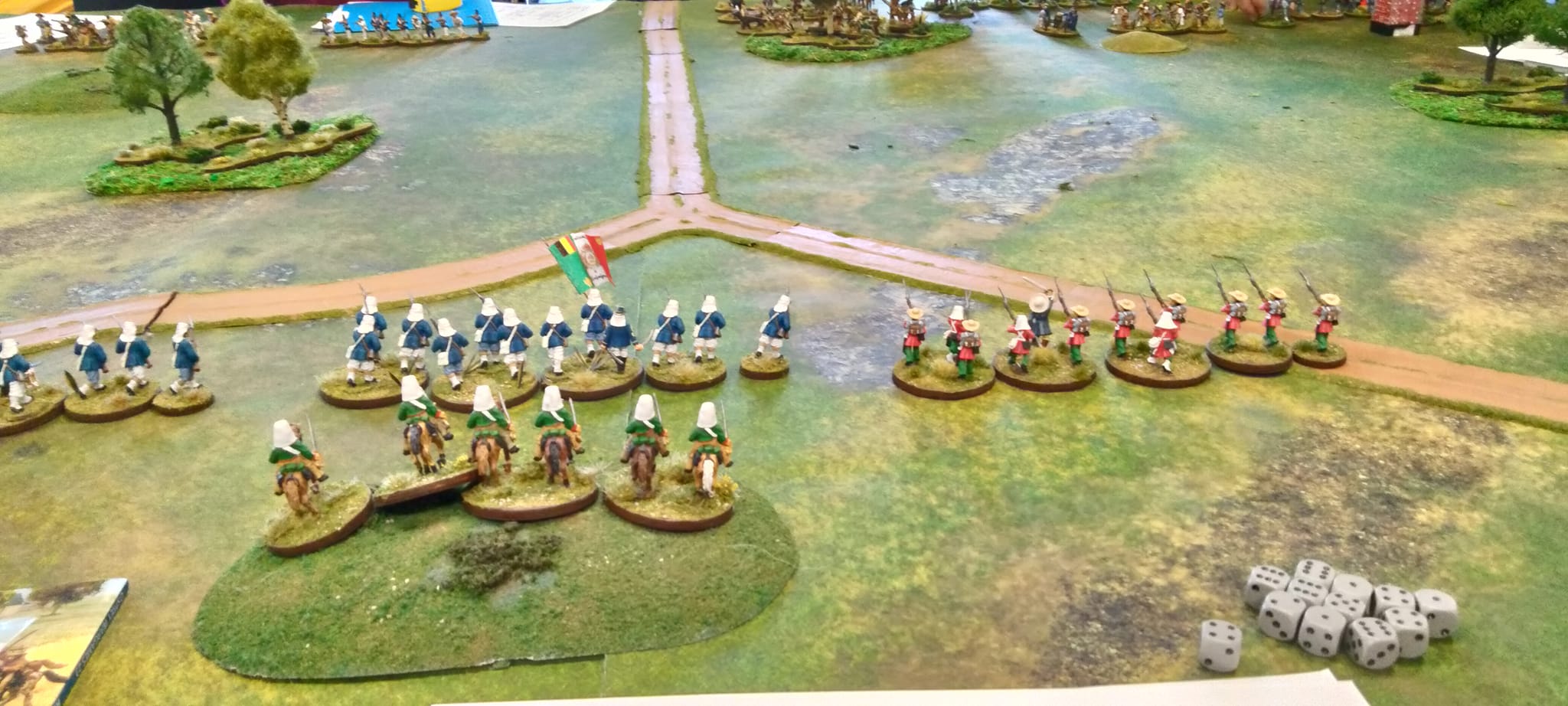
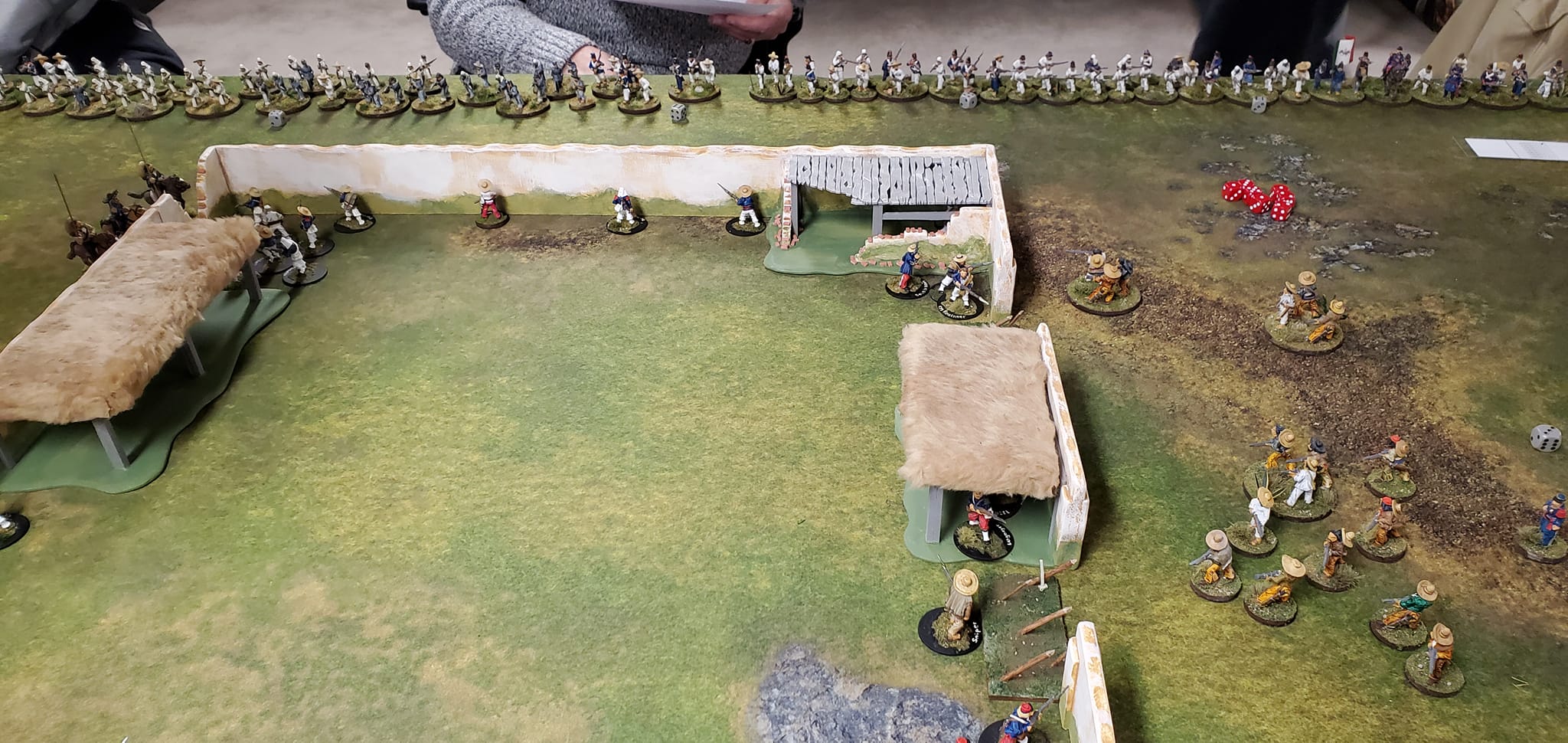
My challenge was to come up with a scenario that did not involve throwing troops of equal point values out to slaughter each other. That’s boring. So we instead did a scenario that was not atypical of the French in Mexico–the French chasing a retreating Republican army that was trying to get to safety. There were two French players, and one player that had a force of Imperial troops. Imperial troops were those serving in Maximilian’s Mexican army. The French were Napoleon III’s expeditionary troops that arrived in Mexico in January 1862 and remained until 1867. The Imperial troops represent the army of Imperial Mexico raised by Maximilian after he arrived in Mexico in May of 1864. The French were hard bitten veterans of Algeria and Mexico and I rated them as veterans and aggressive. The Imperial troops were conscripts and volunteers, with little experience by November 1865-the time of our scenario-and were rated green.
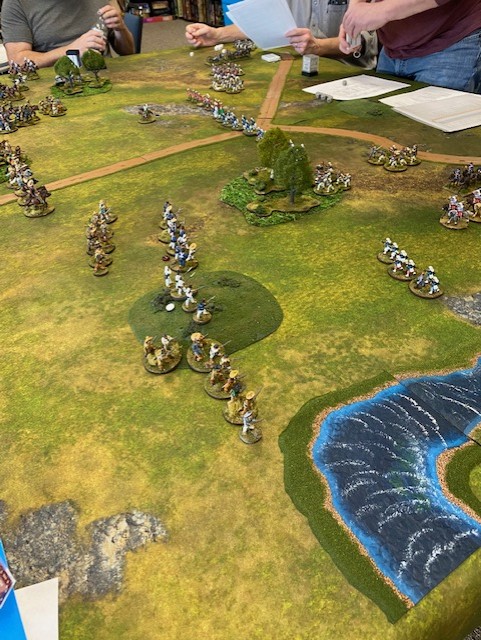
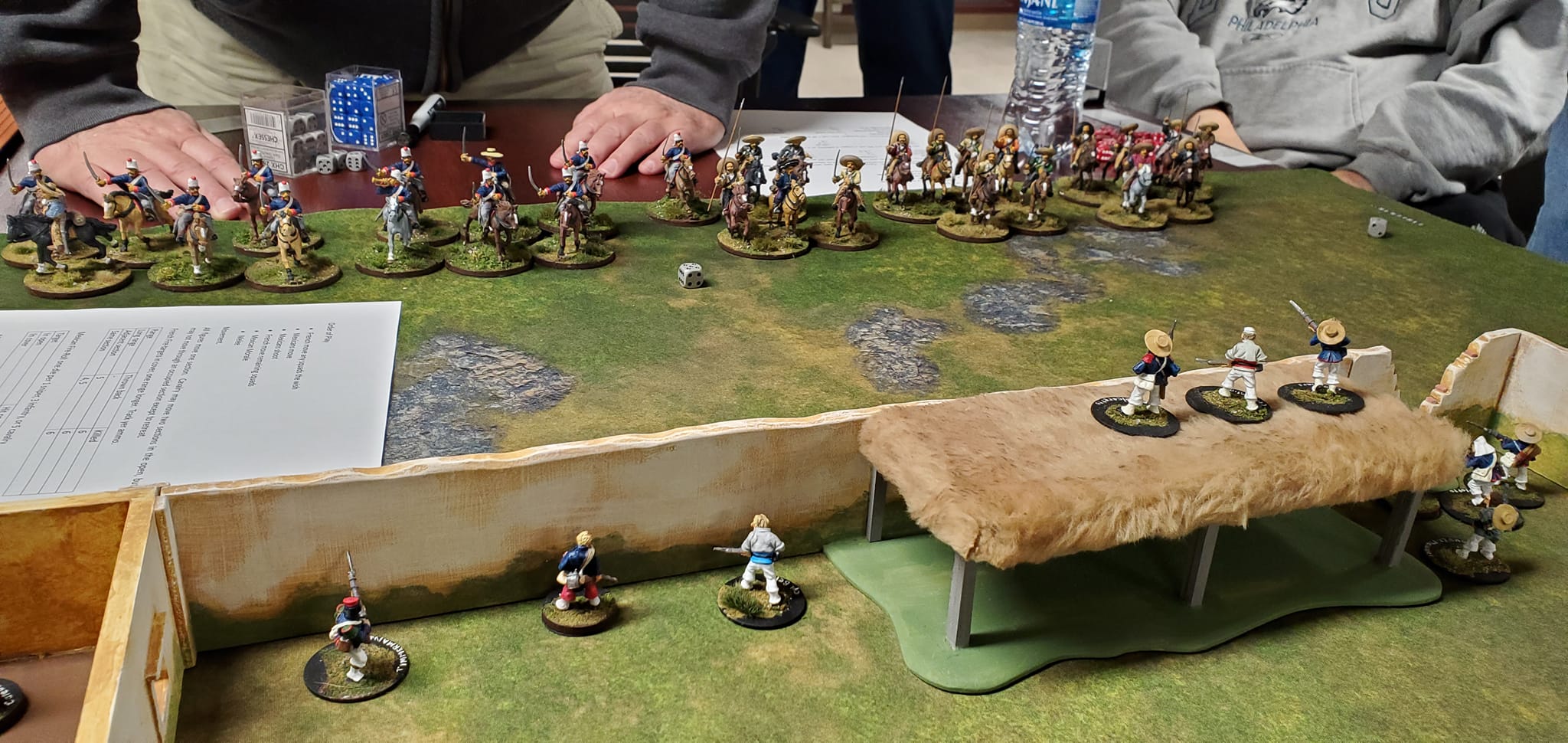
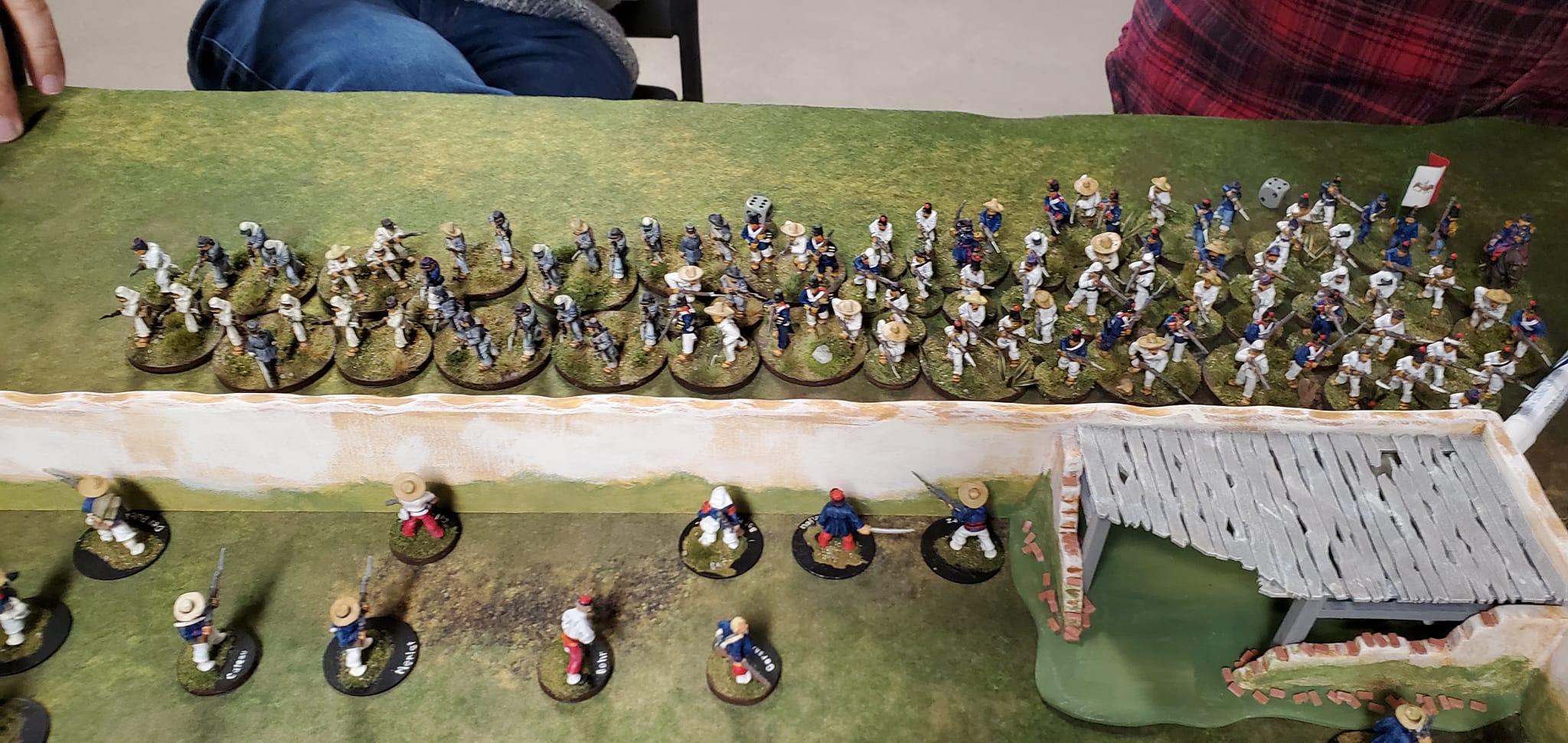
Imperial forces advance!!!A look across the table. Republicans on the left, French and Imperial forces on the right.
Each French/Imperial player had some units to play with. The two French players each had a gun, a unit of light cavalry, a light infantry unit and two line units. All units were veteran and aggressive except for the artillery piece. Lots of points. The Imperial player had three line infantry units, including the Belgian Legion, and one light cavalry units. Nothing special. Their mission was to kill Republicans and position themselves to exit the board by the road. The Imperial troops set up a foot and half on to the board, while French troops game on to the board near the road entrances.
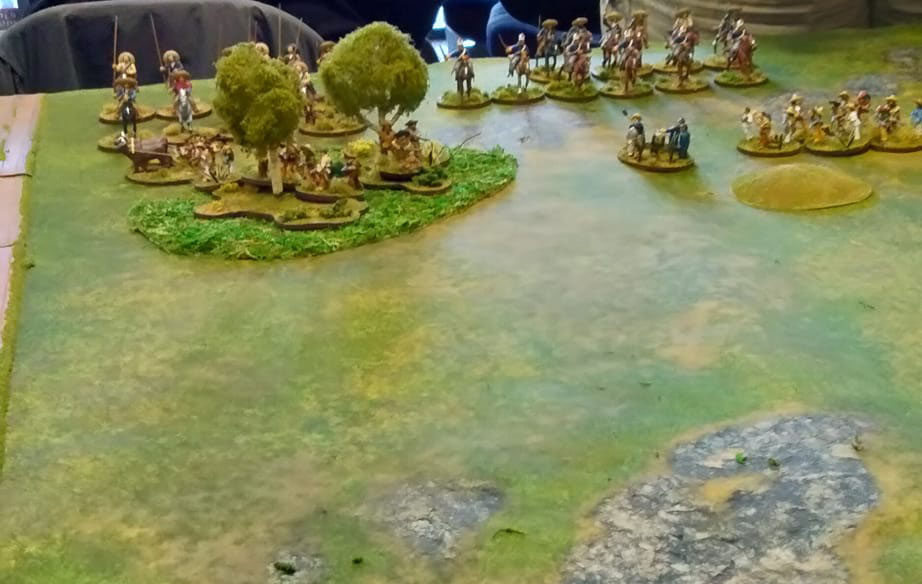
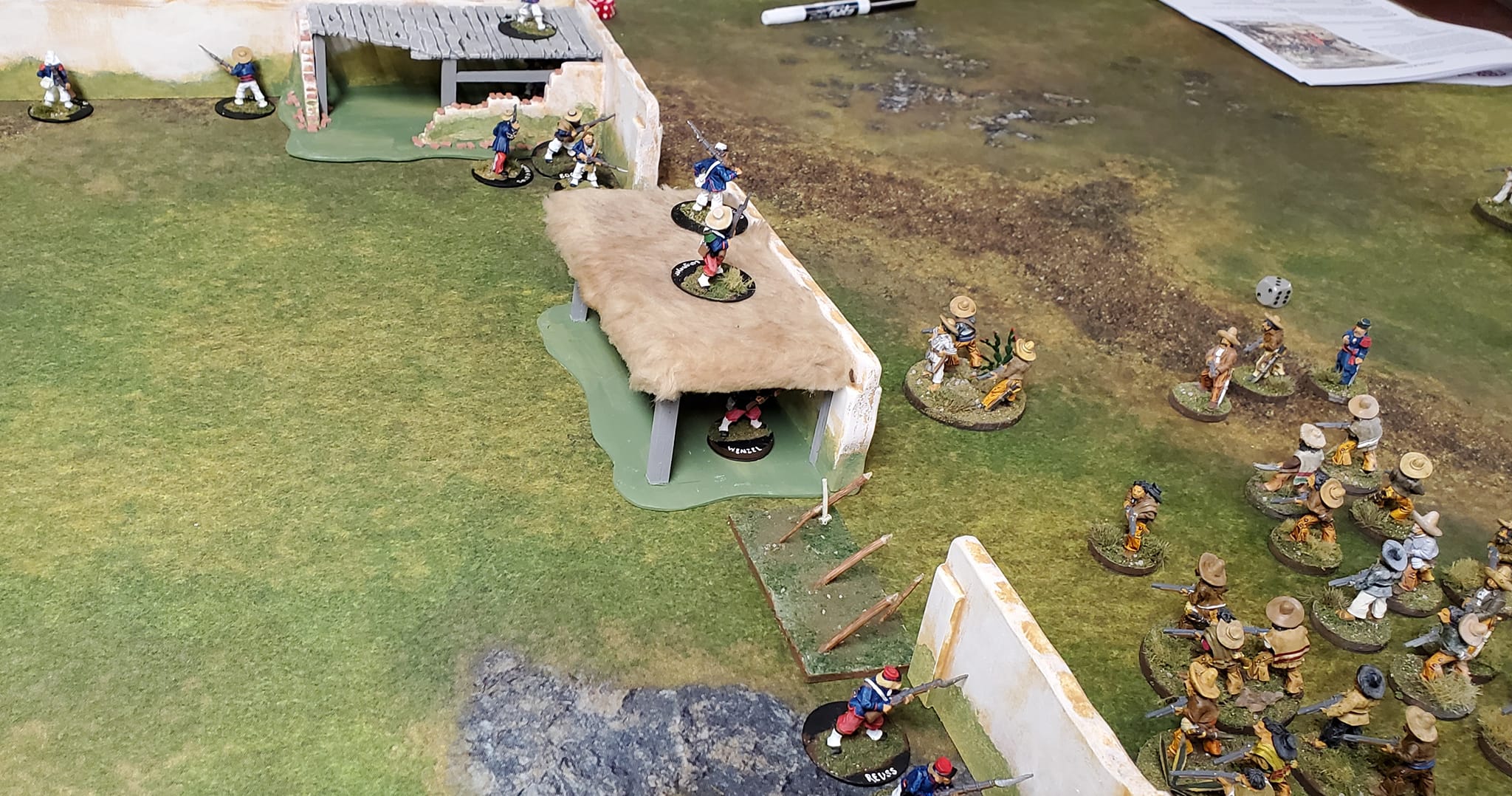
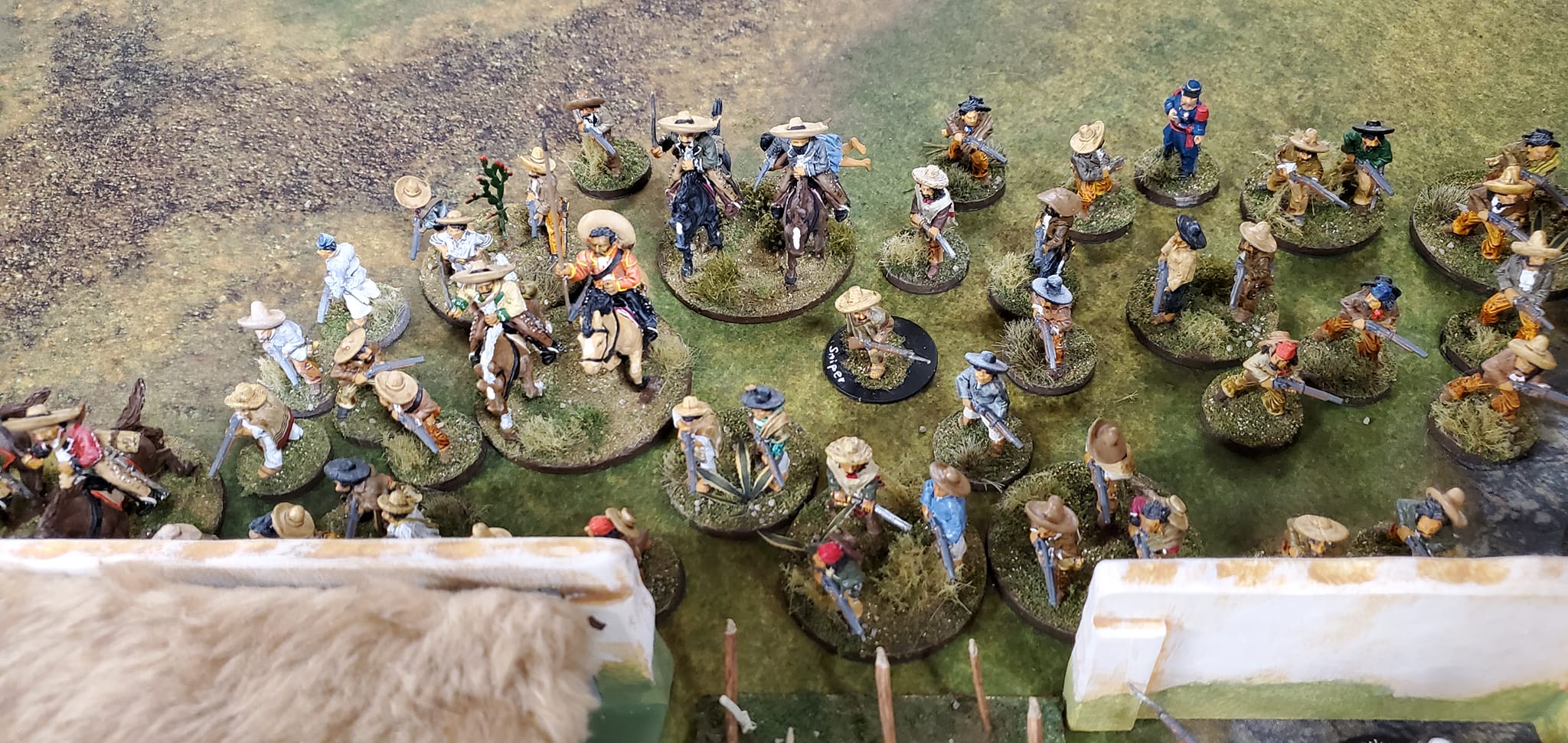
Republicans deploy their artillery in the middle of the field with support from militia infantry and cavalry.
Choosing troops for the French and Imperial troops was easy, the question was setting up the Mexicans in a way that generally historical but offered some challenges to the French. By November 1865, the American Civil War was over. President Lincoln and later President Johnson vehemently opposed the French intervention in Mexico. Though the U.S was still recovering from the aftermath of the Civil War, Generals Grant and Sheridan notably opposed the French violation of the Monroe Doctrine and the establishment of a European-style empire across the Rio Grande. Grant served in the Mexican War 1846-48 and was notoriously sympathetic to the Mexicans in his Memoirs. He directed Sheridan to the Rio Grande with a sizable number of troops. Though Sheridan’s men did not intervene in the conflict, they did make sure surplus weapons made their way across the river and into Mexican hands. Empress Carlota wrote with sorrow about the effect of American repeating carbines against the charge of the Imperial Red Lancers in 1866.
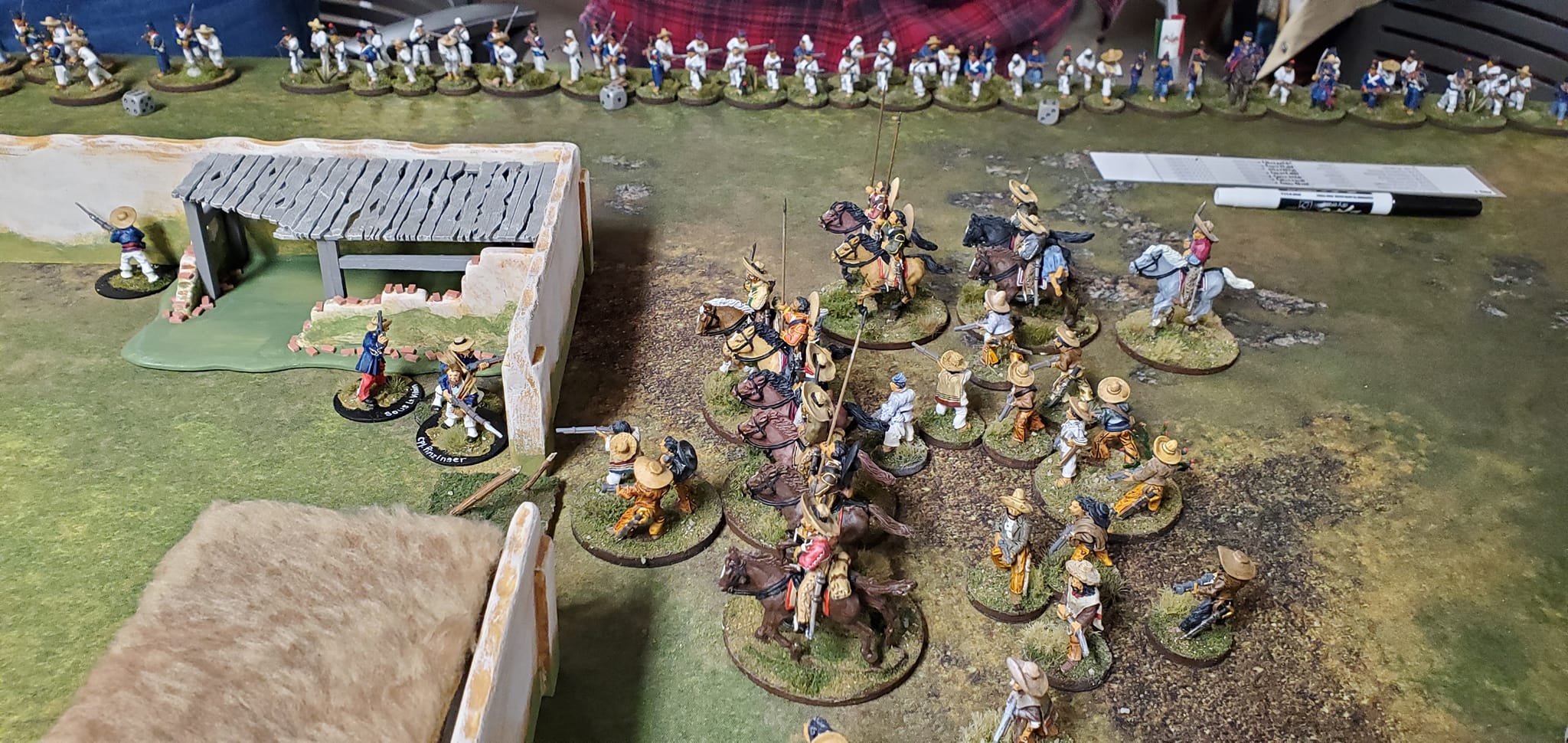
My troops gathered around the hill. Had a chance to do some damage with these guys, but those damned dice . . .The French light infantry advance.
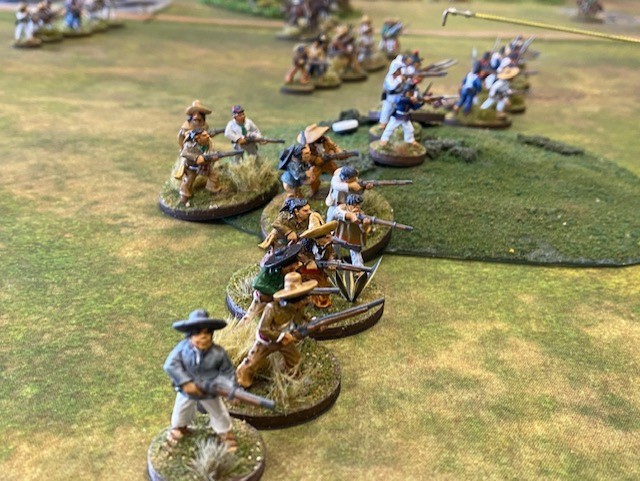
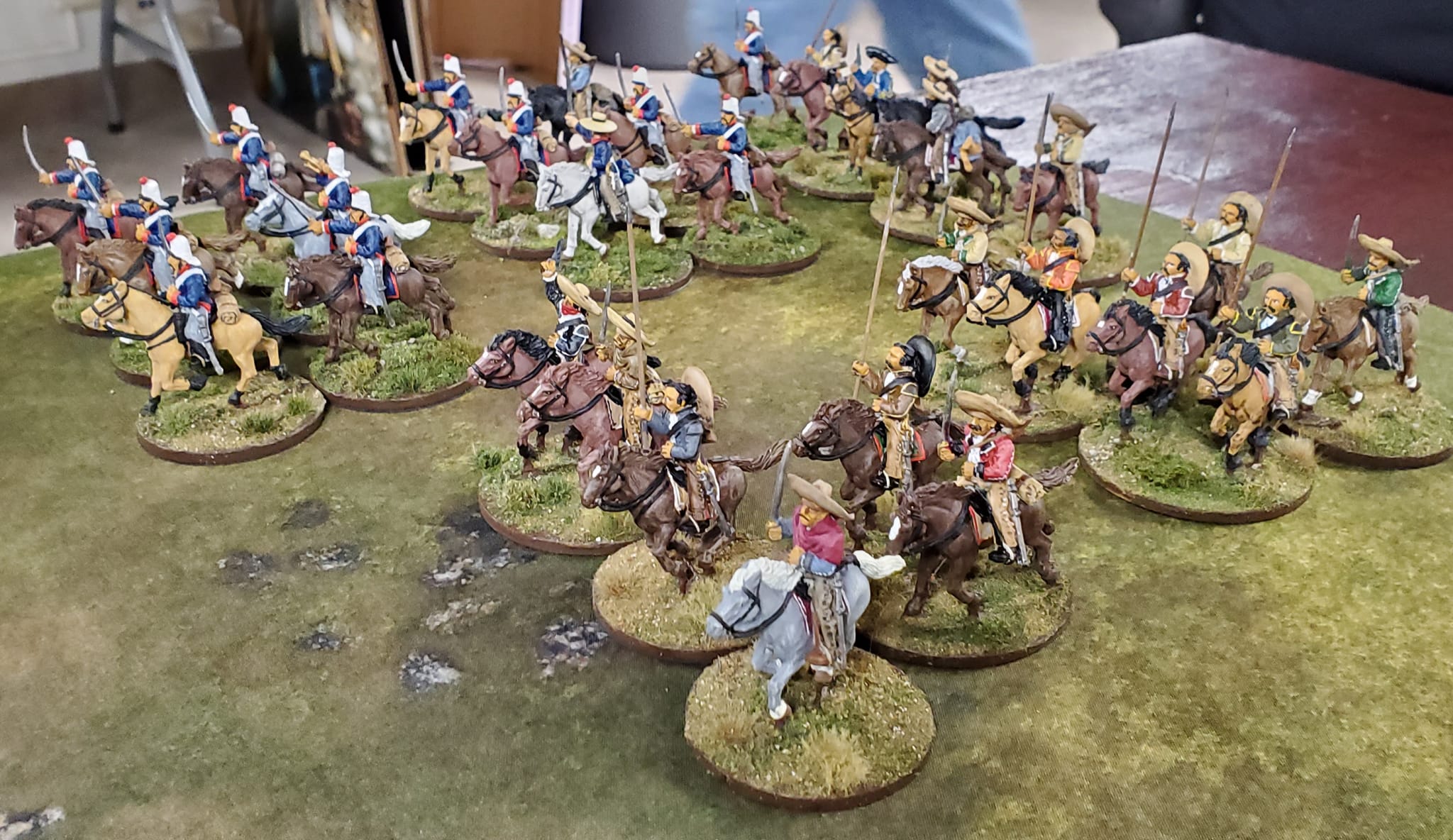
Taking this into consideration, I did some fiddling with the rules in the Mexican organization. The Mexicans had three commands. The first was a cavalry command with five light cavalry units. Three of the units were militia units. I made all the Mexican militia units in the game regulars, because they had considerable experience in the war on both sides. However I did make a key rules change regarding the militia, I’ll explain shortly. The militia were supplemented by two units of regular light cavalry. These units were veterans and armed with American repeating carbines. More on this to come. There were also two infantry commands. Each had a regular, veteran unit armed with repeating rifles. Each also had two units of militia foot rated as average. One of the commands had a gun. The other had a skirmish sharpshooter unit (American Sharps rifles with scopes, of course.)
The rules changes I made for the scenario were as follows:
The militia units did not suffer the green -1 modifier for activations and rallying. However, they could only suffer two disorders before melting away instead of the usual three in the rules. This made them brittle and more likely to melt away as things got bad. This better represented how Mexican militia seemed to react historically. Militia units also could not form closer order, which meant no volley fire.
The other big change was the use of repeating American arms in the game. The cavalry had repeating carbines and the infantry had repeating rifles. Activation and ranges were the same. I allowed these shooters to add 50% more dice in a successful shooting attack. Nasty. However, each time they successfully fired, they rolled to see if they needed to reload–a 1 on a D6. This was resolved by taking a turn to make a successful shooting activation. Shooting could commence the following turn and French would fall in droves. Hah!
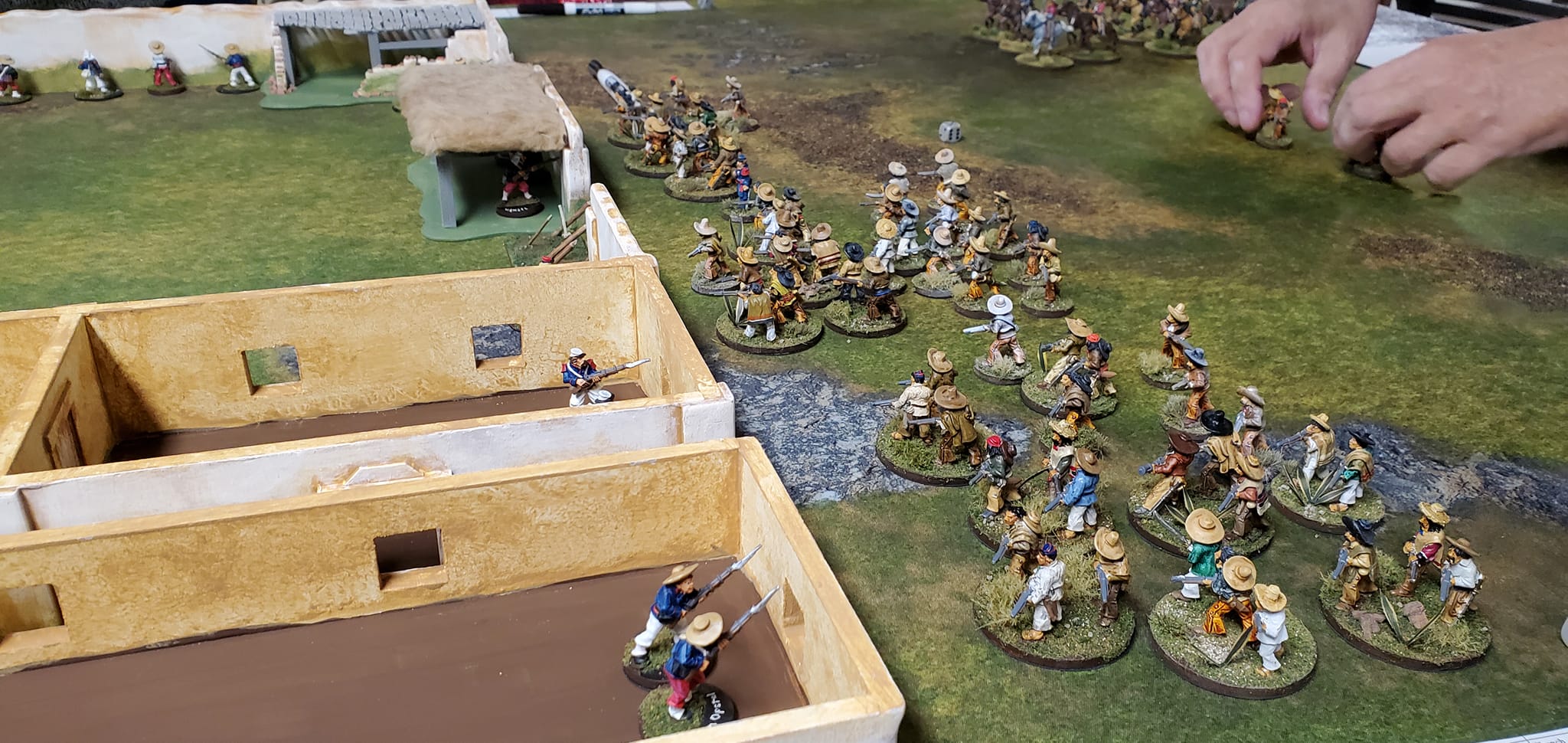
The game began with a general advance with the Imperial troops in the middle and the French on either flank. There was some promise as one of the Republican regular cavalry units blasted the French 5th Hussars from the saddle on the left. The skirmishers and a regular infantry unit engaged the French light infantry on the right inflicting some losses. But the veteran French morale came into play as they began to take casualties, casually passing morale checks, while the Mexicans had trouble activating and hitting. I ended up commanding the Mexicans on the right flank and though I had positioned my troops to inflict considerable damage on the French in front of me, I had failed activations, rolled poorly on my shooting, and in the end, the French simply throttled me. My teammates did better, but it wasn’t going to be enough as the French advanced across the table. Even the green Imperial troops seemed unstoppable. I think everyone had a good time, all played well, but at the end of Turn 9 we called it good.
This is a scenario I wouldn’t mind trying again. I don’t think I’d do anything different for the French. They were mighty and given that they had the onus of getting across the table, they had to be tough. They also outnumbered the Mexicans. Though the activation rolls required for the green Imperialists did slow them down a tish, they were all there at the end of the game, getting ready to roll over what was left of the Mexican center.
I would change some things for the Mexicans. I’d get rid of the Mexican cavalry corps. I’d add a third Mexican infantry command. I’d also add a cavalry unit to each of the Mexican commands. Each would have the same organization with a regular unit armed with repeaters. One command would have a gun, another with skirmishers, not sure about the third command. I liked the repeaters, but I think I’d ditch the reload roll. The French seemed quite capable of weathering the storm.
I’ll follow up with a quick intro to the French Adventure in Mexico, just in case you’re thinking, “Whoa, this is cool” but don’t know how to get started.
For those who have never played SAGA before, it’s a ancientish/Dark Ageish/medievalish skirmishy set of rules. The game uses single figures, organized into units of three classes. Hearthguards, the good troops, get four figures for one point. Warriors are usually the worker bees and are eight figures for one point. Levies, everyone’s favorite peasant types-typically missile troops-are twelve figures to a point. Armies aren’t tiny, they usually figure in at 40-50 figures minimum. Because I like to have a large figure mix to choose from, my armies tend to be bigger, more in the 72 figure range. For game purposes, an army is a leader plus six points.
I like the game a lot. Every army comes with a battle board that contributes to the army’s uniqueness. The rules themselves are good, but it requires good faith on the part of all the players, and a certain rigidity to the rules. It’s seems a bit gamey at times, but for the most part avoids those Phil Barker moments in which the players spend 15 minutes trying to interpret the use of a comma. It’s a difficult set of rules to just pick up and be good at. Because the different armies have different battleboards and hence characteristics, getting a new army is a little like learning to do long division all over again. But honestly it’s a little bit like playing golf–anyone can hit one great shot, and maybe get them back out on the course again. If you just slaughtered your opponent’s Viking berserkers, well, you could be a winner next time.
I have four armies, but for the most part I use two–the Irish and the Skraelings. They are two very similar armies, that mostly prosper when they can use terrain and shoot missiles. The Irish have their slingers and javelin chuckers. The Skraelings are bowmen and javelin dudes. The Irish are an “official” army from The Age of Vikings supplement. I’ve used them in a tournament. I like to say they are all sticks and stones. Levies and warriors, but they can also have horsemen and hearthguards. They can have heroes and Legendary Leaders that can balance them out a bit.
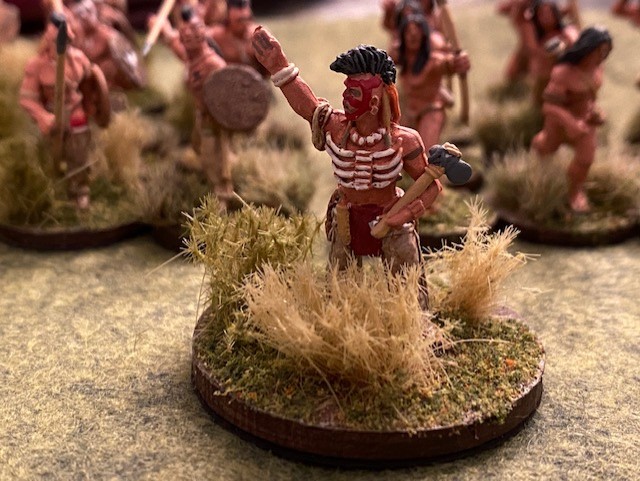
The Skraelings are not an “official”army. They were created by the Studio Tomahawk folks (publishers of SAGA) as a special enemy for the Vikings. Its the name the Norse settlers of Newfoundland and Greenland gave to the Native Americans they encountered. The settlers were few and the indigenous inhabitants were many. One definition for Skraeling is “screamer” for the war cries these natives used. It seems appropriate.
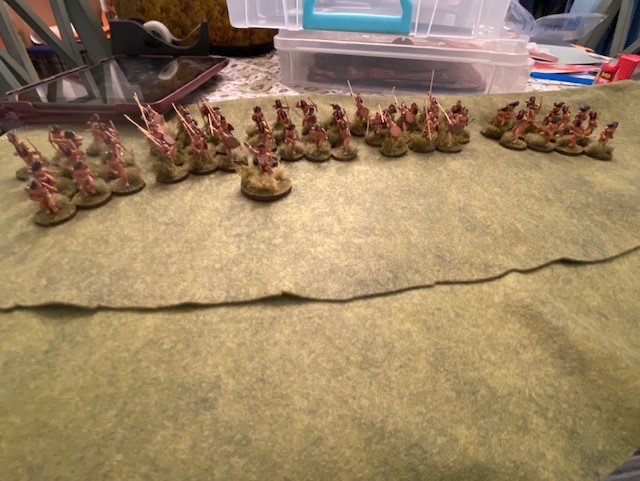
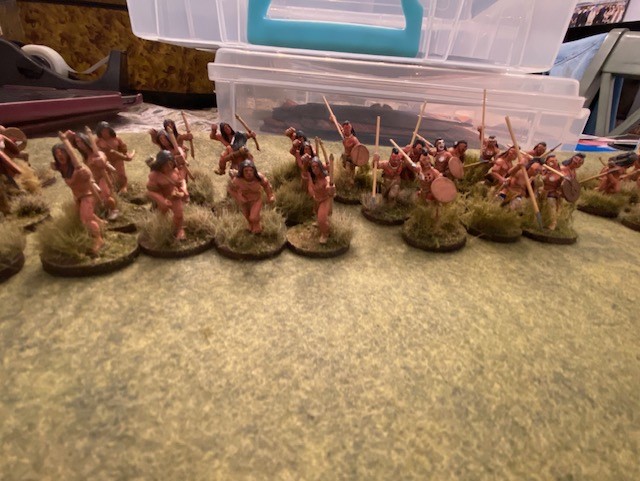
This is my 6 pt. Skraeling army. I’ve increased the size of my two warrior units to 12 figures. It makes the army easier to command, and gives the warriors a bit more staying power.
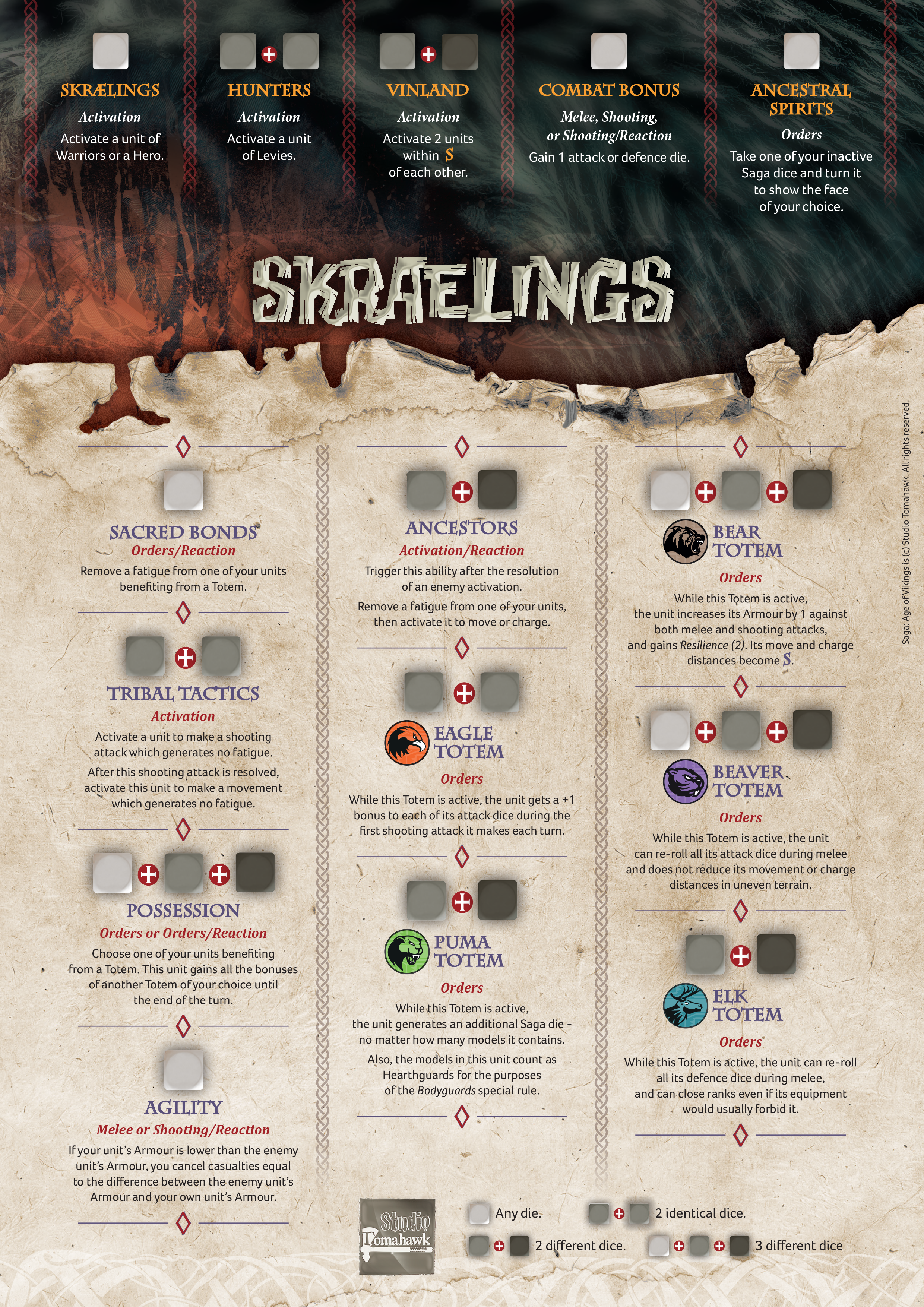
Though not official, the Skraelings have a unique battle board. They don’t use a standard set of SAGA dice. Their troops types are limited. No legendary leaders, no heroes. No horses, so no cavalry. Just warriors with javelins and levies with bows. They are slightly movable mass missile projectors.
Their battle board is unique and a bit of a challenge. Though they lack a lot of interesting SAGA advantages, there is the business of the Totems. There are five SAGA abilities called totems that can be summoned with the right combination of dice. What’s great about totems is that once activated the totemic abilities are used by the activating unit for the entire game, until the unit is wiped out. The totems offer some advantages, such as re rolling all attack dice, or re-rolling all defense dice. Another allows a unit a +1 to its first shooting attack in a turn. These are helpful. However, it takes a lot to activate Skraeling units. Though warriors can move on one SAGA die, it takes two dice that are different to activate one hunter (levy) unit–that’s moving or shooting. Though their board does allow the activation of two units with two dice by using the Vinland activation ability, there are no abilities to massively activate all the units or just allow them a free move.
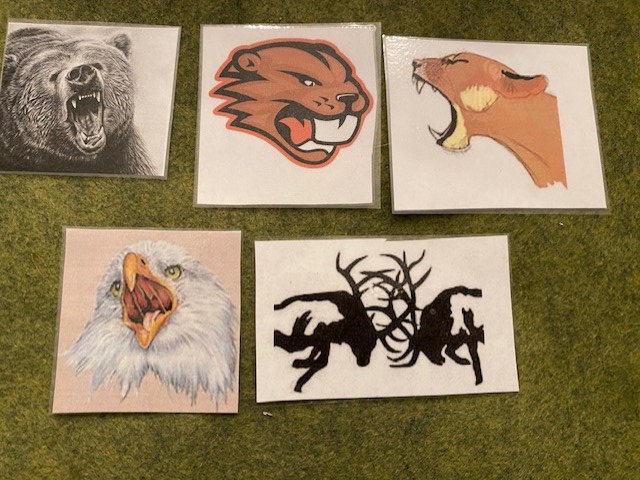
These are my totem tokens. Yes that is an Oregon State Beaver image.
I’ve probably played 6-8 games with the Skraelings. I’ve learned a lot about them. While they are interesting, they are no free lunch. I’ve run them against Vikings and Anglo Danes. I’ve run them against later cavalry armies which is really a challenge. Here are a few suggestions if you want to try ’em out.
My warband consists of five units plus a leader. There are no armor or armament options, so you’re taking ’em right out of the box. I take a point and divide it in half to make two 12 figure warrior units. I do this for two reasons. First, it allows the warriors to roll a lot of attack dice, two extra missile dice, and perhaps more importantly, it allows the warrior units to absorb more damage. When fighting a four man hearthguard unit or eight figure warrior unit, it’s a help. Second, when activating units is difficult, it’s helpful to have fewer of them. Though it does cost a SAGA dice, if it’s a big deal you can try to get the Puma Totem which has several advantage including an extra SAGA die. The remaining three units are levies with bows.
A little closer view of hunters on the left and warriors on the right. Both are big clots of dudes.
I don’t pretend to know everything about the Skraelings, but here is what I can offer. This is best as an army that deploys in or behind cover. They don’t have any movement advantages in cover like the Picts, but they need to slow the enemy down. I usually use woods, but deploying some rocky terrain or marshes that breaks up attacks is useful. It’s tough to generally attack much with the Skraelings. Attacks really require some coordination with multiple units and it’s hard because it takes so many dice to do much with the levies. I’m not saying you can’t attack–the large warrior units getting a +1 to their attack for their javelins can be formidable. But they’re better counter-attacking than trying to take an offensive to the enemy. I recently played a game against Anglo-Danes, another army that should defend, and he impatiently flung some units into a horde of missiles. Though I did some incredibly terrible die rolling, it was still ugly for Cnut and his minions. The Skraelings really need at least average die rolling in order to attrit their opponents a bit.
My Skraelings are the Skraeling figures from Footsore Miniatures. I like ’em. They do come with terrible spears, so I cut mine out, drilled out the little hands and used Northstar spears. They wear very little clothing that is mostly animal skins and hence very easy to paint. Of course, if you have a hoard of some early Native American figures someplace, you can certainly use those.
I’ve cobbled together most of a Viking army that I’ll paint this summer. It’s not that I feel the need to supply Vikings to fight the Skraelings, though keeping a manageable foe handy to fight a historical enemy feels right. Honestly, however, the poor schmucks who fought the natives near L’Anse de Meadows were settlers not heavily armed and armored followers of Ragnar with Bloody Hands. But that would be history and this is SAGA, so I gotta get over it. However the Skraelings and Vikings are a perfect match for Tribal, the rules set I discussed in my last blog post. A SAGA army for each can easily make enough figures for two players per side for a Tribal game. That’s a this summer project. I’ll keep you posted
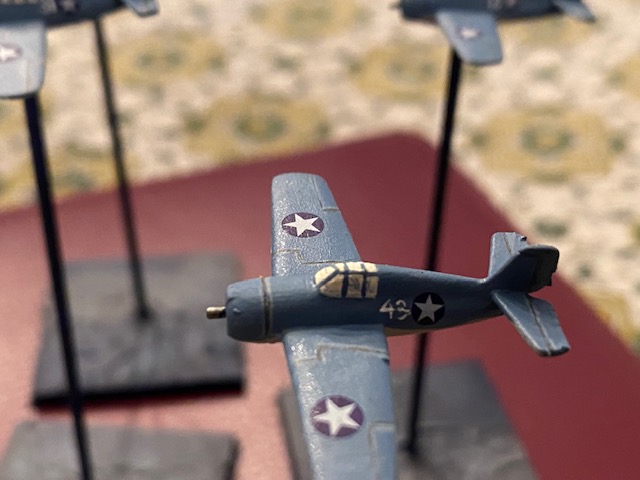
I’m always painting something. Raiden F4F-4’s at Henderson Field. A dozen of them.
I think I’ve explained my gaming stuff routines before, but maybe I haven’t. I’ll try to keep it brief.
First, at my most basic, I’m a painting guy. I love painting and try not to create needless obstacles that make it difficult to paint something. I paint every day, or almost every day. Usually a couple of hours though not all at once. With baseball soon to appear on television or the radio I’ll likely paint more.
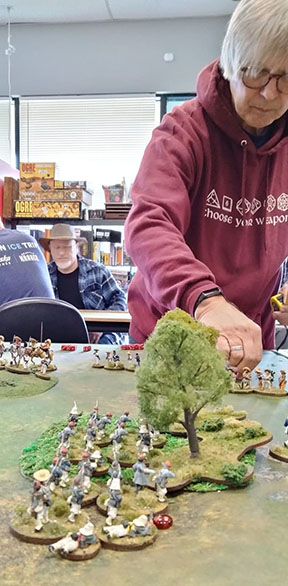
I game on Wednesday afternoons. We have a game group called the Weekday Warriors. We’re all retirees and we play in Tacoma. Great guys. Could not ask for a better group of folks to hang out with. We started out playing SAGA twice a month. We are now moving to an every week group with other games on non-SAGA days. We did a SAGA tournament in January and February and somehow I managed to win with my Irish. Sticks and stones win every time.
I’ve come to enjoy SAGA. It’s a very gamey set of rules, meaning that though there are a variety of nifty historical elements to the game, it’s really just more of a game best played with cool guys you trust. We’ve begun using more of the scenarios from The Book of Battles, which means you’re not always just trying to clobber the other guy. I have pretty much stuck to armies from The Age of Vikings. I have four at the present time: Norse Irish, Irish, Anglo Danes, and, well the Skraelings who really aren’t in the Age of Vikings group, but were created by Studio Tomahawk to play the Vikings. Needless to say, I also have several unpainted armies because I’m a miniature wargamer.
I also love love my Daniel Mersey (Lion Rampant, Rebelsand Patriots, The Men Who Would Be King, Xenos Rampant) rules because they are fun and easy to teach and play. Let me see, what stuff do I have for this? English and French Hundred Years War, Aztecs and Conquistadors, American War of Independence, America Rampant (Wayne’s Legion and later), Mexican American War, Maximilian and Mexico, The Philippine Insurrection, Spanish American War and the Rebellion in Cuba, Vietnam, and Sci-Fi stuff. Yeah, it’s a lot, but the system is so fun.
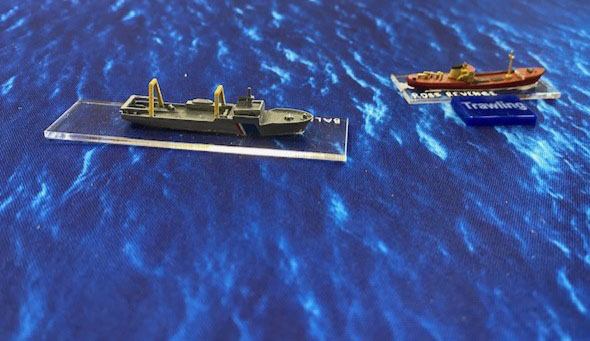
And then there is my David Manley stuff for air and sea. Again, the playability is great and like Mersey I have lots of stuff. ACW, The Battle of Lissa, Spanish American War, lots of pre-dreadnoughts and WWII in the Pacific. There are coastal combatants for both WWII and the modern era. I recently was able to play Cod Wars with some Icelandic Coast Guard versus Royal Navy and cod fisherman. Very fun. David Manley’s rules offer the right blend of period feel and elegant complexity to a very playable set of rules. High on my list are Airwar 1940 and Fire When Ready.
Iceland Coast Guard trawler and a British fishing trawler hurl insults in a Cod Wars game in January. Ships printed by Decapod.
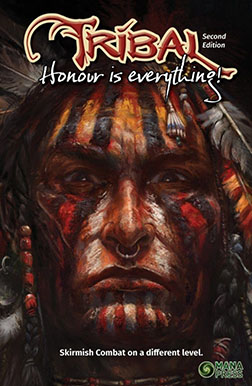
But now I’m just bragging. There are some other rules sets I’d like to try. Actually one I have already tried is Tribal. Tribal is a very fun, diceless system played with regular playing cards. I’ve used David Sullivan’s Bronze Age figures and Eric Donaldson’s Mycenaeans and both were very fun. These are singly mounted figures and each player probably needs about 20 figures, so not a lot is required. I really want to do these with my Makah/Northwest natives. The rules allow for some interesting scenario making. While it wouldn’t take a lot of time or figures to craft some forces to play each other in Tribal, my real attraction to it is the availability of the pre-existing SAGA armies with all the single figures to play the game. Doing double duty is not a bad thing. A perfect scale for Vikings vs. Skraelings.
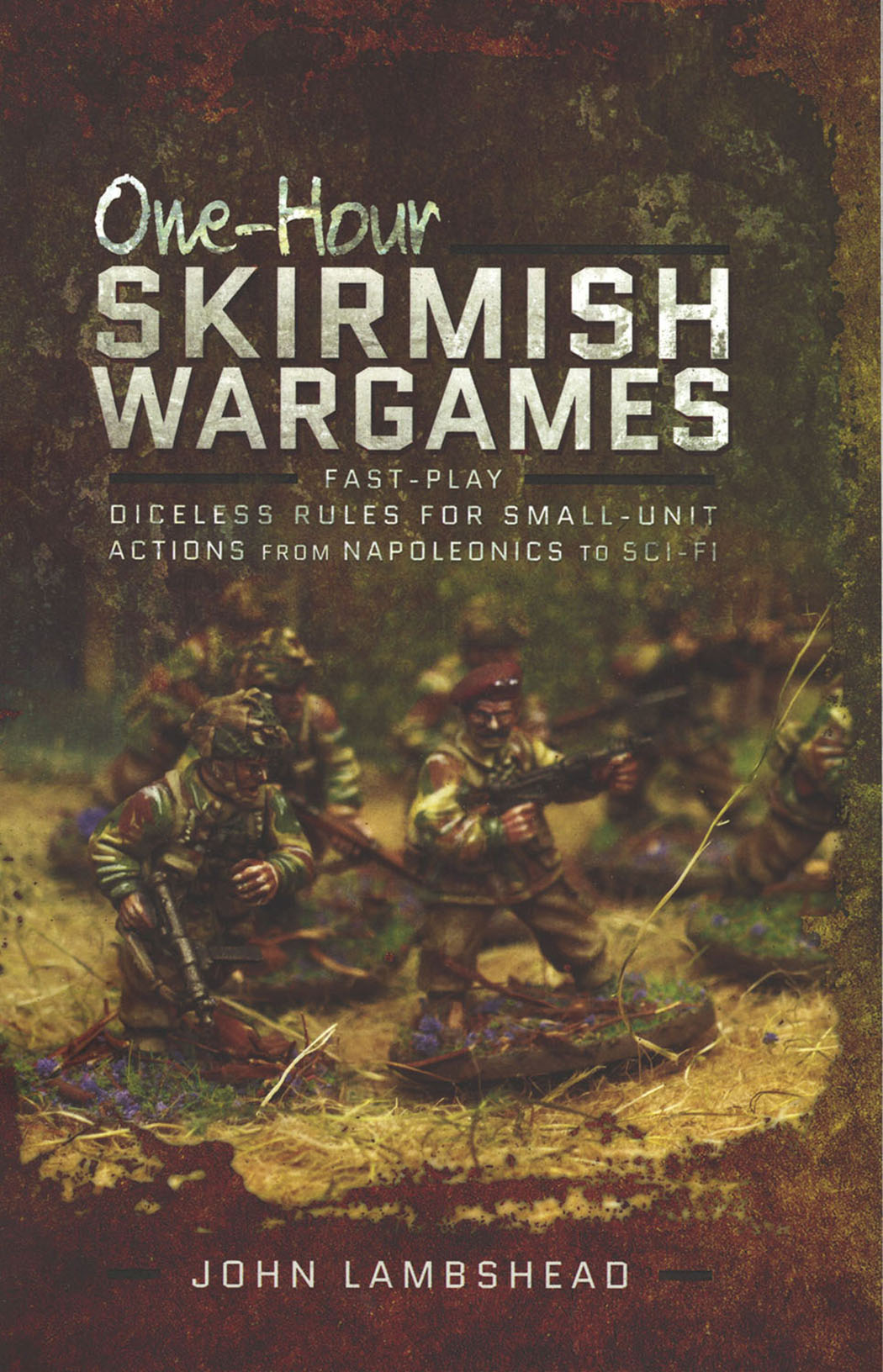
Another set of rules for skirmishing is One Hour Skirmish Wargames by John Lambshead. Phil Williams ran these at Drumbeat in February and the games received rave reviews. I haven’t played them though I do have a copy of the rules. Another diceless rule system, and my friends have given them a try. Generally aimed at the gunpowder era, additional support from the author does allow for armor. A single player generally commands 8-12 figures. I’m looking at some of my game periods and how I might add a few more singly mounted figures. I’m thinking Maximilian, the Cuban Revolution and the Moro War. Apparently they also work well for sci-fi skirmish. On my list for this summer.
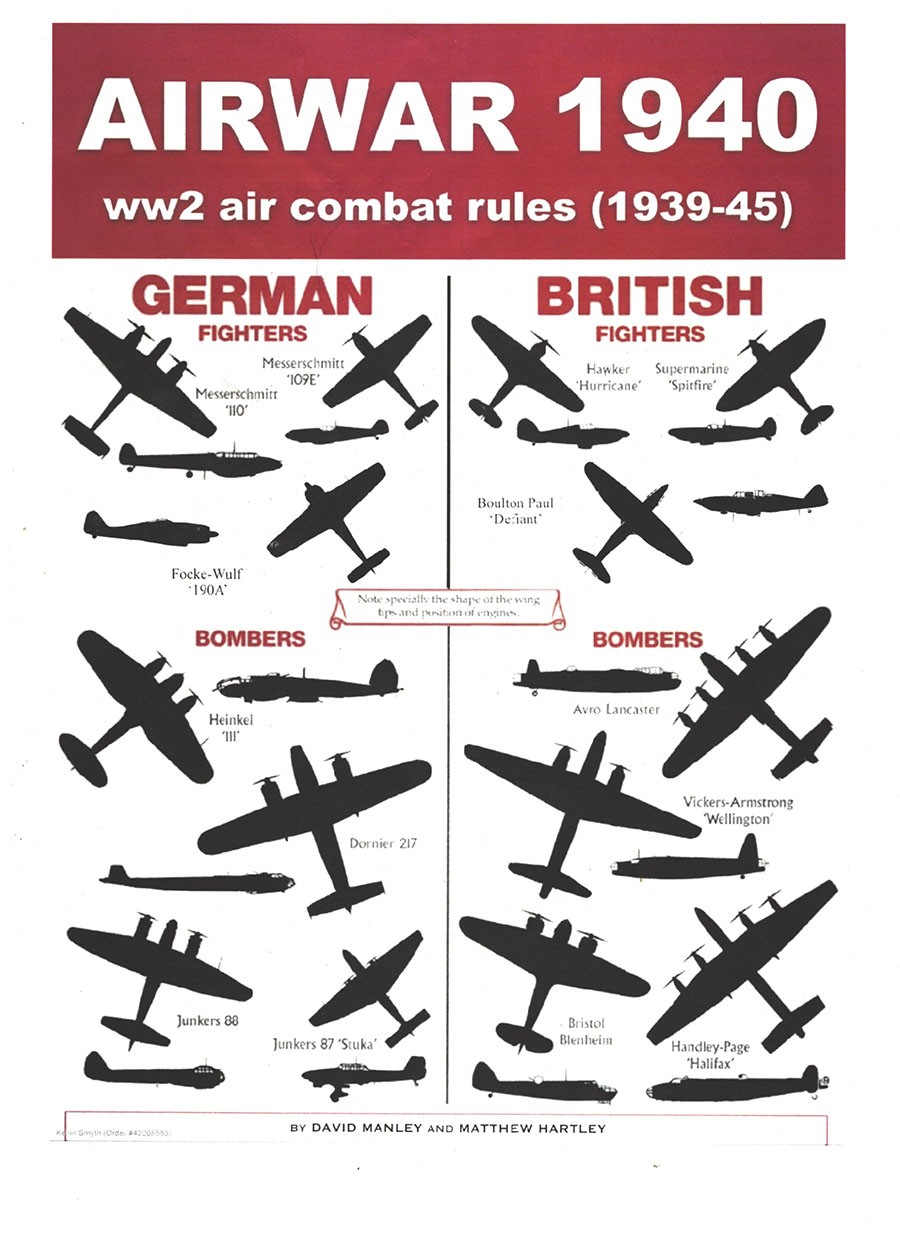
The last set of rules I’m spending some time with is Airwar 1940. I’ve actually run and played these rules many times. Dave and I gave up Mustangs for these rules as David Manley began playtesting them for eventual publication. David allowed us to use his beta copy and we made the most of it. We bombed the Tirpitz, attacked the Illustrious and raided Malta’s Grand Harbor. But when Dave became ill, those games were over. Our partnership was a wonderful one. I was primarily the painter, but Dave was the scenario designer. He knew the rules to a fault. I hadn’t picked up the rules since 2019, but I recently bought the Wessex edition and have begun perusing them. I love painting planes. That will be a topic of a future blog entry, and I’ve begun painting for a Pacific War project I hope will be huge. Dave had such great management tools for playing and I’m trying to put together my own that will keep game play reasonably easy.
Always something new to look at. I’m telling you, this is the Golden Age of Gaming. It’s a great time to be a miniature gamer.
Yeah, I don’t want to spend a lot of time talking about it or explaining it. I’ll just try to do better.
But it has been a busy gaming year. One of my biggest energy expenditures has been moving Enfilade to a new location. In December we got word our long time home at the the former Red Lion in Olympia was purchased by developers and we would have our contracts for 2024-25 voided. That left me in a frantic scurry to find a new home for this year. We settled on the LaQuinta Inn and Suites in Tacoma. It is an imperfect site, but I’m hoping we can pull off a solid convention for this year and make decisions about the future after May. More another time.
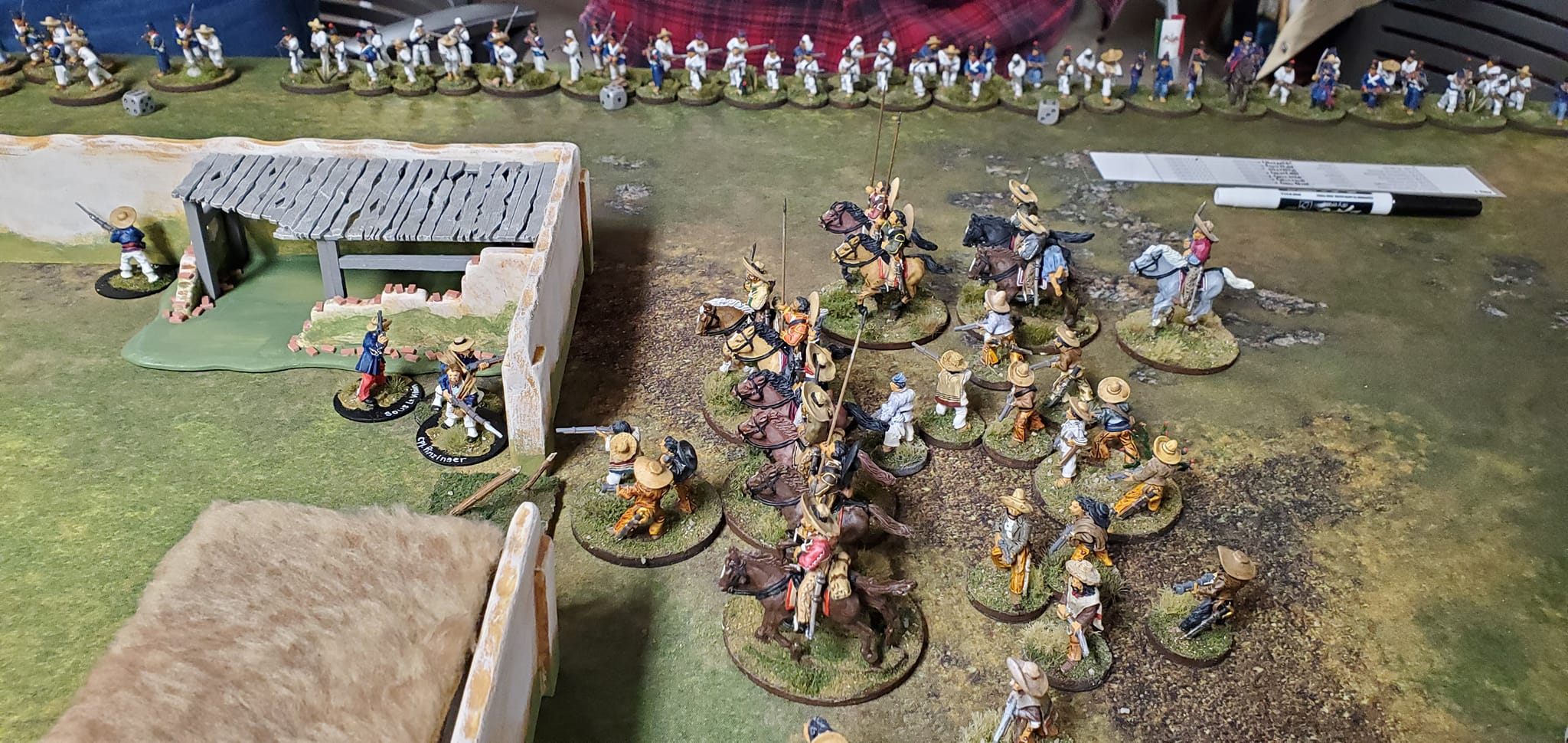
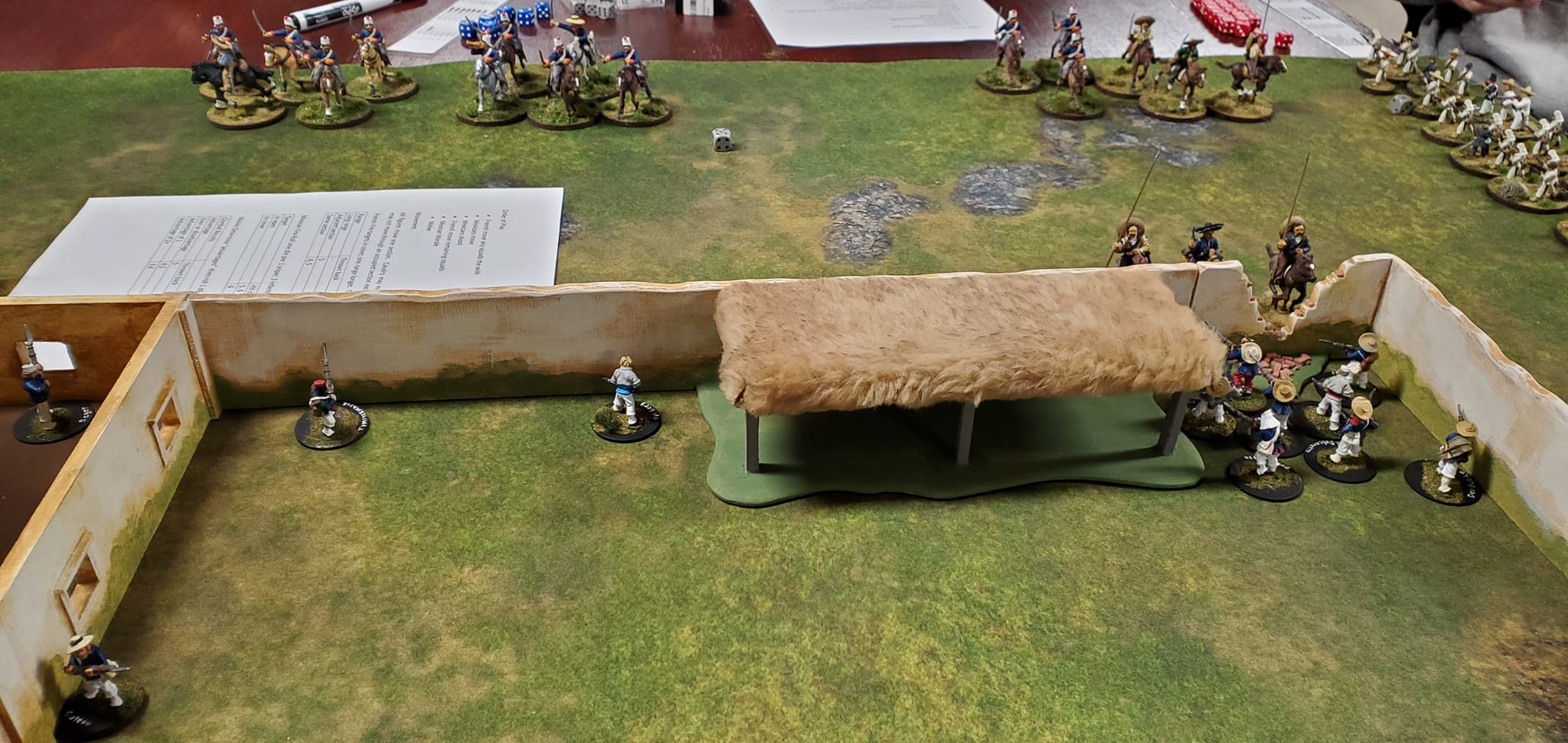
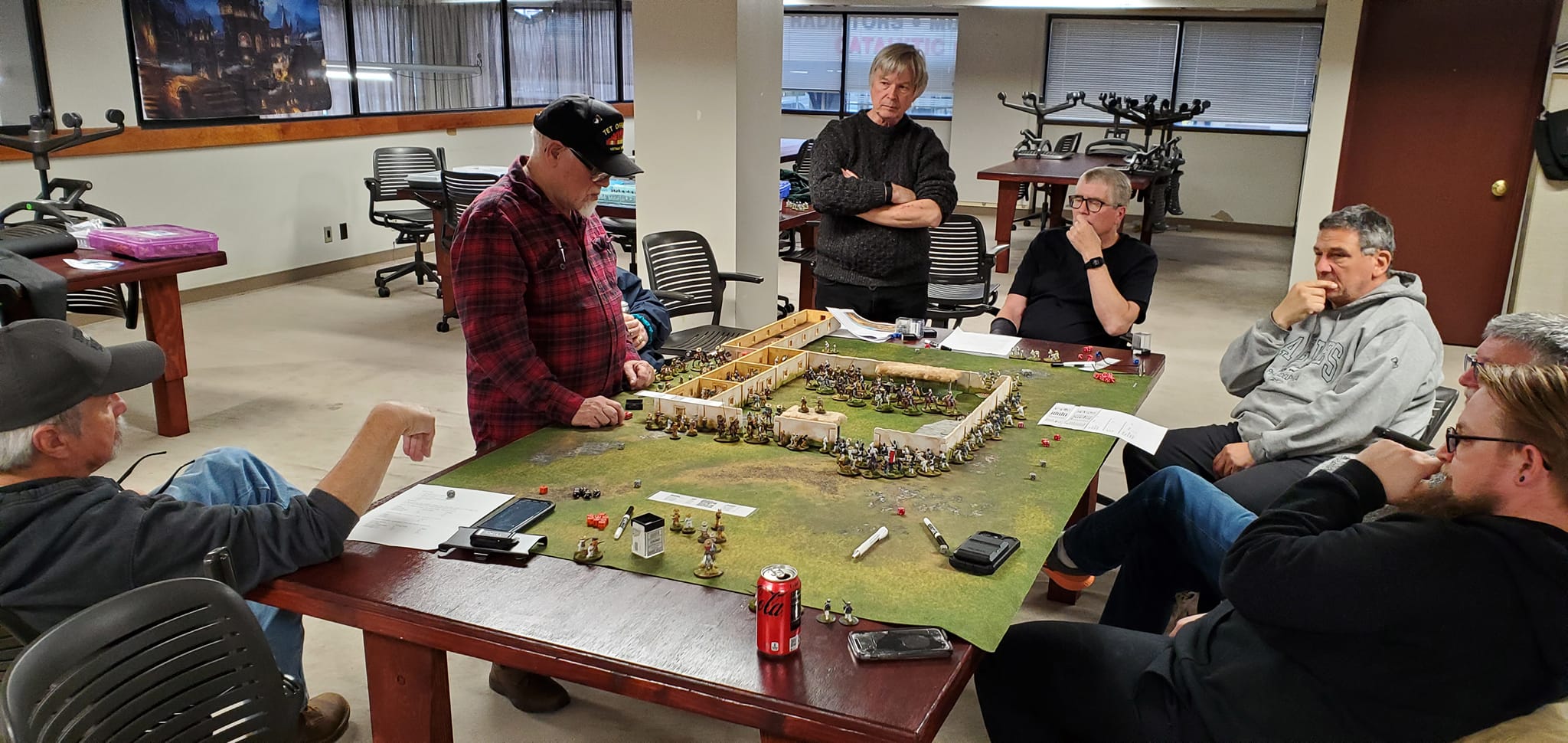
All photos are from the initial Camerone playtest in October.
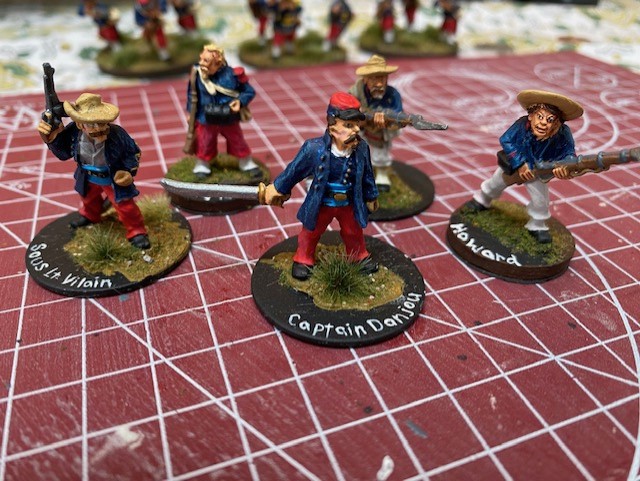
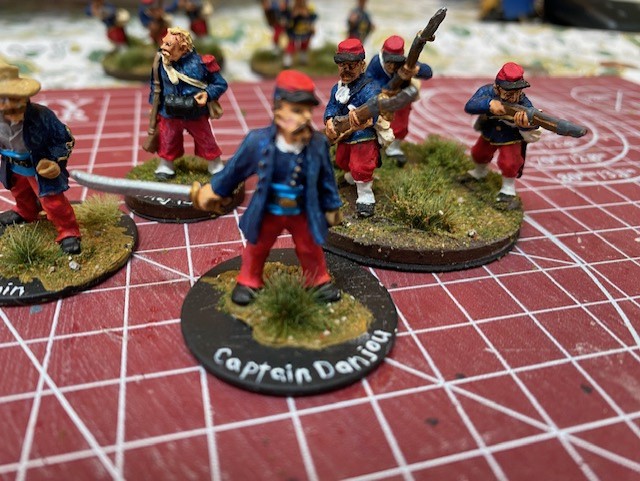
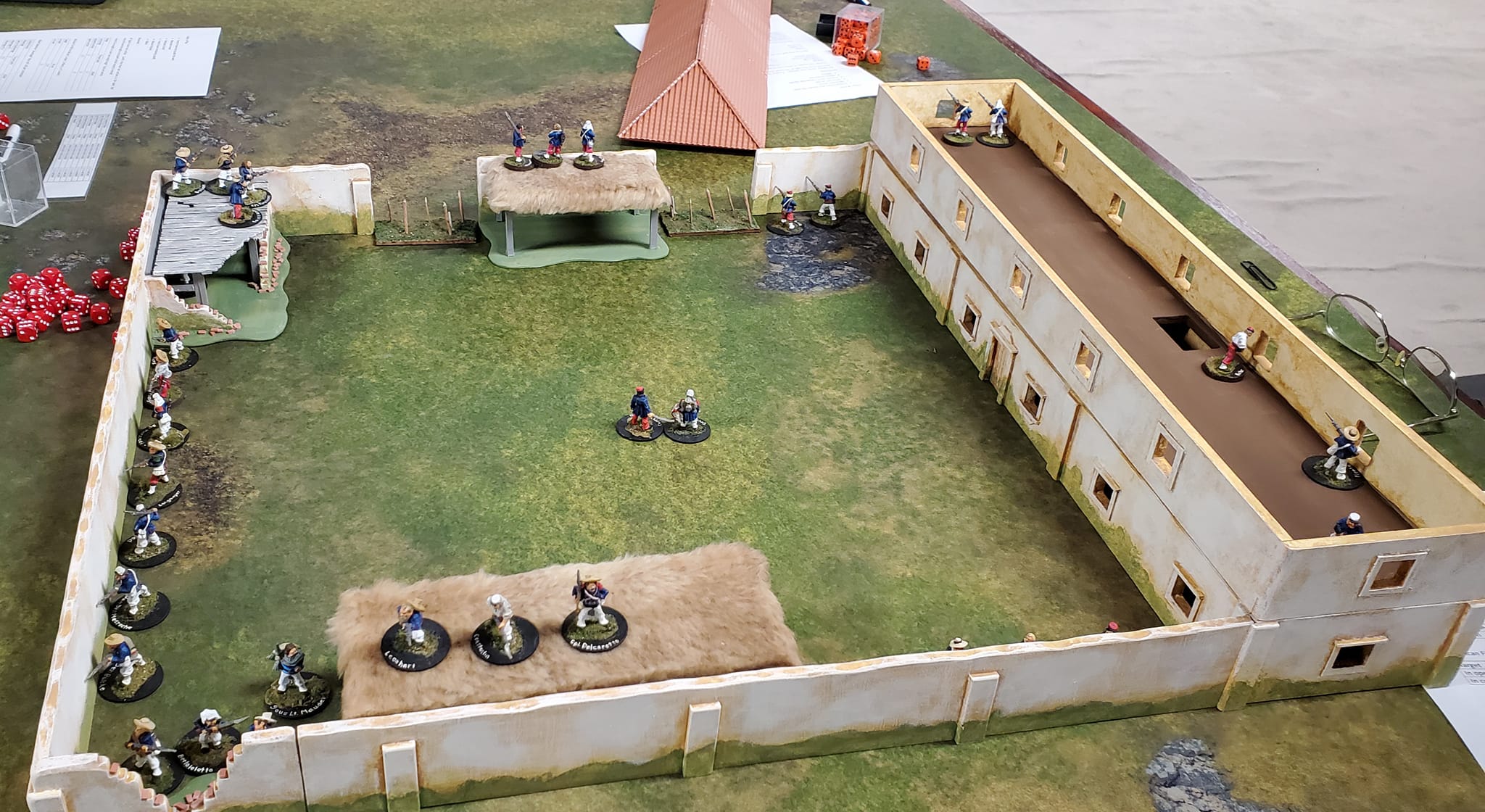
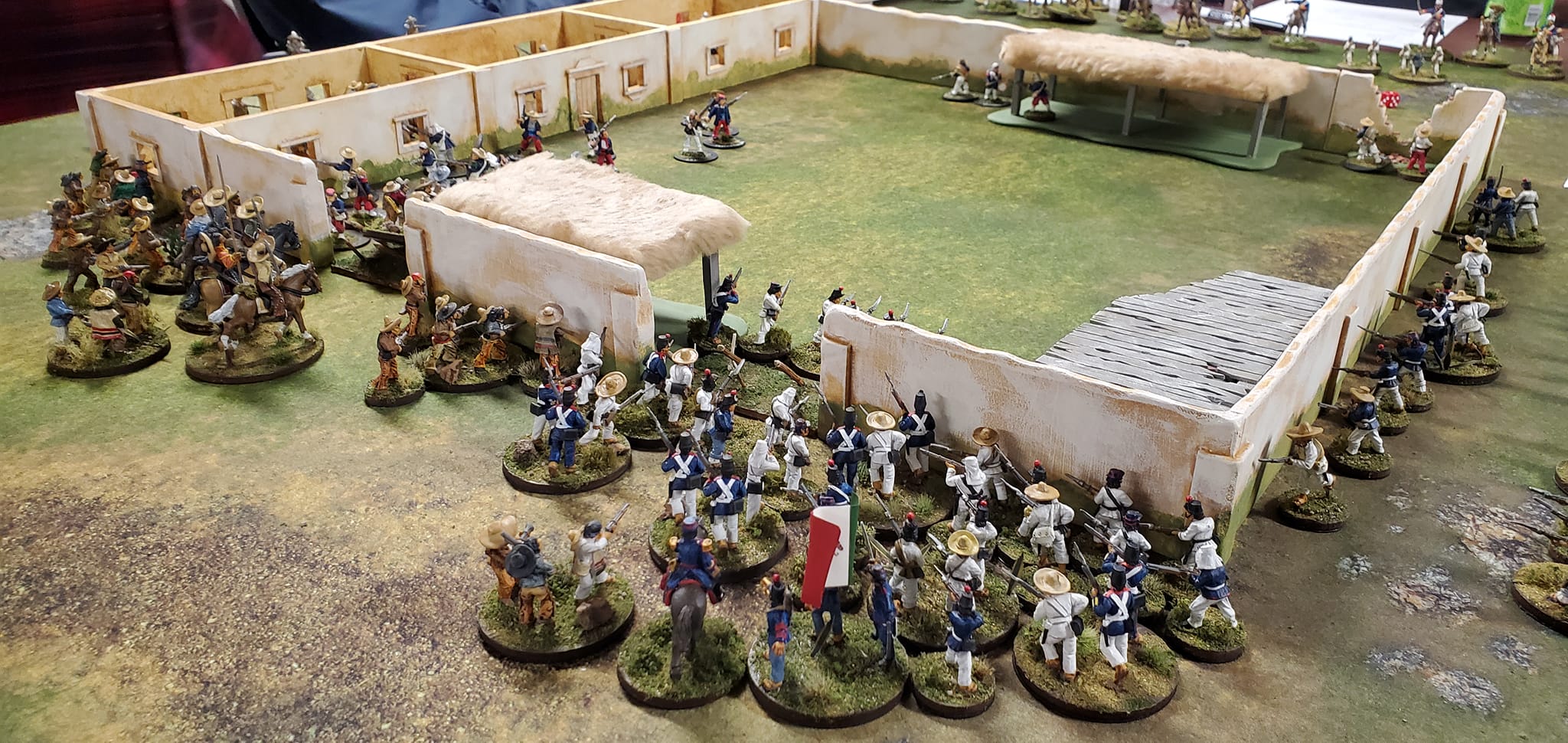
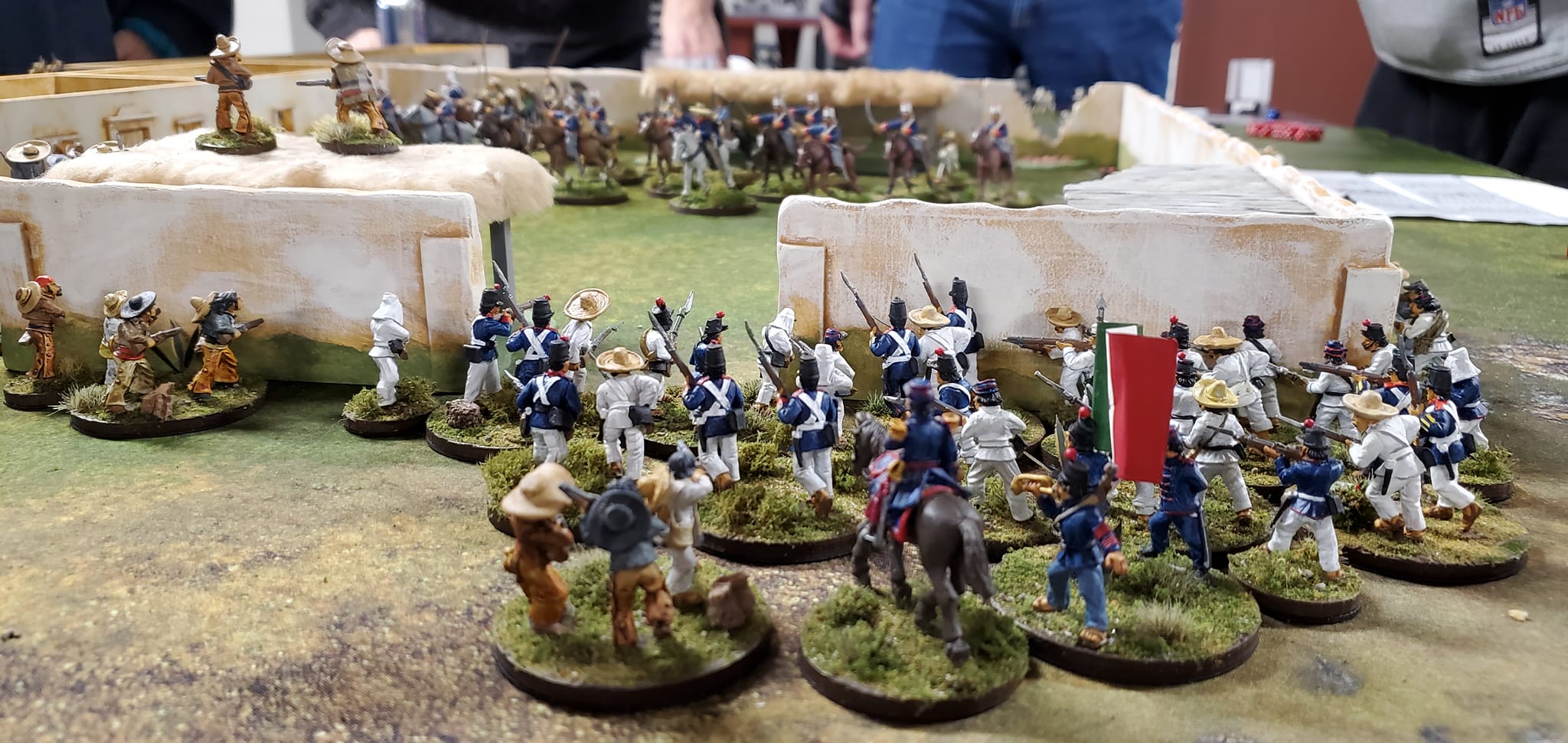
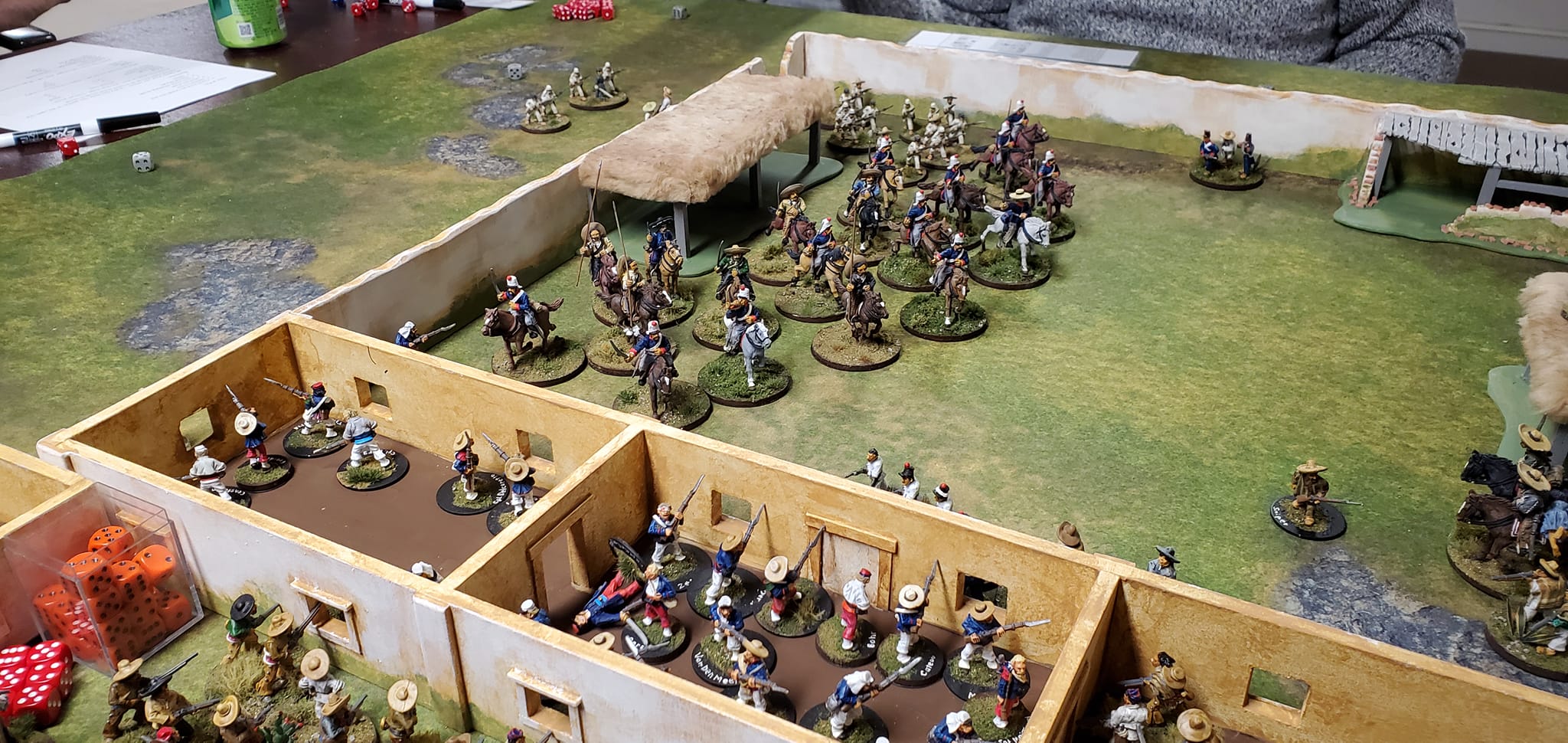
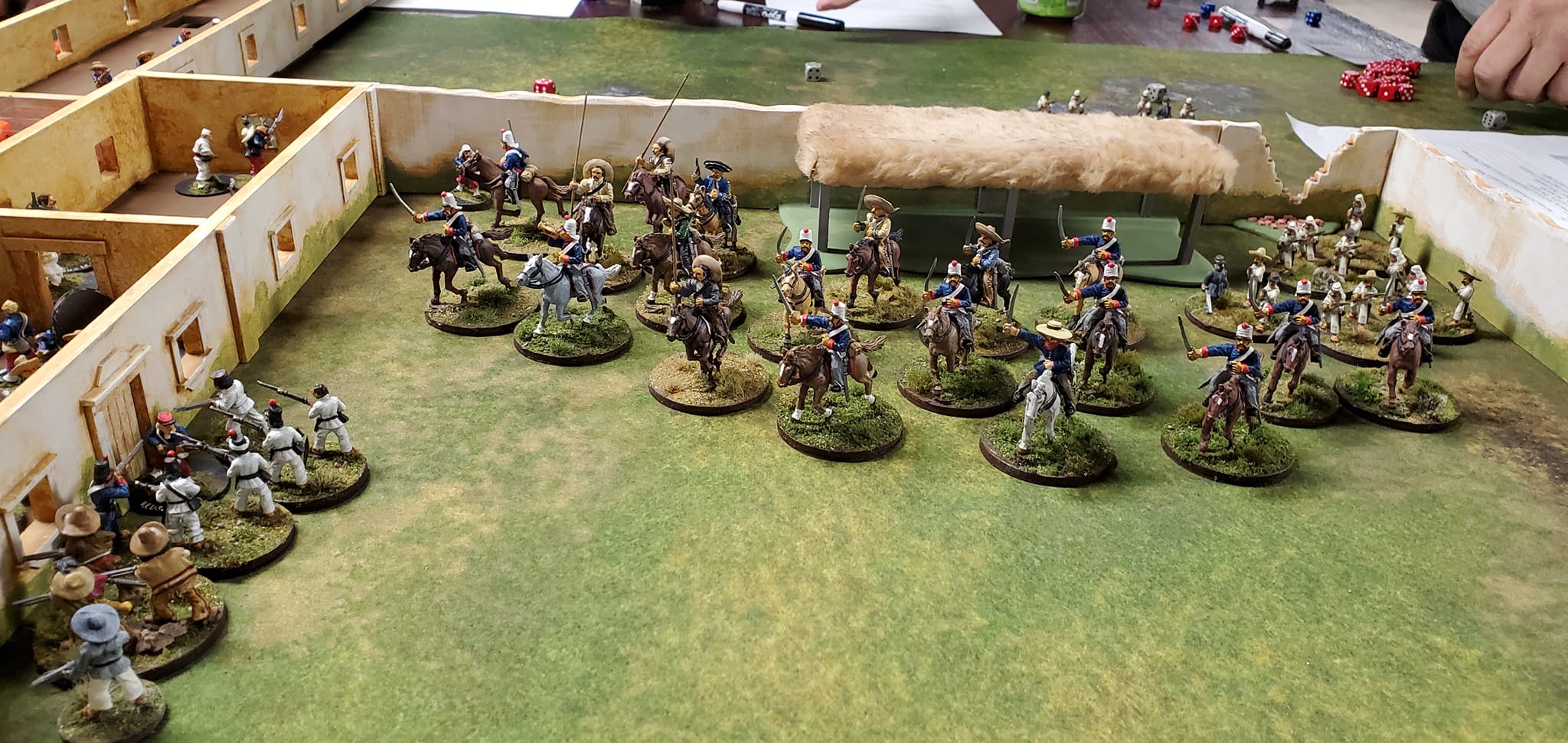
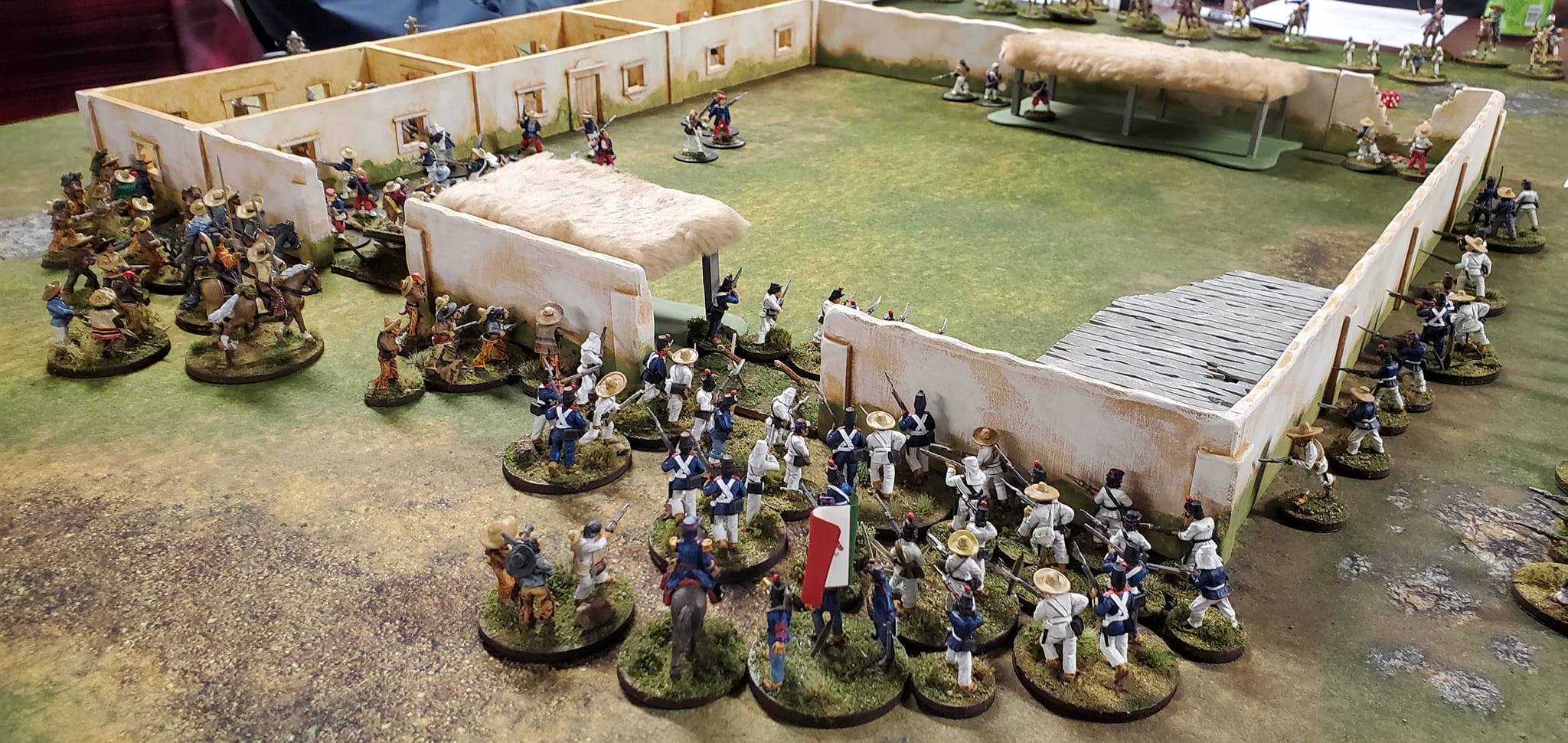
I’m hosting one game at the convention this year. It is Camerone. Mark Waddington and I have conspired to produce a beautiful looking game of Captain Danjou’ s last stand with his detachment of Foreign Legion in Mexico. I’ve tried doing Camerone several times using different sets of rules. We’ll be using the Howard Whitehouse “The Wooden Hand of Captain Danjou’ rules. I devoted most of the fall months to wrapping up the figures needed to play. For the French I used the Old West French Foreign Legion and Filibusters figures by Wargames Foundry. The Mexicans are a mix of Gringo 40’s and Foundry figures. The game looks nice, and we’ve done a couple of play tests. It would be nice to get in one more, but the timing doesn’t look good.
While speaking of Mexico, I have two Mexico-related projects I’m currently working on. One is the remounting of my entire Aztec project. I’ve been picking at for most of the last six months or more. Re-mounting is not one of my favorite things. I’ve found ways to re-mount that is not a physical danger to knife-wielding re-mounter, but it is resource intensive supplying new bases and quite time consuming. There are also about 400 figures to re-base to my beloved 3-2-1 system so it has taken a while. I’m hoping I could be done by Enfilade. But maybe not.
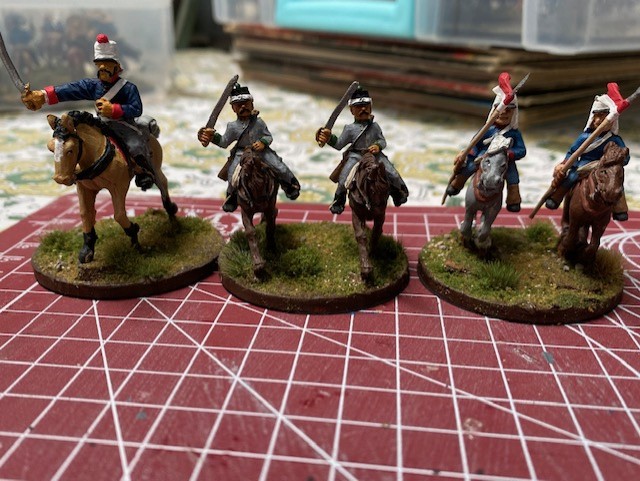
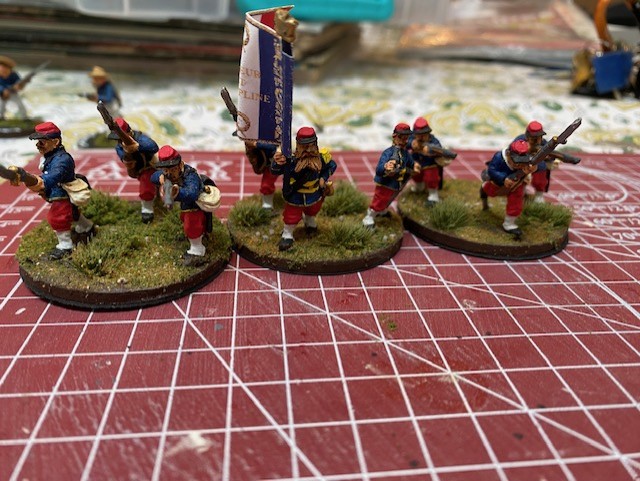
The other 28mm project I’m pretty focused on is wrapping up the figures for my Maximilian in Mexico project. Camerone uses a lot of figures for this, but the complete project is much larger than just Danjou and his mates fighting off a bunch of Mexican infantry. This is a Rebels and Patriots project. I’ve completed all the Juarista Mexicans and all of the Maximilian imperial forces. I’m just down to completing the French. I wrapped up a unit of French hussars and a second unit of Chasseurs D’Afrique. Just down to painting line infantry at this point. I’m excited about wrapping them up. Note: After some reading I’m intrigued by the idea of adding a couple of units of Austrian Legion by Gringo 40’s (24 figures) and some additional Contra-Guerrilla figures for use with a different set of rules.
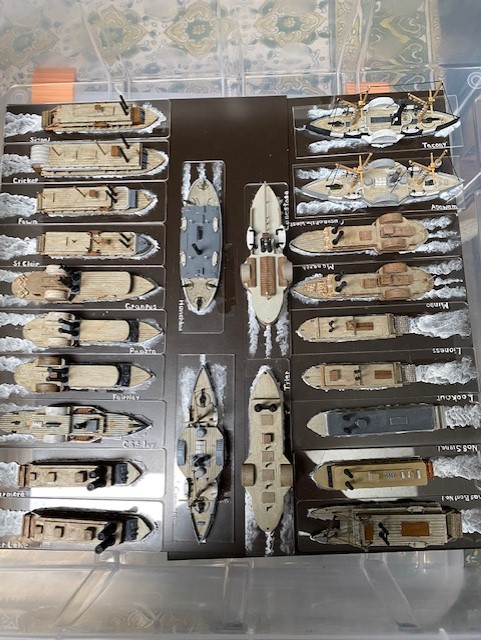
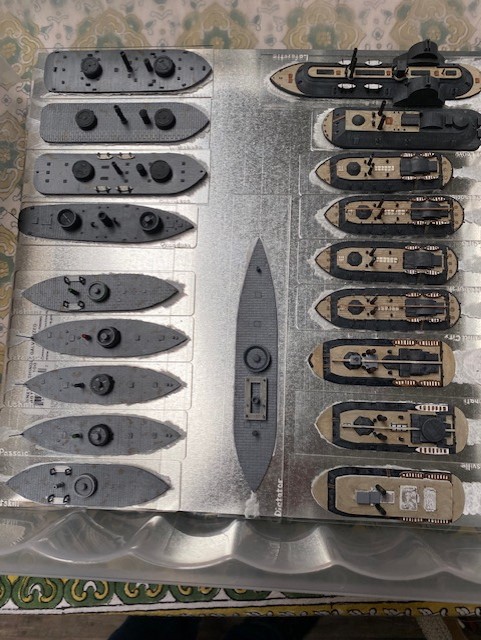
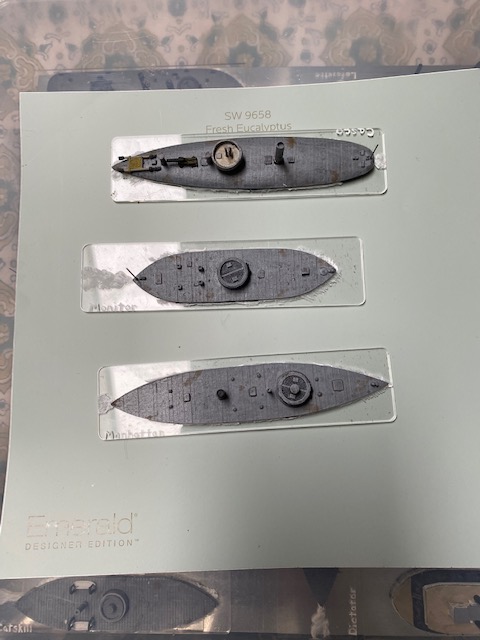
These are the 46 or so ACW ships I’ve painted or rebased since November. Acrylic bases by Litko. I’ve focused on Union ships so far.
I’ve also focused on some ship and aircraft projects. Just a quick digression here and I’ll come back to these topics in future posts. I’ve collected a sizable number of ACW ships over many years. They are based using a variety of materials on bases of various sizes. I’ve decided to tackle some of them and am re-basing them on more uniform bases. It makes storage so much easier. I’ve also added a bunch of 3D printed ships. I’ll spend some more time on this next week.
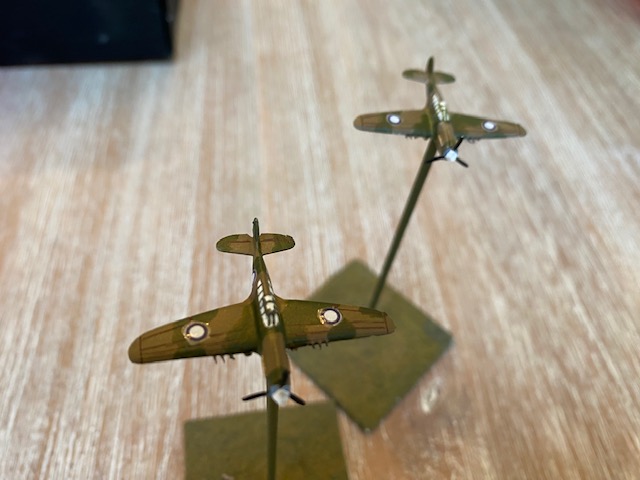
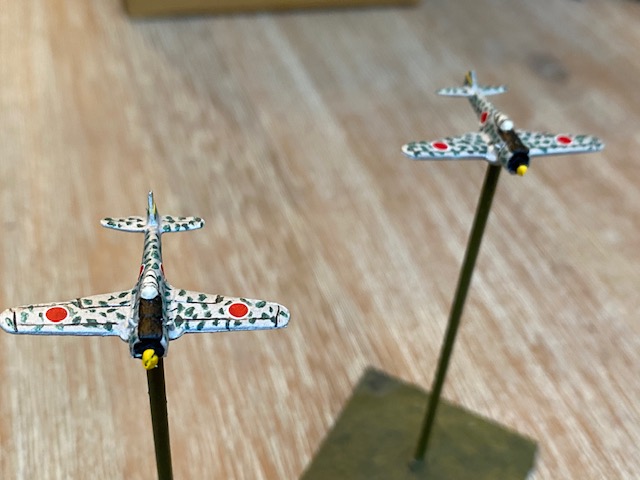
Royal Australian Air Force Kittyhawk 1A’s (P-40E) by C in C. Ki-43 Hayabusa (Oscars) by MSD games.
Finally, I’ve devoted time to painting some 1/300 scale planes. This is another big topic that deserves its own post. I promise to do that. I’m currently focused on a gigantic Pacific War project. Planes have been difficult for me. It was a genre that I exclusively did with Daveshoe. We were great partners. I was primarily the painter while Dave was the brains of the outfit. It’s not that I couldn’t conceive of interesting scenarios, but Dave was just so good at developing the tools for a great game that made play so easy. I’ve recently downloaded and printed the updated version of David Manley’s Airwar 1940 rules. I’ve also started building a collection of usable tools for the game based on Dave’s work. I also have a plan for my first Kevin-only game. More on this to come.
I’ve gone on long enough. My goal is to share regularly (weekly?) on what is happening here with my game groups as well as what I’m up to. Thanks, as always, for reading.
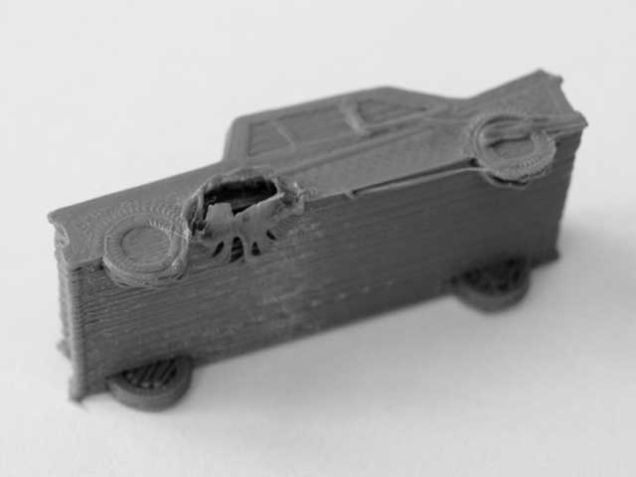
Not my failed print, but it might as well be. In fact this is better than my failed prints.
I said farewell to my 3D printer yesterday. I gave it to my good friend Mark Waddington. Mark, like me, is not 3D printer adept, but I do believe he has the persistence and the “tool IQ” to figure it out. I probably tried at least 20 prints, all but one of them ending in abject failure. Though Mark and I fiddled with the print settings all day in August, it just seemed more than I was willing to continually subject myself to.
I bought the printer under less than optimal conditions. Amazon Prime Day 2022 had a deal on the Elegoo Saturn S bundle. It was very reasonably priced and so from a financial standpoint it was a super deal. However, it was also a couple of months after Casey died, and the rule is, don’t make any major purchases while you’re grieving. It’s not that the printer cost as much as a car or I invested in Florida swamp-land, or anything like that, but in game expense comparison, it was significant.
The tide really turned against keeping the Saturn when I began seeing commercial printing sites offering the specific models I purchased the files to print. I’ve been in contact with Chad Weyenberg at Iron Horse Collectibles. He is printing David Manley’s files for ACW ships. They are very reasonably priced. I’ve ordered eight models and they’ve already shipped. I’ll review these after I get them, but I find this to be really significant
War Times Journal is no longer printing their ship models, but three sites in the U.S. are printing them for much less than WTJ did. I can’t say I’m having a ton of success communicating with them, but I’m trying. I keep in mind that these are all small companies probably with the owner having a day job.
I know Mark will print stuff for the two of us when he figures things out. But I had to face up to a simple fact. I love painting figures. That’s something I’m reasonably good at, and diverting myself from that purpose with something else I don’t have any feel for is just a mistake. I always believed that 3D printing was almost a separate hobby. It’s almost more like an art and a science. I really admire those who are able to stick with it make it work for them. It’s just not something I could do.
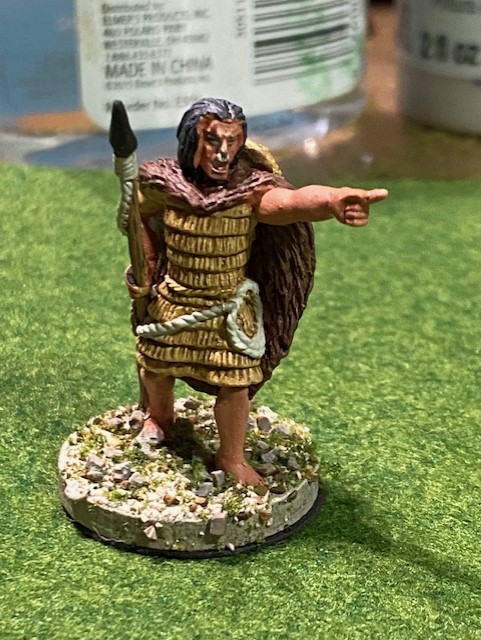
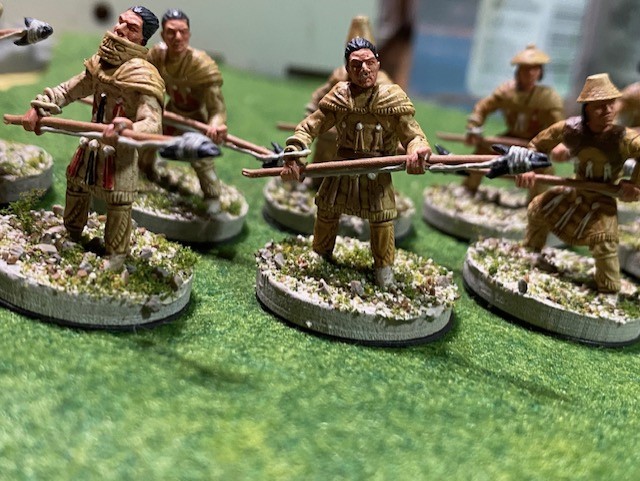
The Makah leader is great and quite heroic in size.
When I gamed in the 80’s I was raising a family, didn’t have much extra money, and thus didn’t have a lot of cash to invest in the next big thing in figures. Friends would talk about the new Dixon figures at a buck a piece and I would laugh and go about painting my strip Minifigs. Times have changed, and I do pay attention and every now and then the hook gets set and I’m suddenly hurtling through the air after the next shiny thing. Sometimes it works out and others, well, not quite as much.
There was a post in one of our groups about the Pacific Northwest native figures from Paymaster Games. Paymaster is a small company located in Seattle (just up the road) that offers some real niche figures, including MesoAmerican peoples, Pacific Islanders and Northwest natives. I am a sucker for anything resembling local to this area so I was immediately intrigued. David Sullivan and I began looking at playing the recently revised Tribal rules, which call for small singly mounted commands of 15-20 figures. We both thought these would be just right for such a mini project. We jumped right in on the PNW natives.
With the completion of my Skraelings for SAGA and the wrap up of the Camerone figures I currently have, I felt the time was right for work on these PNW figures. As I said, Paymaster is a Seattle company. I would guess they are quite small, maybe they don’t do their own casting. Their on-hand supply of figures seems to be quite limited. David Sullivan and I have made small, multiple orders and have exhausted what seems to be in-stock. My first order was slow in coming and wasn’t exactly what I ordered, though the second order arrived promptly and was exactly what I asked for. I’m sure it’s a tough business for newbies. I chose to focus on the harpoon-armed warriors that resembled, at least in my mind, Makah warriors. I tried to do a little reading to learn a bit more about dress. Though there is an Osprey book on Indians of the Pacific Northwest, it’s of limited utility and I had to make my own best guesses.
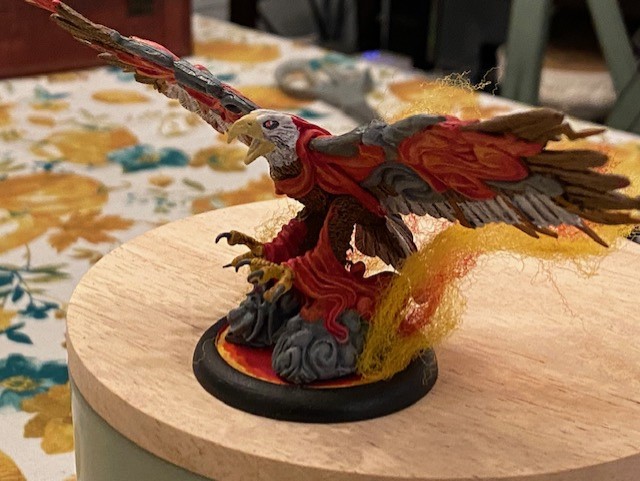
the Great Thunderbird miniature was very fun to paint and really inspired me to be creative.
I had the figures for six weeks or so before I started doing anything with them. I did, however, paint the Great Thunderbird figure immediately. It was so cool and such a great attraction I couldn’t help myself. It was a four piece resin cast miniature, quite large that I’m sure I can figure out a way to use in something. I loved every minute of painting it. They also have an Ogopogo miniature based on a Loch Ness-like myth that lives in Lake Okanagon. Another local story that I can’t ignore.
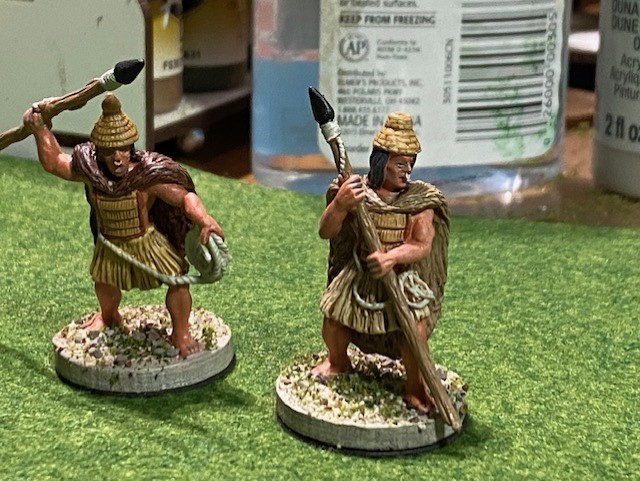
Last week I finished my last Camerone guys so it was time to start doing something with the Paymaster dudes. The Paymaster ranges are similar throughout. I can buy warrior packs of five figures and supplement those with more individual “heroic” figures. The “heroes” are definitely distinct. They are more expensive, much larger and some of the poses are quite cool. I had actually painted the Makah leader and the two Makah harpooners and I liked them quite a bit. They had just the right amount of detail and the casting really reflected the simplicity of dress these larger than life fellows would have had. However I had a bunch of warrior figures to assemble and paint, and they would be different.
The Makah heroes are quite large and have wonderful details-the hats, the armor, the harpoons were all just wonderful to work with.
The Paymaster warriors of all types come in packs of five figures. Looking at the pack, my eyes bulged out at the pieces, “holy crap.” Depending on the figure type, there are 4-6 pieces per figure that must be assembled: legs, torso, head, separate arms or arm combination, and a quiver if your figure has a bow. I became very friendly with my large bottle of Zap CA glue and Bob Smith’s CA glue accelerator.
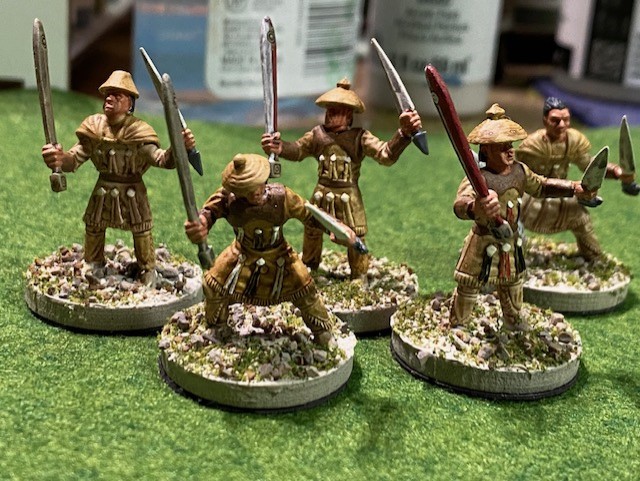
The PNW basic warrior.
The warrior figures are not large. They are much smaller compared to the one piece “heroes” types. In terms of animation they aren’t super. There are some very nice touches. I like that 3/5ths of the torsos have the capes, typically made of cedar bark, that many northwest natives wore to keep off the rain. The harpoons, which are cast metal, have very nice detail with the whale sinew rope wrapped around the projectile and the hands. Love the pattern printed on the quivers, very northwestish. The tassels on the tunic are a nice touch, but everybody has ’em. I also really like the variety of headgear for the figures.
Makah harpooners.
But there are issues, at least for the dude like me who is new to the party. The figures come with a nice variety of weapons and bits. The archers have a choice of a bow being fired in the left hand OR a bow that is schlepped, and in the right hand, one has either an arrow or a war club (or at least I think that’s what it is.) Unfortunately those options don’t work for every figure. If the figure has a cape, it can’t use the right hand with arrow. How did I find out? The hard way. Harpooners with capes good. Harpooneers without capes, bad. The harpoons actually come attached to both arms, one version clearly for dudes with capes, one clearly for sans capes. The arms for without, just don’t fit right without lots of filing and epoxy filler. This automatically catapults them to the bottom of Kevin’s most-loved figures list. They were quickly dragooned into service as archers or with war clubs, but that was only because I had a fair amount of figures to mix around and I was able to discern the patterns in the void pretty quickly. Some directions would have been useful.
Painting isn’t difficult. There actually is a Pacific Northwest Indians Osprey book (Men at Arms 418) but the plates don’t give a ton of guidance. The figures probably much better attired than the pre-contact warriors would have been. I chose to keep colors simple and used a lot of variations on tan. Then I soaked ’em down with Army Painter Soft Tone wash. I was pretty happy with the results. For the tassels on every warrior figure’s chest and back, I did a few in light brown, but most I painted red, white or black, because those are colors that appear in most contemporary native cultural symbols. Is it right? No idea. The tassels are attached with off[-white shells. The figures were easy, but kind of fun to paint.
The assembly is a pain. I’ve assembled a fair number of plastic figures-Perry, Victrix, Gripping Beast, North Star-some more fiddly than others. These were worse.
That said, these figures fill an interesting niche and the detail is nice. The warrior figures look good when painted, though the posing is mostly uninteresting. The heroic figures I really like, but they are also quite costly. The warriors work out to an acceptable $2.25 each or so, but the heroic figures can be pretty pretty spendy at $8-10 a whack. These figures are also quite large. They are beefy and about 34mm tall. The warrior figures, by comparison, seem slight and measure in at 28-30mm.
I would never say not to buy these figures, however the buyer should be aware of what they are getting and that they carry some risks with them. I will add more figures as I need them to make a good 4 player Tribal game. But now I know what I’m getting into.
Saturday was August 5th, International Naval Wargaming Day is today, the 6th. Unfortunately I wasn’t available to game today so I hosted eight of my friends at my house yesterday to celebrate the notable gaming occasion.
Hosting games at my place is a little tricky because I don’t have an obvious place to play a game. My garage, where I’ve set up games before, is full of stuff for sale at our space at the local antique mall. It’s been a beautiful dry summer in the Northwest so I planned to host a the game outdoors on the lawn under the shade of our big maple tree, but with a pop-up canopy for additional shade just in case. The weather early in the week was predicted to be 86 degrees and dry, in what has been a very dry summer.
I chose a scenario from Monroe’s Legacy, a scenario book on America’s emergence as a naval power in the late 19th century by The Admiralty Trilogy Group. It was a hypothetical scenario for the Spanish American War about an early encounter between Cervera’s Spanish armored cruisers and Schely’s Flying Squadron before the former became bottled up in Santiago harbor and doomed to blockade by the entire American fleet. Perfect scenario for six players, but I had two late additions to I added a scenario within the scenario–a sortie by the tiny Santiago naval defenders to drive off the gigantic, but poorly equipped American merchant cruiser St. Louis which had been tearing up the telegraphic cables between Santiago and Cienfuegos.
I take this hosting business seriously and spent a good part of the week getting ready for the game, carefully preparing ship cards. We played David Manley’s Fire When Ready Rules, which we’ve played before but not in a couple of years, so refreshing our memories were part of the game, and mistakes were made. I supplied the 1/1200 scale ships-a few Navis metal models, but many 3D printed ships from War Times Journal and Matthew Lawson’s Brown Water Navy Shapeways shop. Lunch was ordered. Thursday night all was organized and prepared.
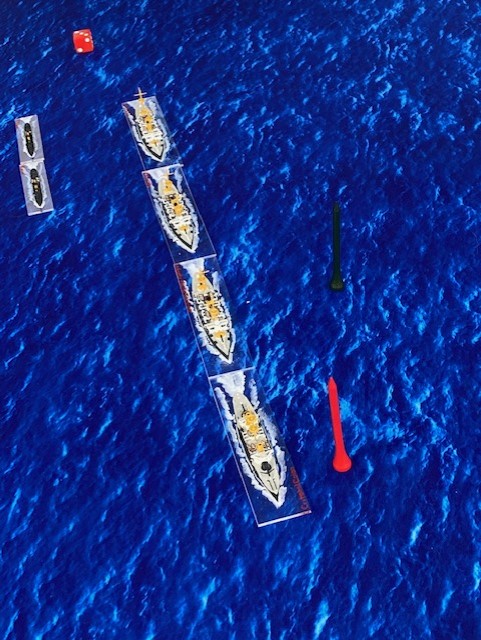
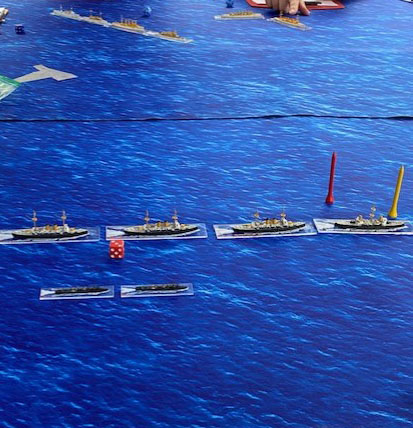
The battle unfolds. Minneapolis and Columbia lead the US. Followed by Massachusetts, Brooklyn, Texas and New Orleans. Cervera’s Spanish squadron is in the foreground.
And then it started to rain. Not a drenching, pouring gully washer, not even persistent northwest drizzle, but an unpredicted, cool damp I definitely couldn’t plan for. I asked George to bring his canopy just in place we needed space to stay dry. The 8 X 6 table fit under my canopy, but I feared that everyone’s chairs might not. In the end it dripped off and on throughout the day, but it had the affect of cooling things down, so no big deal.
Everyone arrived as planned. John, John and Mark volunteered to be Cervera and the Spanish with their four armored cruisers and two destroyers. George, Bill and David took on the Americans. Michael agreed to take the massive St. Louis while Eric took the Reina Mercedes and tiny gunboat Alvarado trying to get away and return to Santiago.
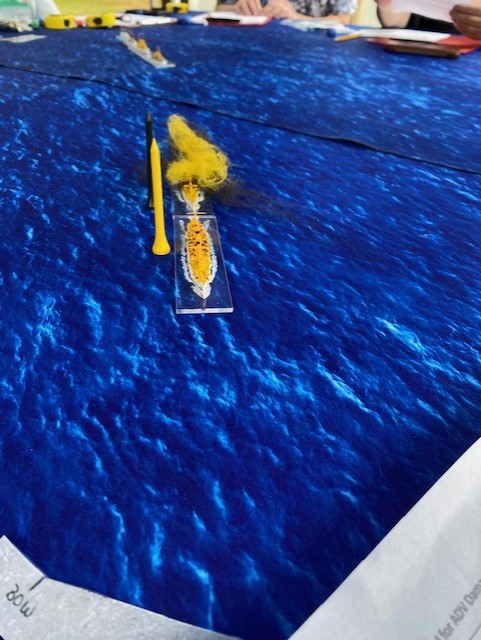
Minneapolis is battered and Columbia suffers a raging fire.
This was a tough game for the Americans. They started at long range, and never really managed to close it much. They decided to split off the large protected cruisers Minneapolis and Columbia to perhaps cross the T of the much slower Spanish armored cruisers. Instead they drew a lot of fire which eventually led to their destruction. On top of that, the American gunners simply shot poorly. Because the range remained quite long they weren’t able to use their secondary batteries and could only hit with their few main guns. With the bad rolling that wasn’t enough to do anything catastrophic.
In the end the Spanish met their victory conditions of crippling the Americans at a 2:1 rate.
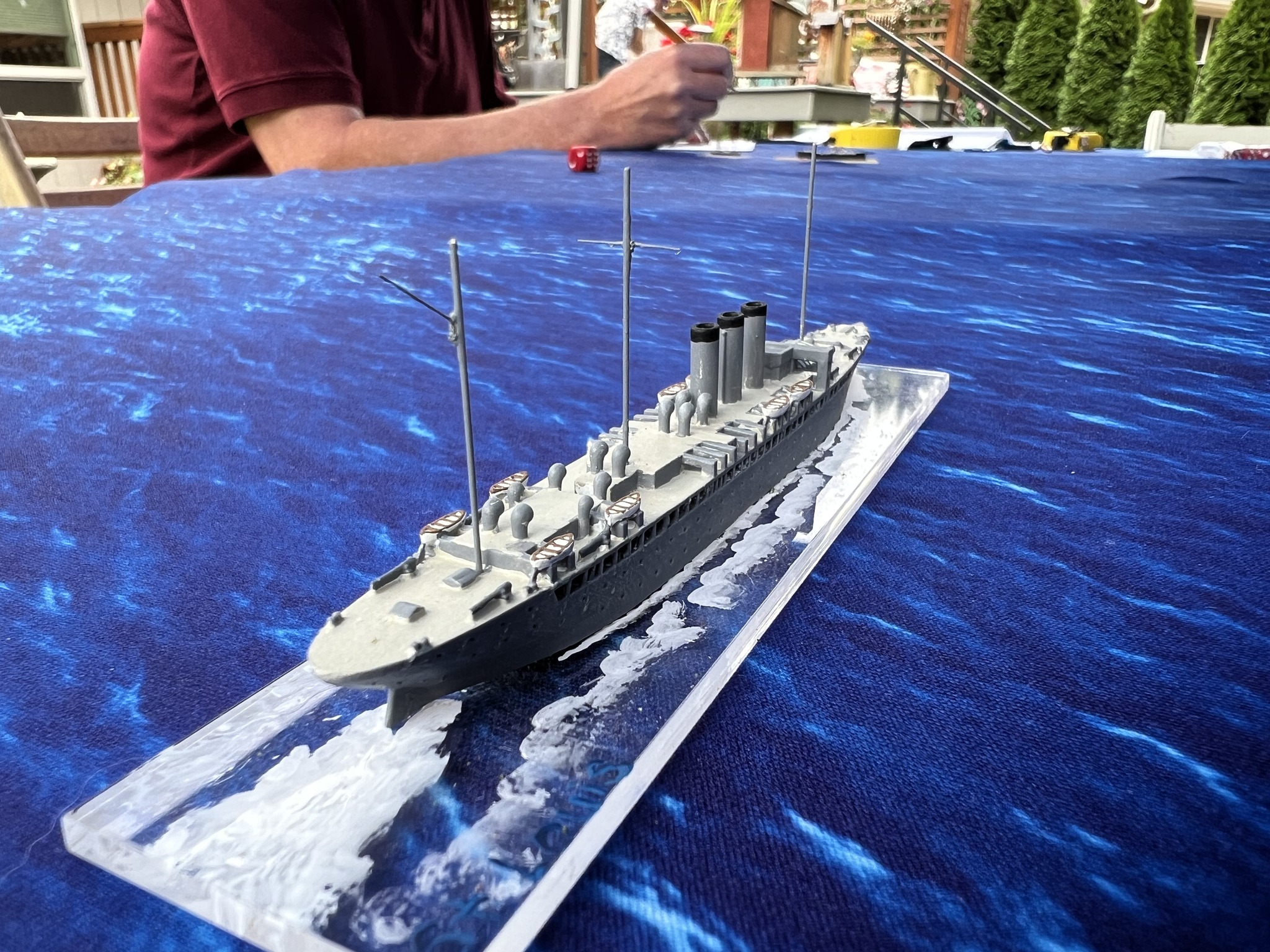
American merchant cruiser St. Louis. Miniature by War Times Journal. Photo by David Sullivan
The other chunk of the game was Michael with the St. Louis chasing Eric with Reina Mercedes and Alvarado. St. Louis was a nearly 15,000 ton converted liner while Reina Mercedes was an obsolete wooden-hulled unprotected cruiser and Alvarado was barely ocean-worthy at 120 tons. St. Louis was also much faster but had a much larger turning radius. The rules of engagement were simple. The Spanish simply had to identify the St. Louis, then turn tail and get back off the east board edge. St. Louis had a more difficult task. It had to prevent the Spanish from getting away. Neither side was well armed. The gunboat only had quick firing guns. The Spanish had six ancient medium guns, but only two could fire fore and aft. The St. Louis only had four 4-inch quick firing guns, again only two firing fore and aft. The Spanish disadvantage was they had to make a 180 degree about face, and were five knots slower than St. Louis, while the big American ship only had to turn 90 degrees.
The much larger St. Louis pursues the Alvarado (left) and Reina Mercedes
The lack of gunpower really showed in the game, but so did the speed disparity between the two sides. One Spanish salvo did cause a raging fire on the St. Louis, but the Americans were able to put it our in the repair phase. An American salvo finished the Alvarado, which had no damage points to spare. The Reina Mercedes suffered a flooding critical as it was nearing the board edge, but met its victory conditions by being the tortoise to St. Louis’ hare.
In the end, it seemed fun for all. The puppies, Owen and Ringo, made their appearances and seemed to enjoy the company. I hope to make this an annual game and I’m already thinking about possibilities for 2024.
 A Gamer's Tales