Force Z travels to Chehalis

A setting up picture of Repulse. It would not stay quiet for long.

Today was one of those days. I woke up at 3:15, and could not get back to sleep. At 5:00 I began drinking coffee and reading Chernow’s Washington. It didn’t put me to sleep either. I loaded the car last night. I started the car, and headed out at 6:30, stopped for a breakfast sandwich and Americano at Starbucks, and hit the road for Chehalis. Traffic was fairly light. and I pulled into the Vet’s Museum at 7:50. I laid claim to a table and immediately began setting up. By 8:45, I had four excellent choices to run the game and we got started.

The Force Z game is played in five waves. In each of the waves there is either one squadron or two squadrons, 7-9 planes or 15-18 planes. Their goal is to deliver their ordnance while surviving as much damage as possible from the shipboard AA fire. The Japanese win by sinking the British ships. Anything less is a loss.

The first wave of level bombers achieved their purpose with a hit and fire in the hangar area of Repulse.

It didn’t take long to find four volunteers for the game. Vic, Dale, Joe and Jessica all were the Japanese mad bombers. Wave one was eight Nell bombers with 250kg bombs ready to drop them on the Repulse. They dutifully flew over the ship in column, and each plane dropped two bombs inflicting one hit that caused minor damage. The players could all learn what it was like to move, turn and take AA fire. The Repulse, in the middle of a violent made half its inadequate AA fire unavailable for the first wave, and inflicted some minor damage to the attacker

Joe and Victor plan their attack for Wave 2 on the smoking Repulse.

The second wave was a bit more challenging. The players get two squadrons of planes to run. They’re Nell torpedo bombers. The torpedo attack rules are more limiting. The bombers must be at low level. The attacks must be made at speed 7 or less until they drop their torpedoes. Torpedo ranges are critical and pre-measuring isn’t allowed. Bombers can’t launch in a turn in which their planes are turning. But torpedoes are the money in this game. Bombers flying two miles high just don’t hit much, so it’s the torpedo luggers that have to do the hitting.

Wave 2 attacks the Repulse from the Southeast corner of the table. Lots of great discussion between the players about which chances to take. They decided a straight in strike would be best and with four torpedo hits, who’s to argue.

The players had some decisions to make. The board entry put them closest to Repulse. Would they attack there? Would they maneuver planes to both sides and attempt an “anvil” attack (raises the chances of a hit. Would they try to shift the entry location and tempt the fates that all planes would get there on time.

For the time being their decision could wait. At the beginning of the game they rolled on the Getting Started table which had three possible outcomes, all kinda bad for the Japanese. They rolled the Interception option. The British had 11 Brewster Buffaloes waiting 90 minutes or so away to come to the aid of the Force Z if called upon. In the Getting Started table, a die roll would direct the Buffaloes to intercept Wave 2 off table, with a die roll against each squadron. Jessica’s die roll directed both attacks on Lt. Take’s squadron and he paid the price. Two planes were shot down, and two were so badly damaged they couldn’t continue. Lt. Takei would be bringing 3 planes to the table instead of 7. The Japanese could have rolled differently and broke up their attacks or created unfavorable sea conditions making it harder to hit, but got the interception instead.

Lt. Takei’s survivors and Lt. Ishihara’s nine planes stuck with a plan to attack Repulse directly. Though they had planes damaged in the attack, none were shot down before their torpedoes were launched, and one was shot down as it was exiting the board. The Repulse was not so lucky and suffered four torpedo hits. But it wasn’t just the hits. It was the die rolls on the damage table that were 7,7,8,8 on the D10’s the game uses. Anything 7-10 does critical damage, such as flooding, rudder jams, loss of AA or internal explosions. The Repulse was left in pretty bad shape, in a sinking condition and loss of most of her AA. Eeep.

There was an actual lull of almost an hour between waves two and three. I meant to have a British damage repair roll. I wasn’t prepared (as in, I forgot,) but that will be something for a future game.

12 of the Bettys in Wave 3 targeted Prince of Wales. The Prince actually shot down two of them, but as you can see, five torpedo hits left her paddling for her life.

Wave three was two full squadrons of Betty torpedo bombers. Bettys actually lugged heavier torpedoes but I just didn’t think a distinction was worthwhile. They approached from the west, or mainland side of the Gulf of Siam. Five targeted the listing, sinking Repulse, while the remainder attacked Prince of Wales. By the time they departed the Repulse had taken five more hits, and the Prince of Wales engineering was wrecked, she was listing and the game was pretty much done.

Vic’s five remaining planes targeted the listing, rudder jammed hulk of Repulse. You can see what happened. Five hits. Secondary explosions. Ick.

Overall, I was incredibly pleased with the game. It looked great. It played easily enough. The mechanics of movement, anti aircraft fire, bombing and torpedo attacks worked well. The torpedo damage was really bloody, but the die rolling for the Japanese was really hot and I can’t do anything about that.

But one of my goals was to get the Japanese through all five attack waves and we only made it through three. So here are a few things I’ll do for the next play test.

  1. Move the Prince of Wales a little closer to Repulse. That way the Japanese can still gang up on one of the ships, but it’s more likely they’ll be able to support each other with AA fire.
  2. Put two British destroyers on the table. There were three destroyers as part of the task force, though they seem to have played little part in the Dec. 10th attacks except for rescuing survivors. I have rules for the destroyers. They are mostly a distraction and contribute little to the AA attacks, but they’re something.
  3. Probably the big change is making the torpedo attacks harder to hit. Don’t have a problem with the damage, but it seemed like they were hitting at a rate of about 40% which is about twice the rate historically. It’s easier to judge the short range distance on the table from the long range, so hitting on the table has to be more difficult. At the current time hitting is possible on a 7-10 unless there are subtractions for angle or damage. I’m torn between hits on 8’s or 9’s.

Another playtest on the 28th at Wizard Kings. I’ll need to organize. Looks like the PoW’s mast needs a repair. But looking forward to it.

Just one last word in praise of the Chehalis Veteran’s Museum. First, for our group, it’s a terrific venue for a game space. It isn’t huge, but it could easily house our three or four games we ran each period. It’s comfortable, not too warm, lots of room to spread out. We had 32ish folks there at one time. It wasn’t loud, which is what often happens with a bunch of old guys who don’t hear well. I didn’t spend time in the museum itself, but I have and it was great. Lots of great stuff to see including exhibits on women in the service during WWII. Some might call that woke; I just call it history. It’s equidistant between Portland and Seattle and we had a nice turnout from both areas. We’ll be back in August, and I hope to be there too.

Force Z explained

The Trumpeter Repulse completed and ready for action.

In a few days I’ll run my first playtest of the Force Z game I’ve planned for Enfilade. It’s one of three games I’ll run at the convention, but because I’ve written the rules and more or less designed the game myself, it’s the one I’m most proud of, concerned about, most involved with. So I’m going to lay things out for you, dear reader, we’ll see how it goes, and I’ll follow up with a review.

For those not in the know, Force Z was the naval task force the British sent to support their forces in Singapore. The task force included the relatively new battleship Prince of Wales, the WWI era battlecruiser Repulse, plus several destroyers: Express, Electra, and the WWI Australian vessel Vampire. While cruising the Malayan coast, hoping to intercept Japanese invasion forces, the ships were set upon by long range Japanese naval bombers and destroyed. Happening a few days after the Pearl Harbor attack, the raids on the Philippines, and host of other Japanese raids, Asia was on the edge of falling to the Japanese, and the Age of the Battleship seemed to have sunk in the muck of Hawaii and the bottom of the Gulf of Siam.

Prince of Wales and Repulse with a few of the markers I made for the games. The markers were more fun than the models.

The game was suggested to me by a friend. He was a fanatic about doing this game. Though I did the work on the game, it wouldn’t have happened without James’ suggestion. Dave Schueler and I did similar games combining air and naval elements. In those games the ships were simply targets, pieces of terrain. Dave built the ships, I painted most of the planes, and Dave designed the scenario. Often there was air combat over the ships. In this game air combat is unlikely and will take place off-board.

In this game, I’ve envisioned the battleships as a large unmoving target much like marshaling yards in Normandy, the ball bearing plants of Schweinfurt, or the oil production centers of Ploesti.

This is a co-op game and all four players will fly the Japanese bombers. The planes will arrive in squadrons and be armed as historically, either with bombs or torpedoes. It’s not quite enough to just say, okay go sink the ships, because generally that would be pretty easy. I mean, it was easy. So, I’ve added some circumstances to spice things up a bit. At the beginning of the game the Japanese commander will make a die roll that will A) cause the squadrons to be even more split up, B) two squadrons are intercepted by alerted Buffalo fighters and suffer damage, or C) the conditions are rough and it is harder to hit with torpedoes. Another variable, is whether any British destroyers are present and give a tish more AA support during the game. Again, a die roll

Torpedoes in the water and a hit on the Prince of Wales.

Each wave of Japanese bombers arrive in a specific order. There are five waves of planes, some are bomb armed, some armed with torpedoes. Some waves are a single squadron of 7-9 planes, some are two squadrons each with 7-9. The planes are subject to AA fire and can be damaged or destroyed. Each ship puts out a certain level of fire that is measured in D10’s. Each turn the squadron remains within the radius of that fire they’ll have to roll. Level bombers can only be hit by long range fire. The torpedo bombers will have to brave long range fire and short range fire.

The game will be won or lost by the torpedo bombers. Their torpedoes can be launched at long range (20″) or short range (10″). If they have a broadside shot, that’s better, but maneuvering to get to a better position will keep them under fire longer.

The challenge will be to keep the mechanics simple, and the game challenging. Ideally the Japanese players should have to work through all five waves of planes with the ships sunk or near sunk at the end. If they are sunk after the second wave, there’s a problem.

I’d like to give credit for the inspiration for the game. I would like to imagine it sprang into my head one day, and I exclaimed “What a great idea!” but I’m just not that smart. First and foremost James McAbee suggested it to me last summer and I wasn’t sure. We agreed to talk more and we did. I agreed to do the planes, because they’re planes, I love planes and that wasn’t hard. The challenge was to create a workable game engine. I considered a six player game with two British players who would also run a British air interception featuring everybody’s favorite Buffalo fighters. But a conversation with Chris Craft in December really changed my thinking and encouraged me to look at this as a cooperative game instead. Initially I was thinking six players, but felt there might not be enough for six players to do, and so I cut it to four.

I read the Osprey Air Campaign book on Force Z, which is handy and has useful information. However, to really get to know the action I highly recommend Battleship by Martin Middlebrook and Patrick Mahoney. The book is focused on the formation and destruction of Force Z. Lots of useful details on the differences between ships, the Japanese search process and the actual action itself, the nature of the British commanders. I can’t recommend it highly enough and it’s a great read.

The basic air mechanics are largely based on David Manley’s fun and very playable Airwar 1940 rules. Dave Schueler and I used the rules for most of our “and bomb stuff” games. For this game, because it needed to move quickly through the attacker waves, I eliminated the phase 2 for each turn, but the mechanics for those turns were the same.

I do take credit for the anti-aircraft fire tables. I had a lot of trepidation over the bombing and torpedo tables. I consulted Manley, looked at Command at Sea, GQ 3 and an old set of rules called Clear For Action. But I needed something simple for To Hit. It wasn’t going to be a game that involved running out torpedoes aligned against ship movement because the models weren’t going to be moving on the table. So I cobbled together a few simple modifiers and put together a hit table I hope will work. I was really concerned about calculating damage–again something that was quick and dirty–and really labored those and drew the most inspiration from Clear For Action and did my best to offer something that was simple, and possibly dramatic.

Finally, I’d be failing if I didn’t give credit to my missing bestie Daveshoe. I think this game contains the best of the work we did together, including the simplicity and common-sense abstraction that offers an interesting but easy-to-play convention game. He is much missed.

I’m hoping for three playtests before the convention and I am anxious to give it all a try.

Pods and Projects

About 18 months ago I began planning for a podcast about gaming the Pacific Northwest. My view was there was lots of great stuff happening here, and that it would be great if others knew about it. I’d listened to some podcasts, but not a lot, and I thought I had some things worth saying, and that others would enjoy listening to. I was working with my son Patrick, a veteran podcaster, and preparing for something starting in the spring of 2025.

Almost exactly a year ago my friend David Sullivan died and I spent more than a month cleaning out his game stuff with others. It derailed my plans and really sent me to just kind of a dark place. I didn’t have the energy or the confidence to take on something this new or this unfamiliar. So my super spiff microphone sat in a box in my den alone and ignored.

I was at a game day in November when Steve Abarr expressed his interest in doing a podcast for exactly the same purpose–a Pacific Northwest focused podcast that featured local gatherings, game designers, business owners and other topics that would inform local gamers and the larger game community what we do out here. I asked if I could tag along and he seemed happy to have the company. Though my roots in local game history are older, Steve is better connected and his reach is broader than mine. We compliment each other. I offered to participate and he agreed. We’ve been recording the Tanks and Tomahawks podcast for the last couple of months. We’ve completed five episodes so far, but only the first three are available. We’re trying to keep it a monthly offering. We are both going to have a busy summer, and we’re trying to get some additional episodes in the can and release them in a deliberate manner.

The Repulse and Prince of Wales join Tirpitz and Illustrious in Daveshoe’s box of ships. All, including the destroyers, appeared at an Enfilade game (or two in the case of Tirpitz). I can think of no more honored spot for my ships.

Doing the episodes is fun. We’ve started with a script that we stick to less and less with experience. Each episode we have a guest and the pod is focused on them. We’ve had a blast. Steve is doing all the hard work of editing and posting the work, and he’s doing a super job. Still a few things we’re trying to get right, but we feel like it’s coming along.

The Repulse in all of its gray and black glory. The model is quite long, and I love it’s lean battlecruiser appearance. The photo also caught an amazingly large fingerprint in the middle of the black camouflage block I’ve had to go back and repaint. Nice.

Today, I’ll complete the HMS Repulse and the Force Z project will be nearly done. Let’s just say that building the Trumpeter Repulse has been a humbling experience. It was an order of magnitude more difficult than the Prince of Wales, which was another order more difficult than any previous modeling experience. It felt like the Trumpeter kit was needlessly more difficult with more assembly of structures that had to be properly fit, while similar pieces of superstructure were cast complete in the Tamiya kit. And honestly, I just couldn’t make it all fit. I’m sure a more experienced and capable modeler than I would have been just fine, but it was definitely more difficult for me. The good news is the paint scheme is far simpler than the PoW.

I’ve been marching Force Z toward completion. I’m creating some player aids. So far there are torpedo hit markers and some torpedoes in the water markers. I need to create some damage markers from bombs, but those should be an easy evening’s work, and honestly I don’t need too many of them. I finally wrapped up the torpedo damage charts. The good news is Saturday March 14th is the day of the first playtest, so I’m anxious to see how it turns out.

Finishing up this project will leave me free to do other things. I have piles of other things to do. In some ways I’m just looking forward to doing something different and if that leaves me wandering a bit that’s okay. A couple of the guys from our Wednesday group have expressed an interest in doing some MESBG, and it just so happens I have a bunch of Lord of the Rings figures that need painting. The American Revolution and the Hundred Years War are my Forever Projects, that I’d like to make progress on as well. Plus there is all the stuff on behind my painting area that are just piles of goodies I need to take care of. It should be done. Maybe from now until Enfilade it’s just The Big Cleanup. At this point I’ll do anything

Whatever it is I work on, the good news is the Repulse will be done by tonight and I will have finished my first figure of the month.

Annihilating Force Z and some playtesting

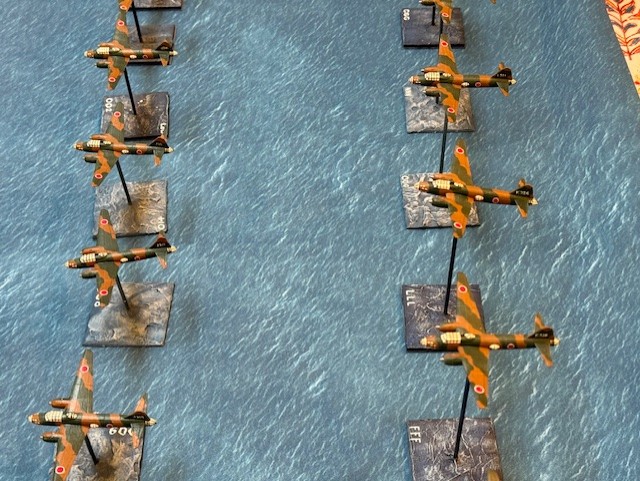
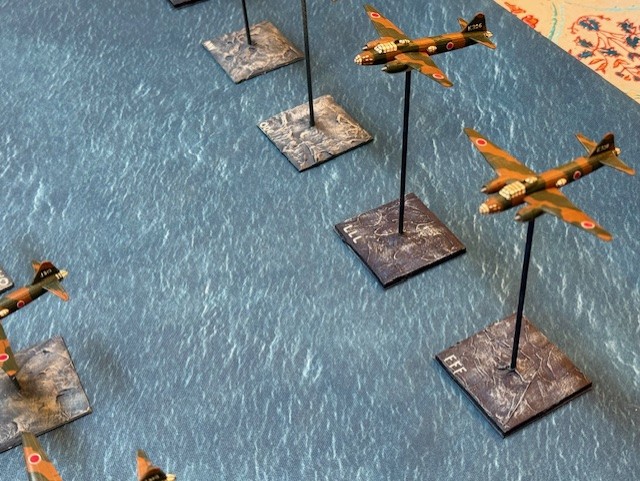
Betty bombers will be armed with torpedoes when the attack Force Z including the battleship Prince of Wales and Repulse.

Oops, hope the title isn’t too confusing. Those are two different things I’m doing.The first, and most time consuming is preparing for one of my Enfilade games–The Annihilation of Force Z. This is the Japanese naval air attack on The HMS Prince of Wales and HMS Repulse from Dec. 10, 1941, shortly after Pearl Harbor. The sinking of these two ships, together with the destruction of America’s battleship fleet three days earlier truly signified the end of an era in which surface ships could roam the seas in daylight without air cover in the face of a determined foe with massive modern air assets.

This will be my opening Enfilade game. Friday afternoon I’ll be tucked away in the Alder Room and the game will be a four player cooperative game. All the players will be Japanese pilots trying to do their job: sink the two British capital ships. The Japanese pilots who flew the twin engined bombers that destroyed Force Z were veterans, and knew their jobs. They were at the end of their fuel limits and were afraid the Royal Navy slipped from their search. But when they were found, the various Japanese pilots were summoned to the place and they guided their attacks to success. It wasn’t easy. The anti-aircraft fire was fierce. The angles of attack weren’t favorable. But in the end the deed was done, and airpower prevailed over sea power. The Japanese players will have to do the same.

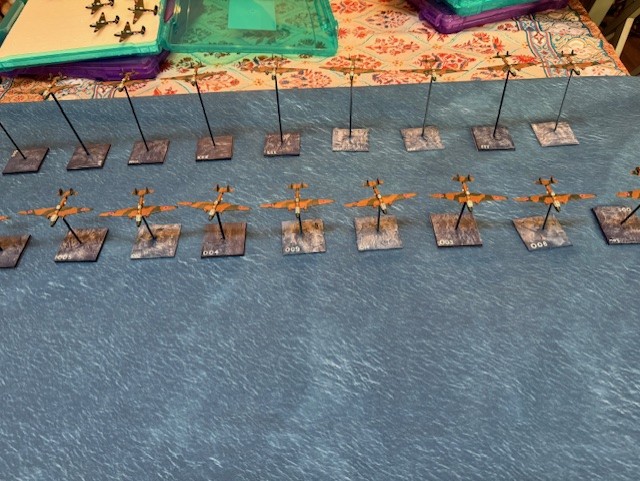
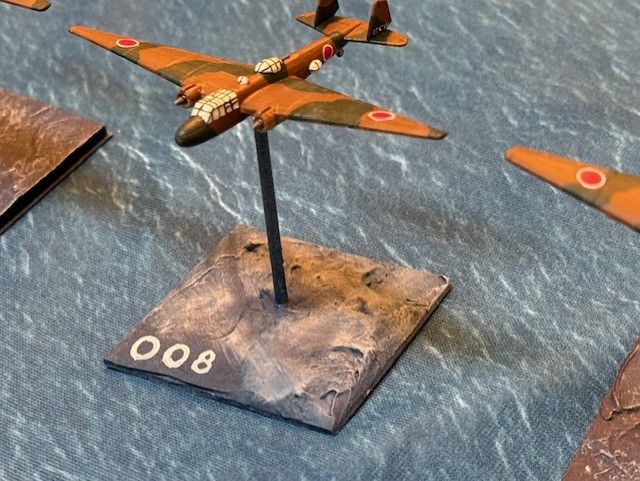
From left, a little closer look at the Bettys. Center, 18 Nell bombers that heft bombs or torpedoes in the game. Everything is stuck on a low or high level flight stand identified with numbers or letters. The things we do for our games. Right a little closer view of the Nells.

The rules for the game will be my own. The Japanese planes will appear on the board in squadrons of 7-9 planes. Sometimes two squadrons will appear at the same time. So there won’t be 50 planes on the board all at once, but there could be 18. At the beginning of the game, a simple die roll will determine the additional obstacles the Japanese will face. It could be that some of the squadrons were intercepted and some planes were lost or damaged. It could be that the squadrons are even a little more scattered by weather. It could the seas are rough and the conditions are windy and it may be more difficult to hit with bombs and torpedoes.

The rules are mostly my own work but inspired by other games I’ve played. As always, I’m motivated by the aircraft rules in Airwar 1940 by David Manley. A lot of the AA rules and scenario specific flying rules are determined by what can keep the game simple and easy for the players to figure out on a Friday afternoon. The bomb and torpedo rules in the game have stretched my thinking, and I’ll be referring to three sets of rules to determine something final. Those are an old set of rules called “Clear for Action,” “Command at Sea 5” by the Admiralty Group, and “General Quarters, 3rd edition.” I’m really inspired by the Osprey Air Campaign book on Force Z and Martin Middlebrook’s wonderful writing in “Battleship” which covers the history of Force Z from it’s inspiration in the UK to it’s apocalyptic demise.

I’ve painted more than 40 planes for this game. They are all 3D printed from Flight Deck Decals. Equal numbers of G3M Nells and G4M Bettys. Finished the last of them a couple of days ago. I’m working on the five ship models that will have to be built. I’m done with two of the three destroyers and then come the capital ships.

Play testing will be critical to the success of this game at this convention, though that hasn’t always guaranteed success in the past. Careful planning rarely survives first contact with the gaming public with all apologies to Helmuth Moltke. However, I am hopeful I might have a first go of it on March 14th for our scheduled game day at the Veteran’s Museum in Chehalis.

Though I spend a lot of time in my den painting (and building) stuff, I do try to get out and game regularly. I think I’ve written that when I was working-teaching-I spent a lot of time planning for my games but rarely got out to play as often as once every other month. Now I try to get out to game at least once a week. Doesn’t always work out that way but I do my best.

Recently, I begun playtesting a set of rules for my friend Chris Leach. Chris is a game designer in White Rock, B.C. who has worked extensively with Arte Conliffe on a number of games and gone on to design and publish some of his own including the ancients game Control to Catastrophe. Chris tends to favor mass battle games, but he put something together that is kind of skirmishy and asked if I’d be willing to give them a try. I put together a couple of scenarios for my Wednesday gaming colleagues to try. We liked them.

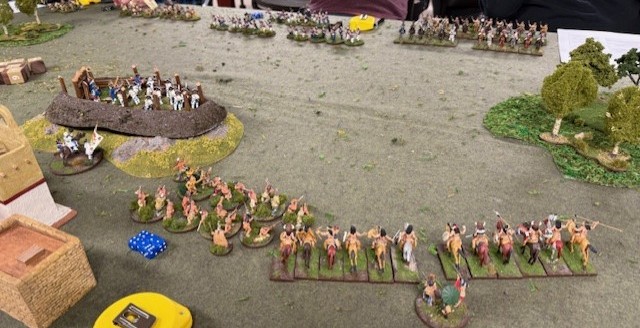
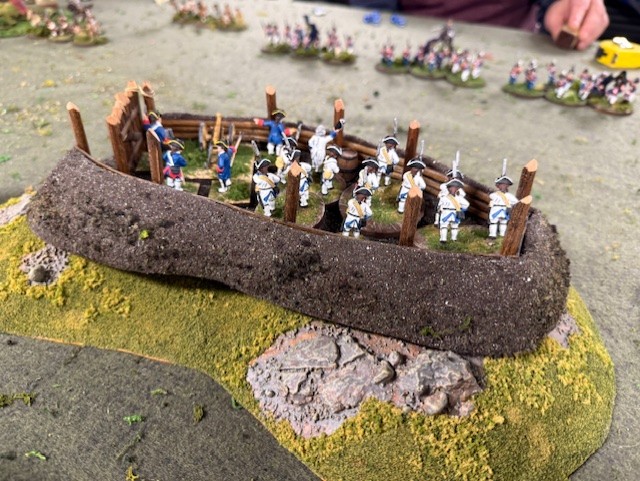
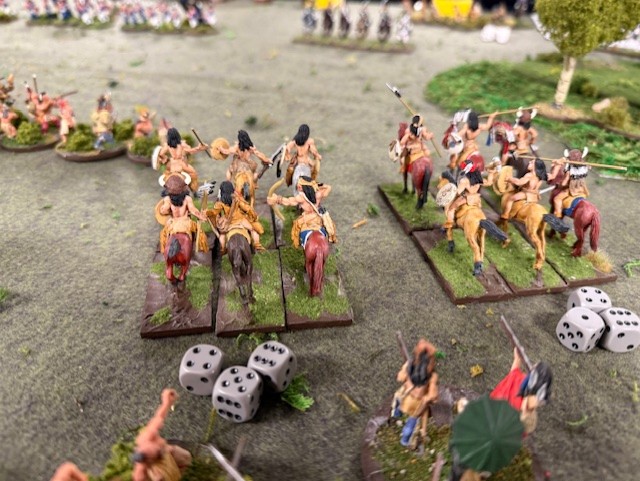
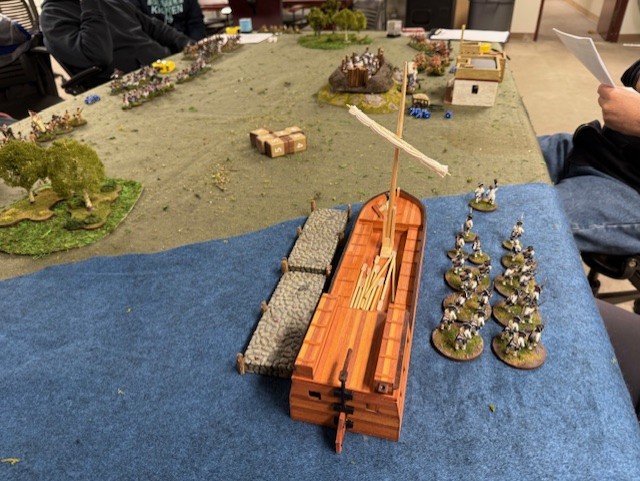
Our Take Action game from last week. The Americans were tasked with forcing the Spanish out of “Nachitoches” during a hypothetical conflict in 1806 over the Southwestern boundary following the Louisiana Purchase. Figures are mostly Old Glory Wayne’s Legion, some Conquest Comanches, and some RSM Spanish. The keelboat was scratchbuilt for me a long time ago by Mark Waddington. The game was tough on the Spanish mostly because the rules didn’t quite work as I intended. Back to the drawing board.

The rules are called Take Action. They are for that horse and musket period also covered by Daniel Mersey’s Rebels and Patriots rules. Like R and P the rules are activation based, but activation can be more varied. Units may combine different actions with their die rolls. The number of die rolls is determined by the quality of units. So, regulars get four die rolls and militia get three. A unit can use these dice to rally, move or shoot. The mechanics of the game are deliberately simple, and we have had no trouble picking them up and playing them. We’ve been able to give them a try a couple of times and are angling to get in one more game sometime this month.

It’s been fun to get in on this, and I appreciate Chris trusting us enough to not make a mess of them.