Burning Hesselberg Pt. 2: The playtest

Yesterday we did the first playtest of the game.

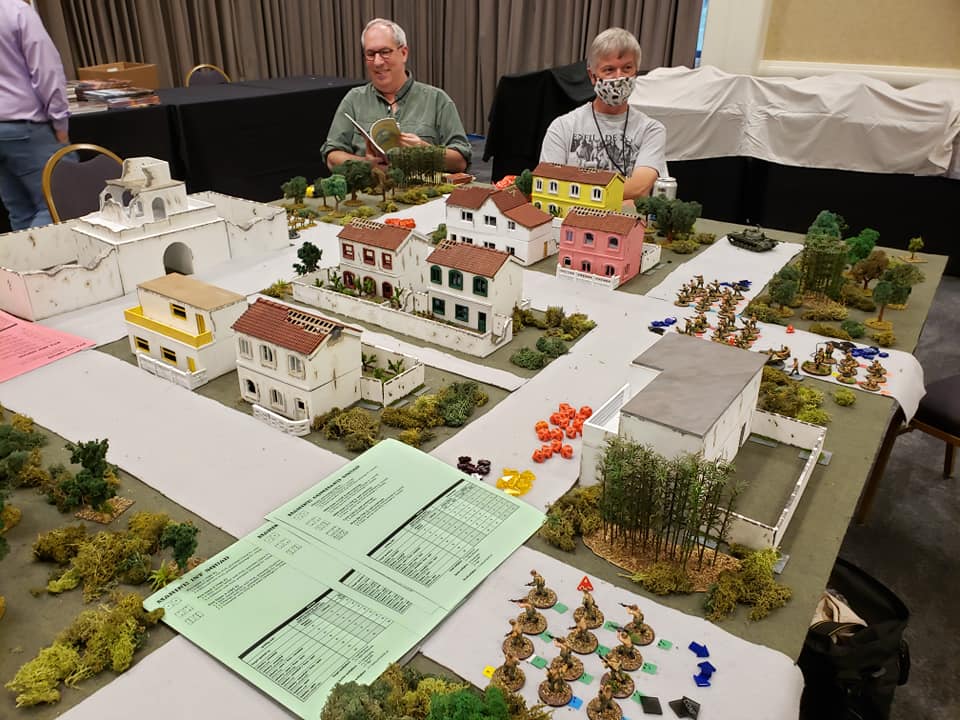
The Cascadia Tabletop Gamers held their monthly meeting yesterday at the Panther Lake Library across the parking lot from  Wizard’s Keep because of a game conflict-which unfortunately wasn’t actually a thing.  The one real complication with the move to the library was the size of the table space. I was planning on something close to 8′-6′ and I lost about a foot. Not catastrophic, but I would have loved a tish more set up space.

In the scenario , the British have the onus of being offensive.  They have to burn houses, and forage from gardens to punish the town for its support of the Continentals during the winter/spring of 1777.  The most valuable of the landmarks is the Sylvester Sawmill.  The Americans have fewer troops, but their mission is more defensive: defend the mill and kill British.  Both sides played well, especially not knowing the rules.
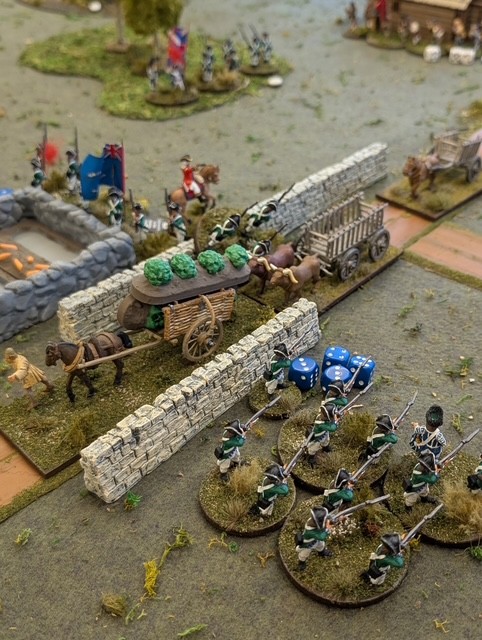
Wes Rogers effectively used his provincials to fend of the Patriots while gathering forage.

The Americans were allowed to plunk their three militia units in the town before the British set up and deploy six markers including three dummies to represent potential positions.  The British were also able to deploy one of their commands, the three units of Loyalist Provincials in the town with wagons for removing forage.  The remaining British, a command of three loyalist militia and a command with a unit of light cavalry and Hessian Jaegers came in on one end of the board.  An American command with two units of Continentals and a unit of Continental riflemen came in at the other end of the board.
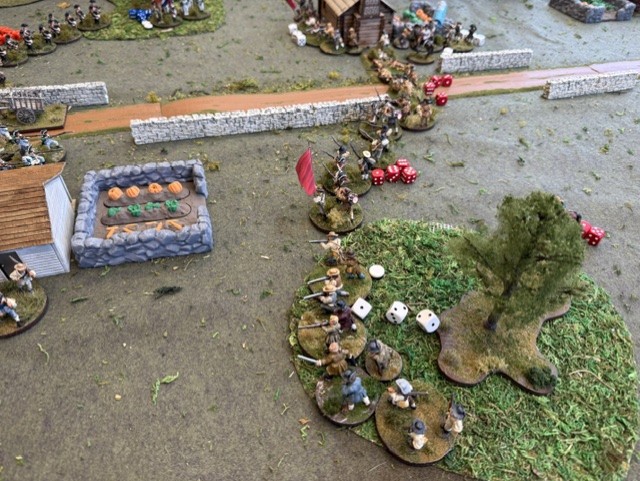
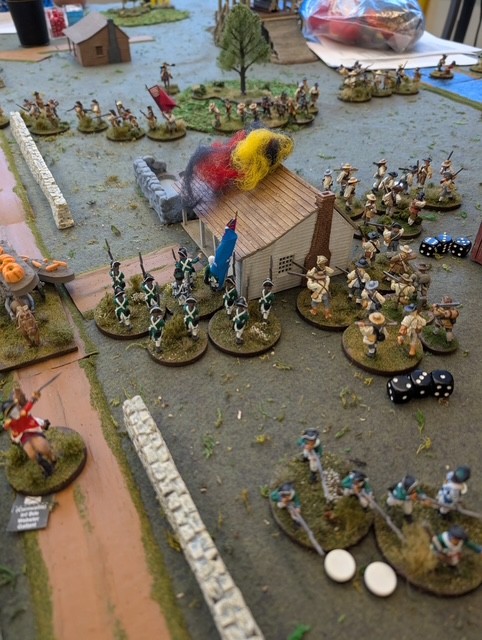
The Americans used the woods and the house to anchor their defenses to limit the British advance into Hesselberg. The building became known as “Hesselberg Alamo.”

The British, in addition to dealing with the Americans, had to put up with my in-game shenanigans.  They had limited torch markers to burn things with and had to make my silly die rolls to get things to burn and they rolled phenomenally badly, so it wasn’t easy.  But in the end three of the seven buildings on the board ended up ashes.  The Jaegers and the militia were also subject to a “become looters” rule.  No harm, just time wasted.  Only one of George’s militia units fell into the spell of ransacking a house they should be burning.
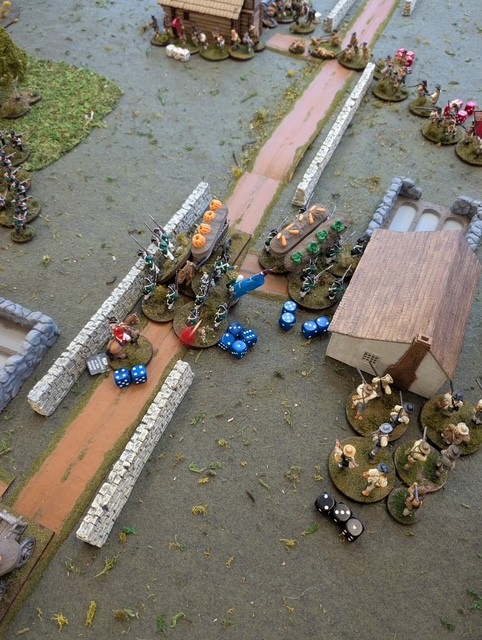
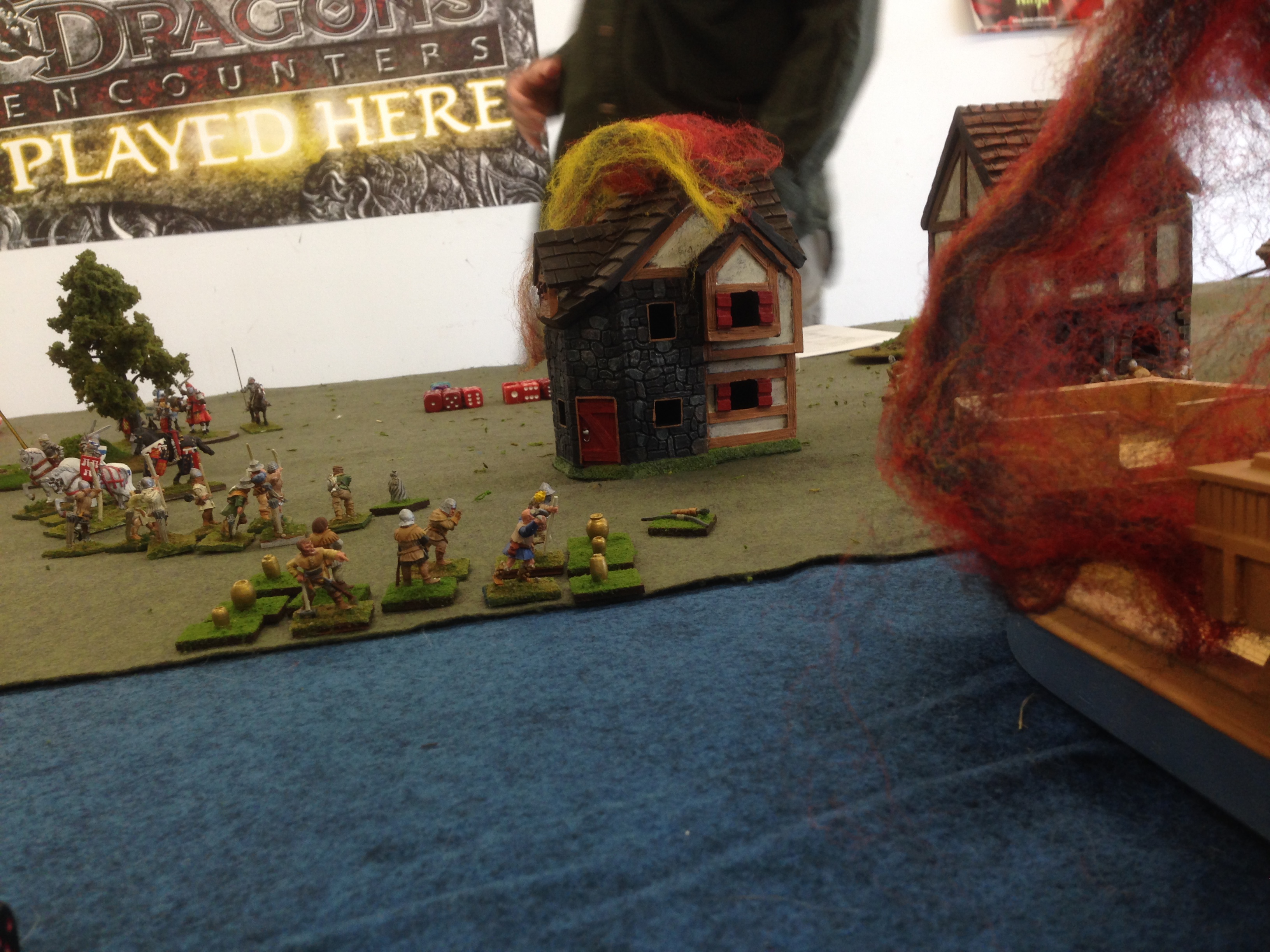
One of the factors holding up the British advance was the “looting” shenanigans I pulled on some British units. Thankfully only one of George’s militia units was snared by the looting die roll. This is them piled up outside the house instead of burning it.

The real game, however was in the two battle lines that formed in the middle of the table.  The Americans seized formidable positions that they defended well, inflicting damage on  the British usually from cover and regularly made saving throws.  One of the houses, occupied from the beginning of the game by one of Joe’s militia units, became known as “Hesselberg’s Alamo.”
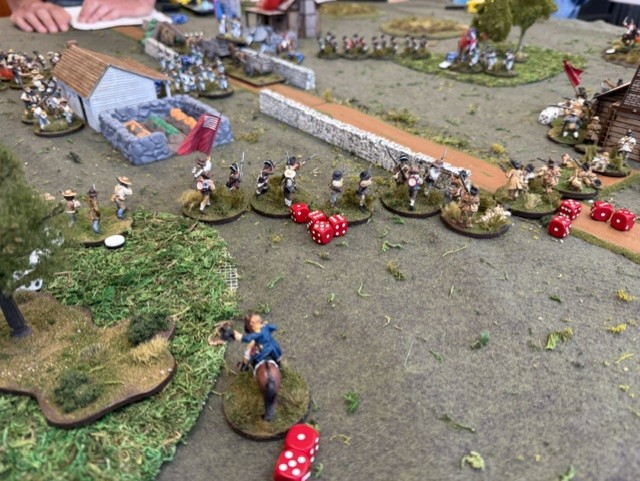
The battle lines form from the American POV.

The final gambit was Bruce using the speed of his dragoons to ride around the flank and rear of the American army to seize the valuable sawmill, but Americans, seeing the danger were able to bring fire on horsemen and inflict significant damage.  We ended the game shortly after. 
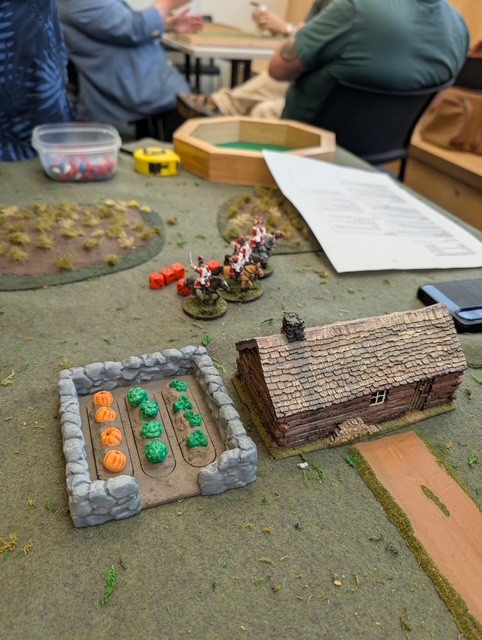
Bruce’s dragoons ride around the American army as they attempt to capture Sylvester’s sawmill. They were thwarted as the Continentals diverted units to target them with damaging fire.

Based on the victory conditions I wrote for the game, the British received points for burning and removing forage, but the Americans held the vital sawmill and dished out a fair number of casualties.  It would have been a slight American victory.  But Hesselberg did lose almost half its buildings and half its forage, so I’m content calling it a draw.  The British had a difficult job and played well.  So did the Americans.  I was quite loud and had fun.  A few tweaks were suggested and they will be incorporated when I run the game again at Drumbeat South.

There are a couple of rules issues I need to work through. This was the first game I’ve played with cavalry. According to the rules it really takes two hits to kill a figure. That’s something I overlooked and it won’t happen again. There was also a melee that didn’t turn out the way I thought it should, so I’m working through that. But the game was played with five guys who hadn’t played the rules before and I think had a pretty solid grasp of them before we were through.

Force Z travels to Chehalis

A setting up picture of Repulse. It would not stay quiet for long.

Today was one of those days. I woke up at 3:15, and could not get back to sleep. At 5:00 I began drinking coffee and reading Chernow’s Washington. It didn’t put me to sleep either. I loaded the car last night. I started the car, and headed out at 6:30, stopped for a breakfast sandwich and Americano at Starbucks, and hit the road for Chehalis. Traffic was fairly light. and I pulled into the Vet’s Museum at 7:50. I laid claim to a table and immediately began setting up. By 8:45, I had four excellent choices to run the game and we got started.

The Force Z game is played in five waves. In each of the waves there is either one squadron or two squadrons, 7-9 planes or 15-18 planes. Their goal is to deliver their ordnance while surviving as much damage as possible from the shipboard AA fire. The Japanese win by sinking the British ships. Anything less is a loss.

The first wave of level bombers achieved their purpose with a hit and fire in the hangar area of Repulse.

It didn’t take long to find four volunteers for the game. Vic, Dale, Joe and Jessica all were the Japanese mad bombers. Wave one was eight Nell bombers with 250kg bombs ready to drop them on the Repulse. They dutifully flew over the ship in column, and each plane dropped two bombs inflicting one hit that caused minor damage. The players could all learn what it was like to move, turn and take AA fire. The Repulse, in the middle of a violent made half its inadequate AA fire unavailable for the first wave, and inflicted some minor damage to the attacker

Joe and Victor plan their attack for Wave 2 on the smoking Repulse.

The second wave was a bit more challenging. The players get two squadrons of planes to run. They’re Nell torpedo bombers. The torpedo attack rules are more limiting. The bombers must be at low level. The attacks must be made at speed 7 or less until they drop their torpedoes. Torpedo ranges are critical and pre-measuring isn’t allowed. Bombers can’t launch in a turn in which their planes are turning. But torpedoes are the money in this game. Bombers flying two miles high just don’t hit much, so it’s the torpedo luggers that have to do the hitting.

Wave 2 attacks the Repulse from the Southeast corner of the table. Lots of great discussion between the players about which chances to take. They decided a straight in strike would be best and with four torpedo hits, who’s to argue.

The players had some decisions to make. The board entry put them closest to Repulse. Would they attack there? Would they maneuver planes to both sides and attempt an “anvil” attack (raises the chances of a hit. Would they try to shift the entry location and tempt the fates that all planes would get there on time.

For the time being their decision could wait. At the beginning of the game they rolled on the Getting Started table which had three possible outcomes, all kinda bad for the Japanese. They rolled the Interception option. The British had 11 Brewster Buffaloes waiting 90 minutes or so away to come to the aid of the Force Z if called upon. In the Getting Started table, a die roll would direct the Buffaloes to intercept Wave 2 off table, with a die roll against each squadron. Jessica’s die roll directed both attacks on Lt. Take’s squadron and he paid the price. Two planes were shot down, and two were so badly damaged they couldn’t continue. Lt. Takei would be bringing 3 planes to the table instead of 7. The Japanese could have rolled differently and broke up their attacks or created unfavorable sea conditions making it harder to hit, but got the interception instead.

Lt. Takei’s survivors and Lt. Ishihara’s nine planes stuck with a plan to attack Repulse directly. Though they had planes damaged in the attack, none were shot down before their torpedoes were launched, and one was shot down as it was exiting the board. The Repulse was not so lucky and suffered four torpedo hits. But it wasn’t just the hits. It was the die rolls on the damage table that were 7,7,8,8 on the D10’s the game uses. Anything 7-10 does critical damage, such as flooding, rudder jams, loss of AA or internal explosions. The Repulse was left in pretty bad shape, in a sinking condition and loss of most of her AA. Eeep.

There was an actual lull of almost an hour between waves two and three. I meant to have a British damage repair roll. I wasn’t prepared (as in, I forgot,) but that will be something for a future game.

12 of the Bettys in Wave 3 targeted Prince of Wales. The Prince actually shot down two of them, but as you can see, five torpedo hits left her paddling for her life.

Wave three was two full squadrons of Betty torpedo bombers. Bettys actually lugged heavier torpedoes but I just didn’t think a distinction was worthwhile. They approached from the west, or mainland side of the Gulf of Siam. Five targeted the listing, sinking Repulse, while the remainder attacked Prince of Wales. By the time they departed the Repulse had taken five more hits, and the Prince of Wales engineering was wrecked, she was listing and the game was pretty much done.

Vic’s five remaining planes targeted the listing, rudder jammed hulk of Repulse. You can see what happened. Five hits. Secondary explosions. Ick.

Overall, I was incredibly pleased with the game. It looked great. It played easily enough. The mechanics of movement, anti aircraft fire, bombing and torpedo attacks worked well. The torpedo damage was really bloody, but the die rolling for the Japanese was really hot and I can’t do anything about that.
But one of my goals was to get the Japanese through all five attack waves and we only made it through three. So here are a few things I’ll do for the next play test.

  1. Move the Prince of Wales a little closer to Repulse. That way the Japanese can still gang up on one of the ships, but it’s more likely they’ll be able to support each other with AA fire.
  2. Put two British destroyers on the table. There were three destroyers as part of the task force, though they seem to have played little part in the Dec. 10th attacks except for rescuing survivors. I have rules for the destroyers. They are mostly a distraction and contribute little to the AA attacks, but they’re something.
  3. Probably the big change is making the torpedo attacks harder to hit. Don’t have a problem with the damage, but it seemed like they were hitting at a rate of about 40% which is about twice the rate historically. It’s easier to judge the short range distance on the table from the long range, so hitting on the table has to be more difficult. At the current time hitting is possible on a 7-10 unless there are subtractions for angle or damage. I’m torn between hits on 8’s or 9’s.

Another playtest on the 28th at Wizard Kings. I’ll need to organize. Looks like the PoW’s mast needs a repair. But looking forward to it.

Just one last word in praise of the Chehalis Veteran’s Museum. First, for our group, it’s a terrific venue for a game space. It isn’t huge, but it could easily house our three or four games we ran each period. It’s comfortable, not too warm, lots of room to spread out. We had 32ish folks there at one time. It wasn’t loud, which is what often happens with a bunch of old guys who don’t hear well. I didn’t spend time in the museum itself, but I have and it was great. Lots of great stuff to see including exhibits on women in the service during WWII. Some might call that woke; I just call it history. It’s equidistant between Portland and Seattle and we had a nice turnout from both areas. We’ll be back in August, and I hope to be there too.

Force Z explained

The Trumpeter Repulse completed and ready for action.

In a few days I’ll run my first playtest of the Force Z game I’ve planned for Enfilade. It’s one of three games I’ll run at the convention, but because I’ve written the rules and more or less designed the game myself, it’s the one I’m most proud of, concerned about, most involved with. So I’m going to lay things out for you, dear reader, we’ll see how it goes, and I’ll follow up with a review.

For those not in the know, Force Z was the naval task force the British sent to support their forces in Singapore. The task force included the relatively new battleship Prince of Wales, the WWI era battlecruiser Repulse, plus several destroyers: Express, Electra, and the WWI Australian vessel Vampire. While cruising the Malayan coast, hoping to intercept Japanese invasion forces, the ships were set upon by long range Japanese naval bombers and destroyed. Happening a few days after the Pearl Harbor attack, the raids on the Philippines, and host of other Japanese raids, Asia was on the edge of falling to the Japanese, and the Age of the Battleship seemed to have sunk in the muck of Hawaii and the bottom of the Gulf of Siam.

Prince of Wales and Repulse with a few of the markers I made for the games. The markers were more fun than the models.

The game was suggested to me by a friend. He was a fanatic about doing this game. Though I did the work on the game, it wouldn’t have happened without James’ suggestion. Dave Schueler and I did similar games combining air and naval elements. In those games the ships were simply targets, pieces of terrain. Dave built the ships, I painted most of the planes, and Dave designed the scenario. Often there was air combat over the ships. In this game air combat is unlikely and will take place off-board.

In this game, I’ve envisioned the battleships as a large unmoving target much like marshaling yards in Normandy, the ball bearing plants of Schweinfurt, or the oil production centers of Ploesti.

This is a co-op game and all four players will fly the Japanese bombers. The planes will arrive in squadrons and be armed as historically, either with bombs or torpedoes. It’s not quite enough to just say, okay go sink the ships, because generally that would be pretty easy. I mean, it was easy. So, I’ve added some circumstances to spice things up a bit. At the beginning of the game the Japanese commander will make a die roll that will A) cause the squadrons to be even more split up, B) two squadrons are intercepted by alerted Buffalo fighters and suffer damage, or C) the conditions are rough and it is harder to hit with torpedoes. Another variable, is whether any British destroyers are present and give a tish more AA support during the game. Again, a die roll

Torpedoes in the water and a hit on the Prince of Wales.

Each wave of Japanese bombers arrive in a specific order. There are five waves of planes, some are bomb armed, some armed with torpedoes. Some waves are a single squadron of 7-9 planes, some are two squadrons each with 7-9. The planes are subject to AA fire and can be damaged or destroyed. Each ship puts out a certain level of fire that is measured in D10’s. Each turn the squadron remains within the radius of that fire they’ll have to roll. Level bombers can only be hit by long range fire. The torpedo bombers will have to brave long range fire and short range fire.

The game will be won or lost by the torpedo bombers. Their torpedoes can be launched at long range (20″) or short range (10″). If they have a broadside shot, that’s better, but maneuvering to get to a better position will keep them under fire longer.

The challenge will be to keep the mechanics simple, and the game challenging. Ideally the Japanese players should have to work through all five waves of planes with the ships sunk or near sunk at the end. If they are sunk after the second wave, there’s a problem.

I’d like to give credit for the inspiration for the game. I would like to imagine it sprang into my head one day, and I exclaimed “What a great idea!” but I’m just not that smart. First and foremost James McAbee suggested it to me last summer and I wasn’t sure. We agreed to talk more and we did. I agreed to do the planes, because they’re planes, I love planes and that wasn’t hard. The challenge was to create a workable game engine. I considered a six player game with two British players who would also run a British air interception featuring everybody’s favorite Buffalo fighters. But a conversation with Chris Craft in December really changed my thinking and encouraged me to look at this as a cooperative game instead. Initially I was thinking six players, but felt there might not be enough for six players to do, and so I cut it to four.

I read the Osprey Air Campaign book on Force Z, which is handy and has useful information. However, to really get to know the action I highly recommend Battleship by Martin Middlebrook and Patrick Mahoney. The book is focused on the formation and destruction of Force Z. Lots of useful details on the differences between ships, the Japanese search process and the actual action itself, the nature of the British commanders. I can’t recommend it highly enough and it’s a great read.

The basic air mechanics are largely based on David Manley’s fun and very playable Airwar 1940 rules. Dave Schueler and I used the rules for most of our “and bomb stuff” games. For this game, because it needed to move quickly through the attacker waves, I eliminated the phase 2 for each turn, but the mechanics for those turns were the same.

I do take credit for the anti-aircraft fire tables. I had a lot of trepidation over the bombing and torpedo tables. I consulted Manley, looked at Command at Sea, GQ 3 and an old set of rules called Clear For Action. But I needed something simple for To Hit. It wasn’t going to be a game that involved running out torpedoes aligned against ship movement because the models weren’t going to be moving on the table. So I cobbled together a few simple modifiers and put together a hit table I hope will work. I was really concerned about calculating damage–again something that was quick and dirty–and really labored those and drew the most inspiration from Clear For Action and did my best to offer something that was simple, and possibly dramatic.

Finally, I’d be failing if I didn’t give credit to my missing bestie Daveshoe. I think this game contains the best of the work we did together, including the simplicity and common-sense abstraction that offers an interesting but easy-to-play convention game. He is much missed.

I’m hoping for three playtests before the convention and I am anxious to give it all a try.

Modeling: Gee I Wish I Was Better At This

These are the three destroyers that escorted Prince of Wales and Repulse. They include the Australian destroyer Vampire, and the two British E-class Express and Electra.

Over the years I’ve had all these genius ideas for games that required building plastic models. There was the Golden Age of Air Racing game. These mostly really old Hawk air racing models were pretty simple. I even bought an air brush and compressor that I stopped using after the planes were done. Pretty serviceable stuff. I built a model of a Littoral Combat Ship when Dave and I ran our Bulldogs Away game for a Gulf of Hormuz scenario back in the mid aughts. I took advantage of a local hobby shop’s estate sale of models. But there are some 20 boxes of 1/700 scale ship models sitting in my garage, none larger than an Aoba class cruiser waiting for construction.

What would I do with them? Well they are mostly scenic pieces waiting to be bombed in an air game. I have a few Americans, including a Liberty ship. I have a lot of Japanese. Thinking Rabaul. I have two friends working on Bismarck Sea projects, so that’s probably unnecessary. The two Aobas are for the day after Cape Esperance and what happened when American planes based at Henderson Field tangled with IJN planes from New Ireland over the damaged, fleeing cruisers.

This is kind of a tag-along I thought I’d go ahead and finish. It’s a Tamiya O/P class that I finished as Pathfinder with it’s green-gray/dark gray camouflage.

Now there is Force Z. I ordered the necessary ships in November. There are three destroyers plus the two capital ships. I’m not dilly-dallying. I finished building and painting the small ships last night. Tomorrow, I’ll start on the Prince of Wales.

This is so not my long suit. Painting figures just comes a lot easier to me. For painting, I always know what I’m trying to do. I know what colors I’m using. I know how to modify those colors if need be. I have appropriate brushes that I’m really picky about. I paint every day, it’s a matter of routine. For model building, I lack experience an confidence. I have to fight off urges to be impatient and press on when things should be drying. Ack.

The Vampire was a V and W class WWI era destroyer in Australian service. Sunk in 1942 by Japanese carrier planes. The first of the destroyers I built and a good learning model.

I have learned some lessons from building the destroyers. The models were Tamiya ship models and easy to work with. I made a commitment to actually using model glue, the Tamiya thin brush on glue that worked fine. In the past I’d used CA glue, which is pretty unforgiving and allowed me to accidentally glue searchlights to hulls and my fingers. I bought some really great tweezers for use on applying decals and that helped with some of the really small parts. Just a heads up, these were purpose-built tweezers for modelers that were really inexpensive on Amazon. I think it was three pair for about six bucks, and more than worth the cost. Yes, I’m sure they’re from China.

The Express was the second of the two E-class boats. Always good to learn, and find a way to apply one’s failures.

I also learned that sometimes things just have to dry before trying to move on. Honestly, the Tamiya glue acts fairly quickly, but it does its work by melting plastic pieces together. That can take some time. I can always fold clothes, take the dogs for a walk or read a book for a bit before heading back to the den for another session.

Two views of the Electra. Electra was a challenge. Lost a boat davit somewhere on my dining room floor so she is short a boat. Managed to cover up the holes. Though I sprayed all the ships with primer after completion, Electra just didn’t want to take my Lifecolour light grey, so the base coat for both the E’s was Vallejo Sky Grey. Did complete the decks and camouflage with the Lifecolour paints.

But amid all that learning there is still some frustration. Ships have lots of little pieces. Gun directors, searchlights, boats and boat davits. I don’t really have a model builder’s table, it’s a painting table littered with painting stuff. It’s easy to lose tiny pieces or, worse, drop them on the floor even if I’m being super careful. I can’t tell you how many times I managed to find a tiny 20mm gun lodged in a little fluff of dog hair on my floor. I actually managed not to lose anything. Well . . . there is the matter of some misplaced decals. Sigh.
Painting is likewise a bit different. I’ve tried to use accurate naval colors based on what I’ve learned are the camouflage patterns on the British destroyers. HMAS Vampire is blacks and grays, while Express and Electra used grays, gray-green and blue-gray. I used the Lifecolor paint set for the Royal Navy. I’d used these paints before for 1/1200 scale ships and really liked them. The problem with many specialty paint sets, for me at least, is that many are really intended for airbrushing while I am a brush painter. So the paints tend to be pretty thin and require multiple coats. That’s a pain, but I lived through it.

But the good news is that the three British destroyers are done. And they were just rehearsal for what is coming. This weekend I hope to complete the Prince of Wales. It is likewise a Tamiya model. I’ve popped open the box and looked at the directions, and like the destroyers is a lot of sub-assemblies that eventually all go together and then requires some paint. A pretty complex camouflage pattern. It’s too large to build at my painting table, so I’ve gotten permission to work at our dining room table, but at least I have a plan. The Repulse looks even more daunting. It’s a Trumpeter model instead of a Tamiya kit. 300 pieces. Lord.

Annihilating Force Z and some playtesting

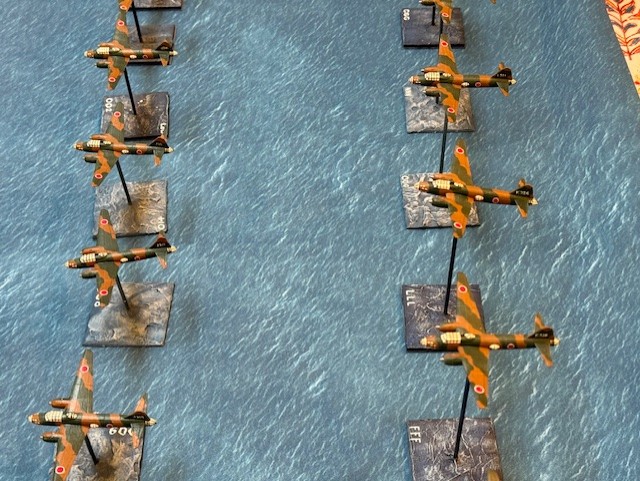
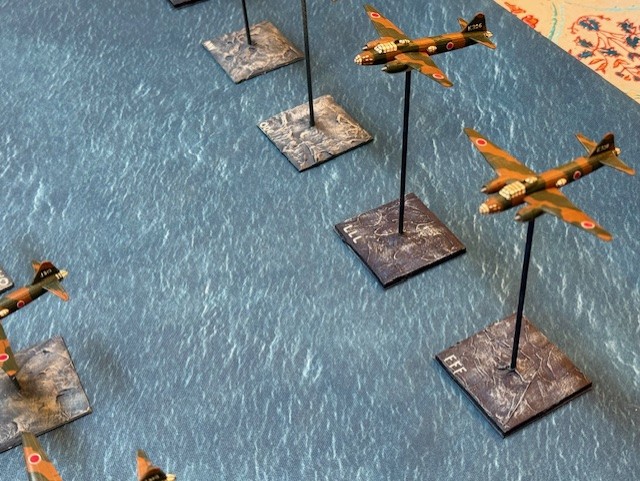
Betty bombers will be armed with torpedoes when the attack Force Z including the battleship Prince of Wales and Repulse.

Oops, hope the title isn’t too confusing. Those are two different things I’m doing.The first, and most time consuming is preparing for one of my Enfilade games–The Annihilation of Force Z. This is the Japanese naval air attack on The HMS Prince of Wales and HMS Repulse from Dec. 10, 1941, shortly after Pearl Harbor. The sinking of these two ships, together with the destruction of America’s battleship fleet three days earlier truly signified the end of an era in which surface ships could roam the seas in daylight without air cover in the face of a determined foe with massive modern air assets.

This will be my opening Enfilade game. Friday afternoon I’ll be tucked away in the Alder Room and the game will be a four player cooperative game. All the players will be Japanese pilots trying to do their job: sink the two British capital ships. The Japanese pilots who flew the twin engined bombers that destroyed Force Z were veterans, and knew their jobs. They were at the end of their fuel limits and were afraid the Royal Navy slipped from their search. But when they were found, the various Japanese pilots were summoned to the place and they guided their attacks to success. It wasn’t easy. The anti-aircraft fire was fierce. The angles of attack weren’t favorable. But in the end the deed was done, and airpower prevailed over sea power. The Japanese players will have to do the same.
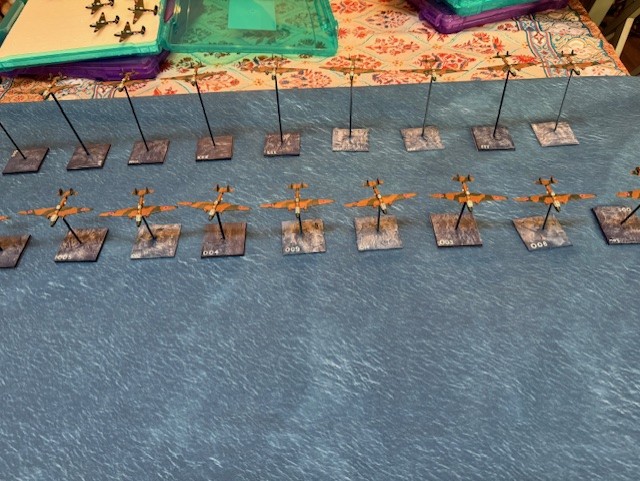
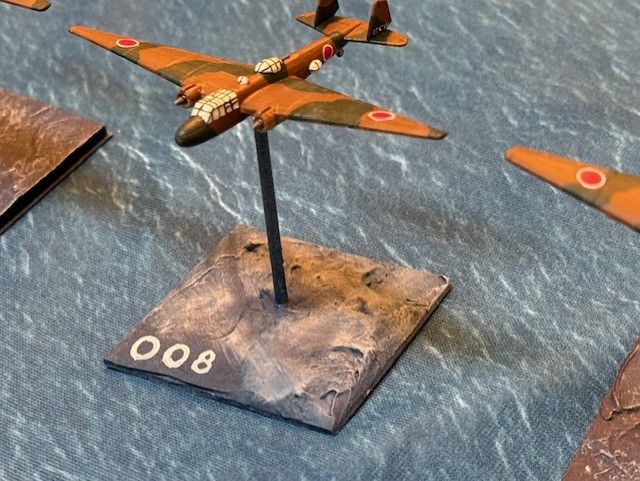
From left, a little closer look at the Bettys. Center, 18 Nell bombers that heft bombs or torpedoes in the game. Everything is stuck on a low or high level flight stand identified with numbers or letters. The things we do for our games. Right a little closer view of the Nells.

The rules for the game will be my own. The Japanese planes will appear on the board in squadrons of 7-9 planes. Sometimes two squadrons will appear at the same time. So there won’t be 50 planes on the board all at once, but there could be 18. At the beginning of the game, a simple die roll will determine the additional obstacles the Japanese will face. It could be that some of the squadrons were intercepted and some planes were lost or damaged. It could be that the squadrons are even a little more scattered by weather. It could the seas are rough and the conditions are windy and it may be more difficult to hit with bombs and torpedoes.

The rules are mostly my own work but inspired by other games I’ve played. As always, I’m motivated by the aircraft rules in Airwar 1940 by David Manley. A lot of the AA rules and scenario specific flying rules are determined by what can keep the game simple and easy for the players to figure out on a Friday afternoon. The bomb and torpedo rules in the game have stretched my thinking, and I’ll be referring to three sets of rules to determine something final. Those are an old set of rules called “Clear for Action,” “Command at Sea 5” by the Admiralty Group, and “General Quarters, 3rd edition.” I’m really inspired by the Osprey Air Campaign book on Force Z and Martin Middlebrook’s wonderful writing in “Battleship” which covers the history of Force Z from it’s inspiration in the UK to it’s apocalyptic demise.

I’ve painted more than 40 planes for this game. They are all 3D printed from Flight Deck Decals. Equal numbers of G3M Nells and G4M Bettys. Finished the last of them a couple of days ago. I’m working on the five ship models that will have to be built. I’m done with two of the three destroyers and then come the capital ships.

Play testing will be critical to the success of this game at this convention, though that hasn’t always guaranteed success in the past. Careful planning rarely survives first contact with the gaming public with all apologies to Helmuth Moltke. However, I am hopeful I might have a first go of it on March 14th for our scheduled game day at the Veteran’s Museum in Chehalis.

Though I spend a lot of time in my den painting (and building) stuff, I do try to get out and game regularly. I think I’ve written that when I was working-teaching-I spent a lot of time planning for my games but rarely got out to play as often as once every other month. Now I try to get out to game at least once a week. Doesn’t always work out that way but I do my best.

Recently, I begun playtesting a set of rules for my friend Chris Leach. Chris is a game designer in White Rock, B.C. who has worked extensively with Arte Conliffe on a number of games and gone on to design and publish some of his own including the ancients game Control to Catastrophe. Chris tends to favor mass battle games, but he put something together that is kind of skirmishy and asked if I’d be willing to give them a try. I put together a couple of scenarios for my Wednesday gaming colleagues to try. We liked them.

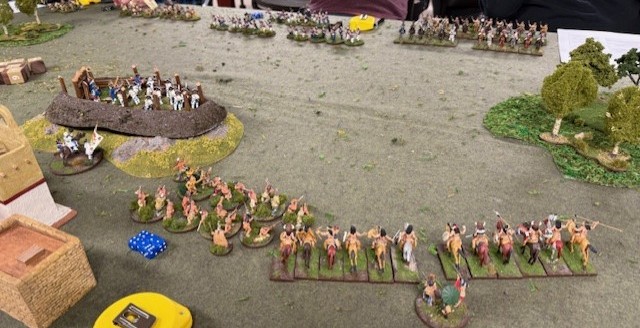
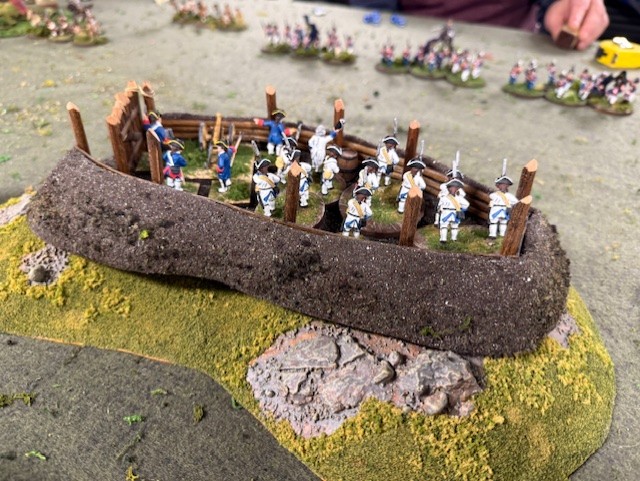
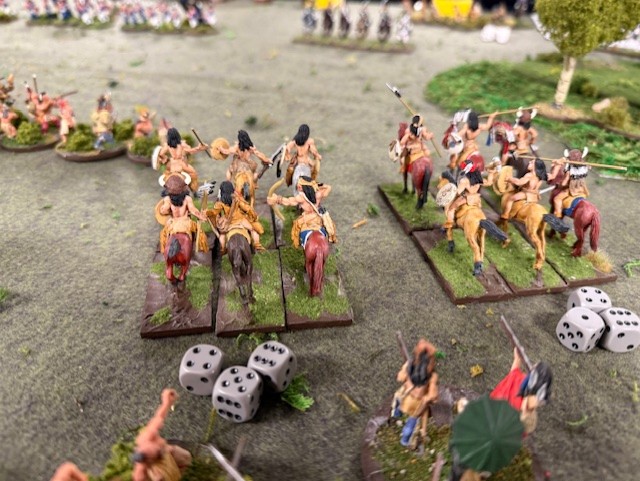
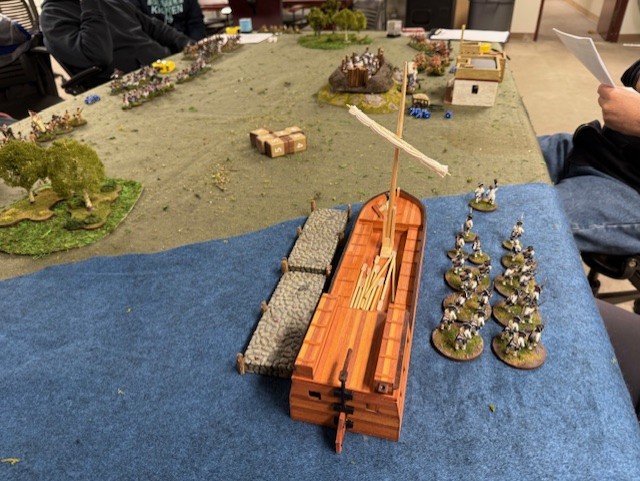
Our Take Action game from last week. The Americans were tasked with forcing the Spanish out of “Nachitoches” during a hypothetical conflict in 1806 over the Southwestern boundary following the Louisiana Purchase. Figures are mostly Old Glory Wayne’s Legion, some Conquest Comanches, and some RSM Spanish. The keelboat was scratchbuilt for me a long time ago by Mark Waddington. The game was tough on the Spanish mostly because the rules didn’t quite work as I intended. Back to the drawing board.

The rules are called Take Action. They are for that horse and musket period also covered by Daniel Mersey’s Rebels and Patriots rules. Like R and P the rules are activation based, but activation can be more varied. Units may combine different actions with their die rolls. The number of die rolls is determined by the quality of units. So, regulars get four die rolls and militia get three. A unit can use these dice to rally, move or shoot. The mechanics of the game are deliberately simple, and we have had no trouble picking them up and playing them. We’ve been able to give them a try a couple of times and are angling to get in one more game sometime this month.

It’s been fun to get in on this, and I appreciate Chris trusting us enough to not make a mess of them.

Just Carrying On

I hate to be morose and a downer, but there are times when I’m just bummed about my losses. Sometimes I just think I need to write away those feelings. Just to recap, in the summer of 2022 I lost my son Casey. Six months later I lost my Daveshoe. Last year I lost David Sullivan. I know I am not the only person who lost them. But, I can only write from my perspective, and their passing has left huge holes in my heart and in my life that are just holes.

Casey hearing from Patrick why the Beatles were the greatest rock band ever. Or maybe they’re discussing wrestling moves. Any or all of the above.

Losing Casey was and is indescribably difficult. He was my son, my gamer buddy. We are coming up on Thanksgiving which was his favorite holiday. He would come early, give attention to the dogs, and pretend to be helpful–kind of wishing there was a way he could be helpful, even if he wasn’t. Casey was a baseball hater, and he loved terrible music. Poor Casey would take the position that the Beatles weren’t that great and would have to fend off arguments from Patrick and I about how wrong he was. But he was an amazing son, a profoundly good person, a dedicated on-line gamer, and a very good board gamer. We miss him and talk about him every single day.

Shoe and I running our Raid on St. Nazaire game at Enfilade. I’m not sure why it seems like I’ve stepped in a hole here.

In the case of Shoe (Dave Schueler for those who might have no clue who I’m referring to, but he’ll always be Shoe to me,) I just miss the brotherliness of our relationship. We didn’t talk on the phone often, but sometimes, and the conversations were always enjoyable. It was always the collaboration, the getting together to share ideas about projects, new games, inevitably the Mariners and sometimes politics that I enjoyed most. I won’t recount all the games we did together. But we did love David Manley’s rules, and we hosted air games using his jet rules, Airwar C.21 and his WWII rules Airwar 1940. I was the chief painter of planes, but Dave crafted the scenarios and built the ships that would inevitably become targets.

2019 was the last time Dave and I ran any Manley air games. Covid canceled a lot of gaming including Enfilade in 2020, and his illness came right on the heels of the worst of the pandemic, so he had to stay away from exposure to germs. I’ve simply lacked the confidence to run these games on my own. I have Dave’s ships and some of his planes, but not the willpower to use them.

However, for at least the past decade George Kettler has pestered me about doing some Viet Nam era air games. I had the planes. And then I had some of Dave’s planes. And then I had even more unpainted planes. But the past few months something changed, and I embraced those challenges. A week ago we did get together at George’s with Scott Abbott and Bruce Syvinski and we tried a little Airwar C21. It was an easy-does-it walk through of the rules and we did pick it right up and it was easy to play and most importantly it was a lot of fun. Honestly, the two sets of Manley Airwar rules were similar and I’ve even figured out how to make the air data cards Shoe was so good at. I foresee more air games in the future, but I’ll be thinking about Shoe and all the trouble we would have gotten in together.

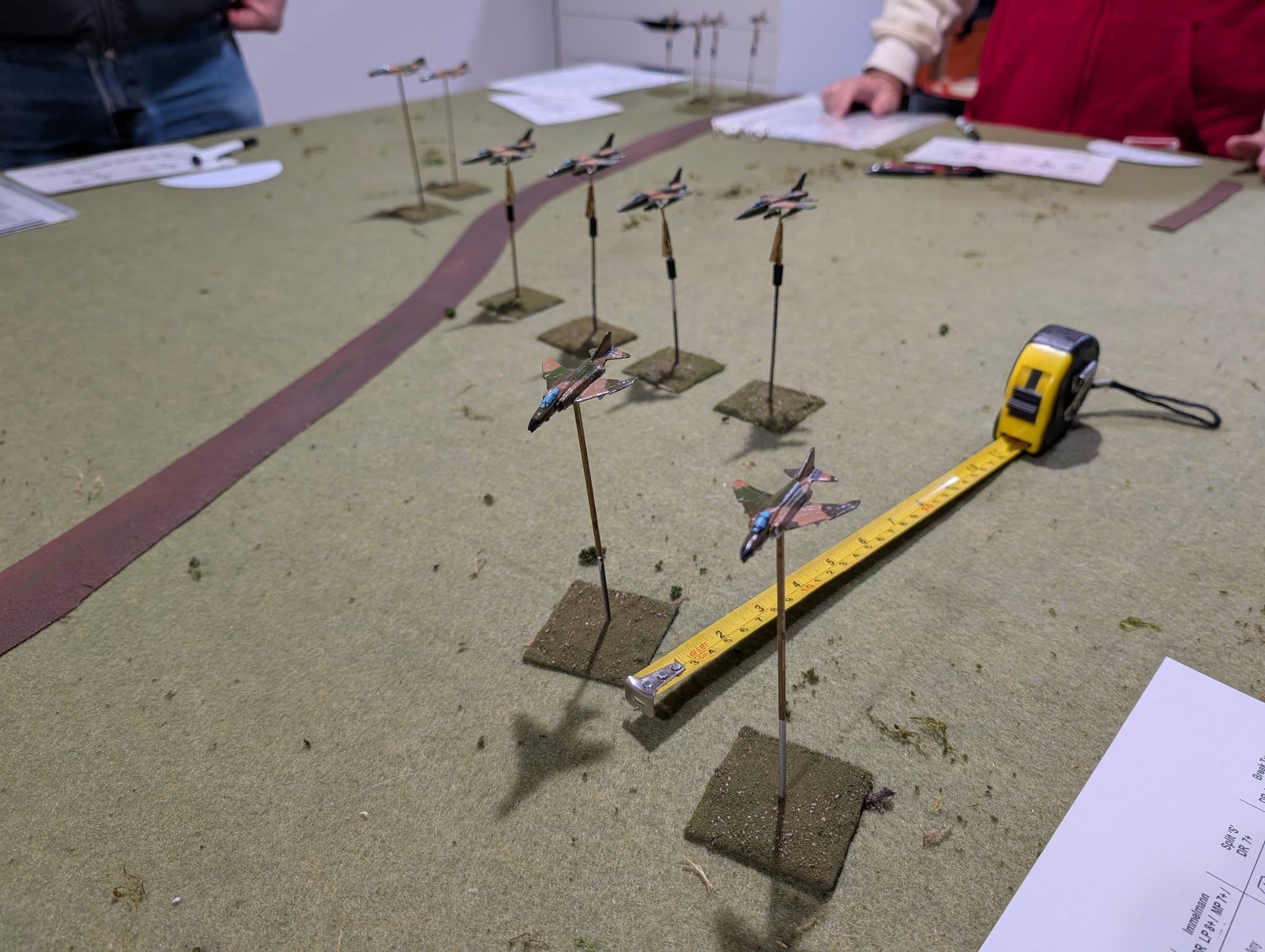
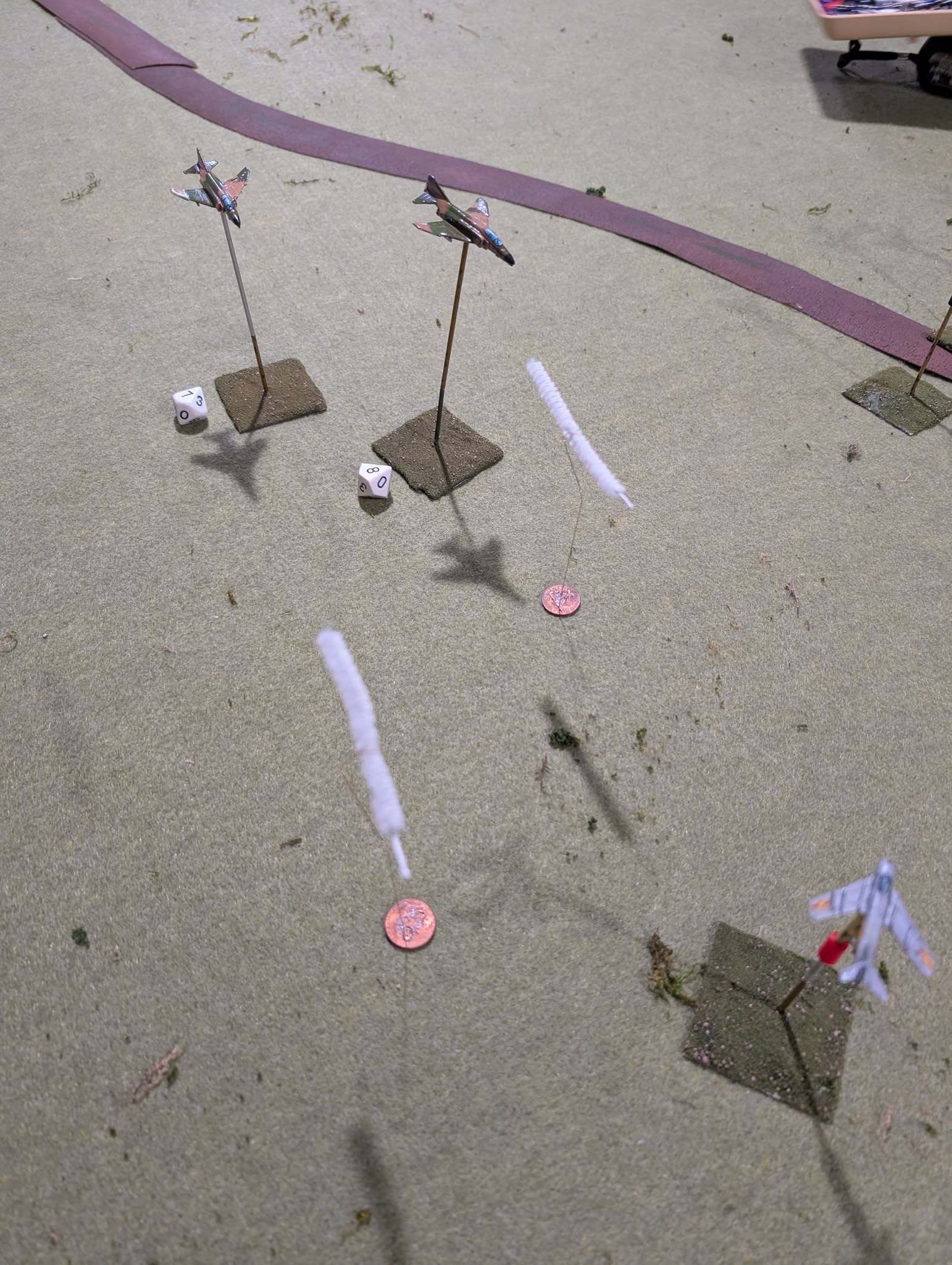
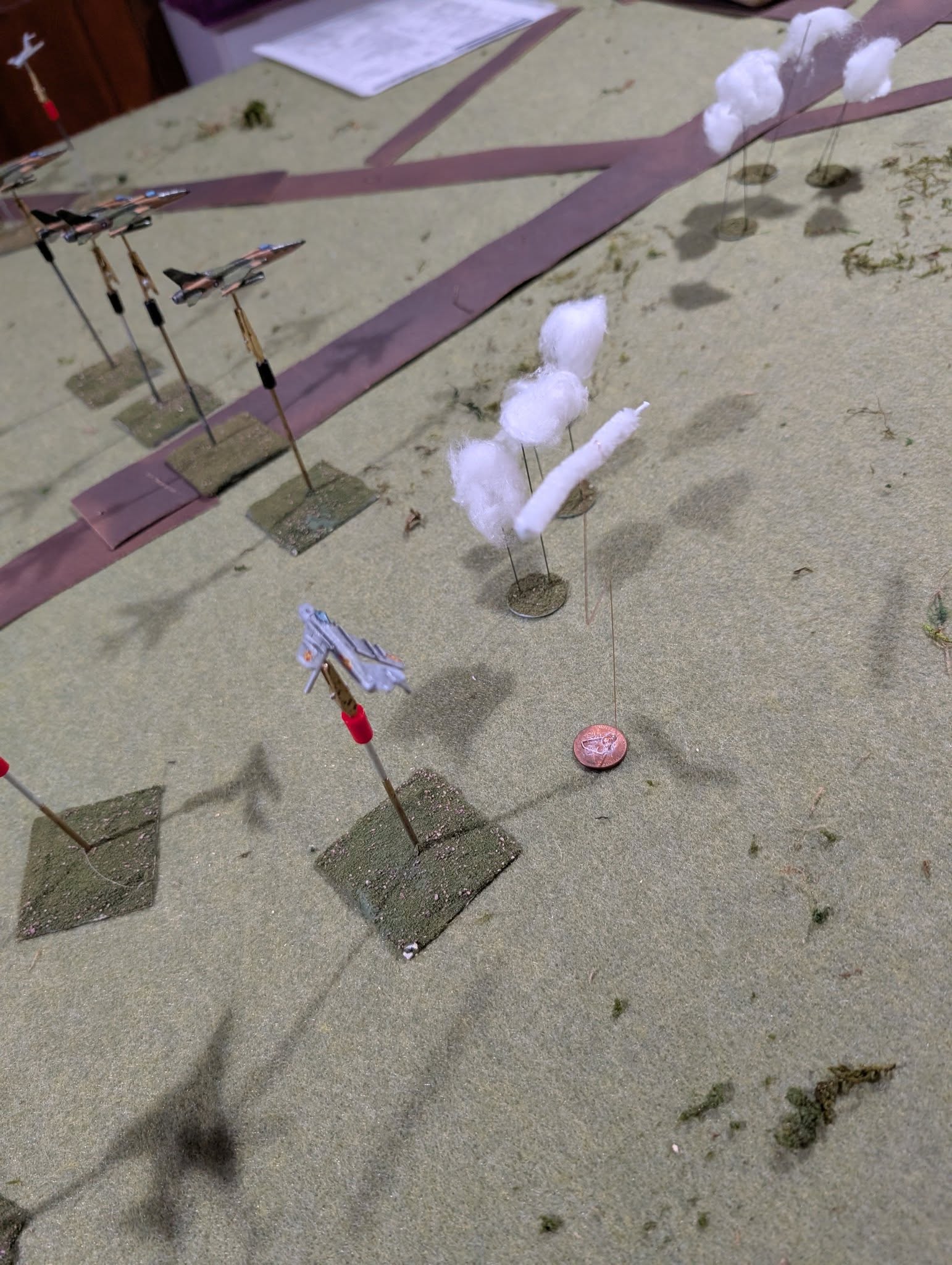
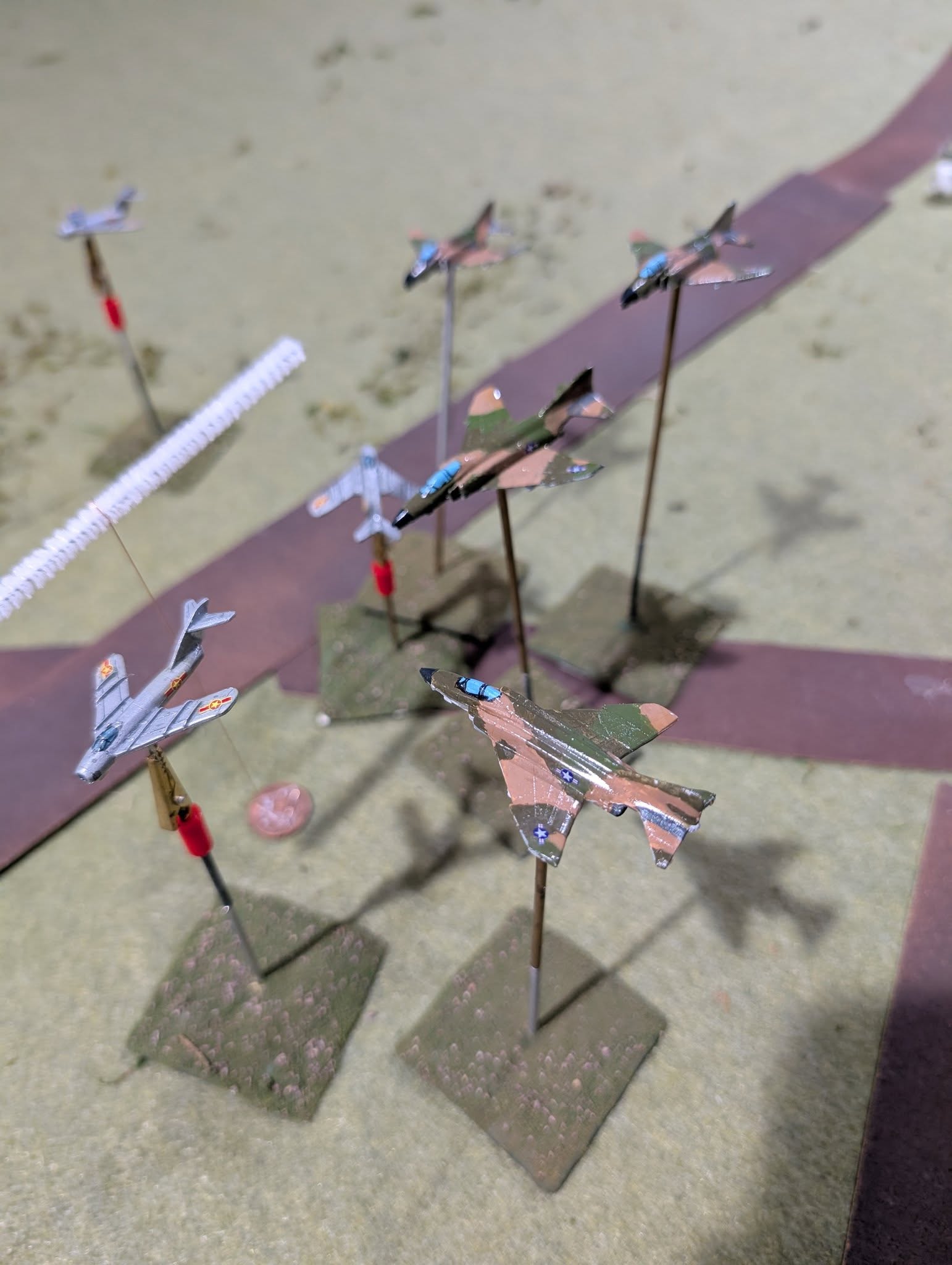
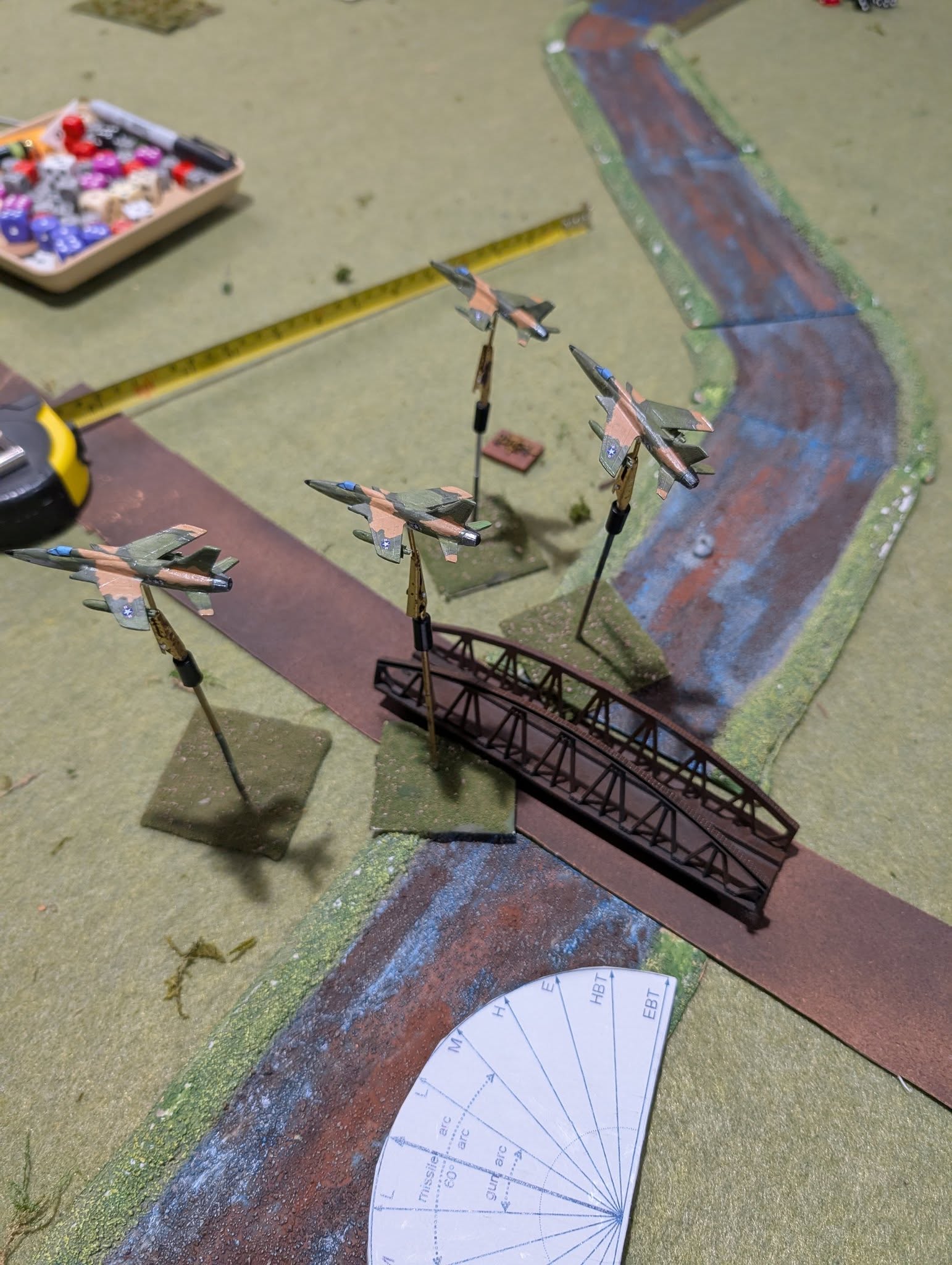
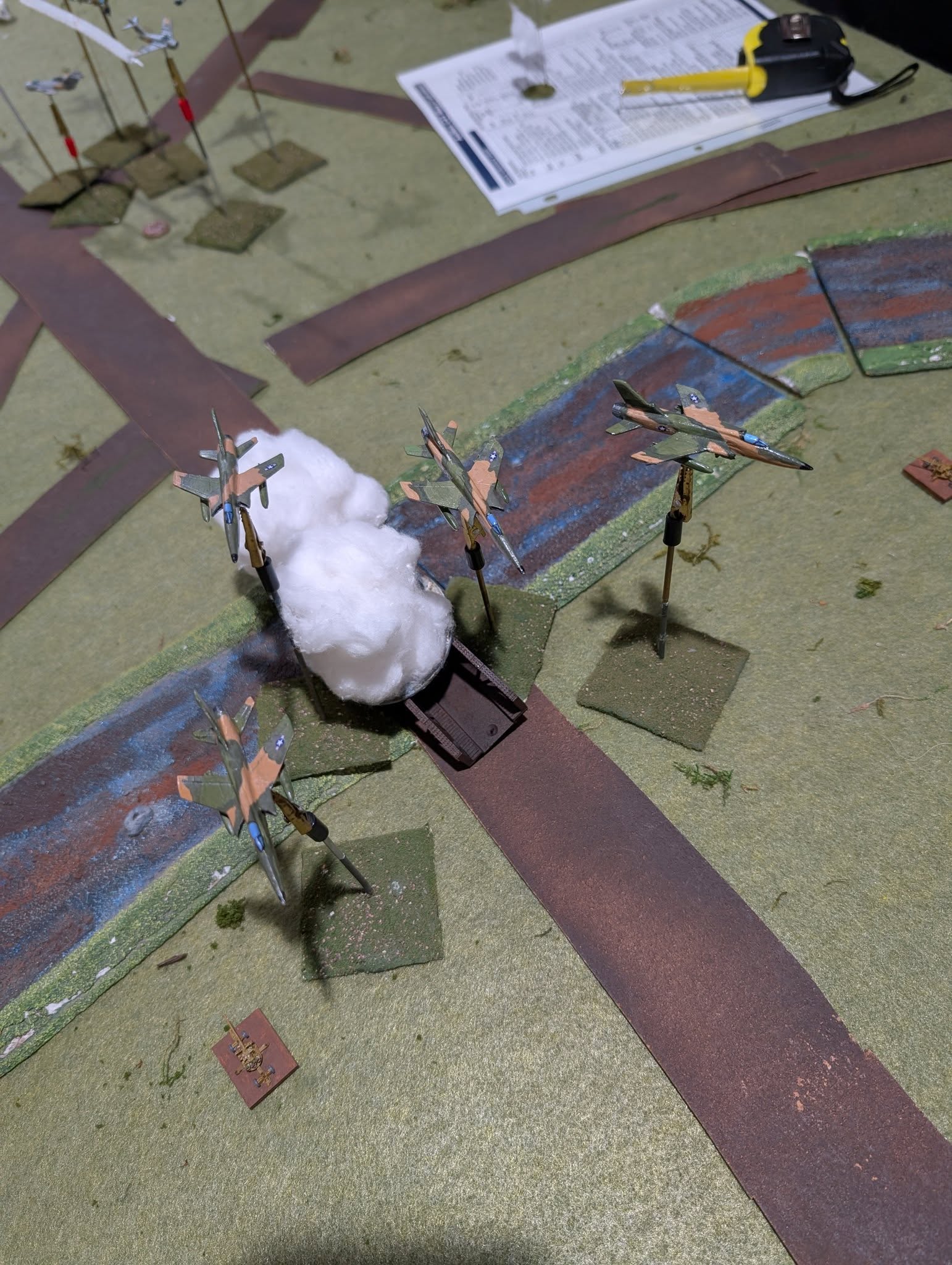
The game at George’s house was pretty simple. Four F-105’s commanded by yours truly were tasked with bombing a bridge. They were intercepted by four MiG-17’s that took too wide a turn to catch me. They were met by four F-4’s that launched piles of missiles at them, but mostly missed. All the Thunderchiefs got to their target, didn’t miss, rolled well and kablooey. All photos by George Kettler.

When David Sullivan developed pancreatic cancer and then passed away last March, I was just kind of lost. He was also a master collaborator, but had his own distinct and separate interests too. Again, we did so many things together, I don’t think it’s worth it to make a list, it would just go on and on. David had more stuff than we could all imagine. Some of it was stuff we’d done together, and some of it was his personal projects. When we moved it all mostly out of his garage, the question was what to do with it. David had gorgeous terrain, beautiful miniatures and just an incredible pile of unpainted miniatures. I tried to hang on to our cooperative stuff, and made sure that there was plenty to get out to others. I ended up glomming on to a lot that was unclaimed. For the past few months, it has mostly sat in my garage glaring at me, hoping for a plan. Unfortunately I don’t really have one.

One of my many favorite projects with David, the Battle of Hue in 2021 at Enfilade. Photo by Warren Bruhn.

Just to be clear, there isn’t any trash here. David and I had some big plans–He has a tub o’ Mexican War figures that we really need because we don’t really have enough Mexicans. There are two giant batches of American Revolution figures, that almost exactly match my giant pile of American Revolution figures. We were going to paint up some for Rebels and Patriots and some for Regimental Fire and Fury–Perry figures, Foundry figures and Front Rank British line. The good stuff. He has some beautiful Navis German Pre-Dreadnaughts that need a little bit of attention. And that isn’t half of it. Now if David were here, and I knew about all this stuff, perhaps we could give it all some direction. Or maybe we both would have run off in some other direction doing different things. But at least we would have talked about it and laughed about it and shaken our heads over lunch.

I’m in the middle of painting 26 of David’s remaining Crucible Crush figures. 11 are European and 15 are Indians. Added to the 50 or so figures we already have painted, that’s plenty to mess around with. They are great figures and a pleasure to paint.

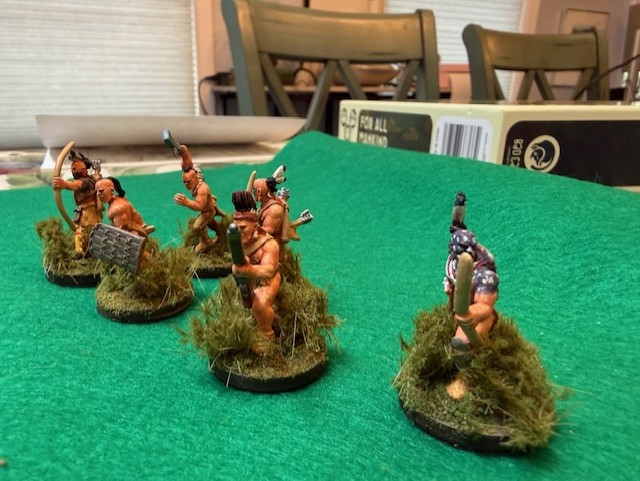
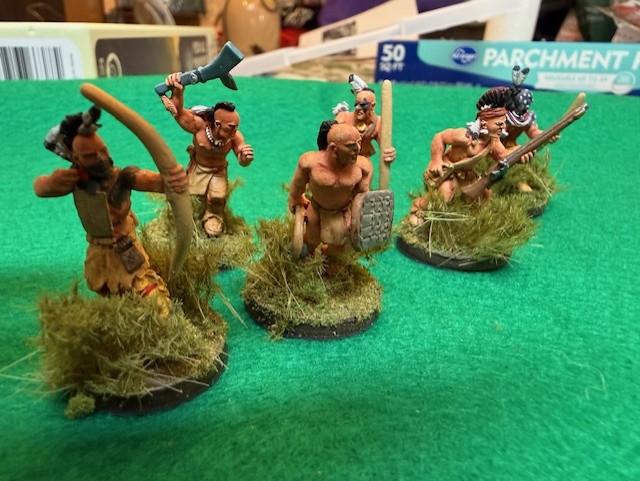
I’ve taken some of David’s figures into my den to have close by in case I’m ready to do something with them. I’ve started working on some of the beautiful Crucible Crush Europeans and Native Americans Bob Murch did for his Flint and Feather rules. I’m revisiting The Song of Drums and Tomahawk rules David and I used to do the early contact Native American stuff back in the days. It’s very stylized, but quite fun, true skirmish. I’m going to run a game using our figures at our December 6th game day. Looking forward to it.

I’m just having one of those moments when I’m missing my guys.

I’ve been quiet

My 60th birthday, 2015.

It’s been a long time since my last post. It’s not that I haven’t played games, or painted figures. We had a convention and lost a great game day. I’ve had some really great days and great games. But I think my writing go derailed when my friend David Sullivan died quietly on March 7th.

For those of you who didn’t know David, I can only say I’m sorry you didn’t know him. David was a wonderful man, an incredibly smart man who reveled in the knowledge of the arcane and off-beat. It informed many of his gaming interests. It made him a wonderful conversationalist. He was good friend, a lover of cats, and a good scotch. I deeply miss him.

I won’t carry on for too much longer, but David and I were good friends. We met the summer of 1991, right after the first Enfilade convention. We immediately became colleagues in a host of gaming projects. We did the Battle of Manila Bay with the old Houston’s ships 1/1000 scale models. We did Ironclads first in 1/1200, and when Toby Barrett launched his Thoroughbred 1/600 scale ships we transitioned to the larger scale and converted the hex-based games to no-hex miniatures. We used Crossfire to do a Tarawa game in the ’90’s. He dragged me into playing WRG 6th edition ancients in 28mm in the early 2000’s (I should have just said no.) We did Hue, and Aztecs. Our most successful game was the retreat from Concord. We did lots of stuff together, but we weren’t joined at the hip. David explored lots of projects on his home and self published a number of rules sets–Row Well and Live, for ancient naval rules, and Pike and Periwig for pike and shot in the age of Louis XIV.

Kevin and David do Hue, Enfilade 2021.

David and Daveshoe and I were a thing together. We just loved each others’ company. I’ll never forget in 2018 we spent the two previous weekends prior to Enfilade together playtesting Concord, then we ate every meal together during the convention. To lose them both has been hard.

David also had incredible piles of stuff. Painted and unpainted figures. Beautiful terrain pieces. Lots of ship projects. Together with my friends, Eric, both Marks and Michael, we’ve been able to see that it all got a home. I, of course, took way more stuff than I should, and I’m hoping to re-home some of it. But I’ve hung on to a lot of bits I’m hoping to do something good with over time. There are Perry AWI figures, a bunch of Mexican War figures, Ancient ships, pre-Dreadnoughts for Germany, Japan and China, Aztecs. You name it. David had a little problem with figures. It’s been really challenging rehoming some of it and absorbing more than I should, but I’m doing my best.

Though I haven’t written much, I have been busy. My big Enfilade project was the Battle of Shrewsbury from 1403. It’s a battle of English vs. English from the Hundred Years War period, though it was really one of the acts of rebellion against Henry IV’s usurpation of the crown in 1399. We played a modified version of Lion Rampant. Very bloody and very fun.

A group of us have decided to do the Spanish Civil War in 28mm a in sort of skirmishy version. I am painting Republican militia, both the POUM socialist militia and the CNT anarchists. Empress Miniatures are just really nice for the period.

I’m also working on my figures from the Cuban Rebellion 1895-98. I’m making progress through my pile. I’m going to have a bunch of stuff for Daniel Mersey rules “The Men Who Would Be Kings”, but I’m also doing some singly mounted figures for One Hour Skirmish Wargames. Dopily, I’d also like to add more figure types, American bluejackets and American Marines. I have an idea for a scenario–the landing at Guanica at Puerto Rico. Hoping it’s an August game.

I’m also planning for a couple of opportunities to pull out my Aztecs in the next couple of weeks. We’ll be using David’s Quetzacoatl Rampant modification of Lion Rampant as rules. I’ll be sure to write it up and share some pictures from the game.

I apologize for my absence, but it’s honestly I’ve needed some time away. Hope all is well with each and every one of you.

Because, Just Because: The Great Snow Fight of 1864.

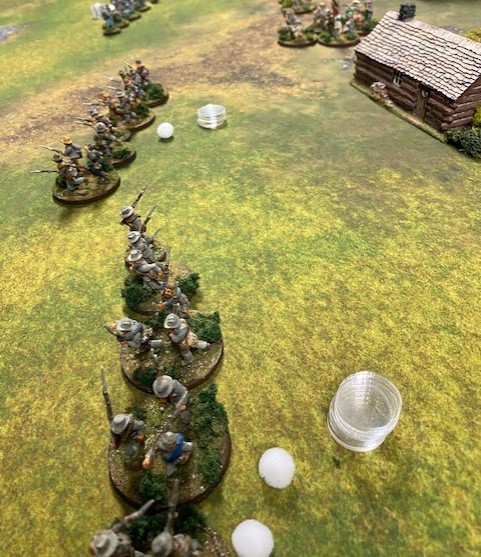
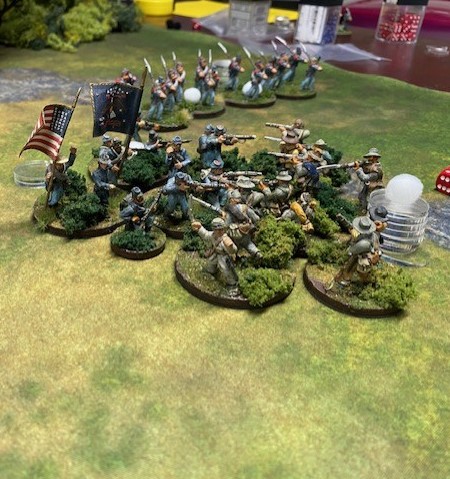
The 9th Florida prepares to advance against the 5th Georgia. Each unit has a stack of stamina markers and a supply of two snowball ammo markers that can be expended. Reloads are available but it’s tricky.

It’s been a while since my last post. Sometimes I feel like I just run out of worthwhile stuff to say. I’ve been busy. I’m probably playing 3-4 games a month. A fair amount of SAGA, some MEBSG (Lord of the Rings) and some Moro Wars using the One Hour Skirmish Wargame rules. More than anything I’m enjoying time with my friends. Oh, and preparing for Enfilade 2025 in May. Ack.

Georgians (blue) and Floridians (gray) brawl.

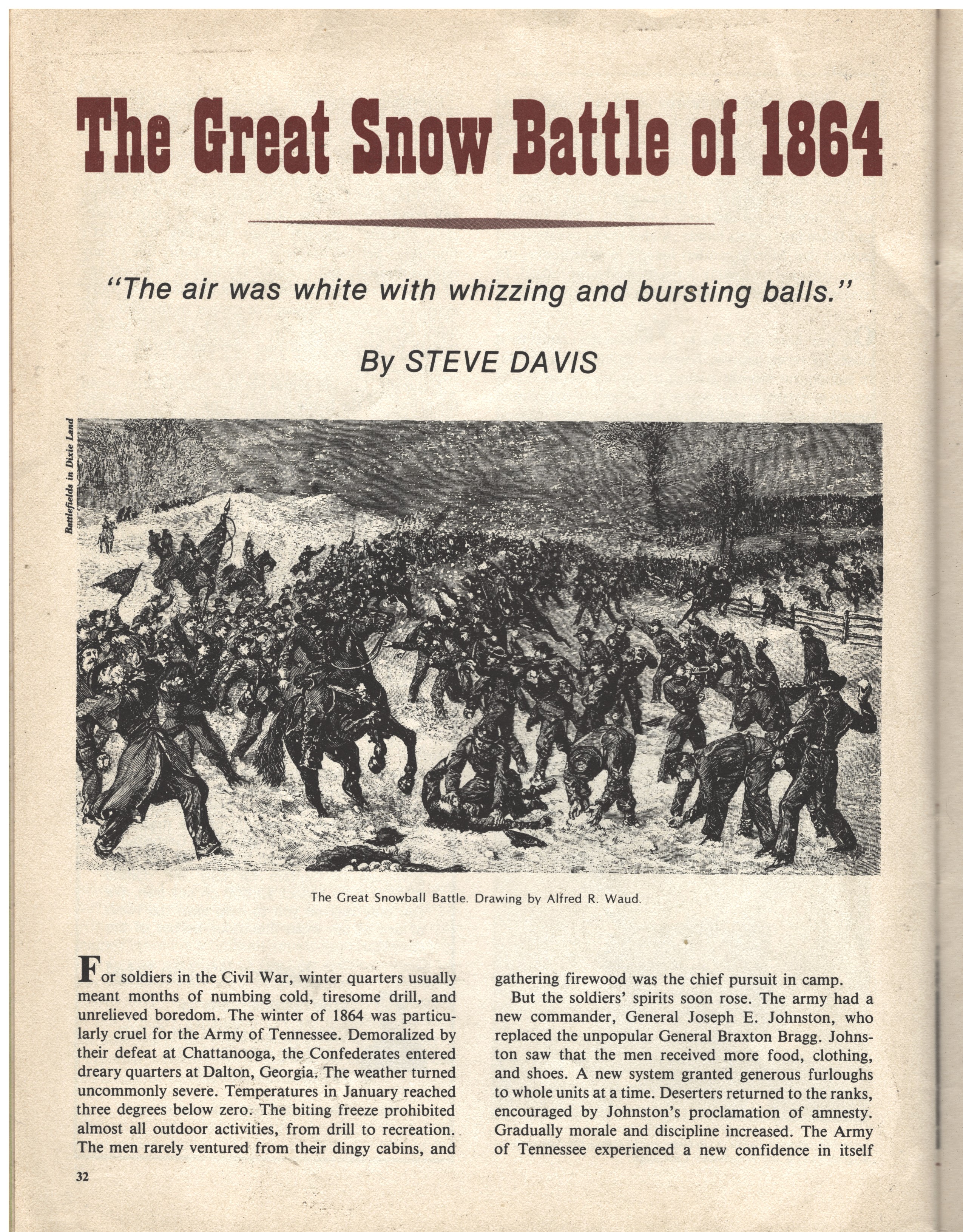
However, one day I decided to do something I’ve always wanted to do and that is write some rules for and run a game of The Great Daulton Snowball Fight of 1864. Just a quick historical synopsis. In 1864, the Confederate Army of Tennessee, disastrously ejected from Chattanooga at Missionary Ridge by U.S. Grant, was encamped at Daulton, Georgia in winter quarters preparing for the 1864 spring campaign. Under new leadership by veteran general Joseph E. Johnston, the soldiers awakened to a snowfall of 5-7 inches and snowball fights broke out across the encampment. Eventually, the skirmishes spread into company, regimental and even brigade level clashes. Generals Cleburne and Polk both appeared at the head of their troops as snowballs whizzed by. I learned of this fun-sounding clash while reading Steve Davis’ wonderful article (“The Great Snow Battle of 1864”) in the June 1976 issue of Civil War Times Illustrated many years ago.

Probably 25 years or so ago I tried to run a game using a published set of rules on this topic and it just didn’t go well. I’ve always had this in the back of my mind, and thought it would be fun–and different–so I cobbled the rules together over a couple of days and yesterday we tried them out.

I have a few ACW figures for Rebels and Patriots, six infantry for each side. These are twelve figure units. Not a lot of figure losses, though that changed a bit with our game play. I got together some willing friends on a Weekday Warriors Wednesday and we gave it a try. I’d like to say they were perfect out of the gate, but they weren’t. However there was a basis for constructive collaboration and I really appreciated that.

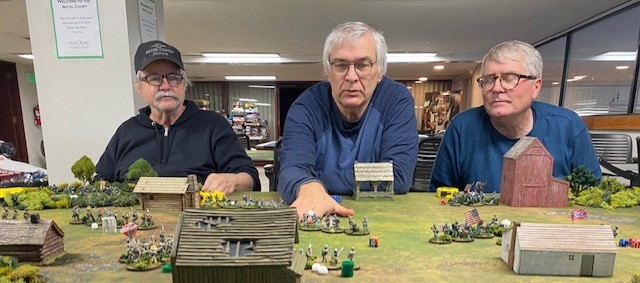
Mark, Mark, and Eric consider how best to survive this initial test of The Great Snow Fight of 1864

Each unit was allotted stamina points, because while snowball fights don’t cause casualties, they do wear out the participants with cold, wet and the odd bumps and bruises. Units could “huck” (throw snowballs) or they could “brawl” (melee). The rules as written really favored brawling, so we saw more of that than huckin’. Units expended their stamina points quickly in brawls which forced them to take time to recover their stamina before jumping back into the festivities. Each player also had an encampment building which needed some defending. Each turn was played in rounds with a die roll for initiative. Snowballs were restricted to supply and reloading. It was possible to have “dirty” snowballs, but they carried a required brawling response that was sort of like mutual assured destruction, so we didn’t see these used. We played 12 turns in about 2 1/2 hours

All agreed that the game was a fun idea and that there were lots of choices for players to make. Lots of sensible suggestions were made that standardized some game features, including figure losses (think of them as desertions as things got too cold, wet and rough.) I’ve already made changes to the rules and am anxious to try them again. I’ll get the chance on December 28th at the monthly Wizard’s Keep Saturday. Looking forward to it. A big thank you to Mark Waddington, Mark Wensnahan, Eric Donaldson, Gary Griess and Keith French for playtesting the rules. I had a lot of fun.

Enfilade around the corner: My mad dash to the finish line.

Though I may not have written much recently, that doesn’t mean I haven’t been busy.  I have three games I’m running at Enfilade, and I’m still trying to wrap up the last one in time for my weekend-before-the-convention playtest.

I’ve done a lot this spring/winter (this is so embarassing!) Dave Schueler and I will host a game we’ve wanted to do for many years-the 1942 combined sea/land raid on St. Nazaire. I slowly accumulated all the motor gunboats and assorted naval vessels needed to play the game, but the challenge was always going to be putting together what would pass for a harbor and adapting a game to it.  Dave and I have done a lot of projects together including the Tirpitz game and the Persian Gulf tripwire scenario with lots of modern gunboats, but this was especially challenging.  Dave did most of the work modelling the various pieces representing warehouses and dockyards.  I contributed some, but the work is mostly his.  The scenario will force the British players to cooperate and be aggressive as they try to land their commandos in the face of fire and demolish their targets.  Dave and I will run the Germans using a combination of ideas from David Manley’s excellent Action Stations and the old Raid on St. Nazaire board game by Avalon Hill.

I’m also running two games using the Lion Rampant rules by Daniel Mersey.  As I’ve written before, I really like these rules-you just need to think outside the box. The first scenario, Raid on Agen, I’ve already written about.  I’ve done a couple of playtests, and hopefully I’ve worked out the flaws. It represents a typical chevauchee of the Hundred Years War.  Maybe not typical, but the French are inclined to resist in this scenario.

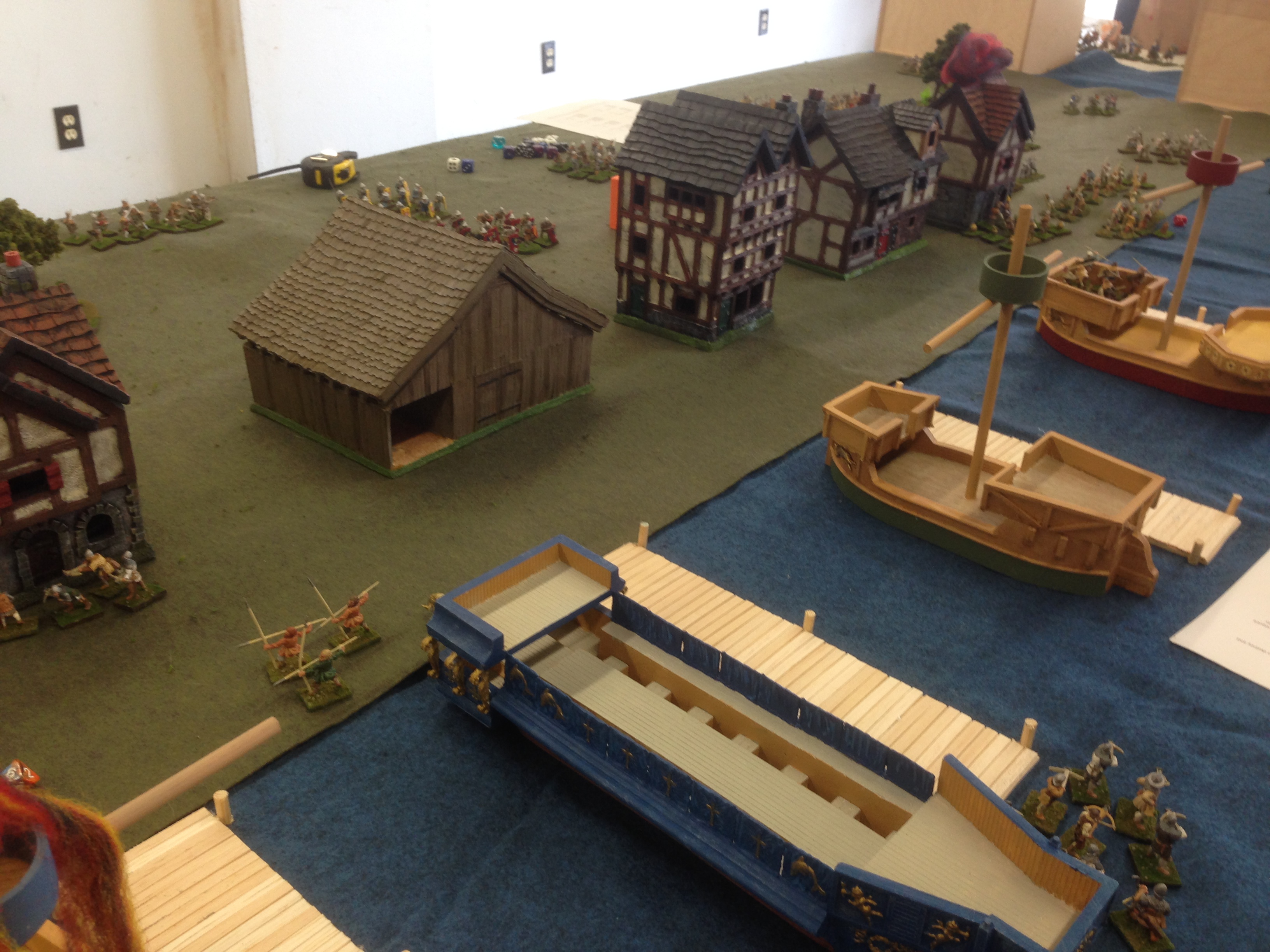
The second game is the preparation sucker.  It is based on the English raid on the port of Bolougne in 1340.  It reminds of the Raid on St. Nazaire in the sense that the raiding force was disembarked in darkness, did their work, but were trapped and captured or killed. The English will start on either end of the lower town.  Their job is to destroy buildings and ships along the waterfront. The resistance in the dock area is light, but enough to be a pain to the attacking English. The challenge to the English will be the French relief force as it masses and thunders down from the upper town.

For both scenarios I’ve tried to think outside the box.  I’ve used or created troop types to assist in the scenario.  Town militia was a type suggested on the game forum hosted on Boardgamegeek.  I’ve created a sailor troop type to defend some of the ships.  I’ve also created an engineer type charged with destroying the ships and town in the Bolougne raid. In addition to troop types I’ve also worked out rules for burning.  In the case of the Bolougne scenarios, I’ve put together rules for tow-wrapped flaming arrows and combustibles used by the engineers.  Don’t know how historical they are, but they should be fun and easy.

Playtest photo.  The English land in the lower town, setting afire a waterfront building and a ship

Playtest photo. The English land in the lower town, setting afire a waterfront building and a ship

I hope to have pictures from the Saturday playtest on the web by the weekend.

The playtest set-up. The French fleet rests at anchor as English retinues approach from either end of the town. French reinforcements boil out of upper Bolougne and down to the docks

The playtest set-up. The French fleet rests at anchor as English retinues approach from either end of the town. French reinforcements boil out of upper Bolougne and down to the docks

August is the best month

I haven’t posted much this summer.  That’s unusual because summer is when I typically get a lot of painting done, projects take shape, and I take lots of time to share.  Not so much this summer.  Though I have painted some, I’ve mostly really relaxed, watched a lot of Mariners baseball, played with the dogs, and now I’m back at school.

I have managed to get in some games.  I played some home brew ancients games.  I participated in an awesome ACW naval game using my Webb model and Sail and Steam Navies.  I ran one of my Louisiana games and was offered some great feedback for a scenario I plan to run at Fix Bayonets in September.  Last, I played in Damond Crump’s excellent L-Z X-Ray scenario, based on the 7th Cavalry’s Ia Drang Valley battle in November 1965.  It was incredibly fun, kind of a like a gigantic problem solving event.  I really enjoyed playing the NVA with Joe Waddington and Al Rivers.

I’ve also played a lot of board games.  Not only that, I’ve acquired a lot of board games.  Mostly the multi-player non serious games, because they are the most fun.  Generally I’ve stayed away from acquiring these games because A) they’re expensive, B) you need a bunch of folks to play them and C) they take up a lot of room.  Unfortunately, I’ve had a little extra money this summer so I’ve indulged my interests.  I bought a new copy of an out of print game (key words meaing lock up your wallet) called The Making of the President: 1960 on the Kennedy/Nixon campaign.  I’ve played it once and would have to say that along with GMT’s Twilight Struggle, using a similar card-driven system, it is my favorite game. I also picked up a used copy of GDW’s Tet Offensive from 1991, and with my birthday cash a copy of GMT’s Dominant Species on the coming of the Ice Age. Maybe I’ll include some reviews as I work through them a bit.

But I do paint as often as possible.  It hasn’t been every night, but I will get back on that track as much as possible.  I will feature pics from a couple of items I’m pretty happy with.  The first is a pair of command figures for my Poitiers game.  I know I haven’t talked much about this the last couple of years, but I will keep picking at it.  they are Arnoul D’Audrehem and Jean Clermont, the Marshal of France.  They each led a column of French mounted knights in the vanguard of the French army and gave the English archers fits trying to penetrate their well armored horses.  Unfortunately, fits or not, Clermont was killed and Audrehem captured.  The figures are from Old Glory, with heraldry matched as well as I could from online and print sources.

The second group of figures are Butler’s Rangers, provincial militia from the American Revolution.  They frequently teamed with Iroquois warriors to challenge American control in the over-the-mountain regions of New York and Pennsylvania, leading to considerable bloodshed among frontier settlers.  I have a mind to do some skirmishy games on the frontier there.  These are Front Rank figures.  I’ve had them for more than twenty years, and in fact I made one of two smallish figure orders to fill them out to their 25 man ranks. Butler’s Rangers provided their own uniforms,  hence the varying shades of green, including a few with traditional red-faced uniforms instead of the more practical hunting shirts.  I used four different shades of Vallejo green to give them variety. As always, Front Rank figures, with their deep creases and defined bulges, are a pleasure to paint.

I also picked up some AWI civilians and “Nervous Militia” figures from Perry Miniatures.  Pics to follow.