Burning Hesselberg Pt. 2: The playtest

Yesterday we did the first playtest of the game.

The Cascadia Tabletop Gamers held their monthly meeting yesterday at the Panther Lake Library across the parking lot from  Wizard’s Keep because of a game conflict-which unfortunately wasn’t actually a thing.  The one real complication with the move to the library was the size of the table space. I was planning on something close to 8′-6′ and I lost about a foot. Not catastrophic, but I would have loved a tish more set up space.

In the scenario , the British have the onus of being offensive.  They have to burn houses, and forage from gardens to punish the town for its support of the Continentals during the winter/spring of 1777.  The most valuable of the landmarks is the Sylvester Sawmill.  The Americans have fewer troops, but their mission is more defensive: defend the mill and kill British.  Both sides played well, especially not knowing the rules.
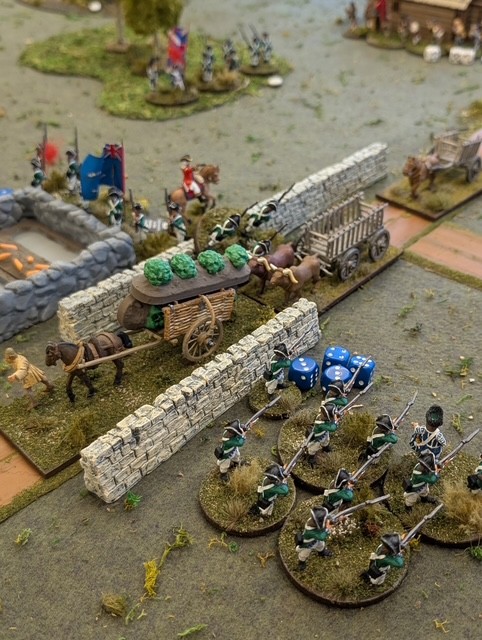
Wes Rogers effectively used his provincials to fend of the Patriots while gathering forage.

The Americans were allowed to plunk their three militia units in the town before the British set up and deploy six markers including three dummies to represent potential positions.  The British were also able to deploy one of their commands, the three units of Loyalist Provincials in the town with wagons for removing forage.  The remaining British, a command of three loyalist militia and a command with a unit of light cavalry and Hessian Jaegers came in on one end of the board.  An American command with two units of Continentals and a unit of Continental riflemen came in at the other end of the board.
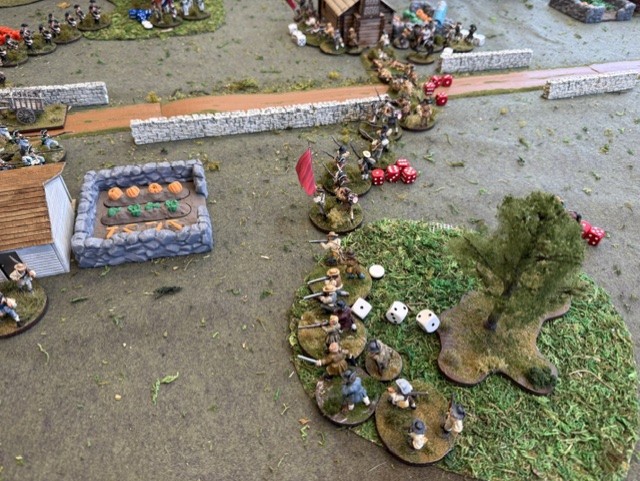
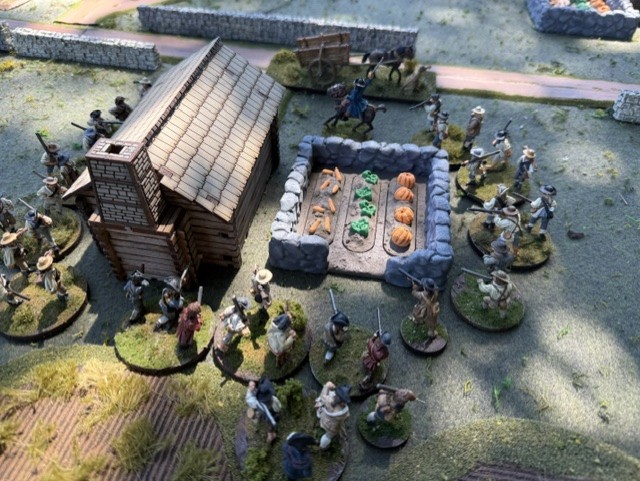
The Americans used the woods and the house to anchor their defenses to limit the British advance into Hesselberg. The building became known as “Hesselberg Alamo.”

The British, in addition to dealing with the Americans, had to put up with my in-game shenanigans.  They had limited torch markers to burn things with and had to make my silly die rolls to get things to burn and they rolled phenomenally badly, so it wasn’t easy.  But in the end three of the seven buildings on the board ended up ashes.  The Jaegers and the militia were also subject to a “become looters” rule.  No harm, just time wasted.  Only one of George’s militia units fell into the spell of ransacking a house they should be burning.
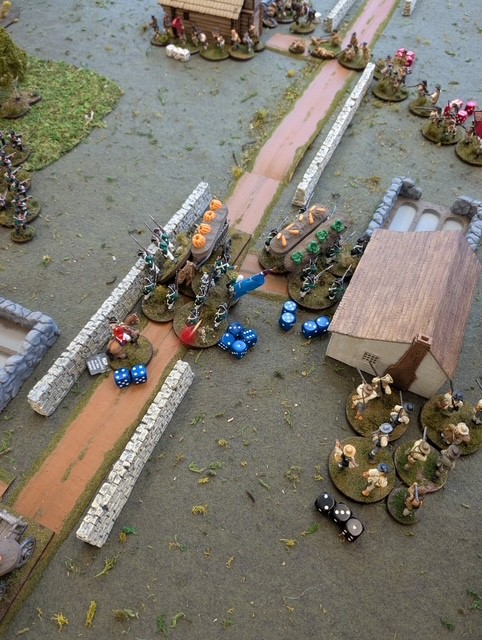
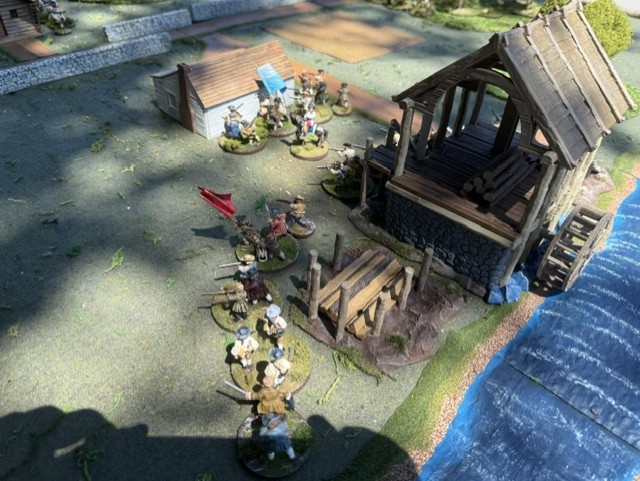
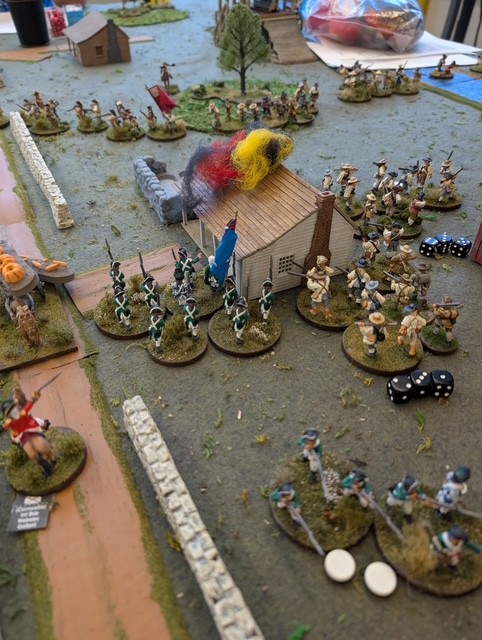
One of the factors holding up the British advance was the “looting” shenanigans I pulled on some British units. Thankfully only one of George’s militia units was snared by the looting die roll. This is them piled up outside the house instead of burning it.

The real game, however was in the two battle lines that formed in the middle of the table.  The Americans seized formidable positions that they defended well, inflicting damage on  the British usually from cover and regularly made saving throws.  One of the houses, occupied from the beginning of the game by one of Joe’s militia units, became known as “Hesselberg’s Alamo.”
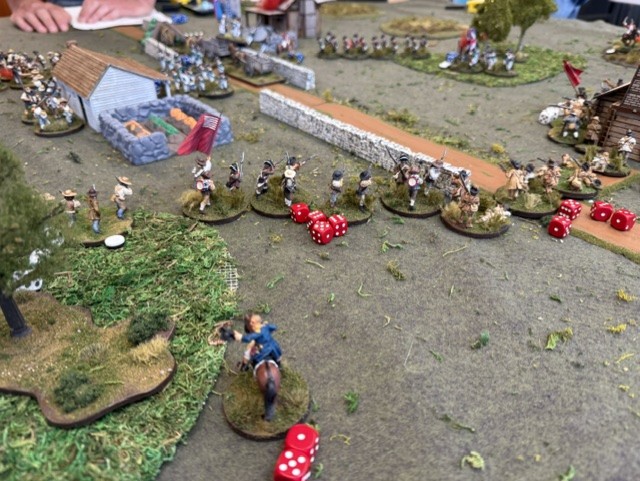
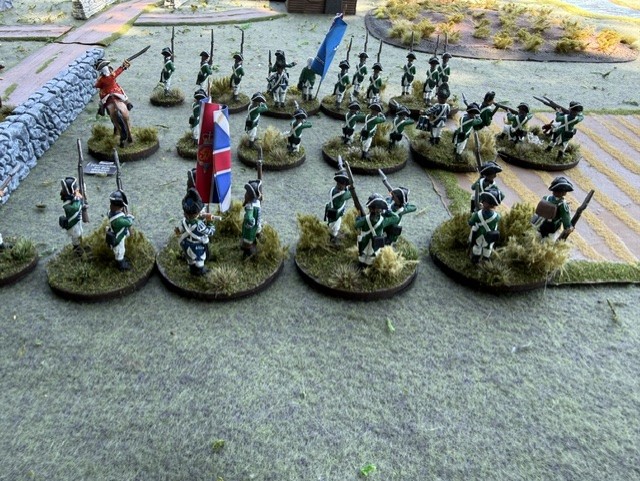
The battle lines form from the American POV.

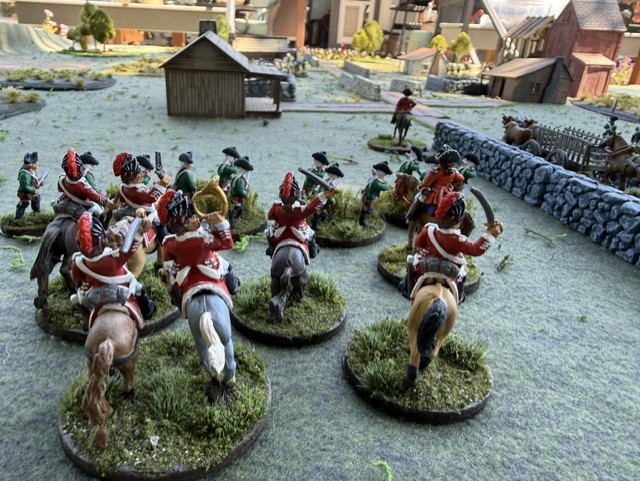
The final gambit was Bruce using the speed of his dragoons to ride around the flank and rear of the American army to seize the valuable sawmill, but Americans, seeing the danger were able to bring fire on horsemen and inflict significant damage.  We ended the game shortly after. 
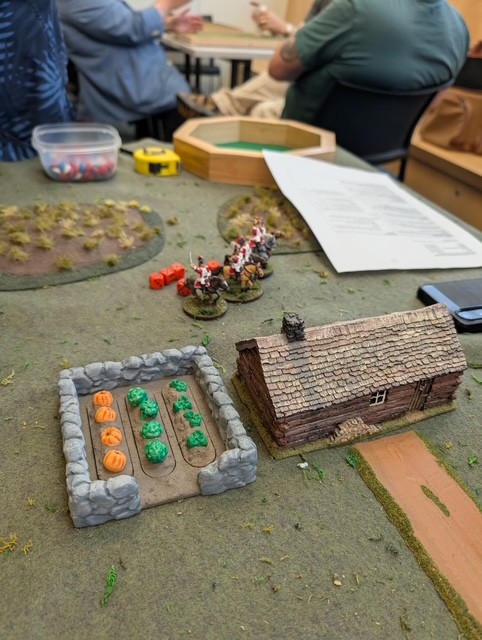
Bruce’s dragoons ride around the American army as they attempt to capture Sylvester’s sawmill. They were thwarted as the Continentals diverted units to target them with damaging fire.

Based on the victory conditions I wrote for the game, the British received points for burning and removing forage, but the Americans held the vital sawmill and dished out a fair number of casualties.  It would have been a slight American victory.  But Hesselberg did lose almost half its buildings and half its forage, so I’m content calling it a draw.  The British had a difficult job and played well.  So did the Americans.  I was quite loud and had fun.  A few tweaks were suggested and they will be incorporated when I run the game again at Drumbeat South.

There are a couple of rules issues I need to work through. This was the first game I’ve played with cavalry. According to the rules it really takes two hits to kill a figure. That’s something I overlooked and it won’t happen again. There was also a melee that didn’t turn out the way I thought it should, so I’m working through that. But the game was played with five guys who hadn’t played the rules before and I think had a pretty solid grasp of them before we were through.
The Burning Hesselberg playtest: Part One

Today is the day I’ll be running my first Burning Hesselberg game. Remember, this is my AWI playtest using the Take Action rules by Chris Leach. These rules fit my purpose as a semi skirmish game, similar to Daniel Mersey’s Rebels and Patriots game. It is an activation based game, but the players are offered a bit more flexibility than the Mersey rules. Burning Hesselberg is played in 28mm figures, with three British players and two American players.

In the game, the British have been sent to punish Hesselberg for their support of the Patriot cause. Their job is burn houses, forage food, and try not to get too shot up by whatever Americans are sent out to face them. They have some very good troops–light dragoons and jaegers, some middling troops-Loyalist provincial infantry, and some truly wretched troops-New Jersey loyalist militia. Their mission is to do their jobs and go home.

The Americans have some ties to Hesselberg and hope to save some of the buildings, particularly the big sawmill. Their job is to harass the British, minimize the destruction and drive off the invaders.

The game is scaled for the properly for the rules and the relative inexperience of the players with Take Action.

Running games is always a challenge for me. I really like developing scenarios. I want scenarios with a little bit of a twist, something more than two armies show up and have a battle. Especially for these lower level skirmishes, there’s usually a purpose in mind, but there are extenuating circumstances that make things interesting. And while I’m imagining all this and writing it down, its still important, at least for this game, that I see what the table can look like. Unfortunately, I don’t have a game table in my house. But yesterday it was very nice as it often is in summertime Puyallup, so I was able to set up tables on my patio to get a glimpse of what the board should look like.

I use a 6 X 10 felt mat for my games. Yes, I know it’s old school, in my case really old school. I’m guessing this mat is 30 years old. I do have some of the mousepad mats, but Ii don’t love ’em and prefer to use my felt that is well cured with residue from years of lichen and various tree shedding (plus a small but unsightly coffee stain.)

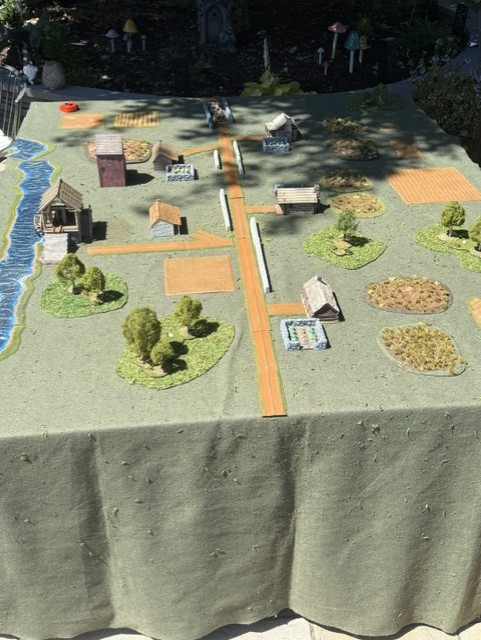
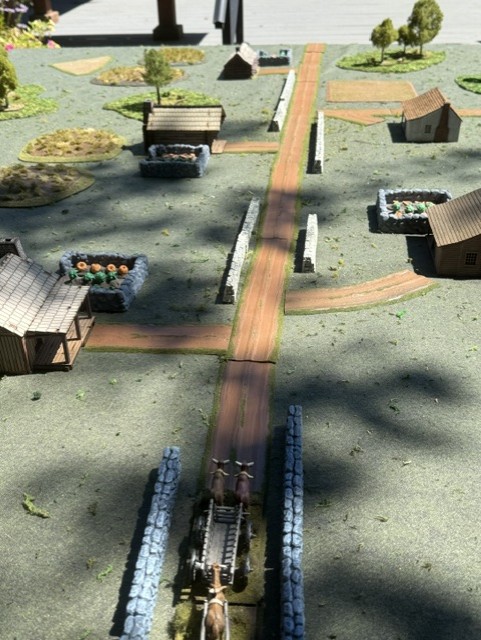
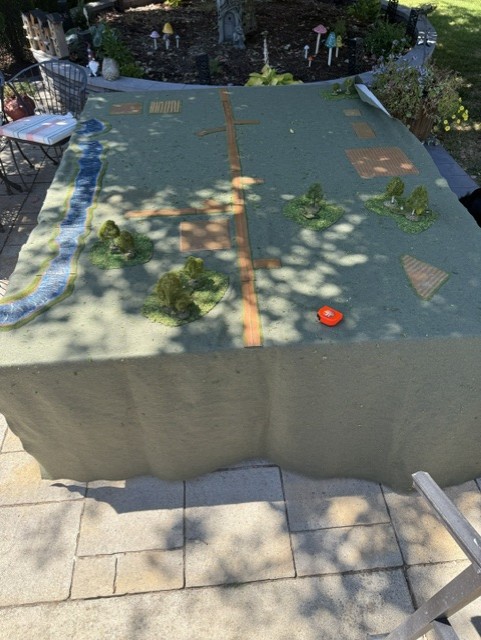
The first step was to put out the Hesselberg road. It has to run about 8′ down the center of the table. I have 2″ Wizard Kraft roads, but I wasn’t sure how much straight road I could manage. Thankfully there was enough. From there I needed to determine where British units would enter the board. I wanted them to start 12″ in from the “East” board edge. I plunked down a wagon to show where that would be. From there I could begin distributing the buildings that form the farming town of Hesselberg.

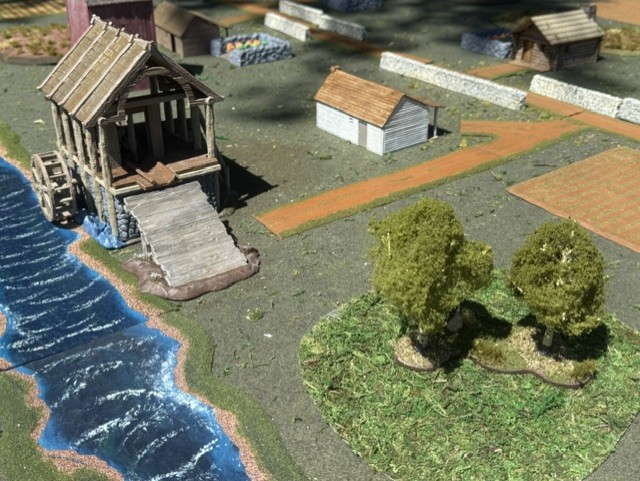
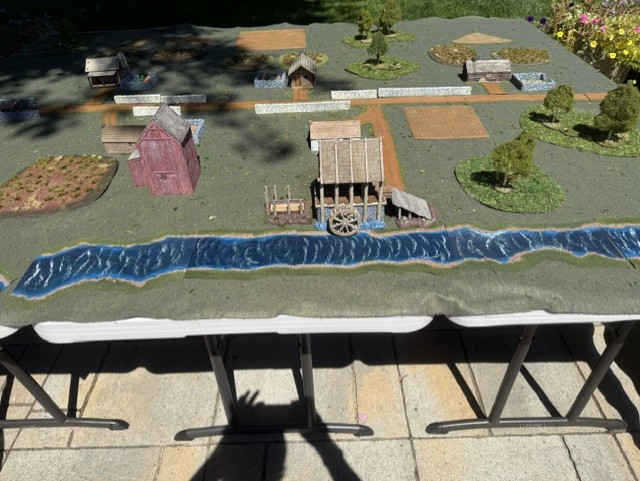
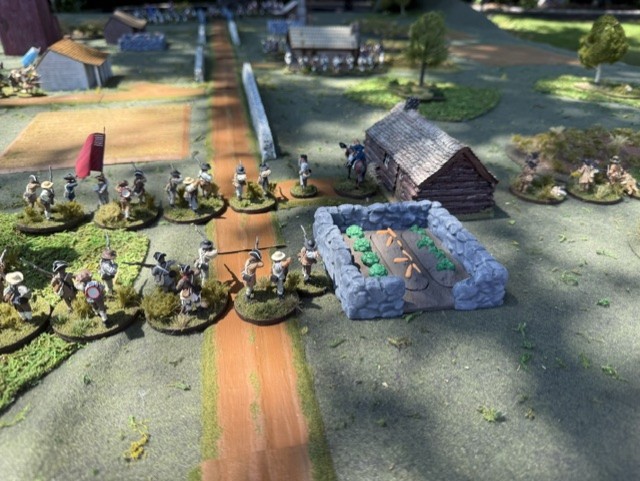
From left: This picture was actually taken as I was putting things away, but it shows the main road and the additional “driveways” I added to space out the buildings. Destroying the buildings is a British victory condition, so they couldn’t be too close together or too far apart. The large saw mill is an important victory condition for both sides. I added a few small woods to break up line of sight and fields for eye candy. The mill is water powered, so there had to be a river.

My goal with scenario development is to create a story. The British are sent to Hesselberg to carry off some needed forage. This will be represented by vegetable gardens scattered through the village that can be carried off. They are also ordered to burn the sawmill and other houses which have supported the Patriot cause. One British command will start in the village, the rest must move on to the board. There will be wagons which must stay on the road. There are rules for burning the structures and there are limited resources for effectively burning. Some British troops may be tempted to loot buildings rather than doing their jobs which might be a problem, chiefly a time waster.

The Americans have a different goal. Sent to Hesselberg by General John Sullivan, New Jersey militia with men from the town will begin in the town so early opportunities for combat exist. They won’t deploy their three units immediately, but will have six counters including three dummies to confuse their enemies. Three units of Continental troops will set up at the west side. They win by saving the saw mill, and as much of the town as possible, and by killing British.

The British definitely have the tougher job.

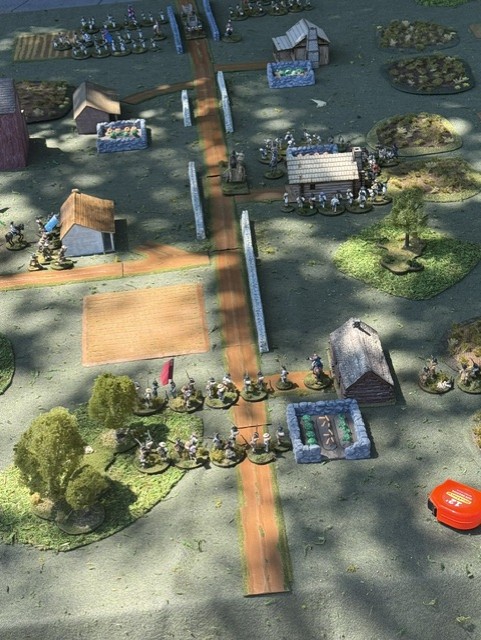
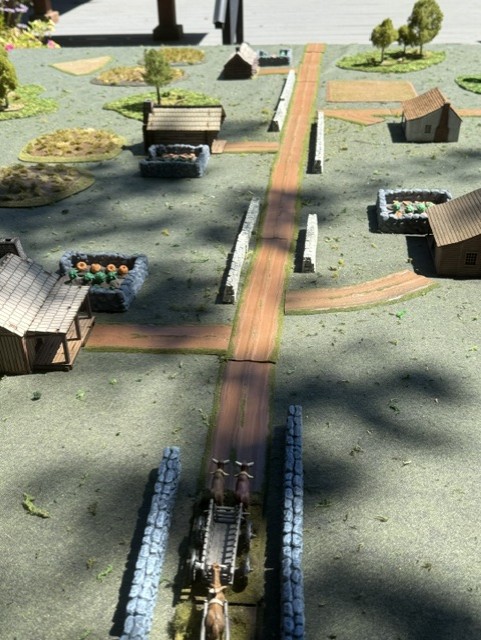
The set up for the game will look something like this.

From left, an overall picture of the battlefield. In the foreground Connecticut Continentals head down the road from the “West” board edge. The British come in from the “East” with Loyalist militia ravaging a farmhouse in the middle of town. In the middle of town Loyalist militia surround a farmhouse. Will they forage and burn, or will they loot the place? 17th Light Dragoons and New Jersey Provincials enter the East side of town. New Jersey militia defend the mill. Connecticut Continentals and riflemen enter from the West.

I’ve done the best I can to create a game that isn’t symmetrical but should have some play balance. Looking forward to working through it. I’ll be running it again in Chehalis in a few weeks. It’s also a game that has Enfilade potential.