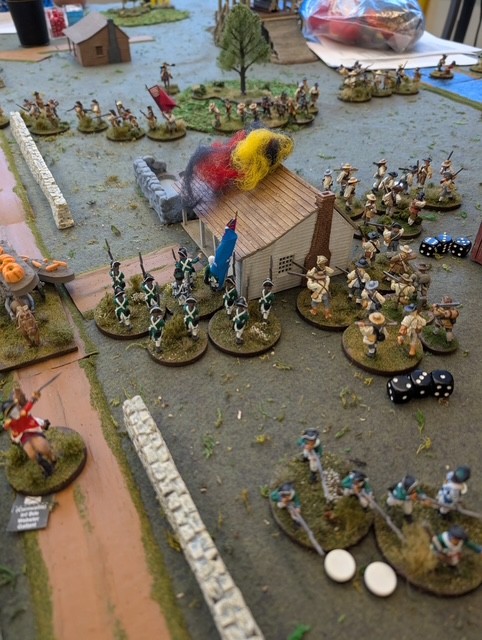
Yesterday we did the first playtest of the game.
The Cascadia Tabletop Gamers held their monthly meeting yesterday at the Panther Lake Library across the parking lot from Wizard’s Keep because of a game conflict-which unfortunately wasn’t actually a thing. The one real complication with the move to the library was the size of the table space. I was planning on something close to 8′-6′ and I lost about a foot. Not catastrophic, but I would have loved a tish more set up space.
In the scenario , the British have the onus of being offensive. They have to burn houses, and forage from gardens to punish the town for its support of the Continentals during the winter/spring of 1777. The most valuable of the landmarks is the Sylvester Sawmill. The Americans have fewer troops, but their mission is more defensive: defend the mill and kill British. Both sides played well, especially not knowing the rules.
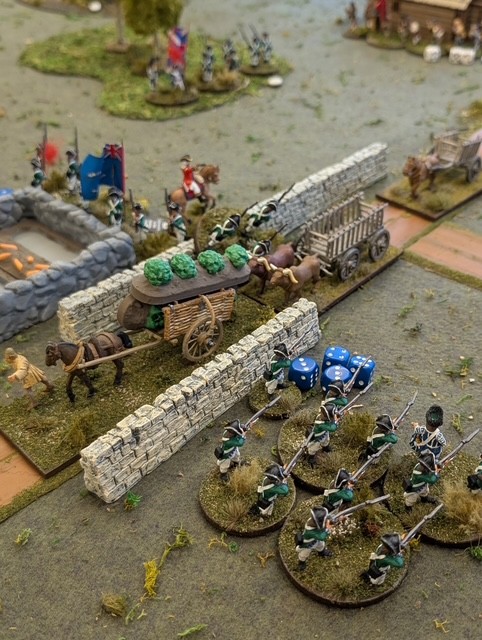
The Americans were allowed to plunk their three militia units in the town before the British set up and deploy six markers including three dummies to represent potential positions. The British were also able to deploy one of their commands, the three units of Loyalist Provincials in the town with wagons for removing forage. The remaining British, a command of three loyalist militia and a command with a unit of light cavalry and Hessian Jaegers came in on one end of the board. An American command with two units of Continentals and a unit of Continental riflemen came in at the other end of the board.
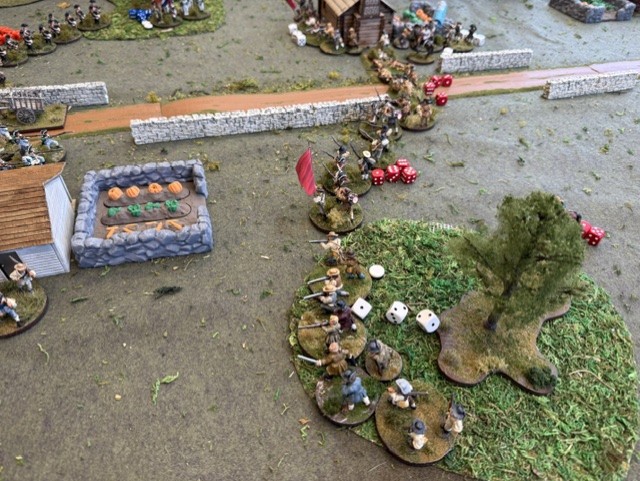
The British, in addition to dealing with the Americans, had to put up with my in-game shenanigans. They had limited torch markers to burn things with and had to make my silly die rolls to get things to burn and they rolled phenomenally badly, so it wasn’t easy. But in the end three of the seven buildings on the board ended up ashes. The Jaegers and the militia were also subject to a “become looters” rule. No harm, just time wasted. Only one of George’s militia units fell into the spell of ransacking a house they should be burning.
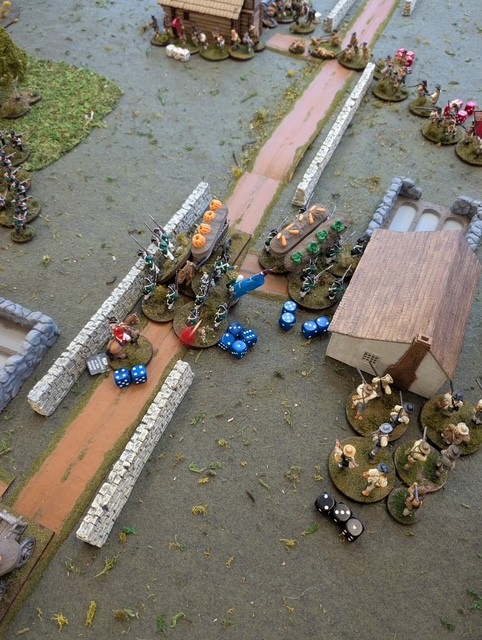
The real game, however was in the two battle lines that formed in the middle of the table. The Americans seized formidable positions that they defended well, inflicting damage on the British usually from cover and regularly made saving throws. One of the houses, occupied from the beginning of the game by one of Joe’s militia units, became known as “Hesselberg’s Alamo.”
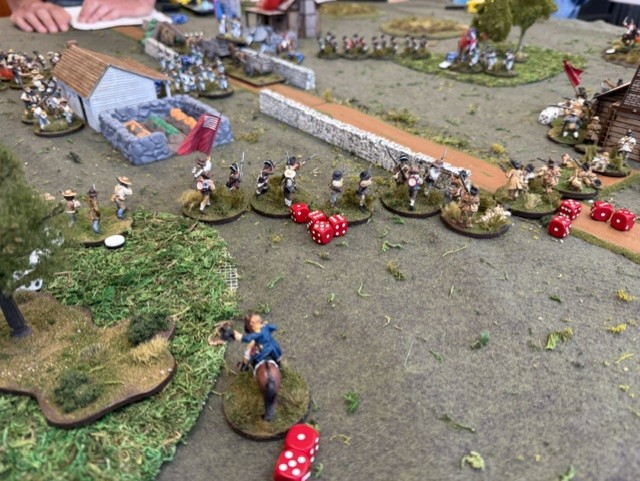
The final gambit was Bruce using the speed of his dragoons to ride around the flank and rear of the American army to seize the valuable sawmill, but Americans, seeing the danger were able to bring fire on horsemen and inflict significant damage. We ended the game shortly after.
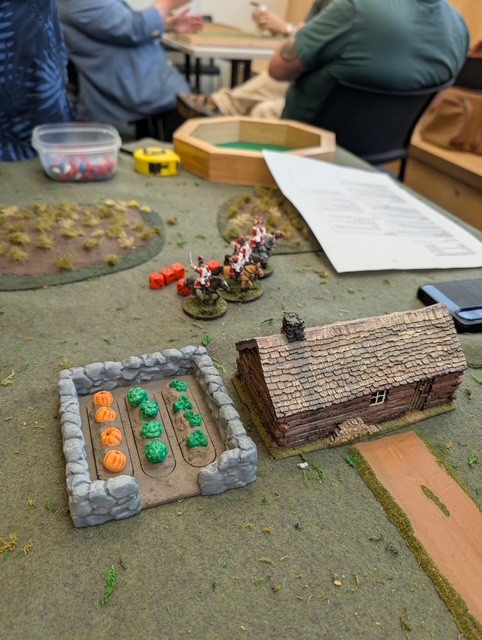
Based on the victory conditions I wrote for the game, the British received points for burning and removing forage, but the Americans held the vital sawmill and dished out a fair number of casualties. It would have been a slight American victory. But Hesselberg did lose almost half its buildings and half its forage, so I’m content calling it a draw. The British had a difficult job and played well. So did the Americans. I was quite loud and had fun. A few tweaks were suggested and they will be incorporated when I run the game again at Drumbeat South.
There are a couple of rules issues I need to work through. This was the first game I’ve played with cavalry. According to the rules it really takes two hits to kill a figure. That’s something I overlooked and it won’t happen again. There was also a melee that didn’t turn out the way I thought it should, so I’m working through that. But the game was played with five guys who hadn’t played the rules before and I think had a pretty solid grasp of them before we were through.

