The Burning Hesselberg playtest: Part One

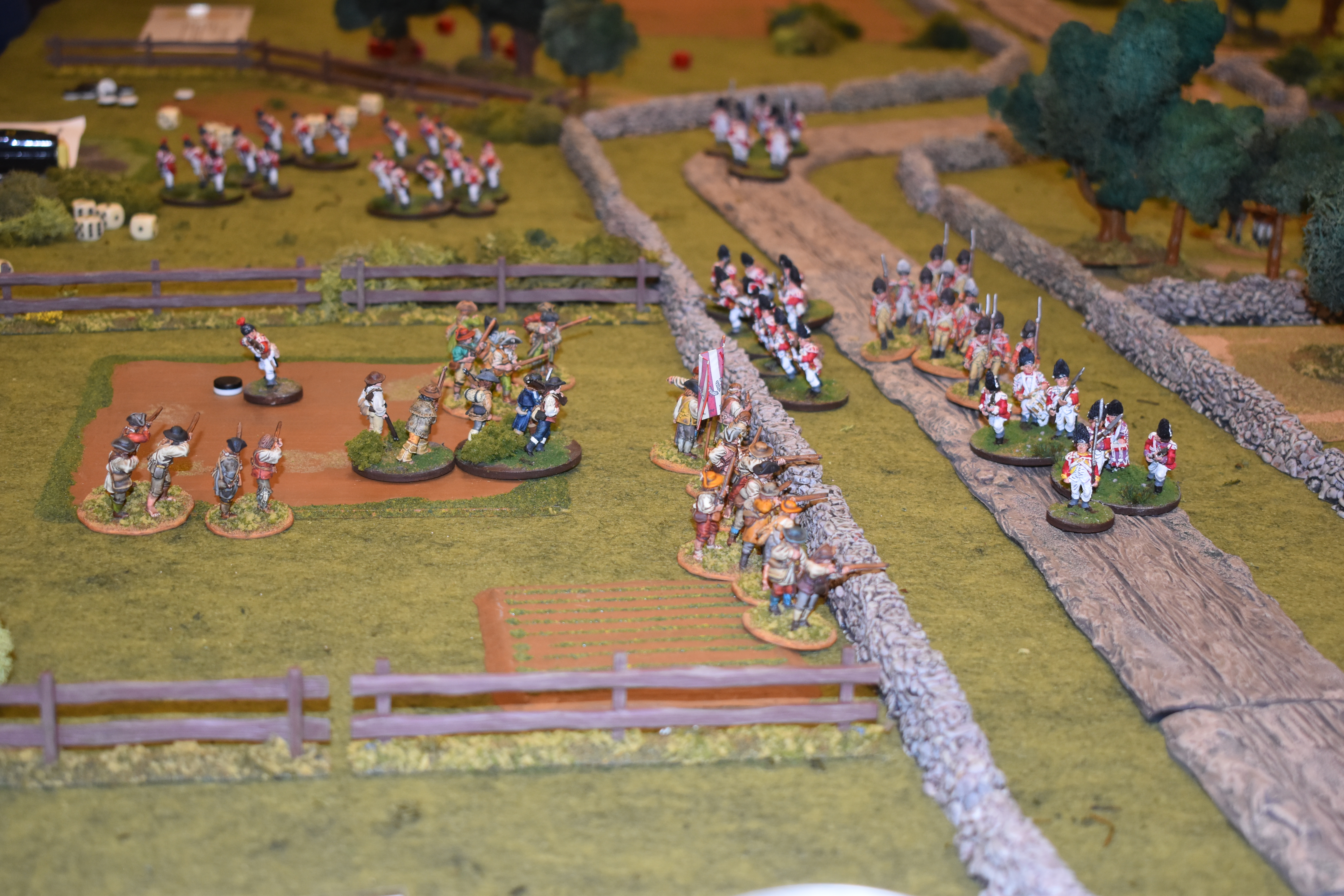
Today is the day I’ll be running my first Burning Hesselberg game. Remember, this is my AWI playtest using the Take Action rules by Chris Leach. These rules fit my purpose as a semi skirmish game, similar to Daniel Mersey’s Rebels and Patriots game. It is an activation based game, but the players are offered a bit more flexibility than the Mersey rules. Burning Hesselberg is played in 28mm figures, with three British players and two American players.

In the game, the British have been sent to punish Hesselberg for their support of the Patriot cause. Their job is burn houses, forage food, and try not to get too shot up by whatever Americans are sent out to face them. They have some very good troops–light dragoons and jaegers, some middling troops-Loyalist provincial infantry, and some truly wretched troops-New Jersey loyalist militia. Their mission is to do their jobs and go home.

The Americans have some ties to Hesselberg and hope to save some of the buildings, particularly the big sawmill. Their job is to harass the British, minimize the destruction and drive off the invaders.

The game is scaled for the properly for the rules and the relative inexperience of the players with Take Action.

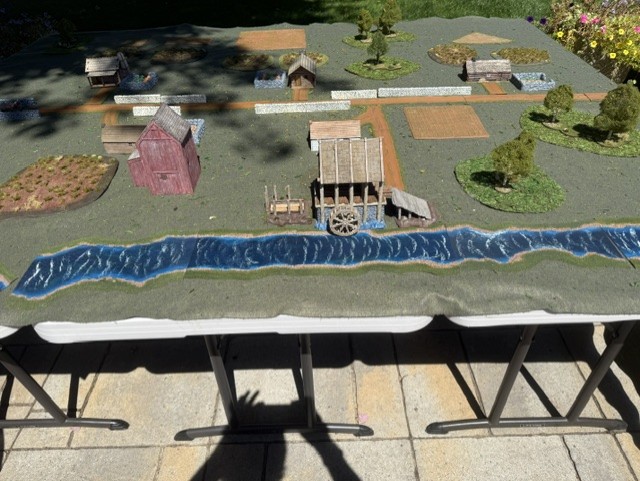
Running games is always a challenge for me. I really like developing scenarios. I want scenarios with a little bit of a twist, something more than two armies show up and have a battle. Especially for these lower level skirmishes, there’s usually a purpose in mind, but there are extenuating circumstances that make things interesting. And while I’m imagining all this and writing it down, its still important, at least for this game, that I see what the table can look like. Unfortunately, I don’t have a game table in my house. But yesterday it was very nice as it often is in summertime Puyallup, so I was able to set up tables on my patio to get a glimpse of what the board should look like.

I use a 6 X 10 felt mat for my games. Yes, I know it’s old school, in my case really old school. I’m guessing this mat is 30 years old. I do have some of the mousepad mats, but Ii don’t love ’em and prefer to use my felt that is well cured with residue from years of lichen and various tree shedding (plus a small but unsightly coffee stain.)

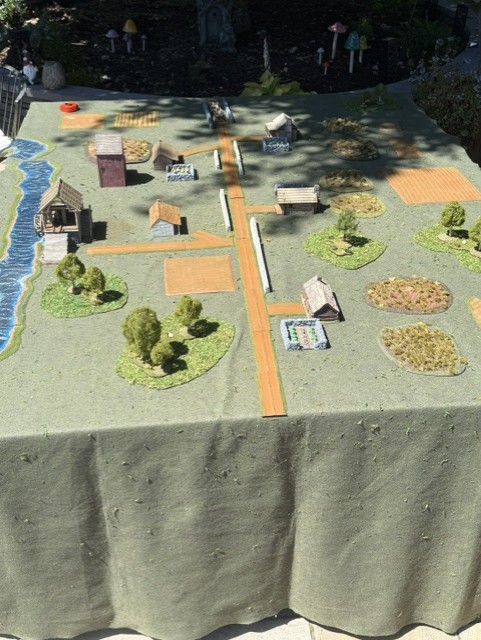
The first step was to put out the Hesselberg road. It has to run about 8′ down the center of the table. I have 2″ Wizard Kraft roads, but I wasn’t sure how much straight road I could manage. Thankfully there was enough. From there I needed to determine where British units would enter the board. I wanted them to start 12″ in from the “East” board edge. I plunked down a wagon to show where that would be. From there I could begin distributing the buildings that form the farming town of Hesselberg.
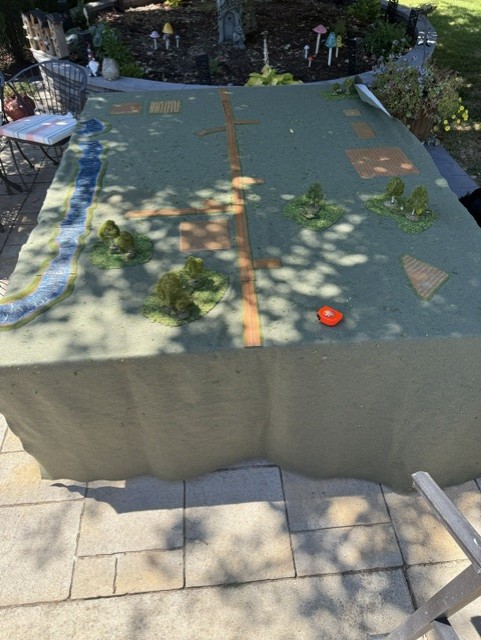
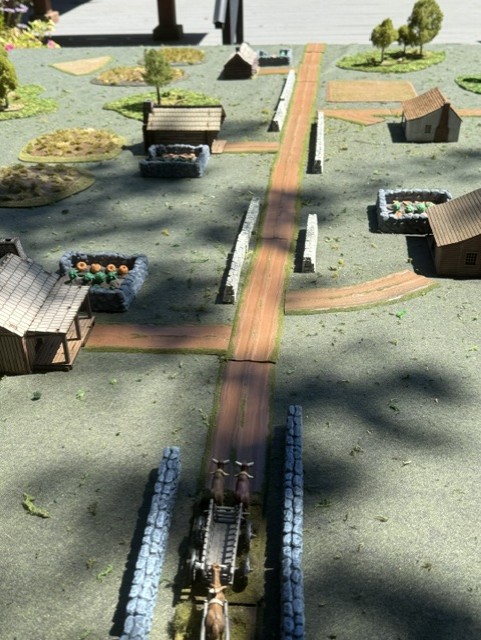
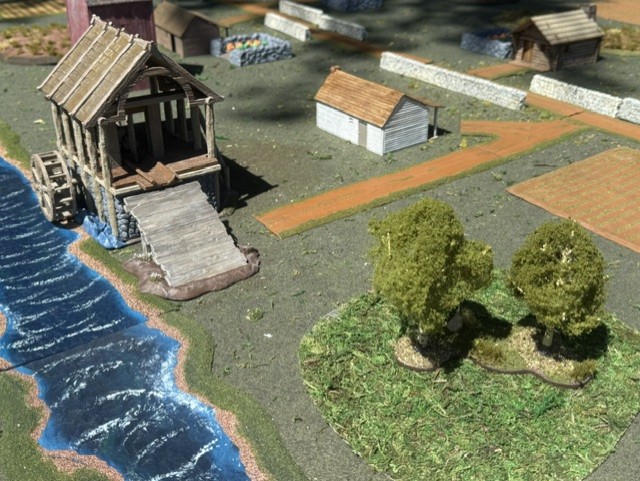
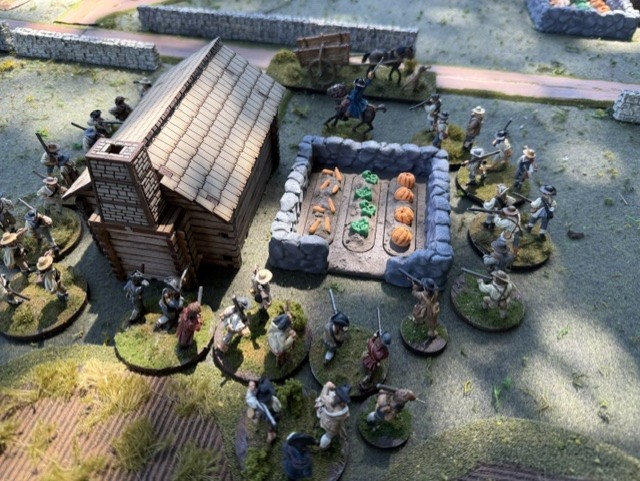
From left: This picture was actually taken as I was putting things away, but it shows the main road and the additional “driveways” I added to space out the buildings. Destroying the buildings is a British victory condition, so they couldn’t be too close together or too far apart. The large saw mill is an important victory condition for both sides. I added a few small woods to break up line of sight and fields for eye candy. The mill is water powered, so there had to be a river.

My goal with scenario development is to create a story. The British are sent to Hesselberg to carry off some needed forage. This will be represented by vegetable gardens scattered through the village that can be carried off. They are also ordered to burn the sawmill and other houses which have supported the Patriot cause. One British command will start in the village, the rest must move on to the board. There will be wagons which must stay on the road. There are rules for burning the structures and there are limited resources for effectively burning. Some British troops may be tempted to loot buildings rather than doing their jobs which might be a problem, chiefly a time waster.

The Americans have a different goal. Sent to Hesselberg by General John Sullivan, New Jersey militia with men from the town will begin in the town so early opportunities for combat exist. They won’t deploy their three units immediately, but will have six counters including three dummies to confuse their enemies. Three units of Continental troops will set up at the west side. They win by saving the saw mill, and as much of the town as possible, and by killing British.

The British definitely have the tougher job.

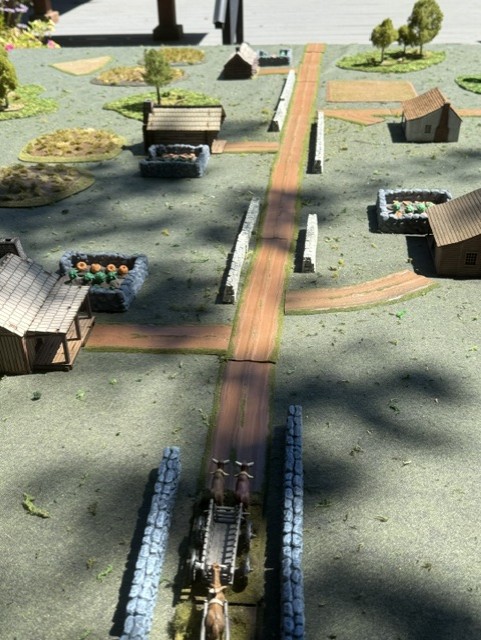
The set up for the game will look something like this.
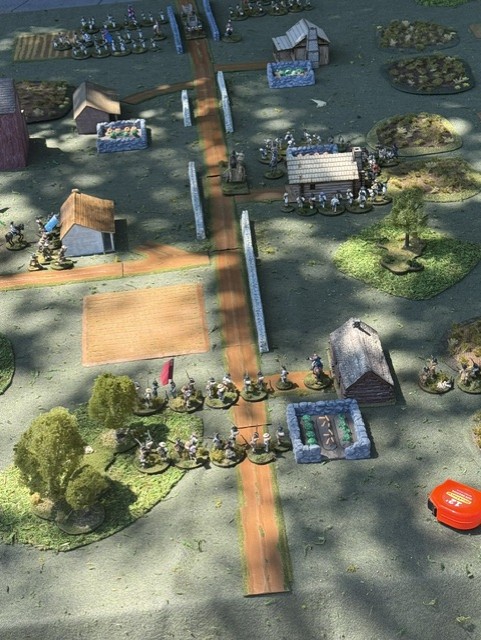
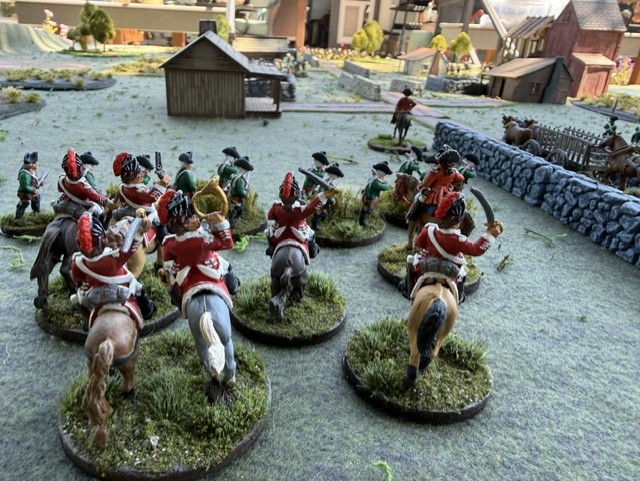
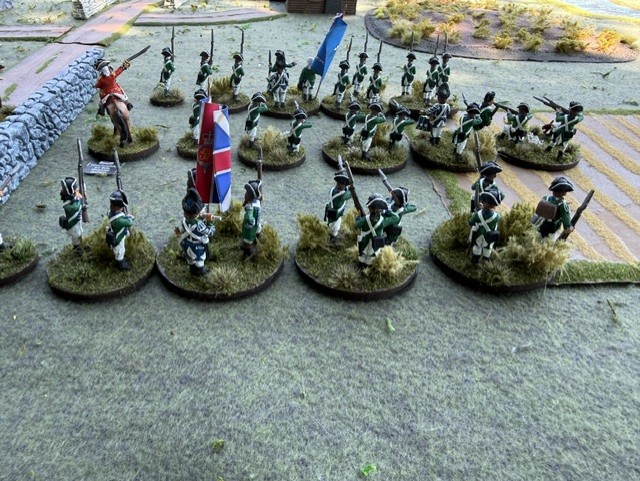
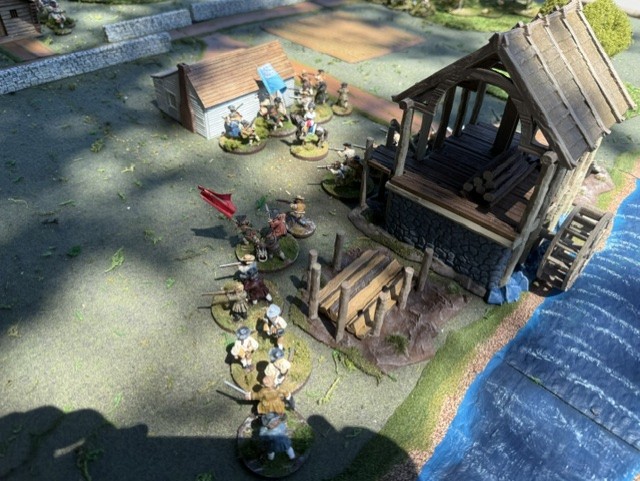
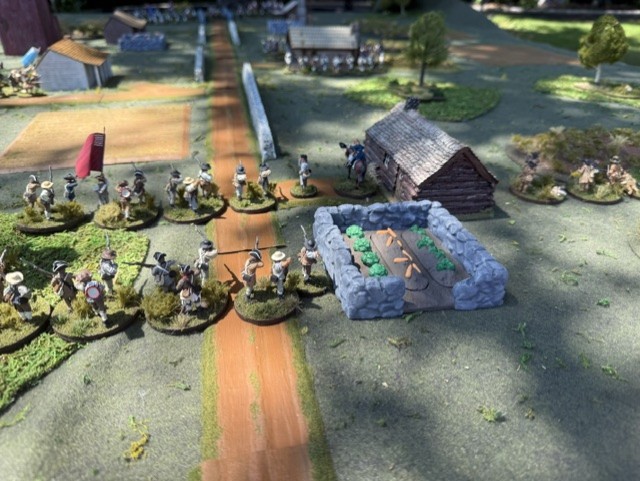
From left, an overall picture of the battlefield. In the foreground Connecticut Continentals head down the road from the “West” board edge. The British come in from the “East” with Loyalist militia ravaging a farmhouse in the middle of town. In the middle of town Loyalist militia surround a farmhouse. Will they forage and burn, or will they loot the place? 17th Light Dragoons and New Jersey Provincials enter the East side of town. New Jersey militia defend the mill. Connecticut Continentals and riflemen enter from the West.

I’ve done the best I can to create a game that isn’t symmetrical but should have some play balance. Looking forward to working through it. I’ll be running it again in Chehalis in a few weeks. It’s also a game that has Enfilade potential.

My AWI Summer

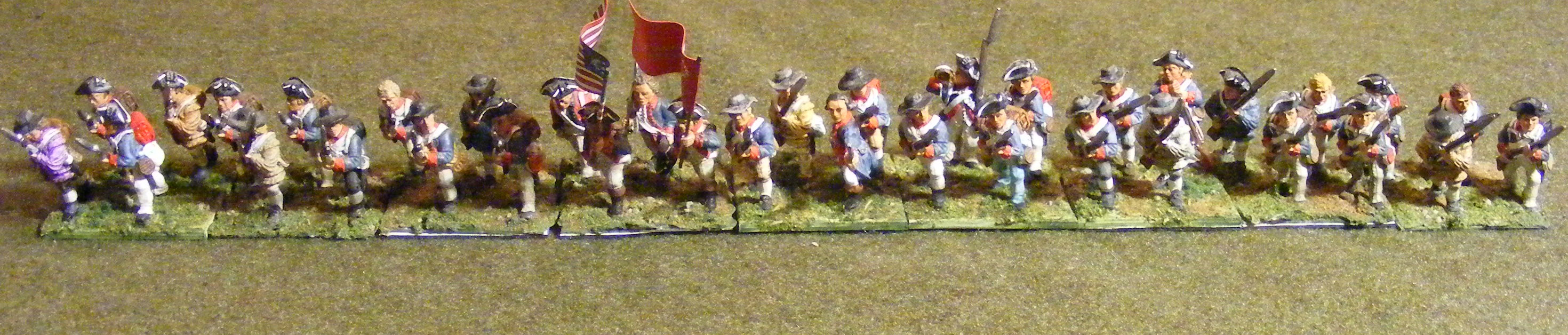
1st Connecticut Continentals ca. 1777. These are Perry figures. Only one figure has a uniform.

One of the things I really wanted to do in 2026 is paint my way through my giant pile of American Revolution figures. They’re all 28’s, metal. Some I’ve had for a number of years, mostly Perry figures, with some Old Glory and Front Rank/Gripping Beast figures thrown in for good measure. I inherited David Sullivan’s mega pile of AWI figures too, and they leaven my Perry/OG/Front Rank pile with more Perry figures and some nice Foundry figures.

How many are there? Really? You want me to count them? Let’s just say there is a lot. I think that since the first of the year with all my other projects I’ve worked on I’ve painted about 125 AWI figures. How committed am I to sticking with it? Well, I’m hoping that by the end of the week it will be closer to 150 figures.

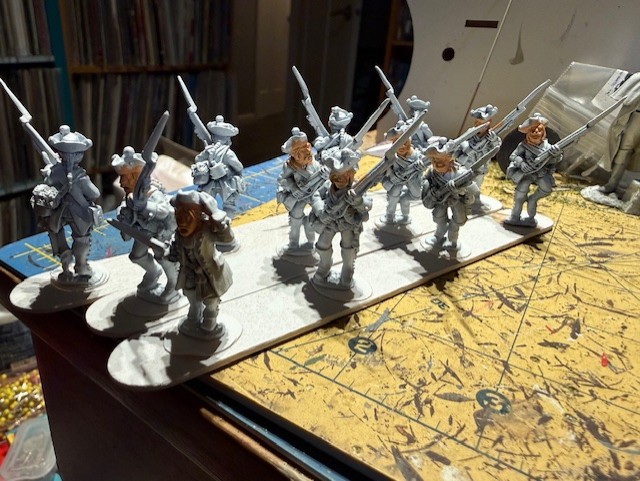
These figures are, I believe, Foundry figures and came from David Sullivan’s giant pile of AWI figures. And there are so many more. These are painted as Provincial regulars from the New Jersey Loyalists. This was a very large Provincial formation that raised six battalions and will appear in my Take Action game on August 15th in Chehalis.

As I’ve written before, my AWI Project, like my Hundred Years War project is torn between two projects differing in scale. I have my bunch of semi-skirmish units that I can do small scale actions with. I play these with Daniel Mersey’s Rebels and Patriot rules, or I can use the Take Action semi-skirmish rules under construction by my friend Chris Leach.These rules both use 12-figure units. A lot of the figures I’ve been painting are for these games. One doesn’t need a ton of units to play these games. Really a player should only command 3-4 units to manage them effectively. But it’s really important to have a nice mix of different unit types and that’s where I am now. I have lots of militia troops for both sides. I’m currently painting some New Jersey provincial troops for the British. I’ve done a pile of Hessians, with a few more to come. For these games I’m mostly considering the “forage wars” that persisted in New Jersey from 1777 to the end of the war. But I’m also really drawn to the persistent conflict between Patriot and Loyalist militias in the Carolinas and Georgia from 1779-81. The most important thing is to have the right mix of representative units . . . which admittedly could be endless.

I’ve painted a lot of troops for this skirmishy stuff, but have overlooked one of my bucket list projects–building the units for Nathaniel Greene’s southern campaign from Guilford Courthouse to Eutaw Springs. I’m not sure why I’ve let this slip. I’ve always had an interest. I continue to read a lot about this, but I haven’t added to the units I have. The American regulars stay pretty much the same with a few adds and subtractions, but the British change considerably. After Guilford, the first of Greene’s semi-victories, Cornwallis slips away with his army to Wilmington and then on to Virginia and its eventual doom at Yorktown. The remaining British commanders in Charleston are left to hold South Carolina with a handful of British regulars, provincial troops and whatever else they can get their hands on. I’ll play this out with Regimental Fire and Fury.

These are Lawson’s Virginia militia that were in the first line at Guilford Courthouse. These are Perry figures, that seem just a little too well armed with their bayonets. The remaining pile of southern militia are being combined with other figures for less well clothed regulars for the early war. See Connecticut infantry above.

Yes, I know Regimental Fire and Fury is considered kind of Old School, but I like ’em. I love the Maneuver Chart which is the chief play engine of the game. The firing chart seems to work fair and equitably. I would say the rules are of medium complexity, but not impossible to figure out by a newbie. Good stuff.

I just finished my first F and F unit in a long time. Just some Virginia militia for Guilford Courthouse, but there are a lot of them, so I gotta start somewhere. There are British Guards and line infantry, more Americans, lots to do, but it is all work I enjoy doing them.

I do have a game I’m planning. We have a game day scheduled for August 15th in Chehalis at the Veteran’s Museum (be there or be square.) I’m going to run a hypothetical game based on the burning of a Patriot town in New Jersey in the early summer of 1777. It will be called Burning Hesselberg and will include patriot militia and Continentals vs Loyalist regulars, some mounted and dismounted cavalry, and raw Loyalist militia. We’ll see how this goes. Will keep you updated.

And in the coat closet . . .

I think many of us, when we get to a certain age, and if we’ve been gaming long enough, have accumulated far more miniatures, board games, rules, and books than we can effectively play with. I think I’ve made the case that I have some 40ish odd projects that are in various stages of completion. Some I haven’t played with in years and others I couldn’t if I wanted to because they need more attention. Others are done, kinda, and maybe I’ve moved on from them. A candidate for being parted out to a potentially more interested user.

In my garage, where I keep my painted and based stuff, there is a shelf in my wire rack devoted to ACW Naval. I have something on the order 130 painted ships in 1/600 scale. I would love to say I’m finished, but I doubt I ever will be. David had a huge number of unbuilt ships. Most I gave a way but I purloined a few for myself. David Manley and Matt Lawson continue to fill holes in the register of ships available to both navies. I don’t have little check boxes of needs, but maybe I should. I don’t need every Confederate ironclad ram real or imagined, I don’t need every Union monitor, though a couple more of the Canonicus class would be nice. Lots of ships here and my friends, Michael, George and Scott have ships too. They just need to see the light of day.

Our choice is to play the old Yaquinto Ironclad rules. Yes these were written in 1979. Yes they have more charts than an ophthalmologist would be comfortable with reading (in relatively small print.) But to quote General Patton, “But God help me, I do love it so.” David Sullivan and I developed a hexless miniature conversion for 1/600 ships 30 years ago and we’ve stuck by these rules.

You will be shocked to hear that not everybody loves them. I discovered that on Dave’s lawn during a Covid game. It broke my heart. There are other games out there. None of them have Irondclads’ depth, but in many cases they move the game along. One game I’d like to try–in fact I own it–is Dawn of Iron. I’ve looked at it and didn’t find it compelling but haven’t played it. Hammering Iron–I laugh at you. Iron and Fire by David Manley I’d consider for a large game. I have everything for Sail and Steam Navies–which I don’t hate, but also don’t love.

This week, my first post-Enfilade game was an Ironclads game. I’ve kind of had the itch the past few months and I’d just painted Matt Lawson’s beautiful Dictator monitor so, what the hell. I reached deep in the back of my reptile brain that seemed to be stuck in Tiger II’s and JSII’s and decided to do a hypothetical 1866 game. The Confederates had stayed in the war and managed to free Wilmington but badly needed supplies. I gave the Johnnies a pair of blockade runners and the Laird Rams (because it’s 1866 and if you are unarmored you’re nothin’) The blockade runners Fort Donelson and AD Vance had to cross the table edge safely, under fire from Union batteries. The ironclads, Mississippi and North Carolina had to turn around and exit the table edge to Bermuda.

Blockade runners Fort Donelson (front) and AD Vance (trailing) are about ready to exit the board and gain victory points for the Confederates. But wait . . .

Unfortunately, the Union ironclads Dunderberg and Dictator are both appearing to the South on that board edge. Both are sizable and quite nasty, and even a tish faster than the Confederate ships and they somehow have to turn around to escape. The only Confederate advantage is their 9″ rifles which out-range the Yankees.

Turn three, Scott is maneuvering the Laird Rams past the Dictator and and near the Dunderberg. It’s about to get ugly.

That is the scene, and on turn one things are looking pretty good for Confederate Navy. The blockade runners are moving 13″ a turn and in three turns they’ll be off the board. The batteries have missed their fire. The Laird Rams are making their turns and fire all eight of their guns at the Dunderberg. Most bounce off harmlessly, but one hit and penetrated the pilot house requiring the huge mountain of iron to lose half its speed and remain on course for the next four turns. Pretty tough in a game where moving and turning matters. The Union ships were out of range for fire.

Turn two was fairly uneventful as the the Confederates took a turn to re-load their guns and the Union ships had difficulty hitting. Though the Dunderberg had plenty of guns to fire, most couldn’t angle properly to shoot at the fleeing Confederates, and Dictator was a victim of bad die rolling. The blockade runners continued their hell-bent ramble toward the board edge and safety.

Before the deluge. Mississippi has maneuvered past the Dundeberg, but North Carolina sits squarely in her broadside. Bad things about to happen.

Turn three things got a little interesting. Dunderberg’s pivot 11 inch guns began to hit North Carolina. Not enough shots to do serious damage, but demonstrated that with some good die rolls, they were big enough to trash some armor. Dictator misses again. Fort Donelson just crossed the board edge and escaped, but AD Vance was not so lucky. The 8 inch Dahlgrens penetrated and rolled the dreaded “Engine Critical” in which the engine loses all power, and each turn must roll to restart. An unlucky die roll results in an explosion. We’ll see.

Turn four is the turning point of the game. North Carolina maneuvered into Dunderberg’s broadside and took a withering amount of damage, including a fire which miraculously it rolled off in the damage phase. Dictator’s 15 inch guns also got in on the fun. The Confederate ship lost floatation and speed. Mississippi was properly aligned for an exit. The Confederates were reloading. AD Vance was unable to to start its engine, but with momentum reduced to half speed was also unable to exit.

Turn five Dunderberg is finally able to increase speed and maneuver. Not shoot as much. North Carolina is slowed by damage and both Confederate ships fire. Dunderberg accepts damage like the big armored ship she is and shrugs it off. Mississippi is positioned to escape and leave her sister to her fate. Ad Vance continues to slow as that darned engine refuses to start.

Turn six Dunderberg lets North Carolina have it withits stern pivots and the damage is catastrophic. Two fires break out. A magazine hit. The “Engine Critical.” Bad stuff beyond bad stuff and the doomed ship strikes. The Mississippi escapes. The AD Vance and her stuck engine explodes killing virtually the entire crew.

AD Vance fails to restart engine which explodes killing all its crew. Not so good.

It was, in the end, a tough day for the Confederates. I really wanted to drag out the Dunderberg. The model was a Bay Area Yards casting that I really enjoyed making and I knew it would be difficult for the Confederates to handle. I tried to create a scenario that didn’t require the rams to fight the Union, but rather to get away, and hoped they would simply make a u-turn to escape, but they tried to loop around the Union ships and Kurt, running the Dunderberg simply rolled too well on his damage rolls.

The game itself went fairly fast. Michael Koznarsky did his usual great job running the charts. I think it was not easy for Keith who had not played the game before, and when the Dunderberg unloaded the turns could get long. Even so, I’d like to put in another Ironclads game before the summer is over, using wooden ships.

Sometimes a Little Ken Burns . . .

I had the good fortune to have spent my working life doing something I really enjoyed. Before I retired in 2019 I was a school teacher. 36 years in the classroom. But it was so much more. I finished as a high school history and English teacher, which was my dream when I graduated from Carlmont High in 1973. The path there wasn’t easy. The Baby Boomers were aging out of schools and the vast demographic bubble that was inflated by a massive population of school age kiddoes was collapsing and there simply wasn’t a need for fresh-faced know-it-alls to share their truth with the young ‘ens. I was only able to become a teacher through a back door and for my first ten years in the classroom wasn’t really doing what I wanted to do.

But I did eventually make it into a traditional classroom and taught U.S. History, Washington History, and English to 5th and 6th graders, middle school students and high school sophomores and I loved it. I was able to do some super cool stuff with outdoor ed. I took students camping and we regaled in the wonders of the Lewis and Clark bicentennial here in the Northwest. I earned a Gates Foundation tech grant in 2000, and was able to bring computers into my classroom where students could do research without being limited to the library. I became a journalism adviser and took part in the wonderful community supporting journalism advisers here in Washington State and nationally. I had a wonderful career, and would never choose another. Unless, of course, I could just read, paint figures, play games, and have lunch with friends, which is sort of my current vocation.

Or if I could just be Ken Burns.

I love books. I don’t have a massive library, but I do fill my bookshelves. I read each day, not as much as I should, some time every day. I love interesting documentaries. But Ken Burns’ work I simply worship. I love his style-the inclusion of historians, the voices of David McCulloch and Peter Coyote, the variety of perspectives, the illustrations. Every Burns documentary makes me look beyond what I already know. After Baseball, I sought out Buck ‘O Neill, after Lewis and Clark I built a library many colleges would envy, after Vietnam, I acquired and read books by Vietnamese writers like Bao Ninh. A great documentary film maker should inspire us to learn more, read more widely, or at the very least seek out more documentaries and Ken Burns does that for me. He isn’t the final word, and he always inspires me to learn more.

The most recent Burns opus, The American Revolution, was another inspiration. I think I’ve watched every episode twice. It wasn’t that I didn’t already know stuff. I’ve read both the Rick Atkinson volumes he’s published on the conflict. Atkinson was the chief expert pictured in the doco. I thought broadening the focus of the TAR to include greater detail on the lives and views of women, Native Americans and enslaved people was perfectly valid and interesting. I’ve added Colin Galloway’s books to my Amazon want list. It has inspired me to read more deeply about George Washington, and I’m in the middle of James Flexner’s George Washington: the Indispensable Man, a book I’ve owned and not finished since, well, forever.

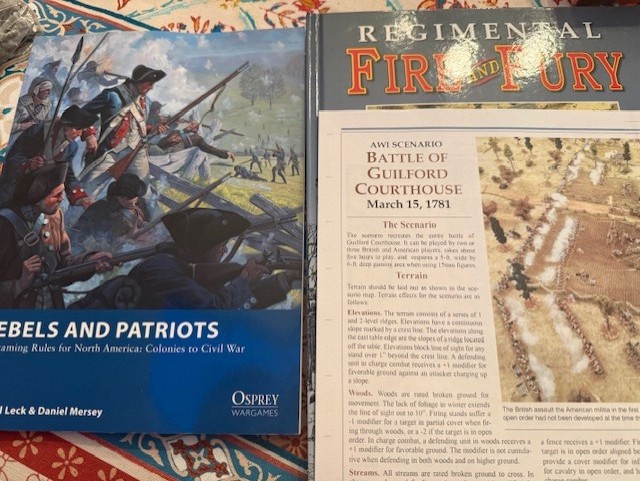
Rebels and Patriots is from the Daniel Mersey pile o’ rules published by Osprey. I like ’em and use it for a variety of periods from the Horse and Musket era. Reasonably available and relatively inexpensive. Regimental Fire and Fury is hardcover, more costly and harder to get. There is an excellent Fire and Fury website with variants for AWI, War of 1812 and Mexican War with some handy rules for specific battles.

More importantly, from a gaming standpoint, Burns and TAR have fired greater interest in returning to my two (!!!!!) American Revolution projects. I have over 1300 painted 28mm American Revolution figures. Yes, I know, it’s absurd. What’s even more absurd is that I have plenty of unpainted figures. Compounding that problem is that I took on all of my friend David’s unpainted figures when he passed away last spring. They do live in the house, taking up a huge bunch of storage area. I swear, while I’m sitting at my desk painting and watching something terrible on television, I hear them whispering about their place in the painting queue. I’ve actually put some on the painting calendar, with Hessian units for Rebels and Patriots up next.

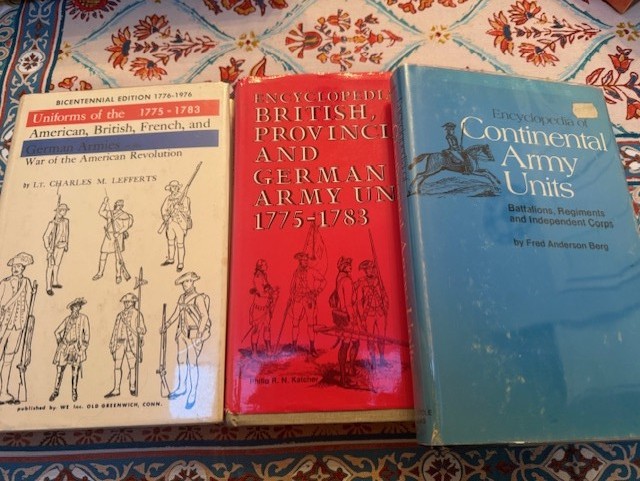
Lefferts, Katcher and Berg. Indispensable Old School sources on the AWI armies.

Do I have a plan? Well yes. The plan is to paint the damn things. Oh you mean, what will I do with them? One of my goals is to have the figures to do each of Nathaniel Greene’s battles in the south, 1780-81. There are four of these actions-Guilford Courthouse, the siege of Ninety-Six, the Battle of Hobkirk’s Hill, and Eutaw Springs. All of these battles were losses for the patriots, sort of, but each were costly victories British that caused them to surrender ground in South Carolina. I’ve already gamed Hobkirk’s Hill once. Perhaps some future Enfilade, I’ll run them all and see how it turns out.

The First Maryland mounted for Regimental Fire and Fury. This is my oldest AWI unit. Front Rank figures painted in 1992 for a Guilford Courthouse game at Enfilade 2. David Sullivan, Phil Bardsley, Bill Stewart and myself were some of the participants in that project. I think they’ve been remounted three times.

The Nathaniel Greene battles all involve a fair number of troops and units. Those games will be played with Regimental Fire and Fury. It’s an older game, but I love the mechanics. It was written for the American Civil War and chiefly for 15mm. However there is a super Fire and Fury website with rules to support variants including the American Revolution and 28mm scale. Greene’s battles are larger and often include a lot of militia The good news is that for the Americans, a lot of the units show up at all the battles, so they can be reused. Guilford Courthouse was the first of those battles and the British under Lord Cornwallis marched off to recover in Wilmington, N.C. and then made their way north to Virginia. Greene’s enemies changed with each of the succeeding battles. There is still much painting to do, but I seem to have the figures.

David Sullivan and I ran a Rebels and Patriots game featuring the Retreat from Concord April 19, 1775. It was the best game we ever ran together and was decided on the last turn of the game. Enfilade 2019.

One of the great things about gaming the American Revolution is the plethora of smaller engagements. These actions can be gamed using the Daniel Mersey’s Rebels and Patriots. I love these rules. They are looser and easy to learn. The New Jersey winter campaign of 1777 is replete with lots of engagements between New Jersey militiamen and British and Hessian forces attempting to forage, ie steal, food, fodder and supplies from New Jersey landholders. South Carolina is another theater in which there was intense fighting between Patriot and Loyalist militias that were very bloody and very important to the course of the war. I have tried to acquire a fair number of Perry militia figures so I can effectively recreate actions like Fishing Creek or Blackstocks Tavern.

These Hessians are in my painting conga line. I’ve had these for some time (like more than five years) and to be truthful, I don’t know the maker. Could be Hinchcliffe, could be RSM, but they’re old school one pose dudes. They’ll do for Rebels and Patriots.

I’ve generally tried to avoid the major actions of the war–Brandywine, Germantown, Monmouth. Part of it is the size, part is just personal interest. I am fascinated by the Southern campaign of 1778-81, and its political and military difference from the northern campaigns. It is far more of a civil war than the war in the north, they exist in both places. The northern war, however is fought more with ideas, prisons and seizure of property, while the southern war is fought with bullets and battles. Burns did a great job of emphasizing this when he pointed out that the only British soldier at the Battle of Kings Mountain was the Loyalist commander Patrick Ferguson, but all his soldiers were Loyalist Americans. There are also fascinating personalities in the south from Daniel Greene and Lord Charles Cornwallis to Banastre Tarleton, Daniel Morgan and Thomas Sumter (and those are just a few.)

In any case, I am hoping 2026 is a year when I can make a lot of progress on this project, and Ken Burns is definitely helping my level of motivation. Now if Burns could only do a documentary on the Hundred Years War, perhaps I could make more progress on that project.

Reviving the Oldies: Quetzacoatl Rampant Leaves the Closet

There’s always gotta be some mouthy guy up front giving orders.

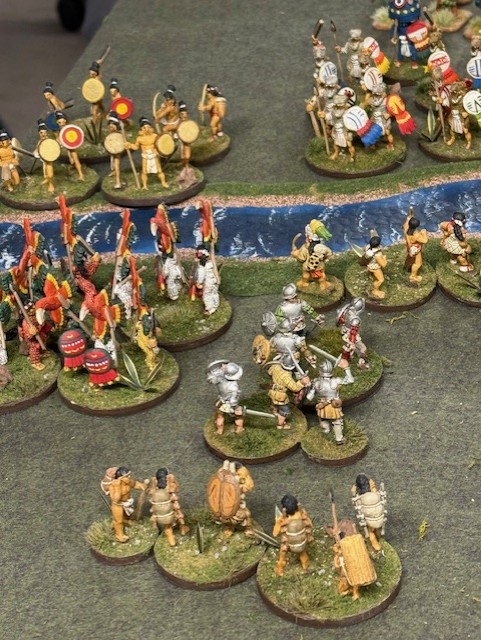
In 2015 or 2016, or maybe both years, David Sullivan and I had played a few games of the Lion Rampant and decided it would be cool to try to adapt it over to playing the game system with Aztecs and Conquistadors. Of course, the rules didn’t quite cover the period, but we didn’t let that stop us. David immediately began crafting some changes that all Daniel Mersey rules seem to invite. He called them Quetzacoatl Rampant. We both bought piles of figures. Most of them came from Eureka Miniatures and their fine range. Others were from The Assault Group and Outpost Miniatures.

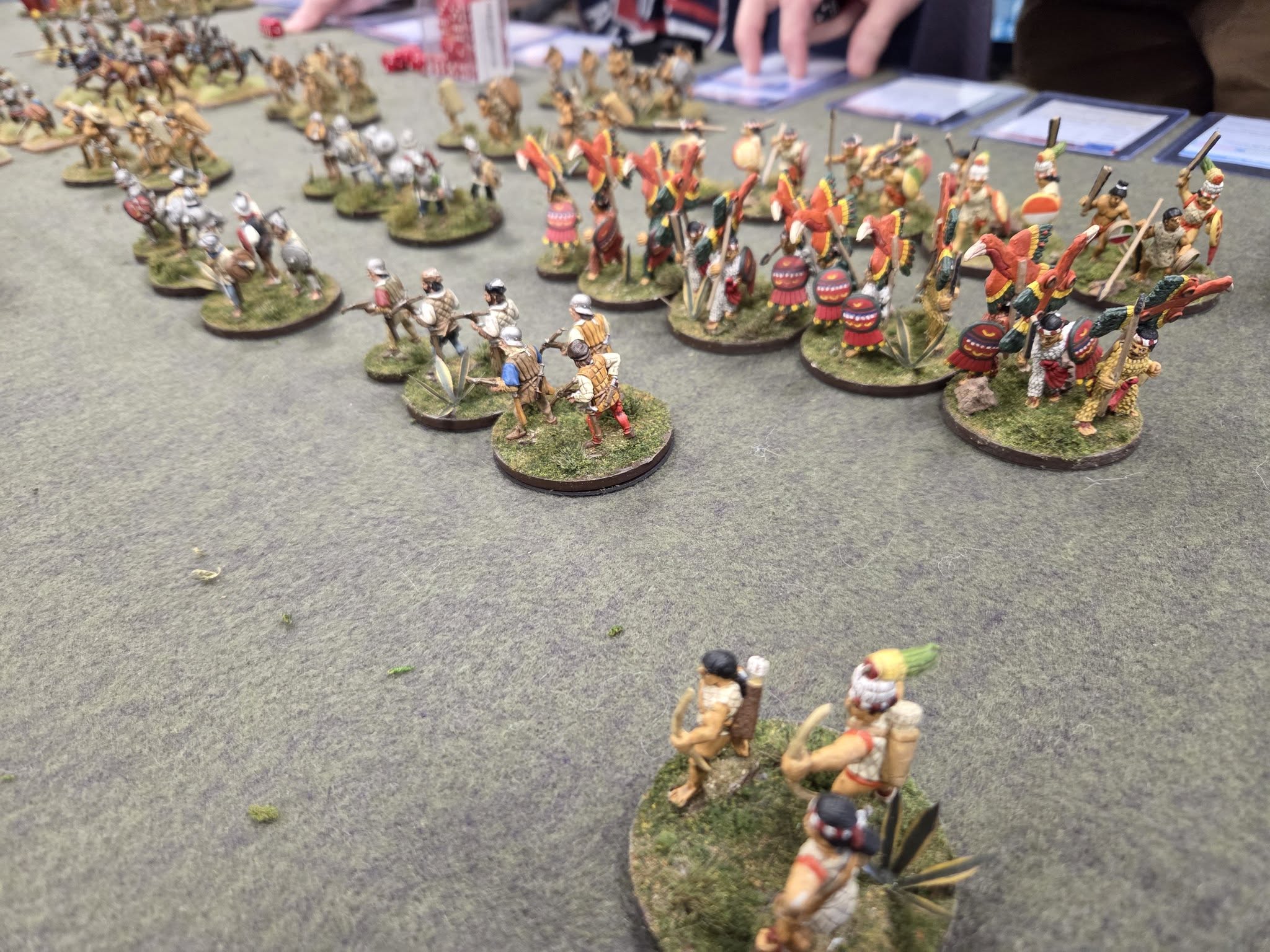
We ran a couple of different scenarios. David and I both acquired Aztec temples from Stonehouse Miniatures, but David was much more “all in” with his. We ran a big temple game at Enfilade. I focused my efforts on a foraging scenario with the Spanish aided by Tlaxcalan allies trying to gather supplies in the face of hostile Aztecs. That was a long time ago.

When David passed away in March, I tried to glom on to as many of our shared projects as possible. One of those was David’s Conquistadors and Aztecs. His painted figures were mostly focused on the Spanish, which more or less repeated mine-a cavalry unit, a bunch of swordsmen, a cannon and some missile troops. But his are a bit nicer (mine are okay,) and these were also his first venture into the Dip painting technique he would get to be so good at at.

I spent a lot of 2024 remounting my 400 or so painted figures for this project to my preferred 3-2-1 mounting model. I haven’t remounted David’s figures, which are mounted singly and honestly, I don’t think I will. However, by acquiring them, I did plan to work in a game or two. July was the month for me to act.

There are some important rule changes to note for QR. Actually, these are rules that could be applied to any Lion Rampant derivation. There is that entire activation thing. We’ve played the game straight out of the box, that any activation failure means you’re done. That seems harsh. We’ve played so that everyone gets a chance to activate, which seems excessive. We’ve played so that the leader can re-roll one failed activation or courage test per turn. David and I decided that instead we could give each side ten Appeal to God tokens. Each of these could be spent to re-roll a failed Activation or Courage test. However they also gave their foes an additional victory point.

Another change we made was in the die rolling rule for Lion Rampant. Full strength units get 12 dice and then at 50% casualties they fell off the cliff to six dice. We felt this was too arbitrary. Our game group in Tacoma decided to allot dice by figures in the unit. A standard 12 figure unit generated one die per figure, so twelve. Six figure units would generate two per figure or twelve. But as figures were removed by casualties, they would lose one die per figure or two dice per figure respective.y. A big deal for this project because all Spanish units are only six figures

Last, but not least, there are the historical flavor adds, and that is in the pile of little modifiers we threw in to reflect the period. Gunpowder weapons negatively affected Aztec armor and Courage tests. However, our favorite was the “Your Beating Heart” rule which allowed the Aztecs to capture casualties rather than remove them from play. This required a Courage test, with all required modifiers. Success would boost the captors’ Courage and give a negative courage modifier to the enemy. The hearts could give the Aztecs victory points as well.

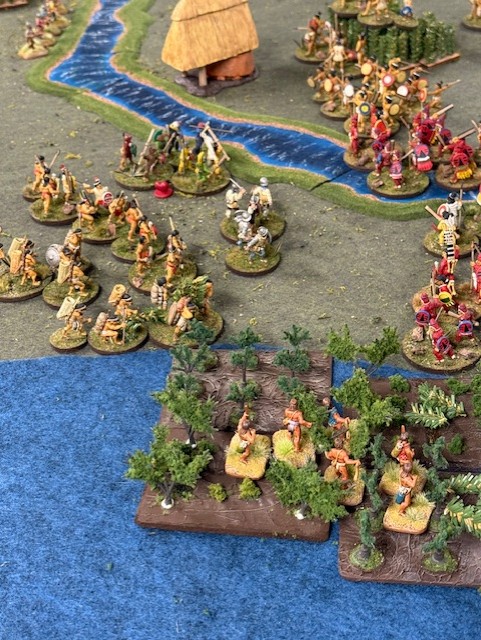
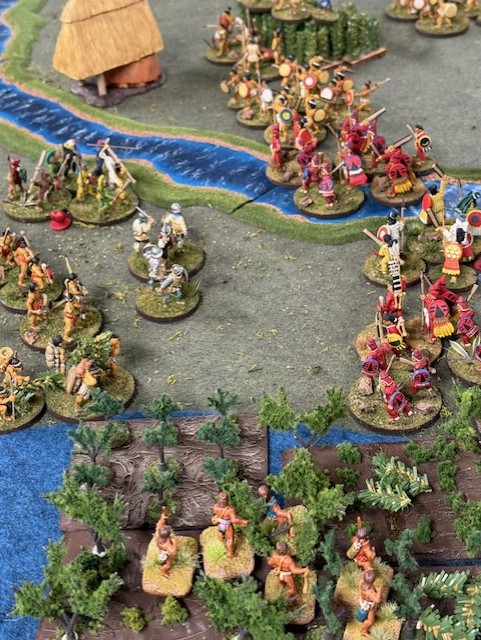
July provided a couple of opportunities for me to host games using my Aztec pile of wonder. I focused on running the foraging scenario twice, once for the monthly game day at Wizard’s Keep and the other at Silver King for my usual game buddies.

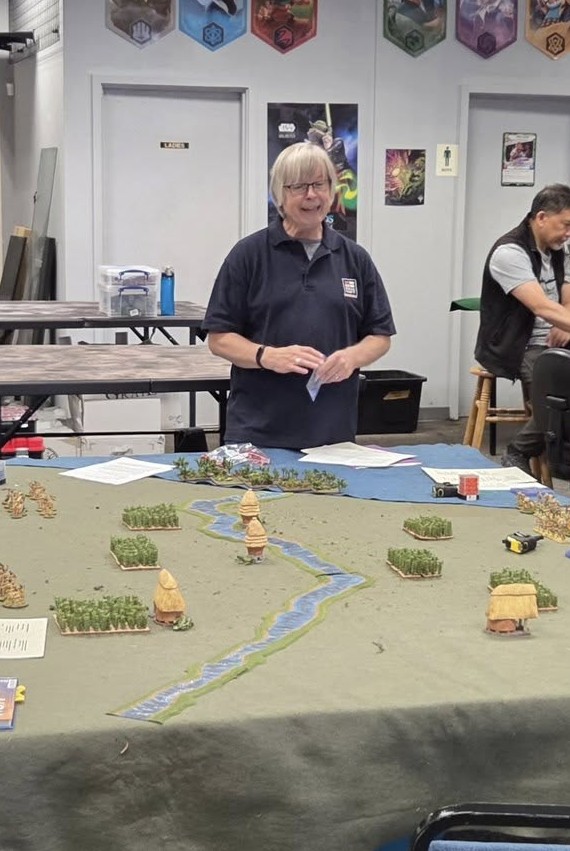
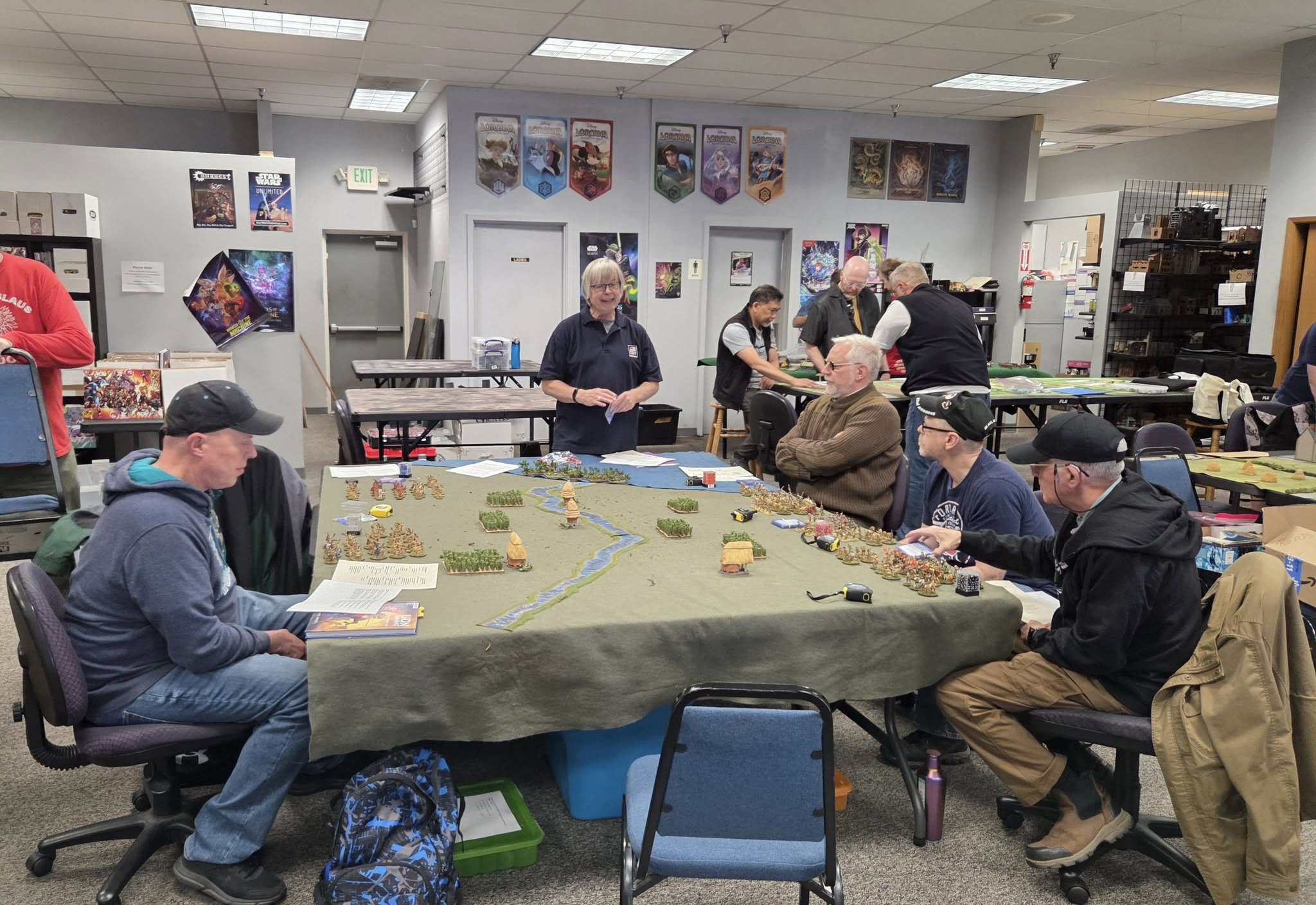
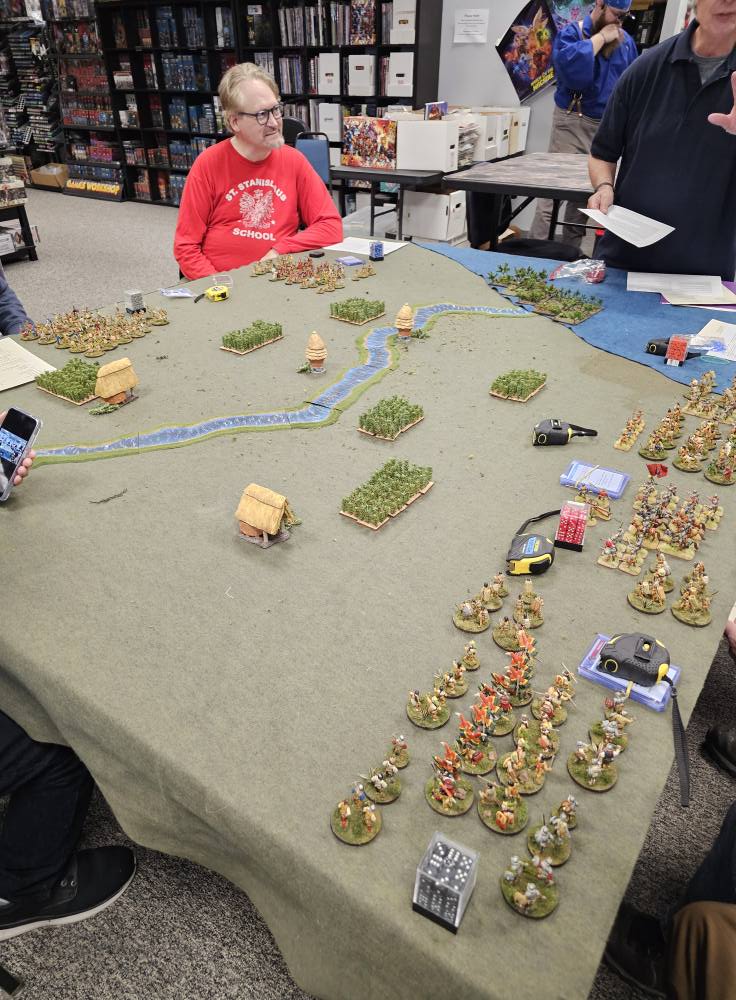
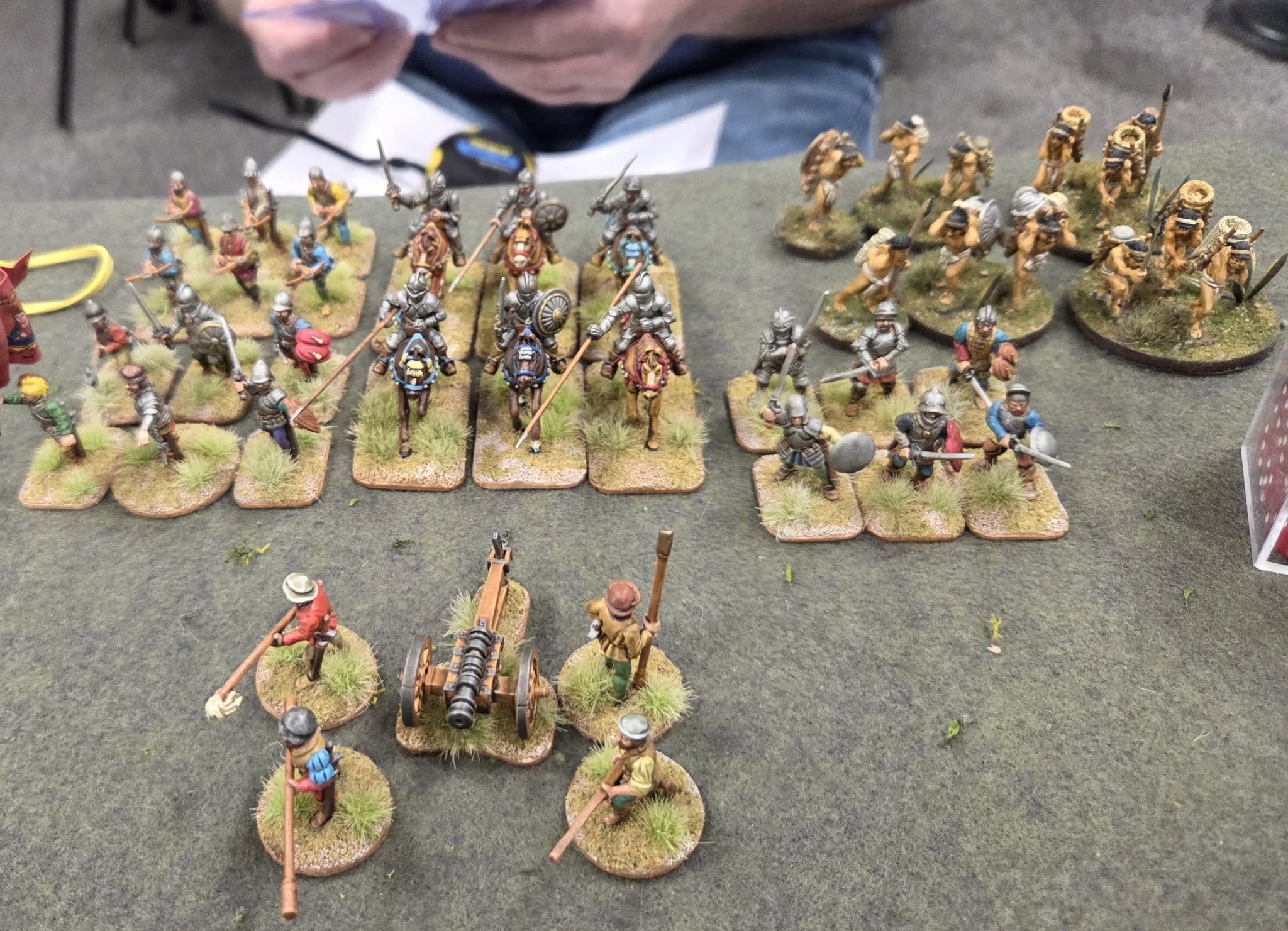
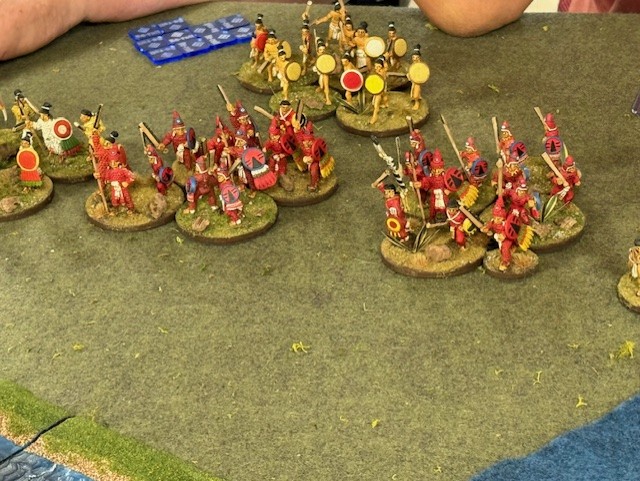
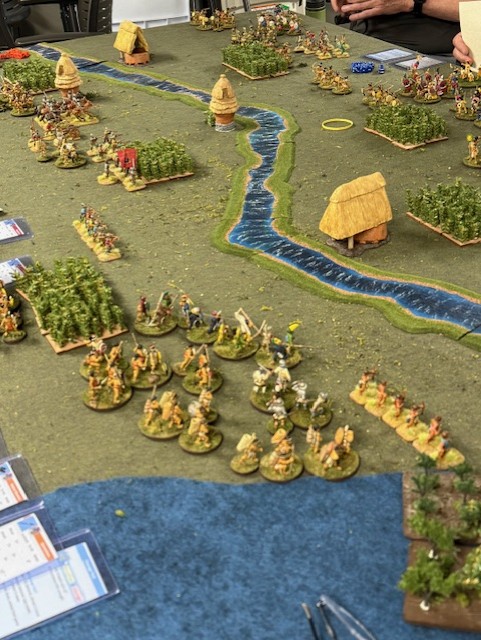
The Wizard’s King day came first. Lots of guys I knew well who would be reasonably kind. I had a 6′ by almost 8′ table so lots of width and depth. The Spanish were constrained by the bay of chimnampas or floating gardens, which was also a source of victory points. The table was bisected lengthwise by a stream. Most of the food storage to be captured by the Spanish was located there. The Spanish had three retinues. They were pretty big. The two flank retinues were mostly Tlaxcalan allies with two Spanish units-a swordsman and a missile unit. The middle retinue was all Spanish and included a mounted unit, a sword unit, two missile units and a cannon. They set up 12″ on to the table.

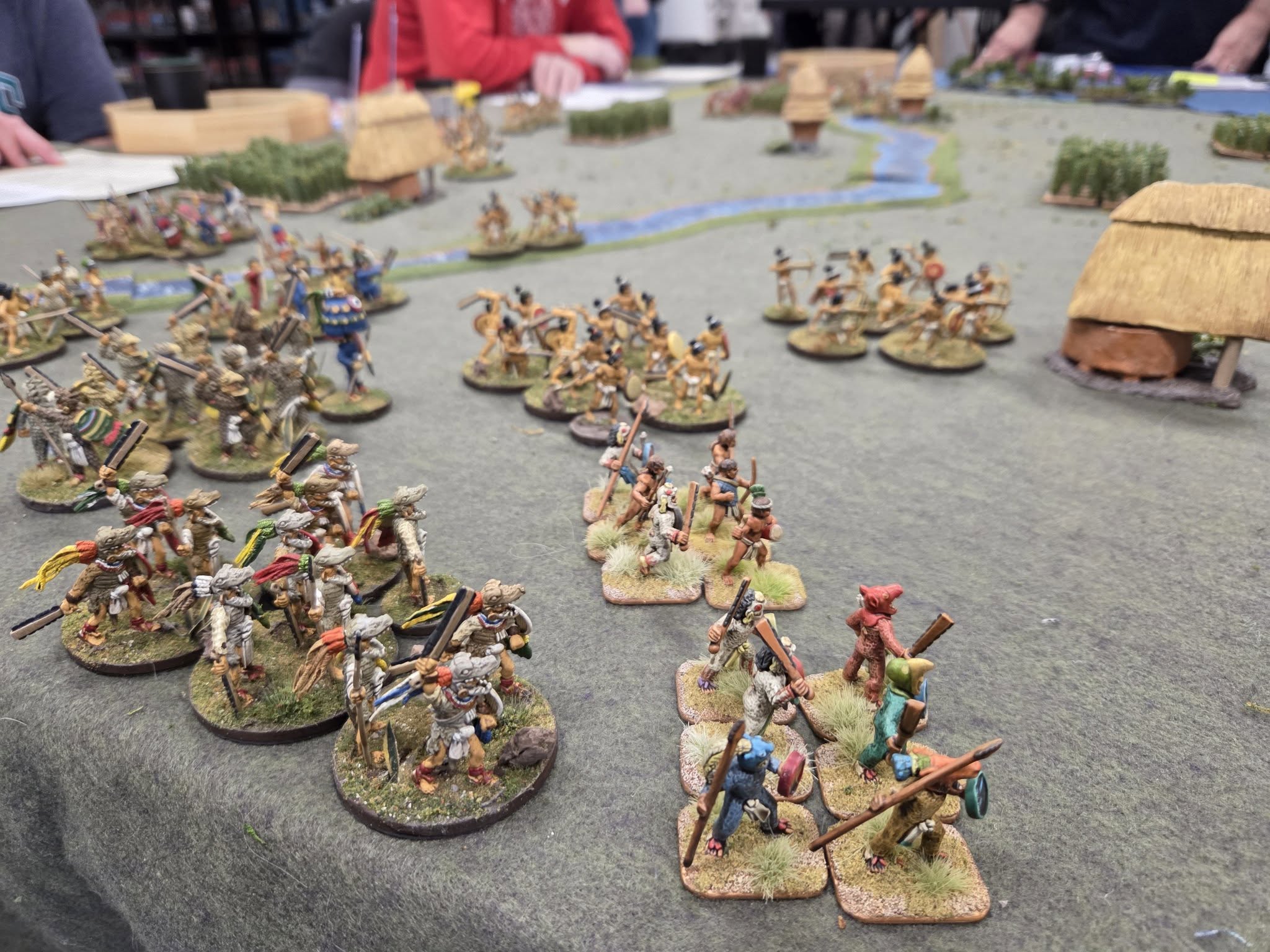
The Aztecs set up 18″ on the table. Again the retinues were largeish with four units of warriors and two units of skirmishers. The middle retinue had five units of warriors to cope with the Spanish to with the skirmishers. The right hand retinue appeared on the board edge at the end of turn one to give the Spanish something to think about.

This game didn’t go quite as I planned. I loved the activation snafus and the decisions about whether to Appeal to God or not. Honestly, there may have been too many units for everyone to manage effectively. I probably should have started units further on to the table-activation failures really slowed the armies from getting to grips. The skirmishers were too effective. The game ended up a Spanish victory. All the native bearers who collected forage were successful and survived. The Aztecs took some hearts and inflicted some casualties, but not enough, but it was a fun first step.

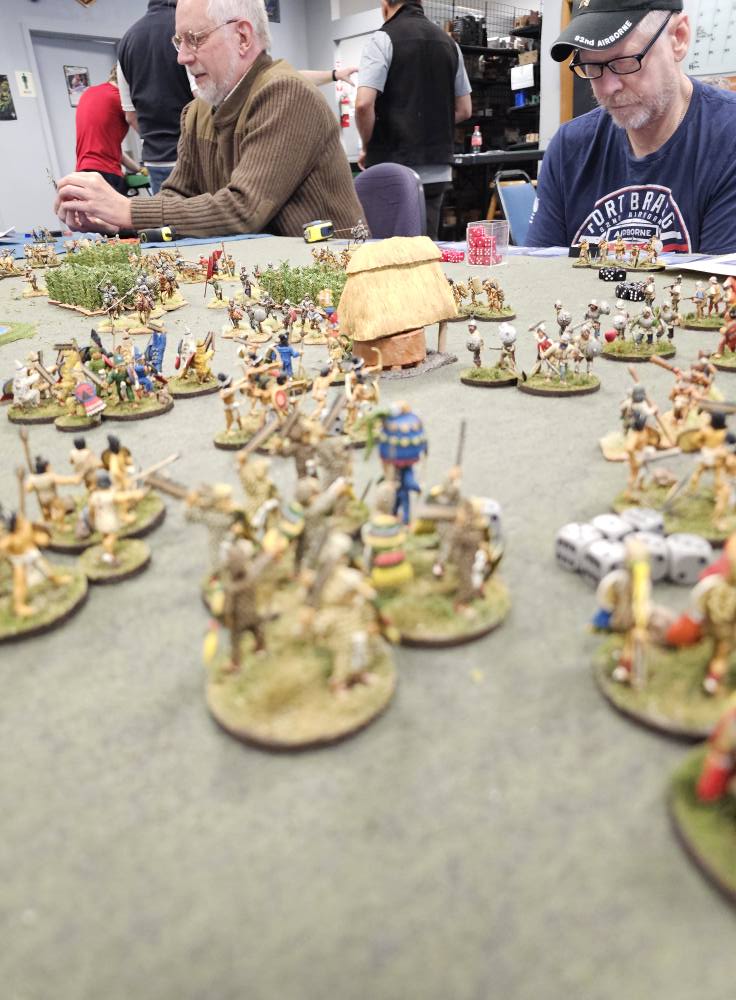
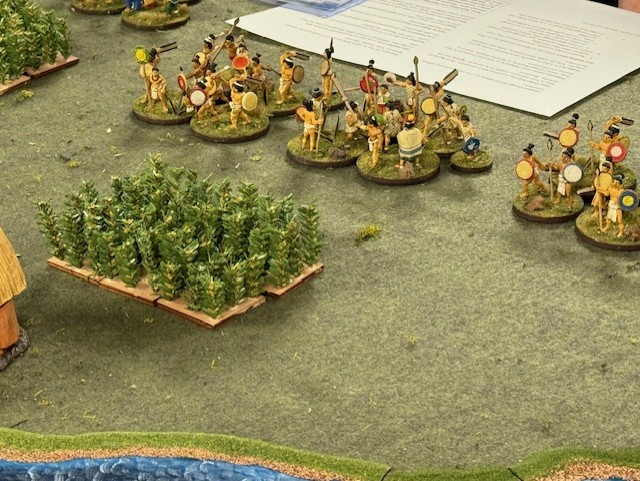
The Silver Kings game was only a few days later so I had a chance to clean things ups. I wanted to reduce and standardize the retinues. The Tlaxcalans would each have three warrior units, a Spanish swordsman, two units of bearers and a skirmish unit. The Spanish would have a horse unit, a swordsman, an arquebusier and a crossbowman, the cannon and one bearer. The Aztecs would also be a bit more limited. The two flank commands each had four warrior units and one skirmish unit. The center unit had five warrior unit and two skirmish units.

The tables at Silver Kings are only 4′ wide, so much narrower. I also limited the skirmishers to be the “Flighty Light Troops” on pg. 120 of Lion Rampant, ed. 2, which limits their shooting to skirmishing only, no Shooting activations.

The game was popular and we had seven players for the six positions. Keith and Scott divided the center Aztec command which effectively became two commands. The game also played much differently

The Spanish/Tlaxcalans almost immediately lost two units of bearers, and reduced their ability to gather forage reduced by 40%. The narrower table, however made the Spanish shooters much more effective and Mark rolled well with them, doing a lot to put pressure on the Aztec center. Those guys were severely affected by splitting their command, as Keith took his pile of warriors to the left to help Mark fight Kurt while Scott had his smaller group of guys to fight off other Mark in the center. At the other side of the table, Eric and John conducted their own private bloodbath of Tlaxcalan warriors with their handful of Spanish fighting off Aztec Knights in what seemed like an even struggle.

I thought a couple of choices made in the game were really interesting. One were the few Appeals to God made in the game. Each side burned three tokens. Because the game was so tight, it may have been a wise choice, though I wonder about the activations not made as a result. The other choice was the few Beating Hearts attempted. Mark had one successful capture-worth victory points. But after failing a second attempt, he decided to stop. No other Aztecs attempted Beating Hearts. I thought it was interesting.

It was a great game and everyone had a good time. Lots of figures on the table makes everything good. It was very tight with the Spanish perhaps winning by one victory point.

I am anxious to try again this fall. David had perhaps as many as a hundred unpainted Aztecs and Tlaxcalans I’m hoping to paint. I’d also like to pick up some Aztec civilian types that Foundry makes. I have a scenario I’d like to try that was generated through Chat GPT that has potential. Looking forward to more.
The Hundred Years War and Me

I know, I know, in my last post I laid out my plans for the new year, and honestly I’m not sure they’ve changed a lot in less than two weeks. Santa the gamer was quite kind to me. Actually Missus Kevin was quite kind to me. She rounded up the remaining figures I need to complete my LOTR project, elevating it to a must do wrap up. I’ve finished another unit of Cuban rebels for the The Men Who Would Be Kings. However, my time right now is pretty focused on The Hundred Years War.

I have few project interests in the Old World. No Romans or “ancients” per se. My Dark Ages SAGA stuff for sure. No Seven Years War or Napoleonics. They’re pretty, but a black hole of gaming because I could paint my entire life and never have enough. Nope, most of my interests are in the Western Hemisphere. AWI, Western Expansion, The Mexican War, Maximilian, The Spanish American War and it’s subsidiary effects. But that Hundred Years War thing.

I find it to be a fascinating conflict, incredibly complex, with roots more than a century before its outbreak, even back to 1066. It’s a war with terrific economic stress on both sides throughout the conflict. There are great kings English and French, ineffective kings, mad kings, great leaders, poor leaders, changes in technology, sea battles, great sieges, politics, politics, politics, usurpation, civil wars, civil wars within civil wars, and the emergence of France as the first true nation-state. It’s amazing.

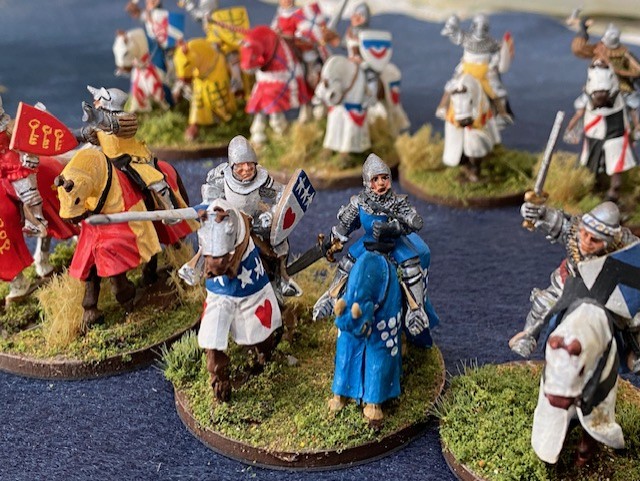
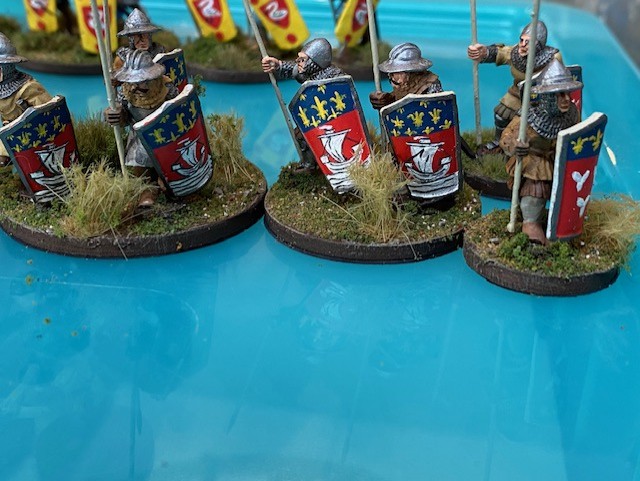
And I have figures. A virtual shit-pile. How many? I have no idea. I am planning to remount them for Lion Rampant. Not a great rules choice for big battles, but I think I can make it work. Daniel Mersey is quite flexible in that way. But just to give an idea of how many figures I may really have, I’ve remounted six units of crossbows plus one unit of mixed missile and melee troops, two units of French local levies, for a total of 108 figures, plus four units of French mounted knights, and a unit of Irish skirmishers for the English. A total of 140 figures. A drop in the bucket. I was looking at my painted longbows last night and they number at least 200. Maybe a few too many. That leaves aside dismounted men at arms and various other wretched infantry, many mounted figures, plus all the unpainted stuff (which will likely be added as SAGA armies for the new Age of Chivalry factions.)

So I’ve got a lot of figures for the period.

What’s changed is that these figures have mostly laid fallow for the past decade, and now I’m super enthused about them. Maybe it is the imminent arrival of Age of Chivalry, maybe it’s the publication of the final volume of Jonathan Sumptions’s history of the Hundred Years War. I’ve also read Dan Jones’ excellent new bio of Henry V and recently ridden the Michael Livingston traveling circus. But something has fired up my interest in revisiting this project

I’ve begun to consider scenario plans to go with it. I would really like to do the Battle at Blanchetaque ford in 1346 just days before the Battle of Crecy. It would be a very different, interesting game. However it would require a lot of playtesting due to the unique nature of the action. I just don’t think there is enough time to do the remount and do enough practice to make a good game at this time. Instead I’m drawn to the Battle of Shrewsbury of 1403. It’s a battle between Englishmen during Henry IV’s contested reign and the sky will be filled with arrows. It should be fun, and I’ll keep you posted dear reader.