Late Sunday night I was still struggling to get some stuff finished for the week, despite putting in a fair amount of painting time for the week. But, it finally happened.
Let’s be clear, I do have some busy distractions right now. In early October Lorri and I are going on vacation to Hawaii. We’re excited. We’ve never been there before, so it’s a big hoo-hah deal.
While we’re gone we are doing a major remodel at Chez Smyth. The remodel will require moving all the furniture out of the living room and dining room. We’re renting a POD to store furniture, but I have about 700 books and 300 records that will have to be packed so bookcases and record storage can be moved.
It’s a job. The benefit is that I’ve been able to weed out some of my books, which will create better storage for other books I’d like to move to more desirable places and creating a bit more storage for other things. Like miniatures.
But, I have gotten some painting done.
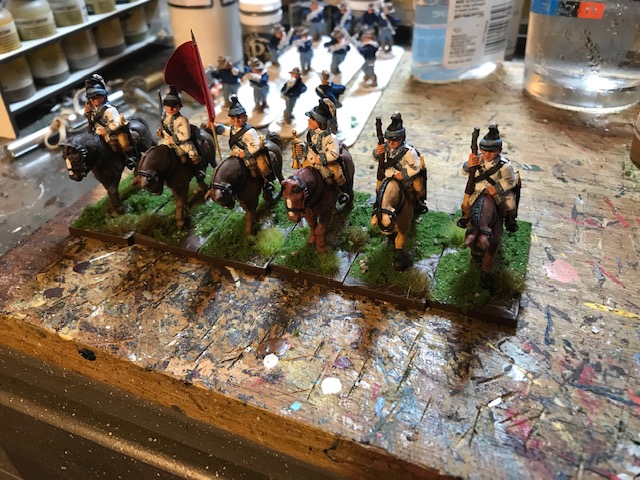
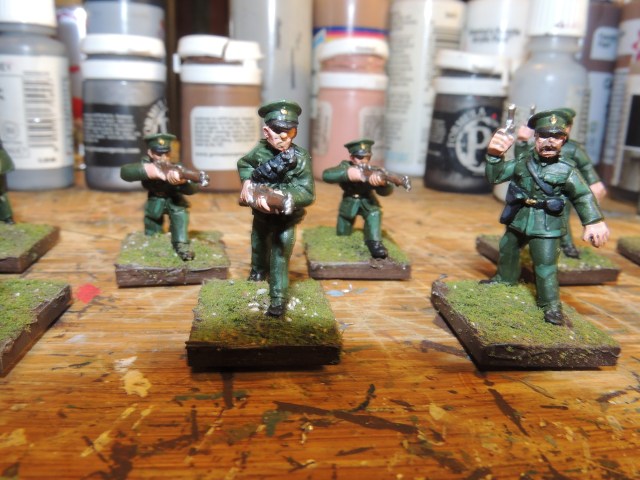
Washinton’s 3rd Continental Light Dragoons is one of my very favorite units from the War of Independence.
I completed my first mounted unit for Rebels and Patriots. I’ve long loved William Washington’s 3rd Continental Dragoons. They fight everywhere throughout the Southern Campaign. Washington, a cousin of that George guy, was a terrific leader. Even though his unit totaled less than a hundred men, they always seemed to be in the right place. At Cowpens and Guilford Courthouse, key counterattacks really turned the tide of those battles. Unfortunately, Washington’s luck ran out at Eutaw Springs when he led his cavalry into wooded ditch defended by British regulars. He was unhorsed and captured.
My figures are from Front Rank. I’ve had them for a while, and I’d like to start painting a lot of these stray figures. As will al Front Rank figures they are pleasingly chunky. If I have a quibble, it is that the troopers all have their carbines out, which I think is dumb. The British light dragoons don’t have their firearms out. They have swords, like any proper light dragoon. When Washington wounded Tarleton at Cowpens, trust me, he wasn’t slinging a musket stock.
I love the white coatee with blue facings. It is white, with Vallejo Light Blue Grey. I gave the officer white pants, the others have Vallejo Desert Yellow. I could have opted to do the coat in Vallejo Grey-White and done a bit more with highlighting, but I didn’t. I did highlight the horses, which left them a little lighter and redder than I would have liked. I also highlighted the horse furniture and I’m really happy with how that turned out.
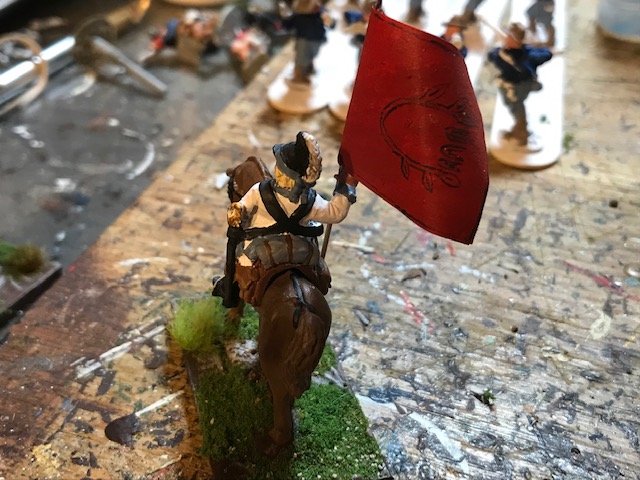
The Eutaw standard, which really isn’t much of one. But it was fun to paint.
The standard, called The Eutaw Flag was the one carried by the 3rd Continental Light Dragoons. It was made from the tablecloth of Washington’s fiancee. I hand-painted that baby, yessirree. Not a major strain, I assure you.
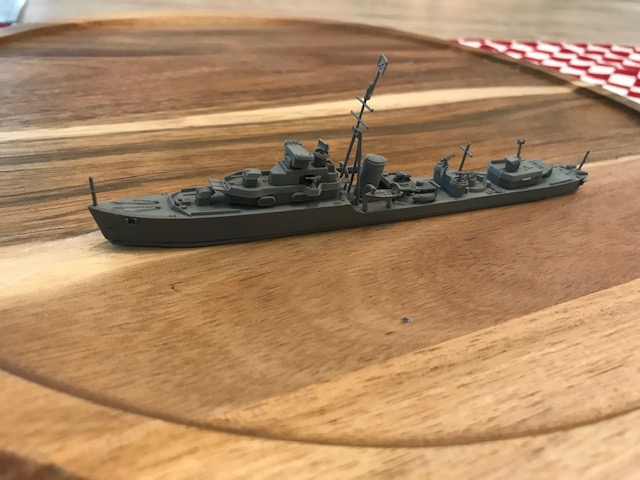
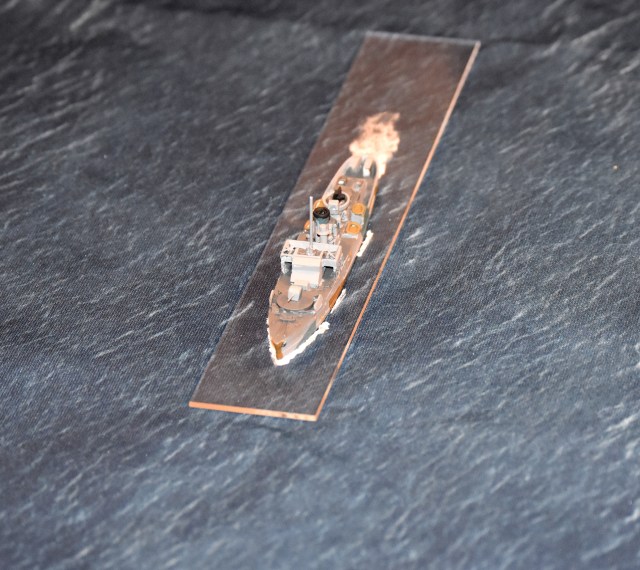
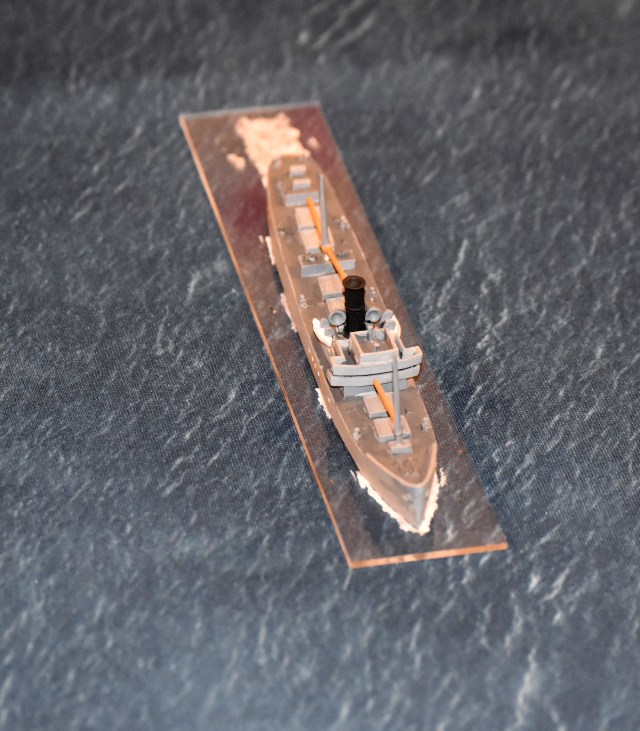
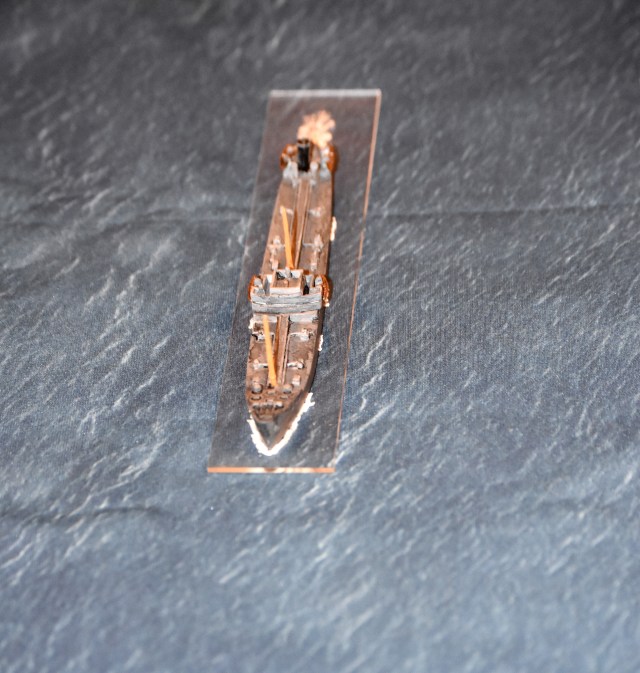
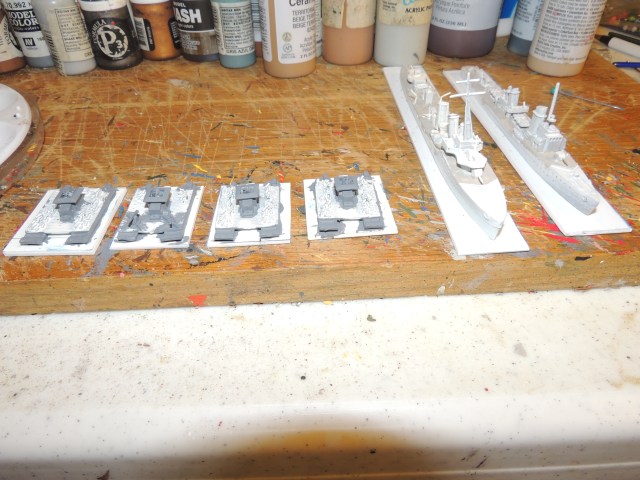
From here, I’ll pick up the continuing saga of the HMS Orwell. You’ll recall it is a plastic kit I was struggling a bit with.
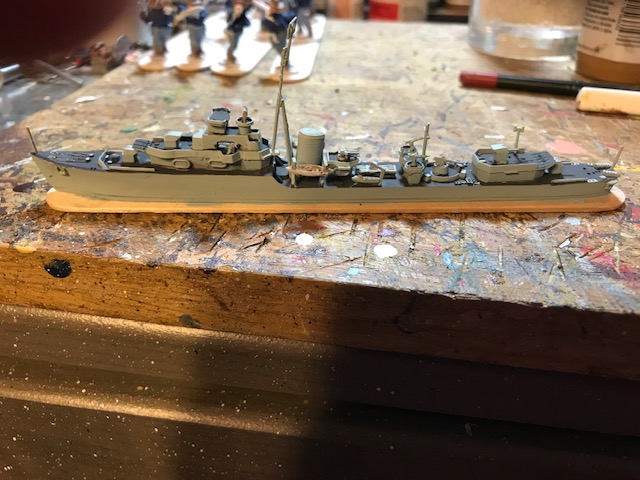
Orwell in Light Sea Grey before the camouflage is painted on.
After spraying it with Humbrol light grey, I took on the real paint job. Think of the spray as a primer coat.
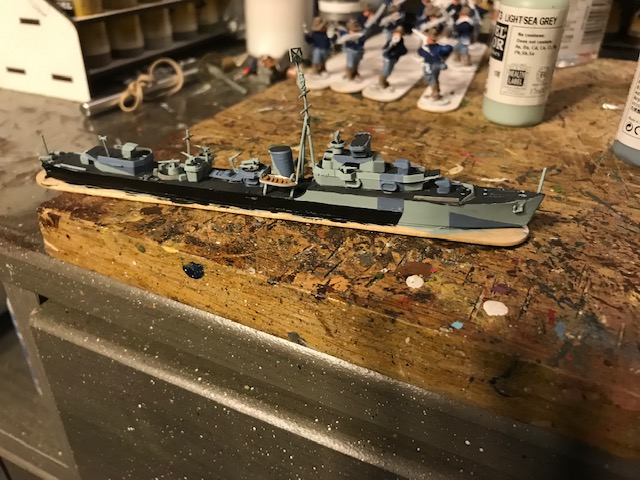
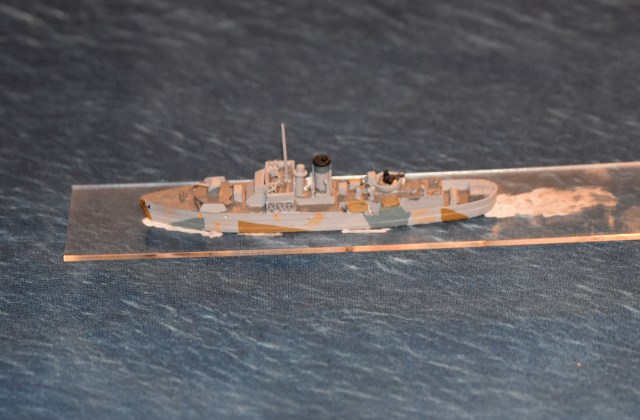
Orwell after camouflage. All that is left are a few decals, and then glue the model to its clear acrylic base.
First I painted all the decking with Ceramcoat Charcoal Gray. Then I went back and painted the hull and all the non-deck places Vallejo light sea grey. The camouflage, taken from an illustration of another O class destroyer, the Obedient was applied in Vallejo Black, and Vallejo Light Blue Grey. Yes, it was all done by hand, and no I didn’t use any kind of mask because I’m basically a lazy sluggard.
All that’s left to do is the decals and there aren’t many of those.
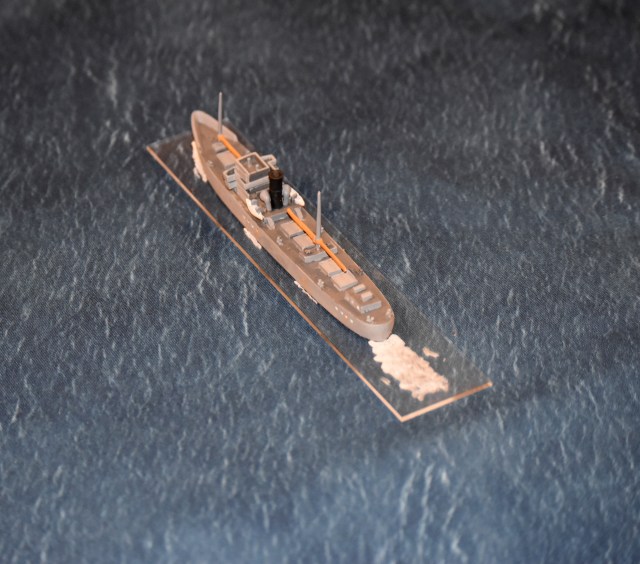
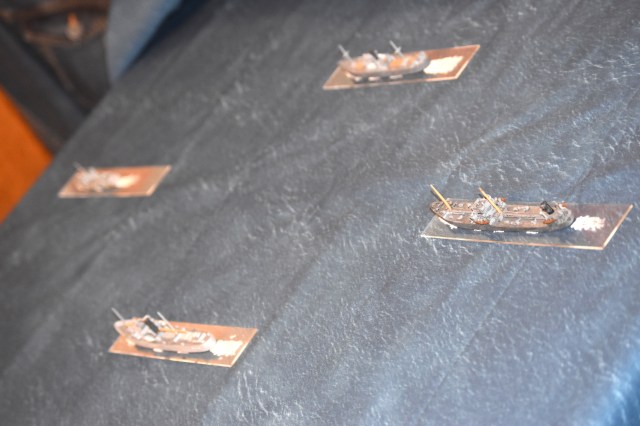
From here, it’s on to finish up some U.S. Volunteers in the Philippines, and I’ll begin assembling my remaining transports for the Museum of Flight convoy game.


 Henry V’s Navy: The Sea Road to Agincourt and Conquest 1413-1422 . by Ian Friel To suggest that books about the Hundred Years War at sea are as rare as hen’s teeth may be giving too much credit to the hens. The only other book-length study I’m aware of is 2011’s Edward III and The War at Sea, 13227-1377 and is pretty much worth a king’s ransom (and somehow I missed it when it came out, sniff.) I determined not to be shut out when this book became available on February 1, and promptly ordered a copy. The small volume was not over-priced, and I’m hoping to read it soon. Henry V was a noted shipbuilder and vastly increased the size of the fleet that virtuallydisappeared during the reign of Richard II.
 The Civil War at Sea by Craig Symonds. Symonds’ name may ring a bell. He’s a prolific writer, best known for his military atlases, but he’s written about many military topics, including the naval aspects of the Civil War. He tackles this massive topic thematically rather than chronologically, focusing on the changing nature of ships and armament, the blockade, commerce raiding, war on the rivers, the attack on ports (using Charleston as an example) and the success of the Union naval strategy. The book has only 170 pages of text, so it tends not to get hung up on detail, so if that is your desire this may not be the book for you. But as a thematic interpretation of the Civil War on the water, it could do the trick.
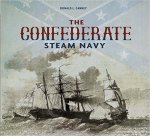 The Confederate Steam Navy by Donald Canney. I have only ordered this book and haven’t received it yet. But I have been angling for a copy since it was released on December 9th. Canney’s book on the Confederate Navy is supposed to mirror his brilliant two volume study of the The Old Steam Navy that went out of print in the ’90’s. These are books I constantly consult and I believe the new book will be just as useful. So much of what is written about the Confederate Navy is conjectural while Canney’s work always seems to be anything but. It covers all types of vessels from the ironclad rams to blockade runners, and as with his previous work, will be crammed with illustrations and photos, some not previously published. I’m excited. Hoping it arrives from Amazon today.
