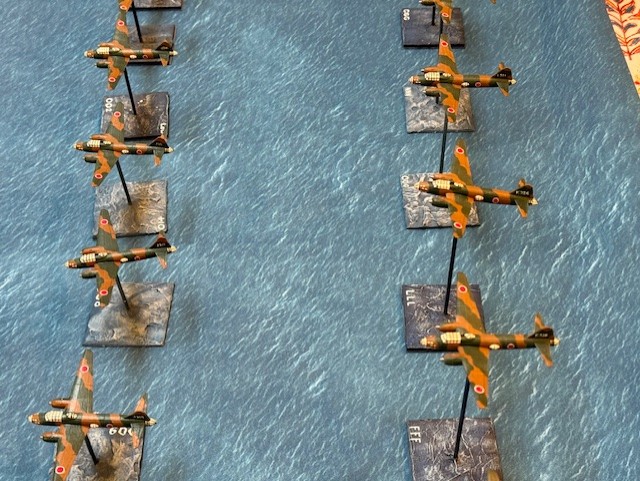
Oops, hope the title isn’t too confusing. Those are two different things I’m doing.The first, and most time consuming is preparing for one of my Enfilade games–The Annihilation of Force Z. This is the Japanese naval air attack on The HMS Prince of Wales and HMS Repulse from Dec. 10, 1941, shortly after Pearl Harbor. The sinking of these two ships, together with the destruction of America’s battleship fleet three days earlier truly signified the end of an era in which surface ships could roam the seas in daylight without air cover in the face of a determined foe with massive modern air assets.
This will be my opening Enfilade game. Friday afternoon I’ll be tucked away in the Alder Room and the game will be a four player cooperative game. All the players will be Japanese pilots trying to do their job: sink the two British capital ships. The Japanese pilots who flew the twin engined bombers that destroyed Force Z were veterans, and knew their jobs. They were at the end of their fuel limits and were afraid the Royal Navy slipped from their search. But when they were found, the various Japanese pilots were summoned to the place and they guided their attacks to success. It wasn’t easy. The anti-aircraft fire was fierce. The angles of attack weren’t favorable. But in the end the deed was done, and airpower prevailed over sea power. The Japanese players will have to do the same.
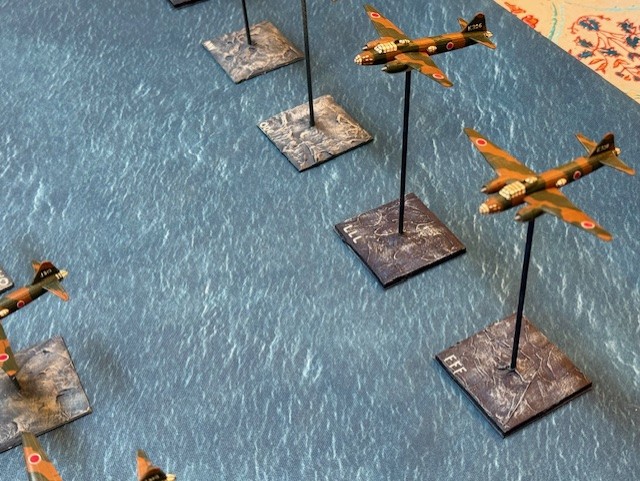
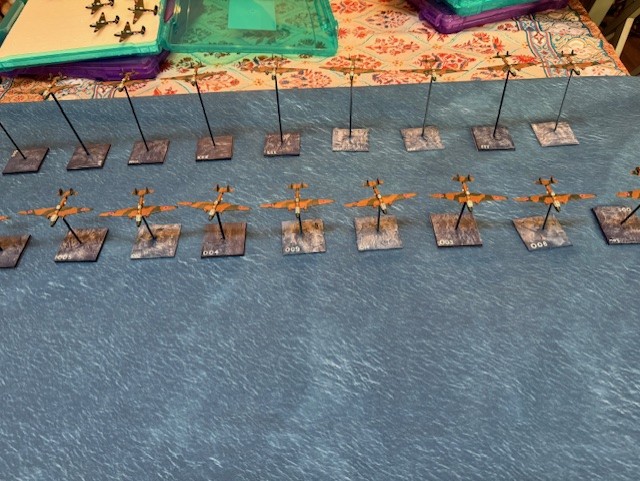
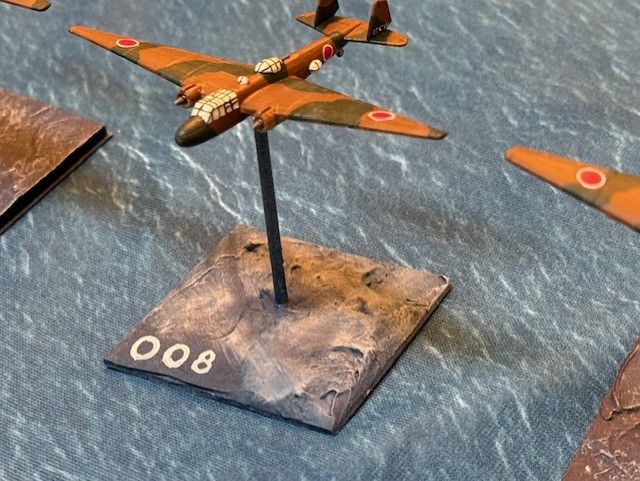
From left, a little closer look at the Bettys. Center, 18 Nell bombers that heft bombs or torpedoes in the game. Everything is stuck on a low or high level flight stand identified with numbers or letters. The things we do for our games. Right a little closer view of the Nells.
The rules for the game will be my own. The Japanese planes will appear on the board in squadrons of 7-9 planes. Sometimes two squadrons will appear at the same time. So there won’t be 50 planes on the board all at once, but there could be 18. At the beginning of the game, a simple die roll will determine the additional obstacles the Japanese will face. It could be that some of the squadrons were intercepted and some planes were lost or damaged. It could be that the squadrons are even a little more scattered by weather. It could the seas are rough and the conditions are windy and it may be more difficult to hit with bombs and torpedoes.
The rules are mostly my own work but inspired by other games I’ve played. As always, I’m motivated by the aircraft rules in Airwar 1940 by David Manley. A lot of the AA rules and scenario specific flying rules are determined by what can keep the game simple and easy for the players to figure out on a Friday afternoon. The bomb and torpedo rules in the game have stretched my thinking, and I’ll be referring to three sets of rules to determine something final. Those are an old set of rules called “Clear for Action,” “Command at Sea 5” by the Admiralty Group, and “General Quarters, 3rd edition.” I’m really inspired by the Osprey Air Campaign book on Force Z and Martin Middlebrook’s wonderful writing in “Battleship” which covers the history of Force Z from it’s inspiration in the UK to it’s apocalyptic demise.
I’ve painted more than 40 planes for this game. They are all 3D printed from Flight Deck Decals. Equal numbers of G3M Nells and G4M Bettys. Finished the last of them a couple of days ago. I’m working on the five ship models that will have to be built. I’m done with two of the three destroyers and then come the capital ships.
Play testing will be critical to the success of this game at this convention, though that hasn’t always guaranteed success in the past. Careful planning rarely survives first contact with the gaming public with all apologies to Helmuth Moltke. However, I am hopeful I might have a first go of it on March 14th for our scheduled game day at the Veteran’s Museum in Chehalis.
Though I spend a lot of time in my den painting (and building) stuff, I do try to get out and game regularly. I think I’ve written that when I was working-teaching-I spent a lot of time planning for my games but rarely got out to play as often as once every other month. Now I try to get out to game at least once a week. Doesn’t always work out that way but I do my best.
Recently, I begun playtesting a set of rules for my friend Chris Leach. Chris is a game designer in White Rock, B.C. who has worked extensively with Arte Conliffe on a number of games and gone on to design and publish some of his own including the ancients game Control to Catastrophe. Chris tends to favor mass battle games, but he put something together that is kind of skirmishy and asked if I’d be willing to give them a try. I put together a couple of scenarios for my Wednesday gaming colleagues to try. We liked them.
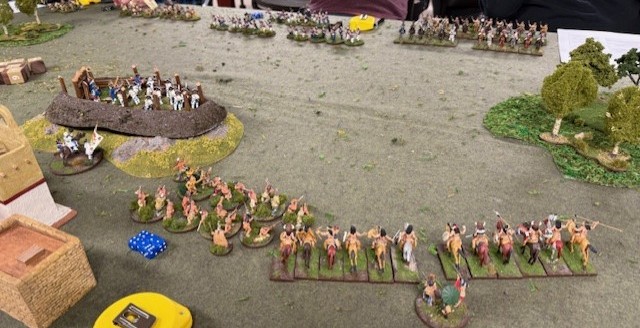
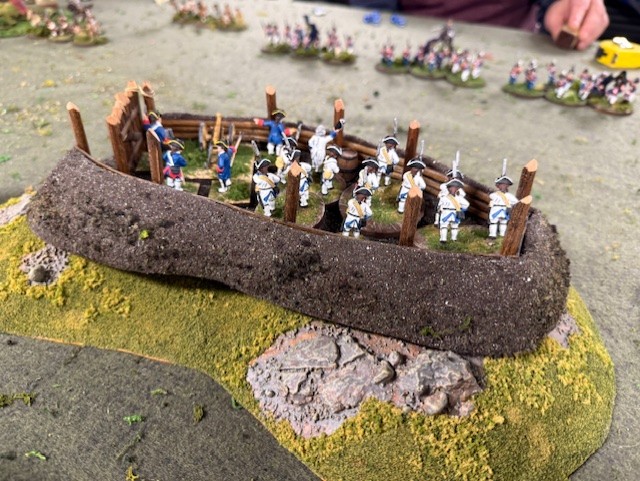
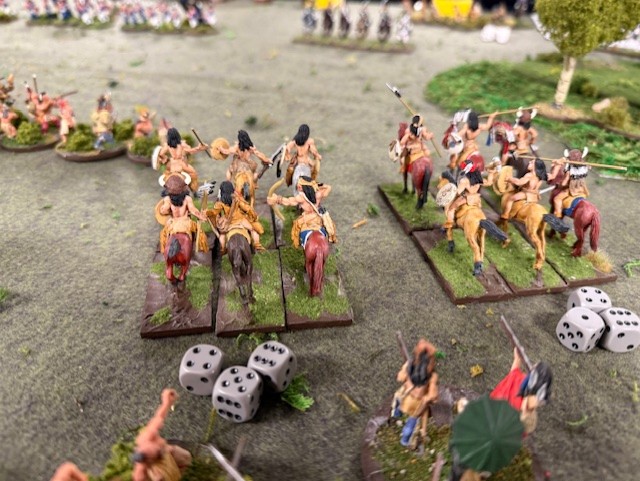
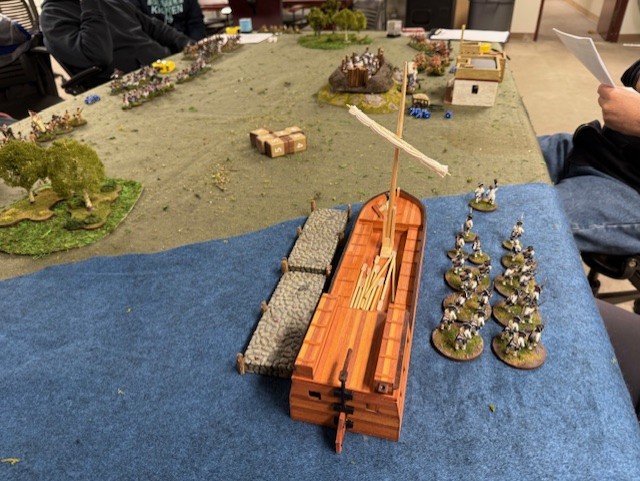
Our Take Action game from last week. The Americans were tasked with forcing the Spanish out of “Nachitoches” during a hypothetical conflict in 1806 over the Southwestern boundary following the Louisiana Purchase. Figures are mostly Old Glory Wayne’s Legion, some Conquest Comanches, and some RSM Spanish. The keelboat was scratchbuilt for me a long time ago by Mark Waddington. The game was tough on the Spanish mostly because the rules didn’t quite work as I intended. Back to the drawing board.
The rules are called Take Action. They are for that horse and musket period also covered by Daniel Mersey’s Rebels and Patriots rules. Like R and P the rules are activation based, but activation can be more varied. Units may combine different actions with their die rolls. The number of die rolls is determined by the quality of units. So, regulars get four die rolls and militia get three. A unit can use these dice to rally, move or shoot. The mechanics of the game are deliberately simple, and we have had no trouble picking them up and playing them. We’ve been able to give them a try a couple of times and are angling to get in one more game sometime this month.
It’s been fun to get in on this, and I appreciate Chris trusting us enough to not make a mess of them.
 A Gamer's Tales