When I gamed in the 80’s I was raising a family, didn’t have much extra money, and thus didn’t have a lot of cash to invest in the next big thing in figures. Friends would talk about the new Dixon figures at a buck a piece and I would laugh and go about painting my strip Minifigs. Times have changed, and I do pay attention and every now and then the hook gets set and I’m suddenly hurtling through the air after the next shiny thing. Sometimes it works out and others, well, not quite as much.
There was a post in one of our groups about the Pacific Northwest native figures from Paymaster Games. Paymaster is a small company located in Seattle (just up the road) that offers some real niche figures, including MesoAmerican peoples, Pacific Islanders and Northwest natives. I am a sucker for anything resembling local to this area so I was immediately intrigued. David Sullivan and I began looking at playing the recently revised Tribal rules, which call for small singly mounted commands of 15-20 figures. We both thought these would be just right for such a mini project. We jumped right in on the PNW natives.
With the completion of my Skraelings for SAGA and the wrap up of the Camerone figures I currently have, I felt the time was right for work on these PNW figures. As I said, Paymaster is a Seattle company. I would guess they are quite small, maybe they don’t do their own casting. Their on-hand supply of figures seems to be quite limited. David Sullivan and I have made small, multiple orders and have exhausted what seems to be in-stock. My first order was slow in coming and wasn’t exactly what I ordered, though the second order arrived promptly and was exactly what I asked for. I’m sure it’s a tough business for newbies. I chose to focus on the harpoon-armed warriors that resembled, at least in my mind, Makah warriors. I tried to do a little reading to learn a bit more about dress. Though there is an Osprey book on Indians of the Pacific Northwest, it’s of limited utility and I had to make my own best guesses.
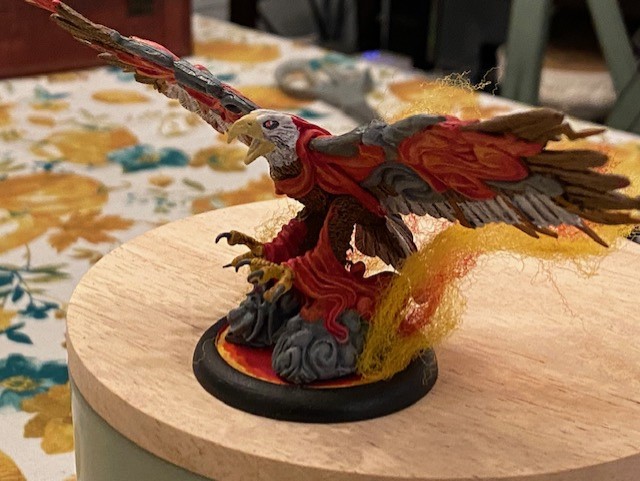
I had the figures for six weeks or so before I started doing anything with them. I did, however, paint the Great Thunderbird figure immediately. It was so cool and such a great attraction I couldn’t help myself. It was a four piece resin cast miniature, quite large that I’m sure I can figure out a way to use in something. I loved every minute of painting it. They also have an Ogopogo miniature based on a Loch Ness-like myth that lives in Lake Okanagon. Another local story that I can’t ignore.
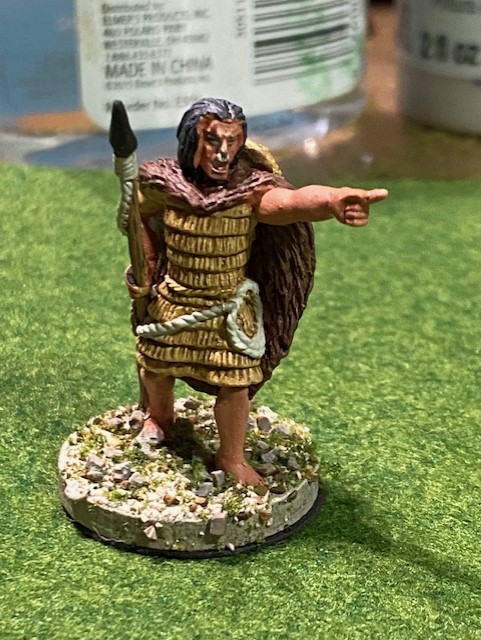
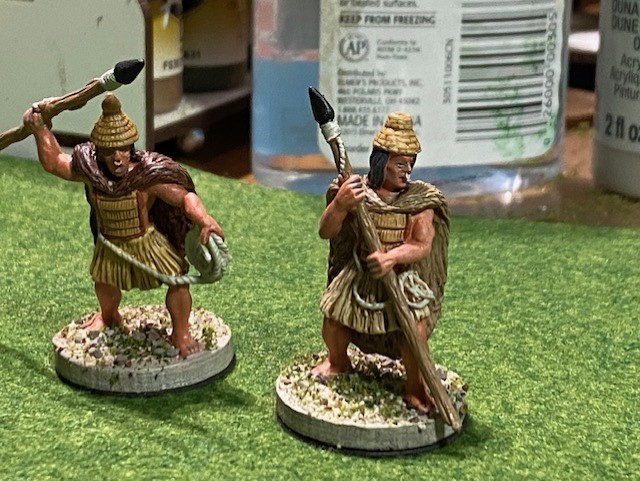
Last week I finished my last Camerone guys so it was time to start doing something with the Paymaster dudes. The Paymaster ranges are similar throughout. I can buy warrior packs of five figures and supplement those with more individual “heroic” figures. The “heroes” are definitely distinct. They are more expensive, much larger and some of the poses are quite cool. I had actually painted the Makah leader and the two Makah harpooners and I liked them quite a bit. They had just the right amount of detail and the casting really reflected the simplicity of dress these larger than life fellows would have had. However I had a bunch of warrior figures to assemble and paint, and they would be different.
The Paymaster warriors of all types come in packs of five figures. Looking at the pack, my eyes bulged out at the pieces, “holy crap.” Depending on the figure type, there are 4-6 pieces per figure that must be assembled: legs, torso, head, separate arms or arm combination, and a quiver if your figure has a bow. I became very friendly with my large bottle of Zap CA glue and Bob Smith’s CA glue accelerator.
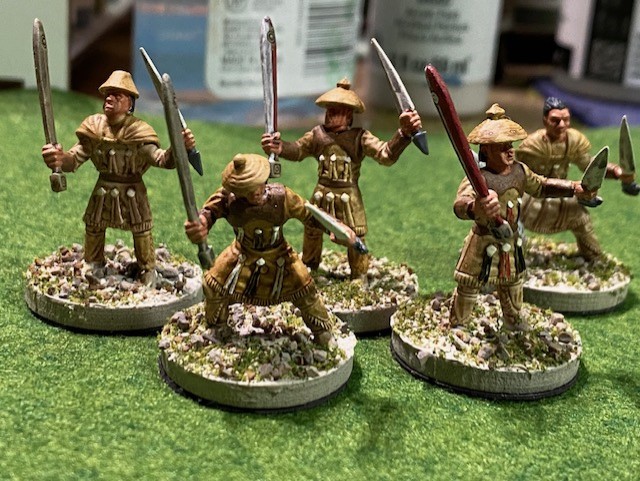
The warrior figures are not large. They are much smaller compared to the one piece “heroes” types. In terms of animation they aren’t super. There are some very nice touches. I like that 3/5ths of the torsos have the capes, typically made of cedar bark, that many northwest natives wore to keep off the rain. The harpoons, which are cast metal, have very nice detail with the whale sinew rope wrapped around the projectile and the hands. Love the pattern printed on the quivers, very northwestish. The tassels on the tunic are a nice touch, but everybody has ’em. I also really like the variety of headgear for the figures.
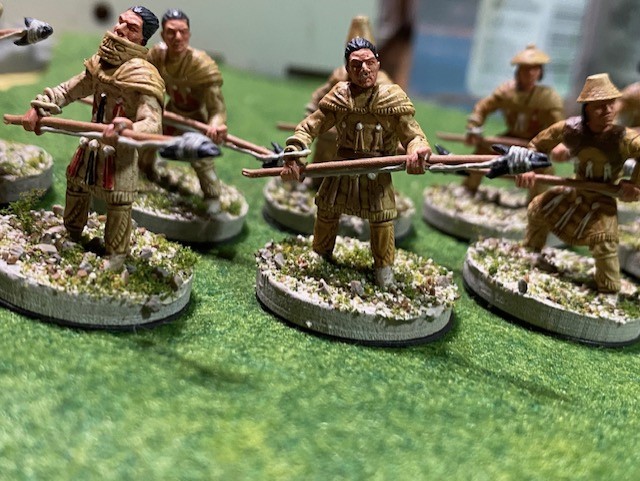
But there are issues, at least for the dude like me who is new to the party. The figures come with a nice variety of weapons and bits. The archers have a choice of a bow being fired in the left hand OR a bow that is schlepped, and in the right hand, one has either an arrow or a war club (or at least I think that’s what it is.) Unfortunately those options don’t work for every figure. If the figure has a cape, it can’t use the right hand with arrow. How did I find out? The hard way. Harpooners with capes good. Harpooneers without capes, bad. The harpoons actually come attached to both arms, one version clearly for dudes with capes, one clearly for sans capes. The arms for without, just don’t fit right without lots of filing and epoxy filler. This automatically catapults them to the bottom of Kevin’s most-loved figures list. They were quickly dragooned into service as archers or with war clubs, but that was only because I had a fair amount of figures to mix around and I was able to discern the patterns in the void pretty quickly. Some directions would have been useful.
Painting isn’t difficult. There actually is a Pacific Northwest Indians Osprey book (Men at Arms 418) but the plates don’t give a ton of guidance. The figures probably much better attired than the pre-contact warriors would have been. I chose to keep colors simple and used a lot of variations on tan. Then I soaked ’em down with Army Painter Soft Tone wash. I was pretty happy with the results. For the tassels on every warrior figure’s chest and back, I did a few in light brown, but most I painted red, white or black, because those are colors that appear in most contemporary native cultural symbols. Is it right? No idea. The tassels are attached with off[-white shells. The figures were easy, but kind of fun to paint.
The assembly is a pain. I’ve assembled a fair number of plastic figures-Perry, Victrix, Gripping Beast, North Star-some more fiddly than others. These were worse.
That said, these figures fill an interesting niche and the detail is nice. The warrior figures look good when painted, though the posing is mostly uninteresting. The heroic figures I really like, but they are also quite costly. The warriors work out to an acceptable $2.25 each or so, but the heroic figures can be pretty pretty spendy at $8-10 a whack. These figures are also quite large. They are beefy and about 34mm tall. The warrior figures, by comparison, seem slight and measure in at 28-30mm.
I would never say not to buy these figures, however the buyer should be aware of what they are getting and that they carry some risks with them. I will add more figures as I need them to make a good 4 player Tribal game. But now I know what I’m getting into.
 A Gamer's Tales