The French Adventure in Mexico is one of those semi-weird conflicts that might get you some weird looks. I did get the quizzical question “There were French in Mexico?” during my game on Saturday. The answer is yes. The French invaded Mexico in January of 1862. They established a ruling Emperor there headed by the Austrian Archduke Maximilian in 1864. The French forces left Mexico in March of 1867. Maximilian was captured and executed by Republican forces in June of 1867. That’s a simple time line, but the story is much more complicated.
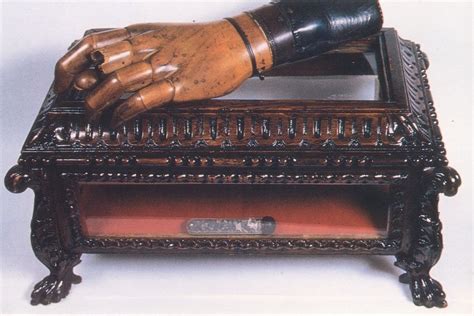
Here’s a couple of things you may know, sort of. Cinco De Mayo occurs during the French Adventure in Mexico. It celebrates the repulse of the first assault on Pubela on May 5, 1862. Puebla fell to the French in a second, better-prepared attack a year later. The French Foreign Legion remembers the action at Camerone where Captain Danjou, he of the wooden hand, led a doomed defense of a decrepit hacienda with 46 men, against 1,800 or so Mexican attackers. The Legion celebrates Danjou’s defense each year. That was April 30,1863.
Here’s what I hope to do in as few words as possible. 1) A little history-the whys and the whens. 2) Where can you read stuff. 3) Some minis, some rules, some advice.
A Little History.
What were the French doing in Mexico? It all begins with the end of a three years civil war in Mexico called The Reform War. This lasted for three years between forces advocating the end of peonage and for religious freedom versus large landowners and the church. It ended with the election of Benito Juarez as president. In Europe, those opposing Juarez began imploring Catholic monarchs including Napoleon III of France and Franz Josef of Austria-Hungary to invade Mexico, toss Juarez and establish a monarchy in the New World.
Though the pleas of the Mexican representatives go Napoleon’s attention, that was not the deciding factor in sending troops to Mexico. Another factor was money. Juarez’s predecessors borrowed large sums of money for dubious economic development activities. Juarez, seeing the size of the obligations refused to pay and sought better terms. This was not resolved by the time of the French invasion.
Finally, and probably most importantly, in April 1861, troops in Charleston Harbor fired on Fort Sumter. The United States, in the Monroe doctrine, declared that no European nation could intervene in the affairs of nations in the western hemisphere. For the next four years, the government of the United States would be otherwise occupied, leaving the French a free hand to A) send troops to Mexico, B) force the duly elected government of the country to flee for its life, C) Establish a foreign nobleman as monarch in Mexico City, D) capture most of the country, E) decide the cost in blood and treasure was too much and leave said monarch to sort it out as best he could and fail.
The French would go on to control Mexico City, Veracruz, Puebla and most of the large cities on the coasts and Mexican plateau. They were able to capture Oaxaca in a monumental campaign through the mountains against hero and future jefe, Porfirio Diaz in 1865. The French commander, Bazaine, was far less blood-thirsty than his conservative Mexican supporters desired, and Juarez and his forces were allowed to melt away into difficult terrain and gather strength. At the end of the American Civil War they were also able to gather surplus weapons from sympathetic American generals, gathering the latest rapid firing rifles and entire batteries of rifled cannon left for them south of the Rio Grande. Though the conflict had plenty of large battles, it was chiefly a conflict featuring raids and counter-raids by guerrillas and counter-guerillas reminiscent of our own more recent 20th and 21st century conflicts, tough on combatants and non-combatants alike.
When Maximilian ascended to his monarchy in June 1864 he set about building his own army. This was never large, but it had some interesting units and very cool uniforms. Some were foreign troops from Austria Hungary and Belgium. But most were either conscripts or entire units that changed sides during the conflict. Generally, they weren’t terribly dependable. But they did look good.
When the French pulled back to Mexico City and then exited Vera Cruz in the spring of 1867, they left Maximilian outnumbered, out gunned and out classed. The Emperor, a talented sailor but not much of a soldier, a lousy administrator, and author of a memorandum requiring that troops in arms against his reign and captured be executed, was himself captured at Queretaro. His own end was inevitable despite the pleas of most of the heads of Europe.
Where Can You Read Stuff?
This is a sticky question. You’d think a fascinating conflict like this would be full of great histories. Not so much, at least not in English. The big attraction to the French Adventure in Mexico is the tragedy of Maximilian and his wife Princess Charlotte of Belgium. Frankly it’s all pretty melodramatic. But there are at least three long books about them since 1972, including one during the pandemic.
But here are a few suggestions. There may be many more that I am simply unaware of so if you can help me out, let me know.
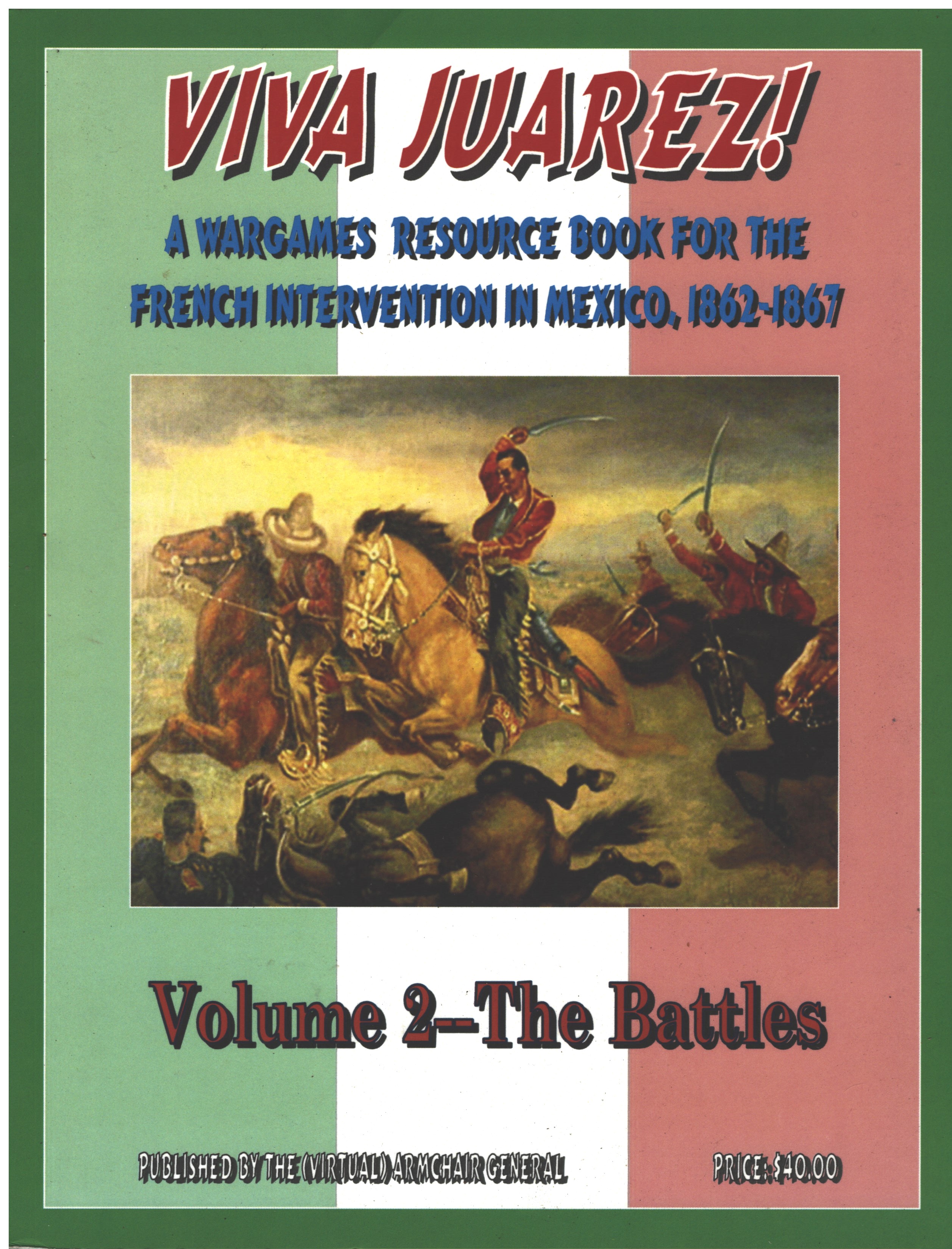
- Viva Juarez! This is something you probably can’t live without. It’s actually two books. Volume 1 provides information, including color pictures, of the different troop types that fought during this conflict. Equal time is given to the Republican, Imperial, and French troops as well as those who are not easily categorized including early and later militias, guerrillas and bandits. Volume 2 is a gigantic compilation of information. There are great maps. There are army organizations and troop strengths. There’s a really useful timeline. There are orders of battle. It isn’t perfect, however. It really needs a narrative that tells the story and holds all the pieces together. This is published through The Virtual Armchair General and the estimable Patrick Wilson.
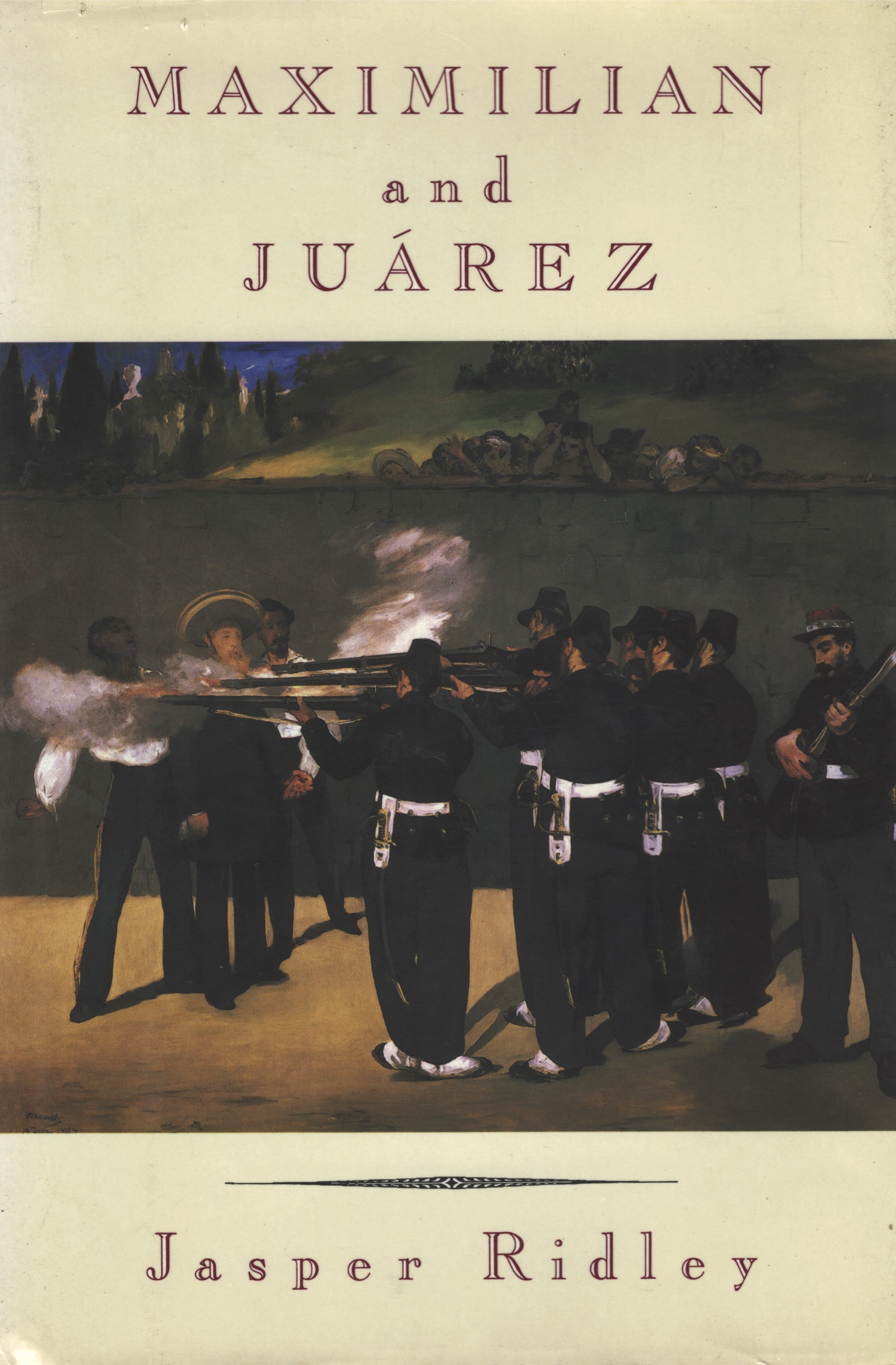
- Maxmilian and Juarez by Jasper Ridley. This 1992 history is the closest I’ve found to a narrative of the French Adventure. It holds together the complicated narrative pieces of the earlier Mexican Civil War, cogently assembles the causes of the war, and follows the trials and tribulations of all the involved parties. It doesn’t get into the nitty gritty of individual battles, but it will fill in a lot of big picture blanks.
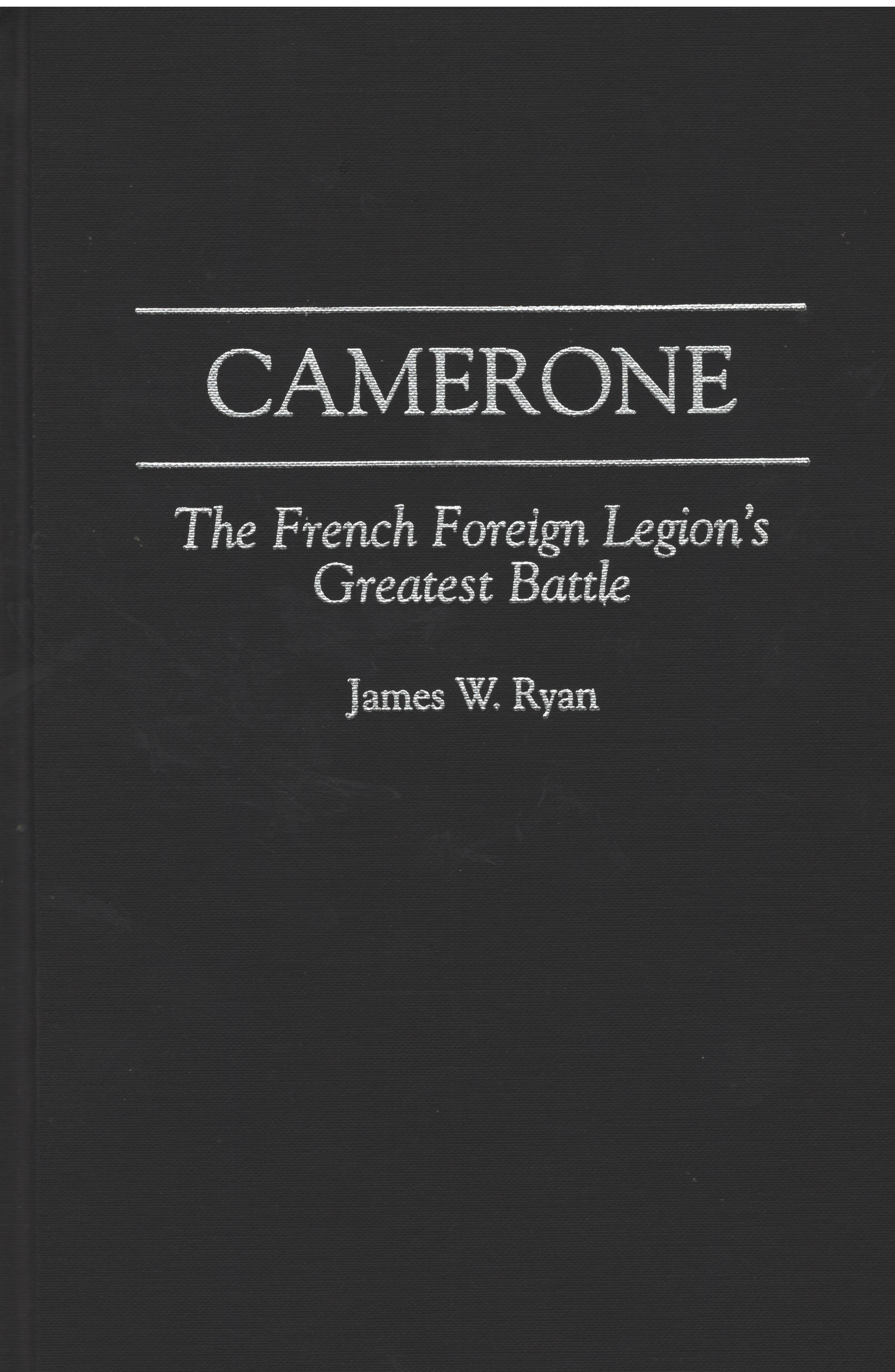
- Camerone: The French Foreign Legion’s Greatest Battle by James W. Ryan. If you are interested in Camerone, this is the book you need. It’s a relatively short book about a relatively brief and bloody day, but it has all the detail about Camerone you will ever need.
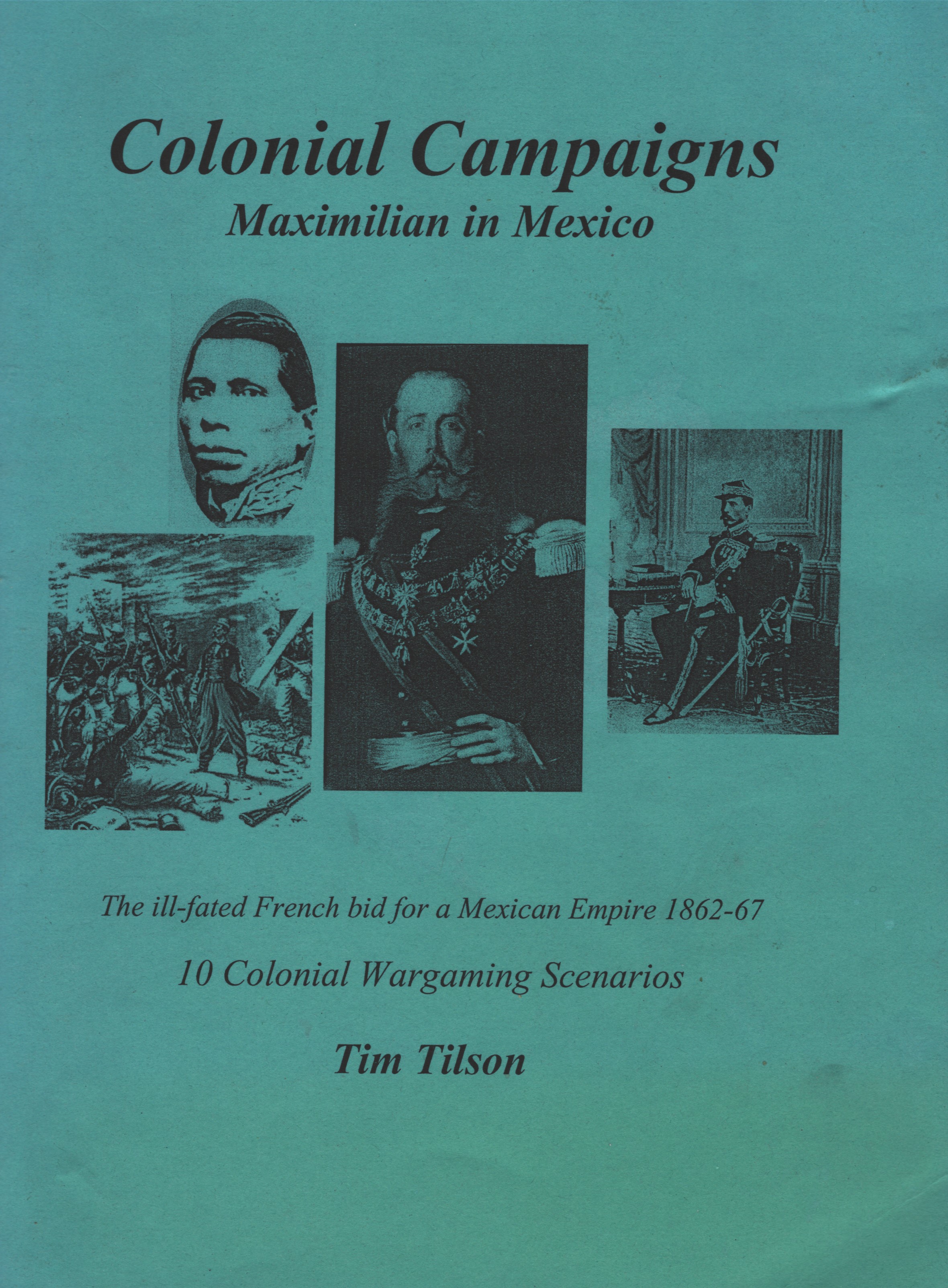
- Colonial Campaigns: Maximilian in Mexico by Tim Tilson. This is a 1990’s guide for wargamers that was part of a series offering scenarios for The Sword and the Flame. Tilson provides ten scenarios. It’s pretty handy. A lot of the scenarios are actually pretty large battles scaled for TSATF or whatever rules you may be using. I ran Matehuala using Rebels and Patriots. There is a Major Dundee scenario. Long out of print, this is one to keep your eye out for at flea markets and Bring and Buys.
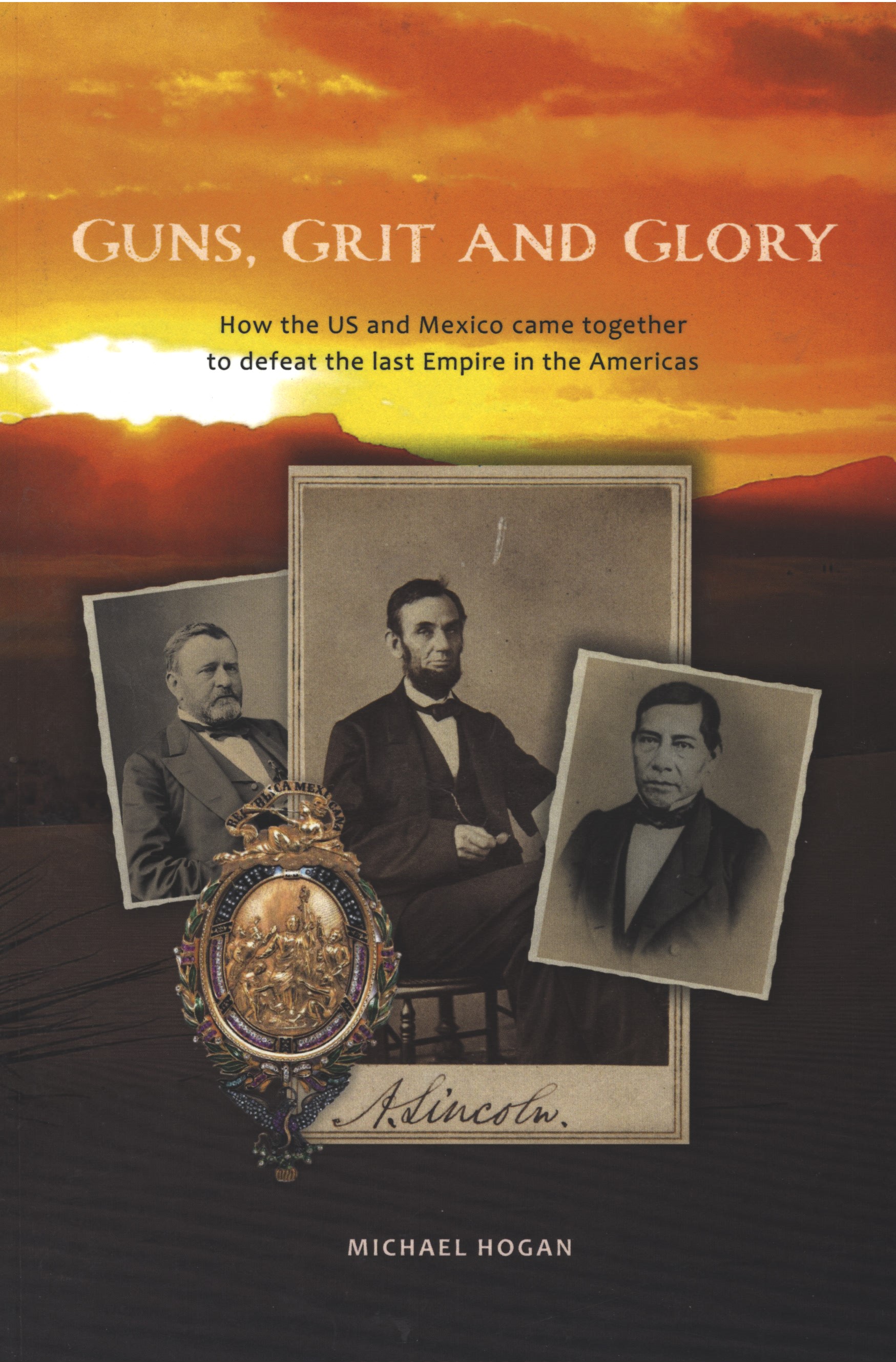
- Bonus: Guns, Grit and Glory by Michael Hogan. This 2019 book is a handy look at how Juarez tried to work with the Lincoln and Johnson administrations to defeat the French and Maximilian. Very readable with lots of detail about weapons and the potential for American intervention in Mexico. A good, if somewhat improbable read.
Let me just add that there is a an Osprey Men At Arms book #272 “The Mexican Adventure 1861-67” by Rene Chartrand. Chartrand is reliable, and it is cheap, but it is pretty brief. I’m sure there must be other usable sources out there. In fact, I suspect that some time in Google Translate will get you into some very useful Mexican official sources.
Miniatures
There are definitely some miniature choices out there. But let’s be real for just a moment. Maybe you want to try the period out but don’t want to make a big investment. You could definitely use some ACW figures for French and Mexican War figures for Mexicans, if you have those laying around instead. Red pants for the French instead of bleu. If you want to go a different direction, here are some suggestions in no particular order. I’ve included some photos for comparison
Gringo 40’s– Not much in the way of French to go with, just a few figs for Camerone. However, they have some very nice Republican infantry, lots of different poses. I love the Republican regular and irregular cavalry, though they are quite large. I have the Belgian Legion figures, and would love the Austrian Legion figures. More spendy than some and then there is the matter of postage.
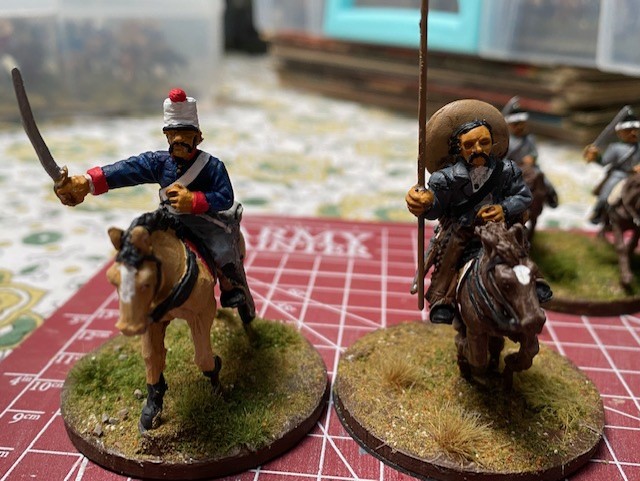
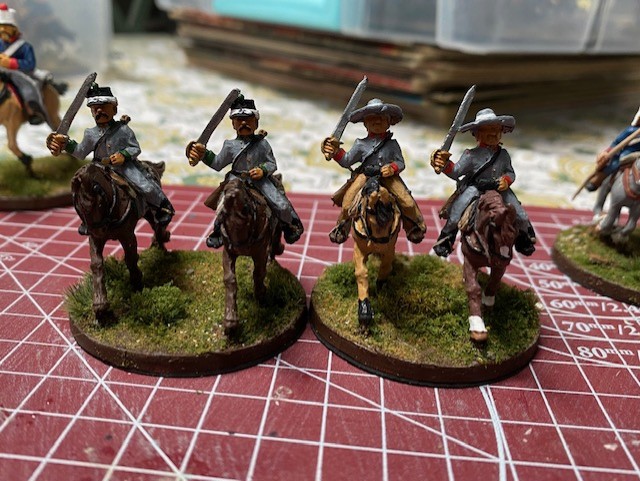
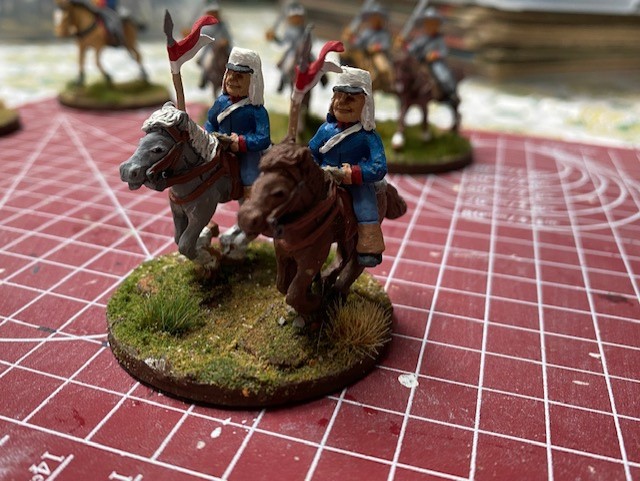
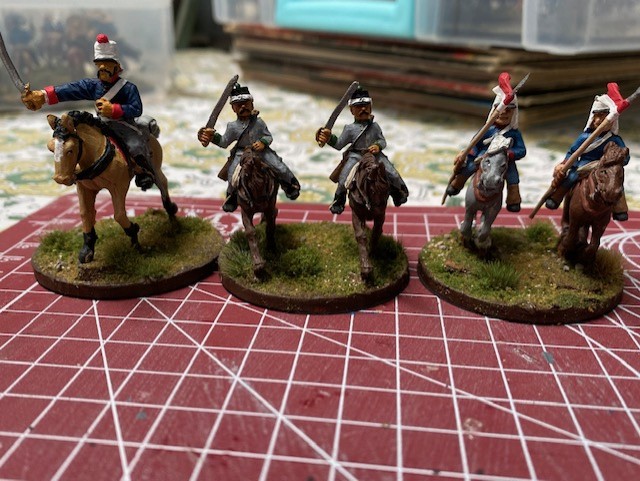
The Virtual Armchair General-These are actually Richard Houston’s old Juarez range from the 80’s and there’s no getting around it, they are dated. However, let me offer a couple of suggestions. I like the cavalry figures. They are very representational of the conflict and very inexpensive. I have a bunch for the Imperialists. The Republican artillery is great because it comes with guns and ox limbers, again, quite inexpensive. Nobody else makes a Republican gunner though you could probably cobble something together with ACW figures. The TVAG figures are inexpensive, and the range is pretty complete and those are virtues. Infantry comes 20 per bag for $30. Cavalry are 12 per bag for $30. Artillery comes with gun, limber, draft animals for $14.00. Pretty good deal.
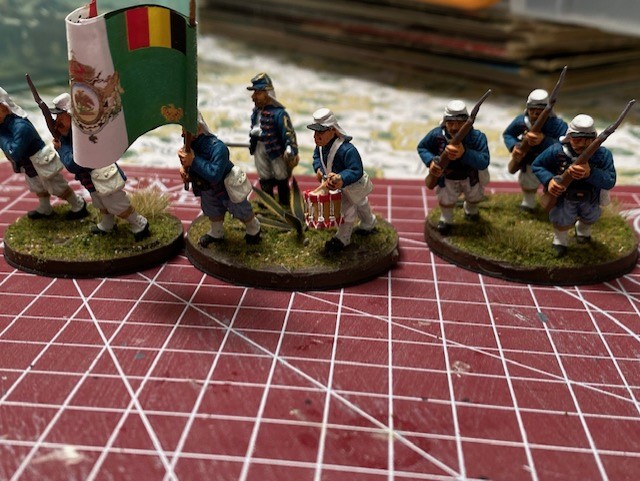
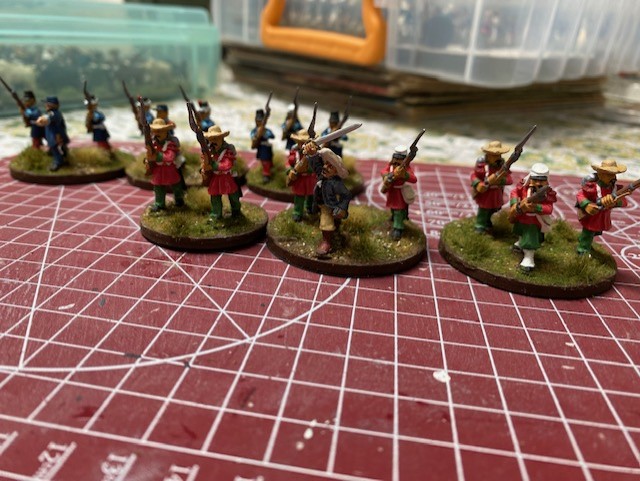
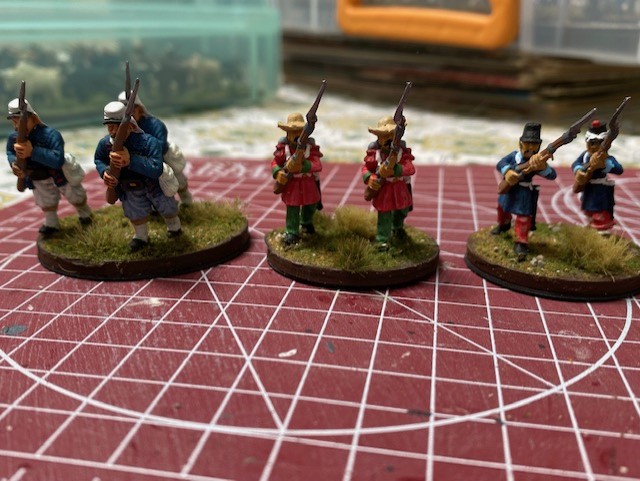
These are Imperial infantry.
Wargames Foundry–Foundry has a bit of the Good, the Bad, and the Ugly. The original Wargames Foundry had a French in Mexico, range by sculptor Aly Morrison in the 90’s. Many of these figures still pass muster. A few don’t. The real challenge is in the packaging. I know the troops did not all dress the same, but this is ridiculous, particularly as it applies to cavalry. It took three packs of figures to make one six figure unit of Republican regular cavalry and two units of Rurales. That’s the ugly. They are big 25’s but smaller than 28’s. I have a lot of these figures from when I began with the French Adventure in the 1990’s. I would suggest using the French from the Franco Prussian War range. These are sculpted by the Perry Bros. and are quite nice. They are robust 25’s , but avoid the troops in overcoats and full kit. In Mexico they dressed as lightly as possible. Unfortunately the French in sombreros and havelocks are no longer available.
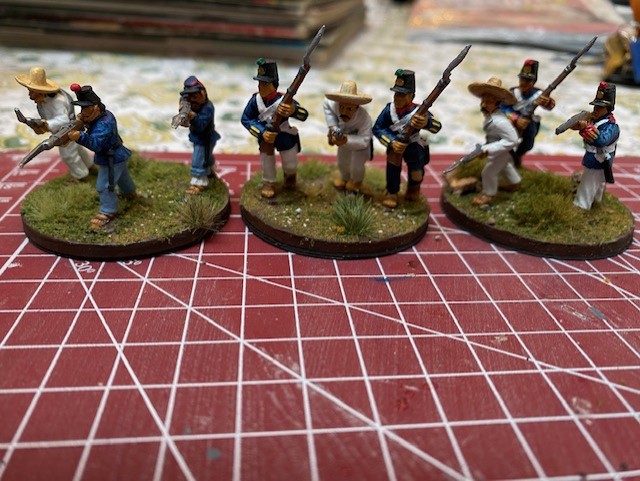
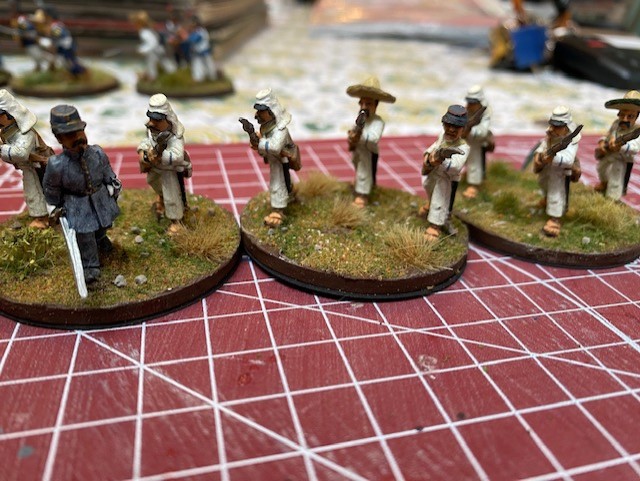
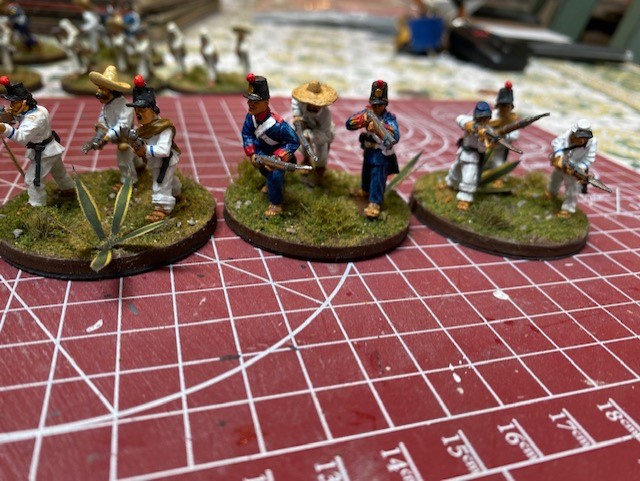
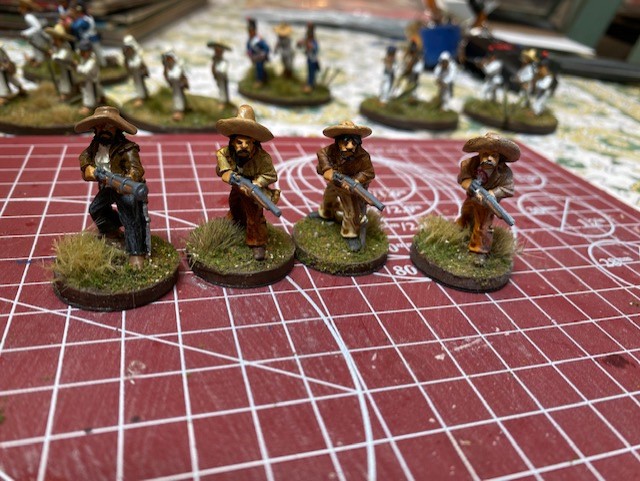
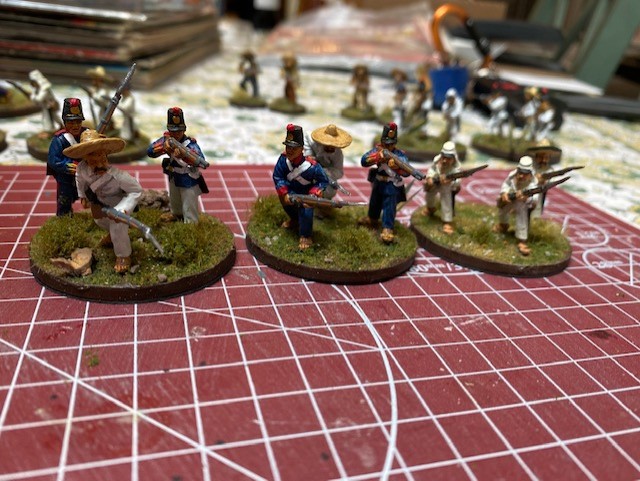
The 25’s are nice, but there are some hidden treasures are in the Old West ranges. First, there are four packs of French Foreign Legion and Filibusters. These are very nice figures that match up very well with the Gringo 40’s figures. Lots of life. There are ten sets of Mexican regulars, irregulars, armed peasants, plus command and villagers. Again, large, well-sculpted figures. The Old West range is also available through Badger Games in Wisconsin, so not necessarily an overseas mail exercise.
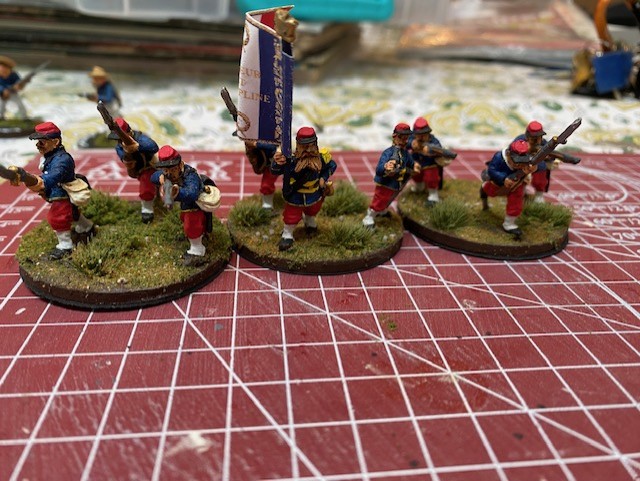
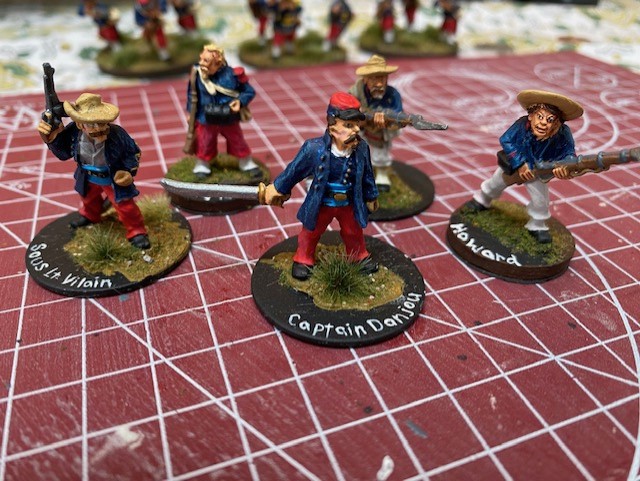
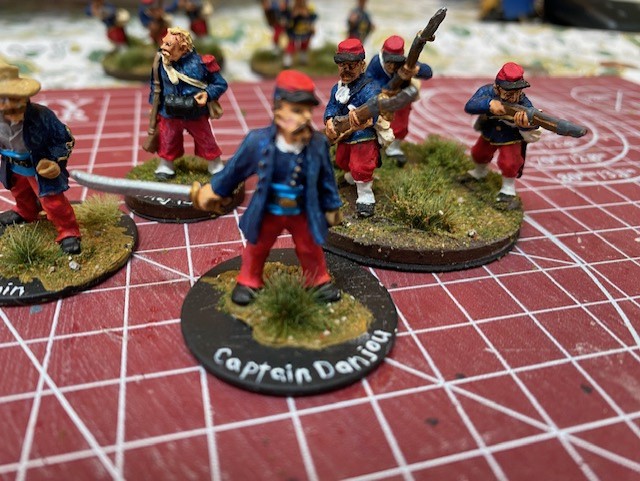
Perry Figures-I’m reluctant to mention these but what the heck. The Perrys have been working on a Franco-Prussian range. The French infantry figures in their full kit are great for 1870 Europe, not so good for sun drenched Mexico. But the cavalry figures seem very nice. I have the artillery pieces and I can vouch for their quality. Very good stuff.
Rules
Rules are such a matter of personal preference, but here are a few thoughts.
The Sword and the Flame
If you’re old school, you might want to consider this venerable set of rules. First, Mark Stevens has written an expansion called The Sword in Mexico, though you may have to do some searching for this out-of-print version. Caution: it isn’t my favorite. I find it a bit fiddly and a person can only run a couple of units, so big battles are out. But it does have a certain amount of charm and it is a hobby standard.
Rebels and Patriots
It is one of my favorites and to be truthful it’s the rules set that got this project out of the garage and on to the gaming table. The rules are logical and simple and do seem to represent the period.
One Hour Skirmish Games
This is a true set of skirmish rules. But there are tons of small skirmishes between irregular troops and regulars. The French organized Contra-Guerrilla units to fight bandits and irregulars. French convoys to ambush, hostages to take. Lots of possibilities. No dice, played with cards. Quick and dirty. Few figures required.
Just a couple of quick pieces of advice. . The most important advice I have is to enjoy the obscurity and do whatever suits you and your budget.
 A Gamer's Tales
An excellent summary! :-) And lots of nice troops! I quite enjoyed reading The Cactus Throne by Richard O’Connor, although it’s centred around Maximilian and Carlotta.