Playtest: Quetzcoatl Rampant

Today was the day, long awaited. David Sullivan, Dave Schueler, Dave Demick and I met at Meeples in West Seattle to try David’s adaptation of the Lion Rampant rules to the Conquest of Mexico. Last night I sat down and made some quick play sheets for the Quetzacoatl Rampant adaptation. . This morning I laminated them.I reorganized Aztecs according to the rules. I have thirteen units instead of eleven.

This morning I piled by prized collection into the car, and   I picked up Dave D. in Tacoma at 9:00, grabbed Brother Schueler in West Seattle, and we actually made it to Meeples before the store opened at 10:00

I knew the table space would be fair small, and I was okay with that for our first run through.  I love playing games-miniatures or boardgames-in the Meeples cafe.  It is terribly comfortable, if small.  The food and beer is tasty and cheap.  And because what we do isn’t typically what is played at the store, there are always folks interested in what we are playing.

I set up the table with the Spanish advancing on an Aztec village. The Spanish had a unit of horse, five of sword and buckler men, two arquebusiers, a dog pack, and a unit of Tlaxcallan allies. The Aztecs had four units of skirmishers, a unit of Eagle knights, three units of veteran warriors and two units of peasant warriors.

I didn’t have any expectations.  The Aztecs were pretty outclassed, but didn’t know by how much.  Let’s just put it this way, the Spanish won in a walkover. There were Spanish figure losses, but the Aztecs, though they pointed out about the same as the Spanish, were not able to do much to them.

We went over some simple changes that would balance out the rules: reducing the Spanish armor value by a point, improving the Aztec’s move, shoot and attack values, reduce the accuracy of Spanish arquebusiers.

Like I said, simple changes, and all we need is the opportunity to try it again. Would like to give the game a whirl on a larger table so we can cram all the Aztecs into the game. Can’t wait to give it a try.


Playing alone better than not playing at all

Yesterday I said I’d give a quick shot to Jim Purky’s Fife and Drum rules for the American Revolution.  Just to be clear, I am a Fire and Fury Regimental guy.  But I don’t play them often, and if I take them off to a convention they can be a little overwhelming.  Jim sent these to me when I ordered from his excellent range of figures a few years back, and they’ve mostly sat out in my painting room staring at me. I’m sure I’ve heard them whispering, “Well?”

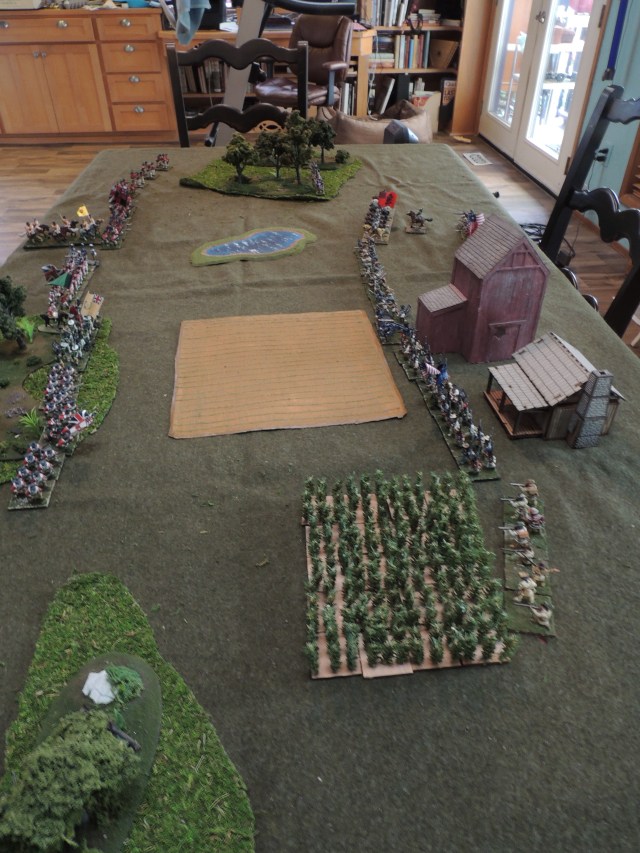
Since I’m home alone this week, I thought I’d drag them out and give them a try. I set my dining room table up for “Action at Lizzard’s Farm.” It was great.  I dragged out all kinds of stuff and littered my 76″ by 40″ table with it. I even used one of my 4Ground buildings.

The scenario was simple. Lizzard’s Farm was defended by a brigade commanded by Otho Williams including a battalion of North Carolina militia, the 5th Virginia, the 5th Maryland and a section of artillery.  They were reinforced by Lee’s Legion dragoons and foot.

The British had two brigades including loyalist battalions Volunteers of Ireland and the New York Volunteers, a battalion of the 71st regiment (highland), the 21st regiment, and converged battalion of light infantry.  They kept Coffin’s South Carolina Dragoons in reserve and also had a section of artillery.

I’ll review the game with some photos, but right now I’d just like to focus on the rules.  Let me just say I like ’em.  They are easy without being ridiculous, they are logical and they work pretty well.  As with any one page set of rules, however, there are a few items that aren’t clear to me, and because I wasn’t playing with the author I didn’t have one of those a-ha moments.  So there are a couple of things I’d clarify

  • Units have to charge to initiate melee
    • Units who charge would receive an advantage in melee
    • Units who charge can’t shoot
    • Units who “lose” a melee after two rounds become shaken.

It’s possible that’s what Jim meant, but it isn’t clear to me. There is the right amount of death, but not so much as to be silly.

Big Set up

The set up extends across both sides down the table.  I wasn’t trying to be subtle.  In the British center right, they are trying to carry the American position by main force while the British light infantry and the 21st Regt. try to sweep up a thinly held American left flank. The Americans stuck riflemen in the cornfield, hoping to slow the Highlanders’ advance, while screening their right, holding a Continental regiment in reserve.

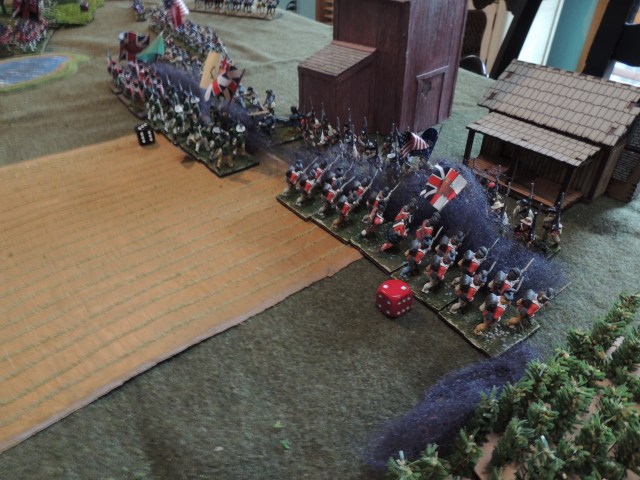
The British advanced briskly.  The Highlanders quickly emerged from the woods with the Irish and New Yorkers moving quickly with them. The American line units were out range, but the Brits came under fire from the artillery and the riflemen, andsuffered no casualties.

The following turn, however the 71st had to decide whether to engage the riflemen who shot so poorly or advance directly on the 5th Virginia.  A die roll of 5 meant huzzah! Damn the riflemen and charge the Virginians.  The two loyalist units followed suit.  An exchange of musketry found the Brits receiving decided the worst of the firefight.  With the aid of artillery fire, a bit of luck from the militia, and flank fire from the bypassed riflemen, the English line was staggered, but continued their advance.

On the British left, the 21st Regt. marched smartly around the pond as the light infantry prepared to engage Lee’s Legion light corps.  Outnumbered two to one and likely to be outflanked, the infantry began looking for friends.

The Charge

Hightlanders, New York Loyalists and The Volunteers of Ireland advance against Williams’ thin line. The Highlanders also take flank fire from the cornfield.

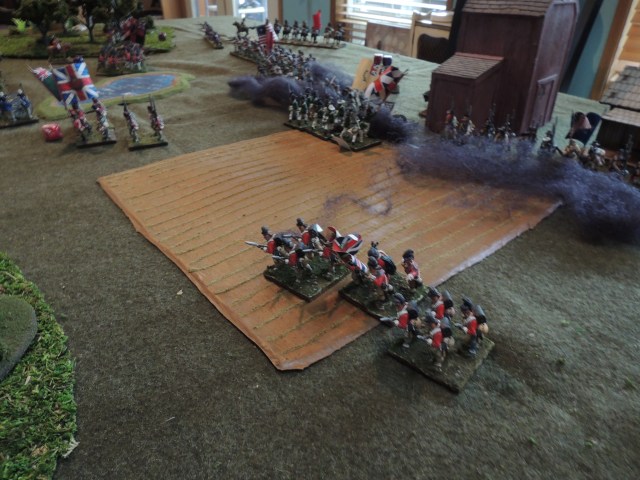
Turn four was the climactic turn.  The British decided on attack, and that’s where I was unclear about the rules.  The Americans gave them another dose of fire, causing the Highlanders and VOI to become shaken  Though the New Yorkers drove off the artillery crew, they were alone as their flank supports melted away.

Repulse

Repulsed!! The Highlanders and Volunteers of Ireland were simply shattered by fire and unable to effectively charge the defenders. The New York Loyalists had more success, capturing the American artillery.

On the British left, the Lee’s Legion infantry corps withdrew from British reach, and the dragoons fell back to support them.  Williams committed the 5th Maryland to face the 21st Regiment.

At that point it was clear the main British assault failed and I called it good.  It was much fun and I’m glad I gave it a try. It was super to pull the figures out of the box again. Would I play a solo game again–maybe if the cards aligned correctly.

Henry V’s Navy: Review

51j13gnZ0mL._SX342_BO1,204,203,200_

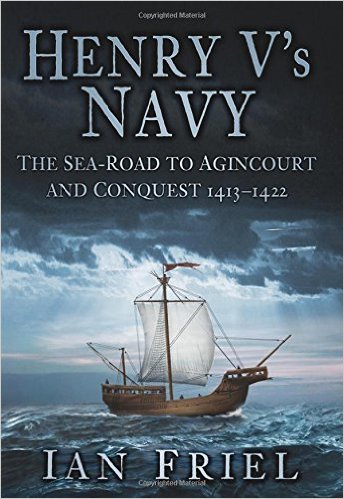
This is one of the naval history books I snagged a couple of weeks ago. I wasn’t quite sure what to expect, and I confess a certain degree of initial disappointment at the book’s slim profile.  There are only 157 pages of text.  But my initial sorrow was quickly set aside once I began reading.

Ian Friel’s study of King Harry’s fleet focuses on the Royal Navy, those ships built, purchased, or captured for the king. Like many historians of this period, Friel struggles a bit to share what can be known and what must be surmised based on the evidence.

But what Friel is able to share is extremely valuable to understanding the importance of controlling the sea lanes to projecting  English power into France during the Hundred Years War

Friel does a great job of helping the reader understand, creating a common language to use when discussing the naval war between England and France in the early 15th century.  He limits his discussion largely to the Royal Navy, the king’s navy, or those ships purchased, built or captured and a part of Henry’s fleet as opposed to the many vessels and crews, privately owned, “arrested” and put into service as fighting vessels or transports for the king’s army.  He also carefully explains the classes of ships: great ships or carracks, ships such as cogs, and then oared vessels, barges and ballingers that all had important roles in King Henry’s navy. Friel goes on to explain further amount typical crews and likely armament for many ships.

Only after the reader has reached an understanding of Henry’s Navy, does Friel attempt to report the important naval combats accompanying the invasion of 1415 that led to the siege of Harfleur, and subsequently the battle at Agincourt.  He also recounts the Normandy campaign of 1417, the Battle of La Chef De Caux, off the Seine estuary.  Friel emphasizes the importance of the navy in its seakeeping role-ensuring the sea lanes were free of French ships, and just as importantly those belonging to their allies, the Castilians and Genoese. Finally, he includes the role of the navy in the siege of Rouen.

Unfortunately, all good things come to an end.  The navy, a costly arm of royal power went in to decline as ships could not be maintained, rotted and simply sank in port. In most respects the story of Henry V’s navy is a mirror of the Hundred Years War, enjoying great success, but always costing more than England can afford, and silenced when resources became scarce.

My chief revelation from Henry V’s Navy is the important role oared vessels played in the royal fleet. Though these vessels were small with relatively small numbers of armed men, they played an important role in scouting and seakeeping. I had always believed oared vessels to chiefly a feature of Castilian and Genoese fleets, but clearly I was mistaken.  Gonna need to add some oared vessels to my cog fleets.

This is a very enjoyable, highly accessible book, and if you have an interest in the Hundred Years War and hope to understand the important naval aspect of Henry V’s campaigns, it is well worth your time and money.

What’s on my painting table. 

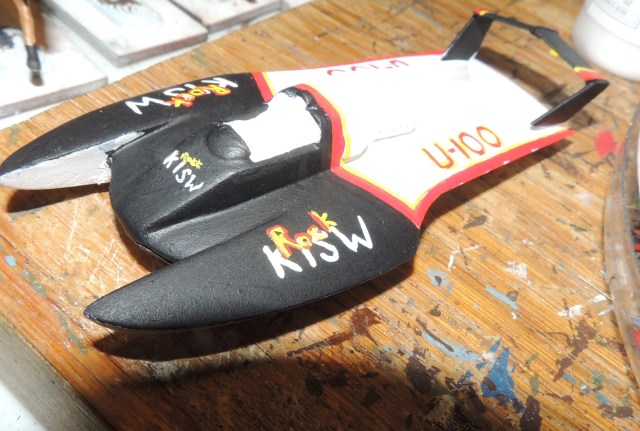
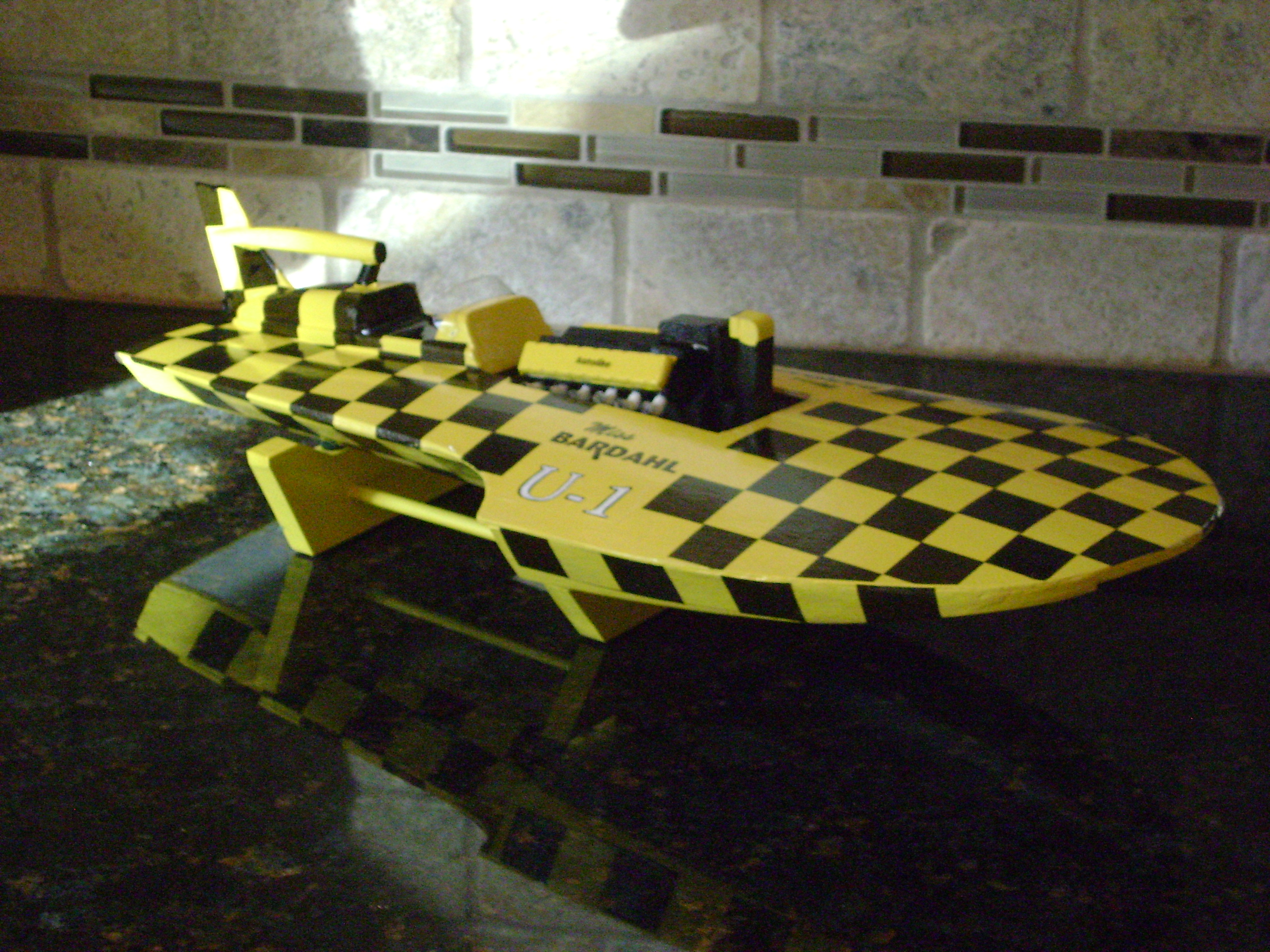
Well, this is pitiful.  I haven’t finished anything recently.  I’ve been stuck at school a lot.  But I did start working on the Miss Rock KISW hydroplane from 1983.Nearly done, need a bit more yellow trim on the numerals, some touch-up and varnishing. A simple color scheme, but I really like it.

DSCN1509

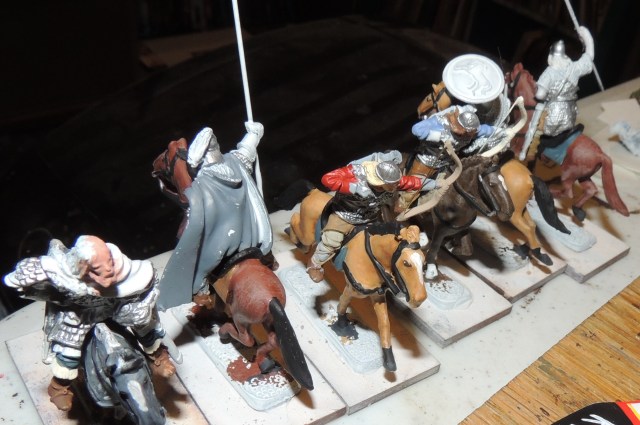
I’ve made slight progress on my Riders of Rohan, but it is something.  The riders are now mounted on their horses, and I’ve made some progress on the two bowmen.

DSCN1508

Music to paint by

I’ve written about my love of Blue Oyster Cult.  I went to see them for the second time at the Emerald Queen Casino on Saturday night with some friends from work.  I wrote a review of the show here.  BOC comes to EQC fairly regularly, and I can’t recommend their show highly enough.  Though Eric Bloom and Donald “Buck Dharma” Roeser are the sole remaining original members, the band is incredibly talented, and play with passion and professionalism.  Bloom is a great frontman, and Buck is simply the greatest guitarist I’ve ever seen.  The tickets are cheap for a show these days (we paid $25 for view seats), and even though a concert at the Emerald Queen is liking watching a show in a large high school gym, it was still wonderful.


Bostons and the Irish cops

DSCN1479

I’m having a great painting month.  And with a four day weekend approaching (for this teacher, at any rate,) and nothing much planned, I’m looking forward to a great painting weekend.

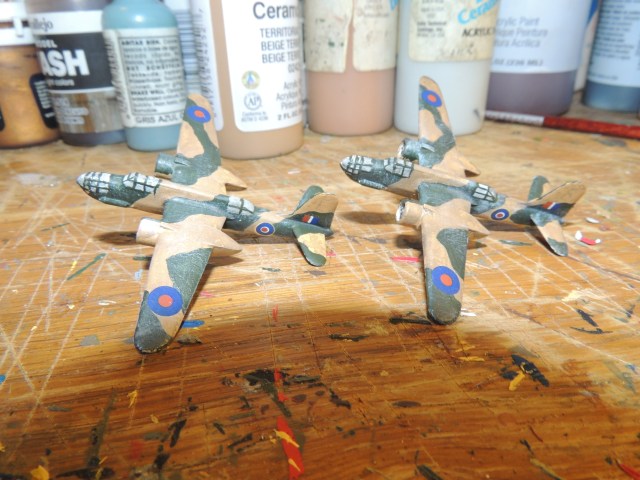
First on my completion pile is the C in C Boston bombers.  These are American built bombers built by Douglas.  Primarily light bombers or attack planes and given the designation A-20A, many were flown by the Brits as Boston II’s.  I chose to paint them in a North Africa/Mediterranean scheme.  They are my entire British RAF representatives for this theater.  Maybe I need more. It will encourage me to paint my GHQ Hurricane II’s I’ve had sitting around for decades.
DSCN1483

The miniatures are by C in C. The minis have lines that are really clean and I like that.  However, they are bit short of detail.  Overall nice, but lacking a little bit, or the scribing so light for the control surfaces I simply painted out the detail The camouflage is Vallejo Desert Yellow as a base, with Vallejo Military green.  I dry brushed over the whole business with white to lighten up the colors a bit and then black washed the lot. The undersurface is painted with Vallejo Light Grey.  The paint scheme is out of the book Flying Colours.

I’ll probably add two more at a future time so I have four planes to work with.  That’s the minimum.

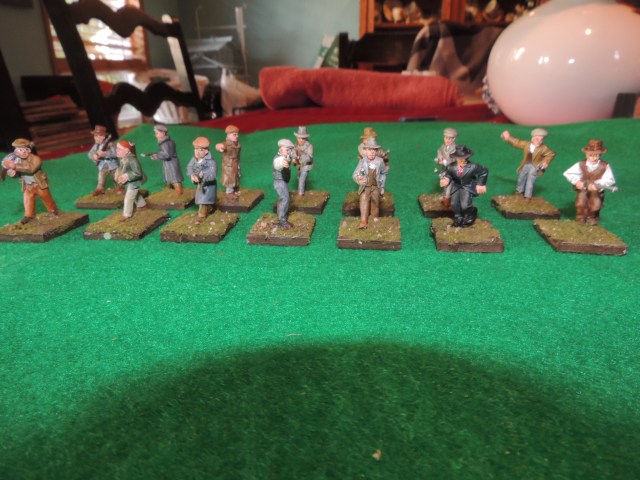
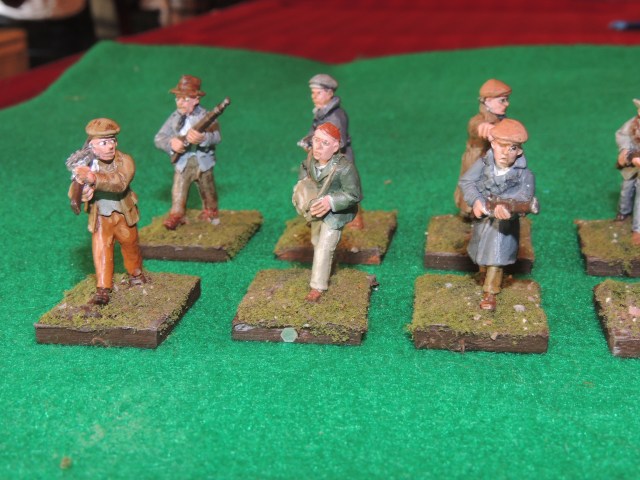
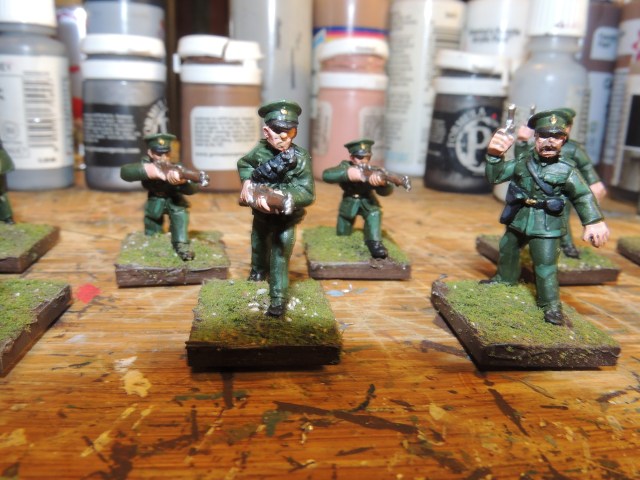
I’ve also completed nine of the Musketeer/Footsore Royal Irish Constabulary figures. These are figures I really enjoyed painting, probably because they are really easy.  With their dark green 20th century uniforms, there isn’t a whole lot to them.  I used Vallejo Military Green as the base color and did my best to highlight them, but they are still pretty dark. I painted their cartridge belts black, which may be a no-no, but I have no photos to refer to for this equipment, and all other belting was black and the Auxies most definitely wore black cartridge belts.

What’s on my painting table?
DSCN1486

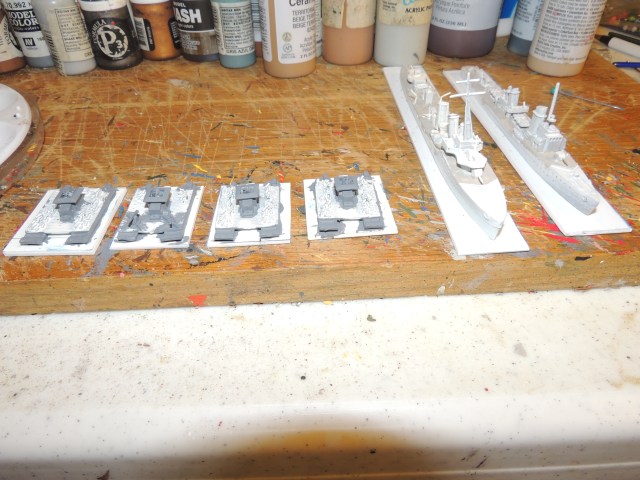
From the RIC to WWII at sea.  I’ve assembled and primed four of the Skytrex-now ROS/Heroics-Siebel ferries.  I had a couple I purchased during our St. Nazaire prep last year. I added a two more in December. They’ll go with my 1/600 coastal collection.  They served in the Mediterranean, the Baltic and the Channel coasts.  A unique catamaran vessel they were designed for the invasion of Britain in 1940.  They were designed as amphibious landing craft, and could carry about 100 tons of cargo, including trucks and tanks.  Experimentation with propulsion systems included truck engines and aircraft engines. All were armed at least with light AA weapons, and some were armed with multiple 88mm guns.

After that, it’s on to a couple of much larger vessels, the German Wolf class torpedo boat we’ll use in the Channel Dash scenario. The second vessel is a British V & W class destroyer.  I’ve decided to do the Wolf in light gray with a white bow wave camo.  The British destroyer I’m going to color up a bit in a Western Approaches color scheme which includes a white hull and markings in pastel green and light blue gray.  No point in tedium.

After the ships it will be on to do the first unit of Rohirrim for Dragon Rampant.  These will all be Mithril miniatures I bought during the early 1990’s, so needless to say they’ve been waiting around for a paint job for a while. Then it will be hydroplanes and assembling some Crosley tenders for my Irish project. I have one model by Sloppy Jalopy and two more by Company B miniatures.  I’ll cross my fingers and trust to luck.

Less is more

I did make one purchase.  I picked up a pair of Passaic class monitors from Thoroughbred.  Just wanted to fill out what I have. This will give me three monitors from a class of ten. I won’t need any more.  I suspect another order in the not too distant future-probably a Canonicus class monitor and the Civilian Purchased Screw steamer variant of the always useful Yankee Gunboat model.  Any variety of steamer I can put my hands on is a bonus.

That makes me a +11-2 for this time, and a + 19 for the year.

And a quick plug

I’ve been buying 1/600 scale ACW ships from Throughbred Figures since they issued the Albemarle almost 25 years ago.  I’ve always loved owner/designer Toby Barrett’s work. It is of high quality, sturdy and for an all metal miniature, very fairly priced.  Now Toby has added superb customer service.  I ordered my monitors on Monday and they were in my mailbox today (Friday.) For the record, Virginia Beach, the home of Thoroughbred Figures, is about as far as one can be from beautiful Puyallup Washington, and remain in the continental United States.  Check it out here.

Pages afloat

Normally I would be sharing some awesome music with you.  Unfortunately my listening habits have been detoured by my decision to binge watch The X-Files.  Sick? A waste of time? Absolutely, and I’m enjoying every minute of it. But for the next post, I promise I’ll share a review of Zephyr, by the band of the same name.  Haven’t heard of them?  Well, you will soon.

However, I have bought a few books recently, all of them related to naval warfare in a couple of different periods. Note:  I have read none of them yet, but two are relatively new, and worth knowing about.
51j13gnZ0mL._SX342_BO1,204,203,200_Henry V’s Navy: The Sea Road to Agincourt and Conquest 1413-1422 .  by Ian Friel To suggest that books about the Hundred Years War at sea are as rare as hen’s teeth may be giving too much credit to the hens. The only other book-length study I’m aware of is 2011’s Edward III and The War at Sea, 13227-1377 and is pretty much worth a king’s ransom (and somehow I missed it when it came out, sniff.)  I determined not to be shut out when this book became available on February 1, and promptly ordered a copy.  The small volume was not over-priced, and I’m hoping to read it soon. Henry V was a noted shipbuilder and vastly increased the size of the fleet that virtuallydisappeared during the reign of Richard II.
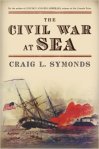
51CezmtWcJL._SX329_BO1,204,203,200_The Civil War at Sea by Craig Symonds.  Symonds’ name may ring a bell.  He’s a prolific writer, best known for his military atlases, but he’s written about many military topics, including the naval aspects of the Civil War.  He tackles this massive topic thematically rather than chronologically, focusing on the changing nature of ships and armament, the blockade, commerce raiding, war on the rivers, the attack on ports (using Charleston as an example) and the success of the Union naval strategy. The book has only 170 pages of text, so it tends not to get hung up on detail, so if that is your desire this may not be the book for you.  But as a thematic interpretation of the Civil War on the water, it could do the trick.
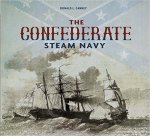
61yXPXIuvrL._SY454_BO1,204,203,200_The Confederate Steam Navy by Donald Canney.  I have only ordered this book and haven’t received it yet.  But I have been angling for a copy since it was released on December 9th.  Canney’s book on the Confederate Navy is supposed to mirror his brilliant two volume study of the The Old Steam Navy that went out of print in the ’90’s.  These are books I constantly consult and I believe the new book will be just as useful.  So much of what is written about the Confederate Navy is conjectural while Canney’s work always seems to be anything but.  It covers all types of vessels from the ironclad rams to blockade runners, and as with his previous work, will be crammed with illustrations and photos, some not previously published.  I’m excited.  Hoping it arrives from Amazon today.


Orcs!!!

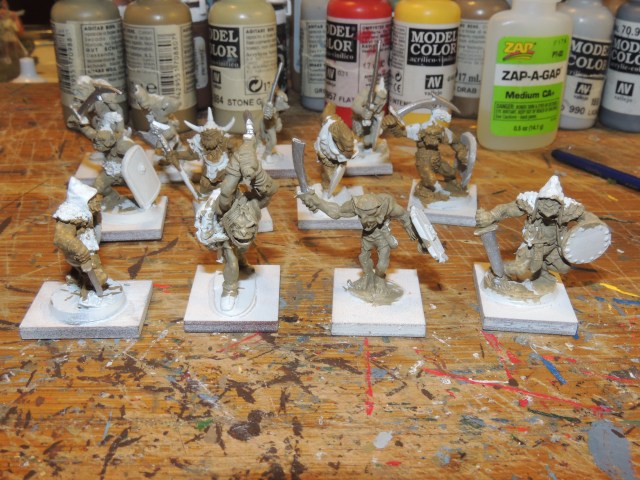
I’ve finished painting my band of orcs.  There is a great variety to them because they are by three different manufacturers.  The tallish looking ones are by Mithril Miniatures.  The short squatty guys are Ral Partha.  The biggest and two smallest are by Alternative Armies. I like ’em.  It’s a nice variety-as manufactured creatures should be.

The twelve figure unit didn’t take long, just a few days.  To insure a mix I went with three different Vallejo colors as the basis for their flesh–khaki, khaki-grey and stone gray.  I painted their accoutrements a variety of grays and browns and washed the lot brown.  Made sure to paint on something resembling a face and even managed some eyes.  Pretty basic, but I wanted to insure some variety.

This is the first unit for my orc Dragon Rampant armies.  Ideally I’d like to have a total of eight, or enough for two retinues (or whatever the clot of units is called for the fantasy game.)  They were fun, and they’ve been awaiting paint for about 25 years.

And on my painting table . . .

I’ve mapped out a plan for February, which gets an extra day because of leap year. Here’s what I’ll be doing this month:

  1. The two Boston bombers are next on my list, and I’m already making good progress on them.  Wish I had a couple more.
  2. Nine Musketeer/Footsore Royal Irish Constabulary figures for the Irish Civil War.  They were the British cops who were well-armed, but not as nasty as the Black and Tans and Auxies, who were often veterans brutalized by their experiences in France.
  3. Six 1/600 scale ships.  This includes a German Wolf class torpedo boat and a British V and W class destroyer, as well as four German Siebel ferries–motorized catamarans used to transport stuff around the Adriatic.
  4. Six Mithril Rohan horse.  They’ve been knocking around my unpainted pile for decades and its time to get them done.
  5. if I can get all these finished with time remaining for the end of the month, I’ll turn my attention to the four hydroplanes that need painting.  That would be as much as 39 figures painted by the end of the month, including the orcs.

Less is more

No new figure purchases.  I hope that’s something I’ll repeat with regularity throughout the year.

Painting the dozen greenskins gives me a total of +10 for 2016.  Love to see the pluses.

Music to Paint By

Deep Purple is best remembered as a guitar heavy rock band from the 1970’s.  Though not as well known as Led Zeppelin, like that band they had a death dealing guitarist in Ritchie Blackmore, and later they had an awesome vocalist in Ian Gillian.

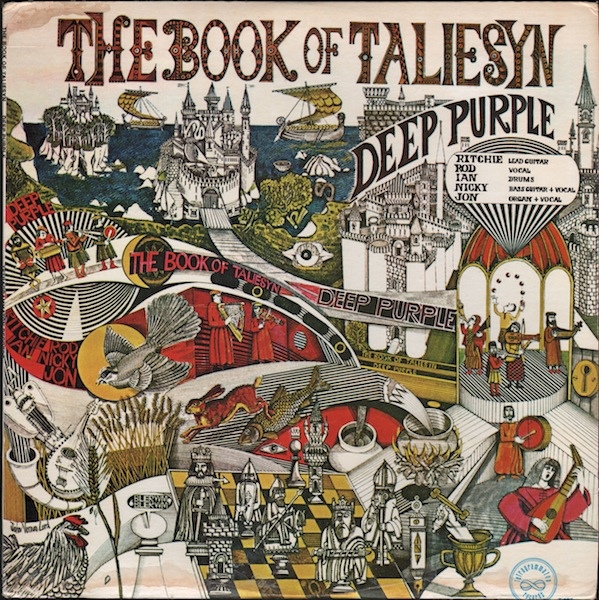
But in 1968 they released their second album, The Book of Taliesyn.  It’ an odd album that is desperately trying to find its place among the many bands exporting music from England.  With the fiery, “Listen,Learn, Read On,” I was reminded of Pink Floyd’s Piper at the Gates of Dawn, and other bands producing uniquely British psychedelia.  But other songs are more puzzling.  The purple bunch cover Neil Diamond’s “Kentucky Woman,” The Beatles “We Can Work it Out” and Ike and Tina Turner’s “River Deep Mountain High.” The remaining songs are an odd mix of guitar rock and  folk influenced songs.  This is a band still searching for an identity they will find later.

Book of Taliesyn

Very uneven stuff.  But it has such a cool cover!!!!

Musketeer/Footsore Irish Republican Army

DSCN1435

14 IRA gunmen by Musket Miniatures, now Footsore Miniatures.

Being of Irish heritage-my much missed grandfather was from Cork-the Irish Rebellion and Civil War 1916-22 is of great interest to me.  A few years ago I bought figures from Musketeer Miniatures for this period, a British company, who had an American distributor in the U.S. Unfortunately Musketeer changed hands last year and is now part of Footsore miniatures.

They weren’t my first figures for the Irish conflict.  The Australian company, Cannon Fodder also got a start on the period with a group of very nice IRA gunman, a very nice Auxiliary figure and a British soldier.  Unfortunately they didn’t get very far with the range before Cannon Fodder became Blaze Away miniatures.  Sadly, Blaze Away is now gone and so are 20th century figures from the Cannon Fodder line.  Pity.

DSCN1436

A little tighter view of the Lewis gun, left, with his loader.  There is a nice variety of figures in the range and the figures themselves are pretty good. A little bit of breakage, however, and some mold mark issues as well.

I’ve decided to focus on my collection of figures for this period as one of my painting projects for 2016 and yesterday I finished my collection of IRA gunmen–14 in all.  When I bought my Musketeer figures I was very excited about them.  I’m a bit less so now.  Let’s be clear, they are still nicely proportioned, historically correct, and dressed in a variety of period attire, but they have some production issues that make them a bit less than I’d like.  First, they have very breakable gun barrels. At about two bucks a figure, the last thing I want is to get figures that aren’t usable because their gun barrels are broken. Some also had unfortunate mold marks.  Well-detailed pewter figures are hard to clean, and I found these with just a little too much flash in hard-to-get-to places for my liking.  If I was rating them, they’d get maybe a 7 of 10.  Good, but not brilliant. Cleaner than your average Old Glory figure, but not as good as the average Perry figure.

Nothing fancy to paint these guys.  They are a combination of Vallejo and Ceramcoat colors. I did make sure to do some highlighting before washing them with Vallejo black and brown wash.

What’s on my painting table

I’ll be taking on my first Dragon Rampant unit.  I have twelve orcs from a variety of manufactures, including Mithril, Ral Partha, and Alternative Armies.  They work together size wise, plus, as we learned in Peter Jackson’s Fellowship of the Ring, orcs are manufactured in a variety of colors and sizes, so–no problem.

DSCN1437

Watch out!! My first Dragon Rampant unit is on the painting table.  It’s a mixture of Ral Partha, Mithril and Alternative Armies figures.  It’s actually a pretty nice mix.

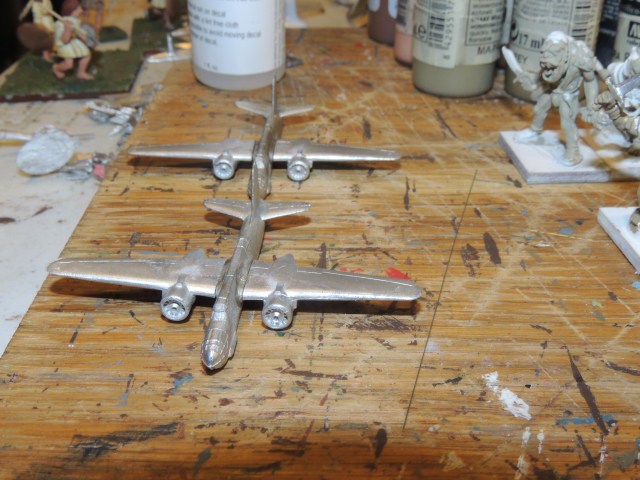
I’ve also dredged up a pair of C in C Boston II’s from my aging airplane stash.  I’m still assembling them, which is not always an easy feat.  They’ll be completed in a camo for the British in the Mediterranean.

DSCN1438

The very nice C-in-C Boston II’s.  I like forward to painting these in British colors for the Mediterranean.

Looking way down the road my next Irish Civil War unit will be the green-clad Royal Irish Constabulary figures by Musketeer–there are seven of them.

Less is More

I’ve given up the idea of tracking each of my purchases and painting on a running basis, but I have come to embrace the idea that finishing figures is a good thing, and completing more than I purchase is also good.  So I’ll try to keep a running total right here in Less is More. Just in general, I’m not buying new stuff–well sort of.  I did buy some planes for the Channel Dash as well as additional jets for a future Cuban Missile Crisis project. I also have some stuff from ROS coming, some day in my lifetime, that I’ll figure into this initial entry.  The goal is to finish the year with more painted figures than purchases, way more.

Purchases

  • From 1-94 Enterprises  28 airplanes
  • From ROS  6 airplanes 2 Siebel ferries

Painted

  • 20 airplanes
  • 14 Irish Republican army figures

Net

34 figures painted (January) – 36 purchased (December) = net of -2 figures.  Still a week to go in the month and no additional purchases planned.  I fully expect this will be the only time I register a negative number.

Music to Paint By

When I graduated from college in 1978, one really popular album was the debut by Van Halen.  It was like nothing I’d ever heard before.  One of the songs Eddie and the boys covered was a Kinks song “All Day and All of the Night.”  They destroyed it with Van Halen’s smoking guitar and David Lee Roth’s incendiary vocals. And one of the things it did was to inspire the Kinks and their lead guitarist Dave Davies, Ray’s brother, on to some flaming guitar heights of his own. Listen to their 1980 live album, One for the Road, and you’ll know what I mean.

Dave Davies

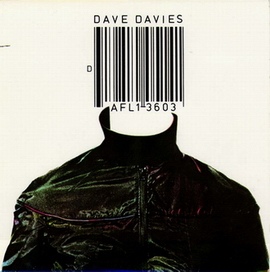
Most importantly, it encouraged Dave, the less well-known Davies brother, but a fine guitarist, to go out on his own.  His first solo effort is AFL1-3603. This is a good record.  All the songs are written by Davies.  He also plays almost all of the instruments. Most of the tunes feature some heavy-handed guitar work. From the opening song, “Where Do You Come From,” there is no mistake you’re listening to a rock and roll record.  But there are other songs, that are also quite good, notably “Visionary Journey” and “Imaginations Real.”

Don’t get me wrong, though this is guitar focused, it is not a record of aimless solo guitar-noodling.  Rather, it’s a product of its time, the guitar is loud, it’s very raw, but supports the song structure without wandering about by way of the third moon of Saturn only to return to what’s important three minutes later. C’mon, it was released in 1980, we’re done with that shit.

I guess my overall verdict is AFL1-3603 is solid, with consistently good songs and good performances.  It won’t remind you of Lola vs. Powerman and the Money-Go-Round, or really not much of the Kinks catalog at all.  But it’s a good record, with a very cool cover, and a worthwhile addition to your colleciton

Dragon Rampant-Yes!!

Dragon-Rampant-Mock-Up

On December 22nd, Osprey Publishing released the latest of their rules sets, Dragon Rampant.  Built on their, in my view, very successful  and very fun Lion Rampant, this is a set of fantasy rules that keep things quick and simple.

Dragon Rampant is intended to be relatively economical.  Every army will likely have 4-6 units.  They will likely have at their core some 12 figure units of infantry slime, with some six figure units of knights, or elites, or monstrous nasties, maybe even some 1-3 model units of something or another really unpleasant–trolls, ogres, giants, wizards, dragons would fit the bill.  The game allows magic.  Author Daniel Mersey has made allowances for players to experiment with all kinds of unpleasantness.  I love it.

Unfortunately, new rules often mean more purchases-something I’ve pretty fastidiously avoided the last nine months.  It doesn’t mean I haven’t bought anything, I have–ships and planes for Pensacola and the Channel Dash–but no figures to speak of. That’s especially true of fantasy figures.  I try to keep my historical minis to no more than two bucks a throw, more for mounted troops. But fantasy figures are often five bucks a pop or more. And it’s not like I don’t have tons of figures laying around waiting to be painted.

So I’ve turned over every loose rock I have to locate anything that might serve to make a couple of fantasy armies, and tonight I struck paydirt. More about this in a moment.

I’ve decided on a couple of different armies.  The first is a Rohan army.  I love the Rohirrim.  I did long before there were Peter Jackson movies.  I’ve always wanted to do the Battle of the Pelennor Fields in 15mm, and some day I may still do that. I have many of the figures–they just need paint.

But I also have a ton of Rohan figures I bought when Games Workshop was putting out their Lord of the Rings range. I have plastic cavalry and infantry and some metal leaders–a Theoden, Eomer, Eowyn and standard bearer who can form a unit of heroes. But wait, that’s not all folks.  In rummaging through the deepest darkness of my boxes o’lead I also rant across enough old Mithril Rohan figures to build a unit of mounted.  So here is what I think I can do:

  • Rohan heroes (Elite riders)–1 X 4 figures
  • Riders of Rohan (heavy riders–4 X 6 figures Games Workshop, 1 X 6 figures Mithril Miniatures
  • Men of the Westfold (heavy foot)–2 X 12 figures Games Workshop

Of course, every fantasy army needs something truly fantastic, so I will also add a 1 X 6 unit of Eureka centaurs.  I’m not quite sure if they qualify as some sort of cavalry or if they are a unit of warbeasts.  We’ll see.

So I was able to construct an army of Rohirrim of troops I already have. But I want them to have somebody to face.  My first choice is, of course, orcs. But as much as possible I want to minimize the cost. Remember, fantasy figures are spendy, the centaurs are five dollars each.  I have some orcs from the GW LOTR range, but not enough to do a lot with.  I can make one unit of Uruk-Hai pikemen–that’s cool. I also uncovered some Mithril and Ral Partha orcs, enough to make a unit of nasty looking bastards.  I remembered that once upon a time I bought a whole bunch of Alternative Armies orcs and various other nasties, and these went missing for the longest time.  But no more!! Tonight I found them.  There are orcs, some warg riders and even some orc chariots of doom.  Enough nasties to field against the Rohirrim.  If I get desperate, I’ve even dismantled the old HeroQuest game I used to play with my sons twenty years ago and run off with the plastic figures, including goblins, orcs and various other bad guys.  Yes, I have stooped that low. I still don’t know quite what I have or how I’ll organize them.

The difference between beginning Lion Rampant and beginning Dragon Rampant is that my armies for the Hundred Years War were already painted–enough so that I could field seven retinues of English and French. Unfortunately, exactly none of my fantasy figures are painted. So it will be a while until I can actually play, but I’m game.  Anything I can do to usefully employ some figures I’ve just got gathering dust is a good thing.  So Dragon Rampant will be a big project for 2016.

I’ll be sure to share as the project gets rolling.

Thunderboats v. 2.0: Painting the Pickleforks are hard

I really enjoyed painting the 1950’s and 60’s hydroplanes for our Thunderboats! games.  I’ve painted 23 of the 1/72ndish scale boats cast by Sean McEvoy for the game.  I found them to be a joy to take on.  Mostly blocks of color with some numbers and lettering and often a symbol or emblem to paint.  Kind of like painting HYW heraldry only a little easier.

But as I move on to paint those 70’s boats, they are definitely different. The new hulls with the picklefork noses are larger-longer and broader-as they become a bit more stable and safe after the carnage of the middle 60’s. The wider hulls sit deeper in the water, so almost all the detail on the boats are now on the decking.

Not only that, but the paint schemes of the 60’s definitely change during the 70’s.  Instead of the nice block styles, the paint schemes are linear and colorful.  Often lines run the entire deck, and boats like the Pay ‘N Pak have their name in huge multi-colored lettering along the entire deck.

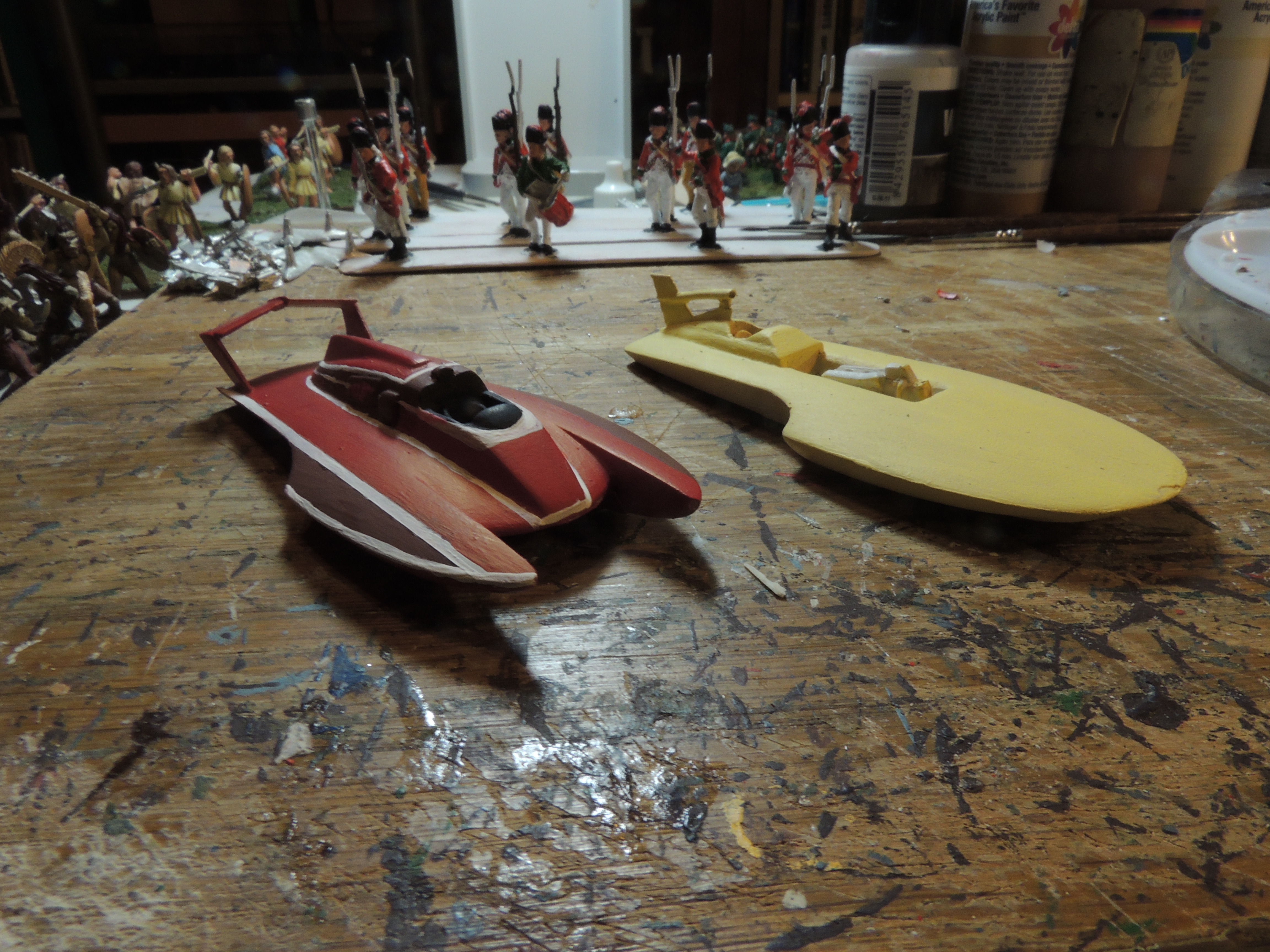
The 1979 Squire Shop and the 1968 Miss Bardahl in the Smyth boatyard.  Not far on either yet, and both will take lots of extra TLC.

The 1979 Squire Shop and the 1968 Miss Bardahl in the Smyth boatyard. Not far on either yet, and both will take lots of extra TLC.

No big deal for a graphics designer working 1:1, a bit more of a challenge for an old blind guy like me working at 1:72.

1981_U-2_The_Squire_Shop_Hull_7902_

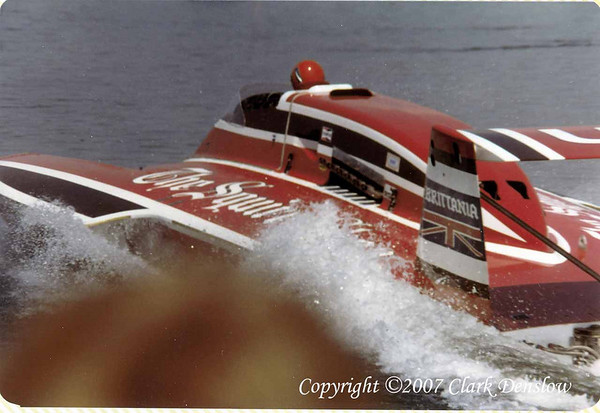
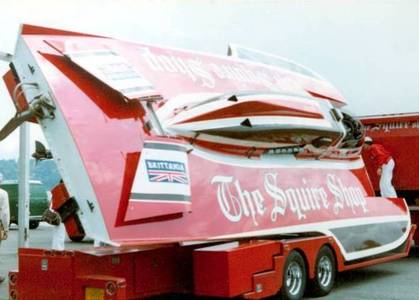
Both of the above pictures are of the 1979 Squire Shop.  In a year that was swept by Bill Muncey's Atlas Van Lines, a very young Chip Hanauer drove the Squire to victory in the Seafair Race.  It is a beautiful boat with striking, hard-to-paint markings.

Both of the above pictures are of the 1979 Squire Shop. In a year that was swept by Bill Muncey’s Atlas Van Lines, a very young Chip Hanauer drove the Squire to victory in the Seafair Race. It is a beautiful boat with striking, hard-to-paint markings.

The first boat I’m painting is one of my favorites, The Squire Shop from 1979.  As you can see, the boat has some nice red and mahogany (I’m using both colors from Vallejo,) but it’s also a plethora of white lines, that have to show up against that background and remain pretty straight.  There is a Squire Shop emblem and then an Olde English font.  I’ve been working away at it as you can see, and probably have a couple of hours into the cab forward hydroplane.

MissBardahl1968bow

If I was going to imagine a boat guaranteed to make me tear my hair out, it would probably look like this.  But it is somethin'.

If I was going to imagine a boat guaranteed to make me tear my hair out, it would probably look like this. But it is somethin’.

The next boat I’ll take on is the 1968 Miss Bardahl.  Slight change in hull design from the classics, but not the picklefork hull. Again, there is the more daring graphics, a departure from the block coloring and lettering.  Not quite sure how I’ll paint the checks all over, but I’m certainly excited to give it a try.

I’ll keep you posted.

What’s On My Painting Table?

I know the picture is dark, but hopefully you can see the minis are coming along. Perry Miniatures Volunteers of Ireland.

I know the picture is dark, but hopefully you can see the minis are coming along. Perry Miniatures Volunteers of Ireland.

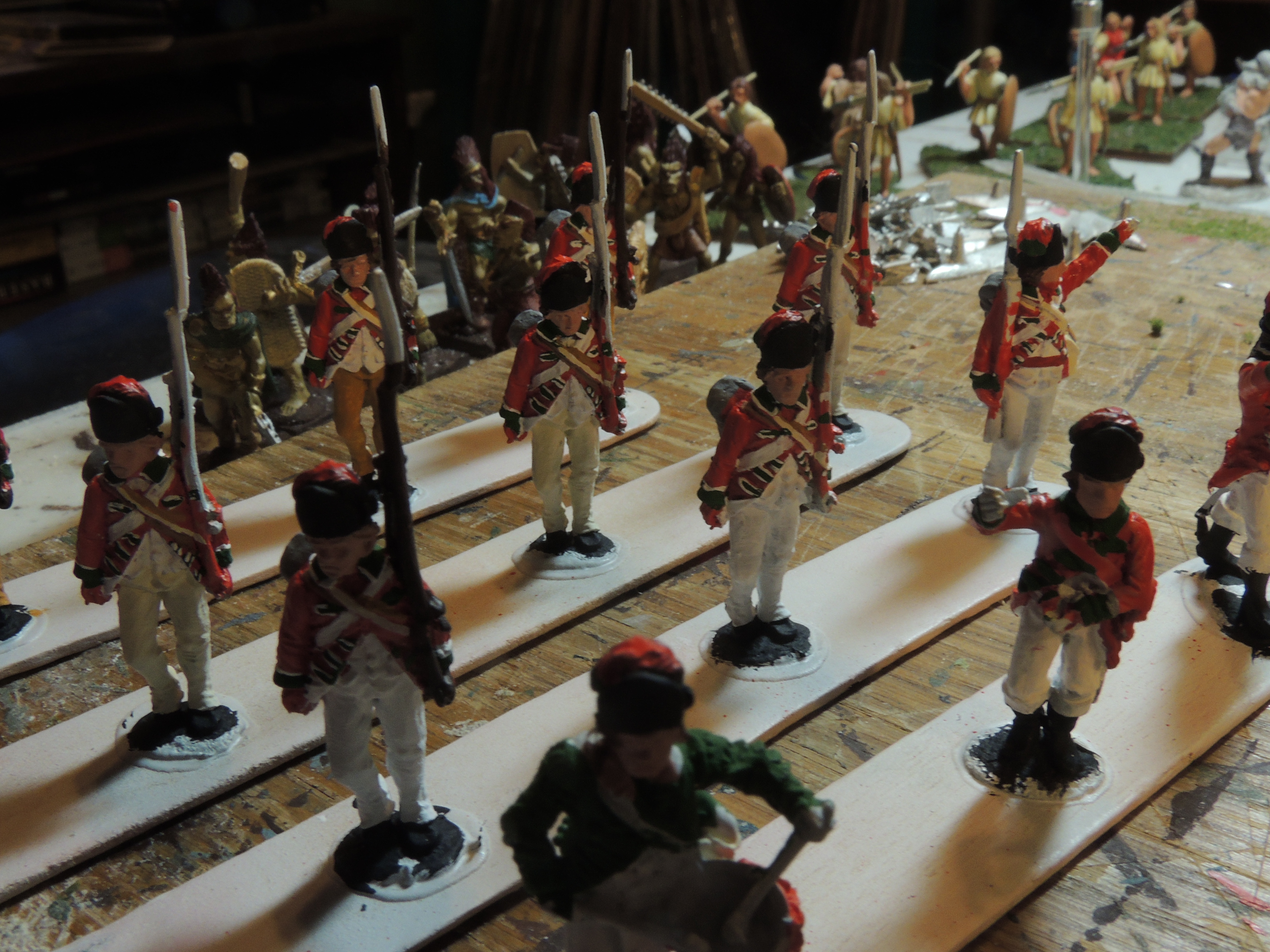
Well, hydroplanes of course.  Yes, you’re right, I do have issues with painting ADHD, so I usually have something else going on as well, and it is those same Perry Volunteers of Ireland.  I’m making progress, and hoping to maybe even finish painting the sixteen figures tonight.  They’ve gone fairly quickly, but are not without challenges.  The Brandenburg lace is a bit hard to see, and these figures feel smaller than my other Perry AWI figures, almost as small as the Fife and Drum British guards I painted a while back.

Even so, the painting has gone pretty smoothly. The lace wasn’t horrific to paint except for the silver on the officers.  There won’t be a lot to highlight.  Looks like I won’t finish tonight but after a super painting day, they are at least close.

And For Your Listening Pleasure

I’ve always liked the idea of The Pretenders, and have a copy of their 1994 CD Last of the Independents.  But I’ve never really had a chance to give a good listen to the music that made them famous.  I picked up a copy of their first record, titled simply The Pretenders and gave it a good listen.

It’s a solid record steeped in new wave, punk and solid pop music.  With semi-autographical lyrics by frontman Chryssie Hynde, it blends some great musicianship with snarling vocals.  There is a solid cover of the Kinks hit, “Stop Your Sobbing,” and “Brass in Pocket” became a big MTV hit. My favorite song, however is “Kids” which combines some snarling guitar with some wise and prescient words about the loss of privacy that comes with celebrity.  There is some anger on this record and there is some introspection, but most of all it’s a collection of excellent, pointed songs that represents some of the best of its era.

Regimental Fire and Fury in the 100 Years War: Playtest One

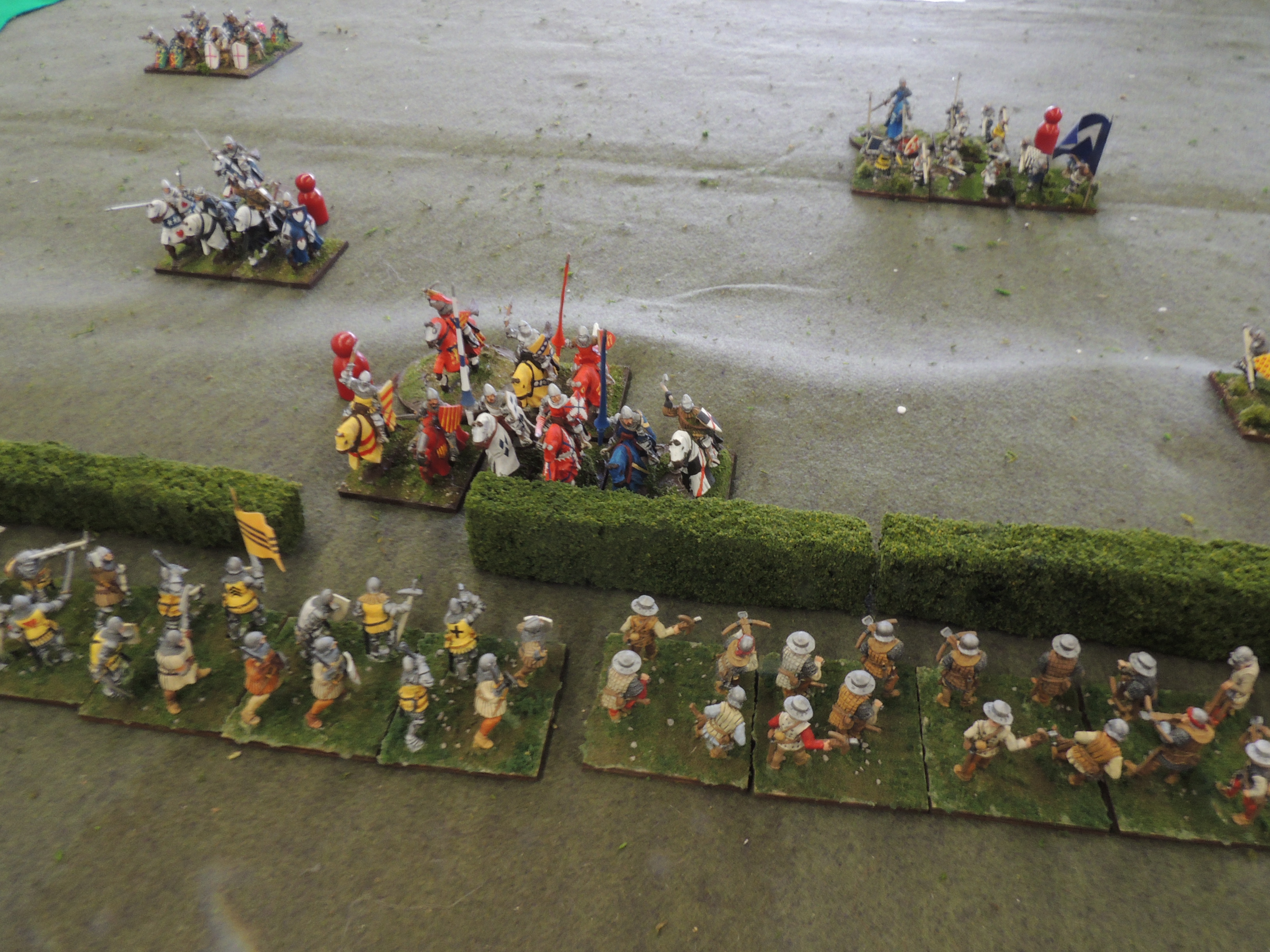
Marshal Clermont tries to coax his shaken mounted men-at-arms across the hedge to attack the English dismounted knights.  They don't seem to want to follow.

Marshal Clermont tries to coax his shaken mounted men-at-arms across the hedge to attack the English dismounted knights. They don’t seem to want to follow.

As promised, I’ve been tinkering with a set of rules for the Hundred Years War.  I turned to a set of rules I really like, Regimental Fire and Fury and purloined some of their rules engine to help me move this project forward.

There are some basic principles I wanted to incorporate in my big battle rules.

  1. Longbow fire was devastating but not in the way many believe.  It wasn’t masses of bowmen shooting and Frenchmen suddenly dying–unless you happened to be lightly armored troops like crossbowmen.
  2. The effect of longbow fire was to render the French knights, on foot or horseback, less effective (well sort of, horsemen mostly died.) They would slow, clump together, close their visors, be less aware to flank attacks, raise their shields against the rain of arrows-they might be pounded by arrows, but most would be deflected by armorer, though some would find soft spots, wounding and in some cases killing.
  3. The real killing would happen when the French went into melee, impaired by their pounding, blundered into the English lines as an ineffective mass–unable to fight their waiting English cousins and would be dispatched accordingly.

What I hoped to capture with my rules was this idea that English bow fire could be very tough on the French, without masses of stand removal.

I’m not sure I did that.

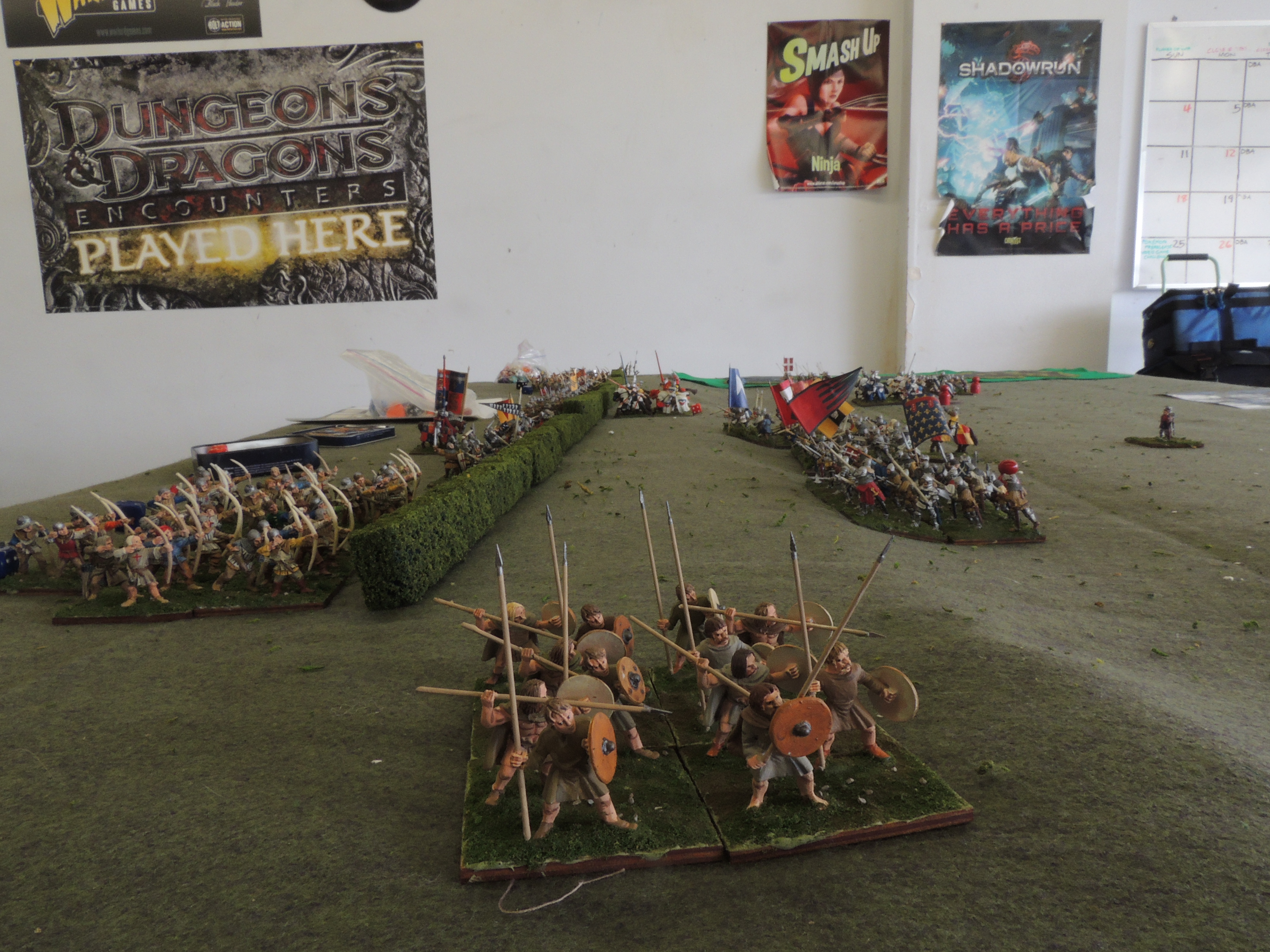
Yesterday I met Dave Schueler at Game Matrix in Tacoma.  I set up the English behind hedge on top of a hill a la Poitiers with one flank covered by a stream and a marsh.  We played on an 8 X 5 table, which was probably too wide for the number of figures I had.  I ran the English, of course, and Dave ran the French.  He had two units of mounted knights, three units of dismounted knights, a couple of units of crossbows and a unit of town militia, rated as light infantry.

The English had three units of dismounted knights, a unit of Welsh foot, rated as light infantry, four units of longbows and a small unit of Gascon crossbowmen.

Together it represents everything I have painted–I need more.

Dave started his advance to dislodge me from my position, knowing that charging across the hedge line offered a significant tactical advantage.  As Dave advanced, I began firing my longbows from their position on either flank.

The two chief “engines” I used from the Fire and Fury rules were the Maneuver Chart and building of the fire around target quality rather than the shooter. I did change a couple of things.  I did not use the Fresh/Worn/Spent designations, and instead gave a simple -1 for each stand loss on the maneuver chart.  Rather, a unit would be in good order/disorder/shaken based on fire and melee combat results.

Dave had no difficulty moving his fresh units, but in defensive fire, began to suffer disorder from long range fire.  More fire in my movement phase was pretty ineffective, mostly because of bad die rolling.  As Dave advanced, his horse increasingly took a pounding, I seemed to have a few really great die rolls and a bunch of really stinky ones.  But it was enough to shut down the French advance.  Only one of Dave’s dismounted knights made it to the hedge.  It was untargeted by bow fire, but became disordered as it crossed the defended obstacle.  The defenders had a slight advantage and the roll off was also close resulting in a repulse.  At that point the French attack stalled out.

The results were a bunch of shaken and bloodied French units and the English relatively untouched.  We talked through some changes to the fire table, and I’m thinking about additional fire changes.  I made allowance for an arrow storm rule that wasn’t needed under the current structure of fire, so I need to look at that too. But Dave suggested not making too many changes at once, because it becomes unclear whether the correct problem is being dealt with. But in most respects I feel like I’m on the right track. Movement rates and missile ranges seemed to work. It was an encouraging beginning and I hope to try it again soon.

My silly Welshman moving out on the flank are about to be shot full of crossbow bolts.  Mostly took this as a look at the battlefield from the flank.

My silly Welshman moving out on the flank are about to be shot full of crossbow bolts. Mostly took this as a look at the battlefield from the flank.

Longbowmen finished and other cool stuff.

Longbowmen

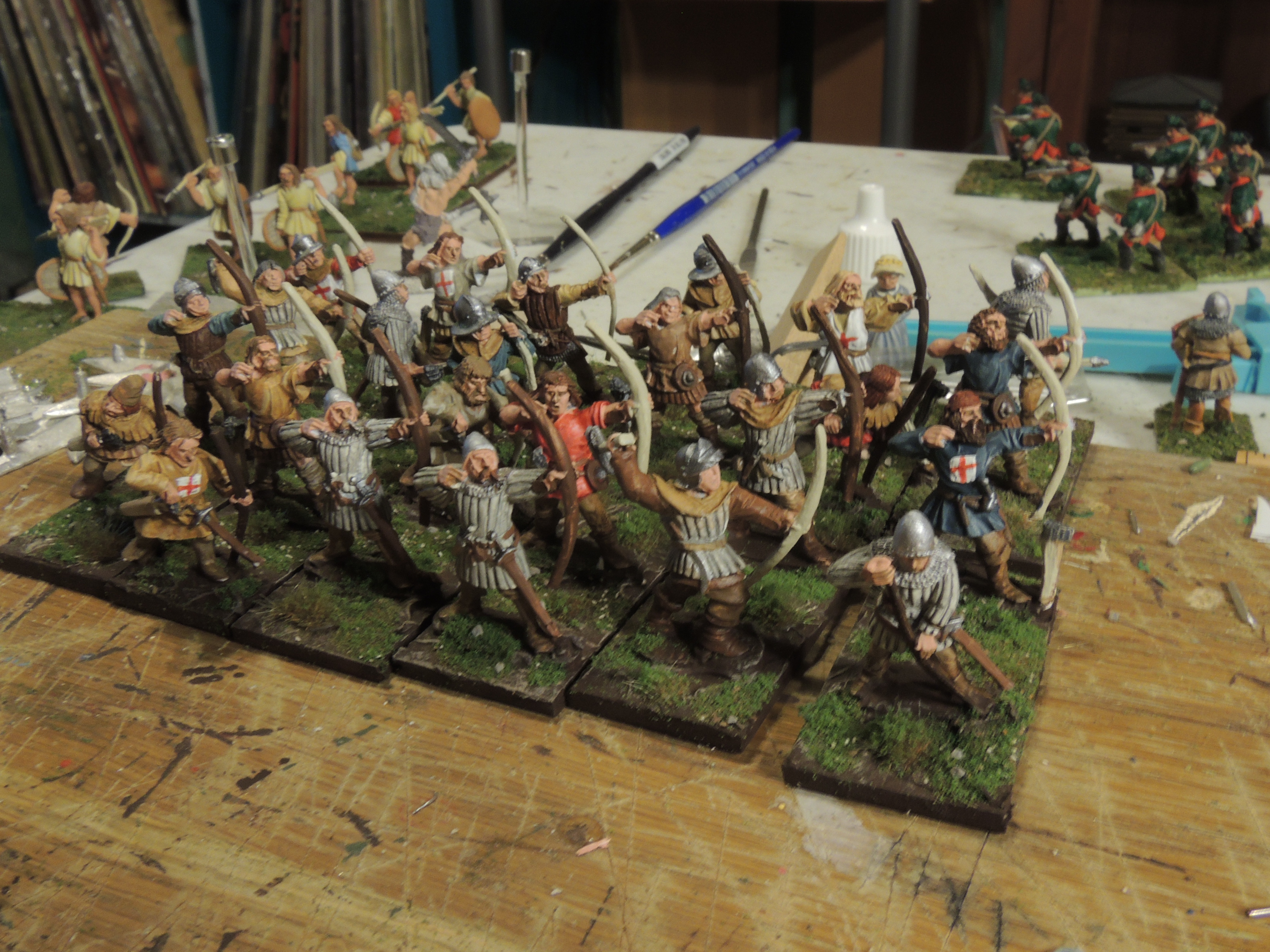
I finally finished these guys last night.  I made their bases a bit busier than I usually do.  They are supposed to be able to fight in difficult terrain, and at Poitiers–always a guiding star for me-were able to navigate swampy terrain They aren’t brilliant, but the first rule of miniature wargaming is that any painted unit is a WELL-PAINTED unit.

Old Glory longbows on half stands, ready to go.

Old Glory longbows on half stands, ready to go.

Escodida Versatil Brushes Arrive

So my Dick Blick order arrived in an enormous padded mailer.  Inside were my carefully packaged 0 Escodida Versatil brushes.  I carefully pried them out of their packaging and was singularly unimpressed.  They are the right size but as miniature gamers we live and die by brush points.  No brush point, much less detailing. These didn’t come with one of those little protective plastic thingies that fits over the ferrule, so one of the brushes had any potential points squashed right out of it.  The others retained something of a point, but only one of the three brushes seems to have “winner” exuding from it.  I’ll have to work with them.

My Escondida Versatil brushes  arrived from Dick Blick yesterday.  I am not optimistic, but they're the brushes I have . . .
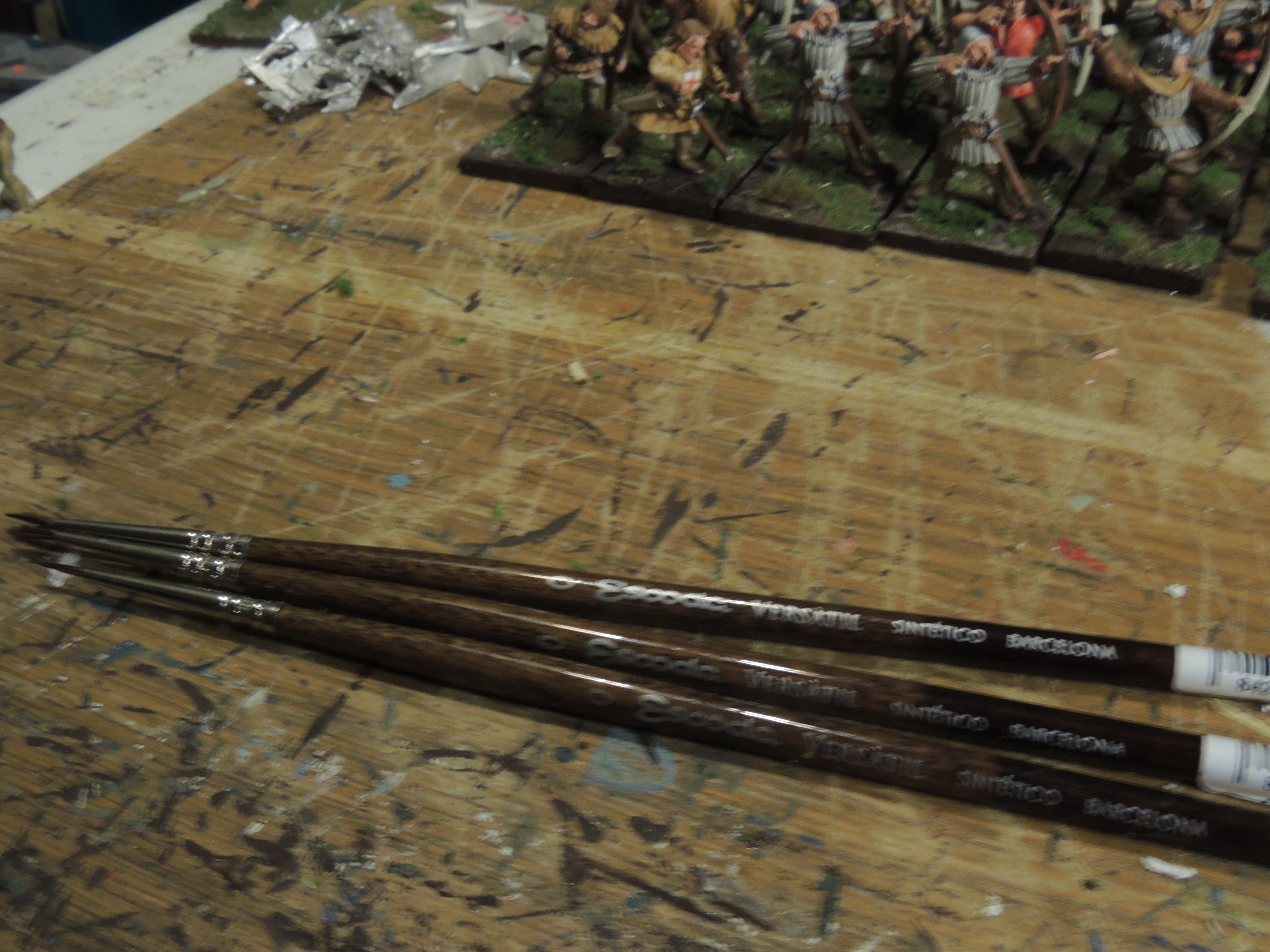
My Escondida Versatil brushes arrived from Dick Blick yesterday. I am not optimistic, but they’re the brushes I have . . .
Re purposing My Den

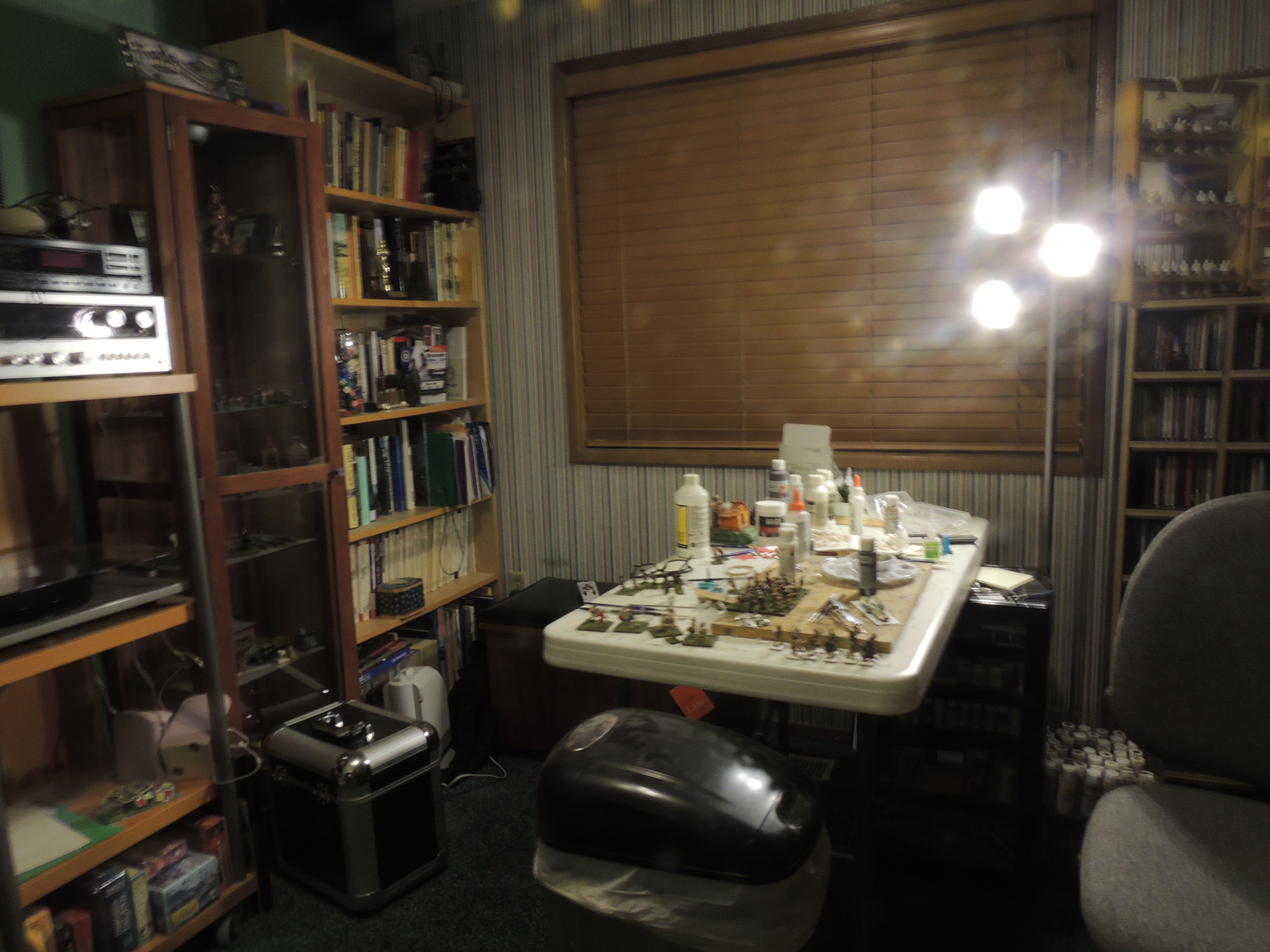
My den/painting area/ music room is tiny.  It’s 8′ X 8′ and is crammed full of miniatures, board games, my stereo, a television, dvd’s all my Kevin stuff. It had also become virtually unnavigable.  As my music consumed a bigger and bigger portion of my time and resources, the situation I had in there with my painting table plunked right in the middle of the space made accessing my stereo difficult. So I did some switching, moved my table to a place that renders the rest of the room more accessible and doesn’t negatively impact my ability to work efficiently and comfortably The lighting is probably better, and will be better still when we emerge from the great darkness of the Northwest winter, which seemed to begin yesterday and will last until June.
It's hard to tell from this photo, but I've pushed my painting table toward the back of the room and near the window.  It's opened up the space so it's more walkable without interfering with my work space.

It’s hard to tell from this photo, but I’ve pushed my painting table toward the back of the room and near the window. It’s opened up the space so it’s more walkable without interfering with my work space.

Enfilade Plans

Yes Enfilade is in May, but I like to have things worked out well in advance.  Dave Schueler and I always work together on at least one game.  We’ve done two super successful rollouts: the bombing of the Tirpitz–which was just gorgeous–and the prize winning Raid on St. Nazaire from last year.  This year it looks like we’ll do The Channel Dash of the Scharnhorst and Gneisenau and various auxiliaries from Brest in Brittany to the German port of Wilhelmshaven where they could threaten North Atlantic convoys.  It turned into a disaster for the British who could muster little naval power to threaten the German battleships, and whose repeated air attacks were driven off with heavy losses by defending elements of the Luftwaffe.  The sheer variety of British aircraft–Wellingtons, Spitfires, Hurricanes, Swordfish, Whirlwinds, Hampdens and Blenheims make it all pretty attractive.

Beyond the Channel Dash, I’m not too sure what I’ll do.  After last year’s “fill the car” excitement, I may stick to something a little less demanding.  I have a bunch of 1970’s era hydroplanes to paint–I could update my Thunderboats!, which is always a crowd-pleaser.  I could also do some ACW naval stuff.  I still have some ships to paint, and I’m sure David Sullivan and I could do something.  He was interested in an Ironclads game.  Now that would be retro.

What’s on Your Painting Table?

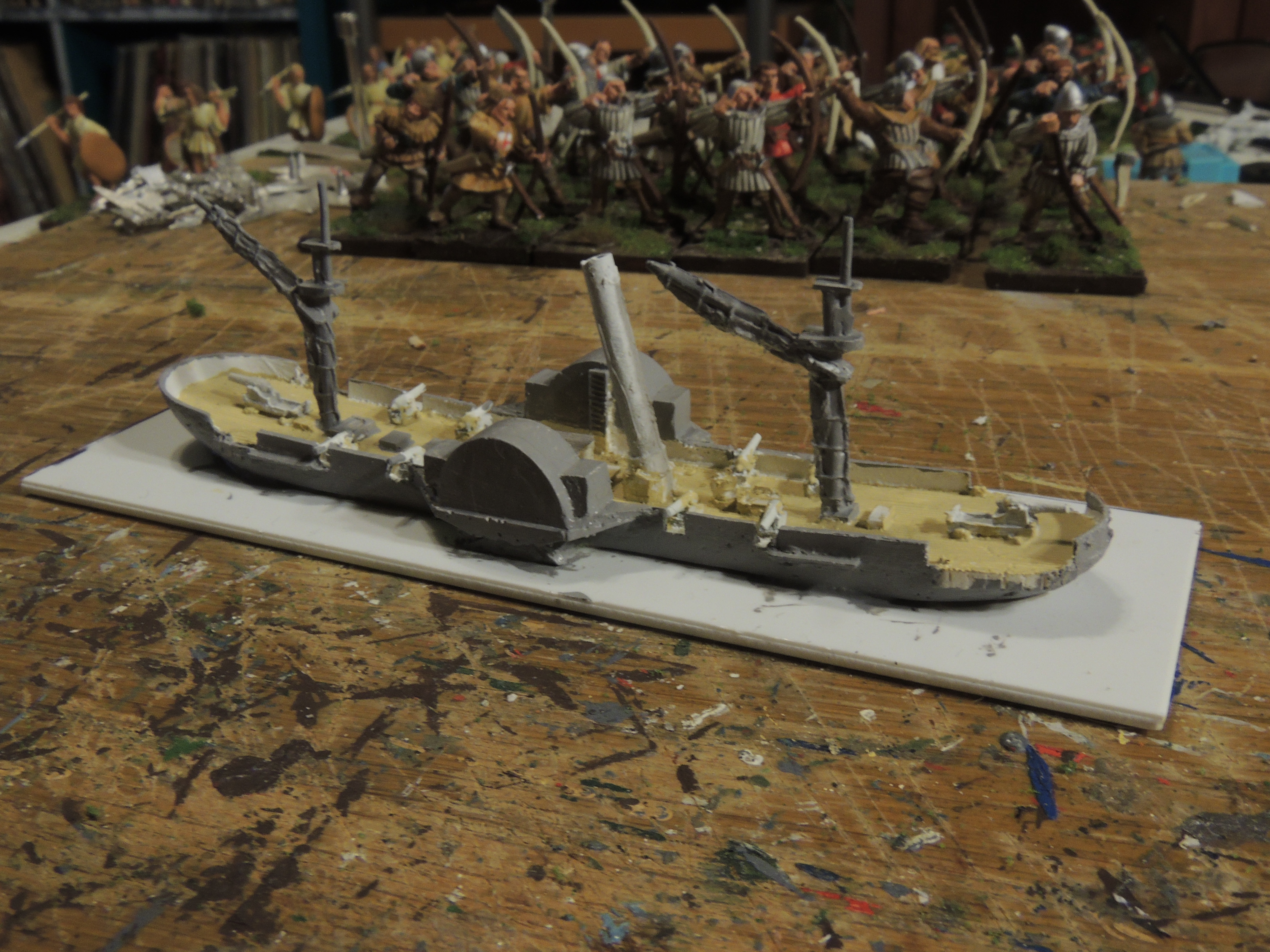
With the longbowmen finally completed, I’m just dorking around with things I want to do. The Miami (gunboat) is a step closer to completion.  I’m getting ready to base some figures for Mars. I’ve primed a big Baueda pavilion for a potential camp for the Hundred Years War.  Not terribly focused, eh?  It shouldn’t take forever to paint them.  I think after I do that, I’ll paint the Volunteers of Ireland for the American Revolution.  I bought the GMB flags for them, they have a different looking uniform, and they are pretty small for the period. After that, it’s the gunboat Selma from the Battle of Mobile Bay.  That should get me into November.

A bit more done on the Miami.  My goal is to be finished, based and rigged by the end of the week.

A bit more done on the Miami. My goal is to be finished, based and rigged by the end of the week.

And Now For Your Listening Pleasure

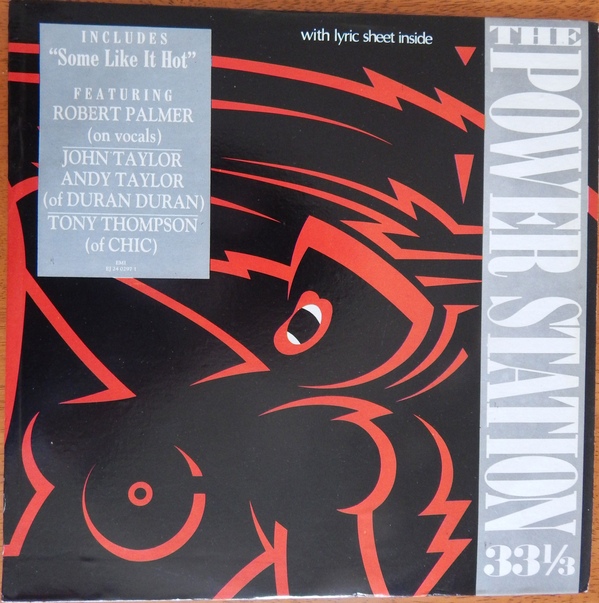
The Power StationI have a bunch of mini collections in my pile o’ vinyl.  Little Feat, Steve Miller, Boz Scaggs and a few others.  One guy I really like who is kind of under-appreciated is Robert Palmer.  He’s a British blue-eyed soul singer is best known for his lounge-lizardish appearance on some early MTV videos.  “Addicted to Love” is his best known video with the long legged, pretend backing band. But before that he made some very good R and B influenced albums.  Before his MTV fame, however, he teamed up with two former members of Duran, Duran John Taylor and Andy Taylor, and Chic’s Tony Thompson.  Together they formed The Power Station.  Their first album, titled, simply enough, The Power Station (1985) is pretty enjoyable.  It is energetic synth-pop, but not so much as to be annoying.  Palmer’s vocals are powerful and the two Taylors have enough guitar influence to keep things interesting.   My favorite song is a cover of TRex’s “Bang a Gong.” Good stuff, worth a listen.  Picked mine up for half a buck at the Goodwill Outlet.