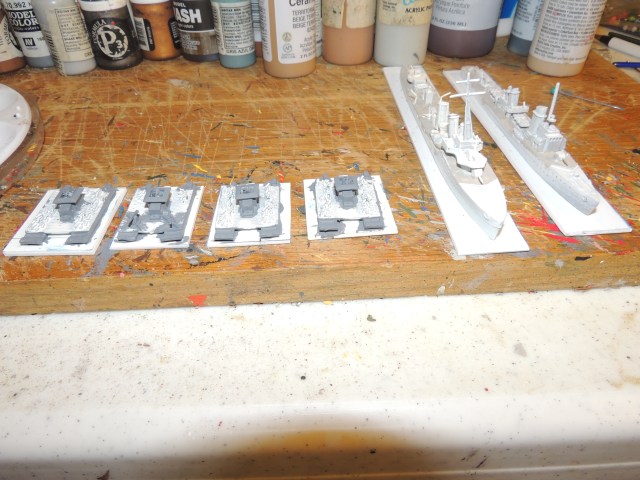
To say I’ve hit a gaming dry spot is a gross understatement. Yes, I’ve been painting and planning, but I haven’t played a legit miniatures game since DANG at the end of December.
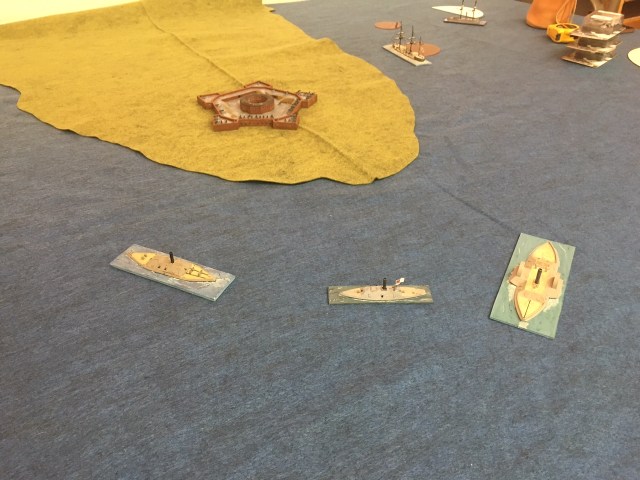
Tennessee and Tuscaloosa slowly make their way around Santa Rosa Island, while Nashville speeds past them on its way to reengage Fort Pickens. All ships in sight-Tennessee, Tuscaloosa, Nashville, Stonewall and North Carolina (Scorpion) are Thoroughbred models. The Fort is Bay Area Yards’ Fort Jackson.
But today I packed up a pile of my !/600 ACW ships, my big star fort, headed north to pick up Dave Schueler and made our way to The Panzer Depot to meet David Sullivan and try out my Pensacola game. In order to do that, of course, I had to survive some ridiculous Puget Sound traffic, but the less said the better.
The plan was to walk through my Pensacola scenario. I knew it was likely just the three of us to do the walk through, so I took on the game master’s role of running the fort, while the Dave’s took on the role of running the Confederate fleet. This was strictly a play test, and I had some specific goals in mind.
- Could the hundreds of guns mounted in Fort Pickens be homogenized down to a few simple die rolls per turn.
- Could the Confederate ships mount a destructive attack on the fort?
- Was the game interesting enough to hold players’ attention for four hours of game play?
At the same time, I omitted a couple of important pieces of the scenario. There basically was no Union player. They get to run some Union naval pieces they’ll get to choose from. They were not available today in order to keep things simple.
David took the Bahama Squadron including the ironclad sloops Stonewall and North Carolina, as well as the Nashville from Mobile. Dave took the remainder of the Mobile squadron, including the rams Tennessee II and Tuscaloosa, as well as the wooden gunboats Morgan, Gaines, and Selma. Their mission was to inflict sufficient damage to Fort Pickens to force it’s surrender at the end of the scenario.
First, a confession about Ironclads. It’s a set of rules that I dearly love. I’m certain I’ve played those rules more than any other I’ve ever owned. But they are very much a product of their time: complicated tables, a series of die rolls for each and every gun fired and hit scored. In 1979 that is what people wanted. But they are an impediment today. Though I have played many different sets of ACW naval rules, I still believe Ironclads gives the best feel of the period. I’ve run games using these rules at conventions before, and players have enjoyed them. My goal was to take the rules, do some slight modifications, and make them just a little more playable for a convention setting, retaining every bit of the historical feel the rules impart.
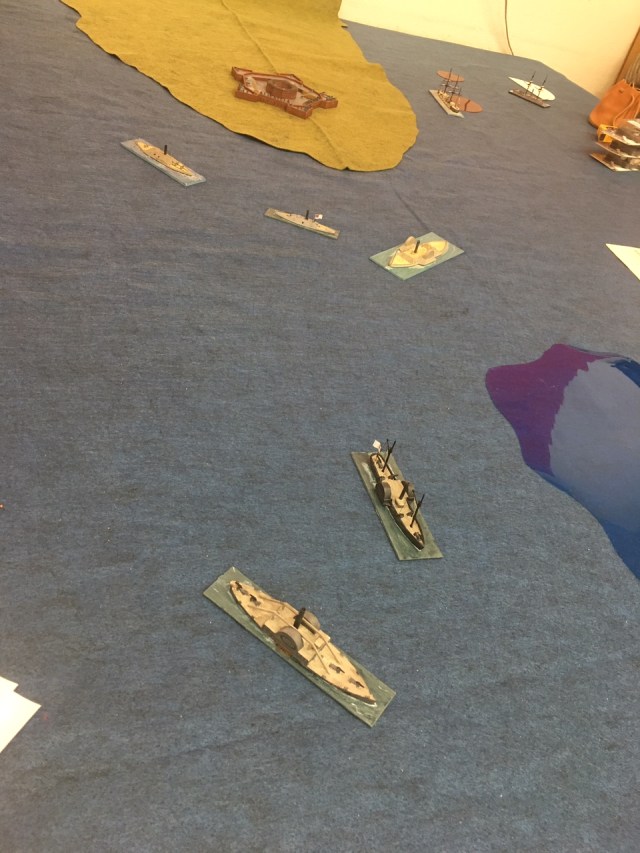
A bit wider view of the table as Selma travels around the bar at the harbor’s entrance and Morgan sits silently, most of her crew dead after a boiler explosion. Selma is a Bay model. The Morgan is Thoroughbred Figures.
One of the things I did to simplify the fire from Fort Pickens was divide the fort into five faces. The Confederates would have to inflict critical damage to three of the five faces to force its surrender. The fort, with literally hundreds of guns, would return fire. I kept it simple by requiring a simple die roll by each ship in the target face’s arc of fire. The highest die roll would be the target for the fort that turn. If ships tied for the highest die roll, there would be multiple targets. After targets were identified, each one would suffer a six sided die roll that determined the number of hits, 1-4 per turn. then there was a simple die roll for each hit on a table divided for ironclads and wooden ships. The die roll spelled out the damage.
The job of the Confederates was simple: pummel the fort. They would play the game with the goal of inflicting as much damage as possible. When the game was over, damage would be assessed, and morale losses taken by the fort caused by loss of armor, guns, crew, fires or magazine explosions and comparing it to a modified morale level would determine if the fort surrendered or not.
We played the game for about two hours. David and Dave are Ironclads veterans and knew quite well what they were trying to do. We decided immediately to scrap order writing. It would prevent collisions entering the constricted ship canal and perhaps remove an element of humor for the game master, but it was one step we could get rid of and keep players concentrated on their goals.
With that, the first move was taken and the fort was pounded. The North Carolina, with it’s turreted British naval guns was by far the most dangerous, doing huge amounts of armor damage, while the Mobile squadron with its slower ironclad rams and narrower fields of fire had difficulty getting lined up.
But the fort dished out its own volume of fire. After each turn the Confederate ships in each face’s field of fire would roll a six sided die. The high roll would be the target for the fort that turn. It became a bit of a comedy to see who would be the lucky recipient of the fort’s attention. One turn Dave rolled four sixes for his five ships. They all took damage. As you can imagine, hits on the ironclads were largely ineffective. Lots of minor armor hits and no-effects, but occasionally they’d get whacked pretty good. The Stonewall took a fairly painful waterline critical penetration that resulted in flotation damage and speed loss, but that was an outlier. Nashville and North Carolina both took minor steering hits, but both resumed their mission of destruction against the fort.
Much different story on the wooden vessels. The Morgan was hit repeatedly, and eventually suffered a critical boiler explosion that virtually disabled the ship. The other wooden vessels, Selma and Gaines, took less damage but were finding a way to exit the area at the end of the game. All suffered serious armor damage, though they were still fighting their guns.
As I explained, we played about two hours of game time. Figure that at the convention we might have as much as three and a quarter hours given set-up and teaching noobs the rules. They would also likely be less efficient at running the Confederate ships-but maybe I’m wrong. By the end the Fort was in serious trouble. It’s total morale value was reduced from 24 points to 8. There was little reason to believe they wouldn’t polish off Fort Pickens, so we called it. We also talked it through. We all agreed the fort would be in better shape with Union defenders. I shared my ideas for those defenders, but honestly I think I’m going to put together two or three packages for the Union players to choose from, which will each include a couple of ships and additional shore defenses.
All in all, I considered the playtest a success:
- The fort gunfire was very smooth. Eliminated the too hit rolls for hundreds of guns per turn and just went with hits. Fort gunfire maybe took five minutes each turn. I will be adding an additional penetration damage to the Ironclads column, but otherwise I’m happy.
- The Confederates showed they could definitely do damage to the fort. If they had more gun hits, the game would have been over. I need to take a look at the effect of cumulative crew losses. We already agreed the loss of five guns in a fort face would reduce the number of hits inflicted by the fort by one. Maybe the same with crew losses.
- Was the game interesting enough. Well, if it was just the Confederates pounding the fort into submission, I think it would be a snooze, though maybe it would be enough for some players early Sunday morning. But adding a another shore battery and Union ships to the fort’s defenses would give the Confederate player plenty to do.
It leaves me with a little more tweaking to do but not much.

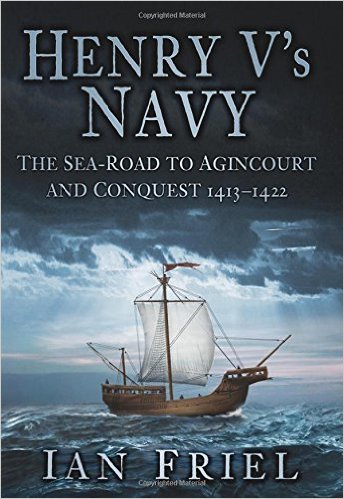

 Henry V’s Navy: The Sea Road to Agincourt and Conquest 1413-1422 . by Ian Friel To suggest that books about the Hundred Years War at sea are as rare as hen’s teeth may be giving too much credit to the hens. The only other book-length study I’m aware of is 2011’s Edward III and The War at Sea, 13227-1377 and is pretty much worth a king’s ransom (and somehow I missed it when it came out, sniff.) I determined not to be shut out when this book became available on February 1, and promptly ordered a copy. The small volume was not over-priced, and I’m hoping to read it soon. Henry V was a noted shipbuilder and vastly increased the size of the fleet that virtuallydisappeared during the reign of Richard II.
 The Civil War at Sea by Craig Symonds. Symonds’ name may ring a bell. He’s a prolific writer, best known for his military atlases, but he’s written about many military topics, including the naval aspects of the Civil War. He tackles this massive topic thematically rather than chronologically, focusing on the changing nature of ships and armament, the blockade, commerce raiding, war on the rivers, the attack on ports (using Charleston as an example) and the success of the Union naval strategy. The book has only 170 pages of text, so it tends not to get hung up on detail, so if that is your desire this may not be the book for you. But as a thematic interpretation of the Civil War on the water, it could do the trick.
 The Confederate Steam Navy by Donald Canney. I have only ordered this book and haven’t received it yet. But I have been angling for a copy since it was released on December 9th. Canney’s book on the Confederate Navy is supposed to mirror his brilliant two volume study of the The Old Steam Navy that went out of print in the ’90’s. These are books I constantly consult and I believe the new book will be just as useful. So much of what is written about the Confederate Navy is conjectural while Canney’s work always seems to be anything but. It covers all types of vessels from the ironclad rams to blockade runners, and as with his previous work, will be crammed with illustrations and photos, some not previously published. I’m excited. Hoping it arrives from Amazon today.





 A Gamer's Tales