My Brush Crisis


I don’t know what kind of brushes you use, but I am a Kolinsky sable person.  I have been for probably the last decade.  My preferred brush is from Dick Blick Art Supplies, the size 0 Master Kolinsy Sable brush with the short red handle. The size 0 is perfect because of its durability and because it holds a nice amount of paint.  Not a go to for everything brush, but for most figures it’s a brush I can use for coverage and detail. I can usually paint a year’s worth of miniatures–let’s say several hundred–with a single brush.

Siberian-weasel

It’s all this varmint’s fault.

Unfortunately, the U.S. Dept. of Fish and Wildlife put the kibosh on the importation of Kolinsky sable hairs from Russia.  The brush hairs come from tails of the Siberian weasel.  It’s a critter that isn’t grown in captivity and has to be trapped in the wild.  Though the critter is desirable for a variety of uses, and grabbing the tail hairs is a byproduct of its uses, the Dept. of Fish and Wildlife temporarily banned the importation of these hairs from 2014-15.

Entire classes of artist brushes simply dried up: Windsor and Newton, Escoda, and Blick were simply unable to get supply for brushes.  Those that were available became terribly expensive.

The limit on importation has changed from a ban to restriction.  That has contributed to a very spendy market.  But most importantly it has also changed my beloved brushes. The Blick Master Kolinsky has gone from a brush length of about about 8mm  to about 5mm. Still has a nice tip, but simply not suitable for covering much of anything.

During the crisis I’ve tried a number of things.  Most involve synthetics, and I’ve hated almost all of them. The don’t stay straight for long.  The only brushes worth a damn have been some of the Army Painter sets, but still not quite satisfactory.

I may have a substitute I can live with.  Blick sells the Princeton Siberian Kolinsky Sable.  I’ve been using one of these for about the last four months, a size 0, and it has served quite well. It’s tip is advertised at about 7.9mm.  Not quite as durable as my old Blicks, but not too bad.  At the current sale price of $6.17 on the Blick website, not a bad deal.  My chief criticism is they are long handled brushes–which can be easily altered to short handles–or I’ll poke myself in the eye.

You just can’t paint much without good brushes.


Book Review: Cursed Kings

Cursed Kings

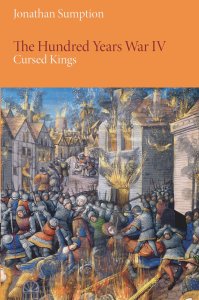
As I headed back to school last September, I was shocked to see “Cursed Kings” was available on Amazon.  This is the title of the fourth volume in Jonathan Sumption’s history of the Hundred Years War.

The book picks up where the third volume, “Divided Kingdoms” left off, with the usurpation of Richard II’s throne by Henry of Lancaster (Henry IV,) and the onset of insanity in the French king, Charles VI.

The book begins with the struggles faced by Henry IV to assert his legitimacy, as well as conflicts with Parliament to wangle sufficient revenue to maintain his household, let alone protect his Gascon holdings in France. Throughout his reign (1399-1413,) Henry faced multiple uprisings on the Scottish border as well as the persistent rebellion in Wales led by Owen Glendower. These were complicated by his own poor health and a wary eye on his talented, but ambitious, son the Prince of Wales.

In France things were, if anything, worse.  The intermittent madness of King Charles led to a dynastic struggle to control the royal council and the resources of France.  Led by the Armagnac faction of Valois uncles and brothers to the king, France exploded in civil war when the John Duke of Burgundy murdered Louis Duke of Orleans in the streets of Paris in 1407.  From that time on, the Burgundy and Armagnac factions of the Valois family were in constant conflict, illustrating the fundamental weakness of the French monarchy: though France was a much richer country than England, it was divided between the two factions that counted on quasi-independent dukedoms like Brittany and Navarre to support them in a bloody civil war, just as the greatest warrior king in English history was set to embark on a new invasion of France.

Henry V’s entry in the Hundred Years War was so much more than his Crispin’s Day address and the Battle of Agincourt. Though his reign was comparatively brief, 1413-1422, his campaign to open Normandy to invasion at Harfleur, the shocking defeat of the French army, and his relatively rapid conquest of Normandy and mastery of siege warfare, opening the Seine valley all the way to Paris itself should not be overlooked. His job was made somewhat easier by the persistent strife among the French.  The disaster at Agincourt was enabled chiefly because the French army was thrown together shortly before the battle and because there was really nobody to lead it. It simply marched to its death without a battle plan, and without a commander agreed upon by the Burgundy and Armagnac factions.

As Henry blazed a trail through Normandy, the struggle to control the streets of Paris, manage revenues even the person of King Charles and Queen Isabelle continued. John “the Fearless” generally had the support of the Parisian mob.  Armagnac forces struggled to coalesce around a strong leader as the two oldest of Charles’ sons died. Eventually, his youngest son, became Dauphin and leader of the anti-Bugundian French.  His murder of John “the Fearless” in 1419, led to a withdrawal of Burgundy from active participation from the war with the English, but instead became more of a diplomatic interloper, together with Brittany and other lesser feudal French vassals who could, and did play both sides of the game.

Unable to compel the Dauphin to fight the decisive battle he, and all English kings sought, Henry agreed to a lasting treaty, guaranteeing a certain amount of his goal.  The 1420 Treaty of Troyes wedded Henry to Catherine of Valois.  It also established Henry as nominal regent of France and created a dual kingdom of France and England. It insure that his heirs would also be King of France and England and essentially disinherited the Dauphin.

The book ends with French fortunes at a low ebb, but the English in France as largely a spent force.  With Henry in control of Paris and consolidating his control around the city, he is faced with the same crisis of fiscal collapse that confronted Edward III, Richard II and his father.  Unable to make the conquest and settlement of Normandy pay for itself, crushed by years of high taxation at home, parliament withdrew its unwavering financial support for the war in France. On the battlefield, Henry successfully removed persistent Dauphinist strongholds threatening the feeding, and subsequent civil peace of Paris.  Unfortunately his successes are undone when he contracted dysentery and died.  His death is followed shortly after, by that of his father-in-law, bringing an end to a long era of uncertainty in the French monarchy.

Jonathan Sumption’s histories are always a commitment in time and persistence by the reader.  The 773 pages in text in this volume are no different. It took me months to get through it as demands on my reading time were very extravagant this spring. But Sumption’s work remains accessible and provides remarkable detail about this conflict.  In this volume he pulls together an incredible number of threads-social, economic, political, and military-to assemble a complete picture of the conflict. I was left with a fuller understanding of the hopelessness of the English cause that might be a winner on the battlefield, but like the snake that swallowed a porcupine, France was simply too big and spiny a meal.  Though the French certainly did its best to sabotage its own defense, it’s clear by the end of the book and Henry’s death that, though the English kingdom in France could continue for a time, the English shot most of the limited bolts left to them, and the ending will not be pretty.

If you have an interest in the Hundred Years War, or want a greater understanding of the context for Agincourt, this book is a must read.  Not a summer at the beach reading, but definitely worth the time.

Painting is good

It’s July 5th. I made no posts in June. Zero, nada, zilch, nothing. Not any games played either.  Let’s just say, that June was not a good month for posting or gaming and get on with our lives.

But that doesn’t mean it was completely inconsequential.  June was a pretty good month for painting figures.

Spanish Swordsmen

After Enfilade I came home and began working on Spanish Swordsmen for my Quetzacoatl Rampant project.  The figures are all from Eureka Miniatures and combine the more heavily armored figures with the lighter armored variety that became de rigeur as the conquest progressed. These were great figures to paint.  Relatively easy, nicely formed minis. I used the dip on these figures, and I feel they turned out well.  The dip did a very nice job in accentuating the joints in the armor, and the decoration on the steel shields.

This period will continue to receive a lot of attention throughout the summer.  I expect I’ll try my first unit of Aztecs next in the project. I own all the Spanish I need.  These figures represent four 6-figure units, and raises my completed Spanish units to six.

Black and Tans

I’m also bound and determined to finish or nearly finish my Irish Rellion/Civil War project this summer.  I have a pretty simple set of rules called, “Like Cricket, But With Guns.” I forget where I found these, but they sure seem simple.  I just need to get my figures finished to try out a game.

I finished painting 14 of the Royal Irish Constabulary Auxiliary or the “Black and Tans.”  Frequently these were British WWI veterans, who wore as much of the RIC’s dark green kit as they could get, but frequently wore part or all of the standard issue uniform. The figures are the very nice minis by Musketeer/Footsore miniatures.

I don’t have a lot left to paint for this period.  I have a couple dozen Renegade early war Brits in SD caps that will mostly serve as Irish Free State army for the Civil War.  I also ordered a pack each of RIC officers and IRA militia types from Reiver Castings to add just a few more figures for each side. They seem a little small and not quite up to the standard of my Footsore and Cannon Fodder miniatures, but they are something different.  We’ll see how they paint up.  If they paint up well, I may buy s couple packs of the dark uniformed Auxies that traveled in the Company B. Crosley tenders I have to build and paint.

The Luisiana Dragoons

I’ve had these figures for a while, and it’s nice to have them completed. These go with my United States vs. Spain project.  I’ve had them for some time, and am just trying to wrap them up.  I loved the color scheme–something about the blue and red that I like. These are from the old RSM range offered by Dayton Painting Consortium.  Decent figures, but certainly not front line today.  This is a project that still has a few loose ends I’d like to work at and finish up.

Next Up

The Red Captains, or those of us who are connected to the Space 1889/Martian/The Sword and the Flame on Mars have committed to a summer game that is essentially a sea battle on one of the Martian canals. I’ve agreed to supply my medieval vessels as Martian warships–I have three Merrimac Shipyards cogs and a galley.  For the Brits I have the Reviresco paper steam gunboat, which is a cheap and handy little model, even if it shows my clear lack of expertise assembling paper models. But I also have the nice resin Nile River gunboat by Merrimac.  I’ve been waiting to do something with it for probably a decade, so I think the time to work on it is now.

I expect I’ll spend most of the rest of the summer painting the rest of my Irish stuff, as well as Aztecs and Conquistadors.  I have a timetable for playing Quetzacoatl Rampant that requires my stuff to be fairly complete by January, so I do have a bit of time pressure there. But I am happy to paint on whatever my heart desires right now.

Music to Paint By:

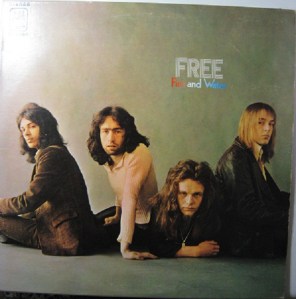
Free Fire and Water

Free was a very young band when they formed in 1968.  All of their members-vocalist Paul Rodgers, guiarist Paul Kossoff, drummer Simon Kirke and bassist Andy Fraser-were still in their teens when the band formed and recorded their first two albums.  Their breakout record was 1970’s  Fire and Water, that included the hit “All Right Now.” It’s a very good record that showed the band’s potential.  Free was a blues-based outfit, with a solid no-nonsense musical core.  It rocked harder than Cream, but certainly flowed from similar musical influences. Not always an easy get.  It can be hard to find, but usually affordable.


Straight lines are not my friend

Less than a week until Enfilade.  I’m really looking forward to this convention.  I’ve been more or less in a miniature gaming desert for the past six months.  I’m excited about running some games and seeing some friends.

My last posts were about the travails of assembling 1/300 biplanes.  But ultimately I got all ten miniatures done in time for a walkthrough of our Channel Dash scenario at Dave’s house last weekend.
DSCN1560

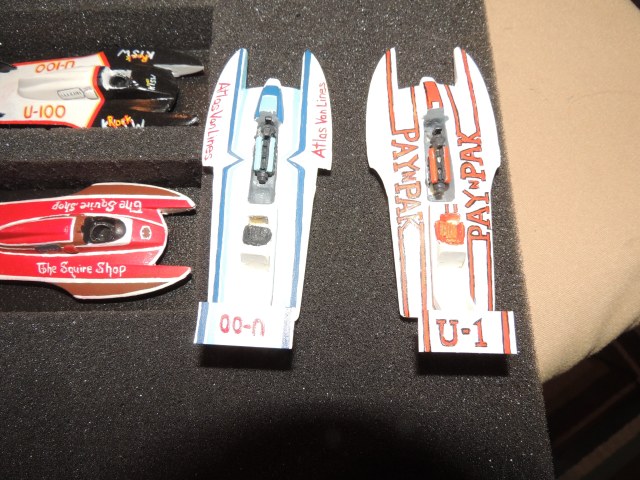
An okay photo of Atlas and Pay N Pak.  Doesn’t quite do justice to Atlas’ dreadful lining job.

That left me two hydroplanes to paint for my Friday evening game at the convention: Thunderboats: The Rise of the Pickleforks.

I’ve been picking my way through the picklefork hulls I bought a few years ago at the convention. For those who aren’t in the know, the picklefork hull design became popular in hydroplane racing in the 1970’s, providing a wider, safer hull design. Unfortunately, it’s also the time when I lived in California and forever lost touch with hydroplane racing until my interest in this project. So the boats from the period I don’t know as well as those from the “classic” 1950’s and ’60’s era.  There also seem to be fewer pictures on the web from the 70’s, until the massive switch over to turbine powered boats.  Weird, but true.

The two boats I had left to paint have identical hulls, and are limited to just a couple of boats.  The most obvious paint scheme was the “Winged Wonder” Miss Pay N Pak from 1974.  The second is really the same boat when it became the Miss Atlas Van Lines. in 1976.  The Pak was very successful in this iteration, the Atlas, not quite so much.  For the Atlas crew this was very much a transitional boat to Bill Muncey’s famous “Blue Blaster” that would eventually take his life.

Needless to say, it is a very cool hull design.  But like the other boats from this period, both were a gigantic pain in the ass to paint. Generally speaking, the earlier three point hydros were block colors with some special marking, font scheme, or number that made them unique.  The pickleforks, because they sit lower in the water and have enormous decks, tend to use quantities of straight lines, often piped in a contrasting colors.

Pay N Pak is a perfect example.  The entire deck is lined in orange piped black.  Even the name fits into the lining and piping scheme.  It was a nightmare to paint.  Because I’m an impatient boob, I refused to take the time to tape this out.  At five feet it doesn’t look bad.  At twelve inches, not so good. Painting straight lines with perfectly even distribution of paint off the brush is really hard.  At least it’s hard for me.

As difficult as Pay N Pak was, Atlas was even harder.  Trying to keep the alternating light and dark blue lines of uniform width was incredibly difficult.  I kept comparing photos on my iPad to what I was painting on my boat, only to realize there was earlier iteration of the Atlas with the same colors, but an entirely different lining scheme.  At one point I ended up sanding the whole thing down and starting over.  But mercifully, it’s done. Not perfect but not bad.
DSCN1561

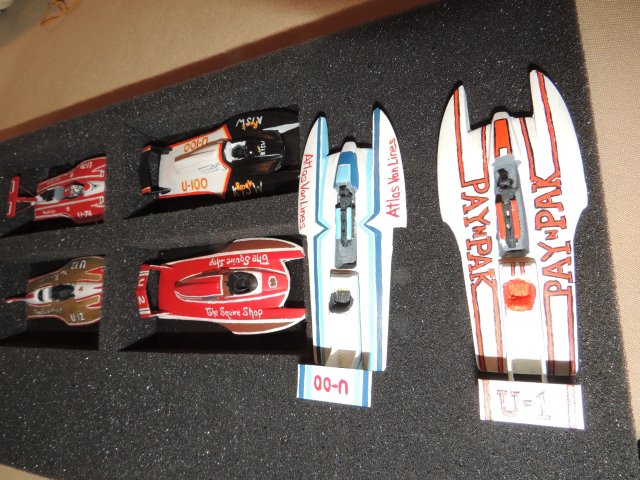
All six pickleforks.  I’d like to do more and am hoping to snag some more at the convention next weekend.

So I’ve wrapped up all six of my picklefork hulls.  I’m hoping Shawn is at the convention with a few more to sell.  It’s the only purchase I’m really hankering to make.  At the bring and buy, I’m also hoping I might find a couple of rules sets.  Some guys on TMP have suggested a modification of Peter Pig’s AK 47 for the Spanish Civil War.  Wouldn’t mind taking a look a that.  I’m also interested in a copy of Sharp’s Practice as a possible rules choice for my America vs Spain conflict.

What’s on my painting table.
DSCN1564

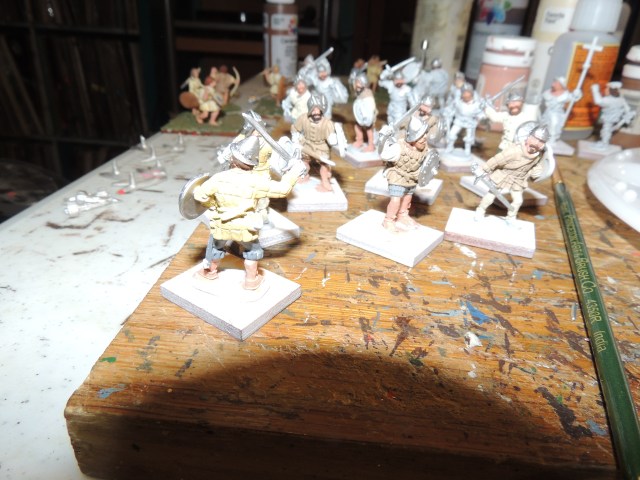
Fairly washed out by the flash, some Spanish swordsmen for Quetzacoatl Rampant.  Hoping to have the first eight or so finished before the convention.

Had a really enjoyable painting day yesterday.  Finished up the hydros and moved on to painting Eureka’s Spanish swordsmen for Quezacoatl Rampant, our little wars in Mesoamerica adaptation of Lion Rampant.  I have sixteen figures primed with enough on the way to give me four units of six figures each.  More to come as I finish more figures.

With Enfilade more or less out of the way, I’m freed up to work on what I please.  The various Rampants are at the top of the list, though I’m hoping to also knock out my Irish Civil War figures and my four remaining ships–all large masted vessels– for the American Civil War.

Music to paint by
Cheap Trick

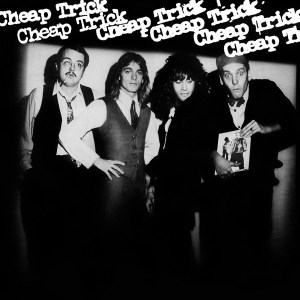
The annual Rock and Roll Hall of Fame induction always reminds of the music I don’t know well, or that I’ve overlooked in my collection. This year Cheap Trick entered the Rock Hall. They are actually a band I do know something about.  I saw the Tricksters in concert twice in the late 70’s when they were less well known.  They were great-really great- and incredibly loud. They might have been the loudest band I’ve ever heard.  But they were always energetic and a lot of fun.

So the upshot is, I’ve identified seven of their albums as a mini-collection.  It’s not complete, but it’s their best records.  Sadly I had a few of these once upon a time. I was able to pick up their 1977 debut, entitled simply Cheap Trick for five bucks on Discogs, and yesterday I listened on the Rega.  It’s a great record, very much in line with In Color and Heaven Tonight with very upbeat melodies and catchy lyrics.  Need to listen to it a couple more times.  Guitarist Rick Nielsen does almost all the writing, and its just great stuff. Very listenable, played best LOUD.

Swordfish pt. 2: the hatred continues

DSCN1558

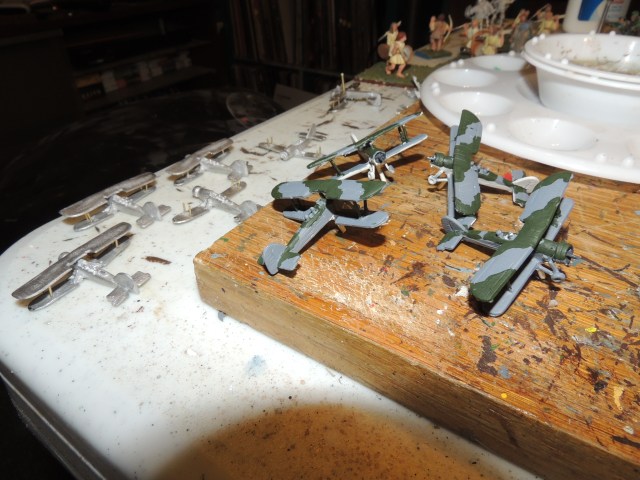
MSD Swordfish finished.  They were a walk in the park compared with the ROS Heroics planes

In my last post, I shared my struggles to assemble 1/300 Fairey Swordfish torpedo bombers by MSD miniatures and ROS/Heroics.

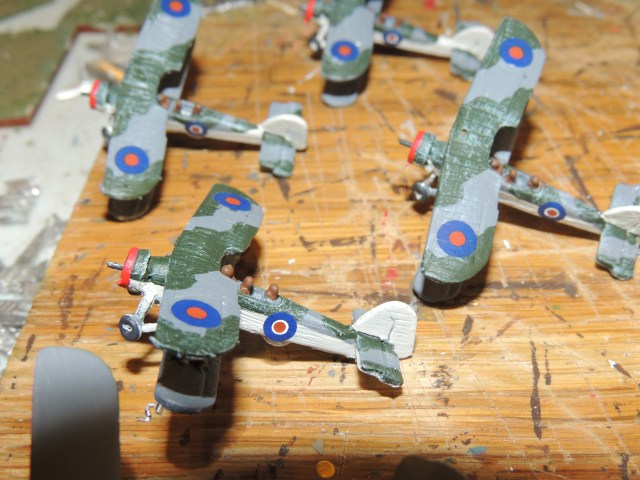
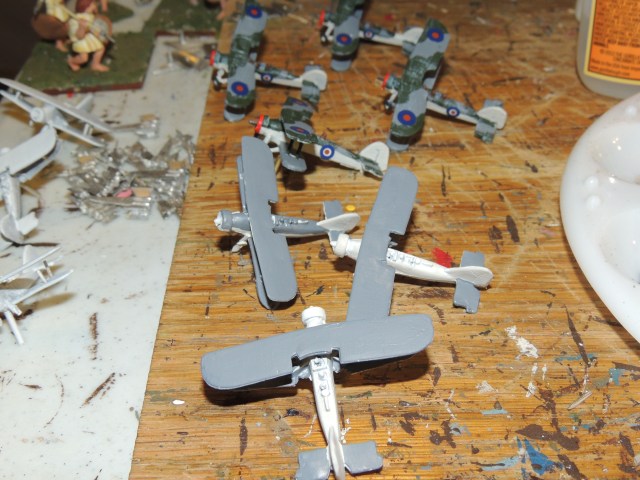
I finished the MSD planes.  It’s official, they are done.  Did my best to paint them sort of like they may have appeared in 1941.  I didn’t give them a yellow stripe around their fuselage roundel.  I just wanted them to be done. Paint scheme was Vallejo Neutral Gray with Military Green on upper surfaces.  Vallejo Silvergrey on lower surfaces.  They were not fun, but the most important thing is they are done.

DSCN1559

Three ROS/Heroics Swordfish in the foreground.  I am in the initial stages of painting them, but I hope to have them ready to go for Saturday’s playtest with Dave.

The ROS planes are a dreadful, wretched, horrible pain in the ass. Dealing with the wing struts is awful, but no problem at all compared to the wholly inadequate, incorrect, wretched and vile landing gear.  I am certain before this is all over they will have one, two or no landing gear.  It’s a matter of horrible model design and there is simply no excuse for it.

The good news is they are all more or less assembled and I’ve begun painting the last of them.  It’s too bad, because I really enjoy working with planes, but I don’t think I’ll be building many biplanes in the future.

Lots of great stuff I’d like to be painting.  But I still have the Swordfish to finish, and then it’s on to my last couple of hydroplanes. After that it’s Spanish swordsmen for Quetzacoatl Rampant, and then maybe a break for some ACW ships–big ones with masts.  Not until after Enflilade, however.

Music to Paint By

ArgybargyThe 80’s are a decade I largely ignored.  I was poor, raising kids, and stuck in my classic rock, so with a few exceptions–say what I liked on MTV, which was free–I didn’t pay a lot of attention to popular music.  A band I’ve really come to appreciate is the British band Squeeze. I’ve listened to bits of their new wave tinged pop on the radio and Spotify, and decided I needed some in my collection. I picked up the 1980 LP Argybargy during my trip to Los Angeles. It is energetic pop, with wonderfully literate lyrics.  My favorite song on the record is “Pulling Mussels From a Shell,” but the album is full of smart, sensible songs like “Another Nail in My Heart,” “Separate Beds,” and “If I Didn’t Love You.”  Squeeze had a pretty long career, their records are pretty inexpensive, and there are some really good ones that can be had for five bucks or less. Definitely worth a listen.
Swordfish Shouldn’t Suck

DSCN1556

Smyth’s Swordfish production line. The MSD planes have paint, while the ROS/Heroics planes are still under construction.  Raiden or Scotia need to make a better miniature or the other manufacturers need to provide opioid pain killers.

It’s been awhile hasn’t it.  Since spring break it’s been one thing after another-deadlines for both the yearbook and the newspaper, nationals in L.A., by annual evaluation, lots going on.  At home it’s been yardwork and birthdays, my nightly fight with insomnia, some awesome records, a little bit of reading.

I’ve been able to paint, but not as much as I’d hoped.  I finished a unit of goblins for Dragon Rampant and a unit of Tlaxcalan infantry for Quetazcoatl Rampant (I’ll share more about these another time.) But mostly I’ve been trying to figure out how to finish off my last few bits for Enfilade. Those bits are some Fairey Swordfish torpedo bombers and my last couple of hydroplanes.

Doesn’t sound like a lot, right? In theory you’d be correct. But since you think so, you obviously haven’t tried to assemble any 1/300 scale biplane bombers and paint them.

Let’s just start at the beginning. Fairey and Blackburn made something on the order of 2,300 Swordfish planes.  They weren’t just a one-off, small production run. That’s nearly 1,000 more Swordfish than Me 262’s. They served throughout the war.  In 1945 there were nine squadrons still in service, chiefly in an anti-submarine role.

But we chiefly remember the quaint, fragile looking bomber as the torpedo bombers that sank the Italian fleet at Taranto, that damaged the Bismarck and allowed the British navy to close in and administer the coup de grace.

You would think that such an important plane was worthy of a first-rate miniature right?  Let’s just say I’m still waiting.

I ordered some miniatures from ROS/Heroics back in December, waited my four weeks for them to arrive and tried to assemble them.  Let’s just say these planes had more tiny parts than you can count, all of them repellant to CA glue. I tried one of the six models, put them away and figured I’d drag them out another time.

I figured I’d been granted a miracle when Dave told me MSD miniatures made a Swordfish model.  They are the same company that started out with the Luft 46 planes some time ago.  I ordered them from Noble Knight Games, got them quickly enough, and last week started breaking them out of their blister packs. Each plane was supposed to have eight parts, but unfortunately several of them were missing important stuff like wing struts.

So I had ten 1/300 scale Swordfish miniatures, none of which seemed like they could be assembled.  That’s about $60 worth of small pewter pieces.

On Thursday I finally rolled up my sleeves and tried to figure out what I could do.  I had two MSD planes with struts, so I started working on those planes first.  Of course the struts didn’t fit well, and caused the wings to not receive all their support and sit higher than they should, but heck, at least I got them to go together.  The other two planes I assembled by cutting four struts per plane from brass wire, about the same size and I allowed them to dry sufficiently to provide support for the top wing.  Bingo, after some patience waiting for things to dry, I had biplanes.  All I had left to do was add the landing gear, which, assembled out of the box, has the wheels twisted at bizarre angles.  Perhaps nobody will notice.

This encouraged me to try the ROS planes again.  I’ve chucked the soft lead struts supplied the by the manufacturer and gone strictly to brass. They don’t really fit right, but the upper wing is designed to rest on the nose of the fuselage anyway, so no biggie.  The landing gear are absolutely terrible-a very small one strut affair that are inaccurate.  So far I’ve got one set assembled, though I have all six planes set up with two wings.

Bottom line? I have no freakin’ idea if these look much like Swordfish or not.  Perhaps those who play our Channel Dash game will be kind enough not to ask.  Dave has a couple of these he’s working on, and I know he’s having just as much fun as I am. I’ve started painting the MSD planes. I’m probably a day or so away from being in the same place with the ROS planes.  I’ll have photos of the finished planes.  I’m happy just to apply some paint and decals to these guys and call it good.


New directions and adventures with “the dip”

Welllllll, I didn’t get as much done during the break as I would like.  But that’s not to say I didn’t paint a lot, I did.  I even played a couple of games and that was really great.  But it took some time to wrap up the figures I was painting, but got another unit done within a couple of days.  But wait, I’m not making sense.

Let’s start slower

Games

Dragon Rampant

Dragon-Rampant-Mock-Up

I played to games during spring break.  The first was a quick walk through of Dragon Rampant.  I played at David Demick’s house and we used 15mm figures.  Dave has tons of painted 15mm fantasy figures.  I was initially concerned about working around figure losses and the zone of control, but we found it was quite manageable.  I ran Orcs and was thrashed by his Men of the West, but it was fun to try.  Like Dave, I have a bunch of 15mm fantasy figures painted and unpainted and I am pleased to find a new purpose for them.

En Garde

En Garde!

Last Saturday David Sullivan and I got together with Phil Bardsley and tried out another set of Osprey Rules, En Garde! It was pretty fun.  Intended for Pike and Shot era miniatures, we instead used David’s 40mm Bronze Age Europeans.  David had to finesse the rules a bit, rating bowmen and slingers rather than gunpowder troops.  In any case, the rules seemed to play well, though we did mess up a key component of melee combat.  You can read David’s observations here.  Would love to try these again with my Musketeers figures.

Quetzacoatl Rampant!

Great minds think alike.  After playing some games of Lion Rampant, David and I both agreed that the Spanish conquest of Mexico could easily be played using an adaptation of the LR rules.  Apparently author Daniel Mersey has a bunch of period specific adaptations of these rules ready to launch, so be watching for them.  But we’re beating him to the punch on this one. After some discussion, we agreed we were on pretty much the same page conceptually for the Spanish, and I really had no clue about the Aztecs.  But David posted some troop types and special rules to his blog.  He sent them to me on Tuesday and I think they’re right on.  Give ’em a looksee.

I’ve picked up a unit here and a unit there for this period, but last night I went whole hog and ordered all the Spanish figures I felt I needed from Eureka USA.  Well, almost all the figures I needed because they were short a few packs of Spanish swordsmen. In any case, they are on their way.  Yes, this is a violation of the no new projects pledge.  Yes, I know you feel my contrition and begging for forgiveness. But we did get a decent tax return and my wife said it was okay, so she is complicit. Blame it on Lorri.

Painting

DSCN1552

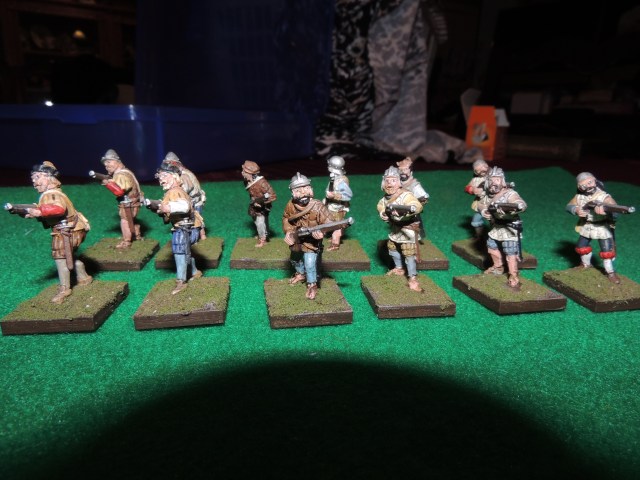
Sooooo if you’re going to start a new project it’s best to paint some figures to get started. I have carefully squirreled away a dozen Eureka Spanish arquebusiers.  And I tried something new.  David and Dave Schueler both chatted up their adventures with”the dip,” using the Minwax Tudor Brown stain over a block painted figure to achieve some natural shading.  I gave it a try with the Spanish shooters.  It was easy, cheesy.  My first time out, my mistake was to not paint on a heavy enough coat.

Minwax Dip

But I learned from that.  For those of you who haven’t tried “the Dip” before, here are the steps I used.

  1. Prime as usual.  I spray prime in white, your inclinations may be different.
  2. Block paint your figure.  Completely paint everything.  Lighter shades are better than dark to show off the shading.  No shading or highlighting needed.
  3. David suggests coating with some spray semi-gloss after painting.  I’ve faithfully done this, but I wonder if just spraying with Dullcoat or some other matte finish would suffice.
  4. Get yourself some Minwax polyshades Tudor Brown.  Not easy to find.  The big box stores don’t sell it, but Ace Hardware and Amazon both do. About $15.00 for a half pint.
  5. I used a big cheap round brush to slather on the dip.  It smells foul, so doing this in a hot, enclosed space is probably not optimal.
  6. If the stain pools, use a second brush to swab off the excess.
  7. Allow plenty of time to dry, before shooting with Dullcoat
  8. Do basing as you prefer. Voila you’re done.

Not bad.  Not brilliant, but they look better than okay.

I did a second batch of figures, a dozen plastic Orcs for my 28mm Dragon Rampant army. They are actually old plastic figures from my boys’ long expired HeroQuest game.  I really don’t want to lay out real money for my Dragon Rampant units, so I took these guys and drafted them into service.  Mind you, the game is about 22 years old and honestly the figures aren’t great . . .12 guys in exactly the same pose with slightly different weapons.  But they were free, and remarkably easy to paint.  I slathered “the Dip” on a bit heavier with these guys and they look a lot better.  There will be a few more HeroQuest denizens that play a role in my Dragon Rampant armies. Don’t tell the boys; they’ll be cranky.

Music to paint by: In the Court of the Crimson King by King Crimson

King Crimson

I got listening to some of my progressive rock collection, mostly inspired by Emerson, Lake and Palmer and The Nice-but there’s lots more.  One album that kept coming across best progressive rock record lists is In the Court of the Crimson King by King Crimson, of course. The 1969 record was the first by this storied band.  They had lots of success with lots of different lineups, but Robert Fripp was always in the middle of things.  I really wanted to try this record, because the bassist and lead singer is Greg Lake.  I’ve only listened to it once, but it is an absolutely lovely album, mostly laden with songs about approaching doom and darkness.  Only five songs, with many classical-sounding interludes.  My favorites are “21st Century Schizoid Man” and “Moonchild,” but absolutely all of them are great.

Love the cover

Playing alone better than not playing at all

Yesterday I said I’d give a quick shot to Jim Purky’s Fife and Drum rules for the American Revolution.  Just to be clear, I am a Fire and Fury Regimental guy.  But I don’t play them often, and if I take them off to a convention they can be a little overwhelming.  Jim sent these to me when I ordered from his excellent range of figures a few years back, and they’ve mostly sat out in my painting room staring at me. I’m sure I’ve heard them whispering, “Well?”

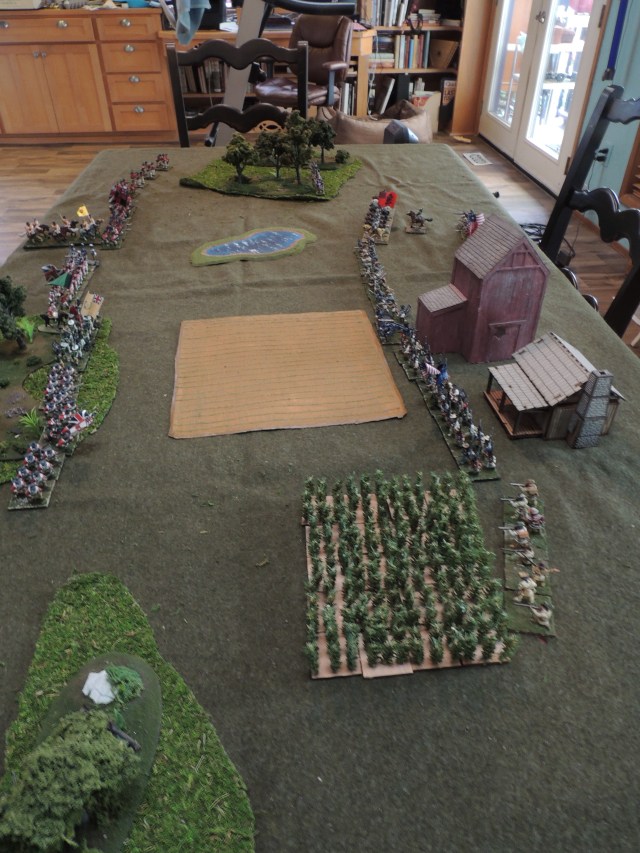
Since I’m home alone this week, I thought I’d drag them out and give them a try. I set my dining room table up for “Action at Lizzard’s Farm.” It was great.  I dragged out all kinds of stuff and littered my 76″ by 40″ table with it. I even used one of my 4Ground buildings.

The scenario was simple. Lizzard’s Farm was defended by a brigade commanded by Otho Williams including a battalion of North Carolina militia, the 5th Virginia, the 5th Maryland and a section of artillery.  They were reinforced by Lee’s Legion dragoons and foot.

The British had two brigades including loyalist battalions Volunteers of Ireland and the New York Volunteers, a battalion of the 71st regiment (highland), the 21st regiment, and converged battalion of light infantry.  They kept Coffin’s South Carolina Dragoons in reserve and also had a section of artillery.

I’ll review the game with some photos, but right now I’d just like to focus on the rules.  Let me just say I like ’em.  They are easy without being ridiculous, they are logical and they work pretty well.  As with any one page set of rules, however, there are a few items that aren’t clear to me, and because I wasn’t playing with the author I didn’t have one of those a-ha moments.  So there are a couple of things I’d clarify

  • Units have to charge to initiate melee
    • Units who charge would receive an advantage in melee
    • Units who charge can’t shoot
    • Units who “lose” a melee after two rounds become shaken.

It’s possible that’s what Jim meant, but it isn’t clear to me. There is the right amount of death, but not so much as to be silly.

Big Set up

The set up extends across both sides down the table.  I wasn’t trying to be subtle.  In the British center right, they are trying to carry the American position by main force while the British light infantry and the 21st Regt. try to sweep up a thinly held American left flank. The Americans stuck riflemen in the cornfield, hoping to slow the Highlanders’ advance, while screening their right, holding a Continental regiment in reserve.

The British advanced briskly.  The Highlanders quickly emerged from the woods with the Irish and New Yorkers moving quickly with them. The American line units were out range, but the Brits came under fire from the artillery and the riflemen, andsuffered no casualties.

The following turn, however the 71st had to decide whether to engage the riflemen who shot so poorly or advance directly on the 5th Virginia.  A die roll of 5 meant huzzah! Damn the riflemen and charge the Virginians.  The two loyalist units followed suit.  An exchange of musketry found the Brits receiving decided the worst of the firefight.  With the aid of artillery fire, a bit of luck from the militia, and flank fire from the bypassed riflemen, the English line was staggered, but continued their advance.

On the British left, the 21st Regt. marched smartly around the pond as the light infantry prepared to engage Lee’s Legion light corps.  Outnumbered two to one and likely to be outflanked, the infantry began looking for friends.

The Charge

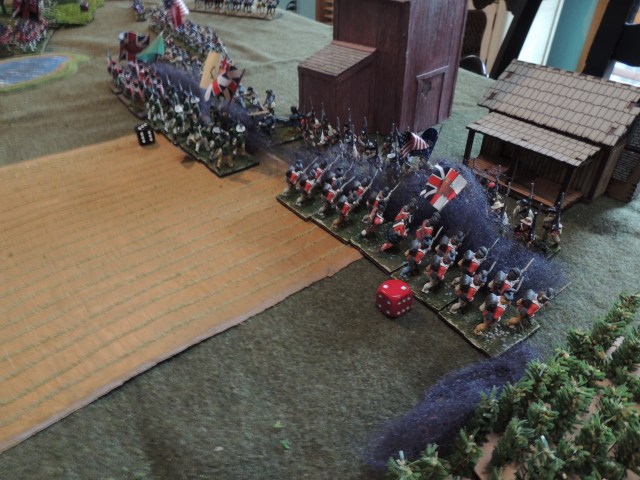
Hightlanders, New York Loyalists and The Volunteers of Ireland advance against Williams’ thin line. The Highlanders also take flank fire from the cornfield.

Turn four was the climactic turn.  The British decided on attack, and that’s where I was unclear about the rules.  The Americans gave them another dose of fire, causing the Highlanders and VOI to become shaken  Though the New Yorkers drove off the artillery crew, they were alone as their flank supports melted away.

Repulse

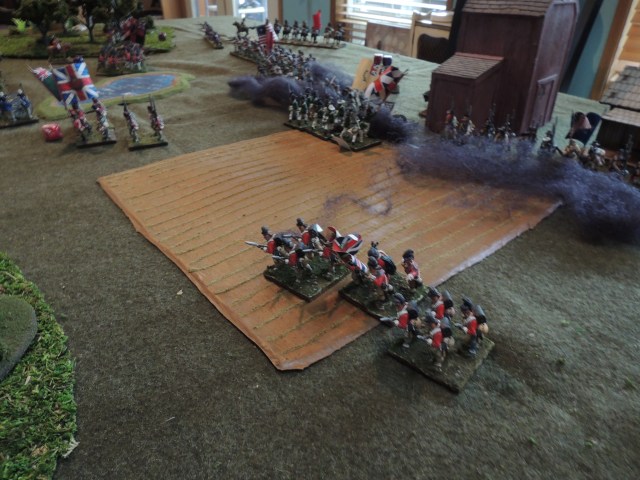
Repulsed!! The Highlanders and Volunteers of Ireland were simply shattered by fire and unable to effectively charge the defenders. The New York Loyalists had more success, capturing the American artillery.

On the British left, the Lee’s Legion infantry corps withdrew from British reach, and the dragoons fell back to support them.  Williams committed the 5th Maryland to face the 21st Regiment.

At that point it was clear the main British assault failed and I called it good.  It was much fun and I’m glad I gave it a try. It was super to pull the figures out of the box again. Would I play a solo game again–maybe if the cards aligned correctly.

Spring break at last!!

So spring break has finally arrived.  I’m looking forward to some painting and some gaming. And some sleep.  And catching up at work. And just not having to account for somebody else for my time. Anyway, after today it’s seven more fabulous days of not being at school . . . sort of.  Here’s what’s on the docket:

DSCN1529

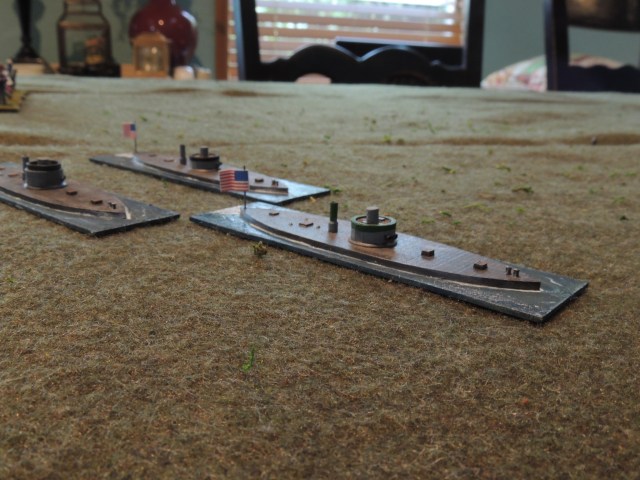
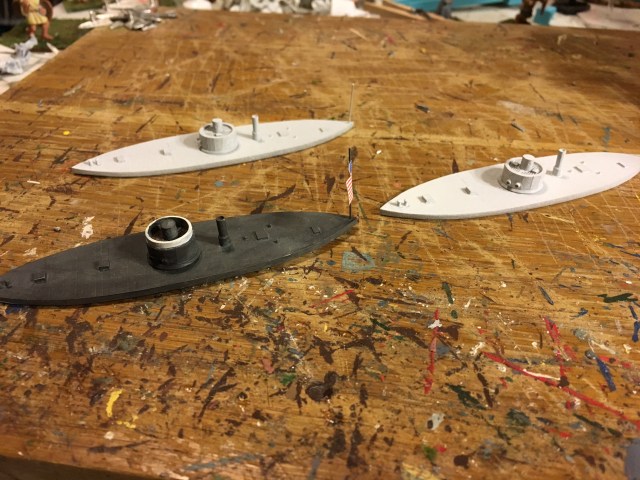
Three Passaic class monitors by Thoroughbred Figures.  The leading ship is the Nahant with its green striping.  The ship to the left, Lehigh, is an older version of this miniature.

Painting stuff

Actually I’ve finished a couple of things the last couple of days. First on the list are three Passaic class monitors.  These are the smaller of the Ericsson built vessels that followed the original monitors.  Generally, they were pretty robust. Armed with an 11-inch and a 15-inch Dahlgren smoothbore, they compelled the surrender of the ironclad ram Atlanta, were absolutely pummeled in a seaborne assault on the Charleston defenses. Most of them had very long lives.  The Nahant was still in service in 1904.

I had three Passaic class vessels to paint, including my original model from twenty or so years ago.  The earlier model is different, featuring a more sheltered turret top, but generally pretty much the same. I had to remount it because the original balsa base was starting to get pretty warped, so I re-primed it and went with the same color scheme as the later two.

I decided to approach it the same as the pics in Kevin Dougherty’s Ships of the Civil War 1861-1865.  This shows the monitors in an iron color, rather than a dark gray or black. I gave them a couple of coats of Formula P3 pig iron.  After that I gave them a couple of good washes of Vallejo black wash. I painted the funnels and turret faces Rain Grey by Delta Ceramcoat.  I also referred to a description of the monitors in Donald Canney’s essential Old Steam Navy, vol 2 and painted a stripe on the turret top for each of the ships.  Lehigh had a black stripe, Nahant had a green stripe and funnel top, Catskill had a lead color (which I interpret to be charcoal gray.) When it was all done, I gave a quick dry brush of Cold Steel by Formula P3.  Mounted them all on thick plasticard bases.

DSCN1532

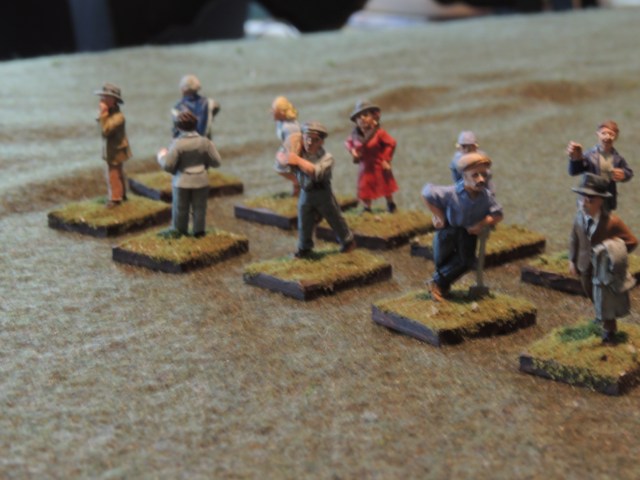
Completed civilians by Musketeer Miniatures

I also finished the ten civilians by Musketeer Miniatures for the Irish Civil War.  Honestly, they were pretty easy to paint and went pretty quickly.  I enjoyed painting them.

A Solo Game

Monday, I’m going to play a solo game.  Never done that before, but I am tomorrow.  I haven’t had out my Revolutionary War figures in about five years, and I want to try out a one page set of rules I got from Jim Purky (De Alte Fritz) a few years ago when I ordered some Fife and Drum Miniatures from him. Honestly, they look pretty straightforward, so I’d like to give them a try.  It will be a simple meeting engagement with five or six units per side. I just want to get a feel for the mechanics and whether or not I could easily run them with a group. I’ll keep everyone advised on this.

On the painting table

Spring break should always be a good painting week.  And I do have my plans made. I’ve begun working on some Eureka Spanish conquistador figures for Lion Rampant.  I’ve charted the Spanish for the conquest of the Aztecs.  David Sullivan is working on this also, so we just need to swap some notes.  I have a dozen arquebusiers I’m working on, which is enough for two units of six.  They are nice figures and I’m about a third done with them.

I’m going to try something new with these figures too.  I’m going to apply the dip.  I’ve got my Tudor Brown acrylic stain, and I’m anxious to see how the figures work.  I saw David’s ECW figures after using the dip, and they look quite nice.  The colors pop and some natural shading happens.

It shouldn’t take too long to paint these figures, and then it will be on to  my last two hydroplanes for Enfilade.  They are the same hull.  The Pay n’ Pak from 1973, and the Atlas Van Lines for 1976.  A lot of white on both, but also a lot of lining (boo) and some lettering (double boo.)

If I finish these with time to spare, I’ll either work on the Bay model of USS Mississippi or some Musketeer Auxiliaries.  I have fifteen of these paint. .

Music to Paint By

I’ve snagged a few records recently.  I reviewed Buck Dharma’s solo record, Flat Out over on Tails From the South Sound.  When I snagged that record, I also picked up Green Thoughts by the Smithereens.  I reviewed an earlier record by the powerhouse 80’s band, Especially For You.  This is one of those bands that I didn’t know anything about before I launched on my vinyl addiction tour last year.  Green Thoughts is a very good record.  The Smithereens are sort of formulaic.  They are a very good power pop band.  The songs are almost always about messy relationships and bad break-ups, which sounds like a recipe for boredom, but they are really good at it.  Strong guitars, driving bass lines, good vocals.  There isn’t a super song on this record like “Blood and Roses” on Especially for You, or “A Girl Like You” on 11, but “Only a Memory” and “Drown in My Own Tears” are very good.  I’ve purchased a copy of 11 on Ebay to wrap up my Smithereens mini-assortment because “A Girl Like You” is so damned awesome.

Dragon Rampant down payment

IMG_0519

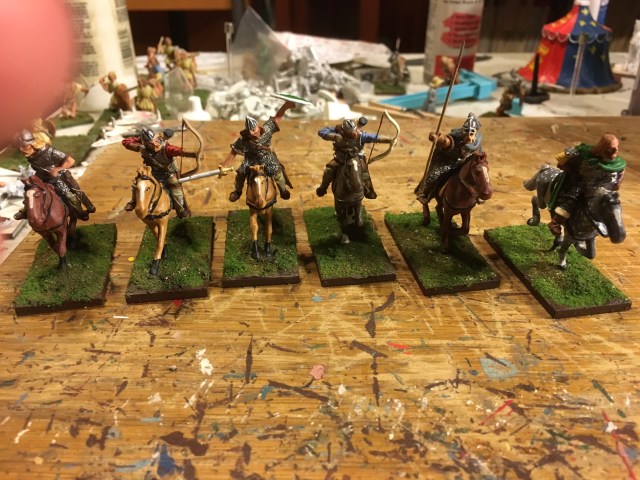
Mithril Rohirrim, painted and finally seeing the light of day after about two decades of darkness. Nice to get them done.

March is always a slow month for me.  Actually the middle of February to the middle of April is difficult because so much is going on at school  The newspaper usually has a deadline week.  There is loads of preparation for the national convention in April.  With the addition of the yearbook there are more deadlines.  Students need letters of recommendation.  It’s just busy.

And at home it’s not much better.  Sunday is the first day of spring.  I haven’t mowed my back yard yet and there is tons of stuff to do.  Gah!

So, I know I’m behind in my posts and I haven’t painted as much as I’d like to.

However, I have finished my first Rohan unit.  As promised, I finished my old unit of riders, and they are by Mithril figures.  I pried these out of their boxes about 20 years ago, and chopped away their leg supports and they are now quite fragile.  I really enjoyed painting the horses, but the miniatures, though they too are pretty nice are a bit fiddly and I painted the riders after mounting them on their horses.  Some of the detail was super hard to get at, so I may need to reassess this.

Even so, that’s the first of about eight or nine units I’ll paint of the Rohirrim. I have them all, mostly plastic, I just need to buckle down and paint ’em up.

On the painting table

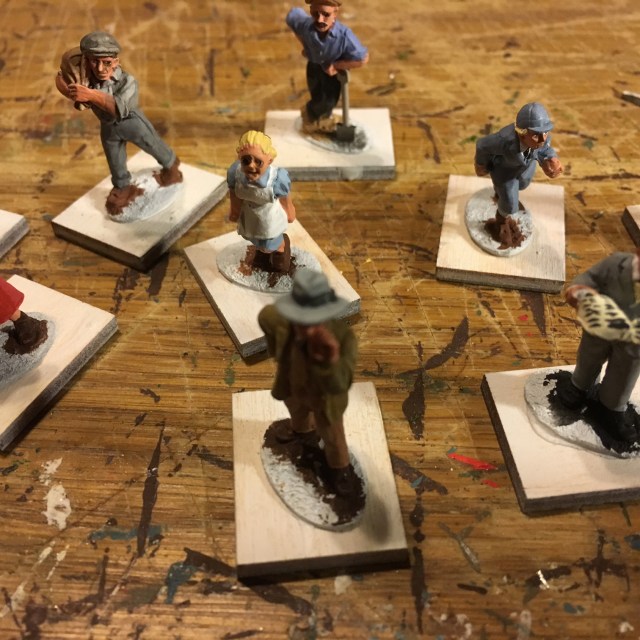
I have a couple of things I’m working on.  The first is ten civilians for the Irish Civil War by Musketeer/Footsore Miniatures.  I bought two sets and they are pretty nice.  They really come from their Very British Civil War range, and as such look a bit more from the 30’s than 20’s, but I don’t think anyone will notice.  They are nearly done, which will leave about 30 figures more to paint for the project. I will have some vehicles to paint–a beautiful Lancia armored truck no longer available from Musketeer, and a pair of Crosley transports by Company B.  We’ll see how good I am at this vehicle business.

IMG_0522

A nice variety of civilians by Musketeer/Footsore miniatures. They were designed for the Very British Civil War range, so they look a little more 30’s than 20’s.

I also have a pair of Thoroughbred Passaic class monitors primed and ready to go.  I’ll be offering them as potential Union naval forces for the Pensacola game.  I have a third that is painted that needs to be remounted from its original balsa base, and I’ll probably do that over Spring Break, which starts next week. I’ve already decided to paint the two new ships as the Lehigh and the Nahant with its black and green coloring respectively.

IMG_0521

Three Passaic class monitors by Thoroughbred Figures.  I’m going to repaint my older ship so they’ll all fit together.

Less is More. 

March has not been a smart month for NOT buying miniatures.  I haven’t gone absolutely nuts, but I’m really interested in building Conquistadors and Aztecs for Lion Rampant.  David Sullivan and I have both dabbled in rules and have similar ideas.  David has also been buying figures. In any case, I sent off an order for a dozen figures from Eureka and when I was at Panzer Depot, I bought another dozen.  I’ll be painting some Spanish arquebusiers.  In any case, let’s just say my net positive has taken a hit.  I started with 25 figures + the 6 Rohirrim= 30-24 =6.  That’s not so good, though I’m nearly done with the ten ICW civilians, and should be done with the monitors before the break is over.

Music to Paint By

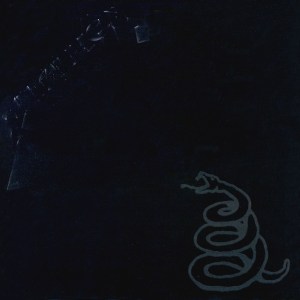
Metallica

I’m not a heavy metal music fan.  It just doesn’t appeal to me as a genre or subgenre. But I love “Enter Sandman” and “The Unforgiven” by Metallica.  There’s just not getting around the lure of great songs. Though I could see adding the band’s 1991 eponymously titled record to my collection, the problem was it falls into the vinyl “sweet spot” as the industry was ending production of records and stepping up the production of compact discs.  With only one LP pressing, the starting value of Metallica is about $175.00.  So when I was trolling the new records at my local shop and there was a bright, shiny new copy, I snapped it up.  I was not disappointed.  If you like these songs on the radio or MP3, you’ll really like them on vinyl.  I paid about $27.00 to support my local record store.  You’ll pay about $25 on Amazon. Worth every penny.