I have 672 painted and based 12mm WWI figures. I painted ’em all and stuck ’em on bases. About half are British figures from Great Escape Games. The others are Serbian figures from Kallistra. Yeah, yeah, I know “who’s the dope with Serbian figures?” Save it.
There were six of us who bought 12mm figures to play GEG’s 1914 game. The rules came out in 2018, and I think we started collecting miniatures when we were still facing lockdowns. The figures by Great Escape were really lovely for such tiny fellows. Before I knew it, I had a bunch of British.I decided, well what the hell, and added the Serbs from Kallistra miniatures. Piles of little men raring to go.
Everyone diligently painted and based their figures according to the rules. We played the rules several times. We hated it. We just couldn’t make sense of them. One of our group concluded, “these are the worst rules I’ve ever played.”
My friend, Mark Waddington is a WWI guy. His dream is to play Belleau Wood in 28mm and he’s almost ready to go. He inherited Daveshoe’s 12mm Belgians, David Sullivan’s Germans. He had a stash of his own, and I think Eric Donalson’s figures floated south to his McCleary garage. He’s worked on some WWI rules with others. While I have have moved on to other things, Mark has actively searched and collaborated on a set of rules we might be able to use with our many figures.
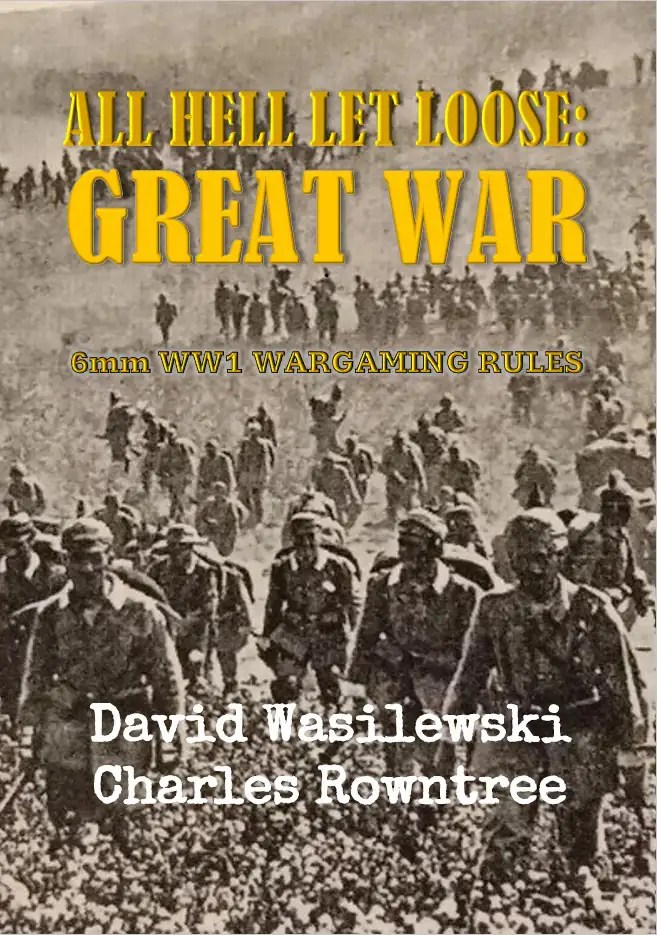
He found some. All Hell Let Loose: Great War is a set of WWI rules based on an earlier set of WWII rules, also titled All Hell Let Loose, by David Wasilewski and Charles Rowntree. Mark was an early adopter and we sat down to our first game on Wednesday.
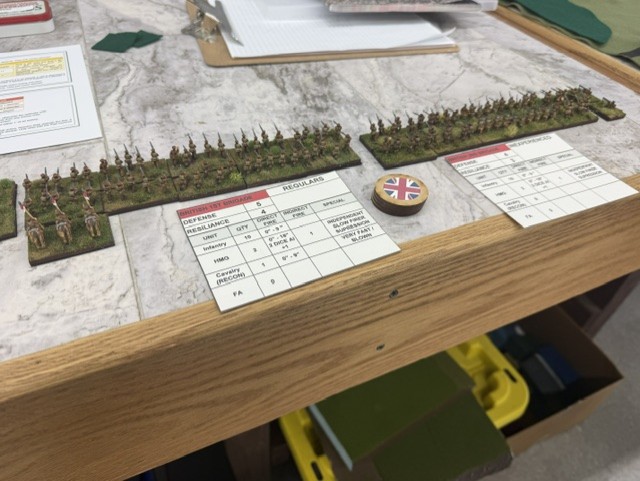
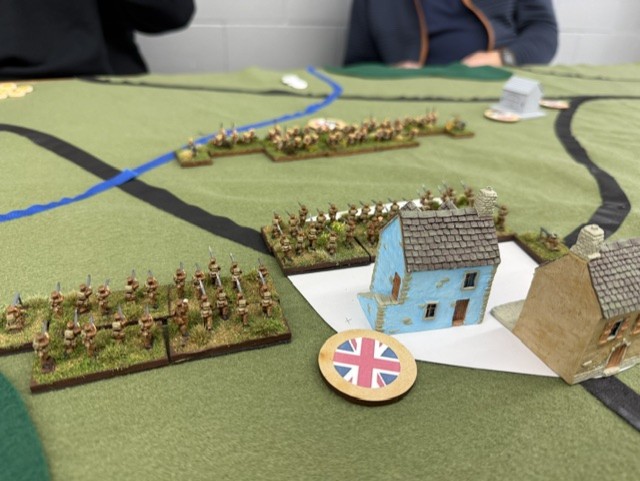
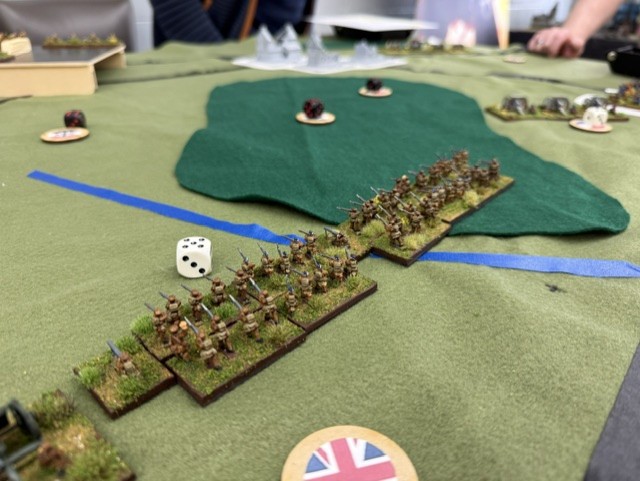
The first two pics show one of my two infantry regiments getting ready for the game ans seizing the town. The right pic is of my second (of two) regiments forming in the woods on my flank. Germans and French will fight for control of the woods. Germans to my front will fumble their activation rolls and suffer the effects of “the mad minute” rapid rifle fire.
Units, or they prefer formations, are basically regiments, with stands equaling companies. There is a strategic movement phase of the game with formations represented by markers until they get within 12″ of each other and then things get down to business. Our game mostly included infantry, maneuvering in 1914, but there are detailed rules for trenches and bombardments. We included field guns and some cavalry stands for scouting.
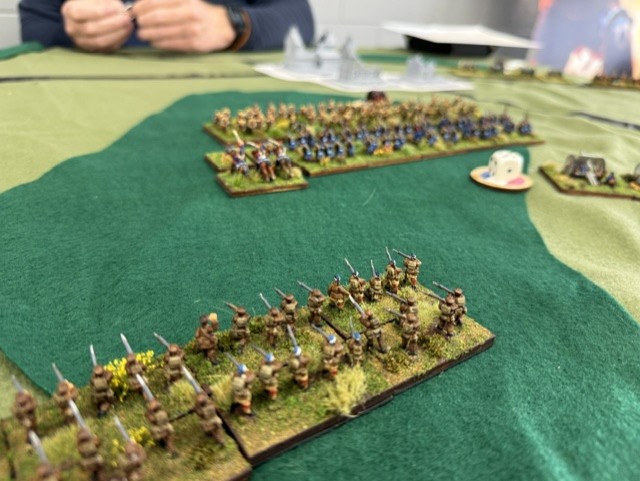
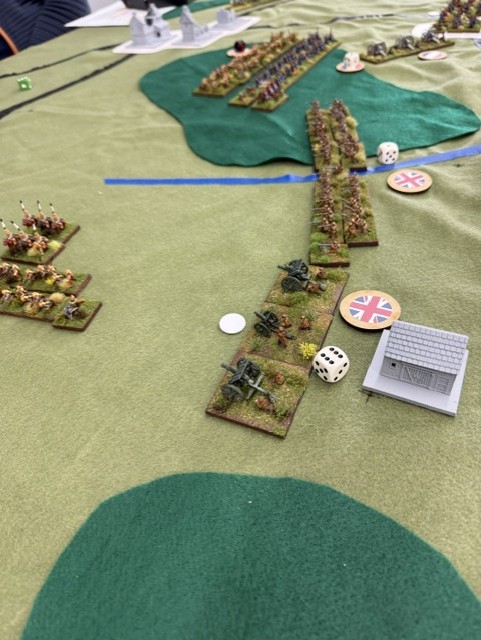
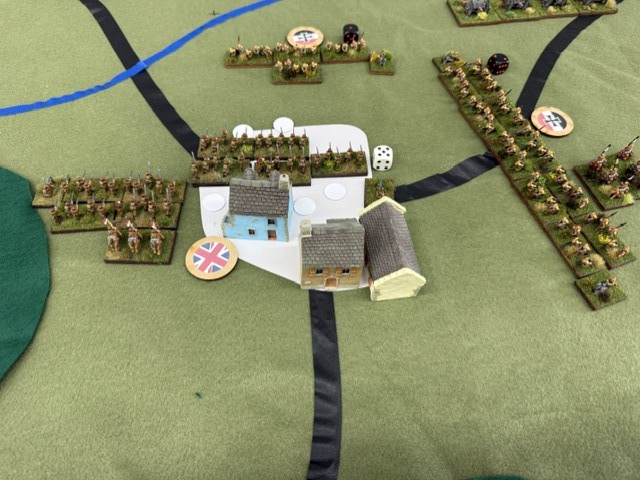
My right flank unit watches as the French hurl themselves at the Germans in the wood, and are forced back. The Germans rush past the front of my artillery and infantry and prepare to take it in the shorts. My poor regiment about to be assaulted in the town by two German formations.
In our scenario, the objective was to capture and hold three towns on the board. One was close to the German side, one was close to the Allied side and one was in the middle. I was the British player and I glommed on to the town in the middle. Most of the action involved the Germans commanded by Tim, trying to throw me out of the town. Formations roll for activation each turn and Tim mostly rolled poorly, and consequently he took a lot of fire.
The formations with their component stands really has a herding function over those components that each can do a variety of different things. That takes some getting used to. Firing is pretty potent and leads to lots of death. A lot of stands become disordered and dead. But the key in a game like ours is to prepare to and execute an assault to take a position. It’s pretty challenging and we did some stuff incorrectly for our first play test.
But I learned a lot and it was fun. I’m anxious to try it again.

