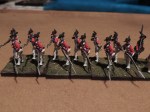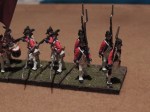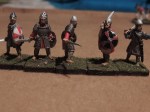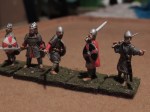
Dean Motoyama is my hero

So I’ve blathered on a lot about my engagement with Lion Rampant.  I’m not the only one in my area who is partaking.  Others are doing their best to assemble units and retinues for the game.

I played a the big Agen scenario with a great group of guys ten or so days ago.  One of those is Dean Motoyama. Dean has his own blog, that you simply must check out. WAB Corner is where Dean share’s his latest creations.  The amazing thing about Dean is that he’s relatively new to the hobby. (like within the last decade.) Yet he’s taken on some great projects, from Warhammer Ancient Battles, to Sharpe Practice, and now on to Lion Rampant.  His projects are big and beautiful; he paints them quickly, and his miniatures are stunning.

I’ve painted over 500 figures for the Hundred Years war.  I don’t use shield transfers, and my figures can’t hold a candle to Dean’s work.  I am regularly in awe of whatever he’s produced today. Hugh Despenser. James Audley.  Just some great stuff. Check it out, it’s the real deal.

Dipping your toe in the Lion Rampant pond.

If you’re thinking about trying out these rules, whether you have stuff or not, I hope, with this post, to offer some guidance to you.

First, a bit about my decision to go with this game rather than another. I am the owner of some 500 singly mounted Hundred Years War figures.  I have more than a hundred painted longbowmen.  I have more than a hundred painted dismounted men-at-arms.  I can field seven units of foot sergeants and multiples of most other units from this conflict.  I am also a devoted student of the period.  My interest in these rules was only natural.  All I needed was to try them out to see if they met some simple requirements

  1. Were they easy to play?  Could I easily run them at a convention with folks who didn’t know them at all?  The answer was a simple yes. I’ve played with at least a dozen of my gaming friends. Of those only one has had a less than enthusiastic response.
  2. Were they suitable for making well thought out scenarios?  I didn’t want a game that was really designed for head to head games.  Again, I’ve tried several multi-player games and have reported on the Agen scenario.  I’ll likely run that one at Enfilade, together with a second scenario based on the 1340 raid on the Boulogne docks.

I find Lion Rampant to be a great set of rules.  Of course, I feel fully prepared to play them with figures, high interest and research material galore.  What if I wasn’t?  How could I get started?

First, some basic parameters.  If you’re interested in refighting Agincourt, or Bannockburn, or Mortgarten, these are not the rules you want.  These are small unit actions.  No archers behind stakes, no Flemings defending ditches, no massive schiltrons of Scots spearmen driving foolish English knights into swamps. Those troop types might be available to you, but they won’t quite function the way they would in large formations. I confess I haven’t quite found the right set of rules for fighting big battles in the late middle ages, but Lion Rampant won’t do the trick either.

I always worry about the cost of rules sets. Rules books that cost forty or fifty bucks really annoy me.  They better come with their own electronic service like Siri to answer my questions, a useful painting guide, complete army lists and an introduction by Anne Curry.    Worse than rule books that cost forty or fifty bucks are rule books that cost forty or fifty bucks and will require the forty or fifty dollar expansion or two.  I don’t care what the logic is, it’s ridiculous and inexcusable.

If you’re worried about the cost of Lion Rampant, you can buy it at your local game store for $17.95.  You can order it at Amazon for $13.62.  You can order it for your Kindle or Kindle ap for $10.49.  I bought two.

What do you get for your dough? A complete set of mechanically simple, grammatically clean set of rules. There are some quirks to the game, but nothing that is unreasonable or unfathomable.  There are a plethora of handy color plates and game photos.  There are eleven troop types and 40 sample retinues to muster them into. Finally there are twelve sample scenarios. That’s a lot for less than twenty bucks.

This is a highly adaptable rules set.  Though the sample retinues cover England all the way to Eastern Europe, the Middle East and the Thomas Mallory Arthurian legend, there is definitely room for more.  I see these rules as something to experiment with, as many did with The Sword and the Flame. A friend has been playing Korea and Japan.  I plan to build something around the Spanish conquest of  Mexico.  It should work for any region up through the early gunpowder age. Not only that, but author Daniel Mersey is highly accessible, regularly answering questions on a Lion Rampant forum on BoardGameGeek.

So what is the cost to get in on Lion Rampant? Units are either six figures or twelve figures.  I’d suggest starting out with a retinue which is usually 4-6 units.  If your army is infantry-heavy, like the Swiss you’ll need more figures, say 60 figures.  If you have expensive troops, like the English you’d have fewer, say 42.  Armies with cavalry like the French Hundred Years War army, the Normans or the Ottoman Turks makes an army more costly in real dollars. Be sure what you buy fits in with your friends, and is an army you are really interested in.

There are lots of great figure manufacturers for the Hundred Years War.  Here are a few of my favorites:

Old Glory Miniatures–They have a huge range for this period.  They are relatively inexpensive per figure, especially if you are an Old Glory Army member. They are also quite nice and draw a distinction between the early period of this war (say until 1380) and later.  The drawback is that you have to buy the figures in pretty large quantities.

Front Rank Miniatures–A very nice range of miniatures for the Hundred Years WAr and the Wars of the Roses.  The range is older, so not tons of variety between figures of the same type, but a huge range of troop and armor types.  The mounted figures are really awesome.  They also have some great accessories and wagons. The downside is their size.  They are huge.  They don’t mix well with other manufacturers in the same unit.

Crusader Miniatures–Some great figures, but not tons of different troop types.  Sized well, all the major troop types are covered. Some very nice command figures too.

Perry Miniatures–The Agincourt to Orleans range is geared strictly for about 50 years of the conflict. Absolutely stunning miniatures, but a little spendy. The Perrys have a number of plastic boxed sets that are super reasonable covering the Wars of the Roses.  They plan to release an English boxed set for Agincourt to Orleans before Christmas (hark, I hear sleigh bells.)

Before I close, I’d simply add that no I am not an Osprey employee, nor do I hang out with Dan Mersey.  I do believe this is a great set of rules. Not perfect, and with limitations that are clearly stated.  If you believe you’d enjoy a skirmish set of rules for the late middle ages, these may work for you.  They definitely work for me and my interest in the Hundred Years War.


Lion Rampant: The Agen Scenario

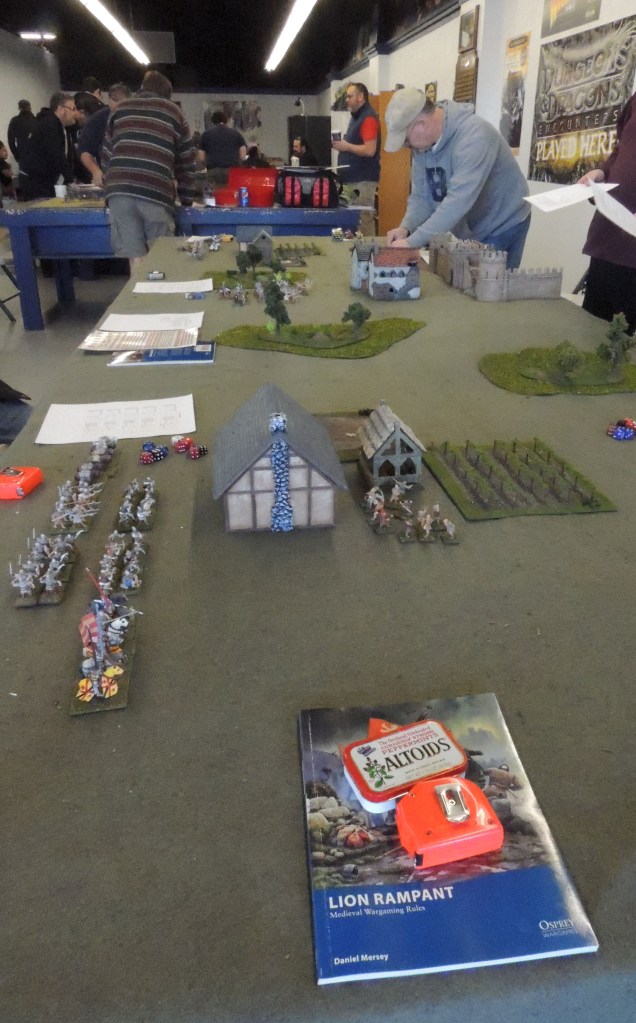
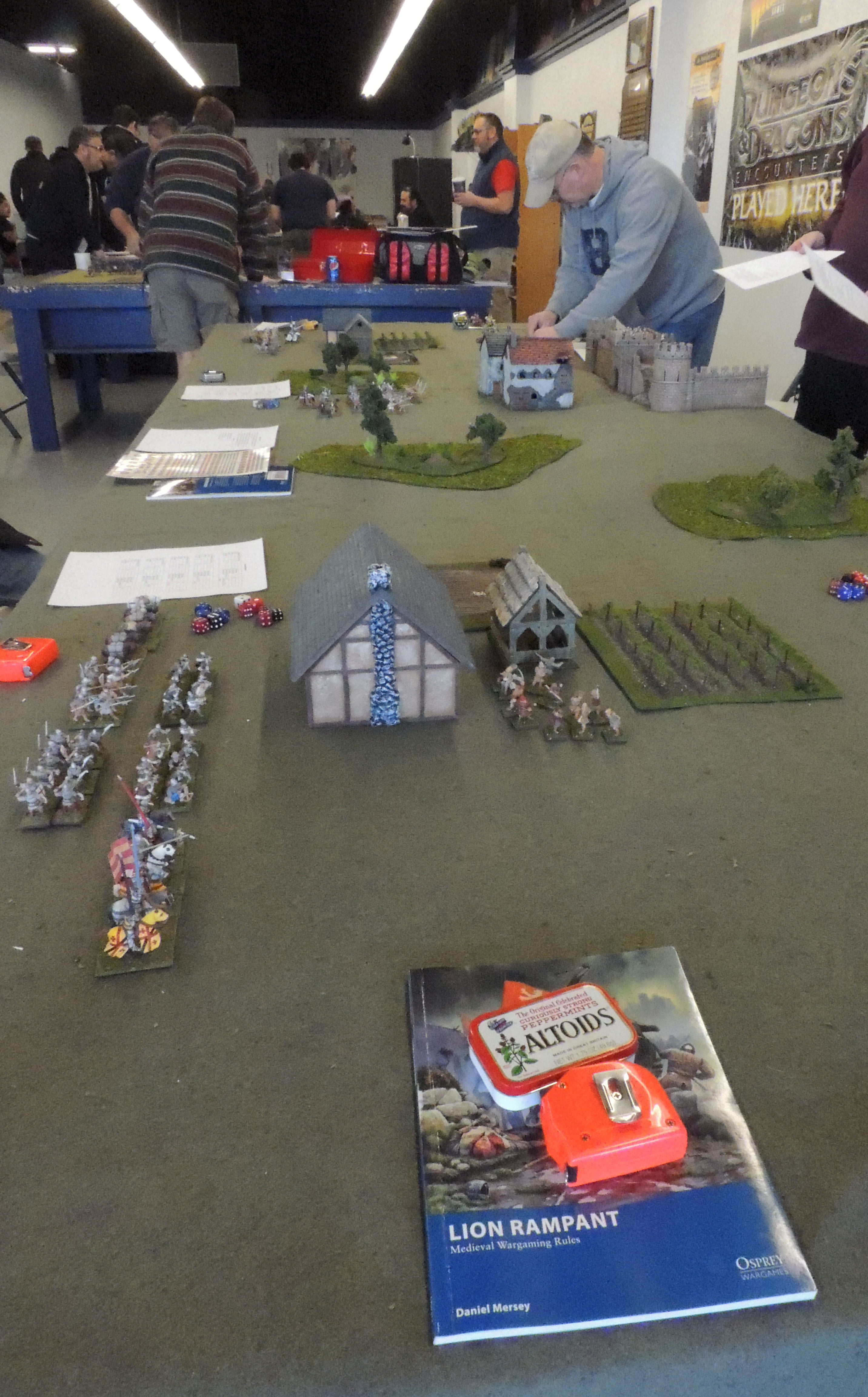
A quick shot down the 14' board at Game Matrix.  Enough going on to make it look good, without too much clutter.

A quick shot down the 14′ board at Game Matrix. Enough going on to make it look good, without too much clutter.

It’s rare that I’ve fallen utterly in love with a set of rules.  Maybe only one other time.  About twenty years ago I played the original Fire and Fury Rules for American Civil War and I continue to believe they were the most influential rules set in my life.

But, for the moment, at least, I am consumed by Daniel Mersey’s Lion Rampant, published by Osprey. In my previous post I mentioned my idea for a game involving a raid on a small town, a castle and too many troops.  Yesterday, with the help of many friends we tried it out.  It was sort of like buying an awesome car-maybe one of the new Chevy Camaros. It looks cool.  It sure drives nice between Tacoma and Seattle, but you really need to get it over the pass on a trip to the Gorge to see Tom Petty and the Heartbreakers to air it out and see what you’ve got.  Yesterday was our trip to the Gorge.

First of all the basics:

  • This was a scenario based game-cooperative in the sense the three French players and three English players had to decide on a plan.
  • The table was 5′ X 14′. That was the table mix available at Game Matrix so I went with it.
  • There were three retinues for each side.  None of the retinues were the same.  I have no idea of the total retinue points or quite how even they were.  There was one additional retinue composed of four serf units.whose primary mission was to stay alive. All in all, there were 12 French units, 14 English units and the 4 Serf units for a total of 30 units on the table.
  • The game was played “out of the box” with one exception I’ll get to shortly.  I did add some rules to the scenario.  The rules were chiefly added to allow the English to sack the settled areas on the table.  These included rules for looting and burning. There was also a rule that allowed peasants to panic and flee toward the castle, violating the 3″ ZOC around French units.
  • Each side earned victory points-the English chiefly for destroying/looting/killing, the French for saving property and killing English.  The French also received points for killing Englishmen, of course, the peasants, scored separately, won points for stayin’ alive, stayin’ alive, ah, ah, ah ah, stayin’ aliiiiiiive. (sorry couldn’t help myself.)

The game was large and pretty elaborate.  I made sure to get to the shop as early as I could and allow about an hour’s set up.  I used two buildings for each of two. I put the castle on a hill near the three building town.
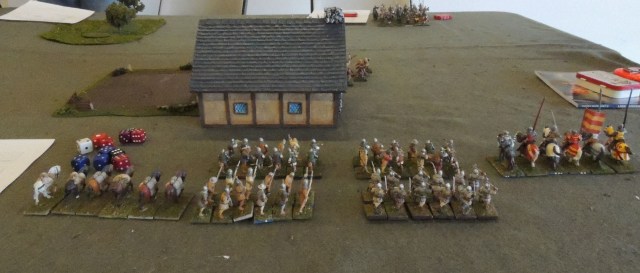
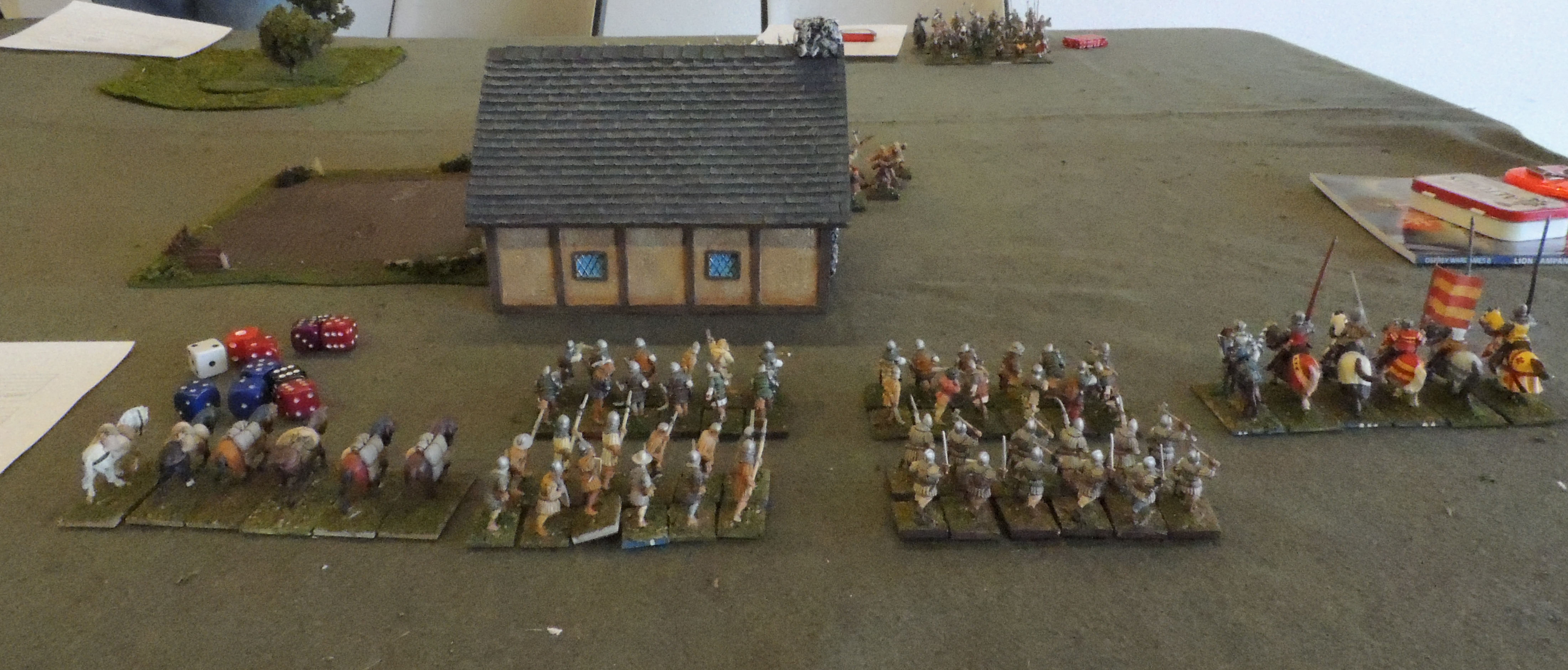
One of the English retinues.  Five units 54 figures is a pretty typical retinue size for Lion Rampant.

One of the English retinues. Five units 54 figures is a pretty typical retinue size for Lion Rampant.

The English forces, who had a pretty complex bunch of tasks to choose from, were allowed to set up 6″ from each of the three settled areas.  The French were allowed to set up 18″ on to the table. The challenge for the English was to make a plan from a variety of point scoring options, and fight off the French.

Though there was complexity in the scenario, the game devolved mostly into retinue on retinue combat, though the English were also burdened with devoting time and resources to looting and burning. On the English left, things went badly, mostly through bad die rolls. The French attacked with their cavalry, eventually destroying the English unit of mounted knights and killing the leader.  The English couldn’t activate their archers, and failed key courage tests. Though they were able to burn one of two structures, they couldn’t make key die rolls when needed.
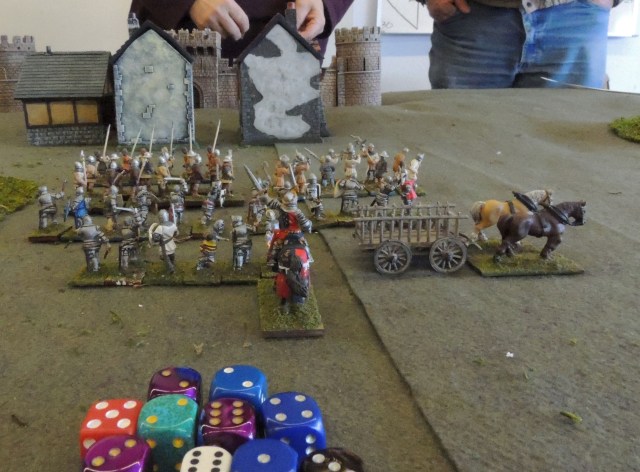
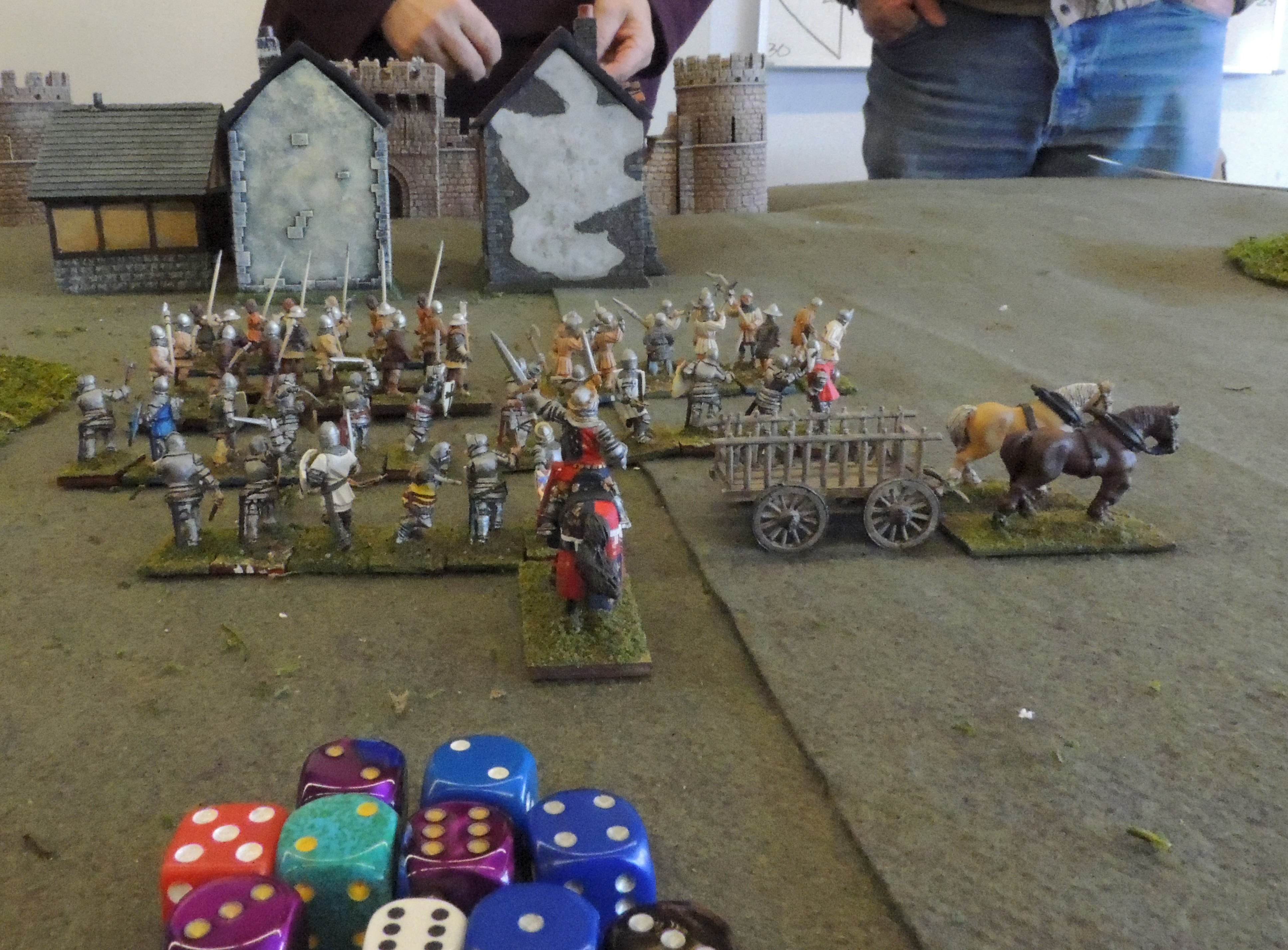
English retinue in the center comprised three units of dismounted men-at arms, two units of expert foot sergeants and a unit of bidowers. Nasty stuff, but they faced supporting fire from the castle.

English retinue in the center comprised three units of dismounted men-at arms, two units of expert foot sergeants and a unit of bidowers. Nasty stuff, but they faced supporting fire from the castle.

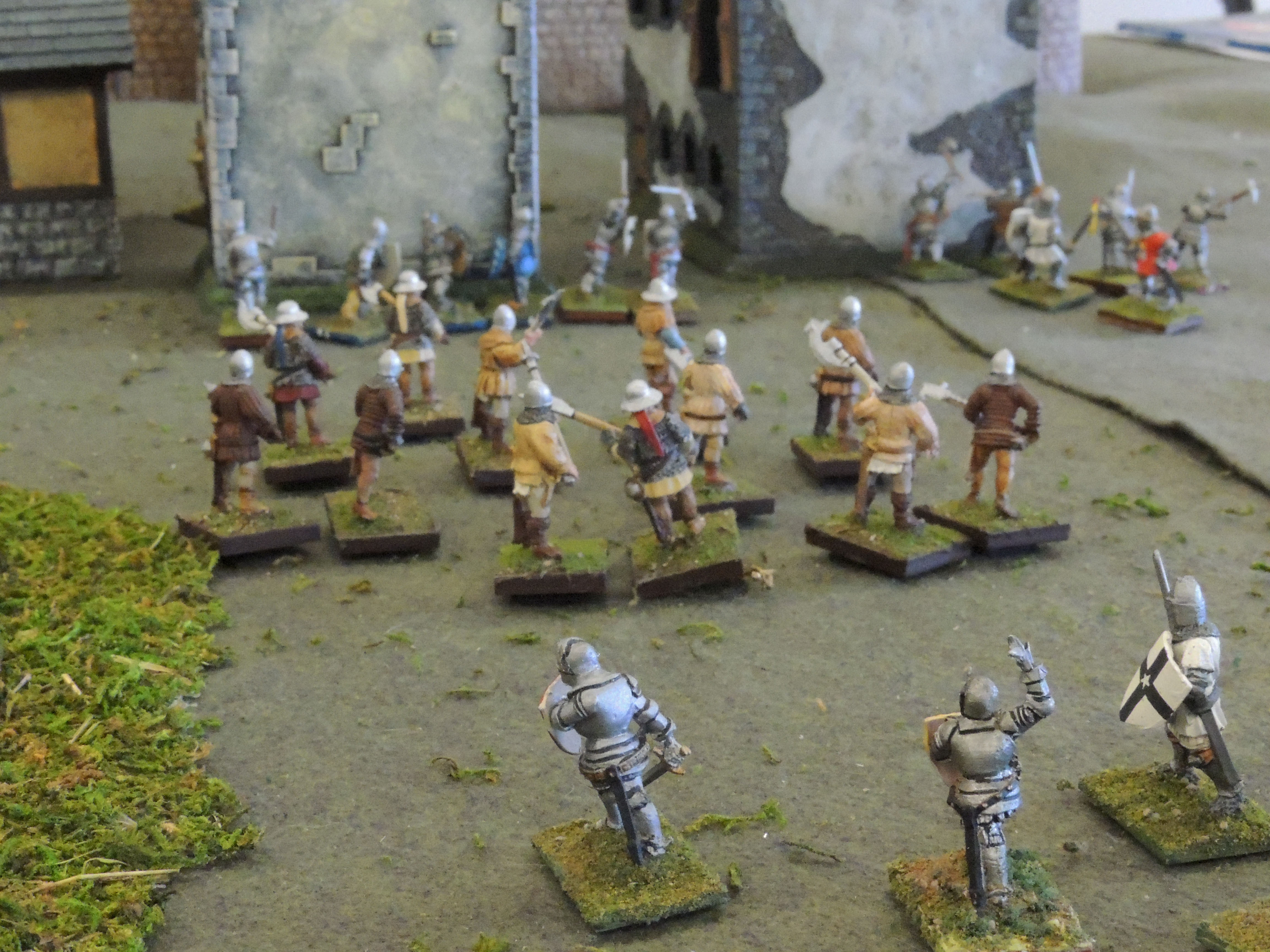
In the center, the English burned all three buildings in the town, driving the serfs into the castle.  However they suffered from crossbow fire from the castle walls losing a vulnerable unit of bidowers. They also drove off a counterattack from the mounted sergeants coming from the French left.

On the English left, they easily burned the farmstead and held off the French advance.  The French were content to stay away from the English bowmen and siphon some of their mounted troops to the center of the board to support the castle.

We played for about two and a half hours.  All but one of the players had played at least one game of Lion Rampant, but I don’t think anyone had played more than one game. We carefully walked through the first turn, and pretty much after that, players ran on their own, with occasional questions.
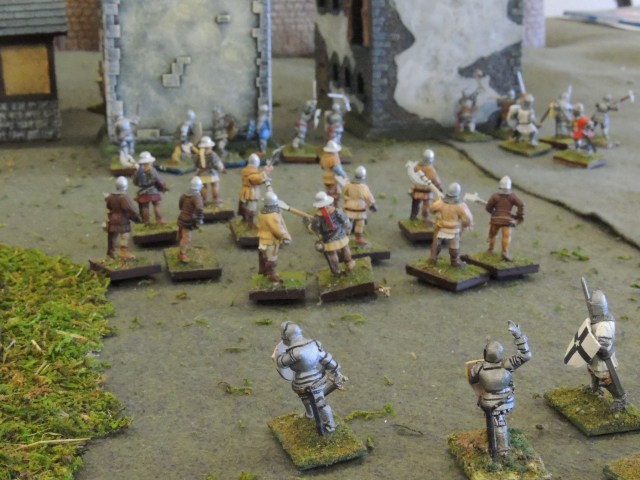
A tighter shot of the English assault on Agen town. They successfully drove the peasants out of the buildings and burned them, but didn't try to take the castle. ,

A tighter shot of the English assault on Agen town. They successfully drove the peasants out of the buildings and burned them, but didn’t try to take the castle. ,

We did struggle a bit to keep everyone on the same game turn.  Multi-player games are a bit of a mystery and aren’t covered much in the rules. I set up the game so the English retinues went first, then the serfs, then the French. There was a little more thumb twiddling than I’d like as folks from one end of the table who weren’t involved with combat waited for those who were.

All agreed the rules were fun, the scenario was enjoyable and easy to figure out. The serfs, based on the victory points I’d set up won easily, with the French edging out the English for second. I made some mistakes in the rules that were quickly brought to my attention (gotta work on that.)  This is a scenario I’d really like to run again, and possibly at Enfilade.
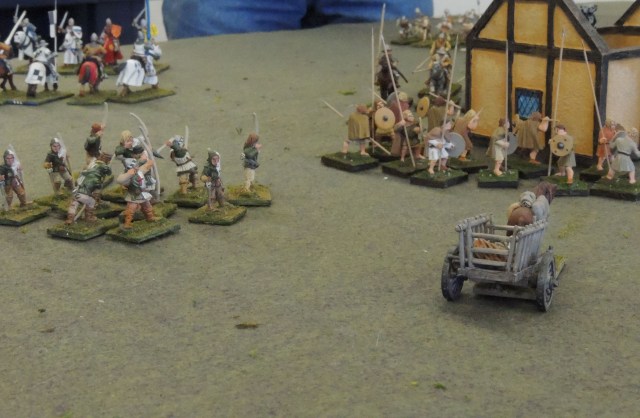
English on the left have burned one of the farm structures, while mounted French advance on them.

English on the left have burned one of the farm structures, while mounted French advance on them.

A couple of quick changes I’d make:

  • Adjustments in the victory points. Not a big deal, that’s why you play test is to make adjustments.
  • Would like a shorter table. 5′ X 14′ was too long, 5′ X 12′ would probably be optimal.  5′ X 10′ would probably be crowded.
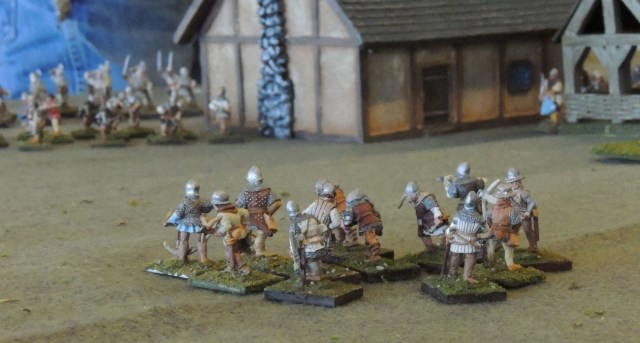
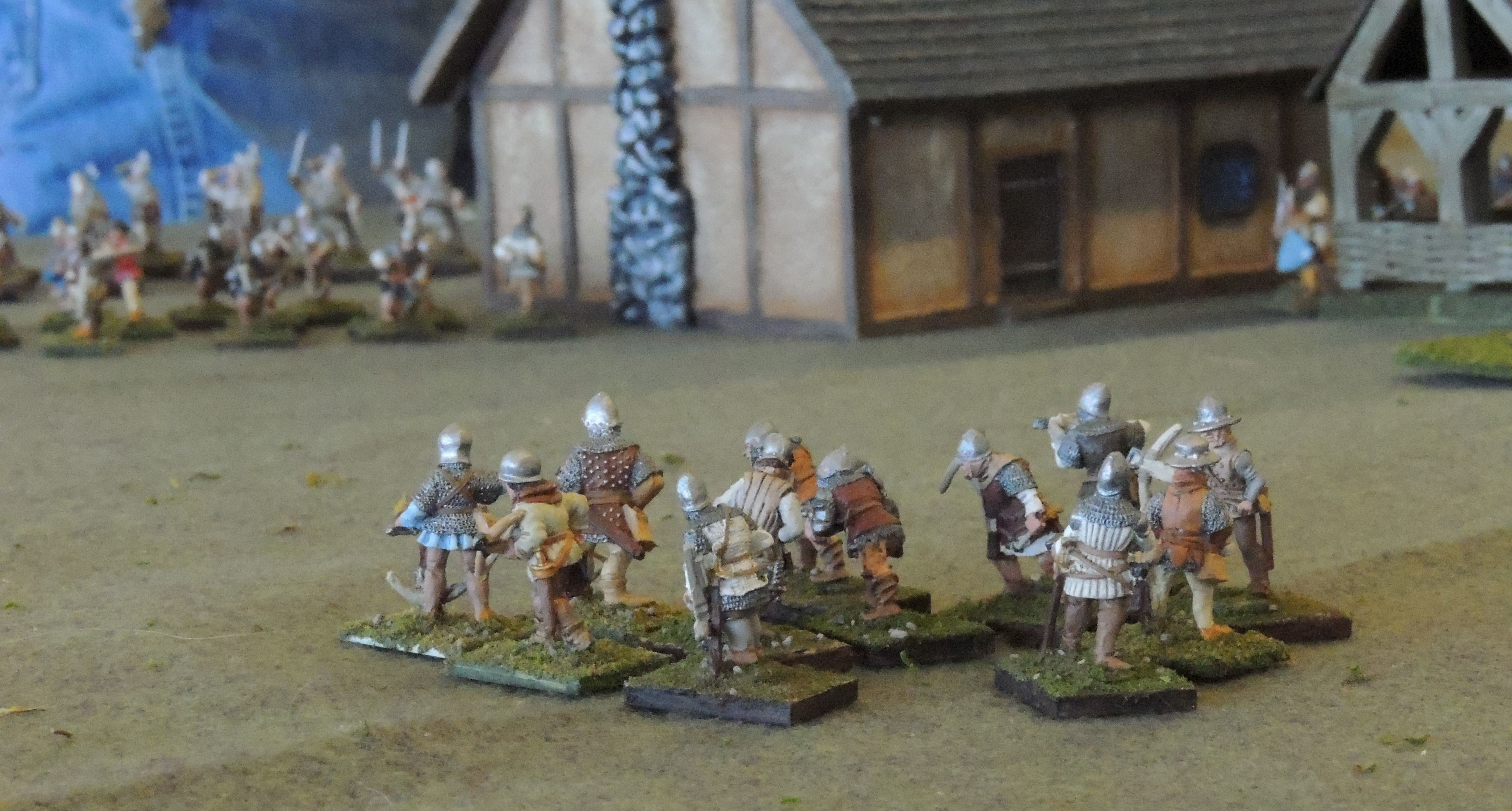
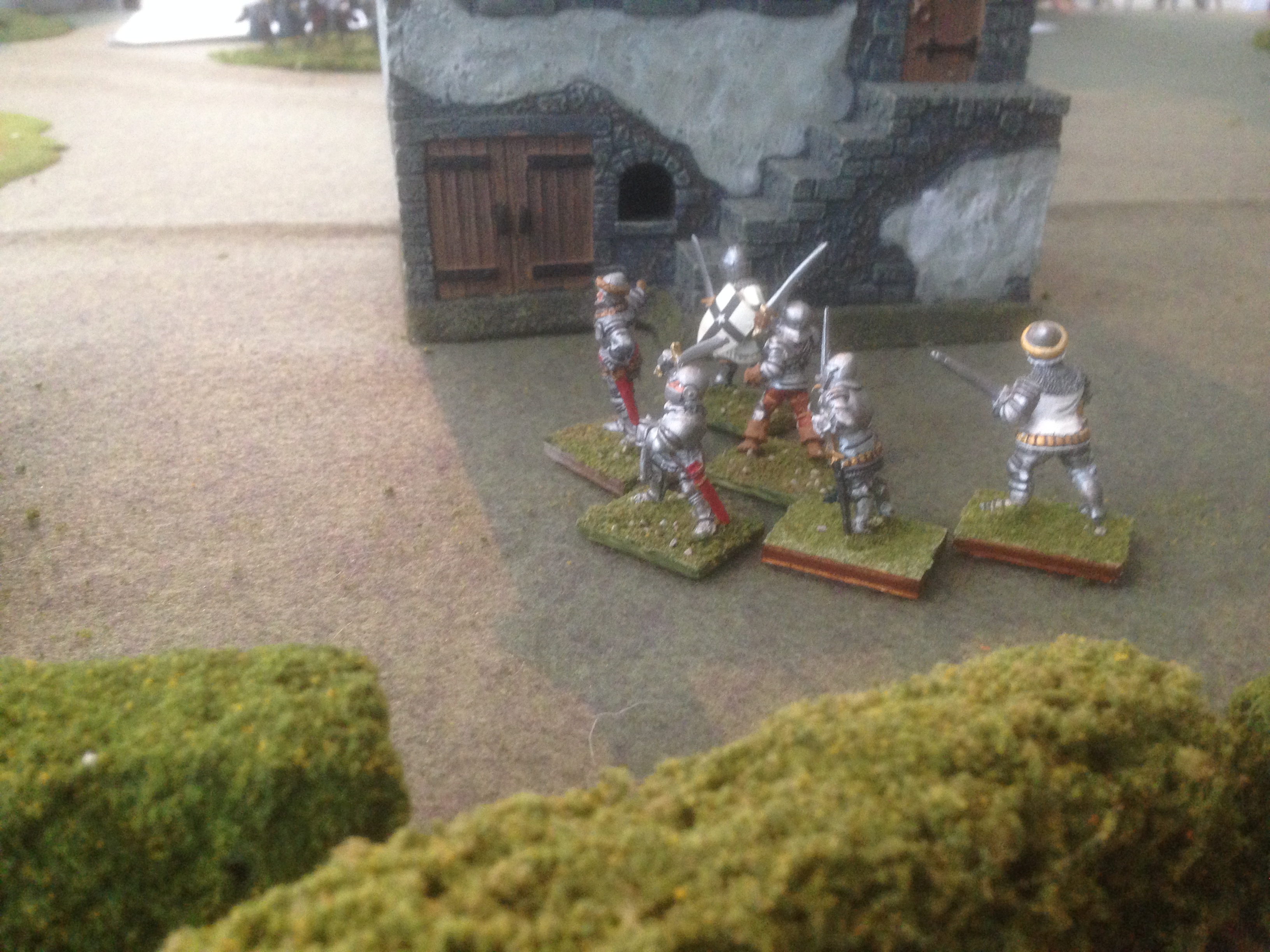
On the French left, a unit of crossbowmen huddle, unsure of what to do against the English

On the French left, a unit of crossbowmen huddle, unsure of what to do against the English

For myself, I never looked forward to running a game as much as this one.  I had my troops perfectly organized to pull out of boxes.  There was plenty of terrain-Barbs Bunker vineyards and fields, Pegasus and Miniature Building Authority buildings including a castle with a breached wall. I wrote over two thousand words worth of retinue charts and scenario notes.  I painted 24 figures worth of foot sergeants in four days. I came home exhausted, but extremely satisfied.  Thanks to all the players-Dean, Bill, Ron, Scott, James, Lawrence and Gene.  They were great to work with and were willing to take the time to debrief the game with me.  Ron pointed out the rules errors I was making-thank you.  It was just a great day.

So, we got that Camaro out of the garage and let it rip.  We drove like mad from North Bend to George, and though the WSP was out in force we didn’t get caught speeding. Petty was awesome and I  can’t wait to do it again.
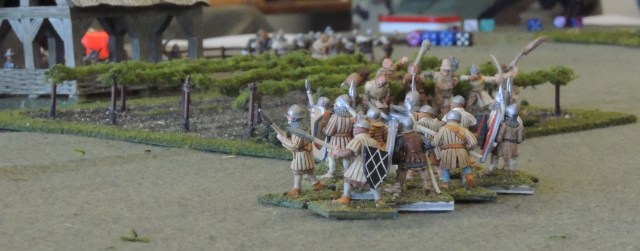
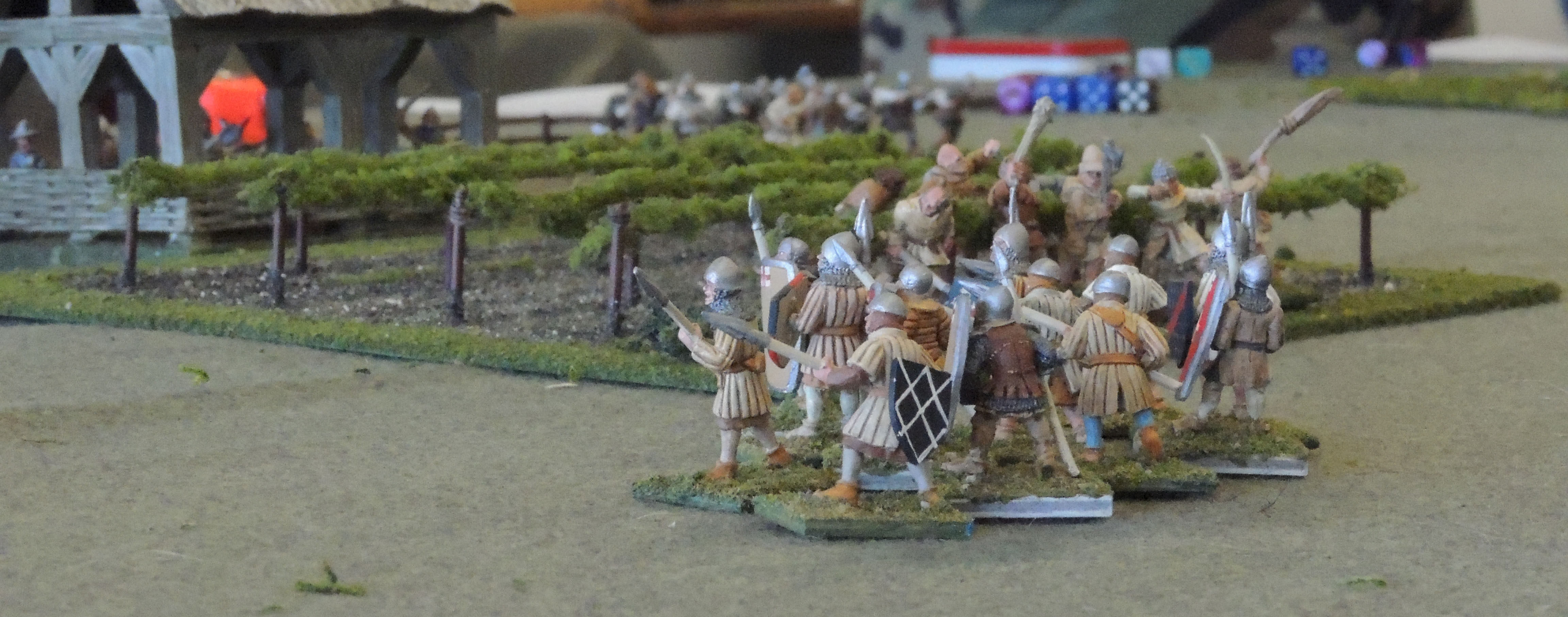
French sergeants take shelter behind the vineyards.
French sergeants take shelter behind the vineyards.
Lion Rampant Again

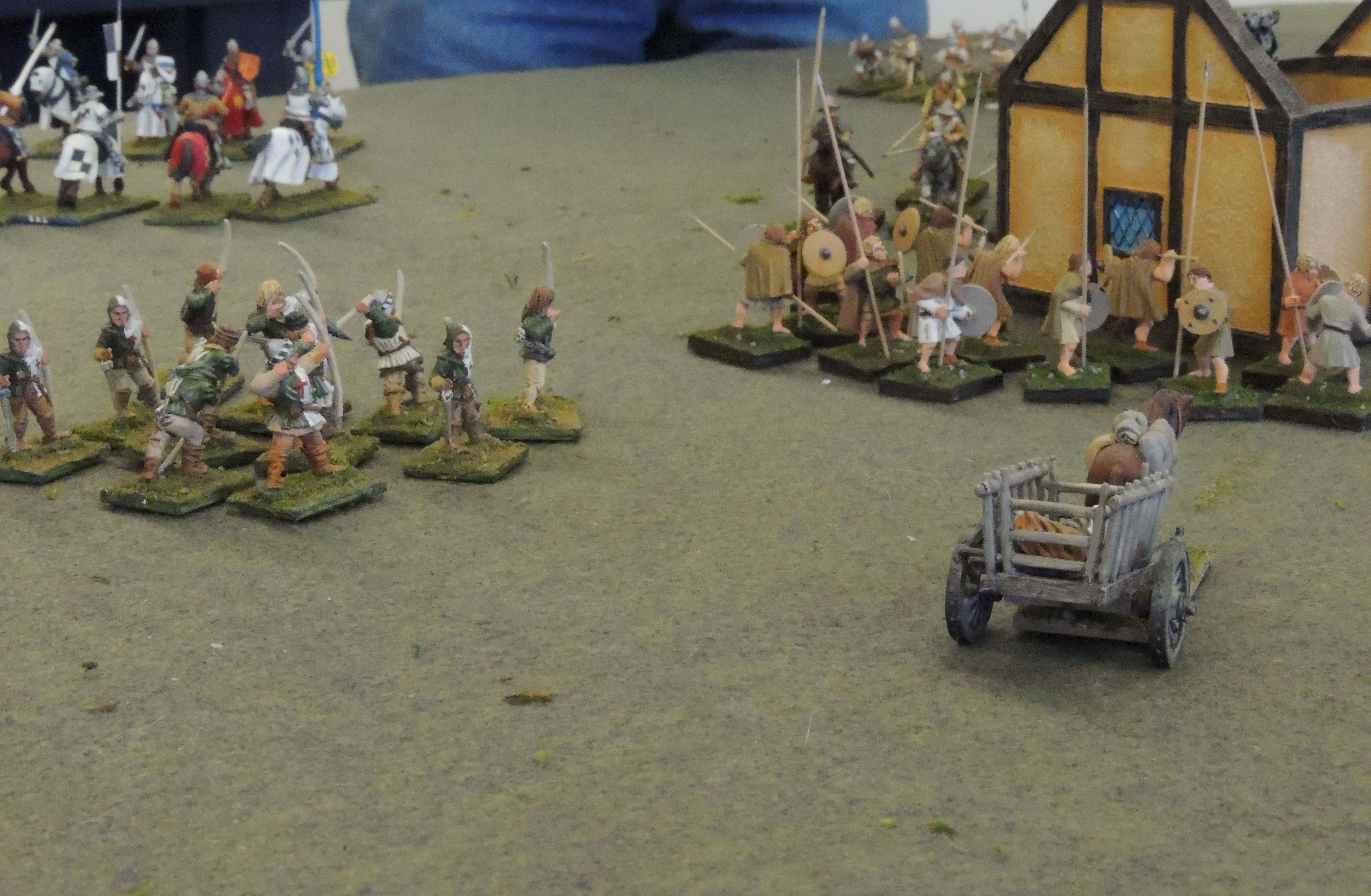
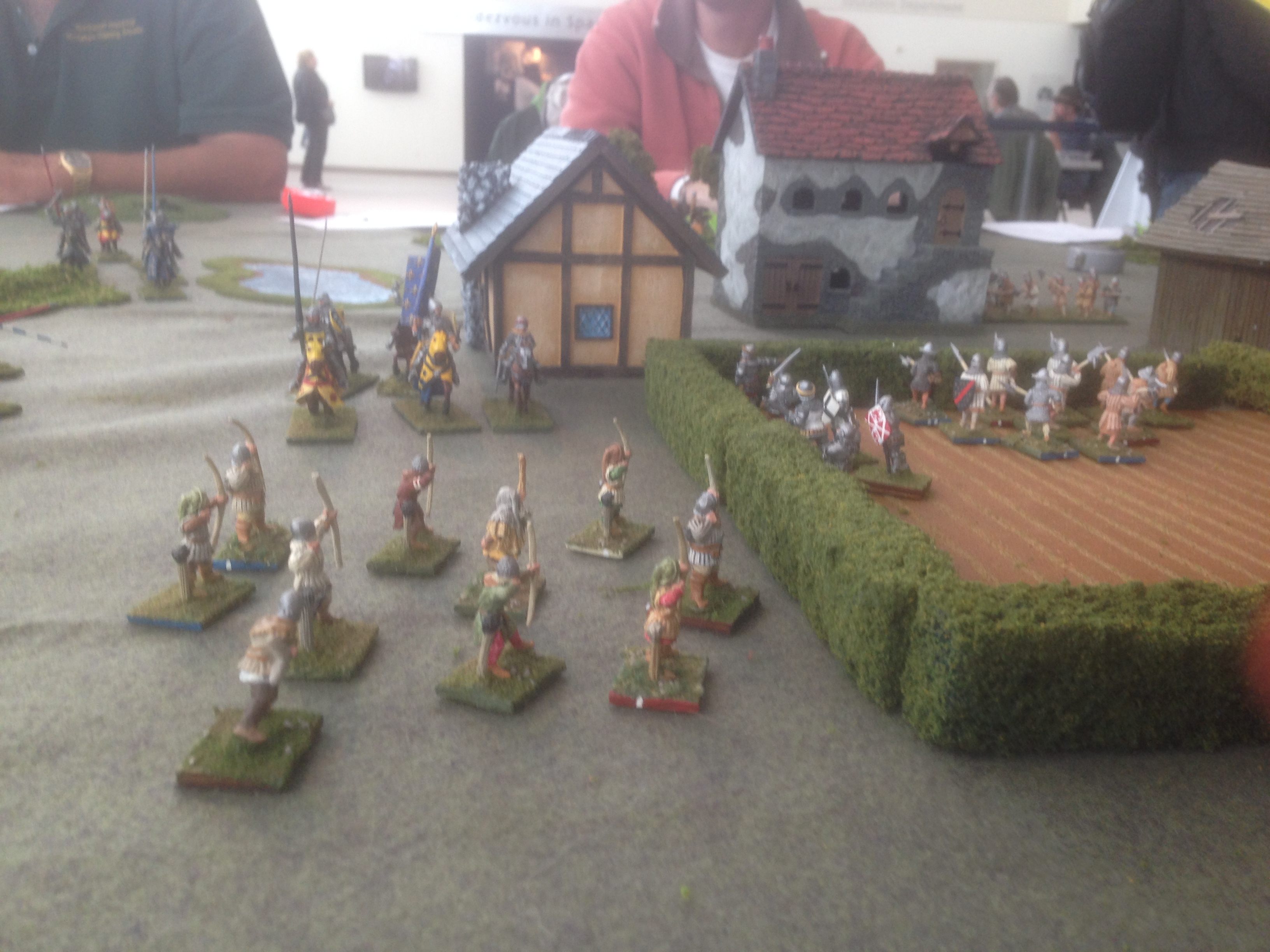
English longbowmen confront French mounted troops

English longbowmen confront French mounted troops

402In our neck of the woods (Washington state, Puget Sound region)  many gamers are very interested in Lion Rampant.  For some of us, Lion Rampant is competing with SAGA as a rules set of choice for medieval warfare.

Confession: I am not a fan of competitive, one-on-one rules sets with points-based army lists. I know many of my good friends really do enjoy that gaming environment.  I’m not one of them.  No slam on those who do, but that’s not what it’s about for me.  SAGA is that kind of game.  Lion Rampant could be, with its points-based retinues, but it doesn’t have to be, at least not from my perspective.

I’ve had the good fortune to walk through four games of LR over the past ten days.  I believe the rules can be a very capable vehicle for scenario design.  In each of the games we had multiple players in games-four players, three players, up to eight players.  The games all proceeded fairly quickly through simple scenarios finished in less than two hours, and in some cases even faster.

For those of you just picking up these rules, or trying to decide if this is the rules set for you, there are some important things you should know.

  1. These are skirmish rules.  Though author Daniel Mersey suggests they could be sort of semi-skirmish, they are intended to be 1:1 scale.  Each unit of 6 or 12 figures represents 6 or 12 guys.  They are a collection of dudes, not intending to represent a formation one would find on the battlefield at Agincourt or Tournai.
  2. Mersey uses an interesting device in the rules–a 3″ zone of control around each unit that may not be crossed by friendly or enemy units (unless you are being attacked.)  This keeps the combat unit to unit, and fairly tidy, but it does create some interesting problems. This extra 3″ footprint takes up extra space on the table, likely requiring more room than one would think at this scale. Resist the temptation to toss this requirement.  The 3″ rule is sacrosanct and gives the game real flavor and uniqueness, on the one hand, but it doesn’t complicate the simple, but clear game mechanics
  3. One would think that with such small units on the table it should be easy to throw loads of them out there. Careful. The 3″ footprint does rob lots of valuable space from the tabletop.  I would suggest two 24 point retinues on a 5′ X 4′ table. Four 24 point retinues on an 8′ X 4′ table.  Six 24 point retinues on a table at least 10′ – 12′ long. This is an important  consideration in scenario design.  Most foot units only move 6″ per turn and due to activation rolls may not move much at all in a turn. Mounted Men-at-Arms move 10″ per turn, but are fairly disdainful about moving. Missile fire extends 18″ from the shooter.  So, if you’re counting on your units covering great expanses of the table, think again. And the 3″ zone of control makes it more difficult to throw lots of units into an extended skirmish.
  4. Missile fire can be deadly.  Putting terrain on the table to break up line of sight is critical.

For my purposes, I feel like the rules work well.  In the Hundred Years War there are endless small unit battles in Gascony and Brittany over strong points and market towns. English chevauchees left many small towns in ashes, while local French commanders scratched together troops to drive off the invaders. I have an idea for a raid on town guarded by a derelict castle, though I also fear it may involve too many troops.  We’ll just have to see.

I confess the rules have really captured me. I like it that they are inexpensive.  I like it that the mechanics are easy, though there is some subtlety.  The activation roulette means that no unit alone is queen of the battlefield. Suggested retinues should be considered just that, suggestions subject to contact with history.

And One For All . . . : Eureka’s 40mm Musketeer figures

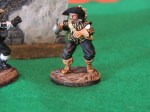
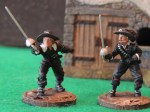
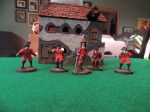
I’ve painted a lot of figures in my gaming life, but I don’t think I’ve ever enjoyed painting a batch of figures like Eureka’s 40mm Musketeer figs.

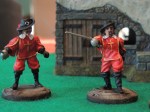
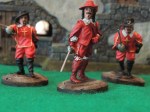
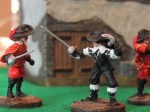
Just to be clear, these are the first 40’s I’ve ever painted before.  They are modeled on the characters and dress from Richard Lester’s excellent The Three Musketeers and The Four Musketeers from the early 70’s.  They are beautiful figures, incredibly well cast.  They have lots of nice folds in the clothing, presenting lots of opportunities for shading.

Let’s start with the chief characters (note: I’m referring to the first 11 figures I painted, so the Musketeers, Rochefort and the Cardinals Guard, and a couple of identical tough guys.)

Each of the four musketeer figures bear a resemblance to their character from the movie.  The difficult part is to make them interesting.  For the most part they are clothed in black.  They even lack the slashing, allowing their white shirts to pop through with a bit of contrast as they did in the movies. I did a lot of highlighting with a charcoal gray color.  Wherever possible I used a light gray in shirt creases or in bits of lace, just to break up the monotonous black and white. Athos, Aramis and D’Artagnan are variations of this black and white theme.  However Porthos, vain character that he was, had lots of gold lace and his belt was entirely gilded, except in the back, as you may recall.  It was difficult to create suitable designs in the space available, so I did the best I could. Even so, Porthos was fun to paint.

Christopher Lee’s Count Rochefort is probably the most recognizable of the character figures, with its long hair and eye patch.  I painted the figure with a Ceramcoat dark red figure so old I can no longer read the name on the bottle.  The lace on the figure is well-formed and it’s easy to add a little bit of gray to help it stand out. In the movie Rochefort’s boots are almost exactly the same color as the rest of his red attire, but I decided to do a little something different, mixing the Ceramcoat red with a Ceramcoat Maroon.  That gave me something a little bit different, but still similar. enough to give the sense that they were color coordinated.

The four different figures that are part of the Cardinal’s Guard are all painted a base of Vallejo Vermillion.  These figures were very fun to paint.  I lightened with Vermillion and white and darkened with Vermillion and Carmine Red, and they came out quite nicely.  I also used the Carmine Red to “blackline around the gold edges and the crosses. The Vermillion is a bit bright, but it’s also easy to work with as a base color for shading.

The two “hired blade” figures are pretty straightforward, and I lavished the least attention on them. ‘Nuff said.

I probably have all the 40mm figures I plan to buy for this project.  I did add all the remaining Eureka figures with the exception of Mr. Bonacieux. If I have any criticism of these miniatures it is that there aren’t more figures to flesh out the range.  Some soldiers, a few beggars, a few more civilian types would really be nice additions. However, they are absolutely a hoot to paint, and I honestly believe they are my best efforts in at least a decade.

I’m taking a little break from these guys for now as I wrap the last 18 figures I need to finish up all my Vikings for SAGA, and my first handful of buildings for St. Nazaire.  Then I’ll return and finish up the remaining 15 or so figures for this project.

Lion Rampant at Meeples

As I mentioned in my last post, I picked up a copy of Lion Rampant by Osprey Publishing.  I’m always looking for interesting rules sets for the late middle ages.  I have 500 or so miniatures for the Hundred Years Wars and another 500 or so unpainted figures for the period.  When I heard these were coming out, I pre-ordered them from Amazon for $13.40, knowing they were unlikely to have expensive add-ons and expansions.

The rules are mechanically simple, and easy to follow, but the proof is in the pudding.  Today I met Dave Schueler and David Sullivan at Meeples Games in West Seattle to give them a try.  I put together a simple retinue more or less out of the book for the French and the English and let the two Daves have at it.  I was not disappointed.

Here are some things you should know about Lion Rampant

Scale-small scale.  The rules say 1:1, though I could see them being scaled at 1:5 and still working.

Points based system.  But there are no firm army lists.  There are a number of different unit types for mounted troops, foot melee types, and missile troops.  Units are composed of six or 12 figures.  A retinue or command comprises 24 points which is typically equal to four or five units.

Mechanics are simple, but fun.  There are some required actions that must be taken-wild charges by undisciplined knight types, rallying “battered” units, or challenging enemy leaders to single combat.  The rest of the actions a unit may take-movement, shooting, attacking-all require a die roll against a unit’s ratings. No big charts with long lists of modifiers.  Roll 2 D6 and you’re in or you’re out. Each unit that isn’t rallying is entitled to an action die roll until you miss one and then you’re done. A unit that suffers casualties immediately suffers a “courage” die roll and applies the results.  It’s simple

David ran the French with an abundance of mounted figures, against Daveshoe with the requisite bowmen, some Welsh spearmen and Breton bidowers.  They fought over some hedge lined fields.  The English bowmen shot away the French crossbowmen and foot sergeants, but the English leader lost a single combat, before the mounted English knights were ridden down by their French counterparts.  Both sides were looking beaten up by the end of the game, which lasted no more than an hour.

The three of us expressed considerable delight with the rules.  They have the virtue of being clearly written, mechanically simple, and of course they are very inexpensive.  With an eye toward gaming one of my core periods, these rules nicely allow the game host to recreate actions from the endless campaigns in Gascony throughout the Hundred Years War, or the decades long civil war that was fought in Brittany.  These are intended to fight small actions and not large battles.

But just to show me wrong, Daveshoe suggested we line up some figure a la Agincourt.  So we piled out eight or so units of French foot men-at-arms and a few crossbowmen and had them attacking a mixed force of archers behind stakes and English foot men-at-arms.  It was interesting.  I was very fortunate with activation die rolls for my bow units and shot the snot out of loads of Frenchmen.  But eventually my activation rolls began to fail and the foot knights began to cross my stake lines and slaughter the bowmen.  Again, the rules were easy and fun and I am planning a larger game in a couple of weeks. I could not be more pleased with the rules.

I’d also like to get in a word for Meeples.  Meeples Games is one of growing number of games in the Puget Sound areas that sells mostly board games, a few miniatures for Warhammer 40K and Warmachine, but combines it with a dining experience.  It has excellent table space for board games, and I was able to find a table easily large enough for our Lion Rampant game.  It’s a friendly place.  The food is simple and inexpensive fare.  Probably not the equal of Cafe Mox in Ballard, but much cheaper than AFK Elixers in Renton.  They also have beer and wine on tap.  The only negative I have is that it isn’t in my backyard. If you like supporting local businesses, it’s definitely a place worth a visit.

So Many Projects, So Little Time

lion rampant cover

I feel pulled in at least five  directions as September wraps up.  Usually I’m pretty good at staying focused on one thing at a time but not this time.

  1. So there is a lot of interest in the SAGA rules at the present time.  David Sullivan reminded me the rules have been around for over two years, and I have yet to actually play them.  As I explained in my last post, it looks like I have enough Vikings to put together a four point “faction.”  I’ve agreed to participate in a November 29th tournament, so somehow I’ll have to get a game or two in before then.  I also have a fistful of figures to paint-about 25 or so, but they should go fairly fast. I’ve completed a five figure command set by Gripping Beast and am in the middle of painting ten archers.
  2. I’ve received the first of my pieces for the Raid on St. Nazaire.  These are mostly tiny 2mm buildings by Brigade Games though Pico Armor.  Very nice stuff. I ordered some residential buildings that would appear in St. Nazaire’s Old Town, some railroad buildings that also seem quite nice, along with some trackage.  Finally I got the industrial building set, but likely will need quite a bit more. I’ve also ordered the eight or so vessels I need from PT Dockyard.  I got a note they shipped yesterday, so they should be here soon.
  3. Last week I received the new medieval small action rules, “Lion Rampant.”  These rules are perfect for my singly mounted Hundred Years War figures. I have enough figures to create many “retinues” as both French and English. I’m trying them out on October 11th with Dave Schueler, a simple one off game prior to hosting a larger multi-player game two weeks later.  The rules seem simple and fun with lots of die rolling and death.  They have the virtue of being cheap without a bunch of add-ons a la SAGA, and honestly they just fit my interests a bit better.
  4. I’ve finally dragged out and assembled all my 40mm Three Musketeers figures from the “And One For All” range by Eureka Miniatures.  I’ve primed them and slapped some flesh paint on faces.  I’ve also purchased additional figures for the period from Chris Hughes excellent ECW range at Sash and Saber.  I’m quite thrilled to get them.  This is for a role-playing game I’ve offered to run, and I’m looking forward to painting the magnificent figures and drawing up the scenarios. Will probably use a combination of GDW’s old “En Garde” rules and Ganesha Games’ “Flashing Blades,” with liberal input from Alexandre Dumas (pere), films by Richard Lester, and maybe a little contribution from the “Musketeers” series on BBC America.
  5. I’ve said no new projects for the last couple of years, and I’ve pretty much stuck to that pledge.  But I am looking at something new and that is 28mm Aztecs and Conquistadors.  I actually have boxes and boxes of 1/72 scale Revell plastics, but they are missing a few key items that I can’t seem to duplicate in 20mm.  Eureka has a gorgeous range for both that is quite complete.  I don’t envision anything gargantuan-probably 200-225 miniatures.  There is a Sword and the Flame version for this period, though I can still see some simplifying too. I’ve ordered a sample pack for each side and they are quite nice.

Lots going on, and lots to do, but it all seems pretty fun.

The Fife and Drum Guards

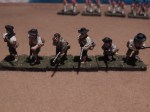
I’ve kept very busy painting in September, and it’s been a very productive month.  I finished fourteen various colonial figures to go with the Butlers Rangers miniatures I painted last month.  I have some other irons in the fire, and I’m painting almost every night, enjoying every minute of it.

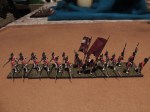
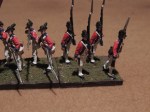
However, my big completed project for the month is the 28mm Guards unit from Fife and Drum miniatures.  You might recall I reviewed these figures after I received them last December.  I began painting them at the end of August and finished them earlier this week.

This is a special range of AWI figures, commissioned by Jim Purkey (the Alte Fritz for those who knew him on TMP.)  They were intended to represent the units taking part in the 1777 campaign, including Bennington, Saratoga, Brandywine, Germantown and a host of smaller actions that took place in the Year of the Hangman. We like to think of the Brits in their tricornes and lacy red coats, those were chucked by General Howe as he began his ambitious campaign to win the war.  We find these British in floppy fedoras, long, but largely lace-free coats and overalls rather than breeches.

The miniatures are quite nice.  They have just the right amount of detail and are relatively easy to paint.  They are British AWI figures after all. Loved the lace on the drummer and found the only challenging part was hunting down all the buttons. The muskets are quite long compared to other manufacturers, but also the remember the muskets, together with their bayonets seemed quite long in the movie, “The Crossing.” In my previous post I commented on the figure size and my opinion hasn’t changed.  By height I think they are fine, but they are slender by comparison to other ranges.  Even so, I really enjoyed painting them.  I bought them for a guards unit at Guilford Courthouse, and I’m sure I’ll use the Fife and Drum guys for the second unit.

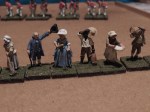
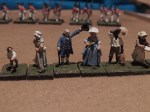
In what’s been a very good painting month, I also finished six Perry “nervous militia” figures from their AWI range, as well as a package of civilian types.  I want to use them in a raid game featuring Butler’s Rangers and Indians vs frontier settlements.  I think I’ll cobble together my own rules for the game, based on Brother Against Brother and/or Sword and the Flame.  Something one pagey and simple.  The British will have to torch structures, keep casualties low and prevent their Indian allies from killing everything in sight.  The settlers will have to hold on until help arrives. May have to try out a pack of Perry plastic Continentals to make this work.

I’m presently trying to immerse myself in painting my SAGA Vikings before moving on to 40mm Three Musketeers figures.


The year’s big project

Enfilade made it official last week and announced the theme for the 2015 convention.  It will be Raids.  Not really much of a raids person, though I could imagine a few raids that might be worth gaming.  I’ve painted some figures for raiding the frontier during the American Revolution.  Maybe, we’ll see.

Actually I’m fibbing.  Daveshoe and I have long discussed the possibility of gaming the St. Nazaire Raid of 1942. This raid was carried out against the Normandie docks, the only one on the Atlantic coast capable of hosting the German battleship Tirpitz.  In a daring land/sea expedition elements of the Royal Commandoes and Royal Navy destroyed the docks and important infrastructure in St. Nazaire’s maritime/industrial region. Unlike lots of games, there aren’t a couple hundred 28mm figures that will need to be painted.  Instead, we’ll be modeling the game table for a 1/600 scale coastal action.  I have many of the British gunboats already built and painted, but I have eight more to go.  There will buildings galore to paint, felt game space to construct and etc., etc., I’ll keep you posted on the project as we proceed.

I’m currently painting my Fife and Drum British Guards from the American Revolution.  These are exquisite 28mm figures, with just the right amount of detail.  They were sculpted to model troops for the 1777 campaign.  Though their coats are a bit long, they’ll do for Guilford Courthouse as well.  They are very nice, but a little on the small side. Smaller than Perry’s 28mm AWI, and even a little smaller than Old Glory figures.  I’m working on a 24 figure unit and making steady progress.  I hope to have them finished by the end of the week.

What then?  I have fourteen singly mounted militia and civilians I want to paint for the AWI frontier scenarios I mentioned earlier. These are all Perry figures that I expect to paint up very quickly.  They’re nice figures, a good variety of men, women and children.

I proposed to do some role playing with my son and friend David, and promised to take on the role of game master.  I asked Casey what kind of role playing he would most be interested in, and he thought it would be fun to do some swashbuckling along the lines of the Three Musketeers.  I thought that was a great idea because it gives me an excuse to pull out my Eureka 40mm And All For One figures.  They are unpainted, but I think they’ll take the next place in the painting queue.  I’ve been re-watching my copy of the Richard Lester stories (The Three Musketeers (1973) and The Four Musketeers (1974) are by far the best versions of the Dumas story; don’t let anyone tell you otherwise.) I’ve also checked out the BBCAmerica The Musketeers series for story ideas and I’m anxious to get started.  I’m likely to use Fudge as the rules set but am consulting the ancient GDW EnGarde rules as well as Ganesha Games Flashing Blades for ideas as well.  I have the original nine figure set Eureka issued a while back, and I’ve ordered a couple more of the assassin type figures, and I’m looking out for where I might be able to pick up a few more additional figure types for the era.

Finally, there’s been an increasing amount of talk about the SAGA rules for some quickly small action gaming.  I have 25 painted Vikings and was pawing through my piles of unpainted lead hoping to find a few more.  Indeed I discovered another 20+ miniatures which I want to paint.  That way I can join the cool crowd too.  I would guess I’ll work on these while I’m painting my Musketeers.

In any case I’ve got lots on my plate to keep me busy.  I can assure you I’ll do my very best to make it a good time.

August is the best month

I haven’t posted much this summer.  That’s unusual because summer is when I typically get a lot of painting done, projects take shape, and I take lots of time to share.  Not so much this summer.  Though I have painted some, I’ve mostly really relaxed, watched a lot of Mariners baseball, played with the dogs, and now I’m back at school.

I have managed to get in some games.  I played some home brew ancients games.  I participated in an awesome ACW naval game using my Webb model and Sail and Steam Navies.  I ran one of my Louisiana games and was offered some great feedback for a scenario I plan to run at Fix Bayonets in September.  Last, I played in Damond Crump’s excellent L-Z X-Ray scenario, based on the 7th Cavalry’s Ia Drang Valley battle in November 1965.  It was incredibly fun, kind of a like a gigantic problem solving event.  I really enjoyed playing the NVA with Joe Waddington and Al Rivers.

I’ve also played a lot of board games.  Not only that, I’ve acquired a lot of board games.  Mostly the multi-player non serious games, because they are the most fun.  Generally I’ve stayed away from acquiring these games because A) they’re expensive, B) you need a bunch of folks to play them and C) they take up a lot of room.  Unfortunately, I’ve had a little extra money this summer so I’ve indulged my interests.  I bought a new copy of an out of print game (key words meaing lock up your wallet) called The Making of the President: 1960 on the Kennedy/Nixon campaign.  I’ve played it once and would have to say that along with GMT’s Twilight Struggle, using a similar card-driven system, it is my favorite game. I also picked up a used copy of GDW’s Tet Offensive from 1991, and with my birthday cash a copy of GMT’s Dominant Species on the coming of the Ice Age. Maybe I’ll include some reviews as I work through them a bit.

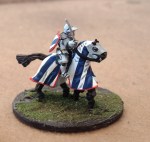
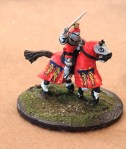
But I do paint as often as possible.  It hasn’t been every night, but I will get back on that track as much as possible.  I will feature pics from a couple of items I’m pretty happy with.  The first is a pair of command figures for my Poitiers game.  I know I haven’t talked much about this the last couple of years, but I will keep picking at it.  they are Arnoul D’Audrehem and Jean Clermont, the Marshal of France.  They each led a column of French mounted knights in the vanguard of the French army and gave the English archers fits trying to penetrate their well armored horses.  Unfortunately, fits or not, Clermont was killed and Audrehem captured.  The figures are from Old Glory, with heraldry matched as well as I could from online and print sources.

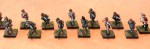
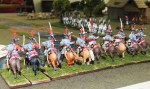
The second group of figures are Butler’s Rangers, provincial militia from the American Revolution.  They frequently teamed with Iroquois warriors to challenge American control in the over-the-mountain regions of New York and Pennsylvania, leading to considerable bloodshed among frontier settlers.  I have a mind to do some skirmishy games on the frontier there.  These are Front Rank figures.  I’ve had them for more than twenty years, and in fact I made one of two smallish figure orders to fill them out to their 25 man ranks. Butler’s Rangers provided their own uniforms,  hence the varying shades of green, including a few with traditional red-faced uniforms instead of the more practical hunting shirts.  I used four different shades of Vallejo green to give them variety. As always, Front Rank figures, with their deep creases and defined bulges, are a pleasure to paint.

I also picked up some AWI civilians and “Nervous Militia” figures from Perry Miniatures.  Pics to follow.