Finishing Bay Area Yards’ USS Miami

The U.S.S. Miami was a double end gunboat intended to patrol America’s coasts and inland waters during the American Civil War.  With rudders at both ends, the intent was to avoid having to turn the good-sized gunboat around in narrow waters.  Most were built of green wood and deteriorated rapidly after the war.  But some had long and productive careers.  The gunboat Monocacy served on China’s inland rivers until the the turn of the 20th century.
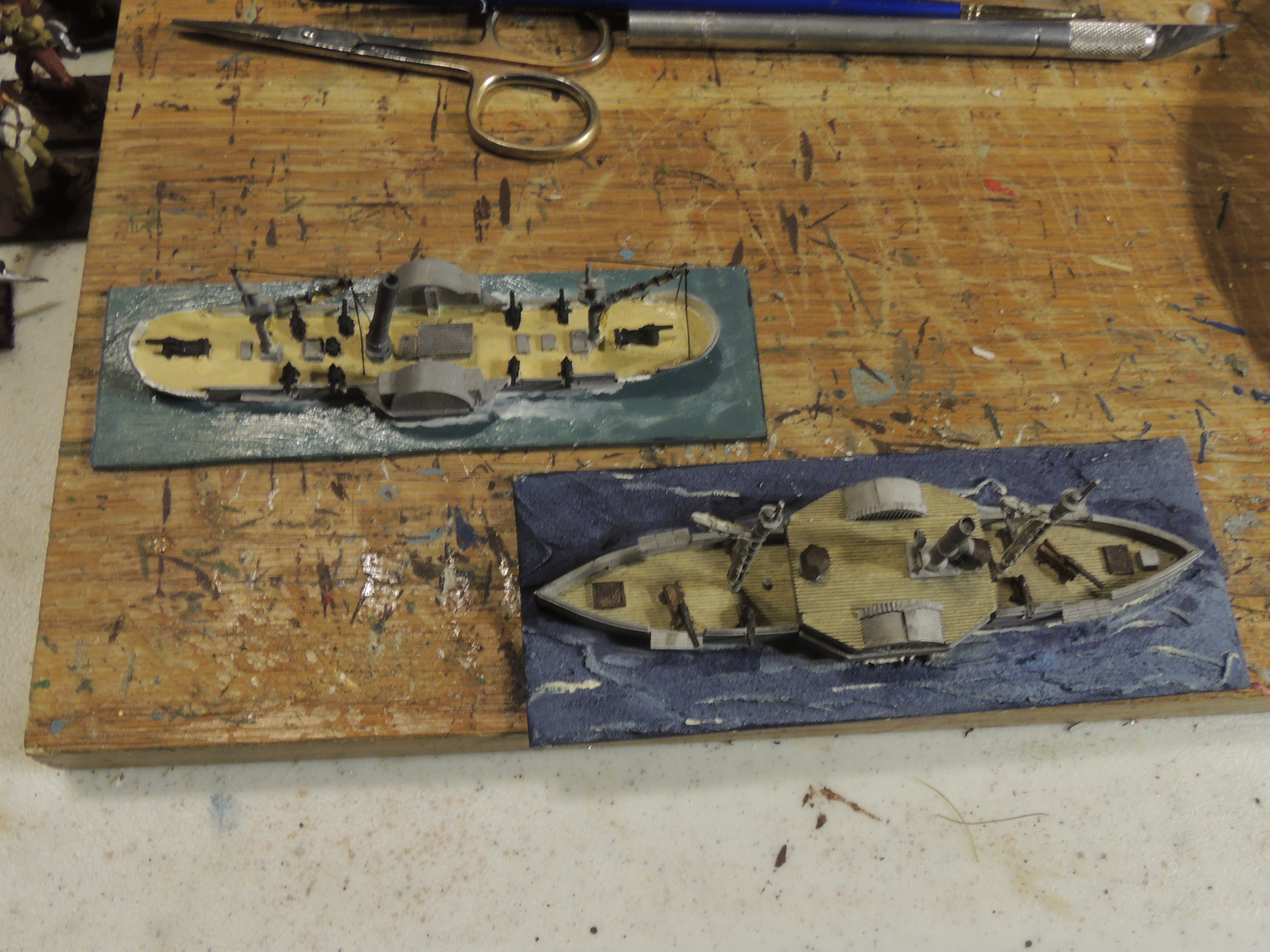
A quick comparison between the Thoroughbred Sassacus double-ender (front) and the less massive Bay Miami (back)  Both are very nice models

A quick comparison between the Thoroughbred Sassacus double-ender (front) and the less massive Bay Miami (back) Both are very nice models

I’ve shown you a few pictures of my Bay Area Yards miniature of the Miami.  I believe it’s my fourth double end gunboat.  There were more than forty built in four different classes. I also have two of the Sassacus class by Thoroughbred Miniatures and one that is a scratch-built model. It’s good to have plenty because they were fairly ubiquitous on the rivers off Chesapeake bay and the Atlantic coast.
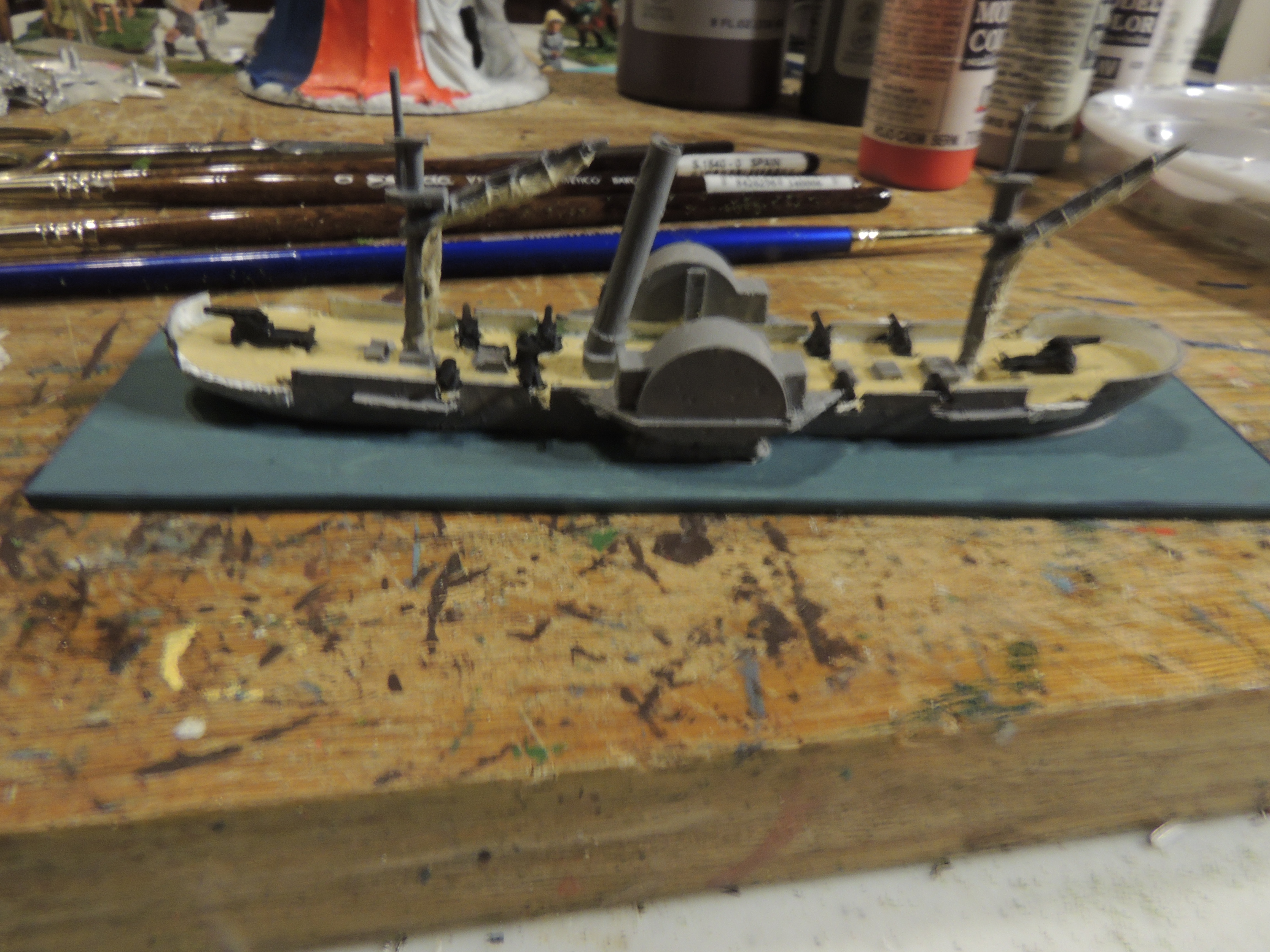
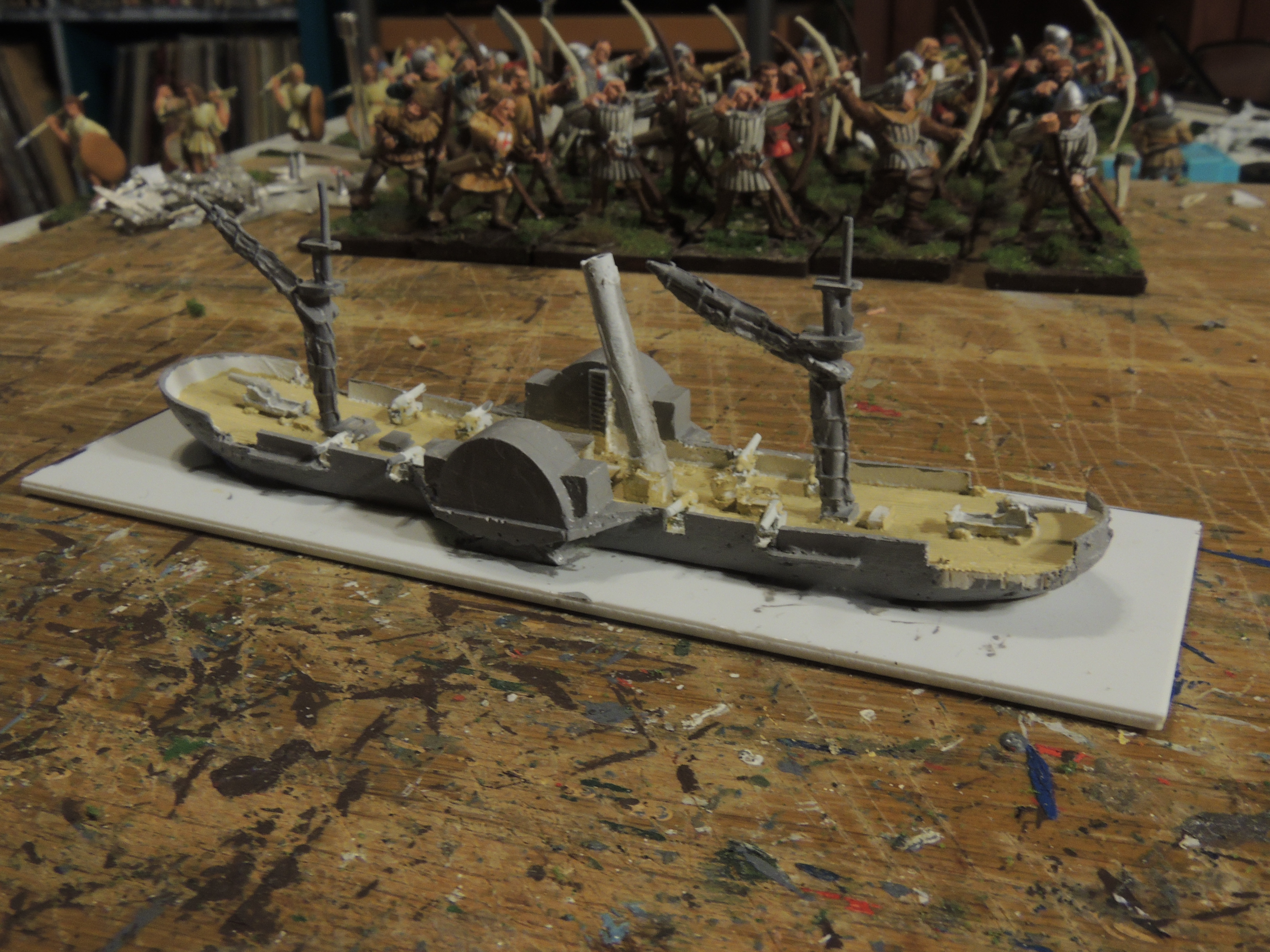
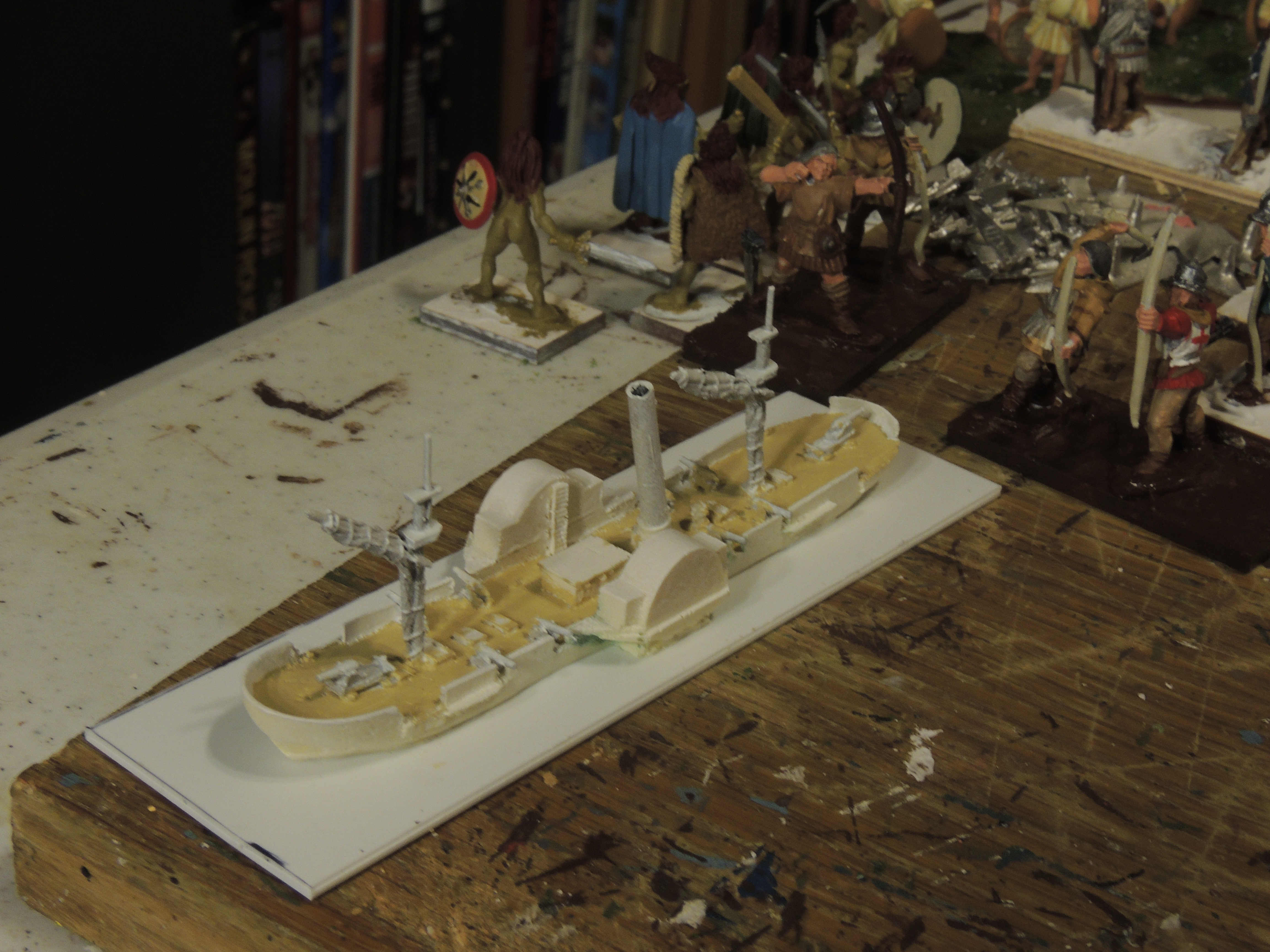
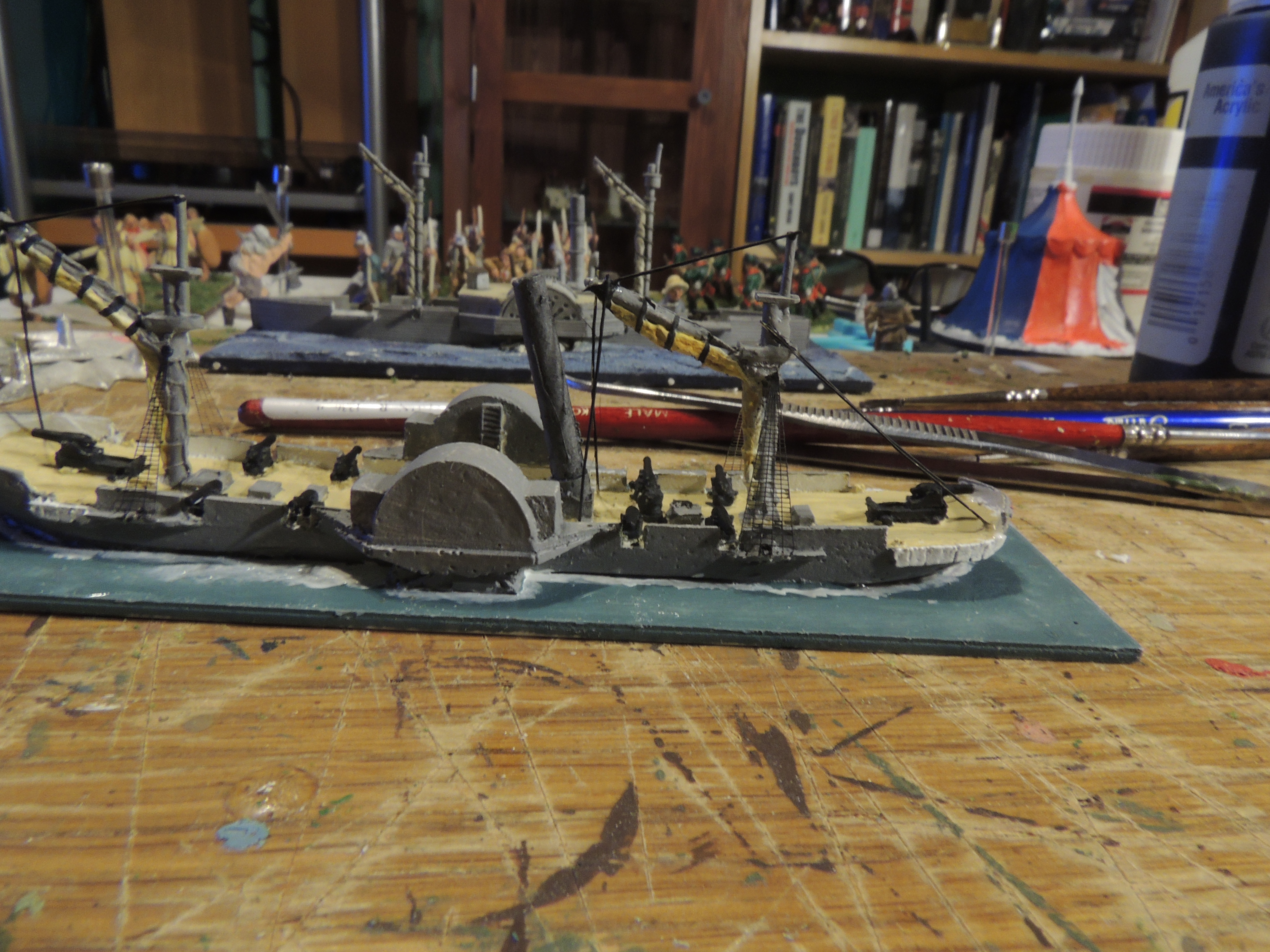
Portside view of the Miami.  the base colors are all there, but no additional work on the base and beginning to think about rigging.

Portside view of the Miami. the base colors are all there, but no additional work on the base and beginning to think about rigging.

The Bay Model is the only one made of the Miami and her sister the Octarora. It’s considerably different in configuration than the Sassacus miniature pictured.  It is relatively easy to build.  I purchased the resin hull separately and purchased the masts, also from Bay.  I had quite a collection of Bay guns, if not those would be separate purchases as well. The ship has only two masts, and I had to place them appropriately.  I probably cut too much off the ends of the masts–they should definitely be taller. I used my pin vise to drill holes in the resin deck.  Not difficult. Then I placed large rifles on pivots at either end of the ship.  The Dahlgrens mounted on Marsilly carrigages were glued at each gun port.

After priming the whole business I started work.  I used Vallejo Buff for the deck.  Then I painted the interior bulwarks white. I feel like I erred on the color of the gun carriages.  I should have used the Vallejo Neutral Gray color, which is a nice middling shade and a better contrast with the black of the gun tubes than the Ceramcoat Charcoal I chose. I used Vallejo Sea Gray for the overall exterior color, including the stack which I washed black.  I chose not to do an overall wash.  I normally would, but there isn’t a ton of detail to bring out in this miniature, so I was afraid it would just make a pool, except maybe on the decking.
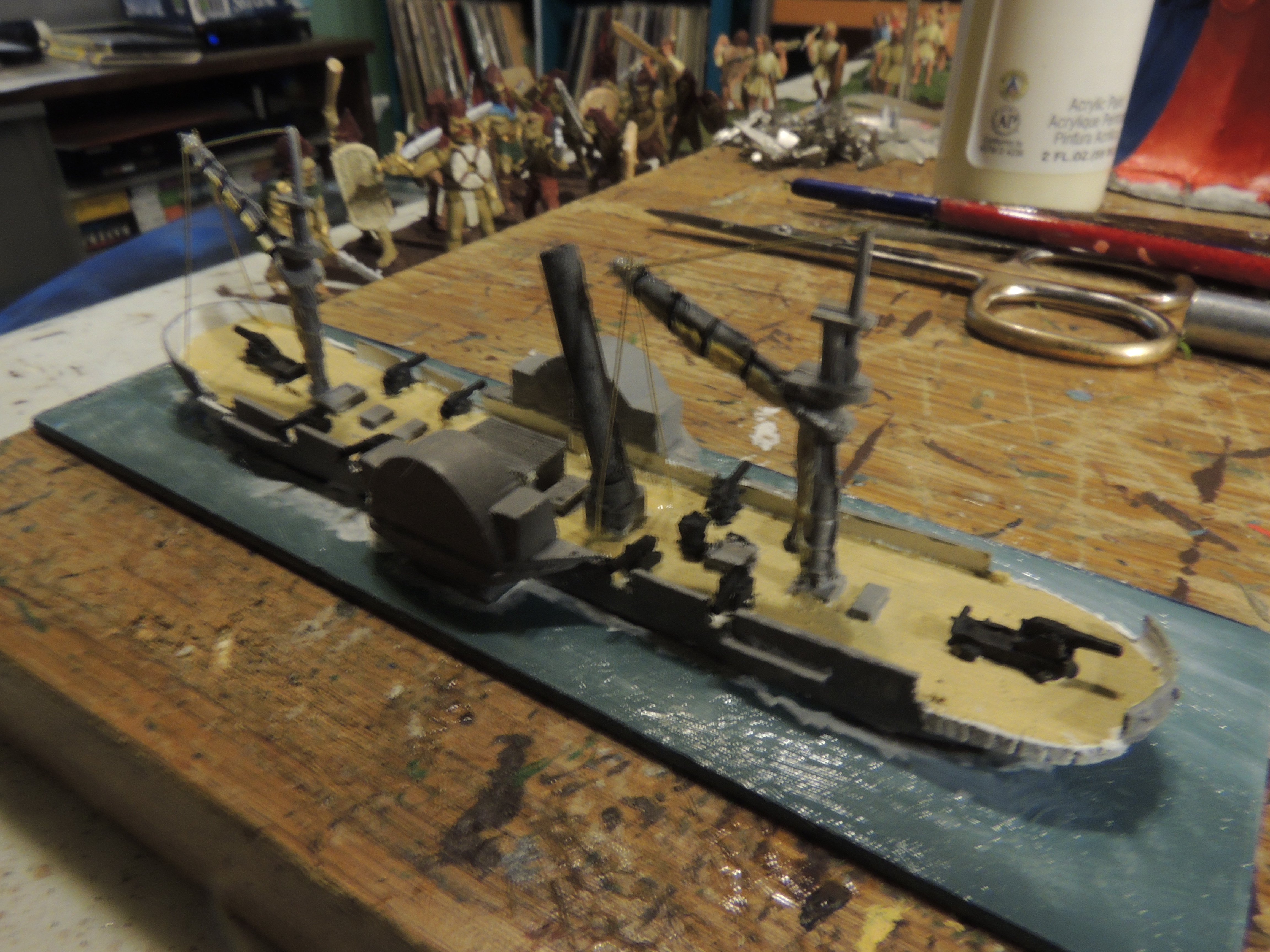
This picture shows the brass wire going up around the two masts.

This picture shows the brass wire going up around the two masts.

With the painting done, I contemplated rigging the ship.  For the most part I’ve rigged my models in recent years. I try to keep it simple.  I don’t use thread.  Pre-stretched, cotton, acrylic, it doesn’t matter to me, thread rigging sags.  I have a beautiful model of the Hartford to prove it.  Instead, I use brass wire, glued with CA glue. I buy .010″ brass wire from Metal Shapes.  It’s available at Hobby Lobby, and is the only product which drags me in that store. I try to cut the length of wire as close as I can to the length I need it, glue it in place and use floss scissors to cut the wire as close as I can get it. I let it dry a good long time.  If I don’t want to end up with bristles glued together;  who needs that? Then I paint it black.  I always try to do what is easy with rigging, because ultimately it’s a wargame model and not a showpiece behind a glass case.
A broadside view of the finished Miami.  The ratlines are clearly visible
A broadside view of the finished Miami. The ratlines are clearly visible

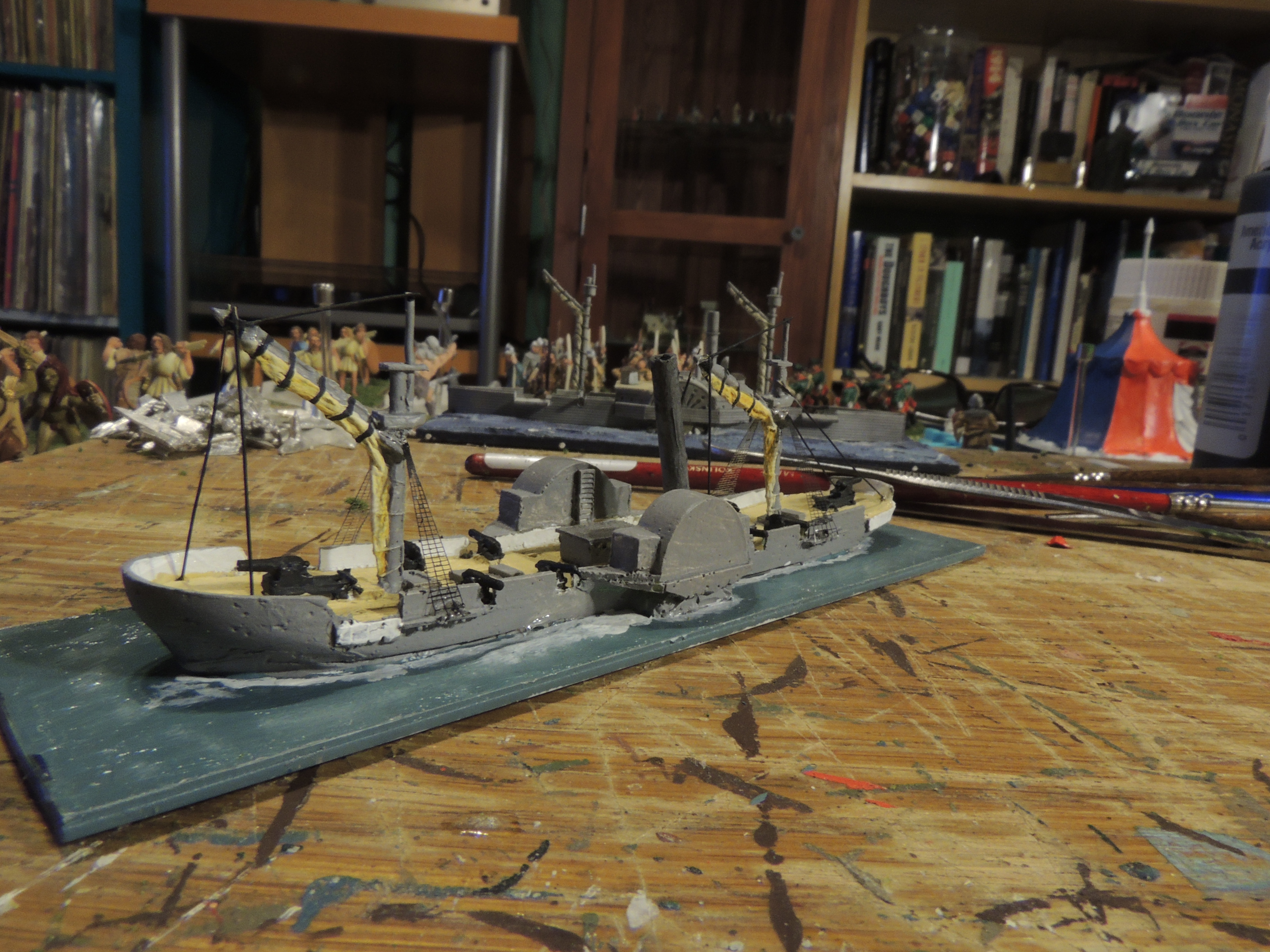
A final port quarter view of the Miami.  I'm pretty happy with the results.

A final port quarter view of the Miami. I’m pretty happy with the results.

In addition to taking on standing rigging, I also add ratlines. I wasn’t sure there were ratlines on the double ender’s simple pole masts, but I checked photos and drawings, and they are there. Battlefleet Models makes 1/700 scale ratlines, so scalewise they are a bit small, but really do add something to your model.  They are photo etched brass and taking a bit of patience to work with.  The ratlines come in a variety of sizes, choose yours carefully.  Use an extremely sharp knife or floss scissors.  Again I glue them in place with CA glue. Painting the ratlines can be a real challenge.  They are metal and almost impossible to prime.  I paint them black, and try to thin down my acrylics.  The ratlines are very fine and easy to glop up.

Finally, you can mount your minis on a base or not–entirely up to you.  I do.  I mount my ships on thick styrene bases.  I like to leave a bit of a margin around the ship.  I painted the base a nice coastal Vallejo Blue Gray.  I also scrubbed the base a bit with Vallejo Pale Blue, before going around the ship with your basic white. When it’s all over I paint over the base with Liquitex gloss gel
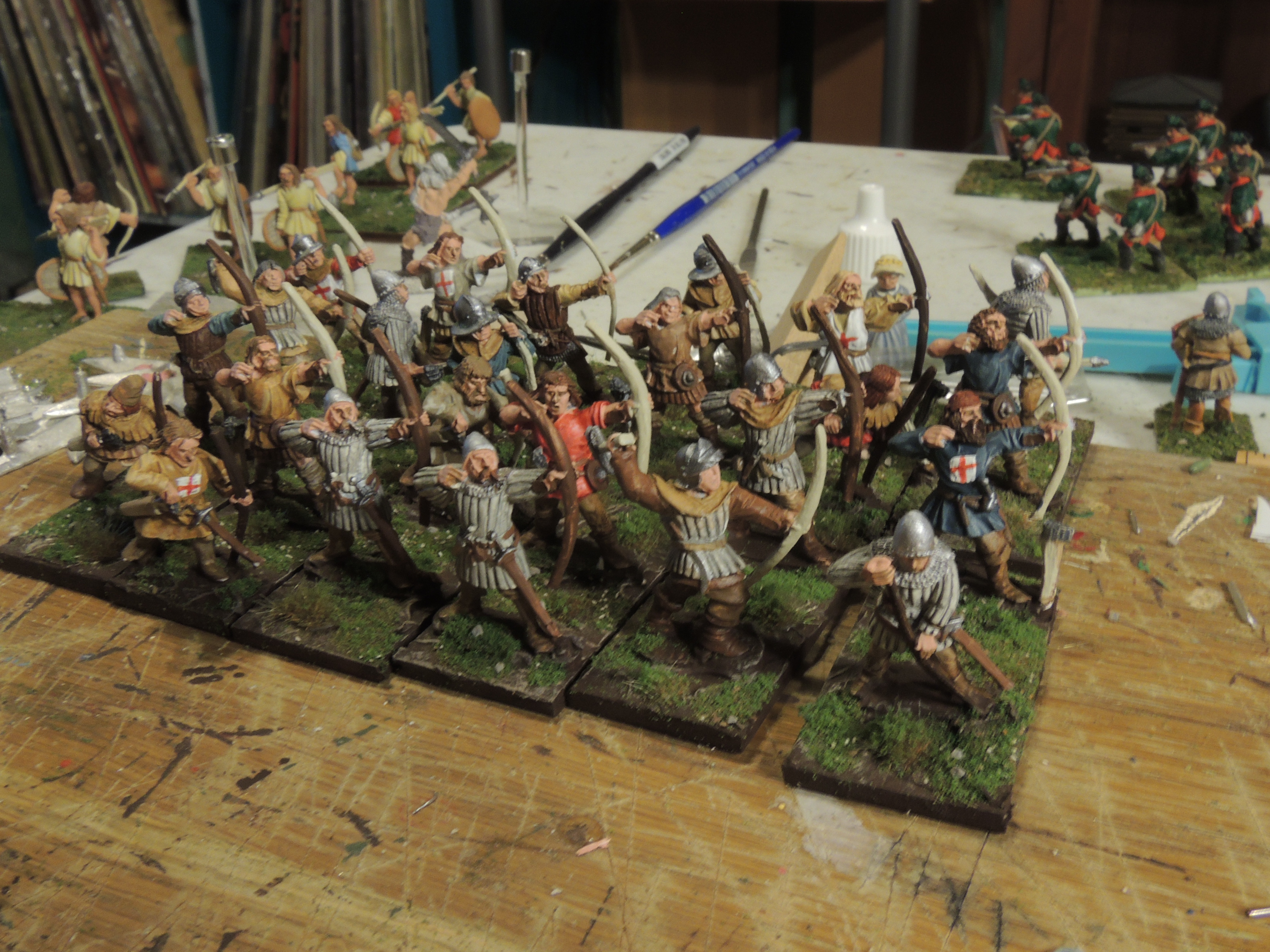
Longbowmen finished and other cool stuff.

Longbowmen

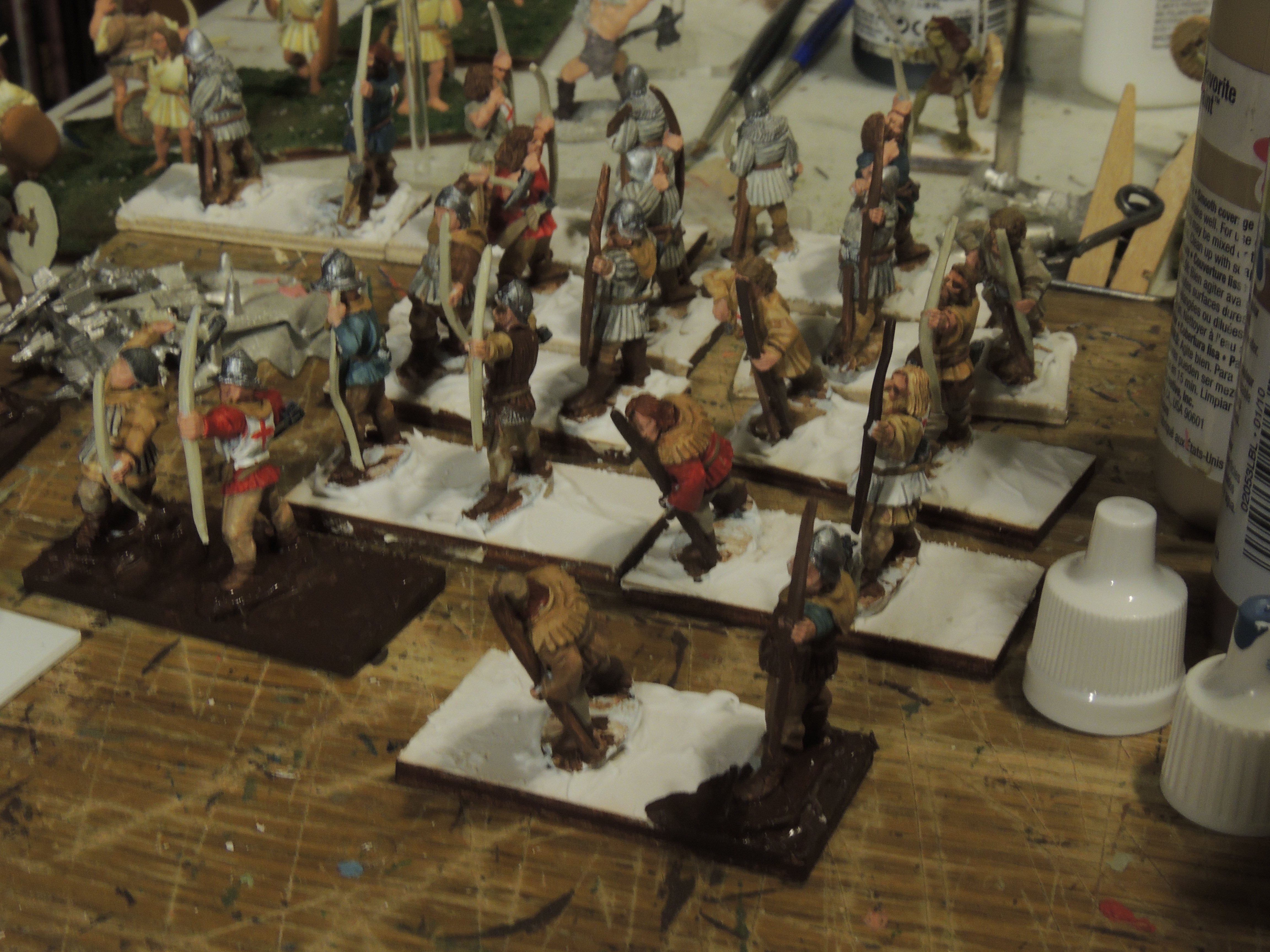
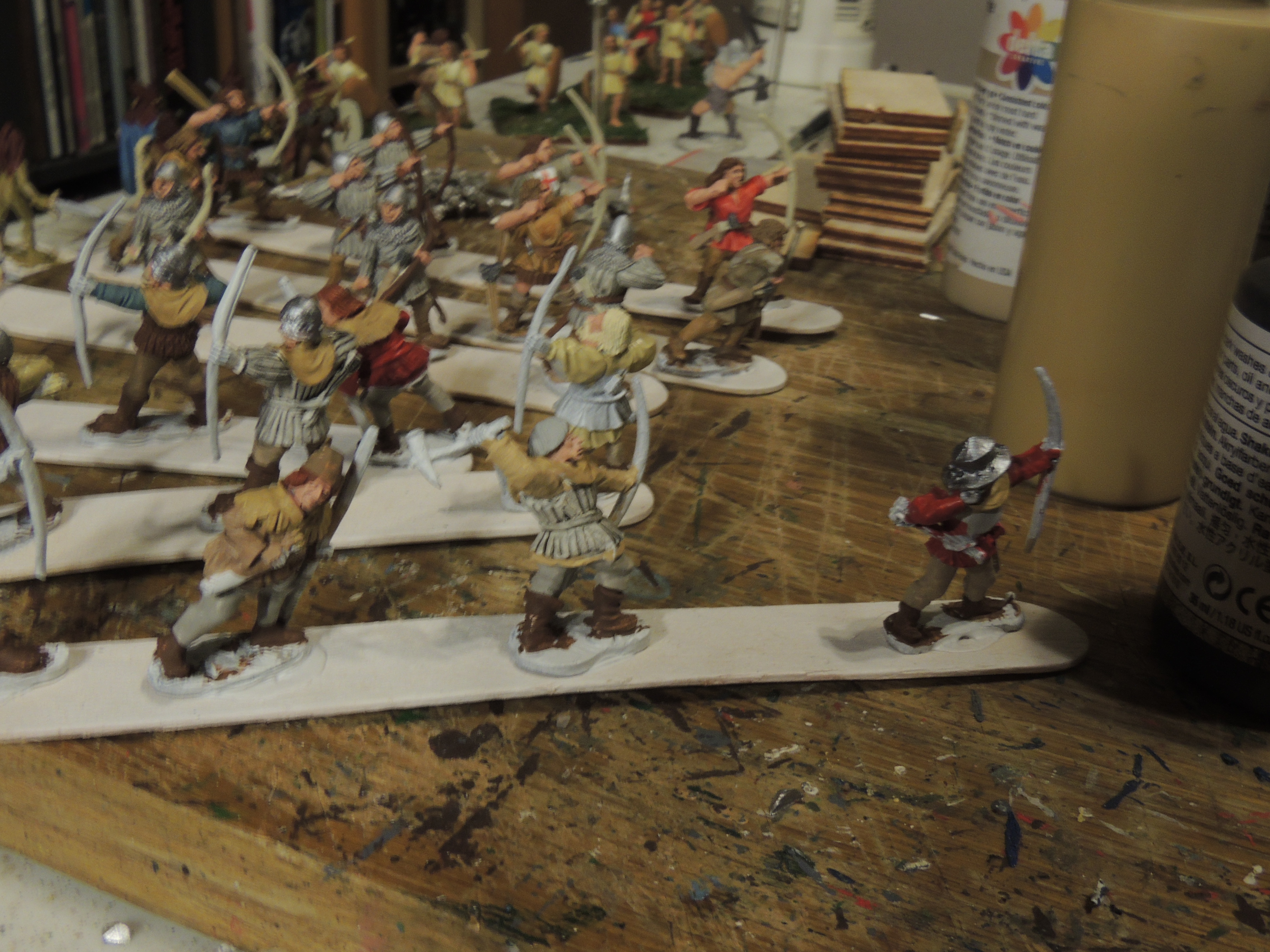
I finally finished these guys last night.  I made their bases a bit busier than I usually do.  They are supposed to be able to fight in difficult terrain, and at Poitiers–always a guiding star for me-were able to navigate swampy terrain They aren’t brilliant, but the first rule of miniature wargaming is that any painted unit is a WELL-PAINTED unit.

Old Glory longbows on half stands, ready to go.

Old Glory longbows on half stands, ready to go.

Escodida Versatil Brushes Arrive

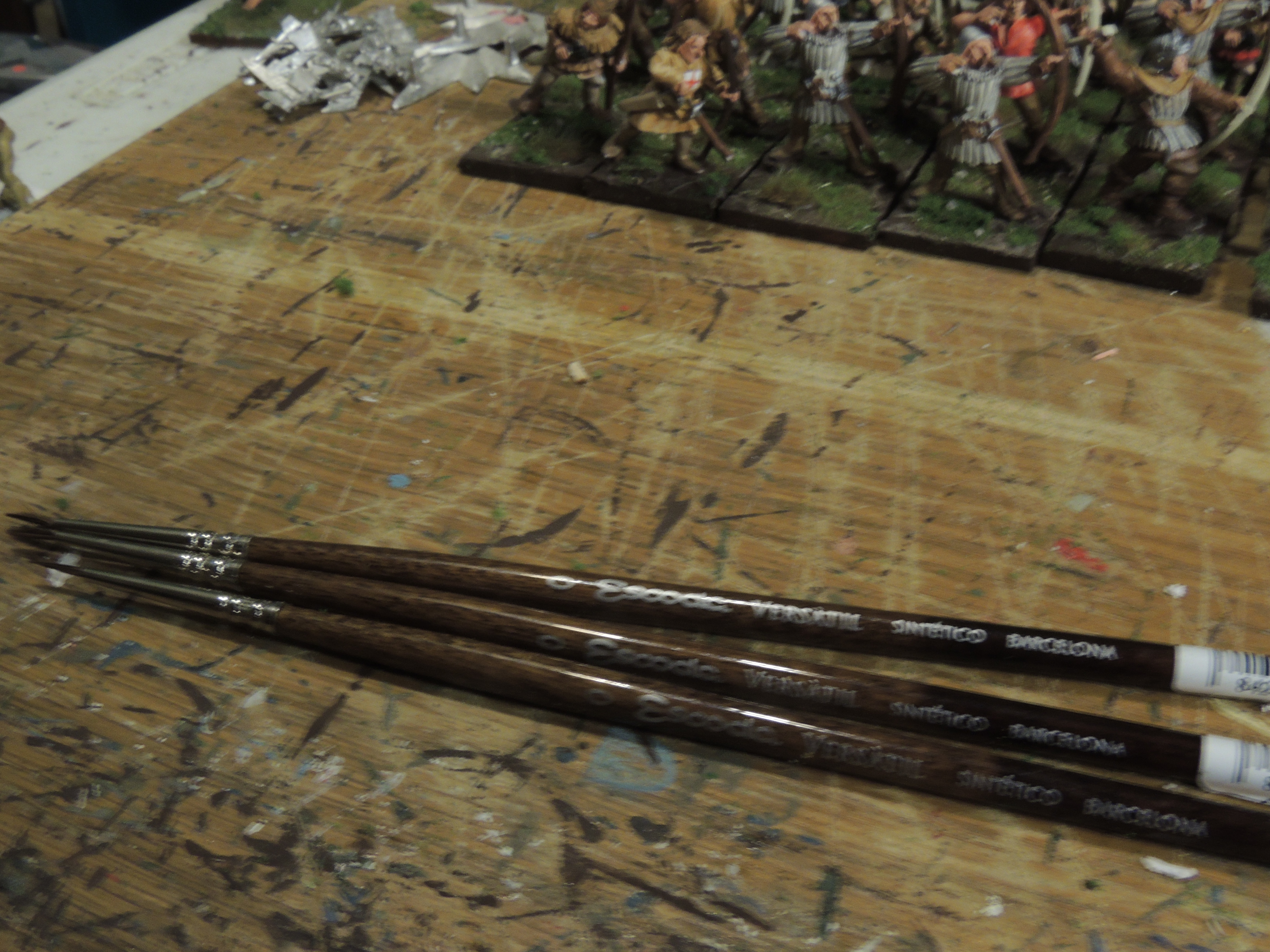
So my Dick Blick order arrived in an enormous padded mailer.  Inside were my carefully packaged 0 Escodida Versatil brushes.  I carefully pried them out of their packaging and was singularly unimpressed.  They are the right size but as miniature gamers we live and die by brush points.  No brush point, much less detailing. These didn’t come with one of those little protective plastic thingies that fits over the ferrule, so one of the brushes had any potential points squashed right out of it.  The others retained something of a point, but only one of the three brushes seems to have “winner” exuding from it.  I’ll have to work with them.

My Escondida Versatil brushes  arrived from Dick Blick yesterday.  I am not optimistic, but they're the brushes I have . . .

My Escondida Versatil brushes arrived from Dick Blick yesterday. I am not optimistic, but they’re the brushes I have . . .

Re purposing My Den

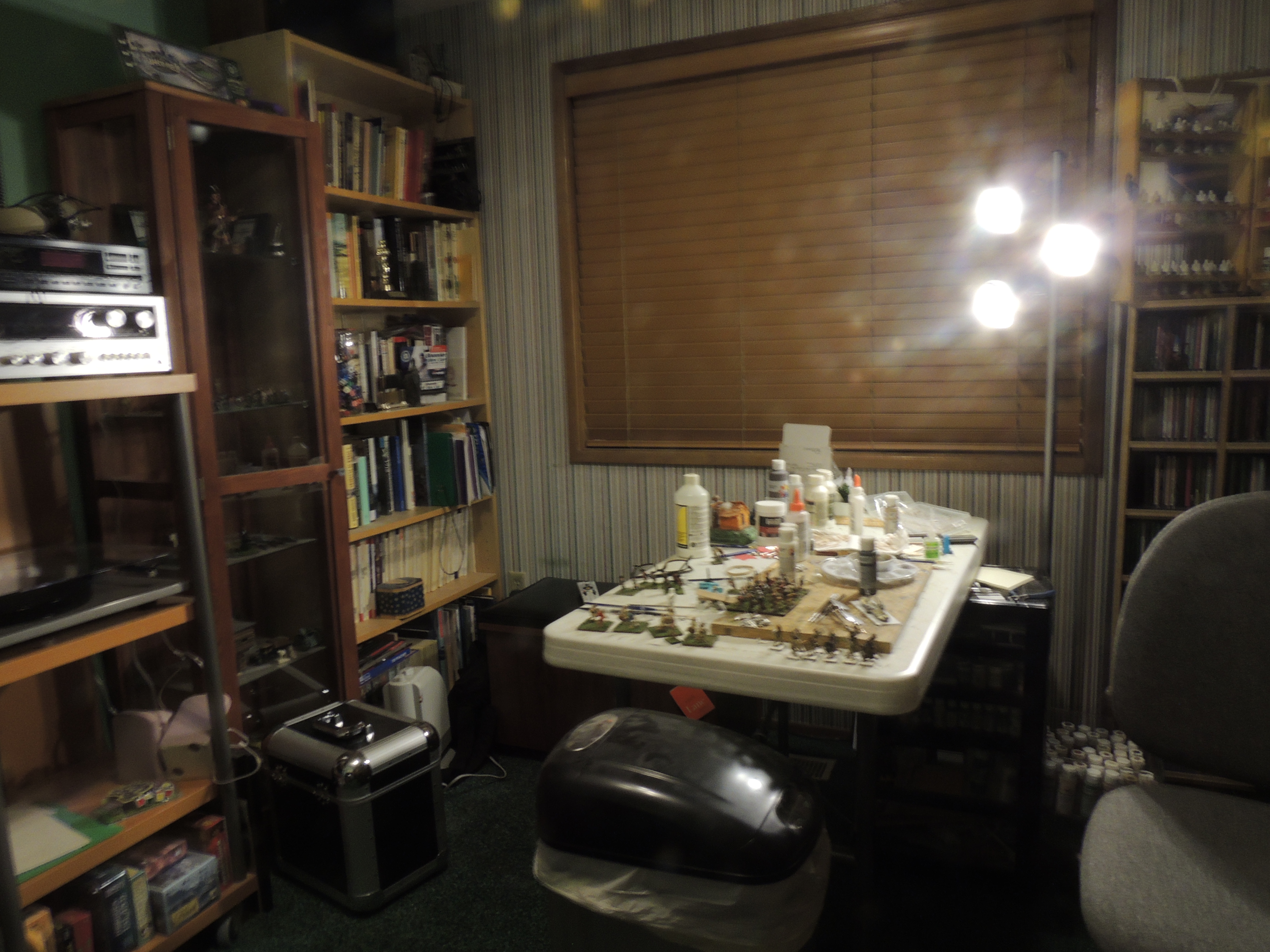
My den/painting area/ music room is tiny.  It’s 8′ X 8′ and is crammed full of miniatures, board games, my stereo, a television, dvd’s all my Kevin stuff. It had also become virtually unnavigable.  As my music consumed a bigger and bigger portion of my time and resources, the situation I had in there with my painting table plunked right in the middle of the space made accessing my stereo difficult. So I did some switching, moved my table to a place that renders the rest of the room more accessible and doesn’t negatively impact my ability to work efficiently and comfortably The lighting is probably better, and will be better still when we emerge from the great darkness of the Northwest winter, which seemed to begin yesterday and will last until June.

It's hard to tell from this photo, but I've pushed my painting table toward the back of the room and near the window.  It's opened up the space so it's more walkable without interfering with my work space.

It’s hard to tell from this photo, but I’ve pushed my painting table toward the back of the room and near the window. It’s opened up the space so it’s more walkable without interfering with my work space.

Enfilade Plans

Yes Enfilade is in May, but I like to have things worked out well in advance.  Dave Schueler and I always work together on at least one game.  We’ve done two super successful rollouts: the bombing of the Tirpitz–which was just gorgeous–and the prize winning Raid on St. Nazaire from last year.  This year it looks like we’ll do The Channel Dash of the Scharnhorst and Gneisenau and various auxiliaries from Brest in Brittany to the German port of Wilhelmshaven where they could threaten North Atlantic convoys.  It turned into a disaster for the British who could muster little naval power to threaten the German battleships, and whose repeated air attacks were driven off with heavy losses by defending elements of the Luftwaffe.  The sheer variety of British aircraft–Wellingtons, Spitfires, Hurricanes, Swordfish, Whirlwinds, Hampdens and Blenheims make it all pretty attractive.

Beyond the Channel Dash, I’m not too sure what I’ll do.  After last year’s “fill the car” excitement, I may stick to something a little less demanding.  I have a bunch of 1970’s era hydroplanes to paint–I could update my Thunderboats!, which is always a crowd-pleaser.  I could also do some ACW naval stuff.  I still have some ships to paint, and I’m sure David Sullivan and I could do something.  He was interested in an Ironclads game.  Now that would be retro.

What’s on Your Painting Table?

With the longbowmen finally completed, I’m just dorking around with things I want to do. The Miami (gunboat) is a step closer to completion.  I’m getting ready to base some figures for Mars. I’ve primed a big Baueda pavilion for a potential camp for the Hundred Years War.  Not terribly focused, eh?  It shouldn’t take forever to paint them.  I think after I do that, I’ll paint the Volunteers of Ireland for the American Revolution.  I bought the GMB flags for them, they have a different looking uniform, and they are pretty small for the period. After that, it’s the gunboat Selma from the Battle of Mobile Bay.  That should get me into November.

A bit more done on the Miami.  My goal is to be finished, based and rigged by the end of the week.

A bit more done on the Miami. My goal is to be finished, based and rigged by the end of the week.

And Now For Your Listening Pleasure

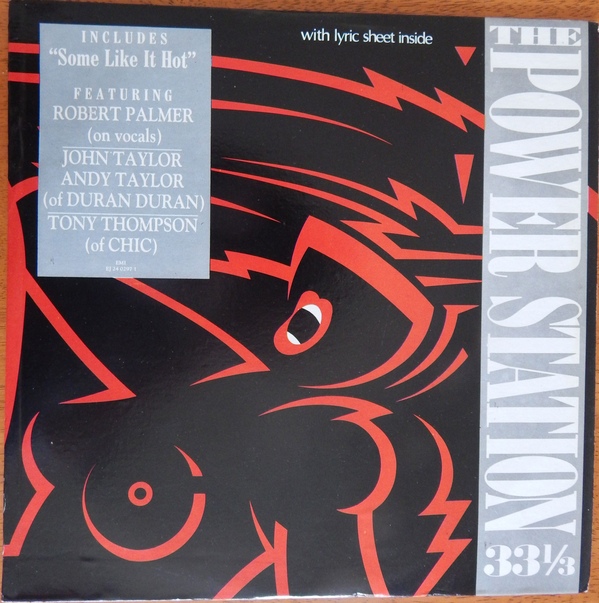
The Power StationI have a bunch of mini collections in my pile o’ vinyl.  Little Feat, Steve Miller, Boz Scaggs and a few others.  One guy I really like who is kind of under-appreciated is Robert Palmer.  He’s a British blue-eyed soul singer is best known for his lounge-lizardish appearance on some early MTV videos.  “Addicted to Love” is his best known video with the long legged, pretend backing band. But before that he made some very good R and B influenced albums.  Before his MTV fame, however, he teamed up with two former members of Duran, Duran John Taylor and Andy Taylor, and Chic’s Tony Thompson.  Together they formed The Power Station.  Their first album, titled, simply enough, The Power Station (1985) is pretty enjoyable.  It is energetic synth-pop, but not so much as to be annoying.  Palmer’s vocals are powerful and the two Taylors have enough guitar influence to keep things interesting.   My favorite song is a cover of TRex’s “Bang a Gong.” Good stuff, worth a listen.  Picked mine up for half a buck at the Goodwill Outlet.

Five Essential Books on the Hundred Years War

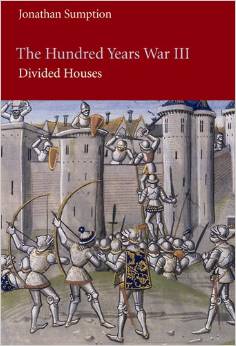
Divided Houses

Got a request a couple days ago about books on the Hundred Years War.  I’ve been meaning to post something about what I was reading, and maybe I’ll follow up with that at the end of that post.  I’m going to preface my examples and remarks with a couple of quick observations

First, there are a ton of great reads on this conflicts.  Not just lots of books, but lots of good reading. So if you are interested in military history and are looking for another period to learn about, there is ample material.

Second, the core historians writing about he Hundred Years War in English are, not surprisingly, Brits.  Their research and willingness to shatter old myths perpetuated by Shakespeare, Alfred Burne and others changed our perception of this conflict.  It’s what keeps me buying books and reading their stuff.

Anne Curry

  1. Jonathan Sumption.  Yes that’s an author’s name and not a book title.  Sumption is the pre-eminent narrator of the period and has four books 1) Trial by Battle, 2) Trial By Fire, 3) Divided Houses, 4) Cursed Kings.  I have read the first three, and the first book twice. Sumption is so good at telling the story and helping us understand the political, social, economic as well as the military strands to this conflict.  It’s big picture stuff that’s complex but he somehow masters the contemporary sources and pulls it together into a readable, cogent narrative. Expensive and dense, not for the faint of heart, but definitely the best. Cursed Kings was released in August 2015, which I just learned as I was writing this article.
  2. War Cruel and Sharp by Clifford Rogers is an analysis of the English military system as it evolved under Edward III, and how it was used tactically and strategically.  Gone is the view the English army was small, outnumbered and beleaguered. It was an offensive weapon that sought battle.  Rogers traces the development and employment of the army from its development on the Scottish border to its ultimate victory at Crecy. I got my copy used, which helps with cost.
  3. Arms, Armies and Fortifications in the Hundred Years War edited by Anne Curry and Michael Hughes.  This book is a collection of essays by many different writers on a variety of military topics relating to the Hundred Years War.  There is an essay on battlefield tactics and two more on the composition of the English army 14th and again 15th Century. The war at sea and defense of the English coast are covered.  It is a real wealth of information in very manageable chunks.
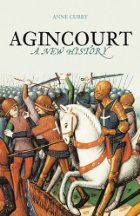
  4. Agincourt: A New History by Anne Curry.  Curry takes one of the best known stories, told by Shakespeare, re-told by Col Burne in the 1940’s and kicks the props out from under it.  Curry has investigated and written about Agincourt for decades, but this narrative of the campaign and battle challenges long held beliefs about the size of both armies and tactics used by English and French armies.  A great book. Honorable Mention: Henry V and the Battle that Made England is a more traditional history by Juliet Barker.  Like Curry’s book, this was released in 2006.  It takes a more conventional look at Agincourt, but is also a broader examination of Henry V and events that shaped his decision making-his wounding at Shrewsbury, the usurpation of Henry IV and its role in the Southampton Plot. A great narrative. The two books are great together.
  5. Conquest: The English Kingdom in France 1417-1450 by Juliet Barker.  This is a great topic nobody else covers well. Maybe Sumption will. Barker focuses on Henry V’s second invasion of France and resulting conquest of Normandy as well as efforts to conquer all of France.  Yes, Joan of Arc makes her way into the narrative, as does the social impact of colonizing Normandy.  Barker doesn’t let us forget that England lost the war and focuses some attention on France’s reconquest. The only single volume history I’m aware of that covers this period.

One last entry–and I’ve said this over and over again-that is worth a read is the Agincourt chapter from John Keegan’s Face of Battle.  If that doesn’t stir some interest in this period, I don’t know what will.

There are loads of other histories that cover battles, soldiers and armor as well as interesting biographies. It is a historical era awash in great historical writing.  There are some items not covered well in English and that is the war from a French perspective. There should be biographies of the Valois kings from Philip VI to Charles VII, with a really great one on Charles V.  There should be a great study of the Bureau brothers and how their artillery changed the course of the war.  There should be a great study of the evolution of the French army during the Hundred Years War.  A People's History

What I’m reading now:

The Hundred Years War: A Peoples History by David Green.  This is a great book that takes a broader look at the social impact of the war on England and France.  Because we don’t have the sources to focus on the lot of Piers the Plowman, Green tends to examine the very small middle class, but the picture he paints ain’t all jousts and feasts.  Tough to live in the 14th century.

Divided Houses by Jonathan Sumption.  This may be the best of Sumption’s work.  It covers the years between the Treaty of Bretigny and the fall of Richard II and the House of Plantagenet. Packed in its 800+ pages of text are the English obsession with Castile as well as the strategic vision for its possessions in France. The emergence of Charles V (the Wise) as a great king and war leader and how he transformed French economy and military system into a winner and drove the English to the brink of defeat.  Not an easy read.  It took me six weeks to finish.  But it is just a great book on little known topics.

And Some Good Old Fashioned Whining!

I got busy this weekend and didn’t get a chance to finish my longbowmen until Monday night.  I’m working on basing them now. As you can see they are two figures to a 25 mm X 50 mm base.  These are really half stands that will serve as longbowmen in open order.  They are a feature of the new rules for the Hundred Years War I’m working on. Not quite done, but I’ll have them ready to look at by this weekend.

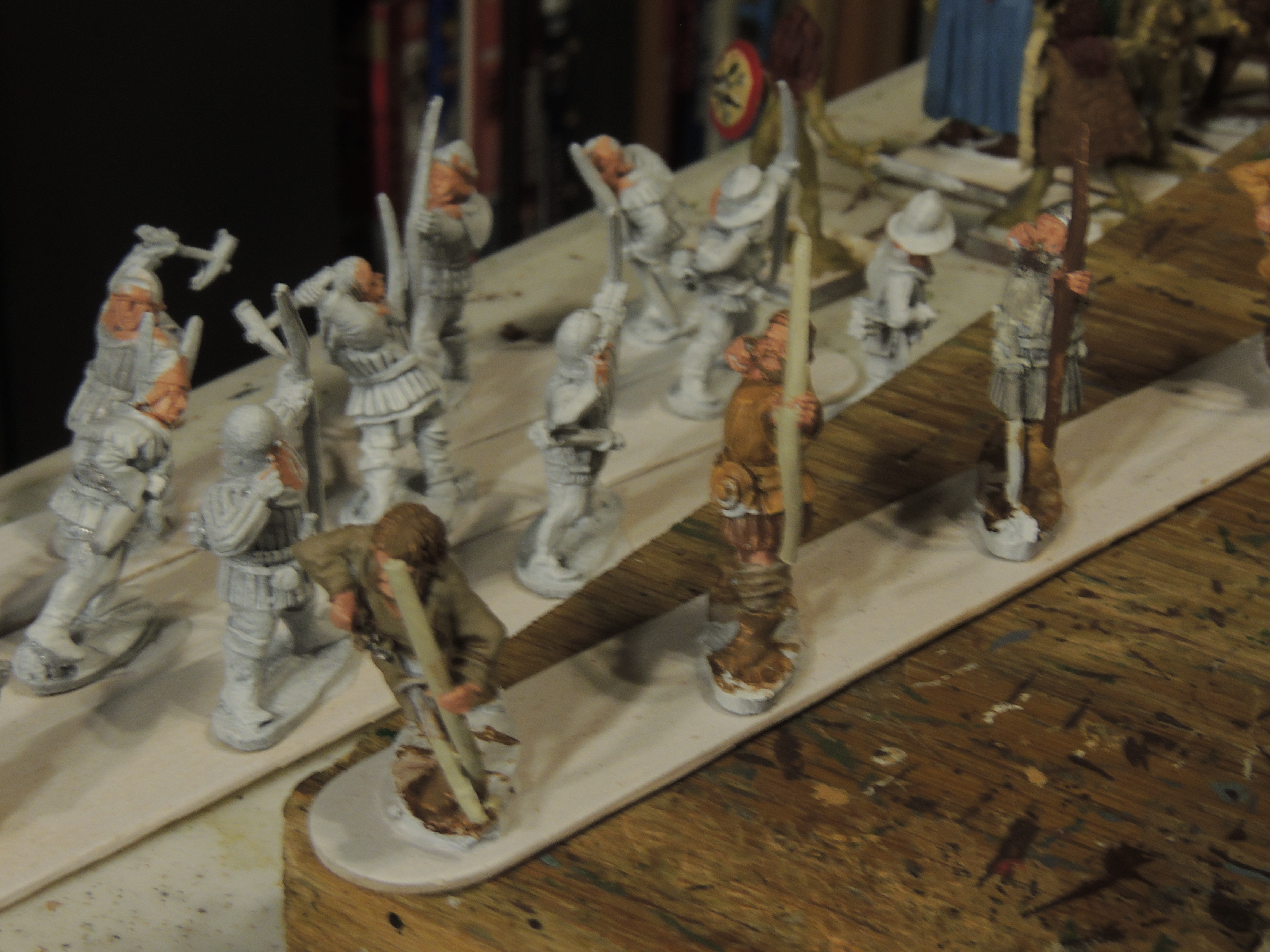
Longbowmen are nearly finished.  Just basing to do.  I've applied the Liquitex Modeling Paste and have begun painting with Burnt Umber.

Longbowmen are nearly finished. Just basing to do. I’ve applied the Liquitex Modeling Paste and have begun painting with Burnt Umber.

For those who don’t know my basing supplies, I use Liquitex Modeling Paste.  It comes in a jar that lasts me about a year.  $12.99 at Jo-Anns, less with a coupon.  It comes in a larger size, but I’ve found, much to my chagrin, that it tends to dry out and a lot of the material is wasted.  I’d stick with small even though the larger one is a better value. It comes in white, and is an acrylic substance that dries quickly.  You can usually paint over it within an hour.  I usually just paint it with Burnt Umber, i.e. really dark brown, and dry brush over it with Ceramcoat Trail Tan, and then apply whatever flocking I want to use.

One thing I’ve learned, to my sorrow, is that my pair of Dick Blick Kolinsky Sable 0 brushes are about to kick the bucket.  I’ve had the same ones for a couple of years, but alas, it’s time to look for some new ones.  I’ve lamented the cost of these brushes before.  They were about $3.99 when I first started buying them about eight years ago and they are now about ten bucks each.  If that wasn’t bad enough, Kolinsky sable is now considered a protected species by U.S. Wildlife, so the brushes are now spendy AND hard to get.  Grrrr. I worry enough about global climate change, do I have to stress over my brushes too?

I’m going to try a substitute.  I’ve ordered some Escoda Versatil brushes from the big Blick.  The art supply giant touts these as the synthetic alternative to Kolinsky Sable.  They are about a dollar cheaper, so not cheap and of course you have to chip in some cash to mail the little buggers. I’m hoping for the best but I don’t like synthetic brushes.  They tend not to hold their point long and bend, but I’m willing to give them a try–or start farming Kolinsky sable.  I have a big backyard, though I’m not sure the Aussies would like them.  Rusty would be good at herding them I’m sure.

Bay Area Yards U.S.S. Miami.  The Miami was a double end gunboat, one of several classes built during the American Civil War.

Bay Area Yards U.S.S. Miami. The Miami was a double end gunboat, one of several classes built during the American Civil War.

The other piece on my table is the U.S.S. Miami by Bay Area Yards. I like the shape and size of the resin hull.  I also ordered the mast kit for the model from Bay, but I’m pretty sure I cut the masts too short and the model looks goofy.  Overall the miniature looks good, even though the stack seems a bit extreme in its raked angle.  I used Bay guns too, which are very nicely sized.  Not quite as detailed as Thoroughbred guns, but those are a bit out of scale.

I learned at Enfilade that Bay Area Yards was sold to Old Glory.  I haven’t heard anything about this from OG, and the Bay site, though it has many items unavailable, makes no such announcement.  I do hope these miniatures remain available.  I’ve had a lot of fun building them and hope to get more. Quite a bit of work left to do on the Miami, but will update photos as I go.

And For Your Listening Pleasure: Radiohead The Bends

The BendsAbout twenty years ago I listened to music with my 15 year old son.  We did the grunge thing together.  Pearl Jam, Mudhoney, Soundgarden, Nirvana.  It was all quite familiar.  But after Kurt Cobain died and the Grunge movement began to peter out, Pat began listening to other bands, including Radiohead.  I had little experience with them, except for watching them live on an MTV Music Award show.  I didn’t like them.  They seemed weird for the sake of weirdness, and that’s always a no go for me. Over the years I’ve sampled a bit of their work, but really haven’t listened for real.  When I was in Astoria I went to Rock and Bach, the local record store.  They mostly specialized in new pressings.  I bought a copy of The Bends by Radiohead and tonight I finally broke it out of its cellophane and listened.

It’s a great record.  If you like classic guitar rock you’ll definitely find something to like.  It’s musically strong without being loud or overwhelming. Very melodic, I really liked it at first listen.  But it’s just as clear this isn’t a happy record.  Thom Yorke’s lyrics, which  I usually pick up last, are definitely a downer.  Even so, it’s a record I’ll listen to often. Very good stuff.

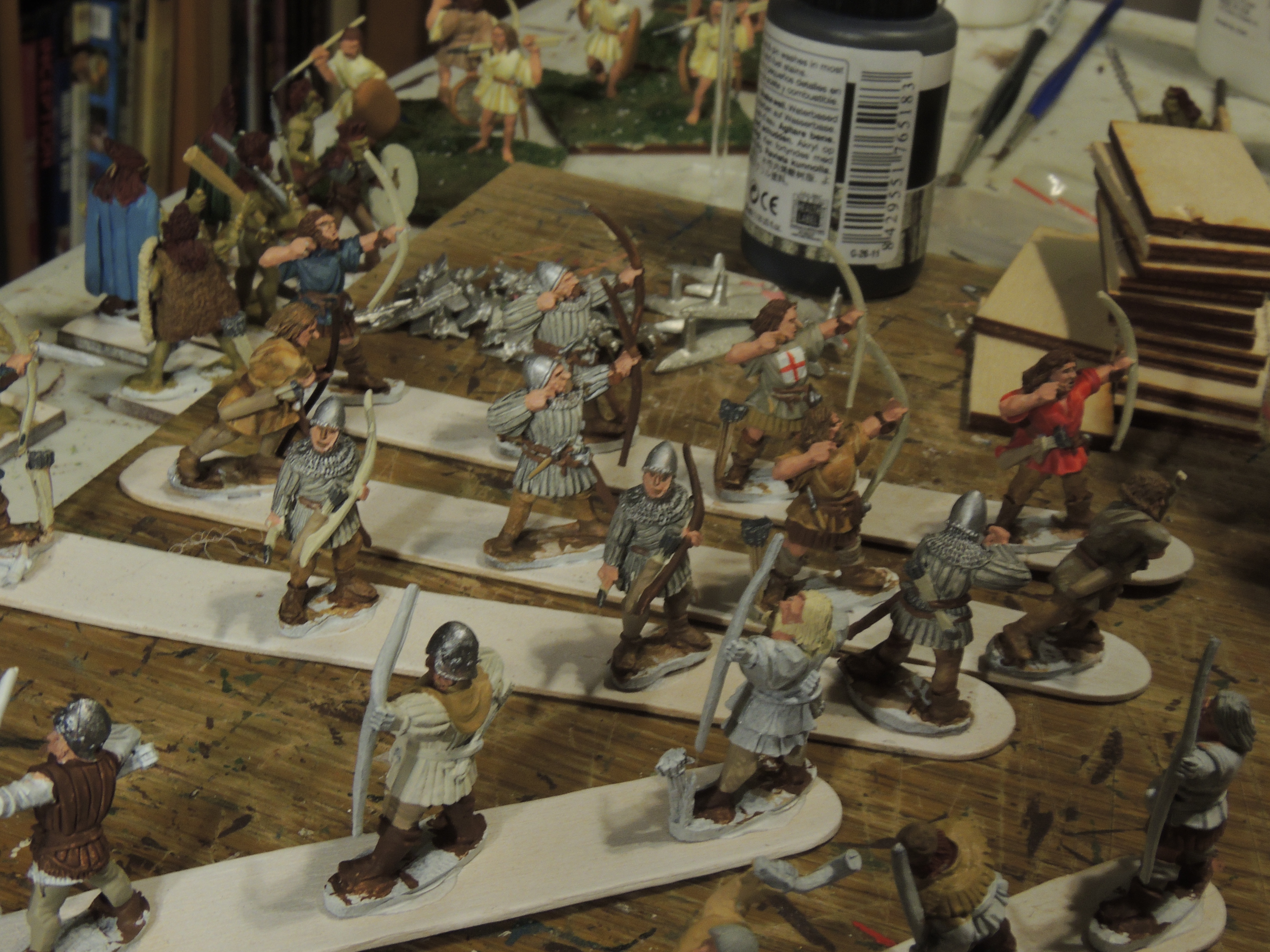
Longbowmen: WIP 2

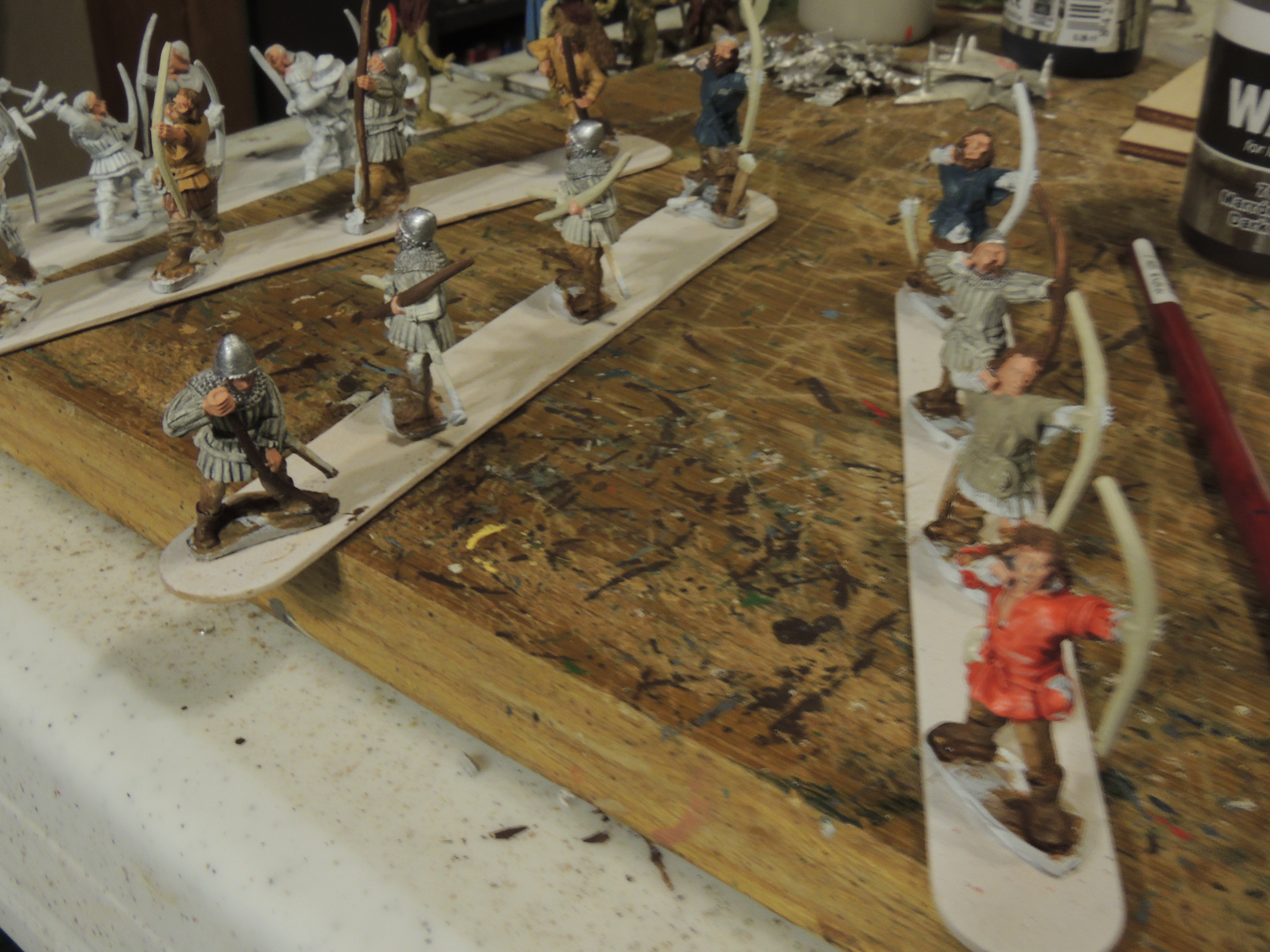
A dozen archers done, I've begun working on batch two.

A dozen archers done, I’ve begun working on batch two.

As you can see, my longbow unit is coming along.  The first dozen are done.  I’m working on the final twelve.  I had a pack of later longbowmen I could combine with the early guys, so some jack armor to combine with the gambesons and unarmored, as well as some kettle helmets and even a bascinet.

Last night I made a lot of progress on batch two.  About to move on to detailing.  I hope to have them finished by Sunday.

Last night I made a lot of progress on batch two. About to move on to detailing. I hope to have them finished by Sunday.

Mostly I tried to stick with more muted colors–various tans and browns as well as somewhat dull reds and variations on blue-grey. I painted the gambesons, which are essentially a quilted linen or wool jacket stuffed with scrap cloth or horsehair, white and washed them black.  The other clothing colors get a wash of black or brown and often a lightened highlight.  Haven’t quite gotten there with the second batch, but soon.

It probably took five to six hours to paint the first twelve.  I’m about three hours into the second group. I’ve given up trying to paint eyes on these guys.  I think I need a stronger pair of cheaters–and definitely some new brushes if i”m going to attempt that with regularity.  I’m getting a little old to see well enough for it.

Hoping to have these wrapped up by the weekend.  I won’t post again until they are finished and based. I’m eyeing a ship model for my next project–the Bay Area Yards mini of the U.S.S. Miami which should offer some challenges to go with the fun of assembly and painting.

AND NOW FOR YOUR LISTENING PLEASURE

As promised I have a couple of records to share.  It’s been easy to listen because the M’s have lost every game since my last post.

HoppkorvHot Tuna was Jorma Kaukonen and Jack Casady and supporting musicians.  Kaukonen was lead guitarist and Casady bassist from Jefferson Airplane.  Hot Tuna was their spin off project that actually lasted longer than the Airplane. Hoppkorv, their seventh record from 1976 is probably their first embrace of a mainstream pop sound.  HT’s prior records were filled with extended jams, mostly Kaukonen’s compositions with Casady’s rumbling bass providing the foundation for the guitarist’s extended riffing. Hoppkorv adds keyboards to fill out the sound.  Covers dominate with Kaukonen adding only one of his own songs.  There is a great cover of Buddy Holly’s “It’s So Easy” and another of Chuck Berry’s “Talking ‘Bout You.”  If  the album lacks a great “go-to” track, likewise it doesn’t have any stinkers.  It’s a great record to paint to, uptempo without being obnoxious, ten great well-played songs.

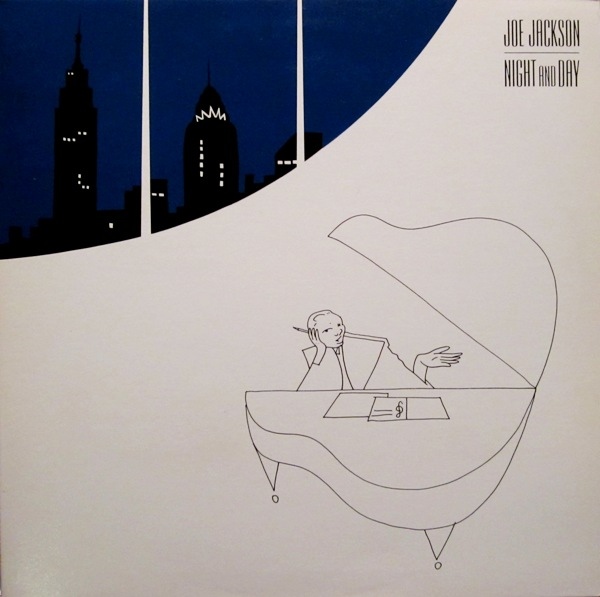
Night and DayLast night I pulled out my copy of Night and Day by Joe Jackson.  Jackson was in the forefront of the New Wave with 1979’s Look Sharp! But by 1982 he’d taken the edge off and put together something positively Gershwin-like. Short, with only nine songs.  Side A, the “Day” side positively sparkles with MTV hit “Breaking Us In Two.” It follows with intelligent commentary on ’80’s culture.  But the real gem is “Real Men,” a critique of masculinity in the early 80’s.  Side B “Night” I found to be less interesting, with “Chinatown” a genuine stinker.  But the record ends with the magnificent “Stepping Out,” another star of MTV’s early days.  I loved listening to this again, the piano-driven and salsa-laden melodies are quite good, and some of the songs are so great they’ll have you singing out loud.  Good painting music–well it worked for me.

And Now For Something Completely Different: Music For Your Painting Pleasure

I have made no secret of my love of vinyl records. Researching and cataloging compete for my time along with painting and gaming.  But I’ve never forgotten how much I Iove this hobby, the people in it and, especially painting figures, and so I’m trying to figure out a way to bring the two together.

With the baseball season ending soon, at least for we sad Mariners fans, I’m looking at a way to maximize my listening and painting time.  In the past, I’ve always been able to make about an hour per night available for painting.  Sometimes a little bit more, but an hour a night about 340ish days per year.  This year it’s been harder to pull that off.  Maybe with my health issues, or the distractions that come with other interests it’s pulled me off track.  One serious distraction is my three delightful companions who don’t like me in my painting room.  They often come in demanding a walk or some unidentifiable something.

Anyway, as the baseball season evaporates into a cloud of disappointment, I am making an effort to spend more time in my painting room–painting-which is good because it’s way too small to do anything else.  To keep me there I plan to paint at least long enough to listen to a single vinyl record.  A record lasts about 20 minutes per side, so about 40 minutes total.

A by-product will be sharing with you the reader, what I’m listening to and what I’m working on.  So, it will be a compilation of music to paint to. Let’s see how this works.

I'm currently working on a dozen Old Glory longbowmen.  They'll paint up fairly quickly if I just put the time in.

I’m currently working on a dozen Old Glory longbowmen. They’ll paint up fairly quickly if I just put the time in.

I’m currently working on some Hundred Years War longbowmen.  Pretty easy and straightforward work.  These are Old Glory bowmen.  I find them to be simple to paint.  I also feel like they are underdressed.  These are pretty good for levy bowmen, but an awful lot of bowmen accompanying Edward III, the Black Prince or Henry of Lancaster in France or Gascony, or Castile in the middle part of the 14th century probably would have worn more garments that could have shown livery colors such as a hooded tunic or gambeson.  They are suitably lightly armored, but just a bit too casual.

I also got started on the next twelve figures in the 24 figure unit.  Twelve figures at a time is usually about all I can manage at once without out bogging down.

I also got started on the next twelve figures in the 24 figure unit. Twelve figures at a time is usually about all I can manage at once without out bogging down.

I’ve been working on these first twelve figures for a few hours.  Tonight I washed the brown surfaces-tunics, leggings and shoes with Vallejo Brown Wash.  I also went on to paint basic hands.  Not a lot to get done in 40 minutes but progress.  In the background you can also see twelve more figures freshly primed, and I painted their basic flesh on their faces.

I have a load of painted longbowmen individually mounted for Lion Rampant and multiple mountings too.  These will be for my muliple-mounted game-based on Fire and Fury–but they will be skirmish stands.  Under these rules the English army will be able to break some bow units into skirmish order to take advantage of terrain or act as tirallieurs as suggested by Matthew Bennett in his essay on battle tactics of the Hundred Years War.

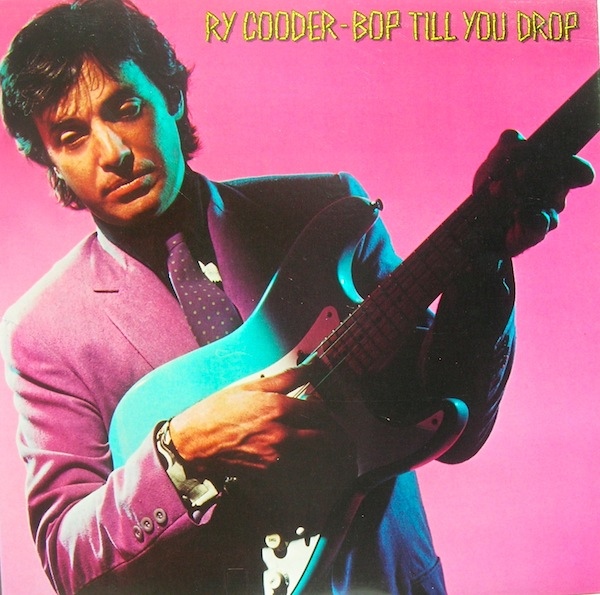
Ry Cooder's 1978 is known for being the first digitally recorded album.  A collection of light R & B songs I found it to be very pleasant painting accompaniment.

Ry Cooder’s 1978 is known for being the first digitally recorded album. A collection of light R & B songs I found it to be very pleasant painting accompaniment.

Tonight I popped Ry Cooder’s Bop Till You Drop on to my turntable.  I picked it up for a buck at an estate sale and this was my first listen.  I’ve always thought well of Cooder as a guitartist, songwriter and collaborator so I was anxious to give it a spin.  It was quite enjoyable.  It is a collection of rhythm and blues tunes, with Cooder backed up by a great band including Jim Keltner and David Lindley.  Chaka Khan makes a guest appearance providing backing vocals. It has a very light touch with great songs like “Little Sister” and “I Can’t Win.”  The album is famous (or notorious) for being the first digitally recorded record.  Though it is not particularly highly thought of, I found it to be perfect music to paint to.

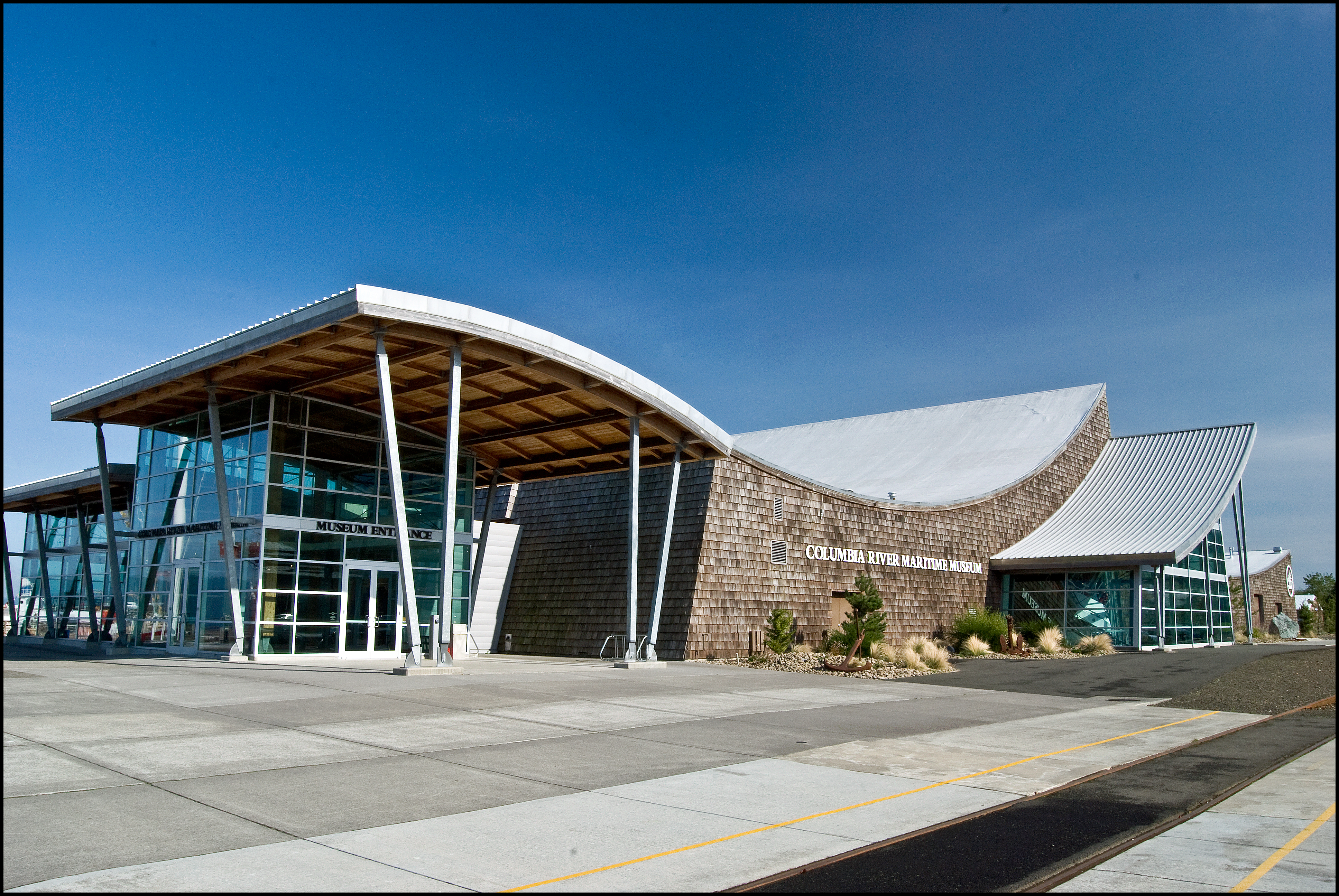
Gaming at the Columbia River Maritime Museum

columbia-river-maritime-museum

I love Astoria.  It is one of my very favorite towns. Astoria is a great mix of new and old with its Victorian houses and riverside condos.  It has a wonderful selection of excellent brew pubs, blocks of small and off-beat shops and antique malls. I’ve made Astoria a regular stopping point for the last twenty years or so and my wife and I love to visit.

A few years ago Astoria gamers Lloyd and Dave suggested a game gig in Astoria.  Lloyd, a retired Astoria teacher and a docent at the Columbia River Maritime Museum, suggested we might hold an event at the museum.  This summer he offered up a date.  As soon as I hear about it I suggested to Lorri we attend, go down early and spend an extra day in town. We immediately booked our stay at the Crosby House, an Astoria B and B and made plans for boarding the Aussies. The game was scheduled for Labor Day Sunday, so we made plans to drive down on Friday spend some time together in Astoria on Saturday, game Sunday, and have leisurely drive back on Monday.

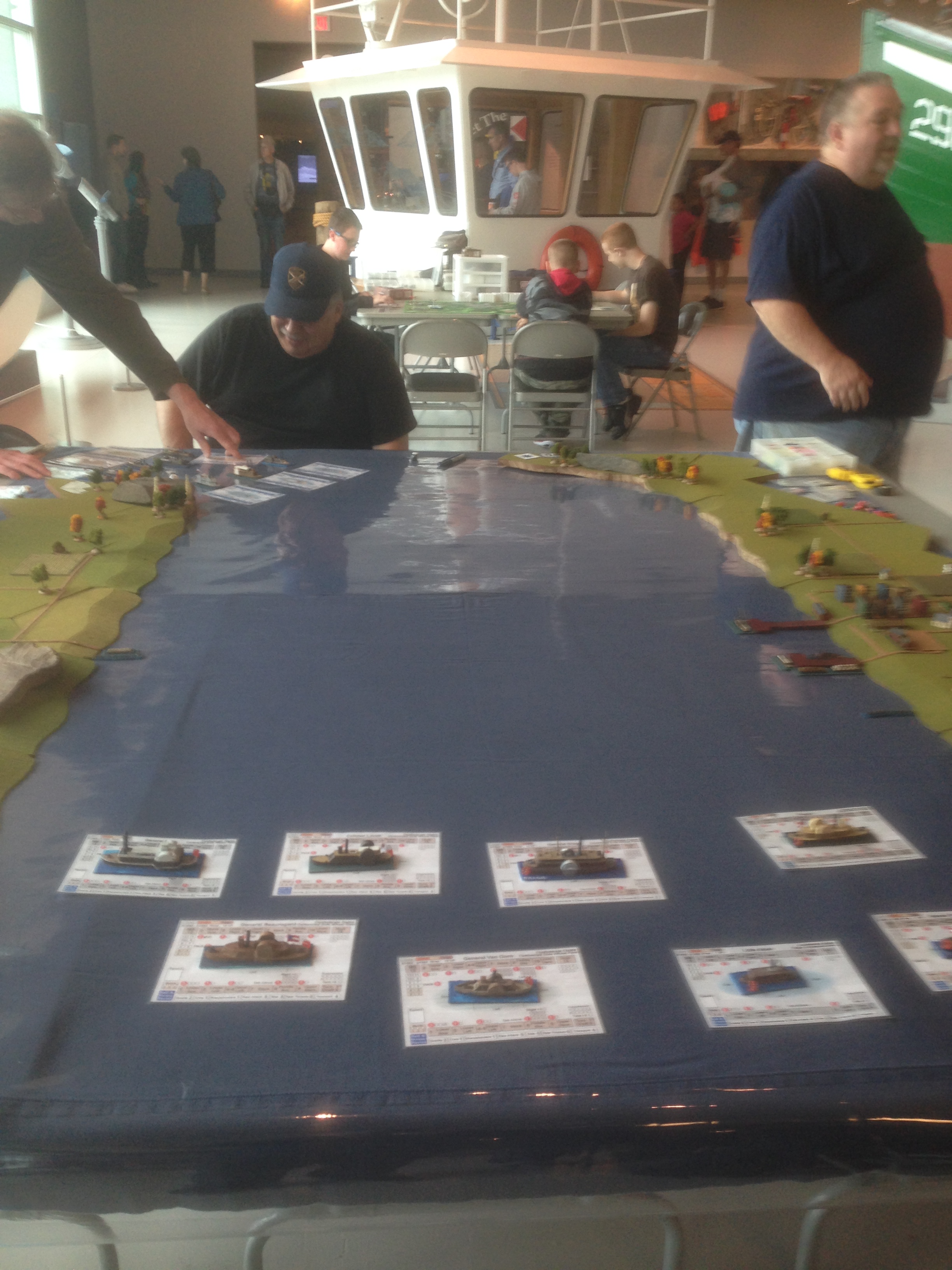
I’ve already written extensively about our big Astoria shopping outing, and you can read that here if you are so inclined. But the real attraction was the game day.  I arrived at the museum at about 9:45, a short drive from Crosby House. Lorri dropped me off with my goodies and I met Lloyd and the guys waiting for the museum to welcome us. We were shortly ushered into our game space.  Scott Potter set up an all-day Wings of War furball on one table.  The second table was taken up by the rest of us.  In the morning Dave, Lloyd and Dan set up the Battle of Memphis, an American Civil War naval battle, using the Sail and Steam Navy rules.  Ah, a set of rule I know and a battle I’ve always been interested in but afraid to try.

Confederate ram fleet in the foreground, looking down the river as the Union forces prepare their advance.

Confederate ram fleet in the foreground, looking down the river as the Union forces prepare their advance.  ACW naval newbie Clyde Carpenter prepares for the big show.

Memphis starts out simply enough.  The Mississippi Defense Fleet (Confederates) have their rams fighting upriver to defend Memphis from a combined arms fleet of Union armored gunboats and rams coming down river.  It’s a tough spot for the Johnnies because, to be effective, they have to ram the Yankees and they are badly outgunned. The rules call for two movement phases, giving a distinct advantage to rams, but the GM’s decided on a house rule allowing only one movement phase. I opted to be a Confederate, knowing it might be difficult.

The game started with a plan to use four vessels to engage the Union rams, leading the parade on to the board, while the remaining Confederates took on the slower ironclads. You know what they say about plans and first contact with the enemy.

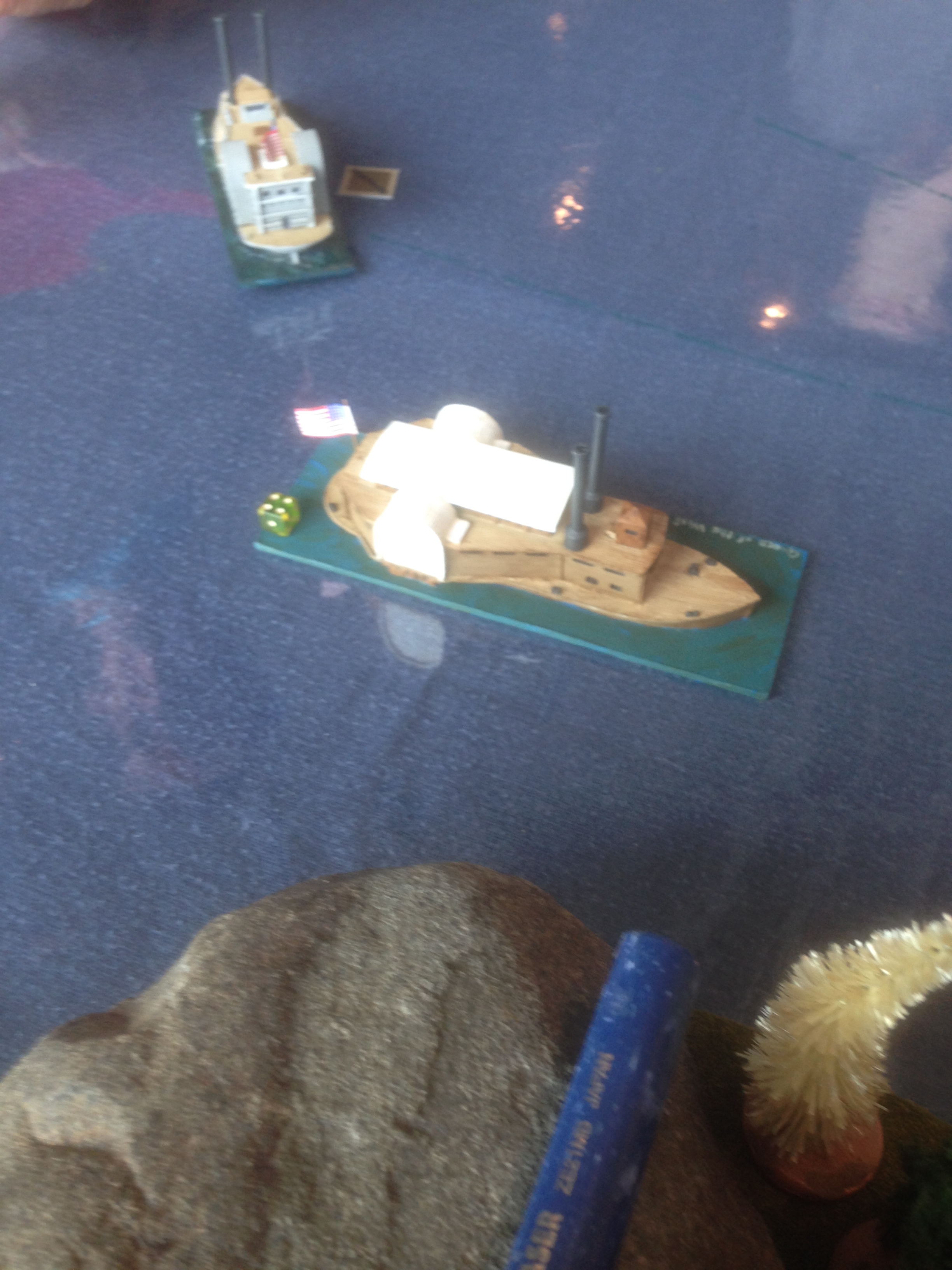
Union ram slips past the Switzerland stuck on a shoal.  It would later be rammed and sunk.

Union ram slips past the Switzerland stuck on a shoal. It would later be rammed and sunk.

The Union players obliged us by running a ram onto a shoal where it remained stuck for most of the game.  Dave Schueler, running the rams to my right slid past the advancing Union rams and near the rear of the Union formation.  My  rams remained in the middle of the board, firing their two small guns as they advanced on the Union ships, taking fire as they went, suffering significant but not critical damage. On the right the remaining Confederates advanced slowly, trying to line themselves up as the Union vessels maneuvered around the shoal and turned upriver.

Let’s just say the rebels were a bit more lucky in their fire than the Union forces. A hit on the Benton critically damaged their boilers, knocking out all power and setting it up for a ram. The Union ram Switzerland, stuck on a shoal was in turn rammed by Daveshoe’s ships and his second ship was lining up a target.  Though some of the Confederate ships, such as my General Price, were badly shot up by the heavy and unrelenting Union fire, they were damaging superstructure, not infrastructure.

We played the game for more than three hours, and I really enjoyed it.  By the end, we agreed the Union would have difficulty meeting their objectives.  One Union vessel was sinking, and others were in serious danger of being rammed. It was good.

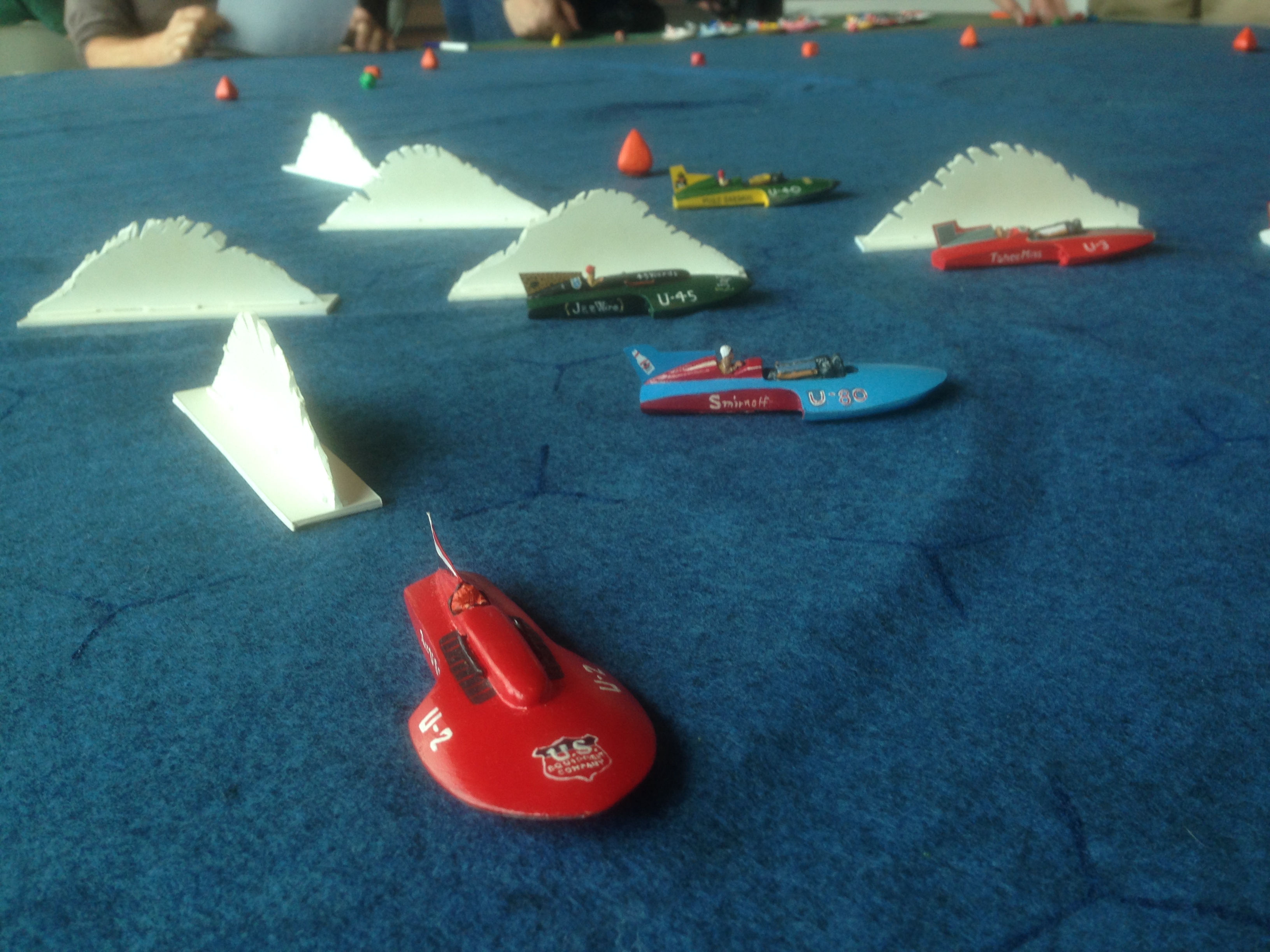
The latter couple hours were spent with Thunderboats!  I promised to bring it because it was fun and easy to learn.  We played from a standing start, so the boats were pretty clustered at the beginning of the game.  But Dave Schueler quickly took control, with a series of great die rolls and passed engine pushes. After the end of the first lap he was so far in front it was no longer necessary to take many chances beyond pushing the engine.  By the end of the game he had a half lap lead on the field.  I believe I finished second in my JagWire boat.  I had super luck pushing corners, avoiding collisions, and splashing through roostertails.  But I could never roll higher than an 11 or 12 on my every turn engine pushes, and never made up any ground on the leader.  Still, it is strictly for fun, and I think there was that in abundance.  Nobody was eliminated in the game despite a rash of hard bounces and water in the intake manifolds.  There was even liberal use of the nitrus bottle, but few fires.

Dave Schueler's Miss Bardahl takes the inside position.  He would eventually fly into the lead and never look back.

Dave Schueler’s Miss Bardahl takes the inside position. He would eventually fly into the lead and never look back.

It was definitely a fun day.  Going forward I would happily do it again, though I’m not sure that Labor Day Sunday is best for me. The weekend is usually the last minute teacher prep days, and to say I really needed those this year was an understatement.

Look, I’m Painting Stuff: Hessian Grenadiers

Hessian Grenadiers 001

School is back in session, and having a much different course load than in years past is taking its toll on me.  I passed on last weekend’s Fix Bayonets, an excellent little game gathering at Old Fort Steilacoom in west Pierce County.  I hope it went well, and to all my friends I’m sorry I missed you.  Next game on the docket is Fire and Fury at the same Old Fort Steilacoom.

My games have been fairly few and far between.  I haven’t reported on my Labor Day Weekend gaming in Astoria, which I will do in the next day or so, but aside from that I’ve been pretty unavailable. But I have been painting.

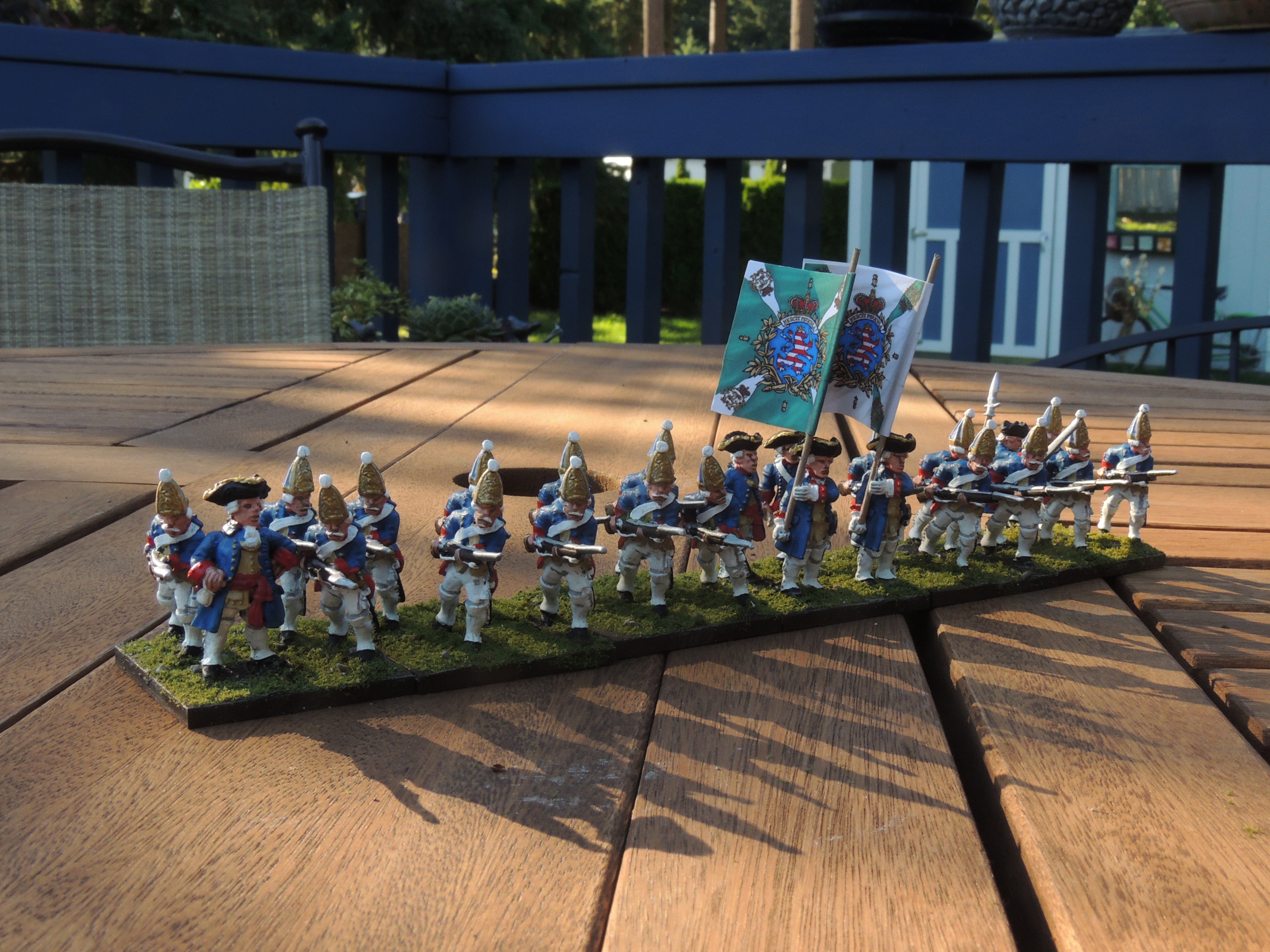
I am kind of in a mood in which I’m painting whatever I damn well please.  First on the docket here is the Hessian Grenadier Regiment von Rall.  It was the only grenadier unit stationed in the south during the later years of the American Revolution.  The regiment changed names at least twice during the war.  The unit was sent to Savannah, where it fought French and American forces and took heavy losses. Von Rall was also at the siege and capture of Charleston and was rotated back to New York in 1780.  Unfortunately the grenadiers were not present at the big battles of the southern campaign, but for a one off game who knows.

The figures are by Foundry.  They were easy to paint.  I was short a couple of grenadiers so leavened them with an extra officer or two.  I found them fun and easy to paint, nothing difficult. They are the first Hessians I’ve painted for my somewhat dormant AWI project. But they certainly aren’t the last.  I have the Old Glory figures to paint the von Bose regiment, present at Guilford Courthouse. I also have some stray Front Rank Hessians I may fill out to 24 figures each for another musketeer and fusilier regiment.

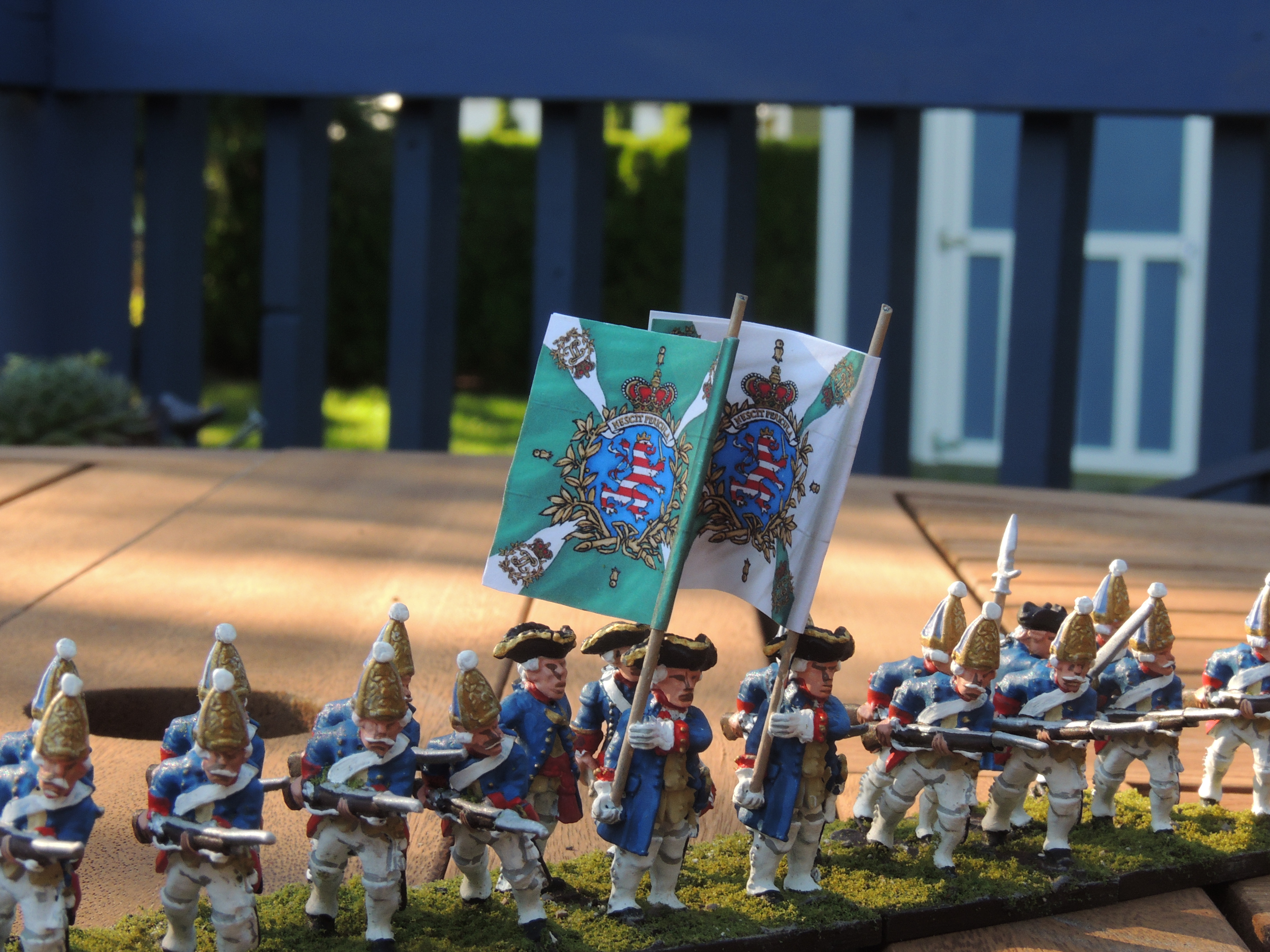
The big “new thing” I tried out with this unit is the addition of GMB flags.  I’ve always been a flag cheapskate, downloading flags from free sites and taking what I could get. With this unit I decided to change.  Giles Allison uses GMB flags on his magnificent units. I have friends that use them.  Heck, what’s wrong with me.  I ordered on-line, which was easy enough. But I did catch them on vacation.  It probably took 2+ weeks to get them from the U.K. They aren’t cheap at three quid 45 pence, but they are beautiful and the color and detail is amazing.

A little closer up of the GMB flags. Very nice. Worth their cost.

A little closer look at the GMB flags. Very nice. Worth their cost.

Last night based the figures and added the flags.  I carefully cut them out and and wondered what to do with them next.  It would be helpful if GMB included suggestions or directions or at least posted some on their site.  Thankfully you can find anything on the internet, and was able to find some forum posts that were helpful.  I didn’t feel too adventurous first time out so the flags look pretty straight, but it does show the detail off nicely.

4Ground buildings

001

Last year, about this time, I was contemplating a big Indian/Loyalist game on the frontier during the American Revolution.  I haven’t done the game yet, and honestly don’t know if I will anytime soon.  The scope in my mind is a lot bigger than my grasp.

In any case, as I was preparing, I realized that I didn’t have many frontier habitations.  How can Butlers Rangers burn down the frontier if there aren’t any buildings to burn? A friend of mine had shared some of his experiences with laser cut wagons at 4Ground miniatures.  I perused their catalog, checked out their buildings from the American frontier and thought I would give them a try. I ordered from my local hobby shop, and they immediately went into the big pile of “all things Smyth,” as in I forgot I even owned them. But as I was deciding what to work on this summer, I set these aside to finish.

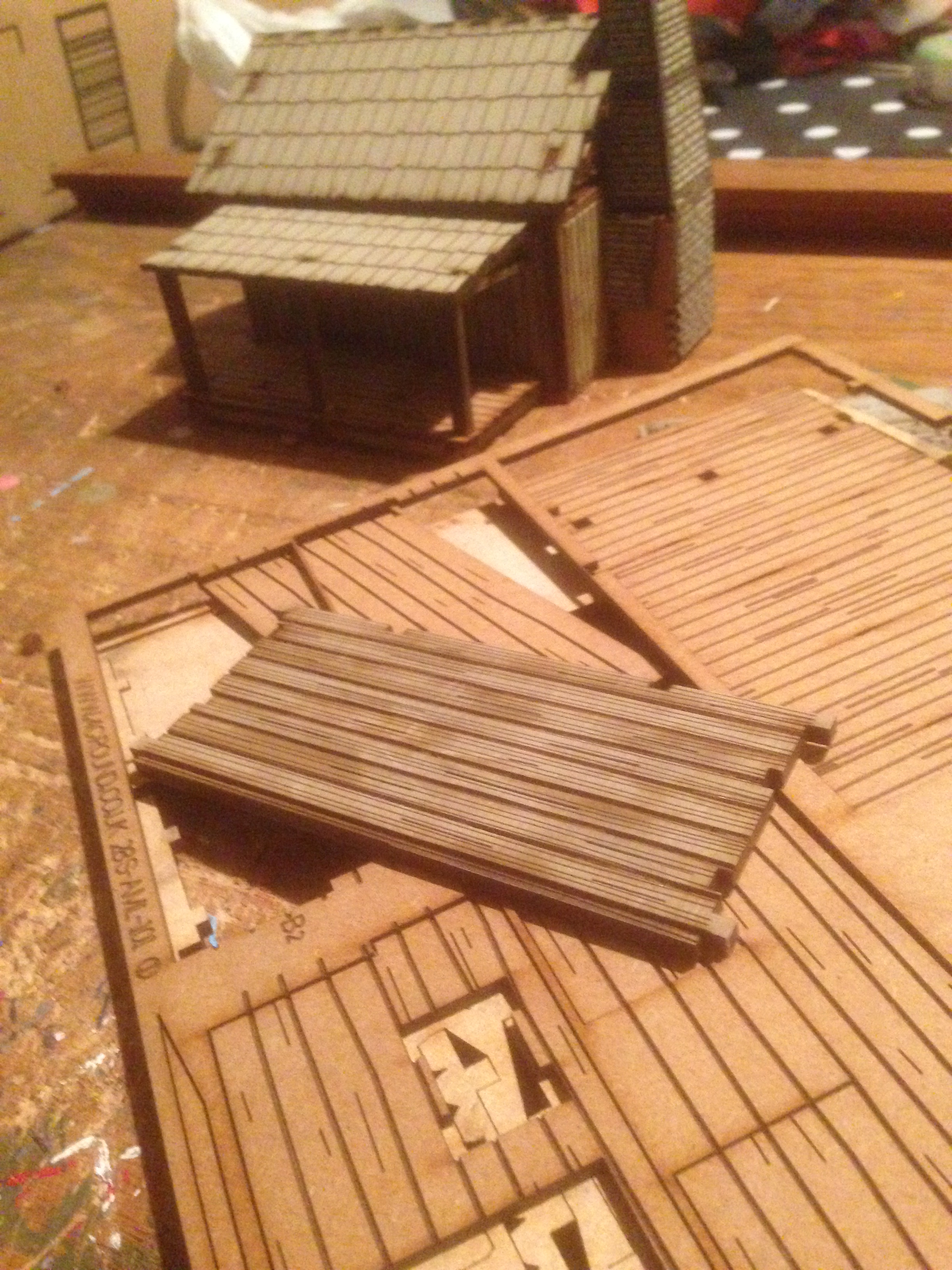
The two buildings I purchased were the Pioneer’s Log Cabin and the Settler’s Log Log Timber Cabin.  Each came in a sealed plastic bag with four slabs of laser cut plywood pieces.  The top was carefully sealed and the full color instruction guide was included with the parts. Together the two kits cost about $60, which is pretty fair for quality buildings–if you’ve priced a structure from Miniature Building Authority lately. . Because the structures are raw wood, the different colored wood examples work pretty well.

I would love to say the buildings went together quickly and without a hitch in a matter of moments, but they didn’t.  It could be that any building project for me is just going to take longer because I”M BAD AT BUILDING STUFF! But honestly, because we’re assembling structures with PVA glue (Elmers or something similar) sometimes things just need to dry. I assembled both buildings over three evenings including two Mariners games and the Republican presidential debate, which was easily as long as a Mariners game.

I can say with truth, that I was quite pleased with the way things went together.  The instructions took me step by step through the pieces I would need at each phase of construction and give a rough picture of how they went together. The pieces were of high quality and did go together well.  The construction was mostly pretty darned easy–good fit.  The finished interior and exterior had nice attention to detail, though there were some gaps I’ll share more about.  I could easily recommend these to another user.

However, I am not without some constructive suggestions. First, there is the matter of the directions.  Though they give an order to things, the lack of even simple written directions at times left me trying to figure stuff out and tearing things apart to reassemble. I felt like Tonto, with half the vocabulary, giving directions on sewing a shirt to The Lone Ranger. “No Kimasabee, it go here.”  The lack of clarity led me to mis-assemble the chimney on one of the buildings, though it is obscured by a chunk of the roof.  Pity, because the detail is so great. Another issue with the directions is although the piece numbers are printed on the color directions, they blend right in and are difficult to read.  For those of us in the geriatric set, this is a problem. Bigger, darker, clearer would be better.

In the case of the Frontier Log Cabin, some of the pieces really needed double assembly so the detail would show on both sides.  For the most part, 4Ground is really good at doing this, But for this model, some of the finishing pieces could be better.

Overall, for price, quality of detail and ease of assembly, I can at least give these models a solid B, maybe even a B+.

Hundred Years War and fighting the big battle.

Lion Rampant is a great set of rules for fighting the many small actions of the Hundred Years War.  Adding a few more troop types, like town militia and mounted archers will help.  But overall I think it’s a fine set of rules that are simple and easy to learn.

I run into trouble when I want to fight a big battle.  I’ve bought fully into the Hundred Years War sickness. I have my 400+ (and growing) singly mounted figures.  But I also have 200+ (and growing) miniatures on multiple figure bases.  So I’m preparing to fight the big battles as well as the skirmishes, raids and small battles.

My problem is finding a set of rules to do the job. The rules sets I’ve seen don’t fully embrace the unique characteristics of the Hundred Years War, and it’s much different than other wars.

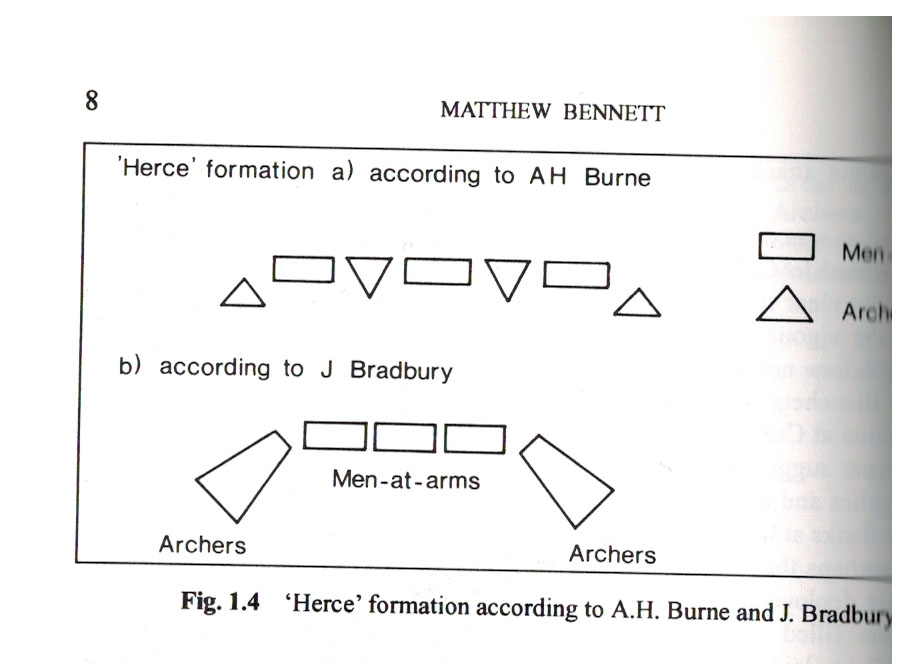
Much of that uniqueness is related to the English system of warfare.  To fully understand it means throwing out some myths about how the English fought.  Lots of that myth was perpetuated by a relatively modern writer of English military, Col, Alfred Burne. Burne wrote two important books on the Hundred Years War, The Crecy War and The Agincourt War in 1954 and 1956 respectively.  His model for the English battle line looked something like this:

Burne and Bradbury

In this drawing the triangles marked with an A represent archers, specifically longbowmen.  Burne’s argued, that based on his reading of Froissart’s version of Crecy the English adopted a herce or harrow shaped formation with archers interspersed in the main battle line.Burne’s reasoning was that the harrow, an agricultural implement had teeth with gaps between for the grain to be gathered.  Thus the English line must have had archers as the teeth.

This was accepted orthodoxy for many years, until it was questioned in Jim Bradbury’s 1985 book The Medieval Archer. In his analysis of Burne’s work, Bradbury suggested that the little wedges of archers in the English battleline would have led to weaknesses easily exploited by French cavalry or armored  men-at-arms in melee.  Bradbury suggested that It was far more likely that longbowmen were deployed well out on the flanks, protected by terrain features or battlefield improvements such as stakes or pits. Bradbury’s models for the proper deployment of the English army at Crecy and Agincourt are widely embraced by the scholarly community.  This diagram is from an article by Matthew Bennett in Arms, Armies and Fortifications in the Hundred Years War (1994).

The challenge in fighting the big battle of the Hundred Years War is to properly depict longbowmen which usually form 1/2 to 4/5’s of an English army. In several sets of ancients rules that also depict the Middle Ages, one of the complaints about Hundred Years War English is that they don’t make a very good army.  That’s chiefly because unless the English are fighting according to their historical set up they have little chance to succeed.

In his biography of Edward III (Edward III and the Triumph of England, 2013) Richard Barber’s analysis of Crecy begins with an apology for having so few facts about the battle.  But as he examines as many eyewitness accounts as possible, including a definitive location of the battlefield, However, one thing he communicated with certainty is the likelihood the English men-at-arms, fighting dismounted, were on a very narrow front, as little as 400 yards. Reasoning, the archers must have been able to cover the armored troops’ front with fire,or at least the front of their division with fire. Bennett, in his article on development of battle tactics echoes Bradbury’s suggestion that the archers in their horn, may have actually shot over their accompanying men-at-arms.  Sadly, without any kind of evidence or drawing any conclusion.  However, Bennett, in his 1994 article, and echoed in subsequent works, suggested the English may have employed some archers much like the French used tirailleurs in the wars of the French Revolution and in the Napoleonic Wars.  Operating in small skirmishing groups, some longbows may have shot their arrows to prick their more heavily armored adversaries into action, thereby bringing on an action more quickly than was desired.

On the wargame table this could mean providing the longbows with greater range, firing in deeper ranks, and allowing some the ability to skirmish and doge around blocks of friendly men-at-arms.  It certainly means English armies will perform best if their troops are allowed to fight historically.  They are tactically defensive, so forcing them to be aggressive or fight a meeting engagement is well outside their comfort zone. A big battle set of rules should reflect this.