36

36

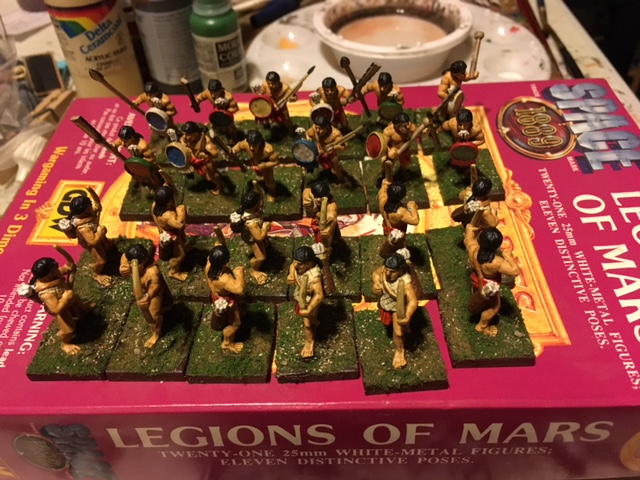
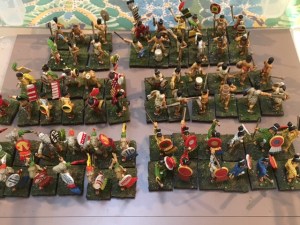
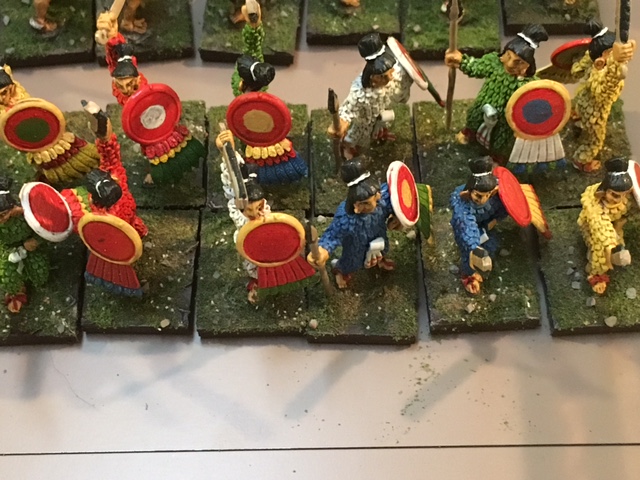
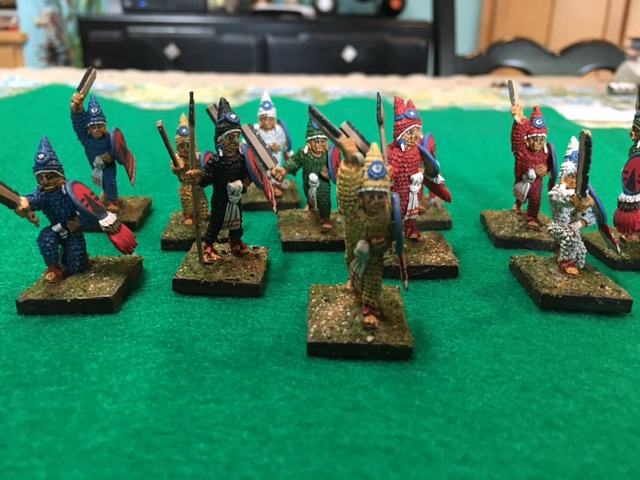
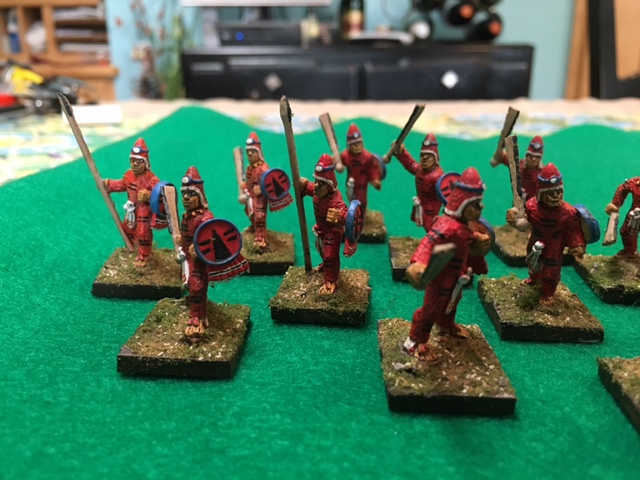
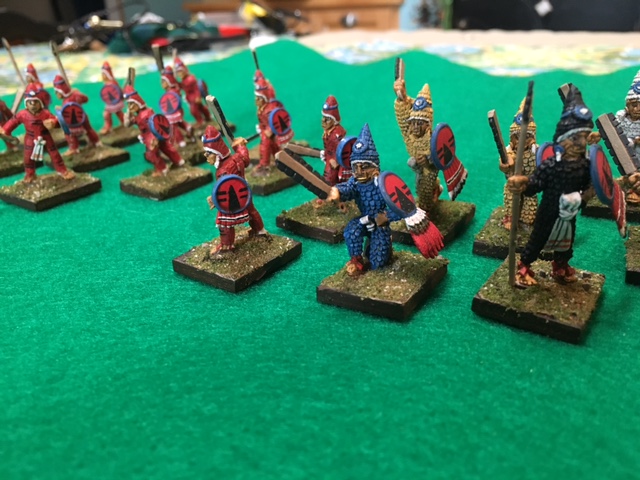
Twenty-four peasant Otomi warriors from my Tlaxcalan command, allied to the Spanish.  Not a lot to  them.  They are in their summer dress uniforms, and can’t afford interesting shield patterns that are above their station anyway. 

I’ve painted like one possessed for this Quetzacoatl Rampant project.  I’ve avoided the trap of over-ordering, and I’ve managed to really persevere and stay focused on getting figures done.

But I don’t think I’ve ever done what I did this week.  I began, painted and based 36 Tlaxcallan warriors. Yes, 28’s.  That’s great because it wraps up all the units I currently own as the newspaper heads into its first deadline week-time to paint will be thin from Tuesday to Friday. I do have two more units of Aztecs coming, and they should arrive about the middle of the week, so I’ll have something to do when the paper is done.

Just a few caveats.  They are mostly without clothes.  They aren’t exactly the Grenadiers of the Old Guard.  They are peasants, so their shields are pretty plain. 12 of the them are archers.  No heraldry involved.

Even so, my painted total of figures for this project is currently is about 260.  That’s pretty good given that I didn’t start until just before Enfilade. I’ve also pinned down the final number needed to meet the 72 point force for each side.  Here is what is left to do:

Aztecs: 3 X 12 figure melee units, 2 X 6 figure skirmisher units= 48 figures

Tlaxcallans: 2 X 12 figure melee units, 2 X 12 figure missile units= 48 figures

Spanish: 2 X 6 figure swordsman units= 12 figures

All in all just about 100 figures.  In addition I’ll add some Aztec command figures and bearer figures for scenario making.

On my painting table

Though I expect this will be a pretty light painting week, I’ve assembled ten 1/285th scale planes by Raiden.  I’m fascinated by the Cuban Missile Crisis and keep thinking I’m going to have some sort of scenario breakthrough for some sort of hypothetical bombing or photo recon of sites in Cuba 1962. I’ve got the following lined up

2 X F8 or RF8 Crusaders–did actual photo recon over the IRBM sites in Cuba, one of my very favorite jet fighters

4 X F-100 Super Sabers–Front line USAF fighter of the time. Don’t have any F-105’s to go with them.  They will be in Air Force natural metal

4 X A-4 Skyhawks-early Skyhawks without the lump.  Somebody has to deliver the payload.

2 X F3H-Demons-all weather, all missile armed fighter.  Progenitor of the F4 which was replacing it at this time.

I have a couple more Crusaders and Demons on the way from I-94 Enterprises as well as some new decals. Won’t have these finished in time for the Museum of Flight on November 6th, but I do expect to have them for Enfilade.  Am bugging Dave Schueler for a good scenario.

Music to paint by

rodriguez

I’ve listened to so much good music lately, and I haven’t shared much of it. But one album I picked up used is Cold Fact by the artist Rodriguez for about twenty bucks. It is a re-pressing of a 1970 record released by the Detroit based singer songwriter that sold poorly and the album and performer sank into obscurity. But Rodriguez’s story became the subject of a 2012 documentary called Searching for Sugarman, and the album was reissued.

I decided to give the record a try, and was not disappointed. Think of early Jackson Browne, the good stuff, but probably not quite as consistent.  Critical of the establishment, observations of drug culture,  the best song is definitely “Sugarman” but the rest stand on their own. Worth a listen, but I found it a worthwhile add to my collection.

The feast of St. Crispian and this wargamer’s life.

perry-royal-armouries-agincourt

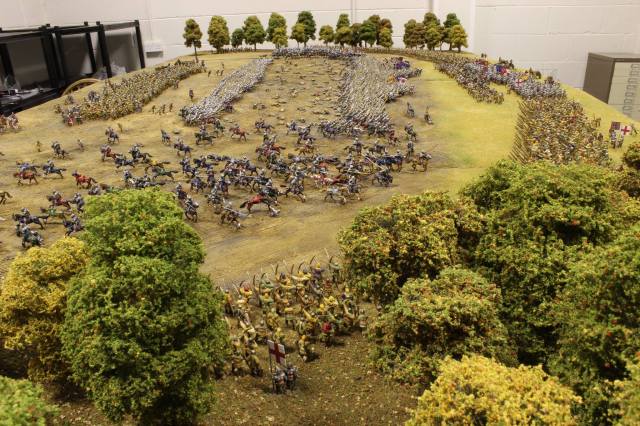
Alan and Michael Perry’s amazing diorama in the Royal Armoury to commemorate the 600th anniversary of Agincourt. 

October 25th is the anniversary of Agincourt, fought in 1415, 601 years ago.  Agincourt is one of the best remembered of all British battles, one that recalls good King Hal with his tattered band of yeomen drowning a vastly superior French army in a sea of mud, while raining down a storm of arrows that left the French broken, dispirited and leaderless. That’s all hokum of course, according to the new research about the Hundred Years War and this most English of battles.

But this post isn’t to revisit Agincourt and our changing perceptions of the battle, it’s really about me. I don’t claim to know everything about the battle.  In fact, I’m regularly confronted with the fact that I know little.  But learning about Agincourt set me on a road I remain happy to follow: a healthy obsession with the Hundred Years War I play out in reading and miniature wargaming.

the-face-of-battle

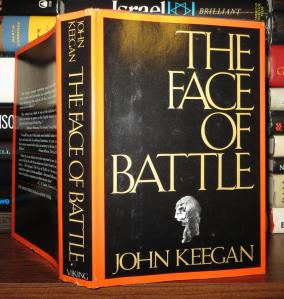
My battered 1976 copy of the Face of Battle. It wlll be the last book I ever part with. 

No work influenced my connection to this period more than John Keegan’s 1976 book, the Face of Battle.  Intended to be a look inside battle, from the soldier’s perspective, Keegan devoted about 37 pages to breaking down the experience of archers, men-at arms, and horsemen at the battle.  Drawing from mostly secondary sources, Keegan’s observations were vivid.  Though measured against today’s writing, it may seem wholly incorrect, The Face of Battle drew me into the period and put Agincourt on my list of must do’s.

I read Keegan’s book in 1978, the summer I graduated from college.  It is about this time I also plunged fully into miniature wargaming. Surprisingly, or maybe not, I didn’t leap headlong into the HYW in miniatures.  My friends and I played Napoleonics in 15mm, WRG Ancients, again in 15mm. Later I did George Gush’s Renaissance rules, Lynn Bodin’s Imperialim, my first flirtation with 25mm figures. But no Agincourt.

In 1989 I saw Kenneth Branagh’s Henry V. And then I saw it again.  I bought it on VHS, I have it on DVD.  I can stream it on Netflix. It is not historically accurate, but the words mean so much to me. Whether it is Exeter reminding the Dauphin that young King Henry has matured and will “make your Paris Louvre” shake with gunstones, or the brilliance of the Crispian’s Day address, it still gives me chills. I’ve watched it at least a hundred times. Maybe I’ll watch it today, make it an even 101. If you’ve never watched Branagh at his finest, it’s here for you to view. If you don’t want to become one of his “band of brothers,” check to see if you have a heartbeat.

I began my Hundred Years War project at least 15 years ago.  I have more figures painted for it than any other, and far more unpainted miniatures than for any other period. I’ve hosted skirmish games and chevauchees.  I’ve run naval battles.  My goal is play Poitiers, rather than Agincourt, because the circumstances of the more famous battle are so difficult to recreate on the game table. While I have plenty of unpainted figures, I really want to take advantage of the new Perry plastics, which have the dual virtues of being beautiful AND cheap.

Though I’ve given up on Agincourt as a game, without my exposure to it, the passion that will always inspire me for the period would never have begun. What began with Keegan and Branaugh continues with Jonathan Sumption and Anne Curry, with the superb miniatures by the Perry brothers, and watching my friend Chris Craft roll his beautiful miniatures out on the table to play Verneuil, and of course, Agincourt itself.

Like most wargamers, I am easily distracted.  My interests change with the moment-new rules, new miniatures, what my friends are doing–but my desire to continue with the project, paint what I have and more, find new ways to game the Hundred Years War, will never die.

What’s the point, man?

I met my painting goal for the week.  I polished off the last of my Aztec figures.  I still have 36 Tlaxcallan allies to wrap up, and tonight (Sunday) I’ll start getting them ready to be primed and painted over the next couple of weeks. My goal is to finish the first twelve–all medium quality warriors, leaving a couple dozen peasant types.  That’s like seven or eight points worth of guys.

Points, I hate ’em. I’m a great believer that points systems kill good scenario making. It’s too easy to just throw figures out on the table at the agreed number of points each and have at it. Most game systems have points that guide choices from Hail Caesar to Flames of War, and I don’t like it.

img_0680

img_0679

My two boxes of Aztec warriors.  A total of 15 units so far, with more to come. 

That said, those same point systems can guide building armies and sticking armies in the field because they do offer an insight to relative strengths of the opposing armies.  I do think it’s okay to have unequal sides, especially of scenario rules and game objectives compensate for that inequality.  But  it’s always nice to know, as a scenario designer what you have on the table.

I like the idea of being able to offer six player games for the “Rampant” series, and the same is true for the Aztecs and Conquistadors. So, with my figures all nearly painted it’s time to evaluate where I am.  The rules call for 24 point retinues or commands, which is a good but not hard rule of thumb. This is what I have:

Spanish

4 X  swordsmen @ 6 pts ea =  24 pts

2 X crossbowmen @ 4 pts. ea.= 8 pts

2 X arquebusiers @ 4 pts ea = 8 pts.

1 X Caballeros @ 6 pts ea. = 6 pts.

1 X cannon and crew @ 4 pts = 4 pts

1 X war dog party @ 4 pts = 4pts

The total is 54 points.  I think that’s plenty of Spaniards.  However, I don’t like the mix.  I would like to add another two units of swordsmen because I feel like the number of missile troops is disproportionate. to a historical Spanish force. It just adds to the counter mix and choices players can make.

Add to the Spanish the Tlaxcallan contingent.

1 X Tlaxcallan knight @ 4 pts ea = 4 pts

1 X veteran warriors @ 4 pts ea = 4 pts

4 X skirmisher @ 2 pts. ea = 8 pts.

The total is 16 points.  I’m not sure this organization works out.  David suggested the Tlaxcallans had separate missile units, so the skirmishers may have to be combined for a total of 12 points.  I will add troops to the Tlaxcallans.  They’ll be the Outpost Tlaxcallans, and I will likely add melee troops to bring them up to about 24 points. Ideally I want them to form about 1/3 the points of a Spanish army. The addition of atl-atls or dart throwers gives an extra point to warriors.

Aztecs

3 X warrior knights @ 4 pts ea = 12 pts

4 X veteran warriors @ 4 pts ea = 16 pts

4 X peasant warriors @ 3 pts ea = 12 pts

4 X skirmishers @ 2 pts ea = 8 pts.

The total is 48 points.  That’s not a lot compared to the Spanish and their allies. The Aztecs could add an extra point to each warrior unit for atl-atl and that would bring things up to 59, but still significantly less than 72 points.  Because the Aztecs are fairly generic, that is a good number to shoot for, so I will continue to add units to the Aztecs.

Even though there is a part of me that wants to be done with this project-I have been dogged in my perseverance with this project for the past five months, both with time and dollars, it’s going to take a bit more to finish up

img_0682

Feather suit warriors by Eureka Miniatures.  I like the feathered suits by Eureka.  Good stuff. 

img_0683

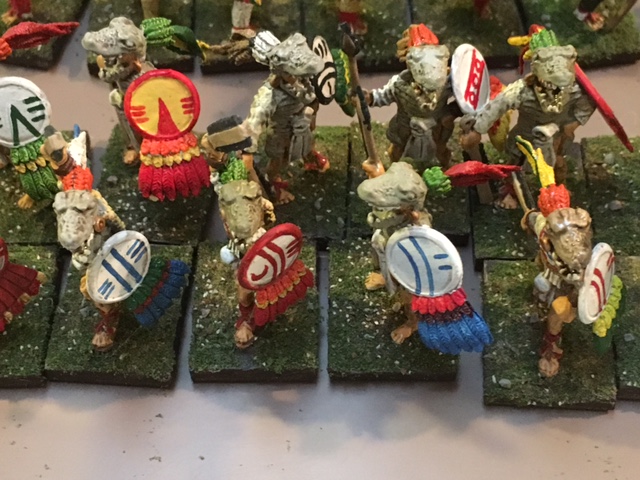
Cayman knights by Eureka.  Interesting figs, though almost no source discusses cayman knights. 

Cortes is ready

After taking time away to begin work on the Aztecs, I decided to polish off the rest of the Spanish I’ve purchased for Quetzacoatl Rampant. It’s been two weeks since our playtest of the game at Meeples and I spent last weekend working on my mounted Spaniards. This week, aided and abetted by our strange day off on Tuesday.  I finished painting on Wednesday, took care of all the washing and basing on Friday, and tried my hand at workable flags Saturday while listening to the Huskies devastate the hated Ducks in Quackland.

All my Spanish are done. There are nine units, each of six figures. In our rules they are nasty, but their small size makes them quite brittle.

I have one mounted unit. The Spanish had a handful of mounted men-not your basic Gendarme from the Italian battlefield, but the horses were fear inspiring, and the riders were motivated, very tough on the Aztecs whose largest domestic animals were small dogs raised for food.

I also have four units of missile troops, two each of arquebusiers and crossbowmen. Both weapons did terrible damage to the native Mexicans who were unarmored or wore cloth padded armor.  But these weapons also had limitations.  They were very slow firing, especially in comparison to the Aztec dart throwers, slingers and archers who could literally rain missiles down on the small Spanish forces. The gunpowder weapons, though fearsome and deadly, like all black powder weapons, were great on their first fire, but prone to misfires as their users reloaded with loose powder and shot.

Finally, the core of all conquering Spanish armies were the swordsmen. Armed with Toledo steel versus cloth armor, light wooden shields and wooden club-like Aztecs, the swordsmen were the most effective of Cortes’ troops. I have four units of Spanish swordsmen, and I my add two more.

All figures are from Eureka, ordered from Eureka USA in Massachusetts.  They are great figures and I very much enjoyed painting them.  They are nicely shaped, and detailed enough, without being difficult to paint.

I’ll be moving on to my last two units of Aztecs, in the hope that I’ll have both twelve figure units finished by Sunday, a week from today. That will leave only the 36 Tlaxcallan warriors to complete.  My goal is for everything to be completed before Thanksgiving so I can turn my attention to terrain for this project and move on to other things. That is about a 250 figure turnaround since I began working on this project in April.  I’m pretty happy with all of it.

A few of my favorite projects

As Quetzacoatl Rampant begins to wind down, I’ve already started looking at some of many unfinished projects and what to work on next.  I’ve promised myself I won’t start anything new until at least next summer. My copy of The Men Who Would Be King, the next installment by Lion Rampant creator Daniel Mersey, arrived from Amazon yesterday.  I’m pretty sold on the Sudan Campaigns with all the various elements from Hicks to Kitchener, maybe even Tel-el-Kebir.

Another project, probably need like a hole-in-the-head.  I’ve done started lots of projects.  Parted with many of them too. 15mm WWII-couple of them-gone, sold them both. 15mm ACW, gave them a good home to an old friend. 15mm WRG Ancients and Renaissance-parted with decades ago. I only have a couple of 15mm projects anymore.  I have 30+ DBA armies I haven’t played with in years, plus a few unpainted for good measure. There is my 15mm Spanish Civil War army I’d like to rebase and perhaps play Osprey’s A World Aflame. I also have a bucket of 15mm fantasy figures I always intended to make into a Middle-Earth campaign built around the Battle of the Pelennor Fields.

But my heart is really set in my 28mm projects.  I have more than I wish to name.  All of them have importance to me, and together with various air and naval projects will be what keeps me in the hobby until I can no longer see well enough to paint.

Even so, I have some favorites that are finished or nearly so, sort of. Maybe. Here are six in no particular order:

Cogs

In 2011 I was utterly consumed by the Hundred Years War.  Today I only have an unhealthy obsession. While reading and painting anything I could get my hands on, I decided I ignored the naval aspects of the conflict and needed to do something about it.  After all there were the naval battles at Winchelsea and La Rochelle, and the decisive engagement at Sluys. I set out to acquire some very nice cog miniatures available from Outpost games.  Unfortunately they were about 3.5 pounds apiece, and needing about 80 or more ships began to consider a better way.

I decided to build them myself.  In the winter and spring of 2011 I did exactly that. I set up a cog shipyard, building nearly 100 ships.  I also built a half dozen galleys and all the terrain for the scenario.  British author David Manley graciously provided me with a beta copy of his medieval naval rules, and I was off to the races.  It was a wonderful accomplishment.  We playtested it once, ran it at Enfilade, and used the ships in a medieval naval campaign at Dave Schueler’s house for his annual naval games.  Just got to get those babies out some more.

It is a completed project that was all my own work.  Perhaps my proudest moment in the hobby.

Lewis and Clark and the Great Spanish-American War 1797-1810

No, there really wasn’t a Spanish American War 1797-1810.  But there could have been.  This project came about because I had another unhealthy obsession, the Lewis and Clark expedition from about 1997-2010.  After some reading Donald Jackson’s Letters of the Lewis and Clark Expedition and running across the authorization of a Spanish force to arrest Captain Lewis and his followers, I decided there was a game in it. I tried it with mixed success at Enfilade and Drumbeat.

But the project really grew further reading about the Burr Conspiracy, the treason of General James Wilkinson, and some additional stuff about the Spanish frontier in America.  The country was so close to war with Spain before and after the purchase of Louisiana Territory, why not put together some forces for a hypothetical conflict.  I put together some Chickasaw allies for Spain, hundreds of militia for the Americans, and regulars for both sides. I also added some home built terrain.  The crowning glory was the game based on the Burr Conspiracy I hosted at Enflade in 2013.  It was simply the most interesting game I’ve ever run.

I have about 200 Indians, Spanish and Americans left to paint for this period.  I should probably just get ’em done.  Don’t see adding to it, though.

Any project with Daveshoe

I am blessed with some really wonderful friends.  Almost all of them are gamers of one stripe or another.  But our friendships go deeper than the gaming table. Dave Schueler is one of those guys. Whether we are talking games, baseball, politics or life in general, Dave is someone I want to grab a beer and hang out with.

We’ve done projects together for Enfilade at least the last ten years, and all of them have been memorable.  Dave is so much better at designing games than anybody I know.  If I have a harebrained idea, he can usually build a game around it that is balanced with intriguing options for both sides.  He is amazing.  And when I say projects together, I’m mostly the painting mule, because that’s what I’m good at-though Dave does his share and more.

The Channel Dash, the air attack on the Tripitz, a naval action in the Straits of Hormuz, hydroplane and air racing, these are some of the projects Dave and I have worked on together.  My favorite, however, is the 1942 Raid on St. Nazaire we hosted at Enfilade 2014.  We discussed it for years, usually over beers at the Elliott Bay Brewery in conversations that began, “Ya know, we outta . . .” The result-I became very familiar with the shade of paint known as Mountbatten Pink, and the game won best raid-themed game at the convention.

One last thing, Dave is always there to help me run games at the convention.  He always knows what I’ve got going on, and helps gamers walk through my crazy schemes.  He was there for the Burr Conspiracy game, a diplomacy/miniatures game which only allowed written diplomatic communications.  He helped out David Sullivan and I with our Fort Pickens game last year, an attempt at a convention style Ironclads game with simplified fort rules. Both went surprisingly well, but chiefly because we had extra hands.

We haven’t discussed plans for 2017, but I’m sure we will.  I think I have one more slot open. Maybe we should re-run an oldie but goody. There are so many to choose from. Nothing left to paint at the present time, except a dozen hydroplanes.  But there could be . . .

Mars and the Red Captains

I don’t know how many years ago it was, maybe as many as twenty, Mark Waddington and I began talking about our unpainted collection of RAFM figures for Frank Chadwick’s Space 1889 Soldier’s Companion Rules.  About ten years ago, or maybe longer, we agreed to get after it and turn it into a game.  All it took was a partner to really get me going.  I painted all my minis and got them ready to play.  But Mark was the true evil genius.  All I can do is paint, but Mark made the toys and caught the eyes not only of gamers, but of Frank Chadwick himself.  Museum quality air ships, steam tanks, earth-boring vehicles all magically appeared at his finger tips like so many shiny quarters

We were hosting games at Dragonflight, ConQuest, and Enfilade and regularly attracting crowds.  Games of 18 or 20 or more gamers would show up at our tables begging to play, with the two of us running games-we couldn’t swat ’em away. The game at Enfilade, however long ago, had 22 players, four GM’s and is the only non-historical game to win Best in Show.

But more than that, the Martian games really created a cottage industry of mostly South Sound gamers who wanted in on the fun.  We hosted regular games supported by guys who were quietly, but rapidly amassing their own RAFM, Parroom Station.  Venusians, Martians, European allies, various mechanicals, even Gene Anderson’s efforts to do the 1/1200 Sky Galleons of Mars in 28mm are all by-products of this project.  All the interested parties called ourselves “The Red Captains” for those non Martians seeking fame and fortune on the Red Planet.

Though our ardor has cooled a bit over the past few years, the interest never dies. Gene’s work was the last big thing, until our efforts to put together gunboat rules for the Canals this summer.  Still a project I’m proud to be a part of. Almost all of my stuff is painted.  About 40 figures of flying Martians left to complete, and a unit of steam-powered mechanical horse.  Less than 50 figures in all.

Hydroplanes

You almost have to be a native Northwesterner to understand my passion for this racing game.  It grew out of an air racing game designed post-9/11 when we were looking for a non-lethal game to run at The Museum of Flight. It morphed into hydroplane racing while a group of us were sitting around one Sunday afternoon at Enfilade, waiting patiently for the crowds to disperse.

Dave Schueler designed the game around a simple series of choices gamers could make constructing their hydroplane and driver, and in-game choices driven by probability as the game progressed.  I love running it.  I love playing it.  But most of all I love painting boats and promoting it to others. We’ve been fortunate to see the game played in other places, including the U.K., learned of through blog posts and other ‘net sources.

I really want to run a game at Unlimited Hydroplane Racing Museum in Kent.  I’d paint pretty much any boat I can.  I have twelve unpainted boats at the moment, including classic ’50’s and 60’s boats and the 70’s pickleforks.

The Hundred Years War

I’ve gone through various phases with the HYW.  I am completely fascinated with the history.  Every time there is a new book available I snap it up.  It is interesting, it is complex, and it has constantly evolving scholarship.  More than any other period, I am completely hooked.

That said, I’ve been working away on figures for this period for a decade or more.  By far, I have more figures for the Hundred Years War than any other period–probably 600 painted figures, with maybe another 400 unpainted. I started with semi-skirmish, looking for rules that would allow me to do some hundreds of small actions of the period.  I cobbled together a homegrown set of rules called Arrowstorm, mostly inspired by Arte Conliffe’s Tactica Medieval Siege rules. But then Lion Rampant happened, and I was completely sold on those rules with their ease of play and interesting quirky randomness.

But my real desire is to build, not only my semi-skirmish, singly mounted, armies, but armies for large scale battles.  My dream is to do Poitiers, 1356.  I have a fair number of multi-figure based units, but lots more are needed.  I also need a set of rules I’m comfortable with that take into consideration the uniqueness of the period. Medieval combat mostly gets rolled into ancients rules that mash everything together and decide that Mauryan Indian longbows that fought against Alexander the Great at the Hydaspes and 14th Cenury English bows are the same,  and had the same tactical use. I think that’s stupid and lazy. So I’ll probably end up doing something on my own. I’ve run a sample example using a Fire and Fury engine.  It didn’t work well first time out of the box–another game Daveshoe helped me with.  I’d like to try it again.

Literally hundreds of figures left to paint, and I can see myself acquiring more of the Perry plastics that are recently released.

There are lots more projects I didn’t write about-American Revolution, Maxmillian in Mexico, ACW Naval, air and coastal gaming.  I love them all, but I’ve already blathered on too long.

KONICA MINOLTA DIGITAL CAMERA

Bins of stuff that needs paint 


Playtest: Quetzcoatl Rampant

Today was the day, long awaited. David Sullivan, Dave Schueler, Dave Demick and I met at Meeples in West Seattle to try David’s adaptation of the Lion Rampant rules to the Conquest of Mexico. Last night I sat down and made some quick play sheets for the Quetzacoatl Rampant adaptation. . This morning I laminated them.I reorganized Aztecs according to the rules. I have thirteen units instead of eleven.

This morning I piled by prized collection into the car, and   I picked up Dave D. in Tacoma at 9:00, grabbed Brother Schueler in West Seattle, and we actually made it to Meeples before the store opened at 10:00

I knew the table space would be fair small, and I was okay with that for our first run through.  I love playing games-miniatures or boardgames-in the Meeples cafe.  It is terribly comfortable, if small.  The food and beer is tasty and cheap.  And because what we do isn’t typically what is played at the store, there are always folks interested in what we are playing.

I set up the table with the Spanish advancing on an Aztec village. The Spanish had a unit of horse, five of sword and buckler men, two arquebusiers, a dog pack, and a unit of Tlaxcallan allies. The Aztecs had four units of skirmishers, a unit of Eagle knights, three units of veteran warriors and two units of peasant warriors.

I didn’t have any expectations.  The Aztecs were pretty outclassed, but didn’t know by how much.  Let’s just put it this way, the Spanish won in a walkover. There were Spanish figure losses, but the Aztecs, though they pointed out about the same as the Spanish, were not able to do much to them.

We went over some simple changes that would balance out the rules: reducing the Spanish armor value by a point, improving the Aztec’s move, shoot and attack values, reduce the accuracy of Spanish arquebusiers.

Like I said, simple changes, and all we need is the opportunity to try it again. Would like to give the game a whirl on a larger table so we can cram all the Aztecs into the game. Can’t wait to give it a try.


Hey jerks, don’t lie to me.

Some things really bug me, and being dishonest and untruthful is one of them.

Before I leap into the issues I have with a certain manufacturer, let me first state what a great hobby miniature wargaming is, and how blessed I am dealing with business people, small business people, doing the best they can with a niche hobby, trying to stay ahead of a fickle market; so many of them are polite, prompt, respectful, helpful, and just really nice people. I truly appreciate that.  I’ve bought mail order, phone in orders to Great Britain, and made internet orders with dozens of companies across the U.S., in the U.K., and Australia.  I’ve never had any serious problems or complaints with any of them.  Some are faster than others, but all of them answered e-mails, kept track of and got out orders, and were completely honest about delays, back orders, and in one case even explained  a mold was missing and they couldn’t make one of my items.

But The Assault Group is simply contemptible. I placed an order on August 15th. This was after John Kennedy, my friend and owner of the Panzer Depot, and former distributor for The Assault Group in America explained they could be challenging to work with.  They had the range of Aztecs and Tlaxcallans I was really interested in, the dollar was significantly up against the pound, so I placed an order for $85.00 worth of Aztec enemies. I didn’t receive an order receipt from TAG with my PayPal payment, so when I hadn’t heard anything on August 21st, six days later, I inquired just to be sure they’d received my order-#4650.  I almost immediately received a response explaining:

Hello!

Your order received on 15/08/2016 was posted today.

Thank you for your custom!

Best wishes,

The Assault Group

Bastards!

I waited patiently as Labor Day came and went and school started. Finally, last Friday, September 17th, I sent out an inquiry to TAG to both e-mail addresses I had. Nothing. They didn’t respond when I threatened a complaint through PayPal.

Today, September 22nd, the order arrived.  It’s been nearly six weeks since my order. That’s not good.  But what really pissed me off is the order wasn’t mailed on August 21st, it was September 9th, three weeks later.

Look, all figure manufactures operate on small margins with small staffs, if any at all. They get behind, they may work “real jobs,” and I am  perfectly understanding if someone gets behind.  All I ask is the truth, not some cock and bull story about “the figures are  in the mail.” The only vote I have is with my dollars, and I will not spend them with The Assault Group again. And you, dear reader, should know in case you decide to play lead roulette with a small miniatures manufacturer in Nottingham.

What’s on my painting table

img_0667

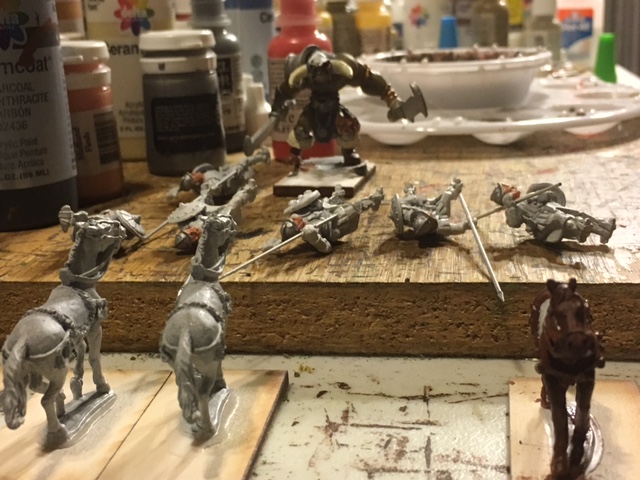
The autumn winds are blowing on my Quetzacoatl Rampant project. I have 24 Aztecs left to paint with 12-24 Aztecs left to buy.  I have 19 Spanish left to paint, and 40 Tlaxcallan allies.  They paint up relatively quickly, so I hope to have the lot done by Thanksgiving. I’m even starting to look around at what to focus on next.  There is Dragon Rampant stuff to work on, hydroplanes to paint, AWI units that need building. I am never at a loss for things to paint. A quick look at my table shows some Spanish caballeros and a really big orc leader.

Music to paint to

beatles-rooftop-concert

I’ve made no secret about my love of the Beatles and I’ve pretty much put together my mini collection of 28 LP’s that cover all their Parlophone (U.K.), Capitol (U.S.) and Apple releases. But one album that caught my eye was The Complete Rooftop Concert.  You may have heard the Beatles did a concert on the roof of the Abbey Road studio in January 1969.  It was the Beatles last live public performance and included keyboardist Billy Preston, whom the Beatles met as a 16 year old performing in Little Richard’s touring band in 1962.

As I was poking through Discogs listings looking for live Beatles music, I ran across The Complete Rooftop Concert.  I was immediately intrigued.  It was an unofficial, unauthorized, i.e,. bootleg, recording offered by the Spanish label, Gato Gordo. I had to order it from Spain, and combined with shipping from Europe was about $35.00.

As records go, it isn’t much of one.  It is largely a set of studio outtakes and run throughs of songs that would appear on the Let it Be album.  There are three versions of “Get Back,” two of “Don’t Let Me Down,” two more of “I’ve Got a Feeling,” and one each of “Dig a Pony,” and their cover of “The One After 909.” Added on is a couple of takes of “Hey Jude.”

I’m not gonna lie, if you like bootlegs, this is the album for you.  The sound is uneven, the takes are raw, there are even some microscopic blank spaces in the recordings. So it sounds authentic.  But the “Complete” label is a misnomer. There are at least three or four songs from the 42 minute performance that are missing.  Even so, it is hard to mistake this recording as anything but an important artifact from the Fab Four’s career, as the curtain began to come down on one of the most important artists in rock and roll history. Think of this as the caramel drizzle on a fine dessert, unnecessary, but a highly desirable finish to something very tasty.


A second try at Canal Wars

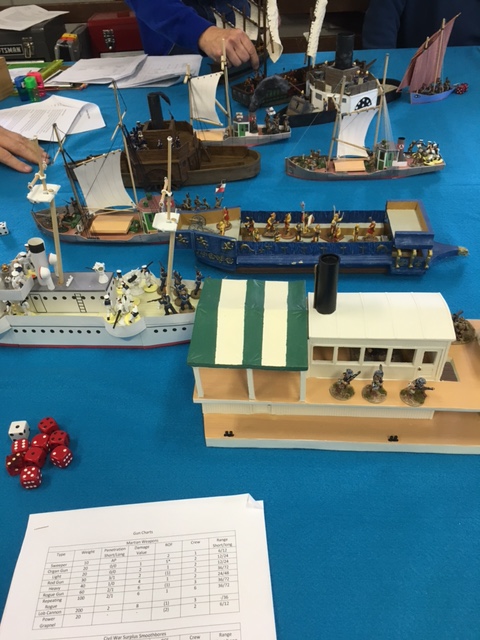
A while back I wrote about our get together with 28mm gunboats and our shoot-out on the Martian canals. Today we were at it again.

In the six week or so since our last play-test, I’ve been busy with a cruise, school beginning and attention to lots of Aztec miniatures. But one of my tasks between our July meeting and today’s get together at the annual Fix Bayonets game da in Steilacoom, was to re-write a set of miniature rules for gunboat combat that fit with our period.

Re-write rules? Are you kidding me?  I immediately took a look at the rules set that began my interest in Frank Chadwick’s Space 1889 universe in the first place, Sky Galleons of Mars. Most of what I put together is based on Sky Galleons.with some adaptation to the canal milieu from the air.

I found the most important point was to determine hull size for each vessel.  Once that was decided it was easy to begin thinking about hit points, armament, and crew.  I decided that steam vessels had an automatic speed of 16″ and sailing vessels were 8″. The one rowing galley had a movement of 8″ with a ramming speed of 12.” Guns had a pretty long range, with the British guns having a clear advantage in range and damage points. The Martians were dangerous up close and looked to board.

canal-wars-2

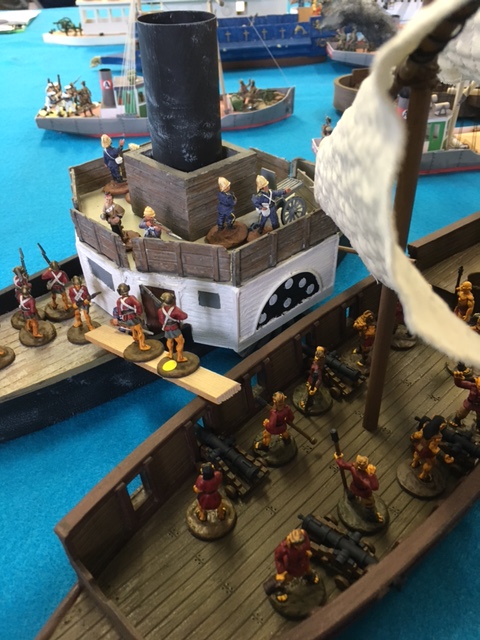
British gunboats pass through the Martian line of attackers.

I didn’t really have a scenario planned, and was just interested to see who would arrive with what for our play test.  Needless to say, there were plenty of boats and we cobbled together a British convoy that had to traverse the table. The game only lasted about an hour and a half.  Most things seemed to work pretty well. The gunfire and hit location were great.  I allowed too much damage value to most guns, and I’ll lower those a bit. The critical hit charts seemed to work fine. We tried a couple of boarding actions, and they went well, but I’m not sure I’m happy with them.

canal-wars-1

The Safieh is boarded by a Martian Xebec.

Just for the record, the British sank one of the Martian vessels and damaged others. They also suffered a fair amount of damage and lost one of their gunboats and a transport to capture. But the game reached a decisive ending fairly quickly.

It was fun.  Now to build a real scenario and try it again.

Armies for Quetzacoatl Rampant

Painting Table 2

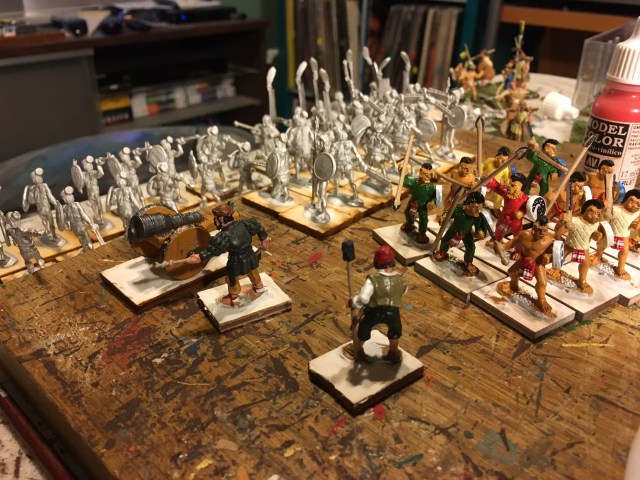
Spanish gun crew and Quaiaquach warriors waiting for the dip. 36 Aztecs await primer and paint.

There may be some of you who have considered creating an Aztec army for the Mexican conquest of the early 16th century.  There is lots of reading you can do, some of which is helpful to miniature gamers, a lot is not. I’m hoping to pass along a few easy rules of thumb.

First let’s talk general history of the conquest. It began February 1519, led by Hernan Cortes with a small army of 450, including 30 crossbowmen, 12 arquebusiers and 12 horses; the balance were likely swordsmen.

  • They landed at Vera Cruz, established a base, Cortes burned his eleven ships, and the conquest was on.
  • After encountering native tribes near the coast, Cortes set his sights on capturing Tenochititlan, the Aztec capital in the Valley of Mexico.
  • Deeply unpopular with its subject neighbors, who suffered from high taxes and the demands paid in blood taxes, Cortes found willing allies against the Aztec empire in Tlaxcalla.The Tlaxcallans joined forces with the Spanish after a series of three battles resulted in crushing native defeats in September 1519
  • Cortes marched to Cholula, one of the largest cities Aztec cities, slaughtered many of its inhabitants and burned the city in November 1519.
  • Cortes and his army were welcomed to Tenochtitlan by the emperor Montezuma and showered with gifts.  Cortes kept Montezuma under house arrest as his army took control of the city-one of the largest in the world at 60-300,000 inhabitants.
  • In April 1520 Cortes left the city under command of Pedro de Alvarado, and he marched to the coast to defeat a Spanish force under Panfilo de Narzaez, sent to arrest him. Narvaez’s 1,300 men joined Cortes’ little army, which returned to Tenochtitlan
  • In Cortes’ absence, Alvarado massacred members of the Aztec nobility, turning public opinion against the Spanish. The city rose in arms against the Spanish and Montezuma was killed. The Spanish were routed in the “Il Noche Triste” (the night of tears,) and fled to Tlaxcalla in July 1520.  The Spanish lost 860 soldiers in their retreat.
  • September 1520, Tenochtitlan is stricken by smallpox. Many die, including Emperor Cuitlahuac.
  • With their Tlaxcallan allies, Cortes and the Spanish take over many Aztec cities, some peacefully, many by the sword.
  • The Spanish launched a siege of Tenochtitlan that lasted eight months. The city surrendered August 21, 1521.  The city was nearly completely destroyed by cannon shot and fire. The siege featured attacks on causeways between the island city and mainland, the use of siege towers, and ship combat on Lake Texcoco.

So the long conquest of the Aztecs in Mexico had a little bit of everything for those who like some variety in their gaming experiences: battles on land and sea, retreats, sieges, a little bit of everything.

A note on scale

I always puzzled over WRG lists for this period.  The Spanish did eventually have a fair number of troops, but they lost a lot too. It would be pretty difficult to even sort of represent them accurately with a set of 1:20 or even 1:10 rules. They depended considerably on their native allies, the Tlaxcallans to fill out their forces. Contemporary writers such as Bernal Diaz wrote repeatedly about being outnumbered and surrounded.  In adopting a set of rules for the period, I recommend something to the scale of Daniel Mersey’s Lion Rampant.  I confess I have an intellectual investment in the success of our knockoff, but something semi-skirmish makes sense to properly represent the Conquistadors. I’ve also played Osprey’s En Garde!, which has rules for the period, and those were fun-just pay attention to complete point costs for the Aztecs.

Building a Spanish force for Quetazcoatl Rampant

David Sullivan, consulting with me, made Spanish units deliberately small and expensive. At six figures, they are brittle, but nasty.  Generally a Spanish retinue (for lack of a better word,) should have Rodeleros, or swordsmen as the main building block. A unit or two of arquebusiers and crossbowmen are add-ons, but both were slow to load in combat-very nasty when they did fire. Horsemen, trained or not, played a significant part in the Mexican conquest. This will be my Spanish army for Quetzacoatl Rampant:

2 X 6 Arquebusiers

2 X 6 Crossbows

6 X6 Swordsmen (Rodeleros)

1 X 6 Horsemen (Caballeros)

1 X 2 Cannon

1 Pack wardogs

Note:  These are not likely to appear in a game together.  The troop types are really intended to provide some scenario flexibility.

Any Spanish force must also be accompanied by native allies. The Tlaxcallans in particular  contributed large numbers of troops to the Spanish attacks on Cholula, in Tenochtitlan, and the final campaigns against the Aztecs. They should always be an element in a Spanish army. The Tlaxcallans had similar troops to the Aztecs, but many more peasant troops than the noble and elite troops of the Aztecs:

1 X 12 Tlaxcallan nobility

1 X12 Tlaxcallan suit wearers

2 X 12 Otomi missile troops

2 X 12 Otomi peasant warriors.

Building an Aztec Army for Quetzacoatl Rampant

I confess I don’t fully understand Aztec army organization.  I could be fully correct, which I doubt, partially right, which is likely, or entirely incorrect, which is possible. However, David has done more research than I, but I think I differ with him slightly.

The Aztecs had a warrior society, one that was ruled by elites, a nobility that played a prominent role in their organization.   Unquestionably, there are three classes of warriors in this organization, though I see it slightly differently than my colleague.

The base of the army rests on a motivated, but unarmored class of peasantry.  Peasant warriors had plain shields, and could not wear armor, feathered suits, or sandals. Peasant troops were more likely to be missile troops with the atl-atl or dart, bows, or slings. They formed the front rank of the Aztec army in combat, and were the most numerous. However, peasant troops could achieve status by capturing enemies, who would inevitably be sacrificed.

The second group of warriors were nobles. Noble warriors also achieved status by capturing troops.  For example, they could not wear sandals until they had captured two. Noble warriors could wear the beautiful feathered suits and shields. Some noble warriors, late in the conquest campaign, may have carried captured Spanish swords and shields.Though it seems the nobility were numerous, they were not the majority of the army They formed the second rank of the Aztec army.

The third class of the Aztecs, were the knights.  They were elite soldiers, adept at capturing enemies. Apparently, they were almost martial arts-like in their ability to somersault, move rapidly-Aztec knight ninjas. Maybe not quite so useful against Spanish steel or ball and shot. There is little question, however, they were brave and fierce. Eagle, Cayman, Ocelot/Jaguar knights are some of the elite class.

A final class of warriors are the fighting priesthood. The priesthood had a prominent and pervasive role in Aztec society.  It was a society dependent on blood sacrifice, not just rip-yer-heart-out death sacrifice but for every day living, and the priesthood was large and played an important role of society. And the French thought they suffered from a plague of priests-these guys had stone knives. It seems inevitable there would be a warrior role for some priests like the Templars, the Hospitallers and the the Teutonic knights.  Like other warriors, the fightin’ priests had status based on the number of captives they took.  They could be either 2nd class warriors, like the nobles, or 3rd class warriors like the knights.

My Aztec Army

8 X 12 Peasant units-These are tricky because I will probably include at least four missile units.  Missile troops probably were integral to many units.  Just not sure how represent this.  David includes a bidower type unit.  Not sure about this, maybe.

4 X 12 suit wearers (Veteran Warriors) I have a pair of Huaxtec units, a unit of barely veteran Quaiaquach, and a unit of suit wearers in feathered suit.

3 X 12 elites.  One unit of Eagle knights, one unit of Cayman knights and a unit of fightin’ priests.

This is kind of a projection.  I have almost all the figures, and am painting more all the time.  Probably enough for two “retinues” in Lion Rampant

Our first play test is scheduled for September 24th, so I’m very excited to give them a try.


A Tale of two Huaxtecs

Since returning from my cruise, it’s taken a little time to get back in the swing of things. It’s further complicated by the fact that I’m back at work, even if I’m pretty much working for free.

In any case I’m back hot and heavy working on Aztecs.  I’m using figures from two different ranges. There are a number of manufacturers who make figures for this period, including the British company Gringo 40’s.  But I’m sticking with Eureka from Australia (though I order, quite happily, from Eureka USA,) and The Assault Group in England.

Honestly, both do a nice job of interpreting the appearance of Aztecs and the Aztec world. But their ranges are quite different from one another.

The Eureka figures are quite nice, but not perfect.  I’ve painted four units (48 figures.) Their “novice” bowmen and atl-atl figures are simple, just appearing in loincloth, and can be painted in an evening. Unfortunately, they can also seem a little flat.  They don’t seem to be as robust as other figure ranges, and lack animation.  This characteristic is accentuated by their height.  They are quite tall, and seem to have that lean and hungry look-a little less proportional than I’d like.  At least half an Aztec army should be these novice and peasant classes. Non-noble types, like these, were forbidden from wearing cloth armor (with some exceptions,) and sandals-which seems just a little punitive.

Eureka Huaxtecs 2

Eureka Huaxtecs.  The feather suits can clearly be seen.

But you may know, the really cool Aztecs wear brightly colored feather suits. Only nobles can wear these suits.  The gear is often determined by local custom AND the number of prisoners taken in battle. Eureka has painstaking included the individual feathers in these suits.  It makes for a beautiful miniature, but also not sure they have it right. They seem a little too spiky, and, as we will see, hard to work with. Eureka figures have their weapons molded into their hands, with no ill effect: the macuahitl, or war club, and tepoztipili, or obsidian edged spear. They also have large, feathered shields.  I’m not quite sure they have these correct, but they certainly are nice to paint.

I’ve painted a few units by The Assault Group.  TAG has a broad range for this period, covering units by specialty and region of the Valley of Mexico.  Their figures are shorter and rounder than the Eureka figures-proportioned a bit more correctly. I’ve painted three units, including a Tlaxcallan upper class unit-allied to the Spanish. I’ve also painted a non-noble unit.  This last unit is particularly nice, with a mix of bare-chested and quilted armor types. TAG figures have to have their weapons glued into their hand, offering moments of frustration.  The shields are varied, with feathers and without, but seem much too small to me.

TAG Huaxtecs 1

Huaxtecs by The Assault groups. The parallel black marks are called ‘hawk scratches,” and are typical of Huaxtec dress.

The feathered suits of the TAG Huaxtecs are less detailed than the Eureka miniatures.  They have an irregular surface indicating something is going on, but the feathers aren’t individually articulated.  This isn’t necessarily a bad thing.  Huaxtec suits often carried the parallel black “hawk scratches.”  It wasn’t hard to paint these on to the TAG figures, but virtually impossible with the very rough feathered suits on the Eureka figures..

The size of TAG Huaxtecs is considerably smaller than the Eureka figures. David Sullivan suggested they look almost like Huaxtec warriors and their sons with figures side-by-side. The photos show a clear size difference.  What to do?  I’ll likely stick with the Eureka as my go-to figures of choice.

Eureka Huaxtecs 1

Eureka Huaxtecs, right, and their shrimpy little brothers from The Assault Group, left. Both are quite good.  At the very least, don’t combine them in the same unit.

One thing, more than any other determines my future figure purchases, and that is ease of acquiring figures and service. The Assault Group is located in the U.K., and they have no U.S. distributors. A local game store, The Panzer Depot, was their American distributor, but finding them difficult to work with, the owner chose to discontinue that relationship and sold off his stock cheap, which is why I have some. On August 15, I placed an order for some Tlaxcallan troops to fill out my Spanish allies. You must be an approved member of their site to order from TAG-it is impossible to order without an email approval of membership.  When my order was completed, and payment was made through PayPal, I didn’t receive a receipt as I do from all other online orders. I finally contacted them August 26th, just to insure they received my order. Coincidentally, I received an e-mail the same day to let me know my order shipped. That’s not terrible or even slow service, but I would like to know my payment was received, and fewer hoops to jump through in an international order.

Eureka USA simply has the best service I’ve ever received from any manufacturer or distributorship in any country. The website lets you know what is in stock. The shopping cart is easy to use as a guest or member. Rob Walter, Eureka’s “Man in America” gives super customer service, responds quickly, and turns around orders very fast. I receive e-mails letting me know my order was received, receipt given, order shipped, and my order is about to be delivered. I always have an shipment within five days of making it-and Rob is near Boston, I am in the Seattle area.

Finally, TAG and Eureka figures are about the same price, $2.25 per figure. Purchasers from The Assault Group will benefit from the currently positive exchange rate with the U.K., otherwise their figures would be more spendy.  Eureka usually charges about $7.00 or so to ship.  TAG has a shipping policy based on points determined by number of packs purchased. Orders over 52 pounds are shipped worldwide free.

About the Huaxtecs

These aren’t actually Huaxtecs, they are Aztecs in Huaxtec dress.  That is characterized by the feather suit (troops in these suits are often referred to as suit-wearers.) Though there are many types of suit-wearers, the tall conical hats make them unique. Huaxtecs also sported some unique facial jewelry, a gold ornament often covered their mouth. The shield pattern is unique to the Huaxtec region of the Valley of Mexico.  These were sent as tribute to the Emperor in Technotitlan. According to a wonderful little guide to the Aztec army by web designer Chronofus (be sure to download the .pdf on Aztec shields etc.,) these soldiers are nobles who have taken at least two prisoners. They are allowed to wear feathered suits and sandals.

I painted my Eureka figures in a variety of suit colors. I chose four different shades of red for the TAG figures.  They have similar shield patterns associated with the Huxtecs.

On my painting table

Aztecs, millions of ’em. Almost.  Another unit of suit wearers from TAG.  I’m also finishing my cannon by Eureka for my Spanish forces. I have one week left before school starts and takes over my life, but an entire week of teacher training.  Will squeeze in as much painting as I can.

Music to paint by

In the Heat of the Night

Pat Benatar was in town last weekend, playing the the King County Fair in Monroe.  I was not a huge fan during her MTV days.  Her image and her songs took advantage of her amazing voice to create something that seemed to be incredibly contrived, and it just didn’t feel authentic to me.

But the little minx really did get my attention with her first record. In The Heat of the Night seemed to have a bit of a New Wave sound, featuring a belter who could cover ALL the octaves. Benatar got my attention with “Heartbreaker,” not the Led Zeppelin version (all four guys have writing credits,) but rather the Geoff Gil/Clint Wade song.  With future husband Neil Giraldo on guitar, this song just smokes in a way that “Hit Me With Your Best Shot” never did. The album also has a solid cover of John Mellencamp’s “I Need a Lover (Who Won’t Drive Me Crazy).” Lots of other gritty, streetwise songs, including the quirky, but wonderful “My Clone Sleeps Alone.”  The title track is also quite good, and the good stuff doesn’t stop there.

In The Heat of the Night may not be the most memorable record of 1979, but it is quite good.  It is an album that is usually available pretty cheap.