The Pledge: February

Even though I haven’t posted a lot, February was a busu month.  I remain very focused on the St. Nazaire project.  There were purchases, but lots of painting too.  And a certain amount of urgency.  Dave and I have our next St. Nazaire meeting scheduled for March 14th, less than two weeks ago.  My goal is to have all my painting assignments done so I can A) move on to my other Enfilade activities, and B) pick up anything else St. Nazaire-ish I might need to do.

On the plus side, here is what I accomplished

12 Old Glory pavisiers

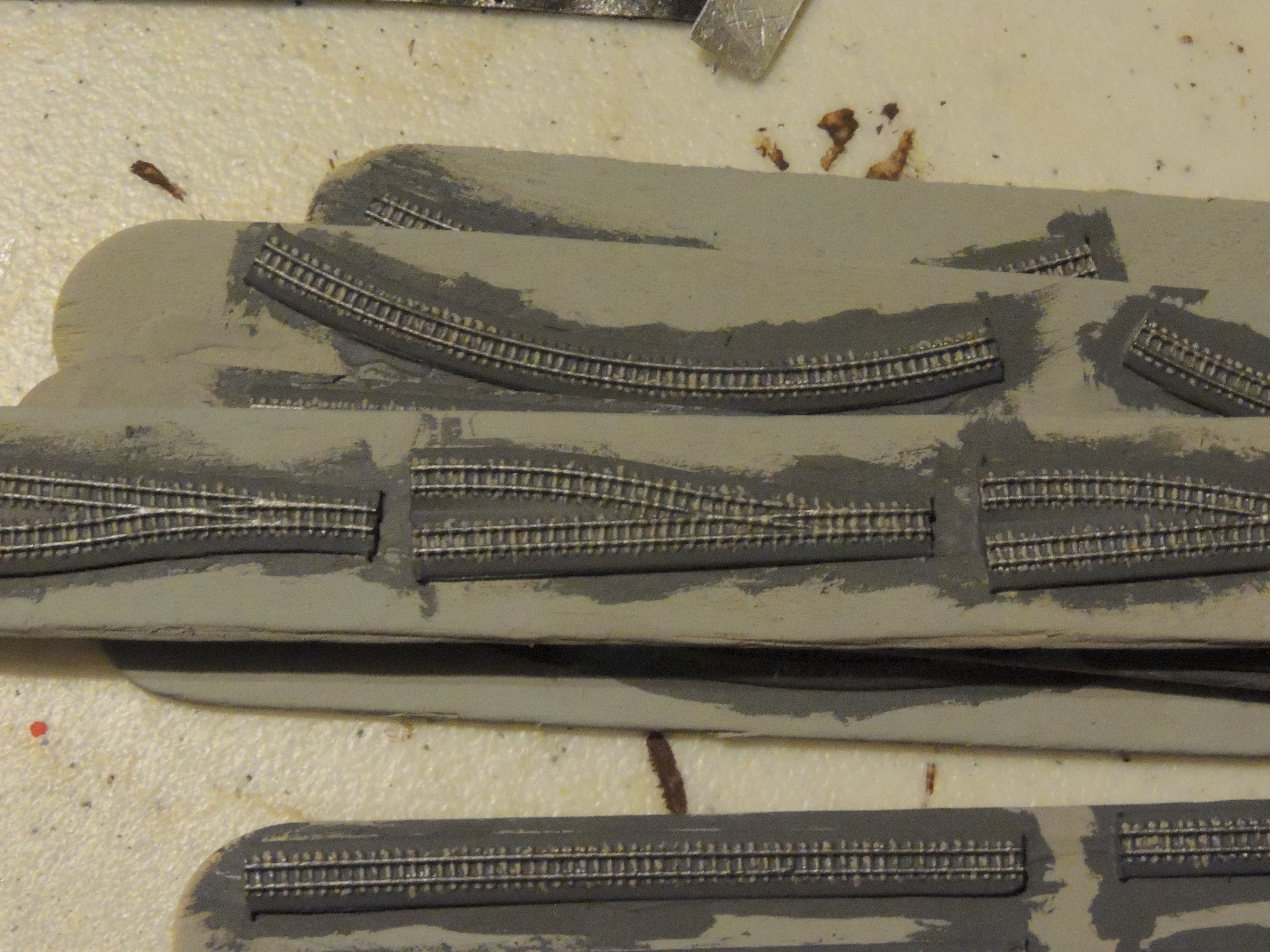
8 figures worth of railroad tracks  (two sets of Brigade miniatures RR tracks-tedium galore.)

6 figures worth of industrial buildings, including Skytrex lighthouse

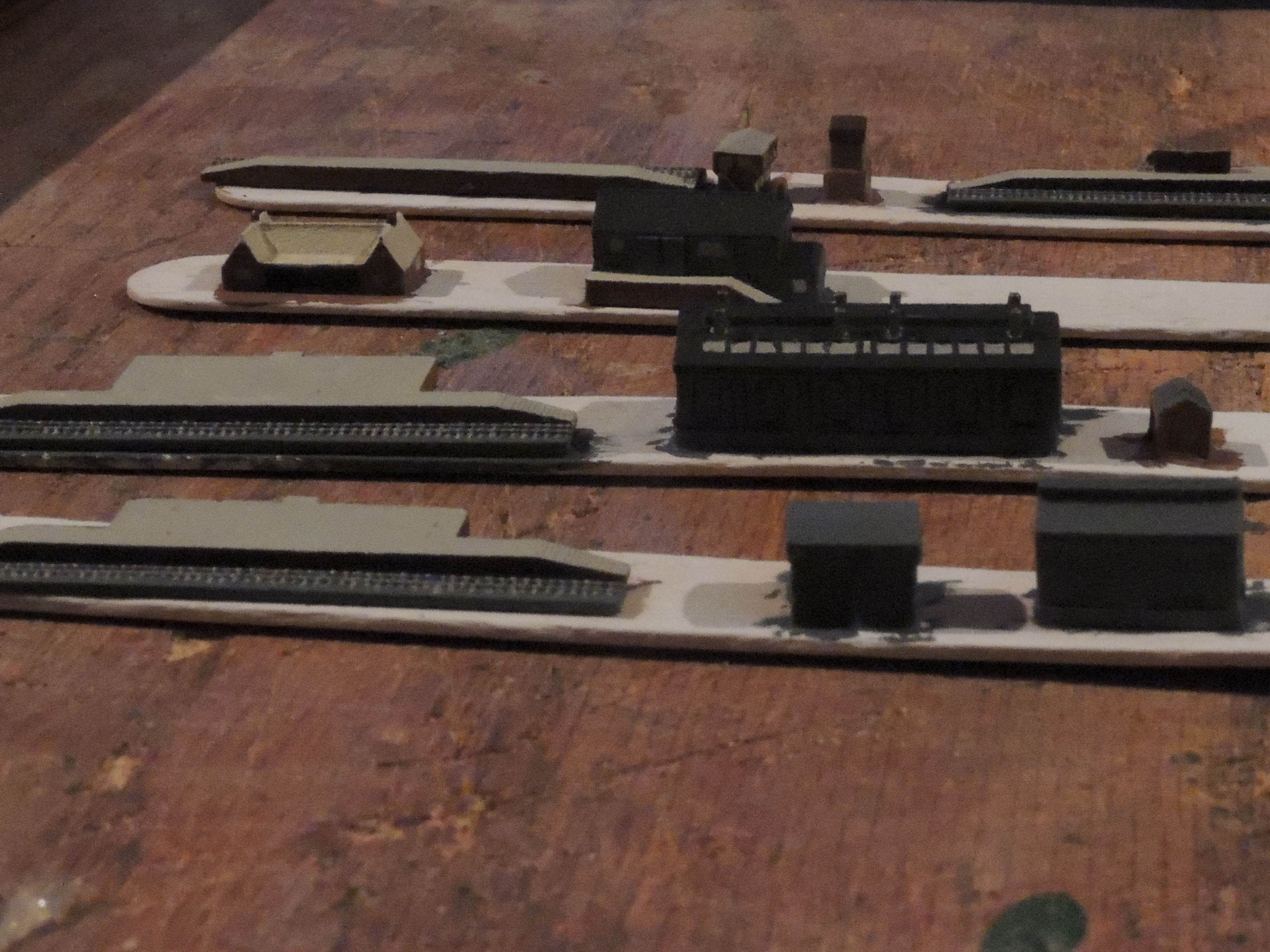
4 figures worth of railroad buildings (one set of Brigade miniatures track and buildings)

12 figures worth of Pico German and British WWII figures (35 stands plus three stands of armored cars-sounds like a lot but it’s not.)

4 figures worth of Skytrex coastal defense buildings

Total figures painted: 46 figures painted

On the minus side, here’s what I purchased.

15 figures worth of Pico infantry

4 figures worth of Skytrex lock gates

3 figures worth of Skytrex coastal defense buildings

1 figure worth of Skytrex German torpedo boat

2 figures worth of Bay Area Yards warehouses

1 figure worth of Bay Area Yards CSS Selma

3 figures worth of Bay Area Yards buildings.

Total = 29 figures

+ 17 figures painted for the month.

As you can see, most of the purchases were related to the St. Nazaire project, but a few were just cool items–the Selma and the Wolf class torpedo boat (really a destroyer sized escort) were just kind of cool and calling my name.

Pictures later this week of some of the completed bits for the St. Nazaire stuff.

March is a busy month at school.  But I still hope to wrap up all of my St. Nazaire figures, before moving on to work on 24 HYW crossbowmen and a 28mm cog by Old Glory shipyards.  My fingers are crossed.

From heraldry to railroad ties: my gamer’s life

I’m a very project oriented gamer.  Almost everything I work on has a beginning and an end, based on its intended purpose. When Enfilade is over in May I’m almost always geared toward what I’m going to do for the next Enfilade. I’ve mentioned my Enfilade projects already, and at some time I’m sure I’ll go into depth about them.  But I’ve shifted gears away from my Lion Rampant stuff, which I really enjoy painting so something a little less interesting and exciting, painting 1/600 scale bits and pieces for a scenario based on the Raid on St. Nazaire.

For those of you who don’t know this action, it was a WWII raid on the French port of St. Nazaire which possessed a strategically important drydock built for the enormous French liner Normandie, the only one big enough on the French coast capable of servicing the German battleship Tirpitz.  The British feared the Germans would move the Tirpitz there where it could menace shipping, the British coast and control of the English Channel.  If you want to really set the Brits off, threaten control of the Channel.

On March 28, 1942 a combined force of British commandos were ferried into St. Nazaire by motor gunboats and an explosives-laden ex-American destroyer, the Campbelltown.  Their mission was to destroy the massive caissons of the dry dock as well as operating machinery and industrial targets in the dock area.  The Germans defended the port apparatus with dozens of automatic cannon and about 6,000 men. The raid succeeded in the sense that the Campbelltown detonated and destroyed the caisson while loaded with celebrating German officials, but the raiding force was largely forced into captivity and the motor gunboats and smaller vessels were mostly non-factors.

Dave and I plan to recreate the St. Nazaire raid, including the Campbelltown and supporting MGB’s, emphasizing mostly the role of the commandoes.  The players will run the British while the Germans are more or less randomly run.

Our challenge as game designers is to reproduce all the dock goodies, including buildings, railyards, teeny, tiny figures and the vessels involved.  After our last meeting, it looks like Dave and I are agreed on using rules inspired by the Raid on St. Nazaire board game published by Avalon Hill many years ago.  We’ve worked together on many projects, and I always look forward to our collaborations.  Dave is the brains of the outfit, and often takes on the bigger modeling pieces.  I usually take on more of the smaller bits. For example, when we did our Tirpitz game a couple of years ago, it was Dave who took on the battleship, while I worked the Fleet Air Arm stuff.

This game is a little different.  We’ll be trying to recreate portions of a large port city, including living areas, industrial and warehouse districts, rail lines and buildings, as well as bridges, canals, lock-gates, and, of course, the enormous dry dock caissons and the ephemera that go with them.

I wish I was an awesome scratchbuilder who could make all this stuff myself, but alas I am not.  So, I’ve been acquiring 1/600 scale buildings from a variety of sources.  One source I really like is the old Skytrex range of ships and buildings. They are all in metal, which I like a lot, but they are also spendy.  Another complication is that Skytrex folded last year and have since been acquired by Ros/Heroics.  I’ve made a couple of orders to them and found them easy to work with, but their goodies are priced in pounds and shipping is significant. I’ve included pictures of some of the items I’ve received.

Another important supplier I’m using is PicoArmor.  If it wasn’t for this project, it’s a company I would have overlooked.  Pico does a lot of work with WWII and Modern 1/600 ground and air combat.  But they also carry some wonderful buildings in that scale from Brigade games. I’ve ordered their industrial buildings and railroad bits, as well as their own 2mm (as in eeny-teeny) figures needed to play the game.

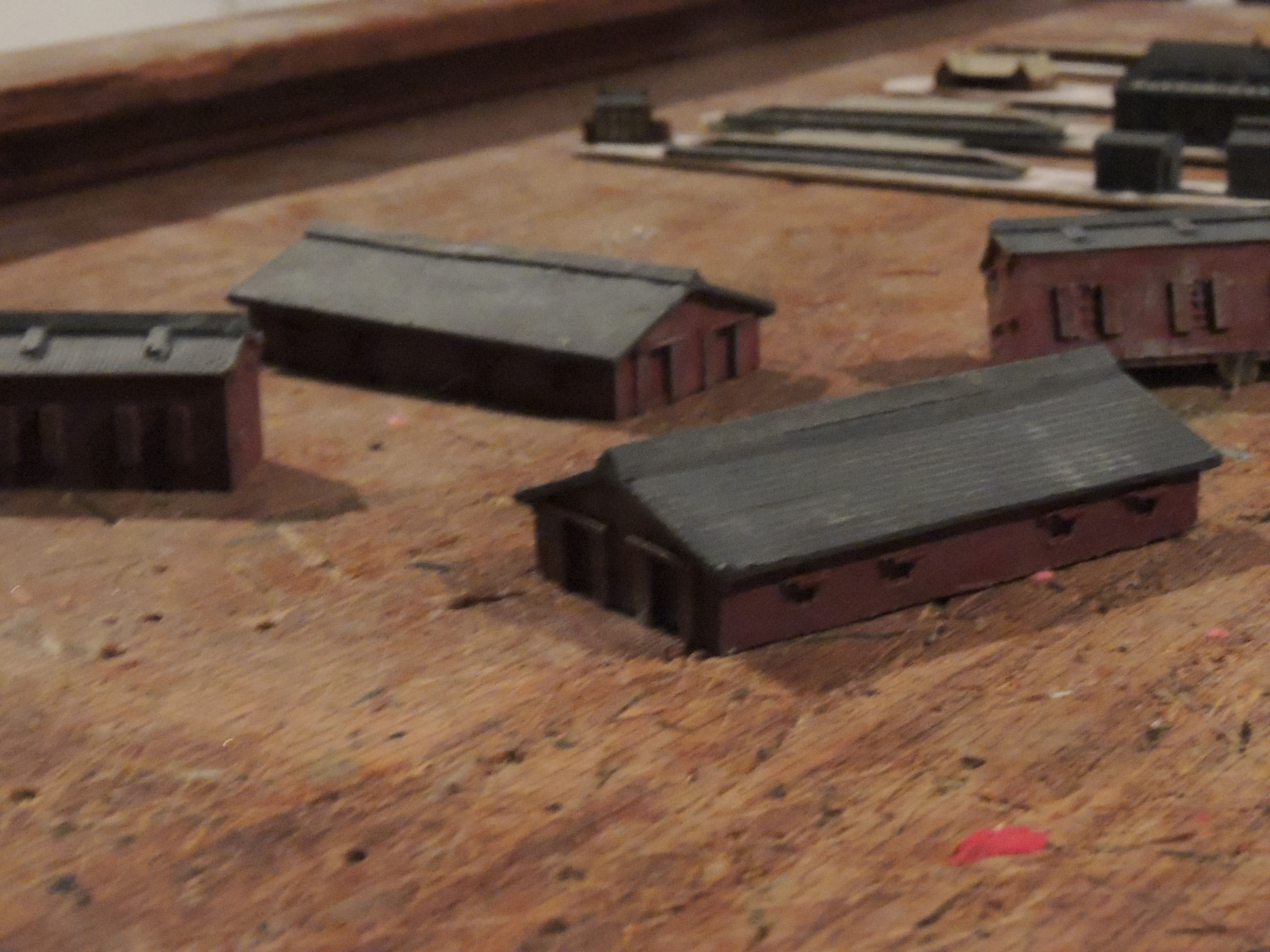
Railway buildings by Brigade Miniatures.  Eeny teeny, but oh so necessary

Railway buildings by Brigade Miniatures. Eeny teeny, but oh so necessary

Railroad tracks by Brigade.  Without question the most tedious thing I've ever painted, period the end.

Railroad tracks by Brigade. Without question the most tedious thing I’ve ever painted, period the end.

Some of the Pico buildings are really small, so Dave and I are also exploring some of the buildings made by Bay Area Yards for their ACW naval range.  I really like Bay, and I really like their buildings.  They are more substantial than the Pico structures, but there is also the question of size and scale.  They may be out of scale, but sometimes it’s important to have something larger and more detailed for our failing eyesight to look at than be just so on something so small.  I’ve included pictures of the warehouses I’ve completed to give you an idea of what they are like as well as a comparison shot with the Pico buildings. Bay casts in resin, and their buildings are nice, and quite inexpensive.  The resin poses a few problems with bubbles and such, but they’re hard to pick out when the miniature is this small.

Bay one

This is a big change from painting my beloved Hundred Years War miniatures, but I’m also very excited about this project.  I’m hoping it will be as good a game and as pretty a project as the Tirpitz affair.  When I’m ready for a bit of a change I’ll share the building of the PT Dockyard vessels awaiting construction.

Sergeants and Town Militia: My Pavisiers

In the Hundred Years War, at least during most parts of the Hundred Years War, the French depended on feudal levies to be called out when their regions were threatened or under attack.  Some of these were rich guys in armor and horseback (mounted men-at-arms) and their retainers (mounted sergeants.) But horses were expensive and not everyone could feed a horse let alone own one, so French nobility depended on foot troops too.  In Lion Rampant these dependable foot types are called sergeants.  They are generally foot spearmen, though they can be upgraded to a nastier version with pole arms.  Together with crossbowmen, these spearmen tended to be what was turned out to defend towns and cities, or to fill out the French king’s army when it took the field.

These French spearmen were often called pavisiers, due to their enormous shield, called a pavise.  These protected them from missile fire.  They also offered shelter to crossbowmen as they reloaded their cumbersome weapons in a sort of early combined arms arrangement.

I really like pavisiers.  They are a departure from the normal depiction of medieval warriors with their cute heater shields.  They also offer a larger canvas to paint heraldry.  Usually the shields show the coat of arms for the down or duchy from which they were raised and to whom they owed fealty.

Pavisiers 007

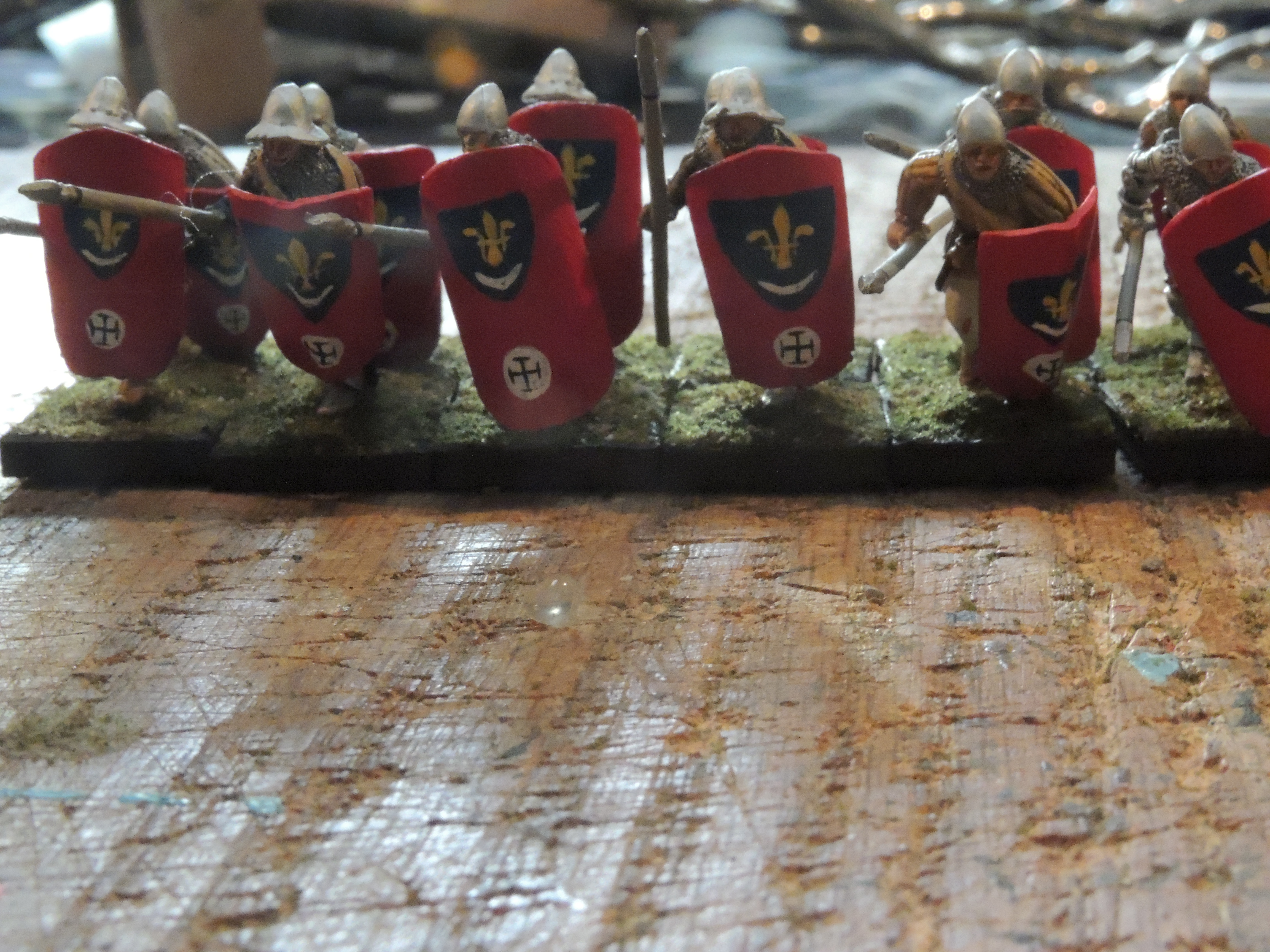
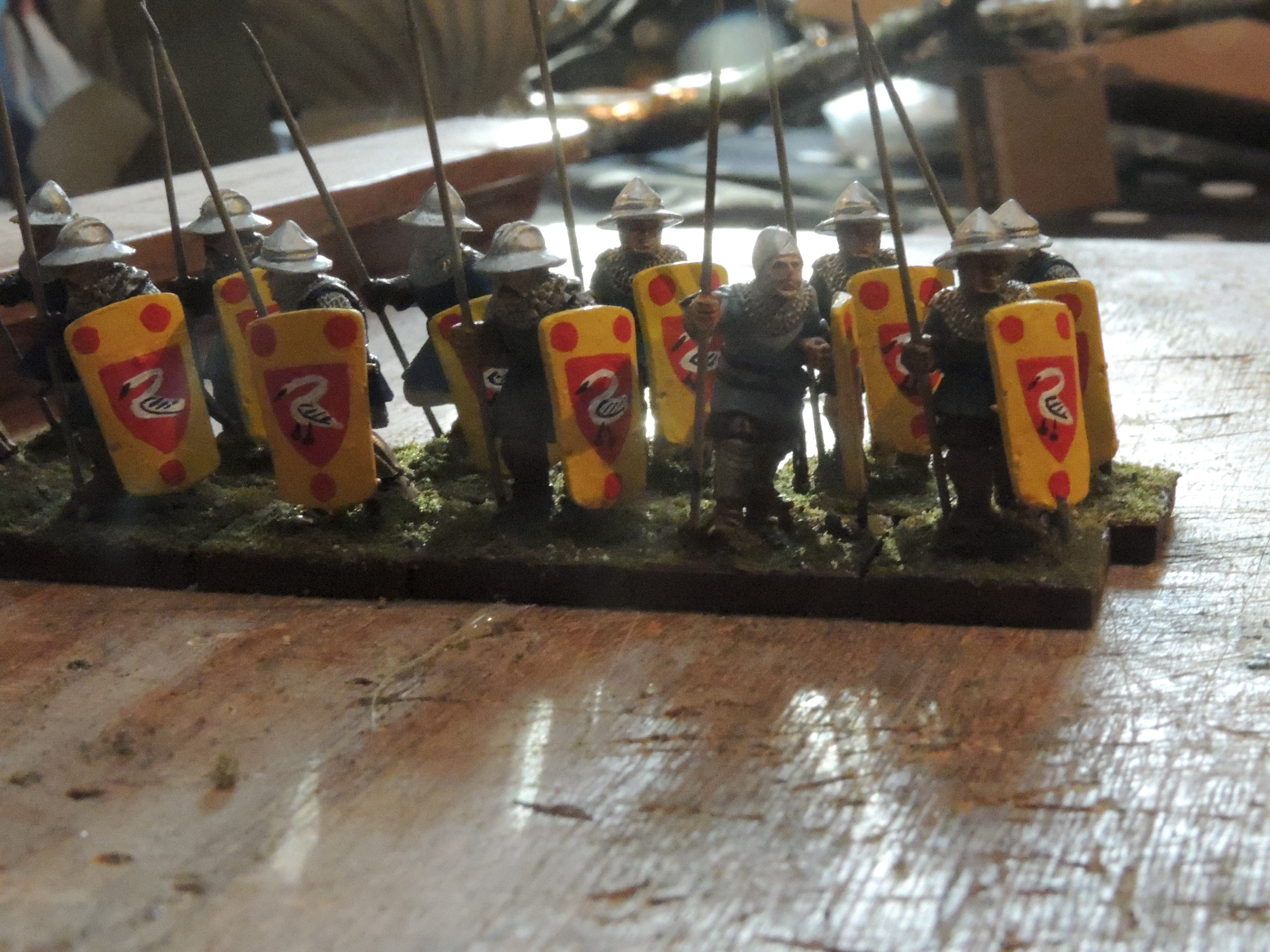
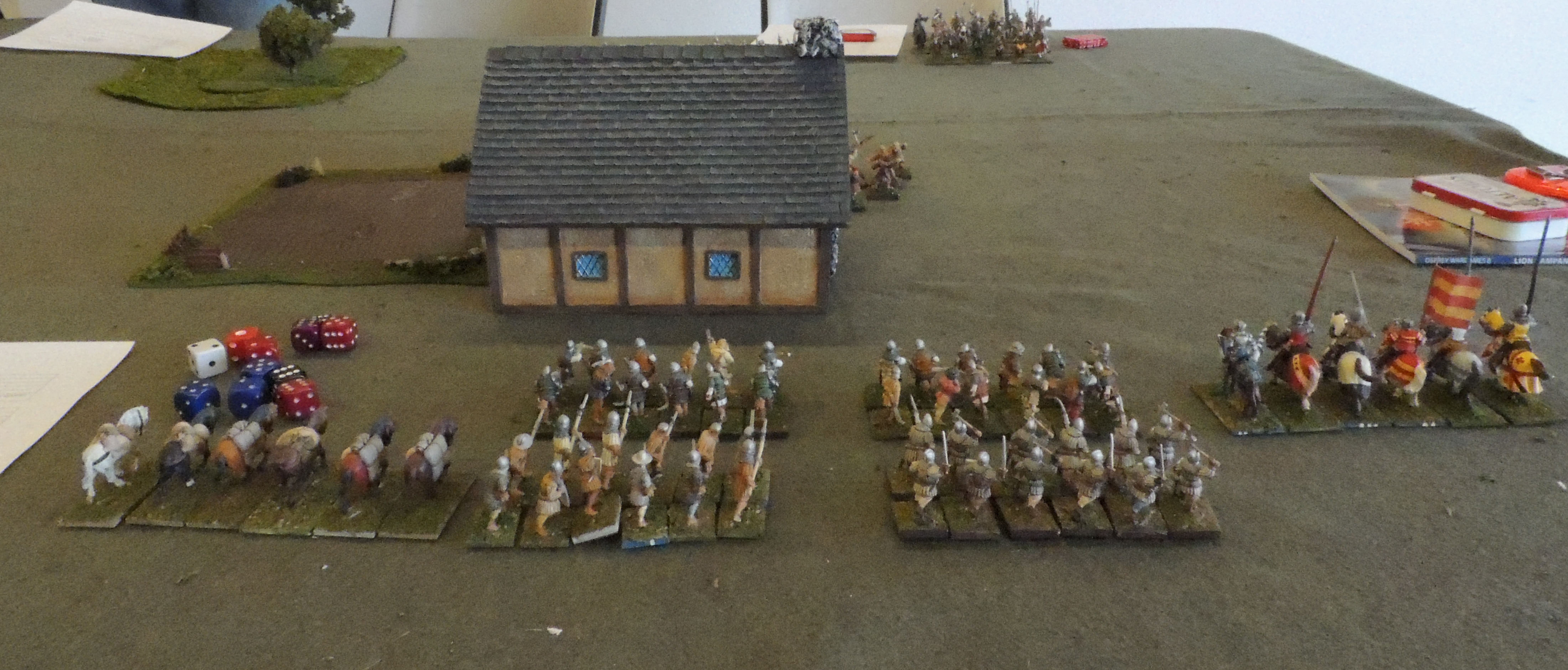
I’ve painted a couple of units the last few weeks.  The first is a unit of Perry pavisiers.  These are very nice figures.  If they have a problem, it is they represent troops from very late in the Hundred Years War, being from the Agincourt to Orleans range (1415-1430.) As a group they are pretty well armored for a batch of militia. Their shields carry the device for the city of Calais, which was an English bastion after 1347, but I liked the heraldic insignia, so don’t let it get out.

Very serviceable pavisiers offered by Old Glory with Perry pavises.  They are armed with the dangerous Northstar spears. They carry the colors of Boulogne.

Very serviceable pavisiers offered by Old Glory with Perry pavises. They are armed with the dangerous Northstar spears. They carry the colors of Boulogne.

The second group of spearmen are from Old Glory.  I actually used their shields for a different project, so had to replace them with Perry shields, which can be purchased separately. I used a pin vice to drill a hole in the back of the shield and glued the pin on the figure into the hole.  The pavises are perfect and are painted with the device from the channel port of Boulogne, a city that will figure prominently in one my of Enfilade scenarios.

The Lion Rampant rating of sergeant for these figures is, in my mind, problematic.  Sergeants may be necessary, but I think of them as the dismounted version of the mounted troop type.  They are reasonably well armored and trained and highly motivated.  I think of pavisiers as more the draftee type who would much rather be at home with the missus in front of the fire trying to figure out how to pay his hearth tax.  That being the case, consider adding this troop type I saw suggested on BoardGameGeek on the Lion Rampant forum.

Militia, 12 Models per unit, Cost 2 Points
Attack 7+, Attack value 6+
Move 5+, Defence Value 5+
Courage 4+, Maximum Movement 6”
Armour 2, Special Rules Schiltron

I’ve used this unit in a game, though it didn’t make much difference.  Give them something to defend and life is all good.

Kevin’s wrap-up and The PLEDGE

Make no mistake about it, I am struggling to post timely, interesting stuff on this blog.  I think there are a few reasons for that. One is that my life is a little more complicated and other interests are taking more of my time.  What does that mean?

1. No  I haven’t and will not give up miniature wargaming.  I continue to paint almost nightly and still have some new projects I’d like to tackle at some point.  I’ve become a bit of a vinyl record collector. No, not collector.  Let’s never use that word again.  But I do love hunting for records I really like and fit into my pile o’ music.  I do discuss this over here. I am not obsessed, or at least try not to be, but it does take some time and cash.

2.  It’s my wife’s fault.  No, really, sort of. The past couple of years Lorri has become a re-seller.  She has a little space at Third Street Antiques in downtown Puyallup.  What does that mean for me?  One problem is her stuff is everywhere.  One of the prime Lorri staging areas is the dining room table.  That is my prime pitcher-taking space, especially during our notoriously long, dark winters when I take photos of newly completed figures.  No pictures, fewer blog entries, ’cause let’s face it, as brilliant a word-smith as I am, Smyth writing is only so interesting. I should tell my wife what?  She actually makes real money at this.  Nearly $500 in each of the last two months.  Her hobby is money-in, mine is like money . . , never mind, but you get it.  Besides, sometimes the money-in trickles down to we deserving but impoverished types.

3.  After years away from it, I’ve taken a greater interest playing board games the last few years.  Not only that, but I’ve bought a few.  I have a number of friends I really enjoy spending time with who still like games, but just don’t do miniatures anymore.  Maybe they weren’t that big on them in the first place, or they’ve moved on from miniatures, but they really do like board games.  Mostly the Euro-games, which, despite the lack of intensity of old Avalon Hill Games or GDW’s Europa series, are still challenging and definitely fun.  My son Casey loves to play these games too, so I play them when I can make time.  But there’s only so much time in the gaming calendar, so this definitely cuts into that a bit.

But I am painting almost nightly.  I used to paint about 350 days a year.  I’m a bit less now, maybe as few as 300 nights a year.  It’s really difficult when we are on late night deadlines on the school paper.  And I willingly give up a few more nights than I used to.

I don’t go to the Miniatures Page as often as I used to.  I had a bit of a falling out with Bill Armintrout a couple of years back and actually managed to stay away for about nine months, but I am back and do occasionally share stuff. It’s a good site, but it was a matter of principal and I am nothing if not a stubborn Irishman. One of my very favorite monthly features is by poster Monkey Hanger who shares his progress toward making his Pledge.  The plan is to paint at least as much as is purchased.  I will do that here each month too.  But I will take it one more step and that is to paint at least one miniature for every day in the year, or 365 miniatures for the year.

For those who know me, I dabble about 75% in 28mm and the other 25% in something else–planes, ships, the odd 15mm figure.  For my purposes a figure is a figure is a figure.  A plane or a ship is a figure, a gigantic 28mm cog is a figure.

Here are the numbers for January

Painted

5-40mm Sash and Saber Indians

6-28mm Perry Men at Arms

12-28mm Perry Pavisiers

Total 23 figures      342 figures from overall goal

Purchases

The purchases for January were pretty light.  Mostly I bought stuff for the 1/600 St. Nazaire project Dave and I are working on. They are as follows

1 pack Pico Armor German Infantry

1 pack Pico Armor German armored cars

2 packs of Brigade models rallroad tracks

Because everything is so tiny and inexpensive, let’s say I spent about $28, a buck a figure so 28 figures.

28-23= -5 figures for January.  Not quite the way to start the year, but I’ll do better.

Good-bye 2014, hello 2015

I can’t believe it’s been nearly two months since my last post. But it’s been a pretty busy two months. After a pretty eventful November when I squeezed in four or more Lion Rampant games, the only miniature game I’ve played was Dave Schueler’s excellent DANG medieval naval game. I’ve squeezed in some board games, but pretty quiet on the miniatures front with the holidays and a big journalism fundraiser at school.

On the painting front, I didn’t produce as much as I would like since my last post, but I have worked steadily. I wrapped up all my 40mm figures for my role-playing project. I’ve also finished a few units for Lion Rampant.

Let’s just move on to Lion Rampant since it seems to be one game I’m pretty excited about. I have plenty of figures to play the game, but I did find myself short of a few figure types. I purchased some Perry pavisiers I’m in the middle of painting right now. I also bought some additional Perry pavises to outfit some Old Glory pavisiers whose shields I swiped for another project a few years ago. Those will give me a couple more units of foot sergeants, a troop type that is pretty ubiquitous. In addition I picked up enough Crusader Miniature crossbowmen for two units. These will balance out my HYW collection and should allow me to run most of the games I want.

These should allow me to host some pretty big games. I’ve already planned out a couple of sizable Lion Rampant games for Enfilade. The first is the Sack of Agen game I’ve already played once, and will run again at Drumbeat next weekend. It’s a 7-player game that gives everyone plenty to do. The second game is historically inspired and based on the 1340 raid on the Bolougne docks that deprived the French fleet of valuable ships and crews for the Battle of Sluys. The battle is the result of an English landing, mostly in the mist. The English are able to overwhelm the resistance in the dock area, and destroy the prime targets on the waterfront, but are mostly cut to pieces by reinforcements coming from the upper city. I have four 28mm medieval ships I’ll be able to use in the game. It will also require some additions to the rules, but I’ve already begun thinking through those.

I don’t intend to devote all of 2015 to painting more singly mounted HYW figures, although I’m sure I could. Remember those 28mm Irish Civil War figures I expressed an interest in? I really mean to work on those and try them out. Probably a summer project. I’m also interested in acquiring enough figures to adapt Lion Rampant to Aztecs vs. Spanish. That will take some time and money. I ordered a few of the excellent Eureka figures for this period and just love them. I’ve also typed up some ideas for troop types.

Last year I promised myself more games and gaming. Not quite sure I did that, but I feel Iike I made more of an effort. There was a gap during the summer-when I would normally play a lot-when I was out with my illness, but I usually played a time or two per month. I also was possessed by board gaming sickness, which has taken time as well. I hope to do even better in 2015

Dean Motoyama is my hero

So I’ve blathered on a lot about my engagement with Lion Rampant.  I’m not the only one in my area who is partaking.  Others are doing their best to assemble units and retinues for the game.

I played a the big Agen scenario with a great group of guys ten or so days ago.  One of those is Dean Motoyama. Dean has his own blog, that you simply must check out. WAB Corner is where Dean share’s his latest creations.  The amazing thing about Dean is that he’s relatively new to the hobby. (like within the last decade.) Yet he’s taken on some great projects, from Warhammer Ancient Battles, to Sharpe Practice, and now on to Lion Rampant.  His projects are big and beautiful; he paints them quickly, and his miniatures are stunning.

I’ve painted over 500 figures for the Hundred Years war.  I don’t use shield transfers, and my figures can’t hold a candle to Dean’s work.  I am regularly in awe of whatever he’s produced today. Hugh Despenser. James Audley.  Just some great stuff. Check it out, it’s the real deal.

Dipping your toe in the Lion Rampant pond.

If you’re thinking about trying out these rules, whether you have stuff or not, I hope, with this post, to offer some guidance to you.

First, a bit about my decision to go with this game rather than another. I am the owner of some 500 singly mounted Hundred Years War figures.  I have more than a hundred painted longbowmen.  I have more than a hundred painted dismounted men-at-arms.  I can field seven units of foot sergeants and multiples of most other units from this conflict.  I am also a devoted student of the period.  My interest in these rules was only natural.  All I needed was to try them out to see if they met some simple requirements

  1. Were they easy to play?  Could I easily run them at a convention with folks who didn’t know them at all?  The answer was a simple yes. I’ve played with at least a dozen of my gaming friends. Of those only one has had a less than enthusiastic response.
  2. Were they suitable for making well thought out scenarios?  I didn’t want a game that was really designed for head to head games.  Again, I’ve tried several multi-player games and have reported on the Agen scenario.  I’ll likely run that one at Enfilade, together with a second scenario based on the 1340 raid on the Boulogne docks.

I find Lion Rampant to be a great set of rules.  Of course, I feel fully prepared to play them with figures, high interest and research material galore.  What if I wasn’t?  How could I get started?

First, some basic parameters.  If you’re interested in refighting Agincourt, or Bannockburn, or Mortgarten, these are not the rules you want.  These are small unit actions.  No archers behind stakes, no Flemings defending ditches, no massive schiltrons of Scots spearmen driving foolish English knights into swamps. Those troop types might be available to you, but they won’t quite function the way they would in large formations. I confess I haven’t quite found the right set of rules for fighting big battles in the late middle ages, but Lion Rampant won’t do the trick either.

I always worry about the cost of rules sets. Rules books that cost forty or fifty bucks really annoy me.  They better come with their own electronic service like Siri to answer my questions, a useful painting guide, complete army lists and an introduction by Anne Curry.    Worse than rule books that cost forty or fifty bucks are rule books that cost forty or fifty bucks and will require the forty or fifty dollar expansion or two.  I don’t care what the logic is, it’s ridiculous and inexcusable.

If you’re worried about the cost of Lion Rampant, you can buy it at your local game store for $17.95.  You can order it at Amazon for $13.62.  You can order it for your Kindle or Kindle ap for $10.49.  I bought two.

What do you get for your dough? A complete set of mechanically simple, grammatically clean set of rules. There are some quirks to the game, but nothing that is unreasonable or unfathomable.  There are a plethora of handy color plates and game photos.  There are eleven troop types and 40 sample retinues to muster them into. Finally there are twelve sample scenarios. That’s a lot for less than twenty bucks.

This is a highly adaptable rules set.  Though the sample retinues cover England all the way to Eastern Europe, the Middle East and the Thomas Mallory Arthurian legend, there is definitely room for more.  I see these rules as something to experiment with, as many did with The Sword and the Flame. A friend has been playing Korea and Japan.  I plan to build something around the Spanish conquest of  Mexico.  It should work for any region up through the early gunpowder age. Not only that, but author Daniel Mersey is highly accessible, regularly answering questions on a Lion Rampant forum on BoardGameGeek.

So what is the cost to get in on Lion Rampant? Units are either six figures or twelve figures.  I’d suggest starting out with a retinue which is usually 4-6 units.  If your army is infantry-heavy, like the Swiss you’ll need more figures, say 60 figures.  If you have expensive troops, like the English you’d have fewer, say 42.  Armies with cavalry like the French Hundred Years War army, the Normans or the Ottoman Turks makes an army more costly in real dollars. Be sure what you buy fits in with your friends, and is an army you are really interested in.

There are lots of great figure manufacturers for the Hundred Years War.  Here are a few of my favorites:

Old Glory Miniatures–They have a huge range for this period.  They are relatively inexpensive per figure, especially if you are an Old Glory Army member. They are also quite nice and draw a distinction between the early period of this war (say until 1380) and later.  The drawback is that you have to buy the figures in pretty large quantities.

Front Rank Miniatures–A very nice range of miniatures for the Hundred Years WAr and the Wars of the Roses.  The range is older, so not tons of variety between figures of the same type, but a huge range of troop and armor types.  The mounted figures are really awesome.  They also have some great accessories and wagons. The downside is their size.  They are huge.  They don’t mix well with other manufacturers in the same unit.

Crusader Miniatures–Some great figures, but not tons of different troop types.  Sized well, all the major troop types are covered. Some very nice command figures too.

Perry Miniatures–The Agincourt to Orleans range is geared strictly for about 50 years of the conflict. Absolutely stunning miniatures, but a little spendy. The Perrys have a number of plastic boxed sets that are super reasonable covering the Wars of the Roses.  They plan to release an English boxed set for Agincourt to Orleans before Christmas (hark, I hear sleigh bells.)

Before I close, I’d simply add that no I am not an Osprey employee, nor do I hang out with Dan Mersey.  I do believe this is a great set of rules. Not perfect, and with limitations that are clearly stated.  If you believe you’d enjoy a skirmish set of rules for the late middle ages, these may work for you.  They definitely work for me and my interest in the Hundred Years War.


Lion Rampant: The Agen Scenario

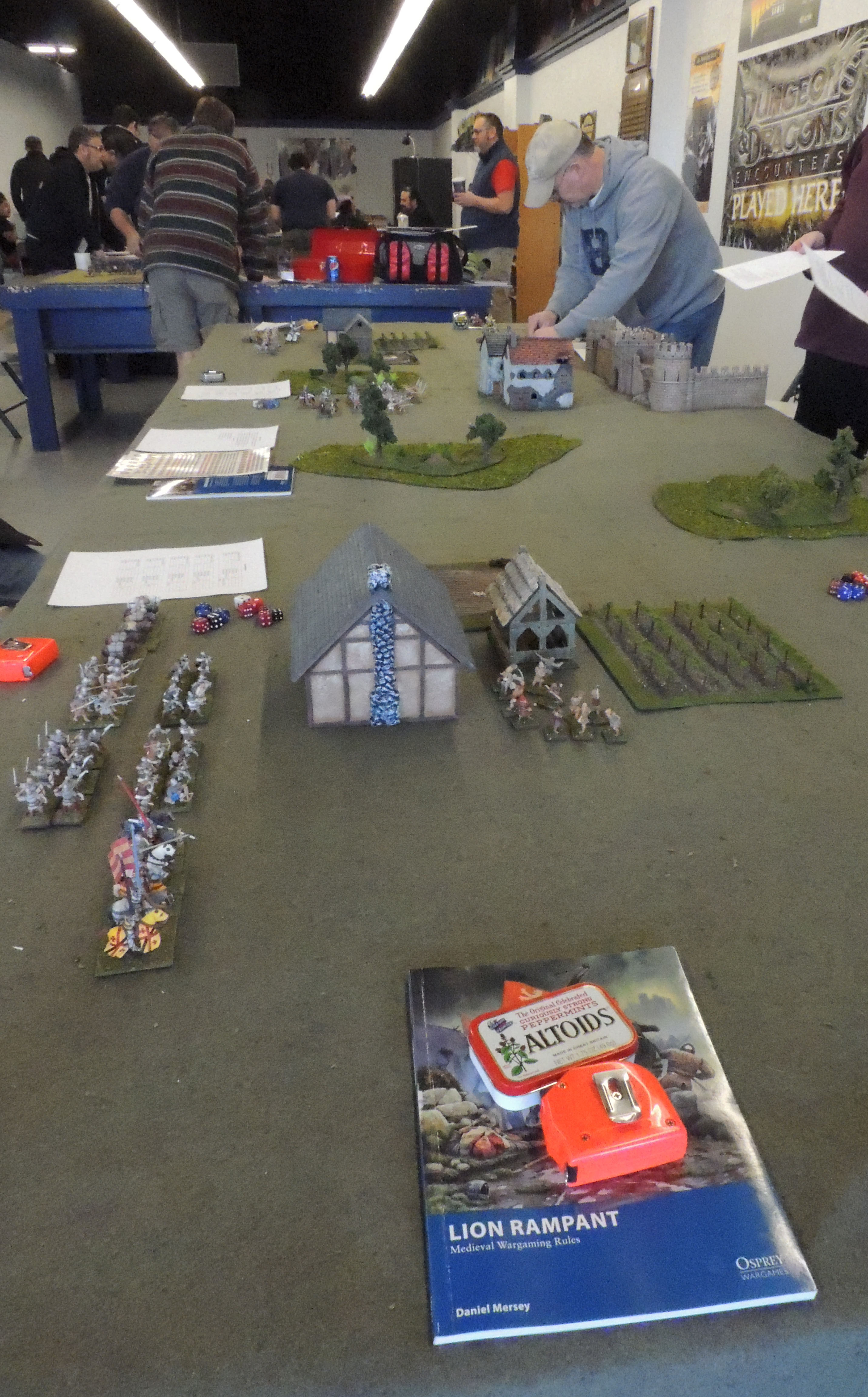
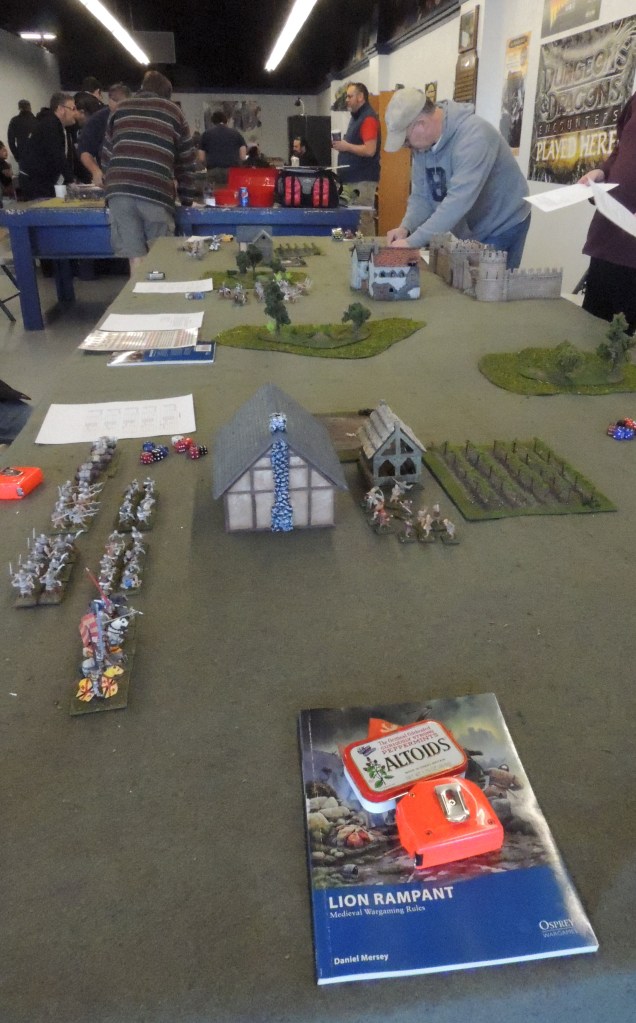
A quick shot down the 14' board at Game Matrix.  Enough going on to make it look good, without too much clutter.

A quick shot down the 14′ board at Game Matrix. Enough going on to make it look good, without too much clutter.

It’s rare that I’ve fallen utterly in love with a set of rules.  Maybe only one other time.  About twenty years ago I played the original Fire and Fury Rules for American Civil War and I continue to believe they were the most influential rules set in my life.

But, for the moment, at least, I am consumed by Daniel Mersey’s Lion Rampant, published by Osprey. In my previous post I mentioned my idea for a game involving a raid on a small town, a castle and too many troops.  Yesterday, with the help of many friends we tried it out.  It was sort of like buying an awesome car-maybe one of the new Chevy Camaros. It looks cool.  It sure drives nice between Tacoma and Seattle, but you really need to get it over the pass on a trip to the Gorge to see Tom Petty and the Heartbreakers to air it out and see what you’ve got.  Yesterday was our trip to the Gorge.

First of all the basics:

  • This was a scenario based game-cooperative in the sense the three French players and three English players had to decide on a plan.
  • The table was 5′ X 14′. That was the table mix available at Game Matrix so I went with it.
  • There were three retinues for each side.  None of the retinues were the same.  I have no idea of the total retinue points or quite how even they were.  There was one additional retinue composed of four serf units.whose primary mission was to stay alive. All in all, there were 12 French units, 14 English units and the 4 Serf units for a total of 30 units on the table.
  • The game was played “out of the box” with one exception I’ll get to shortly.  I did add some rules to the scenario.  The rules were chiefly added to allow the English to sack the settled areas on the table.  These included rules for looting and burning. There was also a rule that allowed peasants to panic and flee toward the castle, violating the 3″ ZOC around French units.
  • Each side earned victory points-the English chiefly for destroying/looting/killing, the French for saving property and killing English.  The French also received points for killing Englishmen, of course, the peasants, scored separately, won points for stayin’ alive, stayin’ alive, ah, ah, ah ah, stayin’ aliiiiiiive. (sorry couldn’t help myself.)

The game was large and pretty elaborate.  I made sure to get to the shop as early as I could and allow about an hour’s set up.  I used two buildings for each of two. I put the castle on a hill near the three building town.
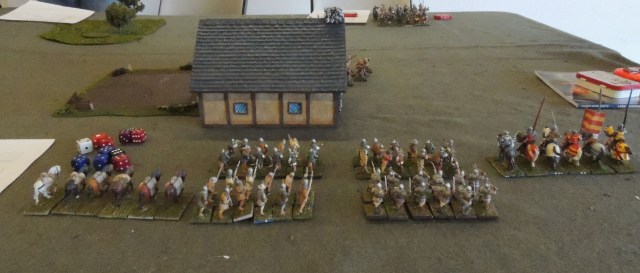
One of the English retinues.  Five units 54 figures is a pretty typical retinue size for Lion Rampant.

One of the English retinues. Five units 54 figures is a pretty typical retinue size for Lion Rampant.

The English forces, who had a pretty complex bunch of tasks to choose from, were allowed to set up 6″ from each of the three settled areas.  The French were allowed to set up 18″ on to the table. The challenge for the English was to make a plan from a variety of point scoring options, and fight off the French.

Though there was complexity in the scenario, the game devolved mostly into retinue on retinue combat, though the English were also burdened with devoting time and resources to looting and burning. On the English left, things went badly, mostly through bad die rolls. The French attacked with their cavalry, eventually destroying the English unit of mounted knights and killing the leader.  The English couldn’t activate their archers, and failed key courage tests. Though they were able to burn one of two structures, they couldn’t make key die rolls when needed.
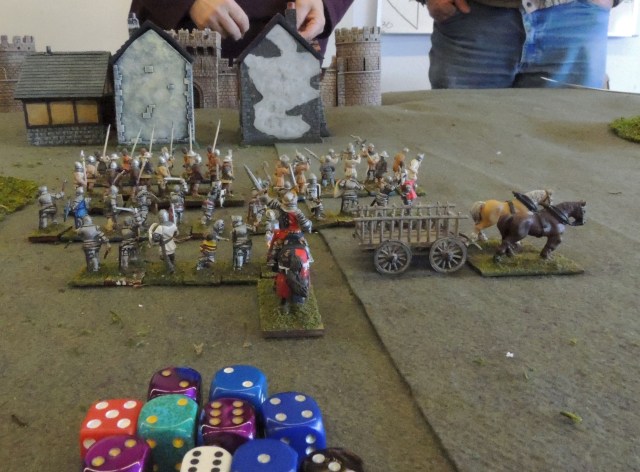
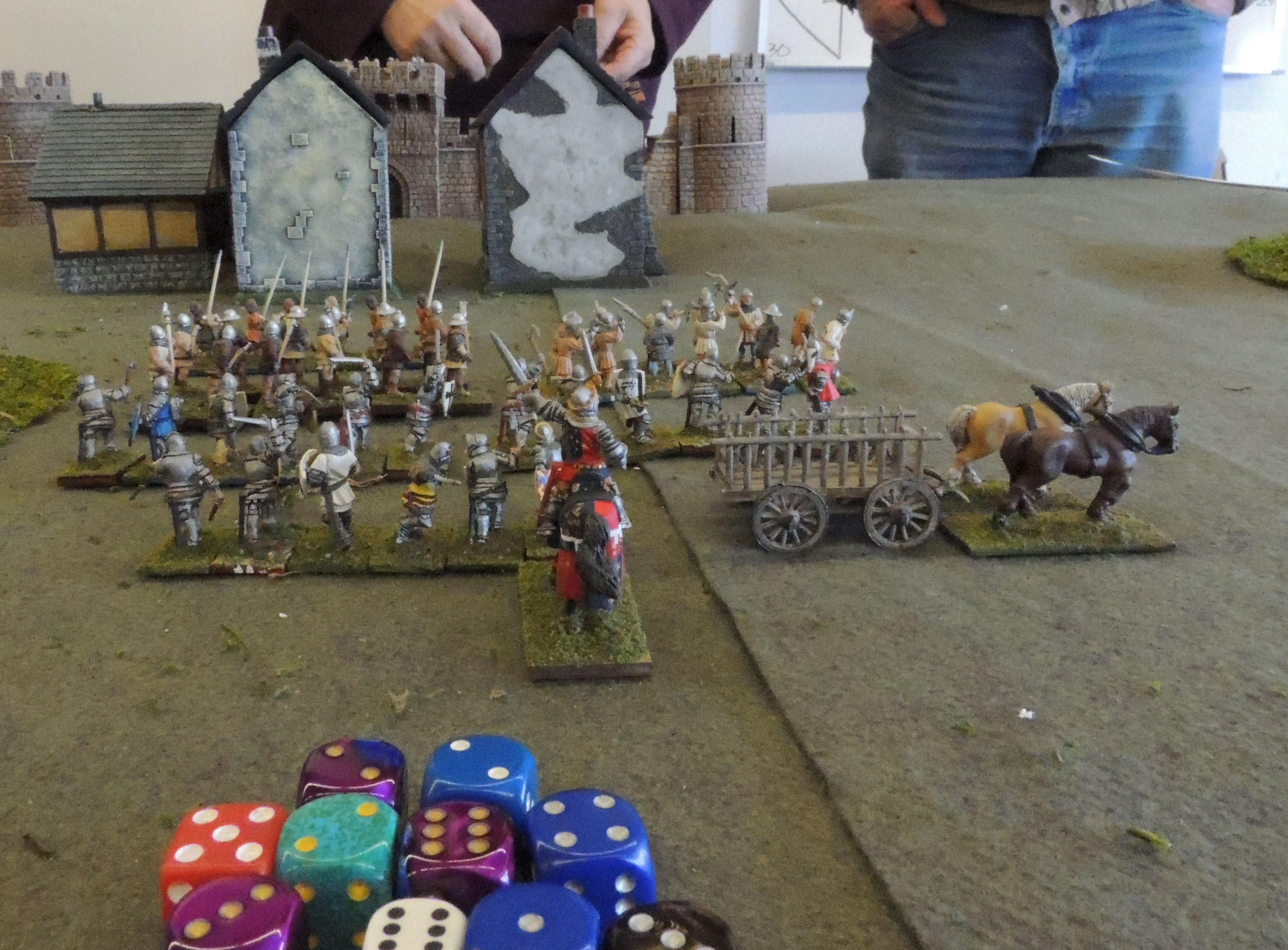
English retinue in the center comprised three units of dismounted men-at arms, two units of expert foot sergeants and a unit of bidowers. Nasty stuff, but they faced supporting fire from the castle.

English retinue in the center comprised three units of dismounted men-at arms, two units of expert foot sergeants and a unit of bidowers. Nasty stuff, but they faced supporting fire from the castle.

In the center, the English burned all three buildings in the town, driving the serfs into the castle.  However they suffered from crossbow fire from the castle walls losing a vulnerable unit of bidowers. They also drove off a counterattack from the mounted sergeants coming from the French left.

On the English left, they easily burned the farmstead and held off the French advance.  The French were content to stay away from the English bowmen and siphon some of their mounted troops to the center of the board to support the castle.

We played for about two and a half hours.  All but one of the players had played at least one game of Lion Rampant, but I don’t think anyone had played more than one game. We carefully walked through the first turn, and pretty much after that, players ran on their own, with occasional questions.
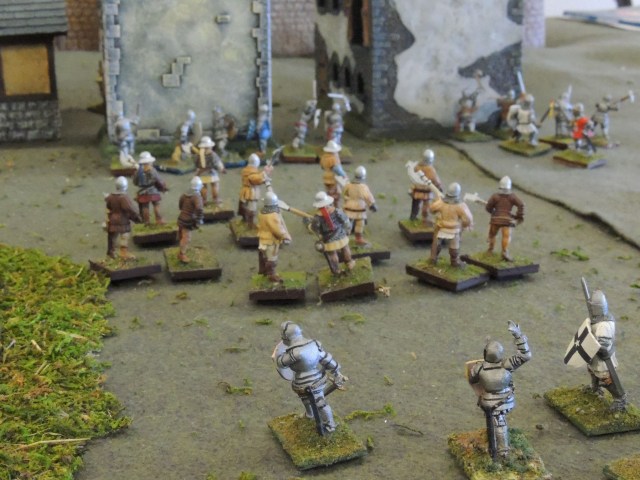
A tighter shot of the English assault on Agen town. They successfully drove the peasants out of the buildings and burned them, but didn't try to take the castle. ,

A tighter shot of the English assault on Agen town. They successfully drove the peasants out of the buildings and burned them, but didn’t try to take the castle. ,

We did struggle a bit to keep everyone on the same game turn.  Multi-player games are a bit of a mystery and aren’t covered much in the rules. I set up the game so the English retinues went first, then the serfs, then the French. There was a little more thumb twiddling than I’d like as folks from one end of the table who weren’t involved with combat waited for those who were.

All agreed the rules were fun, the scenario was enjoyable and easy to figure out. The serfs, based on the victory points I’d set up won easily, with the French edging out the English for second. I made some mistakes in the rules that were quickly brought to my attention (gotta work on that.)  This is a scenario I’d really like to run again, and possibly at Enfilade.
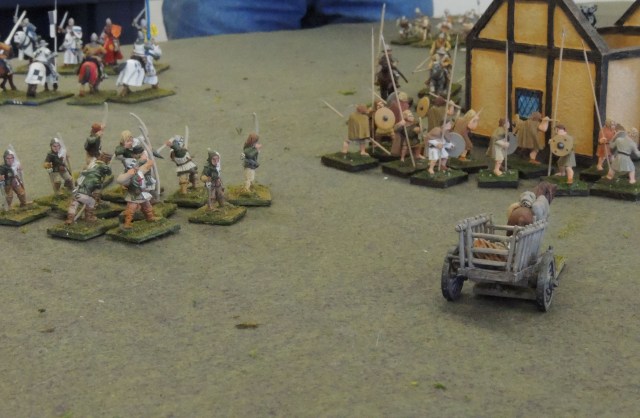
English on the left have burned one of the farm structures, while mounted French advance on them.

English on the left have burned one of the farm structures, while mounted French advance on them.

A couple of quick changes I’d make:

  • Adjustments in the victory points. Not a big deal, that’s why you play test is to make adjustments.
  • Would like a shorter table. 5′ X 14′ was too long, 5′ X 12′ would probably be optimal.  5′ X 10′ would probably be crowded.
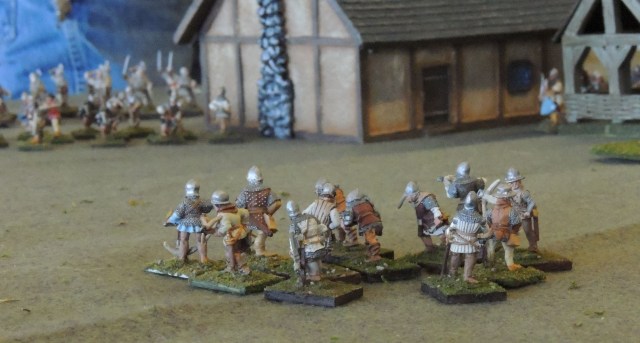
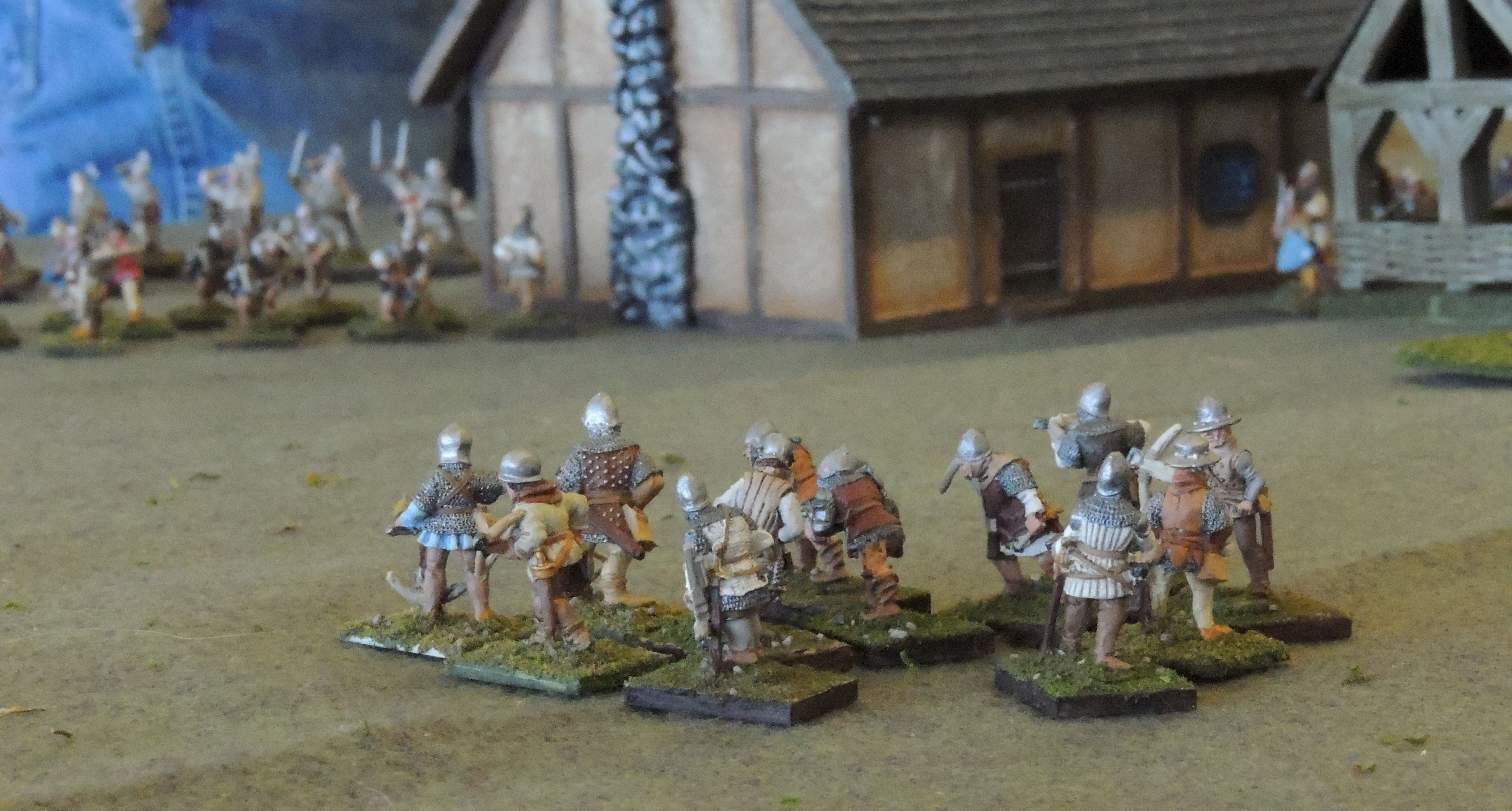
On the French left, a unit of crossbowmen huddle, unsure of what to do against the English

On the French left, a unit of crossbowmen huddle, unsure of what to do against the English

For myself, I never looked forward to running a game as much as this one.  I had my troops perfectly organized to pull out of boxes.  There was plenty of terrain-Barbs Bunker vineyards and fields, Pegasus and Miniature Building Authority buildings including a castle with a breached wall. I wrote over two thousand words worth of retinue charts and scenario notes.  I painted 24 figures worth of foot sergeants in four days. I came home exhausted, but extremely satisfied.  Thanks to all the players-Dean, Bill, Ron, Scott, James, Lawrence and Gene.  They were great to work with and were willing to take the time to debrief the game with me.  Ron pointed out the rules errors I was making-thank you.  It was just a great day.

So, we got that Camaro out of the garage and let it rip.  We drove like mad from North Bend to George, and though the WSP was out in force we didn’t get caught speeding. Petty was awesome and I  can’t wait to do it again.
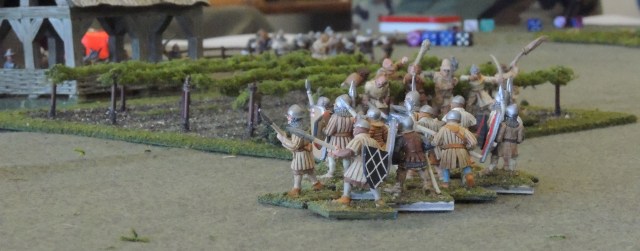
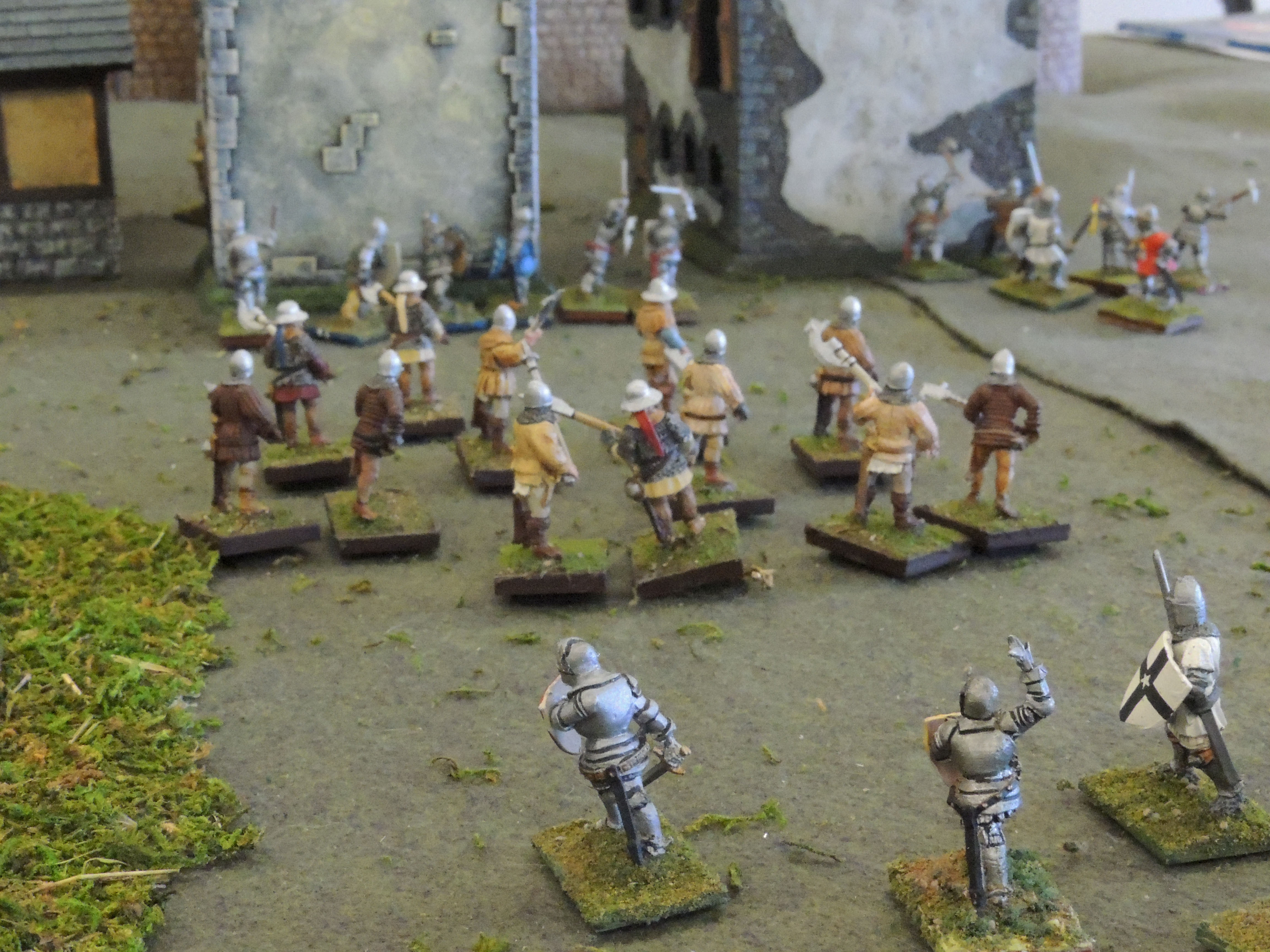
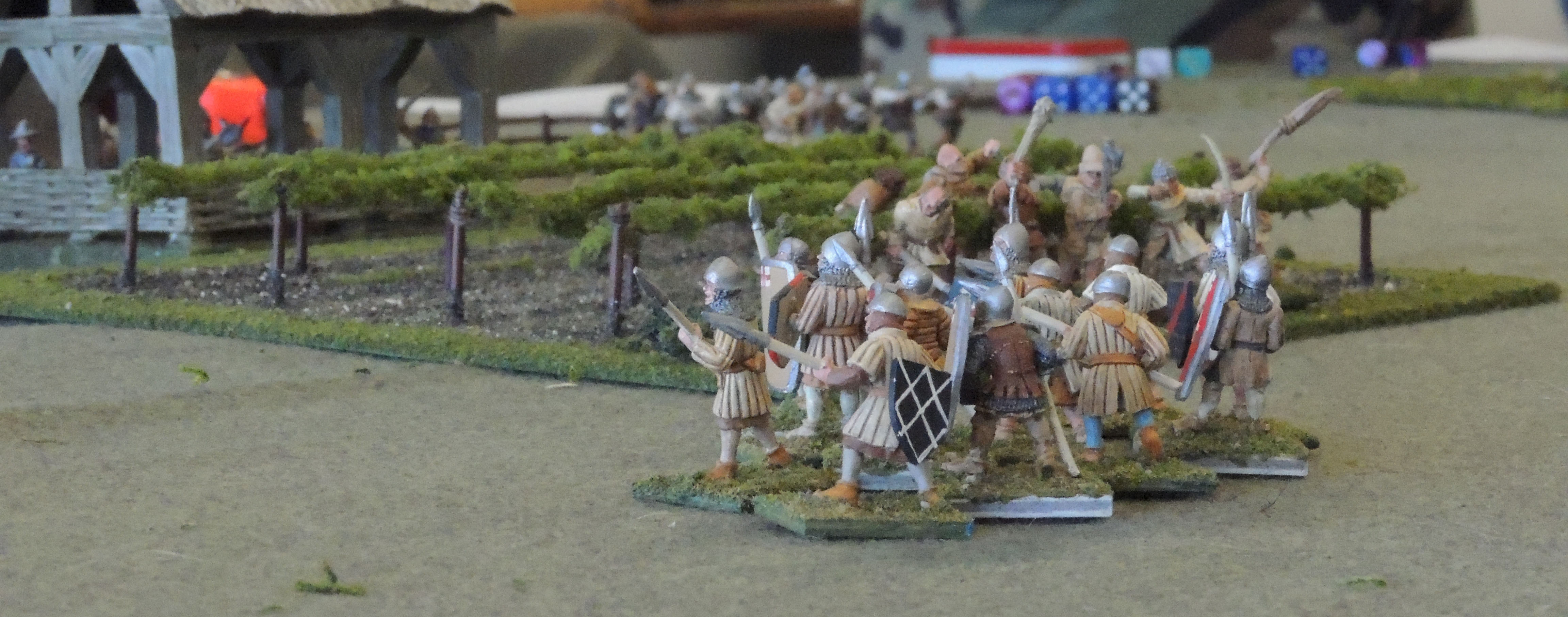
French sergeants take shelter behind the vineyards.
French sergeants take shelter behind the vineyards.
Lion Rampant Again

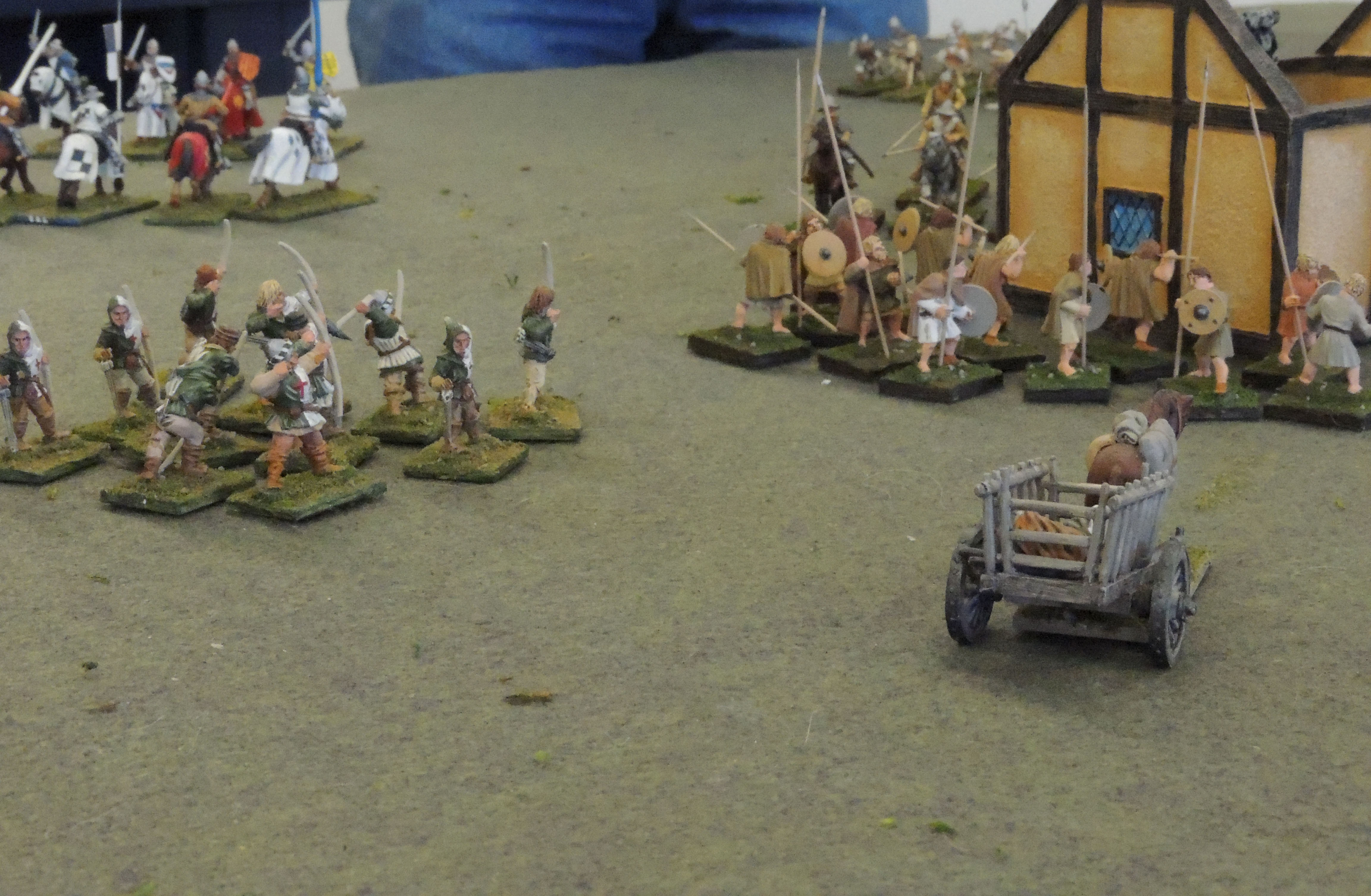
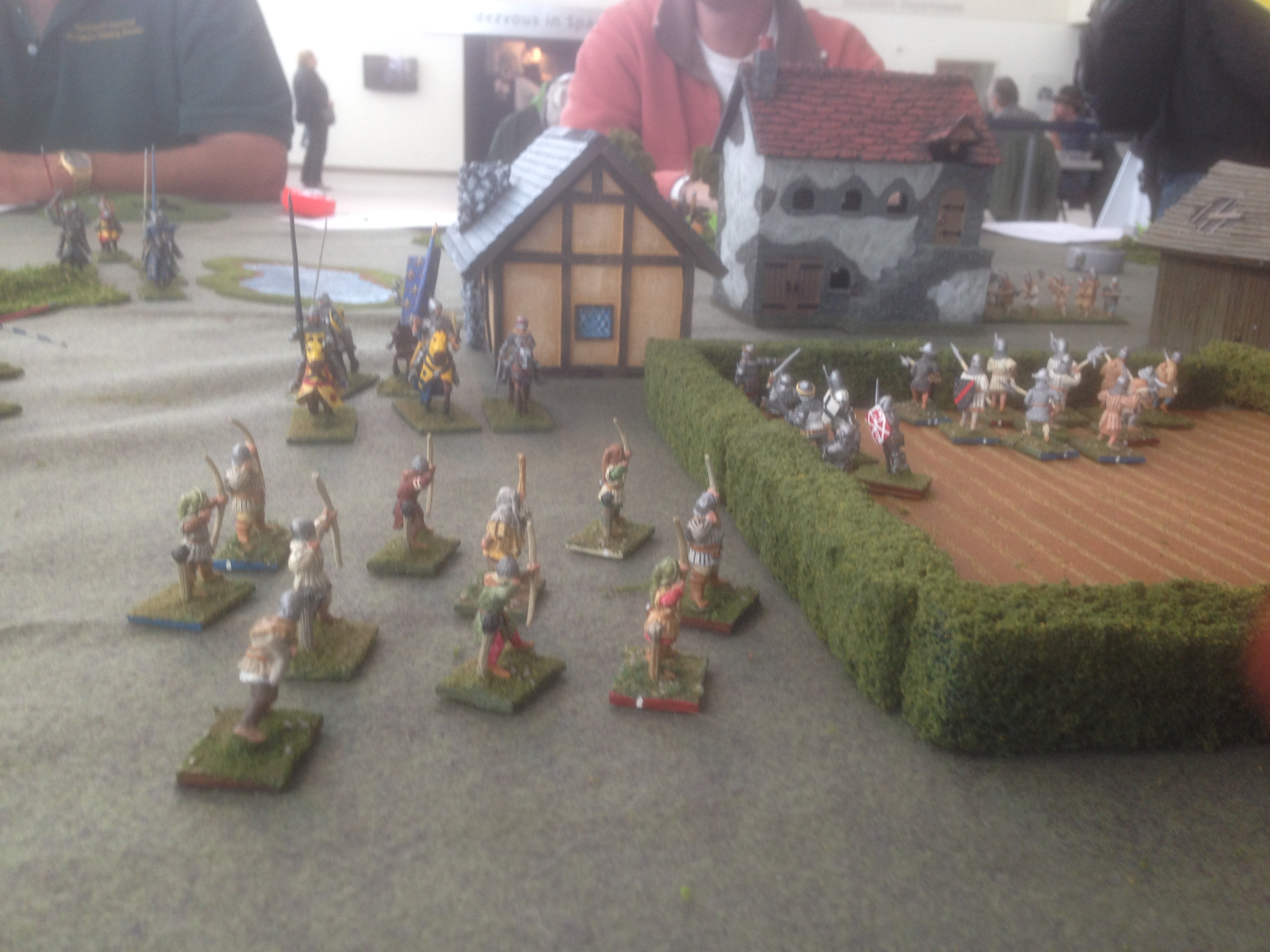
English longbowmen confront French mounted troops

English longbowmen confront French mounted troops

402In our neck of the woods (Washington state, Puget Sound region)  many gamers are very interested in Lion Rampant.  For some of us, Lion Rampant is competing with SAGA as a rules set of choice for medieval warfare.

Confession: I am not a fan of competitive, one-on-one rules sets with points-based army lists. I know many of my good friends really do enjoy that gaming environment.  I’m not one of them.  No slam on those who do, but that’s not what it’s about for me.  SAGA is that kind of game.  Lion Rampant could be, with its points-based retinues, but it doesn’t have to be, at least not from my perspective.

I’ve had the good fortune to walk through four games of LR over the past ten days.  I believe the rules can be a very capable vehicle for scenario design.  In each of the games we had multiple players in games-four players, three players, up to eight players.  The games all proceeded fairly quickly through simple scenarios finished in less than two hours, and in some cases even faster.

For those of you just picking up these rules, or trying to decide if this is the rules set for you, there are some important things you should know.

  1. These are skirmish rules.  Though author Daniel Mersey suggests they could be sort of semi-skirmish, they are intended to be 1:1 scale.  Each unit of 6 or 12 figures represents 6 or 12 guys.  They are a collection of dudes, not intending to represent a formation one would find on the battlefield at Agincourt or Tournai.
  2. Mersey uses an interesting device in the rules–a 3″ zone of control around each unit that may not be crossed by friendly or enemy units (unless you are being attacked.)  This keeps the combat unit to unit, and fairly tidy, but it does create some interesting problems. This extra 3″ footprint takes up extra space on the table, likely requiring more room than one would think at this scale. Resist the temptation to toss this requirement.  The 3″ rule is sacrosanct and gives the game real flavor and uniqueness, on the one hand, but it doesn’t complicate the simple, but clear game mechanics
  3. One would think that with such small units on the table it should be easy to throw loads of them out there. Careful. The 3″ footprint does rob lots of valuable space from the tabletop.  I would suggest two 24 point retinues on a 5′ X 4′ table. Four 24 point retinues on an 8′ X 4′ table.  Six 24 point retinues on a table at least 10′ – 12′ long. This is an important  consideration in scenario design.  Most foot units only move 6″ per turn and due to activation rolls may not move much at all in a turn. Mounted Men-at-Arms move 10″ per turn, but are fairly disdainful about moving. Missile fire extends 18″ from the shooter.  So, if you’re counting on your units covering great expanses of the table, think again. And the 3″ zone of control makes it more difficult to throw lots of units into an extended skirmish.
  4. Missile fire can be deadly.  Putting terrain on the table to break up line of sight is critical.

For my purposes, I feel like the rules work well.  In the Hundred Years War there are endless small unit battles in Gascony and Brittany over strong points and market towns. English chevauchees left many small towns in ashes, while local French commanders scratched together troops to drive off the invaders. I have an idea for a raid on town guarded by a derelict castle, though I also fear it may involve too many troops.  We’ll just have to see.

I confess the rules have really captured me. I like it that they are inexpensive.  I like it that the mechanics are easy, though there is some subtlety.  The activation roulette means that no unit alone is queen of the battlefield. Suggested retinues should be considered just that, suggestions subject to contact with history.

Lion Rampant at Meeples

As I mentioned in my last post, I picked up a copy of Lion Rampant by Osprey Publishing.  I’m always looking for interesting rules sets for the late middle ages.  I have 500 or so miniatures for the Hundred Years Wars and another 500 or so unpainted figures for the period.  When I heard these were coming out, I pre-ordered them from Amazon for $13.40, knowing they were unlikely to have expensive add-ons and expansions.

The rules are mechanically simple, and easy to follow, but the proof is in the pudding.  Today I met Dave Schueler and David Sullivan at Meeples Games in West Seattle to give them a try.  I put together a simple retinue more or less out of the book for the French and the English and let the two Daves have at it.  I was not disappointed.

Here are some things you should know about Lion Rampant

Scale-small scale.  The rules say 1:1, though I could see them being scaled at 1:5 and still working.

Points based system.  But there are no firm army lists.  There are a number of different unit types for mounted troops, foot melee types, and missile troops.  Units are composed of six or 12 figures.  A retinue or command comprises 24 points which is typically equal to four or five units.

Mechanics are simple, but fun.  There are some required actions that must be taken-wild charges by undisciplined knight types, rallying “battered” units, or challenging enemy leaders to single combat.  The rest of the actions a unit may take-movement, shooting, attacking-all require a die roll against a unit’s ratings. No big charts with long lists of modifiers.  Roll 2 D6 and you’re in or you’re out. Each unit that isn’t rallying is entitled to an action die roll until you miss one and then you’re done. A unit that suffers casualties immediately suffers a “courage” die roll and applies the results.  It’s simple

David ran the French with an abundance of mounted figures, against Daveshoe with the requisite bowmen, some Welsh spearmen and Breton bidowers.  They fought over some hedge lined fields.  The English bowmen shot away the French crossbowmen and foot sergeants, but the English leader lost a single combat, before the mounted English knights were ridden down by their French counterparts.  Both sides were looking beaten up by the end of the game, which lasted no more than an hour.

The three of us expressed considerable delight with the rules.  They have the virtue of being clearly written, mechanically simple, and of course they are very inexpensive.  With an eye toward gaming one of my core periods, these rules nicely allow the game host to recreate actions from the endless campaigns in Gascony throughout the Hundred Years War, or the decades long civil war that was fought in Brittany.  These are intended to fight small actions and not large battles.

But just to show me wrong, Daveshoe suggested we line up some figure a la Agincourt.  So we piled out eight or so units of French foot men-at-arms and a few crossbowmen and had them attacking a mixed force of archers behind stakes and English foot men-at-arms.  It was interesting.  I was very fortunate with activation die rolls for my bow units and shot the snot out of loads of Frenchmen.  But eventually my activation rolls began to fail and the foot knights began to cross my stake lines and slaughter the bowmen.  Again, the rules were easy and fun and I am planning a larger game in a couple of weeks. I could not be more pleased with the rules.

I’d also like to get in a word for Meeples.  Meeples Games is one of growing number of games in the Puget Sound areas that sells mostly board games, a few miniatures for Warhammer 40K and Warmachine, but combines it with a dining experience.  It has excellent table space for board games, and I was able to find a table easily large enough for our Lion Rampant game.  It’s a friendly place.  The food is simple and inexpensive fare.  Probably not the equal of Cafe Mox in Ballard, but much cheaper than AFK Elixers in Renton.  They also have beer and wine on tap.  The only negative I have is that it isn’t in my backyard. If you like supporting local businesses, it’s definitely a place worth a visit.