And Now For Something Completely Different: Music For Your Painting Pleasure

I have made no secret of my love of vinyl records. Researching and cataloging compete for my time along with painting and gaming.  But I’ve never forgotten how much I Iove this hobby, the people in it and, especially painting figures, and so I’m trying to figure out a way to bring the two together.

With the baseball season ending soon, at least for we sad Mariners fans, I’m looking at a way to maximize my listening and painting time.  In the past, I’ve always been able to make about an hour per night available for painting.  Sometimes a little bit more, but an hour a night about 340ish days per year.  This year it’s been harder to pull that off.  Maybe with my health issues, or the distractions that come with other interests it’s pulled me off track.  One serious distraction is my three delightful companions who don’t like me in my painting room.  They often come in demanding a walk or some unidentifiable something.

Anyway, as the baseball season evaporates into a cloud of disappointment, I am making an effort to spend more time in my painting room–painting-which is good because it’s way too small to do anything else.  To keep me there I plan to paint at least long enough to listen to a single vinyl record.  A record lasts about 20 minutes per side, so about 40 minutes total.

A by-product will be sharing with you the reader, what I’m listening to and what I’m working on.  So, it will be a compilation of music to paint to. Let’s see how this works.

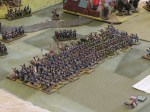
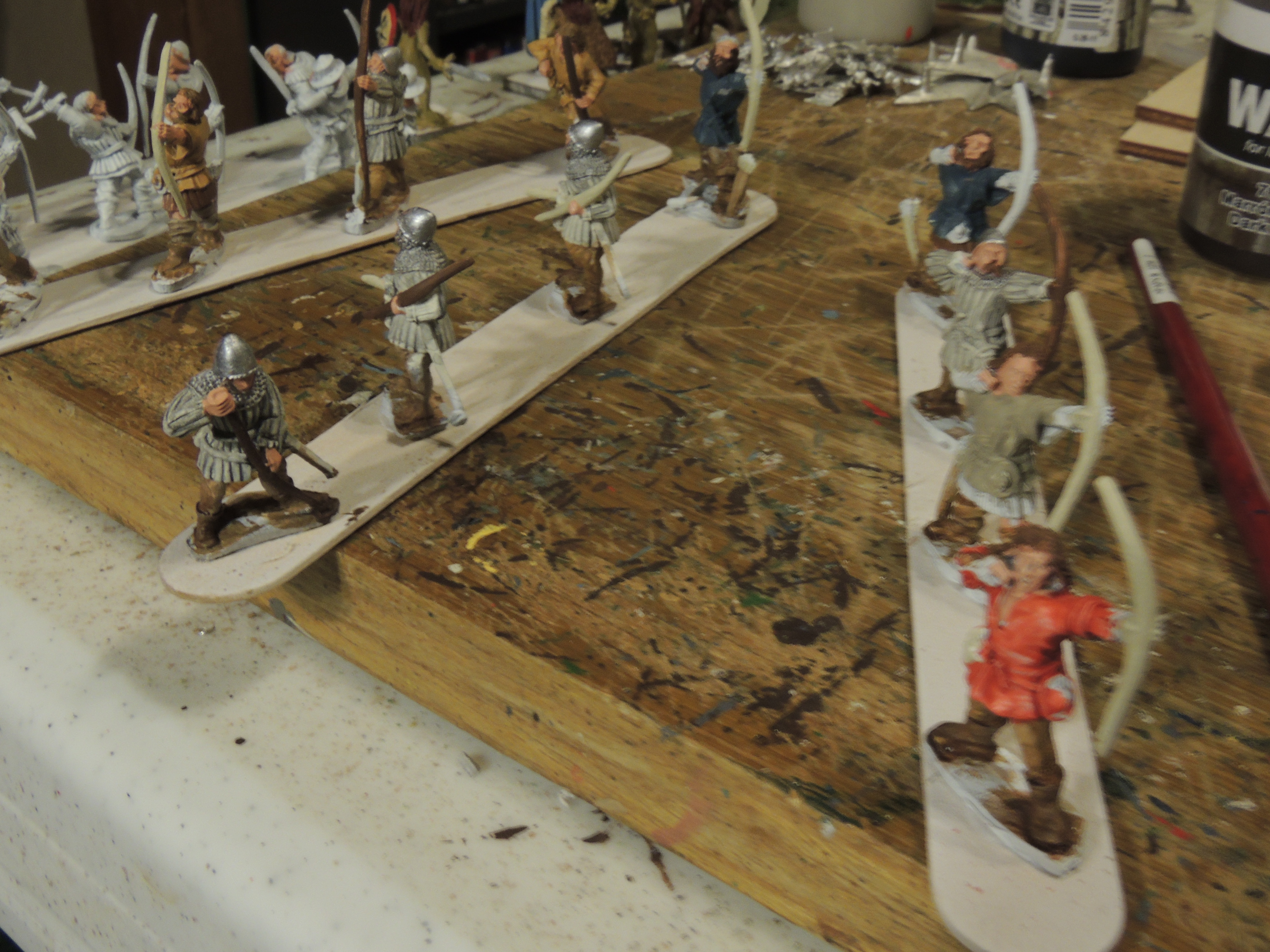
I'm currently working on a dozen Old Glory longbowmen.  They'll paint up fairly quickly if I just put the time in.

I’m currently working on a dozen Old Glory longbowmen. They’ll paint up fairly quickly if I just put the time in.

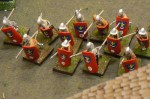
I’m currently working on some Hundred Years War longbowmen.  Pretty easy and straightforward work.  These are Old Glory bowmen.  I find them to be simple to paint.  I also feel like they are underdressed.  These are pretty good for levy bowmen, but an awful lot of bowmen accompanying Edward III, the Black Prince or Henry of Lancaster in France or Gascony, or Castile in the middle part of the 14th century probably would have worn more garments that could have shown livery colors such as a hooded tunic or gambeson.  They are suitably lightly armored, but just a bit too casual.

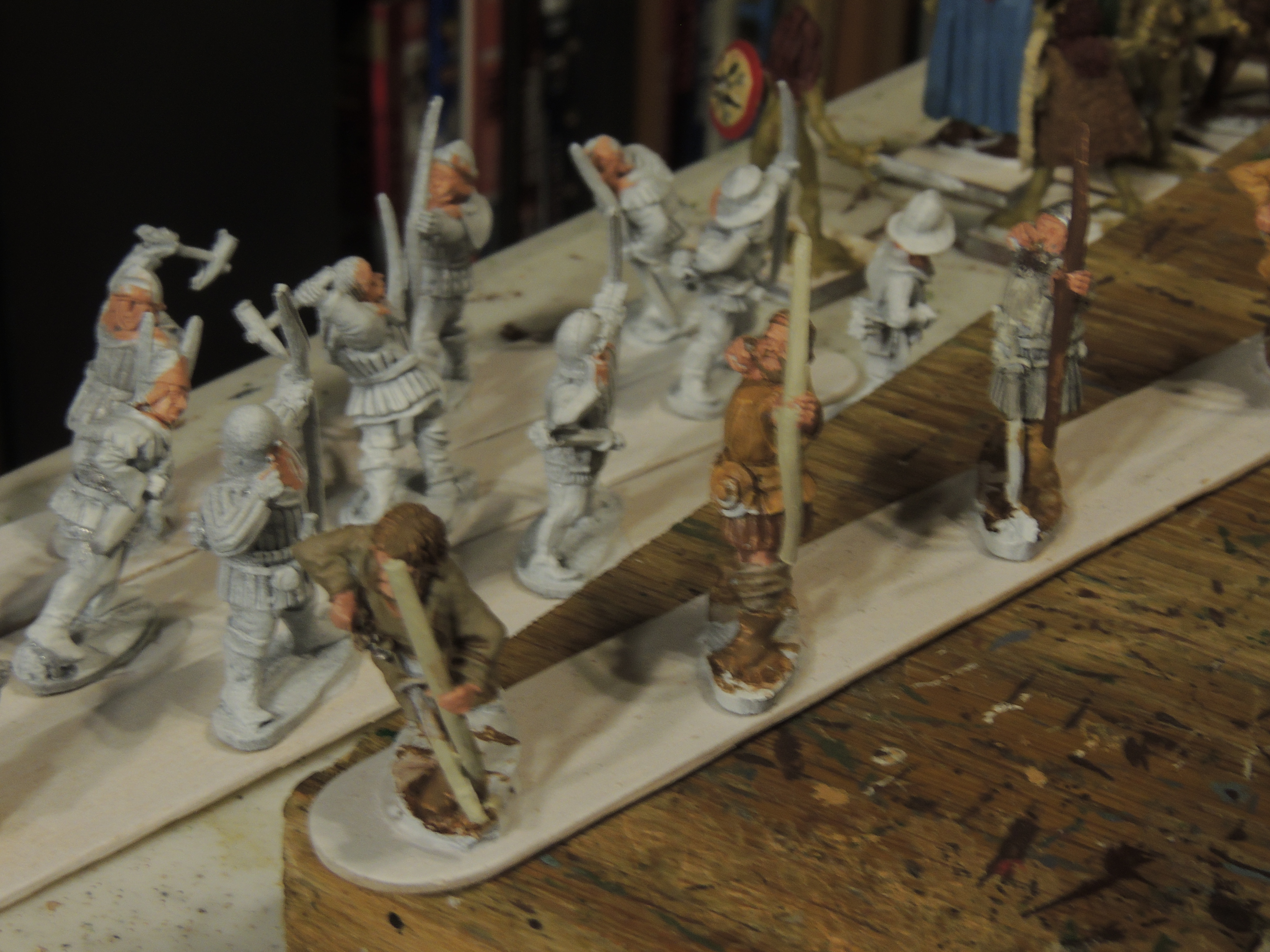
I also got started on the next twelve figures in the 24 figure unit.  Twelve figures at a time is usually about all I can manage at once without out bogging down.

I also got started on the next twelve figures in the 24 figure unit. Twelve figures at a time is usually about all I can manage at once without out bogging down.

I’ve been working on these first twelve figures for a few hours.  Tonight I washed the brown surfaces-tunics, leggings and shoes with Vallejo Brown Wash.  I also went on to paint basic hands.  Not a lot to get done in 40 minutes but progress.  In the background you can also see twelve more figures freshly primed, and I painted their basic flesh on their faces.

I have a load of painted longbowmen individually mounted for Lion Rampant and multiple mountings too.  These will be for my muliple-mounted game-based on Fire and Fury–but they will be skirmish stands.  Under these rules the English army will be able to break some bow units into skirmish order to take advantage of terrain or act as tirallieurs as suggested by Matthew Bennett in his essay on battle tactics of the Hundred Years War.

Ry Cooder's 1978 is known for being the first digitally recorded album.  A collection of light R & B songs I found it to be very pleasant painting accompaniment.

Ry Cooder’s 1978 is known for being the first digitally recorded album. A collection of light R & B songs I found it to be very pleasant painting accompaniment.

Tonight I popped Ry Cooder’s Bop Till You Drop on to my turntable.  I picked it up for a buck at an estate sale and this was my first listen.  I’ve always thought well of Cooder as a guitartist, songwriter and collaborator so I was anxious to give it a spin.  It was quite enjoyable.  It is a collection of rhythm and blues tunes, with Cooder backed up by a great band including Jim Keltner and David Lindley.  Chaka Khan makes a guest appearance providing backing vocals. It has a very light touch with great songs like “Little Sister” and “I Can’t Win.”  The album is famous (or notorious) for being the first digitally recorded record.  Though it is not particularly highly thought of, I found it to be perfect music to paint to.

Gaming at the Columbia River Maritime Museum

columbia-river-maritime-museum

I love Astoria.  It is one of my very favorite towns. Astoria is a great mix of new and old with its Victorian houses and riverside condos.  It has a wonderful selection of excellent brew pubs, blocks of small and off-beat shops and antique malls. I’ve made Astoria a regular stopping point for the last twenty years or so and my wife and I love to visit.

A few years ago Astoria gamers Lloyd and Dave suggested a game gig in Astoria.  Lloyd, a retired Astoria teacher and a docent at the Columbia River Maritime Museum, suggested we might hold an event at the museum.  This summer he offered up a date.  As soon as I hear about it I suggested to Lorri we attend, go down early and spend an extra day in town. We immediately booked our stay at the Crosby House, an Astoria B and B and made plans for boarding the Aussies. The game was scheduled for Labor Day Sunday, so we made plans to drive down on Friday spend some time together in Astoria on Saturday, game Sunday, and have leisurely drive back on Monday.

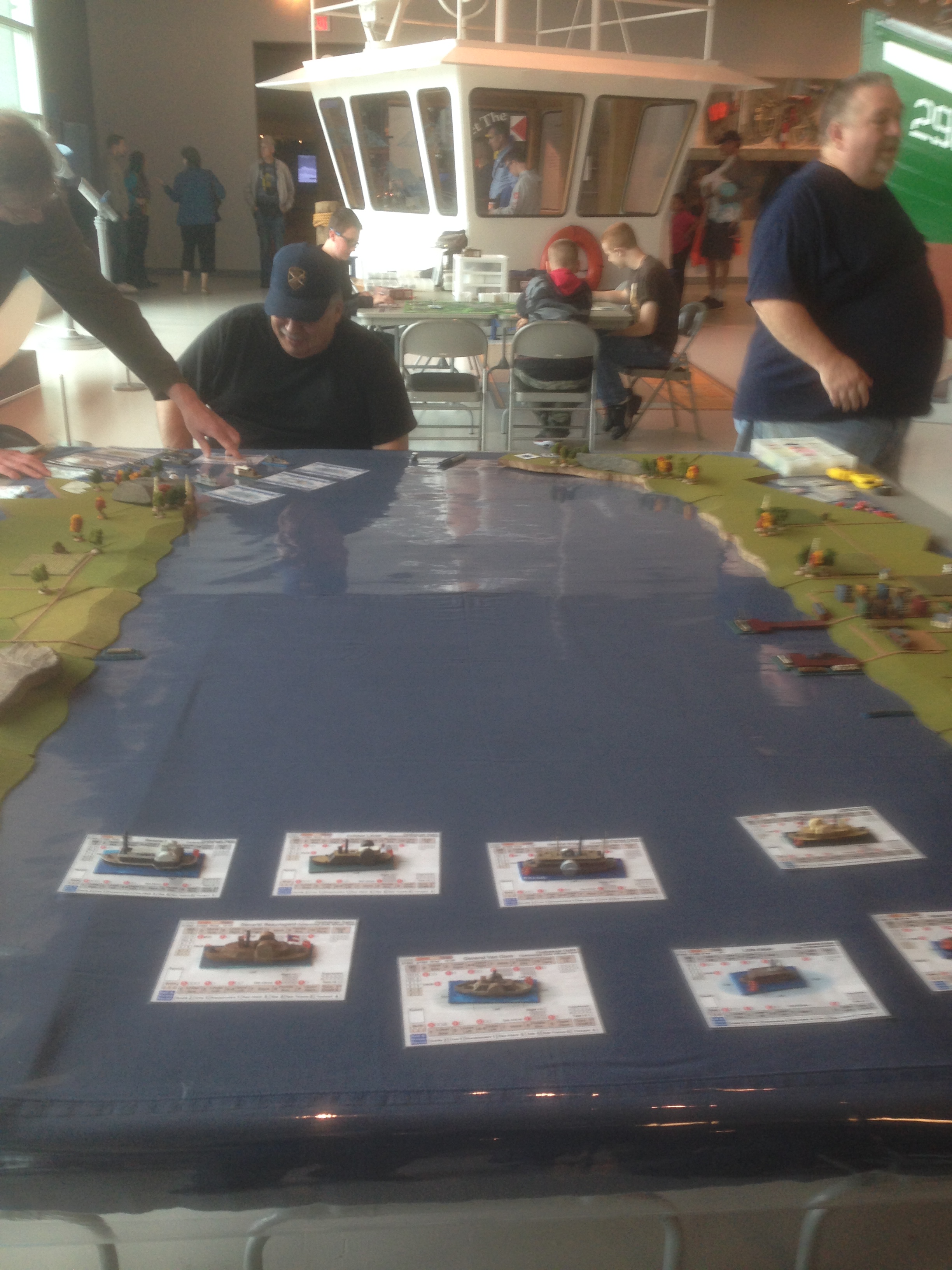
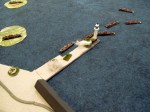
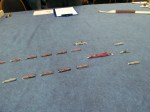
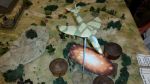
I’ve already written extensively about our big Astoria shopping outing, and you can read that here if you are so inclined. But the real attraction was the game day.  I arrived at the museum at about 9:45, a short drive from Crosby House. Lorri dropped me off with my goodies and I met Lloyd and the guys waiting for the museum to welcome us. We were shortly ushered into our game space.  Scott Potter set up an all-day Wings of War furball on one table.  The second table was taken up by the rest of us.  In the morning Dave, Lloyd and Dan set up the Battle of Memphis, an American Civil War naval battle, using the Sail and Steam Navy rules.  Ah, a set of rule I know and a battle I’ve always been interested in but afraid to try.

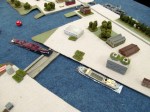
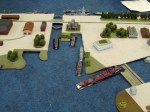
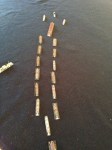
Confederate ram fleet in the foreground, looking down the river as the Union forces prepare their advance.

Confederate ram fleet in the foreground, looking down the river as the Union forces prepare their advance.  ACW naval newbie Clyde Carpenter prepares for the big show.

Memphis starts out simply enough.  The Mississippi Defense Fleet (Confederates) have their rams fighting upriver to defend Memphis from a combined arms fleet of Union armored gunboats and rams coming down river.  It’s a tough spot for the Johnnies because, to be effective, they have to ram the Yankees and they are badly outgunned. The rules call for two movement phases, giving a distinct advantage to rams, but the GM’s decided on a house rule allowing only one movement phase. I opted to be a Confederate, knowing it might be difficult.

The game started with a plan to use four vessels to engage the Union rams, leading the parade on to the board, while the remaining Confederates took on the slower ironclads. You know what they say about plans and first contact with the enemy.

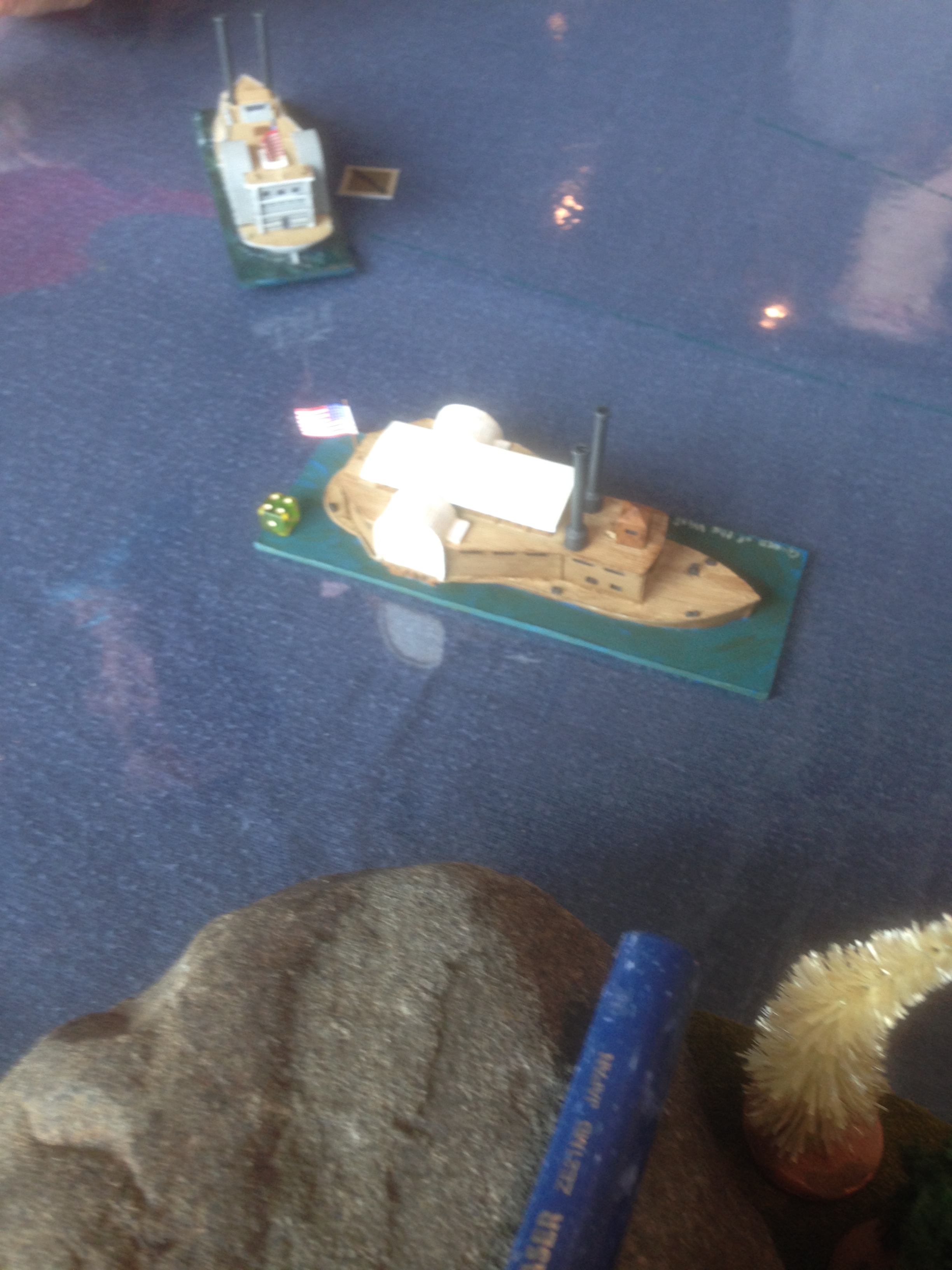
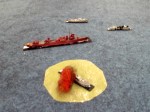
Union ram slips past the Switzerland stuck on a shoal.  It would later be rammed and sunk.

Union ram slips past the Switzerland stuck on a shoal. It would later be rammed and sunk.

The Union players obliged us by running a ram onto a shoal where it remained stuck for most of the game.  Dave Schueler, running the rams to my right slid past the advancing Union rams and near the rear of the Union formation.  My  rams remained in the middle of the board, firing their two small guns as they advanced on the Union ships, taking fire as they went, suffering significant but not critical damage. On the right the remaining Confederates advanced slowly, trying to line themselves up as the Union vessels maneuvered around the shoal and turned upriver.

Let’s just say the rebels were a bit more lucky in their fire than the Union forces. A hit on the Benton critically damaged their boilers, knocking out all power and setting it up for a ram. The Union ram Switzerland, stuck on a shoal was in turn rammed by Daveshoe’s ships and his second ship was lining up a target.  Though some of the Confederate ships, such as my General Price, were badly shot up by the heavy and unrelenting Union fire, they were damaging superstructure, not infrastructure.

We played the game for more than three hours, and I really enjoyed it.  By the end, we agreed the Union would have difficulty meeting their objectives.  One Union vessel was sinking, and others were in serious danger of being rammed. It was good.

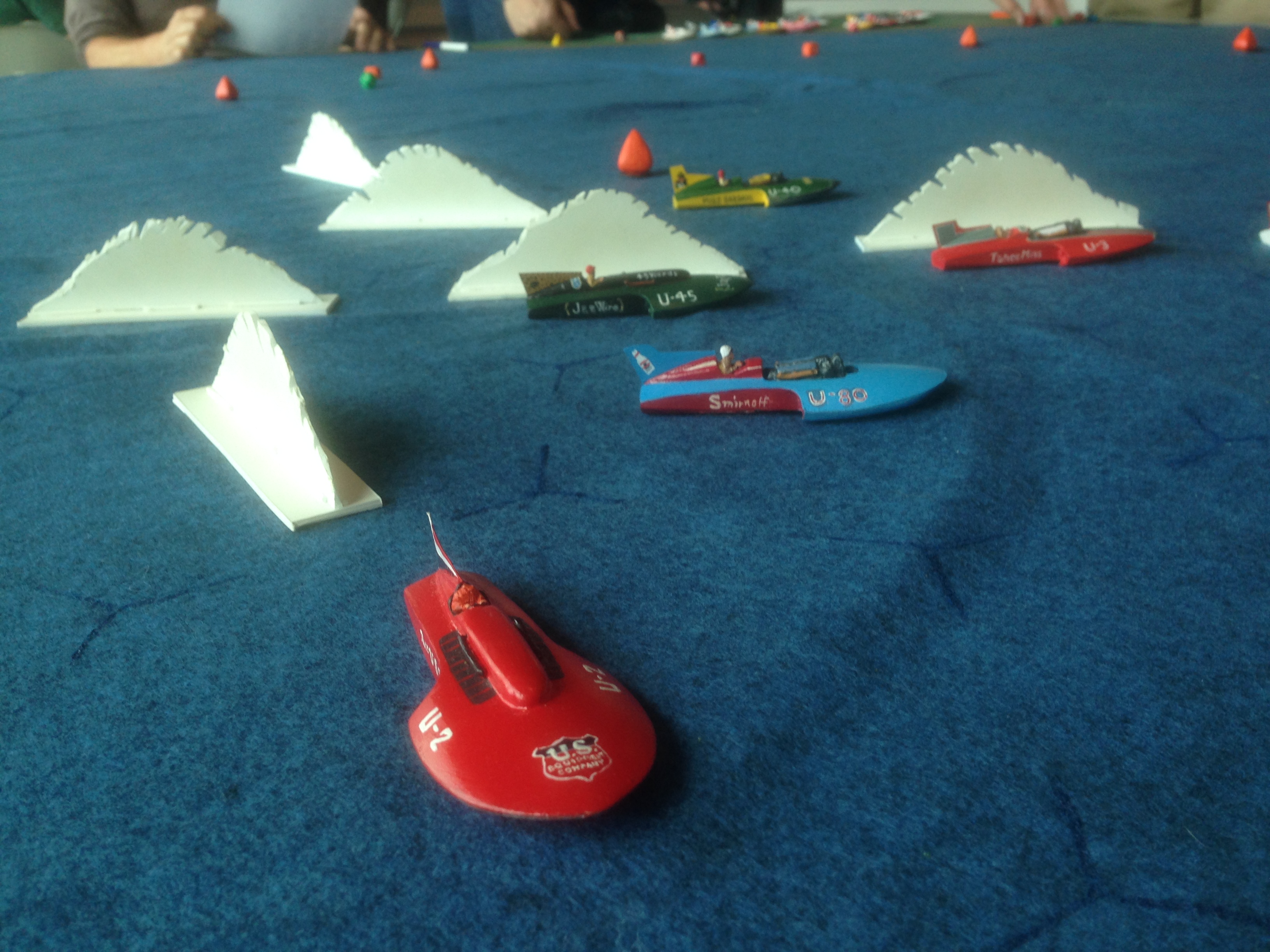
The latter couple hours were spent with Thunderboats!  I promised to bring it because it was fun and easy to learn.  We played from a standing start, so the boats were pretty clustered at the beginning of the game.  But Dave Schueler quickly took control, with a series of great die rolls and passed engine pushes. After the end of the first lap he was so far in front it was no longer necessary to take many chances beyond pushing the engine.  By the end of the game he had a half lap lead on the field.  I believe I finished second in my JagWire boat.  I had super luck pushing corners, avoiding collisions, and splashing through roostertails.  But I could never roll higher than an 11 or 12 on my every turn engine pushes, and never made up any ground on the leader.  Still, it is strictly for fun, and I think there was that in abundance.  Nobody was eliminated in the game despite a rash of hard bounces and water in the intake manifolds.  There was even liberal use of the nitrus bottle, but few fires.

Dave Schueler's Miss Bardahl takes the inside position.  He would eventually fly into the lead and never look back.

Dave Schueler’s Miss Bardahl takes the inside position. He would eventually fly into the lead and never look back.

It was definitely a fun day.  Going forward I would happily do it again, though I’m not sure that Labor Day Sunday is best for me. The weekend is usually the last minute teacher prep days, and to say I really needed those this year was an understatement.

Look, I’m Painting Stuff: Hessian Grenadiers

Hessian Grenadiers 001

School is back in session, and having a much different course load than in years past is taking its toll on me.  I passed on last weekend’s Fix Bayonets, an excellent little game gathering at Old Fort Steilacoom in west Pierce County.  I hope it went well, and to all my friends I’m sorry I missed you.  Next game on the docket is Fire and Fury at the same Old Fort Steilacoom.

My games have been fairly few and far between.  I haven’t reported on my Labor Day Weekend gaming in Astoria, which I will do in the next day or so, but aside from that I’ve been pretty unavailable. But I have been painting.

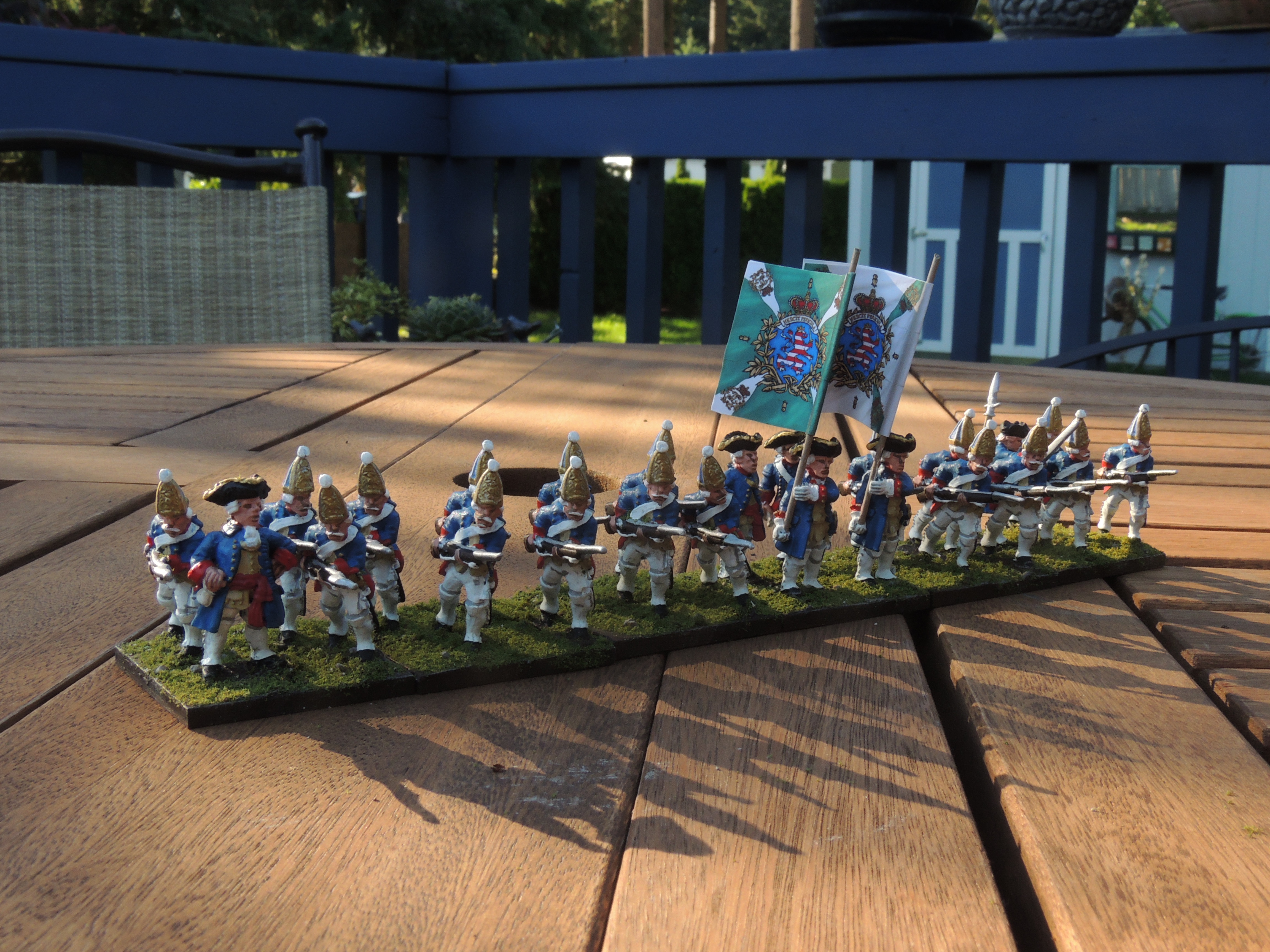
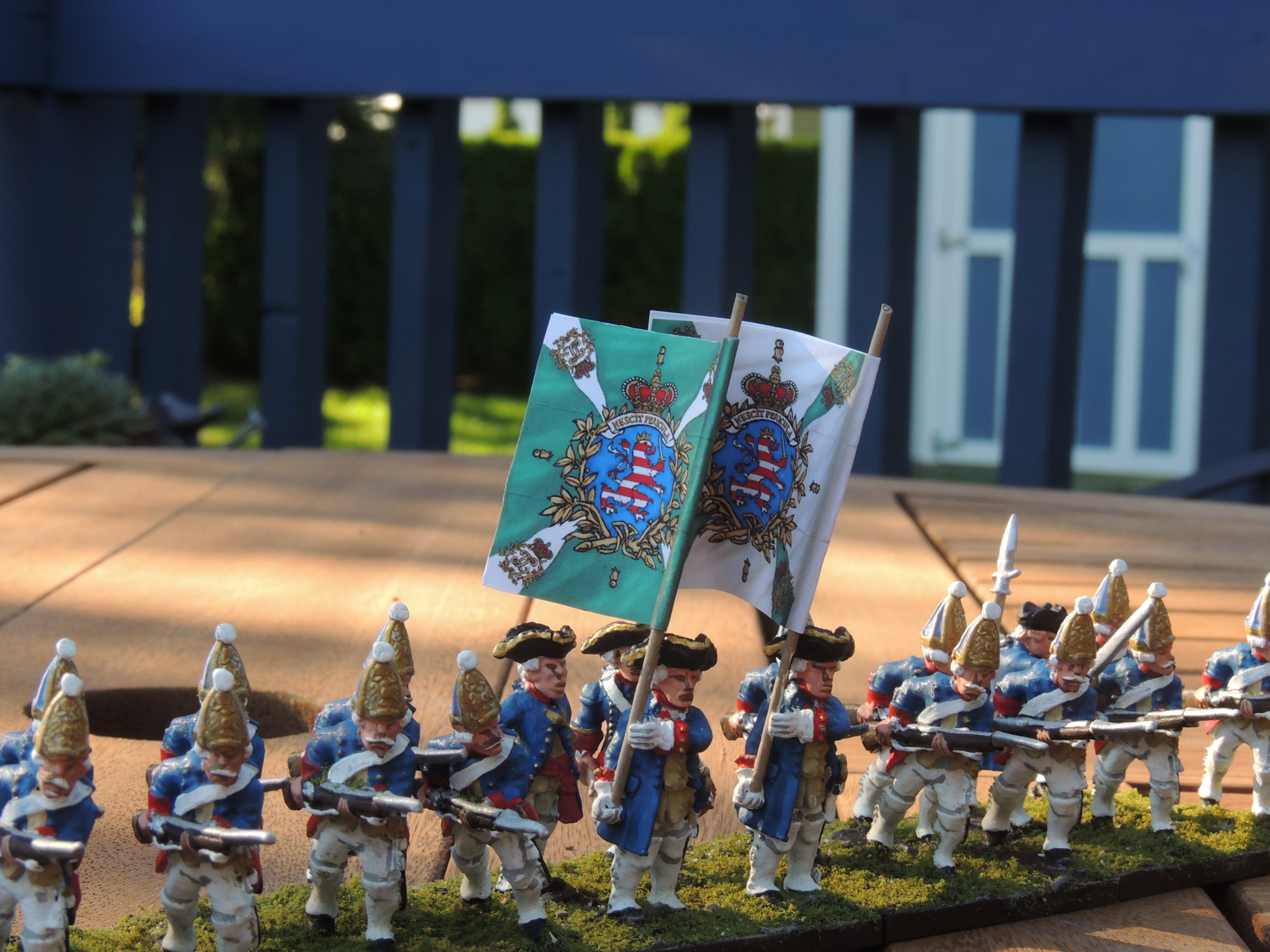
I am kind of in a mood in which I’m painting whatever I damn well please.  First on the docket here is the Hessian Grenadier Regiment von Rall.  It was the only grenadier unit stationed in the south during the later years of the American Revolution.  The regiment changed names at least twice during the war.  The unit was sent to Savannah, where it fought French and American forces and took heavy losses. Von Rall was also at the siege and capture of Charleston and was rotated back to New York in 1780.  Unfortunately the grenadiers were not present at the big battles of the southern campaign, but for a one off game who knows.

The figures are by Foundry.  They were easy to paint.  I was short a couple of grenadiers so leavened them with an extra officer or two.  I found them fun and easy to paint, nothing difficult. They are the first Hessians I’ve painted for my somewhat dormant AWI project. But they certainly aren’t the last.  I have the Old Glory figures to paint the von Bose regiment, present at Guilford Courthouse. I also have some stray Front Rank Hessians I may fill out to 24 figures each for another musketeer and fusilier regiment.

The big “new thing” I tried out with this unit is the addition of GMB flags.  I’ve always been a flag cheapskate, downloading flags from free sites and taking what I could get. With this unit I decided to change.  Giles Allison uses GMB flags on his magnificent units. I have friends that use them.  Heck, what’s wrong with me.  I ordered on-line, which was easy enough. But I did catch them on vacation.  It probably took 2+ weeks to get them from the U.K. They aren’t cheap at three quid 45 pence, but they are beautiful and the color and detail is amazing.

A little closer up of the GMB flags. Very nice. Worth their cost.

A little closer look at the GMB flags. Very nice. Worth their cost.

Last night based the figures and added the flags.  I carefully cut them out and and wondered what to do with them next.  It would be helpful if GMB included suggestions or directions or at least posted some on their site.  Thankfully you can find anything on the internet, and was able to find some forum posts that were helpful.  I didn’t feel too adventurous first time out so the flags look pretty straight, but it does show the detail off nicely.

4Ground buildings

001

Last year, about this time, I was contemplating a big Indian/Loyalist game on the frontier during the American Revolution.  I haven’t done the game yet, and honestly don’t know if I will anytime soon.  The scope in my mind is a lot bigger than my grasp.

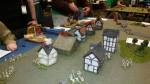
In any case, as I was preparing, I realized that I didn’t have many frontier habitations.  How can Butlers Rangers burn down the frontier if there aren’t any buildings to burn? A friend of mine had shared some of his experiences with laser cut wagons at 4Ground miniatures.  I perused their catalog, checked out their buildings from the American frontier and thought I would give them a try. I ordered from my local hobby shop, and they immediately went into the big pile of “all things Smyth,” as in I forgot I even owned them. But as I was deciding what to work on this summer, I set these aside to finish.

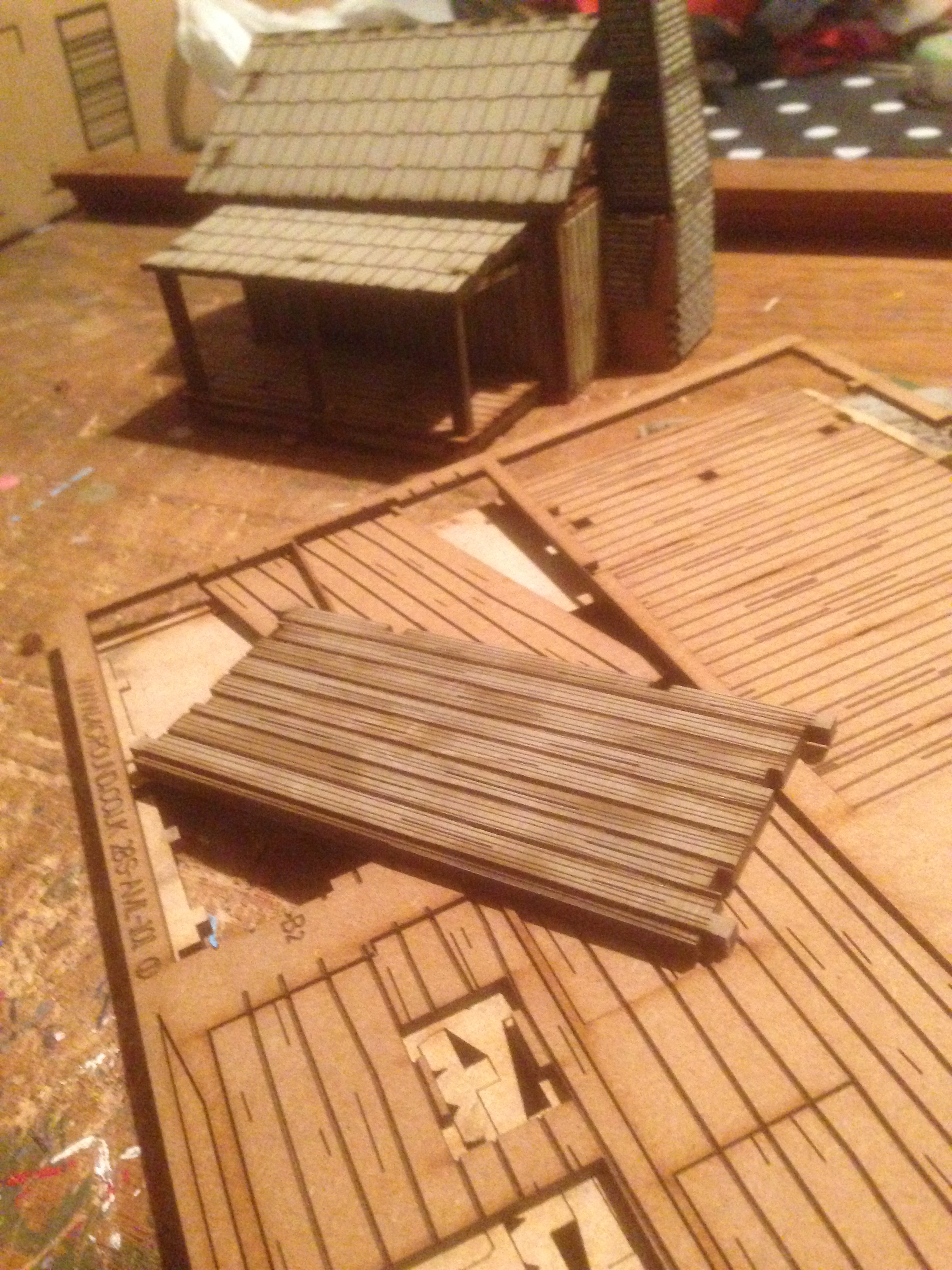
The two buildings I purchased were the Pioneer’s Log Cabin and the Settler’s Log Log Timber Cabin.  Each came in a sealed plastic bag with four slabs of laser cut plywood pieces.  The top was carefully sealed and the full color instruction guide was included with the parts. Together the two kits cost about $60, which is pretty fair for quality buildings–if you’ve priced a structure from Miniature Building Authority lately. . Because the structures are raw wood, the different colored wood examples work pretty well.

I would love to say the buildings went together quickly and without a hitch in a matter of moments, but they didn’t.  It could be that any building project for me is just going to take longer because I”M BAD AT BUILDING STUFF! But honestly, because we’re assembling structures with PVA glue (Elmers or something similar) sometimes things just need to dry. I assembled both buildings over three evenings including two Mariners games and the Republican presidential debate, which was easily as long as a Mariners game.

I can say with truth, that I was quite pleased with the way things went together.  The instructions took me step by step through the pieces I would need at each phase of construction and give a rough picture of how they went together. The pieces were of high quality and did go together well.  The construction was mostly pretty darned easy–good fit.  The finished interior and exterior had nice attention to detail, though there were some gaps I’ll share more about.  I could easily recommend these to another user.

However, I am not without some constructive suggestions. First, there is the matter of the directions.  Though they give an order to things, the lack of even simple written directions at times left me trying to figure stuff out and tearing things apart to reassemble. I felt like Tonto, with half the vocabulary, giving directions on sewing a shirt to The Lone Ranger. “No Kimasabee, it go here.”  The lack of clarity led me to mis-assemble the chimney on one of the buildings, though it is obscured by a chunk of the roof.  Pity, because the detail is so great. Another issue with the directions is although the piece numbers are printed on the color directions, they blend right in and are difficult to read.  For those of us in the geriatric set, this is a problem. Bigger, darker, clearer would be better.

In the case of the Frontier Log Cabin, some of the pieces really needed double assembly so the detail would show on both sides.  For the most part, 4Ground is really good at doing this, But for this model, some of the finishing pieces could be better.

Overall, for price, quality of detail and ease of assembly, I can at least give these models a solid B, maybe even a B+.

Hundred Years War and fighting the big battle.

Lion Rampant is a great set of rules for fighting the many small actions of the Hundred Years War.  Adding a few more troop types, like town militia and mounted archers will help.  But overall I think it’s a fine set of rules that are simple and easy to learn.

I run into trouble when I want to fight a big battle.  I’ve bought fully into the Hundred Years War sickness. I have my 400+ (and growing) singly mounted figures.  But I also have 200+ (and growing) miniatures on multiple figure bases.  So I’m preparing to fight the big battles as well as the skirmishes, raids and small battles.

My problem is finding a set of rules to do the job. The rules sets I’ve seen don’t fully embrace the unique characteristics of the Hundred Years War, and it’s much different than other wars.

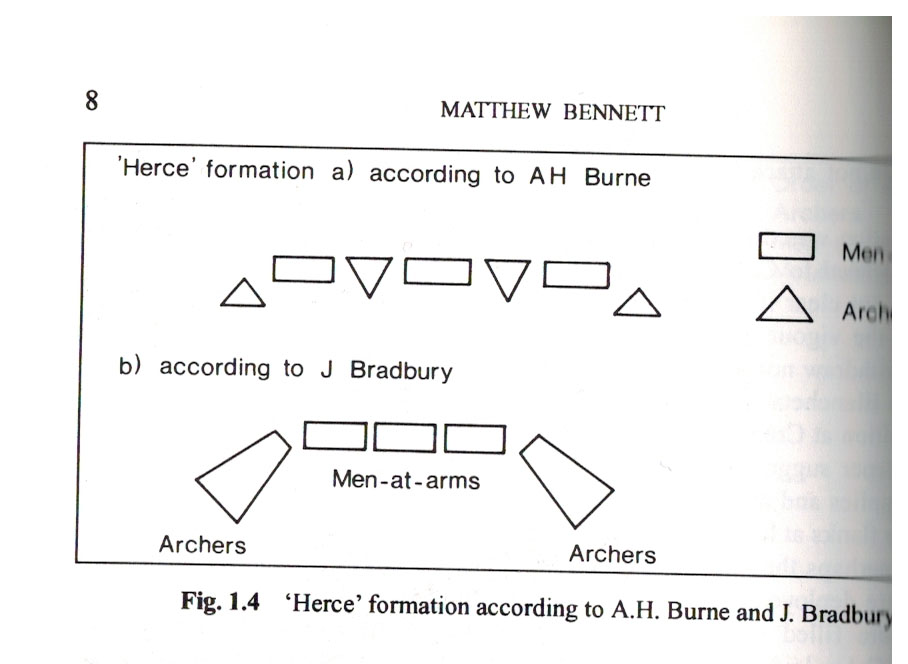
Much of that uniqueness is related to the English system of warfare.  To fully understand it means throwing out some myths about how the English fought.  Lots of that myth was perpetuated by a relatively modern writer of English military, Col, Alfred Burne. Burne wrote two important books on the Hundred Years War, The Crecy War and The Agincourt War in 1954 and 1956 respectively.  His model for the English battle line looked something like this:

Burne and Bradbury

In this drawing the triangles marked with an A represent archers, specifically longbowmen.  Burne’s argued, that based on his reading of Froissart’s version of Crecy the English adopted a herce or harrow shaped formation with archers interspersed in the main battle line.Burne’s reasoning was that the harrow, an agricultural implement had teeth with gaps between for the grain to be gathered.  Thus the English line must have had archers as the teeth.

This was accepted orthodoxy for many years, until it was questioned in Jim Bradbury’s 1985 book The Medieval Archer. In his analysis of Burne’s work, Bradbury suggested that the little wedges of archers in the English battleline would have led to weaknesses easily exploited by French cavalry or armored  men-at-arms in melee.  Bradbury suggested that It was far more likely that longbowmen were deployed well out on the flanks, protected by terrain features or battlefield improvements such as stakes or pits. Bradbury’s models for the proper deployment of the English army at Crecy and Agincourt are widely embraced by the scholarly community.  This diagram is from an article by Matthew Bennett in Arms, Armies and Fortifications in the Hundred Years War (1994).

The challenge in fighting the big battle of the Hundred Years War is to properly depict longbowmen which usually form 1/2 to 4/5’s of an English army. In several sets of ancients rules that also depict the Middle Ages, one of the complaints about Hundred Years War English is that they don’t make a very good army.  That’s chiefly because unless the English are fighting according to their historical set up they have little chance to succeed.

In his biography of Edward III (Edward III and the Triumph of England, 2013) Richard Barber’s analysis of Crecy begins with an apology for having so few facts about the battle.  But as he examines as many eyewitness accounts as possible, including a definitive location of the battlefield, However, one thing he communicated with certainty is the likelihood the English men-at-arms, fighting dismounted, were on a very narrow front, as little as 400 yards. Reasoning, the archers must have been able to cover the armored troops’ front with fire,or at least the front of their division with fire. Bennett, in his article on development of battle tactics echoes Bradbury’s suggestion that the archers in their horn, may have actually shot over their accompanying men-at-arms.  Sadly, without any kind of evidence or drawing any conclusion.  However, Bennett, in his 1994 article, and echoed in subsequent works, suggested the English may have employed some archers much like the French used tirailleurs in the wars of the French Revolution and in the Napoleonic Wars.  Operating in small skirmishing groups, some longbows may have shot their arrows to prick their more heavily armored adversaries into action, thereby bringing on an action more quickly than was desired.

On the wargame table this could mean providing the longbows with greater range, firing in deeper ranks, and allowing some the ability to skirmish and doge around blocks of friendly men-at-arms.  It certainly means English armies will perform best if their troops are allowed to fight historically.  They are tactically defensive, so forcing them to be aggressive or fight a meeting engagement is well outside their comfort zone. A big battle set of rules should reflect this.

Six Things To Know About the Hundred Years War

Though I’ve written little about it on THIS blog, I have a huge interest in the Hundred Years War.  I don’t know when it started.  Maybe it was when I got the little Pan book on Agincourt by Christopher Hibbert from their  British battle series back in the day. Or maybe it was when I bought Donald Featherstone’s little guide to wargaming Poitiers from the Knight’s Battle Series at American Eagles in the late ’70’s.  Most likely, however, I was captivated by John Keegan’s absorbing account of Agincourt  in his landmark book The Face of Battle.

Though many miniature gamers know the minutiae of The Battle of the Bulge, Waterloo and the Napoleonic Wars, and the complete rise and fall of the Roman Empire, but don’t really know much about this war that consumed more than a hundred years of the middle ages (1336-1453) and profoundly shaped the history of England, France and Europe.  Here are the basics:

1. France won the Hundred Years War.  We often forget this because we mostly remembered the epic military disasters they participated in: Sluys 1340; Crecy 1346; Poitiers 1356; Agincourt 1415; Verneuil 1424.  Descriptions of  these battles are usually followed by the phrase “slaughtered the flower of French chvalry.” And indeed, though the English, at various times, occupied and ruled more than half of what we consider modern France, the French evolved, strong leaders emerged to forge a modern state and a royal, rather than feudal, military system and drove the English from possessions they held in France for hundreds of years.

2. The cause of the conflict is complicated.  There were two important causes of friction between Edward III of England and Philip VI of France.  At the center of it all was a succession issue. Philip succeeded his father, Charles of Valois after the Capetian line died out.  Edward asserted his claim to the French throne through his mother Isabella was more valid. Because the English king also owed homage to the French king for the English possessions in Aquitaine, Edward was nominally subject to Philip’s rule, a really odd position to be in.  When Edward refused to recognize Philip as his sovereign, Philip declared Aquitaine forfeit.  Them’s fightin’ words, and so they did.

3. The English military system was genius. The successful armies on the continent depended on large numbers of well- mounted, armored cavalrymen to defeat armies of peasants, infantry or other large forces of armored cavalry.  As a rule, for hundreds of years, that largely worked. England, a relatively poor country, with income about half that of France learned to fight in a different manner. With some armored men-at-arms, Edward III got his knights off their expensive horses and surrounded them with deadly well-trained longbowmen that could be lured into service for cheap wages, or be pressed into service if that was required. The wars with Scotland, in France and at Najera in Spain were cookies shaped with the same cutter-find a strong defensive position, entice the enemy to attack, and rain death on them until the arrows run out.  Then let what’s left have it with competent armored foot. Edward the III was an aggressive military commander who always sought battle, but only fought on his terms. For a hundred years the French system had no answer for this, except avoid battle and let the English pay the exorbitant cost of keeping an army in the field.

4. The Hundred Years War was a complex network of related conflicts   There are maybe 15 sizable battles fought over the 117 years of the Hundred Years War.  It was punctuated by many treaties and truces, some lasting for years, while the opposing sides angled for advantage. But, in addition to the fighting between the two kingdoms there was a succession struggle in Brittany that lasted decades, England had its own civil war resulting in the death of Richard II and the beginning of the Lancaster dynasty. There was war in Wales and Scotland.  France suffered through the rising of the Jacquerie after King Jean’s capture, and the struggle between between the Armagnacs and Burgundy.  France was infested by the Free Companies and both sides fought off the devastating effects of the Black Death. Edward, Black Prince of Wales and French commander Bertrand du Guesclin were both drawn into the war for the crown of Castile. It’s hard to know all the players without a scorecard.

5.  The French were most successful when they avoided big battles.  Like I said, maybe 15 big battles in the Hundred Years War and France lost about two thirds of them. The French won the war because they used their advantages against the English weakness. As much as anything, the war was shaped by two larger struggles.  One was economic.  From the very beginning Edward III realized the great cost of keeping large armies in France.  He borrowed tremendous sums, and bankrupted some of the largest Italian banking houses in Europe as a result.  By the end of his reign, Parliament and the Church were adamantly refusing to provide funds to keep armies in the field in France or provide for the adequate defense of Aquitaine. Later in the war, as England prospered, fewer men of military ability chose to seek their fortunes by force of arms. English armies shrank and Parliament was less willing to pay for them.  France, a much richer country, also had economic issues, but fewer of them. Charles V, a shrewd and dynamic leader of the 1360-80 period. He consolidated the wealth of France, used the money to buy off castles, cities and nobles and established the first, relatively small royal army to respond to English threats under great leaders like du Guesclin and Oliver Clisson. After Henry V’s death, Joan of Arc and Charles VI inspired a new French spirit of nationalism that inspired unity.  The introduction of the French royal army in 1440 and the comparative weakness of the English changed much of this.

6. The Hundred Years War is fundamentally an irregular war. From the beginning, the French viewed big battles as risky and tended to avoid them.  This seems to be the case throughout Europe.  Edward III, Henry of Lancaster, the Black Prince,  Henry V all sought the decisive battle that would bring an end to the war.  Their victories never did win the whole enchilada. And so it dragged on into an exhausting series of campaigns and raids.  The English,throughout the long war engaged in a series of raids called chevauchees.  These raids had two purposes.  One was simply looting and pillaging of wealth, food and supplies that kept the English forces in the field.  The second was equally important and that was to disaffect the gentry and peasantry from the French monarch.  If Philip, or Jean, or Charles wouldn’t protect them, maybe Edward or Henry would . Further, this loss of support might prick the French king’s honor and goad him into battle. The French and English also participated in a litany of local seizures of territory, castle raids, incursions, alliance swaps that shaped the political landscape in Brittany and Aquitaine.  Contributing to the misery of the small folk were the depredations of the Free Companies, small armies of English, French and various mercenaries that roamed France in the late 14th century, who formed heavily armed banditti.  They seized whatever wealth that could be had and lived off tribute and stolen goods until driven out of France or absorbed into the new national French army in the 1430’s.

This is just a quick snapshot of fundamentals about this interesting conflict.  There is a tremendous body of scholarly but highly accessible literature about the Hundred Years War. In a future post I’ll make a list of “must reads.”

As a miniature wargamer, however, I find the period is generally not well served by the rules that cover the Hundred Years War era.  Because the middle ages is often included in a broader Ancients millieu, the uniqueness of specific military systems or conflict get mashed down and homogenized into game systems that don’t work well historically.  The Hundred Years War is desperately in need of its own big battle set of rules.

However, I really do like Lion Rampant.  Perhaps you’ve noticed.  It is simple and easy to play and reflect the kind of small actions that form the vast bulk of conflict during the Hundred Years War.
Gaming in an age of cancer

With Enfilade 2015 in the well I’m rapidly bearing down on the one year anniversary of my cancer surgery.  I’d like to say I’m a brave SOB and nothing about me is changed. But that would be a lie. Physically and psychologically I am a profoundly different person.  I am a little more anxious and afraid, the things that are important to me are different. I am more sober and sentimental

Little things matter to me, especially friends and friendships, and nothing quite brought that home to me than Enfilade. We got the news the week before the convention that Terry Flynn, a longtime gamer and supporter of the hobby died of cancer in Portland.  Though I didn’t know Terry well, his smiling face around the Olympia ballroom was always a regular feature, and I was devastated by the news in a way I would not have been in previous years.

I enjoyed the hour I spent with Ed Texeira in the bar on Friday night.  Ed and I are almost exactly the same age (as we learned over gin and tonic) and go way back to the same game shop in San Carlos, CA in the 70’s.  I always enjoyed his little game gig in Marysville  in the early 90’s (Breakthrough, for those who are searching their memory banks,) and very much admire his work with Two Hour Wargames.  Together with hanging out with longtime roomie Doug Hamm, and my Canadian friends from White Rock and North Vancouver, it was the time together that seemed to matter most.

In the year since my cancer revelation, I haven’t abandoned games or gaming of any type.  I continue to paint figures.  I game-though much less than I would like. I’ve turned inward a bit and have explored another interest-music.  No, I’m not making music; it’s simply not one of my few talents.  No, I’m convinced there are two musical types, music consumers and music producers.  I’m strictly a consumer-a music-in person.  I’ve often wished I was a producer, or a music out person, but if I have any kind of music talent I’m too busy and impatient to find the time to practice, develop and share it.

One of the things I did do is access my longtime interest in music and begin collecting vinyl records.  What does that mean to my gaming hobby?  Collecting anything means money, and so I’ve largely curtailed my spending on miniatures.  Not entirely, but I haven’t bought a figure since February, except for a few odds and ends at the convention.  I still have tons of minis to paint in almost every period, so I’m not exactly going without.  Meanwhile I’ve completed my first record collection, including all the the records by Jefferson Airplane/Jefferson Starship and their ancillary projects.  It is much fun, and I’m sure I’ll turn to another subject soon.  I’m mostly interested in American and British psychedelia, so it’s just a start.  Why have I done this?  I think it’s some kind of acknowledgment that I’m not going to live forever, I have plenty of unpainted lead, this is something I’ve always wanted to do, and there’s no time like the present.  On June 6th I’ll attend the Annual Northwest 45, 78rpm, and LP Record show.  It’s my first show and I’m excited.

For the present, however, I’m staring summer right in the eye.  I have my summer painting all set out with 28mm knights to paint.  After that will be some Galactic Knights ships and a really big steam gunboat.  After that who knows.  I have lots of minis but I’m not willing to make big plans.  Life is too short for that.

More St. Nazaire pics

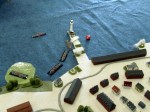
Dave Schueler shared some more St. Nazaire pics. Unfortunately I had already packed my camera, and my phone was dead, dead, dead. So here are some photos, care of Daveshoe.

Just for clarity, the yellowish circles designate ships picked out by searchlight batteries across the Loire River.  Batteries of 75mm guns targeted the British throughout the game, wrecking two motor launches and damaging others.

Enfilade 2015: the hits just keep coming.

I attended Enfilade over the Memorial Day weekend.  It was my 24th Enfilade.  I haven’t missed one yet, and I’ve had organizing responsibilities in almost all of them.  Last year I announced my retirement from the Enfilade committee and all other leadership responsibilities for NHMGS.  It was a carefully considered decision, and the right one for me. There was no animosity or rancor in my decision, and I’ve moved on.

It was a very good convention and I think the organizers did quite well.  It seemed to me there were few glitches and almost all of them were beyond their control.  If I have one suggestion it would be to try to problem solve the event sign-up dilemma. I know and understand all the problems associated with pre-registering for events, but the long 45-minute lines must be addressed. They’ve done a great job of promoting pre-registration electronically for the convention, and now it’s time to put equal or greater promotion into pre-registering for events.  It’s complicated and I get that, but this seems to me a must-do, especially as attendance hovers around the 350 mark and the lines snake through the convention hall.

Each convention is different, and this one certainly was for me.  I had to work on Friday.  That’s unusual for the day of the convention and it presented a number of problems I clearly foresaw.  It meant leaving at school about 2:30 and driving to Olympia and arriving in time to host my 7:00 event.  if you are a stranger to Washington geography, that’s about a 60-70 minute drive under normal circumstances.  Unfortunately Memorial Day weekend is far from normal.  It is the beginning of the camping season, and as the weather moderates any long weekend is a good excuse for camping.  The roads were a mess and instead of arriving at the hotel 3:30-4:00ish, it took an extra hour.  I had piles of stuff to haul in for my game, so by the time I checked in, set up my game, and caught my breath, it was game time. Something to consider for the future.

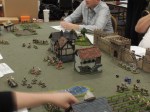
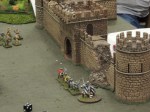
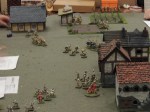
Friday night I ran my raid on Agen scenario.  It was a Lion Rampant game with seven players who had not played the rules before.  All had purchased copies of the rules and were genuinely interested in learning them to see if they liked them, which meant they were motivated to work through them.  That made life a lot easier for me. After a somewhat slow start, they were doing things pretty much on their own.  The story of the scenario is something like this: three English retinues arrive outside the village of Agen, defended by a dilapidated castle.  This is a chevauchee, meaning the English are there to loot and burn the village and carry off their goodies.  The French arrived with a three retinue relieving force-something frequently unusual for a chevauchee-and their job is to prevent the English from achieving their goals.  The last retinue was a smattering of serfs, whose job it is to offer token resistance, but most of all survive.  The French were able to inflict some damage to the English, but the invaders were pretty efficient, looting and burning many of the various buildings on the table.  But, the big winners were the serfs, who by staying away from trouble, managed to score 105 points edging out the English who amassed 104.  Most importantly, the players seemed to enjoy themselves,and especially the rules.  They were running the game themselves by the end of things.

Saturday morning I made time to actually play a game.  I have long been interested in Galactic Knights, the space epic using ships originally made by Superior Models. I own some of the ships and the rules, but only walked through a kind of quickie scenario with Dave Schueler.  The Saturday game was hosted by Scott Williams and Joe Grassman and was loosely based on the WWII Battle of Midway. I commanded the Terran star bombers, which are the rough equivalent of the Ameriacn TBD torpedo bombers slaughtered by the Japanese.  In GK they have the virtue of being faster than the Devastator death traps.  I loved the scenario and learned a lot about the rules.  I was able to be sneaky and sly, took advantage of the rules and administered the coup de gras to two thirds of the Avarian capital ships–following the advice of my colleagues.  The game inspired me to work on my collection of GK stuff-in fact I’m writing this during a break from them.

The Saturday mid-day period was all about judging games for the period’s “Best of Show” award.  Often that falls to one person, but the convention organizers did a super job of mobilizing three judges for each period.  That’s way better than I was able to do.  I actually hope to continue aiding in this because it is great fun.  The best part of serving in that role is the ability to circulate and see all the games during the period.  I actually got around to see each game three times and there were some wonderful ones.  While the 28mm Waterloo game raged on in the corner, John McEwan hosted an amazing undersea submarine game.  Max Vekich and Ed Texeira ran a very interesting hypothetical 28mm WWII Japanese invasion of Washington game I was very intrigued with. Special guest Howard Whitehouse had a very interesting Vinlander/skraeling semi RPG with miniatures game that was very cool.  But the winner was FireForce Rhodesia ’76.  This was a great looking and playing game in which the miniatures and terrain all seemed to work well.  Damond Crump, Bruce Smith and Lawrence Bateman were the big winners in that period.

Saturday evening was my big game, Smoked Bolougne.  It was another Lion Rampant game with space for eight players.  It was a mixed group of LR veterans and noobs.  The game featured an attack on Bolougne’s port at either end by a picked English force.  The goal of the English is to destroy key buildings in the town and destroy the French ships at anchor.  The English got off to a roaring start, using their flaming arrows to set fire to their targets.  The waterfront was quite ablaze, but the invaders were soon bogged down by French reinforcements and poor activation rolls. In the end they were able to achieve what the English did historically–destruction of their targets, but their forces were also destroyed.

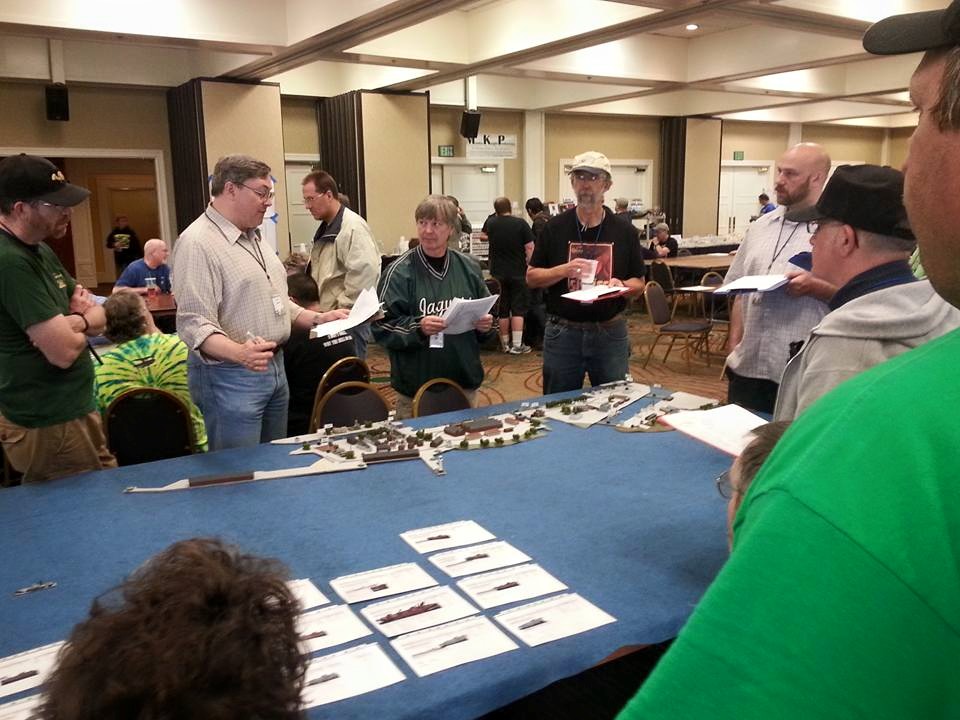
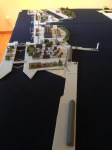
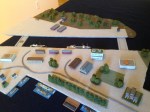
During Sunday’s final period Dave Schueler and I hosted the Raid on St. Nazaire.  I got some credit for helping, but honestly this was Dave at his finest. Based on the raid on the French port city on the Loire River that also contained the Normandie dry dock, this was going to be a tricky show. We’d walked and talked through the way the scenario would be played, but hadn’t had a real playtest. We’d done that on other scenarios, but this was complex in the sense that the six British players had to move their 13 motor launches plus five escorts through German gunfire, land their load of commandos, and destroy important features in the the port area before re-embarking for home. Overall the game went well.  The Brits suffered two losses and several vessels damaged while engaging the port defenses. They did get some commandos ashore, damaging the one of the winding houses and the pump house for the dry dock.  But it was concluded that, like Bolougne, it was a pretty historical result.  Serious damage to the dry dock meant the Tripitz would have to find a new address, but the British attackers were pretty much trapped and would likely be killed or captured.

Picture of St. Nazaire set up courtesy of Rod Fleck. I'm the goof in the green Jaguars wind shirt.

Picture of St. Nazaire set up courtesy of Rod Fleck. I’m the goof in the green Jaguars wind shirt.

The good news is that the powers that be thought enough of our game to consider ti the best of show for the Sunday game period.  It also won the best game for the year’s theme, raids.  It was the perfect finish for the weekend.

Enfilade around the corner: My mad dash to the finish line.

Though I may not have written much recently, that doesn’t mean I haven’t been busy.  I have three games I’m running at Enfilade, and I’m still trying to wrap up the last one in time for my weekend-before-the-convention playtest.

I’ve done a lot this spring/winter (this is so embarassing!) Dave Schueler and I will host a game we’ve wanted to do for many years-the 1942 combined sea/land raid on St. Nazaire. I slowly accumulated all the motor gunboats and assorted naval vessels needed to play the game, but the challenge was always going to be putting together what would pass for a harbor and adapting a game to it.  Dave and I have done a lot of projects together including the Tirpitz game and the Persian Gulf tripwire scenario with lots of modern gunboats, but this was especially challenging.  Dave did most of the work modelling the various pieces representing warehouses and dockyards.  I contributed some, but the work is mostly his.  The scenario will force the British players to cooperate and be aggressive as they try to land their commandos in the face of fire and demolish their targets.  Dave and I will run the Germans using a combination of ideas from David Manley’s excellent Action Stations and the old Raid on St. Nazaire board game by Avalon Hill.

I’m also running two games using the Lion Rampant rules by Daniel Mersey.  As I’ve written before, I really like these rules-you just need to think outside the box. The first scenario, Raid on Agen, I’ve already written about.  I’ve done a couple of playtests, and hopefully I’ve worked out the flaws. It represents a typical chevauchee of the Hundred Years War.  Maybe not typical, but the French are inclined to resist in this scenario.
The second game is the preparation sucker.  It is based on the English raid on the port of Bolougne in 1340.  It reminds of the Raid on St. Nazaire in the sense that the raiding force was disembarked in darkness, did their work, but were trapped and captured or killed. The English will start on either end of the lower town.  Their job is to destroy buildings and ships along the waterfront. The resistance in the dock area is light, but enough to be a pain to the attacking English. The challenge to the English will be the French relief force as it masses and thunders down from the upper town.
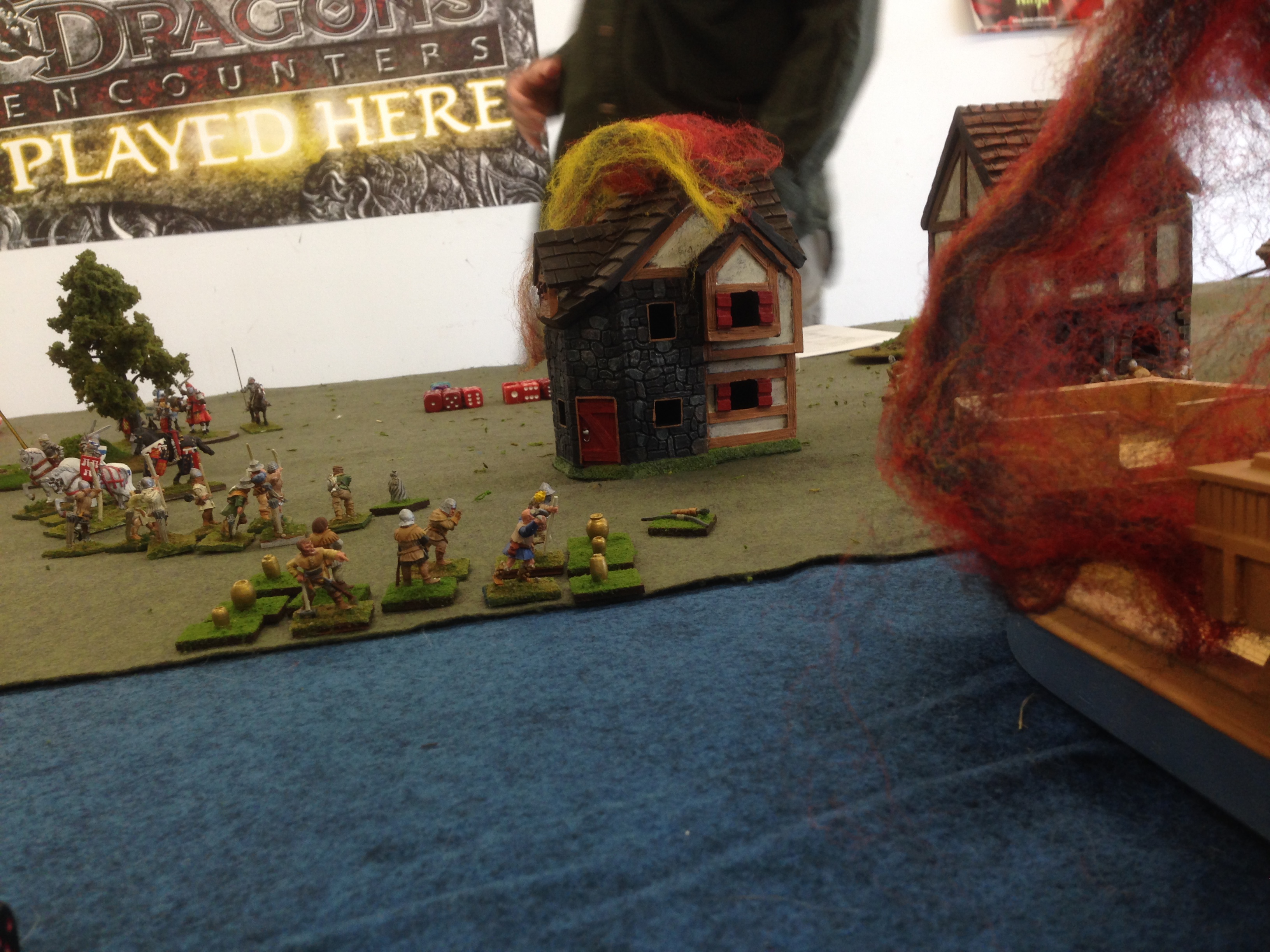
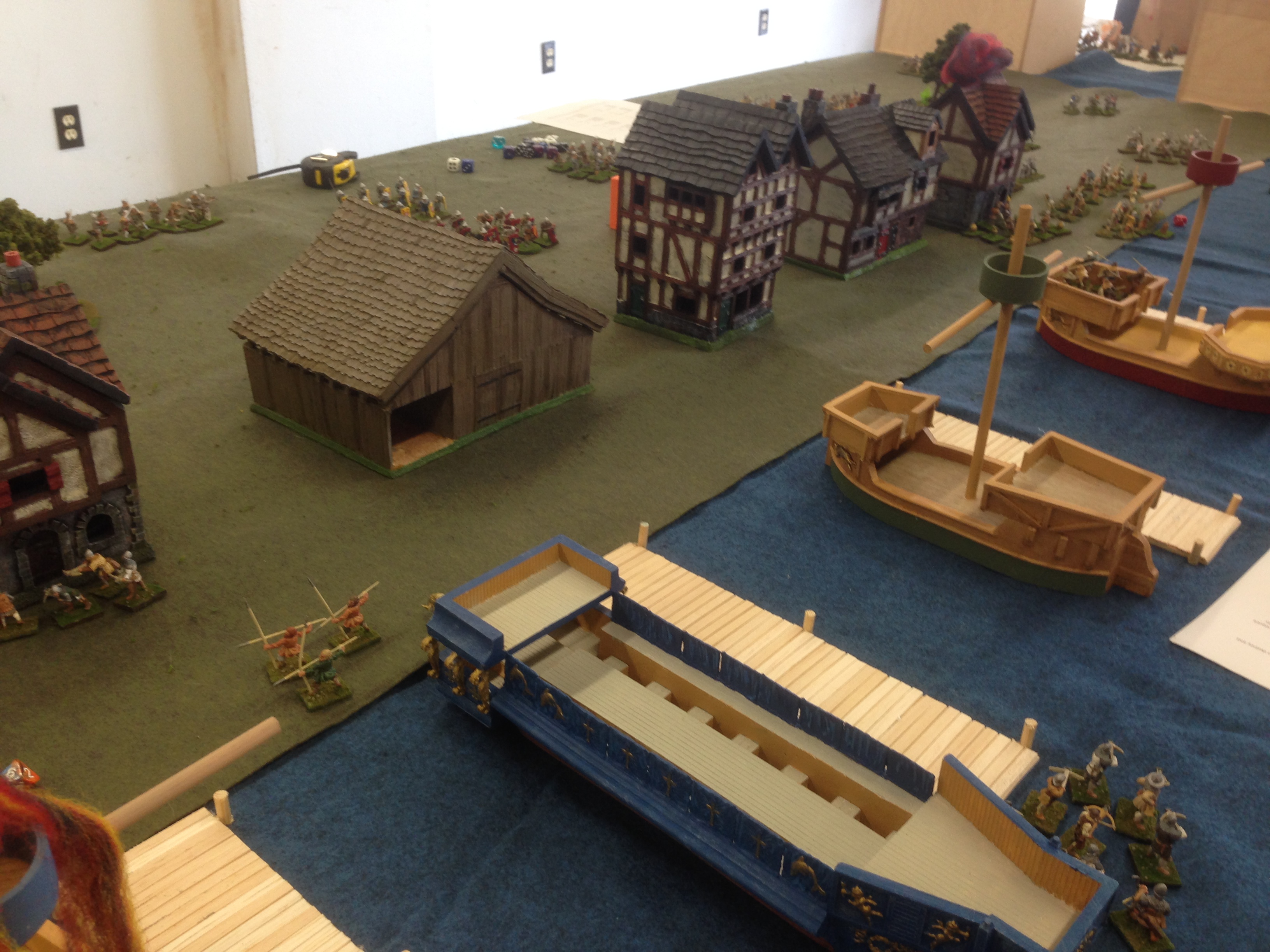
For both scenarios I’ve tried to think outside the box.  I’ve used or created troop types to assist in the scenario.  Town militia was a type suggested on the game forum hosted on Boardgamegeek.  I’ve created a sailor troop type to defend some of the ships.  I’ve also created an engineer type charged with destroying the ships and town in the Bolougne raid. In addition to troop types I’ve also worked out rules for burning.  In the case of the Bolougne scenarios, I’ve put together rules for tow-wrapped flaming arrows and combustibles used by the engineers.  Don’t know how historical they are, but they should be fun and easy.

Playtest photo.  The English land in the lower town, setting afire a waterfront building and a ship

Playtest photo. The English land in the lower town, setting afire a waterfront building and a ship

I hope to have pictures from the Saturday playtest on the web by the weekend.

The playtest set-up. The French fleet rests at anchor as English retinues approach from either end of the town. French reinforcements boil out of upper Bolougne and down to the docks

The playtest set-up. The French fleet rests at anchor as English retinues approach from either end of the town. French reinforcements boil out of upper Bolougne and down to the docks