Shapeways Skywarriors

IMG_1665

I spend lots of times perusing the Shapeways dealers.  I don’t often buy, but I often wish I did.  One of my favorite dealers is Prairiehawkgamer.  He sells lots of interesting 1/300 scale planes, including a Tu-95 Bear bomber for a mere $43.  Let’s just say it’s on my list. It has interception scenario all over it.

Last winter, I took a flyer on a wild hair.  After Malta is complete–not that far away–I want to work on scenarios for Operation Rolling Thunder.  One of the useful, but unheralded, planes for that campaign is the EA-3 Skywarrior, and it’s AirForce similarity cousin, the RB-66 Destroyer.  Though originally built as nuclear bombers, with age they took on such tasks as electronic warfare, reconnaissance, and in-flight tankers. Over North Vietnam, they mostly played an ECM role.

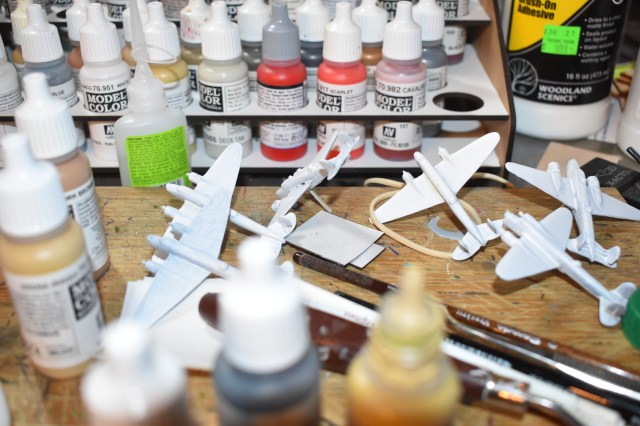
Of course, nobody makes one in metal.  So, back to Shapeways.  Last spring I ordered a pair of the Prairiehawkgamer’s Skywarriors, along with a pair of very enticing Eurofighter Typhoon II’s (with ordinance!!  It’s so cool!!)  I’ve been focused on other stuff pretty hard core for a while, and these have just been sitting on my painting table So I decided to go for it..

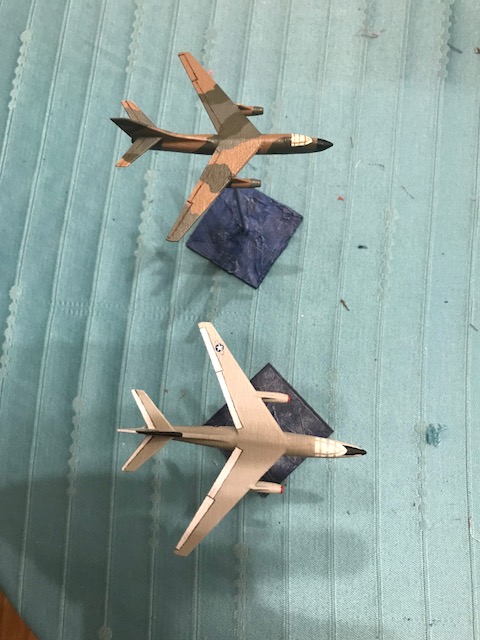
These models have the grainy surface that prevents many of us from investing heavily in the plastic models.  I hand primed it twice with Vallejo primer.  Still rough.  Oh well, goes with the territory.  I decided to put one in Navy colors as an EA-6, the other in Vietnam-era colors.

IMG_1667

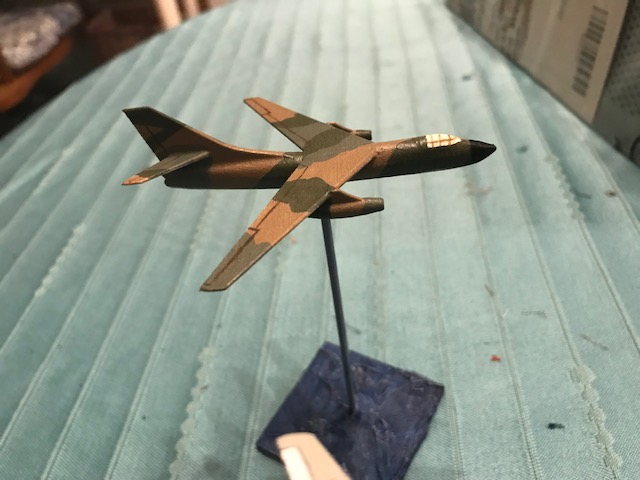
For the Air Force plane I used a modellers example of BAT-21, a B-66.  To paint I used colors from the Vallejo Vietnam collection-US Brown, Forest Green, U.S. Green, and USAAF Light Gray.  I cleverly reversed the Forest Green and U.S. Green in the picture, but I’m counting on my readers not to rat me out.

IMG_1666

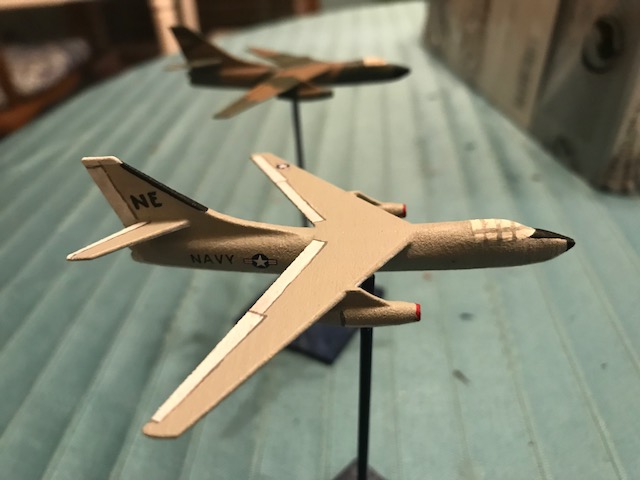
For the Navy version I used Testor’s light Gull Gray over all the upper surfaces and the fuselage.  I tried to use the regulation Testor’s Gloss white on the under surfaces and control surfaces, but while glossy, it just didn’t cover well. I switched over to Vallejo White-gloss be damned. A lot of the photos of Skywarriors show the rear half of engine nacelles in as natural aluminum, so I went with that.

Shapeways is great at providing the basic plane, but if you want detail, you’ll have to paint it in yourself. I started with the canopy.  No mine aren’t blue they are in ivory.  Get over it. Then I painted in the framing as best I could.  Got the lines a little thin for BAT 21.  Then it was on to painting in the control surfaces.  Again, this is on the best you can do basis.  Dark Gull Gray for Navy, Burnt Umber for Air Force.

Last but not least it’s time for markings.  Because the planes are secretive in nature, markings are at a minimum.  The Air Force plane has no national markings and I chose not to paint in unit insignia.  The Navy plane got national markings as well as its NAVY identification, but none of the elaborate ship and squadron markings common from this tiem.   And we’re done.

The planes are spendy at $12 a pop, but I only needed a couple.  I really enjoyed painting them.  Now how many Bear bombers would I need . . .


Rayadillo, Rain on Me

I’ve finally begun painting figures for my Philippine project.  I’ve finished the Tiger Miniatures Philippine scouts.  More about them later.  But that brought me to the first of my non American units.  Should I choose something easy like your basic bolo-armed melee troops, or try something more difficult?

The unfortunate Spanish troops  who unwittingly were swept up in John Hay’s “splendid little war” were clothed in rayadillo.  It is a pin-striped cotton garment, well suited in its light weight for the tropics of Cuba and the Philippines. It also has a certain camouflage quality as the stripes just fade into the background. Many of Emilio Aguinaldo’s troops in the army of the Philippine Republic likewise wore these as they looted Spanish supply depots and armories around Manila when the the Spanish happily capitulated to American troops in 1899. I will have about 60 figures to paint in this pin striped garment.

My first unit is of Spanish infantry.  There were many Spaniards that guarded Manila until the Treaty of Paris was ratified and the commander of Spanish troops made an implicit “deal” with General Wesley Merritt in charge of American forces in the Philippines. With a nod and a wink, after a brief bombardment by U.S. naval vessels, the Spanish withdrew from fortifications guarding the city.  The Philippine forces nominally allied to the American forces, feeling betrayed, looted the Spanish supply depots, taking Mauser rifles, ammunition and many of the interesting Spanish uniforms.

I have no intention of painting the Spanish army of 1898 or 1899.  However, there is a suggestion in my reading that some Spanish troops may have joined the Republican forces as well-paid mercenaries or as prisoners fighting for the Republic..

Ugh.  Thankfully the Miniaturas 1898 website has some useful painting guides for their excellent figures, including one just devoted to the rayadillo.

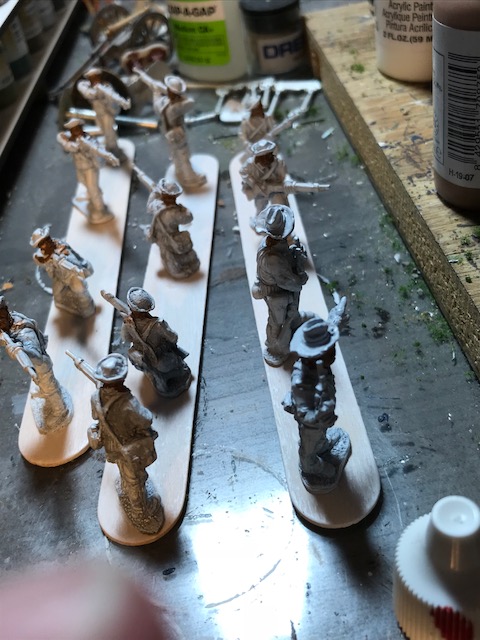
I set out trying to paint my several hundred figures for this project using the recommendations offered Javier Gomez “El Mercenario,” the featured artist on the 1898 Miniaturas website.  Look, the guy is better than me, a lot better. Not only that but we paint using different styles, beginning with the fact that he is a black primer with highlights kind of guy, while I am a white primers with one highlight and washes kind of guy.  Even so I gave it a try. The pictures begin with the figures in process and the completed unit. Here are some of my observations

The Good:

  • Even though I work differently than the method suggested, it went fairly well.  The highlighting suggested was interesting, and I could see it working as I was painting.
  • The Rayodillo creates a kind of illusion.  There is no way anybody can paint tiny little pin stripes that stay straight  on a dozen 28mm figures without going blind or jumping off a bridge.  You’re only painting groups of partial stripes on the areas where the uniform is stretched tightest–knees and elbows, the skirts of jackets, etc.
  • It went pretty fast.  I did 11 figures-still need to do the officer-during the Husky game on Saturday I completed all the pin-striping.
  • The 1898 figures are a joy to paint.  Beautifully cast, well proportioned, crisp detail, but not over-detailed.

The Advice

  • Gomez offered three different combinations for painting and highlighting.  I chose the darkest version (Vallejo gray-blue + cork brown, lightened with white in highlights.) I ended up with uniforms that were much darker than I intended.  Certainly there are illustrations of this uniform that seems quite gray, but it feels too dark to me.
  • I tried to paint the entire unit of twelve at once.  I usually paint small units all at once.  Just force of habit.  My next rayodillo unit I will paint six at a time. I kept worrying about running out of the highlighted colors, and especially when I was painting the stripes (the third highlight.) That also allows me to try to mix two of the different paint formulas for the uniform.
  • The pin striping is a challenge.  You have to use a tiny brush, and honestly there isn’t a tiny brush tiny enough.  You also have to stay on the point of the brush, and that’s very difficult given the angles I found myself holding my brush at times.  I feel like my guys often look like they are in prison uniforms.
  • Clean your brush regularly.  The paint tends to cake at the tip.  Thin your paint so it flows more easily off your tip.

This is my first try.  It is my only Spanish unit, but I expect to do four units of Philippine infantry in rayadillo as well.  I may just stick with it until they are done.  Certainly my next unit will be in the pin stripes.  We’ll see about the rest. Regardless, I’ll be painting more in my own style for most of the figure, except for the major uniform pieces, ie, pants and shirt and hat.  The rest will be all Kevin, for better or worse.

Tiger Miniatures:  Philippine Scouts

I wrote about these guys a little bit.  They are finished, but I’m pretty non-plused by the outcome.  To start with, they just aren’t great figures.  The hat is too small.  Heck the figures are too small, and the American officers I used are too large. Lots of fiddly detail that is really hard to pick out very well.  The good thing about them is they are sort of representative of a valuable unit type.

I started with these guys, and used the Pedro Gomez method.  I wasn’t very happy with the outcome.  The highlighting over the Dark Prussian Blue just didn’t cgme out very well.  I don’t think I was liberal enough with the highlights and the amount of lighter paint–and it just didn’t work that well with the castings.

Best part about these figures was the rifles.  Worst part about these figures were the faces.  No eyes on these guys. Maybe it’s just my advanced age, but combined with the castings, I just played it safe.

Hal Far Airfield done

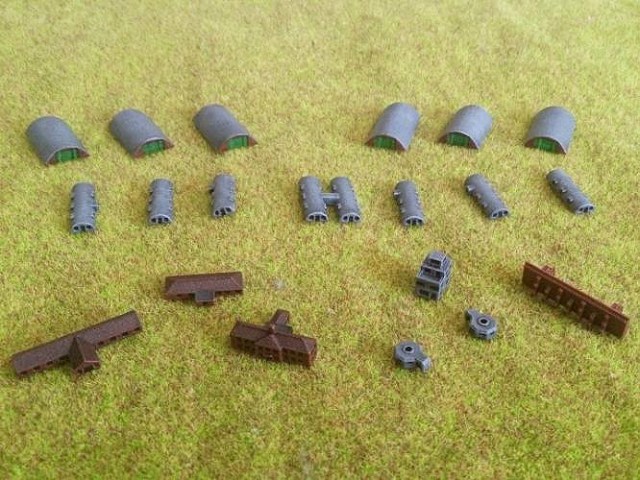
I mentioned, a while back, that I ordered the RAF airfield miniatures from Pico Armor.  They are by Brigade Miniatures, and they join just a bucket of great 3mm terrain offerings from that British company.  There are times I just want to order some of their goodies because they’re so cool. Right, I need another project like a hole in the head.

Just to add to what seems like desolate terrain, I’ll distribute some of the terrain bits I used for my Sluys game back in the day.  It would be cool to have some 1/600 scale planes in the hard stands, but I just can’t go there.  My wife would kill me.  Hell, I’d kill myself.

On the Painting Table

On the Table

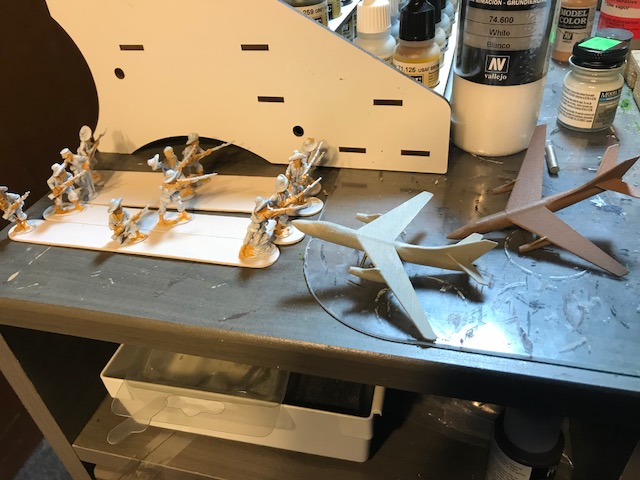
I am preparing a dozen British bombers for their Malta home.  There are some great scenarios to use them in, whether it is attacking airfields in Sicily, or giving the Axis a taste of their own medicine with attacks on their convoys. But right now I have my first Philippine unit on the painting table as well as a pair of Vietnam-era electronic warfare planes.  These are a pair of Shapeways A-3 Skywarriors, which is very similar to the Air Force B-66 Destroyer.  Originally intended to deliver nuclear weapons, they gradually were relegated accompanied bombing missions over North Vietnam while trying to fool  Hanoi’s radars.

A Terrific September

Still a week to go in the month of September.  It was weird, wild and woolly with the, thankfully, short teacher’s strike, the beginning of the school year, and last week’s always wonderful Fix Bayonets.

It’s really been a wonderful month in terms of getting stuff done.  In fact August and September together were pretty great. In many ways it was about progressing on some old projects, advancing on something current-Malta, always Malta, and preparing for something new-the Philippines.

I’ve been able to paint quite a bit

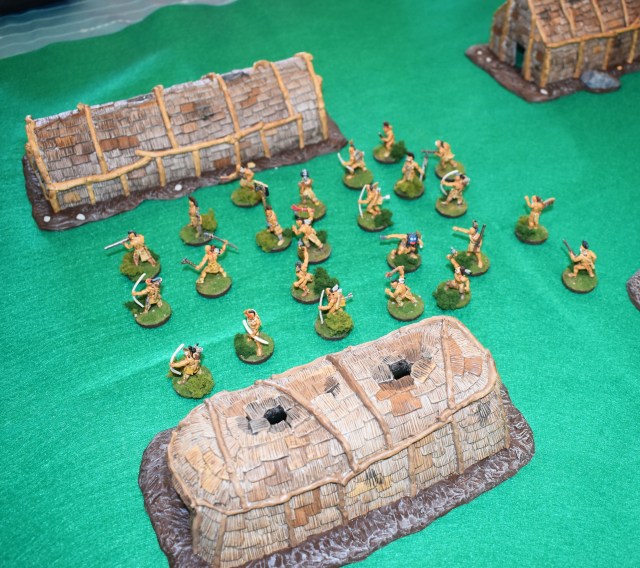
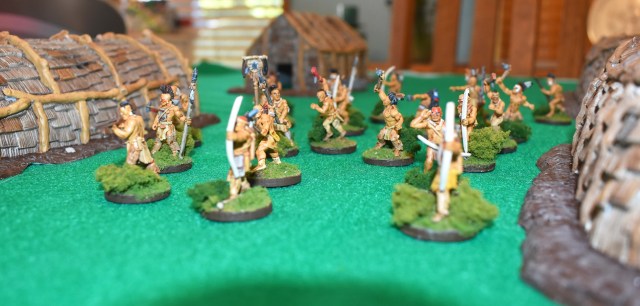
  • 24 Woodland Indians for America Rampant that sat on my painting table for ten months
  • 12 Fiat BR 20 Cicogna bombers
  • 8 Hurricane IIc fighters
  • 6 Beaufighter I bombers
IMG_1647

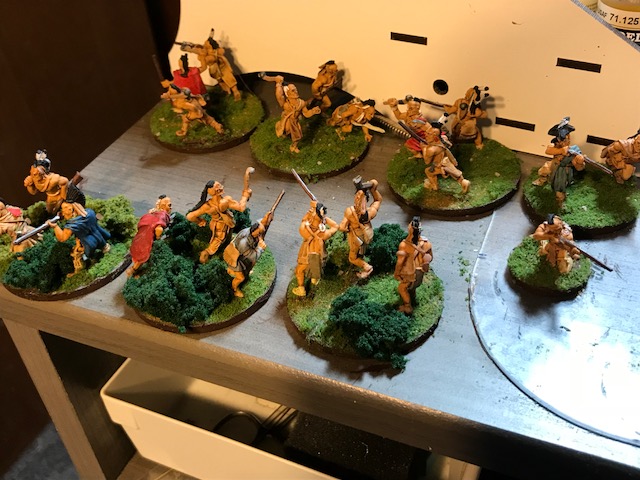
Old Glory Woodland Indians. I’ve had these for many years, and I still have many more to paint. Finished off these guys because they were cluttering up my painting desk, taking up room that could be better used. Finished all their basing tonight.

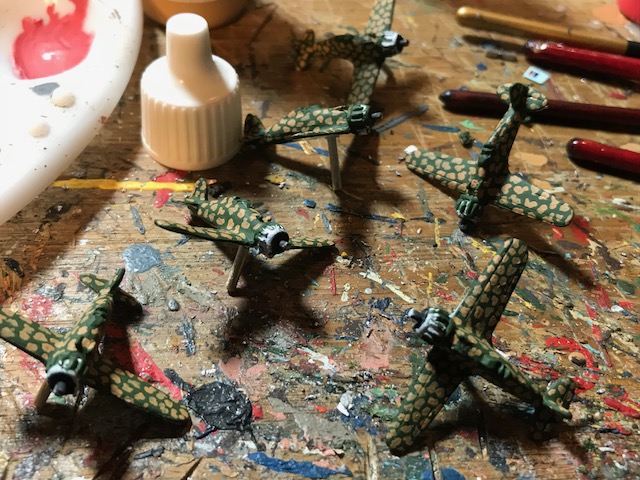
Right now I have a few more items I hope to wrap up in this final week of the month.  I have six more MC 200 fighters that are about half. done.  Shooting for Wednesday. I also have two big resin BTC ploughed fields.  I like these a lot but they were hidden away in my garage for ages.  I’ve gotten a good start on the, and painted the base colors.  It’s time to move on to details.

IMG_1646

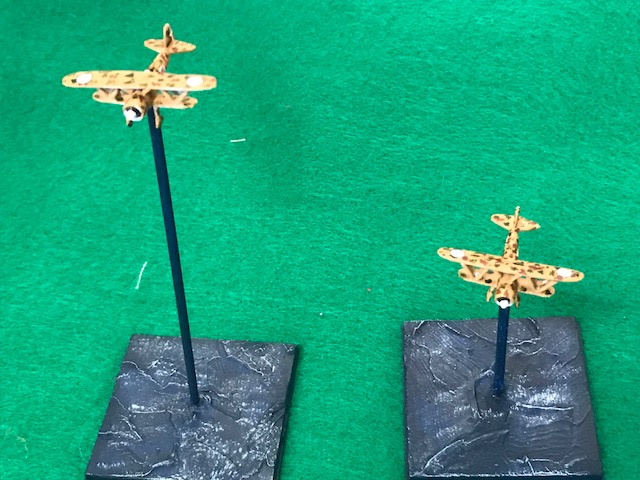
These are teeny-tiny MC-200 fighters for my Malta project. They started out as a base Luftwaffe Camouflage Green, and have since been covered with those Desert Yellow irregular shapes, one at a time. These are nice 1/300 scale miniatures by Scotia Grendel.

Waiting in the wings are the Brigade RAF airfield buildings and Tiger Miniatures Philippine Scouts.  Actually Philippine Constabulary, but I’m using them as the scouts, with American officers.  Can’t wait to get started

IMG_1648

Tiger Philippine Constabulary figures. They are kinda big. They’re primed and ready to go. An undercoat for their faces is as far as I’ve gotten, but I expect to be a lot farther by the end of the week.

Music to Paint By

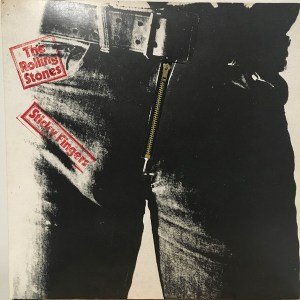
Sticky Fingers

With the Mariners season winding down (sigh) there will be more time for listening to music.  I’ve fired up one of my favorite records recently, just for fun. Polydor re-mastered and re-pressed the 1971 Rolling Stones classic Sticky Fingers a few years ago, and it is simply a terrific record.  The album is riddled with drug-laden lyrics and blues and country-influenced lyrics.  “Sway” and “Bitch” are my two favorites, but there are no weak tracks.  The music is driven by 22-year old Mick Taylor on lead guitar.  A passing listen will impress you.  A careful one will take your breath away.  After Let It Bleed, this is my favorite Stones record during their most fertile period.

Hal Far Airfield WIP

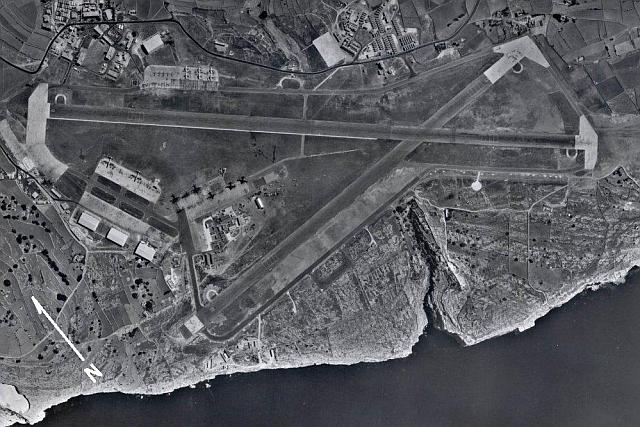
HalFarAirfield1960

In my last post I shared ideas for moving Malta toward completion.  Among those is having two game mats for our campaign.  The Valetta Grand Harbor mat is done thanks to Tiny Wargames, but the airfield mat I’ll have to make myself.

Neither mat will be a one off.  Both will appear in numerous campaign actions.  They are really just background to target throughout the campaign.

I decided to model the airfield mat on Hal Far airfield.  It is one of several RAF air bases that defended island fortress.  There are some useful maps, photos and diagrams of the airfield and vicinity.  It remained in service as a RAF base until 1967 when Malta achieved independence.

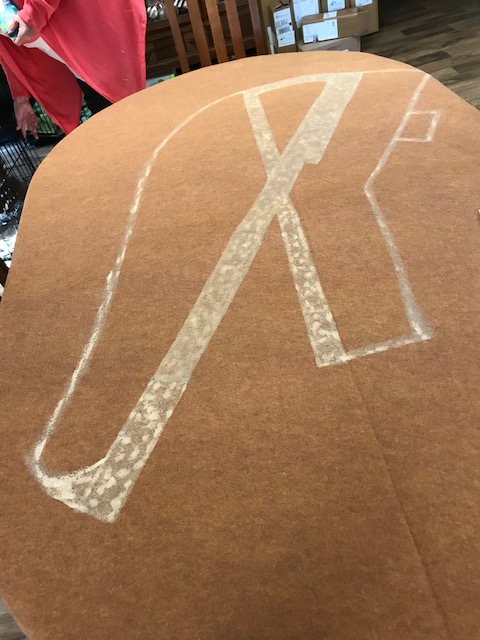
There isn’t a lot to making Hal Far.  It’s basically an X representing the two runways.  One of the strips is 6,000 feet.  The other is 4,800 feet. I threw out the idea of trying to scale out the facility exactly right.  I figured straight lines in approximate proportion would do.

IMG_1635

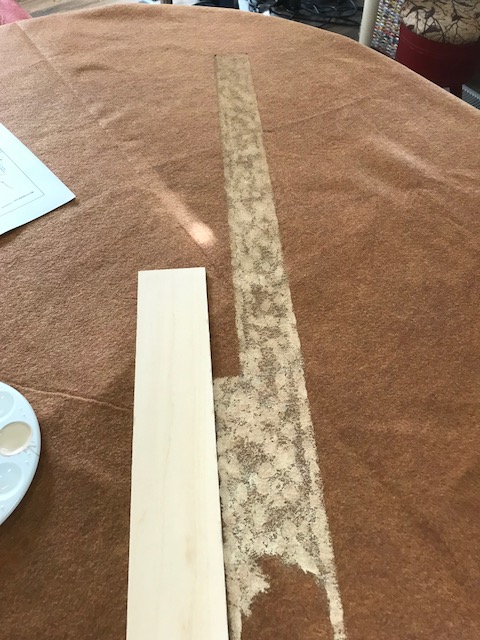
I began laying out the main runway with a 24″ X 3″ sheet of bass wood. So far, so good.

My felt is 9′ X 6′ to fit an 8′ X 6′ table.  It’s a nice mottled brown.  I got it at Joann Fabrics on sale for $3.99 a yard.  A good deal.  I decided to put the airfield in the middle of the felt.  The long runway is about 36″ X 2″, broadening out to 3″.  The short runway is about 30″ by 2″. There were lots of roadways connecting the two runways, as well as taxiways and roads to the various hangars, armories and buildings that housed flying and maintenance crews.  I showed a tiny portion of these.

I started with the long runway first.  Used a straight edge to help me measure and keep things fairly straight.  I painted using Ceramcoat Trail Tan.  I used a large inexpensive brush and pretty much tried to blot my way from end to end and then pushed it across to the other side.  Not difficult, just tedious.  Then I did the same with the other runway.

IMG_1637

I may add another road or two, but for the time being, I think it’s good. It takes up a lot of my 70″ X 42″ dining room table.

I didn’t get it right.  The runways aren’t at a large enough angle, so they end up too close together.  Even so, it’s just a target.  Add the Pico buildings, and it will do. The most important thing is it pretty much done and ready to go at a relatively minimal cost.  The Felt was twelve bucks and the Pico buildings and flak cost about 20 dollars.

Malta-The Final Vision

My Malta vision continues to come into focus as my painting plan is executed.  I currently have 124 finished planes, finishing, six Fiat BR20 bombers, and eight Hawker Hurricane IIC fighters over the labor day weekend.

IMG_1634

Heroics and Ros Fiat Br20 Cicogna bomber.  These bombers made numerous, mostly ineffective bombing raids on Malta

IMG_1632

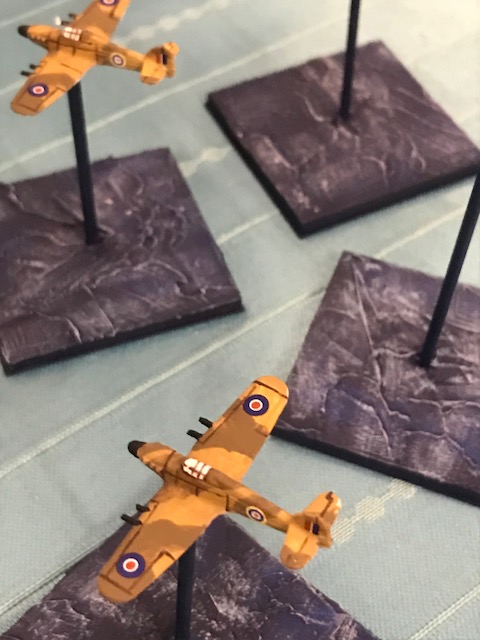
Scotia Collectair Hurricane Mk IIc’s.  They became a slightly more effective defender of Malta than the earlier Hurricane Mk. 1’s with its improved engine and four 20mm guns.  The Scotia planes aren’t as nice as the GHQ variant, but they do cost about a third the price.

I received my really big Scotia Grendel order two weeks ago, with the remaining 70 or so planes I need to finish the project.  I got super service from the UK based company, and I can’t recommend them highly enough.  Planes are cheaper than Raiden, about equal in quality, and they have a broader range of planes at this point. Postage wasn’t ridiculous

That said the painting goes on, and Dave and I have this fond hope we’ll be able to get started on a series of games involving Malta.  The Axis attacks on Malta were aimed at targets either in the Grand Harbor of Valetta, or at the several airfields west of Valetta.  Eliminating the pesky RAF forces covering the harbor would eventually lead to invasion and submission of the tiny island.

I have the beautiful Tiny Wargames mat of Valetta.  Now I need a mat to represent one of the RAF airfields.  I’ve picked up the felt which is a nicely mottled brown, and it’s time to think about what to put on it.  I’m thinking I’ll paint on the lopsided X of Hal Far airfield. I’ve perused potential miniature purveyors for some 1/600 scale buildings usable for the hangers, barracks and other buildings necessary at an airfield.  Struck out.  GHQ, PFC, Heroics and Ros, all struck out.

However, scaling the whole business down means I could use Pico Armor stuff, particularly the RAF fighter base set

RAF Fighter Base

It’s very reasonably priced.  Add a couple of larger hangers housing bombers, also available from Pico, and a set of Bofors guns, and it’s a pretty representative collection of buildings.  I have a variety of scaled down terrain bits, and it should work well .

Some scenarios we’ll want to do will also include attacks on convoys.  Malta was dependent on seaborne cargoes for supplies, so British warships and cargo vessels will also be needed. The island fortress also launched attacks on Axis convoys headed for North Africa, so the ships can play both ways. At this point, the best source of 1/700 cargo vessels is Heroics and Ros.  In terms of future purchases, these are high on my list.

On the Painting Table

I’m just trying to clear some of the excess off my painting table before beginning the Philippines project.  I was productive in August, and through Labor Day weekend.  During the summer I completed all of my 50+ 28mm longbowmen, 24 of those in August.  I also finished a fair number of planes, including the CR 42’s, and the previously mentioned Cicognas and Hurricanes

I have 24 28mm Woodland Indians on my painting table, where they’ve hung out since last November.  I’ve begun working on the first twelve and am nearly finished.  I’ll be trading off between the natives and planes until they are finished.  Then it will be the Philippine project trading off with planes between units until the Malta project is done. I have six more BR 20 bombers begun, and they’ll be followed by some Beaufighter Mk. 1’s.

I anticipate beginning the Philippine project some time in September.  I’m aided by the fact that my union has voted to go out on strike.  I could be wrong, but I don’t expect it to end quickly.  I still have to assume picket duty, but my late afternoons and evenings are free. Painting time.

Flint and Feather Finis

Masked Warrior

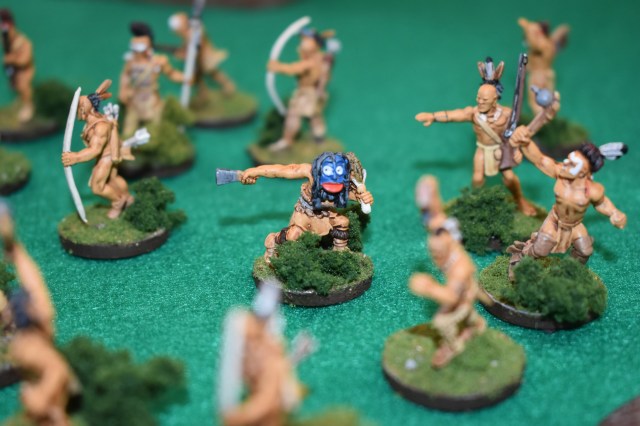
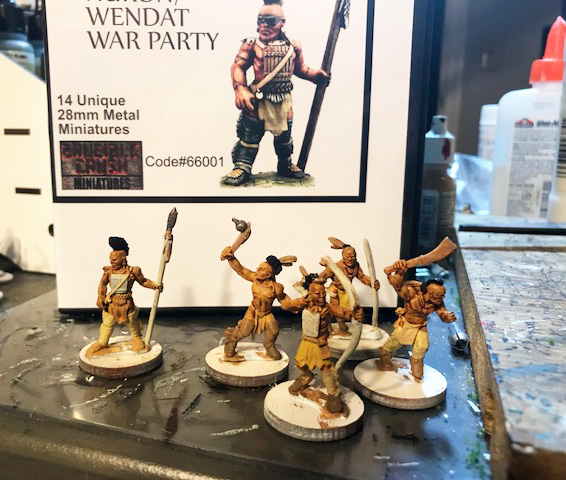
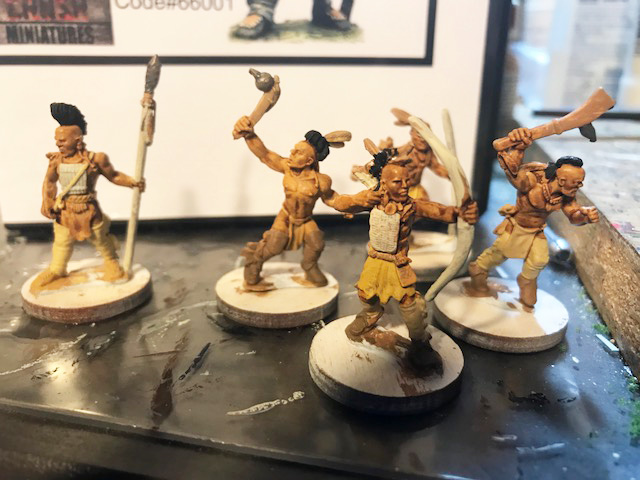
One of August’s big goals was to complete the 24 figures I had from Bob Murch/Crucible Crush’s wonderful Flint and Feather range.  For the most part these figures are intended to game the conflict between the Hurons and Iroquois from the times of pre-discovery.  The range includes warriors from both sides as well as mythical beasts to facilitate the cultural threads of the bloody raids and reprisals between the two groups.

I chose to do these guys because David Sullivan opted in as well.  David has more figures than I do.  He began with Iroquois, but now I think he has both tribes.  He he also has Frenchmen from the period, which adds just a little bit of spice.

I think I’m pretty much done. If I could find a few suitable Dutch solider/trader types, I could see adding those, or if there were native villagers I could be in on that.  I have all the Hurons offered with the range, so for now I am good.

These are my warriors

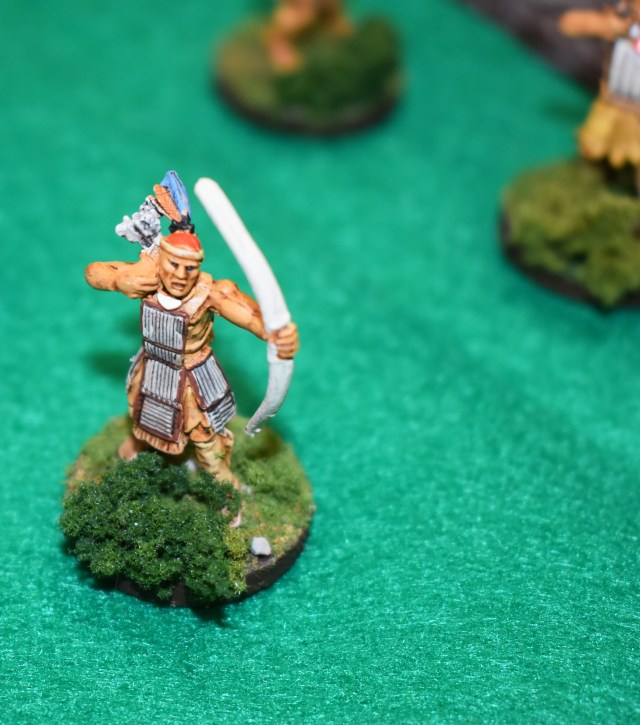
Armored Bowman

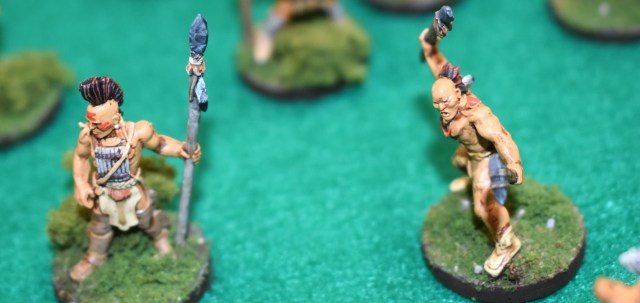
Two Guys

However, I had an excuse to paint up my Acheson longhouses that have sat in a box in my garage for a decade.  I have four of them, and three are different, so it’s nice to have a variety.  For the record they are the Huron Longhouse (2), the Iroquois Peaked Longhouse, and the Iroquois Longhouse.

Another View

The Longhouses are in grey soft resin.  I washed them with soap and water before spray priming them white.  From there I went on a base gray-brown color.  I used the Ceramcoat Gray-Brown and the Folk Art Barnwood.  Then I went back and used some different shades of brown to show areas that might have been repaired or replaced. After all the planks were painted, I washed the structure using Ceramcoat Burnt Umber with a couple of drops of Liquitex Acrylic Matt Medium and thinned with water.   I used additional brown colors for the supporting wood structures.  Then I washed the entire structure again with the Burnt Umber wash.  I added some Vallejo Black Wash to the smoke holes, painted and dry brushed the base.  Voila.  I’m pretty happy with the look. Together with the cornfields and palisade I made for the Chickasaw and America Rampant, it gives me some terrain to fiddle with.

Here We Come


Something Fun Not Miniaturesish

David Demick is my oldest friend. We’ve known each other for over 40 years.  Dave doesn’t do a lot a miniatures anymore.  He was never wild about painting, and when his vision kind of deserted him, he hung up his brushes. But Dave is a connoisseur of all things board game.  Dave almost certainly has one of the largest collections of baseball board games ever.

Dave has a nose for game stores.  It doesn’t matter where he is-Longview, Cannon Beach, or his own backyard on Proctor Street in Tacoma, he always sniffs out shops selling great games.

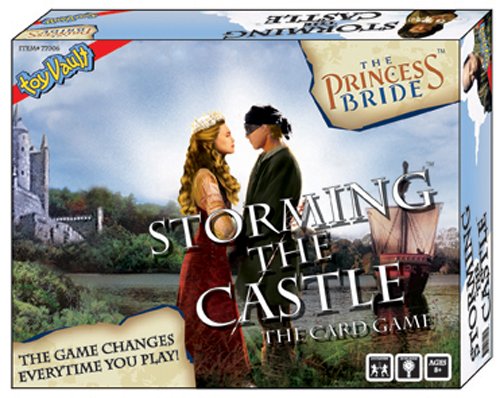
Dave was attending his nephew’s wedding in June, which was also a big family occasion, ended up in Hood River, a lovely little town on the Oregon side of the Columbia River, when his brother-in-law from Boston alerted him to a game store.  Dave wandered in and found Storming the Castle, a game based on the movie The Princess Bride. It’s a great little game. When I shared how much fun it was with my wife, Lorri ordered a copy for my birthday.

stormingthecastle

Ideally it’s a game for four people, hopefully four who know the movie well.  The mechanics are super easy, and amplify every great line from that wonderful movie.  The game is basically a screw your neighbor game as each of the characters-Westley, Buttercup, Fezzig and Inigo try to win their way into the castle.  This is a great game for non-gamers.  I plan to try it with my family, most of whom are non-gamers.

Dave Schueler alerted me to a game printed by Minden Games called Beatles Diplomacy. The game follows the career of the Beatles from 1962-1975.  It’s a terrific looking little game that encourages the four players, each as a member of the Fab Four to work together to further the success of the band while at the same time encouraging each player to meet individual objectives as well.

Beatles Diplomacy

The game comes as a booklet, and the game board, which is hardly anything, and some of the tables would have to be printed on cardstock to make it workable.  But the game, available on Amazon, is only $12.95.  There is a solitaire option, but I’m skeptical.  Am excited to give it a try.


Tiger Miniatures Spanish American War

I’ve waxed on about the 1898 Miniaturas Spanish American War/Philippine-American War range.  Make no mistake, they are very nice miniatures.  I’m writing this from summer journalism camp and I’m plotting how I will use my part of my stipend to purchase miniatures for a couple of my projects–final plane purchases for Malta, and acquiring more 1898 Miniaturas for the Philippines.

Don’t fret.  It will be my big purchase for the year, and it will provide a handy stockpile that should obviate a need for any further major purchases. Don’t laugh.  I’m trying to be proactive here.

1898 Miniaturas has some really beautiful figures, but I gotta tell you, there are some significant holes in the range if we’re talking about the Philippines, or even Cuba for that matter. There are no mounted troops. None for the Spanish and none for the Americans.  Any American army for the Philippines needs at least one unit of cavalry, and probably two.  The dismounted cavalry figures are cool, and they were in both Cuba and Luzon, but mounted guys would be great.  No American machine guns or Gatlings.  That’s a problem.  The only American artillery available are 3.2′ inch guns that are really nice, but a mountain gun is a must. For those guns, it would be nice to have limbers and draught animals.   Philippine Scouts, mounted and dismounted and Philippine Constabulary would contribute toward some great scenarios.  American sailors and Marines seem like a must.

The releases by 1898 Miniaturas come slowly, but hopefully we’ll see see more of these soon.  I’m planning a big order with my camp wages, but I’m not resting on my laurels and hoping the Spanish company fills in their range.  I’ve turned to UK company Tiger Miniatures to fill in some of the gaps.

Let’s be clear, Tiger’s figures aren’t as nice as the 1898 minis.  But they aren’t bad.  They are a bit chunkier and lack some of the deal and variety between figures.  But they are decent and definitely fill in some of 1898’s holes.  I took a chance and ordered from Tiger’s U.S. distributor Recreational Conflict in Kentucky.

Three photos of  the Tiger Miniatures.  From left.  The American mountain gun includes two crew and a mule. Top right is the unit of Philippine Scouts (though they are made of the Tiger Philippine Constabulary figures. The officer and bugler on the right are from the Tiger U.S. Command pack.  Lower right are U.S. Army with Colt machine gun.  Deployed version left and packed version right.

1898 does a great job with the basics.  The infantry is there.  They offer flags and some artillery, and even a few personality figures.  But nothing on a horse, and nothing outside your basic Americans, Spanish and Philippine guys with a gun or a bolo.  I selected a few Tiger Minitatures I thought would help out.

One unit I felt I had to have was a unit of Philippine scouts.  There were about 1,500 of these fellows in American service, they were quite good if somewhat vindictive, and they would be a great add to a scenario.  So I ordered some of these guys . . . sort of.  Tiger also offers figures for the Philippine Constabulary, native police intended to keep the peace in large towns.  But they got it wrong.  They put the scouts in a fez, which I’ve never seen any photos for.  They put the constabulary in the U.S. slouch hat, which the scouts wore with a red band around the edging.  So I bought the constabulary together with a U.S. command pack.  I am not unhappy with the product.

I also ordered some additional bits.  I grabbed a Colt machine gun deployed and one being packed about.  Brian McAllistar Linn makes a couple of references to single Colts in his essential The Philippine War 1899-1902.  I also ordered a mountain howitzer.  It’s nice but only comes with two crew, sadly.  The Americans simply had difficulty dragging around their 3.2″ field guns as the battlefield got further from Manila and deeper into jungle, swamp and broken terrain. I don’t have the sense there were loads of mountain guns, but, again, Linn makes reference to them. I’d like to eventually order a stack of the mules offered.  They look workmanlike and quite servicable.

As to the rest of their figures, if you’re interested in this period and for some reason find the 1898 Miniaturas perilous, these will do.  They’d also work with the Old Glory range, which likewise has holes. I am not terribly wild about the US mounted cavalry figures.  They seem very stiff and cartoonish from photos, so that might be something to avoid.

Just a quick add, Recreational Miniatures was super easy to work with.  When there was a snag with my order, he contacted me immediately and we arranged a substitution.  The order arrived very quickly, about a week after a weekend order.  Not the best packing job, but everything came in one piece. I would definitely recommend.

August Plans

The next couple of weeks I’ll mostly be at home, and trying to be a painting fool.  The last two weeks of the month I’ll be back and forth between home and school, with time in the evening to get stuff done. These are the items I hope to get done this month:

Crucible Crush Flint and Feather figures nearly completed.  Hope to wrap them up tonight. Right, a Huron warrior with Turtle standard.  Every brush stroke has been an absolute pleasure.  I don’t know if I’ve ever enjoyed painting a figure range so much.

19 Flint and Feather Indians for my project with David Sullivan.  Those are all the figures I expect to need along with the five already done, so figures will be pretty much done.

Two Acheson longhouses–I actually I have four of these, so if I can squeeze all these in now, that would be great.  But I’ve had these for many years, so if it’s two in August and two in September, that’s fine too.

24 Old Glory HYW Longbowmen.  This will wrap up all the longbows I have and advance my HYW project that much farther.
DSC_0616

Six Fiat BR 20 Cicogna bombers waiting for paint.  Soon.  Soon.  Four from the Dave Smith bounty, two more from Heroics and Ros. Six more are on the way from Scotia.

Six Fiat BR 20 Cicogna bombers.  These are ugly little bastards, and shouldn’t take long to wrap up.

Eight Scotia Hurricane IIC’s.  These appeared in the mail while I was at camp, and look pretty nice. At 80p, they were  a lot less expensive than the very nice GHQ planes at two for twelve bucks.

The Big Buys

I’m safely back from camp with my well-earned stipend.  I get to keep half and the other half goes to pay off part or our wonderful summer trip.  A big chunk of it will go toward the Philippine project.  Americans, Philippine troops and even a few Spanish will join my growing pile of unpainted lead.  Which means I need to start painting. I should begin in September.  I’ve ordered from Badger games and Wisconsin, and they ‘ve already informed me my order will have to go out mid-week because they are out of some of the flags I’ve requested.  Remember when it took a month or more to get shipments from Modeler’s Mart?  The rest gets sent to the UK for the remaining planes I need for the Malta campaign.  Some Brits, some Germans and some Italians.  I’ve already gotten word from Robbie that they are working on it.  Soon I’ll be up to my neck with more unpainted lead.  What’s wrong with this picture?
Raiden’s CR 42’s


IMG_1604

Pretty tiny miniature which simply complicates the whole process. No eyes for these pilots.

For those of us who are in the little planes biz, mention assembling biplane miniatures and what will follow is a torrent of anecdotes spiced with obscenities and promises to never do it again.  Famously, I did the same when putting together Fairey Swordfish miniatures several years ago.  They were by Heroics and Ros and MSD and both were vile, bad, patooey.  I’ll never do it again (except David Sullivan gave me a couple he’s been hanging on to, so that’s a lie.)

Unfortunately, the Malta campaign involves biplane miniatures.  The British had a handful of Gloster Gladiators.  There were odd numbers of seaplane scout bombers that made their way over the little island.  But, most importantly, the Italians used large numbers of Fiat CR 42 biplane fighters until well past their pull date.  These served as escorts to the SM 79 trimotor bombers and fought with Gladiators, Hurricanes as well as the odd Fulmar and Skua until well into 1941.

IMG_1587

Why, might you ask?  Didn’t the Regia Aeronautica have something better?  The answer is yes.  The Fiat G.50, while not a super duper plane, was available, but it’s short range made it unhandy flying from Sicily.  However, the Macchi MC 200 was a pretty good, if under-armed, monoplane.  Unfortunately a series of  accidents kept the plane out of service until pilots felt more confidence flying it, and the CR 42 remained the main Italian fighter for an unseemly long time.
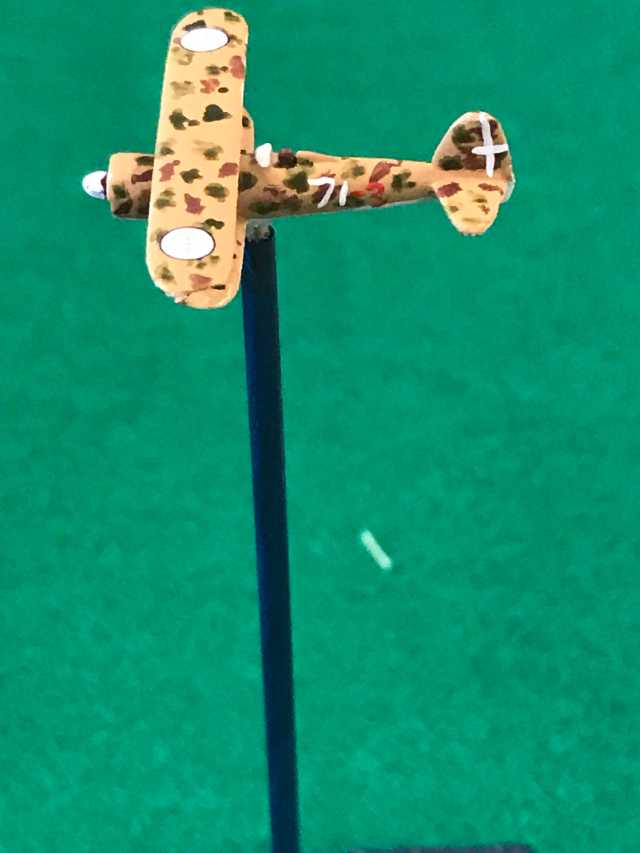
That means my Malta project needs CR. 42’s.  Dave Schueler already agreed to take on the Gladiators and half of the dozen Fiats I thought we needed.  I, blessedly, only had to paint six.

The good news is that Raiden released the Gladiator and the CR. 42 in the last year or so.  They are easy models to assemble, with the struts molded into the kit, instead of mal- formed bits of lead that aren’t clearly part of miniature.  The kit comes in three parts, with fuselage, lower wing with wheels and struts, and upper wing with struts.

Are things absolutely perfect.. No, but pretty easy.  You simply have to make sure the struts are reasonably straight and semi-aligned before dragging out your CA glue bottle. Otherwise, they go together quite nicely.  If you, like me use a pin in the fuselage of the plane, it’s very important to be sure the lower wing and fuselage are aligned properly or it will A) look askew, and B) you pin won’t fit right.

IMG_1602

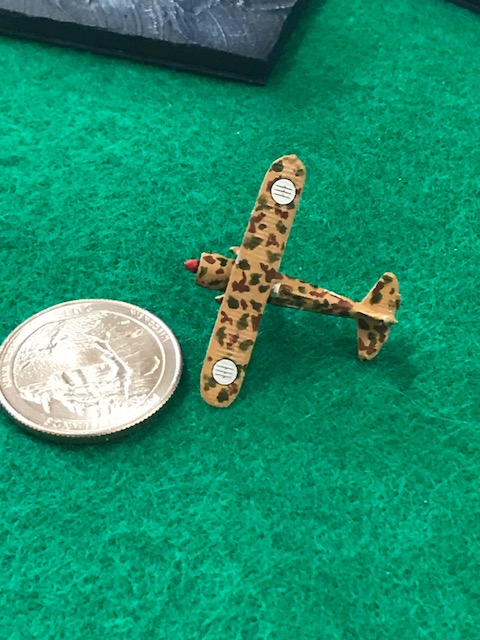
Be kind, this picture is about five times larger than the actual miniature.

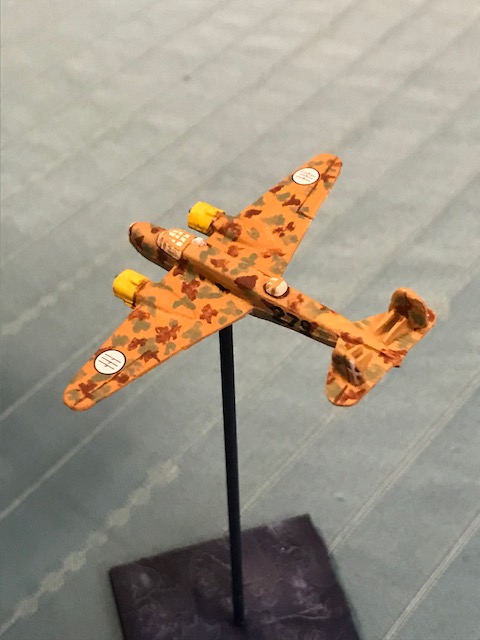
Painting is very Italian.  That means a sand color with green and red-brown blotches.  I don’t mean to make it sound ridiculously easy, it’s not. I primed mine and painted the under surfaces Vallejo Light Gray.  Then I painted the upper surfaces with Vallejo Desert Tan.  The tricky part is the blotches.  if your paint is too thick so it can’t spread a little bit, you’ll end up with polka dots and you don’t want that.

I began by using the Vallejo RLM 75 from their Air Master set, which is thin to begin with.  I added just a little bit of water to thin it out more and applied with a small brush.  It kept the color green but transparent enough so it didn’t overwhelm the base color, and thin enough to spread it around a little bit.  I wanted irregular patterns.  I used Vallejo Mahogany for the red-brown color.  This is much thicker and I didn’t get it watered down quite enough.

The whole biz just requires some patience and willingness to spread things out a bit. Overall I’m pretty happy with the paint job except the numbers.  The white squadron numbers were fine, but the red/black aircraft numbers were almost impossible to see as I was painting them, so they aren’t so great. Excellent Italian decals from I-94.

Generally, this was a fairly painless process and I highly recommend these miniatures.

Flint and Feather and Beyond

Yesterday we played our first game of Song of Tomahawks and Drums at the Game Matrix.  It was fun. Kind of quick and dirty with lots of opportunity for risk and die rolling.

IMG_1582

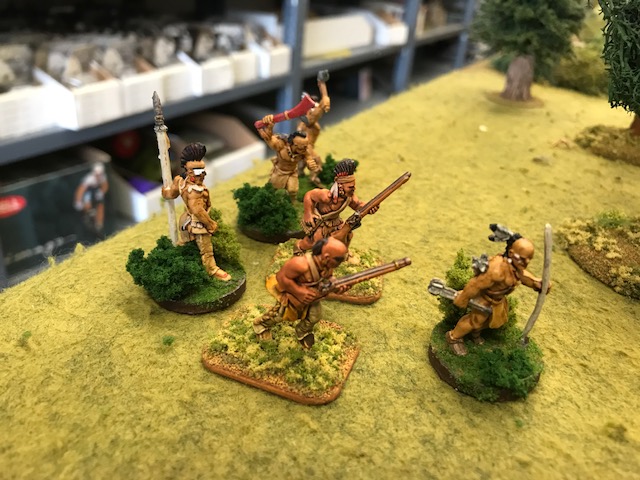
A chunk of my eight-figure command starting from the board edge. My hero figure is the fellow with the stout spear in the rear. The figures on round bases are mine. The figures on rectangular bases are David Sullivan’s

As soon as I got home from vacation, I made a point to tackle the five Flint and Feather figures I began painting, and wrap them up so I could contribute some figures to the game, despite the fact David Sullivan had plenty.  And I managed to get them done.

These are some of the most enjoyable figures I’ve ever painted. They are large, kind of chunky 28mm figures.  They are highly detailed, lots of bits to paint, but those details are also well-articulated, and fun to get at.

IMG_1583

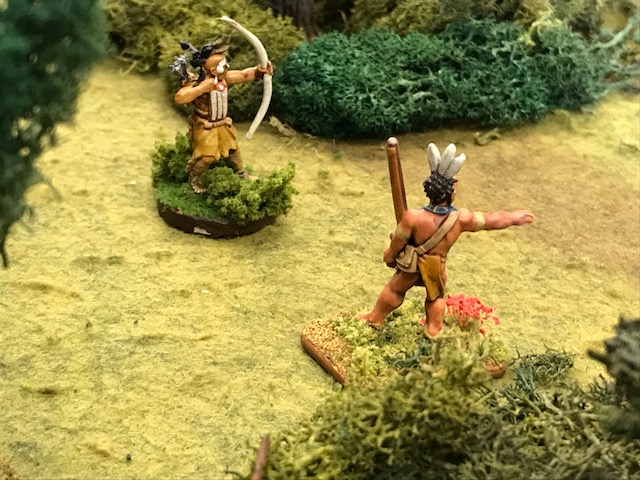
Never bring a bow to a gunfight.

I tried to stick to the suggestions for painting on the Crucible Crush website. I began by spraying them with a white primer. Then I painted them overall with Vallejo Cork Brown, which is kind of a dark beige. Then I painted he overall base flesh tone.  There are lots of choices to make.  David went with the Howard Hues Suntan color, which has more of a red tinge.  It’s a nice color.  I went with a   bronze flesh shade, Vallejo Medium Flesh.  I used this color on my Aztecs and with Indians for my Northwest Indian War project.

IMG_1584

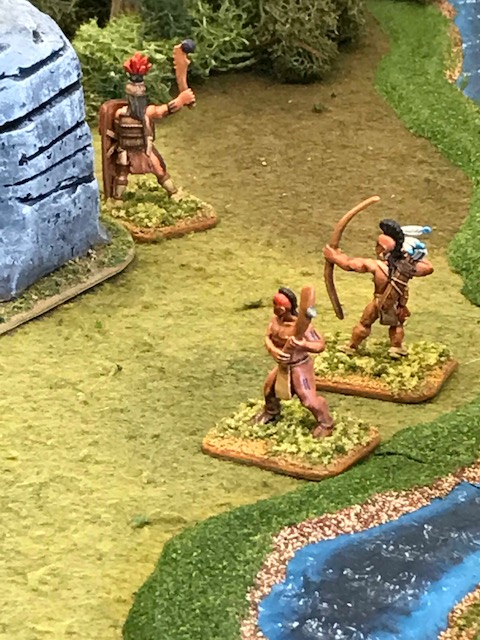
Figures from Dave Schueler’s command hiding behind a rock. Never a bad idea.

After putting down the base color, I washed it with Vallejo Brown Wash.  I added about 25% water to the wash out of the bottle and that allowed me to spread it out a bit for better coverage. I’ve thought about making my own wash out of Burnt Umber mixed with Liquitex Matt Acrylic Medium and water, and may try that with other figures. You could also make a wash from Burnt Umber and a little dishwashing detergent and water.  Or maybe just the dip.  Whatever works best for you.  This worked for me.

Painting the rest of the figure was the fun part.  These are intended to be pre-contact Indians.  They are wearing clothing, or using gear that is found in nature.  I used lots of various shades of tan or greenish colors.  Vallejo colors, such as Flat Earth, Yellow Ochre, Iraqui Sand, Buff, Khaki-Green, Desert Yellow, are just some examples of colors used for breech clouts, leggings, pouches, straps and quivers.

Because few dye sources were available to the early Hurons, red, black and various whites were encouraged for coloring war clubs, beading, or assorted decoration.  I pretty much stuck to this.  I went on to carefully brown wash those animal skin leggings and breech-clouts.  I really liked the way my figures turned out.

As for the game. .  . ? I had some phenomenally bad die rolls and left most of my warriors well behind my hero.  He started out well, killing off a couple of David’s French allied auxiliaries before rolling a one in a combat with his French halberd-wielder.  It didn’t turn out well.

Lots on My Plate

Hurons 1

My friends frequently pay me compliments because I always seem to have new projects completed.  I have very few virtues, but one of them is that I am able to stay focused on projects until they are finished.  That usually means I focus on one thing and stay on it until it’s done. No lures of the new shiny figures, or the new rules set.  I did all the Falklands and Illustrious planes, and the Mad Wet Max boats for Enfilade in the year following Enfilade 2017.  I also finished my Hawkmoon project-well almost, more of this later.

Well, I’ve kind of stepped in a hole. I’ve managed to hoist too many balls in the air and I’m paying for it.  All by choice, mind you, and it will work its way out.

So here’s what I’m trying to do:

Malta-I’ve written about this many times.  I continue to make progress, just not as neatly and as tidily as I’d like.  I’ve completed all the German bombers-12 Stukas, and 12 Ju-88’s.  All that’s left to do for the Germans are a dozen more Me-109E’s and 109F’s and the Germans will be done. But Dave is anxious to start our Malta campaign games before the end of July.  That means I MUST finish my six Italian Cr. 42 biplane fighters as soon as I get home from vacation. I’m running a little behind.

Hurons 2

Flint and Feather-I finally got my figures from Crucible Crush.  They are really nice miniatures. CC was a little slow (three weeks) in getting them to me, but they are definitely worth the wait.  I have the first five figures painting, but they won’t be done before I leave for Canada tomorrow. Very fun figures to paint.  Lots of interesting, very paintable detail.  I’m enjoying them a great deal.  David Sullivan plans to run a game using Song of Tomahawks and Drums at Fix Bayonets in September, so I have to get my figures painted by the middle of August.  We’re not talking a lot of guys, less than 25.  But I need to get it in gear.

Longbows

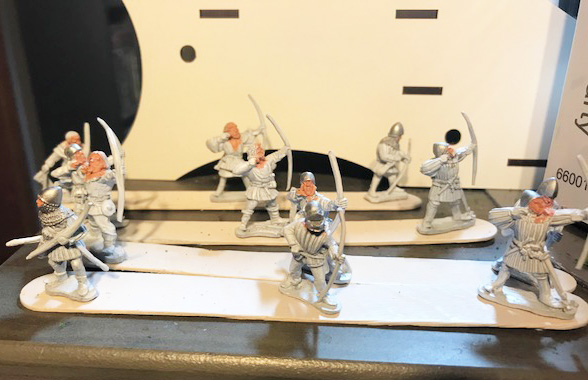
The Hundred Years War: Longbowmen–I’ve lamented my piles of unpainted Hundred Years War figures before, so I’ve decided to do something about it–paint them. I’m starting with my English longbowmen.  They’re all Old Glory figures, and I’ve been picking away at them throughout the spring and in to summer.  I think I’ve painted 48; I do them in batches of 12.  This is for my big battle HYW armies.  It will be a post-retirement project, mostly.  There are rules to re-write and many more figures to paint.  My goal is simply to finish all the longbowmen left to paint, which is 36.  Ideally before school starts in August. When finished my longbows will number 144 figures.  I like that.

Hawkmoon–This project is really done.  Sort of.  Well almost.  In one of the options I have for Hawkmoon, he can use The Sword of the Dawn to call on the Legion of the Dawn.  It’s a single unit of twelve figures.  These are sort of primitive rose colored warriors that he calls on his enemy.  When they are killed they are magically replaced by another.  They aren’t super nasty, there just seems to be an infinite number of them. I ordered some Aztec novice warriors by Outpost Miniatures and I need to paint the dozen of these to finish my Hawkmoon project.  They’ll go fast, but they just need to be painted.  Before I go back to school.  Or sooner.

Philippine War 1898-1902-So I’ve been slowly acquiring a few figures here and there. I’ve got enough Philippine figures for about three units and a gun.  I’ve also purchased one American unit and an artillery piece.  I’m anxious both in a good way, and an anxiety way to get started.  But I won’t let myself begin until I wrap up the CR 42’s, the Flint and Feather figures and the Legion of the Dawn.  So things are on hold for a while.  I’m hoping to get started before Labor Day, but if I don’t, at least I’ll have something to look forward to.  My J-camp wages will also contribute to a large order of these bad boys, and that happens in early August.

Lots going on, as you can see.  Probably too much, but I do love painting, so I’ll have a good time while I’m wading through it all.  And this all leaves aside the publication of Rebels and Patriots–the new Rampantish rules that will cover the wars of America from the French and Indian War and the American Civil War.  I’ve got a few figures I want to paint for that as well.  Ooooh.  So bright. So shiny.  Don’t look into the light.