The 48 Figures of Christmas

48.4

With lots going on in the world–as I watch my retirement savings dwindle with the stock market collapse-it is also the first day of my Christmas break.  The district, in its wisdom, has seen fit to give us an extra day of vacation today, December 21st, and I am set to enjoy it.  On my list of to-do’s are dog-walking, some extra walking at South Hill Mall, holiday chores for Lorri and lots of painting.  As much of the latter as I can stand.

My vision for Concord has only gotten more grandiose as time has passed. David and I divided up the British forces.  I’ll take six light companies, which I think will be 36 figures.  I’ve also got six or seven grenadier companies, which will likely be 36 or so figures.  Not bad.  There are 42 companies of American militia at Concord, or therabouts.  That’s a bit more painting, I’m afraid.

I’m beginning to have some serious thoughts about how best to execute this scenario, which is always dangerous.  A lot of it came to me this morning during one of my frequent bouts of insomnia, and I think it might work, but it may just be a case of needing to take more meds.  I’ll need to run it by my colleagues to see what they think, but there will be more to follow.  This is all more complicated, of course, by the fact that the rules we want to use, Rebels and Patriots, isn’t actually available for a month, so I’m shooting in the dark.

48.3

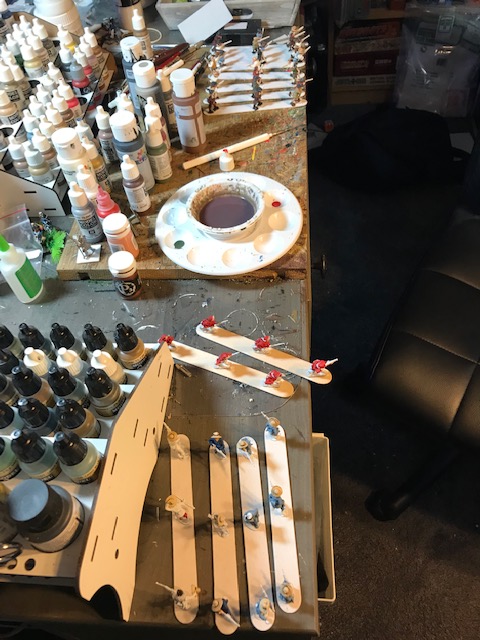
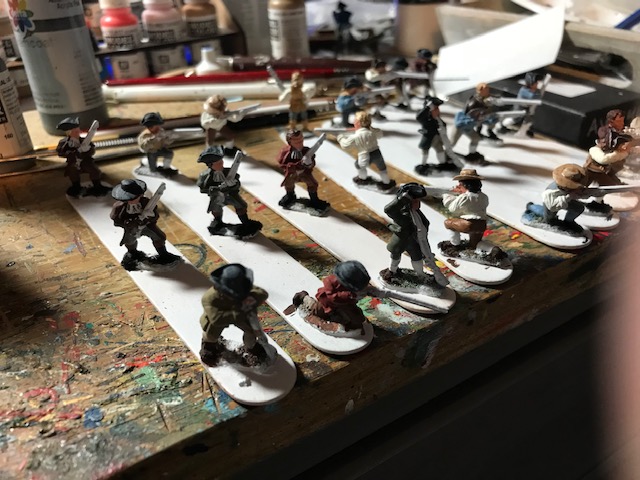
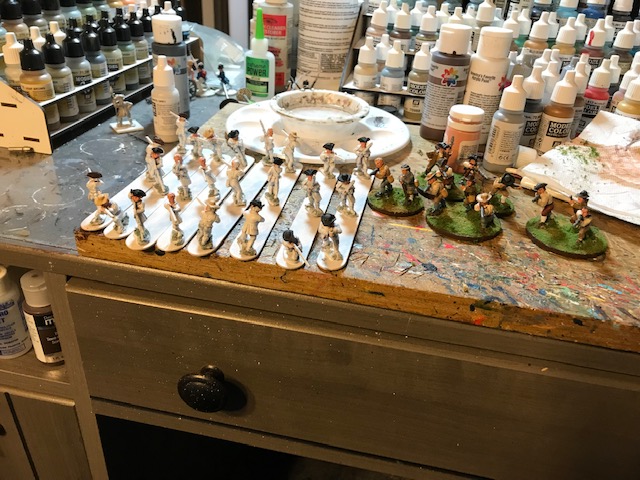
Since there isn’t a ton I can do about rules until I have some to actually look at, my Christmas break will have to be about painting. I’ve blocked out a lot figures I’d like to get done.  First on my list are some Front Rank American militia.  These figures will be grouped into 6-figure units and will likely fight as skirmishers according to what we’ve read in beta test accounts of the rules.  I have 24 of them, and have gotten a good start on them.

48.2

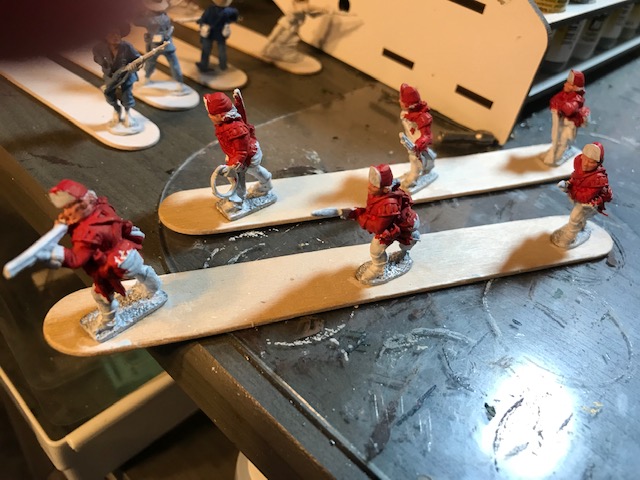
I also hope to get a couple of British companies done.  The first is the light company of the British Marines.  They didn’t receive their royal designation until after the War of Independence.  This is kind of a cool unit with a unique hat and facing plate.  I’ve already gotten a start on them.  The second unit will, for our game, is only a half of a unit, the company of Marine grenadiers. Pretty straightforward-red coat, white facings, square lace.  Life is good.  Not talking about a lot of figures here, just six of each. That brings me up to 36 figures so far that I need to complete during the my Christmas break.

481

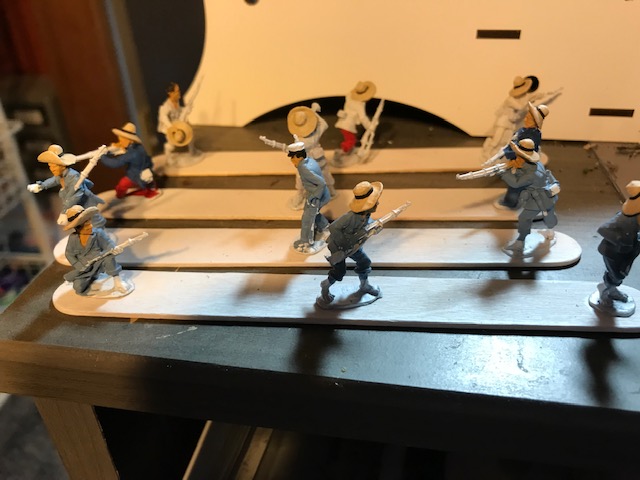
Last, but not least, I began working on a unit of Philippine insurgents about a month ago and stalled out on them.  They sit patiently on my painting talbe waiting to be finished off.  Half of them are in Rayadillo, the rest in white, or blue. Need to knock these guys out.

There is a chance I may wrap all 48 of these guys up with time to spare, and that would be great.  I did receive a significant order from Front Rank this week that should give me all the figures I need for the British at Concord, less a couple of command figures.  Also got a handful of militia types, so I can work on those.

I think I’m gonna watch the two Hellboy movies today and see what I can get done.


Concord–Getting Started

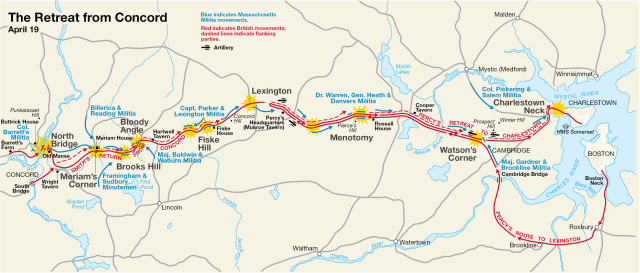
As explained in my last post, David Sullivan and I have settled on the retreat from Concord on April 19, 1775 as our big Enfilade game for 2019.  I see it as a pretty challenging scenario if for no other reasons than we can’t get our hands on the rules for the next six weeks, and I need to start painting immediately–unit sizes may be different than we suspect, but we’re going ahead anyway and doing the best we can.

Thanks to some interesting sources, we’ve been able to pin down the correct units for the British and made some decisions about their sizes–making some assumptions about the rules.

We have agreed on a 1:5 scale.  Yes 1:1 would be nice- but there is neither time or space for 700 or so British or 4,000 angry Americans. Even at 1:5, that would equal some 800 painted American militia, which seems a little excessive.  We’ll almost certainly rotate units in and out of the action

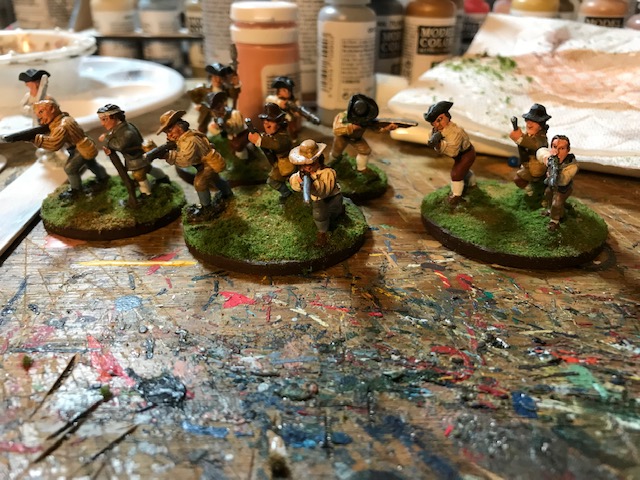
Militia 1

Twelve completed figures and twenty-four more that I’ve just begun.  Hope to have them all finished before the first of the year.

I’ve agreed to take on the painting of six British light infantry companies (36 figures) and seven British grenadier companies (42 figures.)  I have many of these, with more on the way from Front Rank.  I also have FR figures for five militia companies (60 figures,) and I’m willing to do as many more as I can stomach. The militia companies are by community locale, which I think is really super

We’ve managed to rope Dave Schueler into the planning for this game.  He is really good at scenario.  Though the thrust of the game is maneuvering the British from Point A to Point B through very adverse circumstances, it becomes more complicated as the American pop up unexpectedly, and as the British flankers (skirmishing light infantry) try to engage them, while avoiding traps themselves. I feel like this has the potential to be a really interesting game.  Of course, I’ve been wrong before.

Militia 3

My first twelve figures of militia.  Future units will have more interesting basing, but honestly I’m thrilled just to have them done.

Finished my first unit for the project.  They are almost all Front Rank militia with a few Old Glory guys thrown in for good measure.  They’ll do.

With every new project there are acquisitions that must be made.  I’ll be looking for useful terrain pieces–hills are always an issue, and there are some key hills on the retreat route. There are houses, taverns, fields and woods.  The Battle Road is bisected by a couple of streams with bridges, but I have the streams and bridges covered.

All of this excitement for the action also comes with the requirement that I learn more about it. I’ve been trying to amass some books and websites, and have my nose firmly thrust in them.  Here are a few suggestions:

Let’s start with a web source, Jeff Berry’s Obscure Battles blog.  He has a great web post on Lexington and Concord.  It boils things down to basic elements, but not devoid of useful context.  He has the all the units and strengths present on April 19th, some maps as well as advice to wargamers. Nice. Thanks to Dave Schueler for hunting this down.

Phillip Greenwalt and Rober Orrison wrote A Single Blow: The Battles of Lexington and Concord. in coordination with the Minuteman National Park sites.  There is some good stuff here, with good maps, but probably lacking the detail most gamers would want about the battle.  Some interesting black and white photos of historical locations.

You might know Arthur Tourtellot’s Lexington and Concord: The Beginning of the War of the American Revolution by its original title William Diamond’s Drum.  Published in 1959, this book is a great read.  Full of context, its tough for me to put down.  There is considerable space devoted to events on April 19th, but I haven’t quite gotten there yet.

I’ve ordered two additional books, because I can’t help myself. Brendan Morrisey’s Osprey Campaign Book, Boston 1775 will end up focusing more on Bunker Hill, but an overview of Lexington and Concord is included.  I’m hoping for a great map or two. Finally I’ve ordered  Nathaniel’s Philbrick’s Bunker Hill.  Philbrick is a terrific writer who offers great context to his subject, in this case the conditions around Boston in the first year of the revolution, including the events of April 19th.


32 Decals

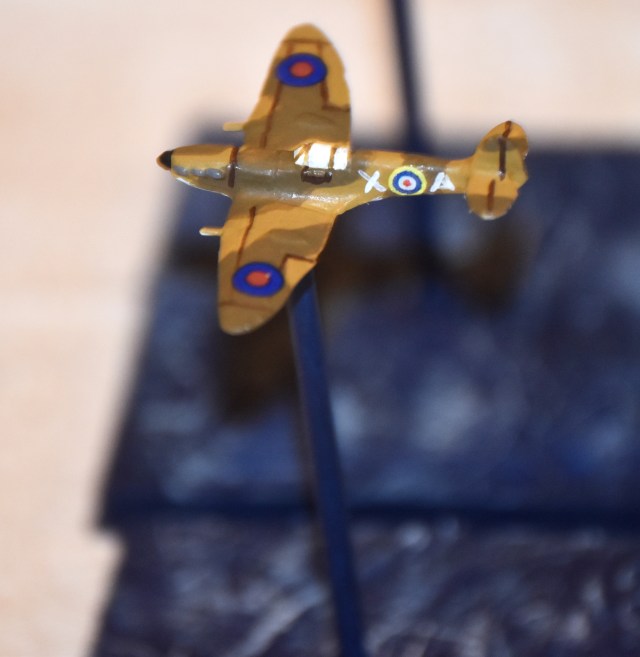
Spitfire 8

Last night I sat down, watched a couple of episodes of Netflix’s Last Kingdom, and finished painting the final planes for my Malta project.  They were eight Spitfire V’s.  I’d already painted four of these, and this was the last of them.

Spitfires figure prominently into the final eight months or so of the Malta siege. By this time, most of the attacks on the island fortress were performed by Germans–mostly Ju-88’s accompanied by Me-109’s.  Some of the German fighters are Jabos-bomb carrying fighter bombers attacking British airfields to the west of Valletta, and targets in Valletta itself. Everything is in short supply as German submarines and aircraft slowly strangle the island of its war supplies, including spare parts and fuel.

I really wanted to have fun with these planes.  They are Scotia miniatures and unfortunately lack the large tropical air filters mounted on the Spitfire Vb’s that were Malta-based.  But they are still nice miniatures.

Painting them offered an opportunity to do some different things with color.  I put four in the standard Mediterranean Dark Earth over Middlestone.  Yawn.  I also went with a flash of color with Mediterranean Blue, a striking color, over sky blue. This is not the predominant scheme for Spitfires however, so I only painted two in this fashion.

The U.S. Navy delivered 94 Spitfires to Malta.  They flew them off the decks of the U.S. carrier Wasp to land on Maltese air fields.  While shipped on the Wasp, it is suggested the Spitfires received their blue paint job.  American Intermediate Blue, standard color for the Navy F4F Wildcat fighter was sprayed over the Spitfires’ Dark Earth/Middlestone dressing creating a middling gray over blue gray effect.  So I went with that.  I gave a Vallejo dark grey blue base, and then mixed in some black for the darker pattern. I’m not sure if it’s quite right, but I can live with it.

My dozen Spitfire Mark Vb’s, by Scotia Miniatures.  Wing roundels by I-94 Enterprises.  Fuselage markings by Dom’s Decals. Lettering by Old Smyth. Remember, each planes is little more than the size of a quarter.  Not bad for an old guy.

Tonight I’ll be applying decals on the planes.  I’ll do wing and fuselage roundels and paint on some white call letters.  Four decals per plane.  I’ll pass on the tail flashes.  The I-94 flashes I have are just too big.  32 decals, that’s it.

The Spitfires are the end of this project.  I really have enjoyed paint through it.  I’ve learned a lot about the period and the planes involved, and I’ve started playing with some of the planes.  There are lots of things I’d like to try, such as convoy raids (but first I need to paint up my ships.)

Here’s what the finished project includes:

Luftwaffe

12 X Ju 88A4’s,  12 X Ju 87D Stuka, 12 X Me109E7, 12 X Me 109F, 6 X Me 110D=54 planes

Italian

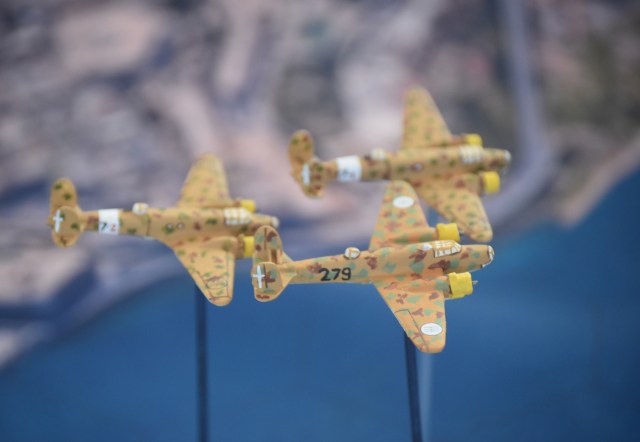
9 X SM 79, 3 X Cant 1007 bis, 12 X BR 20, 6 X CR 42, 12 X G. 50, 12 X MC 200, 6 X Re 2000, 12 X MC 202=72 planes

British

2 X Blenheim Mk. 1, 6 X Blenheim Mk. IV, 6 X Wellington Mk. I, 6 X Beaufighter Mk I, 6 X Fulmars, 12 X Hurricane Mk. I, 12 X Hurricane Mk. 2c, 12 X Spitfire Mk Vb=62 planes

Total=188 planes.

No current plans to add to this collection, but I could see it happen with a few odds and ends–reconnaissance seaplanes and adding a few Stukas to the Italians.  Perhaps also filling out the Sparvieros to twelve planes and three more of the large Cant bombers. But no urgency.  I’m ready to move on to Concord.


Shifting gears-the retreat from Concord

battle_of_concord_retreat

The Malta project is winding down.  I’m wrapping up my last eight planes, all Spitfires.  Spitfires in various shades of blue.  I love that. They will give me 188 planes completed for this project.  I hope to be finished with them by Friday, if not sooner.  There are still some bits to do for Malta, even a few more bits to buy.  I have four merchant vessels to paint, and three more to buy along with some escorts, but no rush.

But today, December 4th, I am a mass of anxiety, because I’m excited to start on something new.  Daniel Mersey’s new rules, Rebels and Patriots is due to come out at the end of January.  I’ve written about my fondness for his rules in past posts.  David Sullivan and I agreed to undertake a project using these new rules in a game for Enfilade.

David and I both have a fondness for the American Revolution in the South, and we initially agreed to stage the battle of Blackstocks Plantation after the fall of Charleston in 1780.  But truthfully, it’s not a battle many folks know well, and I feared it wouldn’t be very exciting.  The only thing it had going for it was I had a lot of the figures.

When we met to play our Malta game at the Museum of Flight, David reminded me of  Thomas Fleming’s wonderful book, Now We are Enemies, about the battle of Bunker Hill.  While I wasn’t too excited to recreate that battle, I considered that some of the early war might be interested and persuaded David to at least contemplate doing the retreat from Concord on April 19, 1775.

The good news is I do have a pile of the figures needed for this battle.  The 700 British soldiers are all grenadiers and light infantry, except for a company of marines. The Americans are all, of course, minutemen militia types.  I’ve had many of these figures, all Front Rank miniatures, unpainted and largely unused for years.  Ironically I purchased them from David about 25 years ago.

There were 10 light infantry companies-six figures each-at Concord.  There were 11 grenadier companies, plus one company of Royal Marines.  They will be represented by six figure units.  It’s not clear if we need all of them or how many would be necessary.  There are lots of militia that will be needed in 12 figure units, and again it isn’t clear how many will be required, but they likely will appear and disappear randomly.

[Painting+by+A.+Lassell+Ripley,+The+Paul+Revere+Insurance+Company]

Interesting terrain bits will also be required-16 feet of stone walls, hills, streams bridges, woods, buildings and fields.  It should be fun.

But, I’ve got those Spitfires to finish as well as a unit Philippine insurgents before things can get started.  Hope to be done no later than December 19th so I can start working my first unit of Sudbury militia.


Folgores and insurgents

Only a few more hours until the Thanksgiving holiday weekend is over.  Alas and alack.

It’s been a great weekend, starting with Thanksgiving at Chez Smyth.  Good food and good company.  But it was also a great weekend for painting, and I made sure to get in lots of it.  Though Thursday night’s weather knocked out my DirectTV, I listened to both the Apple Cup and the Sea Hawks game on my trusty Pioneer receiver while getting some stuff done.

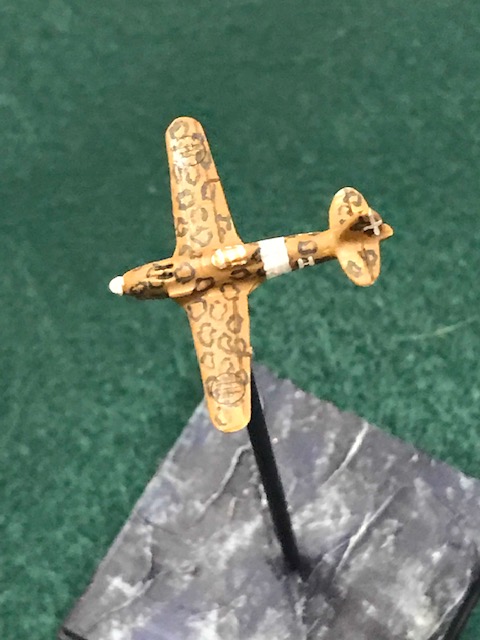
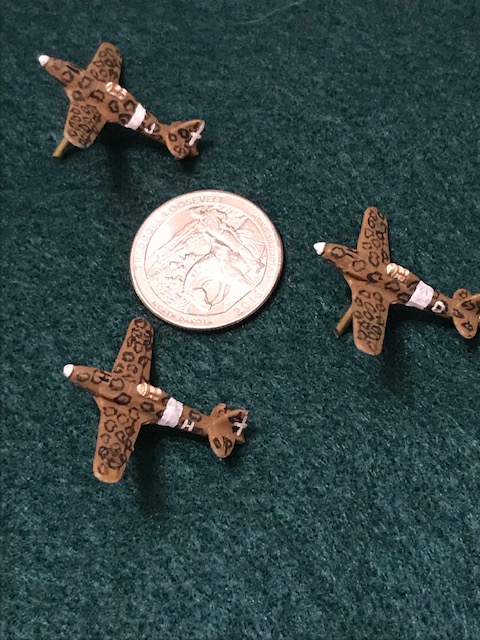
Macchi Mc 202 Folgore


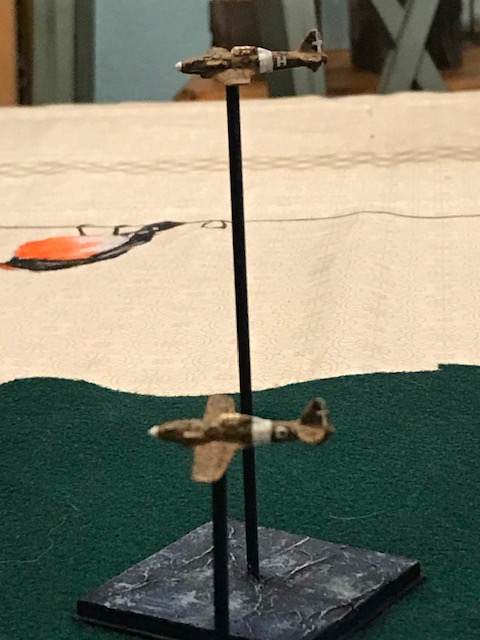
I finished, 13 planes this weekend.  I wrapped up six Scotia Me 109E’s, but I’ve written about these before.  I also wrapped up seven of the dozen Italian MC 202 Folgore’s fighters I need to finish my Malta project. Yes, seven is a weird number.  I thought I had a dozen, but mistook some G55 Centauros for the more slightly constructed Macchi fighters, and had to order some more.  The good news is the remaining five arrived yesterday.

Folgore 2

The big challenge was to figure out what to do with the Folgores.  They represented the next generation of Italian fighters after the open cockpit Fiat G50’s and Macchi 200’s. The Folgore’s were a big performance upgrade with its use of a new inline engine.  But, it also suffered the weakness of many Italian fighters, an inadequate armament of only two 12.7mm machine guns.  The Folgores appeared over Malta in December of 1941, and though many of them were diverted to North African airfields in the spring of 1942, about 60 remained in service over the embattled island throughout the Spitfire spring and summer of that year.

Folgore 1

Italian planes of this campaign do not lack for something interesting and different in the way of camouflage schemes.  One of the more interesting is the “smoke-ring” or “cigar ring” camouflage.  The Folgores get a base top-side paint scheme of a mid-brown with a slight red cast.  I used German RLM 79 Sandgelb.  Not quite right, but I don’t think anyone will notice.  The underside was painted German RLM 78 Hellblau in accord with the article I read.

Folgore 3

The tricky and tedious part was panting the smoke rings on the plane.  According to photos and the article I consumed, the rings had to be vaguely circular and elliptical and generally irregular.  Got most of this done during the Apple Cup.  It gives a nice effect, and definitely something different. The rings are painted a Ceramcoat charcoal.  I used one of the very last Blick Master Kolinsky size 0 brushes that exists.  These were produced after the Kolinsky boycott a few years back and were made with way shorter than the 15mm tips promised.  These were more like 10mm, but very fine with small but useful tips.  Generally speaking it required patience and persistence.  Seven down five to go. This plane also had a very wide fuselage band, appearing just behind the canopy. Italian marking markings, without the white roundel backing them were hard to identify.

Philippine Insurgents–Rayadillo Pt. 2

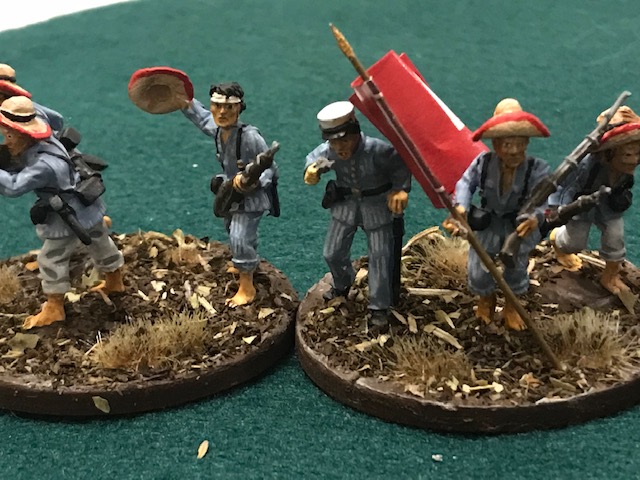
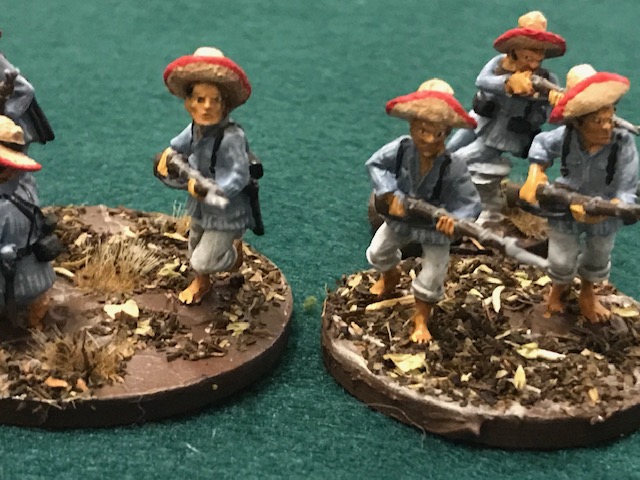
It took me a long time to wrap them up, but I finished my first unit of Philippine insurgents.  You’ll recall I finished a unit of Spaniards, whose rayadillo uniform appeared pretty gray.  I promised myself to try something a little different with my next unit and I did.

Insurgents 1

insurgents 2

These figures started out as Vallejo Blue Gray and highlighted them a couple of times before moving on to attempting the stripes.  I was much happier with the effects, but the uniforms still seem very blue.  I’ll try to get them lighter next time.  The Philippine fighters are accoutered differently than the Spanish, and in some respects seem “busier.”  Even so, the figures are quite nice.

It does seem like I’m learning by process, and I’ll want to try some things differently with the next batch.

I did try something a bit different with the basing.  I’ve been looking at terrain bits for the jungle shared on The Tactical Painter blog.  He has some great suggestions for making jungle terrain, and also rice paddies which were a regular feature of the Philippine War.  One of his ideas I adapted over to terraining my bases for this unit.  He suggested the use of tea and some spices mixed together and put under jungle plants.  I used them on my bases.  I found some aging tea bags and slit them open into a bowl.  Then I sloshed in some bits of oregano, tarragon and rosemary.  I think it looks different and interesting.

Next up

Just a lot going on miniatures-wise right now.  I’m closing in on the last of my Malta planes.  I have a good start on some Regianne 2000’s.  They’ll be followed by the last of the Mc 202’s, Raiden planes freshly arrived from I-94.  Then I have 14 Spitfire Mk. V’s, both B’s and C’s that will wrap up the project. That’s 188 planes painted since spring of this year. I also have started on one last unit of Philippine insurgents.  My hope is that all of this is completed by Christmas break, about four weeks away.

After that, I’ll be getting ready for the Next Big Thing.  Rebels and Patriots, the next Daniel Mersey game is due out at the end of January.  David Sullivan and I have already committed to this rules set, and we plan to have a game for Enfilade.  We’ve talked about a number of actions for this small unit game.  Today we settled on the retreat from Concord in 1775. We talked about other battles, but agree that if we do this right, this will be a signature game. I’ve been taking stock and I have some troops I can begin with immediately. More to follow

Museum of Flight 2018

Today was the annual NHMGS day at the Museum of Flight.  Today’s event was a little different in several ways.  First it was hobby day at the Museum and we shared space with the are RC Modelling and IPMS groups.  I didn’t make it around to the RC guys, but I did get photos of some of the fine modelling examples on display.

I’m not sure I was thrilled with the outcome.  I proposed sharing, but our half of the sharing was certainly the lame half.  The IPMS guys got all the tables around the SR-71, which we’ve held as our space for the past decade or so.  We were kind of out of the way, which I wasn’t wild about.  Not much walk through came our way.

Unfortunately, I also suffered a domestic crisis when the morning session was over, and I had to dash home to solve it.  Lorri and I were car shopping yesterday, and when the dealership borrowed her keys to do a walk through of our Crosstrek, they neglected to return her keys.  It was critical, with Thanksgiving at Maison de Smyth on Thursday that she get out for errands, so I had to connect the missing keys with my desperate wife.

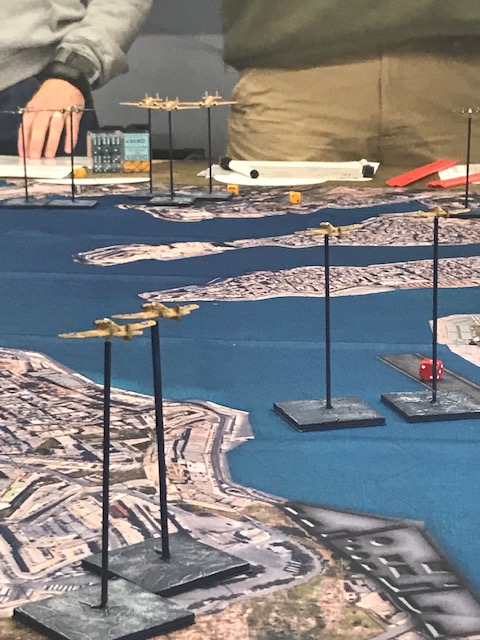
Dave and I re-ran our President’s Day game with seven anxious players. The cannon-armed Hurricane IIc’s were flown by Gary, Tom and Bill.  The German escorts, Me-110’s were fun by Scott and David.  The Italian Cicogna bombers were run by Al, Arthur and myself.

We actually had a pre-game conference.  I persuaded my colleagues to fly up the left side of the map to attack the strategic floating dry dock.  They would get the fighter escorts.  I would fly up the right side, hoping to draw off  at least some of the interceptors. Well, at least it was a plan.

Things didn’t turn out quite as I envisioned, as all six of the Hurricanes were on my buddies like nobody’s business.  But cannon-armed or not, the head on pass is just not a high percentage action.  Even so the Hurricanes and Me110’s took it leading to some quick damage.  One of Gary’s caught fire-never a good thing in a mostly wood and fabric airplane. Even as the opening moves moved on, with fighters blasting away at each other,  the bombers lumbered on rather effortlessly toward their target.

In the next few turns things got wild.  A few of the British fighters tried some special maneuvers that left them far in excess of their max speeds, leaving them open to damage.  Unfortunately one Hurricane had its wings torn off and things began to look questionable.  Another Hurricane took a batch of light machine gun fire from a bomber group suffering engine damage and oil spray on the windscreen.  The defenders were rolling slovenly dice and suffering considerable damage.

Malta 6

Meanwhile, Smyth’s trio of BR 20’s were strolling toward their objectives.  The chianti was shared around and there was commentary on the pretty, but ineffective flak bursts, but I was unhindered in the empty skies over Valletta.

On the left side of the board, the skies were a little more crowded.  With the six bombers, several with a little damage, approached their target, Bill’s lone Hurricane caught up to the attackers.  Two of Arthur’s planes were forced to jettison their bombs. But Al’s planes led the way to the drydock.  Each plane rolled two dice for bomb hits.  They needed four hits to inflict minor damage to the structure.  Unfortunate they only got two.  Boo. Hiss!! Even so lots of Hurricane damage as a trade for a little scare on the dry dock.

My three bombers choogled quietly over their target and dropped their loads.  I also needed four hits to inflict minor damage on the supply dump that was their target.  I got three, so close but no cigar.

Ours was not the only game at the Museum.  Damond Crump ran a very cool looking game of Thuds Over Hanoi using the AirWar C21 rules. I was especially impressed with Damond’s jungle canopy.  With Vietnam on my radar, I definitely took note of the canopy on legs effect.

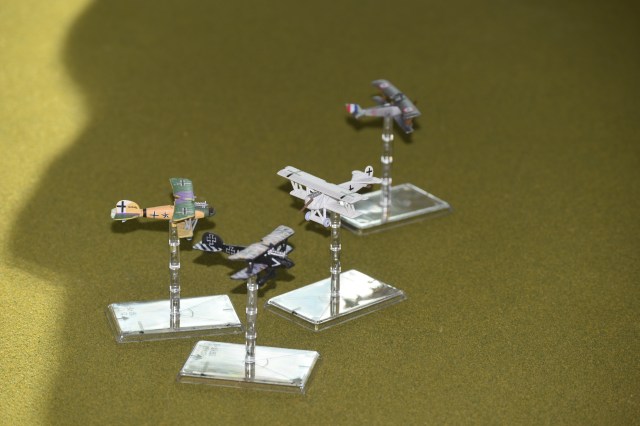
Tom Condon hosted a Wings of War game.  It always attracts drop-in players including some of the Museum visitors.

DSC_0304

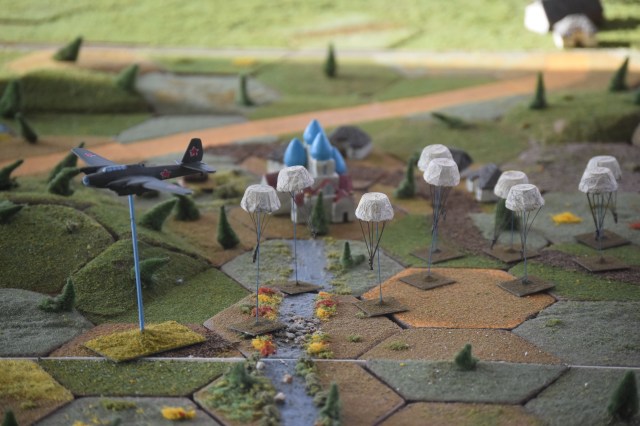
Jeroen Koopman hosted an really interesting looking micro-armor game that featured a Soviet air drop.  Looks pretty impressive to me.

DSC_0302

I’m hoping the rest of the day went as well as the morning seemed to.  I had a good time, and can’t wait for next year.


Monday’s raid on Malta

Hey it’s November 12th.  That means Veteran’s Day holiday for all us public employees.  And no better way to spend a spare Monday than playing games.

November 18th is also the annual Museum of Flight game day, so Dave and I agreed we needed an opportunity run our Wings Over Malta game through with friends who might cut us some slack. So we put the word out we wanted to run a game at The Game Matrix and crossed our fingers for players.

The premise of the game was pretty straightforward. Nine Br. 20 bombers, escorted by four Me. 110s would be intercepted by six Hurrican IIc’s.  Dave was interested to see how the heavier German fighters would perform against the cannon armed Brits.  We figured we needed five Axis players and three British players.  We also figured we could run the bombers on auto-pilot if we had fewer players.

Danged if we didn’t have eight takers.  More actually, but we filled the game. Dean, Jim and Scott A. took the bombers.  Scott M. and Gene ran the Messerschmidts.  They were intercepted by Dave, Al and Gary flying for the RAF.

We laid out the Valetta map and marked three target sites for the bombers.  They could hit one or all of them. The Hurricanes would approach from the west and we’d see how it worked out.

Malta 5

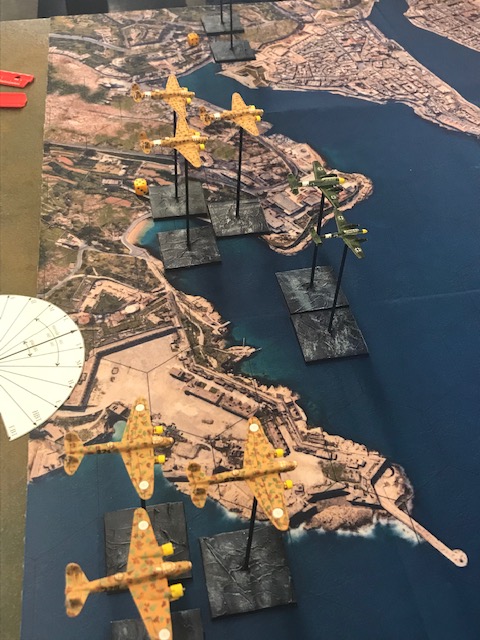
View of Axis entering the board from the view of intercepting Hurricane Mk IIc’s.

The Italians split into two groups with six bombers heading up the east or right side of the board, while three headed west for the important dry dock. The escorts searched for targets while the Hurricanes turned their attention to the Cicognas. The bombers immediately came under largely ineffective AA fire, but seemed to trundle along.

Malta 8

Another view of Axis entering the south board edge.

Scott A’s came under immediate fire from Dave’s Hurricanes, as he made a head-on pass, plugging one bomber with some cannon rounds, but receiving an unlikely critical hit from bomber defensive fire, putting one of his planes temporarily out of action.  Al’s interceptors overshot the bombers, and would take some time get back in the action.

In the middle of the table Gene’s Me 110’s and Gary’s failed special maneuver left the other Hurricane’s badly out of position and running for his life.  As Dave’s veteran pilot flew through Scott’s bombers and line up Jim’s Cicogna’s perfectly, he was blown out of the sky by Scott M’s Me 110’s.  No parachute was seen to open.

With no opposition left to face them, Dean and Jim choogled on toward their target, with only occasional bursts of flak to annoy them.

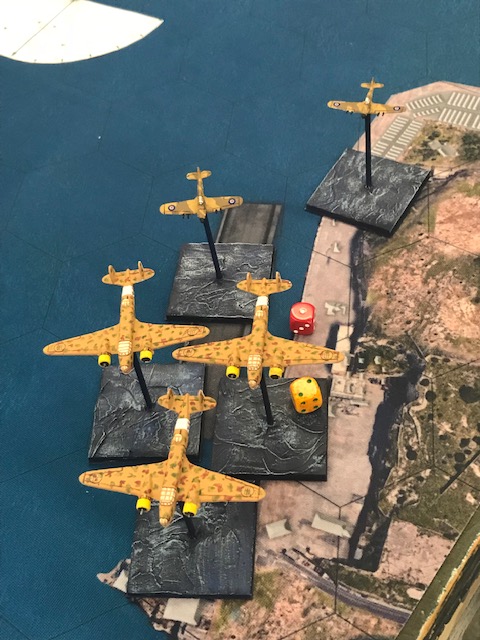
On the left (west) side of the table Al’s Hurricanes slowly overtook Scott’s bombers as they reached the drydock.  He poured sustained bursts into the two trailing bombers, damaging their bomb releases and holing their fuel tanks.  The lead plane, damaged previously by Dave, dropped his bombs, doing slight damage to the dry dock and saving the British from catastrophe. Out of ammunition, Al’s planes returned to Hal Far.

Malta 12

Al’s Hurricanes pour cannon fire into Scott A’s BR 20’s.  His attack forced the trailing bombers to leave with their bombloads and streaming fuel. 

With Gary’s Hurricanes and the Messerschmidt escorts badly out of position, the remaining bombers flew on.  But not scot-free.  Dave’s remaining fighter eventually caught up to Jim’s bombers.  He shot up the trailer and forced him to jettison his bomb-load. The remaining five however scored four hits on their target, inflicting heavy damage on the warehouses and their stores, earning the Axis a minor victory.

Malta 1

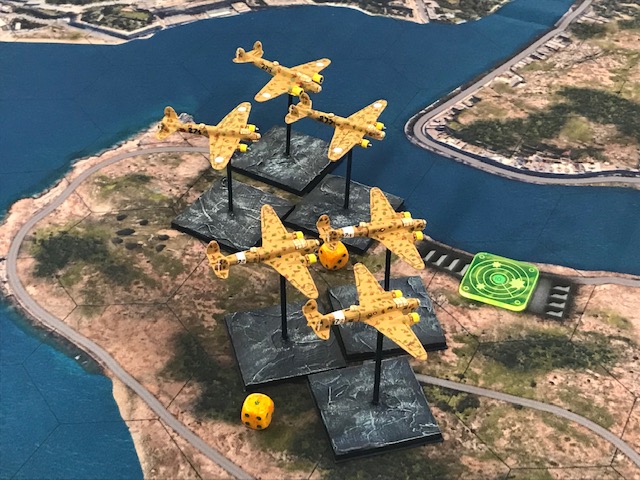
Despite a ferocious attack by Dave’s remaining Hurricane, Dean and Jim’s bombers close on their target.

The score was one British Hurricane shot down, with two BR 20’s unable to return to Sicily and other two other bombers damaged. We learned a lot from the game.  The Me 110’s can be nasty, but they maneuver poorly.  The Hurricane IIc’s were a revelation compared to the eight-gun fighters used in previous games.  However, they are very ammunition restricted.  Despite getting a lot of hits, they never destroyed an Italian plane.

The game was played on my Valetta mat, by Tinymats.  The planes were a mix Scotia, Heroics and Ros, MSD and an unidentifiable manufacturer.  Rules were Airwar 1940 by David Manley.


Blue Blenheims

The Bristol Blenheim is one of my least favorite planes of WWII.  An late 30’s addition to the RAF, the Blenheim showed its mettle by participating in the first raid on Germany Sept. 4, 1939.  Of the fifteen included in the attack, five failed to find the target and five were shot down by anti-aircraft fire.  Three bombs struck the cruiser Emden, but failed to detonate.  This is the Blenheim’s legacy.

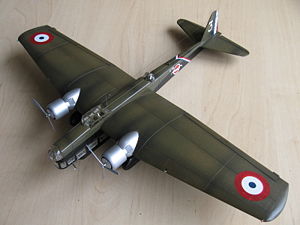
Perhaps it’s the plane’s lines, which seem a bit like a panel truck.  Not nearly so ridiculous as the Amiot 143 which looks like a moving van with with wings.

300px-Amiot_143

But there’s something ungainly about the plane that lacks the charm of a Wellesley, a Wellington, and a Hampden or the masculine ferocity of a Beaufighter.

But, they’re integral to the Malta campaign.  Their participation in attacks on Italian airbases on Sicily and raids on trans-Mediterranean convoys to supply the Axis forces in North Africa were more than just nuisances.  They drew the attention of Italian and German air forces that ultimately led to the two year siege of the little island.

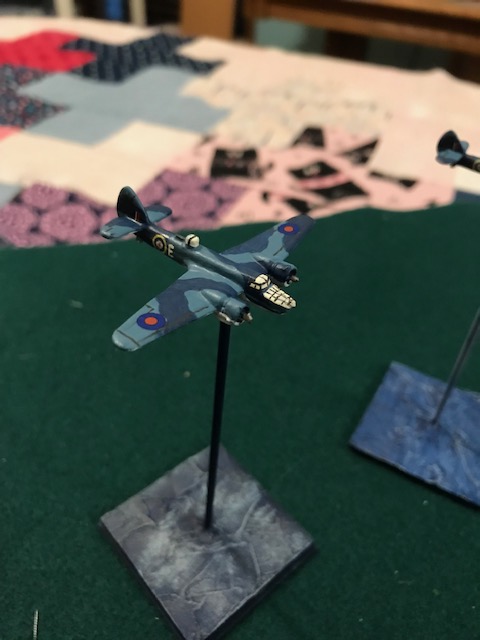
I’ve painted eight fabulous Blenheims for my Malta campaign.  I only meant to do six, but as I went through the treasures of Dave’s bounty I realized there were two Blenheim Mk 1’s and two Blenheim Mk. IV’s.  The latter were used widely in the Mediterranean, the stubby Mk. 1’s not so much.

Never one to ignore a challenge, painted the Mk 1’s and ordered two Scotia Mk. IV’s and later, realizing I was two plane short, I added a pair of Raiden Mk. IV’s

The Mk. 1’s are painted Middlestone and Earth, the go to colors for the RAF.  The undersides are painted black.  Both planes are fully prepared to go drop their duds on the Scheer and Emden.

IMG_1676

What to do with the remaining six?  We usually play our bombers in groups of three, so the answer was easy.  Some bombers based in Egypt, that also made their way to Malta were painted blue.  Not a ton of photos of Blenheims in this configuration.  I used a base coat of Vallejo IDF Blue with markings in Vallejo Dark Mediterranean Blue.  It’s a pretty striking combo, that appears sort of green in the lousy light of my dining room. Undersides in Vallejo Sky Blue.

The remaining three planes were done in Middlestone and Vallejo Dark Green.  They also have the sky blue undersides. But just a little more about these fellows.  Two of these were Raiden planes and one was Scotia.

The Raiden Blenheims are among the finest 1/300 miniatures I’ve ever seen.  The scribing top and bottom across the the entire wing is simply gorgeous.  The canopy panels are superb, just great stuff. I thought it would be equivalent to the Scotia plane, but simply a quantum better.

What’s Next

Lots of projects competing for my time at this writing.  I have a two-thirds completed Philippine Republican unit on my painting desk that needs completing.  The Patriots and Rebels rules come out in January and I’ve agreed to work on an Enfilade project for those rules with David Sullivan.

But I have six Wellington bombers on my desk that need work, and the Malta project just needs completion, and it will take my time until it is finished. There are 42 planes to go, plus I’ve ordered a handful of 1/700 scale cargo vessels for convoy raids.   I’m also committed to working on a Vietnam project, so I think for the next few months planes will be what I’m focused on.


Shapeways Skywarriors

IMG_1665

I spend lots of times perusing the Shapeways dealers.  I don’t often buy, but I often wish I did.  One of my favorite dealers is Prairiehawkgamer.  He sells lots of interesting 1/300 scale planes, including a Tu-95 Bear bomber for a mere $43.  Let’s just say it’s on my list. It has interception scenario all over it.

Last winter, I took a flyer on a wild hair.  After Malta is complete–not that far away–I want to work on scenarios for Operation Rolling Thunder.  One of the useful, but unheralded, planes for that campaign is the EA-3 Skywarrior, and it’s AirForce similarity cousin, the RB-66 Destroyer.  Though originally built as nuclear bombers, with age they took on such tasks as electronic warfare, reconnaissance, and in-flight tankers. Over North Vietnam, they mostly played an ECM role.

Of course, nobody makes one in metal.  So, back to Shapeways.  Last spring I ordered a pair of the Prairiehawkgamer’s Skywarriors, along with a pair of very enticing Eurofighter Typhoon II’s (with ordinance!!  It’s so cool!!)  I’ve been focused on other stuff pretty hard core for a while, and these have just been sitting on my painting table So I decided to go for it..

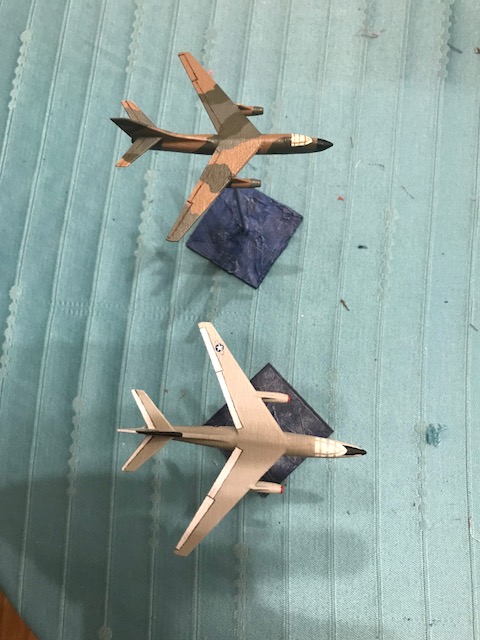
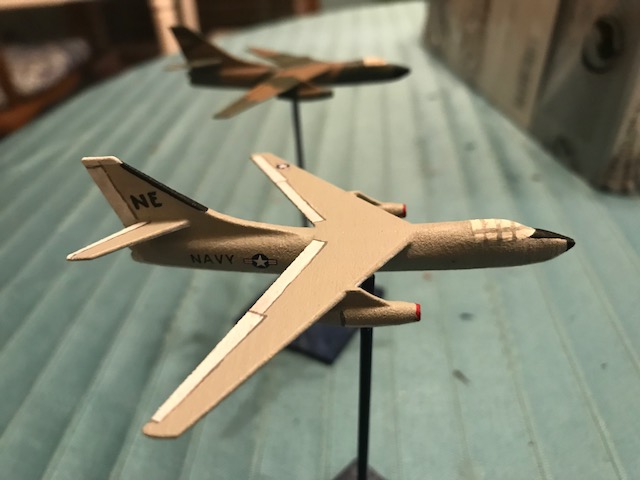
These models have the grainy surface that prevents many of us from investing heavily in the plastic models.  I hand primed it twice with Vallejo primer.  Still rough.  Oh well, goes with the territory.  I decided to put one in Navy colors as an EA-6, the other in Vietnam-era colors.

IMG_1667

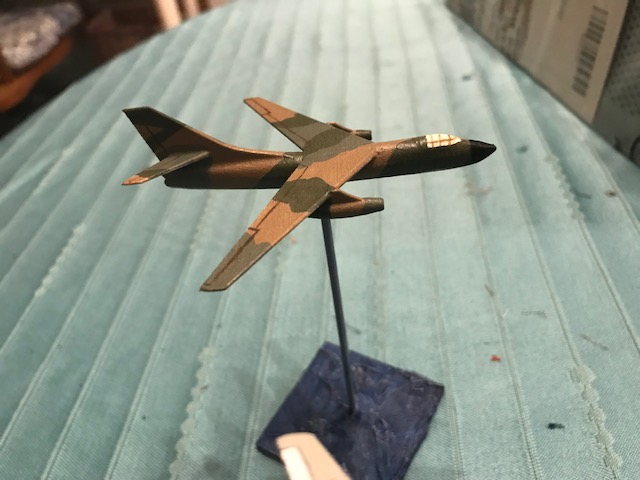
For the Air Force plane I used a modellers example of BAT-21, a B-66.  To paint I used colors from the Vallejo Vietnam collection-US Brown, Forest Green, U.S. Green, and USAAF Light Gray.  I cleverly reversed the Forest Green and U.S. Green in the picture, but I’m counting on my readers not to rat me out.

IMG_1666

For the Navy version I used Testor’s light Gull Gray over all the upper surfaces and the fuselage.  I tried to use the regulation Testor’s Gloss white on the under surfaces and control surfaces, but while glossy, it just didn’t cover well. I switched over to Vallejo White-gloss be damned. A lot of the photos of Skywarriors show the rear half of engine nacelles in as natural aluminum, so I went with that.

Shapeways is great at providing the basic plane, but if you want detail, you’ll have to paint it in yourself. I started with the canopy.  No mine aren’t blue they are in ivory.  Get over it. Then I painted in the framing as best I could.  Got the lines a little thin for BAT 21.  Then it was on to painting in the control surfaces.  Again, this is on the best you can do basis.  Dark Gull Gray for Navy, Burnt Umber for Air Force.

Last but not least it’s time for markings.  Because the planes are secretive in nature, markings are at a minimum.  The Air Force plane has no national markings and I chose not to paint in unit insignia.  The Navy plane got national markings as well as its NAVY identification, but none of the elaborate ship and squadron markings common from this tiem.   And we’re done.

The planes are spendy at $12 a pop, but I only needed a couple.  I really enjoyed painting them.  Now how many Bear bombers would I need . . .


Rayadillo, Rain on Me

I’ve finally begun painting figures for my Philippine project.  I’ve finished the Tiger Miniatures Philippine scouts.  More about them later.  But that brought me to the first of my non American units.  Should I choose something easy like your basic bolo-armed melee troops, or try something more difficult?

The unfortunate Spanish troops  who unwittingly were swept up in John Hay’s “splendid little war” were clothed in rayadillo.  It is a pin-striped cotton garment, well suited in its light weight for the tropics of Cuba and the Philippines. It also has a certain camouflage quality as the stripes just fade into the background. Many of Emilio Aguinaldo’s troops in the army of the Philippine Republic likewise wore these as they looted Spanish supply depots and armories around Manila when the the Spanish happily capitulated to American troops in 1899. I will have about 60 figures to paint in this pin striped garment.

My first unit is of Spanish infantry.  There were many Spaniards that guarded Manila until the Treaty of Paris was ratified and the commander of Spanish troops made an implicit “deal” with General Wesley Merritt in charge of American forces in the Philippines. With a nod and a wink, after a brief bombardment by U.S. naval vessels, the Spanish withdrew from fortifications guarding the city.  The Philippine forces nominally allied to the American forces, feeling betrayed, looted the Spanish supply depots, taking Mauser rifles, ammunition and many of the interesting Spanish uniforms.

I have no intention of painting the Spanish army of 1898 or 1899.  However, there is a suggestion in my reading that some Spanish troops may have joined the Republican forces as well-paid mercenaries or as prisoners fighting for the Republic..

Ugh.  Thankfully the Miniaturas 1898 website has some useful painting guides for their excellent figures, including one just devoted to the rayadillo.

I set out trying to paint my several hundred figures for this project using the recommendations offered Javier Gomez “El Mercenario,” the featured artist on the 1898 Miniaturas website.  Look, the guy is better than me, a lot better. Not only that but we paint using different styles, beginning with the fact that he is a black primer with highlights kind of guy, while I am a white primers with one highlight and washes kind of guy.  Even so I gave it a try. The pictures begin with the figures in process and the completed unit. Here are some of my observations

The Good:

  • Even though I work differently than the method suggested, it went fairly well.  The highlighting suggested was interesting, and I could see it working as I was painting.
  • The Rayodillo creates a kind of illusion.  There is no way anybody can paint tiny little pin stripes that stay straight  on a dozen 28mm figures without going blind or jumping off a bridge.  You’re only painting groups of partial stripes on the areas where the uniform is stretched tightest–knees and elbows, the skirts of jackets, etc.
  • It went pretty fast.  I did 11 figures-still need to do the officer-during the Husky game on Saturday I completed all the pin-striping.
  • The 1898 figures are a joy to paint.  Beautifully cast, well proportioned, crisp detail, but not over-detailed.

The Advice

  • Gomez offered three different combinations for painting and highlighting.  I chose the darkest version (Vallejo gray-blue + cork brown, lightened with white in highlights.) I ended up with uniforms that were much darker than I intended.  Certainly there are illustrations of this uniform that seems quite gray, but it feels too dark to me.
  • I tried to paint the entire unit of twelve at once.  I usually paint small units all at once.  Just force of habit.  My next rayodillo unit I will paint six at a time. I kept worrying about running out of the highlighted colors, and especially when I was painting the stripes (the third highlight.) That also allows me to try to mix two of the different paint formulas for the uniform.
  • The pin striping is a challenge.  You have to use a tiny brush, and honestly there isn’t a tiny brush tiny enough.  You also have to stay on the point of the brush, and that’s very difficult given the angles I found myself holding my brush at times.  I feel like my guys often look like they are in prison uniforms.
  • Clean your brush regularly.  The paint tends to cake at the tip.  Thin your paint so it flows more easily off your tip.

This is my first try.  It is my only Spanish unit, but I expect to do four units of Philippine infantry in rayadillo as well.  I may just stick with it until they are done.  Certainly my next unit will be in the pin stripes.  We’ll see about the rest. Regardless, I’ll be painting more in my own style for most of the figure, except for the major uniform pieces, ie, pants and shirt and hat.  The rest will be all Kevin, for better or worse.

Tiger Miniatures:  Philippine Scouts

I wrote about these guys a little bit.  They are finished, but I’m pretty non-plused by the outcome.  To start with, they just aren’t great figures.  The hat is too small.  Heck the figures are too small, and the American officers I used are too large. Lots of fiddly detail that is really hard to pick out very well.  The good thing about them is they are sort of representative of a valuable unit type.

I started with these guys, and used the Pedro Gomez method.  I wasn’t very happy with the outcome.  The highlighting over the Dark Prussian Blue just didn’t cgme out very well.  I don’t think I was liberal enough with the highlights and the amount of lighter paint–and it just didn’t work that well with the castings.

Best part about these figures was the rifles.  Worst part about these figures were the faces.  No eyes on these guys. Maybe it’s just my advanced age, but combined with the castings, I just played it safe.

Hal Far Airfield done

I mentioned, a while back, that I ordered the RAF airfield miniatures from Pico Armor.  They are by Brigade Miniatures, and they join just a bucket of great 3mm terrain offerings from that British company.  There are times I just want to order some of their goodies because they’re so cool. Right, I need another project like a hole in the head.

Just to add to what seems like desolate terrain, I’ll distribute some of the terrain bits I used for my Sluys game back in the day.  It would be cool to have some 1/600 scale planes in the hard stands, but I just can’t go there.  My wife would kill me.  Hell, I’d kill myself.

On the Painting Table
On the Table

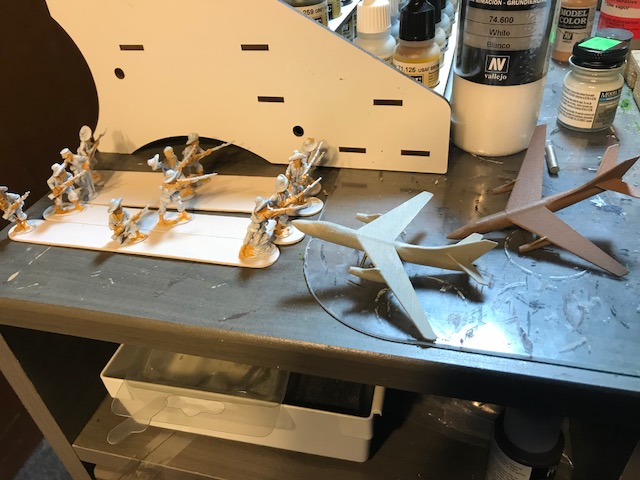
I am preparing a dozen British bombers for their Malta home.  There are some great scenarios to use them in, whether it is attacking airfields in Sicily, or giving the Axis a taste of their own medicine with attacks on their convoys. But right now I have my first Philippine unit on the painting table as well as a pair of Vietnam-era electronic warfare planes.  These are a pair of Shapeways A-3 Skywarriors, which is very similar to the Air Force B-66 Destroyer.  Originally intended to deliver nuclear weapons, they gradually were relegated accompanied bombing missions over North Vietnam while trying to fool  Hanoi’s radars.