When last we met I had finished the British destroyers for Force Z, and was about to begin working on The Prince of Wales.
Well, it’s done. I took a Friday, Saturday, and Sunday to build it. Relatively painless . . . sort of. In a painful sort of way. The PoW is far larger and more complex than the wee destroyers. Lots more pieces. I managed to only drop and lose one, the pontoon from the Walrus scout plane. The one major faux pas was not getting the hull to fit firmly down on the bottom piece provided with the kit. I had it glued and used rubber bands and a clamp, but no not good enough. The gap is plenty big enough for me to see, and everyone else I’m sure. I also managed to glue the main guns of turret A in a semi depressed state, and I wish that hadn’t happened. But the bottom line is this: each of these ships serves as a big ol’ piece of terrain. They don’t move, and will simply have to do.
The painting was the real challenge. I brush painted the ship. I don’t own an airbrush, and just don’t see the need for one. I only build models as I need ’em and that’s not often. But painting the Prince of Wales was a big challenge because it is large and had a very elaborate camouflage for 1941. The Repulse is also camouflaged, but it’s scheme is pretty monochrome and blocky, all angles. The PoW’s scheme flows, includes several shades of gray, but additional shades of green and blue. I approximated it as best I could, but painting the camouflage, all the detail, usually multiple coats with my somewhat thin Lifecolour paints took more than a week.
The good news is I’m ready for the Repulse. I was going to start working on it in between painting sessions, but I opened my box and found it missing an entire sprue, including most of the main deck. I had to re-order, and the new Repulse should be here tomorrow. It’s a Trumpeter kit and a bit different than my Tamiya Prince, but I’m looking forward to it. The original seller has offered to send me the missing sprue, but he’s located in Asia, so who knows how long that will take.
One ship to go until everything is complete. I still need to finish up some rules issues. Chiefly I’m concerned with generating and recording damage to the capital ships. I’ve been looking at other rules sets and am not quite finding what I’m looking for. Maybe I need to look harder. First playtest on March 14th so I need to get on my horse.
Because I am Kevin the Retired, I can work on stuff whenever I want. Sort of. Unless I am Kevin the Grocery Shopper, or Kevin King of Laundry, or Kevin Keeper of the Aussies. The rest of the time I am Kevin the Retired . . . unless I am fixing dinner, or loading and unloading the dishwasher. Well . . . you get it.
Anyway, I am trying to use daylight to build my ships for Force Z. My last post was about finishing the destroyers. Today, I began working on the Prince of Wales. Let’s just say it’s all a learning experience and believe me I’m trying to learn.
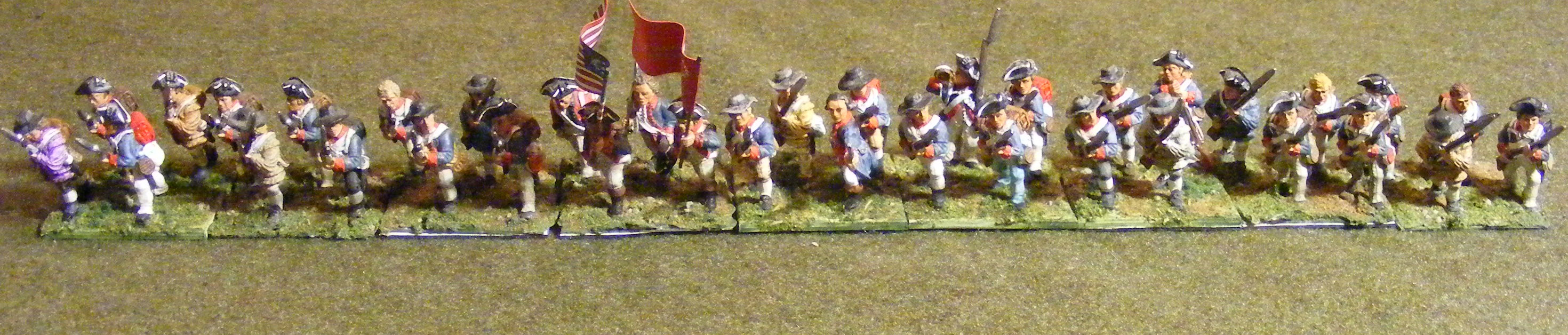
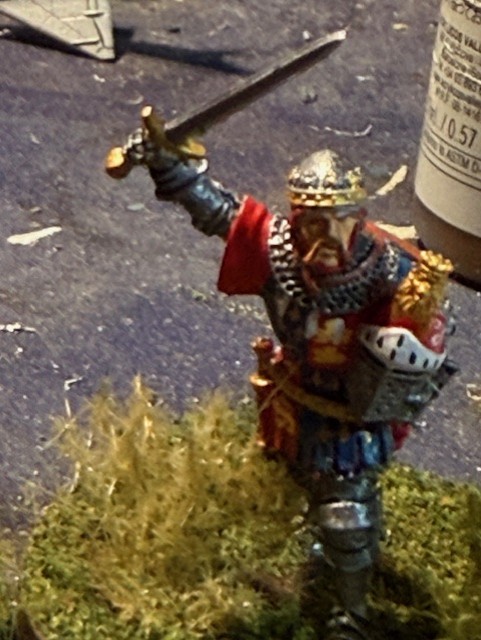
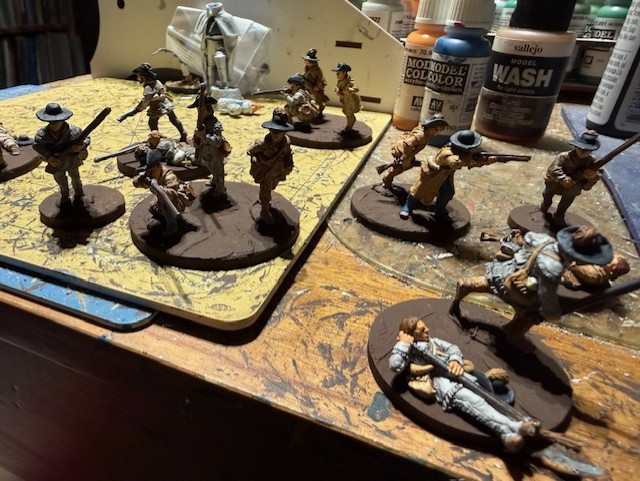
It’s just a little too dark to work on the ships without some natural light this time of year, so I’ve been painting in the evening and watching Lost. Never watched it back in the day, so I’m catching it now. Just as my television choices are a little different I decided to drag something out of my drawers of shame that are a bit different too. I’m working on a 90mm figure of a Continental soldier in kind of adverse condition.
I don’t know the figure. It is completely assembled. The maker’s mark says Worster. Worster Miniatures was acquired by Lost Battalion Miniatures. Lost Battalion is still around, but this figure is no longer available. I think I got it from American Eagles in Lake City after Charlie died and they “rescued” considerable surplus product from his apartment. I picked up a few of these “big boys” (as Doug Hamm calls ’em) at a pretty nominal price twenty years ago.
So there’s a story here. There always is right . . . Back when I was very young, before I ever imagined playing a game with painted little men, I was attracted to toy soldiers. My Grandfather bought me a set of Scottish Britains in the early 60’s, and I acquired a few more–the plastic Britain’s Dee-tail range when I was probably 10 or so. I was a bad plastic modeler, and painted stuff with enamels. I bought my first 54mm figure, a Rogers Ranger figure by Monagram Merite when I was 12. I ordered figures from the Soldier Shop in New York and was an enthusiastic, if unskilled painter of 54mm figures for a number of years. I acquired figures throughout my 20’s and 30’s, but mostly they simply joined a stash of stuff. And there they’ve sat.
I did recently paint a Monagram Berdan’s Sharpshooter, and I was pleased with how it turned out. I promised myself I’d paint more, but I haven’t. As I began painting the planes and then the ships for Force Z, I decided that I needed to paint something a bit different, that might be fun and relaxing, something that would be different. I ferreted around in my two drawers of strange and wonderful figs and pulled out this guy, and decided he was right up my alley.
I’ve been really inspired by others who have painted the bigger figures. Victor Cina in Oregon has done some really spectacular painting. Busts and other figures. Though I don’t love busts I do really do admire his work. We spent some time talking about it at Enfilade last year over beers and what a wonderful evening. I don’t know if I can specifically say I learned something, but Victor did insist there was no right way to do things. That encouraged me, even if I didn’t exactly take the plunge immediately.
I also saw that my friend Dean Motoyama was busily painting some resin Verlinden Napoleonics in 120mm scale. Dean is simply among the best, if not the best, painter I’ve ever known. He’s known for being able to produce figures almost overnight. But it’s not just the speed, it’s the quality. I got a chance to play a game at his home recently, and I took a look at his painted Verlinden guys, and I really liked what he did. They were clean and bright, the detail was all there, but they didn’t have a bunch of shading. Even so they looked great. It inspired me to try something big and colorful and see what I could do.
I took a look at my guy, and the first thing I noticed was there was a lot of flash and a really nasty mold mark. Really unusual for a figure of this quality and this size. I did my best to clean it up with x-Acto and file, but I didn’t get it all sigh. I used to brush prime my big guys, but decided to spray prime this feller with Miniature Painter Desert Yellow, a color I increasingly prefer to Matt White.
I decided to focus on different parts of the figure and paint them to completion. I started with head and worked down. I also made the determination after painting the neck cloth that covered our shivering soldier that I simply couldn’t do the three color shading thing. The figures was simply too large and the traditional lightening and darkening was simply too stark. So I decided to just lighten by drybrushing. It worked, and though I’m always a weeny about using colors that are too light, I did get some shading that may not show up well in the photos, but I like it.
I wasn’t quite sure about what colors to use for a Continental soldier. He was kind of a tough guy to figure out. He clearly has a uniform coat, no tricorne, but a pretty nice cocked slouch hat. He has a cartridge box, pretty nice breeches, but he’s obviously chilly, and semi-shod. He’s pretty well dressed for Valley Forge, but I think most Continental soldiers weren’t well attired after the winters of 1777-80 at least and owing to the clear desire to stay warm in this guys accoutrements, I’m guessing he’s late winter or early spring. One of my favorite units of the American Revolution is the Maryland infantry. There were eight regiments of Maryland regulars raised during the war. I’ve painted a fair number of them for my 28mm American Revolution projects. I consulted Lefferts’ book on uniforms of the American Revolution and learned that in 1777, most of the Maryland units had blue coats faced red, so I was good to go. I decided the rest of our guy’s attire could be ad hoc, begged, borrowed and stolen as he could get them.
In any case, he’s done. I don’t remember too many things I’ve painted I’ve been more pleased with. I’m eyeing my next project. I have a nice Andrea 54mm Richard Sharpe figure from the Bernard Cornwell series that is crying out for paint. From the storming of Badjaoz I think.
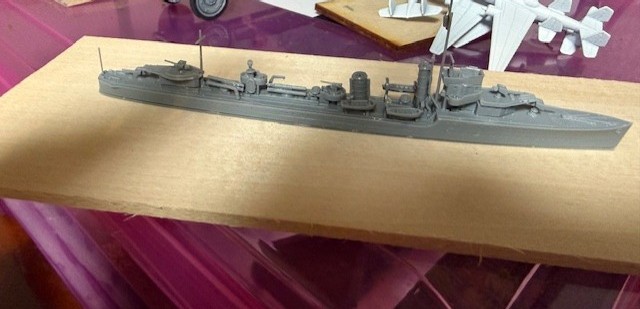
These are the three destroyers that escorted Prince of Wales and Repulse. They include the Australian destroyer Vampire, and the two British E-class Express and Electra.
Over the years I’ve had all these genius ideas for games that required building plastic models. There was the Golden Age of Air Racing game. These mostly really old Hawk air racing models were pretty simple. I even bought an air brush and compressor that I stopped using after the planes were done. Pretty serviceable stuff. I built a model of a Littoral Combat Ship when Dave and I ran our Bulldogs Away game for a Gulf of Hormuz scenario back in the mid aughts. I took advantage of a local hobby shop’s estate sale of models. But there are some 20 boxes of 1/700 scale ship models sitting in my garage, none larger than an Aoba class cruiser waiting for construction.
What would I do with them? Well they are mostly scenic pieces waiting to be bombed in an air game. I have a few Americans, including a Liberty ship. I have a lot of Japanese. Thinking Rabaul. I have two friends working on Bismarck Sea projects, so that’s probably unnecessary. The two Aobas are for the day after Cape Esperance and what happened when American planes based at Henderson Field tangled with IJN planes from New Ireland over the damaged, fleeing cruisers.
This is kind of a tag-along I thought I’d go ahead and finish. It’s a Tamiya O/P class that I finished as Pathfinder with it’s green-gray/dark gray camouflage.
Now there is Force Z. I ordered the necessary ships in November. There are three destroyers plus the two capital ships. I’m not dilly-dallying. I finished building and painting the small ships last night. Tomorrow, I’ll start on the Prince of Wales.
This is so not my long suit. Painting figures just comes a lot easier to me. For painting, I always know what I’m trying to do. I know what colors I’m using. I know how to modify those colors if need be. I have appropriate brushes that I’m really picky about. I paint every day, it’s a matter of routine. For model building, I lack experience an confidence. I have to fight off urges to be impatient and press on when things should be drying. Ack.
The Vampire was a V and W class WWI era destroyer in Australian service. Sunk in 1942 by Japanese carrier planes. The first of the destroyers I built and a good learning model.
I have learned some lessons from building the destroyers. The models were Tamiya ship models and easy to work with. I made a commitment to actually using model glue, the Tamiya thin brush on glue that worked fine. In the past I’d used CA glue, which is pretty unforgiving and allowed me to accidentally glue searchlights to hulls and my fingers. I bought some really great tweezers for use on applying decals and that helped with some of the really small parts. Just a heads up, these were purpose-built tweezers for modelers that were really inexpensive on Amazon. I think it was three pair for about six bucks, and more than worth the cost. Yes, I’m sure they’re from China.
The Express was the second of the two E-class boats. Always good to learn, and find a way to apply one’s failures.
I also learned that sometimes things just have to dry before trying to move on. Honestly, the Tamiya glue acts fairly quickly, but it does its work by melting plastic pieces together. That can take some time. I can always fold clothes, take the dogs for a walk or read a book for a bit before heading back to the den for another session.
Two views of the Electra. Electra was a challenge. Lost a boat davit somewhere on my dining room floor so she is short a boat. Managed to cover up the holes. Though I sprayed all the ships with primer after completion, Electra just didn’t want to take my Lifecolour light grey, so the base coat for both the E’s was Vallejo Sky Grey. Did complete the decks and camouflage with the Lifecolour paints.
But amid all that learning there is still some frustration. Ships have lots of little pieces. Gun directors, searchlights, boats and boat davits. I don’t really have a model builder’s table, it’s a painting table littered with painting stuff. It’s easy to lose tiny pieces or, worse, drop them on the floor even if I’m being super careful. I can’t tell you how many times I managed to find a tiny 20mm gun lodged in a little fluff of dog hair on my floor. I actually managed not to lose anything. Well . . . there is the matter of some misplaced decals. Sigh.
Painting is likewise a bit different. I’ve tried to use accurate naval colors based on what I’ve learned are the camouflage patterns on the British destroyers. HMAS Vampire is blacks and grays, while Express and Electra used grays, gray-green and blue-gray. I used the Lifecolor paint set for the Royal Navy. I’d used these paints before for 1/1200 scale ships and really liked them. The problem with many specialty paint sets, for me at least, is that many are really intended for airbrushing while I am a brush painter. So the paints tend to be pretty thin and require multiple coats. That’s a pain, but I lived through it.
But the good news is that the three British destroyers are done. And they were just rehearsal for what is coming. This weekend I hope to complete the Prince of Wales. It is likewise a Tamiya model. I’ve popped open the box and looked at the directions, and like the destroyers is a lot of sub-assemblies that eventually all go together and then requires some paint. A pretty complex camouflage pattern. It’s too large to build at my painting table, so I’ve gotten permission to work at our dining room table, but at least I have a plan. The Repulse looks even more daunting. It’s a Trumpeter model instead of a Tamiya kit. 300 pieces. Lord.
Betty bombers will be armed with torpedoes when the attack Force Z including the battleship Prince of Wales and Repulse.
Oops, hope the title isn’t too confusing. Those are two different things I’m doing.The first, and most time consuming is preparing for one of my Enfilade games–The Annihilation of Force Z. This is the Japanese naval air attack on The HMS Prince of Wales and HMS Repulse from Dec. 10, 1941, shortly after Pearl Harbor. The sinking of these two ships, together with the destruction of America’s battleship fleet three days earlier truly signified the end of an era in which surface ships could roam the seas in daylight without air cover in the face of a determined foe with massive modern air assets.
This will be my opening Enfilade game. Friday afternoon I’ll be tucked away in the Alder Room and the game will be a four player cooperative game. All the players will be Japanese pilots trying to do their job: sink the two British capital ships. The Japanese pilots who flew the twin engined bombers that destroyed Force Z were veterans, and knew their jobs. They were at the end of their fuel limits and were afraid the Royal Navy slipped from their search. But when they were found, the various Japanese pilots were summoned to the place and they guided their attacks to success. It wasn’t easy. The anti-aircraft fire was fierce. The angles of attack weren’t favorable. But in the end the deed was done, and airpower prevailed over sea power. The Japanese players will have to do the same.
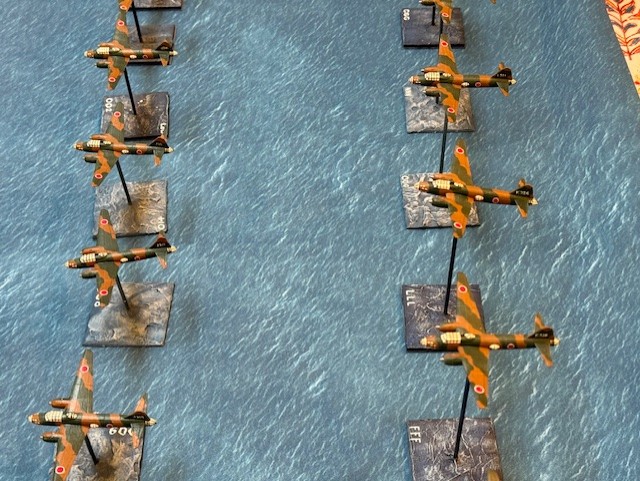
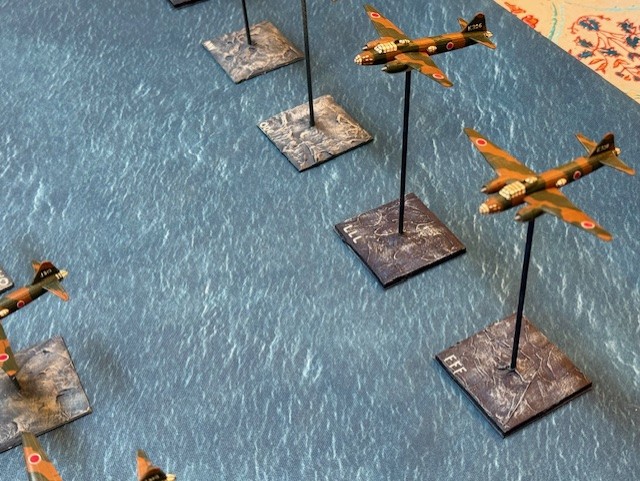
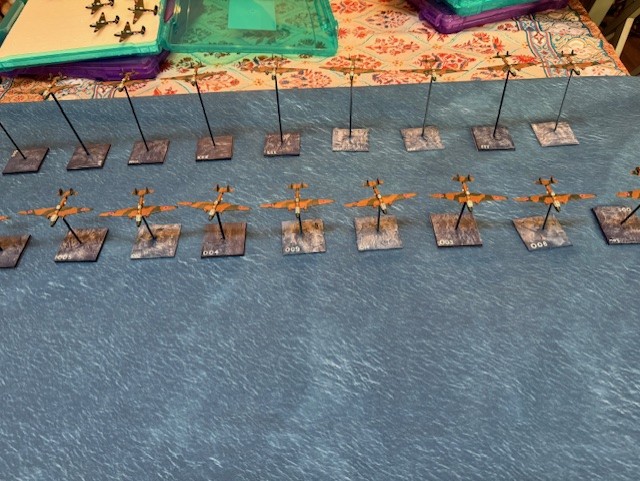
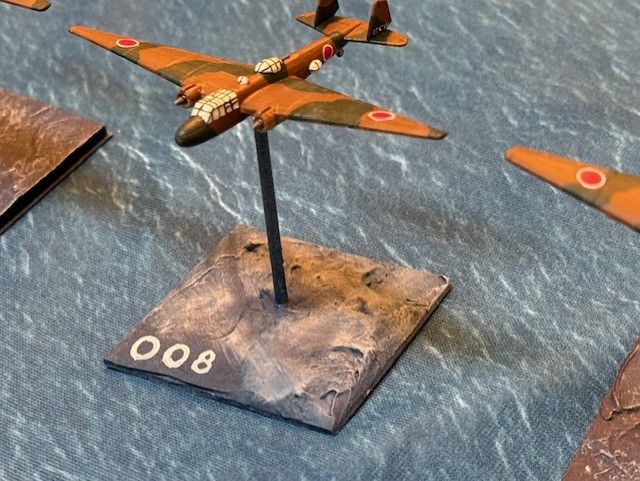
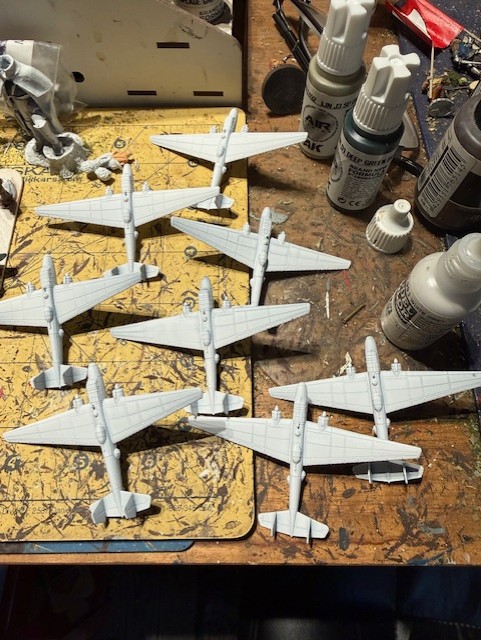
From left, a little closer look at the Bettys. Center, 18 Nell bombers that heft bombs or torpedoes in the game. Everything is stuck on a low or high level flight stand identified with numbers or letters. The things we do for our games. Right a little closer view of the Nells.
The rules for the game will be my own. The Japanese planes will appear on the board in squadrons of 7-9 planes. Sometimes two squadrons will appear at the same time. So there won’t be 50 planes on the board all at once, but there could be 18. At the beginning of the game, a simple die roll will determine the additional obstacles the Japanese will face. It could be that some of the squadrons were intercepted and some planes were lost or damaged. It could be that the squadrons are even a little more scattered by weather. It could the seas are rough and the conditions are windy and it may be more difficult to hit with bombs and torpedoes.
The rules are mostly my own work but inspired by other games I’ve played. As always, I’m motivated by the aircraft rules in Airwar 1940 by David Manley. A lot of the AA rules and scenario specific flying rules are determined by what can keep the game simple and easy for the players to figure out on a Friday afternoon. The bomb and torpedo rules in the game have stretched my thinking, and I’ll be referring to three sets of rules to determine something final. Those are an old set of rules called “Clear for Action,” “Command at Sea 5” by the Admiralty Group, and “General Quarters, 3rd edition.” I’m really inspired by the Osprey Air Campaign book on Force Z and Martin Middlebrook’s wonderful writing in “Battleship” which covers the history of Force Z from it’s inspiration in the UK to it’s apocalyptic demise.
I’ve painted more than 40 planes for this game. They are all 3D printed from Flight Deck Decals. Equal numbers of G3M Nells and G4M Bettys. Finished the last of them a couple of days ago. I’m working on the five ship models that will have to be built. I’m done with two of the three destroyers and then come the capital ships.
Play testing will be critical to the success of this game at this convention, though that hasn’t always guaranteed success in the past. Careful planning rarely survives first contact with the gaming public with all apologies to Helmuth Moltke. However, I am hopeful I might have a first go of it on March 14th for our scheduled game day at the Veteran’s Museum in Chehalis.
Though I spend a lot of time in my den painting (and building) stuff, I do try to get out and game regularly. I think I’ve written that when I was working-teaching-I spent a lot of time planning for my games but rarely got out to play as often as once every other month. Now I try to get out to game at least once a week. Doesn’t always work out that way but I do my best.
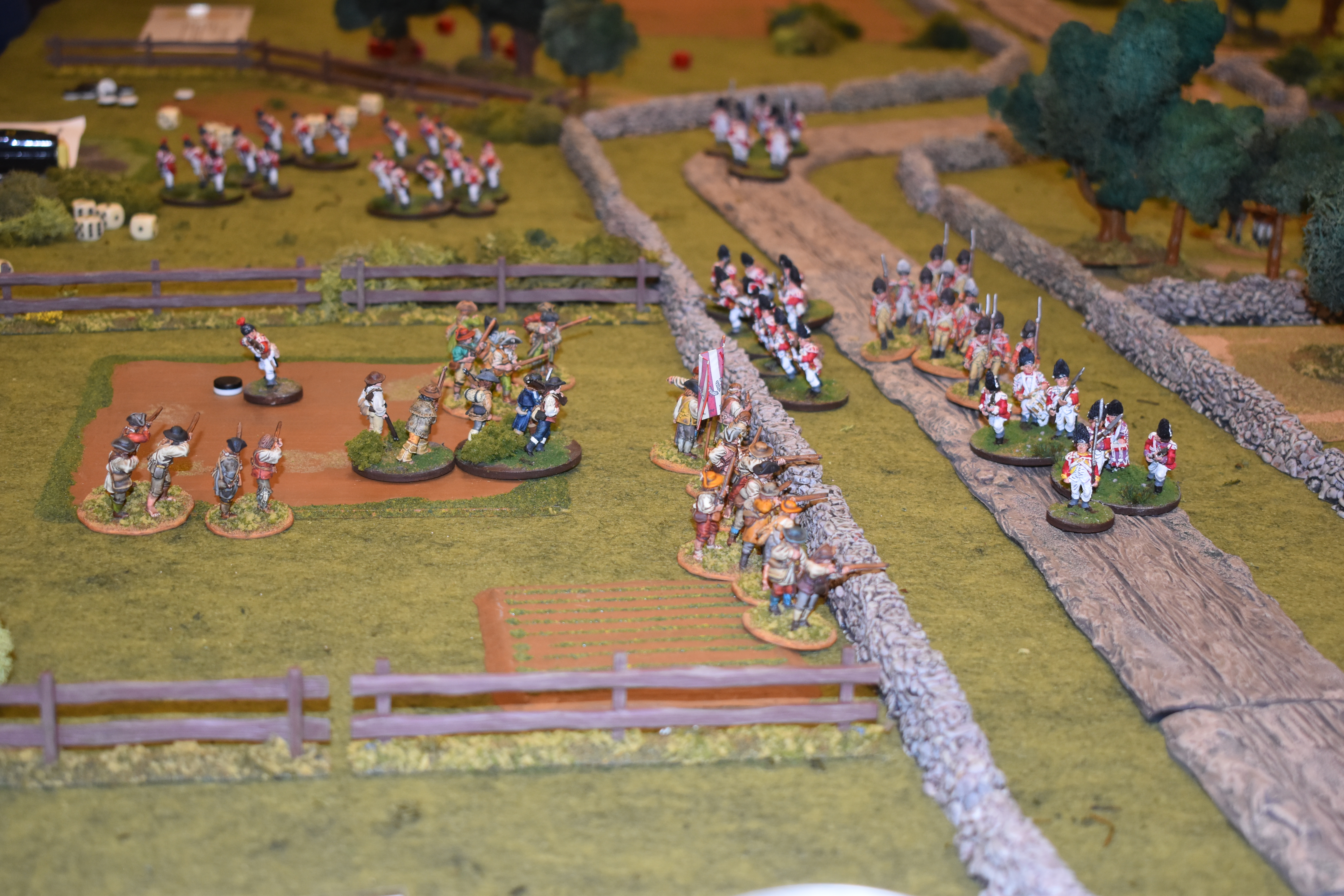
Recently, I begun playtesting a set of rules for my friend Chris Leach. Chris is a game designer in White Rock, B.C. who has worked extensively with Arte Conliffe on a number of games and gone on to design and publish some of his own including the ancients game Control to Catastrophe. Chris tends to favor mass battle games, but he put something together that is kind of skirmishy and asked if I’d be willing to give them a try. I put together a couple of scenarios for my Wednesday gaming colleagues to try. We liked them.
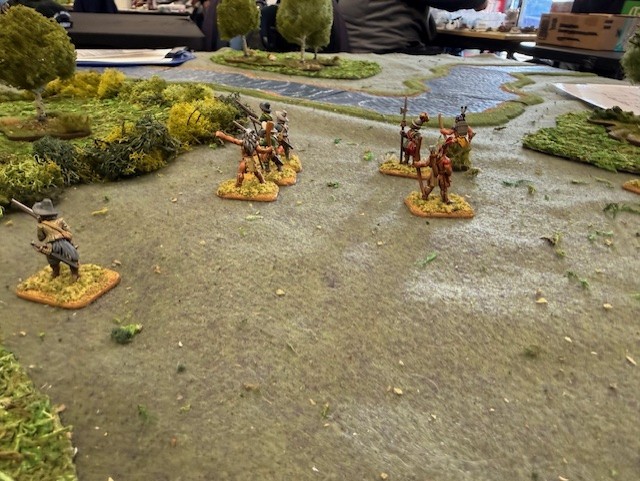
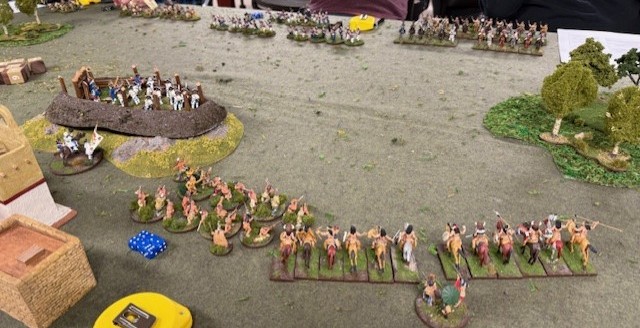
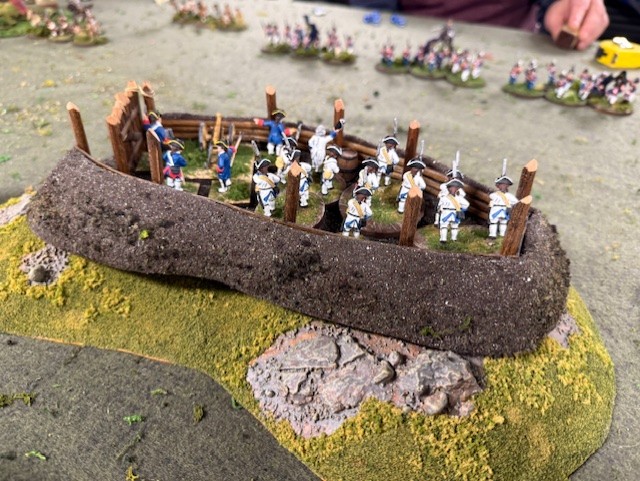
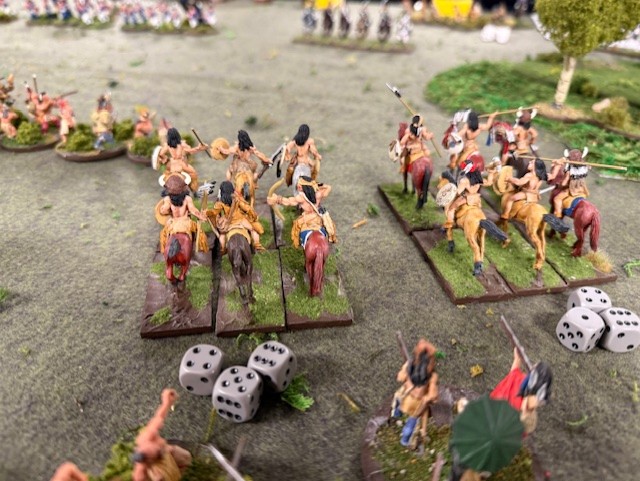
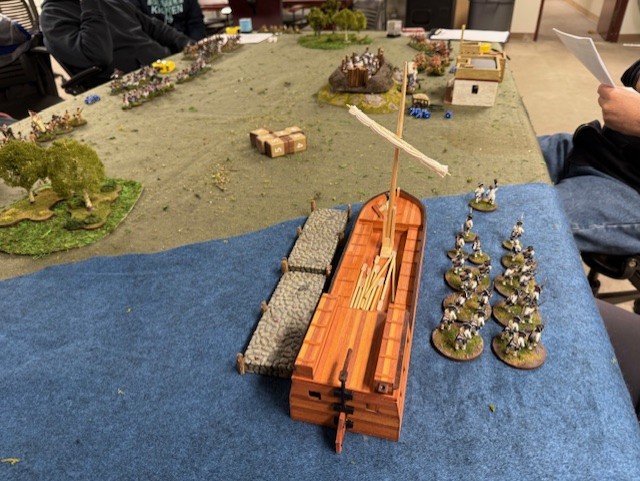
Our Take Action game from last week. The Americans were tasked with forcing the Spanish out of “Nachitoches” during a hypothetical conflict in 1806 over the Southwestern boundary following the Louisiana Purchase. Figures are mostly Old Glory Wayne’s Legion, some Conquest Comanches, and some RSM Spanish. The keelboat was scratchbuilt for me a long time ago by Mark Waddington. The game was tough on the Spanish mostly because the rules didn’t quite work as I intended. Back to the drawing board.
The rules are called Take Action. They are for that horse and musket period also covered by Daniel Mersey’s Rebels and Patriots rules. Like R and P the rules are activation based, but activation can be more varied. Units may combine different actions with their die rolls. The number of die rolls is determined by the quality of units. So, regulars get four die rolls and militia get three. A unit can use these dice to rally, move or shoot. The mechanics of the game are deliberately simple, and we have had no trouble picking them up and playing them. We’ve been able to give them a try a couple of times and are angling to get in one more game sometime this month.
It’s been fun to get in on this, and I appreciate Chris trusting us enough to not make a mess of them.
Last night I finished building Tamiya’s 1/700 HMAS Vampire which was one of three destroyers present in Force Z, my big 2026 project. It will get primed today and I’m waiting on my Lifecolour paint set to wrap things up. Model building is not my long suit, but hopefully this was a useful learning experience.
Actually, before I leap into 2026, I want to just review 2025. I tend to get lost in David Sullivan’s passing and the resulting massive flow of David’s stuff into my possession. But honestly, it was a pretty fine year. I did lots of stuff. Or at least I think I did. Let’s see if I can actually remember–age, you know.
I bought into Studio Tomahawk’s endless SAGA expansion and acquired the rules for Age of Chivalry. Hah! I didn’t buy a damn thing, I just remounted a handful of my gazillions of Hundred Years War figures and played with those. No, I haven’t been able to do a damn decent day of work with those bad boys, and have struggled to figure out how to win with them at all.
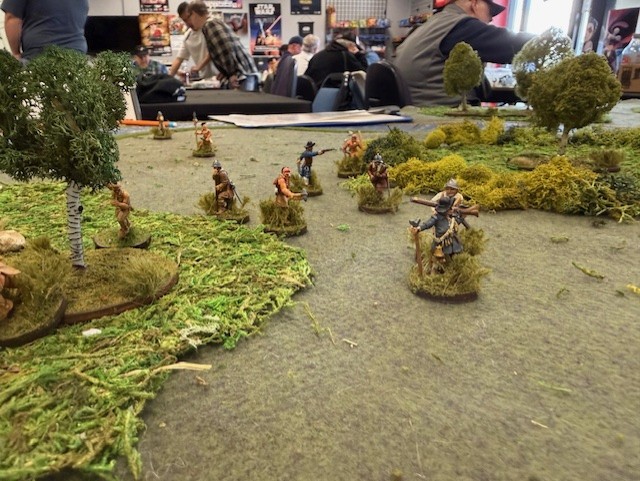
But I did do some fun Hundred Years War stuff. I began the big remount with them, and probably got about two thirds of the remounting done. I painted all the stash of Old Glory figures I have. I ran my Shrewsbury game a couple of times before making it my main event at Enfilade. It was fun. I have plans for more HYW historical games using Lion Rampant, but it’s on the horizon, not in the painting queue.
I wrapped up a years long project to finish all my Wars of American Imperialism project. It’s probably been about ten years since I began by working on the Philippine-American War, continued on into the Spanish-American War, dodged into the Moro Wars, and built the myriad naval forces for the period as well, finishing up with the Cuban Revolution of 1895. I ran a fun Cuban Revolution game in September and plan to run it again at the convention in May.
Together with Michael Koznarsky and Mark Waddington I jumped into a Spanish Civil War project. It’s a big deal because we developed our own rules. I think we’ve done three rules tests and stalled out chiefly because Michael has had ankle surgery that at least for the moment leaves him pretty immobile. I did paint something on the order of 150 figures and 4 vehicles for the Republicans.
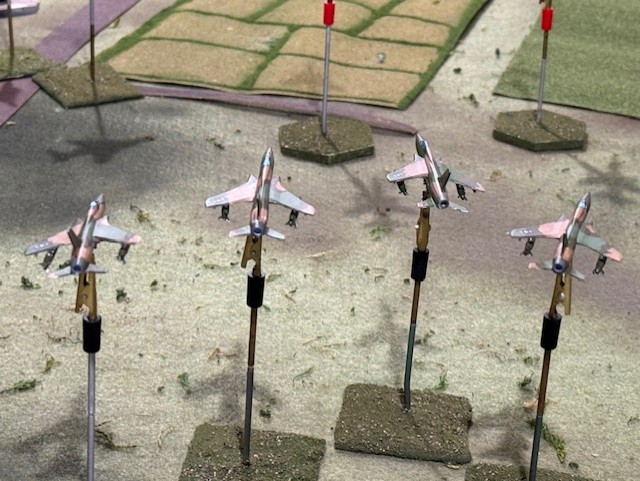
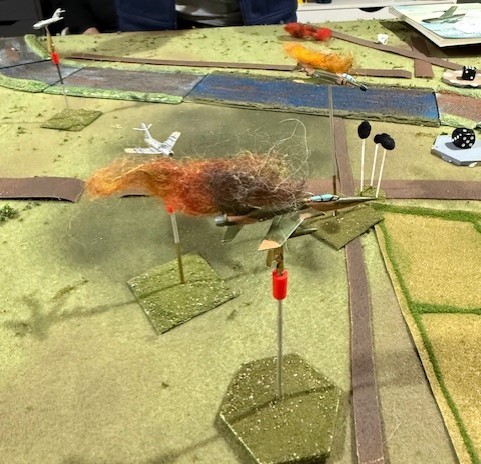
Photos from our December game in George’s bunker. Still kind of figuring out the rules, but we’re close. It ended badly for the Americans with escorting Phantoms blasted out of the sky by MiG’s and ground fire. The Thuds jettsioned their loads and hoped to make it home.
Two other items deserve mention for 2025. One is the two games of Airwar C21 I did with George Kettler. It encouraged me to paint every single Vietnam era plane I had, plus converted some buildings, AA and radar over. I added additional planes and painted ’em all. Moreover it sent me down a road believing I could do the air games Dave Schueler and I did six years ago. On Saturday I hosted a Song of Drums and Tomahawks game using figures David Sullivan and I did together. It went, well, in fact I believe it was actually fun, and I believe “The Search for Father Anthony,” a game I devised with the help of Chat GPT will be a game I run at Enfilade. I cannot begin to express the relief I have that a certain number of ghosts have been purged. I know you won’t understand, but trust me . . . some weight has been lifted.
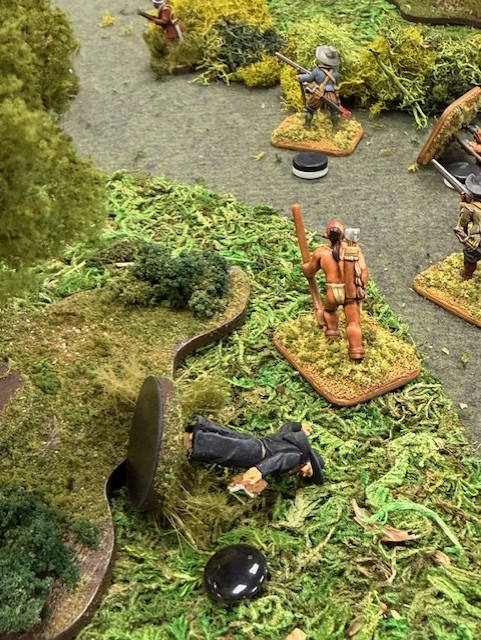
Scenes from The Search For Father Anthony, my Song of Drums and Tomahawks game from Dec. 27th. The game was fun and despite leaving my rules at home, pretty easy to run. I’ll do it again.
So what was 2025 like? I painted about 810 figures this year. Some projects were finished and I think others came into more clarity. Worth mentioning, is that the end of my responsibilities to NHMGS have come into view and that is like deepening my respiration and lowering my blood pressure. I look forward, with enthusiasm, to just being Kevin Smyth, gamer dude. It’s like retiring for a second time. I’ve enjoyed my service, but I’m ready to blend into the woodwork.
So here are things I’d like to accomplish for 2026
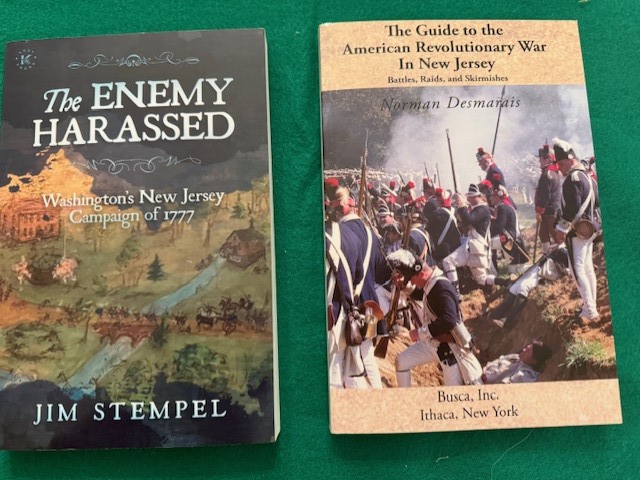
Projects always come with new reading material. Christmas gifts from my beloved and understanding missus.
One thing I’d like to do is continue painting AWI figures for Rebels and Patriots and Regimental Fire and Fury. My goal is to run those Nathaniel Greene battles for Regimental Fire and Fury, do semi-skirmish games in New Jersey 1777 and South Carolina 1780-81 for R and P. I just need more figures. I have ’em but they need paint. I’d like to complete 400 figures in 2025. It won’t wrap things up, but it will move the story along.
I finished a unit of Hessians, Regiment Von Donop, for Rebels and Patriots. I’m not quite sure which figures these are, but I’m thinking Hinchcliffe or RSM, but certainly not newer guys. I have a couple more units of Hessians to paint for Rebels and Patriots.
I did a lot of work with my Hundred Years War figures in 2025 and I’d like to continue to make progress with them. I have a couple of games I’d really like to run with them. One is the crossing of the Ford of Blanchetaque in 1346 and the other is the the Battle of the Herrings during the siege of Orleans in 1430. Unfortunately I don’t think either of those will be completed this year. However, I would like to continue making progress on this project. My hope is I can finish rebasing all my HYW figures, and paint another 100 figures.
One thing I’d really like to finish for Enfilade is attention to some of my air projects. I simply don’t have as much left to do as I did a few years ago. I identified a lot of painted and unpainted planes I decided I’d never do anything with and gave ’em away. I held on to some WWII planes and acquired what I thought I’d need for Vietnam and the Pacific War. As I stated earlier, I finished all my Vietnam era planes and am just down to my Pacific War stuff. I recently committed myself to all the work needed to pull of the destruction of Force Z, the British fleet built around Prince of Wales and Repulse. This includes not only building five 1/700 scale ships plus about 45 planes, but developing a workable game and playable game rules. This will be my big Enfilade project. The planes and ships have been ordered, and things are already under construction. My goal is to have everything and built and painted by March 1st so I can start playtesting. Ambitious but doable.
Flight Deck G3M Nells awaiting paint. They are half of the Nells needed for the Force Z game.
Part of this project is to complete a set of scenario-specific rules. I’m a fan of David Manley’s excellent air rules, but in this case I can use them merely as a guide. The game is played by Japanese commanders in a cooperative manner. There will be no last minute rescues by the Australian Buffaloes and it will be up to me as game designer to make the game interesting by creating obstacles for the players to overcome. Working on the basic mechanics, but I haven’t gotten there yet.
I have lots of other projects I could be fiddling with, and knowing me I likely will. But I think this gives me a basis on which to proceed. I am a daily painter, so it isn’t like I’m asking myself to do something I wouldn’t normally do. I usually shoot for something like 60 figures per month. During the dark winter months I get more painted, during the busy summer months, sometimes it is less but getting 700-800ish figures painted in a year is not something that is a stretch, all things being equal.
I’ve shared my exploits as a 3D printing loser. It was an abject failure, mostly because I simply don’t have the stick-too-it-ive-ness to make it work. I offer nothing but plaudits and praise to those who do. I passed along my Elegoo and all its bits to my friend Mark, and I think he’s gotten his money’s worth.
Though I am not printing my own stuff, I do see a ton of value in buying 3D printed goodies. The cost and the detail available from the printed goodies is often cheaper and better in what one might find in cast metal or resin. Molds don’t wear out, the prints are often cleaner than the castings. The downside is fragility. Though I have purchased some, I tend not to buy printed figures. Swords and spears simply break. If you drop ’em they might shatter. I’ve received printed horses that often arrive without tails and sometimes without legs. I think figures are where I draw the line.
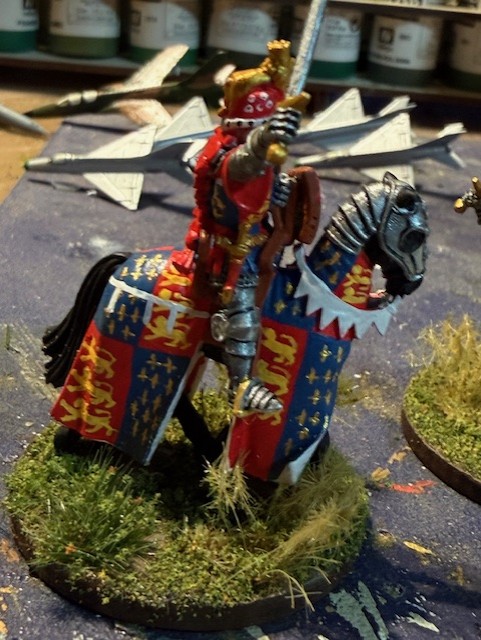
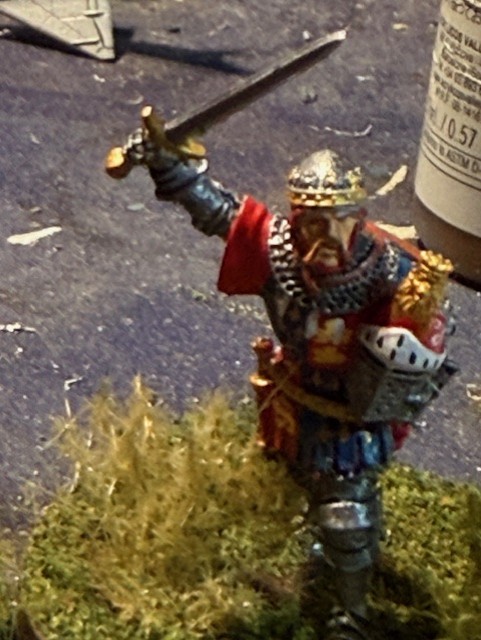
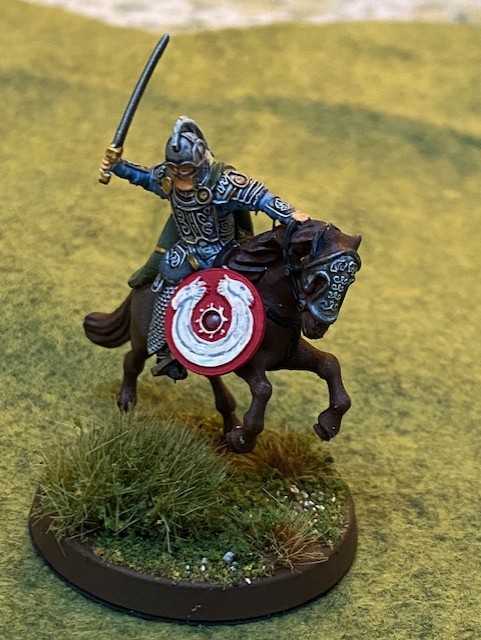
Sadly I can’t remember who printed these two delightful figures of Edward, the Black Prince of Wales in 28mm. Edward is a legendary hero in SAGA and he might help my doddering English HYW army. The same printer also did an excellent Edward III figure, mounted and dismounted. The miniature is well cast, and none of the detail, including the raised sword, seems particularly breakable. On the right a well printed Rohan horseman, Erkenbrand of Westfold.
I have a fair number of printed ships. Mark has printed some beautiful War Time Journal models for me. Chiefly German pre-dreadnaughts, but also some very nice Fletcher class destroyers in 1/1250. WTJ used to print their own miniatures, but now they just sell their STL’s. Either you have to print them yourself, or they do have a couple of reliable printing services they work with. Neither the Germans or the American DD’s are completed, but I’m hoping I might have a shot at them this year. Matthew Lawson likewise does some great work for the American Civil War at his Brown Water Navy site. He is branching out into lesser known 19th century ships as well. I occasionally add to my ACW stuff which has grown obscenely large, and almost all of my Spanish ships from the Spanish American War come from Matt. Finally, David Manley and his Long Face Games designs have also done some terrific ACW stuff. These are printed by Iron Horse Collectibles and other in the U.S. and I am extremely satisfied with the quality of the designs and the prints. I often have to make masts for my pre-dreadnaughts, which isn’t a big deal (I have had lots of practice.)
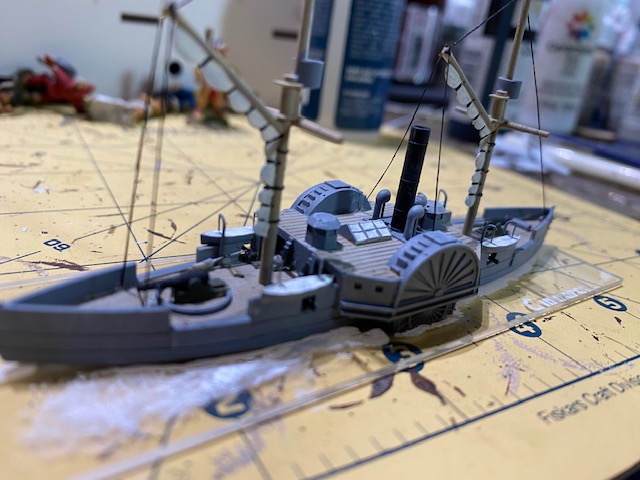
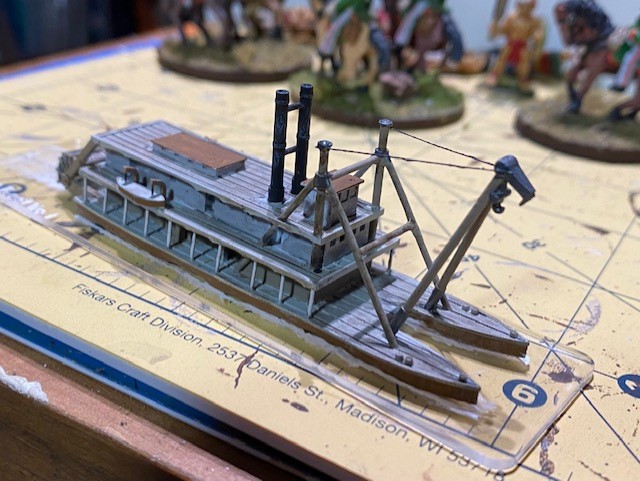
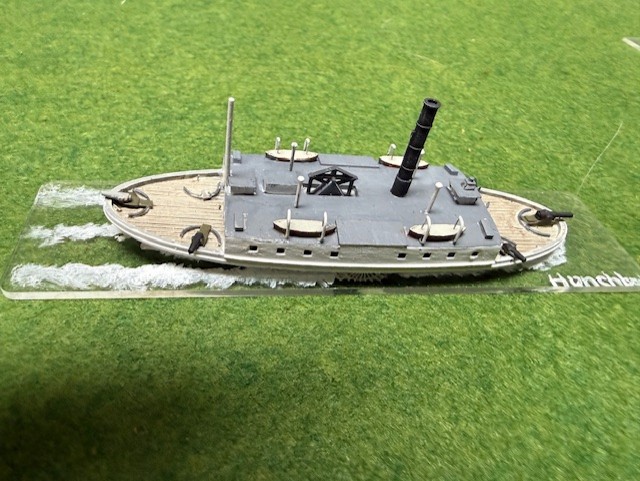
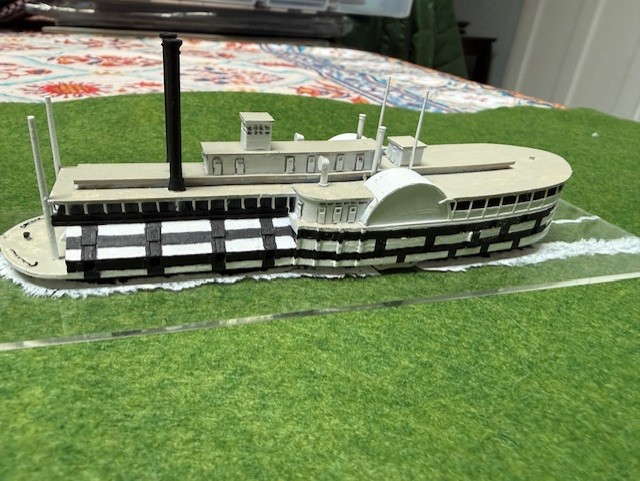
From the top, the three above are David Manley creations through Long Face Games. The ships are the Double End gunboat Cimarron, a Mississippi snagboat, and the ferry Hunchback. They are printed by Iron Horse Collectibles The magnificent Blackhawk tinclad below was David Dixon Porter’s flagship for his various operations in the Mississippi Valley campaigns. It is a great example of Matthew Lawton’s work over at Brown Water Navy.
I’ve also done some work with printed 1/300 scale planes. Back in the day when Shapeways was a thing, I ordered some planes from them. I think it’s very unlikely I’ll ever buy another metal plane. I have lots and lots of them, from tiny fighters to really big ol’ B-24D’s. The printed planes have several tremendous advantages. One is their light weight. It has always been a challenge to plunk a big plane on a stand and not have it be dangerously top heavy. I have a few printed B-17E’s and they are so much easier to manage than the big metal Liberators. I have a friend who is doing some 1/200 Pacific War games and has a PBY that is just really big. But light as a feather. Another advantage is the prints are so much cleaner than the metal castings. Some of these molds are old, they are in desperate need of cleaning or replacement. I recently ordered some A-7 Corsair II’s for Vietnam and they were dreadfully cast. I also really like the detail the designers can build on to the model. No more trying to stick on racks of expensive bombs or other underwing stores. The down side is I found myself cutting off some centerline fuel tanks for my mounting posts. Finally, the printed planes are so much less expensive than metal. Better detail, quality prints, lighter and easier to play with, more detail, I paid about $5.00 each for some beautiful F-4C’s that would cost fourteen bucks from GHQ and probably wouldn’t be as good.
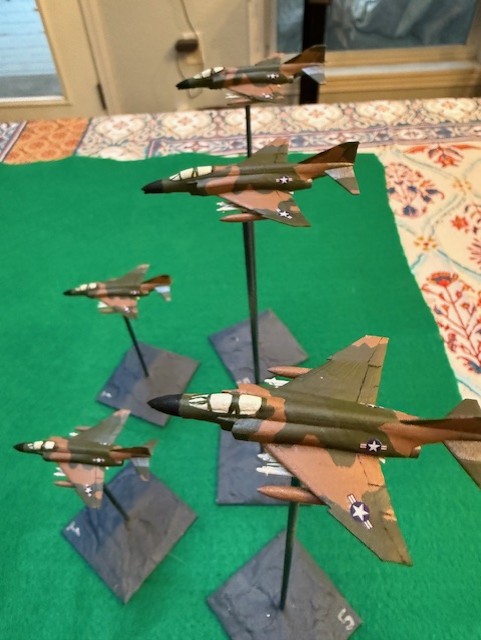
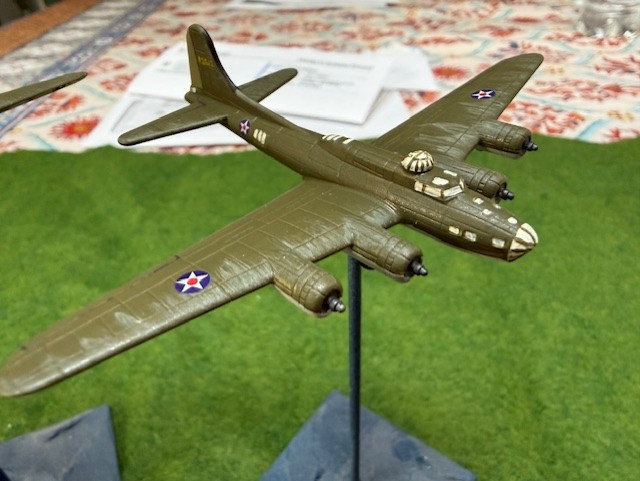
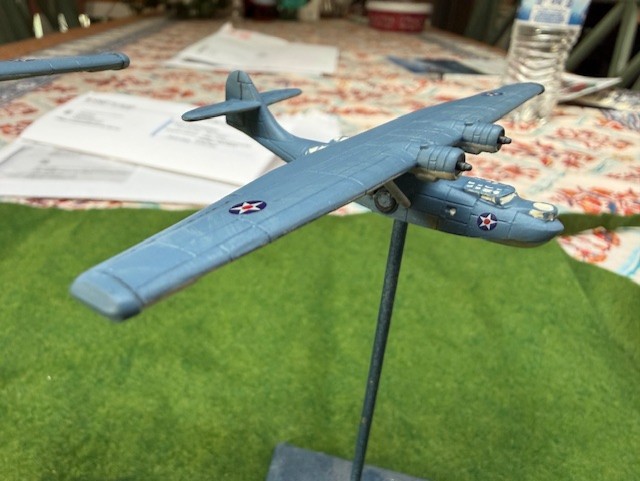
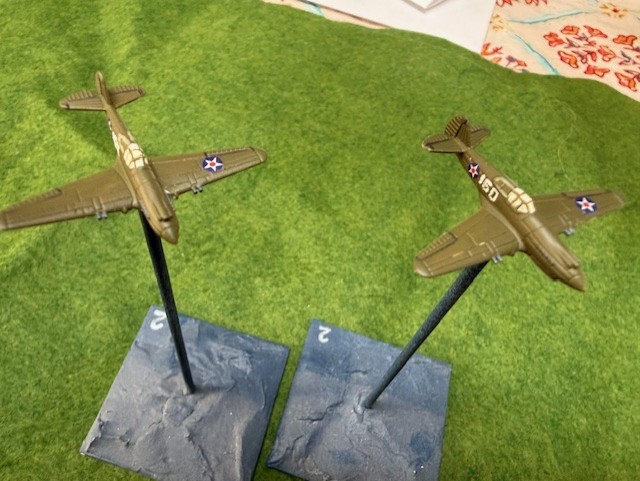
Printed planes from Flight Deck Decals. From left, F-4C Phantom II, B-17E, PBY Catalina, and bottom, P-40B’s.
My maker of choice for planes is Flight Deck Decals. They provide good service, generally have what I’m looking for, and they fit in my budget. Plus, I can get my decals from them. They have WWI, WWII and modern planes from P-26 Peashooters to B-52G’s and newer. WWI planes are offered in 1/144. The other planes are available in 1/200 and 1/300. They will tweak some things for 1/285 but it’s more expensive. They also sell STL’s if you want to print commercially. Other makers are out there too.
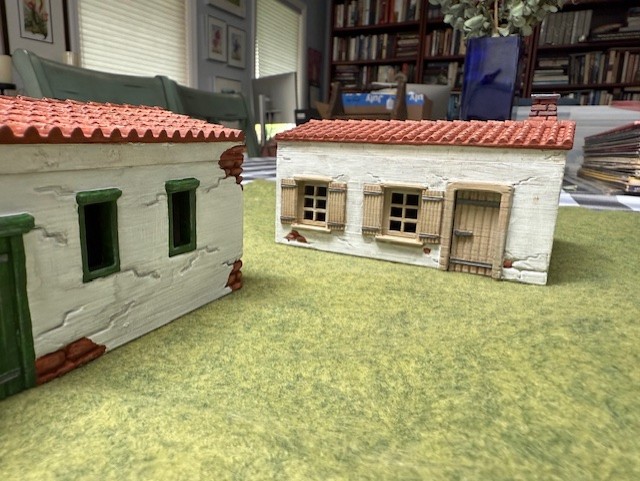
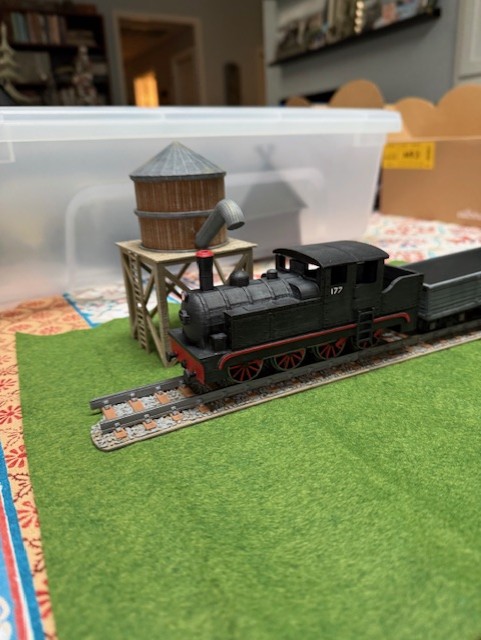
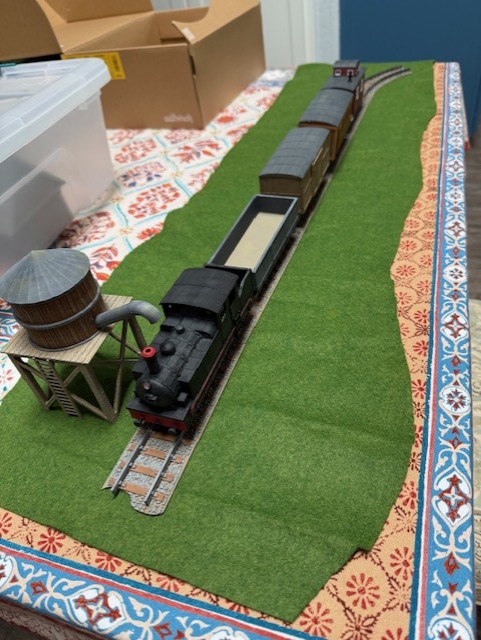
Perhaps the real genius of 3D printing, isn’t the figures, ships and planes, it’s all the cool terrain bits. It doesn’t matter what one is doing in miniature wargaming, there is a ton of cool terrain bits to meet your needs. I’ve gotten a number of cool pieces. First on my list is a spiffy steam train with tracks. I haven’t used it yet, but I see a number of possibilities for the revolution in Cuba in the 1890’s or in Spain during the Spanish Civil War. The Spanish put in a train north/south in Cuba and guarded it with blockhouses. Could be cool. I also got from the same maker, Guardian Hobbies on Etsy, a super collection of Spanish Houses, again for use in Cuba and Spain. For the train and the buildings the cost was, to me, reasonable. Not only that, but I’ve painted them and the buildings have made their way on to the game table.
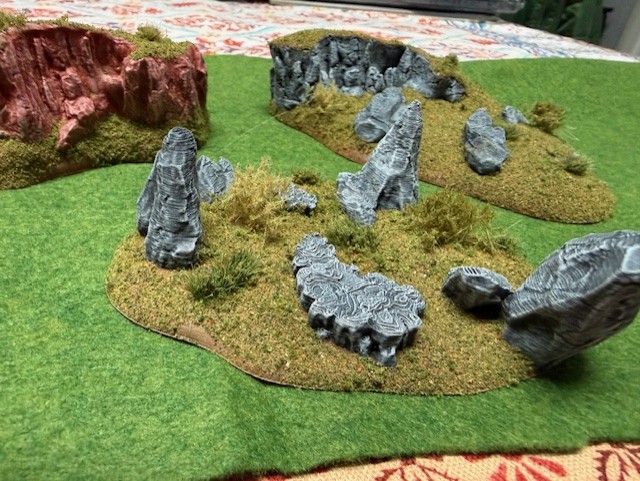
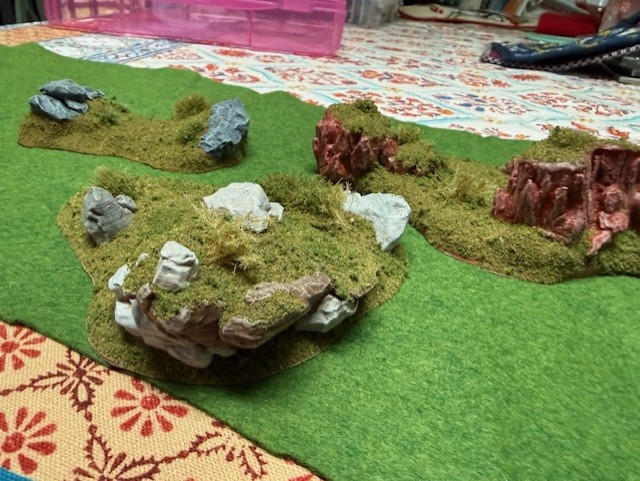
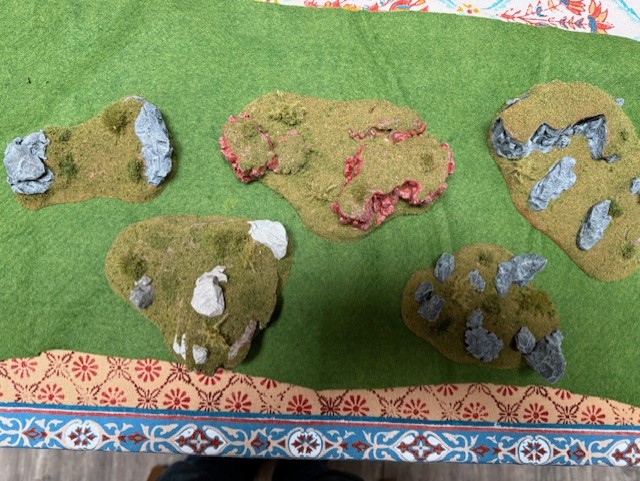
These are some terrain bits I’ve had printed from Etsy sellers for my table. Top left is a Spanish village with three buildings. Small, but just right for my purposes. I have some larger buildings if I need them. Upper middle and right is my train with five cars. I added the water tower. Came with six feet of mostly straight track. Below are my Rohan hills. They seem quite Peter Jacksonish and I really enjoyed painting them.
I’ve picked up some great items for my Lord of the Rings projects. I have some super spiff Rohan hills. A variety of different but very usable hill for any skirmish project. I also have a few Rohan buildings that seem very Dark Agey in appearance I could use for other purposes. Those I haven’t finished yet.
The list of possible terrain pieces or bits and accessories just seem endless. Buildings, trenches, very cool rocks, or just rocky spaces have caught my eye, but for now, I’ll leave well enough alone. Regardless whether I’m currently in the market or not, compared to alternatives, the 3D prints compare at least equally with the laser cut pieces, and so much cheaper than pre-finished options like MBA. Just in the interest of transparency, I have both.
I had the good fortune to have spent my working life doing something I really enjoyed. Before I retired in 2019 I was a school teacher. 36 years in the classroom. But it was so much more. I finished as a high school history and English teacher, which was my dream when I graduated from Carlmont High in 1973. The path there wasn’t easy. The Baby Boomers were aging out of schools and the vast demographic bubble that was inflated by a massive population of school age kiddoes was collapsing and there simply wasn’t a need for fresh-faced know-it-alls to share their truth with the young ‘ens. I was only able to become a teacher through a back door and for my first ten years in the classroom wasn’t really doing what I wanted to do.
But I did eventually make it into a traditional classroom and taught U.S. History, Washington History, and English to 5th and 6th graders, middle school students and high school sophomores and I loved it. I was able to do some super cool stuff with outdoor ed. I took students camping and we regaled in the wonders of the Lewis and Clark bicentennial here in the Northwest. I earned a Gates Foundation tech grant in 2000, and was able to bring computers into my classroom where students could do research without being limited to the library. I became a journalism adviser and took part in the wonderful community supporting journalism advisers here in Washington State and nationally. I had a wonderful career, and would never choose another. Unless, of course, I could just read, paint figures, play games, and have lunch with friends, which is sort of my current vocation.
Or if I could just be Ken Burns.
I love books. I don’t have a massive library, but I do fill my bookshelves. I read each day, not as much as I should, some time every day. I love interesting documentaries. But Ken Burns’ work I simply worship. I love his style-the inclusion of historians, the voices of David McCulloch and Peter Coyote, the variety of perspectives, the illustrations. Every Burns documentary makes me look beyond what I already know. After Baseball, I sought out Buck ‘O Neill, after Lewis and Clark I built a library many colleges would envy, after Vietnam, I acquired and read books by Vietnamese writers like Bao Ninh. A great documentary film maker should inspire us to learn more, read more widely, or at the very least seek out more documentaries and Ken Burns does that for me. He isn’t the final word, and he always inspires me to learn more.
The most recent Burns opus, The American Revolution, was another inspiration. I think I’ve watched every episode twice. It wasn’t that I didn’t already know stuff. I’ve read both the Rick Atkinson volumes he’s published on the conflict. Atkinson was the chief expert pictured in the doco. I thought broadening the focus of the TAR to include greater detail on the lives and views of women, Native Americans and enslaved people was perfectly valid and interesting. I’ve added Colin Galloway’s books to my Amazon want list. It has inspired me to read more deeply about George Washington, and I’m in the middle of James Flexner’s George Washington: the Indispensable Man, a book I’ve owned and not finished since, well, forever.
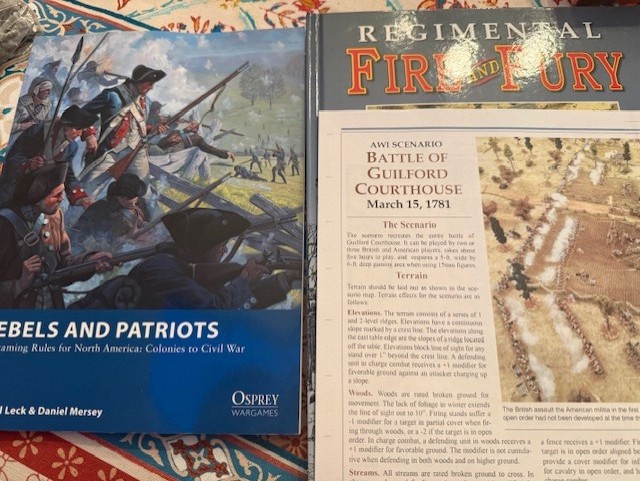
Rebels and Patriots is from the Daniel Mersey pile o’ rules published by Osprey. I like ’em and use it for a variety of periods from the Horse and Musket era. Reasonably available and relatively inexpensive. Regimental Fire and Fury is hardcover, more costly and harder to get. There is an excellent Fire and Fury website with variants for AWI, War of 1812 and Mexican War with some handy rules for specific battles.
More importantly, from a gaming standpoint, Burns and TAR have fired greater interest in returning to my two (!!!!!) American Revolution projects. I have over 1300 painted 28mm American Revolution figures. Yes, I know, it’s absurd. What’s even more absurd is that I have plenty of unpainted figures. Compounding that problem is that I took on all of my friend David’s unpainted figures when he passed away last spring. They do live in the house, taking up a huge bunch of storage area. I swear, while I’m sitting at my desk painting and watching something terrible on television, I hear them whispering about their place in the painting queue. I’ve actually put some on the painting calendar, with Hessian units for Rebels and Patriots up next.
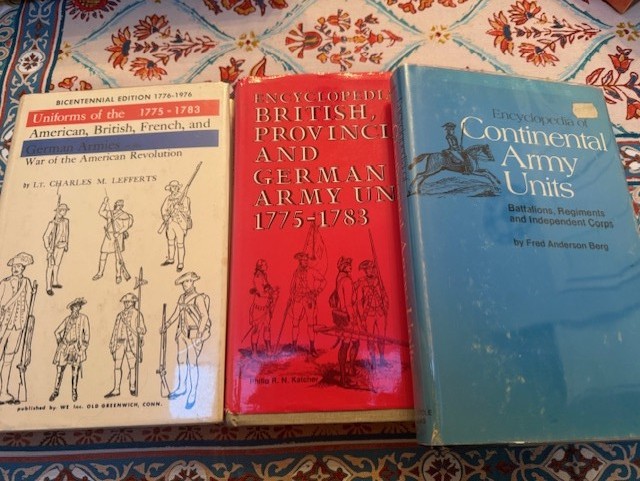
Lefferts, Katcher and Berg. Indispensable Old School sources on the AWI armies.
Do I have a plan? Well yes. The plan is to paint the damn things. Oh you mean, what will I do with them? One of my goals is to have the figures to do each of Nathaniel Greene’s battles in the south, 1780-81. There are four of these actions-Guilford Courthouse, the siege of Ninety-Six, the Battle of Hobkirk’s Hill, and Eutaw Springs. All of these battles were losses for the patriots, sort of, but each were costly victories British that caused them to surrender ground in South Carolina. I’ve already gamed Hobkirk’s Hill once. Perhaps some future Enfilade, I’ll run them all and see how it turns out.
The First Maryland mounted for Regimental Fire and Fury. This is my oldest AWI unit. Front Rank figures painted in 1992 for a Guilford Courthouse game at Enfilade 2. David Sullivan, Phil Bardsley, Bill Stewart and myself were some of the participants in that project. I think they’ve been remounted three times.
The Nathaniel Greene battles all involve a fair number of troops and units. Those games will be played with Regimental Fire and Fury. It’s an older game, but I love the mechanics. It was written for the American Civil War and chiefly for 15mm. However there is a super Fire and Fury website with rules to support variants including the American Revolution and 28mm scale. Greene’s battles are larger and often include a lot of militia The good news is that for the Americans, a lot of the units show up at all the battles, so they can be reused. Guilford Courthouse was the first of those battles and the British under Lord Cornwallis marched off to recover in Wilmington, N.C. and then made their way north to Virginia. Greene’s enemies changed with each of the succeeding battles. There is still much painting to do, but I seem to have the figures.
David Sullivan and I ran a Rebels and Patriots game featuring the Retreat from Concord April 19, 1775. It was the best game we ever ran together and was decided on the last turn of the game. Enfilade 2019.
One of the great things about gaming the American Revolution is the plethora of smaller engagements. These actions can be gamed using the Daniel Mersey’s Rebels and Patriots. I love these rules. They are looser and easy to learn. The New Jersey winter campaign of 1777 is replete with lots of engagements between New Jersey militiamen and British and Hessian forces attempting to forage, ie steal, food, fodder and supplies from New Jersey landholders. South Carolina is another theater in which there was intense fighting between Patriot and Loyalist militias that were very bloody and very important to the course of the war. I have tried to acquire a fair number of Perry militia figures so I can effectively recreate actions like Fishing Creek or Blackstocks Tavern.
These Hessians are in my painting conga line. I’ve had these for some time (like more than five years) and to be truthful, I don’t know the maker. Could be Hinchcliffe, could be RSM, but they’re old school one pose dudes. They’ll do for Rebels and Patriots.
I’ve generally tried to avoid the major actions of the war–Brandywine, Germantown, Monmouth. Part of it is the size, part is just personal interest. I am fascinated by the Southern campaign of 1778-81, and its political and military difference from the northern campaigns. It is far more of a civil war than the war in the north, they exist in both places. The northern war, however is fought more with ideas, prisons and seizure of property, while the southern war is fought with bullets and battles. Burns did a great job of emphasizing this when he pointed out that the only British soldier at the Battle of Kings Mountain was the Loyalist commander Patrick Ferguson, but all his soldiers were Loyalist Americans. There are also fascinating personalities in the south from Daniel Greene and Lord Charles Cornwallis to Banastre Tarleton, Daniel Morgan and Thomas Sumter (and those are just a few.)
In any case, I am hoping 2026 is a year when I can make a lot of progress on this project, and Ken Burns is definitely helping my level of motivation. Now if Burns could only do a documentary on the Hundred Years War, perhaps I could make more progress on that project.
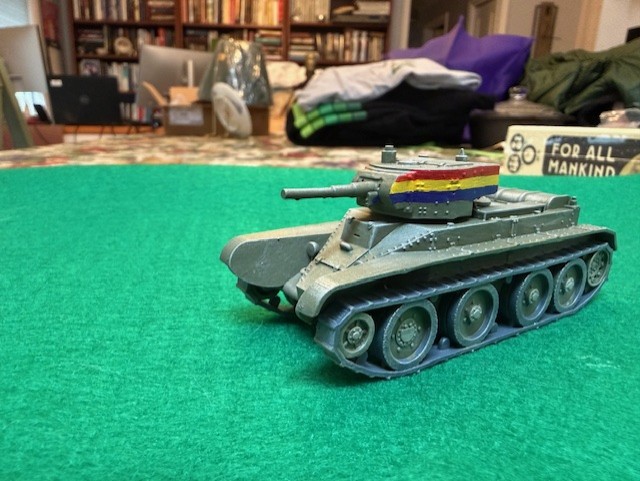
My lone tank, a Russian BT-5 in Spanish Republican colors, for my Spanish Civil War project
The year is quickly winding down. I’d like to think 2025 has been a good year, though the month of December has been pretty lost to me. At 70 I’m still active, hearty and hale, but I’ve been on the verge of needing cataract surgery the past couple of years. November and December was the time I chose to make it happen. I’ve finished the surgeries and they are relatively nothing. But there are required follow up visits and taken together they all take some time. The good news is my vision is much better. I think I can probably function without glasses and I can definitely see better to read.
Usually by now I have all my Enfilade projects carefully mapped out with most of the figures painted and playtests planned. At this point, I’m still up in the air about what I’ll be running in May. I will likely run my Mambi Justice game for the Cuban Revolution. After that it isn’t clear. I’m on the hook for an air/naval game on the destruction of British Force Z in 1941. You might remember it as the air attacks that sank the Prince of Wales and Repulse off the coast of Malaya. But I still think there is a lot of uncertainty about its readiness. Game three is still a blank slate.
One thing that is clear is that my role in the wargaming community will change. On January 1st I will step down from my post as NHMGS President. I’ve enjoyed it. I’ve had a good run, but I’m ready to give up those responsibilities. It’s a leadership position I’ve held off and on since the early 90’s and honestly I don’t have the energy or the interest to continue. I’m active in that role without being controlling, but I think it’s time that others offer a different vision for the organization. There’s an entire world out there that does miniatures that is younger and doesn’t always do historicals that needs tapping. I think that is a job for a different, younger person than I.
This will also be my last year as Enfilade director. It’s our final year under contract at the LaQuinta in Tacoma. My view is our experience there has been just adequate. The LaQuinta has treated us well, but it is a notch or two below what we need. Accessing food, the layout with the convention space down a long flight of stairs and no direct elevator access are issues. The space is smallish and can get loud. I know my successors are looking at other spaces. It just depends on whether it makes economic sense. After six years in charge, including the move in 2024, it’s time to let someone else tackle these issues.
Increasingly my mind is more occupied with figures and games and what I hope to get finished and play with. Friends regularly bring to my attention new figure ranges, new rules and I desperately try to fend them off. I have all these other zillions (okay, thousands) of minis to complete for periods I’m really committed to and I don’t really want to start something new–until I do. Just to be clear, it has been a productive year. I keep track of my figure painting by months, and my goal is always about 60 figures per month. Some times I paint a bit less, others a bit more. At the time of my writing I am at 741 figures which would slight exceed my 720 figure yearly goal. Can’t complain.
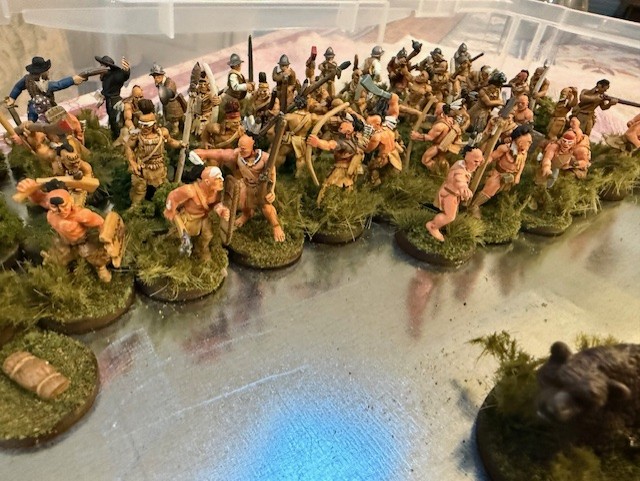
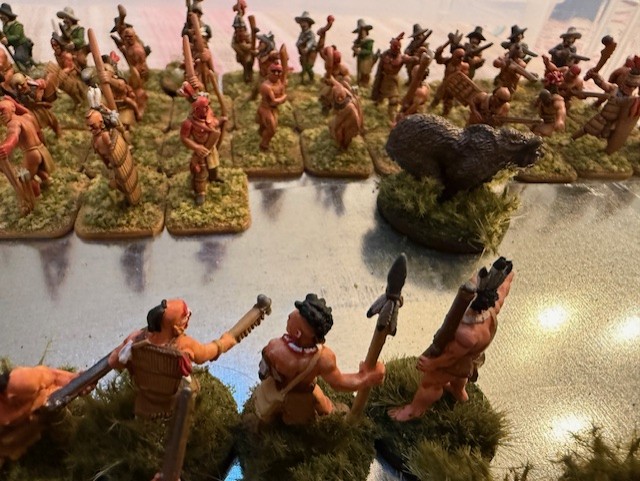
Bob Murch’s Crucible Crush figures we used for Song of Drums and Tomahawks. Great minis. David’s figures on the rectangular bases, mine on the round bases. And look, there’s a bear.
One project I was able to complete in 2025 is all the Bob Murch Crucible Crush figures David Sullivan had to run any size game for Ganesha Games’ Song of Drums and Tomahawks. This is a true skirmish level game chiefly written for the French and Indian War. However Murch’s figures are really intended for earlier European contact during the Beaver Wars. I’ve written a scenario that I’m hoping to try out at the end of the month that could be entertaining. More games for this period and rules set would be fun. This is a completed project.
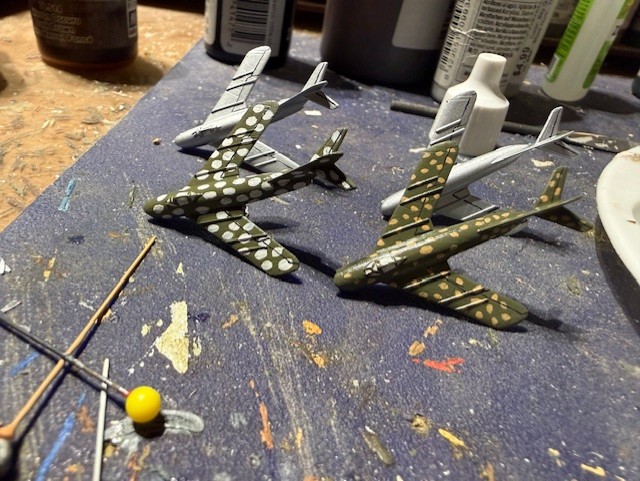
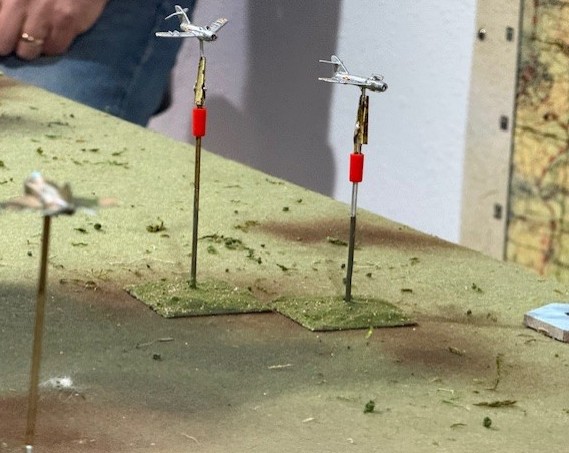
Flight Deck printed MiG 17’s for NVAF by ErikGen Designs. Well-detailed and very light weight. It’s unlikely I’ll ever buy metal miniature planes again. Waiting for decals.The green, patterned planes come right out of Osprey’s “MiG 17 and MiG 19 Aces of the Vietnam War“
I’m currently working on my Vietnam 1/300 air war stuff. I’m doing this with George Kettler and support from others. I’ve focused on painting all the planes I have, and have added a few more from the 3D printed versions offered by FlightDeck Decals. I’m down to my last handful of planes to paint, and then I want to shift over to scenics–terrain pieces, stuff to bomb/defend. George and I have played one game, and we’re trying to get one on the schedule before year’s end. We use David Manley’s AirWar C.21 game which is easy to learn and play. This will soon be a completed project.
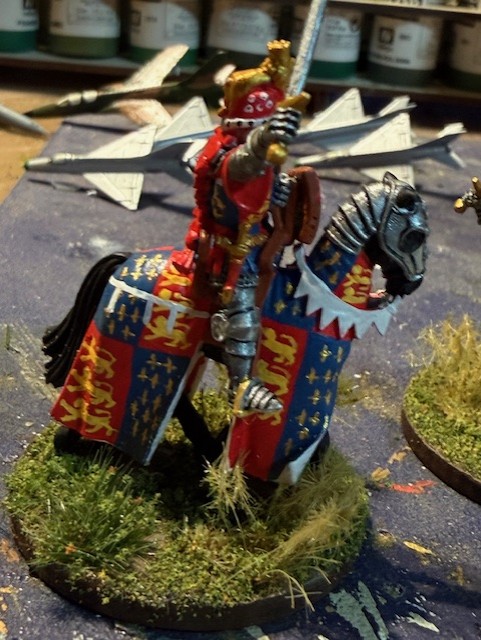
Prince of Wales Edward, the Black Prince is a legendary hero for my SAGA English HYW army. He is a 3D printed figure so hopefully his swords survive their first action. Yes, I did paint the heraldry. Very fun figure to paint.
I have masses of other things to work on. A couple of SAGA armies to complete. I still play SAGA every month so it gets a workout. My Skraelings and my Irish, two very similar armies, are on everyone’s shit list. I still haven’t figured out my HYW English, though I did recently paint the Black Prince of Wales, Edward as a legendary hero. At least he looks good. There are bunches of ships and planes that need paint and I’ve committed to paint a little of each every month.
Perry AWI riflemen awaiting the finishing touches on basing.
There’s also my Spanish Civil War project. That’s currently on hiatus while my friend and colleague Michael recovers from ankle surgery. There’s still more playtesting to do of our rules. I’d really like to get more figures but oddly Empress Miniatures have taken their SCW range on hiatus too. They’re busy producing their new Arnhem range and their Spaniards are just not available at the present time. Sigh. I still have a couple of items to paint, so maybe I should just shut up and do ’em.
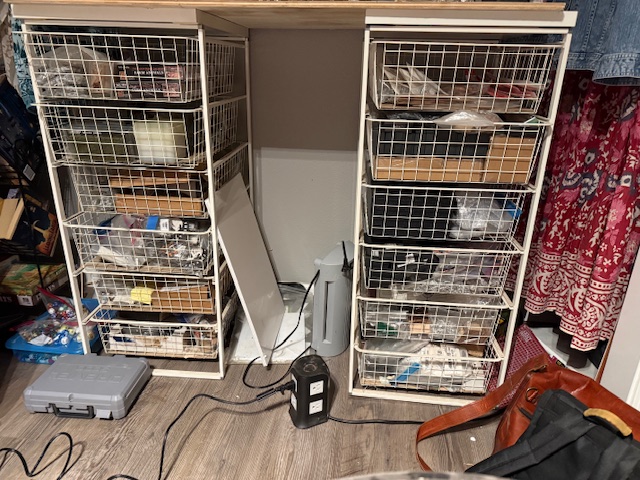
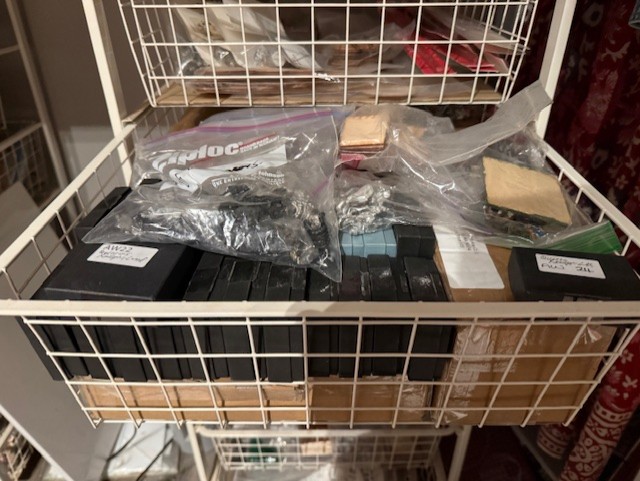
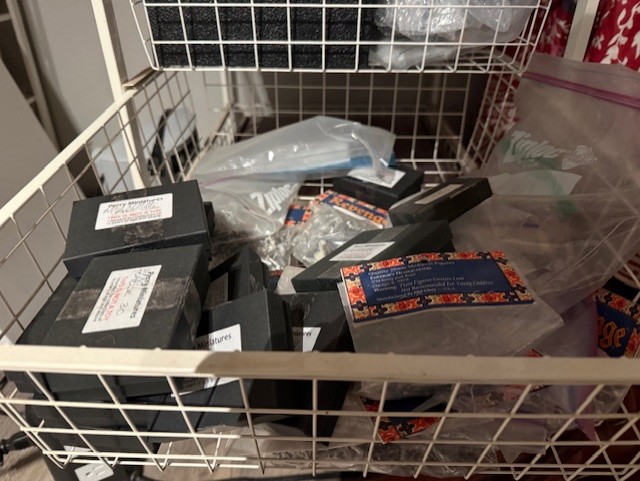
All of my unpainted figures live in this Ikea Antonio rack system. I have two of them. Some are bulging with stuff, others a little less bulgey. The second photo shows my unpainted AWI stuff that is literally overflowing. Mostly Perry, some Old Glory. More in the garage. Yikes. The third photo is my HYW stuff. Not quite as desperate. Some Perry, some Old Glory
My biggest piles of miniatures are my AWI and HYW projects. These projects both currently have more than 1,000 painted figures each. I have big plans for both, so I better keep working on them. This month I actually did complete some American riflemen for Rebels and Patriots. I also remounted some HYW figures. But there is so much to left to do. They are my big targets for 2026.
In the maybe something new department, I will do some DBA in 2026. I gave away all of my 30ish armies a year ago. I don’t regret it. I hadn’t played with them in more than five years. I had a friend just getting started and he’s used the figures very strategically. DBA 3.0 was published and a 4.0 is in the works. Despite my DBA motto being “you can’t have just one (army)” I think I can be more rational about acquiring and painting. Another possibility is a Napoleonic skirmish project a friend recommended to me. Don’t know much (including the rules set,) but I am eyeballing those Perry 40mm figures for the Peninsula that seem so beautiful. If I could keep the commitment to under 50 figures, I’d be good with it.
I hate to be morose and a downer, but there are times when I’m just bummed about my losses. Sometimes I just think I need to write away those feelings. Just to recap, in the summer of 2022 I lost my son Casey. Six months later I lost my Daveshoe. Last year I lost David Sullivan. I know I am not the only person who lost them. But, I can only write from my perspective, and their passing has left huge holes in my heart and in my life that are just holes.
Casey hearing from Patrick why the Beatles were the greatest rock band ever. Or maybe they’re discussing wrestling moves. Any or all of the above.
Losing Casey was and is indescribably difficult. He was my son, my gamer buddy. We are coming up on Thanksgiving which was his favorite holiday. He would come early, give attention to the dogs, and pretend to be helpful–kind of wishing there was a way he could be helpful, even if he wasn’t. Casey was a baseball hater, and he loved terrible music. Poor Casey would take the position that the Beatles weren’t that great and would have to fend off arguments from Patrick and I about how wrong he was. But he was an amazing son, a profoundly good person, a dedicated on-line gamer, and a very good board gamer. We miss him and talk about him every single day.
Shoe and I running our Raid on St. Nazaire game at Enfilade. I’m not sure why it seems like I’ve stepped in a hole here.
In the case of Shoe (Dave Schueler for those who might have no clue who I’m referring to, but he’ll always be Shoe to me,) I just miss the brotherliness of our relationship. We didn’t talk on the phone often, but sometimes, and the conversations were always enjoyable. It was always the collaboration, the getting together to share ideas about projects, new games, inevitably the Mariners and sometimes politics that I enjoyed most. I won’t recount all the games we did together. But we did love David Manley’s rules, and we hosted air games using his jet rules, Airwar C.21 and his WWII rules Airwar 1940. I was the chief painter of planes, but Dave crafted the scenarios and built the ships that would inevitably become targets.
2019 was the last time Dave and I ran any Manley air games. Covid canceled a lot of gaming including Enfilade in 2020, and his illness came right on the heels of the worst of the pandemic, so he had to stay away from exposure to germs. I’ve simply lacked the confidence to run these games on my own. I have Dave’s ships and some of his planes, but not the willpower to use them.
However, for at least the past decade George Kettler has pestered me about doing some Viet Nam era air games. I had the planes. And then I had some of Dave’s planes. And then I had even more unpainted planes. But the past few months something changed, and I embraced those challenges. A week ago we did get together at George’s with Scott Abbott and Bruce Syvinski and we tried a little Airwar C21. It was an easy-does-it walk through of the rules and we did pick it right up and it was easy to play and most importantly it was a lot of fun. Honestly, the two sets of Manley Airwar rules were similar and I’ve even figured out how to make the air data cards Shoe was so good at. I foresee more air games in the future, but I’ll be thinking about Shoe and all the trouble we would have gotten in together.
The game at George’s house was pretty simple. Four F-105’s commanded by yours truly were tasked with bombing a bridge. They were intercepted by four MiG-17’s that took too wide a turn to catch me. They were met by four F-4’s that launched piles of missiles at them, but mostly missed. All the Thunderchiefs got to their target, didn’t miss, rolled well and kablooey. All photos by George Kettler.
When David Sullivan developed pancreatic cancer and then passed away last March, I was just kind of lost. He was also a master collaborator, but had his own distinct and separate interests too. Again, we did so many things together, I don’t think it’s worth it to make a list, it would just go on and on. David had more stuff than we could all imagine. Some of it was stuff we’d done together, and some of it was his personal projects. When we moved it all mostly out of his garage, the question was what to do with it. David had gorgeous terrain, beautiful miniatures and just an incredible pile of unpainted miniatures. I tried to hang on to our cooperative stuff, and made sure that there was plenty to get out to others. I ended up glomming on to a lot that was unclaimed. For the past few months, it has mostly sat in my garage glaring at me, hoping for a plan. Unfortunately I don’t really have one.
One of my many favorite projects with David, the Battle of Hue in 2021 at Enfilade. Photo by Warren Bruhn.
Just to be clear, there isn’t any trash here. David and I had some big plans–He has a tub o’ Mexican War figures that we really need because we don’t really have enough Mexicans. There are two giant batches of American Revolution figures, that almost exactly match my giant pile of American Revolution figures. We were going to paint up some for Rebels and Patriots and some for Regimental Fire and Fury–Perry figures, Foundry figures and Front Rank British line. The good stuff. He has some beautiful Navis German Pre-Dreadnaughts that need a little bit of attention. And that isn’t half of it. Now if David were here, and I knew about all this stuff, perhaps we could give it all some direction. Or maybe we both would have run off in some other direction doing different things. But at least we would have talked about it and laughed about it and shaken our heads over lunch.
I’m in the middle of painting 26 of David’s remaining Crucible Crush figures. 11 are European and 15 are Indians. Added to the 50 or so figures we already have painted, that’s plenty to mess around with. They are great figures and a pleasure to paint.
I’ve taken some of David’s figures into my den to have close by in case I’m ready to do something with them. I’ve started working on some of the beautiful Crucible Crush Europeans and Native Americans Bob Murch did for his Flint and Feather rules. I’m revisiting The Song of Drums and Tomahawk rules David and I used to do the early contact Native American stuff back in the days. It’s very stylized, but quite fun, true skirmish. I’m going to run a game using our figures at our December 6th game day. Looking forward to it.
I’m just having one of those moments when I’m missing my guys.
The cover of our Spanish Civil War rules, nicely designed by Michael Koznarsky
I’d like to say I have some new big ol’ project I’m rushing to complete, but that would be a fib. Actually September and October were filled with fun non-game things. In September Lorri and I used our timeshare to stay in Whistler, B.C. for most of a week. It was the perfect time, with the gondola to Blackcomb and Whistler mountains operating for one last week. Kids were back in school and we had a wonderful time just hanging out in the valley. In October, son Patrick and I flew to Albany and made the trip to visit the holy of holies, the National Baseball Hall of Fame in Cooperstown. This was a bucket list adventure that included the Cooperstown visit, trek across New York to the Canada side of Niagara Falls, and then down to Cleveland for the Rock and Roll Hall of Fame. Both trips were a delight.
Before I left, I completed a pretty big project, my Cuban Rebellion/Moro Rebellion/Philippine Insurgency/Spanish American War projects. I’d also been working pretty hot and heavy with Michael Koznarsky and others on a Spanish Civil War project, including developing our own set of rules. There is more to come on the latter, but I’ll hold off until it’s a bit further along or at least until my brain is a bit more settled on what is happening.
One thing I have been doing is working with AI on Chat GPT to help with developing player aids and scenario design. Chat GPT is free, though it does limit how much work it will do without a subscription. i don’t recommend it as design tool per se, but I have used it to help me gather information about the Spanish Civil War. It has helped me develop several scenarios for use with my Aztecs and Quetzacoatl Rampant, and it is helping with player aids for Airwar C21. Usually it successfully provides what I want, but sometimes it doesn’t help much. It’s worth exploring. Little Wars TV also has a video on YouTube about using Chat GPT for scenario design.
Today is Halloween and the month is coming to a close, so here is what I’ve been working on and what I will likely be doing for the rest of the year. I’m still meeting with my Silver Kings group as often as possible. That’s 2-4 times per month. We’re still playing SAGA. I’ve had an offer to play my Skraelings. My answer is always “of course . . . muhahahaha” Everyone hates them. They’re painful to play, but honestly they probably have a 50/50 win factor. They have crappy armor, no legendary hero, and no mounted figures, no hearthguard. But they all throw or shoot things and make people crazy, so I love ’em. I also try to attend the games at Wizard’s Keep in Kent each month. It’s a great gathering with lots of different games played, so very worthwhile. I am gaming much more than I did before retirement.
My hoard of SCW militia. About 120 figures of socialist and anarchist militia. Mostly based for urban conflict in Barcelona 1936.
I’ve painted a lot of Spanish Civil War figures, as I’ve said, and my stash of unpainted guys have pretty much ended. We’re hoping to do another playtest of our rules on the 11th, so we’ll see how that goes. I have a few more figures coming, some vehicles and an anti-tank gun to finish, then I think I’ll put additional figures on hold for a while until we sort out some important rules issues.
Republican Regular infantry from North Star Miniatures
I’ve been in contact with George Kettler about playing some Vietnam-era air stuff. George has most of the planes needed. While I am slowly starting to complete my planes, I don’t feel the need to have them all done before starting something with him. I am working to try to complete some game aids for the Airwar C21 system. Hopefully I can get some AI help. If not, it’s Kevin alone doing my best Daveshoe impression, which isn’t very good. Finishing the planes I have is a September goal. There are about 20 Thunderfchiefs, Phantoms and Corsair II’s.
Two-fifths of my printed train. It’s coming along.
David Sullivan and I also did a project with Bob Murch’s Crucible Crush Flint and Feather figures. These are just gorgeous Native Americans representing Iroquois and Hurons during the early and pre-European contact periods. I had about two dozen and David had a few more plus some early Europeans with firearms. I painted all I had, but I took a couple dozen more that David hadn’t painted. I’ll add these to the pile and run some games using Ganesha’s “Song of Drums and Tomahawks.” These were fun rules that don’t require many figures, but having more is just fine, and it will be a way of resurrecting a David and Kevin project.
I always have lots to do and paint so I won’t succumb to boredom any time soon.