Enfilade Less Than Two Months Away

cav3

We’re about to start week two of Governor Jay Inslee’s Stay at Home self-quarantine.  I confess to feeling cooped up, but I am painting for Enfilade which is only fifty some odd days away.  I check the coronavirus numbers on the Washington Post that are updated regularly. Though the curve is bent somewhat,  cases in Washington state continue to increase regularly.  Though we should get an update for the governor’s ban on gatherings Tuesday, it’s hard to imagine the convention comes off. There simply is no good news.

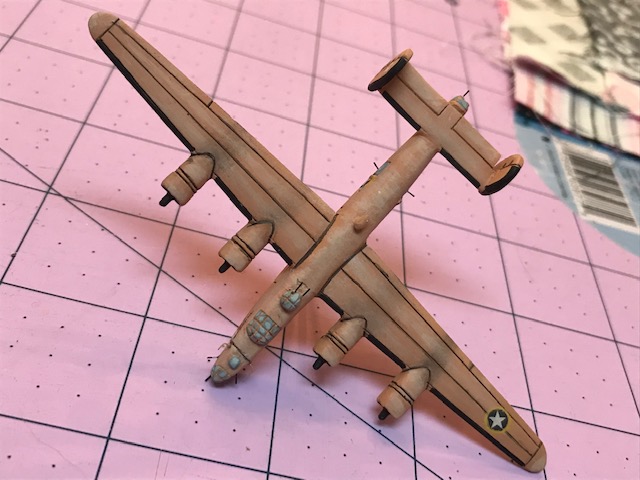
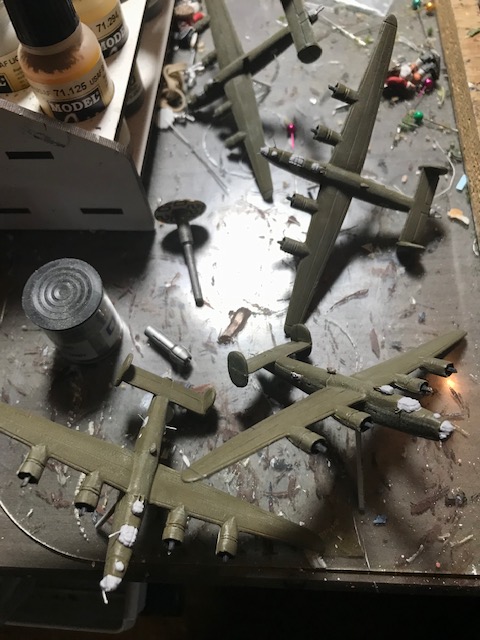
Even so, I am planning as though the Enfilade is still a go. That means I have to finish my projects. I still have a couple of irons in the fire. The first is the Ploesti project.  I hoped to have them finished by Sunday the 29th, but I just don’t see it happening. All the tedious lining is completed, but there is still lots of detailing to do–plexiglass panels, nose art, exhaust plumes, lettering and numbering and decals.  Everything is a bit slow, because of the size of the miniatures. I’m hoping for Tuesday.

cav 2

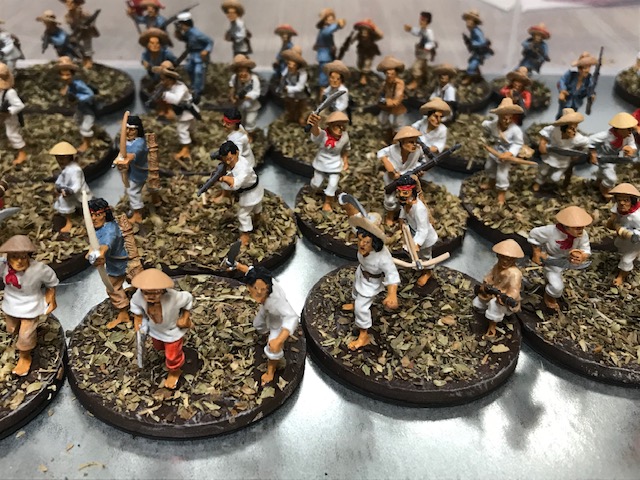
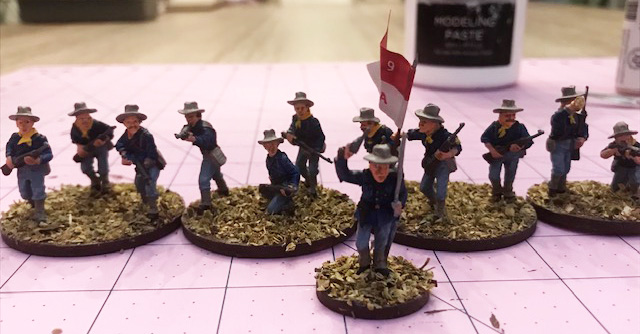
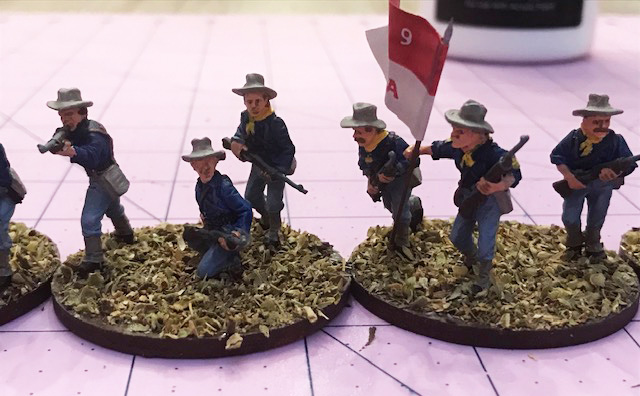
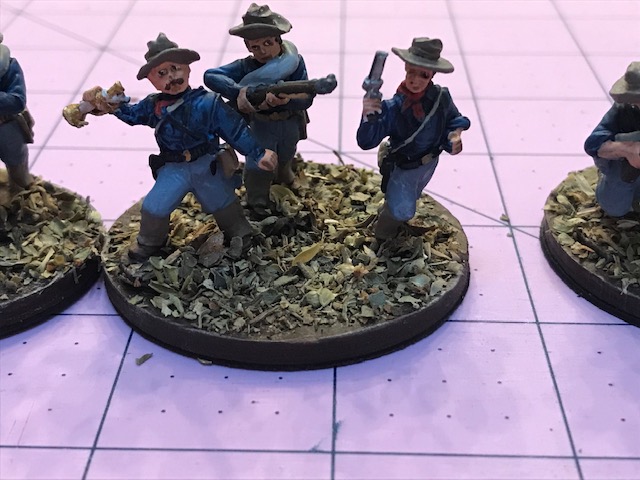
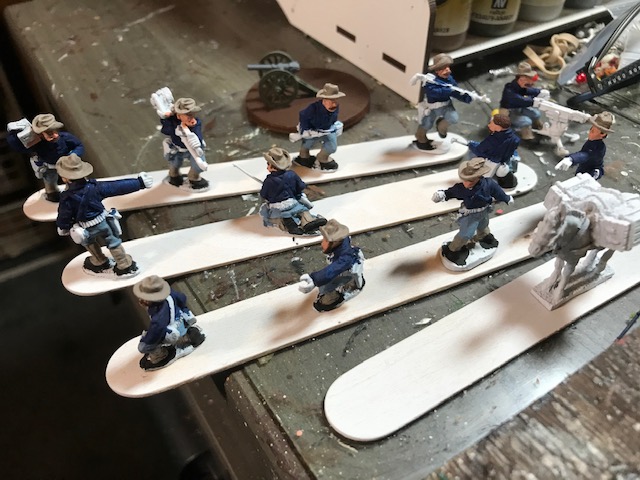
The other big project is the the Philippine-American scenario.  This is one that still needs work.  I finished the last of the American units today.  There are still 32 more bolo-armed Philippine figures to paint.  They’ll go fast, once I get started on them.  I will have painted a considerable number of figures for this in the end.  That’s great, wrapping up this project is high on my list.  When the figures for this scenario is complete, I will still have plenty left to paint, but it’s a project I really want to wrap up.

In addition to the figures, however, is still a fair amount of stuff to do.  I have a pair of 4Ground buildings to complete, plus some additional terrain bits to make that are central to the scenario.  I’ve actually made a lot of progress in this area, but I still have a ways to go.

I’m far more concerned about a lack of opportunity to play test these games than I am finishing the work.  The Stay-At-Home rules make things tough, both for places to play and gathering gamers together to play them.  I think the Ploesti game will be fine, but the Philippine game has some moving parts that really need a couple of walks through.


It’s not the Willow Run Ford line (but I’m trying)

Willow Run

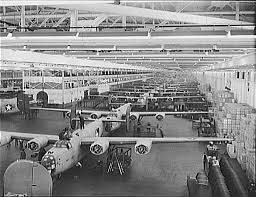
The B-24 assembly line at Willow Run during WWII.

In 1943 the Ford production line in Willow Run, MI wasn’t making cars, it was producing B-24 bombers for the USAAF.  They went from producing autos with a couple of thousand parts to producing planes with about 1.5 million parts each. Workers could produce about 1.5 planes per hour. Not one Liberator completed from beginning to end in less than an hour, but once and a half planes rolling off the assembly line every hour.  Pretty amazing.

At this moment I am also producing 1/300 B-24D’s for my Enfilade game. I don’t have nearly as many parts per plane, but I’m a lot slower. These are for the Ploesti game Dave Schueler and I hope to be running May 23rd.  The game calls for 18 planes for six players, but I hope to have 24, so we can take a couple more just in case more players are interested.

B-24D

One of Phil Bardsley’s most excellent B-24’s for the earlier iteration of Ploesti with Paul Hannah. No, mine won’t be nearly as nice.

Before I proceed on my how-to, I need to make it clear that Ploesti has been done before by two dear friends.  At least a fifteen years ago, Phil Bardsley and Paul Hannah worked with Dave to run Ploesti using the Mustangs rules.  They were both superb painters and their B-24’s are excellent. Their planes were painted in USAAF “Desert Pink.”  Not an official color, this was actually USAAF Desert Sand that oxidized in the North African condition to a lighter, pinkish color.  They mixed their own colors for their planes and did a fabulous job.  Phil passed away a few years ago and I bought his bombers.  They are little pieces of art.  My planes won’t be Desert Pink, they’ll be USAAF olive drab, and while they’ll be well-painted, I’m simply not as good as Phil.  There were plenty of both on the mission.

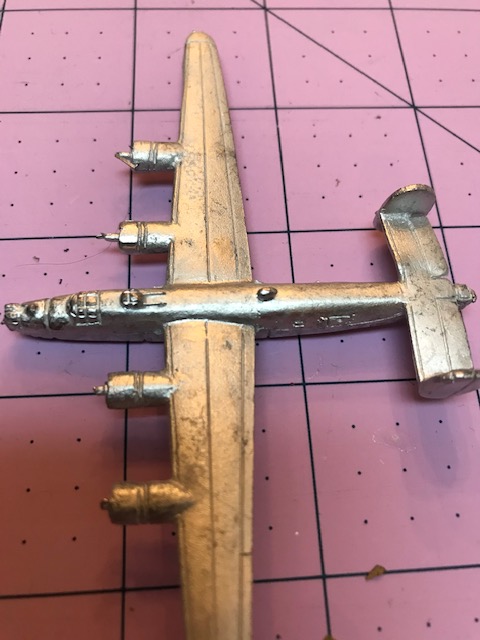
The Ploesti bombers flew B-24D’s with the big plexiglass greenhouse in the nose.  Later Liberators had the big nose turret.  Not many B-24’s available in 1/300 and Scotia makes the only B-24D. Thankfully, it’s a really nice miniature.  The dozen I ordered were are very nicely scribed, well-cast, and didn’t come with their very long wings tied into a pretzel. They were reasonably inexpensive at only four pounds (4.61 a whack at today’s ridiculously low exchange rate.)

What you notice looking at them is, again, the long thin wings, the chunkiness off the fuselage, and the size of those twin tails connected by the large horizontal stabilizer.  It will become a big deal for the modeler because they feel unbalanced, and holding them or maneuvering them around a paint brush is challenging.

When I started working on my planes the first thing I had to do was prep them for paint.  Wings had to be straightened.  It wasn’t severe but took some time and second looks. The twin tail and stabilizer likewise needed some time.  Just apply counter-pressure and there isn’t a problem with breakage.  There are some mold marks to deal with, especially down the fuselage. I scraped those off with a sharp X-Acto knife, but you could also use a needle file or sand paper.  The latter might give you the best result, but I’m impatient.  Paul always used to sand his planes, which eliminated pits in the castings.  Again, I probably should have done that, but I’m kind of a loser.

Before moving on and priming, I decided to drill out locations for the flexible machine guns that festooned the early Liberators.  I not-so-carefully identified the sites for these and drilled them out with a Dremel tool and a wee, tiny bit.  You could use a pin vise, but the pewter is kind of resistant to slow turning drills. After I was done and cleaned out the holes I glued in toothbrush bristles, cutting them to size with a pair of floss scissors. Used CA glue for the adhesive

Moving on to primer, I used the Army Painter white spray primer.  It’s a little spendy but it really covers well and a can lasts a long time. However, after the first four planes are completed I’ll be topping the white primer with Vallejo’s USA Olive Drab Primer.  It will make working with my preferred paint so much easier.  If it isn’t available at your local bricks and mortar store, you can order it from Amazon in a 200ml bottle for less than twenty bucks.

The paint scheme is pretty simple: olive drab over gray.  There are lots of different colors you can work around.  My preference is to use the Vallejo Air Colors series whenever possible, because they are matched most clearly with the historic colors. USAF Olive Drab is included with the American CBI Theater set.  You get six bottles in each of the many sets available for about twenty bucks. It also includes an USAF Light Grey, which is also a great color for the undersides of wings and fuselage.

B-24's 5

The first four B-24’s in base Olive Drab, awaiting dry brushing. The journey begins.

But I don’t you to go grab these and not know the risks in using them.  These colors are designed for use with an air brush.  The pigments are ground very fine and they simply don’t cover very well.  I believe there are four coats of USAF Olive Drab on each of the first four bombers.  I’m super happy with what I have, but it wasn’t easy, and I ordered two more bottle at almost eight dollars a whack to make sure I had enough to finish my project. I ended up not sticking with the USAF Light Grey and switched to Vallejo Sky Grey just because of the coverage issues.

I spent lots of time getting the base colors down, lots of coverage, lots of drying, then a the first of many shots of Dullcote.  Painting planes this large means handling planes, and I didn’t want to rub anything off. I decided early on the big planes needed some weathering, so I mixed 50-50 olive drab and Vallejo Light Grey to get a nice lightened, but not too bright color. Then I carefully dry-brushed the wings, engines, tails, stabilizer and fuselage. More Dullcote.

Next up the lining.  I used a charcoal rather than black over the olive.  I used Vallejo light gray on the underside.  Yes, it’s tricky but not impossible.  You can always paint over egregious mistakes.  Paint the motors and then it’s on to the black leading edges.  This was actually a bit trickier, and I had to paint over some mistakes.  The tail fin edges were particularly difficult because there is no scribing to give me a clue.  In the end, I think my lines are too thick, but I’m gonna live with it. Dullcote again.

How much more detail do you want to include?  From here it’s probably safe to paint the metal spinners on the propellers and proceed directly to decals. Because Phil’s planes include nose art, I decided to try my hand.  His planes have such legible, clear hand-lettering and there is no possibility I can pull that off, hard as I might. I did some research on B-24 nose art, and tried my hand at Flak Alley, Doc, Hard Hearted Hannah, and The Goon.  Are they great, no, but they’re good enough.  These are all painted on the left side of the nose in front of the cockpit.  On the right I painted the symbol for the Flying Eight-Balls, which are really hard to make out.  I left room for a two digit number on the right.

On to the decals.  Phil used the red-bordered star roundel with bars, which was a Pacific insignia.  Pictures show just a roundel, often in pretty mangled condition with the yellow “Torch” band. I bought the latter from Flight Deck Decals.  They are fast, reasonable and do some great work. Oddly, these American planes use an RAF tricolor tail flash.  I had zillions of these from I-94 Enterprises. I stopped there.

That left just  the numerals to paint and the tail letter for each plane.  I painted the numerals white and the letter in Vallejo Golden Yellow, per the photos I’ve seen.  That wrapped up the first four of twelve planes.

It was a terrific learning experience.  I started the four before I left for San Diego, and it’s really taken most of the rest of the week to finish them.  Hopefully I’ve learned some lessons along the way and I might be finished with the remaining eight by the end of the week.


Enfilade in a Time of Covid 19

Enfilade_logo2

Enfilade, for those not in the know, is the flagship miniature gaming convention in the Pacific Northwest.  It’s hosted by the Northwest Miniature Gaming Society (NHMGS) at the Red Lion Hotel in Olympia and welcomes 350+ guests from Northern California to British Columbia, from the Olympic Peninsula to Montana each Memorial Day weekend.

Because there are rental spaces and room reservations,  it involves money which creates a certain amount of risk and reward in a typical year.  Sometimes we make a few bucks, sometimes we lose a few bucks, but we have an extremely capable treasurer who has made an art form of effectively managing our funds. Our contract with the Red Lion is quite fair–as long as everyone shows up in a typical year.

This is not a typical year.  Or maybe you haven’t turned on the news lately. Or noticed that traffic is down 30% (in the Puget Sound area.) Or been surprised that you’ll have to clonk some poor old lady on the noggin in the parking lot in order to snaggle some toilet paper.  I went shopping yesterday and could not get these items: hand sanitizer, ketchup, rubbing alcohol, tp, soup, or olives.  Weird mix of items. Nobody seems to be stockpiling fresh vegetables.

But I digress.  Unfortunately in this age of the Covid 19 pandemic, NHMGS finds itself confronted what is truly an existential crisis.  To cancel our convention in the face of what is a real health crisis, would force NHMGS to pay severe penalties in the tens of thousands of dollars, and force us, a small non-profit, into bankruptcy. Many of our members on Facebook have expressed an interest in attending in the face of the illness.  However, others have fairly expressed their view the convention is too great a health risk, a danger to their families should they attend, and we should fold.  At this time that’s not an option. NHMGS is between a rock and a hard place.

However, there is a potential rescue on the horizon.  No NHMGS won’t be included in the federal bail-out package.  It is the government in the form of Governor Jay Inslee’s social distancing proclamations that offer our best hope of weathering this storm .  At the present time Enfilade would not pass muster against the state social distancing requirements under the current state of emergency.  In the event of government regulation, contract canceled, we can plan for 2021. Yay, right?  Wrong.  Unfortunately, that proclamation expires on March 31st.  Back to gloom and hopelessness.

However it’s inconceivable Inslee won’t extend the ban.  The virus shows few signs of relenting as time progresses.  States are erecting strict “shelter-in-place” laws further limiting social interaction, and I fully expect it is simply a matter of time before Washington does the same.  However, despite anticipation of a future extension or deepening of the current proclamation, it’s unclear how long it will last. Until April 30th?  May 15th? That would be the worst, being in limbo until two weeks or so before the convention. We’d have few attendees, thus little revenue, and we’d suffer penalties under our contract.  Not only that, but the penalties for canceling the convention ramp up the closer we get to our Memorial Day weekend dates.  Bigger rocks, worse hard places.

I recently accepted the NHMGS interim presidency after our elected leader fell quite ill.  Of course I wish him well and a full recovery.  Unfortunately the convention is foremost on my mind.  The good news is that I work with a group of really great people, friends for many years.  We’ll find a way to make it work.


Shiny Objects-My Dance with 1898 Miniaturas.

You’re miniature wargamers.  You know what I’m talking about.  A manufacturer comes out with something new–maybe it’s a period that’s always interested you, maybe it’s an interesting set of rules to go with interesting miniatures, maybe they’re simply the nicest miniatures you’ve ever seen from a period that holds a magnetic attraction on your passions.

I can say, honestly, that I’ve always been attracted by periods and passions and not to figures.  The Hundred Years War, American War of Independence, and a host of other periods have attracted my gaming dollars and the time it takes to paint up a project because I have a deep interest in the period.  Aside-most mainstream interest; War of Independence.  Least mainstream project: Tie between the Lewis and Clark Expedition and The Burr Conspiracy.

About three years ago, at age 61, I was looking around at a last new project.  Let’s just define our terms here, since that often breeds confusion.  By last project, I mean a last new, never begun before new project.  It would mean buying and painting both sides, and all the time that demanded. I was particularly interested in a colonial project.  Osprey had just released Daniel Mersey’s The Men Who Would Be Kings, and I loved Lion Rampant.  Lacking any armies from that period, I was intrigued.

Vols 1

Vols 2

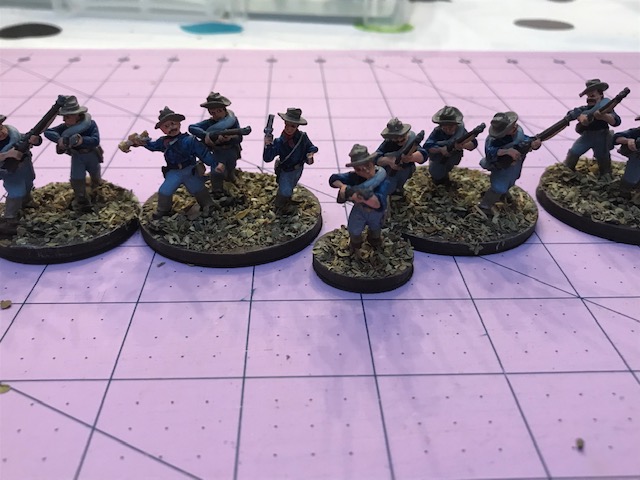
A couple of photos of Old Glory’s volunteers.  State and U.S. Volunteers fought in the Philippine War.  The chief difference between the regulars and the volunteers is that the latter was armed with the 1873 pattern Sprinfield (trapdoor) rifle that fired a black powder cartridge.  Regulars carried the Krag with its distinctive side mount magazine and smokeless cartridges.

My first choice was Egypt and the Sudan.  I was in from Tel-el-Kebir all the way to Omdurman.  The Perrys had a nice range of figures, and I could fill in from other manufacturers, so I was kind of hot to go.  With a conflict lasting from 1882-1898, there would be plenty to keep me busy.

At about this time 1898 Miniaturas appeared on The Miniatures Page.  The photos showed the figures to be truly beautiful, and the announcement that the Spanish company would focus on the Spanish American War AND the Philippine American conflict got my attention.  I decided to follow the range and save my shekels for a future purchase.

At first I was interested in doing both conflicts, but in April of 2018 Lorri and I agreed I would retire after the 2019 school year. That would mean less hobby money along with my reduced income, and I focused instead on the Philippine War. Why?  Well, it seemed more colonial and provoked a real debate in the United States whether our country would join the ranks of other imperialist nations. It had the added benefit of including more state volunteers than U.S. regulars because most of the latter were packed off to Cuba. Those volunteers included an infantry battalion and a battery from Washington state.  I’m such a homer.

I invested some of my summer camp earnings toward the a down payment on the period, and by August of 2018, I had plenty of figures to work for the U.S. invaders and the Philippine defenders.  There were still some holes the 1898 Miniaturas range, but they were still adding some figures.  Last year, they supplemented their excellent collection of infantry with some very nice mounted leaders and an American Gatling gun.

Unfortunately, the death knell of all figure ranges happens when a manufacturer moves on to another range.  The 1898 folks have done exactly that by creating a range of Spanish miniatures for the early 17th century and Thirty Years War period. They’re nice, but not a range I have any intention of doing, and exactly nothing has happened with their colonial range in over a year.

Tiger 1

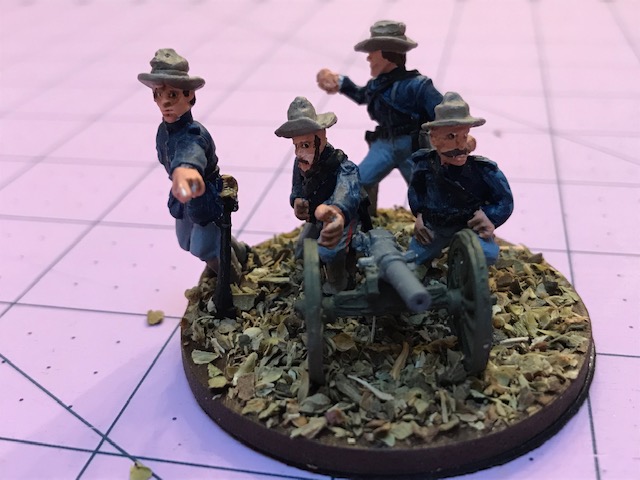
The Tiger mountain gun.  The gun is quite serviceable, and comes with a mule and two crew.  The crew members aren’t great, but the mule is awesome. The rules call for four crew so I added a couple of leftover volunteer officers from Old Glory.

What does that mean?  Well, there are definitely some bits that are missing.  No American volunteers, sailors or marines.  No mounted cavalry for the Americans.  There are still some weapons that would be nice to have-Colt machine guns, light artillery more maneuverable in the jungles and mountains of the Philippines.  Philippine soldiers in American service-the Philippine Scouts and Philippine Constabulary would be valuable units in many scenarios.

Tiger 2

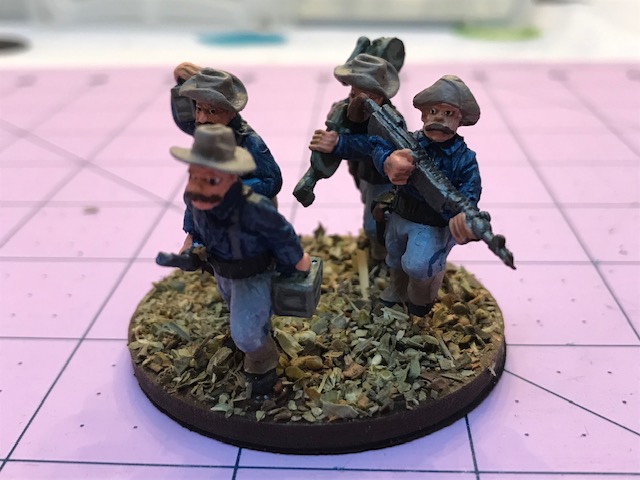
This is the Colt machine gun by Tiger in being schlepped formation.  I had an extra Tiger officer to add to the three man crew. I liked these guys.  Big and a little goofy, but not bad at all.

Tiger 3

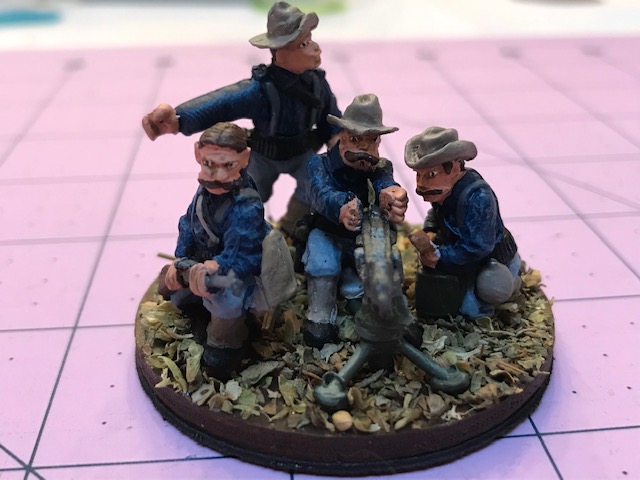
The ready for battle version of the Colt.  Another Tiger miniature.

To be clear, all the miniatures are available.  Old Glory makes all the extra American infantry and cavalry.  Tiger Miniatures has some of the extra weapons bits.  All the figures are very serviceable, but don’t quite match the quality of the Spanish company’s figures.

It’s got to be really hard to sustain a business in this hobby.  Gamers move from game system to game system, and are attracted by new interests and miniature ranges all the time.  A regular customer becomes a former customer easily and predictably. Balancing a company’s offerings with additional and alternatives to attract the maximum number of buyers only makes sense.  But I won’t hide my disappointment that 1898 Miniaturas has not finished what it began.  Yes, the major pieces are there, but there is still plenty to complete the range.

Just in case you’re interested here is what is available for the Spanish American War and Philippine War from 1898 Miniaturas, Old Glory and Tiger Miniatures

Americans

  • Regular Infantry-1898, Old Glory, Tiger
  • American Buffalo Soldiers, Infantry-1898, Old Glory
  • Dismounted Cavalry-1898, Old Glory, Tiger
  • Dismounted Cavalry Buffalo Soldiers-1898, Old Glory, Tiger
  • Dismounted Rough Riders–1898, Tiger
  • Volunteer infantry–
  • Mounted Cavalry–Old Glory, Tiger
  • 3.2″ gun and crew–1898, Tiger
  • Artillerists–Old Glory
  • Gatling guns and crew–1898, Old Glory, Tiger
  • Colt machine gun and crew–Old Glory, Tiger
  • Dynamite gun and crew–Old Glory, Tiger
  • Mountain gun and crew–Tiger
  • Marines–Old Glory, Tiger
  • Marine Artillery (one pounder)-Tiger
  • Marines w/Colt machine gun-Tiger
  • Sailors–Old Glory
  • Philippine Constabulary-Tiger
  • Philippine Scouts–Tiger
  • Mounted personalities–1898, Old Glory

Spanish

  • Spanish Infantry–1898 (many variations), Old Glory (two variations), Tiger (two variations
  • Spanish Civil Guard-Tiger
  • Spanish sailors–Old Glory
  • Spanish Marines–Tiger
  • Spanish Cavalry–Tiger, Old Glory*
  • Spanish mounted infantry-Tiger
  • Spanish mounted personalities–1898
  • Spanish artillery–Old Glory, Tiger
  • Spanish mountain gun–1898, Tiger
  • Spanish Gatling Gun–Tiger
  • Cuban Rebel Infantry–Old Glory, Tiger

*Both Old Glory and Tiger use cavalry interchangeably for Spanish and Cuban rebels.

Philippine Troops

  • Philippine Republic/Native Tagalogs–1898, Tiger
  • Philippine militia w/mixed hand weapons-1898
  • Moros–Old Glory
  • Personalities–1898

A Productive January

It’s been a great painting month.  I spent lots of time focused on those Enfilade projects I’m working on.  I’m kind of a procrastinator about most things in my life, but not about getting convention games ready.  I’ll never forget watching some guys painting figures at their table for their weekend-long Battle of Gettysburg game.  That is not me.

I began the month working on figures for the Rebels and Patriots game David Sullivan and I are hosting.  It’s based kind of loosely on the retreat to North Carolina across the Dan River, leading to Guilford Courthouse.  Sort of like Weitzel’s Mill.

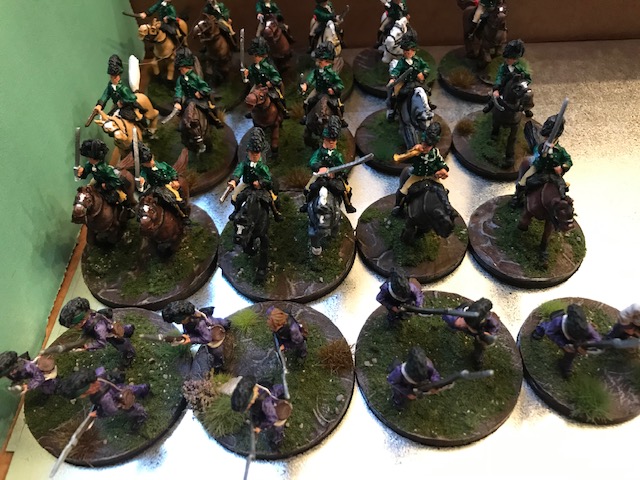
Two of the units I wanted to paint were light companies of the Grenadier and Coldstream Guards that are part of the British pursuit. The figures for both units are Front Rank, from their Light Infantry in slouch hat group.  It’s a pretty thin batch of figures, so there’s not a big mix to choose from.  As I’ve stated before, these figures are very fun to paint, very easy to paint because they’re large and kind of blocky.  They remind me of working with a coloring book, because the lines are so clear. No facing colors or lace to speak of.  I did give the officers Scarlet coats instead of the Vallejo Flat Red, so they could be in regulation dress and be better targets for the American riflemen.

Front Rank Light Infantry in southern dress.  These are painted as the light company for the Coldstream Guards.  Their device is painted on many of the figures’ backpacks in the photo upper left.

Though there’s not a lot to dress them up, I decided to paint their backpacks with crests for each of the different regiments.  The Coldstream Guards were pretty straightforward.  The Grenadier Guards not so much.  Every guardsman was not a recipient, but the majority of figures have their respective crests.

Grenadier Guards light company.  Their devices were more of a challenge to paint and I skipped trying to paint the royal script inside the garter.

I also painted Kirkwood’s Delaware light infantry.  These are Front Rank figures in 1779 regulation dress.  Again, fun to paint.  I didn’t quite get the figure mix right.  Was hoping to add some figures in hunting shirts but didn’t order correctly.  My bad. The biggest distinction for Kirkwood’s troops is the yellow hat lace, so at least I could see them coming.  As their white overalls wore out they resorted to bed ticking for trousers.  I was hoping to have a few more examples of this and remembered what a terrible pain in the ass it was and called two examples good enough.

Robert Kirkwood’s Delaware Regiment was really part of the old Continental Line that served throughout the southern campaign.  It’s the closest Nathaniel Green had to an elite unit, but though it had only 80 or so men.  Kirkwood was a soldier’s soldier, serving through the Revolution, only to die on the Wabash battlefield in 1790.

Back in December I went to the Perry Miniatures site and put together an order for the remaining figures I need for this project–British Legion figures for the loyalist South Carolina Dragoons, Lee’s Legion dragoons, and a handful of riflemen.  Four weeks later, having not received them, I went back and looked at my order, only to discover it tidily sitting in the site’s shopping cart.  Sent in my order the next day, and shipped immediately from the Perry site.  Still waiting, but am watching the mail daily.

While waiting for the Perry’s to arrive I decided to switch gears and begin work on planes for Ploesti.  I don’t have a ton to do but they are big ol’ Scotia B-24D’s.  The models are nice but large, which always poses a bit of a challenge.  The planes often come with their uber-long wings pretzeled and their large stabilizers and double tails needing careful straightening.  I set into this task one evening, only to realize the B-24’s I ordered back in August weren’t the early D version of the bomber that set upon the Romanian oil fields at all, but the later B-24J with the power nose turret.  Still a nice model I can make use of, but it took another order to the UK to retrieve the situation, so I am still awaiting the whims of the Post Office.

B-24D

This Scotia B-24D is one of ten I acquired from the late Phil Barsdley.  They are spectacular in every regard, including the guns Phil added.  The paint, including “Flying Eightball” emblem and nose art I’ll never be able to equal.

B24J

Scotia B-24J in all its raw metal glory.  Note the nose turret. They’ll paint well.

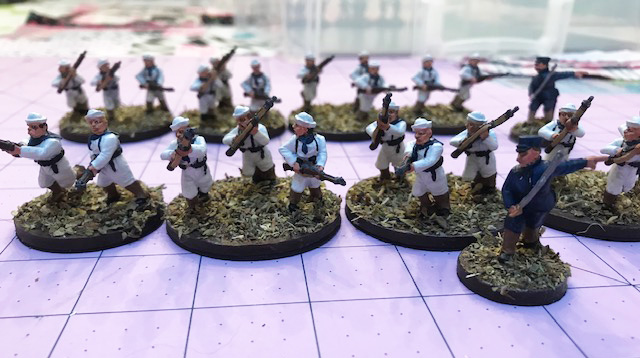
With the R and P figs and the required planes unavailable, I’ve been working on some figures for my Philippine scenario. Because there is a coastal element to the game, I gotta have marines and sailors.  I think I’ve already shared my U.S. Marines.  Like those figures the sailors are offerings from Old Glory.  Not a tough job–because they are in white uniforms with white sailor caps.  Managed to knock out both units this month.  As figures go, they are pretty simple and straight-forward.  they seem a bit small.

Sailors 1

Well, no they aren’t a lot to look at, but if you’re gonna be afloat you gotta have sailors.  Two units of Old Glory Sailors from their Spanish American War range.

They are a pretty simple paint job.  I used Vallejo Grey-White as an undercoat and then painted highlights in straight white.  That’s really all you gotta know.  Simple but reasonably effective.

About the time I thought I could start another unit I got a raging four-day case of the flu.  When I could bring myself to actually go back in my den, I decided to paint some of the heavy weapons I’ll need for the Philippine scenario.  There is a mountain howitzer and crew and a Colt machine gun in both the firing and moving position. I’m about 50% finished with those figures

WIP 1

This bunch is from Tiger Miniatures and include crews for Colt Machine guns as well as a breach loading mountain gun from their Spanish American War range. Under construction.  Hope to be done with the lot by February 2nd.

If I’m able to finish those figures by Friday, I’ll have done 72 figures in the month of January, all 28mm, which is a whole lot for me.  And honestly, it was truly enjoyable.  It’s nice to have about three hours a day to paint.  I can get a lot done.

And the really good news–my Perry order arrived today.

Perry

My small, but anxiously awaited Perry order.


It’s December!! Just five months until Enfilade!!

In fact it’s been two weeks since I began this post, so Enfilade is even closer than it was. Yes, still more than five months away, but time is marching on.

I’ve written before that Enfilade usually guides my projects and 2020 will be no different.  In fact, as the convention becomes more popular, with more people attending and more folks hosting games, Enfilade is no longer left begging for games at that last minute.  When the website opens on January 1st there is a stampede of hosts rushing for the best times and best tables. He who has no plan is lost.

I refuse to be lost.  I have a plan

Enfilade has six game periods and I’ll be running games in five of them. Some are finished, play tested and ready to go.  Others still need a lot of work and I’ll offer more about them later.

Here in the order of game periods is my plan:

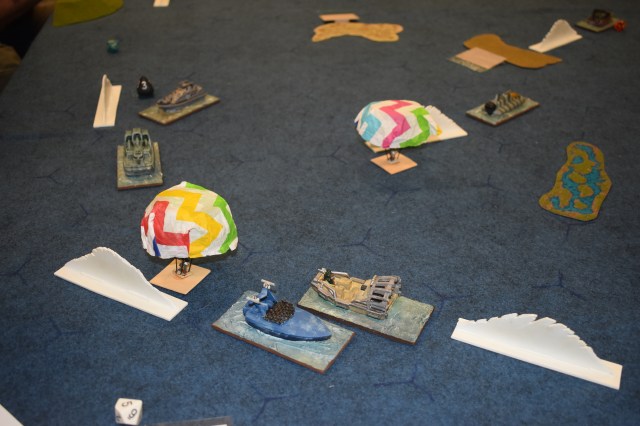
Friday afternoonMad Wet Max.  This is the armed version of Thunderboats!  It’s kinda cute.  Lots of fun between missile launches, mine laying and the occasional shore-bound audience participation. Good way to start the convention.  No, I have nothing left to prepare beyond a review of the rules.

DSC_0247

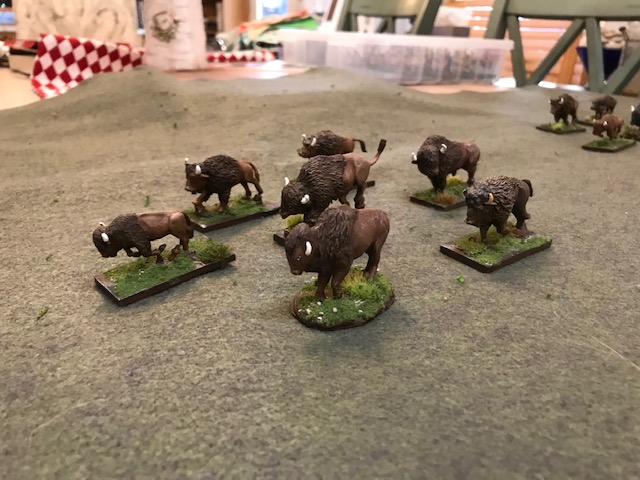
Friday eveningThe Buffalo Hunt. Another just kinda rollicking good time. I’ve run two of these games now, and I’ve picked up some very good suggestions both times.  Players pick it up okay, so I shouldn’t have any residual headaches. All figures are painted, so aside from one more playtest, I shouldn’t have a lot left to do.

herd 2

Saturday morning:  Nothin’.  I’m taking the morning off. It’s a good time for me to be lazy, look at games, yak with friends, maybe do some shopping or run down to Rainy Day Records . . . or not.

Saturday Afternoon: The Race to the Dan/ Rebels and Patriots. David Sullivan and I were interested in running another R and P game after the success of last year’s Retreat From Concord game. We both have a love of the Southern Campaign so I suggested a scenario that might fit with Green’s retreat to the Dan River and preparation for the Guilford Courthouse Campaign. It should be good, with about ten units per side.  Some are painted, many are not.  David is wisely hoping for several playtests so I’ve already begun painting and am making progress. But I do have minis on order from the UK, and it is Christmas time, so I’m hoping I don’t stall out.

R and P 1

Lee’s Legion foot (in purple) and three small units of Tarleton’s British Legion dragoons are four of the ten our so units I’ll be providing to the Race to the Dan game.

Saturday Evening: Ploesti/Airwar 1940.  This will be a six-player cooperative game as U.S. commanders try to brave the flak, and each other, as they bomb the oil refineries in Romania.  It will be modeled on the scenario that Phil and Paul created for Mustangs! many years ago.  Again, playtests are in order.  I have 11 B-24D’s to paint, so some work to do, but not a lot. A great way to end a day of gaming.

Ploesti

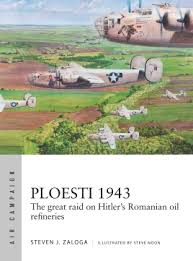
Osprey released its book on the Ploesti attack at the end of November. I think I was first in line to buy.

Sunday:  My Philippine-American War figures will make their official debut.  I have an idea for a six player game that will involve about ten units per side.  There is still a fair amount of painting to do.  Five units for the Americans, two for the Philippines and some miscellaneous weapons.  More daunting is the terrain that will need to be built.  While I have the bamboo forests and rice paddies finished, there is still some miscellaneous jungle terrain I’ll need to do.  Not my long suit.  Like Rebels and Patriots and Ploesti, this will require some playtesting

Philippine 2

November’s Gone

November is already over, and I can’t believe it.  It was a fun month from a gaming standpoint.  I played in a great Black Powder game over at Jim Sagen’s house, attended the Museum of Flight where Dave Schueler and I ran our convoy game twice–and had a blast, and on Friday I ran the second Buffalo Hunt game with some rule changes and had some more suggested to me.  So, more gaming than my pre-retirement self played.

Some photos from our Museum of Flight game convoy game.  British players chose from a variety of bombers to attack an Italian convoy shepherded by two large Cant 1007Z bombers as well as choices of MC 42 or MC 200 fighters.  In the first game the Brits pretty much had their way, but the second game was much closer, with British losses.  However they did torpedo the tanker in the convoy which exploded.

It was also a pretty productive month on the painting table, though I felt like I tried a whole lot of different stuff and wasted a fair amount of time being fairly aimless. Here is what I accomplished:

Aircraft:

These are Raiden’s splendid Beaufort bombers.  One of my favorite airplane miniatures. Unforunately they don’t make the Aussie version with powered dorsal turret.

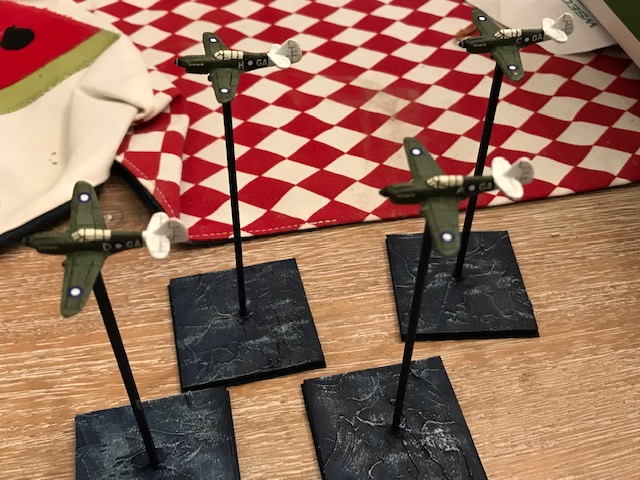
  • four P-40N’s in RAAF colors.  Scotia planes, I wrote about these.
  • six Beaufort torpedo bombers in RAAF colors. Miniatures by Raiden.  More planes for Rabaul.  These are in Foliage Green with markings by Flight Deck decals.  Fun to paint and pretty darn easy
  • Six Beaufighter attack planes in RAAF colors.  Miniatures by Scotia.  Foliage Green, decals by I-94. Again headed for Rabaul.  The first of my attempts at weathering.

Scotia’s very nice Beaufighter.  They are just nasty.  Aussies replaced wing-mounted 8 X .303’s with 4 X .50 machine guns.  Teamed up with the 4 X 20mm cannon in the nose equals some real firepower.

Philippines:

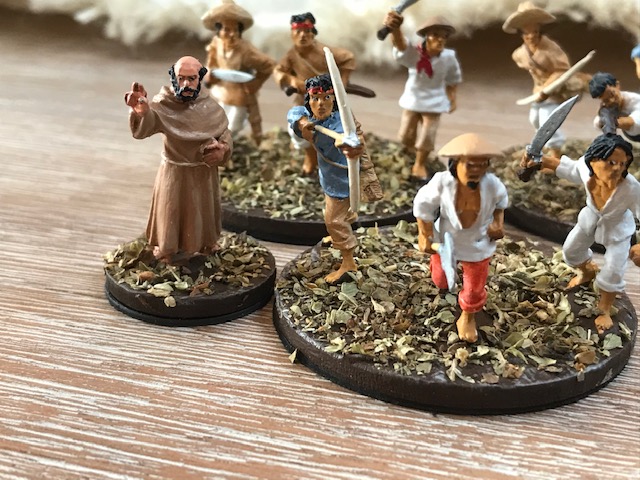
  • 18 figures of bolomen for my Philippine project.  These were pretty easy to paint, and I enjoy painting them.  No rayadillo, mostly white, how tough can it be?
  • 12 figures of irregular riflemen.  I limited myself to three figures with rayadillo, which will probably be my standard going forward.

Ships:

  • One Dragon model of the HMS Zulu, a Tribal class destroyer.  Had an easier time building this than the Orwell, but struggled with the final colors.  Planned to do her as the HMS Eskimo, but just couldn’t get the gray on white paint scheme to work.  Note to self, use white primer next time.

Anti-aircraft

flak


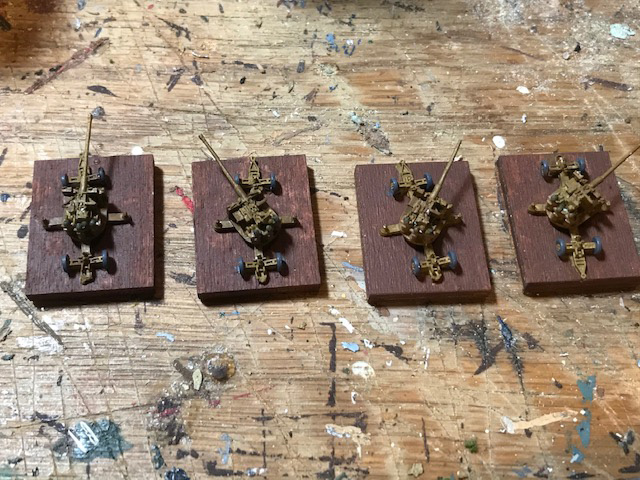
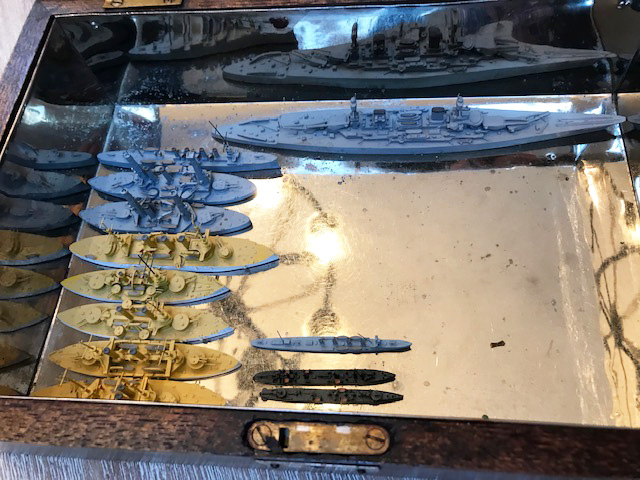
I acquired many, many little boxes of anti-aircraft guns, missiles, transport and radars from George Kettler and the Phil Bardsley estate.  What to do with them?  I’m not sure, but I definitely can’t do anything with them if they aren’t painted.  I’m not sure what these are, but I painted four of ’em and stuck ’em on leftover Litko bases.  It’s a start, but plan to see more of them. Some are clearly WWII  German, others are Soviet and intended for Vietnam.  In either case, pretty easy stuff to paint.

December will be a lot more focused.  I’ll have to have plans made for Enfilade as game registration will open in early January.  More about those plans in my next post, but they involve lots of painting.

On My Painting Table

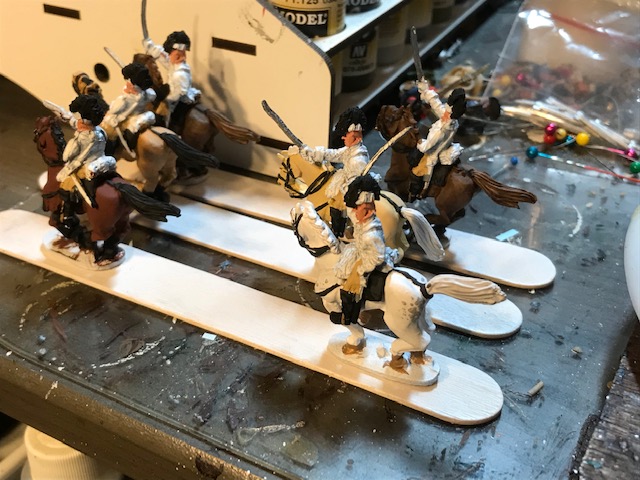
28mm British Legion-These are Old Glory British Legion.  Not the best figures, but perfectly serviceable. They are a big chunk of the painting I need to do for my AWI Rebels and Patriots game I’ll be working on with David Sullivan.  I like these figures.  Different poses in the saddle, decent detail, and the price is right. Not so large I shouldn’t be able to jam two on a 50mm circular base. I need 18 of them for our scenario.  I actually have 30, but twelve of them will get a fresh re-paint job from a game I ran a decade ago.

British Legion

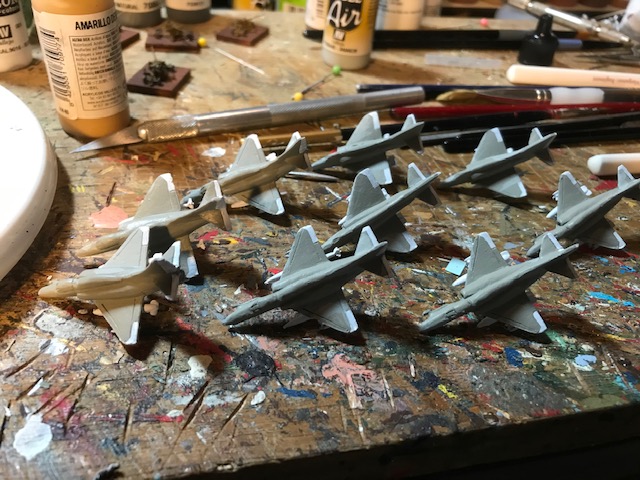
1/300 A-4F Skyhawks-George passed on a pile of these to me a while back, and I truly appreciate it.  There were 18 humpy backed Skyhawks and I’ve decided to divide them equally between USMC and USN versions.  These are the later versions of the little attack plane that remained in service all the way through Desert Storm, and certainly fought off the North Vietnamese 1972 offensive. I’ll find something useful for them to do. The miniatures are from Scotia and NavWar/Heroics and Ros.  Decent miniatures. I’ve tried to equip them with ample drop tanks and bomb loads.  They’ll appear in light gull grey and white.

A-4s

What I’m Listening To

R-3646597-1338831253-8164.jpeg

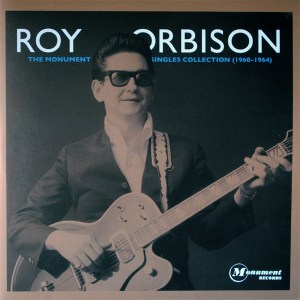
I’ve really enjoyed having the two stereo systems so I can listen to music wherever I am.  Lots of great albums on the turntables, including The Lovin’ Spoonful, The Isley Brothers, The Grateful Dead and The Eagles. But I’ve really had a great time listening to a Roy Orbison anthology-The Monument Singles Collection 1960-1964.  This two LP set issued by Music On Vinyl has mono mixes of all the great Orbison songs from the early 60’s-“Pretty Woman,” “Crying,” “Blue Bayou,” and my favorite “In Dreams” are all there in heart-rending glory with Roy’s absolutely inimitable voice.

Generally not a big fan of anthologies and Orbison has a zillion of them.  But he is also one of those artists who profited from the sale of ’45’s and not so much from LP sales.  This is definitely the best of the lot.


WWII Down Under: The RAAF and RNZAF

P-40 C

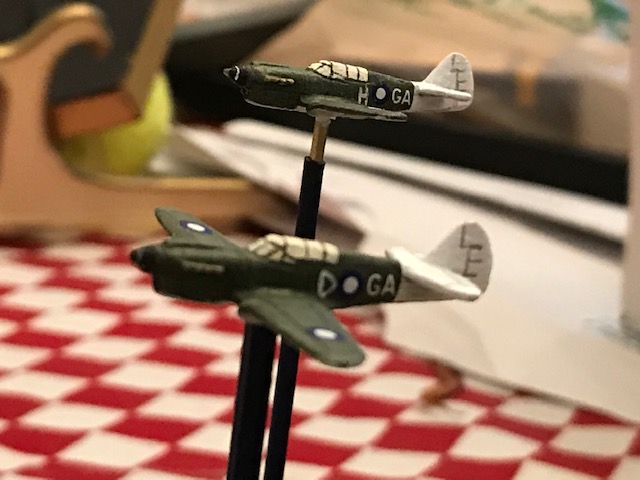
These excellent Scotia P-40N’s are in Australian markings.  They are in the distinctive colors of the 80th squadron in Foliage Green with white tails and no tail flash. A joy to paint, with markings by I-94 Enterprises.

A few months ago I picked up the Osprey Air Campaign book on Rabaul.  The effort to isolate this important Japanese supply base by air was long and pretty interesting.  It also included American, Australian and New Zealand aircraft.  The Rabaul campaign was closely linked to American and Australian efforts to secure New Guinea and the Solomons before launching offensives at the Philippines.

It’s the perfect campaign to generate games for Airwar 1940, at least the way I enjoy the game.  Bomb stuff, intercept the bombers, shoot stuff down.  It’s easy.  And the usual suspects are there.  For the most part, it’s the Japanese naval aircraft defending the island and shipping, while also attempting the occasional counter-punch.  Zeroes, Vals, Kates, the usual suspects are the defenders.  Lots of American naval aircraft-TBFs, F6F’s,  SBD’s and SB2C’s, with some AAF B-25’s, B-24’s and P-38’s thrown in for good measure.

For sure, I’ll be doing some of both, but right now I’m more intrigued with our allies in this campaign, the Aussies and New Zealanders. The Royal Australian Air Force is an interesting collection of American and British planes that is fairly unique.  Lots of P-40’s in its various iterations from E models to N’s.  The RAAF also includes a few B-25’s, and acquired, eventually, a lot of B-24’s, mostly J models. But, the Australians also include a ton of British planes.  Beaufighters and Beauforts were used against Rabaul.  In addition, there are plenty of Australian Spitfires, a fair number of Mosquitoes and the domestically designed Boomerang, and a host of other planes used in smaller numbers.

New Zealand went an entirely different route, procuring only American aircraft for their somewhat smaller air force.  The NZAF sent P-40E’s and SBD’s to bomb Rabaul.  But they also flew various version of the F4U and TBF’s.

If this is a topic of interest, I’d encourage seeking out a copy of the 1970 The Royal Australian and Royal New Zealand Airforce in the Pacific by Rene Francillon.  It’s an Aero Pictorial publication.  No color photos unfortunately, but lots of black and white and lists of every plane type and numbers of each for both countries.  My well-thumbed used copy was ten bucks and worth every penny.

P-40 A

A quick shot of the lot.

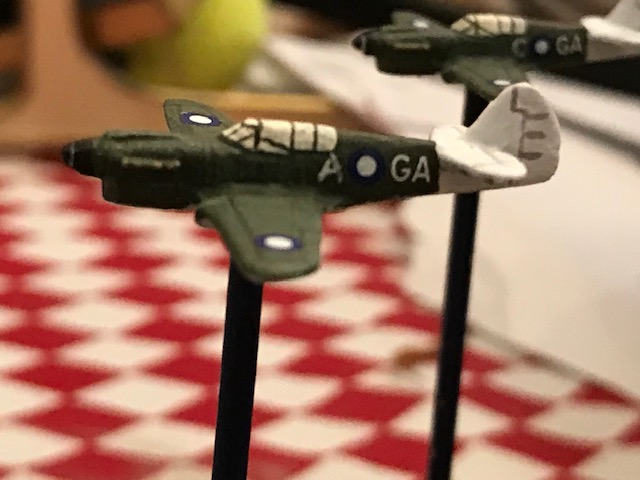
I’ve painted my first planes.  I’ve had four very nice Scotia P-40N’s for well over a decade and not quite sure what to do with them. So, I went with the white tailed Australians of 80th Squadron that mostly flew over New Guinea, but could have made it to Rabaul as well.  The miniatures are well-cast, look right for the later model Curtiss fighter and were a joy to paint.

P-40 B

Shot up close. Not bad. Remember they’re about quarter-sized.

This squadron painted their planes Foliage Green, which was popular in the RAAF. Unfortunately I couldn’t find any Vallejo bottles labeled Folage Green despite having six sets of their air colors.  So I went with US Dark Green from the Vallejo USAAF CBI set. It has a slightly greener cast than an olive and seems to suit both the Australian and New Zealand planes.  After letting it dry I lightened it with a little bit of white and dry brushed and got a decent weathering effect.  Then it was on to the white tails. Underside with USAAF light grey. Voila.

The marking were from I-94.  I used set BR106 which is for the British in SE Asia, but include Australian markings.  I used the squadron markings for 76th Sqdn., but who cares.  They are great.  They don’t go a long way.  I think I’ll have enough appropriate markings to do my next batch of planes, six Beaufighters, but I’ll need to find a different solution. I’m thinking Flight Deck Decals .

BR 106

A quick screen scan of  BR-106, the decal sheet for RAAF by I-94 Enterprises.

On the Painting Table

I’m working on my Philippine figures for my Philippine project.  I actually bought a few more in October, just before leaving for Hawaii.  I am currently working on more bolo-armed troops from Miniaturas 1898.  They are a pleasure to paint.

Beaufighters have a base color.  They are just waitin’.

What I’m Listening To.

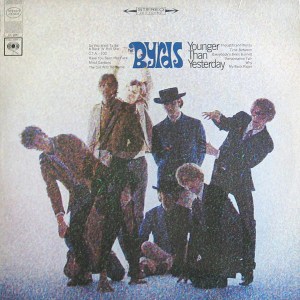
The Byrds-Younger Than Yesterday.

Younger Than Yesterday

This is a great record, the last of the Byrds albums featuring the classic line up of “Mr. Tambourine Man” and “Turn! Turn! Turn!”  David Crosby would leave for CSN, and drummer Michael Clarke moved on.  The album is great and features three dynamite songs.  “So You Want To Be A Rock and Roll Star” is a terrific Chris Hillman/Roger McGuinn composition full of those wonderful harmonies and jangly guitars the band was so famous for.  “By Back Pages” is a Dylan cover, and a truly memorable version of this song.  Crosby and McGuinn share the songwriting credit for Renaissance Fair, another great tune that reminds the album came out in February 1967, anticipating the Summer of Love.

Making Rice Paddies

One of the important aspects of this hobby I feel less skilled for is building stuff.  I’m always amazed when my friends are able to create.  One of the best parts of working with Mark Waddington was the man could build ANYTHING.  Well that, and he’s just one of my favorite people.  Those who can imagine and build buildings, a town, a waterfront, my hats are off to you.

Me, I usually just buy stuff, so my boards are boring and sterile.  But the for the Philippines, I simply have to have terrain bits and lots of it.  I’ve built my bamboo forests, there will have to be jungle terrain.  And one other important feature of all Southeast Asian campaigns whether it’s the Philippines, Indochina/Vietnam, Malaysia or Burma is the rice paddy.  If people live near your battlefield, rice paddies are a must.

There are lots of different approaches to take.  This is a link to the paddy project on the Tactical Painter blog.  His approach looks great, but I have different plans.

One important difference is I want to make rice paddies for 28mm.  I also chose some different materials.  That doesn’t mean my way is better, it’s just my way.

Paddies 1

These are all the materials and tools I used to to cobble together the four paddies after cutting the 12″ squares in half with my jigsaw.

I started with craft plywood for the bases.  I buy it from Michael’s, and it’s easy to get.  It’s 1/8″ thick, so thin enough to work with.  It comes 12″ square and I divided those in half, two sheets to make four 6″ X 12″ rice paddies. I built an elevated border around each paddy to represent the path that most grunts had to walk along in Vietnam, and figured they were probably the same in the Philippines. I used basswood strips.  I like basswood better than balsa because it’s sturdier and less porous.

Paddies 2

My carpentry skills are about as bad as they come, but I decided to miter the edges of the basswood sticks that form the edge of the fields. Made some mistakes, but it worked out in the end.

I actually invested in some stuff for this project.  I bought a new razor saw for my X-Acto gear, as well as a miter box.  I actually cut the 45 degree angles because . . . well just because.  Made a few mistakes along the way, but it all seemed to eventually work.  I glued everything down with Elmers wood glue and let it sit for a good long time.

Paddies 3

I used lightweight spackling compound to form the slopes and fill the joints on the paddy fields. I left it to dry overnight before sanding.

The next step is to fill gaps between the basswood and create a slope down to the growing area.  I couldn’t quite decide what to use.  I considered using modeling paste that I use for my bases.  It dries fast, and because it is acrylic, dries hard.  I decided to use lightweight spackling compound instead.  It is a little harder to work with, but easy to sand.  I didn’t worry about keeping straight lines along the edges from top to bottom.  Those slopes wouldn’t be perfect.

I finished applying spackle and let it dry overnight and into the following afternoon. The next step was sanding most of the rough edges. I started with fine sandpaper, and moved to my Dremel tool’s sanding discs.  It went faster and achieved my purpose.  It also allowed me to even up the outer edges of wood which I didn’t manage to get entirely straight with my jigsaw. After each paddy was sanded, they were sprayed with Testor’s Flat Olive green as a base coat.  They were left to dry overnight.

Paddies 4

I sprayed each field with Testor’s Olive Drab. It’s what I had and it’s a good base color. After that I mixed Vallejo Yellow-Green and White to create a contrasting color for dry brushing the edges. Then I created an even lighter version for further contrasts.

The next step was dry-brushing the the paddies.  I wanted to lighten the slopes and tops while darkening the paddies themselves a bit.  To lighten I dry brushed using Vallejo Yellow-Green, lightened with some Vallejo White. I used a large flat brush.  I did two coats, the second lightened even further.  A final round of dry brushing used a little bit of Vallejo Burnt Umber to darken up the middle of the paddy where the rice would be planted.  It was fine for it to be splotchy.  I just wanted it to darken up a little bit and provide a good contrast with lightened edges.

Paddies 6

A final step in the dry-brushing was to use Vallejo Burnt Umber in the middle of the fields. I was just looking for a splotchy, irregular darkening that would show through the gloss gel I’d use over the top.

I followed that up by adding some turf and tufts by Army Painter.  I put the groundcover in random areas, to allow the dry brushing to show through.  After each paddy was completed.  I sprayed each with dullcoat twice.  I wanted to be sure to keep everything in its place.

Paddies 7

I flocked the edges irregularly and applied tufts. I tried to let the dry brushing show through where possible. I wanted an irregular, natural look. Then I added some tufts. I sprayed each paddy with Dullcote twice, to keep things in place. Note: It’s critical to do this before applying the clear gel medium or it will flatten your shiny surface.

Because the paddies are wet, I needed to show the shining surface of the flooded field. There are so many great products available now, from simple clear varnishes to liquid epoxies.  I took a middling approach and brushed all with Liquitex Super Heavy Clear Gloss Gel Medium. Again, I applied it with a large flat brush.  It took about half and hour to paint it on all four paddies.  Then I listened to Steely Dan’s excellent Aja from 1978, and applied a second coat.
Paddies 12

I used Liquitex Gloss Gel Medium applied with a wide flat brush to create the water effects. I did one coat, making sure to get in the crannies of the slope I’d created, then did a second coat of just straight strokes covering the swirls I’d made the first time.

Paddies 8

Voila!! We’re ready for the terminal stage.

Paddies 13

Leadbear’s excellent tufts. 140 of the small tufts per box cost about seven bucks US. They are the best of the tufts I’ve worked with.

To represent the growing rice, I decided to use tufts.  I didn’t want the tufts to be too tall, for fear putting figures on them would just smush them.  I also wanted something easy.  Tufts are a lot easier than attempting to clump together static grass in a pool of clear Elmer’s so tufts were certainly an answer. I’d seen a blurb on Facebook from a friend that he’d recently purchased tufts from Leadbear.  Another friend showed me his considerable collection of Leadbear tufts, and I was impressed.  It happens that Leadbear also has a Facebook page, so I decided to give him a try. Leadbear is Barry from Australia.  He’s a great guy.  His range of products is considerable.  Prices are inexpensive and the shipping isn’t bad.  I’d received my order in August, but hadn’t used them yet-because I always use up what I already have.

I used the 4mm green tufts I’d ordered.  I thought I would keep them in tidy rows.  Great idea.  The tufts themselves were great.  They were irregular in ways those by others I’ve tried aren’t.  They are super sticky in the ways that others aren’t, so no glue.  I hope I don’t regret it later. Of course, because I’m old and half blind, my straight lines and tidy rows wander a bit, as I expect they might in real life.  I used up some two and a half boxes of the three I purchased for the four sets of fields.

Paddies 10

Paddies 11

Done. I think I worked on these over three days. It did require some patience and waiting time, but I feel like it was worth it.

That’s it.  I’m happy with the way they look.  It’s always fun to make something.  I’ve had the materials to do this for some time.  I didn’t feel like painting figures this week, so this was needed and enjoyable diversion.  It did require some patience, which is so unlike me, but it’s one less thing to do later at then end of this project.

The Inaugural Truant’s Session: The Guns of Fort Pickens

One of my post retirement goals has been to create one Friday per month for a game day for we ne’er-do-well retirees as well as those who might have Fridays off.  I posted on our Facebook page and our yahoogroup about doing this and received a fair number of responses.  I was concerned  whether it would actually happen or not, but when I pulled up to Game Matrix, Al Rivers was there to meet me, and all was right with the world.

I decided to run an Ironclads game. It was a game I ran at Enfilade a few years ago.  Probably more ships than I should, but at least I knew the game well.  The hypothetical game was based on a hurricane wiping out Farragut’s fleet outside Mobile Bay, followed by a Confederate attack on Fort Pickens and Pensacola.

I set up the fort on its island in Pensacola Bay.  There is a relatively narrow channel, thinned even further by a dangerous bar.  At either end of the shallows are even narrower ship channels.  The Confederate victory conditions required bombarding the 1830’s era fort with their interesting and mixed forces, hoping to compel a surrender.

For the game, Dean and Al commanded Franklin Buchanan’s Mobile Defense force.  Al ran the three wooden gunboats Morgan, Gaines and Selma, as well as the ironclad ram Tuscaloosa, the weakest of the ironclads available to the Confederates. Dean ran the ironclads Tennessee and NashvilleTennessee was the best armed and armored vessel in Buchanan’s fleet.

Scott ran two English-built vessels, the Stonewall and North Carolina (aka, HMS Scorpion) commanded by Raphael Semmes.  Both were well armored and had powerful armament.

Pickens 4

Bay Area Yards excellent Fort Jackson model which stood in for Fort Pickens. Pickens was actually a pentagonal fort, much like Sumter. But I loved having the excuse to play with it. The view across the table shows Scott’s armored frigates. heading away from the fort toward the opposite ship channel

In the Enfilade game the Confederates all gathered at the entry point, closed with the fort and pounded two faces of the fort to pieces, and Pickens surrendered to easily win the game.  I changed things a little bit to even things up.  The earlier game was played on a six foot wide table.  Yesterday we played on a five foot wide table.  That meant the Union relief forces would get into the action that much faster.  I also added two earthworks commanding each of the ship channels to the harbor’s defenses.  Things were about to get tougher for the Johnnies.

Yes, there was Union relief.  For the Enfilade game, there was a complicated series of choices for the Union player to meet about their composition.  I didn’t know who I would have to play and how much they knew about the period, so I chose their forces.  I gave them the Saugus, one of the larger Canonicus class monitors, and the Lehigh, one of the smaller Weehawken class monitors. Ralph ran the Lehigh, and Phil ran the Saugus.

Pickens 7

Al’s gunboat flotilla presses toward the fort. The little wooden ships will suffer terribly from fire.

Pickens 8

Dean’s Nashville and Tennessee begin to line up the fort and earthwork for fire. Phil’s Saugus can be seen around the point advancing on the Confederates.

The game began with both sides moving on to the table. Scott drew his two large ironclad frigates off toward the far ship channel and away from Fort Pickens.  This had an important effect on the game, as his ships had the largest guns, effective for fighting the Union ironclads, but also most effective for reducing the fort. Al and Dean cautiously closed with the fort, firing as they went.  Dean’s ironclads suffered minor damage.  But Al’s wooden vessels, though randomly targeted, rapidly took serious penetrating fire from the fort.

Pickens 3

The North Carolina and Stonewall wait for the Lehigh in left background.

Ralph and Phil split their monitors.  Ralph moved to engage Scott’s ironclads.  At long range, it was a fairly even fight.  The Lehigh, unique among her class, had a heavy rifle to go with its 15″ smoothbore. Engaging the North Carolina with its four heavy rifles kept things fairly desultory, but when the ships closed, the Confederate vessel pounded the little Union ironclad to wreckage.  Though Lehigh managed to wound the bigger frigate, the monitor was forced to strike. However, it bought something just as important-time.

Dean and Al continued to pound Pickens.  But Buchanan’s ships were chiefly armed with 6.4 inch and 7 inch Brooke rifles, an admirable weapon, but mostly a medium gun.  To be effective required pretty close quarters.  Al tried that and his wooden vessels paid the price.  The Selma suffered a steam critical.  Then Phil steered the Saugus into the action, Firing his 15″ guns at Al’s wooden ships at close range, the Gaines was ripped apart and sank, and the Morgan was badly damaged.

Pickens 2

The Tuscaloosa follows Selma, Morgan and Gaines as they get their broadsides ready to unleash on Fort Pickens.

Dean’s ironclads remained at medium range, peppering the fort and doing some damage, engaging the Saugus when it entered the battle.  But the Nashville also began to accumulate damage from fire from the fort and the earthwork.

As the clock neared 3:30 I had to shut down the game.  In the final turn the Lehigh was wrecked and the North Carolina suffered a steam hit, and the Stonewall was sailing toward the fort.  All of Al’s gunboat fleet was severely damaged, except the Tuscaloosa which was relatively untouched. Dean’s Nashville was nicked up, and the Tennessee was still blazing away.  Phil’s Saugus had been knocked around, but could still effectively deal 600 lb projectiles every other turn.  Fort Pickens, while pretty beat up, hadn’t suffered the critical damage in crew, gun losses or magazine explosions that would force its surrender. Union wins.

Our next gathering is October 24th at the Game Matrix.  Maybe we’ll see you there.

Pickens 5

I claim the role as chief truant for this game. Al Rivers studies his charts.