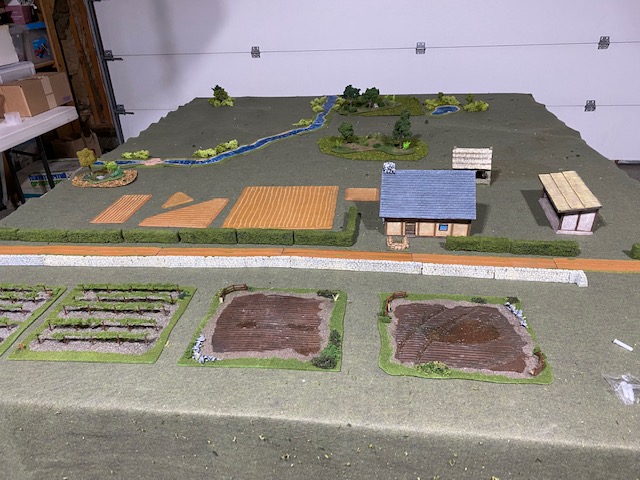
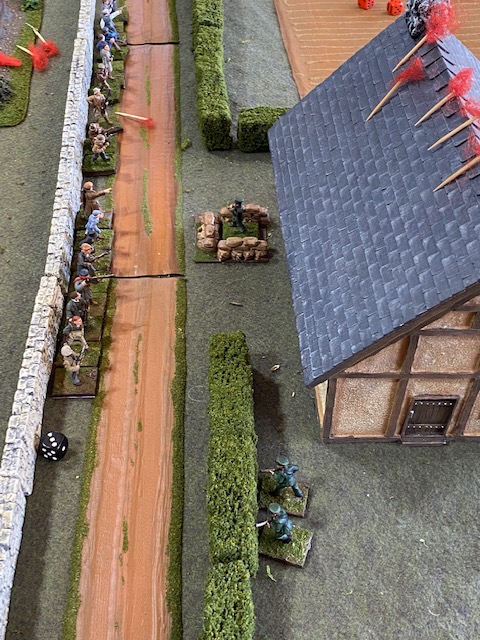
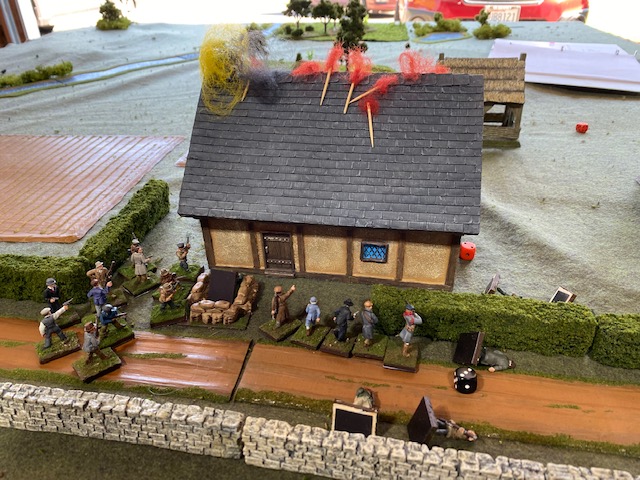
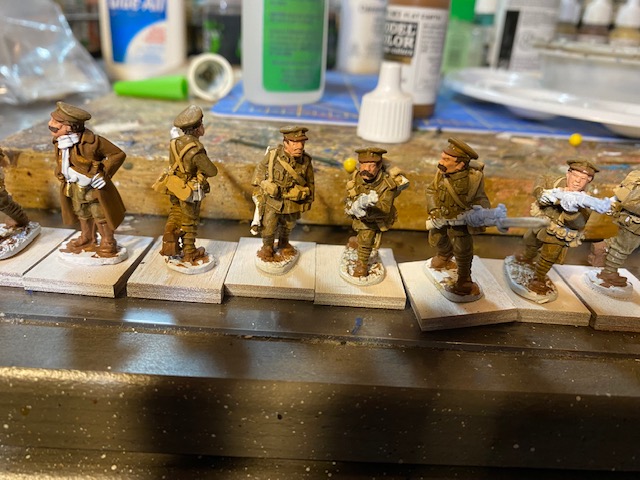
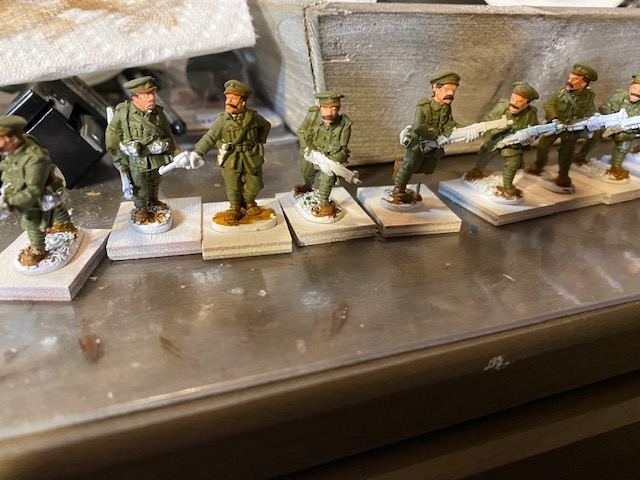
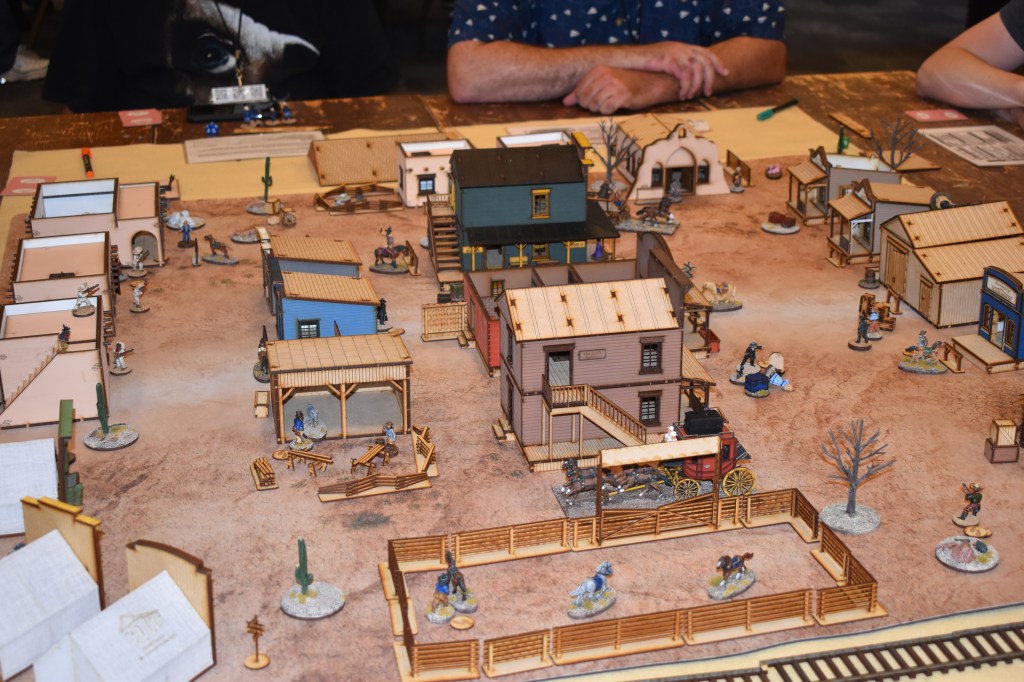
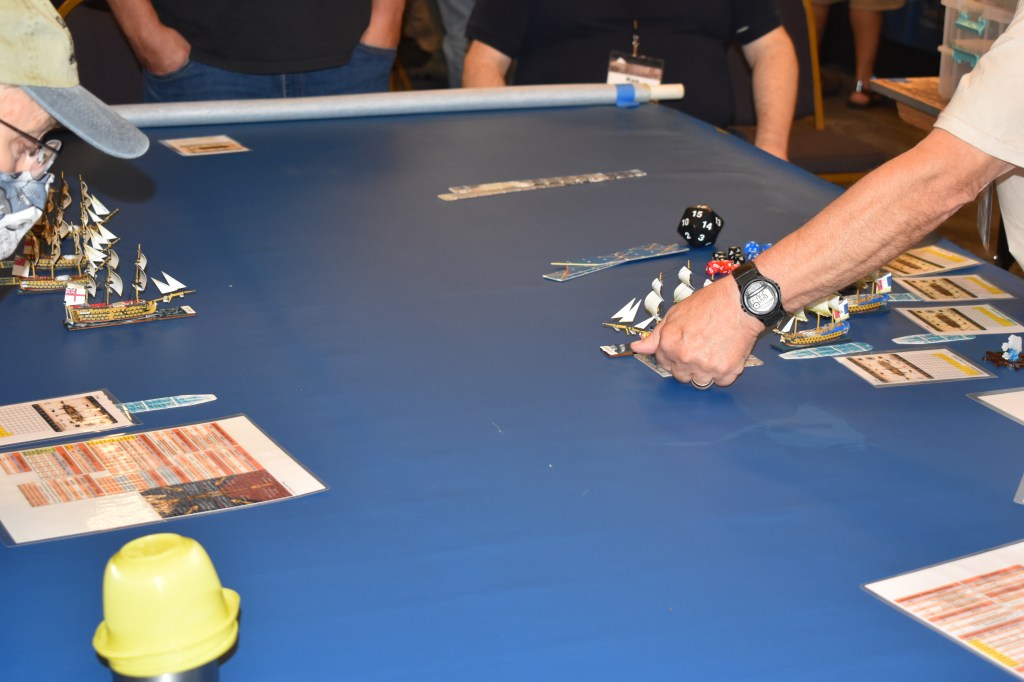
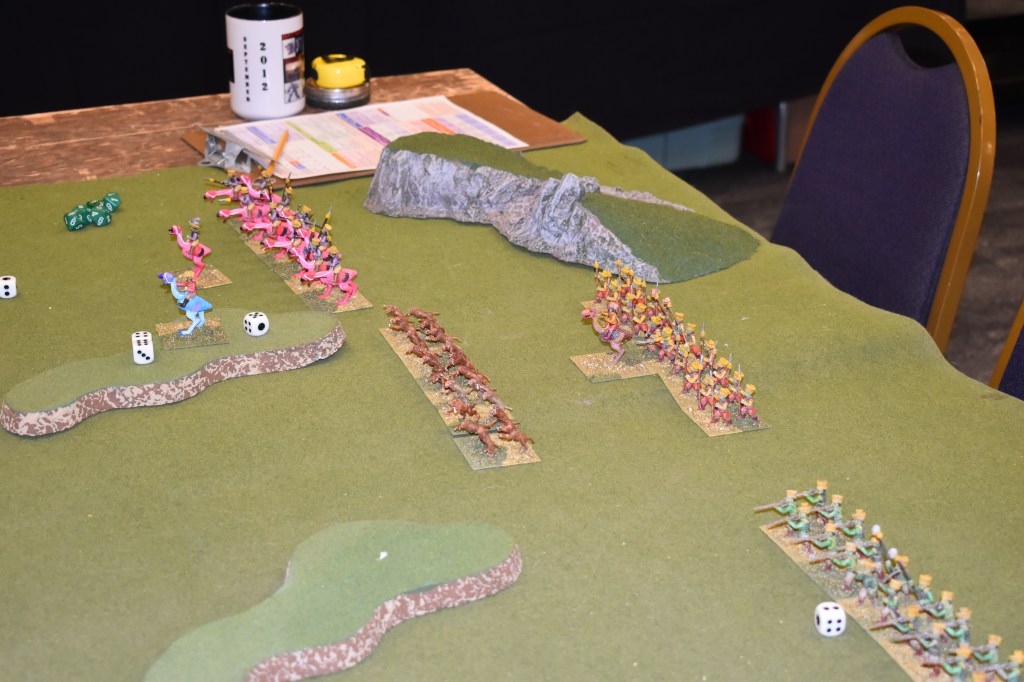
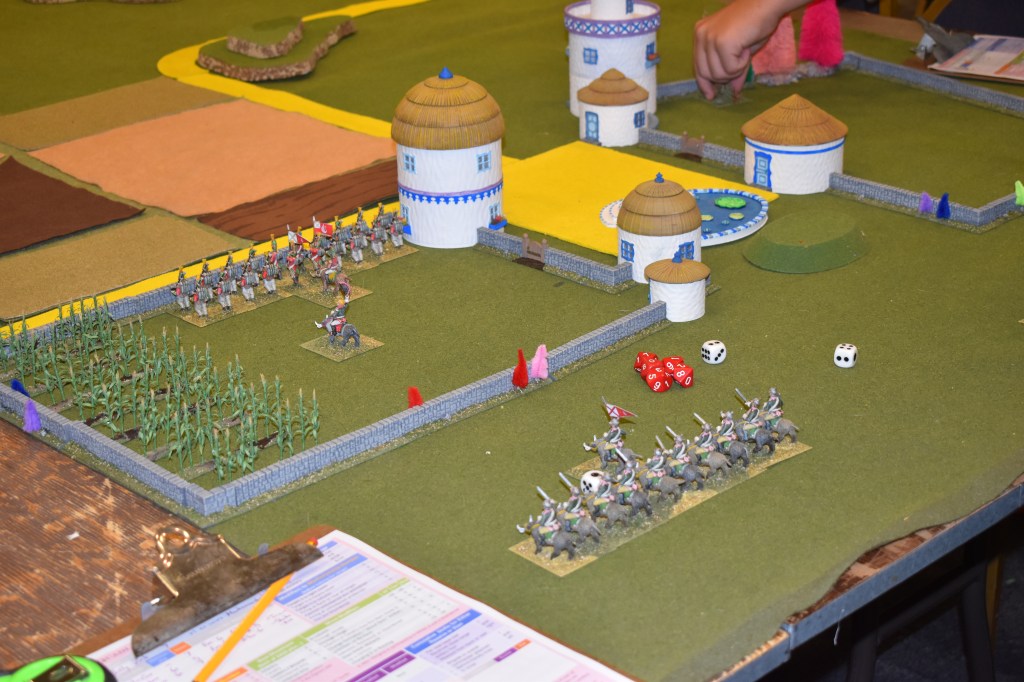
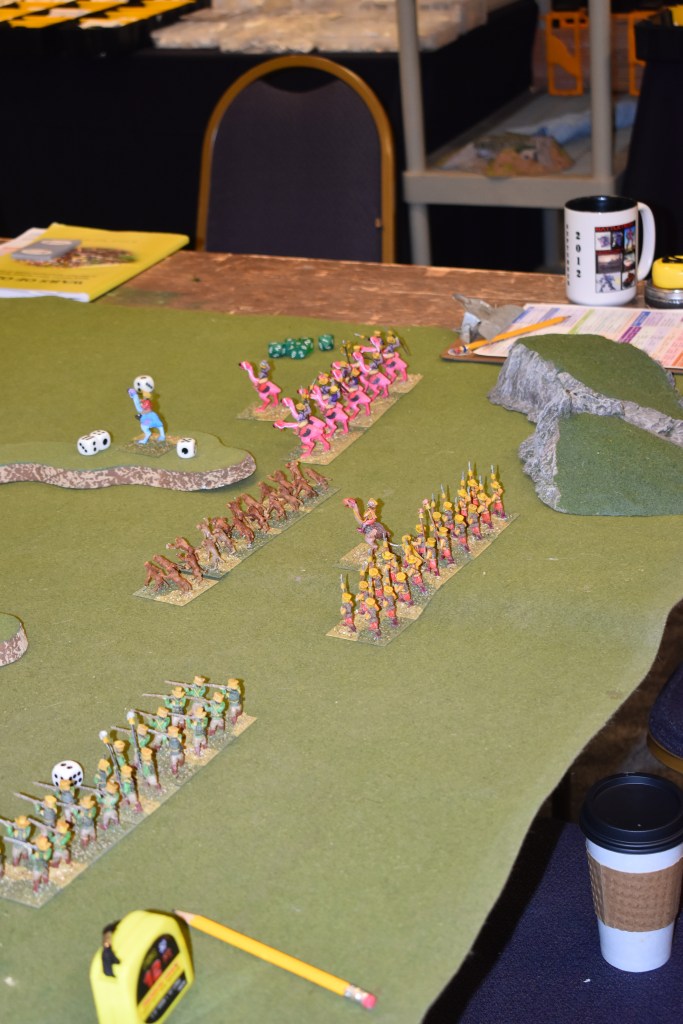
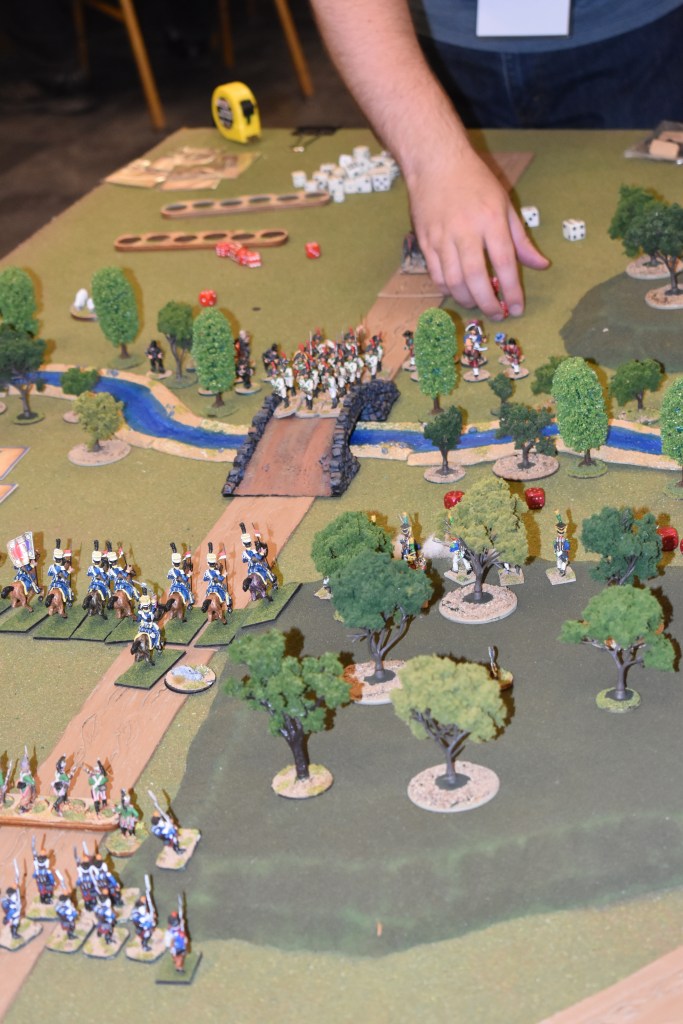
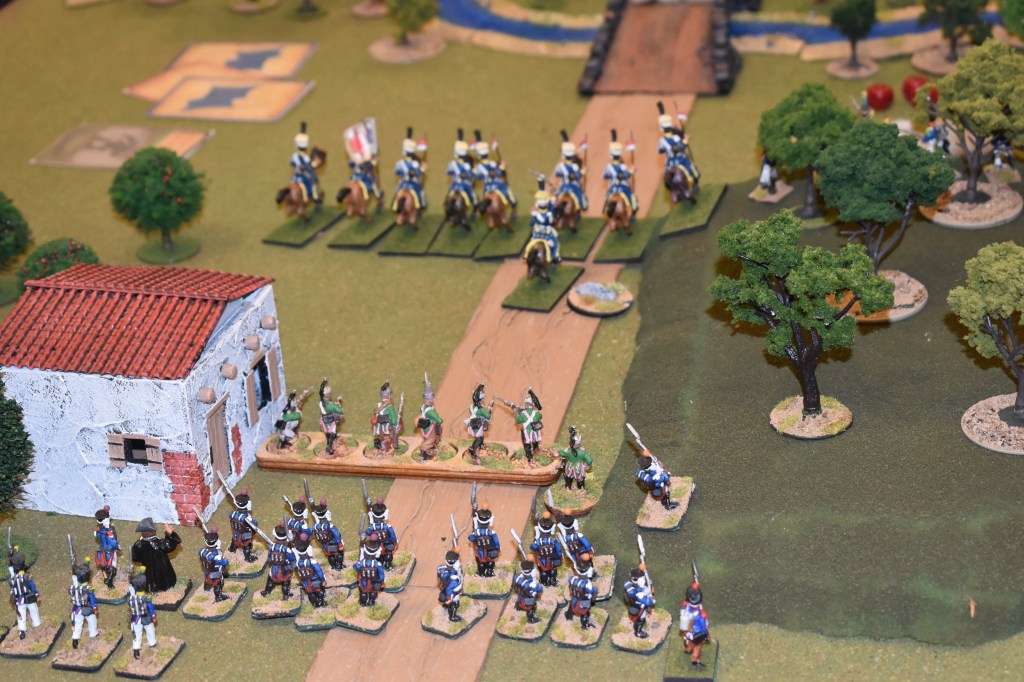
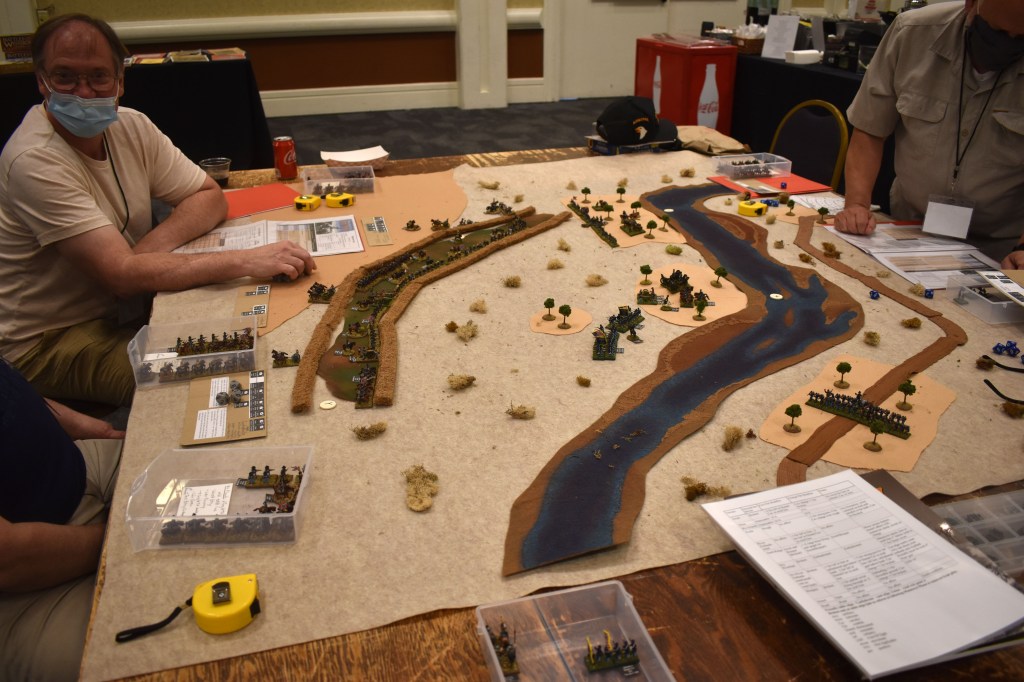
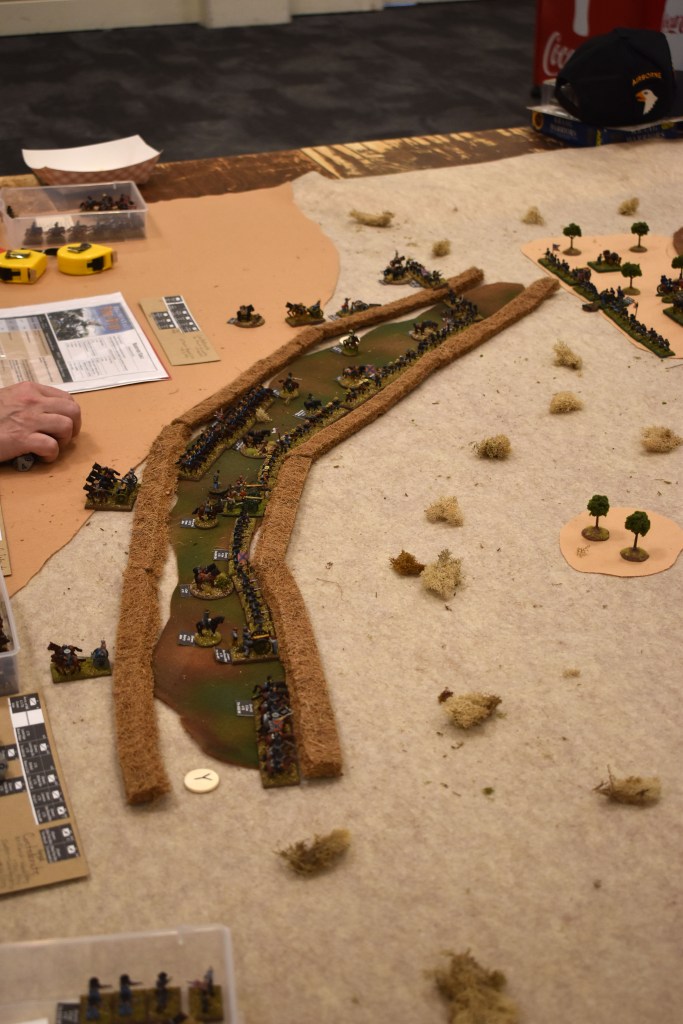
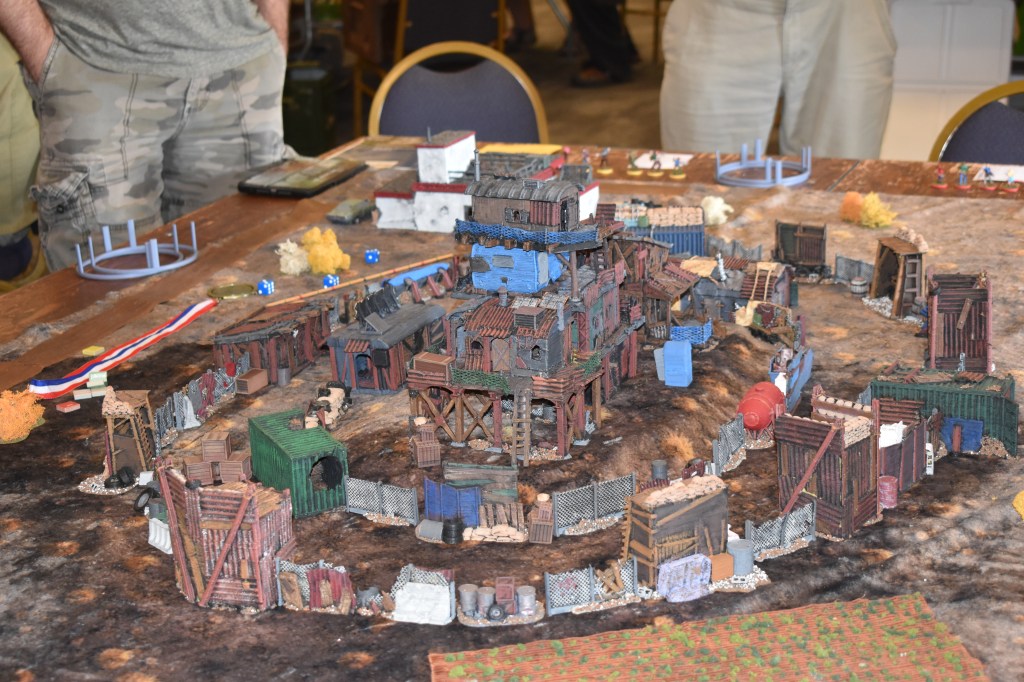
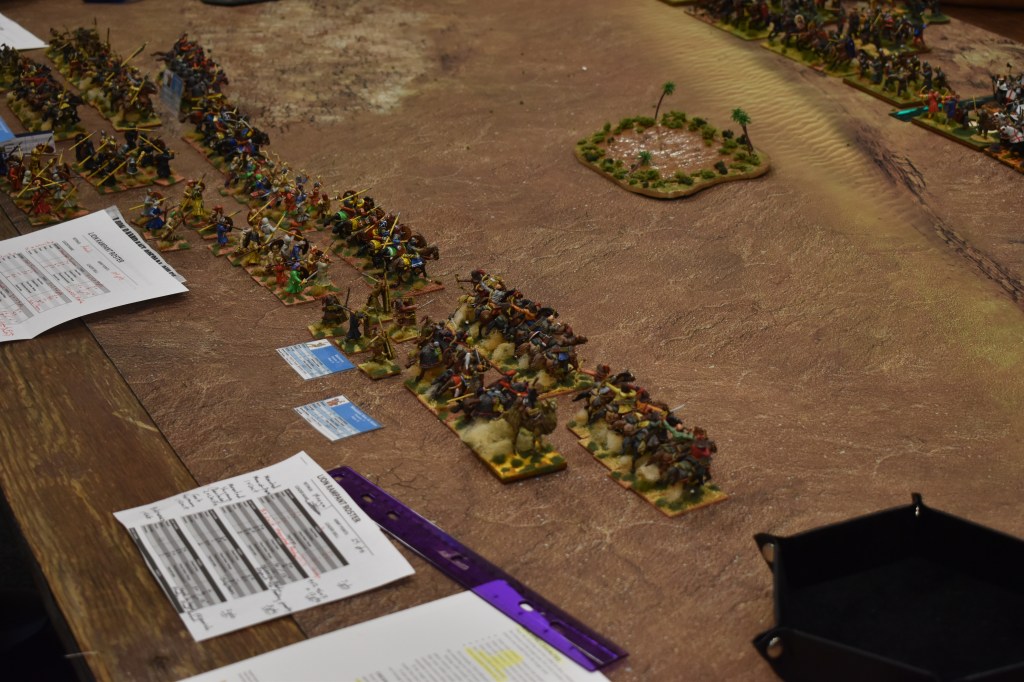
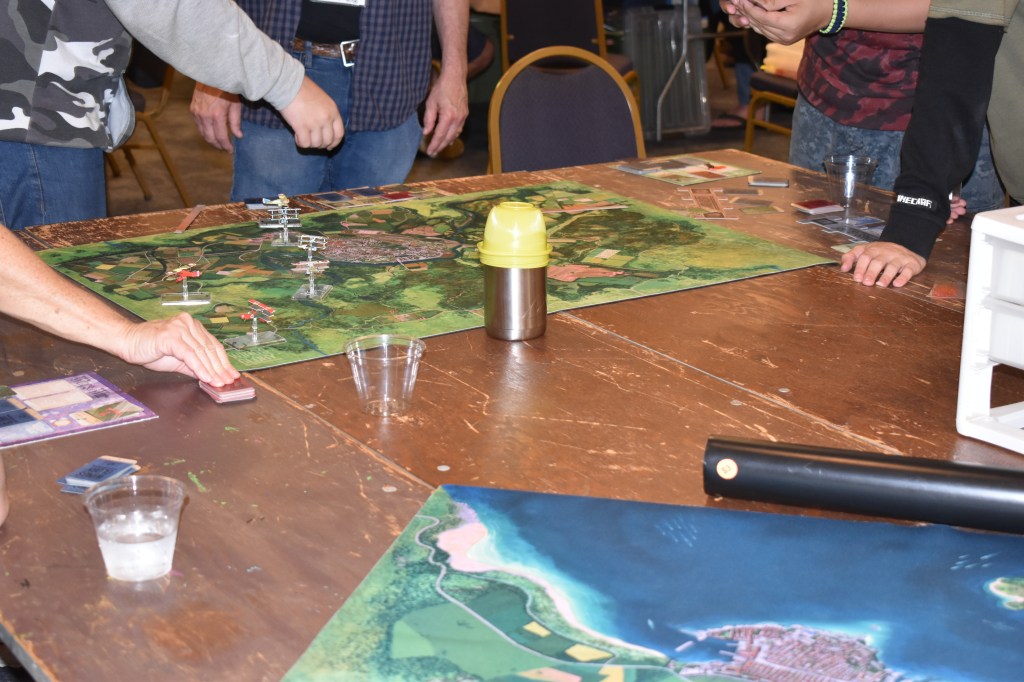
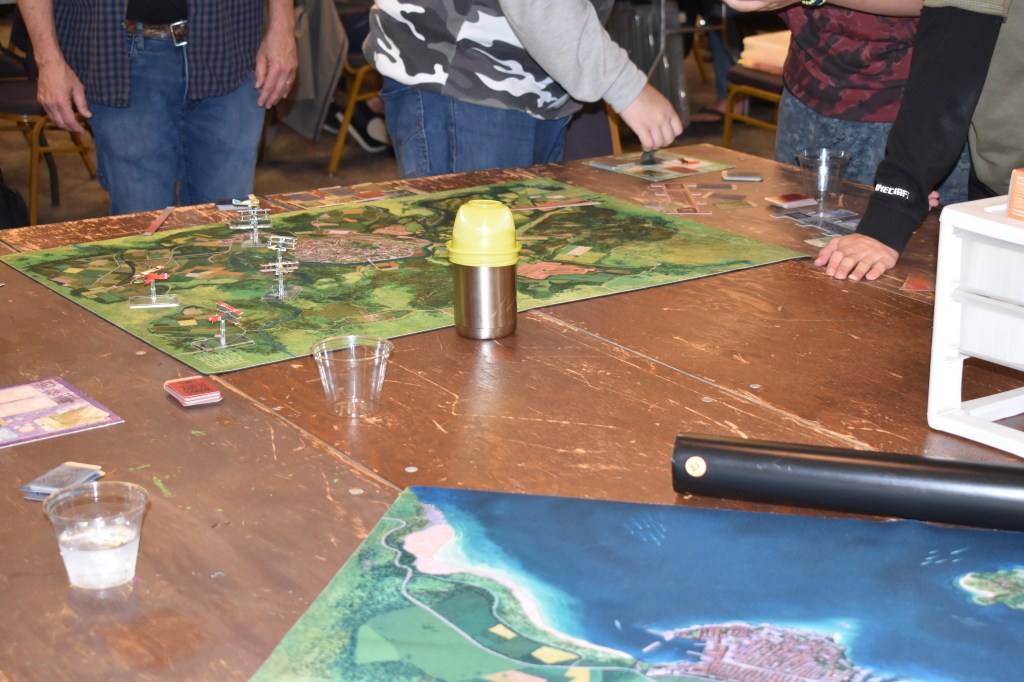
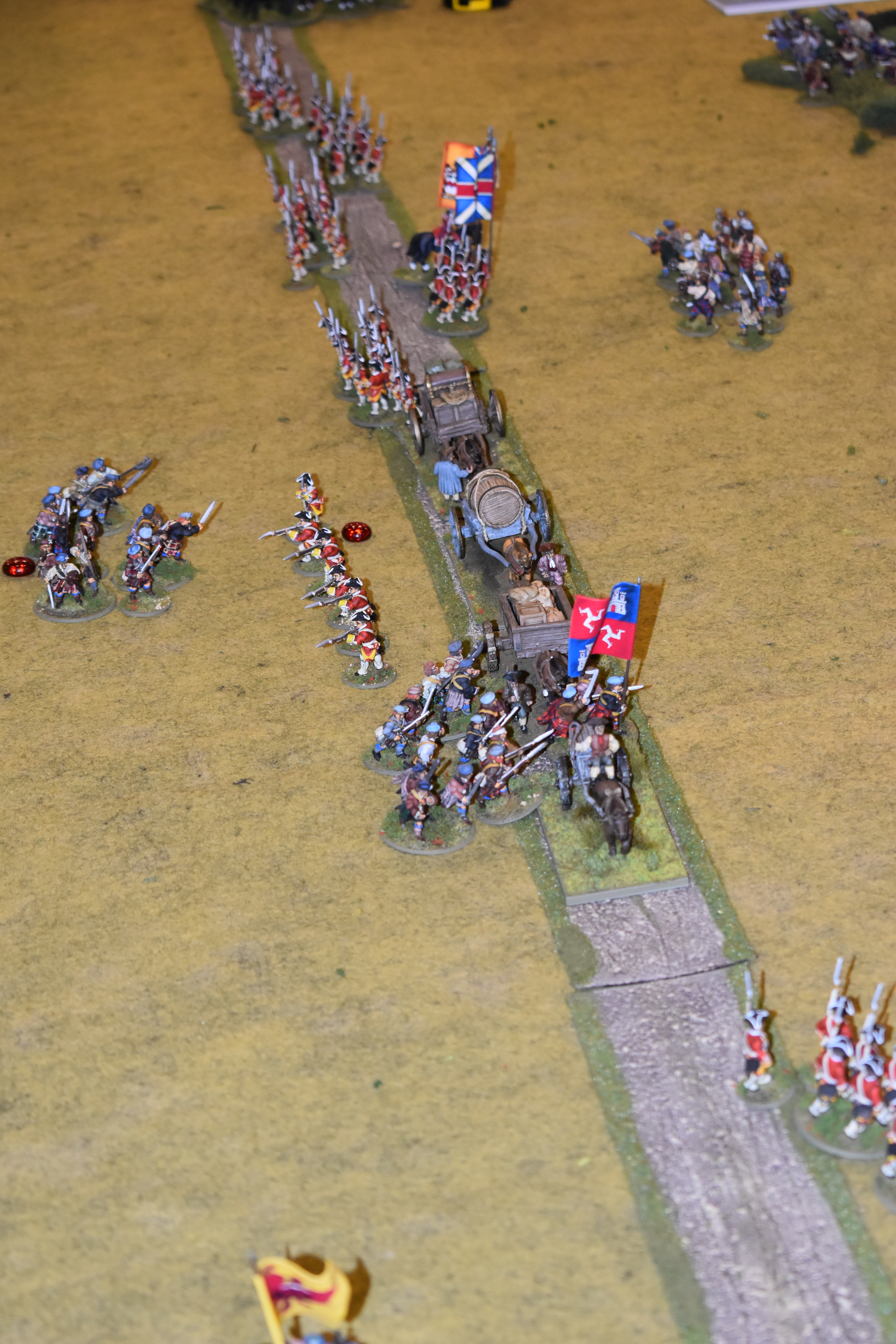
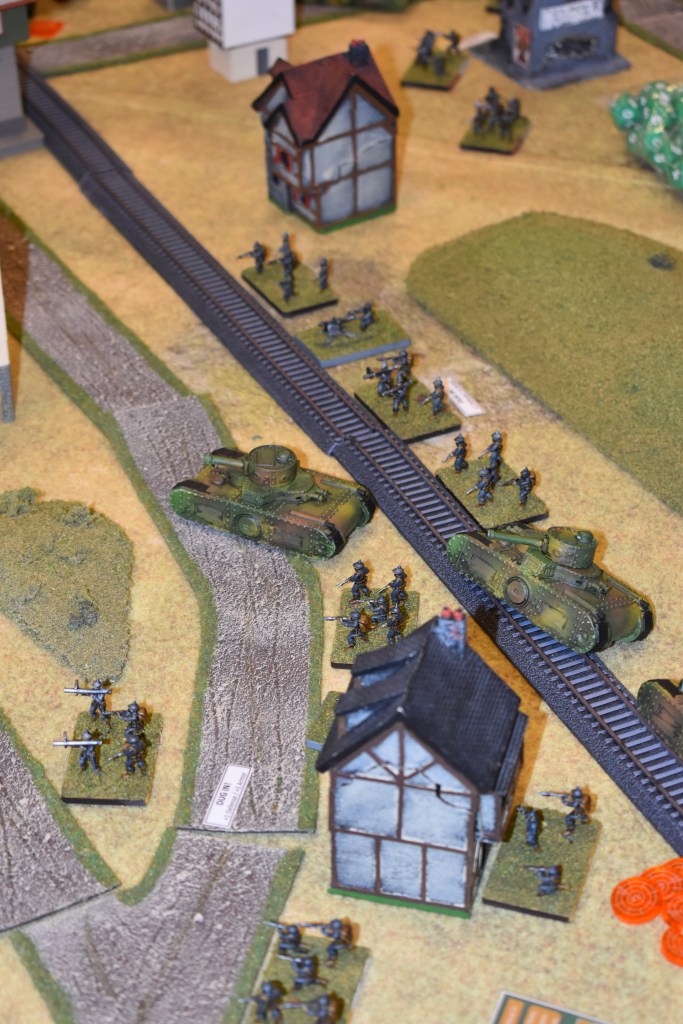
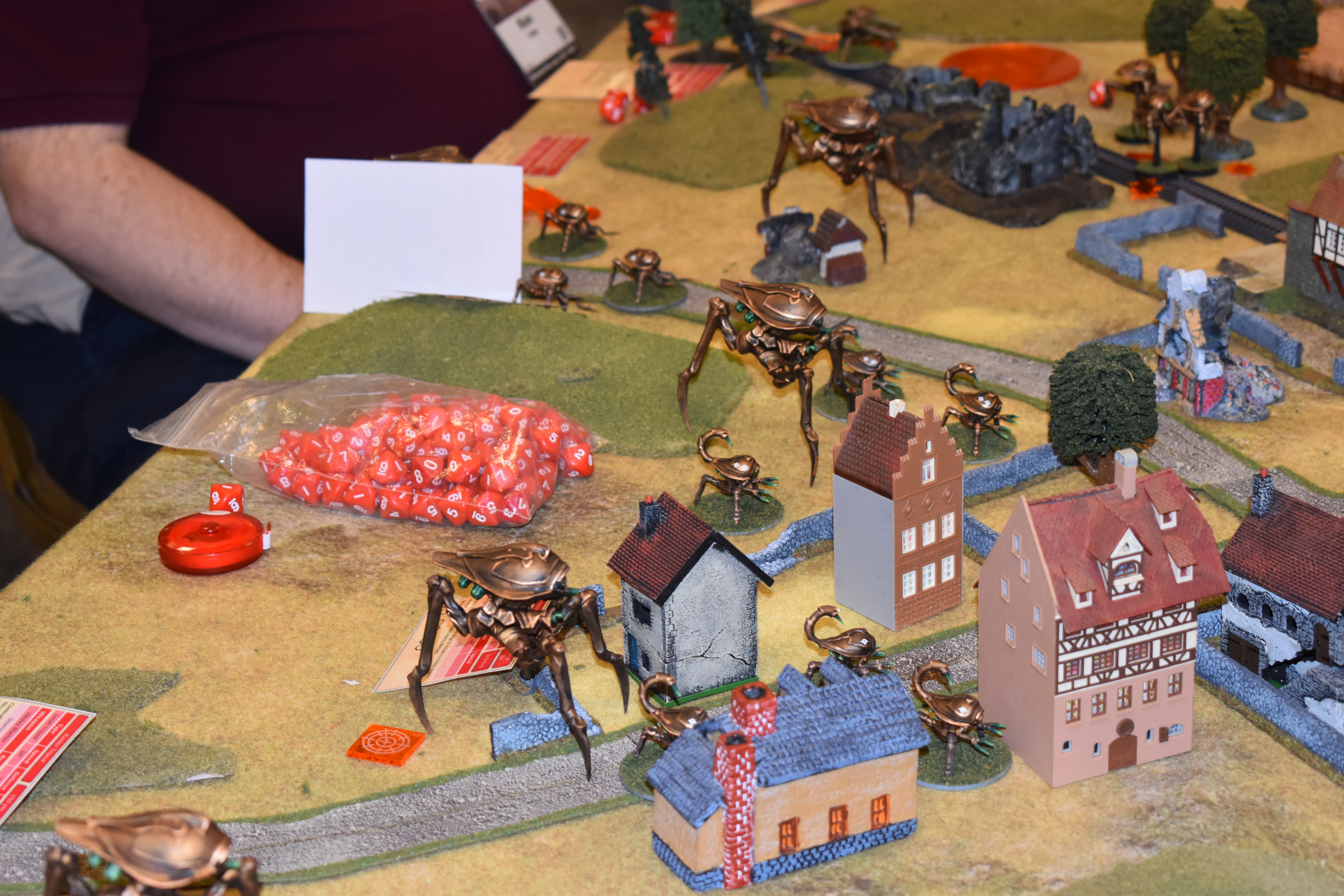
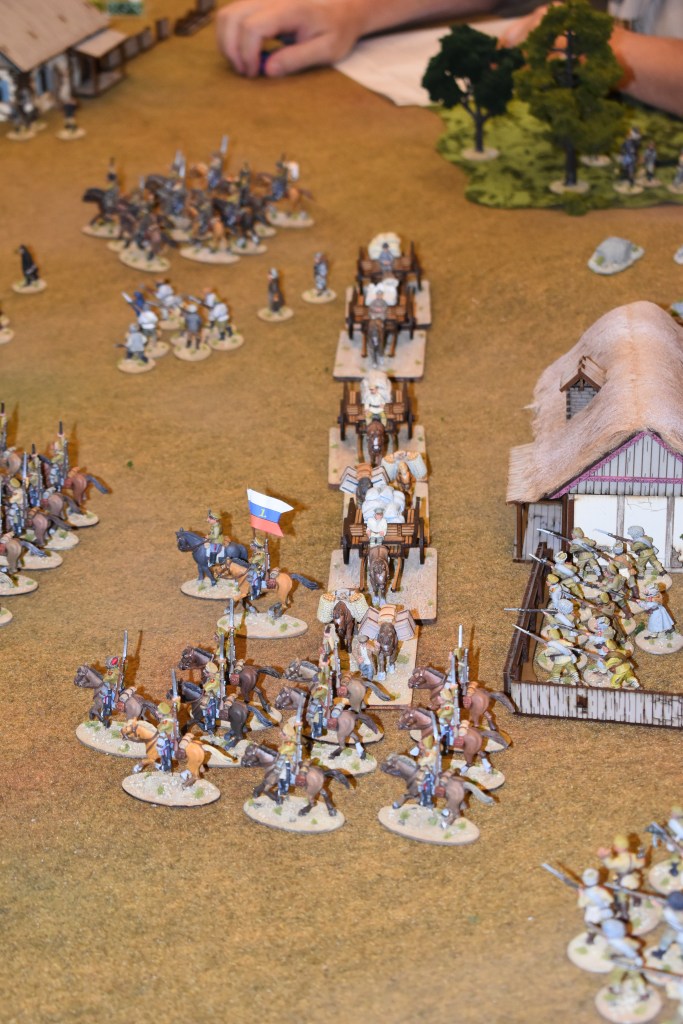
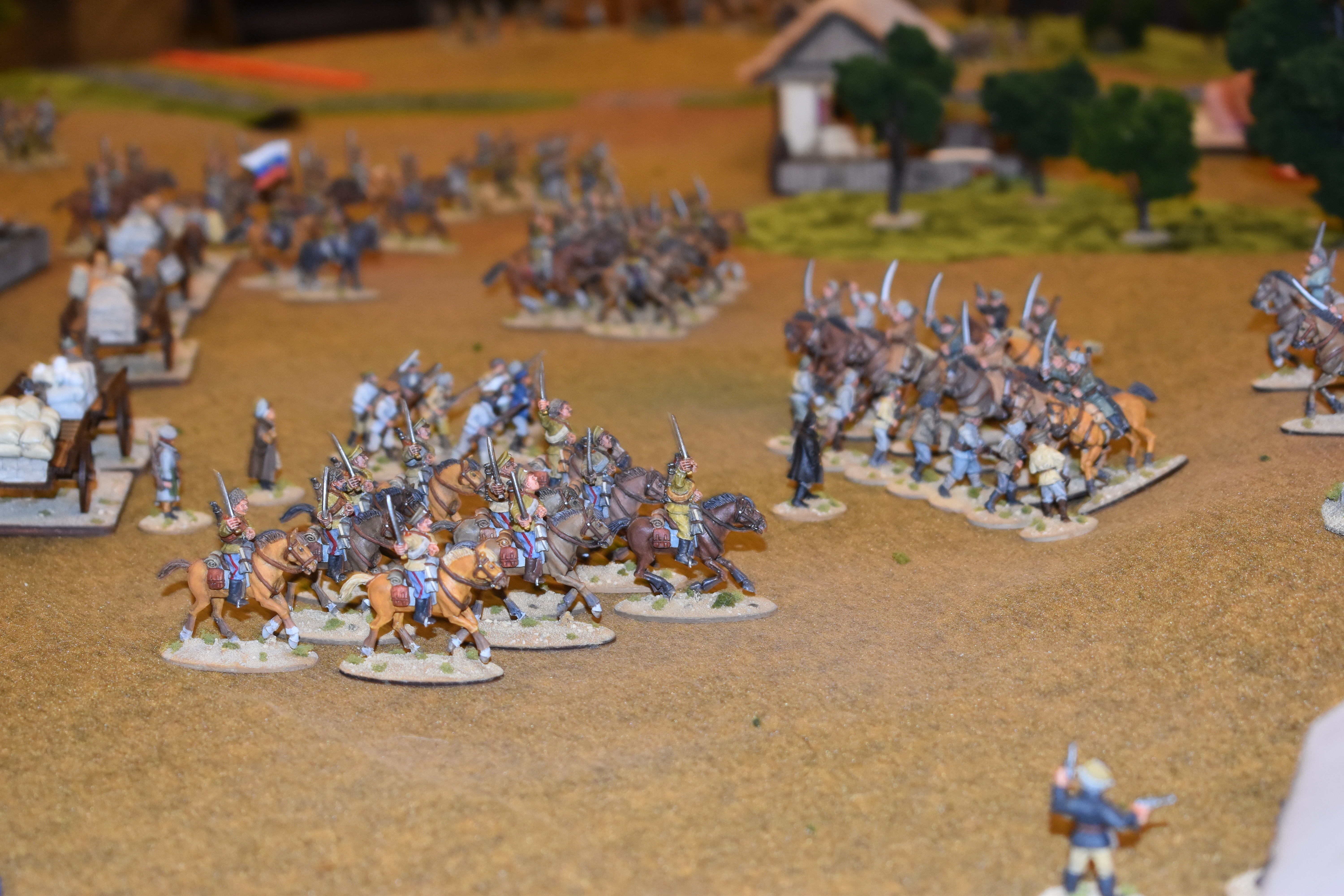
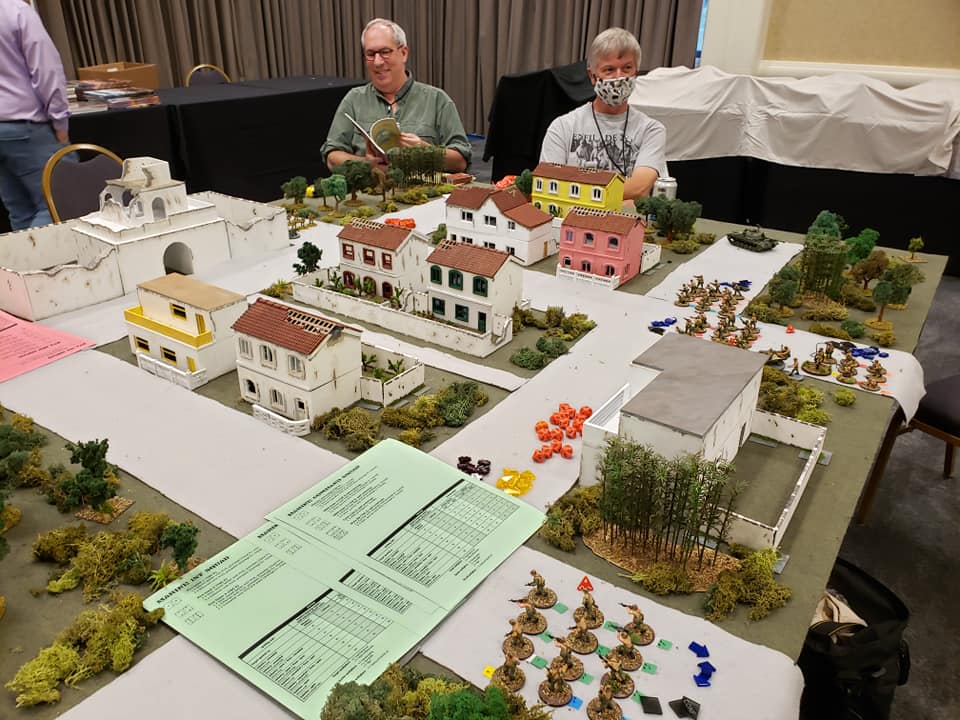
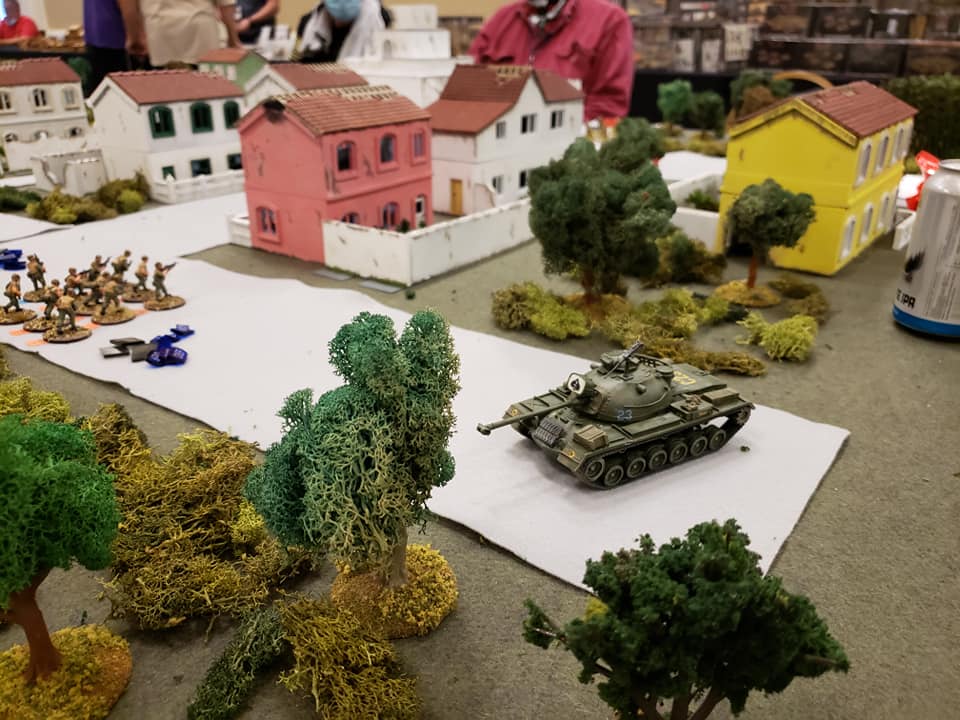
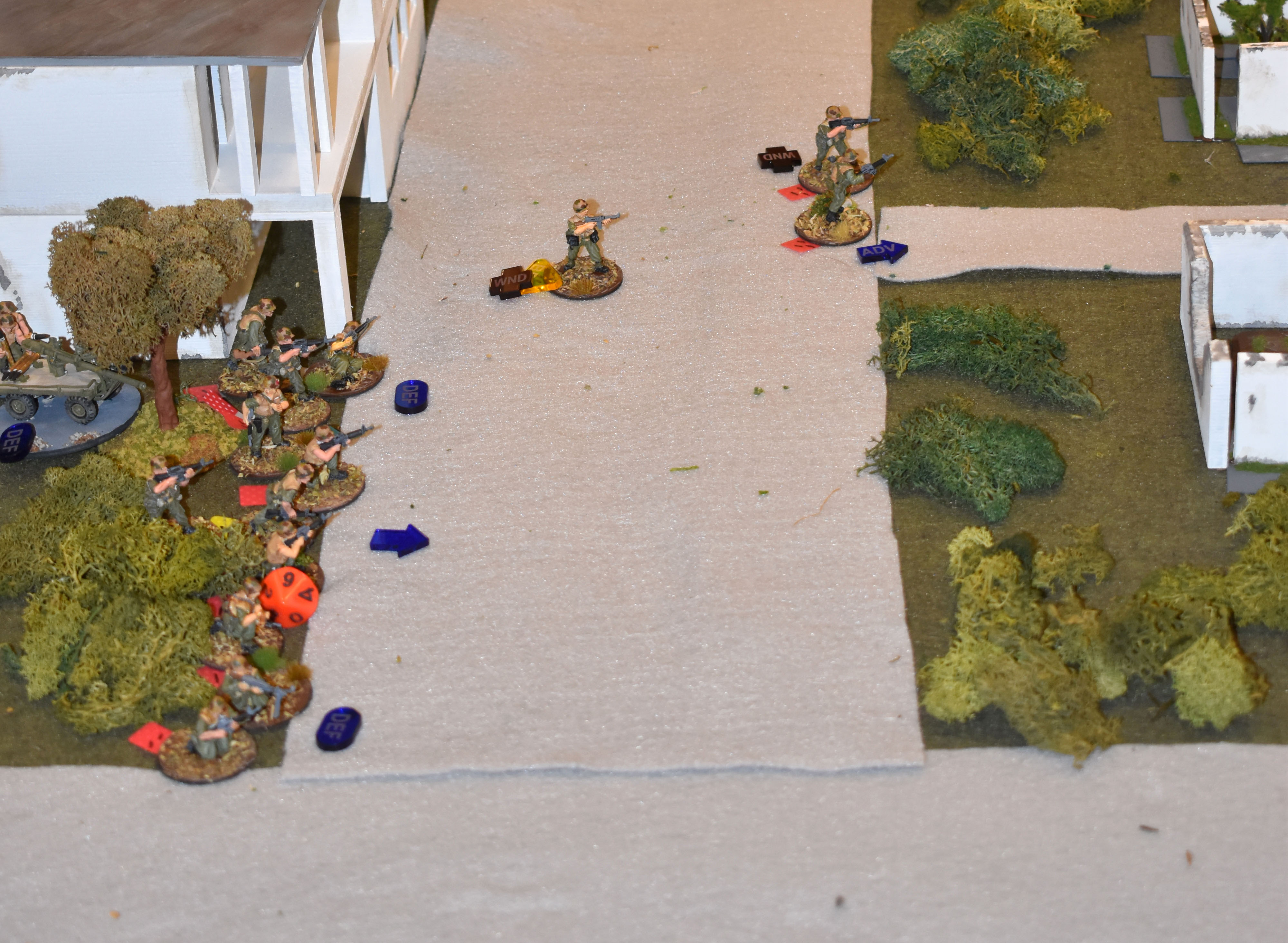
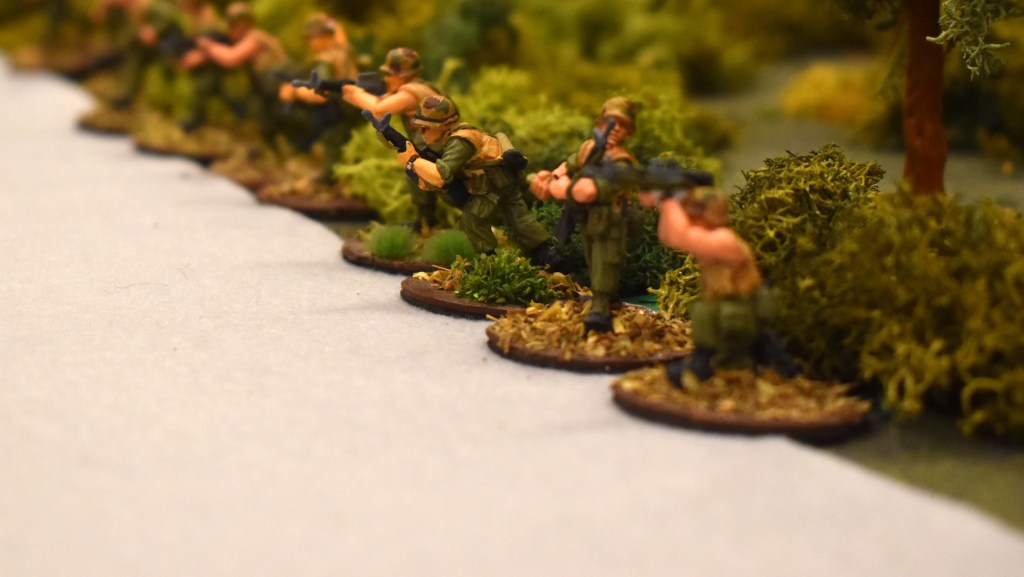
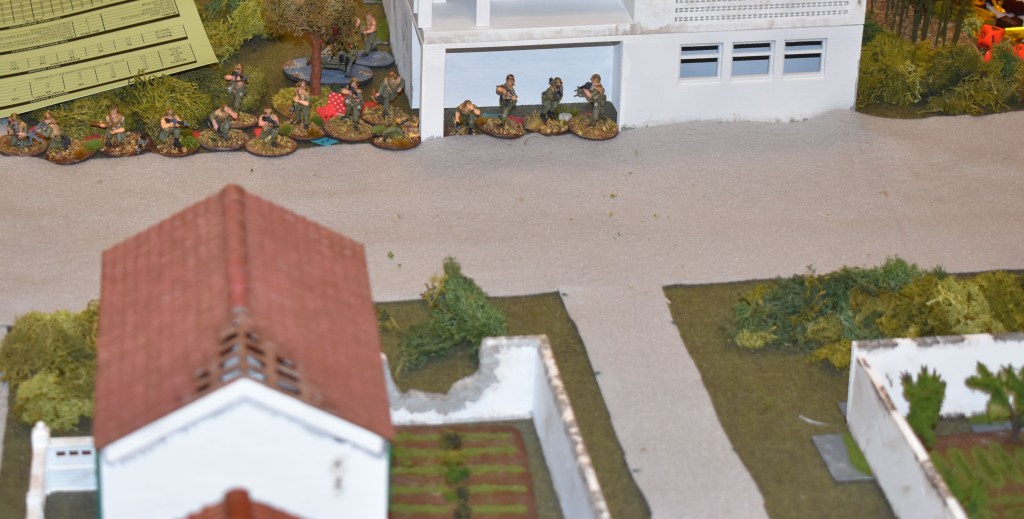
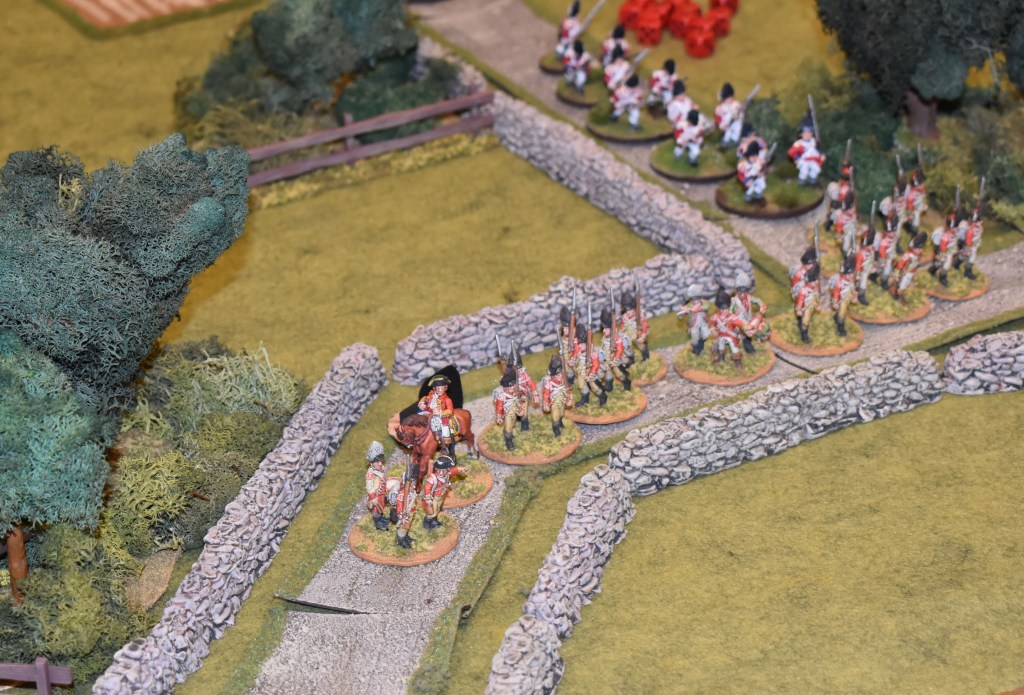
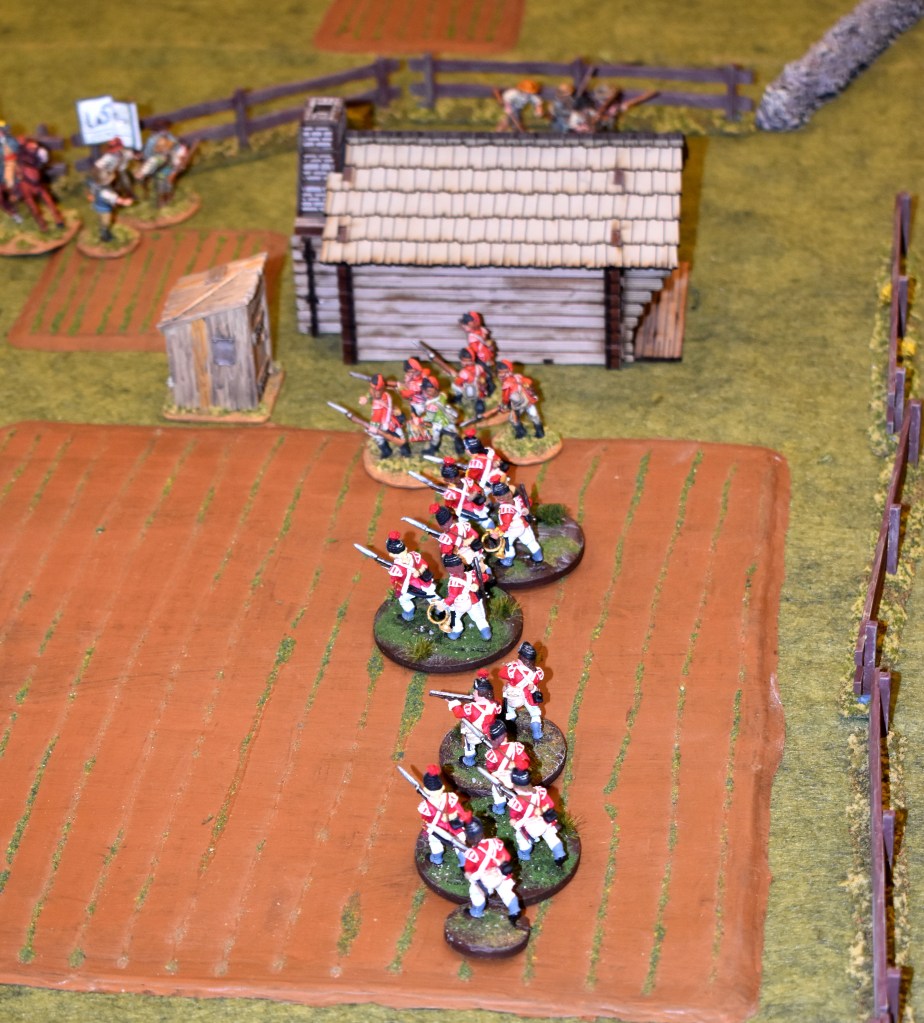
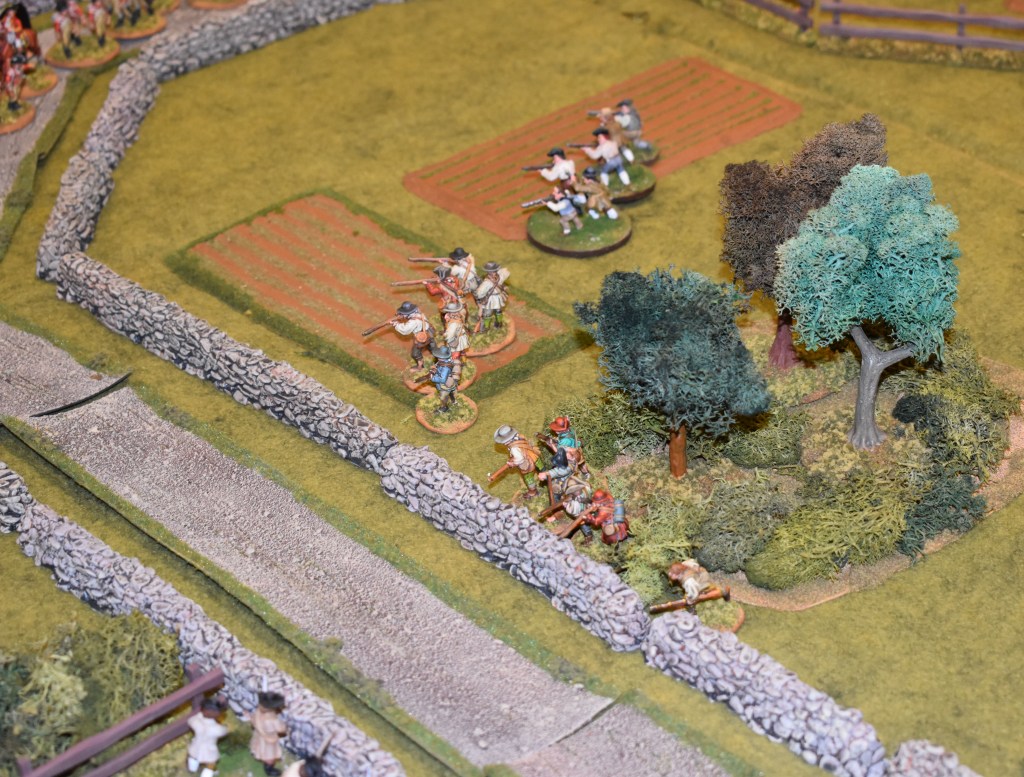
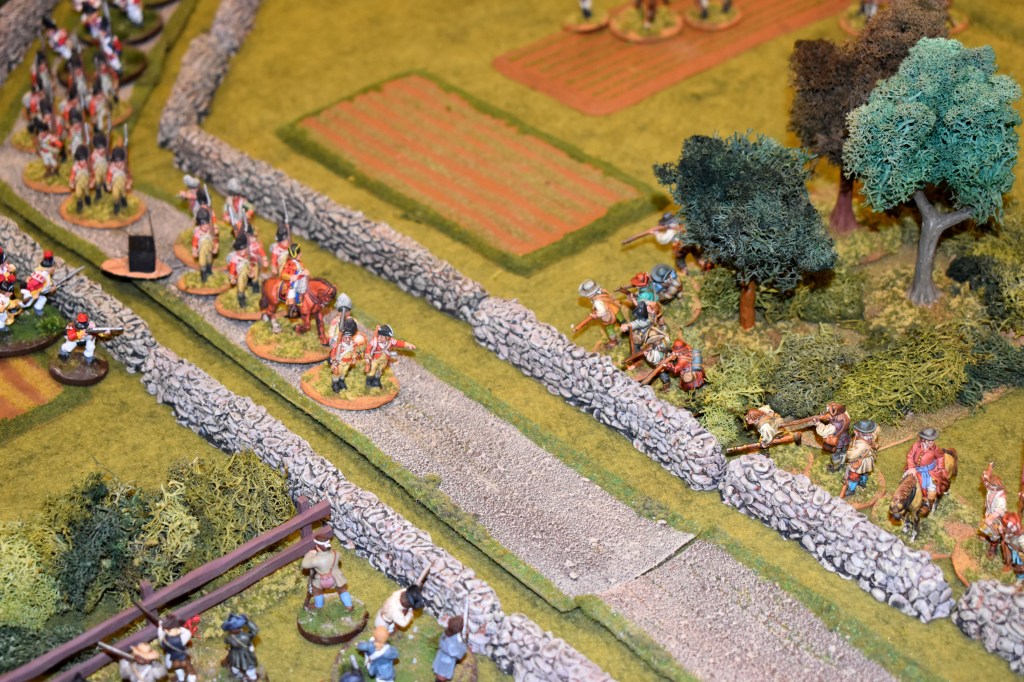
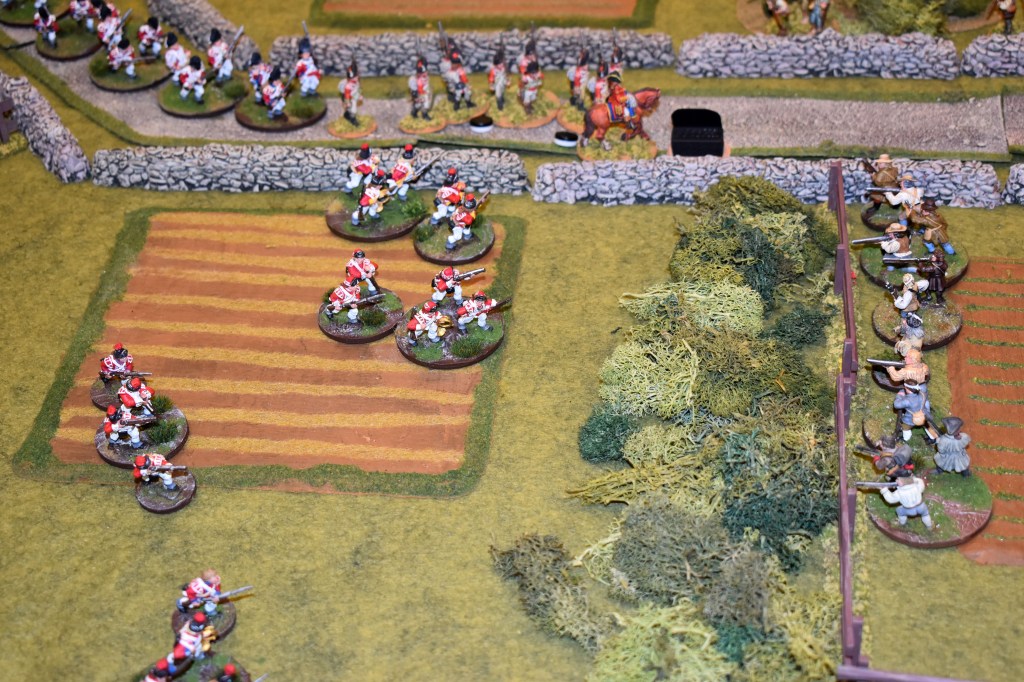
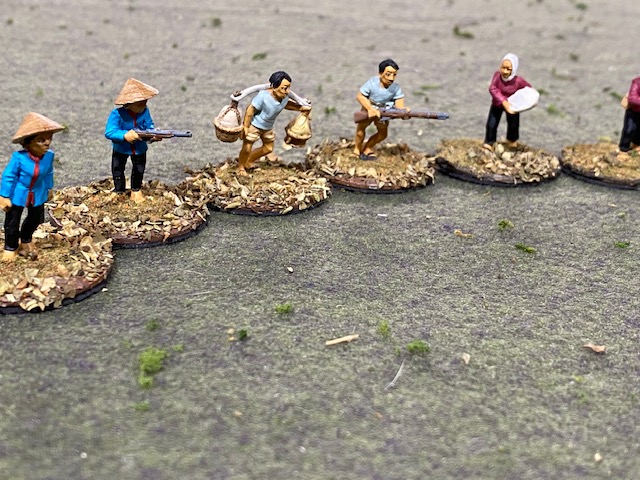
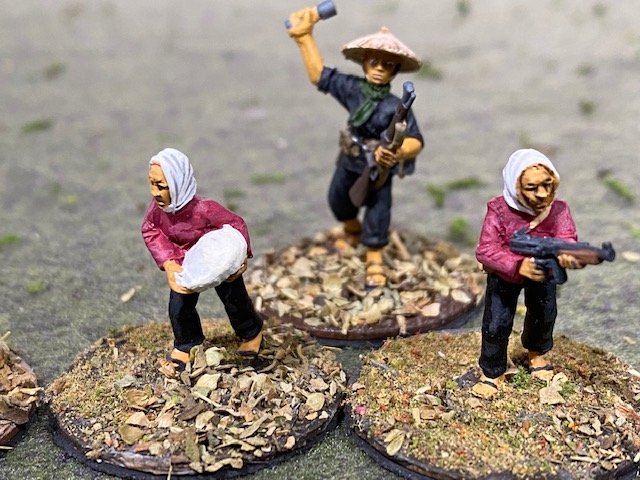
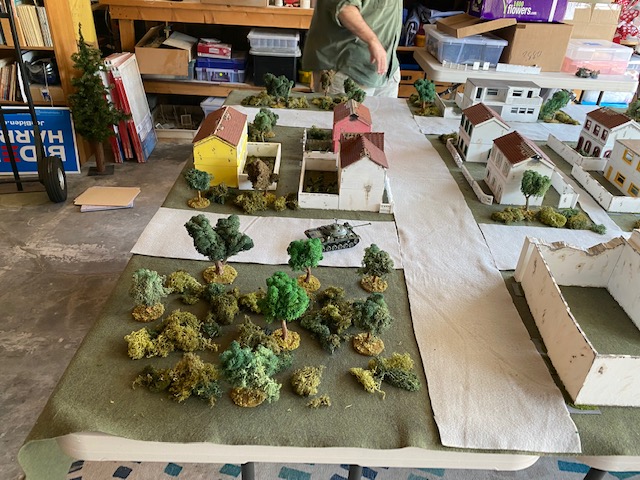
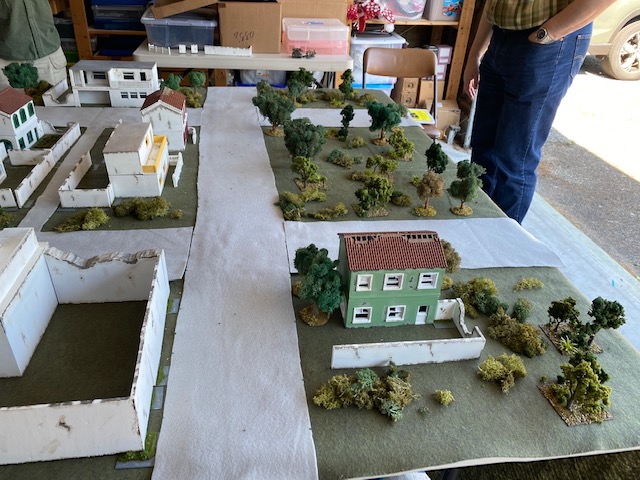
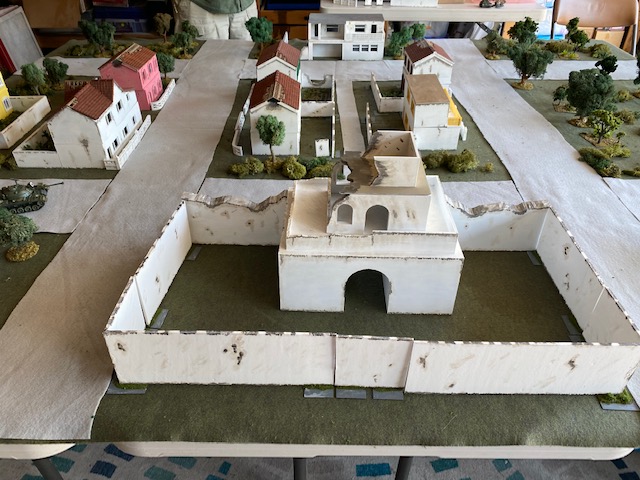
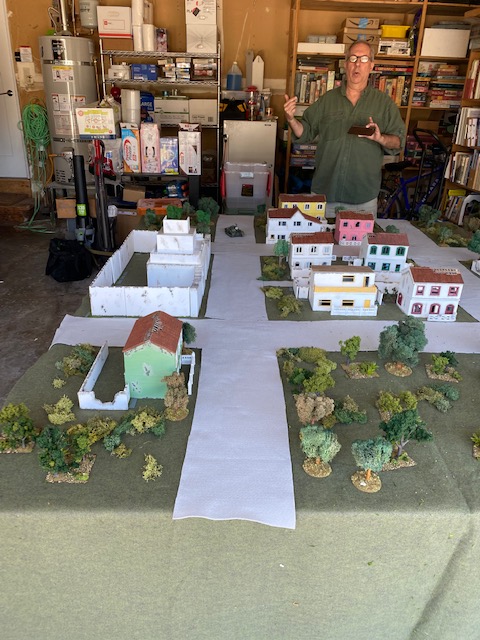
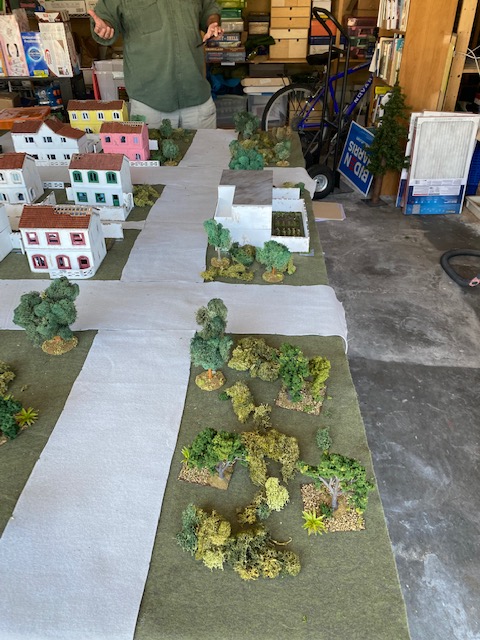
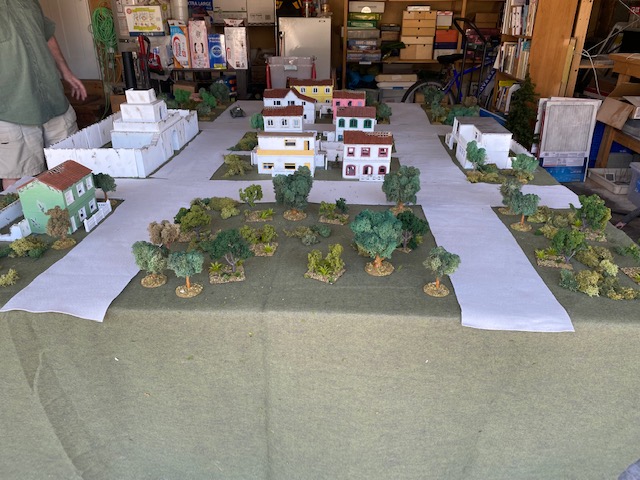
The Antrim barracks set up along the road and guarded by hedges and stone walls
What is it about promises and miniature wargaming that are so utterly impossible to tie to together. I stayed with the nothing new pledge for a week and foof, just like that gone.
Let’s start at the beginning. Last weekend I enjoyed a game of Rebels and Patriots at Eric Donaldson’s house. We played ACW in 28mm. It opened up an entire world of possibilities for me. I have a bunch of painted ACW figures from 30 years ago. They are nice, but I don’t paint like that anymore, and to remount figures is not one of my favorite things. Nevertheless, I’m remounting away. I hope to have a couple of units done by the end of this week.
Somehow, in the conversation that grew in the week that followed, David Sullivan suggested we do the Mexican American War in 28mm for R and P. Now, the smart answer would have been “I’m out,” right? But no, I took the bait like a Northern Pike and within 24 hours had an order off to 1st Corps in the UK for a bunch of Mexican regulars, followed by a smaller order this morning for some Americans. I’m sitting at about 100 figures for now, and am trying to hold the limit there at least until I get most of them painted. It is clear that wargame promises are made to be broken.
In the mean time, I’m just kind of joyously painting whatever. September was the month I finished every, all, absolute totality of my Irish Civil War figures. It was a nice feeling. I also put them to good use on Friday when Michael Koznarsky made the trip from Steilacoom to South Hill and played a game of Like Crickets But With Guns and we dragged out the ICW boys and played a cooperative game in the infamous Smyth Garage
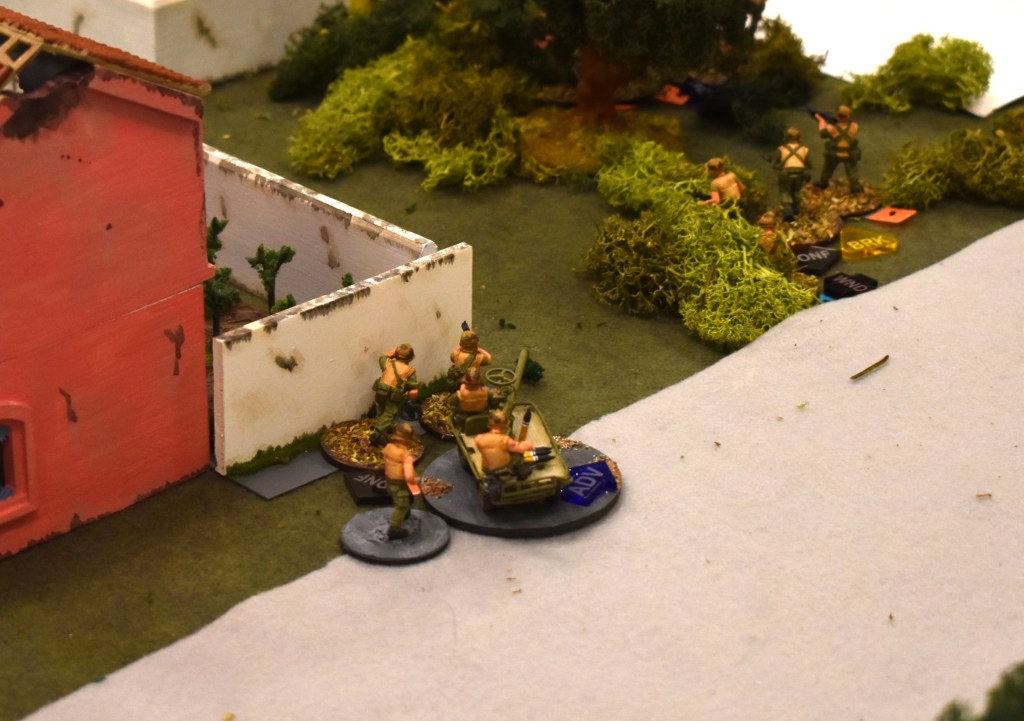
The game was pretty easy and based on a scene from the 1996 movie Michael Collins with Liam Neeson. In that movie Collins leads a group of rebels to attack a Royal Irish Constabulary barracks with flaming clods of dried turf to drive out the defenders and capture the weapons and ammunition inside. In our game, we had four eight-figure units of the Antrim Flying Column to attack a house and outbuildings defended by ten RIC regulars. The IRA units were a mix of regulars and green militia. They had limited ammunition supply and there were rules for making, preparing and throwing turf torches. I let Michael make the important decisions, but knowing that movement in the game is pretty limited, I allowed him to set up the squads ten inches from the buildings.
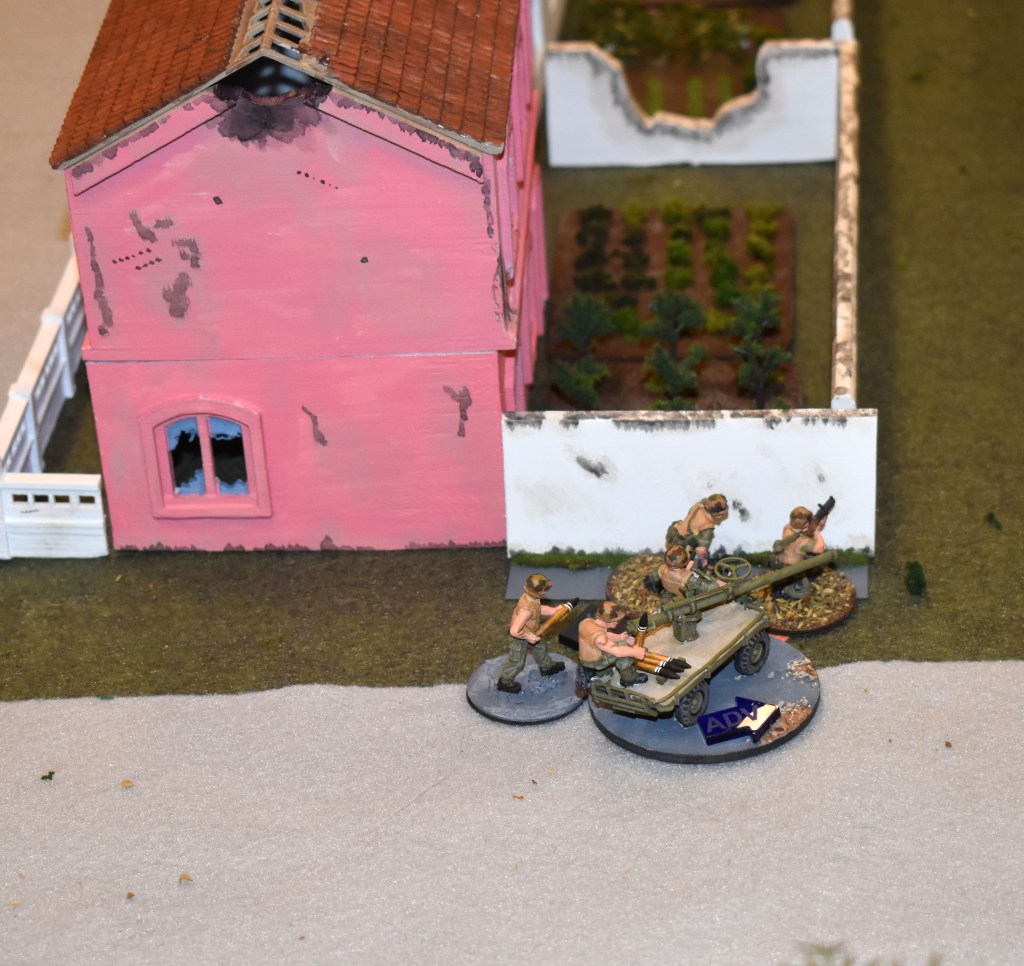
My regular unit has crossed the stone wall and tossed its lone torch on the roof the barracks. The exchange of gunfire between the Antrim boys and the RIC was quite unfair as the coppers only needed a five to hit and IRA gunmen needed a six. Even so it was the rebels who won the exchange.
Michael chose to immediately begin making torches in a field fairly well covered from RIC gunfire. Even so, my militia unit lost a figure, checked morale and immediately hit the dirt for the next four or so turns. In gunfire exchanges, the coppers almost always rolled below average, while my boys always seemed to roll sixes.
The Antrim barracks are fully alight as Michael’s troops bump off the defender in the sentry’s station and move to surround the building.
It didn’t take long for the torches to eventually find their way to the roof of the barracks. With the RIC defenders driven by gunfire away from the windows, and the roof catching fire and the intensity growing each turn, it didn’t take long for the few survivors to surrender. The Antrim boys easily made off with their booty before the local Auxiliary outfit showed up with much heavier weapons.
The rules were fun and easy and surely see myself dragging them out again.
This final week of the month will be spent painting up some Spanish American War figures. I have John’s last unit of Spaniards nearly done as well as a good start on some Cuban rebels. Assuming they’re finished by Thursday, I’ll have painted 74 figures for the month, one shortened by the convention and convalescent period that followed. Not bad.
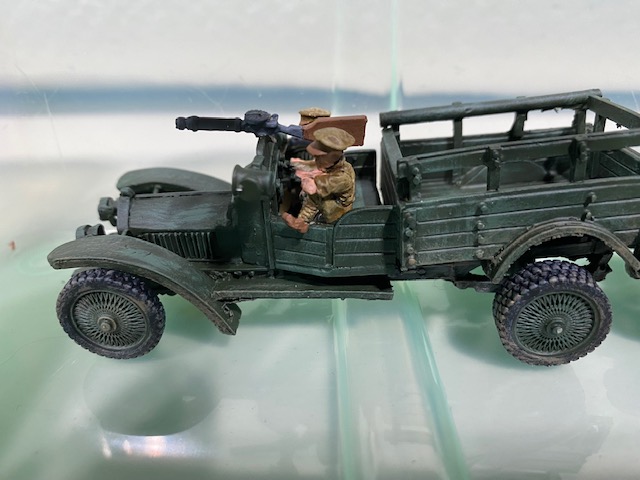
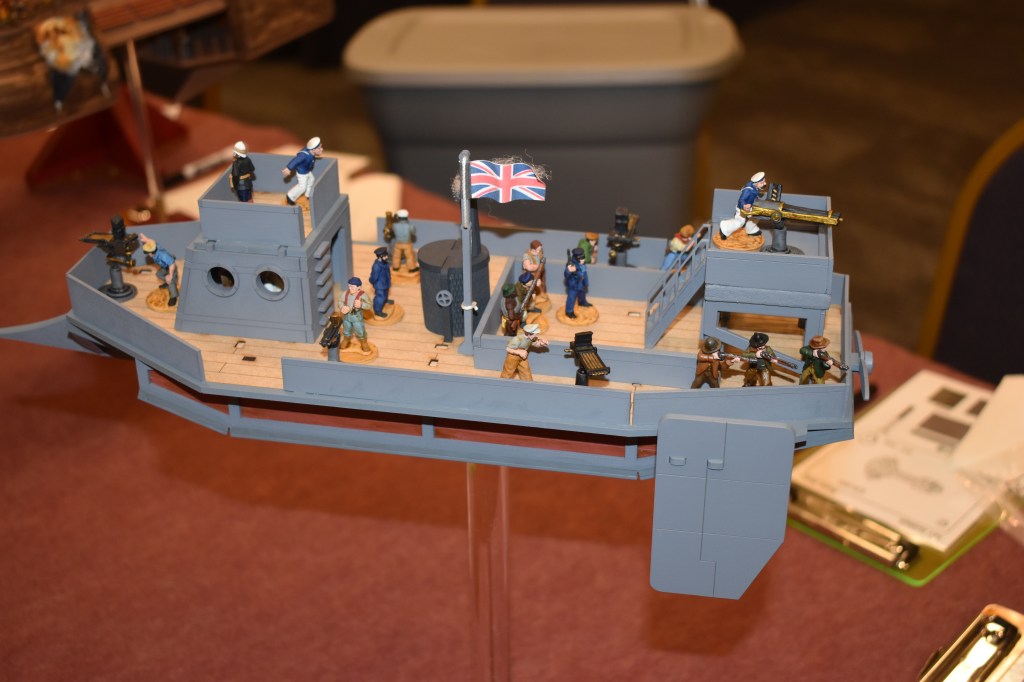
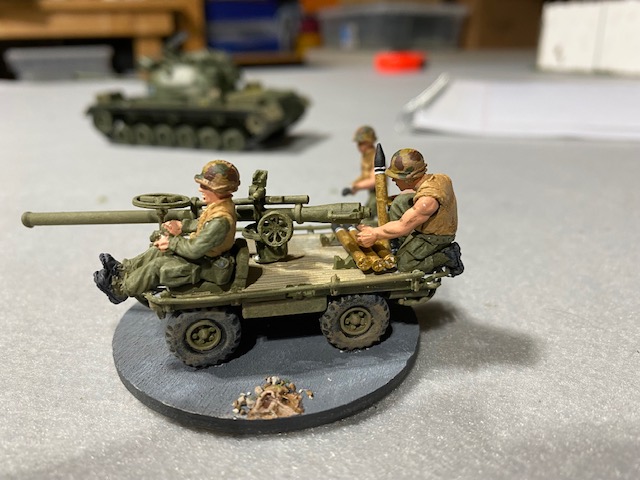
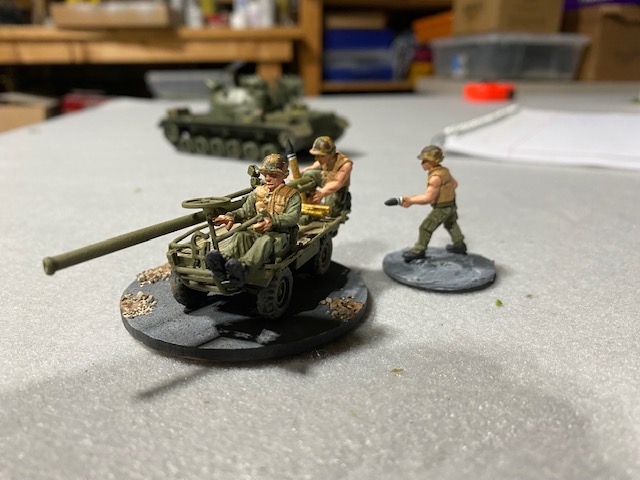
Crosley Tender by Company B Miniatures will go with my Irish Civil War project
Hue is officially done. That doesn’t mean I won’t be pulling out the figures, the tanks and the buildings and maybe adding a little something to them. I have my eye on some Acheson bunkers that look pretty interesting, and Gringo 40’s is adding to their ARVN troops. But, I really do want to do something else.
I’ve pulled out my remaining Irish Civil War figures and have plowed into them. I don’t have a lot to do to wrap those up, and I’ve finished the first 20 figures of Royal Irish Constabulary and IRA from Reiver castings. Not bad. Not as good as Footsore, but not bad. I’ve also assembled, to the best of my limited skill, two Crosley Tenders. They were a difficult build and will form my little vehicle corps along with a Lancia armored truck.
My guess is the Troubles will be finished before the end of the month. What follows is unclear. I’m trying to set a bar for myself and Enfilade 2022. Often I pick a project and I stick to it until it’s complete. The problem is I have zillions of unpainted figures and I REALLY WANT TO PAINT THEM. I know this is unique for a miniature wargamer, perhaps it’s just naivete, but this year I’m really going to try to stick to the, don’t do anything new pledge.
British regulars (left) and Irish National Army (right) on the painting table. Both still under the brush. Figures by Renegade, and damn they’re big. Nice figures.
Well, let me break that for just a second. I think I am going to take on 1/600 Lissa with John Gee, which will involve ten or so Italian ships that will need to be masted and rigged. Yep, broke my own rules, and it only took an extra sentence. But it’s also something small I can pick at.
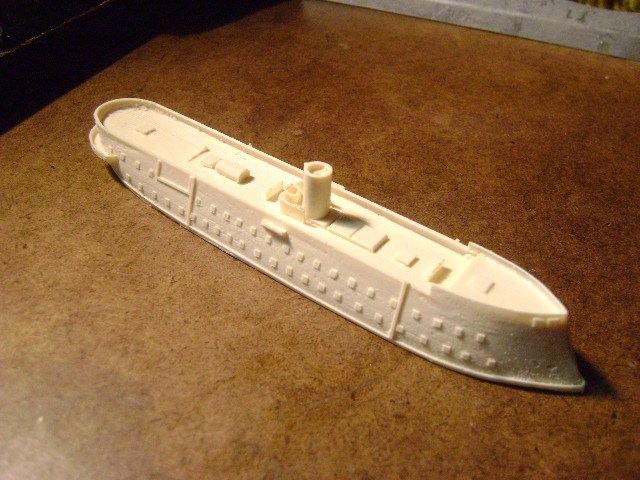
Bay Area Yards 1/600 Magenta armored ship-of-the-line. Not at Lissa, but it looks so badass.
Here are some things I’m thinking about:
I have a bunch of 28mm ACW figures. We’re actually going to play a 28mm ACW Rebels and Patriots game on Saturday. I have a load of unpainted figures and a load of painted figures. I’d really like to paint those that require it and make some decisions with those that are painted. Problems? The painted figures were completed 30 years ago and I use a completely different painting style. There would be remounting required and would they all be remounted for R and P or would I mount some for Regimental Fire and Fury–understanding if I did the latter I’d need a lot more figures. Why can’t everything be easy?
This year I acquired a bundle of figures for the Spanish American War and I didn’t buy ’em just to have ’em. I’ve purchased stuff for both sides, plus some Cuban rebels. The Spanish are a pain to paint, but I knew the job was dangerous when I took it. I see myself progressing on this but I don’t see everything being painted by May. And that’s okay.
John Gee has kindled my interest in organizing my figures and painting unpainted miniatures I have for the American Revolution for Regimental Fire and Fury. I really like the rules and I have a lot of unpainted stuff. The Perrys have recently added to their range with figures for the Guards, and Guilford Courthouse is kind of my battle. Anyway, I foresee some units being painted toward that end. I also have additional figures for Rebels and Patriots, so I can just throw a dart, spill some paint and move the ball a little bit toward completing what I have on hand.
Finally, I am really interested in working with John and Dave Schueler toward playing The Battle of the Yellow Sea in 1/1250 scale. John has like all the Russians for the siege of Port Arthur so Dave and I are working on the Japanese. I’ve finished a few ships, have a few more, and will buy more still. I’m not making rapid progress, but I’m making some.
Those are the things I’m looking at as we aim at Enfilade 2022. I’m still the director next year, so my ability to host more than a few games just doesn’t look very good. Instead of painting toward a particular game, I’m hoping to just paint away and perhaps a game will magically appear out of the work. John has talked about Lissa and a War of 1812 battle. I could be persuaded to either of those, though I’m not sure I could be available to run both. I kind of have a hankering to run my Philippine Insurrection game, San Pascual, but I’m not sure. Some may depend on Shoe’s health and whether he opts into the convention. Maybe there will be planes. Maybe not.
I wanted to wrap up my Enfilade coverage with pictures from other events. There were some 80+ games at the convention, a number that was reduced by Delta variant concerns and filled in by heroic last-minute heroes. I wish I could tell more about each photo, just know that each of the hosts that took time to run a game is top notch in my book.
Sadly, I couldn’t get photos of all the games. I had my own game hosting responsibilities and spent time putting out convention fires as your obedient servant. If I have one regret, it is that I don’t have any photos of Bill Vanderpool’s games. For those who don’t know Bill, he never misses a game period, and is annually six for six running games for a very long time.
Even though attendance and number of games were down, I can’t say the same about our spirit as the everyone seemed to have a really good time. Looking forward to Enfilade 2022, Memorial Day weekend (May 27-29.)
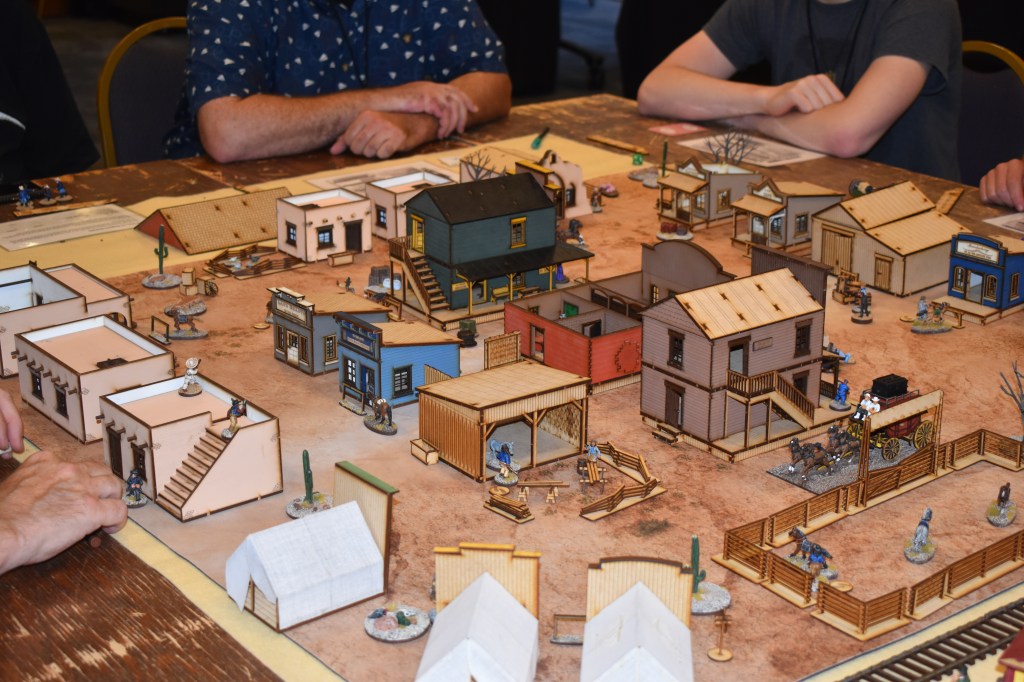
Ron Palma ran his lovely All Hell’s Breakin’ Loose western gunfight twice. He won the overall Best of Show for 2021.
Seth Terry’s General D’Corps 28mm Napoleonics game.
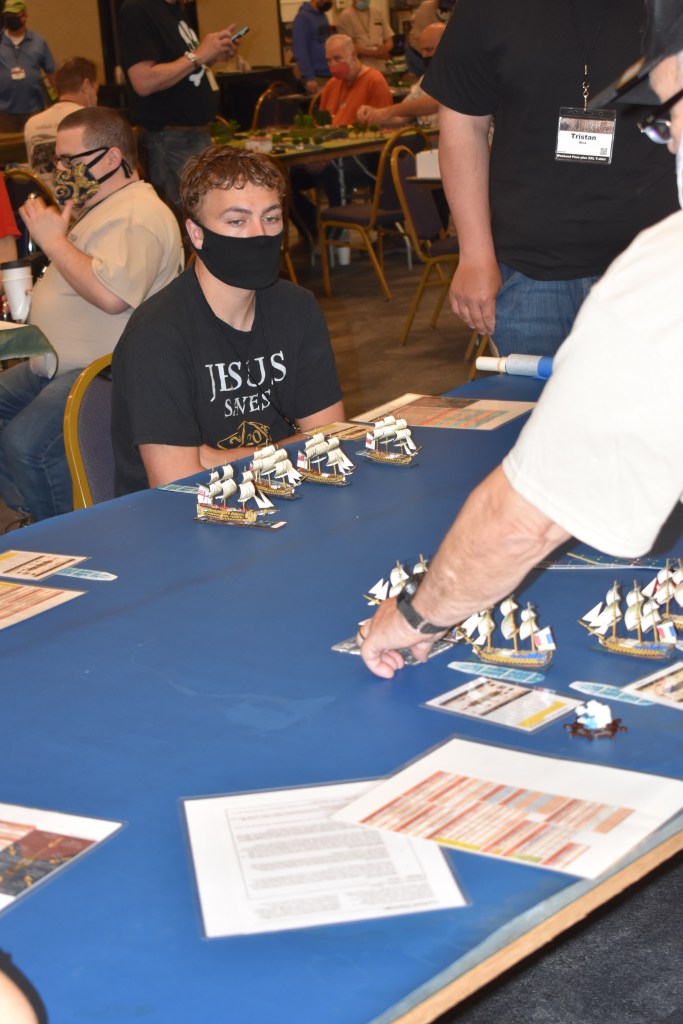
Gary Griess’ Black Seas Fleet Action game
Will Thompson’s 28mm Oz game “Defending the Yellow Brick Road.”
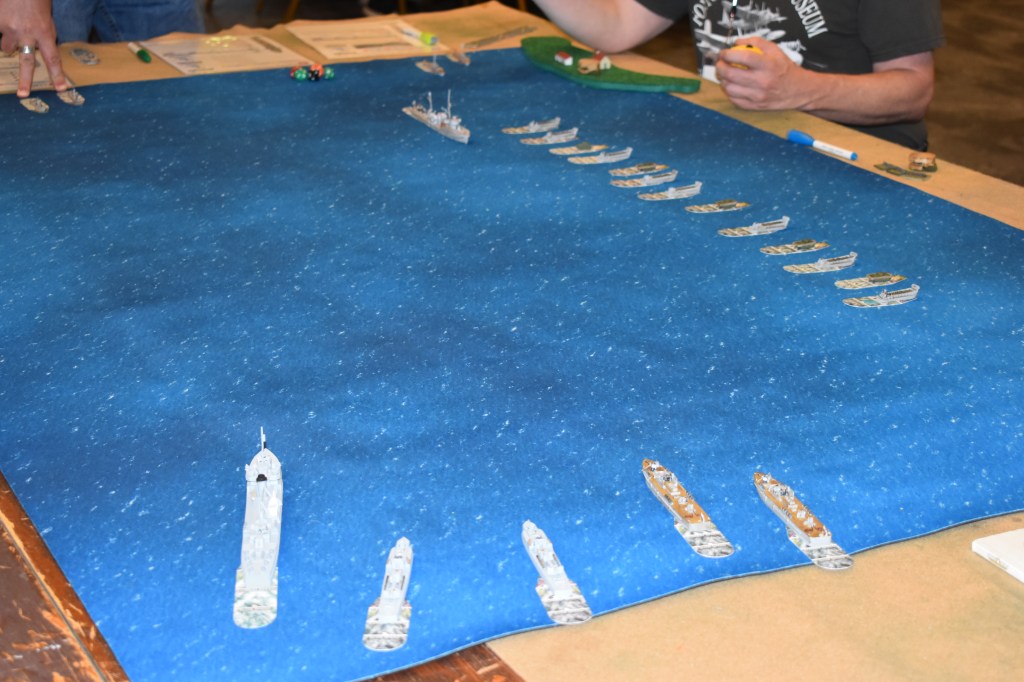
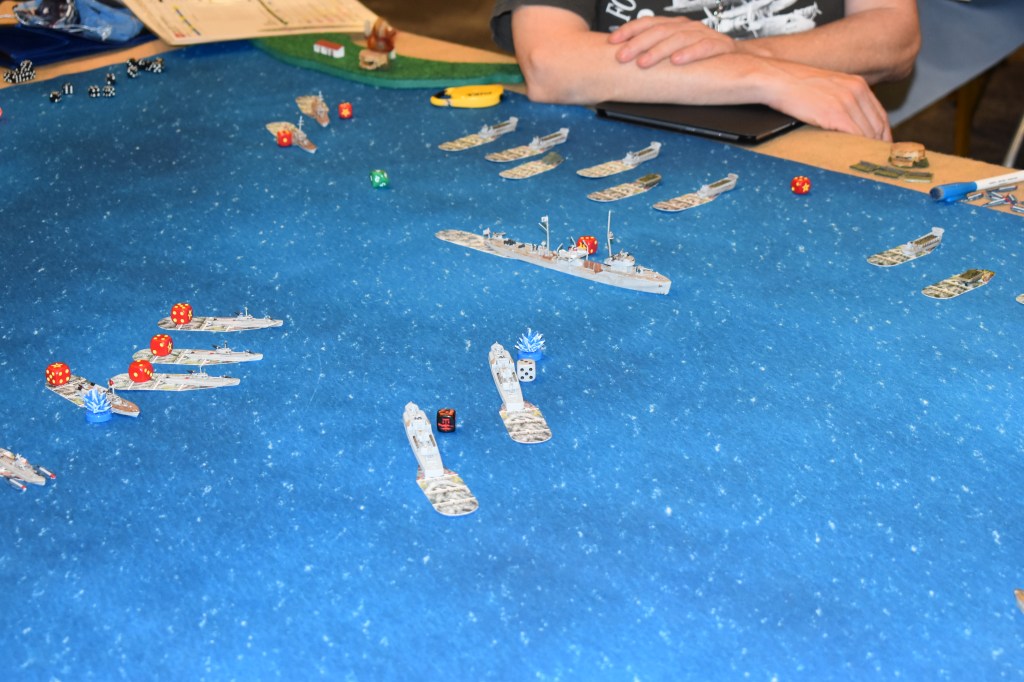
Daryl Nichols’ Cruel Seas 1944 Baltic Sea game
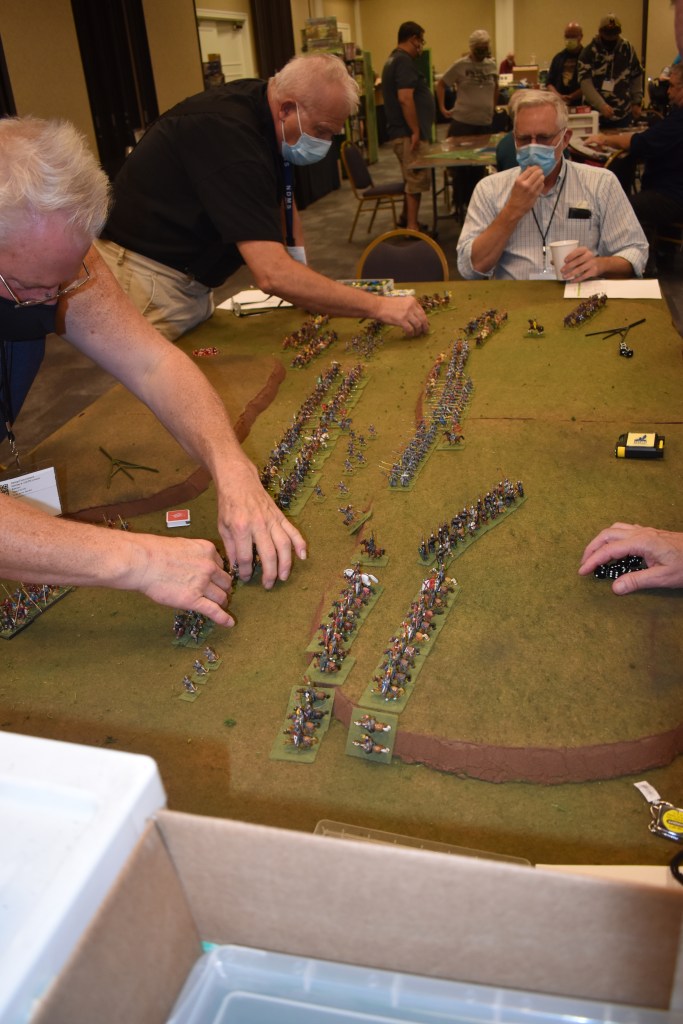
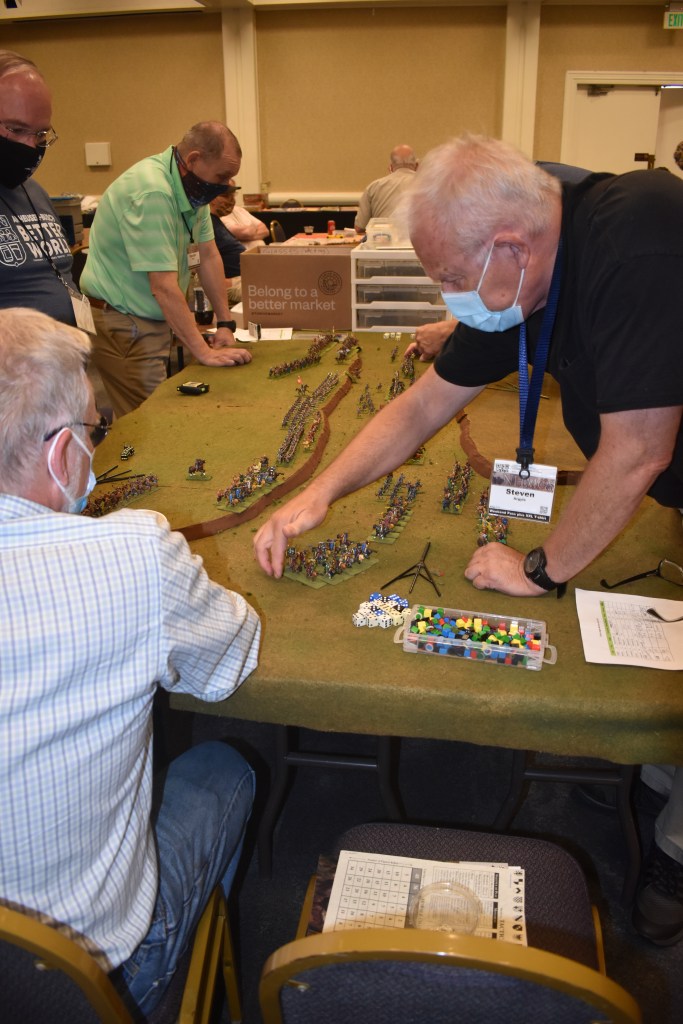
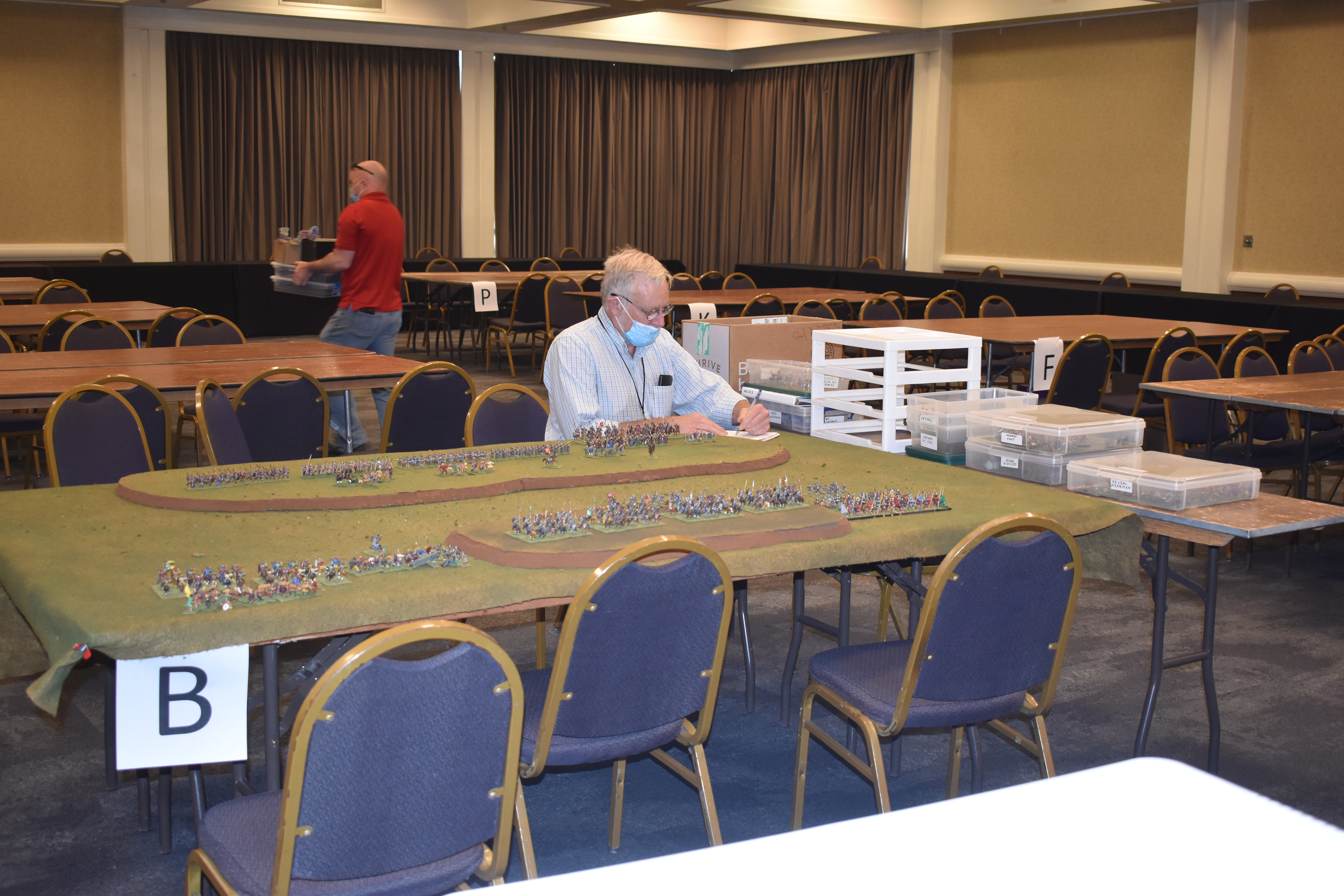
Wes Rogers’ TincheBray 28mm medieval battle
Mitch Berdinka’s Sharp’s Battles “Blow Up The Bridges” scenario. Mitch ran this twice.
Gene Anderson’s Battle of Valverde game, using 15mm figures and Regimental Fire and Fury rules.
Greg Moore’s “Defense of Fort Heston” won the best theme (The Best Defense) game for Enfilade 2021. He had the courage to run it twice
Andy Doty contacted me as I was making my final list of games and offered to run Harpoon: Chief’s Edition all day Friday and Saturday.
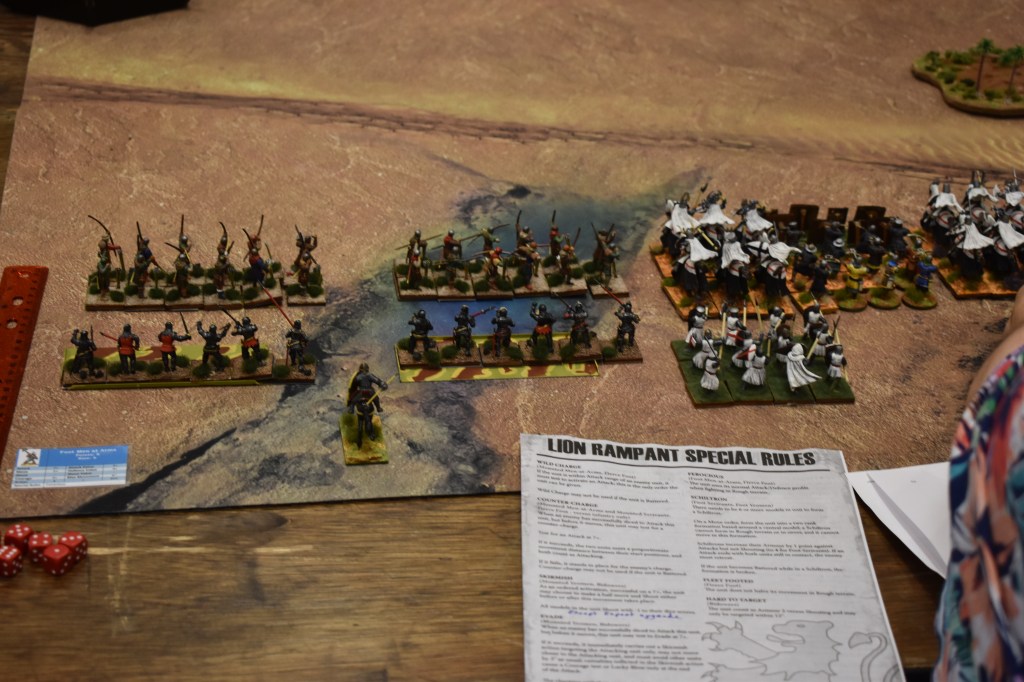
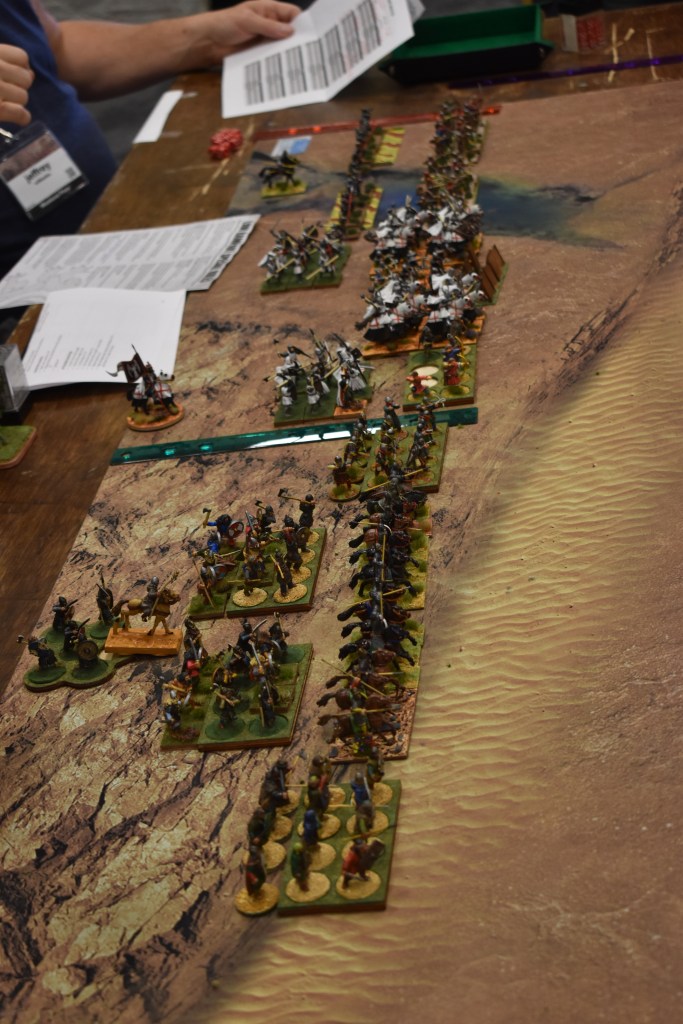
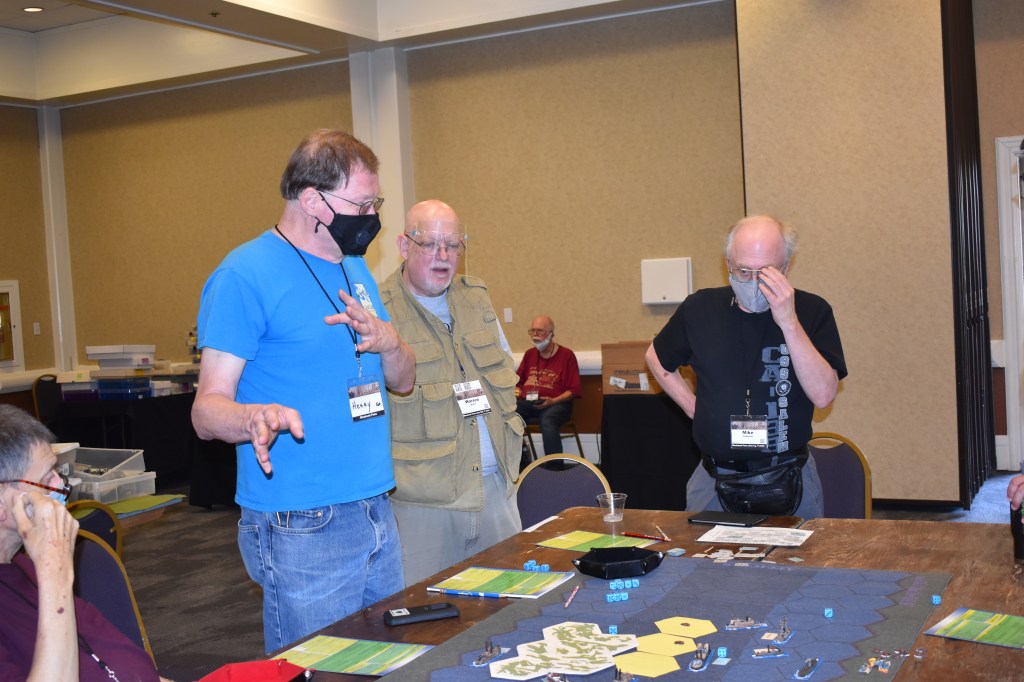
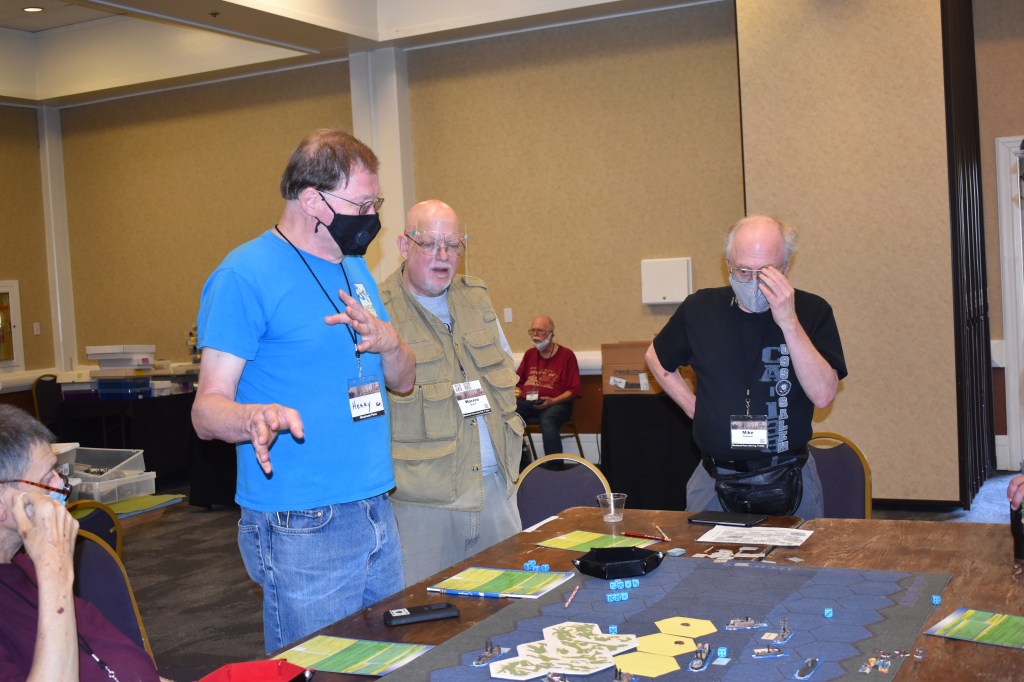
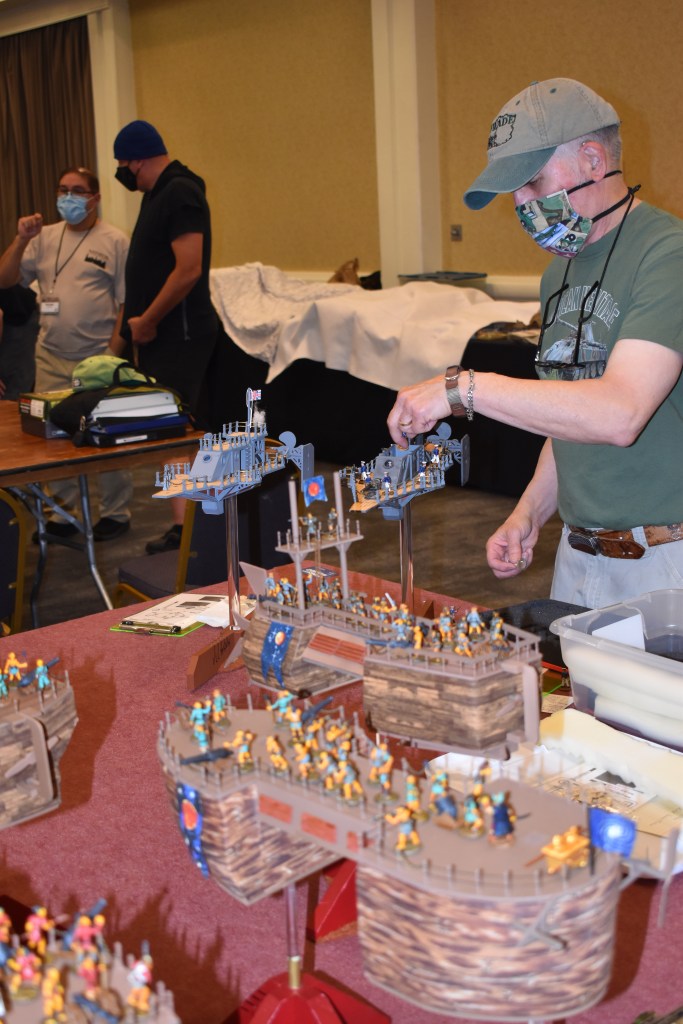
Henry Thompson (in blue) ran what seemed like a billion great games. Upper left Louisiana State Navy. Below, A Local Understanding: Lion Rampant-the Crusader States expansion.
Scott Potter’s Wing’s of Glory game, with able assistance from young friends.
Chris Craft’s Relief of Fort Augustus game of the Jacobite Rising
David Pearce ran several All Quiet On The Martian Front games
No Enfilade is complete without an awesome Will Thompson Galactic Knights game.
Mark Serafin started Friday off with some RCW “Ideology and Potatoes.”
When Teddy Bear Rampant became a Covid casualty, Pete Dixon filled in with Gummy Bear Rampant, because you just can’t be too rampant.
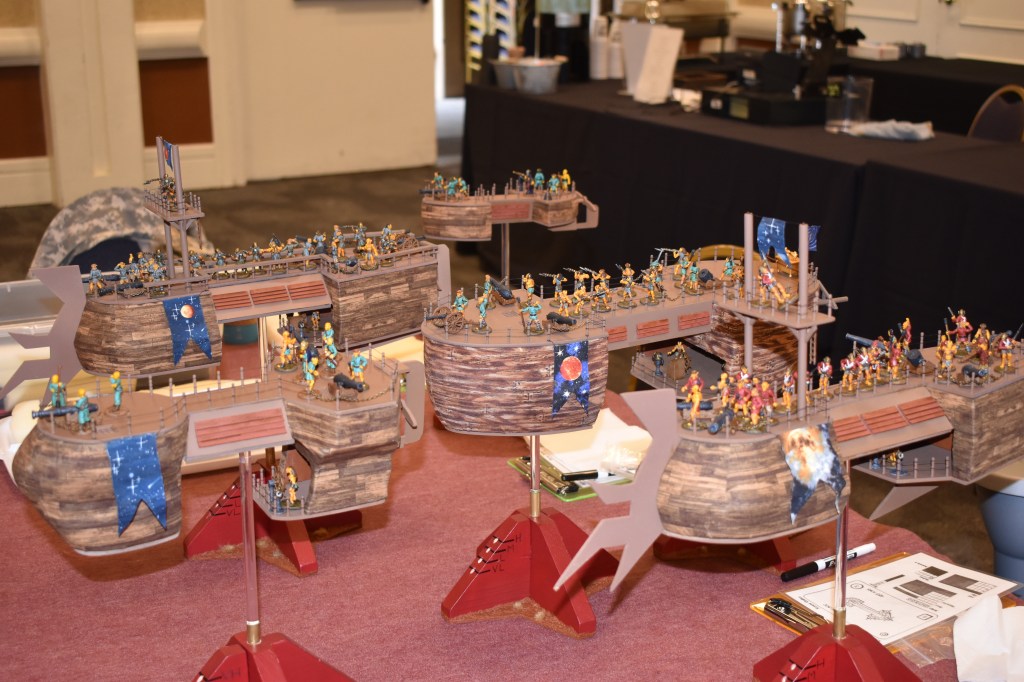
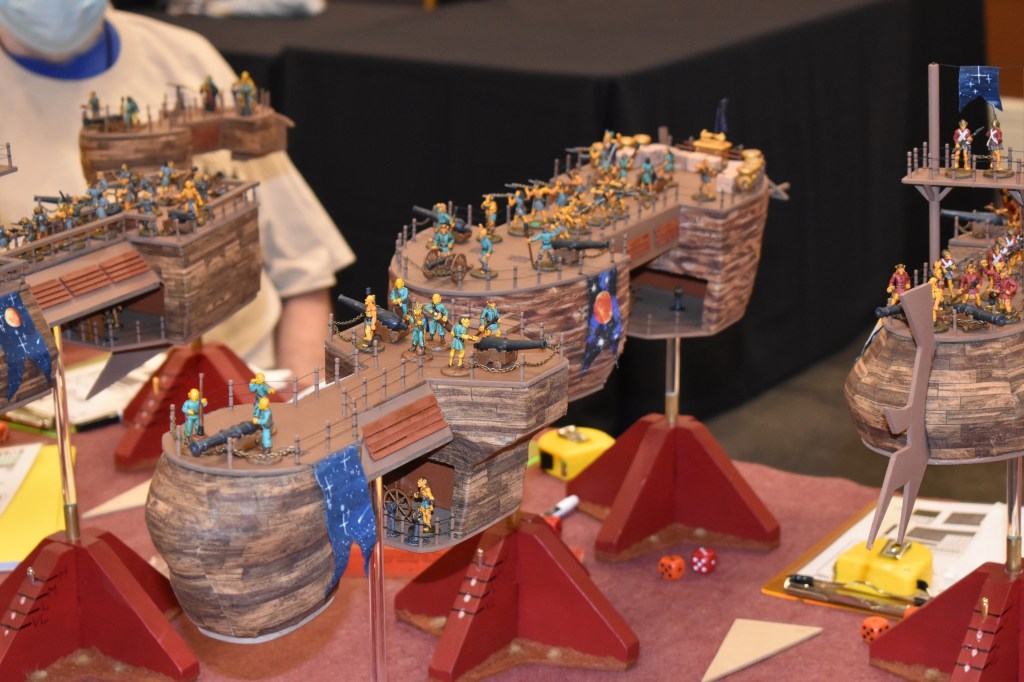
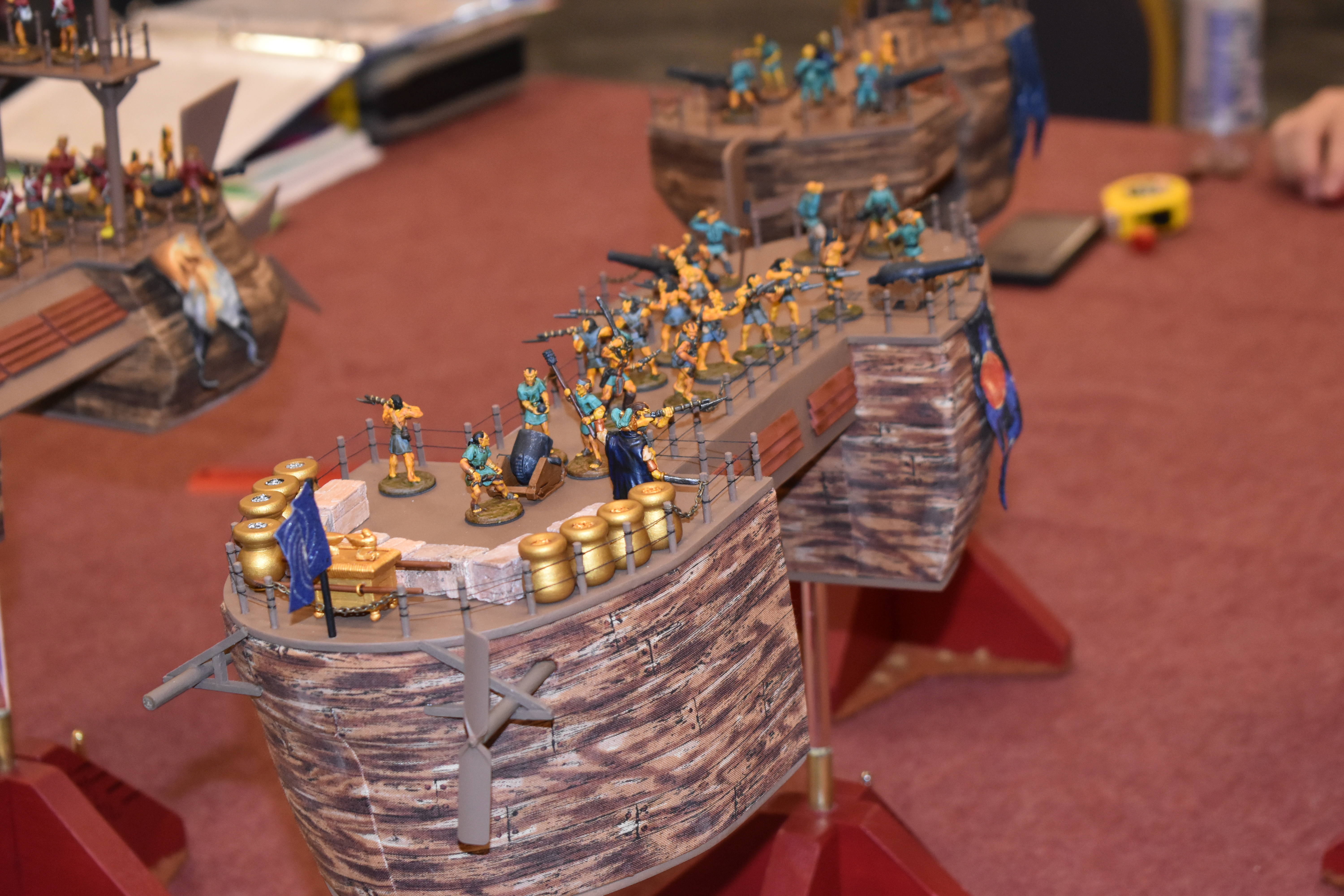
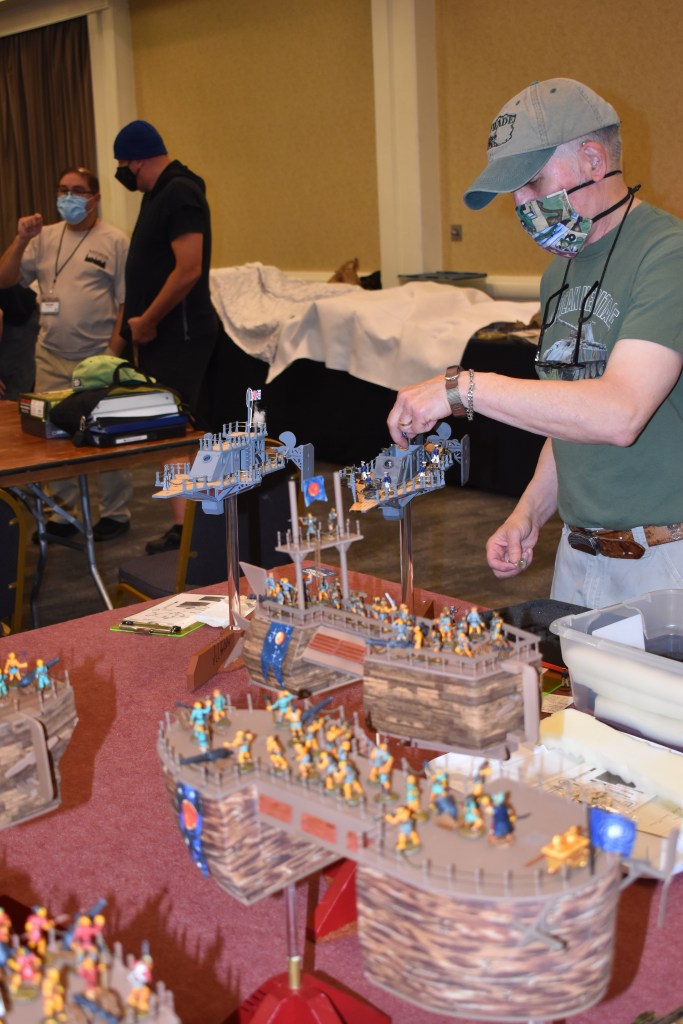
Whenever I see Gene Anderson’s Space 1889 28mm sky galleons there is a certain amount of internal drooling that happens. Sigh.
And I also want to recognize our attendees and game masters for making Enfilade a successful game experience for everyone.
Thanks so much for reading. See you in the spring.
Setting up for the game. David Sullivan left. Yours truly right. Photo by Warren Bruhn.
My favorite part of Enfilade is hosting games, which I usually do with a close friend. This Enfilade was no different, and David Sullivan and I ran a couple of games together. The big project of the year, of course, was Hue and we scheduled ourselves to run it Friday night.
Hue is/was my most elaborate project ever, certainly more involved terrain pieces than I’ve ever done. I’m mostly a paint the figures kind of guy with simple terrain. Because Hue is an urban battle, I thought we’d play with a gray ground cloth. When Dave Schueler and David Sullivan came down in the weekend before the convention to walk through a final set-up we talked over cutting green felt to overlay the gray to signify the boundaries between the roads and green areas. We quickly realized this was a really terrible idea, and the gray ground cloth quickly became roads 8″ wide, equal to a turn’s movement in the game.
Because the board is pretty darn busy it took a lot of time to set up. I think the most stressed out I was at the beginning of the convention was trying to figure out how I was going to get the game ready while doing my director duties Friday afternoon. I pursuaded myself and our events coordinator that it was okay to move me to a vacant 8′ X 6′ table and get started early. David arrived mid afternoon, and well before game time we were ready to go.
David and I experimented with rules throughout the spring. We tried the ancient Giac My rules from the 70’s. They had a certain charm mixed in with verbosity and conditions we’d never encounter. Nice for nostalgia. Not so nice for a convention game. We really thought we’d use Ganesha Games’ Flying Lead rules. We really like the Ganesha game engine, but after walking through the rules a couple of times with the necessary sub-units we were concerned it might be difficult for conventioneers to figure out the nuances.
David suggested Arc of Fire, an aging set of skirmish rules by Chris Pringle and Scott Fisher. We tried them out and they seemed to work. It allowed us to give each player a squad, divided into three fire teams. The units are small and subject to quick catastrophe, but we learned that if moving from cover to cover, the Marines had a good chance of survival.
We were fortunate that we had a full house of early sign ups. Nobody dropped out as Covid cancellation casualties, a problem afflicting many games at the convention. Dean and Scott signed on as NVA defenders with a couple of squads backed up by a DsHK heavy machine gun. They were dispersed throughout the two blocks the Marines were trying to capture. Scott, Wil, Reid and James signed up to be the Marine attackers. The onus of the battle was on them. To win they had to drive the North Vietnamese from their defenses, capture the houses, and minimize their casualties. It was a tall order to fulfill.
The Marines arranged one flank squad, commanded by Scott on the far left. The two remaining squads plus the heavy weapons assigned to them directly facing the citadel at the far end of the table. Wil and Reid commanded the two rifle squads while James ran the two M-60 medium machine gun teams, plus an M48A3 tank and a Mule mounted 106mm recoilless rifle.
The game got underway with an explanation of the victory conditions, capture buildings-minimize casualties. Be smart, use cover. As if to put an exclamation point on things, Wil sent one of fire teams across the street only to have all four members slaughtered in a hail of gunfire. All that was left was a pool of blood. From that moment on, the Marines systematically approached each house, and confronted the defenders with gunfire and if need be cannon fire. No more chancing it on the road.
Despite support from his two additional fire teams, Wil’s first group never had a chance. They disappeared in a bloody mist.
More pics of Wil’s guys ready to go.
on Wil’s right, Reid carefully moved to the blind ends of buildings without risking fire. He carefully picked around the right side, fought a melee in one house and threw out Dean’s defenders. He also moved against the large yellow building near the board edge.
James did his best to offer support. With his two M-60’s he was able to help shoot up some of Dean’s building defenders. However it was clear he didn’t know what to do with the tank. With the commander buttoned up, he simply couldn’t see enough to target his cannon or machine guns. Unbuttoning the commander would almost certainly invite his quick death. Moving too close would likely offer too much of a target to suspected RPG’s that couldn’t be seen, so the tank offered some cover for advancing infantry, which is pretty historical.
The Mule, however, brought down two houses with its cannon, spilling and killing defenders. It had some special concerns because the little utility vehicle is completely open to fire, and on the last turn of the game was damaged by an RPG with the crew wounded.
Scott worked around the wooded left flank, able to avoid the fire crashing down on Wil, Reid and James. He eventually moved against the defenders in the last house on his block. After persistent fire they were eliminated with slight loss. Things were looking up for the Marines, but unfortunately the game ended at 10:45 ish.
The Marines had unquestionably played well and made gains but took too many casualties to get the win. The NVA had their noses quite bloodied but still held too much of the town. A great game, well-played. Except for some rule confusion we did eventually get figured out, I really enjoyed it and would love to play again.
The Mule in action
Our second game was the Retreat From Concord. It was a game we ran in 2019. It’s a game we were really excited about re-running because it was a success. It went reasonably well, but it was as a much a Covid casualty as the convention because we couldn’t make time to walk through and play test. So we struggled a bit with the rules, which was unfortunate. We hadn’t played Rebels and Patriots since February 2020. Sigh.
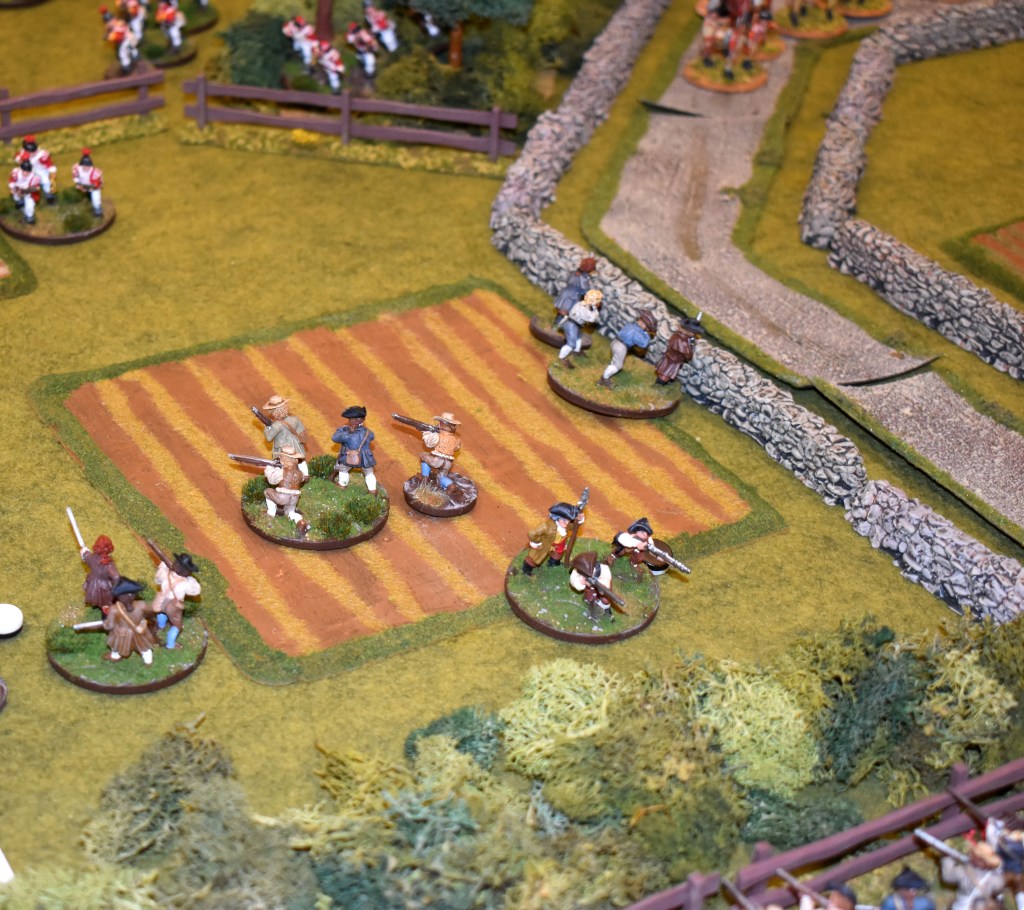
It’s early in the game Scott Abbott’s Light Infantry have shot the Americans away from the first rail fence and is driving them back across the field. A second American line has formed at the next rail fence. It would become the fence of death.
The game is simple. The British grenadiers must march about 52″ or so to within 12″ of the table edge. The American patriot militia bands do their best to work their way to firing positions to drive them stop them. It’s a tough game for the grenadier commander. However, on both flanks there are five units of British light infantry to drive off the nasty Americans.
The grenadiers are marching up the road. They’ve taken some random fire to their left, and their right is protected by light infantry in the woods. They’ve also run low on ammunition, which is not good in a firefight. Light infantry chasing off militia on their left flank.
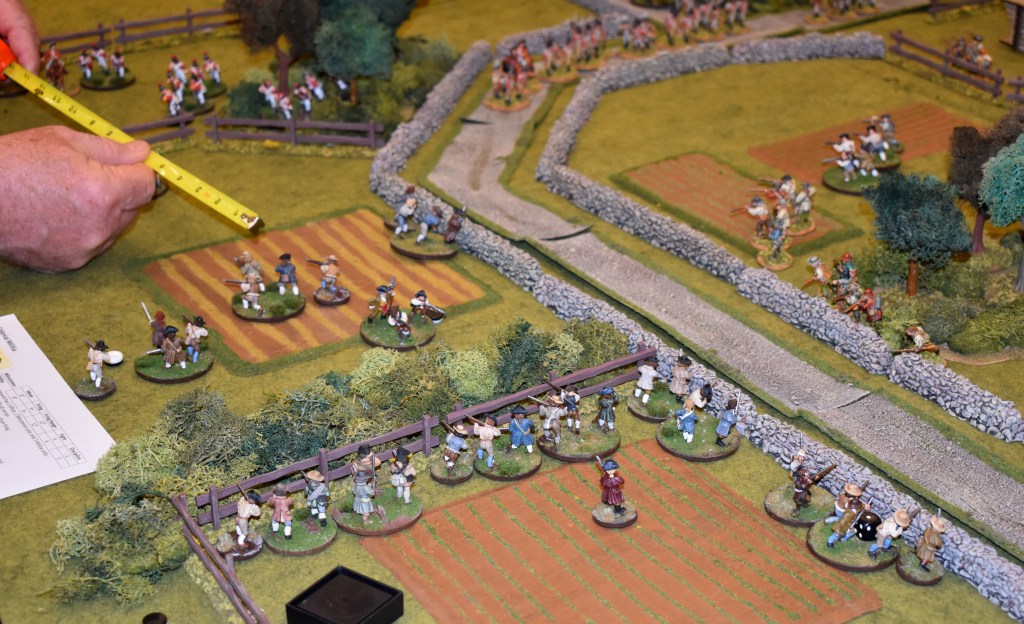
The patriot forces are many, but brittle, but in this game the Brits just seemed to get out-shot. Lots of Americans were able to form little lines of death that the light infantry was unable to dislodge. As more militia crept closer to the stone walls lining the road, the grenadiers simply bogged down in a hail of fire. Tough day. Even so the game was pretty close with the Yanks defeating the Royal forces 7-5.
Little knots of patriot militia line the road to greet the grenadiers. Though the lights are able to control parts of the stone wall, there are just too many Yanks and they are simply too depleted.
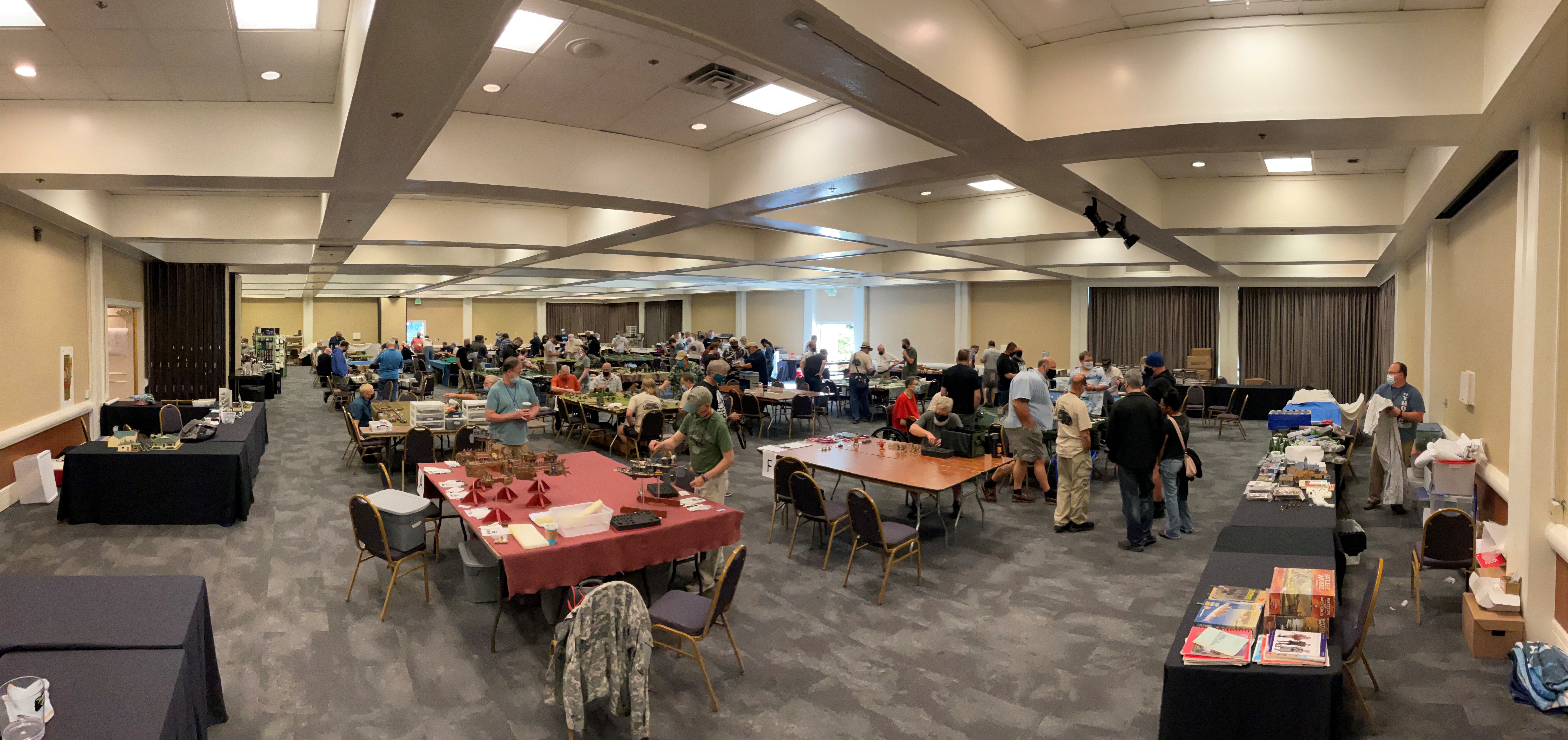
This excellent panoramic view of the convention floor was taken and shared by Michael Koznarsky. It’s early Saturday morning as the show is getting ready to start.
I am slowly recovering from my Enfilade convention. This post will deal chiefly with the convention from the standpoint of Kevin Smyth Convention Director, which is a lot different than the perspective of Kevin Smyth attendee and game host. That will follow in a subsequent post.
This will also include some opinions that are strictly impressions based on conversation and observation, have no basis in numbers and facts, but they are honest, so please forgive me if I seem to paint with an overly broad brush.
I’d like to say it was a normal convention with the floor packed, and games galore with attendees packed in the aisles. It wasn’t. We had 135 attendees and some 80ish games. There were 41 pre-registrants who were no-shows and 50+ walk-ups who registered at the convention.
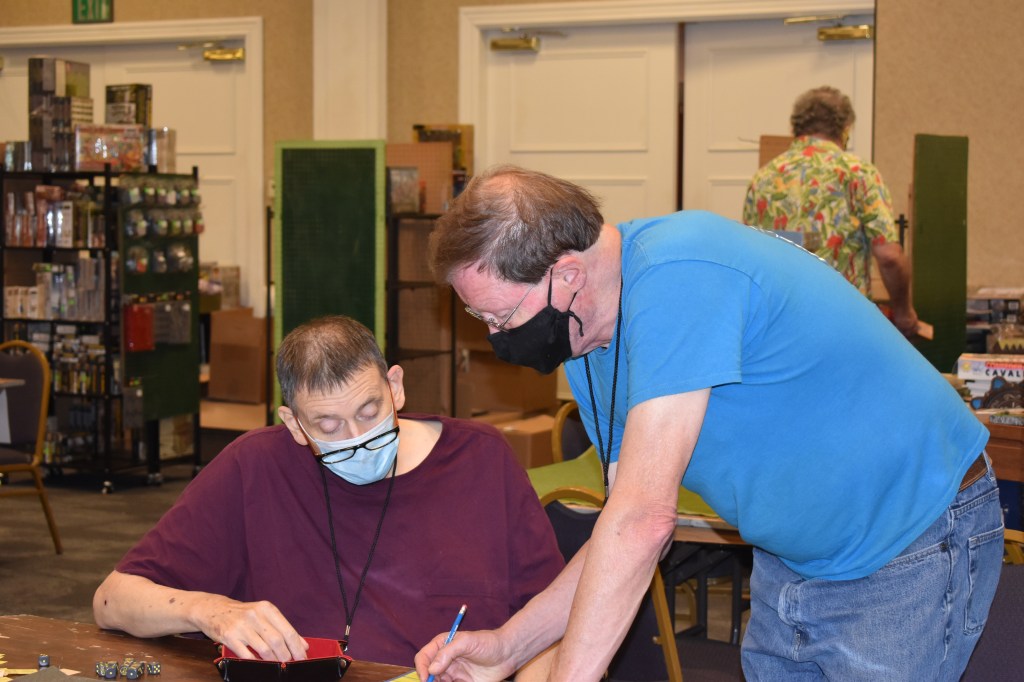
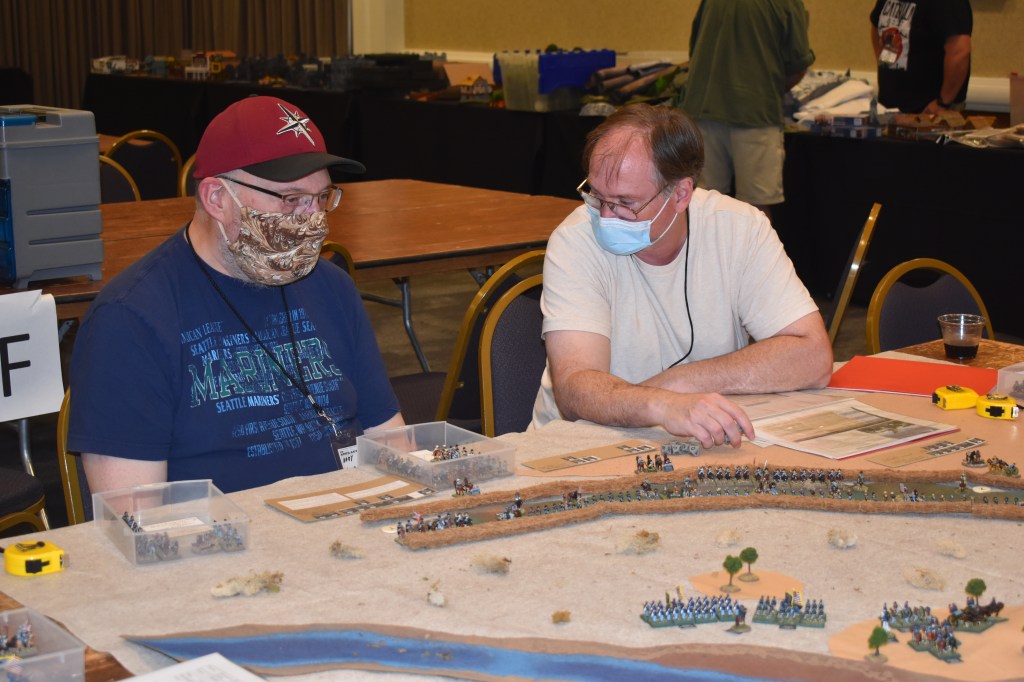
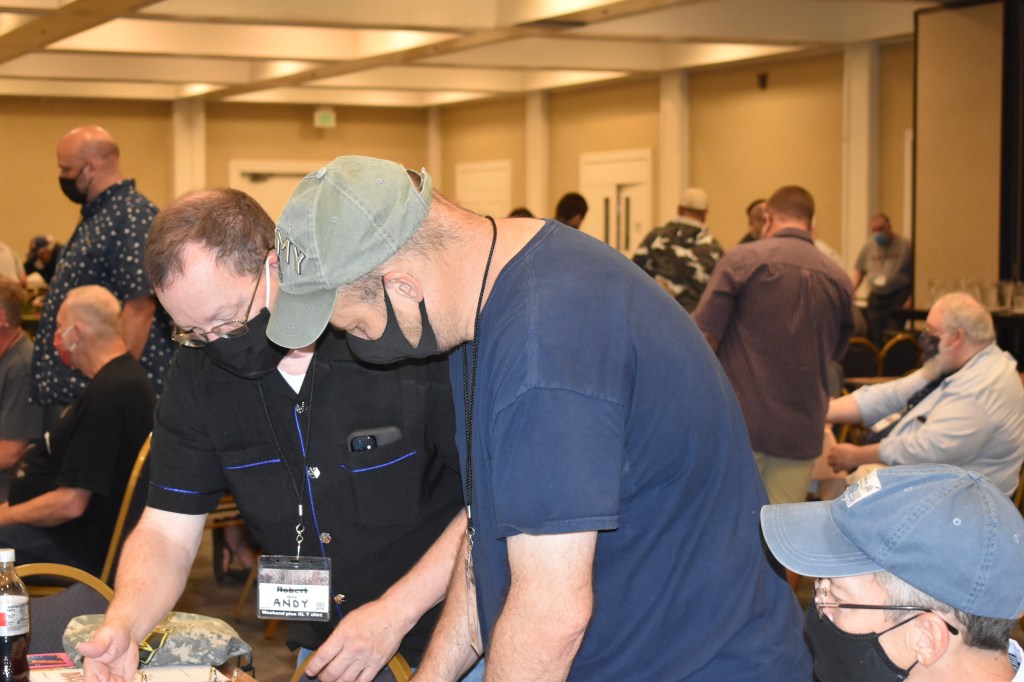
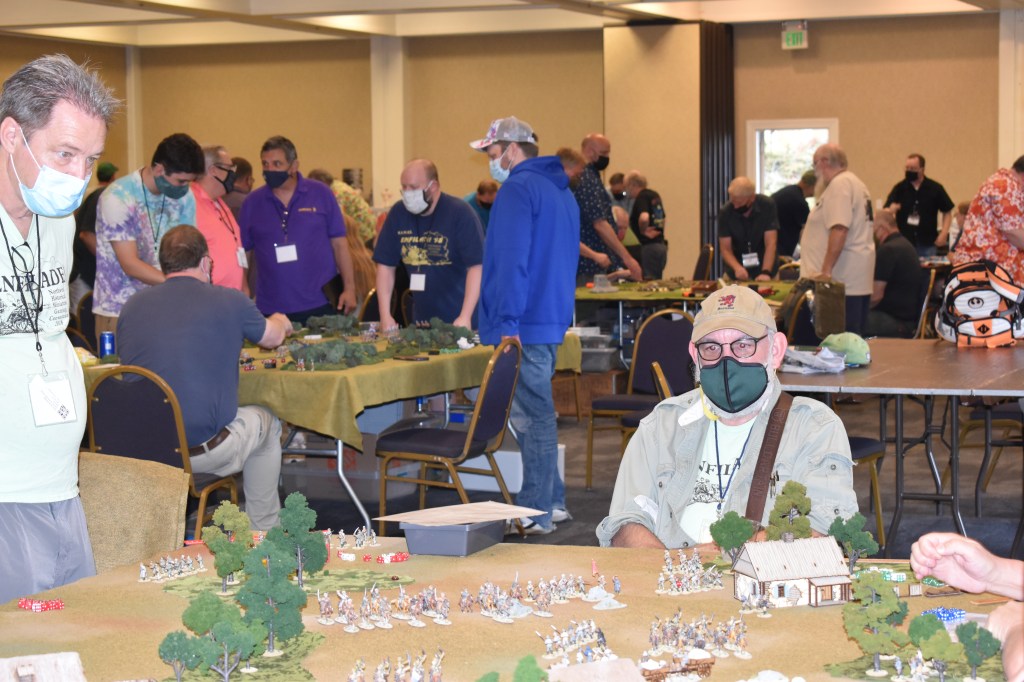
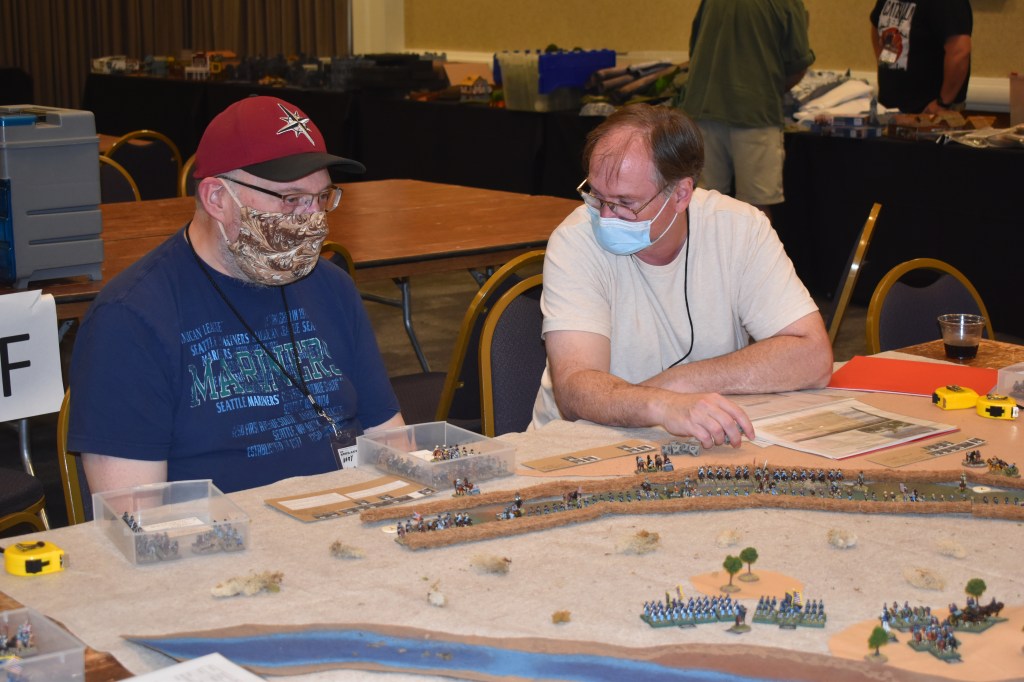
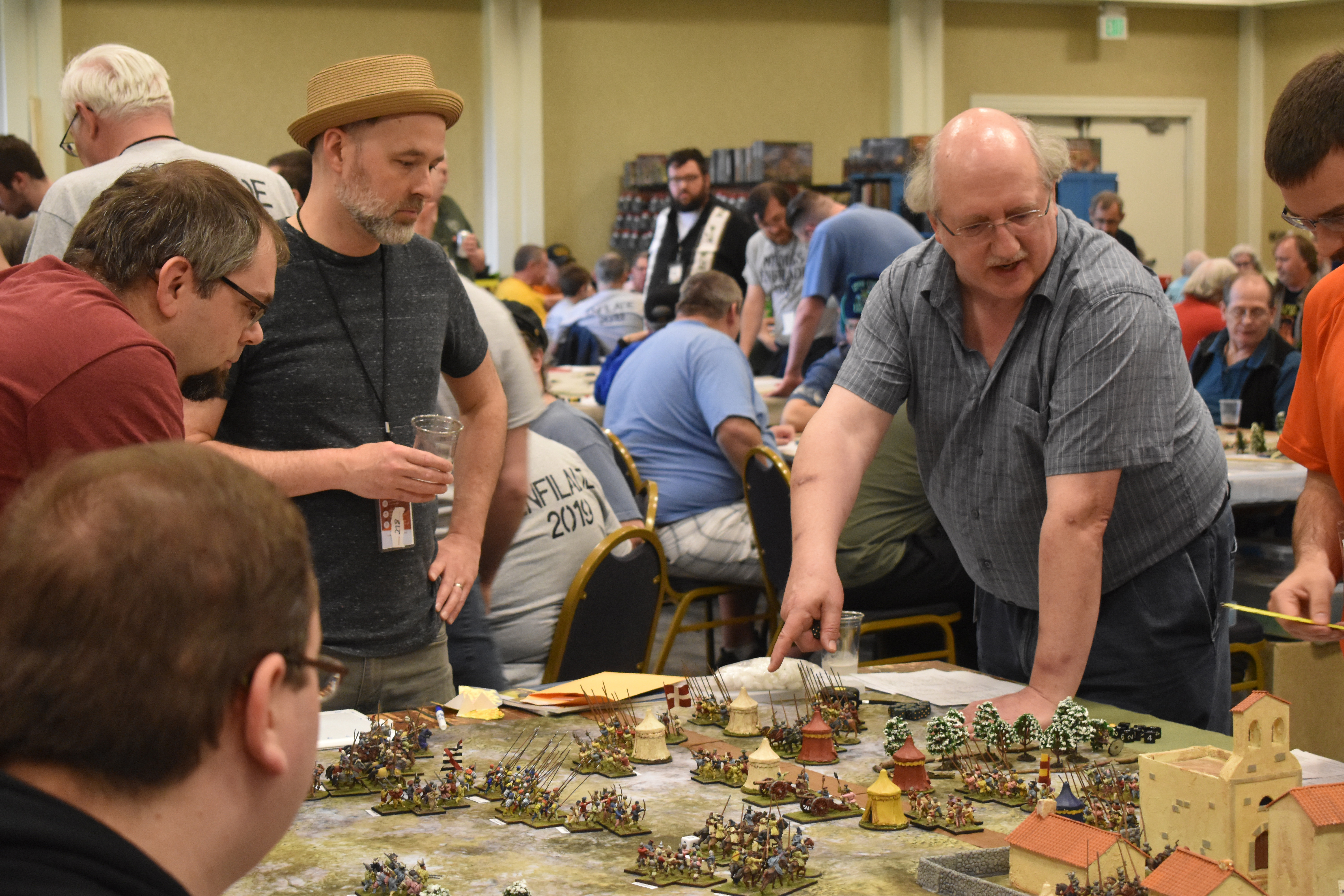
From upper left: Andy Hooper and Scott Murphy prepare for the defense of Valverde. Andy Doty explains the finer points of Harpoon: The Chiefs Edition. Henry Thomsen shares Hammerin’ Iron for his Louisiana State Navy game. Gene Anderson readies his spectacular Space 1889 game.
I can’t say why people stayed away. I don’t have evidence except for anecdotes. One didn’t attend because we didn’t require evidence of vaccination. Five didn’t come because of the masking requirement. We had nineteen pre-registered Canadians who couldn’t come across the border. The majority, however, felt with infections spiking, mounting breakthrough infections and the ultra-transmissable Delta variant dominating it was too risky to a family member or important future plans to take a chance on getting sick. I was the contact for those who canceled for 2021, and those were the stories I heard. It’s not a complete record.
Look, I don’t want to be a downer. It was a weekend filled with happy, enthusiastic gamers. I hosted or co-hosted four games. All but one of them were full. As director, there were no significant complaints. Everyone I spoke to, and I make an effort to contact as many as possible, things seemed to be good. Vendors seemed to be selling products and the B and B was abuzz all weekend long.
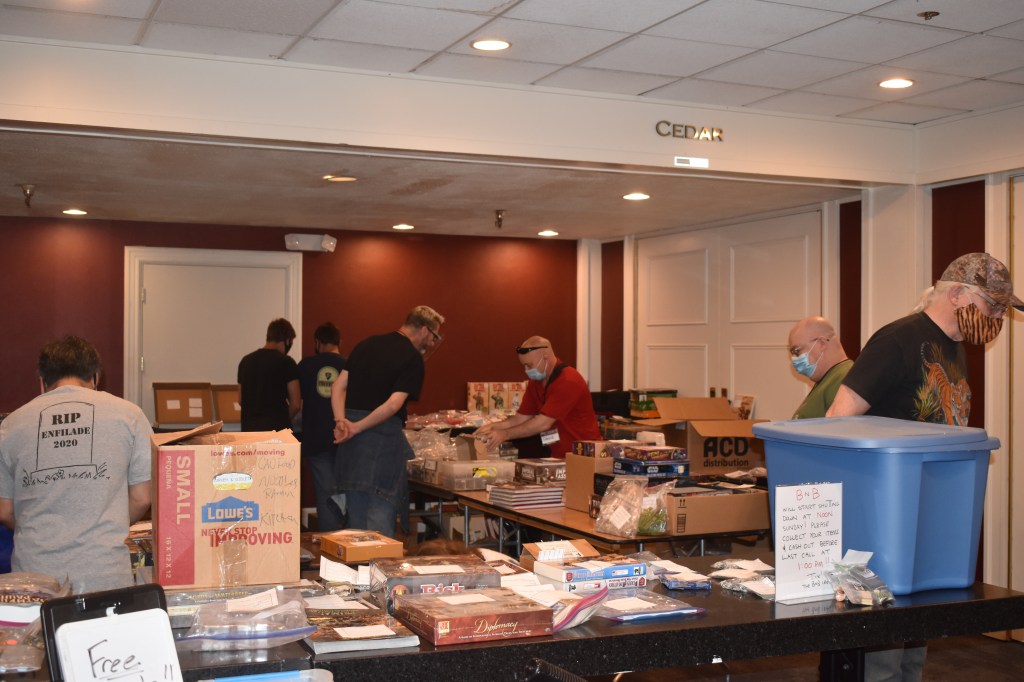
Attendees seemed to know we were in a precarious financial condition and they were anxious to help. A few donated cash. Others supported NHMGS with purchases from a fully stocked Bring and Buy. One of our vendors–Games Plus/Stonehouse Miniatures sponsored a Magic Tournament with profits going to the convention. Eight gamers took part. Not bad.
While it would be super if Enfilade 2021 was like 2019, that simply wasn’t going to happen. The virus was spiking at precisely the wrong time. We missed those who chose not to come, but those who did had a good time.
Sorry, I confess a silent love for the Left Banke and their big 1966 hit. Critics call their music “baroque pop,” and so it is.
While the song is about lost love and a broken heart, this post is more about wrapping up a project and moving on to something else. Anything else.
The Hue project is also a Vietnam project, though I confess my attraction to Hue. I’ve written about that before. It’s unlike the “real” Vietnam. What is the “real” Vietnam? Tim O’Brien wrote about it in “The Things They Carried” when his platoon found the courage to march every day despite the persistent danger of setting off mines, having legs blown off and enduring the eternal anger of the villagers they encountered not far from or long after My Lai.
No, Hue is different. Our game, co-authored with David Sullivan, will be an old fashioned street fight. The figures are done. A playtest was run. The buildings are done. We just have a couple more things to pin down, then the game gets run Friday night at Enfilade.
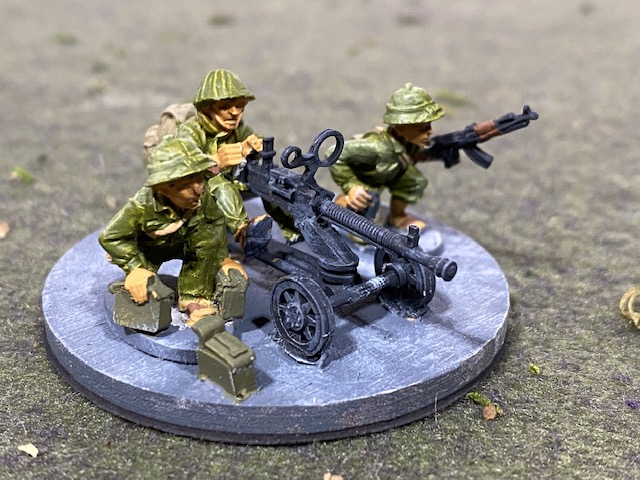
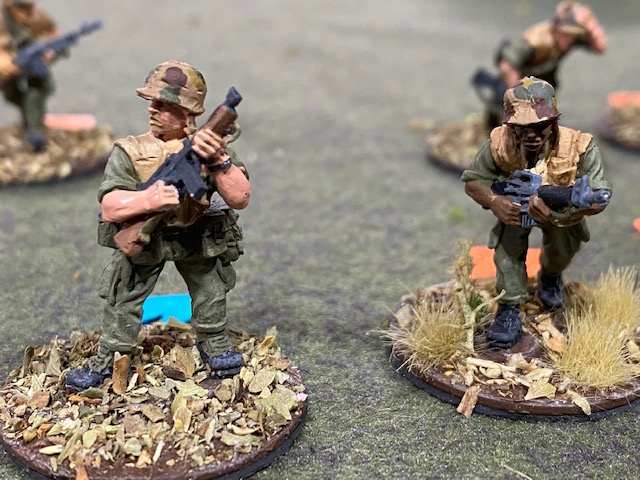
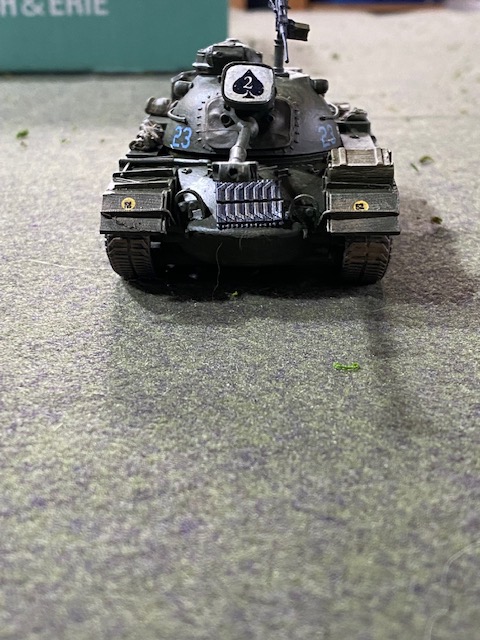
As projects go, it was relatively small. I think I projected painting 115-125 figures. I painted more than that, but not a lot more. I have 75 Marines, all by Gringo 40’s. I also have three American vehicles: a M-48A3 Patton tank by Company B Miniatures, a M274 “Mule” weapons carrier with 106mm recoilless rifle by Gringo 40’s, and a M-50 Ontos by Empress Miniatures. I’ll say a word or three about the vehicles later.
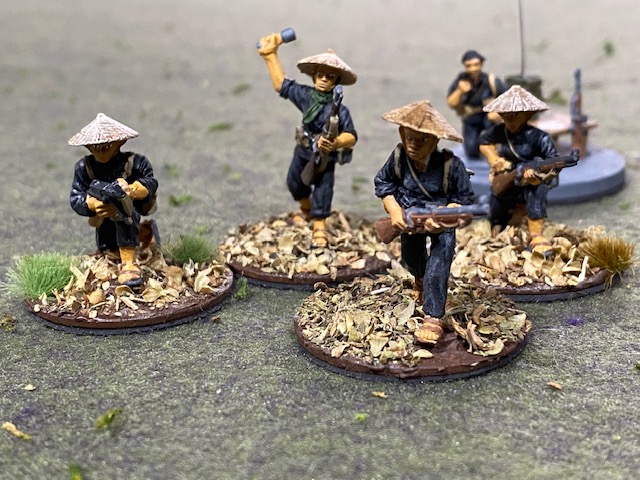
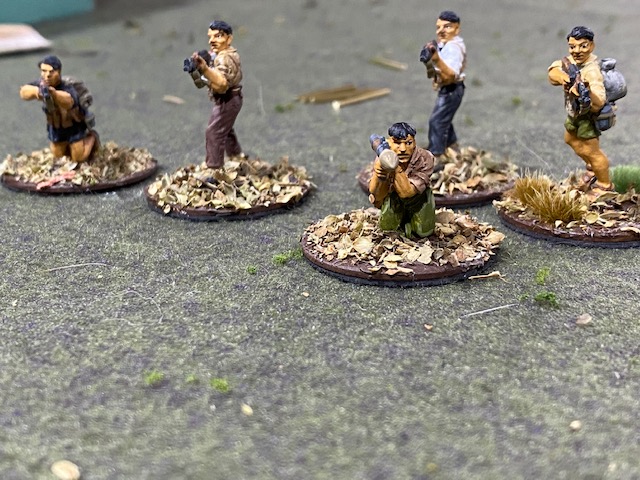
I have 30 NVA figures. All are Gringo 40’s except for the DsHK heavy machine gun and crew by Empress Miniatures. Add to those 31 Viet Cong by Gringo 40’s plus 16 civilian figures by Empress Miniatures.
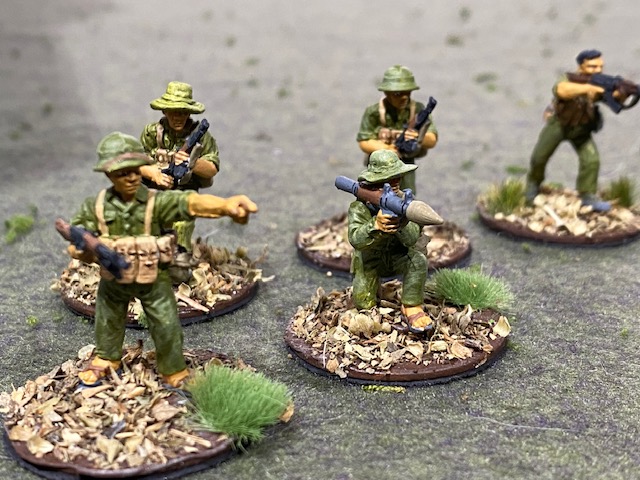
North Vietnamese regulars. Infantry by Gringo 40’s. DsHK heavy machine gun and crew by Empress Miniatures
That puts my figure count at 152, so a few more than I planned. Of course there is the matter of the 15 unpainted ARVN figures. I can imagine adding more figures if G 40 adds more to their ranges, but it won’t be a big add.
I know I’ve written about the Gringo figures before. I think they’ve done a super job. These are large figures with lots of detail, but not too much. The Marines have a lot of different poses and are well-suited for Hue. I still think there are things that need adding. A corpsman figure, a heavy machine gun for the Marines and NVA, maybe a gun truck if they decide to expand their vehicles.
Gringo 40’s Marines
I’ve painted a small handful of the Empress figures. No Marines. They also detailed, enough to be considered elegant, but quite a bit smaller than the Gringo figures. They are the civilians who can also morph into combatants as well as the NVA heavy machine gun and crew. The gun and crew fit in well, mostly because they are all crouched or seated. The civilians work fine because they are civilians. There are some intriguing Empress offerings, but I think I’ll mostly swear off due to the distinct size difference.
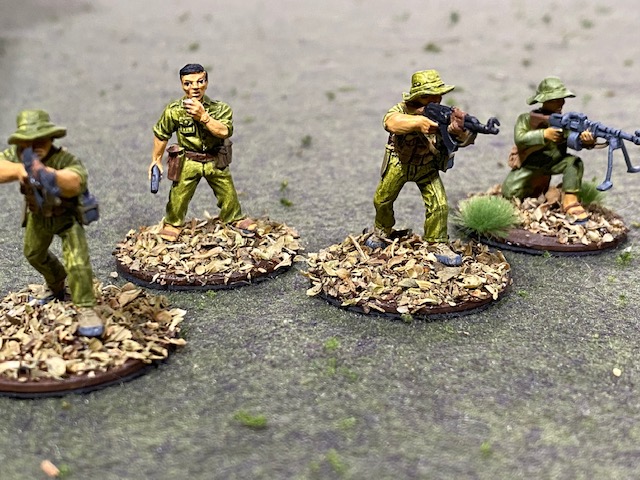
Gringo 40’s does a super job with their Viet Cong figures. Upper left are a few of the women VC offered. The figures to the right are Empress. The picture at bottom offers a size comparison between the Gringo figure (back) and Empress. All nice, but definitely a significant size difference.
My Hue buildings are done at last. They are a different add for me. I don’t have tons of terrain bits for ANY of my projects. Trees fine, rivers yes, some roads and a few buildings, but the nine Hue houses and the large citadel building are a lot. 3D printed, with a lot of sanding required to reduce the printing striations, they turned out well. I’m also adding pins to hold the two levels of the houses together during game times. They are nice and add a certain something to the game. I’ve also scratchbuilt some of the walls that are needed to play the game. That was actually a very good experience for me. Just getting the chance to do some simple work with foamcore was a confidence builder.
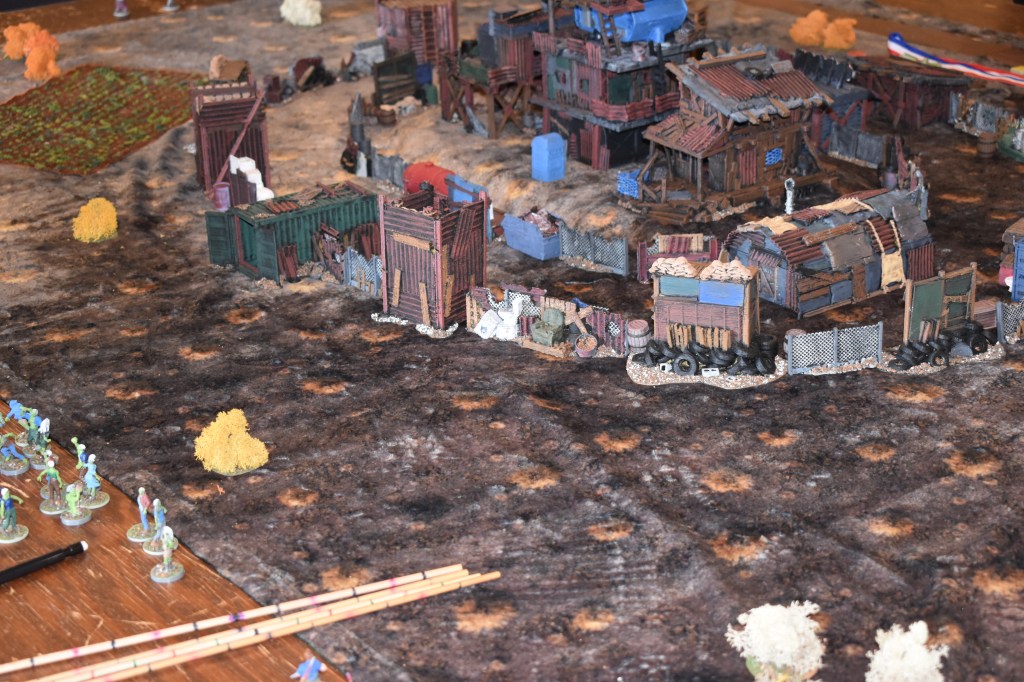
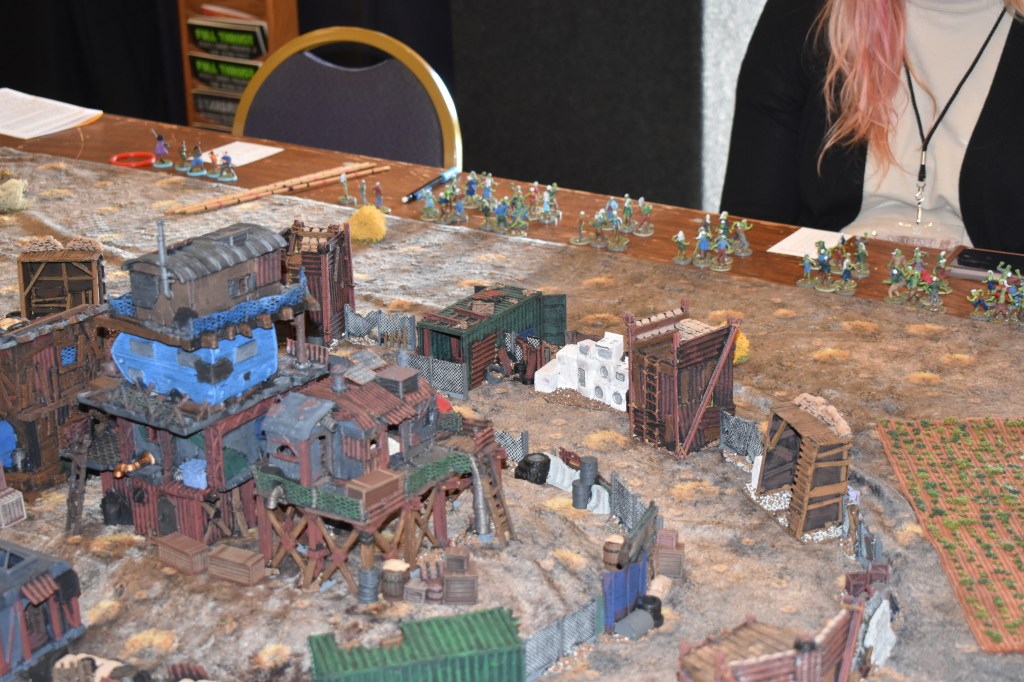
The final set up for Hue using the printed citadel and nine printed houses. Some of the walls are printed, and some are scratch-built.
A few words (!!) about vehicles. I am not a vehicle guy. It’s not that I don’t like them, I just don’t have a lot of experience working with them. My projects don’t call for them. So my decision to buy and build a few was a lot like being thrown into an ice cold bath. Some were easy to work with and some were harder. I’ll do a quick review of my experience with the kits in the order I built them.
Let’s start with the Gringo 40’s Mule with 106mm recoilless gun. All pieces are metal and it comes with three crew members. The crew members are all excellent and meet G40’s’ high standards. I especially like the loader figure. Lots of bits on the Mule. I know we’re shooting for authenticity and detail here, but the kit is underserved by a paucity of directions. I found myself looking at the teeny, tiny picture and the bunch of teeny tiny pieces and going “huh?” Two items in particular received my ire. The first is the steering wheel/gear shift which in a perfect world should sort of fit in the driver’s hand. Look I’m not that picky, but with a complete lack of clarity where that assembly actually goes, the spiffy set up with the driver just doesn’t matter. The other thing that made me cranky were the railing pieces. These are nicely made and fit the miniature well, but by the time they arrived in my hands these long thin pieces were like so much over-cooked spaghetti, and straightening them to some usable appearance was a bit of a trial. In the end, the miniature looks great, though I wish I hadn’t put the loader on a separate stand. That’s on me.
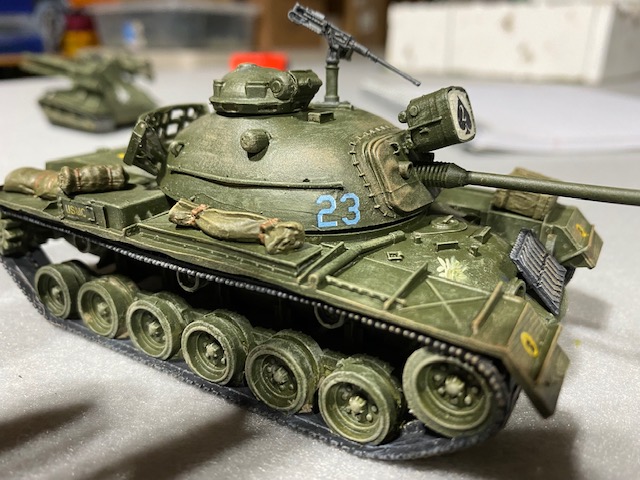
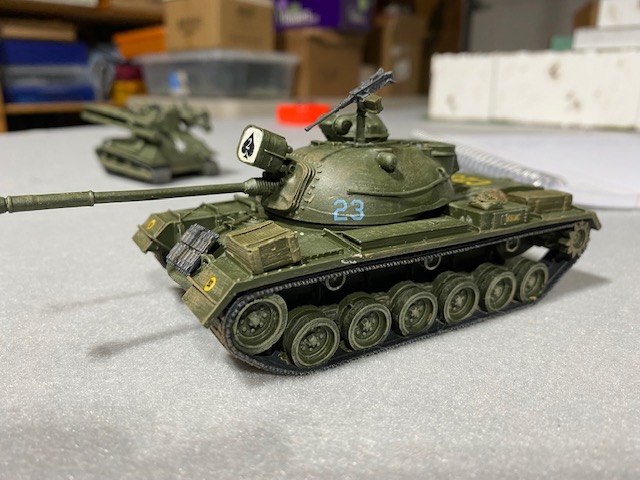
The Company B M48A3 seemed like such a behemoth when I opened it. I worked a bit with my friend Michael who has a ton more experience with vehicles and is also a Company B shareholder. I popped open the kit and was amazed at all the cool stuff. It was a bit light on directions, but there wasn’t a mystery about where everything was supposed to go. Two things that really impressed me were the fit of all the main bits, especially the metal tracks with the resin hull, and the many variations that could be done. The M-48 was in service for a long time in a lot of places so it seemed if you the builder was interested in Western Europe or Vietnam or someplace else there were lots of optional bits. I chose to take the machine gun out of the rotating cupola and mount it on a pintle and failing to use my head promptly glued it down in the absolutely wrong place. I did “unglue” it and move it to a location more suitable. It was a fun build, even for a neophyte, and I love the way it turned out.
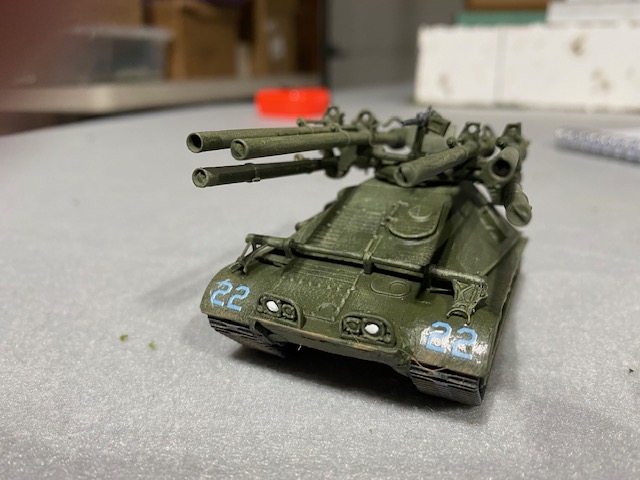
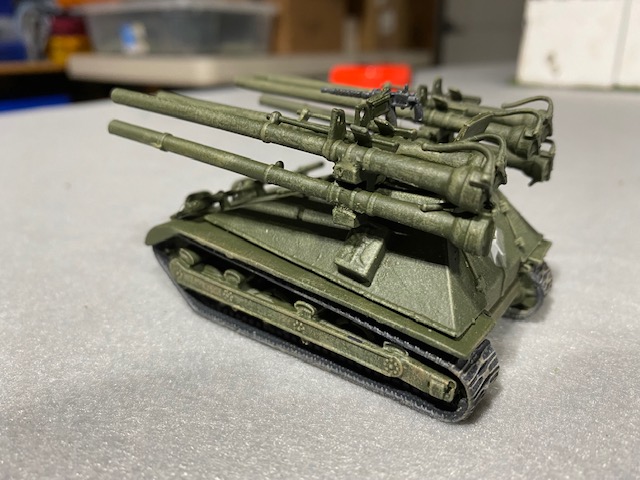
I ordered the M-50 Ontos by Empress because it looks weirdly cool and had such important impact on the fighting in Hue. The Empress kit has several things going for it. There are no unnecessary bits to confuse me, and the Empress website has four very useful photos of the completed model, so there are some pretty good views of where everything goes. However, there are some unfortunate issues too. The hull is resin, and so are the tracks w/fenders. The great thing about the M-48 and its metal tracks is the crispness of the casting. There is no question about fit. The resin Ontos tracks are not crisp, required lots of sanding and still did not fit properly. It required lots of green stuff to fill gaps–and in close examination still did not fit right. My other big issue is with the turret. An Ontos only has sort of a turret. It’s really just a moving cradle to house the six recoilless rifles. The turret/cradle is small and resin. The cannon are all metal, each much heavier than the cradle. Gluing those guns and keeping them straight and parallel on the very light mounting became part of the “no-fun-zone.” While not wildly askew, they aren’t straight despite my best efforts with CA glue, CA glue accelerant, two part epoxy, all the tools at my disposal. I like the relative simplicity of the kit. It has nice detail. But it’s a little too buggy for someone who is a sort of novice with kits like this. Not sure I’d try this again. Maybe someone who is a better model builder than me.
In any case the kits are done, the figures are done and I’m looking forward to doing something else for a while. Not sure exactly what I’ll move on to, but I may not focus for a while. I’m interested in working on my piles of Spanish-American War figures, some AWI for Regimental Fire and Fury, and 1/1250 ships for the Russo-Japanese War
Hoped I wouldn’t have to consider these guys while packing for the convention.
Planning a convention is always a chore. I’ve done it before. It takes some time and diverts attention from what I really like to do which is running games. But someone needs to do it and I’m willing to be that guy periodically.
2019 is significant to this discussion because it was important for a couple of reasons. First, it was the last successful Enfilade. That was run by Alyssa Faden and Vic Cina. It was terrific. It was the most crowded and loudest convention ever in Enfilade’s nearly 30 year history. Tons of great events. They fully implemented digital game online registration for events, which I never had the courage to do. It was a blazing success, it was possibly the best Enfilade ever and I’ve been to all of them and had a hand in running many of them . We had every reason to look forward to simply getting better-though we also worried about out-growing our space.
Needless to say 2020 didn’t happen. I was in San Diego March 6th when my cruise to Mexico was canceled, but in the days before I came home I received an e-mail from a friend letting me know the president of NHMGS was gravely ill and would I be available to help. I was newly retired, with time on my hands. When I came home, my first job was to stay in contact with the convention hotel and in the end, due to the strict lockdown of the economy and social distancing, Enfilade 2020 became a footnote rather than an event.
Photo from Enfilade 2019. It was a very full, very busy convention. Not Covid-friendly
In the months since the virus has ebbed and flowed and spiked and mutated. The NHMGS Board has really grown and fostered an air of quiet competence. We’ve met monthly, updated our by-laws and formulated a process for regular elections. But at the heart of everything was returning some sort of Enfilade, even if it is a rump get-together, not as big as its former self: understanding Covid would likely deter many from meeting in large groups until a more permanent solution began.
By November 2020 we were plotting. We needed to replace our registration website. This fell to yours truly retired guy. Mistake. The best, easiest web-building platform in the world still takes me three times longer to do than your average six-year-old. We looked for a February opening for our website to serve our normal Memorial Day weekend convention.
Covid spiked again in the winter. By late January vaccines were becoming available but they were rolling out slowly. At our January board meeting I pitched the idea of moving the convention to September assuming hotel availability. The Board approved, and I inquired. Labor Day weekend was available, and we agreed to plan for a different Enfilade.
We, were thrilled. Plus it allowed me some extra time to deal with the registration website fortifying my natural inclination to procrastinate.
Winter wore into spring. I was vaccinated in February and was raring to go. Played some games with friends in basements and began eating in restaurants. I was still carefully masked in public places. My friend David and I leaped into the Vietnam period, and became regular customers with Gringo 40’s. We adopted a Saturday night Zoom session so those interested could hang out and paint together while discussing whatever came to mind. We wisely avoided politics.
As Memorial Day weekend approached and vaccination levels were still increasing, we were feeling pretty good. Washington State was getting ready to fully open. No more phases that seemed to favor the Seattle area. No more capacity limits. We were poised for an awesome Enfilade comeback. But there was a troubling trend: Seattle’s vaccination rate was about 70%, but in Pierce County, where I live, at less than 40%. And that was a worrisome trend line the followed into the summer. Some parts of the state were doing really well with vaccinations, others were doing very poorly.
By the end of June, the Covid numbers were still quite good, but there was news of the Delta variant making its appearance. The numbers multiplied, spiked and spiked again. For those brave enough, naive enough or foolish enough to plan a convention for Labor Day, we sucked in our breath.
I have no illusions about those who attend Enfilade. Good people all. Wonderful people. Incredibly kind, helpful and generous people from all over the Pacific Northwest. Great gamers, wonderful modelers some of the consistently best painters I’ve ever seen. Fire and Fury gamers from Centralia, Armati players from White Rock, and my friends from the Puget Sound area who are just too busy with too many things to identify. I love them all truly.
But we are divided by politics. We’ve resisted the call for verification of vaccination. Though we believe the vast majority of attendees would be vaccinated, we estimate a good many would not. We held the line. No vax mandate. Maybe that was wrong. As the numbers mounted registered attendees began to dribble away. Not in droves, but maybe ten. Things in Olympia were rotten.
Even more worrisome were conditions at the border. No, not that border. Washington is a border state and documentation of the misery the border closing had was a popular topic since the March closing. Stories about loved ones who visited each other at Peace Arch Park, marriages at the park, and the odd case of Point Roberts and its unique geographic location are constantly in the news.
But Enfilade has a border problem too. Between 30-40 Canadians regularly attend Enfilade. They are great guys. They host wonderful games and an annual Saturday night party. They rent rooms. They are integral to the convention paying its bills. Despite what seemed to be clamoring by Americans to open the border and Canadian Prime Minister Justin Trudeau seeming to be the obstacle, we were pleased to hear in July that there seemed to be movement. Of course, this was all dashed when the Biden Administration followed a scheduled Canadian opening of August 9th with an announcement the US border would remain closed, confirmed on August 19th until at least September 21st. My Canadian friends would remain locked out of the convention.
Two weeks ago a crowd of 25K at an outdoor concert at the Gorge suffered over 200 infections. Vaccinations suggested, masking for those not inoculated. Sigh.
We’ve always held we would follow state Covid mandates reflected in our hotel rules. August 14th the State of Washington issued a mask mandate requiring that people wear masks in public areas including grocery stores, gyms and other public areas. The governor also announced required vaccinations for state employees, which is another story, but shows the requirements ratcheting up. When I asked the hotel about this they replied that guests would be required to wear masks out of their rooms and public spaces BUT NOT in the ballrooms and gaming spaces.
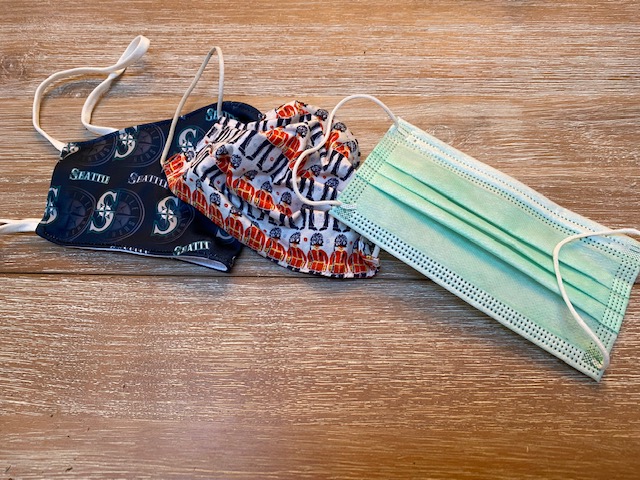
A mask mandate was going to be problematic. From my point of view it was desirable. The ballroom in a normal year would be terribly crowded. If Covid was present, if the unvaccinated were present, a mask would probably be a smart move. At least in theory. Of course wearing a mask to the grocery store and wearing a mask for three game periods of four hours each with an hour’s break in between, that’s a different problem.
With Covid cases skyrocketing and increasing evidence of breakthrough cases, the idea of requiring masks in some places in the hotel, but not where most of the people seemed to be congregating was a disaster. The chief response on our sizable Facebook page was one of outrage. We were sacrificing safety for the cover of misapplied rules. A trickle of non-attendees threatened to become a flood. I was on the verge of asking for an emergency board meeting to extend the mask mandate to the game areas, when we were saved–by the governor
Jay Inslee is a polarizing figure in Washington state. I have never been an enthusiastic supporter, but voted for him three times. Let’s not get into why. But he’s done a great job of protecting the state during the pandemic. Remember, the outbreak started here and he acted immediately. If you live in a state like Florida or Texas that has taken a lot of hands off measures, Inslee is the opposite. He locked the state down quickly and has only gradually let go of mandates and lockdowns. He’s earned a lot of enmity from conservatives, business organizations and the tourism industry, but was easily re-elected in November.
On August 18th he extended the mask mandate that forced the hotel to require masking in all public areas in the hotel including the ballroom and game spaces. The reaction on the Facebook page was almost a universal sigh of relief. Some didn’t like it and made plans to exit, rolling over their registrations to May 2022. Others claimed the crisis was hoax and others refused masking very pointedly. Though these issues have since been addressed and we are moving on, it made for a very uncomfortable 24 hours.
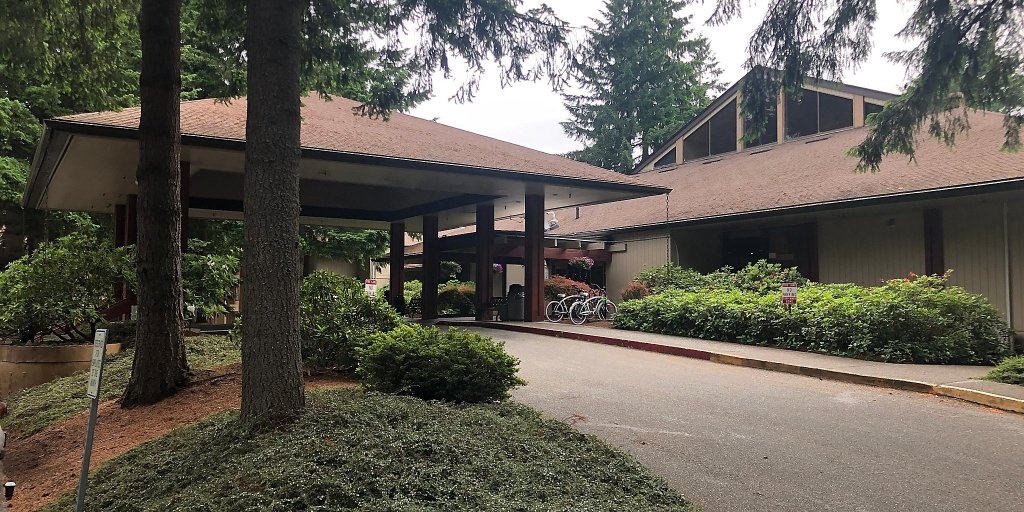
Hotel Olympia is the home to Enfilade. It’s comfortable if aging. It is an affordable convention space, which is tough to come by in the Puget Sound market.
I would be remiss if I didn’t share the financial implications of all this to the convention, NHMGS and to the hotel . Like all conventions, we contract for services with the hotel. Both sides have to perform. The hotel provides services included in our contract, we promise to rent rooms, eat food, and be nice. We’ve been at Olympia Hotel (formerly the Olympia Red Lion) for twenty years and have never had difficulty exceeding our promises. It keeps our ballroom rental costs low and hence registration costs low. It’s a really great space, and our long relationship has been mutually beneficial.
It’s unlikely we’ll meet our obligations this year. As the Delta variant and rate of infection has mounted, we’ve shed room nights like rain running off a roof. We aren’t clear about attendance. All numbers are in jeopardy and the the convention and NHMGS are exposed to considerable loss. We can likely meet the number, but it’s going to be a tough year. And just to be clear, the effects of a down year are mutually destructive. The hotel puts on extra staff to provide service to us, prepares food for anticipated guests. They will likely share the pain (which we will need to make up.)
To date, August 25th, we have 43 cancellations. Of those 19 are Canadian attendees. I put them in a special class of attendees who don’t have a choice. They simply can’t get here. That doesn’t include a number of Canadian regulars who always register at the door. There are 12 attendees who have asked their registrations be rolled over to 2022. There are a further 11 attendees who are not going to attend but will donate their registrations to NHMGS. The last group is significant. Those donations are appreciated, but their loss also represents room nights lost at the hotel, not just dollars at the door and it complicates our obligations to the hotel. Two weeks ago we’d met our room night obligations. Today we’re in the hole. We’ve had a number of supporters who have donated significant funds to NHMGS in anticipation of our losses. I can’t thank them enough.
There is no blame that goes with any of this. Unfortunately it is what happens in the middle of a pandemic when infections spike. We seemed like such geniuses a couple of months ago when things were looking good. I certainly don’t feel quite so smart today. Hey I’m not looking for pity, dear readers, I’m just sharing our story with you. If you’ve gotten this far, thanks for listening
I’ll write a follow-up to the convention in a couple of weeks.
Note: Sometimes my posts are directly connected to what I’m working on or games I’m playing. This one is different and intensely personal. It’s part of my story. Maybe it’s for you and maybe it’s not. It’s something I’ve been working on for about a month. Just thought you should know, and thanks for reading.
I know I’ve told my tale of how my high school buddies turned me on to miniature gaming. Honestly, there are many I could name who have helped with my slavish love of this hobby. Dave Demick, Dave Schueler, David Sullivan (all the Daves) and so many more have had a role in this.
I always had interest in military history. I was a not-very-good model builder, but I built them anyway. I used to play these sort of proto-games with my neighbor Ray Powers, who was a couple years older than I and a really good model-builder, and we’d fly our planes and bomb stuff in each others yard, quite randomly.
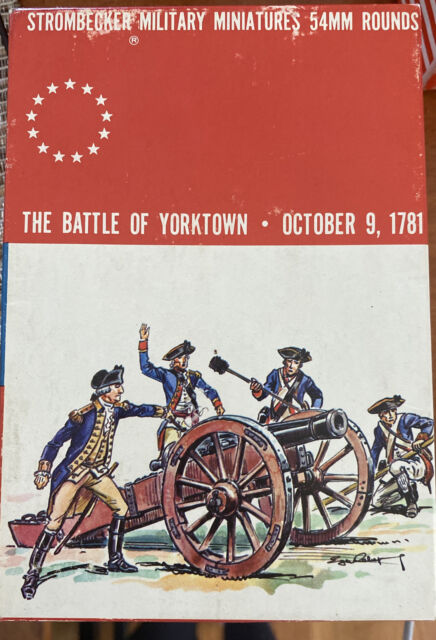
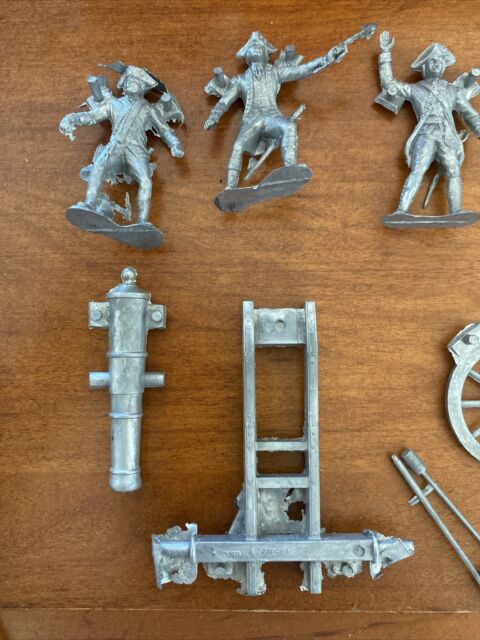
By the time I was twelve or thirteen two things had captured my attention. I purchased the Strombecker miniature set of George Washington bombarding Yorktown. There were four 54mmish figures and a cannon for three bucks. Three dollars was a lot of money for me, but I carefully painted the figures using basic Testors and Pactra enamels I could buy at my local dime store. I don’t think I primed them. I loved it.
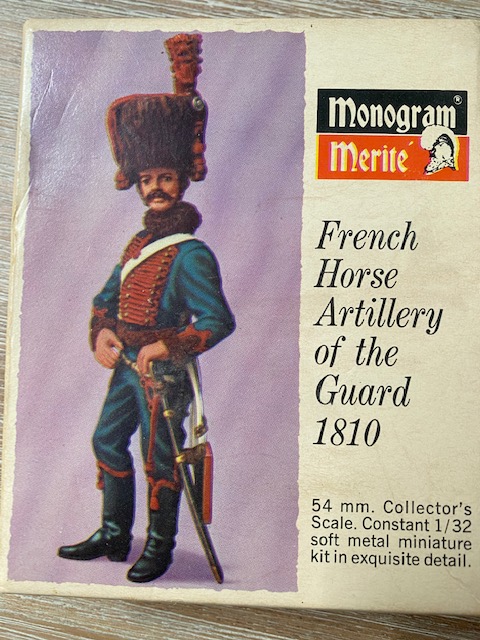
My friend Greg bought a different Strombecker set from WWI–the bombardment of Verdun or something like that. But when I went to the hobby shop in the Northgate Bon Marche–a going concern in 1968-I discovered something even better. The Bon had the complete range of Monogram Merite 54mm figures. I drooled. Also three bucks. For. One. Figure. I bought the French Horse Artillery of the Guard Figure. Of course I did. Why? Because my grandfather was in the artillery of course. I didn’t know French Napoleonics. Didn’t know the Guard. It could have been the Lunar Guard Horse Artillery for all I knew. The Pactras and Testors came out and I carefully made a mess of the un-primed mini. Of course Greg thought I was crazy. Three bucks for one figure when I could get four and an artifact for the same price?
Yes, this really does belong to me. Fresh from my miniatures pile of doom.
Note: To give an idea of just how immersed in nostalgia I am, I have since re-acquired the Monogram Horse Artillery of the Guard figure as well as the Monogram Berdan’s Sharpshooter figure. They remain very nice miniatures, though they cost me somewhat more (but not ridiculously more) than three bucks each. I have yet to paint either one, said every miniature wargamer ever.
By 1968 painting figures was in my blood, even if I wasn’t very good at it and used the crudest of tools.
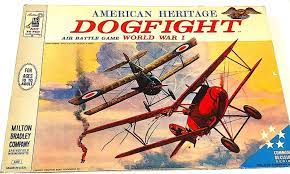
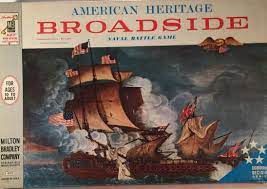
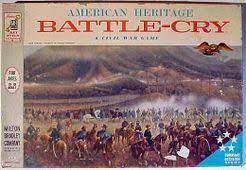
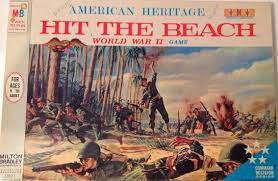
The gateway drug into historical miniature gaming was sort of historical board games. I’d love to tell you I was an early adopter of Tactics II and Blitzkrieg, but that would be a lie. When those games came out I was like eight years old. No, my path forward was definitely Milton Bradley’s American Heritage games. I loved Broadside and Dogfight, but I also played Battle Cry and Hit the Beach. The mechanics were simple. It was move/counter-move and easy to learn. Mostly I got clobbered and learned how to be a good loser, but it was fun and I had a blast.
By the time I was eleven or twelve (1966-68ish) interesting games began popping up at my local Frederick and Nelson department store at Aurora Village. Frederick’s wasn’t as interesting as The Bon, but they had sort of a book department and they had interesting adult-style games. They had the 3M bookshelf games, but these famous World War II battles began showing up: Midway, Battle of the Bulge, Stalingrad and others by Avalon Hill appeared. I was really interested, but the $12.00 price tag was well beyond my reach. I began reading a little bit about them too, and they sure seemed cool. Unfortunately other things like records and plastic models competed for my tiny allowance dollars at a time when a monaural record was less than three bucks and a quality Revell model was fifty cents. Pleas to my parents went unheard, and my entry into hex-based wargames was . . . delayed.
I moved on. My grandparents moved to Edmonds from San Francisco. They were in their seventies and my mother and her sister worried about them being so far away. They convinced them to move back to the Seattle area where family would be able to help them a bit. They managed an apartment complex just a couple of blocks from my cousins who lived close to the wonderful downtown area.
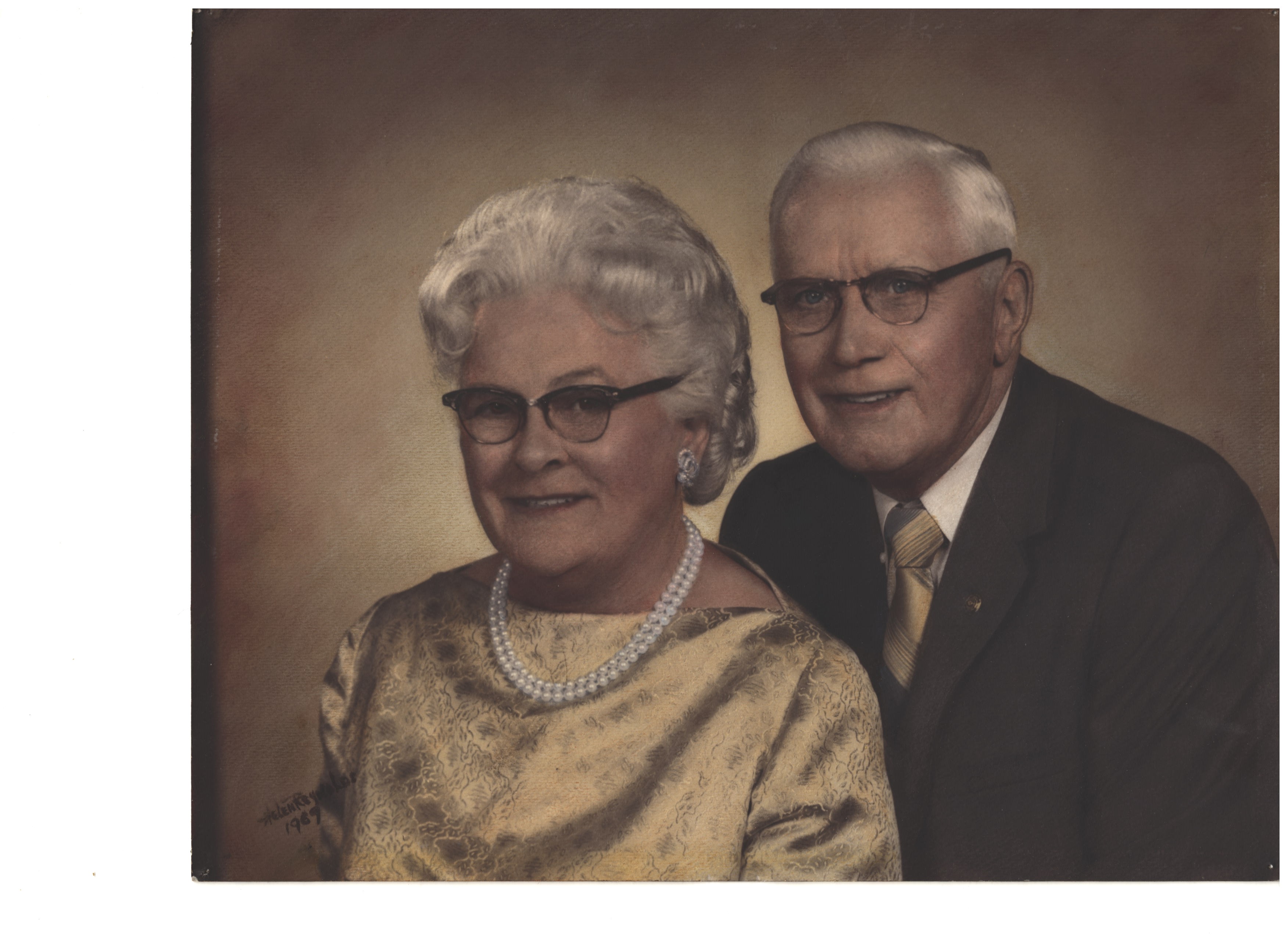
My grandparents Ann and Jerry Casey 1969 for the Golden Wedding anniversary, about the time I acquired Jutland.
I was blessed with two amazing sets of grandparents. They were always happy to see me, always kind. My two grandfathers were similar but different. My mother’s father, Jerry Casey was older than my father’s father, Jim Smyth. Both were terrific story tellers. Jim, born in Tacoma in 1907 never hesitated to tell about the family, was embarrassingly proud of the family. Jerry, born in 1894 in Ireland, orphaned at age three, was vague, elusive, almost silent about his youth and his family. They were both incredibly good to me, and there isn’t a day I don’t think about them. And I don’t mean to undersell the importance of my two grandmothers Ann Casey and Margaret (Mike) Smyth, who were sweet and supportive, and somehow didn’t wring the necks of their spouses who could be insufferable–much like me.
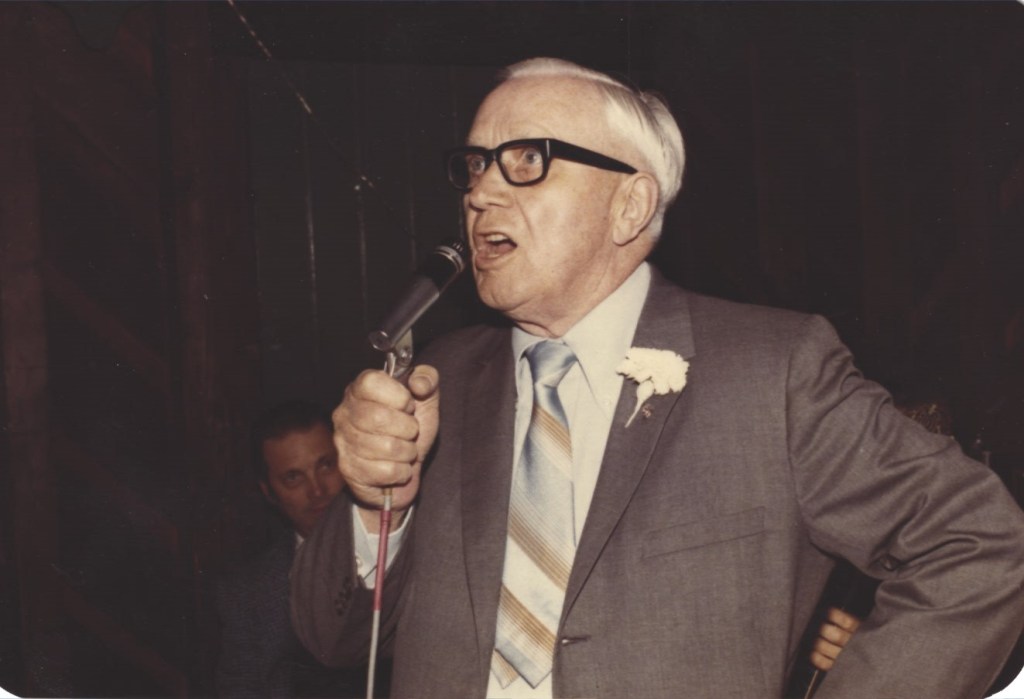
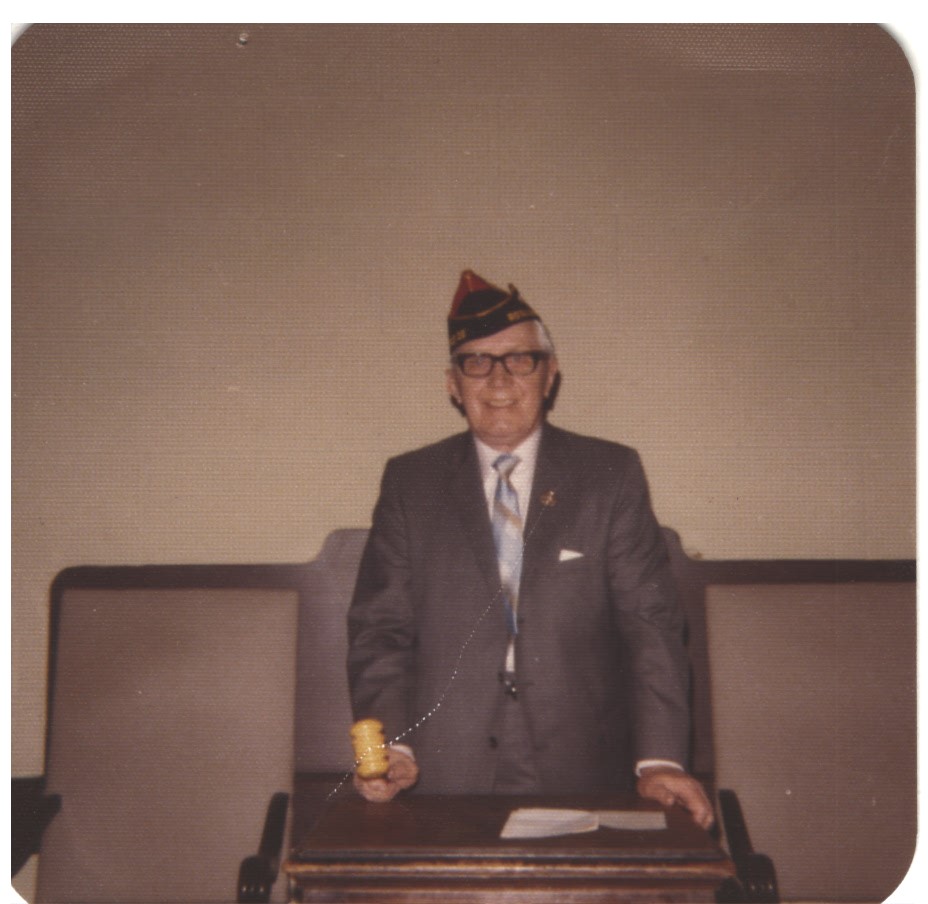
My grandfather had a terrific singing voice, and was once offered opportunity to sing on the radio. Here he is singing at my cousin’s wedding in 1974 at age 80. He was a proud member of the Canadian Legion, he was Post Commander in 1973.
I would occasionally spend the night with my Edmonds Bentler cousins, and once in a while with my grandparents. Though Jerry was closed-mouthed about his childhood, he spoke often and freely of his experience in the British army. He joined at age 16 as a boy soldier. Originally he served in the infantry, 2nd Battalion Royal Munster Fusiliers. But as the Great War approached he changed branches of service and served with the 47th Battery, 44th Brigade of the Royal Artillery. My grandfather was a proud Old-Contemptible and went to France with Sir John French in 1914, and served in France and became an instructor at the artillery school at Woolwich throughout the war. He was discharged in 1920.
At Grandpa’s house we’d often talk about his war experiences and other things. We might listen to a Sir Harry Lauder record or Irish/American pub classics by Ruby Murray Grandma would fix an awesome dinner and sometimes Grandpa would pull out a bottle of Guinness Stout and pour me a half a juice glass. At age 12, it tasted nasty, a position I’ve only recently managed to recant. He watched the evening news about the war in Vietnam. He wasn’t afraid to call politicians “Bums.” He read westerns by Louis L’Amour and Zane Grey.
My grandfather never drove as long as I knew him. He was a terrific walker until the day he died at age 89. Whether it was in San Francisco, Edmonds or the foot of Queen Anne Hill, where ever he lived, if I was going to visit with my Grandpa Casey I was going to walk.
And that was fine. We had great talks. My favorite memory was walking in Seattle in 1969. He was remembering his experience as an infantryman and said, “Kevin, if you couldn’t shoot, you weren’t worth shit.” I was shocked. I was barely beginning to experiment with interesting language and here was my grandfather just blurting it out. God, I loved him.
Often we would walk in Edmonds which had some wonderful shops including a hobby shop and toy store. Sometimes I would come home with treasures my Grandfather bought me. My mother would fuss at me and tell me I shouldn’t let my grandpa buy me ANYTHING.
One sunny spring day we’d gone for a walk and the local hobby store had its doors open. However, just inside in a rack, instead of the latest Tamiya models of Japanese dive bombers, there was a rack of Avalon Hill games. The sign on the rack said 50% off. Midway, Guadalcanal, Bismark, D-Day and others were there for six bucks. My grandfather looked at me. Then he looked at me looking at the games with all the interest of a hungry dog staring in a butcher’s window, and he asked if I would like one. My jaw dropped. I remembered, but then rapidly forgot my mother’s admonition. It was like a tiny bit of code being wiped from my hard drive.
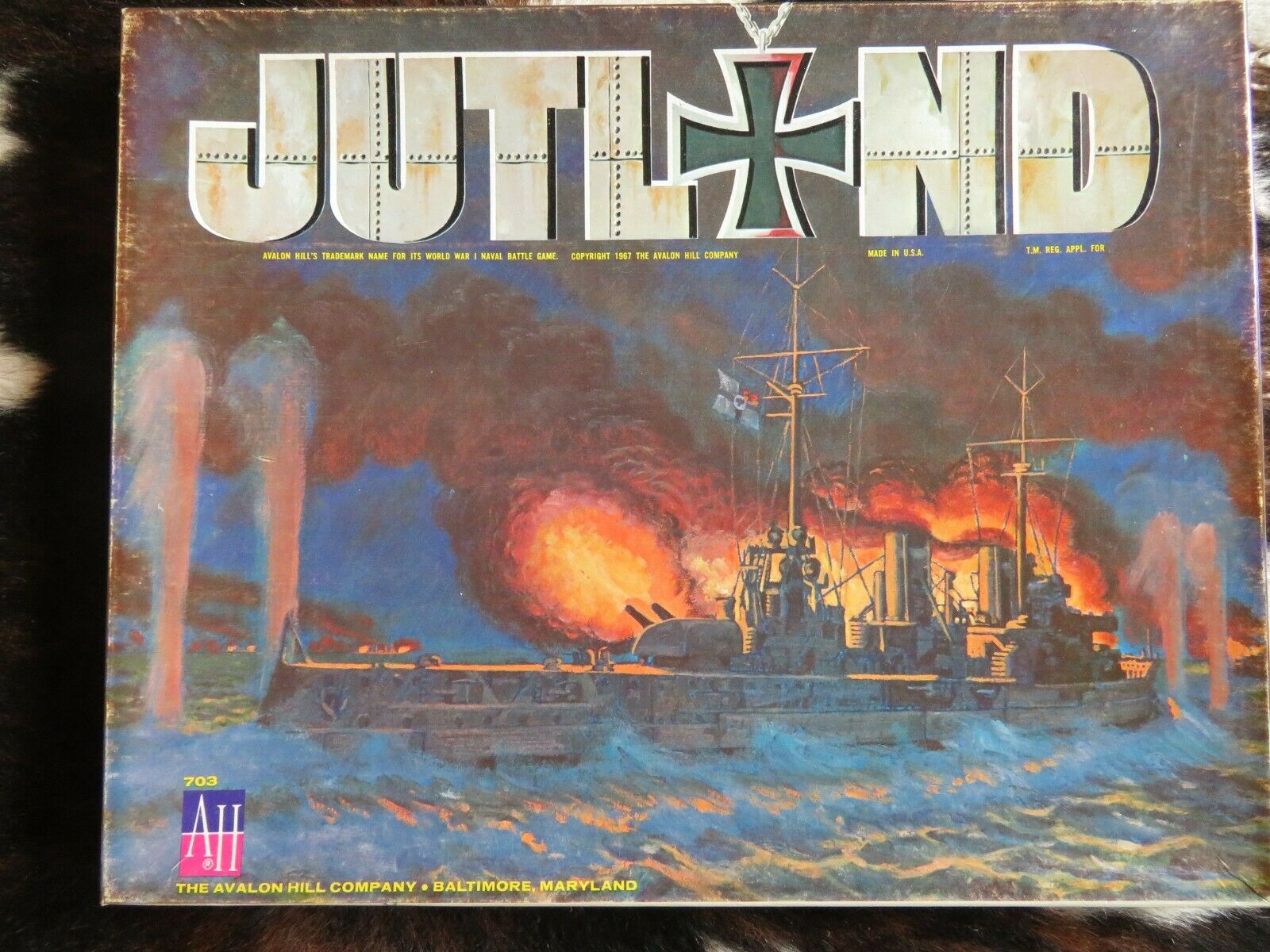
Of course I said yes, and I thanked him very much. The real problem wasn’t getting to yes, it was choosing from the pile. Midway was intriguing, but I think I made the right choice in Jutland. In the end, Jutland is the Avalon Hill game most like miniatures. I didn’t know a lot about the battle, but I had heard of it and loved the box art.
The story could end here, but it doesn’t. Grandfather buys 12 year old grandson Avalon Hill game, he goes on to greater gaming glory. No, I took the game back to my grandparents’ apartment and immediately began looking it over. The basic rules. Ugh.
All those fleet organizations and search rules. Yikes.
My grandfather saw me poring over all this and pretty much said screw it, let’s just put some ships on the floor and have at it. So we lay out equal numbers of cardboard counters representing German and British battleships and shot at each other using the basic rules. It was easy and fun, not so unlike the Milton Bradley games I’d been playing.
So let’s get this straight, my grandfather bought me this mysterious game, sees me struggling with the rules, excises the hard, and to the 12-year old, difficult parts, adopts some simple house rules and then gets his 75-year old knees on the floor and helps me give them a try. Today I’m ten years younger than he was, and I’m not sure how good I’d be at crawling around on the floor with my grandson (if I had one, sigh.)
I do still own a copy of Jutland, but it’s not my original game. Wish I still had it. Would love to play it.
Jutland was my first Avalon Hill game. Later that summer my father’s cousin would gift me a copy of Afrika Korps. For Christmas my parents gave me a copy of Bismark. I was on my way. We played the heck out of Jutland, with all its search intricacies and we played the advanced rules. . Greg got a copy of Gettysburg, which I always seemed to lose. But it was that spring gift from my grandfather that really set me on the road to becoming a miniature wargamer.
By the following year, my grandparents were on their way back to the Bay Area. We would be close behind them. Jerry was an active and proud member and several times Commander of his American and Canadian Legion posts. He was one of the few remaining members of the The Old Contemptible Association which commemorated those surviving veterans of the 1914 campaign. My grandmother passed away in 1974. Jerry continued on until 1982 when he died at the age of 89. they are much appreciated and much missed.
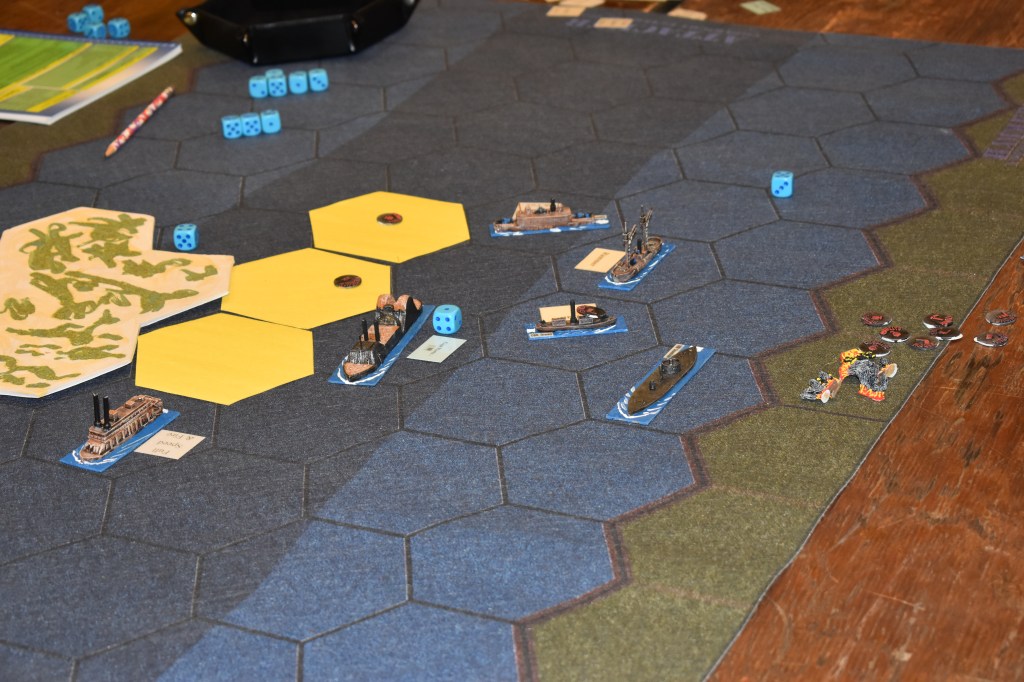
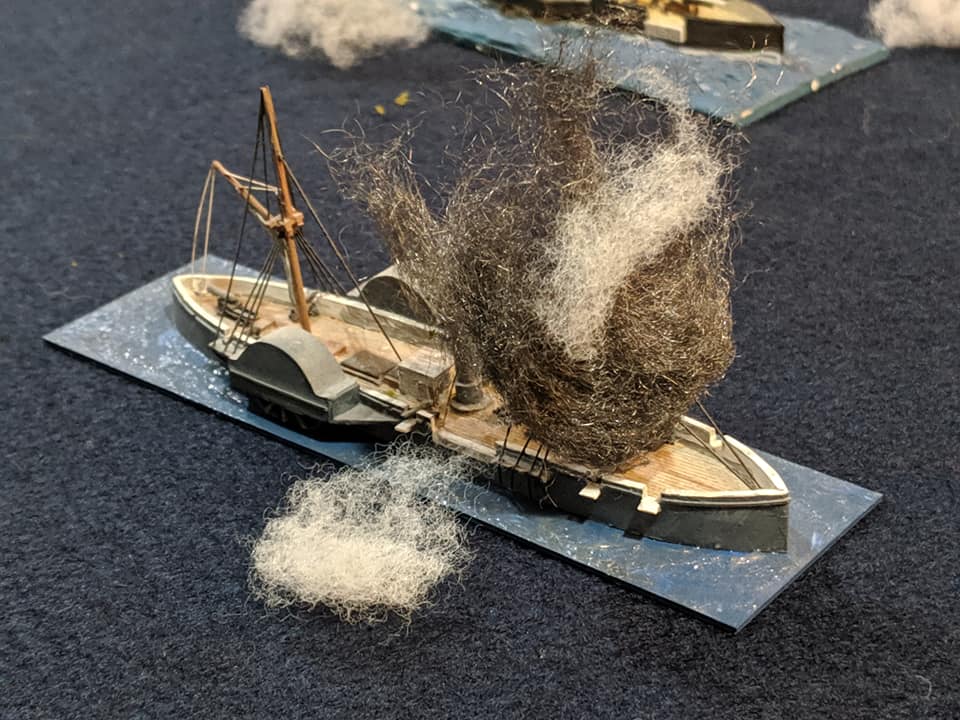
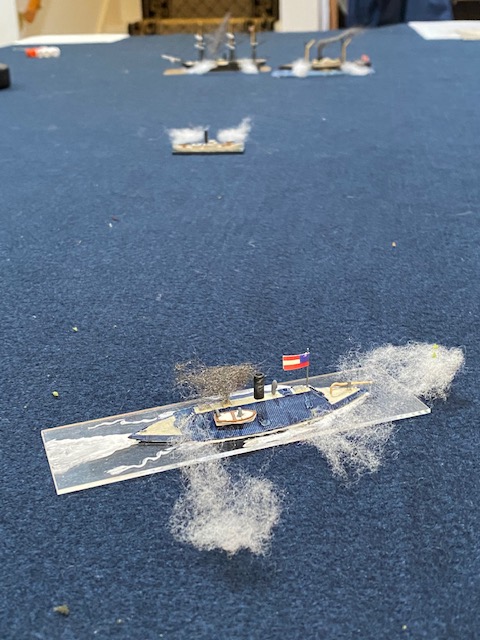
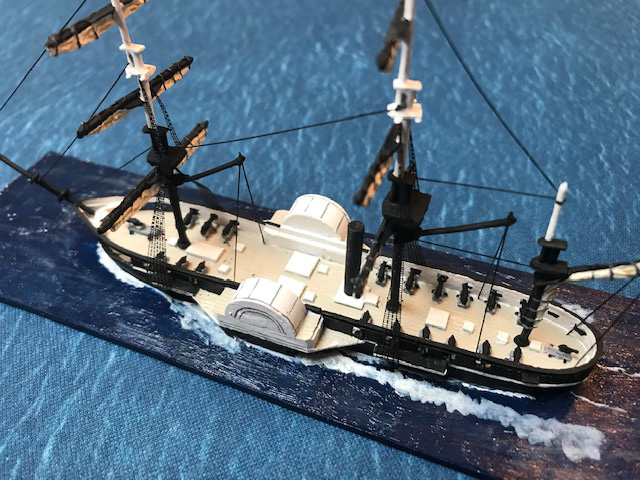
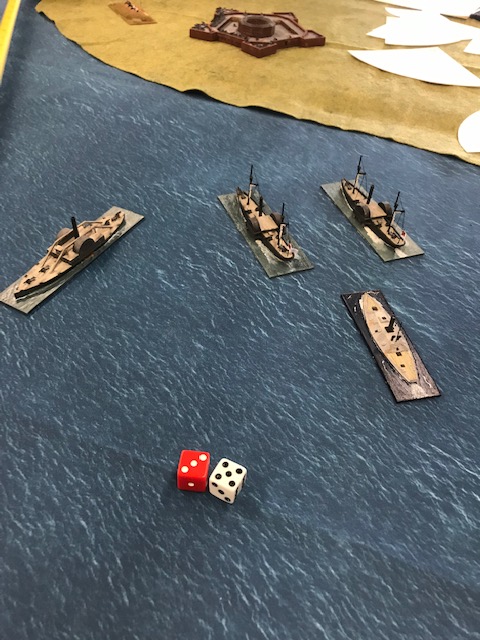
Al’s gunboat flotilla presses toward the fort. The little wooden ships will suffer terribly from fire.
Introduction
David Sullivan and I were attracted to ACW naval miniatures when we first met back in the early nineties. We drove north to The Sentry Box hobbies in Vancouver B.C. and picked up some of the Richard Houston 1/1200 miniatures and were off to the races. We were immediately attracted to the old Yaquinto rules. We played the rules right out of the box and bought some hex mats for movement and fire.
Of course we could never get hex mats large enough, and it seemed silly to play miniatures on a board game board. We tried other rules as well. Age of Iron, Hammering Iron, and Smoke On the Water are a few of the titles we tried. I hated ‘em all. Though Ironclads is a rule set firmly rooted in its 1970’s origins, David and I just love ‘em.
When Toby Barrett and his 1/600 Thoroughbred miniatures appeared on the scene in the later 90’s we were immediately hooked. But it was clear that the hex mats had to go. Ships now took up two hexes minimum, some were three or more. The only way to make it work was if we went hex free and made the required adaptations necessary to make Ironclads a true miniatures game. I sold my hundred or so 1/1200 ships and concentrated what has grown to about a hundred 1/600 vessels. I’ve never regretted the change.
Just to be clear, Toby purchased the rights to the Yaquinto rules some time ago. It was his intent to take the original board game rules and make them a miniature game. It didn’t happen. My hope is that it could still happen some day. I’d buy it in a heartbeat. These rules are a stopgap, a set of house-rules we have inflicted on our friends for decades, and we’re happy to share them with you if and until the worthy Mr. Barrett comes up with something better. And look, they are yours for free. Enjoy them, or not.
Note:
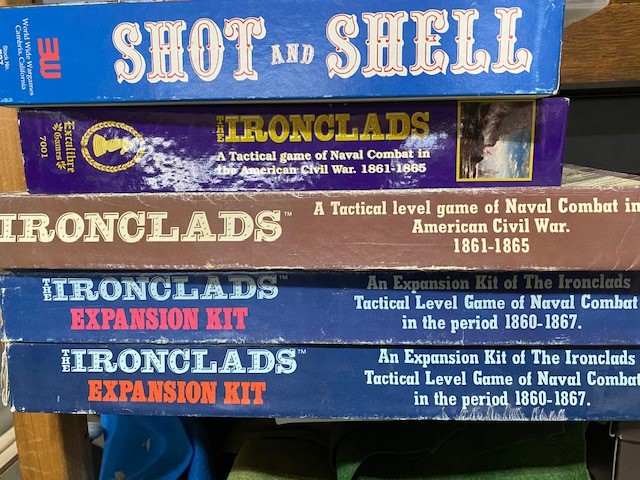
You cannot play these rules without the original Ironclads game. The game was published by Yaquinto in 1979. It was republished by Excalibur games in 1993. In order to play our hex-free game you must have the rules, ship cards and charts. We are simply providing a means of abandoning the hex-grid and making Ironclads a true miniatures game.
Ironclads. You can never have too many copies
The big changes:
The biggest changes in the game are to speed, gun ranges and turning because in the original game rules, these are determined by hexes.
Speed: We agreed that speed would be represented as they were in the rules. One point of speed would be represented by one inch of movement.
Fire: This was a really tricky one. Our problem had to do with scale and the size of the ships we were playing with. Some vessels with lighter guns, say the naval 32pdr, would have difficulty firing the length of their ship, if we stuck with one hex=one inch rule. We agreed to double the gun range. Yes, that gave some ships with really big rifles an advantage, but if we designed interesting scenarios we could avoid exacerbating this problem
Firing procedure
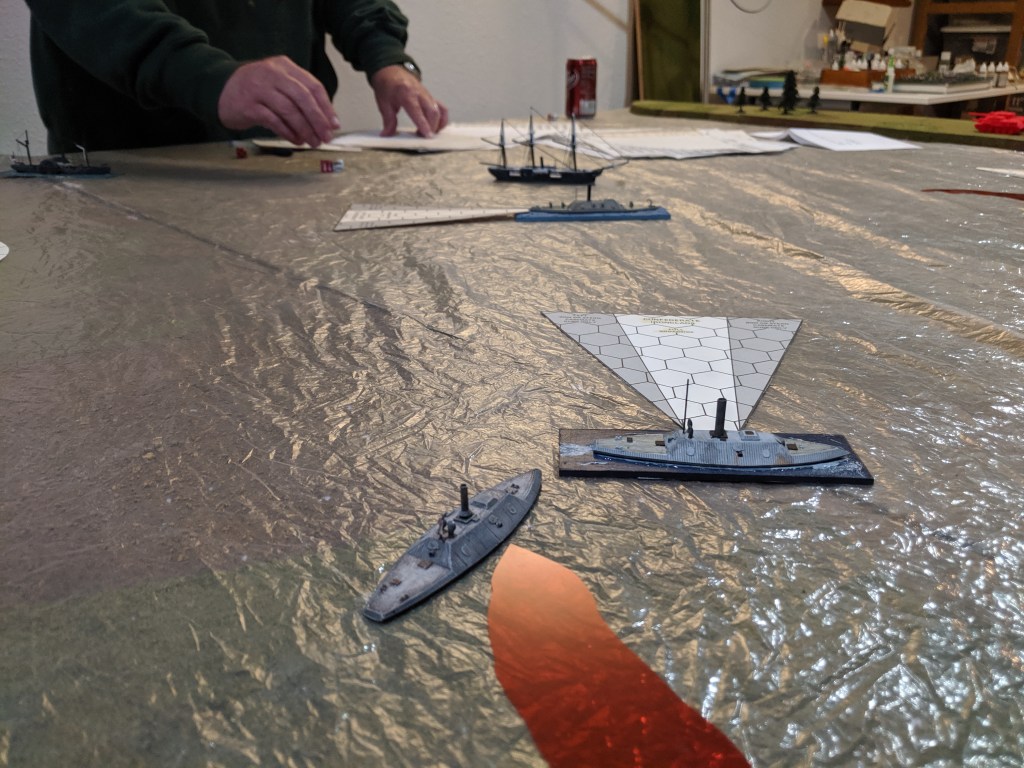
Our house practice is to measure from the gun to closest part of the target. Your house rule could be different-maybe that’s stack to stack, or bridge to bridge, but using a generic firing point messes with ranges in our estimation.
We also use the firing templates provided in the game by the gun if there is a question. Again, the scale of the models makes it a challenge to use a generic interpretation of what can fire and what can’t. A gun by gun determination works best.
To determine the range and penetration factor on the ship card, just run the tape measure out from the firing gun to the nearest point of the target. Get an accurate measure. If your tape reads 24” that will be equal to 12” on your ships card. If it is more than 24”, say 24 ¼ “ you’ll have to round up
Calculate penetration factors normally, just keep track of the range changes, and play on normally.
Example: Remember the 11” Dahlgren now has a maximum range of 36” with changes in penetration at 24” and 12”. The 7 “ 2B Brooke rifle now has a maximum range of 102”, with changes in penetration at 28” and 14”
Turning: In many respects turning is the most difficult of the changes. We all know the Union ships tended to have better engines and turning gear than the Confederate ships, but that was certainly not uniformly the case. In the game that is reflected by the number of hexsides a ship is allowed to turn at a certain rate of speed. I would argue these ratings are fairly subjective.
David suggested using turning circles for ships, and he created these on a scale of A to I. The smaller the circle, the nimbler the ship. “A” would be a tug or other small ship. I would be the Virginia with her balky engines and bad turning gear. Remember, in the rules and on the ship cards, the faster a ships goes, the slower it is to turn, so as you’re writing up your ship, be careful to take a look at the movement line, where the turning changes are and rate your ships accordingly. Do your best to make a good faith effort and your partners will be fine.
Following Up
As I have said many times in many other places, Ironclads is my most played set of rules. I love the period and I love the game. Many complain about the charts, that it’s quite fiddly and mired in its 1970’s roots. I love it because it respects the period and this small-fry naval war so different than what was happening in the rest of the world in the 1860’s.
It doesn’t always get everything right. That’s the risk one runs of trying to rate every aspect of every ship from engine capacity to rear armor to each and every gun. If you run across an error, fix it. Plenty of words and photographs are shed on the American Civil War at sea, don’t hesitate to use them. However, if I had a choice I’d choose The Old Steam Navy, volumes 1 and 2, by Donald S. Canney, which covers most of the Union navy leading up to the war. It does leave out sailing vessels such as the Cumberland. For the Confederates, I’d go back to Canney for The Confederate Steam Navy.
That doesn’t mean there aren’t some fine sets of rules out there. If I was doing a really large game, like Mobile or New Orleans, I would use David Manley’s fine Iron and Fire rules. I’ve also played a dozen or so games of Sail and Steam Navies and there is a lot to recommend them. But in the end, I just enjoy Ironclads more, and so do my friends—that’s what counts.
Add-ons
I’ve provided links to two useful items. The first is a file for David’s turning circles. It’s a four page .pdf document. Print ‘em on cardstock and they’ll last forever.
In addition I provided a blank log sheet. If your hand-writing is as wretched as mine and either can’t fit it in the space provided or you can’t tell your “4” from a “9” this is really handy. It’s in Word and easily edited. I also have taken to scanning the ship configuration from the ship cards and replacing the outline on this form because honestly, who draws?
If you give it a try, I hope you have fun with it. Let me know how it goes.
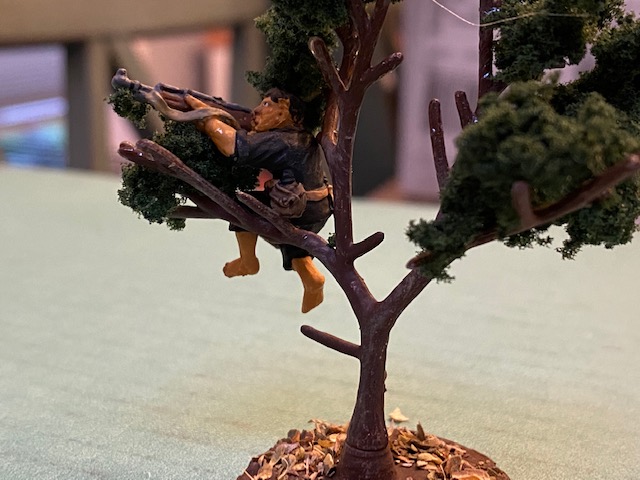
Everybody needs one. Gringo 40’s Viet Cong “sniper in a tree.” Seems to be shooting at quail Or maybe a helicopter.
Let me just say March was a great month for getting stuff done, especially if you were a Spaniard serving in America between 1797-1810, or if you happened to find yourself fighting in Vietnam in 1968.
I made a couple of orders to Gringo 40’s and the Hue buildings arrived, but not many new purchases, which was a good thing.
Oh, and I played in one of my few miniatures games since December. David Sullivan and I got together, hauled out our Vietnam figures and played a game of Ganesha’ Flying Lead. It was much fun–even if we did it wrong. You can read David’s account here.
But, as with most Covid months, March was about painting. I don’t know what it was, but I did my best to dedicate myself to getting stuff done. One thing at the top of my priorities is finishing a project, and that is my America Rampant stuff. I finished the Americans before Christmas. I started working on my leftover Woodland Indians and wrapped up the last of them this month. I’m nearing the end with my Spanish infantry.
The five completed companies of the Luisisana Battalion. Hibernians are still under construction but close to done. Gotta lower that flag a little bit so it fits in the box.
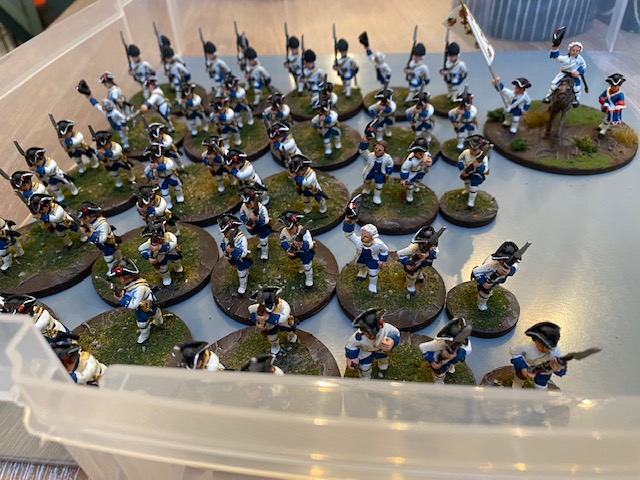
I had painted a bunch of the Spanish infantry but was kind of scatter-shot with their organization. First of all, I did these before the adoption of Rebels and Patriots as the rules of choice for the period. My units were ten figures to the company and R & P demands 12. So there were figures ordered and stands reorganized and it was kind of a mess. Previously I had two battalions organized into myriad companies. (For me a unit is a company.) Now it is two battalions, the Luisiana Battalion, and The Hibernia Battalion. Each has a grenadier company and four fusilier companies. This feels a lot better.
The figures are old RSM figures I order from Dayton Painting Company. Don’t tell anybody but there was some re-painting involved so everything more or less matches. Pretty basic block painting too, because that’s how the originals were painted.
I also painted my quota of Vietnam figures. There were 13 Marine figures, six Viet Cong, and five NVA figures. My painted collection of ‘Nam figures is now 47, and I received another order ten or so days ago. Finishing these will be a priority in April.
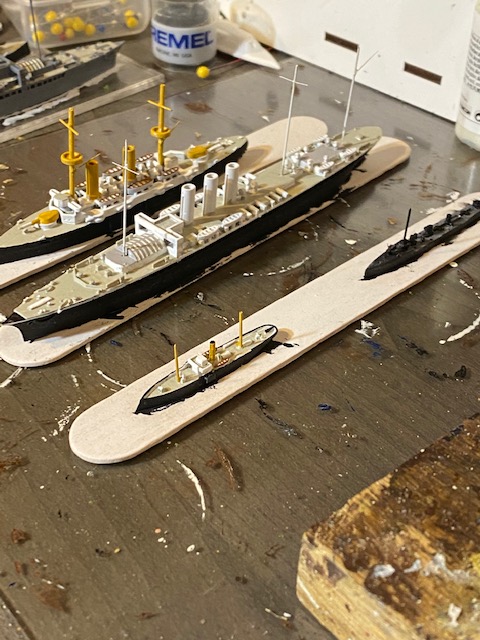
The Smyth Shipyard shows the Thorneycroft destroyer (in black) and the Elcano to be complete. The Yale (middle) is about half done. The Princesa de Asturias (left) is nearly finished. I’m running out of ships to paint in this scale.
Anyway, on to the monthly totals
1/300 airplanes: 6/150. No changes. Nothing new here. I’m starting to feel embarrassed.
1/1250 scale ships: 21/50. I’m claiming five adds for the month. First, I completed the three coastal fortifications on March 1, just to get thing started right. I’ve been working on the ships I received in my wayward WTJ order. I hoped to have them finished, but they aren’t all quite done. I finished the little Spanish gunboat Elcano, and the generic Thorneycroft type destroyer that seemed to serve in everyone’s navy. Nearly complete is the armored cruiser Princesa de Asturias, which will be the final add to the Spanish navy. About 50% complete is the American auxiliary cruiser USS Yale. Yes, I know, I already did that ship, but I’m painting a second version in its livery in the American Line. The Yale hadn’t adopted wartime gray when it steamed into San Juan harbor and shot it out with some small ships. I think I need this, don’t you? Another excuse to do a cool ship miniature.
As the Spanish-American war naval miniatures wrap up I’m considering another 1/1250 project and I’m considering the Japanese to go with John Gee’s Russian Pacific squadron. Because you just can’t have too much fun.
28mm figures: 166/400. No lie, this was a big month for 28mm figures. There were 12 woodland Indians and 47 Spanish fusiliers for the America Rampant project. There were 24 Vietnam figures. I got a lot done and enjoyed every minute of it. I doubled the number of painted 28mm figure in one month.
Lots on the plate for April in the 28mm department. I’m painting some Spanish-American war figures for John complete with rayadillo. The big goal, however is to wrap up the America Rampant guys and finish the Gringo 40’s figures I have left to paint which is about 18. That should keep me pretty busy.
Finally, no more 54mm figures to report, because the Hue building order came in and that will suck up any extra time I have. To date I’ve completed one building and there are about ten more to do, including some big pieces and then there are all the walls too. It’s a priority to move this rapidly forward, but the 28’s will take priority.