Kevin’s Re-base-o-rama

Re-basing figures. Some love it. Some hate it. In the past I’ve put myself in the latter category. But in my later years, I’ve mostly adopted just a couple of rules families and I’ve decided to rebase accordingly. This year is going to be a major re-basing year.

I’m currently re-basing for Daniel Mersey’s Rebels and Patriot rules. Mersey has a family of rules that all purport to be skirmish rules. I almost never play them that way and envision them as semi-skirmish rules in which a 12 figure unit is equal to about a company or 50 men. The family began with Lion Rampant, set of medieval rules. Continued with a fantasy version, Dragon Rampant. Pikeman’s Lament for the pike and shot era appeared. The Men Who Would Be King covers colonials. Rebels and Patriots covers a fairly wide range of the horse and musket period up through the American Civil War.

I really like these rules. They are fun to play and easy to learn. They’re great convention rules. There are some details that are quite annoying that I won’t get into here. They are all somewhat different from one another, which is another frustration as I attempt to apply a rule from one set that doesn’t apply at all.

As I said, these are skirmish rules, and as such I mounted a gillion figures for the Hundred Years War and my Aztecs on single bases. These are Litko bases 20mm X 25mm. And that’s fine if you’re doing a cute one on one scenario with a handful of figures. However, anyone who knows me knows I don’t do cute one on one scenarios and moving 400 figures just takes a lot of time.

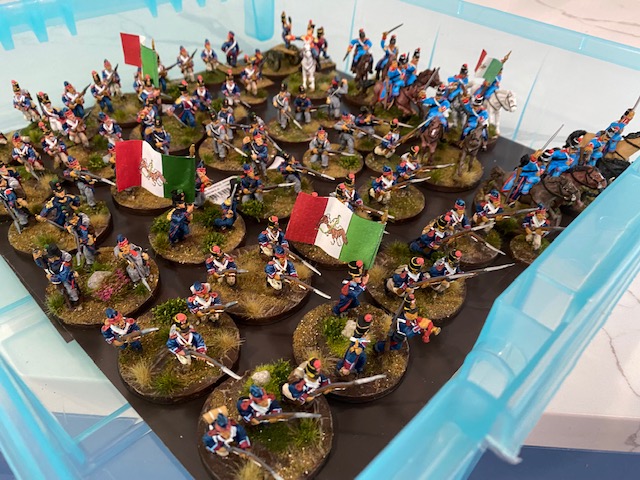
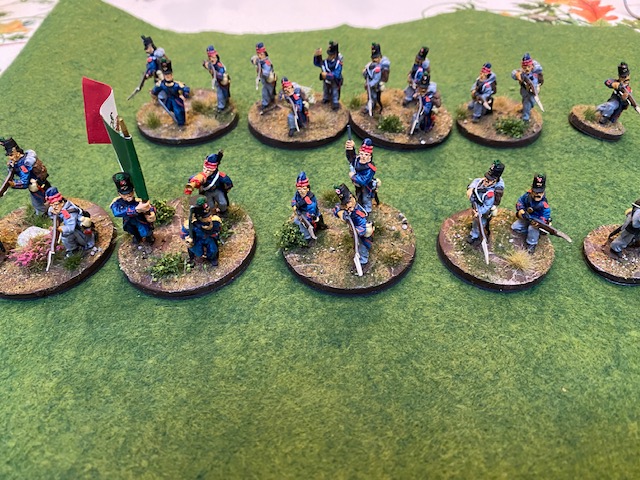
So for Daniel Mersey rules I’ve implemented 3-2-1 basing. For a twelve figure unit, which is pretty standard, a unit would have 3 x three figure bases, 1 X two figure base, and 1 X 1 figure base. So we’ve gone from twelve bases to six. There are six figure units and 18 figure units, your combinations may vary, there certainly aren’t rules here. I’m just trying to reduce the amount of fiddling as well as the amount of handling the individual figures get.

So how do I get from one basing system to another? What do I need? Does it cause intense pain and burn lots of valuable time? Well, I’ll let you be the judge, but I’ll take you through it step by step.

I have a number of projects I want to re-base. They include my ACW figure, my Maximillian project, Hundred Years War (600 figures) and Aztecs (400 figures) I think the key is to do them one at a time. I usually have several things going on my painting desk at one time. However, while I’m doing the remounting I continue to paint whatever I’m painting and I’m still getting about 24 28mm figure per week done.

Step 1: Unmounting
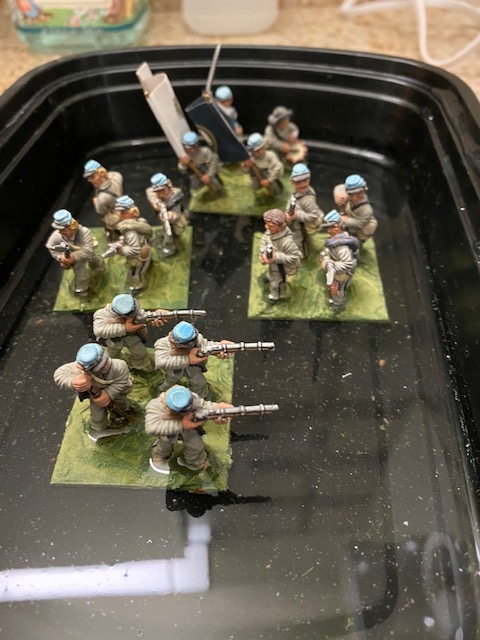
A unit of good ol’ Dixon ACW figures bathe in warm water. These are the VMI cadets, painted in about 1993, mounted for Regimental Fire and Fury. Let ’em soak overnight. I pop ’em off the bases before I get in the shower the next morning.

This is super easy. I just take my figures and put them in a receptacle that holds water and let ’em soak. The water should come up over the base. Just get their wee feeties wet. I usually do it overnight. No, if you sprayed those figs with some sort of matte coating it won’t hurt the paint job. When I’m ready, I just pull them off the base. Some require a little more coaxing than others. I’ve done this with plastic bases, plywood bases, though not metal bases. It should work. P.S. I mount my figures with CA glue. It still works with a minimal amount of effort.
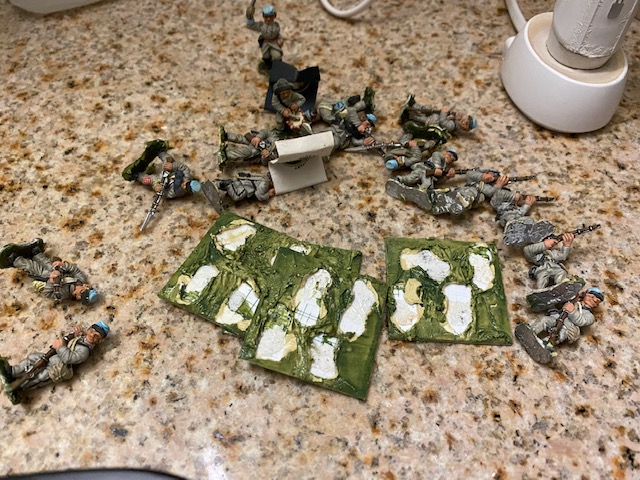
No tools were used to unlock the VMI Cadets from their plastic bases.

Step 2: The Bases

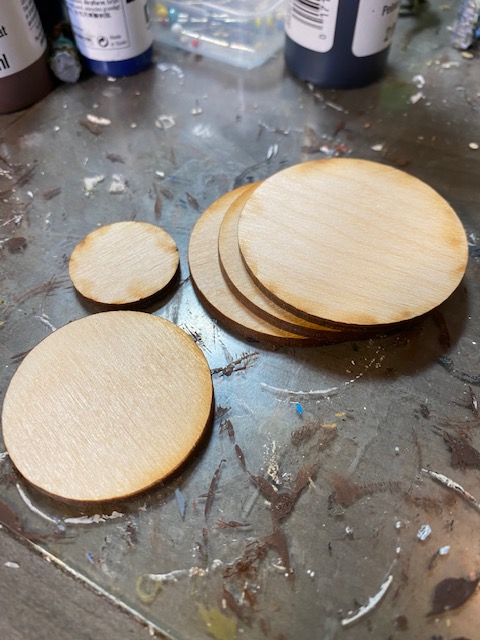
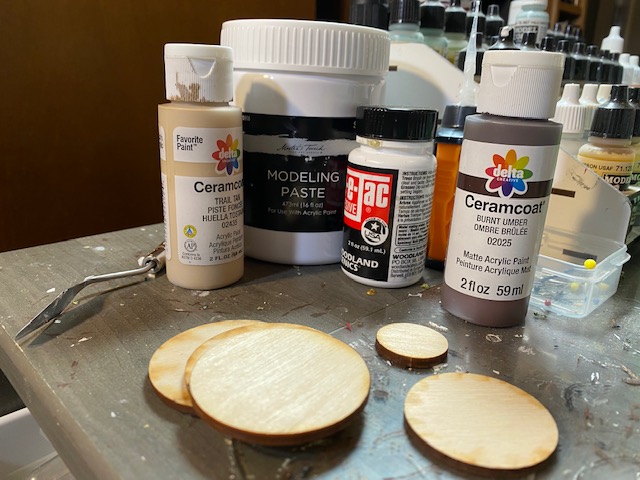
My go to Litko bases. Three 50mm bases, one 40 mm base and a single 25mm base sets up a 12 figure unit.

You can use whatever basing material you like. I strongly encourage you to use something that’s sturdy that will endure. I have some lovely figures that were painted some 30 years ago but were mounted on artist’s board. Unfortunately it’s had its day and is on the verge of death. Some good .050 plastic, bass wood, something sturdy and hard. It all works.

But I just keep it simple. Kenneth Litko and I have a symbiotic relationship. I send him money and he sends me bases. Yep, I feel a little bit dirty about it, but the 3mm plywood circular bases had me at hello.

My three base sizes are as follows. My three figure bases are 50mm in diameter. They’re big, probably too big, but that was the size I chose. You could probably get away with 40mm. 50mm is also big enough to hold a gun and four man crew, or two mounted figures. It’s a good size. My two man bases are 40mm in diameter. Again, plenty roomy, but I don’t think 30mm would cut it for two. My singles are 25mm.

No, you don’t have to use circles. Squares, rectangles, pills, octagonals, there are lots of choices, or you could just make yours in irregular shapes. Whatever you like.

Step 3: Glue Those Figures Down
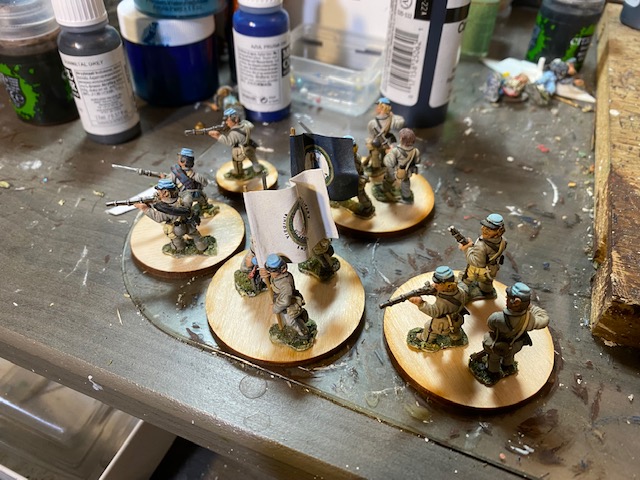
The VMI Cadets safely affixed to their bases

Before gluing, take some time to examine the bases of your figures. Be sure they’ll stand up on their own. use a hobby knife to remove excess yuck from the base bottoms. I probably don’t need to tell you this. When that’s done you’re ready for gluing.

I use CA glue. There, I said it. I know folks say not to do this, that CA glue can get brittle and crack over time. Whatever works best for you do it. CA glue has the advantage of immediate results, which means you can move on to the next stage:

Step 4: Base Build-Up

For years I’ve experimented with different types of basing material to build up my bases and avoid that balls on a billiard table look. I used Cellu-clay, which was papier mache-like, but took a loonnng time to dry. I’ve used various Liquitex products and I can highly recommend those products, though they aren’t as readily available as they once were. I have a friend who makes his own basing goop out of baking powder and something else. You just want something that A) builds up your bases, B) is easily paintable, and C) isn’t going to chip with normal wear and tear. I use modeling paste which, like the Liquitex coatings are acrylic, i.e. plastic, are resilient and dry quickly. There are lots of different brands of modeling paste, Liquitex, Goldens, lots of different generic brands. A giant tub o’paste costs about twenty bucks and lasts me about a year.
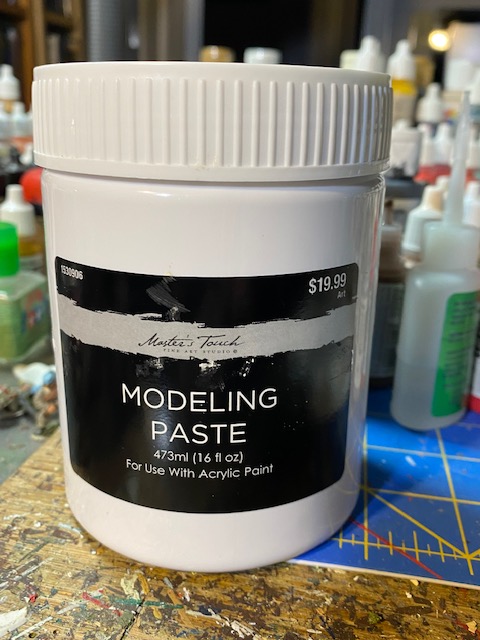
16 oz’s of Master’s Touch Modeling Paste from Hobby Lobby. Labeled at $19.99, I got it for ten bucks during a Master’s Touch sale. It will at least last me to this summer.

A use an artist knife to apply the stuff. I prefer the metal ones over plastic. They clean up better and I can see it better through the white paste. You could use a plastic knife rather than investing in other tools. Be careful not to get the stuff on your figures, or at least where you aren’t going to be putting your basing materials. Be comfortable with ridges. Don’t try to make it flat. Just get the coverage and try not to leave any holes .

I usually allow eight hours or so for the stuff to dry. It actually dries much faster than that-no more than two hours. Then you can paint it. I try to do my basing first thing in the morning so I can finish up in the evening.
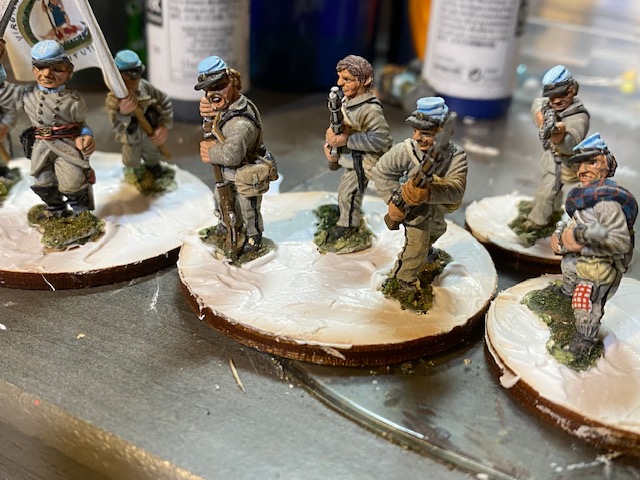
VMI Cadets fully pasted

Step 5: My Secret Affair with Ceramcoat Burnt Umber
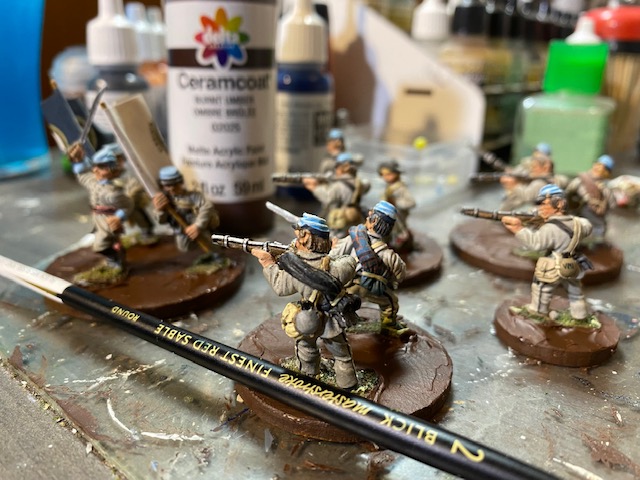
When you’re ready and more importantly when your basing material is ready, it’s time to paint your bases. For me this has two stages. I paint a base coat over my base. Your tastes may differ, but I always use Ceramcoat Burnt Umber. That’s a really dark brown. I don’t use tons of craft colors, but this is a go-to for me. It’s a great color, it covers well. I use it for two things, as a horse color and for painting my bases. I just slop it on there with a #2 Dick Blick brush and let it dry. That won’t take forever, but it’s important that no part of the base is remotely wet before going on to the second paint phase. I’ve used other craft Burnt Umber brands, and they just don’t work as well. They don’t cover. They aren’t as dark. It’s the Ceramcoat stuff for me.

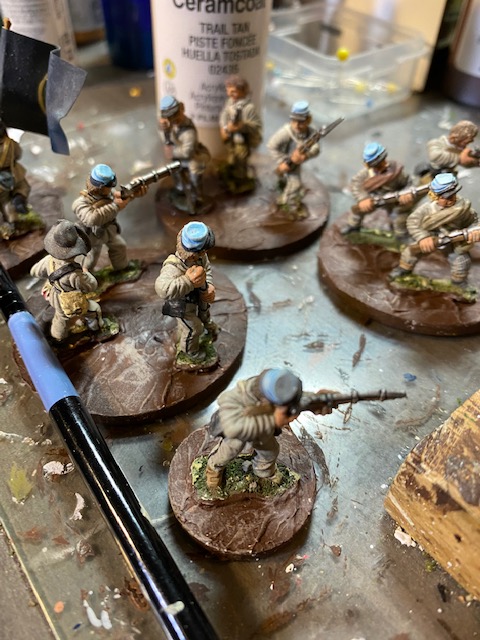
Next, dry brush the base with Ceramcoat Trail Tan. Your goal is to highlight the irregularities in the basing material. It was really hard for me to learn dry-brushing, and I still don’t feel like I’m very good at it, though I do it all the time. The goal is to get a nice contrast between the base color and the raised areas on your figures or bases. It just takes practice. And maybe some repair thrown in there. I like to use inexpensive (but non-shedding) flat brushes for this. You can usually pick up sets of these in different sizes at Michaels or Hobby Lobby fairly cheap. Remember you want to dip your brush in the paint and wipe it back and forth on a rag or a paper towel until you’re not getting much off the brush and then in lightly continue wiping the paint off on your base. Always wipe in one direction if at all possible. Practice. You’ll get it.
Step 6: Basing Material-You Choose

You can do as much or as little with this as you wish. Maybe you’re a tuft person, or a static grass person. Perhaps you like to add rocks, or railroad ballast. I’ve had trees on my bases. I like clump foliage for my ACW figures. It’s really a matter of personal preference.

Generally I like to cover my bases with stuff. I usually start by mixing some PVA glue and water. However, if I’m going to use clump foliage or tufts I’ll glue them down first. PVA glue to supplement the adhesive on the tufts. Clump foliage really works best with Hob-E-Tac, which is like a delayed reaction adhesive. Very sticky stuff that goes on white and dries to its stickiest when it’s clear. That takes about twenty minutes. Then you can put down your clump foliage and really mash it into the glue. It’s not coming off trust me. Usually I have to order that on Amazon.
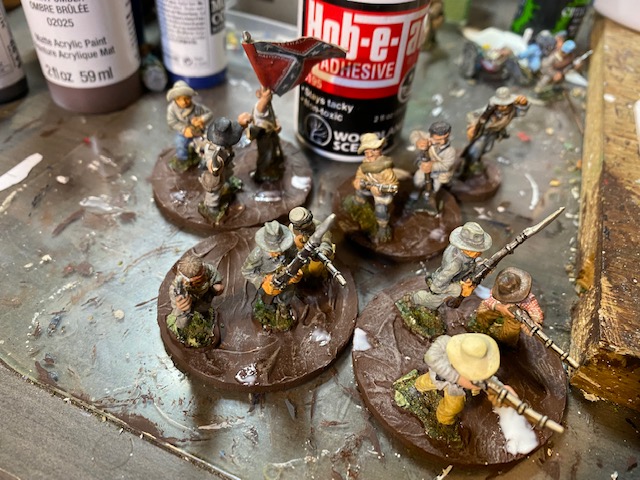
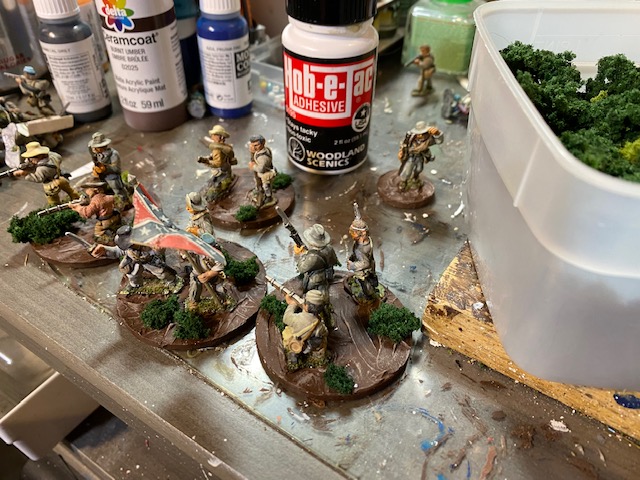
Clump foliage in place. Next I’d put down the tufts. Wrap up with ballast and Woodland Scenics earth.

When you have your plant life accounted for you can decide what’s next. Maybe you just want your painted/dry brushed base to speak for itself. Or maybe you want part of it to show through. I usually just go to good ol’ Woodland Scenics earth. I paint my diluted PVA blue around my tufts/clump foliage and fairly carefully apply my earth. I usually throw down some brown stuff and some blended green stuff that I often mix with the coarser green stuff. I feel like I get a nice effect. Allow about a half hour and you’re ready for the final phase
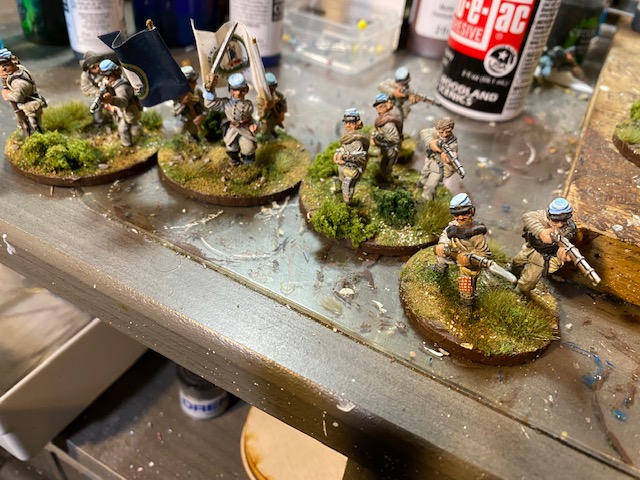
A final look at the VMI Cadets before spraying them with Krylon Colormax Crystal Clear Flat. Mix of clump foliage, tufts by Gamers Grass, and ballast, earth and green blend turf from Woodland Scenics.

Step 7: The Final Spray

I always use a final coat of clear matte enamel spray. I was a Testor’s Dullcote devotee for many years. Then it kind of went away, though it’s back now with a Krylon label. I’ve gone cheap these days and use Krylon Colormax Crystal Clear Flat. It’s cheap. It works. It’s just important you use something to hold down all the super cool stuff you just applied.

Final Optional Step

This is what I do because it works for me. I’ve taken to using the art storage bins available by any number of manufacturers available from Michael’s, Jo Ann’s, Hobby Lobby. They even had a great deal on some at Costco this Christmas. To keep them from rolling around, I slide in two sheets of steel roofing sheets. Then I take my magnetic Litko bases and glue them (don’t rely on the sticky stuff on the bottom,) glue them on to the wood bases and they stick quite nicely to the roofing sheets. Not perfect, but they do offer a modicum of security.

That’s how I’m going about my big remount. I do my remounting at the same time as my painting. My goal is to paint about twenty-four 28mm figures per week. I also try to remount two 12-figure units per week. So far so good.
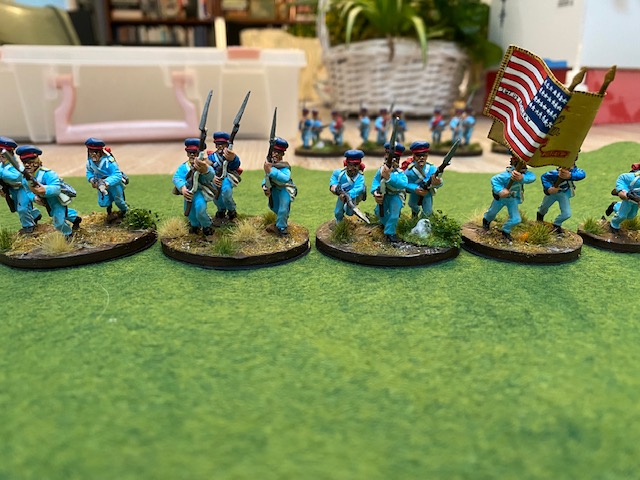
Ready to Scrap: The Mexican American War Project is Finished.

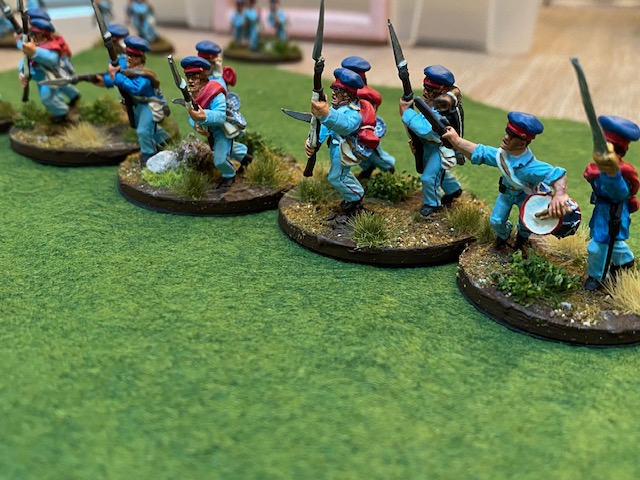
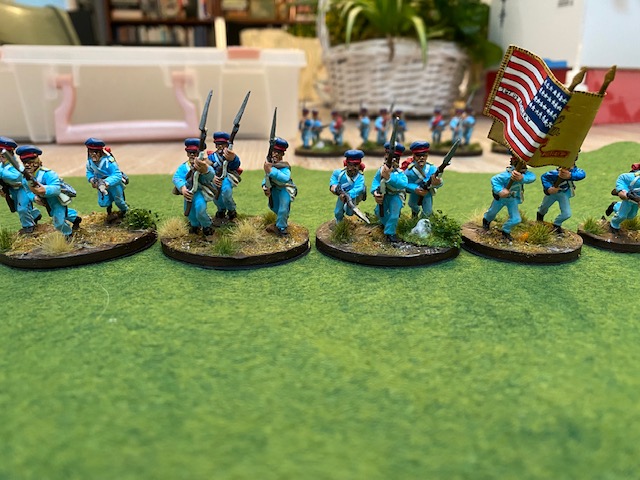
I split the difference on on my American infantry. I painted two units as standard U.S. infantry and two units as artillery serving as infantry, which was quite common.

Last night I put the finishing touches on my Mexican War figures. It was a fun little project. I know my partners in crime will soon be finished with their little piece of history.

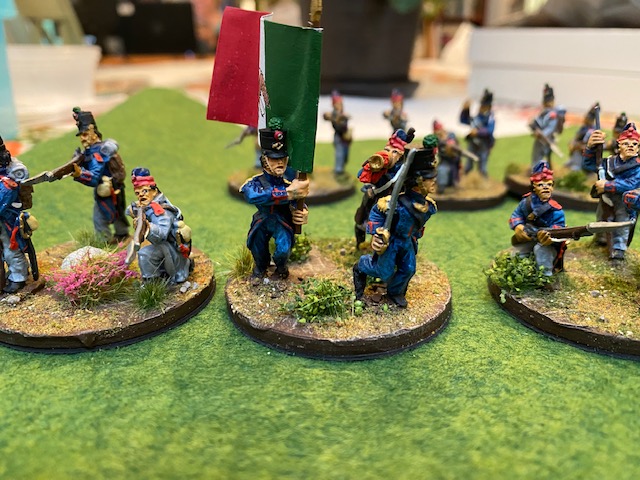
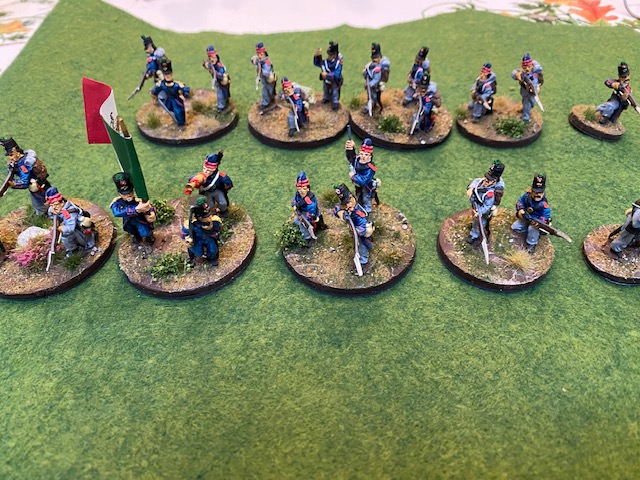
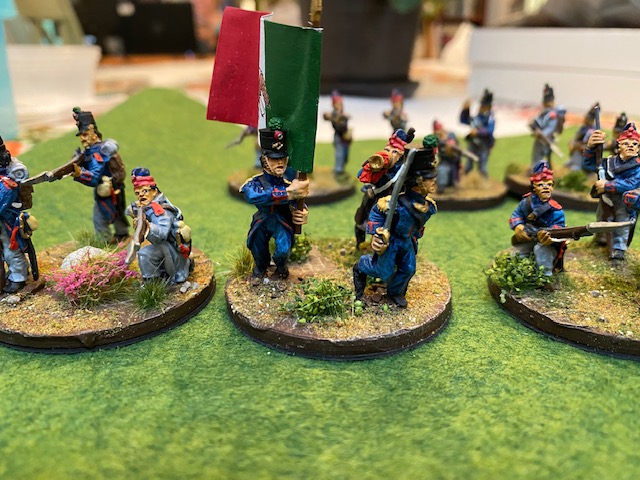
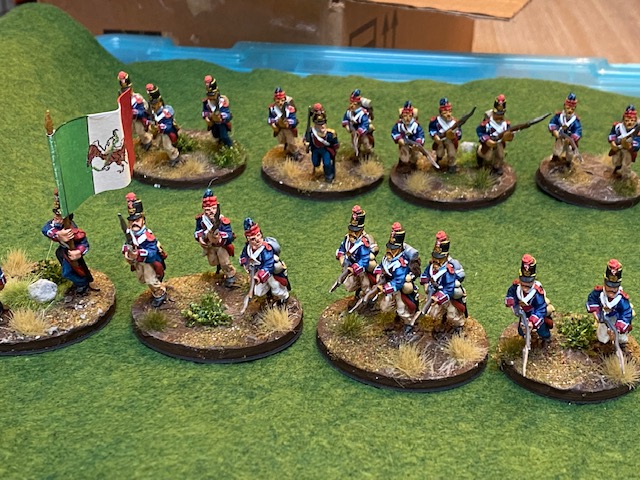
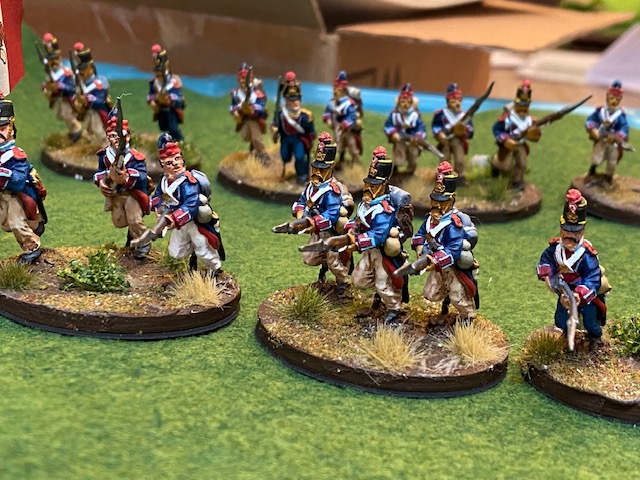
All four of my Mexican line infantry are of the 3rd Line Regiment.

I kept my part simple. Our thinking about the Mexicans is that they weren’t very good. Objectively, we know they had coarse powder that generated a tremendous kick, and they fired from the hip. That’s not something that will improve the accuracy of a Napoleonic era smoothbore musket, so they are bad shooters. They are decent on defense. It’s hard to get them to move. They aren’t as good as U.S. regulars. So I have more Mexicans than Americans. Four line infantry units, two light infantry units, a gun and two light cavalry units or about 32 points worth in Rebels and Patriots
Mexican Light Infantry by 1st Corps. These were the only figures I painted that were disappointing. I felt they got the uniforms wrong with the long tail coats. They were just a general pain.

For the Americans, I did fewer figures. Many of my colleagues were interested in doing Americans, and they are better troops. I stuck with the equivalent of four line infantry, one dragoons unit and a gun. Depending on how one rates the units I would guess 26 points or higher.

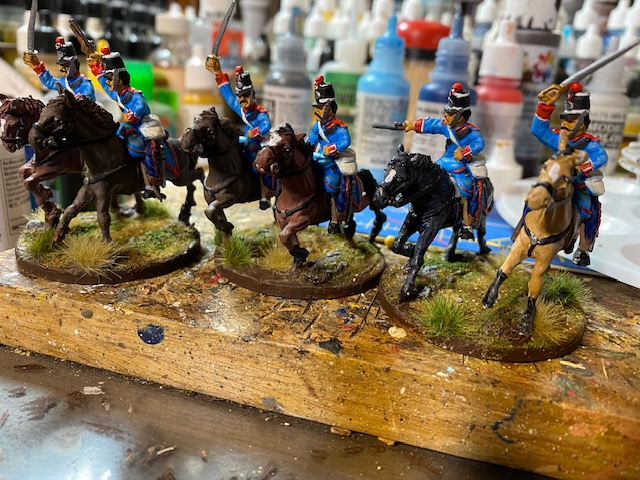
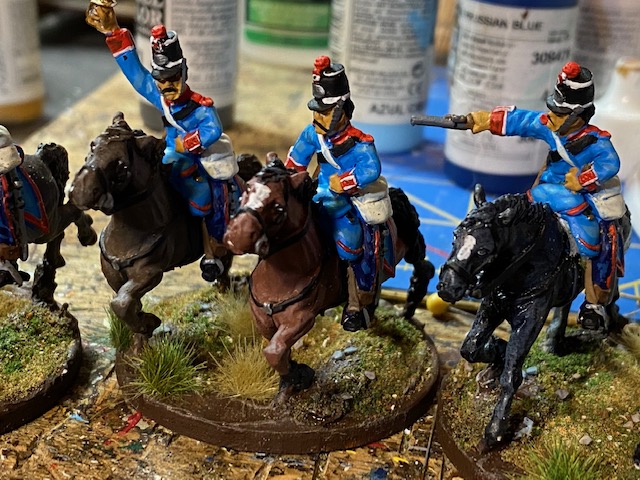
The first of two six-figure units of Mexican Light Horse by 1st Corps.

I try not to get stuck too much on points and prefer designing scenarios, but there you go.

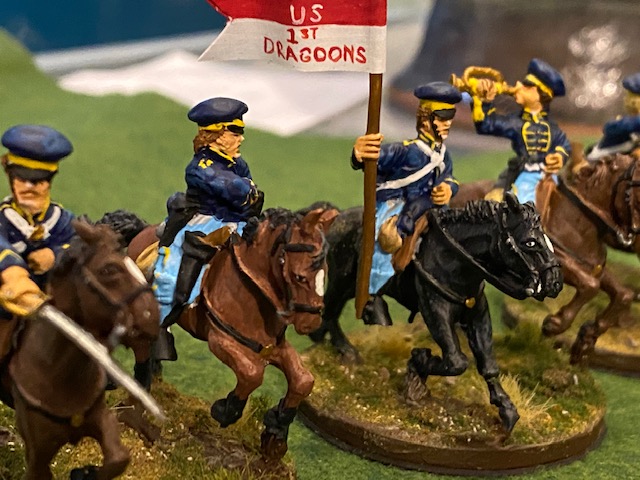
US Dragoons by 1st Corps. These fellows were fun to paint. Not a lot of stress.

I deliberately decided to avoid painting Mexican units that were too fancy, schmancy. So no Jalisco Lancers or Tulancingo Cavalry. Just the guys you’re mostly likely to see out on the line. Pretty much the same with the Americans. No flying battery or mounted riflemen. They can fit into any scenario.

With my attention spread what seems like a million different places, I’m not likely to add much more, though that isn’t impossible. I’m happy just to have them done.

In A Perfect World, 2022 Might Look Like This

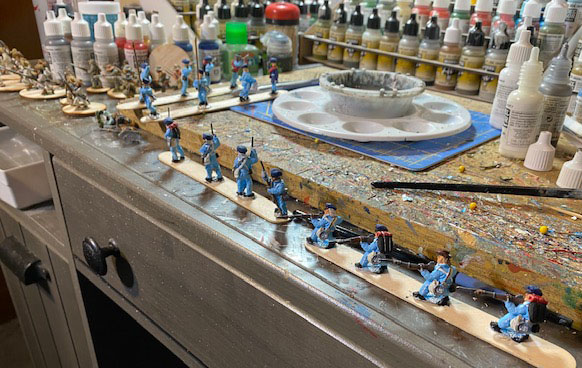
The current state of chaos on my painting desk. In the foreground are the last of my U.S. infantry for the Mexican War. In the background are some Mexican figures and some Confederates awaiting remounting. Note: that I have left myself approximately 6 square inches to work on my good sized desk.

There’s a lot to do. With my retirement and the end of my little notary business I’ve basically become a full time wargamer. MY CHILDHOOD DREAM COME TRUE!!!!!! That leaves me lots of time to paint for the limited time I can actually game.

There are lots of figures to paint. But which ones? I do have a couple of games to prepare for Enfilade. One of those is the Lissa game. My two remaining ships will be at the top of the list moving into January.

A second game for the convention is Matehuala for my Maxmillian stuff. It is mostly painted, but I have a few units I’d like to change out for new figures. The entire project is due for an overhaul. I’d like to remount the whole shebang.

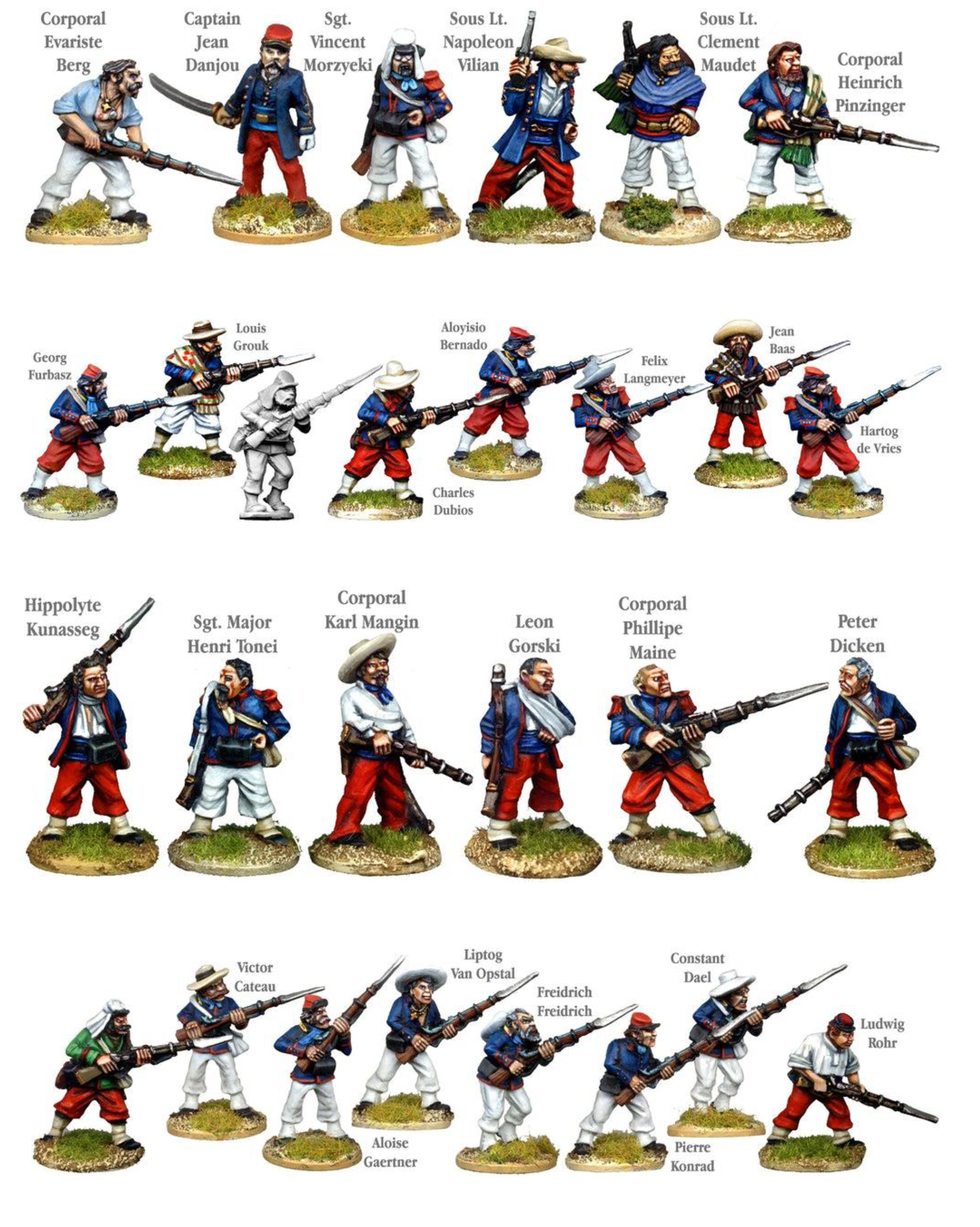
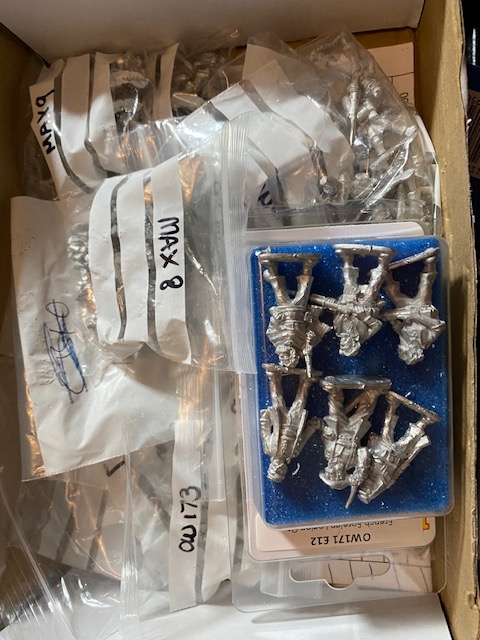
Foundry’s pile of Camerone figures from their Old West range. Yes, I own all of them, though mine lack pigment.

The Mexican Adventure stands to be my big focus for 2022. It’s a really interesting, curious conflict about which I know too little. It’s kind of a three stage affair, beginning with the introduction of French troops in 1862, the arrival of Maximillian a year later, and active American assistance to the Republicans with the end of the American Civil War. Learning more is complicated by the lack of English language resources, but I’ll do my best to acquire what is available.

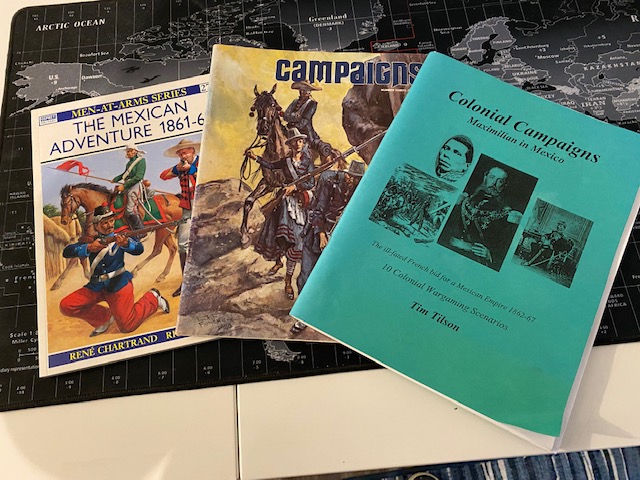
Most of my very lacking resources for the Mexican Adventure. There is some book-length treatment of Maxmillian and Carlota because they make an interesting story. Unfortunately there is very little campaign study available in English.

I feel like I’ve kind of chosen the wrong mix of figures, especially for the French and Mexicans, so there may be more in my future, but not any interest in adding still more figures at the present moment.

Looking beyond the tragedy of Mexico and Maximillian, I do have other things to work on. There are all the Caribbean figures for the Spanish American War. These are for The Men Who Would Be Kings rules and are intended for battles in Puerto Rico and Cuba.

This is a year when I’d also like to confront my American War of Independence mess. I have a considerable number of painted figures for two different sets of rules–Daniel Mersey’s Rebels and Patriots and Regimental Fire and Fury. I also have a passel of unpainted figures. My Regimental Fire and Fury stuff needs some updating and reorganization. In a perfect world I’d like to head toward running a Battle of Guilford Courthouse game. But what’s clear is I need to give time to these projects in order to make any of it work. On my to-do list.

I also promised George Kettler I’d make a real effort to work on my Vietnam era 1/300 planes. I probably won’t take that on until after Enfilade in May, but that’s something I’d really like to get done. I’m hoping to use the Ammo Mig paint colors, but they’re a little hard to come by at this moment. I’ll keep trying.

Finally, I have a couple of re-basing projects to work on, in addition to Maximillian. My Hundred Years figures and my Aztecs/Conquistadors should both be heading into 3-2-1 basing for Lion Rampant. It just cleans things up and makes them more orderly to do so. Don’t know how much progress I’ll make, but these need to be done and, shucks, I’ve got the time.

Of course this could all be de-railed by the suggestion of something new that fogs my brain and makes me hysterically sell my car in order to buy another truckload of figures, but I’m hoping that doesn’t happen. But Daveshoe did just point out the new European figures in the Crucible Crush Flint and Feather range. Sigh.

So, no big predictions or promises for 2022, just an outline of what I hope I might get done all things being equal. No promises about what I might paint that looks like whatever. I would like to try to be pretty regular in my painting–something like 50-70 figures per month. While I won’t project what I should paint, I will try to share what I have painted at the end of the month.

The 2021 Smoother Mover Awards

Smyth Moving and Storage was a prominent Seattle company in my youth. They also had ads in print and radio that trumpeted the claim that Smyth was the smoother movers. Hence the name of this post.

I’m doing a year end shout out to those folks I’ve done business with the past year. Just to be clear, there is no Amazon.com in this hobby. Even the largest manufacturer/sellers are all small businesses with small staffs, often trying to juggle a real job with doing this business with shaky fiscal underpinnings and a limited market in the middle of a pandemic. Anyone who chooses to go into the business of making or selling to the miniature wargame/hobbyist market is taking a major risk against questionable reward and they have my thanks.

That said I’d like to give a shout out to those purveyors of goods who seemed to me did an outstanding job getting the toys, tools and supplies I needed this year.

Miniature Men

I mostly have great experiences ordering figures, but a few really stood out this year.

Gringo 40’s sucked me in with their excellent Vietnam range. If you believe this is a period you’re interested in gaming, it’s hard to overlook them. I’ve made at least six orders to Gringo 40’s in the last year. With each order I’ve been promptly greeted by Ged. He lets me know the status of my order, and quickly follows up with my shipping costs. They are located in Kent in the U.K., so shipping costs can be costly, usually about 25%. I never complain about these things. It is a free market and I know what I’m getting into, even if it makes things a bit spendy. But they are fast, never more than two weeks from my phone to my home, the service is excellent and the figures are lovely. I recently made a large order from their Maximilian range, so I’m anxious to see how that goes.

I made three orders this fall for 1st Corps figures. Two of them were directly from the manufacturer, and one was from Scale Creep Miniatures, their American distributor. These were figures for my Mexican War project and they are really great figures. Again, 1st Corps is a British company, which makes their very complete range of figures a little more costly to get, and then there is that problem with shipping. But order placed, confirmed and arrived quite quickly. I really like the offers they make for figure packages, unit packs, and brigade packs. Scale Creep proprietor Mark Severin did a super job of answering questions and getting my order turned around within a week. Working with someone new is always a little scary, but 1st Corps and Scale Creep made it very easy.

I’ve ordered from and crabbed loudly about ordering from Wargames Foundry Miniatures. My orders were filled, but lost on the slow boat to Alpha Centauri. It wasn’t pretty. I ordered again from Foundry,twice before the holidays, carefully looking at my scars from prior experiences and found it is time to give credit for a great job. Any time a seller in the UK can have figures to me in a couple of weeks, that’s something to celebrate. It seems to me they have also improved their customer communication, and I really appreciate that. They have some very nice holiday discounts, and offering free shipping at 100 pounds makes working with them very inviting. So all, the past hassles are forgotten and all the nasty sentiments taken back. Thanks guys

Rules Guys

There is something special about Wargame Vault. There is a feeling of gaming democracy about it. The access to rules and supporting paper ephemera that is useful, affordable and feels somehow home-grown is refreshing. I find my Wargame Vault Deal-Of-The Day in my e-mail box every morning, but never feel like I’m being spammed. I also have a couple of very good printers, which is a must when downloading docs to print. But Wargame Vault is a great source of print to play rules and games for little out-of-pocket. I’ve downloaded literally dozens of games and never had an issue. It’s a great resource.

Bits

During the pandemic I’ve become this painting and modeling dude. Two things I have to have to carry this off is paint and brass wire. Both are in remarkably short supply locally, so I’ve had to find folks I can count on on the web. I am a Vallejo paint user. Unquestionably my favorite paint due to its pigment-rich formula. Unfortunately Vallejo is also from Spain and getting stuff into shops from the EU has been a challenge. I’ve ordered from Amazon and eBay sellers with very mixed success. Either it’s super costly, or is packaged poorly, often arriving God knows when, and leaking. I managed to access Midwest Model Railroad when I was going through a Vallejo Light Blue Grey crisis. I had three bottles inside of a week at a reasonable price and affordable shipping. They were in a box and safely packaged. No leaks. No muss. I will be looking to MMR when I need future Vallejo colors.

As I’ve become more involved in building ships for miniature games, I’ve used brass wire and brass rod in a variety of different thicknesses. I use everything from .006″ to .032″. Yep that’s pretty small, and it’s even harder to find, especially as supply chains are stretched and local hobby stores have empty shelves. Walthers, the railroading folks, filled in nicely, getting me what I needed when I needed it. Three times I’ve ordered my Detail Associates wire and K and S brass rods, and they’ve never failed to deliver. Their website lets me know what’s in stock, confirms my order, and my goodies always show up within ten days. It keeps the Smyth Shipyards open for business.

The Guys

The pandemic has done a great job of driving gaming underground and out of sight. This is a hobby that perches on the edge. It is socially demanding. You need other guys to play with, or you might just as well be playing computer games on Steam (not that there’s anything wrong with that.) If anything the virus has brought a group of us together, and I so appreciate every one of them. So I’d like to say thanks to Dave Schueler and David Sullivan, who are long-time partners in crime and whom I love like my brothers. While I wish things were easier for him to meet and play with his Canadian neighbors, I have thoroughly enjoyed getting to know John Gee and including him in all my gaming dastardly ideas. I’ve known Bill Stewart and Eric Donaldson for many years, and though we managed to drift apart over time, the pandemic has brought us back together again, and I am so much better for it. Michael Koznarsky is such a great guy, a nice person, an expert modeler and loves projects at least equally as weird as my own-maybe even a touch weirder. I’m so glad he’s gaming with us. It is a privilege to be included with this group and I thank them for it.

My Many Crimes of 2021

I begin every year with plans, plans, plans and then at year’s end I’m left with a puddle of poop. Why is that? One of my friends gave me a verbal dope slap and said to stop my damn planning and I’d be happier.

I made all kinds of suggestions at the end of 2020 about what I would get done, and what I might not get done:

I finished all the 72 woodland Indians I had for my America Rampant project (Rebels and Patriots rules for a fictitious conflict between an expansionist United States and rickety Spanish Empire in America.) I also added some figures to those Spanish to make them playable for R and P. I wrapped up all the ships for the Spanish American War. I think I have everything from battleships to monitors to really terrible gunboats–and Vesuvius and Katahdin–I just don’t think I can stoop any lower.

Hue was the culmination of our Vietnam project. David Sullivan left and me masked.

At the beginning of 2021 I made noise about acquiring a few Gringo 40’s Vietnam era USMC for a little skirmish game. I did that. While Vietnam never turned into a raging crazy project, I did paint about 160 figures–Americans, NVA and Viet Cong, a few vehicles and some of the most elaborate terrain of my life that became the Hue game David Sullivan and I ran at Enfilade. I painted all my figures except for the 15 or so ARVN figures I seem to be saving for a rainy day. I see myself adding a few more ARVN and maybe some cool terrain bits from Acheson Creations, but I’m about done

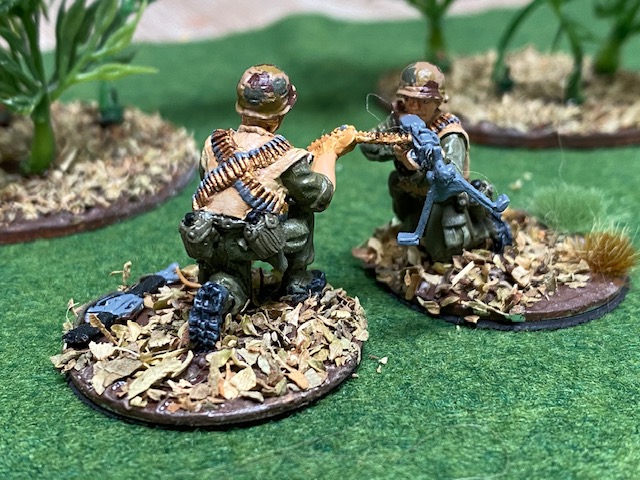
One of many Gringo 40’s Marines. An M-60 team

I said I’d paint 150 planes for the year. I painted 12. More to do in 2022. I have a big stack of Vietnam era planes I’d like to work on.

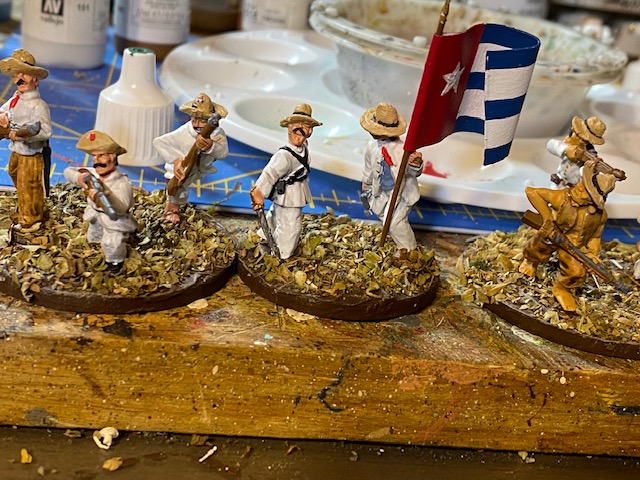
Old Glory Cuban rebels from the Spanish American War. There’s plenty more where these came from.

John Gee and I chatted off and on throughout the spring about perhaps expanding my Philippine Insurrection project to include the Caribbean and the Spanish-American War. I took him up on it. I painted some Spanish for him, and added some for myself. I got a bunch of units painted for The Men Who Would Be Kings and got sidelined by yet another new project. I don’t know. Is THIS a new project or just the expansion of an old project (which falls completely within the unwritten Smyth Proclamation of Purposes: No New Projects (but project growth is okay.) I’m such a failure.

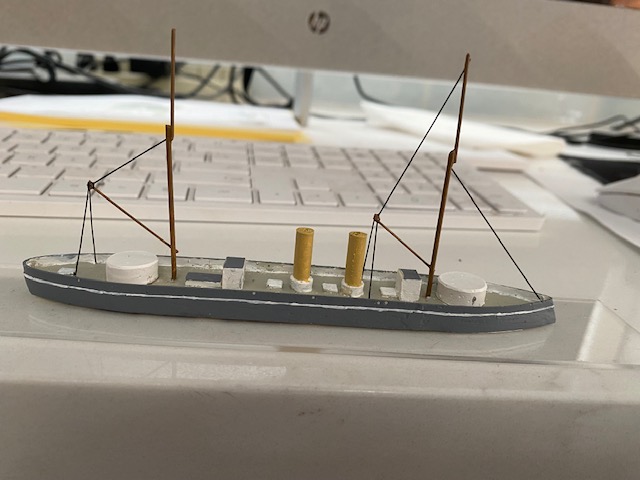
I also promised to paint 50 ships. I don’t know if I did that. I think I did, but maybe not. I wrapped up all my ships for the U.S. vs. Spain. Dave Schueler and I agreed to do the Japanese fleet at the The Battle of the Yellow Sea (1904.) I’ve done some but there are plenty more to acquire and paint. I took on yet another new project by agreeing to run the Battle of Lissa at Enfilade in May. It’s in 1/600 scale and I’m doing a little more than half the Italians. Seven ships. Five are completed. I still have a significant stack of ships to paint, I need more Japanese and I’m slowly acquiring a few of Matt Lawson’s 1/600 Brown Water Navy ACW river gunboats. There will always be ships. If there weren’t I’m sure I’d try carving them out of soap.

One should always have a bunch of ships either under construction, or laid close by to get under construction. Spanish and American ships awaiting final attention.

I don’t know about you, but I love just hanging out with my gaming buddies. I have awesome gaming buddies. They are terrific to game with. No rules lawyering. Not too competitive. It’s always fun to see or hear about what folks are working on. However, it can dangerous. In one conversation David Sullivan was talking about The Texas War of Independence and/or The Mexican American War and it seemed that 10 minutes later four or five of us were ordering figures for the Mexican American War. It’s a Rebels and Patriots project and I ordered Mexicans and Americans. About 150 figures. It’s really coming along well. I’m working on the final Mexican unit and I am about 40% done with my American forces.

Finally, I wrote about the resurrection of my Maxmillian project. I’ve already added some figures to this once-completed activity. This morning I ordered even more. There will be plenty of cavalry, when I once was just scraping by. There will be lots more Imperial troops and Republicans and a few more French for good measure. John and Dave are both adding some figures to the period, so I will only be mostly alone on this one. Hoping for Camerone in the spring.

Here is the first of three large orders of Maxmillian in Mexico figures. Not quite sure what possessed me to do this, but I have. These are Foundry figures. More Foundry figures are on the way as well as a sizable order from Gringo 40’s. Enough figures for a lifetime of Maxmillian.

I’m not gonna say never, no, nothing dammit for 2022. But it seems to me I have a zillion loose ends to work on. So, hopefully no new projects, but at least they’ll be a tough sell. I’ve got some figures to paint.

November is Gone and December is . . . Weird

I’m racing toward the end of the month-hey, that’s tomorrow-trying to finish up an item or two. November was not a super painting month. I’m likely to finish the month with 61 painted figures. Not bad. But not as good as October, which was one of those rare 100 figure months (102 to be exact.) I am shooting to be in the 50-70 figure range, so November will be right in the middle.

Most of my completed figures come from the Mexican War project, which is one of those weird projects derived from a moment of mass hysteria. David Sullivan suggested MAW or the Texas Revolution, ten minutes later there were four or five of us ordering figures. How does this happen?

In any case, I finished the 24 figures of Mexican line infantry from the 3rd Regiment. Then I moved on to a Mexican artillery piece, and wrapped up with 24 units from 3rd Light infantry. The latter were not some of my favorite guys to paint. They really were a slog and I was glad to see them finished. The 1st Corps light infantry figures are nice, but just wrong. They should have shorter coats instead of the long tails as with the line troops. Because the turnback tails are piped instead of a block red, they are more challenging to paints. The rest of the unit is piped red too, so just more going on. Ah, I whine too much. They’re finished and I’m happy to call it good.
The Mexican American War project still has more pieces to get through. I have one of the two Mexican light cavalry units presently under the brush. There is a second as well. Sounds like a lot, but they are only six figure units. I’ll wrap up with a fistful of Americans, 24 infantry, six dragoons and a gun. Am hoping to trudge through all of these in December, but that’s going to be a busy month.

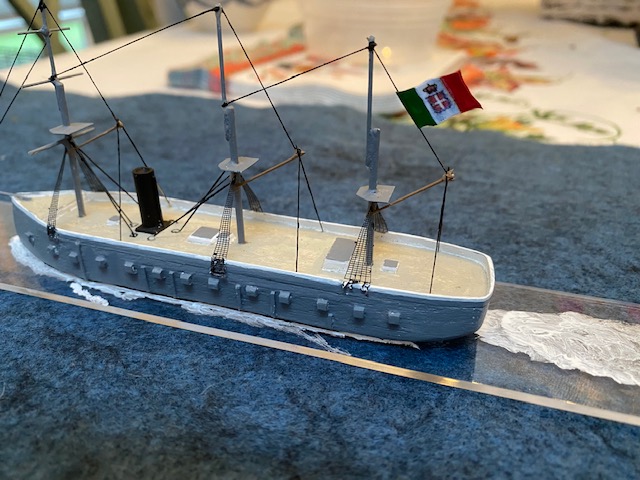
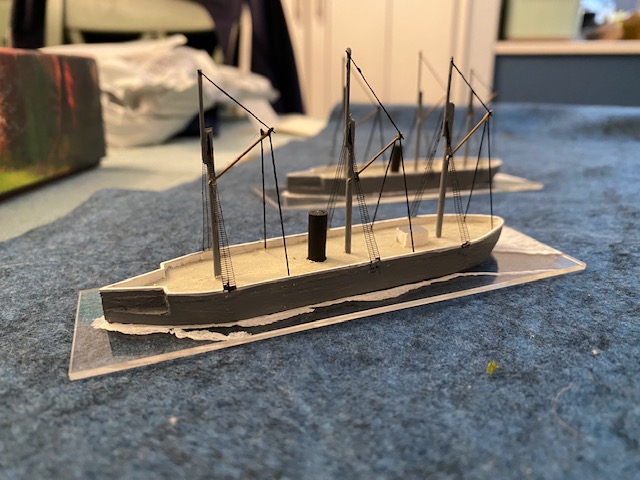
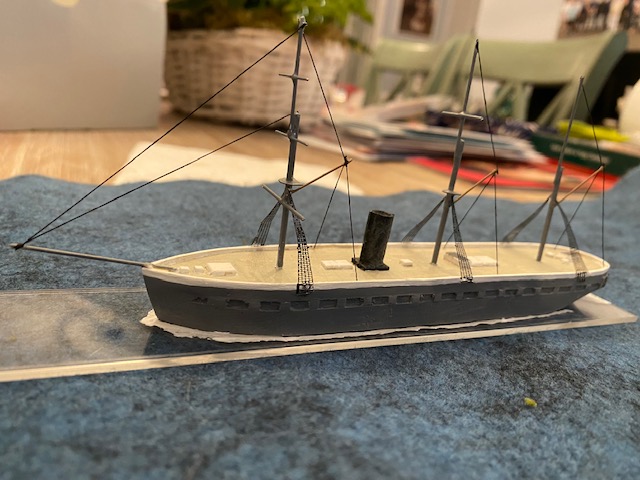
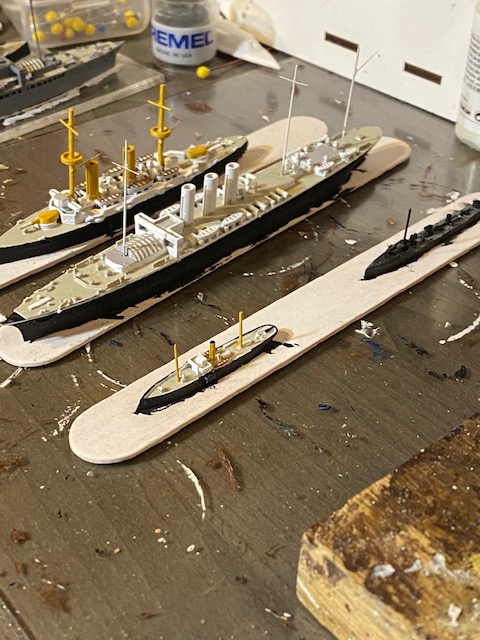
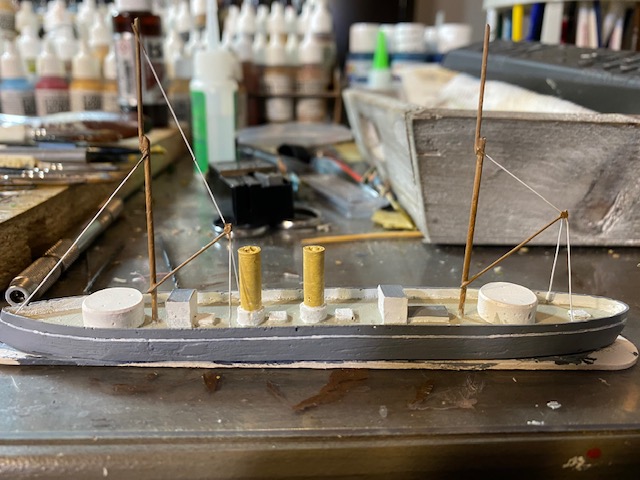
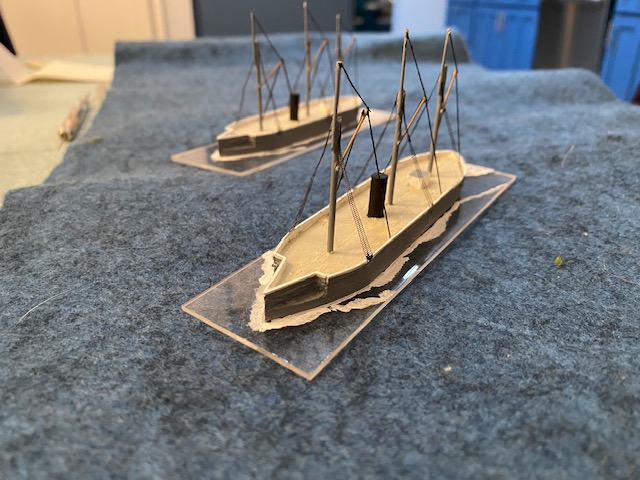
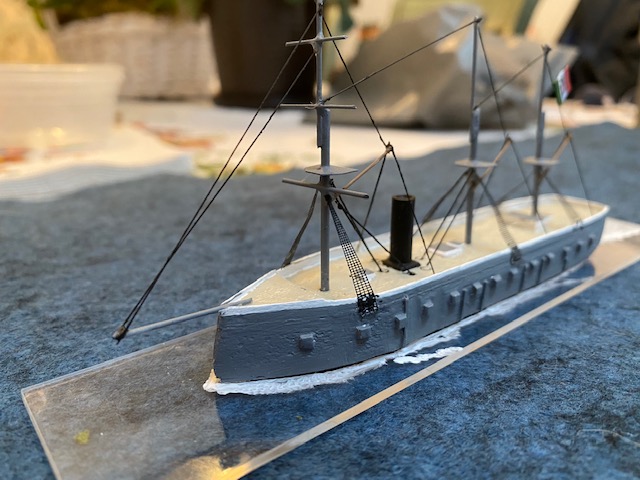
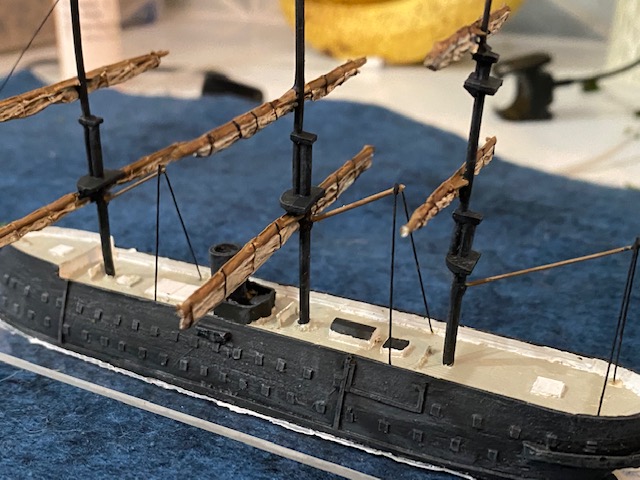
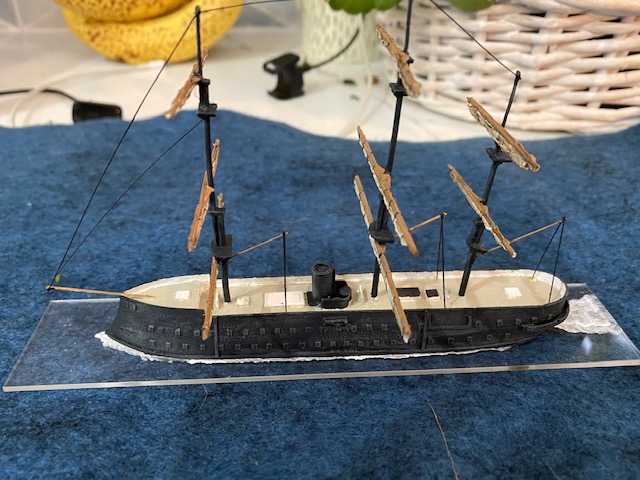
I’m also working on my Lissa project. I have seven 1/600 scale ships from Bay Area Yards to complete for my share of the game. This is an Enfilade project I’m doing with Dave Schueler and John Gee. Dave and I have split the Italians (though in the actual the Italians effectively split themselves, and the Austrians did okay at splitting them too.) The ships are hulls only and I’ve taken to making my own masts, applying ratlines and rigging as appropriate. I’ve learned a lot from this process. I used to see George Kettler’s beautiful ship miniatures and wonder how did ’em, and now I get it sort of. I’ve completed Affondatore, Principe de Carignanon, Terribile, and Forrmidabile. I have gotten a slight start on Re D’Italia, and will also have Ancona and San Martino to wrap things up. Timeline is, again, the end of December. But there is a complication.

Bay model of the turreted Affondatore
Terribile and Formidabile are the smallest of the Italian ironclads
Principe de Carignano required the most rigging work of the four. I also added fighting platforms.

Lorri and I are actually getting away for a week. Out twice canceled cruise to Mexico is back in business, Omicron variant be damned. I’m vaccinated and boosted, prepared to further inoculate myself with prodigious quantities of gin. I will be safe. But without paints, brushes and figures. I’ll lose a week of paint time.

One more quick add. Sometimes it’s fun to have a vanity figure. I completed the Bay Area model of the French armored ship of the line Magenta because it just looked so cool.

Revitalizing An Old Project, and the Matehuala Two-Step

A few of weeks ago I gave a name to our game group. We could have been, “The Kraken In Reverse” “The Puget Sound Wet Warriors” or “The Widely Dispersed Guys of Various Interests.” Instead I settled on “The Guys Who Are Too Old.” It seemed perfect.

Actually I never feel too old. Aside from fairly persistent sleep issues, I have no health issues. I can drive. I have prescription readers I wear to paint, but don’t need additional assistance a la a visor or magnifier (though I probably should have cataract surgery in 2022, no biggie.) I feel fortunate. And I’m retired. I’m not utterly broke, and my wife WANTS to keep working (though I hope she is cured of that in the next couple of years.) Life Is Good.
However, I have these piles of figures. . . and not just the unpainted ones. I have more projects than I can shake a stick at and I wonder how long I can justify holding on to all of them. I wish I could play more, but the facts are: A) I am actually playing many more miniatures games than I did when I was working. I usually get in a couple a month. I would guess I played maybe eight games a year three years ago. And there may still be some room for growth. B) I am dragging out a few more of those aging projects and re-introducing them to the game table

The premiere example of the latter is my Maxmillian in Mexico project. I bought these figures at least twenty-five years ago. They were, at the time, Wargames Foundry figures, but because the range wasn’t complete and the company seemed to be in a degree of disarray, I could only buy what was available at the time. There were some French figures sculpted by Alan and Michael Perry and some Mexican figures from Aly Morrison. But beyond the basics there wasn’t a lot available. I used ACW artillery for both sides and bought some smallish but serviceable Richard Houston cavalry from someplace, maybe The Virtual Armchair General, but maybe The London War Room when they were still in business.

I painted the French for Camerone, so mostly blue with white pants as the French Foreign Legion. I even ran a couple of Camerone games, including cooperating with another gamer at Enfilade to run the show. I also ran some Maxmillian games at the convention using the old Warpaint rules, which weren’t terrible, but for some reason, a lack of forethought or simply being overwhelmed with stuff, I parted with those rules. Dumb me.

In September I made a trade at Enfilade. Could I teach a friend how to play Rebels and Patriots in exchange for an awesome looking board game on the Spanish American War? The answer was an easy yes. I was trying to figure out what figures to drag out, and decided it should be the Maxmillian figures. We played a little one-off game. It was fun and I enjoyed pulling the figures out.

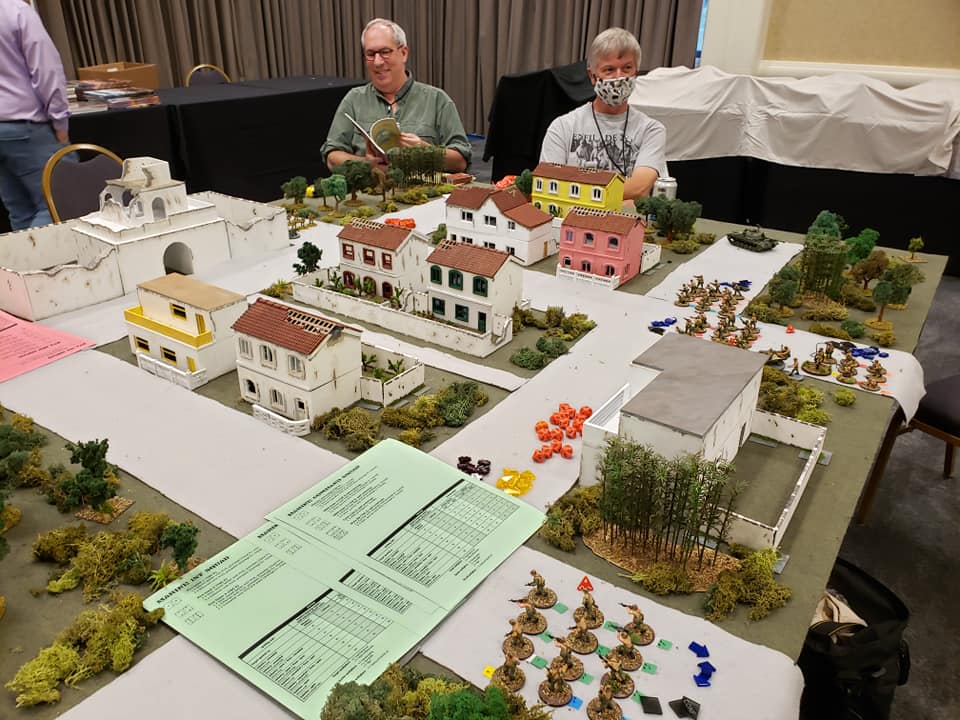
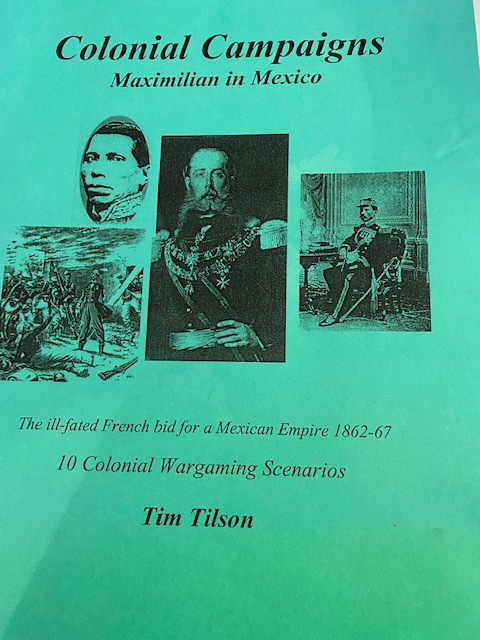
I planned to host a game at my place on November 13th and thought maybe Maxmillian’s minions could make another appearance. I began paging through my none the worse for wear copy of Tim Tilson’s Colonial Campaigns: Maxmillian in Mexico and found his scenario for Matehuala that looked pretty good. Then I went rhrough all my figures to make sure I had enough toys to run the game. It turned out I had just enough for five players, which is the number I expected. I would just run the game.
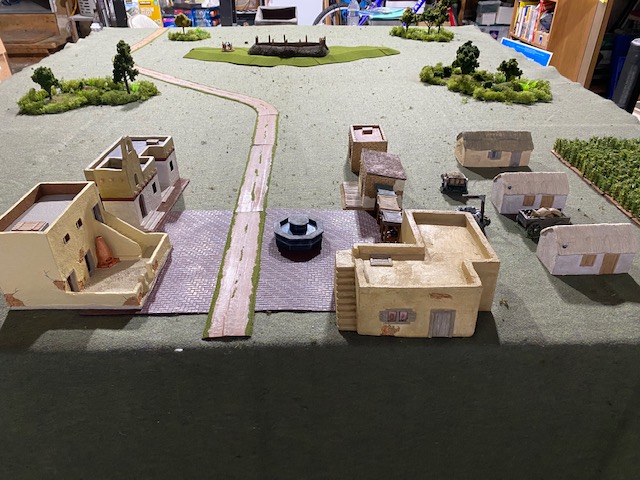
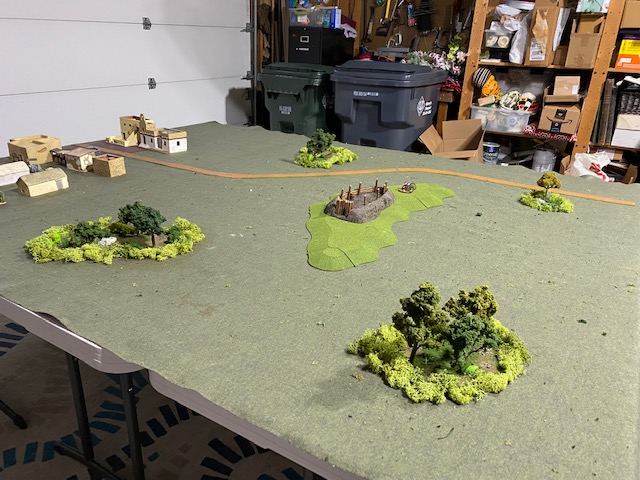
The action at Matehuala is really a pursuit action gone bad. Maxmillian’s Imperial forces are chasing Juarez’s Republican forces when they ran into stiff resistance and had to be rescued by a relieving French force. The scenario was scaled for The Sword and the Flame at reduced size units and in terms of figures that worked pretty well for Rebels and Patriots.

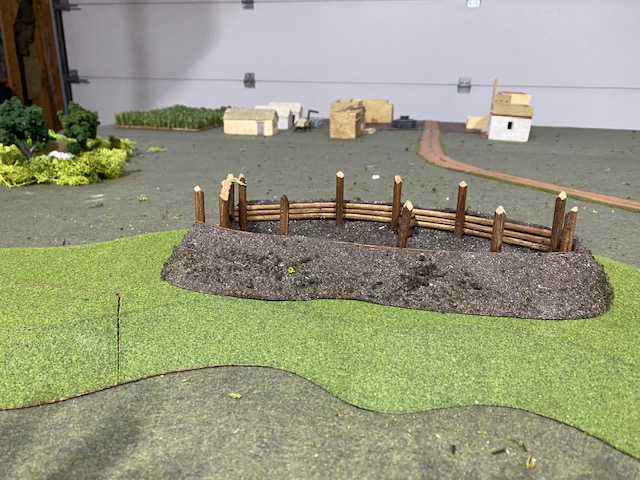
I set up the game with the town of Matehuala on the south end of the board with French reinforcements entering the town on the road. I also allowed for some road movement-9″ per turn for infantry units in close order and the same for limbered artillery. David Sullivan’s Imperial forces were set up on the heights north of the town. One unit was veteran and the other two were regular line troops. They had a medium gun with a limber, as well as a line cavalry unit. One unit had to begin in the redoubt which counted as hard cover. The rest had to be within six inches of the redoubt but could be behind the hill, though not in close order. The French were told the position was well scouted by the Mexican forces and they would have to set up first.

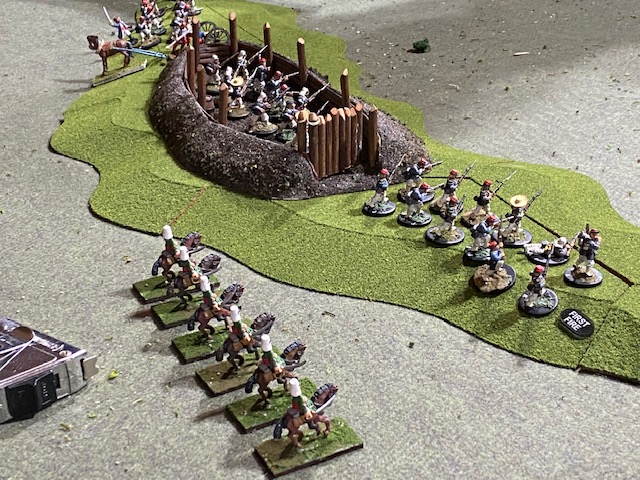
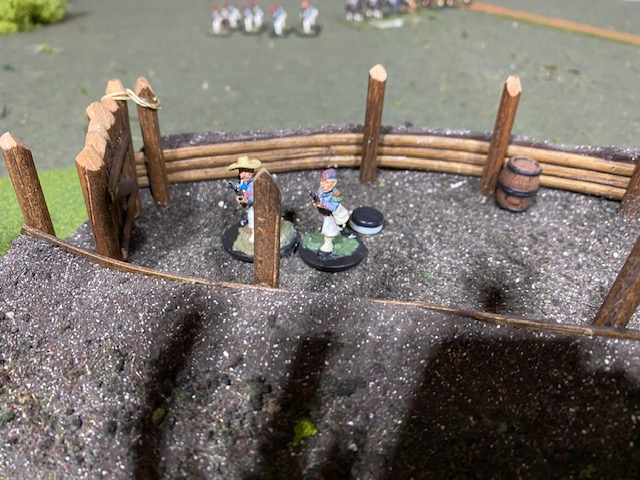
David’s Imperial forces set up on the hill. Redoubt by Barb’s Bunker from many years ago.

The Mexicans had more figures, more units, more of almost everything except quality. There were three Mexican commands. The first was small with two light cavalry units commanded by Dave Schueler. One unit was a line lancer unit, aggressive but bad shooters. The other was a rurale unit that were good shooters, but could only fire as part of skirmish move. Bill’s command was composed of three line infantry units, nothing special. They also had a medium gun, but no limber. Michael’s command was composed of four 18-figure line units, green and bad shooters. These were the local militia units, largely untrained, but just a pile of guys.

I envisioned this as a reverse pursuit battle with the advanced French units falling back on the arriving reinforcements. Hence the two step in the scenario title. The French received victory points for holding the town, which seemed likely. The Mexicans would have to have incredible luck to take the town. The French lost victory points through casualties-routing units or permanent disorder (50%) casualties.

Of course nothing survives first contact with actual play. I envisioned the French setting up in the redoubt and behind the hill ready to retire. They set up on the hill. Both sides rolled for initiative. The French lost, and the units outside the redoubt immediately began taking significant fire. from the Mexican regulars and the rurales as the Lancers advanced behind their left flank. The mass of Mexican militia began slowly moving across the left flank.

By turn two, the French on the hill were returning some fire, but there were far more Mexicans shooting at them, and it took little time for the battery to be wiped out and one of the two infantry units outside the redoubt to be routed, taking the unit commander with them. The cavalry unit and the remaining infantry unit confronted the militia, firing away best as possible, inflicting a few casualties, but taking some in return. The unit in the redoubt was all alone, under constant fire from the mostly immobile Mexican gun and infantry, while two of the Mexican line units ascended the hill for the inevitable assault. While the Imperial troops held on, fire reduced them to splinters and forced the tiny remnants back toward town and the relief troops.

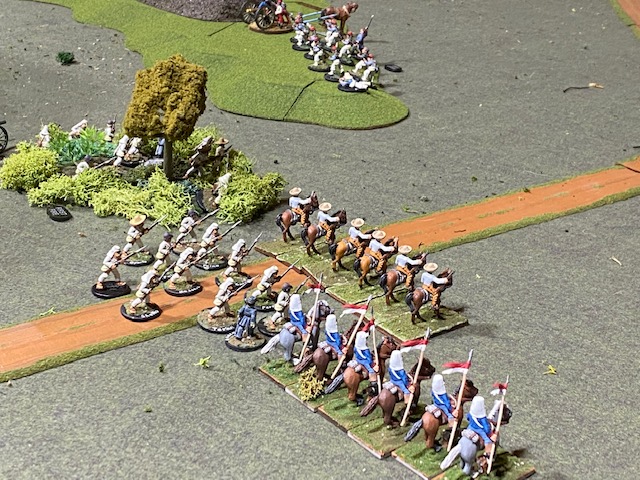
Bill’s regular infantry and gun and Dave’s regular cavalry extend past David’s left flank on the hill top.

The French relief was forced by the scenario to piece-meal their way on to the board. As they began to edge their way into the game Eric, playing the French, made a terrible discovery. I’d rated the French as shock infantry, good at melee, but only a 12 inch shooting range. Meanwhile, Michael’s zillions of Mexican terrible troops were popping off at him at 18 inch range, hitting rarely, but enough to be painful. Eric was able to beat up Dave’s cavalry with his artillery and engaged his lancers with his cavalry detachment. Though Dave’s cavalry was neutralized, Eric was unable to help the Imperial troops stay on the hill and hold the redoubt, or prevent their destruction. Bill’s and Michael’s commands were in charge of the hill position and slowly advancing.

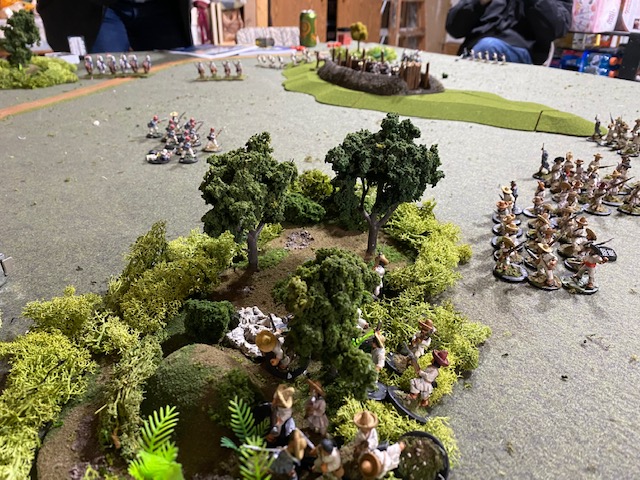
Michael’s vast collection of green infantry/bad shooters have already driven off the unit of Imperial horse and were pushing past the hill and toward the town. The last unit of Imperial infantry stands in their way.
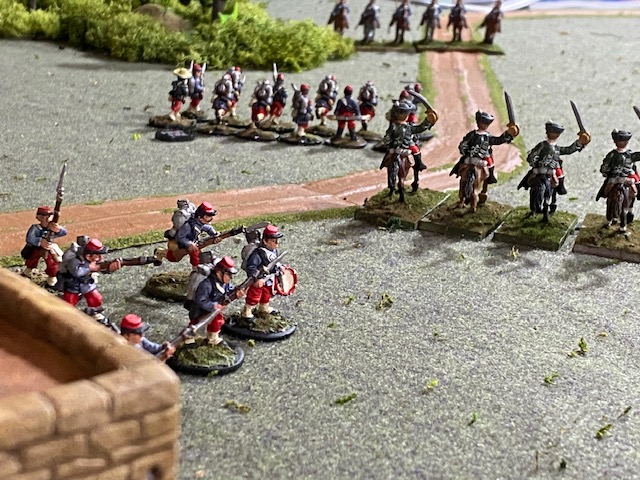
Eric’s French regulars make their way out of the town and up the road to open a retreat path for the Imperial forces.
Then there were two. Bill’s assault with his Republican regulars was repulsed, but spelled doom for the unit defending the redoubt. Fire would later reduce this unit to one figure that fled from the bullet-swept fort.

The victory conditions were for the French to hold the town and preserve as many of their troops as possible. Unfortunately, David’s troops were pretty beat up with only one unit remaining on the board. While Eric’s forces seemed pretty capable of defending the town, the Imperialist/French side was well behind on points. We called it a game and retired to lunch.

The game sparked some interest in my friends, and definitely renewed my own. I’ve taken advantage of the Wargames Foundry Christmas sale to add to my figures. The period definitely has enough interesting French and Imperial troops that just having a selection to choose from will be fun. David also discovered the French/Filibuster sets in the Old West range for Camerone. So I’ve also included all four packs of those in my order. Received notice a couple of days ago my order shipped, so I’m excited for their arrival. It’s good to see my interest in this project spike again. Camerone Day is April 30 and I’m at least mentally making plans.

I have an interest in hosting the game again, perhaps at Enfilade in May. I see a few tweaks. Notably I’d give the French the initiative advantage. That would make it easier for the advanced Imperial forces to choose staying or retreating. The French infantry would also be veteran, aggressive line, which would give them the good melee qualities I wanted them to have without penalizing their shooting, which was not my intent.

Other Side of the Coin: 3rd Mexican Line Regiment

When I foolishly agreed to jump fully dressed into the cement pond of the Mexican American War, I kind of vowed (to myself of course, nobody else takes my vows seriously) to do both sides. I didn’t promise to do piles of guys-this is not going to be the biggest Smyth project of all time. But I did want to have a representative batch of Mexican soldiers, and a reasonable group of Americans. The Mexicans are less effective than their northern neighbors so I’ll be doing a few more of them.

So the troopies I’ll be building look something like this

Americans

4 X 12 units of infantry (1st U.S. Artillery

1 X 6 unit of U.S. Dragoons

1 X 6 lb gun

Mexicans

4 X 12 units of line infantry (3rd Line Regiment)

2 X 12 units of light infantry (3rd Light Regiment)

1 X 6 lb gun

2 X 6 Light Cavalry

It may be a tish different, but not much. I still have some things to buy, but not a lot.

This week I’ve been working on the Mexican line infantry. I chose the 3rd Line and 3rd Lights because they fought at Monterrey. Monterrey was fought in northern Mexico and was a tough city-fight. The Americans chiefly fought for strong points in the city, and it wasn’t the walk-over they experienced at the earlier Palo Alto and Resaca De Las Palmas battles.

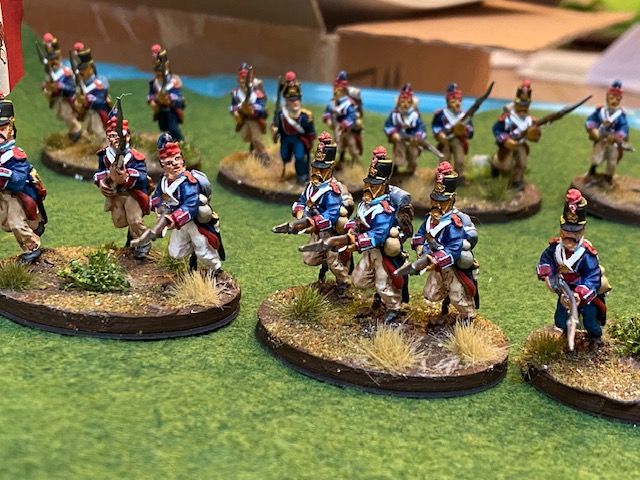
These are 1st Corps figures and I’m sticking with these for the project. I ordered the Mexican Brigade pack directly from the manufacturer in the UK. That gives me 72 figures including 48 line infantry with two command groups, and 24 light infantry with one command group. I also purchased a gun and crew. They weren’t super cheap. Including shipping, it was about $132, so less than two bucks per figure, a fair price point. 1st Corps was easy to deal with and prompt. I had my order within ten days or so.

I finished the Americans I had and quickly moved on to the Mexicans

The Mexican troops are problematic. They are, shall we say decorative, compared to the U.S. Army in Mexico. Very much influenced by French uniforms, they seem downright Napoleonic. However, Mexican troops also received one fancy schmancy uniform and then they were pretty much on their own for staying clothed and they wore a patchwork of linen and canvas and the attractive blue with colorful facings in wool became less available. More sombreros than shakos, more sandals than shoes.

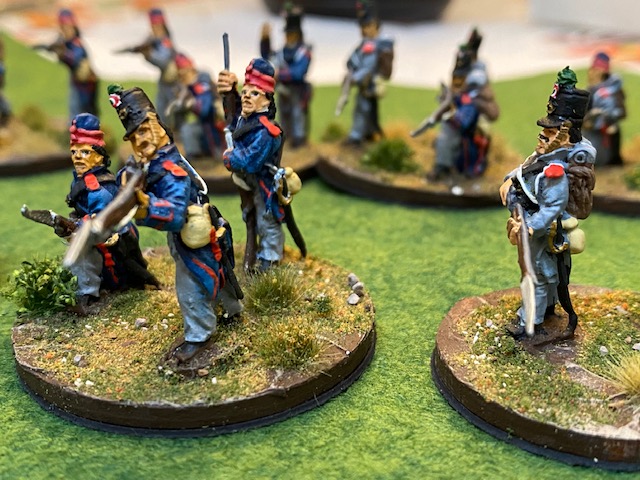
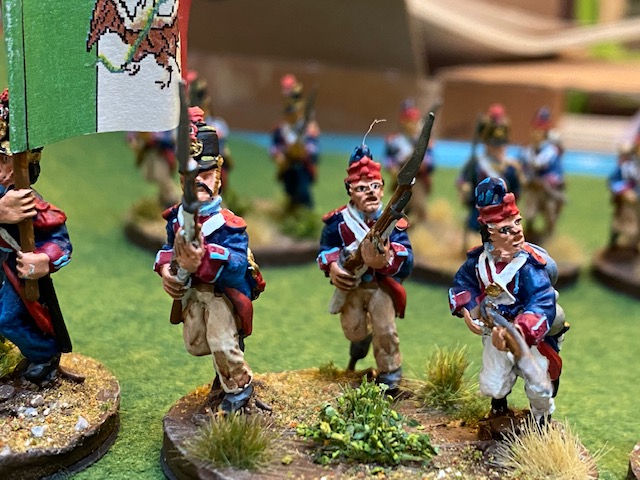
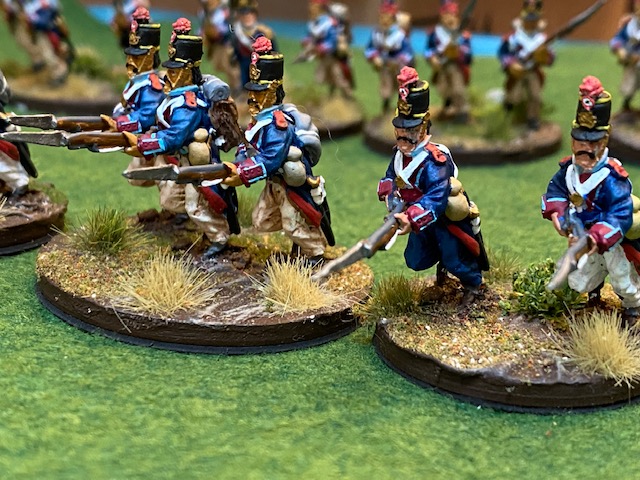
The 1st Corps Mexicans show them at their best, which is fine. The figures look great and that’s always a plus, but they also give the painter a couple of options. Everyone is in their long blue tailcoat, with a shako or fore and aft barracks cap. Pants were a wear item and could be painted in blue or in off-white or white as replacements come in. I opted for a mix of blues and not blues. Some pants I painted Vallejo Ivory and washed with GW Agarax Earthshade (or Vallejo Brown Wash for those not playing GW Bingo.)

Finding a dark blue I really like is tough for me. I want something that does a great job on a first coat, that means a color that is pigment heavy. Dark blues often separate a bit on a first coat and I learn a lot about a color when it separates. Is it purply or greenish? I really love dark blues that have a hint of gray to them. I think that’s a great uniform color because, I believe blue uniforms that wore with the weather looked more gray. The best uniform color ever was Polly S Israeli Armor Blue. Unfortunately, Polly S was acquired by Testor’s long ago, taken out back and buried with the dinosaur bones. Sigh.

Enough of that. I tried a few different craft colors, an Army Painter blue and Howard Hues Union Blue, but finally decided on Vallejo Dark Prussian Blue. It’s a bit purple but quite dark. The figures took a great first coat. Then I gave it a dry brush after lightening with Vallejo Sky Grey. I gave it a second brush after lightening further with a little bit of white. I was really happy with the result, and expect that will be the way forward for me with similar uniform colors.

Facing colors are Vallejo Dark red, piped with Vallejo Sky Blue. Flat Red for the turnbacks and shoulder thingies. No other mysteries.

These are busy figures. The shako needs a lot of attention-chinscales, shako plate, cockade, shako bands are all there to be painted. Uniform buttons are recessed and I could just see making a mess so I passed on them.Some figures have a belt plate, some don’t.

In any case, I’ve now painted 4 X 12 units of these bad boys, and while I’m glad they are done, they were really fun and different for me to paint.

When Paint Formulas Change (accompanied by loud wailing.)

I have friends who are meticulous about tracking the paint colors they use on different units or different projects. Paint blotches and paint names are carefully placed in steno pads or spiral notebooks, or perhaps on index cards in storage boxes that can be carefully organized and easily sorted as needed. Of course I have a better system. Information is stored in my superior memory that can be readily accessed for at least a week, maybe even a month where it is consigned to the same place with the names of all the members of Gary Puckett and the Union Gap. I know it’s in there somewhere. Helloooooooo!!

Okay, so I don’t keep careful track of these things and sometimes I forget and that can be embarrassing as I rummage about for the right color. But there is something worse than this, and that’s when the colors themselves change. Yes, it’s true, sometimes manufacturers change the formula for their paint and the result is a color that isn’t what it what was five years ago or two years ago or, well, last week. Often I only hear about it and never quite experience it myself, but recently it happened to me. Here’s my story.

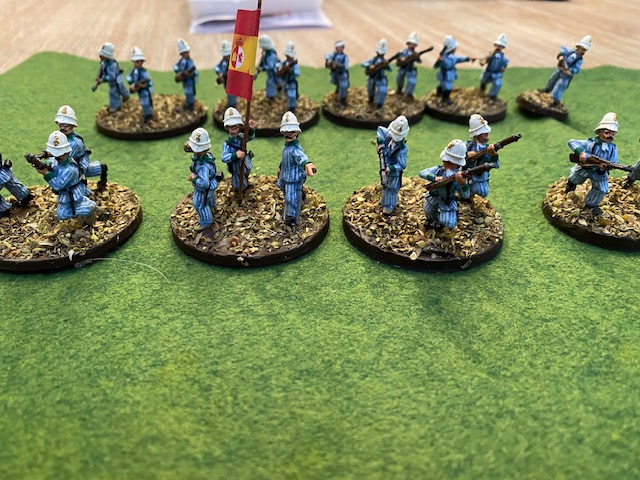
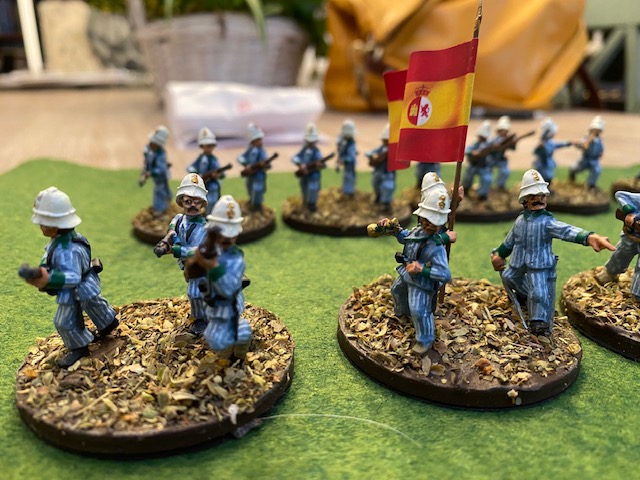
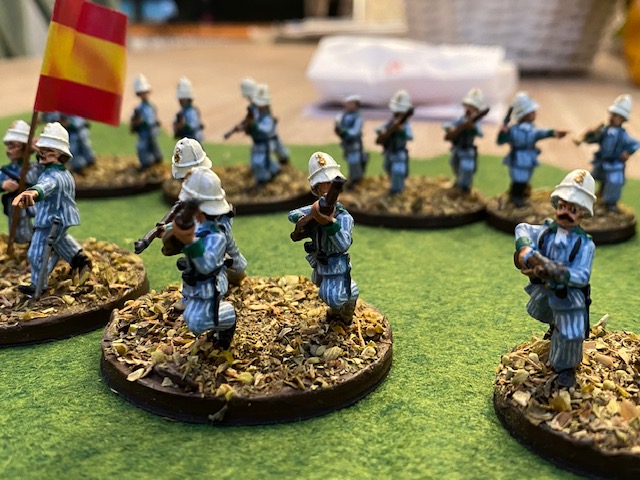
I’ve written a lot about my Philippine/Spanish-American War project. Most of my figures, for the Philippines, are Miniaturas 1898 figures, but if I was to broaden into the Caribbean I’d need some Old Glory figures. Further, I’d also purchased some more of Miniaturas figures including some Spanish infantry and a couple of guns. All would require the infamous rayadillo pinstripe paint job, and that meant I’d be using a lot of the Vallejo 70-943 color 061 Grey Blue paint.

I’d painted some figures for my friend John Gee in the rayadillo and followed the formula of block painting the main color, the blue grey, progressively lightening painting before carefully painting in the representative pin stripes, which is the blue grey lightened for a third time. It’ demanding. I really have to do all of it in one sitting. Yes, I’ve tried a wet palette, but it just hasn’t worked for me.

One of the batches of troop types I bought from Old Glory are the Spanish in sun helmets, which were worn in Puerto Rico. I got started on these early in the month. After I put down a base coat I noticed something incredibly disconcerting: it was the wrong shade. The paint was darker, grayer, and less blue than the earlier work I’d done on my Philippine figures. And I had no idea what I was going to do about it.

Not only that but I’d blocked out 24 figures or two units worth of figures. So I’d either have to come up with an entirely new color, or repaint everything I’d done.

First, I shouted at the air, beat my fists and considered rending my hair as all classical heroes do. But that really hurt too much, aggravated my wife and the dogs and I began to come up with better solutions.

The first thing I did was to search about for a substitute. My preference is something highly pigmented like Vallejo, Army Painter or Citadel. It didn’t take long to strike out. The second choice was to search out the zillions craft paint offerings. I actually bought a shade and brought it home only to discover it is way more green than blue (thanks to the super lighting at Michael’s.) I’m always on a schedule.

This left me in the position of trying to cobble together a workable color. I began with a base of the Grey Blue. In order to get a little more blue in the paint, I added a few drops of Vallejo Sky Blue, which is very blue and very bright, and then began to add Cold White to the paint. I had to give it a good stir before painting/repainting.

Block painted the jackets and trousers. Then lightened with white and dry brushed. The Old Glory figures don’t have as many creases, rolls and crevices as the 1898 Mini figures do, I had to work a bit more at the dry brush. The first lightening was followed by a second. Then it was on to pin striping. It’s a far different gig with the OG figs, because with the more regular surface, there aren’t as many places to hide and stop painting the stripes. It was a much longer and more tedious gig, especially since I was working on 24 figures at once instead of 12. But they’re finished.

Just a quick review of the Old Glory figures. They are really nice. They’re proportioned well and I really like the sun helmets. They lack a little bit of detail, but overall pretty good stuff. If I have a complaint it is that the cartridge boxes seem a bit small, but that’s about it.

I have 36 more figures to paint of these bad boys, so I’m going to have to do my best to match the paint color as closely as possible. I’ve had to order more of good ol’ 70-943 number 61, so hopefully it will arrive soon.

The 1st Corps American Infantry 1846

Having been sucked into the Mexican American War project with my friends, which I say with the greatest affection and knowing my eminent suckability, I quickly sent off an order to 1st Corps in the U.K. I limited myself to a brigade pack of Mexican infantry and a gun and crew. We’ll be playing Rebels and Patriots and units are usually twelve figures or at least multiples of six, up to eighteen, and a brigade pack is three units of 24. So that’s a pile of units. I’ll be busy for a while.

But while I was waiting for 1st Corps to do its magic, I got mopey. I really love the American uniforms, and believe it’s always a good thing to have both sides and I kibitzed with my beloved missus and persuaded her I should order some 1st Corps figures from Scale Creep miniatures here in the states and took the plunge. With a fresh re-stock of figures, I ordered enough figures for two 12-figure American infantry units, with the understanding they would be artillerists serving as infantry.

Scale Creep was amazing and I had more order within a few days. I was staring at some of my Old Glory Spanish infantry that required their rayadillo pinstripes, and decided they could wait and I plunged right into the Yanquis instead.

Figures on the painting table

The figures are quite nice. A litle bit of flash between the legs, but really quite clean. Lots of tin in these guys. They are quite hard and difficult to re-position, but in general, they are well-balanced and very well-cast. Plenty of nice uniform creases. They are a great size that could easily be mixed, though probably not in units, with Old Glory’s considerable Mexican War range. They primed up well and were a pleasure to paint.

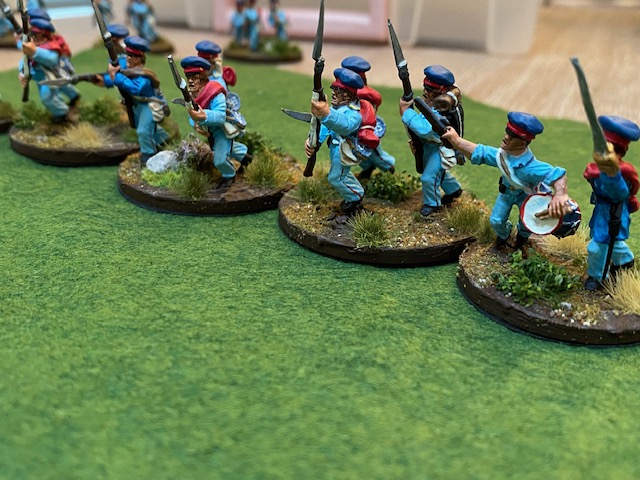
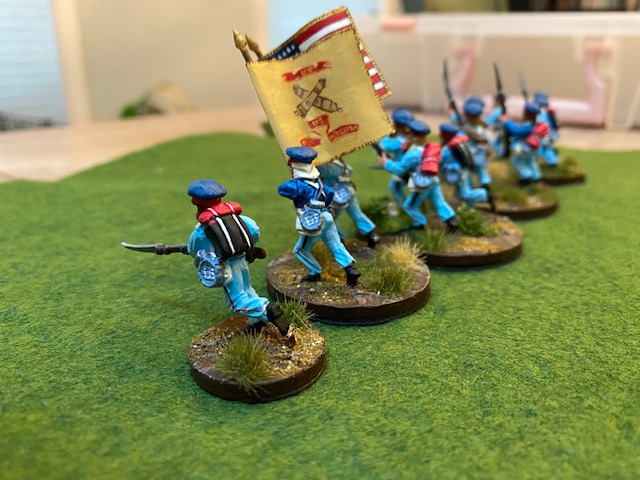
I ordered the charging/advancing figures and a command pack. They come eight to a package, and the command figures four to a pack. The command figures come with an officer, a drummer and two standard bearers. I am painting these for Daniel Mersey’s Rebels and Patriots, so two twelve-figure units. I put the officer and drummer with one unit and the two standard bearers with the second.

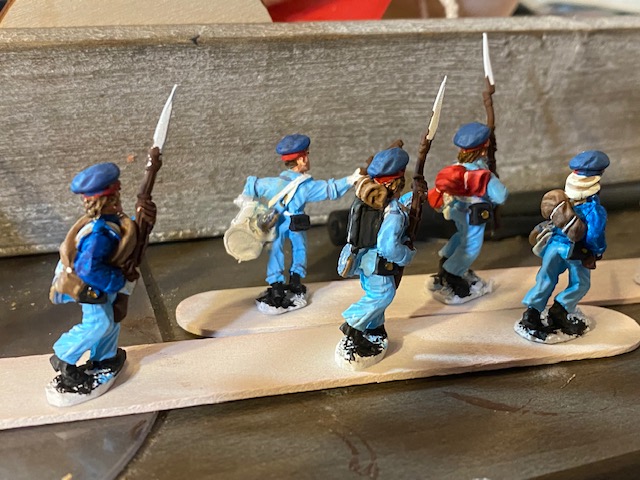
Truly, the paint job is pretty simple and straightforward. The Mexican-American War U.S. uniform is one of my favorites due to it’s color and simplicity. The American artillery as infantry has largely the same uniform as the U.S. infantry–sky blue trouser and sky blue short jacket. Some sources suggest artillerists may have worn the dark blue short jacket, so I mixed a few in there as well.

The photo wasn’t especially well-lit, and shows the blue a bit darker than it actually looks. At least I hope I got things a bit lighter. Vallejo Sky Blue is the base color

I painted the forage hats Vallejo Prussian Blue with a little light grey mixed in for a dry brush. The artillery also had a red hat band, and I used Vallejo Flat Red for that. It’s a bright enough color so it doesn’t get lost, but not as blinding as Vallejo Vermillion or Scarlet.

Lots of facial hair on these guys so using a medium brown or dark sand color that can be washed with a brown wash, either the Vallejo Brown Wash, or Citadel Agrax Earthshade looks good.

Uniform colors were a little sticky. The infantry sky blue definitely faded on campaign, and the Vallejo Sky Blue is quite bright. I used it anyway lightening it twice with white, and dry brushed over it. It’s still a bit brighter than I’d like.

Not much of the collar shows for the yellow piping, but certainly on the shoulder straps. The figures also got a thin red pants stripe to denote their status as artillery, and illustrate their description as “red-legged infantry.”

I decided to paint my own standards. I’m not sure this was a good plan for the national flag. A commercial version would have looked better than my own attempt at a 28 star version of the Stars and Stripes. Oh well, I gave it a shot. I was sort of pleased at the outcome of the 1st Regiment artillery flag. The guns could be longer and slightly better positioned, but the detail looks nice.

In any case, the two units are done. I’m painting that good Spanish Rayadillo right now, but I’ll be switching over to some Mexican line infantry by the weekend. The projects are all coming along and that’s all one can ask. I’ve finished 72 figures for October so far, and I’ll be really disappointed if I don’t make 110 for the month.