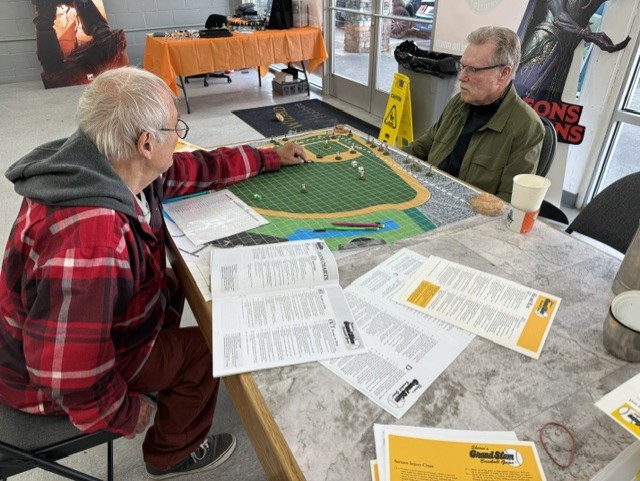
I’ve yammered plenty over the last few years about my long and deep relationships in the hobby. I’ve had a number of different gaming friendships, I’ve talked about, including those I’ve lost. There are others I’ve known for even longer that remain deep and incredibly important and those include Dave, Tim and Jim.
Dave owned Escape Velocity, a game store in Tacoma from the late 70’s to early 80’s and without Escape Velocity I might not be playing games at all. When I became a student at the University of Puget Sound in 1976, I was doing no gaming at all. I started out there in 1978 playing board games and persuaded Dave to bring in some miniatures and it took off from there. Tim arrived as a high school guy. Jim was Dave’s high school and fastpitch colleague.
The three of us, along with a host of others, were baseball fans. We played numerous baseball board games, but for whatever reason I always loved Sherco Grand Slam Baseball. The game is played on a grid. Historical ballparks and their unique characteristic were represented. It is simple to recreate historical players, teams and seasons using commonly available statistics, making it much cheaper than other player-card driven games. I liked it. Still do.
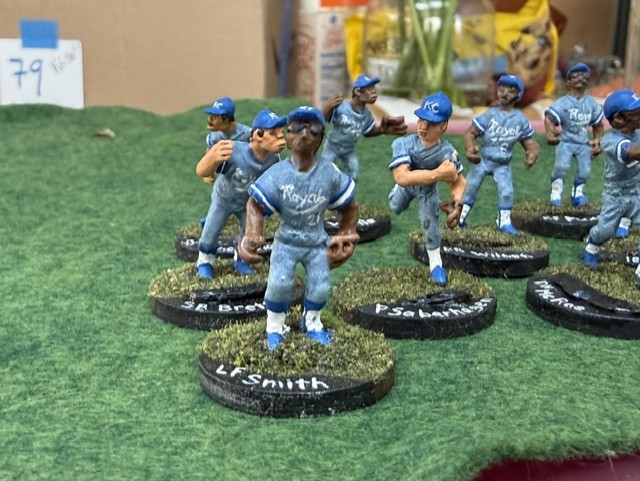
But what really made it special for me, is when Reviresco miniatures for baseball in the early 2000’s. The miniatures are good, if imperfect. Everyone is right handed-it would be fun to have a lefty hitter and a lefty pitcher in each set, but I can work with them. I’ve painted nine historical teams over the years, have a couple more to paint, and will likely buy more soon. In a perfect world I’d have one for each major league team since 1903, but that ain’t happening.
Access to baseball miniatures meant we could play Sherco as a miniature game. We messed around with it off and on but last year, Dave, Tim, Jim and I committed to a round robin tournament using four historical teams. Dave chose the ’69 Seattle Pilots. Jim took the ’61 Yankees. Tim decided on the ’83 Cubs. I took the ’77 Astros. Theirs were personal favorites. I took the Astros for their tequila sunrise uniforms.
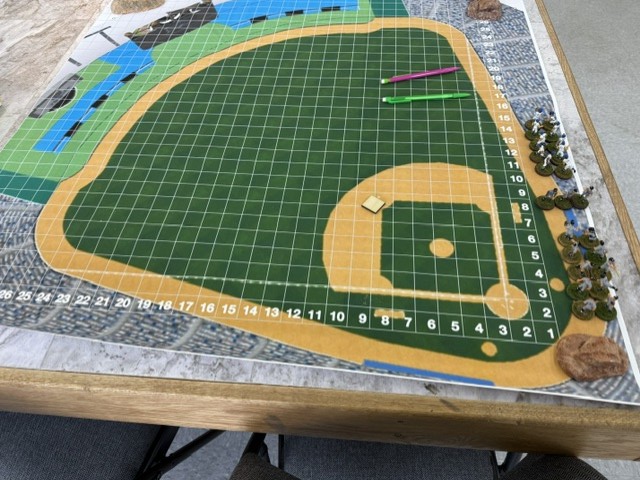
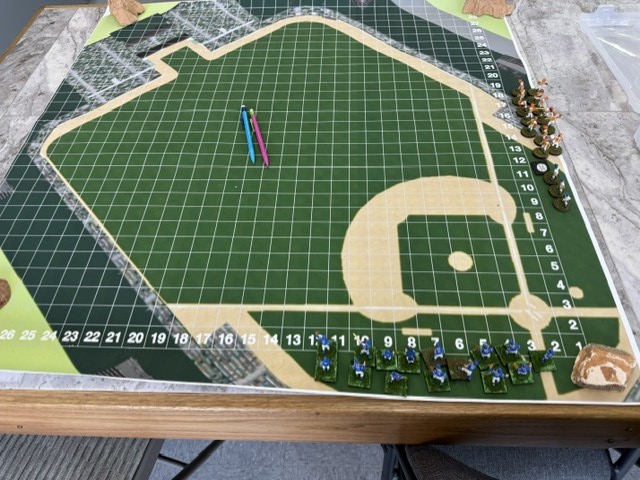
Roomy Kauffman stadium on the left and where the Yankees will play the Pilots. The Polo grounds on the right with it’s short fences and massive outfield waiting to host Astros vs. Cubs.
I made sure to paint the desired teams from my stash of figures. Where to play the games was a matter of discussion. In the board game the ballparks are created by outlining the fences with blank game chits. Our early efforts with miniatures we used felt game boards and put down wooden tiles as the fence line. I even built a 3D version of Sportsman’s Park in St. Louis from the 1946 World Series. It looks really cool, but it’s really hard to set up properly. Tim had a great idea. Take the digital photos of a ballpark, scale them properly and grid them on a 36″ X 36″ mat. We chose two ballparks to play in. One was the old Polo Grounds in New York, home of the New York Giants and the early days of the Mets. Bobby Thompson hit his his homer heard ’round the world, and Willie Mays made his amazing catch and throw of Vic Wertz’s ball in the gap at the Polo Grounds. The ballpark is unique for it’s shallow lines, rapidly deepening alleys and it’s forever deep center field notch. The other ballpark we chose was less “interesting” by more wide open. I’ve always loved the wide open spaces of Kansas City’s Ewing Kauffman Stadium, a ballpark I’d very much like to visit before the Royals move downtown.
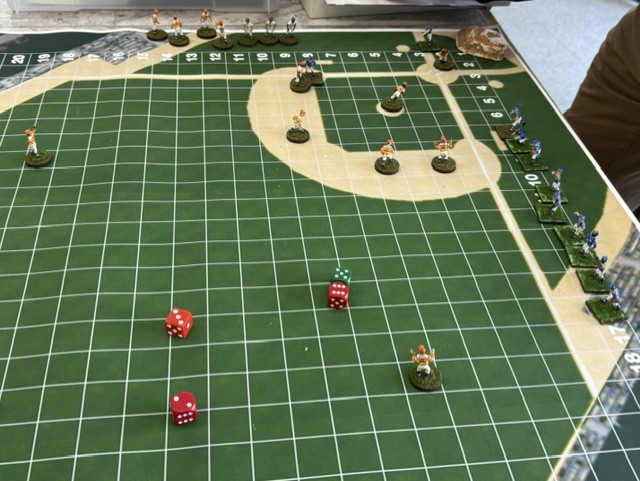
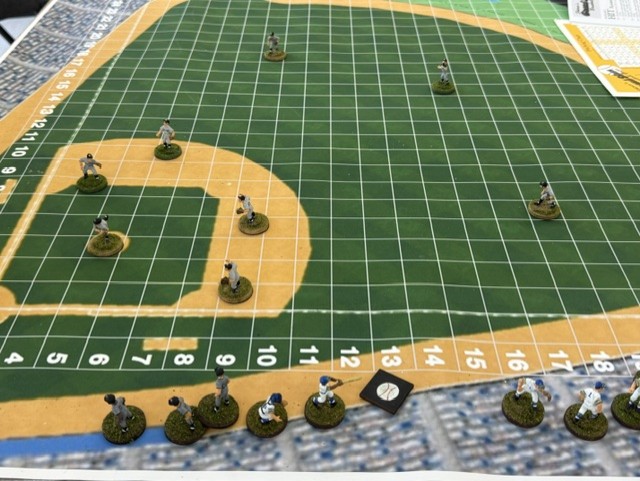
Astros take the field against the Cubs to the left. Astros have a mediocre defense and play the Cubs straight up. On the right Yankees are in the field vs. the Pilots.
I’d like to say the game has super simple mechanics, but there’s some work to it. Pitcher ratings are compared to hitter ratings, a die roll is made and it’s a probable hit or a probable out. Positioning of fielders on the grid is really important. If the result of the die roll isn’t a walk or strikeout, the ball goes somewhere on the grid. Some fielders have a tish more range and can turn hits into outs and outs into hits. In goofy ballparks with unusual dimensions outs can turn into homers or take weird bounces. Steals, baserunning, bunting, hitting and running can all factor into the game. The fielding dimension, and choices about how to make plays or take an extra base is what attracts me to the game.
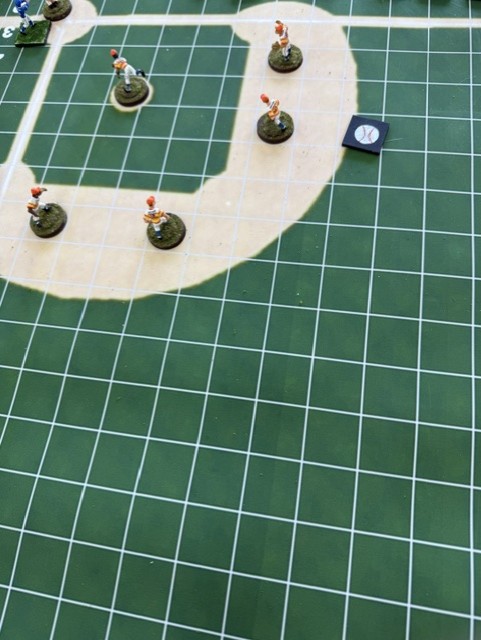
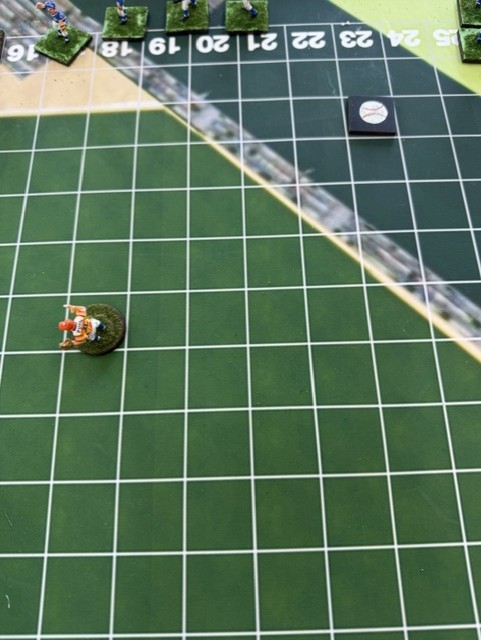
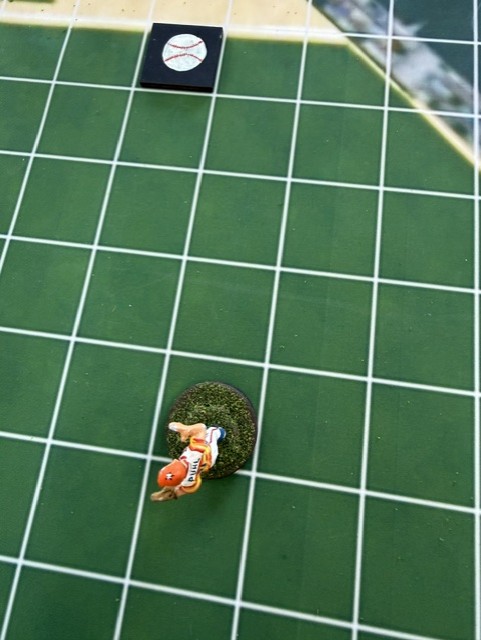
A little game play. A ball can be hit to odd places. A ball hit behind the shortstop with average defense will likely be an infield hit. On the right a screaming grounder bounces off the short left field wall, creating a long run and throw for the left fielder. The Polo Grounds is defensive hell hole.
The idea for the tournament-three games plus perhaps a one game playoff- began more than a year ago. It took quite a long time to actually play the games between vacations, illness and the problems of pulling everyone together. We finished yesterday. I was fortunate enough to go 3-0, but as with all things gaming, the best part is always playing the games, spending time with friends, doing something new and different and planning the next one. Life is good.