Ah-Ha! A plan takes shape

The stuff I’m working on from top left–Indians for the Wabash, about 1/4 done; ten completed Stukas for the Illustrious game; some piles of planes awaiting all kinds of work–Malta-based Hurricane I’s and Macchi 200 Saettas; MSD Vulcan completed and ready to fly across the Atlantic Ocean; nine Italian SM 79 bombers that will take their shot at the Illustrious; four GHG Hurricane IIc’s-nice models.

I am obsessive about knowing what I’m doing.  Most of my wargaming life is built around what games I’m going to host at Enfilade.  Last year, the big deal was the Aztec project I did with David Sullivan.  The year before that it was Lion Rampant.  The year before that it was The Raid on St. Nazaire.

This year is different.  No new big project.  No gazillions of new painted figures to roll out by Memorial Day weekend.  The pressure is officially off.

That doesn’t mean I won’t be doing anything.  I finished my first six Axis planes for the air attack on the HMS Illustrious.  That’s one of the games Dave Schueler and I will be working on for Enfilade 2018.  I’ve already completed the six Fulmars that will be defending the venerable British aircraft carrier.

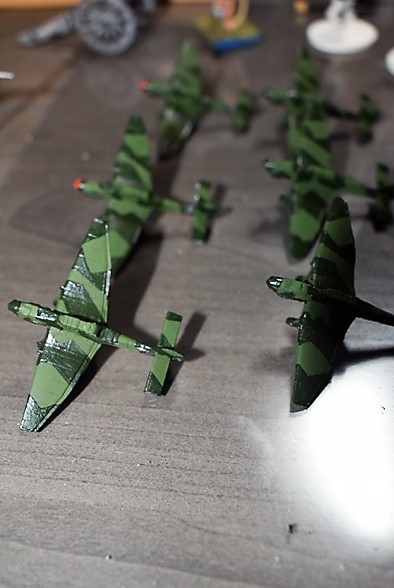
These are Raiden Ju-87B miniatures.  They are one part castings.  Very nice stuff, with lots of detail (but not too much.) They are painted a combination of Vallejo German Camouflage Green and Vallejo Military Green.  The underside is Vallejo Sky Blue from their RAF Mediterranean and Desert Air Colors set. I have four more Stukas that I will paint up in Regia Aeronautica colors.  Pretty much green with a white cross on the tail.

Expect lots more planes from the late 1940-1942 period from the Med.  I have a ton.  I need a lot of Italian SM-79 trimotor bombers for the Illustrious attacks.  I have a load of Italian Breda light bombers and early fighters, such as the Fiat GR 50 that I’ve had forever and need painting. I also have British defenders, including some Hurricane IIc and P-40E Kittyhawks that will be in stone and sand colors.  They should be fun.

But my really big project is one that I touched on last post, and that is The Battle of the Wabash. This 1791 battle in the Northwest Territories (okay, Indiana) was a horrendous massacre of the American army sent out by the Washington administration to conquer the territories for settlers then congregating on the north bank of the Ohio River.  It didn’t turn out well.  It is often known as St. Clair’s Defeat or St. Clair’s Disaster. The 2,000 man force under Arthur St. Clair’s command lost about 900 or so killed, compared to about 275 of Custer’s command at Little Bighorn.

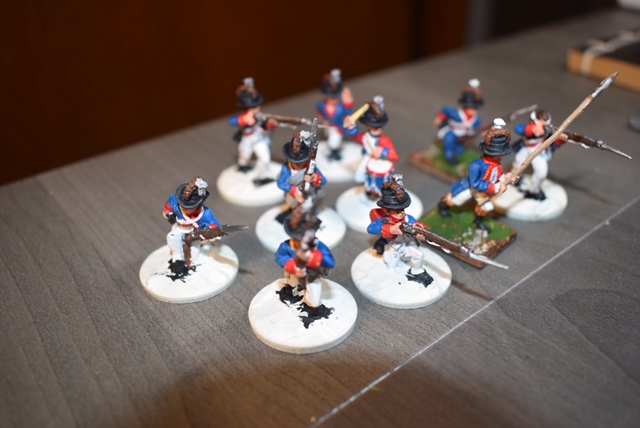
It’s a big ol’, project.  I will use America Rampant, my conversion of The Men Who Would Be King, to this early wilderness period. The Americans have something in the neighborhood of 26 ten figure units.  The Indians, under Little Turtle, have slightly more at 28.  The Americans actually outnumbered the Indian confederation at the battle, but the batches of militia and outposts that were swamped and destroyed at the battle’s outset won’t be represented. There’s lots of fiddling to be done rules-wise, but I’m a long way off from being ready. Lots of terrain to prepare.  That said, this will be my Enfilade 2019 project, so really 18 months out.

I already have eight or so units of Americans painted.  All the American units have ten figures. Two of them are light dragoons, though I believe only one of them is mounted. The Americans also have six cannon, and I have three of them painted.  I believe I am working on native units eight and nine.  All the natives are twelve figure units. I still have lots of unpainted lead, though there will be some additional figures needed to complete the project.

David Sullivan recently posted about his addiction to Daniel Mersey’s projects.  I find myself in concurrence with his views.  They are simply a fun collection of rules. We might be talking past each other in terms of future and ongoing projects, but I do see myself working with David on an ACW version of America Rampant.  We both have zillions of unpainted figures, so I see no reason not to.  I am diverted by that somewhat shinier project at the moment.  But not having the time pressure to get Wabash done instantly means I can also dork around with side painting activities, including some ACW units.

So here is my list of to-do’s:

  • Air Attack on the HMS Illustrious–unknown number of planes, but there will be plenty painted.
  • Remount Aztecs for 1-2-3 system.  That’s a Christmas Break project.
  • Mad Wet Max–more later as WIP
  • New air stands.  Only need a high and low altitude for Airwar C21 and Airwar 1940. I want lots, however, because the game system can handle many more planes.
  • Lots of painted figures–America Rampant, ACW, AWI and Hundred Years War in what ever I feel like order.

New rules to mess around with

Dave Schueler and I have begun lamenting lack of a fairly simple set of air rules. We love AirWar C21, but they are a set of rules for jets. I bumped into David Manley, the author of AW C21 on Facebook.  We’ve had infrequent contact on The Miniatures Page and elsewhere.  He’s also written Action Stations, Iron and Fire, and other rules that I enjoy. Daveshoe has more contact with David than I.

David mentioned he’d written a set of World War II air rules similar to AW C21 he couldn’t get published.  Eventually he offered to let us be playtesters and sent them as e-mail .pdf’s.  We’ve only begun thumbing throught them, but they seem to offer many of the things we like about the jet age rules–hexless, less sltitude emphasis, relative ease of play and the ability to run many planes. More on our progress in the future.
 

A Plan, half-baked or all baked.

Most of the month of October I spent finishing my Falklands project.  And voila it was so.  Project finished and game run at Museum of Flight. Well, almost mostly done.  There are still some plane types I’d like to have for special scenarios–and because they are just so cool.

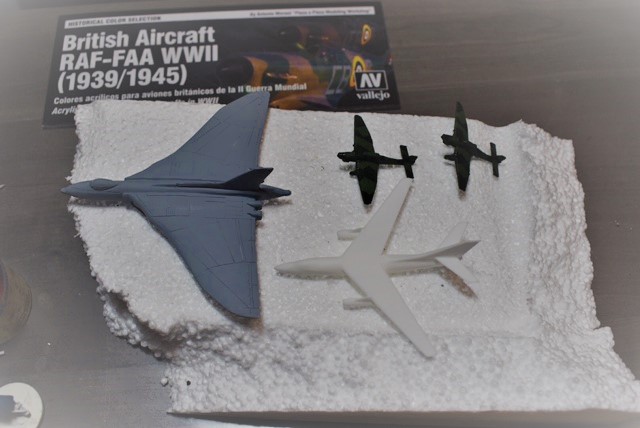
Examples, you ask?  Well how about this one.  An Avro Vulcan.  As the Falklands War broke out these behemoths were just on the verge of retirement from the RAF.  But several of the planes made the “Blackbuck” cross-ocean raids on Argentine airfields in the Falklands. I ordered the MSD Vulcan, a mere twenty bucks and costing extra postage because it’s so huge.  Note: an average plane costs between three and six dollars. This is big. I also ordered a S-2 Tracker, the ex-U.S. anti sub planes the Argentines used as AEW aircraft in the war.  I think there is a scenario in that.  The Brits didn’t have an AEW capability which contributed to the siege their ships endured during the war.

Vulcan

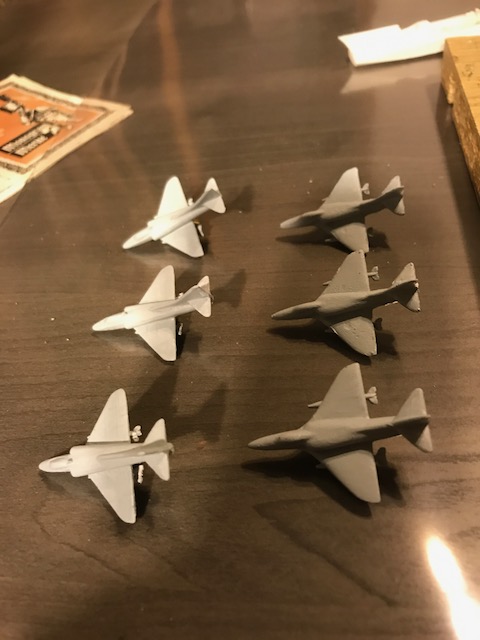
The gray painted Avro Vulcan by MSD miniatures is just really big. A pair of Raiden Stukas are behind the big jet bomber. The white plane behind is a Douglas A-3 Skywarrior in resin by Shapeways. No shrimp.

I’ve also painted some helicopters for both sides and have even more and might even pick up a few I don’t have.

While the Falklands were fun, the big question is what next?  I’ve kind of settled on some projects to work on between November and Enfilade in May.

First up is the for sure air project Dave Schueler and I are working on for the convention–the air attack on the Illustrious in January 1941.  I’ve already completed six Fairey Fulmars for the carrier’s air defenses, and now I am beginning work on the dozen Stukas I’ll be painting.  Well, ten for sure, I also have a pair of C in C Stukas, but they come in many tiny pieces, so I may not get far with them. Illustrious is just a stepping stone into a pile of planes for Mediterranean, and I’m looking forward to painting them.  American Kittyhawks, Spitfires, Hurricane II’s, a host of Italian and German planes.  It will be fun.

Stuka 1 (2)

Raiden Stukas in splinter camouflage for the 1941 air attack on the Illustrious.

Also on my to-do list is to take a long look at David Manley’s wonderful adaptation of the idea behind Thunderboats to a bit more of a Mad Max theme. You can read more about it here. I have managed to acquire the Matchbox boats that will make up the little flotilla for this game.  But I haven’t done anything with the boats yet.  They’ll need some modifications and dirtying up and basing, but I’m not likely to get started until January.  Want to keep the Mediterranean and my other big project firmly in view until then.

That other big project is simply a continuation of my old project America Rampant.  I have a whole bunch of unpainted figures for that, primarily American infantry (Old Glory Wayne’s Legion figures) and Indians from the Old Glory French and Indian Wars range.  How many?  I think enough to paint five units of Americans and at least seven more Indian units.

new jersey

Old Glory Wayne’s Legion infantry that will become the first of four companies of New Jersey 6-month levies. St. Clair’s army was dependent on 6-month enlistees from New Jersey, Pennsylvania, and Maryland.

I recently finished reading William Hoageland’s Autumn of the Black Snake.  Interesting read on the aftermath of the Battle of the Wasbash and forces leading to the Peace of Greenville. It made me look at some of my other books on the Indian War in the Northwest Territory and got under my skin.  I’d really like to shoot to game The Wabash and Fallen Timbers.  I’ll need some more figures to do it at a unit = 50 figures, but there’s no point investing in more when I still have plenty to paint.

Gaming the Wabash would present numerous problems.  It’s huge for TMWWBK.  Terrain is interesting, with lots of it, and the goal for the Americans would have to be simply survive and retreat off the board if possible. But in a game in which the outnumbered Indians (about 1,400 to about 2,000 U.S. troops) have the clear upper hand, it should make for an interesting team game. More later.  I highly recommend John Winkler’s Osprey account, Wabash for a pretty straightforward account of the battle and an order of battle.  I’m busy working on troops that will be one of the four levy companies from New Jersey.

Music to paint by

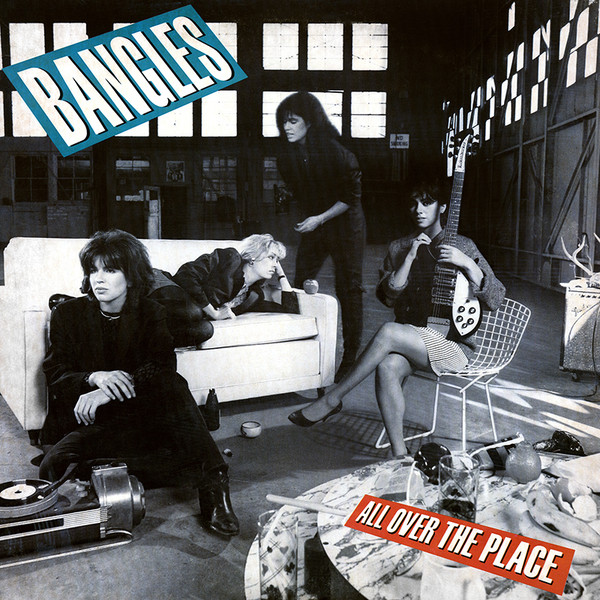
Bangles all over the place

It’s been a while since I’ve included a little music info.  I think I’ve noted that the eighties music scene kind of passed me by.  But one band I really enjoyed, even thought their shelf life was short, was The Bangles.  The all-girl-group grew out of the folk and punk scene of LA, and became a staple of MTV in the mid-80’s with songs like “Walk Like an Egyptian” and “Eternal Flame.”

But the Bangles were more than their hits.  A listen to their first record All Over the Place gives you an idea of what the band was before their label made Susannah Hoffs leader of the band and set in motion the tensions that would destroy the Bangles after only three albums.

All Over the Place is a record rooted in mid-1960’s pop.  Lots of jangly guitars by Vicki Peterson and Hoffs.  Songwriting and vocal chores are shared among different members of the band. There are plenty of good songs, even if it lacks the hits that will follow on Different Light. “Hero Takes a Fall” and “Live” on side one are particularly good. “Restless” and “He’s Got a Secret” are strong on the B-side.

The record features strong guitar interplay, great lead vocals, and fine supporting harmonies.  It’s fun to listen to, and if it isn’t breathtakingly heavy All Over the Place has a fine pop sensibility, the feature of all great artists from Duke Ellington and Frank Sinatra to the Beatles and REM.


Museum of Flight 2017

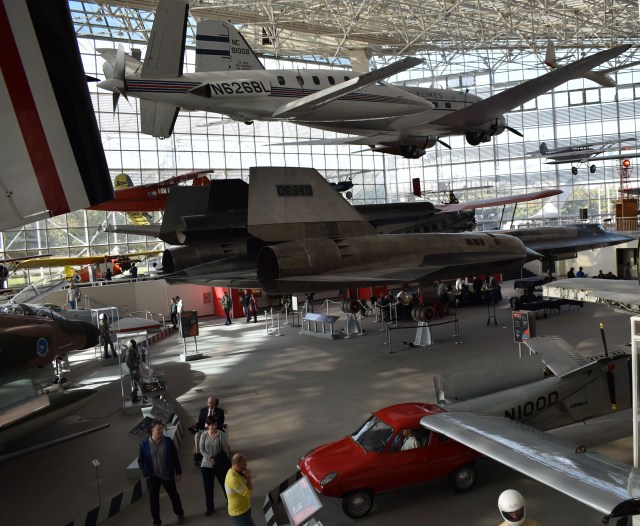
Great Gallery

View out on to the Great Gallery. SR-71 is dead ahead

Sunday marked our 15th year at the Museum of Flight. We hosted seven games and about 35 gamers in what I believe is the best venue anywhere.  I know guys in Houston have gamed on the USS Texas, and that sound cool, and I’m sure there are other great places to game, but this isn’t a one-off, it’s our annual gig, and there simply isn’t anything better than hanging out under the SR-71 on a fall sunny day under the glass roof.

We game under the SR-71. It’s the best game space ever for a small gig like ours.  Not a one-off.  This is where we are EVERY year. 

We divide our time into two game sessions. The morning session featured three great games.  They included Rorke’s Drift in 28mm, hosted by Lawrence Bateman and Damond Crump.  Looked good and the players seemed to have a good time.  The Zulus had successfully overrun the hospital and inflicted a fistful of casualties by the time the session ended.

The second game featured All Quiet on the Martian Front hosted by Dale Mickel.  I was drawn to the massive landship in the game. Very cool stuff.  I think the Martians took it in the shorts in this H.G. Wells inspired game.

The Napoleonic sail game was played across both periods and was hosted by Jeroen Koopman. It was great to see Jeroen-it had been many years. Gorgeous, fully rigged 1/700 miniatures by Triton.  Spectacular.

There were also four games in the afternoon.  Unfortunately, my camera ran out of battery life as I was getting ready to take pictures. Sven Lugar ran an old-fashioned Fletcher Pratt naval game on the 12’ X 5’ table.  It was fun to see the golf tees out marking shell splashes as the players guessed ranges. Scott Murphy ran a Star Wars Armada game with lots of players.  Everyone seemed to enjoy themselves.

Dave Schueler and I ran our Falklands game.  Dave developed a great system that required the Argentines compose their attack force of specific plane types, while the British decided how they would dispose of their defenses. There were some off-board issues to resolve, and the Argentines had the worst of luck, losing four of their nine raiders before even getting to the board. To complicate matters, they targeted the amphibious assault ship HMS Fearless, which was the farthest target to reach and left them open to attacks from Harrier defenders. The surviving A-4’s and Mirages that made it on to the table were under constant attack by Sidewinders and cannon fire, but two made it to the Fearless, only to have one stick of bombs end up as duds, and one lose control of their external system just as they were in bombing range.  Not a good day to take back the Malvinas.

We’ve moved the museum day to Sunday.  The Museum of Flight hosts a lot of Saturday evening fundraising activities.  We get to game for free. So if there is a time conflict, we end up low on the priority scale. We’d have to leave by 3:00 to play Saturdays, so we’ve moved to Sunday which allows us to stay until 5:00. Not optimal, but I’ll take what I can get.

To all my friends on The Miniatures Page who insisted the Etrich Taube was the prettiest plane of WWI, we’re willing to share views of our reproduction with you.  But you have to come to Seattle. 

I’ve included shots of the three morning games as well as some additional snaps of what one can see in the Great Gallery.  It’s a small fraction of what’s available to view in the Museum. The Museum of Flight is sponsored by what used to be our hometown manufacturer, Boeing, so lots of Boeing products on display.

From upper left–Army version of Boeing F-4B fighter; Reproduction of deadly Gee Bee Z racer, used in the movie “Rocketman’; Reproduction of Boeing Model 40B in U.S. Mail service; XF8U-1 prototype Crusader, last of the gunfighters (now how cool is that?); Boeing 80A-1 in Wien Alaska Air colors, a beautiful biplane tri-motor; reproduction of Stinson Model 0; Chinese manufactured MiG 15  (Shenyang J-5.)

The Big Falklands Finish and Beyond

The Falklands project is done, sort of, kinda.  By that, I mean all the British and Argentine warplanes are done.  I have some more goodies to paint.  I’d like to add helicopters to both sides because they were quite important to the land campaign and who knows how we can add them to some future game.

But the game Dave Schueler and I will be hosting at the Museum of flight in ten days.  I’m glad to have them done.  Altogether it is ten British Harriers, and 35 various Argentine warplanes, so 45 planes in all.

I’ve shown off the Argie Skyhawks, and these are the six Mirage Daggers.  These were purchased from Israel, and are the dumbed down version of the Neshers–modified Mirages Israel parted with in the late 70’s.  These are Raiden Mirage V’s that were fun to paint.  They have three color camouflage using Vallejo German Camo beige as the base color, Vallejo Military Green for the dark green color, and Vallejo U.S. Army Olive Green for the lighter green.  The yellow identification bands are Vallejo Deep Yellow and provide some distinctive markings.  The underside is Vallejo Light Sea Gray, that has a slightly blue cast.

I also re-did a few of the Dave Smith planes.  I added his stack of Sea Harriers to the six Raiden planes I have, and painted the lone Gr.3 Harrier in Falklands colors. I also repainted the Pucara light attack planes in more Falklandsish colors.  That gives me seven.  I also, on a lark, painted one in the red and white colors of a test torpedo bombing variant.  Because, let’s face it, who needs eight turbo-prop attack planes in war colors.

From top left–Single Mirage Dagger by Raiden miniatures.  Two Daggers, just for twice the fun.  Sea Harriers by Heroics and ROS (I suspect,) and four Pucaras in four different schemes.  The red and white Pucara (markings are much more distinguishable from below,) was the test plane for delivering a torpedo. 

So I’ve included pictures.  They’re taken with my new camera.  I bought a Nikon D5600 DSLR.  It’s the camera my yearbook students use, and I want to be able to help them, so I’m trying to become a better photographer. This is the whole ball of wax.

So, what next?  I’m not positive.  I have some mounted archers I began working on in August I’d like to finish.  And when they are done I have a bunch more to do. I’ve also been seduced by the four or so units of American Revolution that are lying unpainted in my drawers.  Needless to say, plenty to keep me busy.  I think I’ll just paint whatever I feel like.

On the subject  of seduction, however, every now and then a figure range becomes available that just grabs me.  I know this isn’t unique to yours truly.  Every now and then an announcement flutters across the boards for The Miniatures Page announcing new releases for 1898 Miniaturas, a miniatures company in Spain.  They have a beautiful and growing collection of figures for the Spanish American War and Philippine Insurrection.

To be truthful, I’m more interested in the war in the Philippines than Cuba, but in my broader application of “periods” I would be interested in having figures for both, plus the invasion of Puerto Rico and the capture of Guam.

I’m also thinking this is an out-of-of the book game of The Men Who Would Be King, with lots of different scenario possibilities:

  • Spanish vs. Cuban rebels
  • Spanish vs. Con rebels
  • Spanish vs. Americans (Cuba, the Philippines, Puerto Rico, Guam)
  • Americans vs. Filipino regulars
  • Americans vs. Filipino guerrillas
  • Americans vs. Moros (don’t think this would make a good game and nobody makes figures . . . yet.)

The 1898 Miniaturas collection continues to grow, but does lack artillery and other required bits.  Tiger Miniatures in Great Britain also does figures for the period. They don’t look as nice, but do offer artillery, machine guns, mule trains and some cool looking Filipino Scouts and Constabulary. Old Glory also offers a range including Moros. Lots of different figures to go around, but the draw was the quality of the figures from the Spanish company.

As the list above shows, there is plenty of painting for years of work.  I know the basics of the war in Cuba, but not much else.  I’m waiting to start buying figures until after do some serious reading on the Philippines, and hopefully at least until my Enfilade deadline.

Museum of Flight next weekend and a report to follow.


A moment of introspection, and moving on

August was a tough month.  My house was not my home. The contractors controlled two thirds of the house until September 4th, the day before school started.  The only thing I could do was take care of my shrill, wailing dogs who wanted no part of strange men tramping through their territory.

No games, no painting.  I read a lot, and it’s tough to fuss about that.  Forced to move everything out of my den in order to re-carpet, I made some good use of my dislocation.  Before I moved all my gear back to its home, I examined each and every bit of unpainted stuff, as well as some painted projects.  I put together about a quarter moving box of goodies I could part with and sold cheap at Fix Bayonets.

Hundreds of 28mm ACW figures, many unpainted AWI figs, countless (well, I’m sure not going to count them) unpainted HYW figures all said paint me.  Thoughts of another project-the Sudan, Hawkmoon, other notions were gone.  The fact of the matter is, there are lots of things I’d still like to paint.  Perhaps my American Rampant rules can encourage me to do just that.

Left: Tom Bieker and Joe Grossman, right prepare to assault the Chickasaw and Spanish run by Scott Murphy, Scott Williams and Jessica Grossman. Joe’s Americans mauled Scott’s troops in the woods and cornfield before turning on the the Chickasaw right flank to win the game. Bill Vanderpool, background left, was a huge help in running the game.

In speaking of America Rampant, I ran a game at Fix Bayonets last Saturday.  It was fun.  Same scenario I ran in July, but I replaced the Spanish mounted infantry with regulars and added more Indians to the mix.  The Chickasaw got off to a booming start, surprising the Americans in near the woods, but decent American die rolls and lousy Indian die rolls stalled out their advance. The Yankees rubbed out Indian forces on the left and rapidly moved to the right, leaving behind troops to begin the destruction of the Chickasaw village. Fun.  Learned some stuff about rules mechanics.

And David Sullivan had this brilliant suggestion about a version for the Civil War.  I loved the idea.  Lots of unpainted figures, looking for a project.  It’s a truly great idea.

With the contractors gone, I’ve been back at the painting table.  Between sharing the Mariners miseries and Ken Burns The Vietnam War, I’ve been able to get stuff done.  I finished the six Fulmars, the Argentine naval Skyhawks, and a half dozen Sea Harriers. on the table right now are some Argentine Air Force A-4’s

From upper left-Argentine Air Force A-4’s in the sand and brown and green and off-white scheme.  Fleet Air Arm Fulmars in traditional Sky Type S, grey and green. Argentine naval A-4’s with handpainted Armada, and anchor naval ensign replacing national markings. British Sea Harriers with the much-too-large national roundels on the fuselage. Daggers awaiting paint–hopefully this weekend. 

The Air Force version of the little attack planes that inflicted so much damage on the British fleet, are a interesting looking.  There are several paint schemes they appeared in, and I decided to split my half-dozen between two of them.  Three are in the sand and brown paint scheme.  Three are in the off-white and green camouflage.  Both have the turquoise identification flashes to go with the national markings. I’ve now painted about 18 of the Raiden A-4E’s and they are thoroughly enjoyable to work on.  Great stuff.

My completed Falklands forces continue to grow.  The Argie Air Force planes will get me to 12 A-4’s.  I also have six Mirage Daggers to work on.  Then I’ll add some odds and end. I have four more Harrier and four Pucaras to add as reinforcement.  I will also add a few helicopters, which played a big role in the campaign and saw significant action. Sea Kings, Lynx, and a couple of Chinooks. All in all, about 45 aircraft.  Dave Schueler is dusting off his ship models.  We hope to run something at the Museum of Flight in October.

When the Falklands project is finished, I’m going to remount the Aztecs and Spanish.  It’s a big project and I’m hoping I can be done by the end of October.  I’ll paint some too.  Probably a few planes.  I’ve got some Blackburn Skuas I want to paint, along with some F-101 Voodoos, the big Cold War interceptors.  Armed with Genie nuclear missiles, they were intended to destroy Soviet bomber formations.  Don’t quite know what I’ll do with them, but I feel the same need I have for Howlin’ Wolf records.

Smyth Aircraft is open for business

I finally got my den into production line efficiency.  Assembled my desk.  New chair. Cut some spare carpeting to put beneath my desk to catch metal shavings and other dross that will inevitably fall off said desk.  Hooked up my stereo and organized all my records. Even added a handy holder for all my TV remotes (four!!)  All that’s left is to put my artwork up, and I’m probably a couple of weeks away from having that done.

It’s cozy.  Small space and there is lots of stuff in the room.  But it all has a place.  I added a mid-century media center which houses about 200 records (bands and performers C through Hi.) That leaves me more room for expansion, but that’s definitely the end. Maybe another 150 or so.

Saturday (two days ago) I sat down and enjoyed painting through two and half records: Terry Reid’s 1969 self-titled album; Time and Word, by Yes from 1970, and 90125 by Yes from 1983 for a little contrast.  It was simply wonderful.

Last night (Sunday) it was an hour and a half of The Tick on Amazon.  Life was good.

So what am I working on?  It’s planes, silly.   In my previous post I alluded to the Dave Smith bounty of airplanes. This coming on the heels of the George Kettler bounty of airplanes. Dave is a great guy from North Vancouver, home of some of my very favorite people. He decided to part with his considerable collection of 1/300 scale planes, and I bought them.  Over 750 planes in all, from every nation and period you can imagine. Let’s just say I spent hours, including a couple of hours over beer with Dave Schueler trying to figure out what they were. There is a lot of the common, the unusual, the strange and the wonderful.  I’m happy for all of it.

So what am I doing?  I have air projects I’ll be giving time to.  The first, and probably most important is trying to catch up to that Falklands project I started. Though I’ve finished a baker’s dozen planes for the 1983 conflict between Argentina and Great Britain, probably none of them would be involved in a game. The Argentine Canberras weren’t much involved in attacking the British ships.  The Exocet-toting Super Etendards that sank HMS Sheffied and the Atlantic Conveyor weren’t involved in combat.  The turbo-prop Pucaras did see action, but it was ugly.  Nope, what I need to paint are Daggers and Skyhawks.

planes 1

Six Argentine A-4Q’s in Vallejo Lt. Ghost Gray.  Detailing is up next.  Hope to have them done this week. Planes are a mix of Raiden A-4E’s and something else. It’s not important, they’re all on the same team. 

I have six A-4Q’s on my painting table that have received their coats of Ghost Gray paint, but await detailing as Argentine naval attack bombers.  Together with the six Argentine Air Force Skyhawks I’ll paint, they did most of the heavy lifting in the Falklands war. Frankly, they accomplished a lot considering the technology and British pilot skill deployed against them. There are Harriers to paint and whatever other odds and ends I can pull in-some helicopters, maybe a Vulcan

planes 2

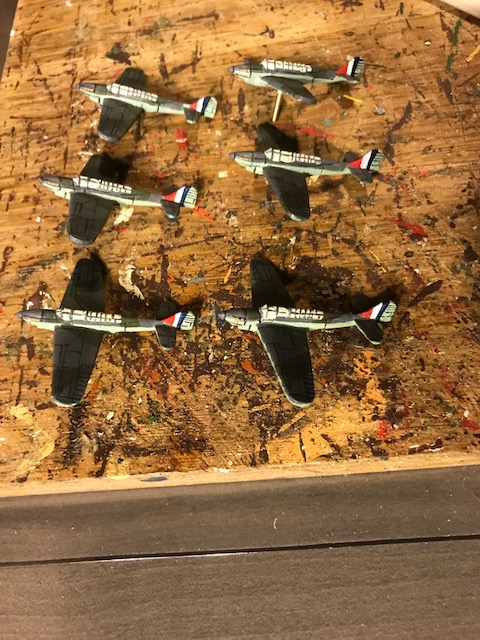
Raiden Fairey Fullmars with Fleet Air Arm Markings over Sky Type S.  Illustrious Fullmars didn’t have the typical British tail flash, but instead painted most of the rudder in the British tricolor. 

In addition to that, I’ll begin working on a World War II Mediterranean project.  Got lots of planes for this from Dave Smith, but I have a lot more of my own to paint too. First out of the gate are some Fairey Fulmars, the two seat reconnaissance shipboard fighters the Fleet Air Arm flew 1940-41. They’re big and slow eight-gun fighters that couldn’t tangle with other fighters, but unmolested could be quite nasty against unescorted bombers as happened in the German assault on the HMS Illustrious in January 1941.  Game?  Just sayin’. The Raiden Fullmar is very nice, very detailed with lots of scribing.  Found the long twin canopy to perhaps be a bit overdone and difficult to paint. All in all quite pleased.

Lots to get done, and I’m having a good time doing it.

Den Upgrades and a Reappraisal of Pile of Lead.

Home renovations.  I’m sure you’ve had them.  Maybe you are somebody with considerable DIY skills.  I don’t.  I’m a pretty good, pretty fast painter-that’s about it for me.

Lorri and I had a long conversation in the spring-move or remodel.  She has a wretched commute that shaves about three hours off her life per day.  Moving even a little closer to Renton would give her back some of that time.  But with the housing market continuing to blaze like Mount Vesuvius, we didn’t feel it was possible to get out of the house we’ve lived in for 27 years, and get something more desirable without losing our shirts.  With retirement not far away, we decided a remodel was a more viable solution.

So, we made our plans.  Unfortunately, due to delays in our re-fi, we didn’t get started until mid-summer.  Combined with working J-camp and a lovely trip to Astoria, here we are.  Our bedroom and bath are unusable. I’ve had to move everything out of my den and Lorri’s sewing room–which is like almost all the STUFF in the house.  And there is no place to paint anything. Sad, because I have little to do but comfort my poor dogs who are driven crazy by the loud noises and strangers working in their house.

Oh, well. Going on three weeks without any meaningful painting time, and that kind of drives me crazy.

There are lots of things I want to work on.  I’ve blocked out two aircraft projects I want to do.  There is the Falklands stuff I started on and would like to have finished for Museum of Flight day on October 22nd. And then I’d like to paint my sizable collection of Mediterranean planes to combine with the Dave Smith bounty, about which I have not yet written.  Soon. Daveshoe and I are talking about the air attack on the HMS Illustrious in January 1941 for Enfilade.

The new den is almost ready for painting.  The records are now all stashed away, the desk is complete–all that’s missing is a selected brush and some water to clean them in.  Those are some Galactic Knight fighters awaiting paint.  Some planes out of view to the left and a hydroplane. 

Lorri granted me the opportunity to make major changes in my den. As I said, everything came out of the den because new carpets were being laid.  That meant all my unpainted figures, a thousand vinyl records, my stereo system, book case, a media stand television and various ephemera-lots of ephemera.  I peeled the 15-year old wallpaper from the one wall it had the misfortune to be located.  I painted the room a stately, but warm gray.  I took down my various military prints, soon to be replaced by a variety music photos—Patty Smith poster, Temple of the Dog, my framed copy of an original Love Me Do 45, Pearl Jam jumping about the stage in ’92, and an original drawing of John Lennon.

But the coolest improvement, without question is the hobby desk Lorri let me order for my room.  It is was a couple of hours worth of construction, but gives me more space than the simple 48” X 30” Costco folding table.  It also has plenty of room for storage, including my SpinClean record washer and all of the bits that go with it.

But, before I moved all my stuff back into the closet in my den, I went through every drawer of my IKEA Antonio-twelve in all-where I keep a lot of my stuff. I made some tough decisions about unpainted bits I’ll be parting with.  It will almost certainly be followed by more choices regarding painted items.  Not like the world will be falling in, but many of my DBA armies will be offered up and priced to sell.  I haven’t played in likely five years, and with the 2.2 vs. 3.0 schism I’m willing to let some go. I have thirty painted armies, I’m okay with it.

But looking past that, as I moved my piles of unpainted figures out on the deck, I need new projects like a hole in the head.  I really do intend to paint every figure I own. There are hundreds of unpainted HYW figures, ACW figures, AWI figures, even some additional troops for the War of 1812.  I set myself a goal of starting on the Sudan next summer, but perhaps that should be delayed even further, or indefinitely.  I have no shortage of figures to paint, projects to complete and, what’s more, desire to complete them.  So I think I’ll hold off for now.

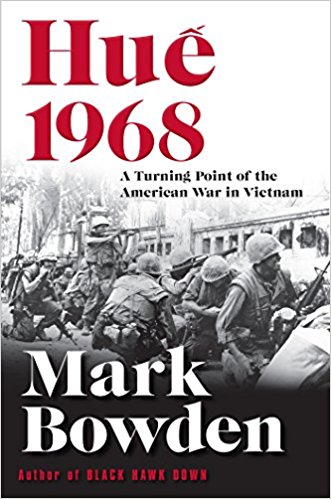
Hue 1968: The Turning Point of the American War in Vietnam

Hue 1968

I’ve read a number of books about the Vietnam War, being relatively of that era. The usual suspects-Halberstam, Sheehan, Karnow, McMaster, even read Daniel Ellsburg’s book Secrets about his decision to release the Pentagon Papers. Mostly they are an analysis of the decision to enter the war, the logical gymnastics the Kennedy and Johnson administrations engaged in as they made the decisions to enmesh the country deeper and deeper into commitments to support the government of South Vietnam.

But for the most part, I’ve avoided the military histories of the war, whether they were devoted to specific battles or combat units.  I wanted to avoid glorifying the sacrifices that were made by the men who fought there in a war waged for goals that were unrealistic and guided by plans that were fantastic and delusional.

This spring, however, I decided to read Mark Bowden’s book on the Battle of Hue when it became available. Bowden is a journalist, writing for The Atlantic Monthly and Vanity Fair magazines. He also wrote the bestseller Blackhawk Down, so he knows his way around military history.  Though I haven’t read that book, the response to Hue was so strong, I bought a copy for my friend for his birthday and downloaded an electronic copy for myself.

I can say unequivocally Hue 1968, is one of the best books I’ve ever read. Bowden has done a superb job with his research and the storytelling that he leaves the reader with an inescapable conclusion: the war was a mistake, fought under erroneous conclusions drawn from incorrect data. It left the lives of many-Americans, supporters of the Hanoi and Saigon regimes, as well as civilians just trying to survive the turmoil of the war, shattered by death, severe injury the loss of loved ones and friends. What’s more, Bowden does his best to offer the perspective of all the combatants and civilians, not just American servicemen.

Bowden begins by sharing the delusions of the American commander, William Westoreland.  Asserting the American war effort is succeeding, and that victory over the Viet Cong and NVA forces is not far away, Westmoreland prepares for an assault on the Marine outpost at Khe Sanh as 1967 was ending and the new year was approaching.  All of Westmoreland’s preparations came with requests for more troops.

While Westmoreland was worried about the Marines in the western highlands, the planners in Hanoi were planning a far more ambitious campaign. To coincide with the Tet New Year, the Viet Cong, together with elements of the North Vietnamese army attacked every large city in the south, including every provincial capital, Saigon, and the old capital of Hue. The goal was to demonstrate the ability of the Communist forces to coordinate widespread attacks and encourage a popular uprising to support unification with the North and reject the corruption and dependence of the South Vietnamese on American support for survival.

On January 30th, the first night of Tet, attacks went off as plan.  The attack on the U.S. embassy made the T.V news.  Cities and towns across the South were captured.  But within a few days the Viet Cong and their regular army allies were driven off with losses.  There was no rising.  And Westmoreland, telling the press he knew about Tet all along, hunkered down waited for the expected Dien Bien Phu-like assault at Khe Sanh and the rest of the country went quiet.

Except at Hue, the old colonial capital, built largely in stone by the French colonizers in the early 19th century. Stone buildings laid out in blocks south of a large, menacing citadel across the Huong River. On the first night of Tet, nearly 20,000 troops were engaged in the capture of the city, defended by a small garrison of South Vietnamese, depleted by troops on holiday leave, and a Military Assistance Command Vietnam (MACV) compound just south of the city occupied by some U.S. Marines and an assembly of support troops.

Bowden’s story is about Major Truong’s effort to hang on to his toehold in the citadel with his depleted ARVN forces, and the American struggle to hang on in the MACV compound.  They had to fight off their enemies, as well as the belief by their superiors they were fighting a few hundred, and maybe as many as a few thousand Viet Cong. They also had to fight with their hands tied as high command refused to allow the defenders to use heavy weapons in the city because of the historical value of the buildings.

But somehow they did survive the NVA assaults, took the offensive themselves and captured the city block by block, suffering tremendous casualties. The city’s stout structures, well-defended by veteran, tenacious regulars, Viet Cong and even local militia, were virtually destroyed. Those civilians unable to flee at the outset of the Communist occupation were caught in a killing zone, usually without food or water, and no easy way out of their desperate circumstancers.

Bowden’s research, combining what was available in print, together with interviews from participants on both sides as well as civilians make this captivating reading.  It’s a great combination of telling the story using official and journalistic sources, as well as the anecdotal accounts that give the story real meaning . It’s a balancing act and Bowden does it masterfully.

The book concludes with an analysis of Hue and its it central role in the failure of the American mission to settle the status of South Vietnam as a independent nation without the need of U.S. support. More important it examines the impact of Hue from the standpoint of the media and it’s retreat from support for the war to the belief that the war could not be won on the battlefield.  Finally, Bowden gives attention to the battle’s influence on Lyndon Johnson’s presidency, the removal of Westmoreland, and LBJ’s decision not to seek re-election in 1968.

Hue 1968: The Turning Point of the American War in Vietnam is a must read for those who hope to understand that war, or want to gain additional perspective on the long American commitment to the Middle East and Afghanistan.  Questions like “Why are we there,” or “How do we win,” and “When are we done,” should have been asked loudly and forcefully during that earlier Asian conflict, and we shouldn’t hesitate to ask them now.


Wargamer Collection Catalog

I was poking through The Miniatures Page this morning, still smoking that Bill Armintrout went on vacation and left those of us who weren’t supporting members mute, when I ran across an interesting post. One of those privileged enough to speak posted about a website that allows visitors to catalogue their miniature collections

With contractors in my house, and my three Aussies objecting to spending the entire day in my den remounting figures, I decided to give it a try.

You can link to Wargame Collection Catalog and set up pretty easily.  You’ll need to create an account and login. Doubtless, you’ll wonder “why should I create another account and login?”  Well, silly, you need to be able to find and complete your collection, right?

Once that’s done, you can take your collection, project by project, and enter it unit by unit.  Yes, it’s tedious, but if you have some time to kill and want to get it done, go for it.

One real practical purpose for this is the valuation the site offers. There is a raw lead value, and a painted value.  It doesn’t really discriminate between really spendy figures and cheaper (Old Glory vs. Foundry, for example) but it does give you something to work with if you want to properly insure your miniatures.

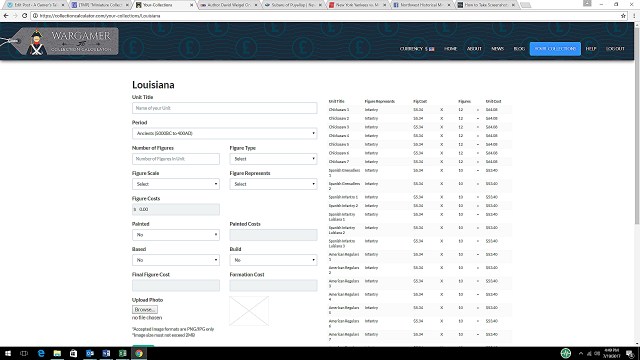
Since it is topical, I’m starting with my Louisiana project.  It’s super easy.  Identify a unit, number of figures, metal or plastic, 28mm, painted, based, plug in a picture if you have one, and voila. Add your entry.

I printed my screen, just so you get the idea.  It looks like this.

Screenshot (1) It’s pretty slick, and allows you to create a pdf to supply to your homeowners carrier. No question it will take me a long time to complete an inventory of my collection, which takes time away from important things like rebasing and painting.  But, overall, not a bad thing. It will also tell me how many painting figures I actually have, which may drive me insane.  But I have an online-catalog of my records, I think my painted figgies are worth it.

American Rampant Again

Gathered with friends for a Truant Friday playtest of America Rampant.  Four of my buddies plus myself gathered at Game Matrix for a game.  This time it was American regulars and militia against a force of Chickasaw Indians supported by some Spanish mounted infantry.

I was really excited about seeing everyone: Mark, Al, Gene and Scott.  It’s been a while since we gamed together.  In fact, it was so exciting to get together, torture one another and push some lead around, that I completely forgot to take pictures.  So I’ll keep it short.

Let’s just say the Americans were out to have the last word in the typical cycle of violence that wove American expansion with native responses to that aggression.  This punitive expedition targeted Chickasaw food supplies and dwellings, while the Spanish were determined to make things bloody for the their dangerous neighbors.

The Americans had four units of regular infantry, supported by a couple of the small King’s howitzers they used on the frontier until the War of 1812.  They were supported by four units of militia, including two units of mounted rifles.

The regulars pretty much had their way with the Chickasaw units facing them.  The Indians tried to pop out of some woods to attack the regulars, but when their double-quick activation failed, they had to show themselves and take a lot of fire. One of the units, rated fierce, actually did make their charge, destroying one regular unit, and badly mauling another, before it was eliminated by fire.

The militia fared less well.  It’s leadership factors were lower, and had a harder time doing much, complicated by Gene’s relatively terrible die rolling. The Spanish mounted infantry chipped away at the four units.  While the riflemen did inflict damage on Spanish, they would likely be kept out of the Chickasaw town.

The game ended with the Americans, bloodied, but unbeaten, advancing on the Chickasaw town, and the natives unlikely to be able to stop them.  I really enjoyed the rules.  Learned a lot more about terminology and the quick way to figure out the differences between pinning and rallying. Very clean, very quick.  I’m anxious to try them again.

But first I need to keep remounting figures.  My goal is to have the entire project remounted by the time I leave for WJEA summer camp on the 26th.  It’s all complicated by the fact that we are also doing some serious home renovations.

big remount

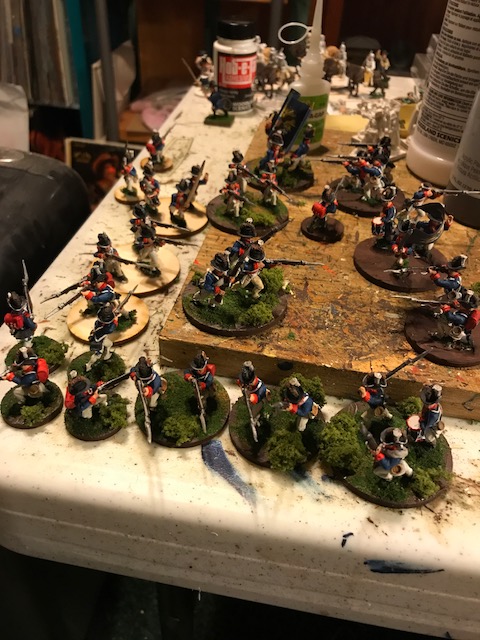
The last of the Americans requiring remount. So far I’ve remounted 25 units totaling some 264 figure.

Even so, I’m usually able to put some hours into the project every day.  It’s time consuming and tedious, but the routines are simple:  pry the old figures off their bases; glue them to new bases and wait to dry; apply modeling paste and wait to dry; paint bases burnt umber and dry brush with Trail Tan; apply flocking and spray with Dullcoat; add some clump foliage and touch up shiny spaces; add magnets.  I can usually get a couple units per day done, sometimes more.
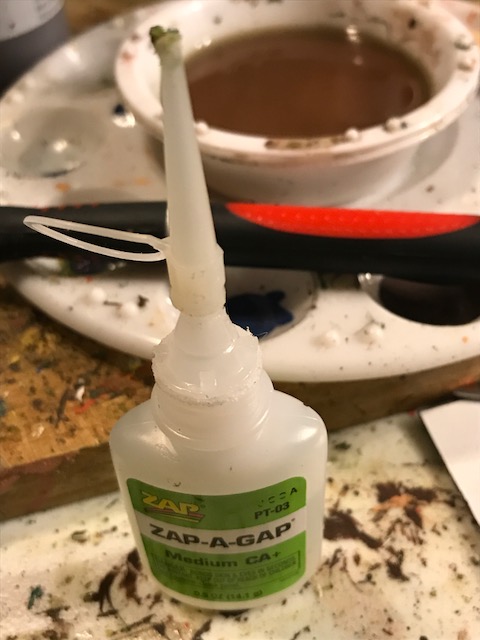
Sounds easy, and it is.  But it does have some inherent hazards. The first part, prying old figures off their bases means using a very sharp X-Acto blade. For the most part the figures have come off without a major struggle. To this point.  I’m not talking 30 or 40 figures here.  The number is over 250. But Saturday and then again Monday the knife slipped and trashed my left palm and thumb.  Blood, a mad dash to stop the bleeding. The solution? The hand bottle of Zap glue on my painting table.
first aid

This is my new first aid kit, with the offending puncture provider in the background.

The good news is the Americans are all safely remounted, leaving only the Spanish to be remounted. But, I’ll be letting my sore thumb heal a few days before taking them on.