Dang, paintin’ these planes is harder than I remember

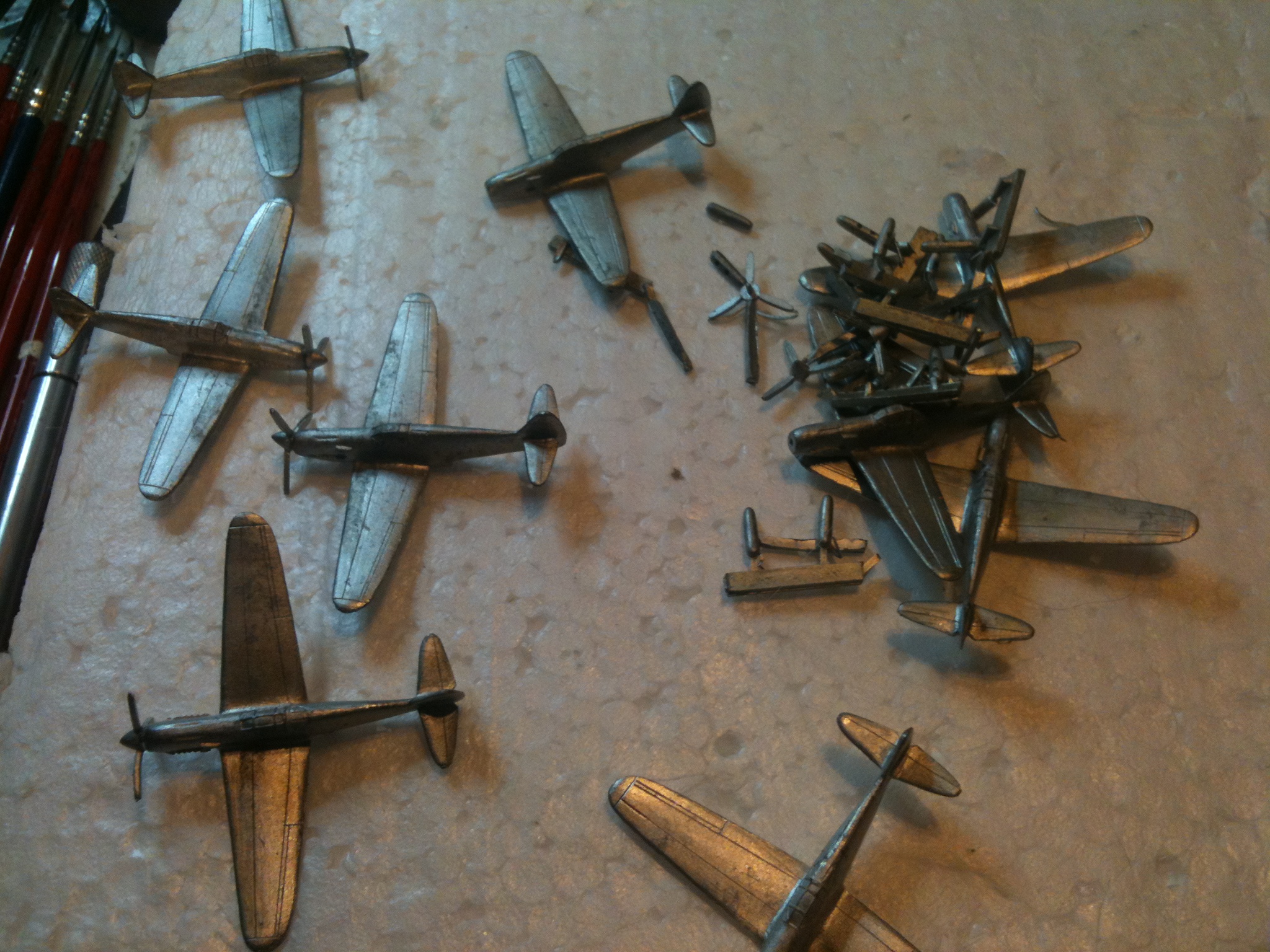
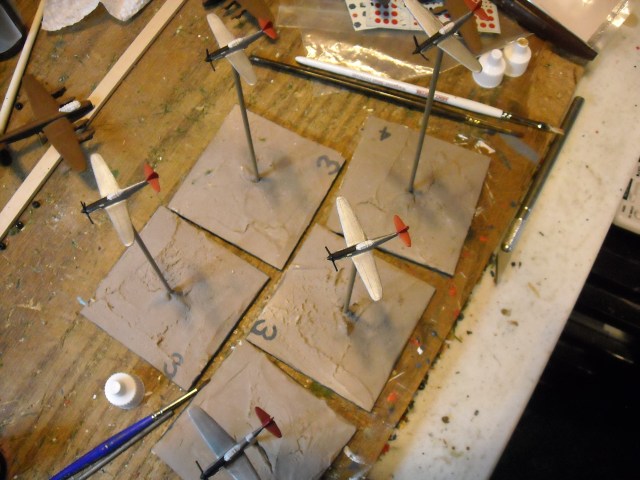
A look at the first group of five Tonys.  They're natural metal with red tails.  They'll also have white boxes for their red hinomorus on wings and fuselage

A look at the first group of five Tonys. They’re natural metal with red tails. They’ll also have white boxes for their red hinomorus on wings and fuselage

Well, I’m back on the painting trail. Last week was an exhausting melange of school related activities that kept me at work for 15 hours a day most of the week.  Thus I didn’t have the time or energy for much work.

On my painting table are five Avro Lancaster bombers and nine Kawasaki Ki-61 (Tony) fighters.   I probably have about 150 1/300 scale planes painted.  Lots are modern aircraft, but many are WWII planes as well.  I don’t remember them being quite so challenging as these guys seem to be.  Maybe I’m just getting old.

The Lancasters pose two major obstacles.  The first is that they’re just big.  With their five inch wingspan and similar fuselage length, there’s just a lot of coverage that has to happen.  The second and actually more challenging problem is their color scheme.  Though they have a fairly simple earth and green camouflage, the rest of the plane is simply painted black.  But that means a straight black line must be painted down the entire fuselage.  Straight. line. Along the way, one must avoid the wing and stabilizer and line things up properly for a straight . . . line. I don’t think I can even see straight at my age.
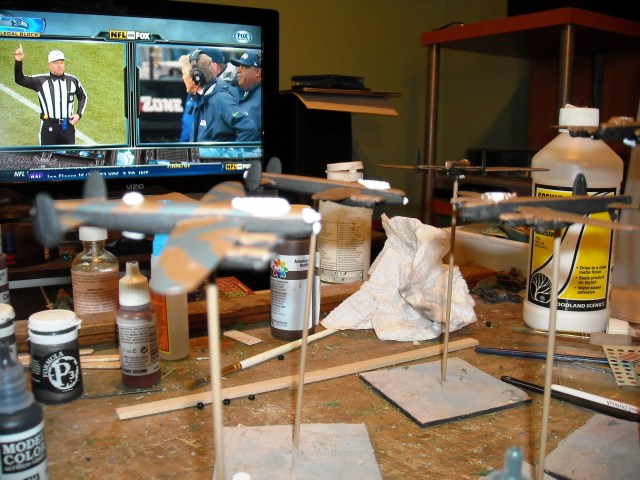
A not particularly clear side view of the Lancasters.  They do show the horizontal black line down the fuselage.

A not particularly clear side view of the Lancasters. They do show the horizontal black line down the fuselage.
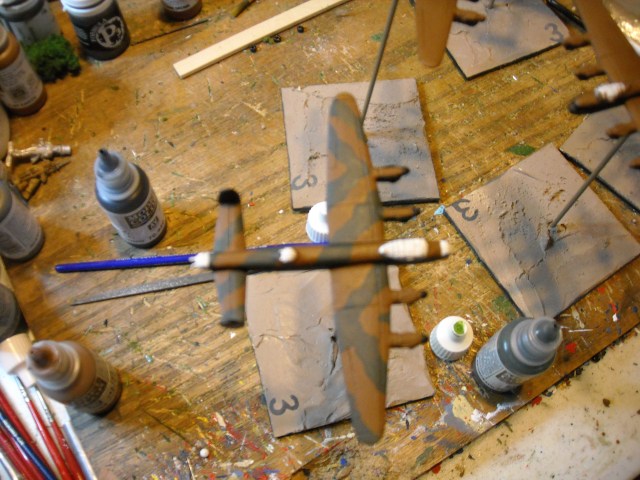
This top Lancaster view shows the camouflage pattern for the five bombers.  Vallejo Bronze Green over Vallejo Dark Earth.

This top Lancaster view shows the camouflage pattern for the five bombers. Vallejo Bronze Green over Vallejo Dark Earth.


The Tony fighters are different.  They mostly appeared on the front lines in natural metal and were field-camouflaged.  Most have very carefully applied small green camouflage.  Others have the paint obviously smeared on to the plane with– I dunno palm fronds or something.  This poses a problem, because the camouflage is just plane difficult for a miniature so small.  I’m going to take four of them and do the best I can.  The other five will be Japanese home defense, capable of playing with Scott Abbott’s awesome fleet of B-29’s.  They’ll be part of the ramming squadron the Japanese air corps developed for dealing with LeMay’s bomber fleet.

These are little bitty planes.  The Lancasters are Scotia/Collectair, with some nice detail.  I’m hoping I can pull them off okay, but mostly I’m concerned with the straight lines. The Tonys are C in C with even more and finer detail. It just seems so much hard to do justice to than it used to be.
Shapeways Planes Arrive!!

I received notice in my Gmail box that my Shapeways order had been shipped.  I totally forgot until I arrived at home today and found a wee box sitting on my front porch.  We’re on deadline this week so it’s going to be difficult to get much painting done.  I snatched it up and took it back to school with me and promised to look at the planes inside later.

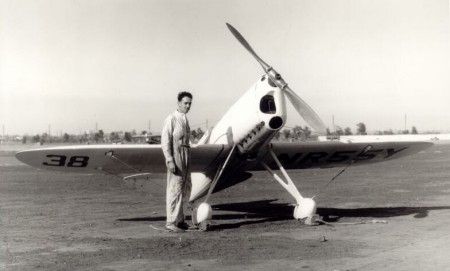
Well I’ve had a chance to paw through them.  I looked at some of the smaller entries first.  I ordered the two different versions of the Keith Rider San Francisco.  One has much longer wings than the other.  I suspect the longer winged version was probably used for distance racing, while the shorter winged version was for pylon racing. The miniatures are simple and nice, but in need of a two bladed propellor.  I’ll have to see what I can do.  They are well cast in white resin with sufficient detail to make the very simple aluminum monoplanes interesting.

Keith Rider’s San Francisco blazed the way for a series of very lightweight racers with a simple monoplane design.

Another plane I received was the Howard “Mike.”  This is another pretty small low wing monoplane with fixed landing gear.  Again, it could definitely be enhanced with a prop.  I’ll have to see what I can make. Unfortunately, this came with some battle damage.  The very fragile undercarriage was damaged on one side.  I think it can be repaired with a little Zap, but that was disconcerting.  To be fair these landing gear have very light struts, but I still expect them arrive intact.

Howard’s Mike was an extremely successful design of the middle 30’s, sweeping the National Air Races in 1934.

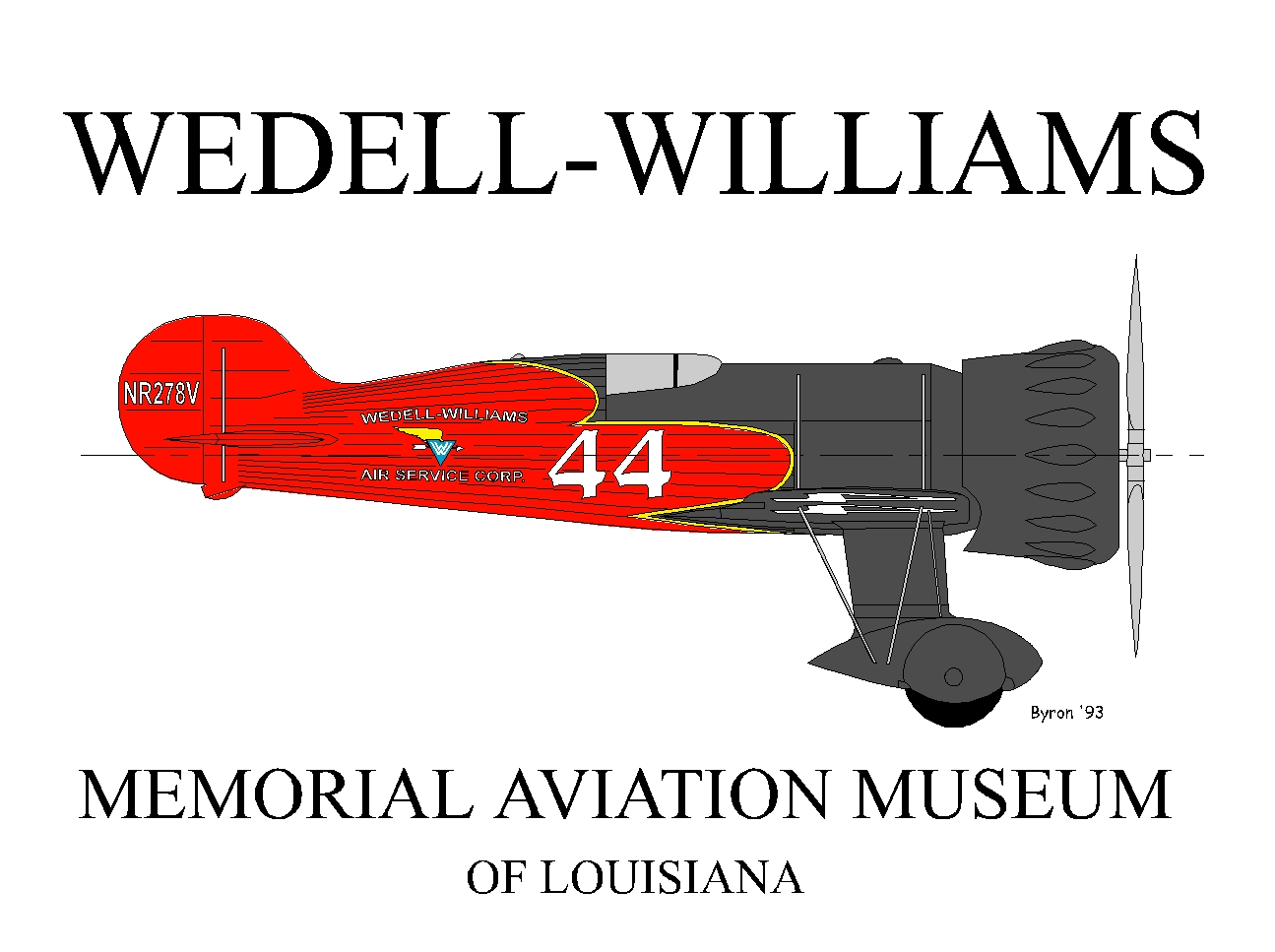
Next up was a Wedell Williams 44 from the 1932 air races.  This is a much larger monoplane with much more substantial wheel spats.  Again, it’s a beautiful miniature with gorgeous lines sprouting off an enormous engine.  There were three of these present in the 1932 National Air Races, and I’m likely going to paint it as Wedell’s own plane.

There were three modell 44’s that appeared at the 1932 National Air Races. I’ll paint this version for my collection.

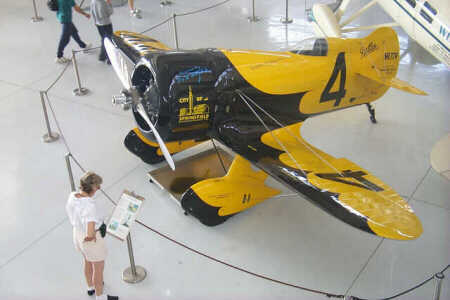
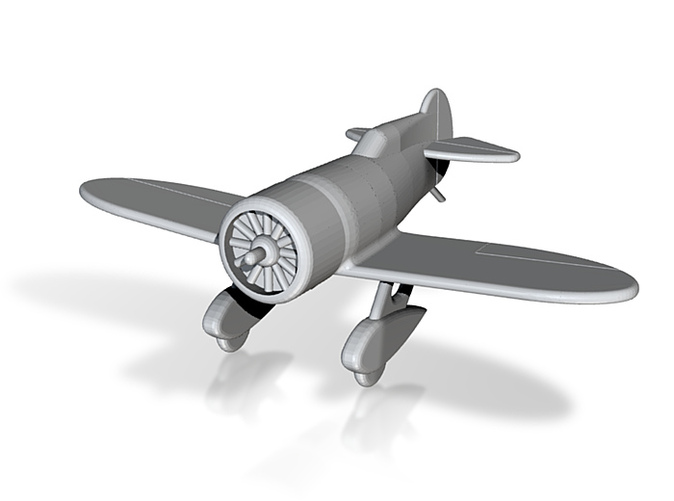
Finally, I also ordered and received a Gee Bee Z that won the 1931 Thompson Trophy.  Short and stubby, but not to the steroid dimensions that appeared in the later Gee Bee R’s, the Z is my favorite air racer.  The miniature is quite faithful to the racer, demolished in a 1931 crash.

Replica of the Gee Bee Z at the Museum of Flight in Seattle.

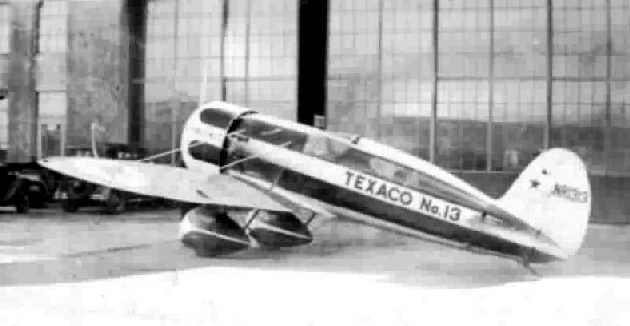
I’ve received five of the 13 air racer miniatures designed by Arctic Skunk.  In addition to that I have the Reviresco TravelAir Mystery ship.  There were four of these planes produced.  I’ve decided to paint mine the colors of the Texaco 13 air racer.

Texaco 13 was purchased from Travelair. It mostly participated in distance races. Other model R racers had two sets of wings. Short ones for pylon racing, longer wings for distances.

Just For Fun

I’m usually a very focused painter, but I’m taking a little break to do some fun stuff.  Ever since Enfilade (last May) I’ve been a good boy and painted figures for the Hundred Years War and the War of 1812.  All in all some 50 HYW figures and 56 War of 1812 figures.  I’ve decided to just do some stuff that is fun and different.

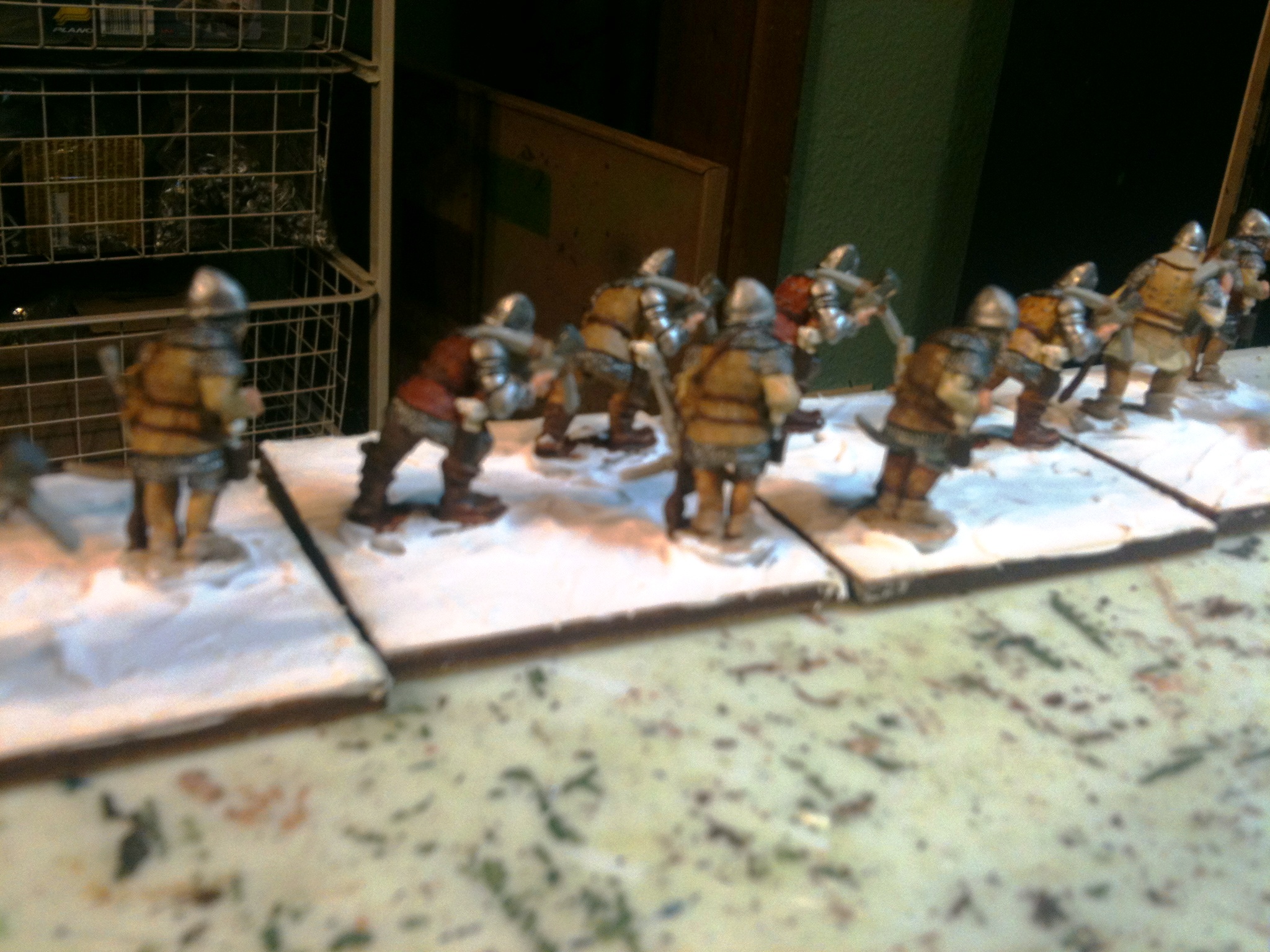
Old Glory Crossbowmen may be my last HYW figures until after the first of the year. These are the last of the crossbow figures I have and fight in the vanguard at Poitiers. Hope to finish basing them today or tomorrow.

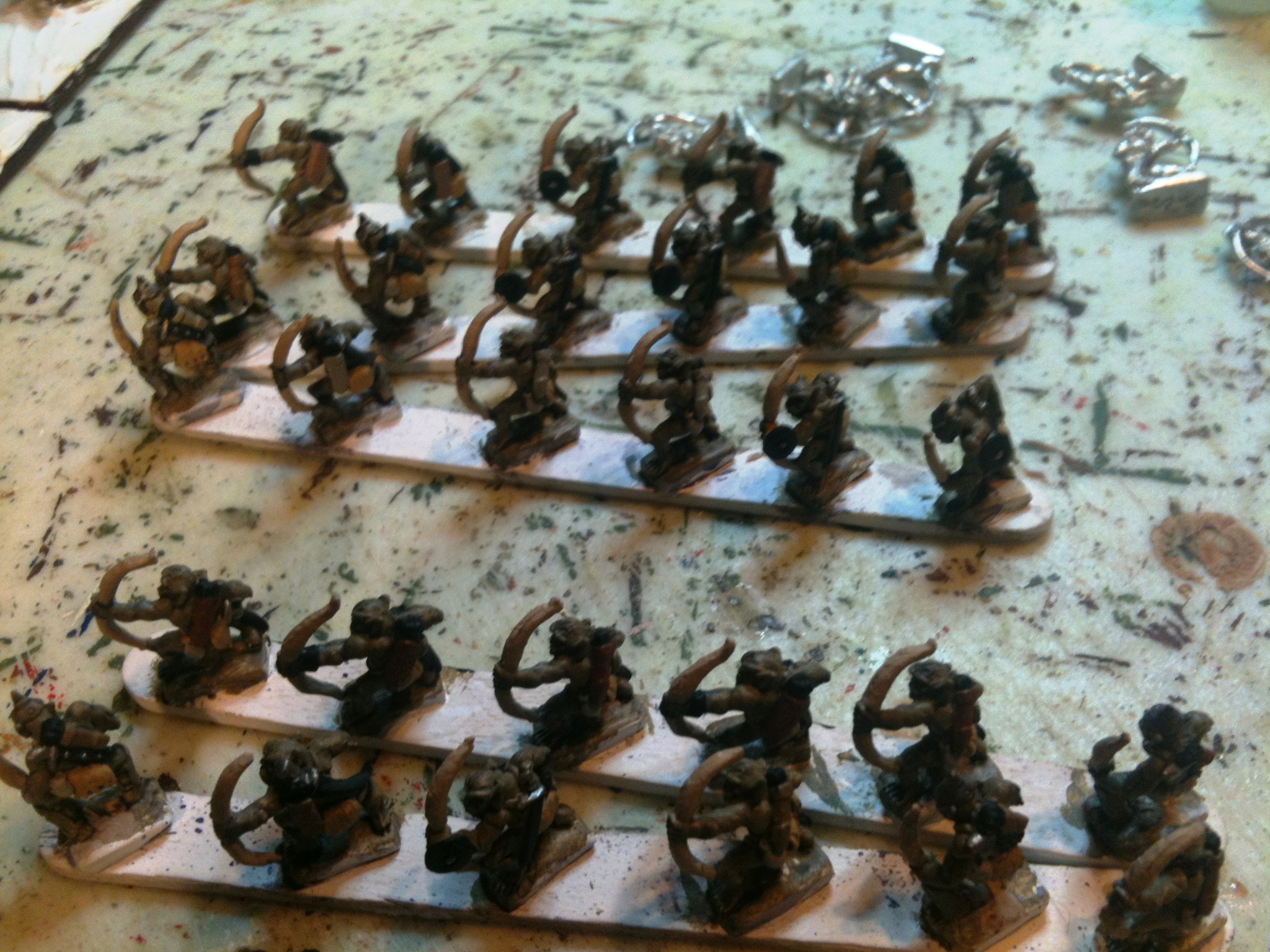
These 30 Black Raven orc archers will make six Sk stands and six Bw stands. Nice start on what I hope will be progress on Orcs for the Battle of the Pelennor Fields.

First, I’m going to paint up some 15mm orcs.  Yes, orcs.  I’ve been hanging on to a bunch of 15mm fantasy figures for many years.  They’re intended to help me portray the Battle of the Pelennor Fields from the Lord of the Rings.  I just cranked out 30 archers.  I’ll be using a DBx basing for the stands, and will combine the figures for Bw and Sk.  I have loads more to paint, and am pleased to get a start on them.  My Rohan army is already complete, so I’m anxious to have somebody to run against.  I think I have all the figures I need except for the Black Raven Foundry Witch King figure.

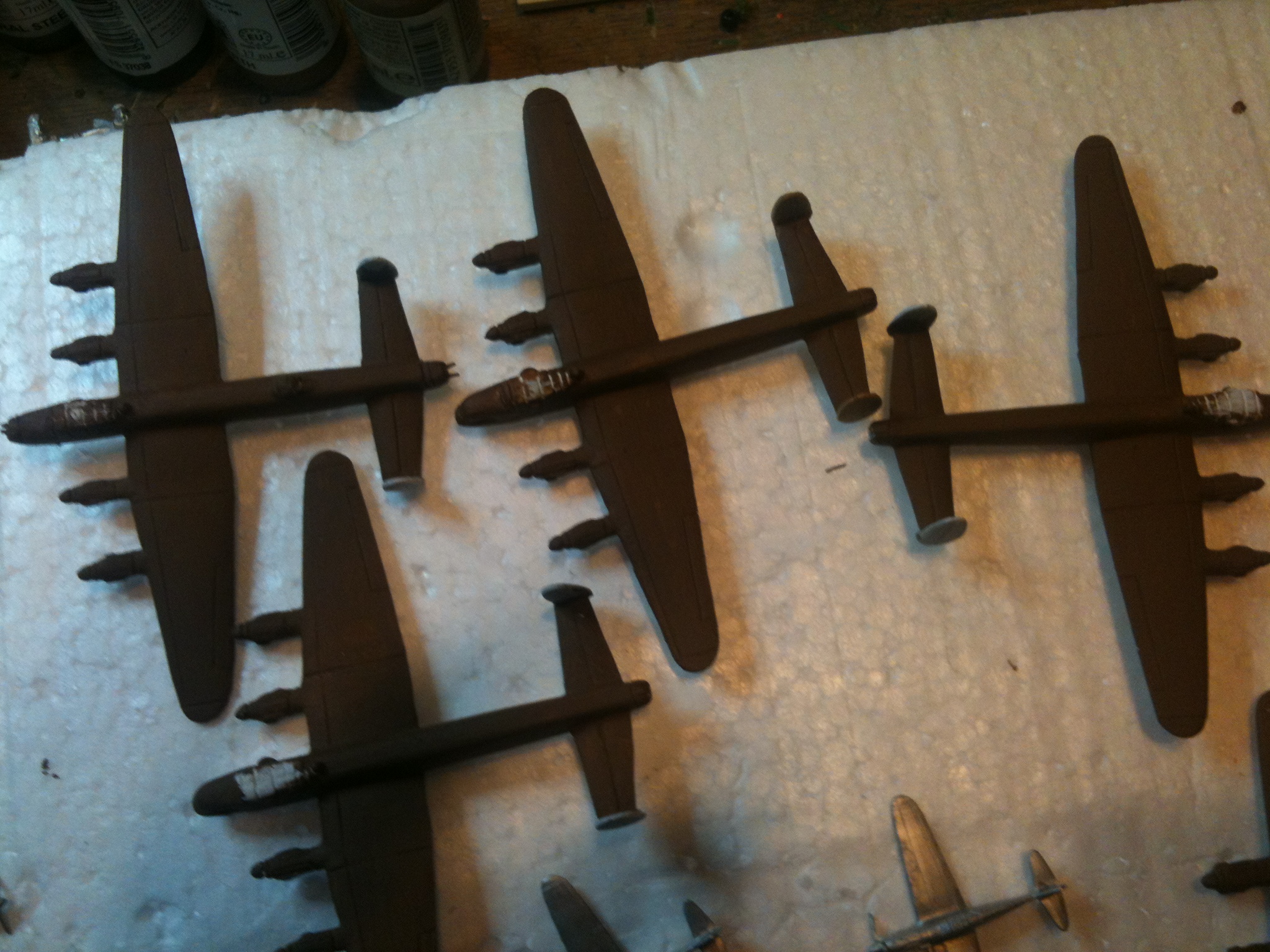
Collectair Lancasters with their base “earth” paint job. The color scheme isn’t real difficult with the earth, green and black basics. It’s getting every thing to line up properly that’s tricky.

I’m also preparing to paint five 1/300 Collectair Lancaster bombers from WWII.  They’re primed and I hope to finish painting them over the Thanksgiving holiday.  Four are armed with the Tallboy bombs used to sink the Tirpitz in Norway in 1944.  They aren’t super challenging to paint, but they do have some pretty straight lines to manage.  I’ll do my best.  I’m even assembling nine (9!!) C in C Ki-61 Tony fighters I picked up at the NHMGS auction and there hasn’t been one of those in years and years.  It’s kind of fun to revisit this old, old stuff and make something happen with it.

The C in C Tonys are little gems. Assembly is super easy. I’ll paint five up as home defense fighters from a “ramming” squadron. Fun stuff eh. Become a fighter pilot. Ram a B-29. The rest will be interceptors defending the empire.

Crappy pictures courtesy of my iPhone.

I still have plenty of War of 1812 and HYW figures on my radar.  I’ve still got 20 French men-at-arms partially painted that I’ll tackle-when I feel like it.  Just can’t face dealing with heraldry right now.  I also have twenty Maryland militia artillery primed.  Probably sooner rather than later.  But right now I just need to have some fun by doing something different.

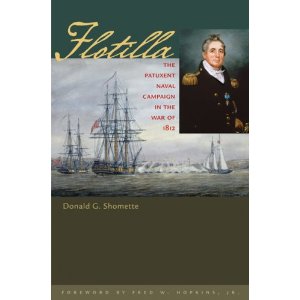
Book Review: Flotilla-The Patuxent Naval Campaign in the War of 1812

The campaign in Chesapeake Bay that resulted in the disastrous burning of Washington in August of 1814 and the abortive attack on Baltimore a month later is not without its chroniclers.  Walter Lord wrote a classic account, followed by more recent accounts that garnered regional interest by Anthony Pitch and Christopher George.  All paint pretty much the same picture: a tidewater region wholly unprepared to defend itself suffered the depredations of the British for two long years resulting in the humiliation of the burning of the nation’s capital followed by the heroic stand at Fort McHenry.  When Dave Schueler alerted me that Naval Institute Press alerted me that Donald Shomette was scheduled to release a new book in 2009 on this topic, I resisted my typical urge to run out and buy a copy.  It’s take a while, but I finally borrowed Dave’s and finished reading it this week.

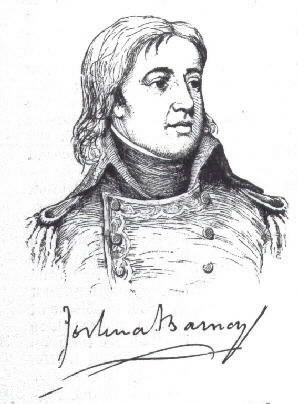
This image of Joshua Barney is circa 1800

In many ways Shomette tells the same story as Lord, Pitch and George.  If you’re looking for something uplifting about the conduct of the War of 1812 in the  Tidewater region, there just isn’t a lot to see here.  Well, that’s not true, there’s a nugget but only a nugget.  Amid the various incidents of the British Navy setting up camp on Tangier Island, raiding both shores of Virginia and Maryland, there is also the story of Joshua Barney and his flotilla of gunboats.  All the histories tell this story, but Shomette simply tells it better and more completely.  Shomette reports on the authorization of the two flotillas of gunboats authorized by Congress, and focuses on those under Barney’s command.  In addition, he shares the details of the little vessels’ construction and armament, as well as their fitting out problems.  Finally, Sholmette details the bottling up of Barney and his valiant, but tiny navy on the Patuxent River, the British navy’s effort to get at him, and the resulting battles at St. Leonard’s Creek and the Flotilla’s flight to Nottingham.

If this is what you’re looking for from this book, you’ll be pleased.  Unfortunately it consumes about a quarter of the book’s 355 pages.  Almost any history of the Chesapeake campaign must focus on the British.  Shomette also tells this story well.  By any standard, the war on the Chesapeake was hopeless.  The British had a vastly superior navy.  As it’s size grew, either by seizing local vessels, or reinforcements from home, it’s mission capabilities also grew.  In addition to deepwater ships of the line, frigates and sloops, the Brits were able to add vessels able to work in the shallow tidewaters and rivers, transporting raiding parties throughout the coastal region that carried off livestock, grain, tobacco and slaves, burned plantations and created general havoc and disaffection among the local landed classes. With the end of the Napoleon’s regime in France, elements of Wellington’s Peninsular army made their way to the Chesapeake and become the strike force that defeats the the American scratch force at Bladensburg and goes on to destiny in Washington D.C.

Shomette’s narrative is lively and offers considerable new information on Barney’s participation in the movements leading to Bladensburg.  Shomette’s account of Bladensburg may be the most thorough I’ve read.  The movements by all units leading to the battle, the political decisions made by American leaders until the battle, the fate of various American militia units and their unceremonious exits from the action, and Barney’s troops and their last stand are explained in more complete detail than other accounts.

Donald Shomette’s book is published by Naval Institute Press and is available from Amazon.com or the Naval Institute

Shomette’s book is a great addition to a War of 1812 library.  Though the narrative provides considerable context,this highly readable volume provides depth and fills in gaps to the body of work readily available to those seeking additional knowledge of the Chesapeake campaign.

My rating:  Five stars.

Royal Marines on the Chesapeake

I’m in the middle of reading Donald Shomette’s wonderful book on the Chesapeake campaign that resulted in the burning of Washington D.C. and the bombardment of Fort McHenry in 1812, Flotilla. Though nominally it’s the tale of Commodore Joshua Barney’s gunboat flotilla on the Patuxent River, it’s really a story about the ease with which the British, with their incredible naval superiority were able to threaten, terrorize and dominate the eastern and western shores of Maryland and Virginia in 1813 and 1814.

The chief instrument of their effective campaign was the Royal Marines.  Because I am in charge of assembling forces for the 1814 battle of Bladensburg, I’ll need plenty of Marines for the battle.  There were four different units of Royal Marines at the battle, including some light infantry, as well as the Colonial Marines.  The Colonial Marines was a unit composed of freed slaves.  Though only about one in three escaped or liberated slaves were eligible for service, those who did don the uniform were quite effective at looting, burning, serving as guides, and, when rarely necessary, fighting off the local militias.  In all, some 20 stands, or eighty figures are necessary to complete all the Royal Marines at Bladensburg.

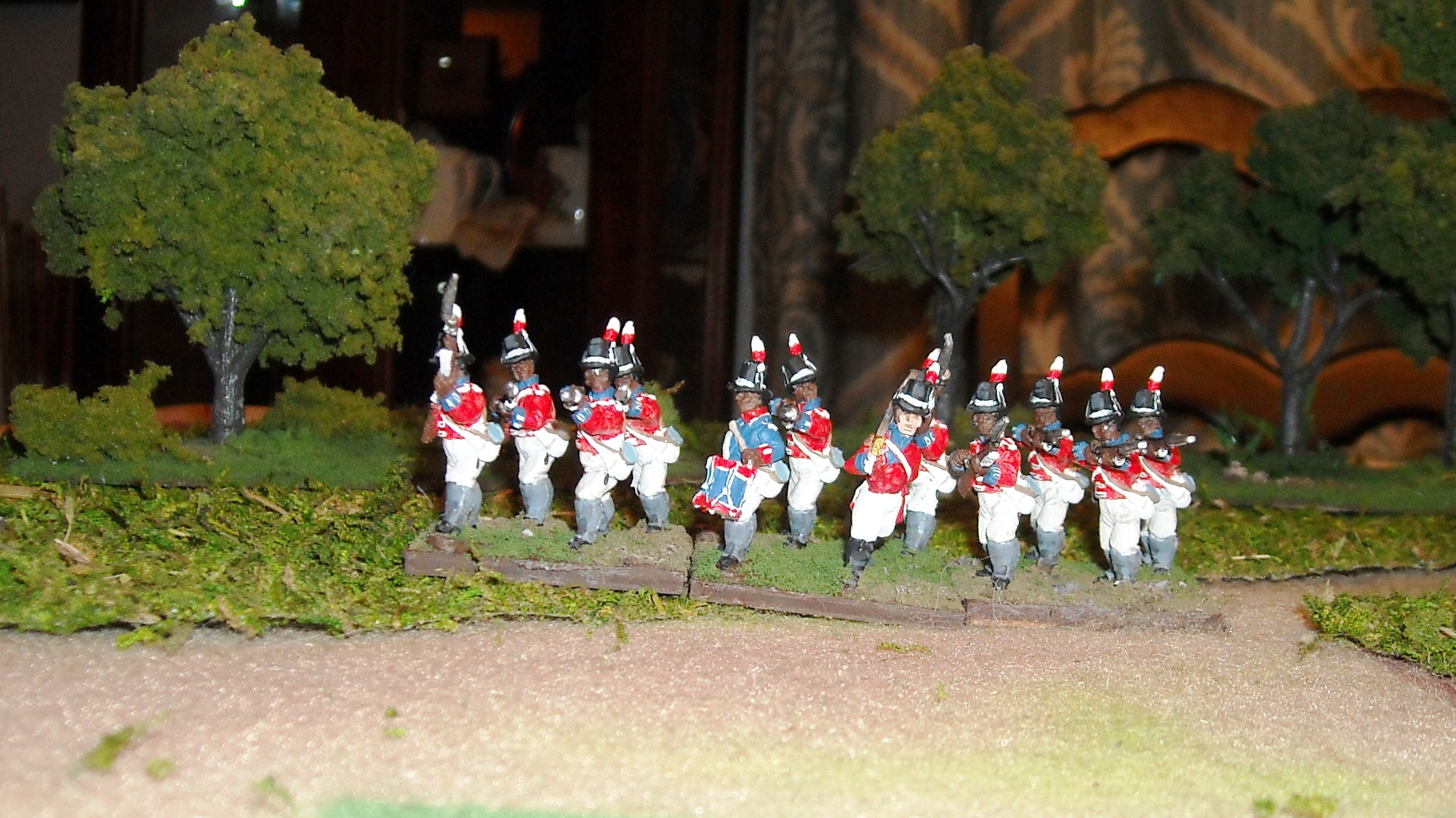
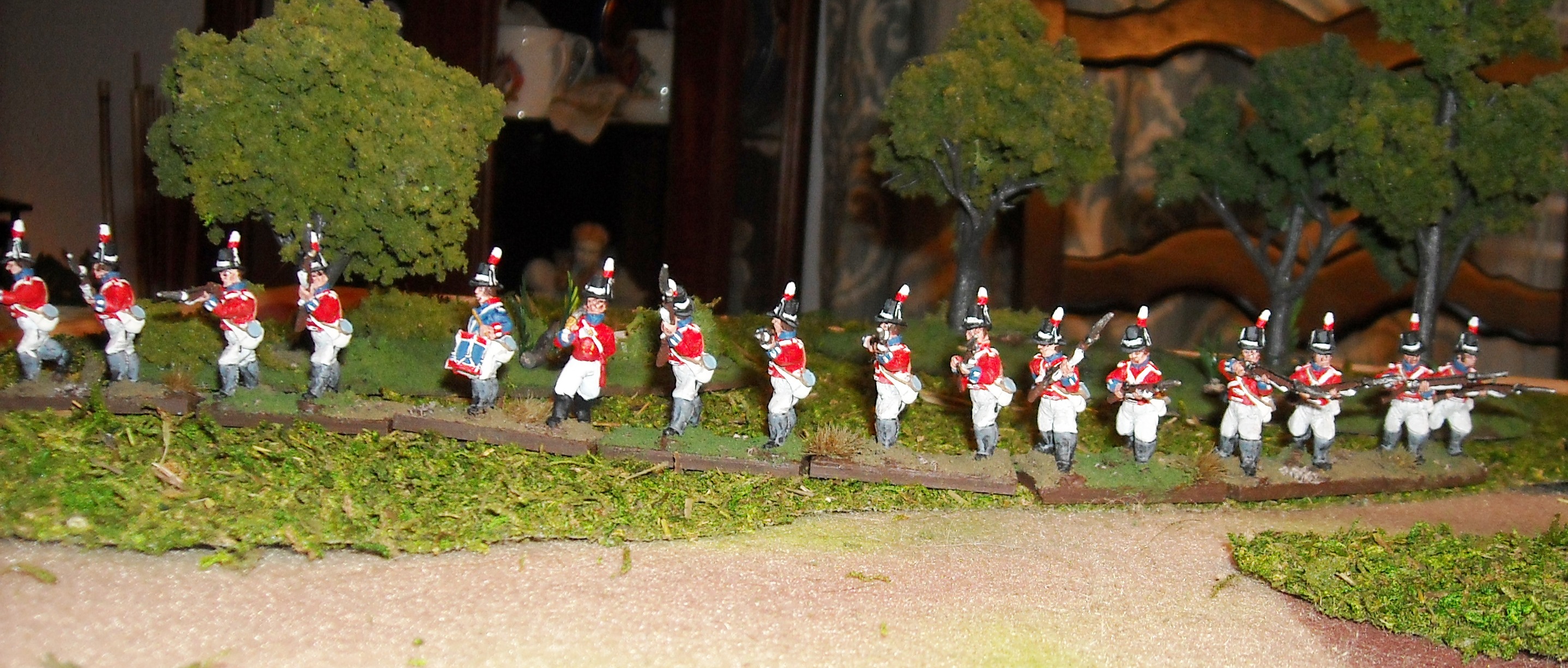
I’ve completed seven stands of Old Glory Royal Marines.  I like the figures.  They aren’t perfect, but certainly adequate.  There are some nice variations, they are well proportioned and you certainly can’t beat the price.  I painted up four stands of Marine light infantry and stuck them on half bases so they could be in extended order. I’m pretty pleased with the outcome.  The other three stands are painted as the Colonial Marines.  They’re black, with a white officer.

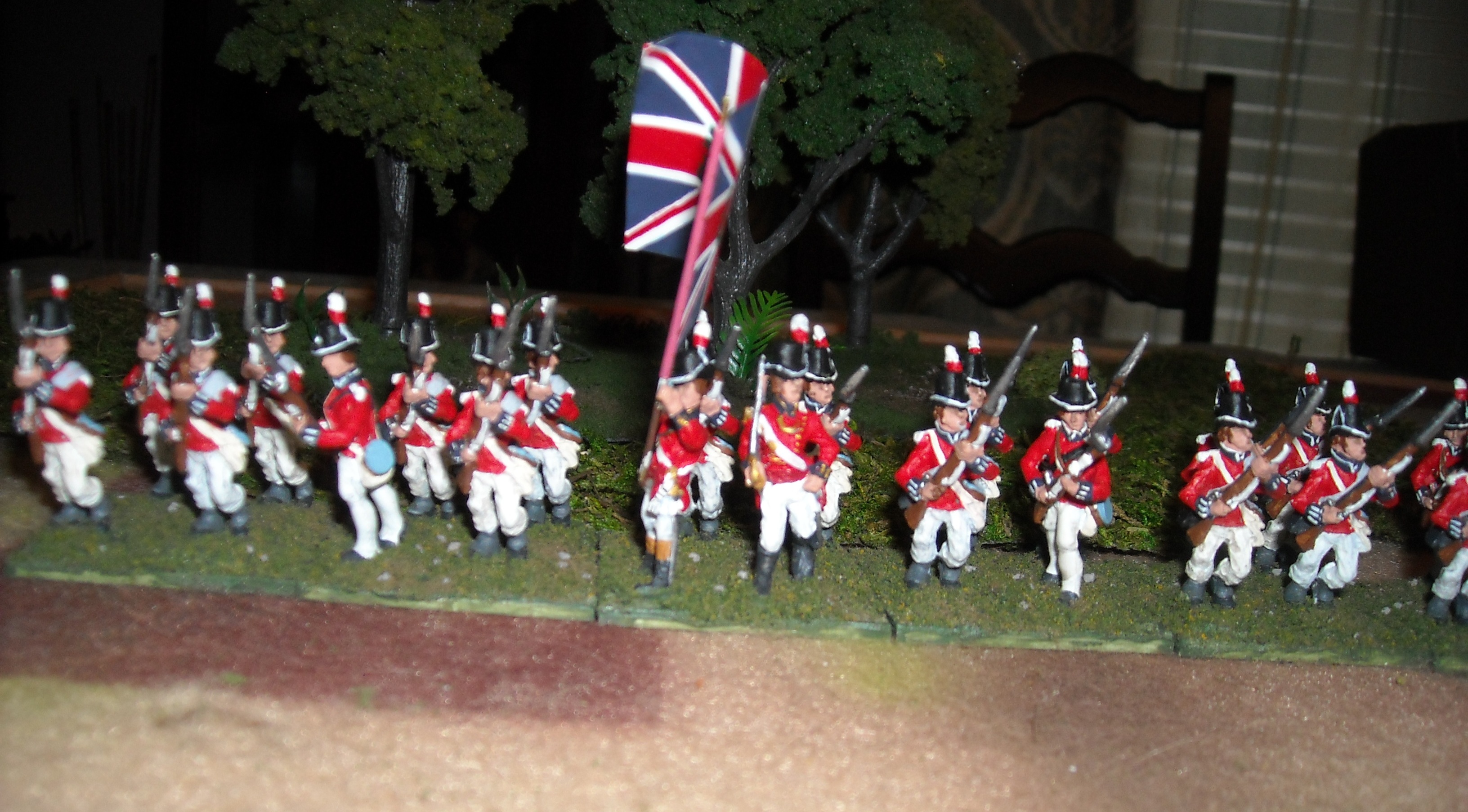
In addition to the Old Glory figures, I have eight stands of Marines I received from Doug Hamm.  I painted them long ago, and I am considering a repaint.  The base color I use for my redcoats in both War of 1812 and the American Revolution is Vallejo Vermillion.  It’s a shade darker than scarlet, but in the same color family.  These look to be either Hinchcliffe or Connoisseur.  They have that tall, lanky Peter Gilder look to them.  Nice figures but single poses. They are my 2nd Battalion Royal Marines, part of the 3rd brigade at Bladensburg.

I don’t know exactly what figures these are, though they seem very Peter Gilder-like. I suspect they are Connoisseur figures.

Looking Ahead to Next Year’s Museum of Flight

Tomorrow is the annual NHMGS day at the Museum of Flight.  I’ve written about it many times on my old blog.  It is probably my favorite game event of the year because we’re under an SR 71 in the Great Hall of the Museum of Flight and it’s frickin’ amazing. We have lots of time to rub elbows with the public.  There are lots of games to take a look at.  I get to hang out with Dave Schueler and Mark Waddington.  Oh, and I run the air racing game in the morning.  (Because I schedule the show and keep the list of games, I can schedule my game whenever I please. Bonus.

Air racing is the one semi-demand the museum puts on us for the show.  That and arriving early we get set up before the public arrives at 10:00.  I love air-racing.  It’s a lot of fun.  I have a collection of planes built and painted by Paul Hannah, Dave Schueler and myself.  They are 1/48 scale kits, and the planes look great.  Some are the old Testor’s kits that were introduced by Hawk fifty years ago.  Some are a bit more upscale and include the Minicraft Seversy racer, and I even have a nice resincast Me-209 which was a test bed world speed record holder.  I really like the racers.

Unfortunately they are a lot to transport, and because we have to transport them quite a distance from the parking lot, they can be a lot to schlep.  It will rain tomorrow, and with several trips to get everything in from the car, it will be an unpleasant walk in the weather. Worse than that however, is my constant fear that we’ll have accidents on the tabletop.  Mounted on flight stands 1-7″ tall, the planes become top heavy.  In a crowd, watchers can inadvertently brush them and knock them to the table or the base, and if that happens, it’s over. That happened once at Enfilade with our seaplanes and that was pretty much the show. They haven’t been out of the box since.

Dave and I have often talked about our wish that someone could make the planes in a more manageable scale, say 1/144th.  The racers are relatively tiny at that scale, small, save weight and all that.  John McEwan at Reviresco made a nice mini of the Travelaire Mystery ship ten years or so ago in that scale and I always hoped he’d follow it up with more planes, but none have been forthcoming.  At that size the bases would be heavier than the planes and they’d be smaller to transport though they wouldn’t be quite so eye-catching.  If only they were available.

I was very pleasantly surprised when Dave sent me an e-mail last week with a link to Shapeways.  Shapeways is a 3D printing company that converts designs submitted to them into 3D miniatures.  Lots of game topics, but amazingly one of their designers, Arctic Skunk, supplied them with some air racing designs in 1/144th scale. The Howard Ike and Mike are available.  The Gee Bees are available, models R, Y and my favorite, the Z, and more. I don’t know how they’ll paint up, but they look pretty basic and interesting.  There are pretty close to a dozen planes in the range.  (Don’t get stuck on the category for Golden Age Air Racing, more are available.) They aren’t cheap, though not bad. The smallish Ike and Mike are four bucks, while the bulky Gee Bees are more than twice as much.  Of course, if you want the super detail material instead of the basic white and flexible resin, you pay more.  About three times as much.  I’m pretty sure I’ll stick with the basics and paint in the detail with the help of Mendenhall’s The Air Racer.

Clockwise from left the Shapeways designs by Arctic Skunk are 1. Hall Bulldog; 2. Howard Ike; 3. GeeBee R 1-2; Gee Bee Z

Welcome to my new home

If you stumbled on this blog by accident, or if you are a long time follower of my blog, Northwest Historical Miniature Gamer over on Blogger, thanks for coming.  Have a seat, make yourself comfortable.  A couple weeks ago I got locked out of my Blogspot blogs by Google.  It’s a long story, some of it my fault, some of it Google issues.  Let’s just say that Google isn’t very helpful at resolving some very resolvable problems or I would still be there.  So here I am at WordPress, which will just eliminate some of the conflicts I was having between my school-related Google accounts and my home -related Google activities.

Here is my guarantee to you, the reader.  If you want to know what’s going on with me and my gaming activities, I will share once week.  Sometimes more, sometimes less.  Many friends suggest my wargaming interests are not traditional, not boring, and occasionally pretty weird.

If you’ve followed the Shastapsh Chronicles over on Blogger, that’s one I’m going to allow to die.  It was great while I was playing tons of Space 1889 games, but today I’m painting little for that project and we are only playing a few games per year.  I’ll update that here on A Gamer’s Tales.

It’s going to take a while for me to figure out the formatting here, which is much different than Blogger.  I’ll get my blog rolls up and include some links I haven’t updated in years. So please I ask your patience, and I thank you for coming for a visit.