Back on track

It’s been an eventful few weeks since my last post. I was pretty sick for the better part of a week. Then we moved on to deadline for the paper at school. While we were on deadline I had wrap up my residual doctor issues relating to my kidney problems. At the same time our much loved 12 year old Australian Shepherd, Lucy became quite ill and we had to have her euthanized. More going on than I needed.

Somewhere in there I managed to squeeze in our first trip to the Heritage Flight Center. It is located in Everett at Paine Field. It’s a working collection of flyable warbirds, and some drivable AFV’s chiefly from WWII. We hosted eight games and brought about thirty members to the museum. The feedback I received from members was universally positive, and it is my hope we can do it again sometime in the near future.

Dealing with my other issues, I spent a good couple of weeks mostly unable to work on my projects. I was also in one of my rare moments when I wasn’t quite sure what to do next. I have plenty of miniatures to paint, and lots of projects to work on. I was caught betwixt and between the Hundred Years War and my Spanish-American project, and not making progress on either. I finished a batch of French knights, but it didn’t excite me, so I glommed on to some Spanish infantry and decided to press on.

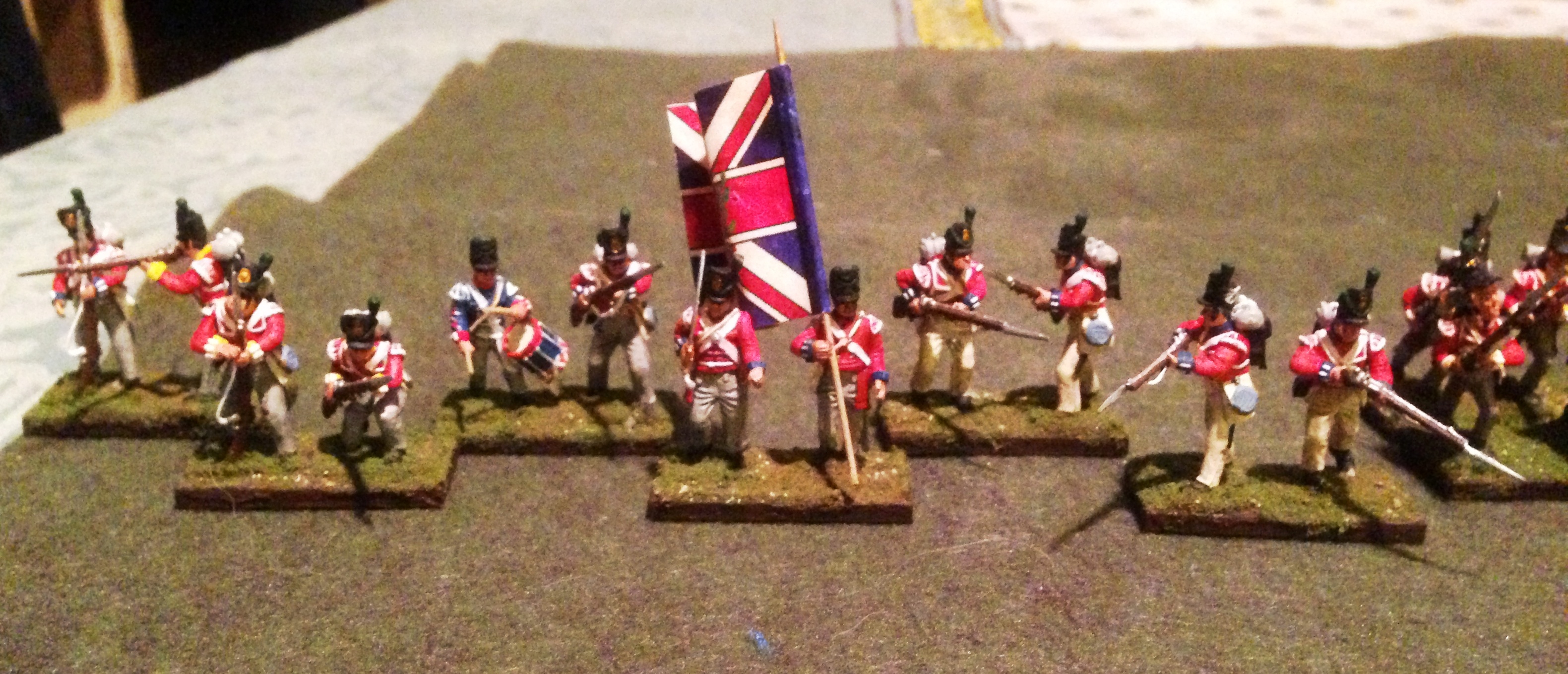
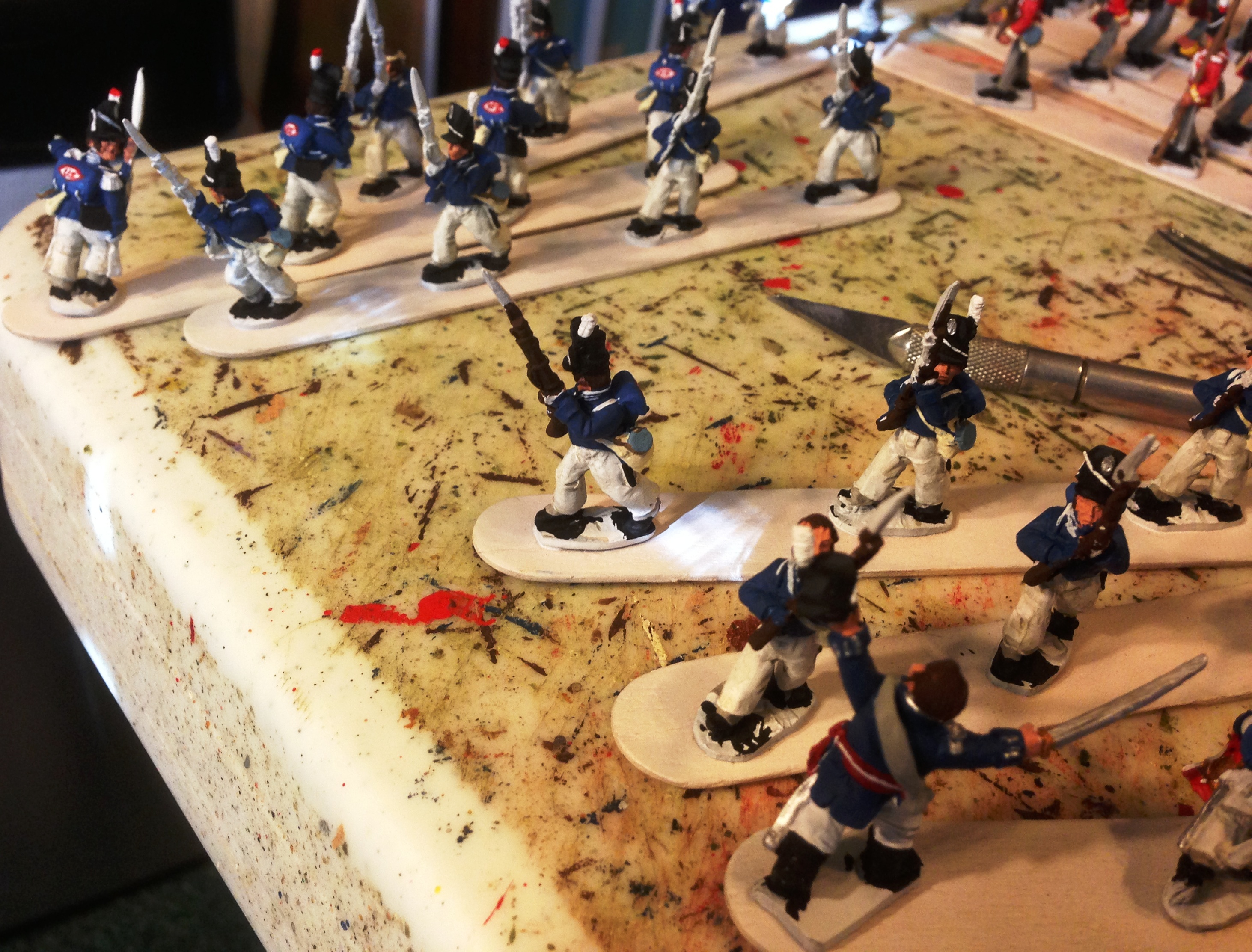
I’m nearly finished with the final two companies of the Louisiana Regiment. It’s an elegant looking unit in white with blue facings. I, use the Brother Against Brother rules, a single figure game. The Louisiana Regiment has three companies of ten figures each, plus a grenadier company with twelve figures. It was a militia unit, but one of quality, raised in America.

I’ll have a second battalion composed of four companies, but from two separate regiments. They will include a couple companies from the Hibernian Regiment, stationed in America for a time. Their attractive uniform-scarlet, with green facings-will enliven the two remaining companies which will be a pretty boring white.

In addition to the Spanish foot, I’ve assembled a sizable number of mounted Spanish and allies. I picked up a couple companies of mounted cuera militia that would have seen service on the frontier against the Apaches and the Comanches. With their lances, carbines and shields, they will be a formidable, if overloaded lot.

I also snagged enough figures for a company of the Luisiana Regiment of dragoons. They’re in bright blue coats, and should add some color to the army.

Finally, as the last gasp from my summer buying binge, I added a mounted Comanche war band to the Spanish army. The figures, from Conquest miniatures are quite promising. There are 21 figures in the unit, and I think they will add considerable flexibility to scenario ideas for this project.

Needless to say, I also have a few Americans to paint, but I want to remain focused and try to make big progress on this project. I’m shooting for completion by the end of summer 2014. I’ll have some terrain bits to wrap up for Bladensburg, but should be able to stay on track.
On the DL

I hoped that Veterans Day might be a great day to get some work done. As we breezed into the weekend I made some work around the house plans to prepare the living room for a new couch. Mission accomplished and the couch looks great.

Then it was off to Terra Crux Games. Located in downtown Tacoma, some friends agreed to meet and play some multi-player board games, and give the place a try. It was okay, I give it three stars out of five. Then down to the Orange Door for Thai food at about 9:00. Though the food was good, the service was comically bad.

While eating, however, I began to feel not so good. I needed to urinate a lot, and it kind of hurt to go. No it’s not what you are thinking. Shame on you. Went home and went to bed feeling lousy. Woke up Sunday morning feeling not much better, and maybe a little feverish. By 11:00 I thought it best to head off to an emergency clinic. After a wait that took me through the second half of the Seahawks dismantling of the Atlanta Falcons, I was eventually diagnosed with a kidney infection.

No doubt about, it’s unpleasant. Fever, headache, and more symptoms I won’t mention. More importantly it’s the fifth kidney incident I’ve had in my adult life, and the third in the last seven years. Time to take this seriously. In any case, the time I would have had for painting Spanish grenadiers and basing French knights, I’ve been laid up and unable to do much more than watch television. Even reading kind of hurts. Harry Harrison too; the good stuff.

Bummed.

Museum of Flight Day

November 2nd was our annual day at the Museum of Flight.  I have explained many times that this is my favorite venue.  It is a different gaming experience than our other events.  I love the museum with its surrounding planes and the inquiring museum guests.  It somehow makes the hobby seem less isolated from the public, and there is less pressure than managing 300 gamers and 130 games at Enfilade.

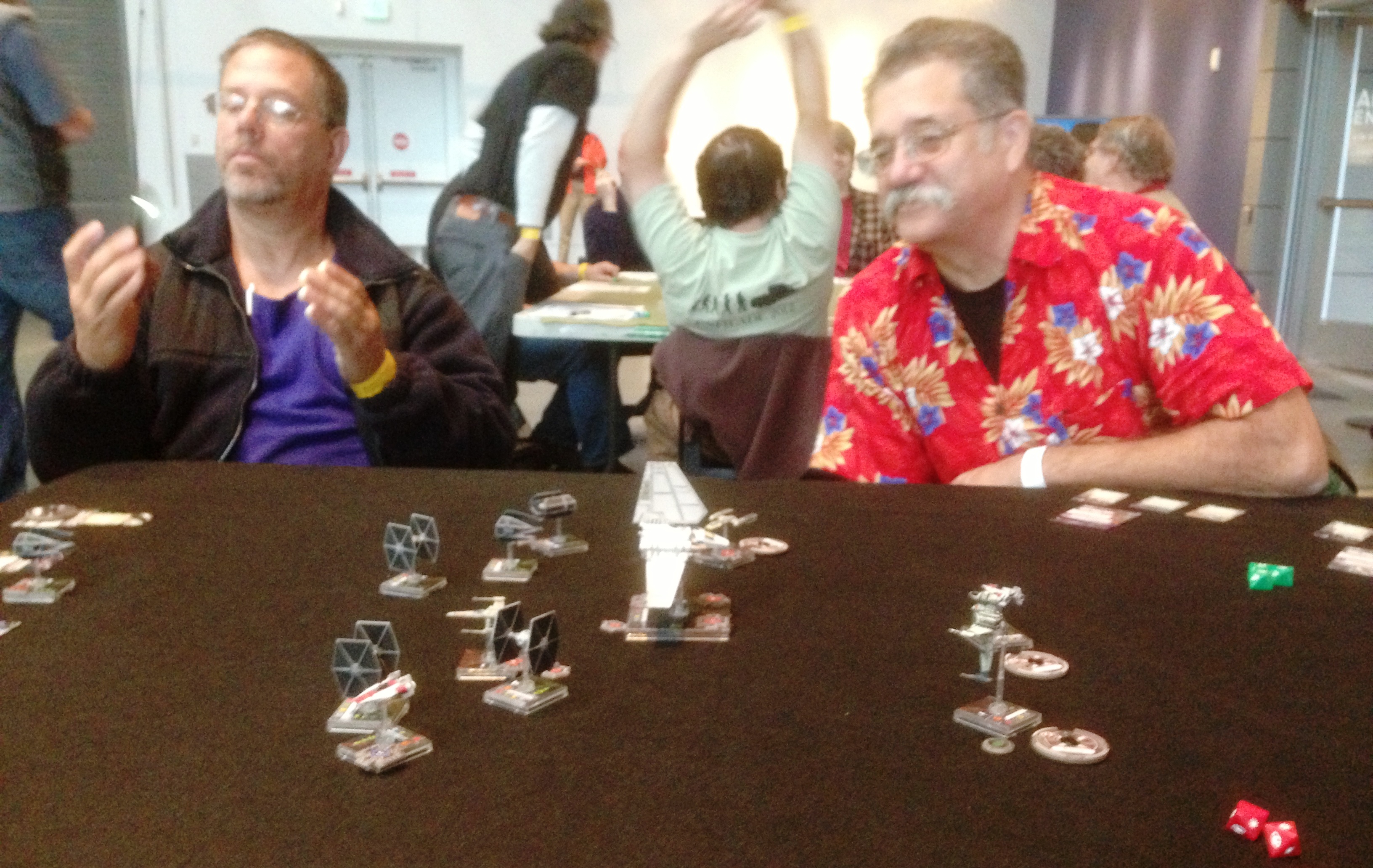
Hugh Sing, right, watches Scott Murphy's X Wing Fighter game.

Hugh Sing, right, watches Scott Murphy’s X Wing Fighter game.

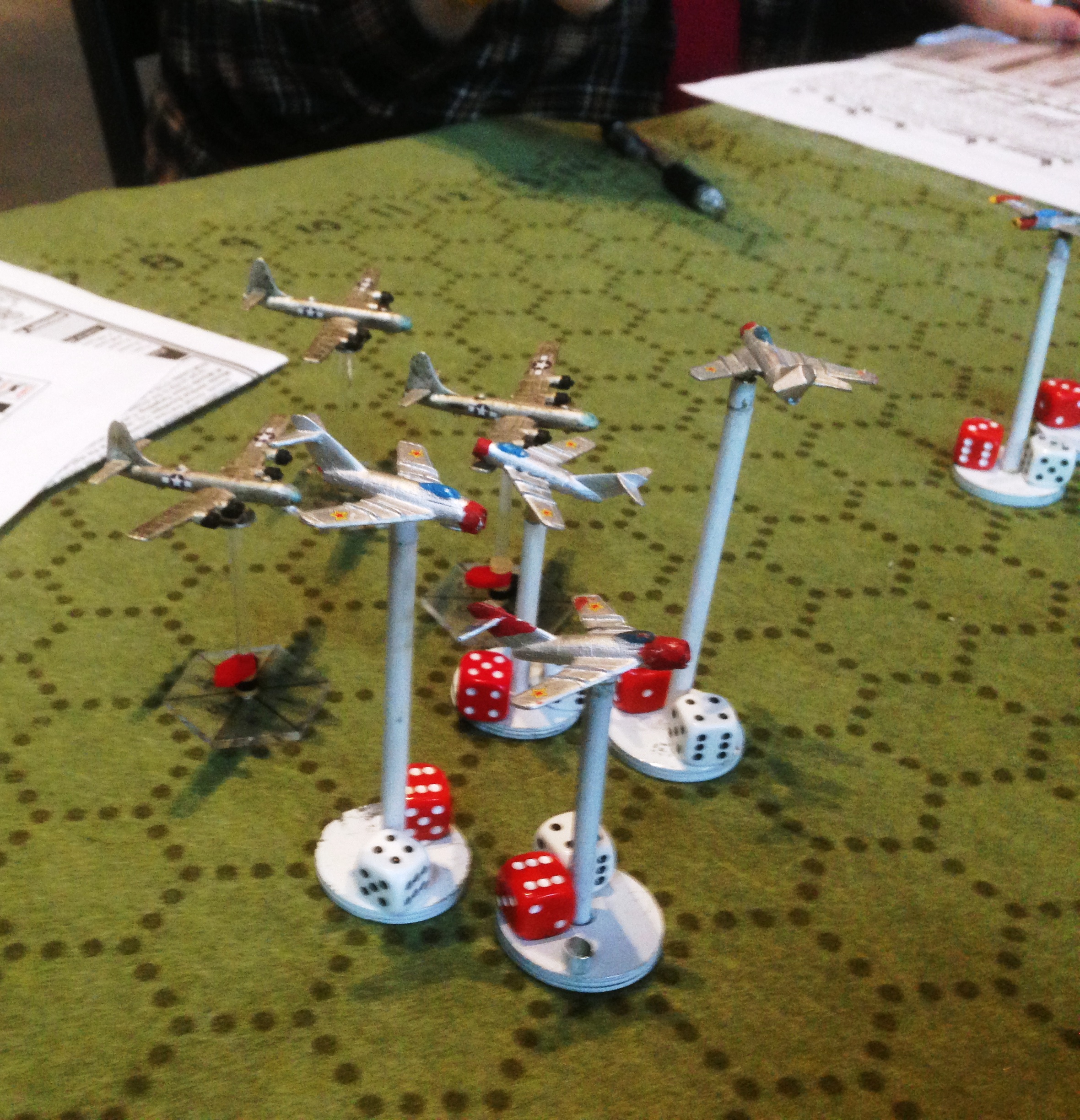
MiG 15's engulf American B-29's in Paul Grandstaff's Check Your Six Korea game.

MiG 15’s engulf American B-29’s in Paul Grandstaff’s Check Your Six Korea game.

Three weeks ago I got the word there was a glitch at the Museum.  Our normal space in the Great Gallery was only available with strings.  We’d have to end our day early, and because so many members had already committed, I didn’t want to do that. We moved our gathering across the street to the Space Center, so we had a new a new adventure at MoF.

It was actually fairly normal.  The weather was gawdawful–pouring rain and high winds.  That tends to be the case forMoF Saturday. Attendees either read the directions and parked at the Space Center, or gradually drifted over from the main parking lot. We had games for each table in each period,  All were well attended and, as I made my way around the room, it seemed everyone was having a good time.

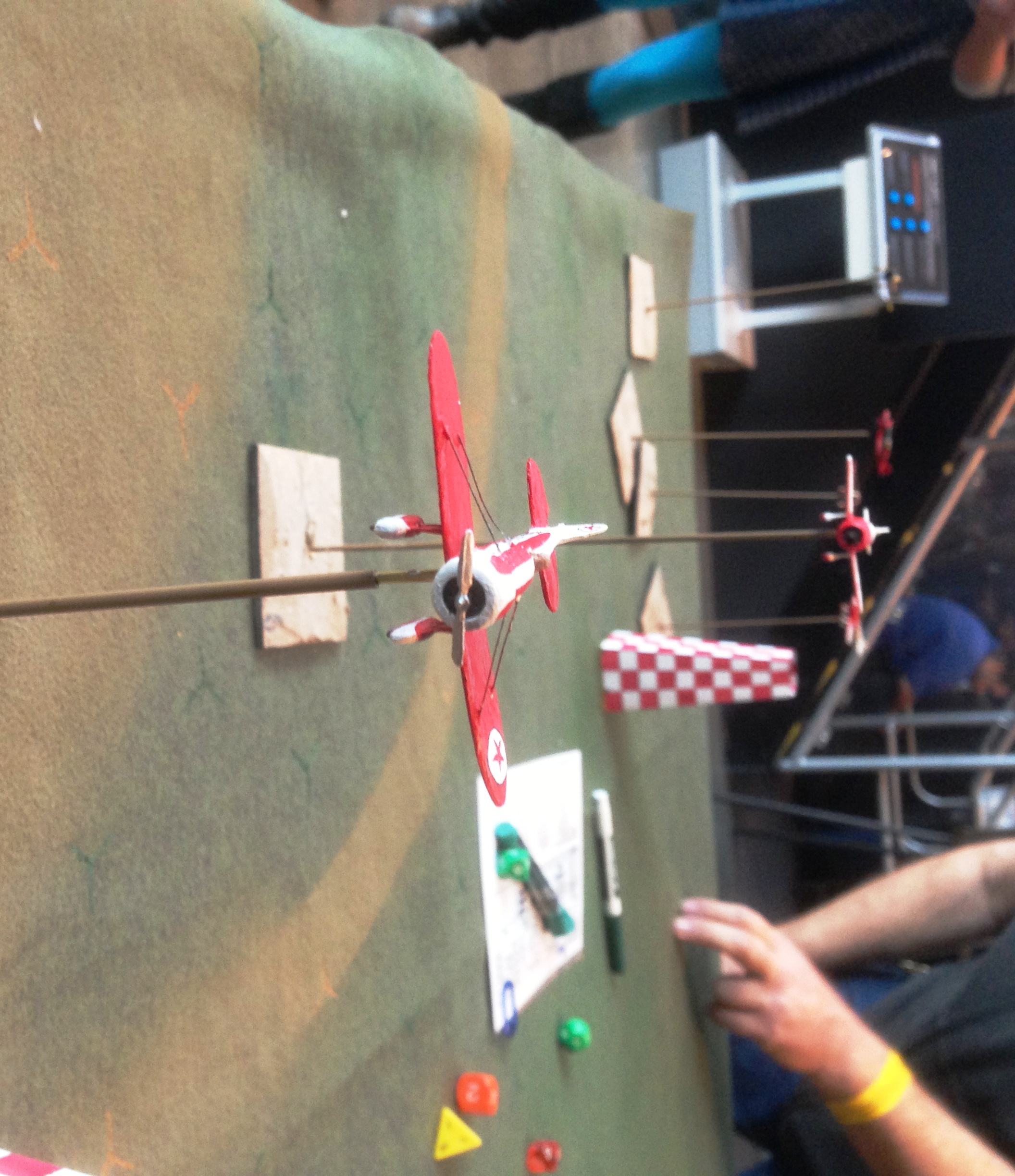
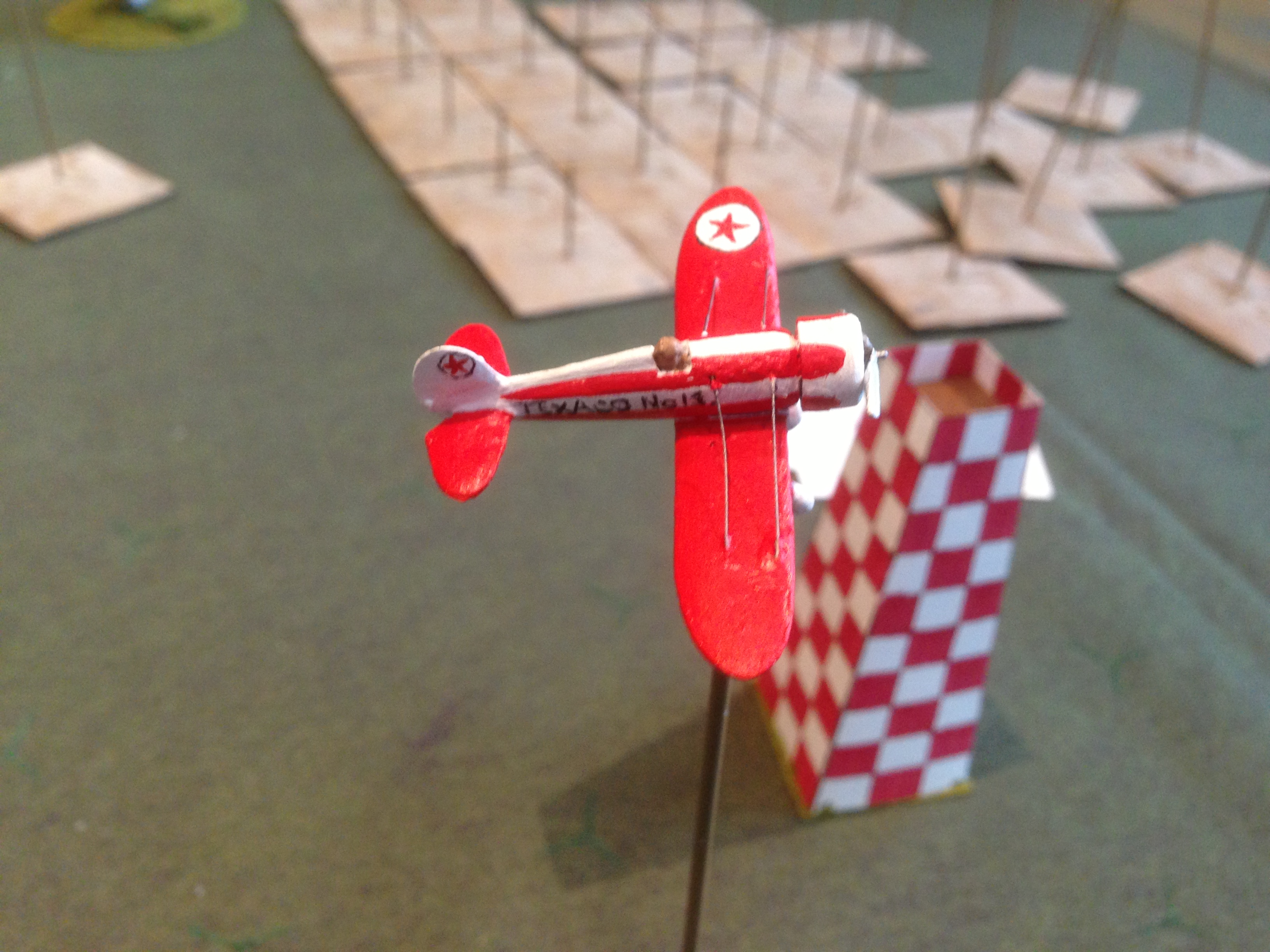
Joe Waddington led wire to wire in the annual Air Racing event.  He flies the Texaco Travelair 14

Joe Waddington led wire to wire in the annual Air Racing event. He flies the Texaco Travelair 14

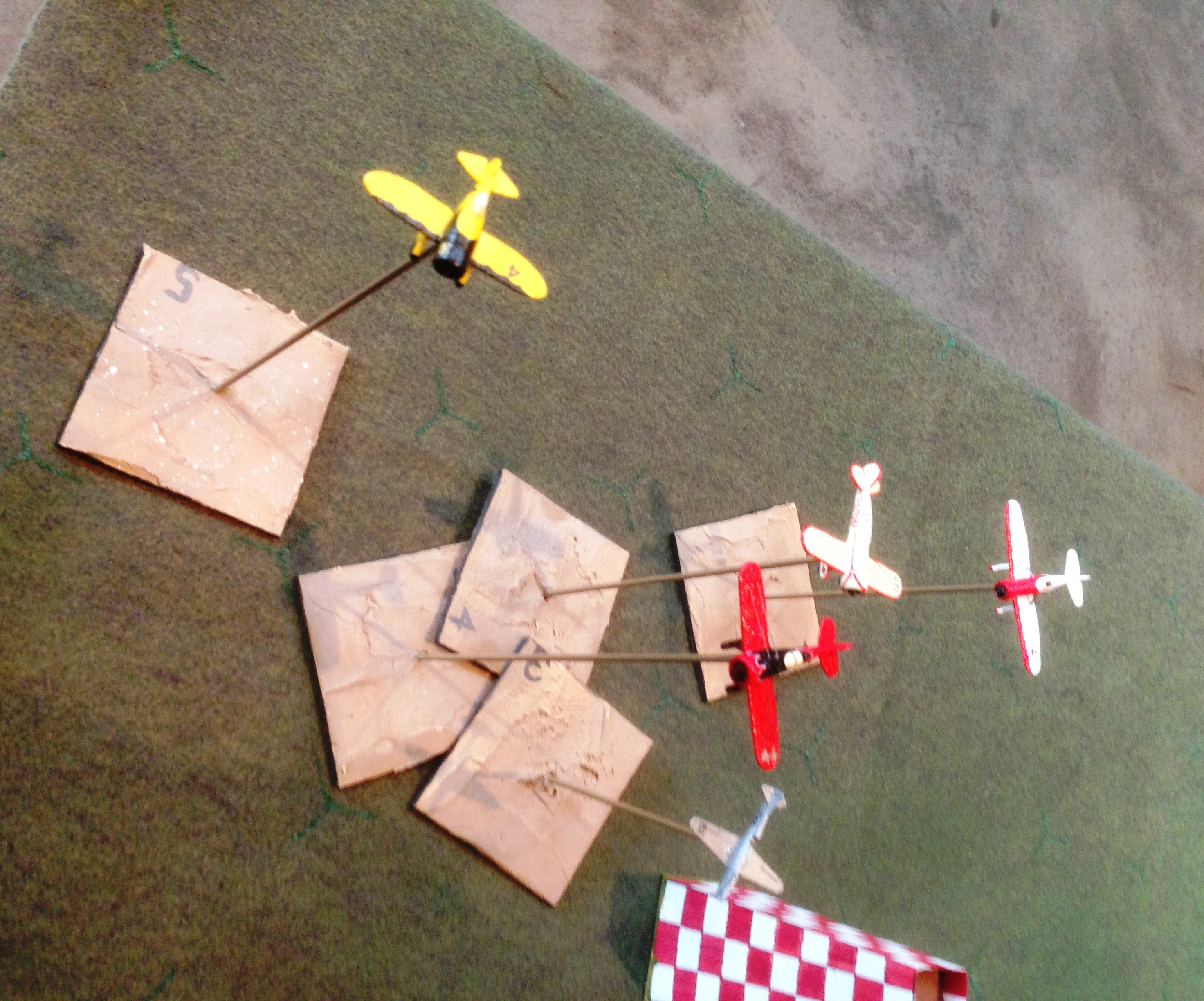
Scrum in turn one.  One of many furballs that kept the pack from catching Joe.

Scrum in turn one. One of many furballs that kept the pack from catching Joe.

Texaco Wins!

Texaco Wins!

The morning session included our annual air racing game.  This year it was won by Joe Waddington who ran a magnificent race.  Joe, usually a victim of his annual lap two crash, led from the get go in the Travelair Texaco 14, and finished a full half lap ahead of the competition.  Not even close. Paul Grandstaff ran a great looking Check Your Six Korea game featuring MiG-15’s attacking a B-29 raid. Scott Murphy ran an X-Wing Fighter game, and Lloyd Bowler and Dave Mebust ran Wings of War.  The afternoon featured more great games.  Andy Hooper ran an Axis and Allies game based on the air raids on Truk Lagoon.  Scott Williams ran a Galactic Knights game.

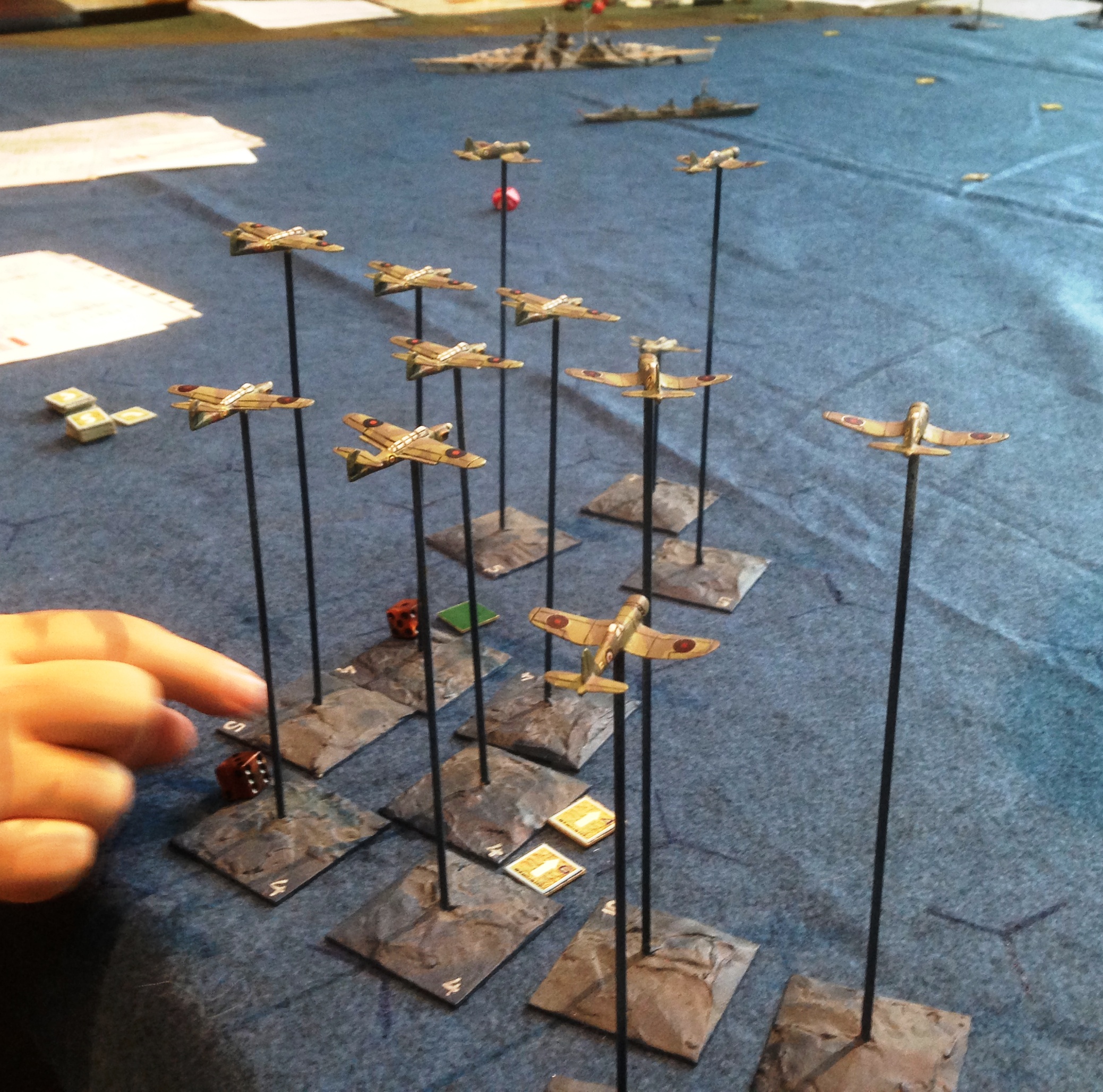
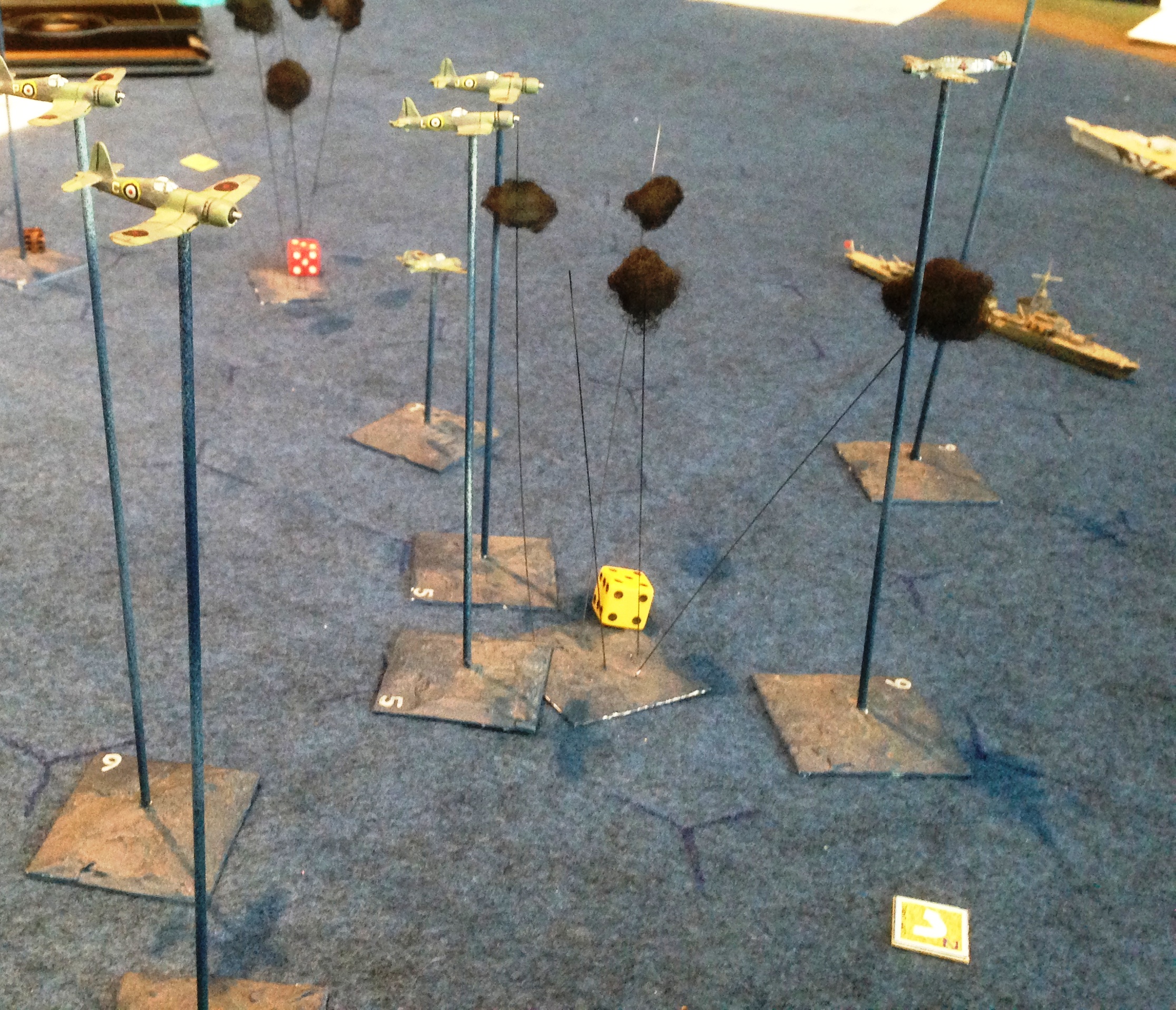
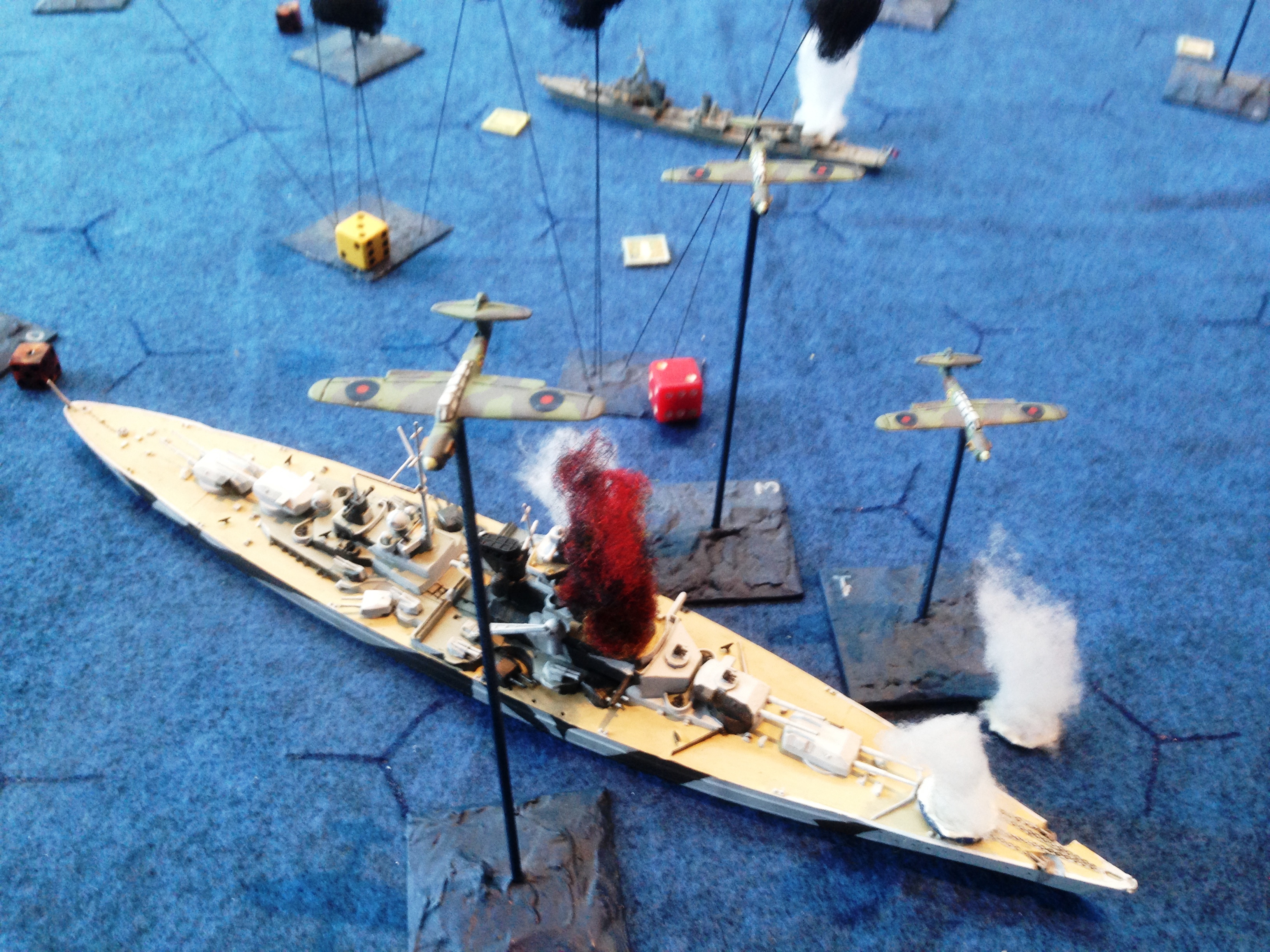
Dave Schueler and I reprised our air attack against the Tirpitz.  This time the Germans had a bit more luck as the British failed their navigation rolls, forcing the forcing the attacking Fleet Air Arm planes to come much farther and face much more flak than at Enfilade.  The intercepting fighters were much more effective at engaging the British defending fighters, and even managed to inflict damage on the bombers.  Though the British did score a couple of hits on the Tirpitz, there was only one critical bomb hit and the Germans were awarded the day.  However, it was determined the Tirpitz was too damaged to be moved and would succumb to the Lancaster raids to follow. Paul

Hannah ran DBA all day.  Some great looking games all around.

Failing their navigation role, the FAA planes plan their course across the board to hit the Tirpitz

Failing their navigation role, the FAA planes plan their course across the board to hit the Tirpitz

The British attack encountered flak and fighters along the way.  The Germans lost two fighters, and the Brits lost a fighter and a bomber before they reached their target.

The British attack encountered flak and fighters along the way. The Germans lost two fighters, and the Brits lost a fighter and a bomber before they reached their target.

The Tirpitz suffered two hits, one critical.  The Germans won a minor victory.

The Tirpitz suffered two hits, one critical. The Germans won a minor victory.

That said, I wouldn’t choose the Space Center again. The floors are concrete and uncomfortable.  It’s darker; players had a hard time seeing the hex grid on my air-racing mat.  We didn’t have quite the walk through traffic and interaction with the museum visitors.  We have a tentative scheduled day with the Museum for Nov. 1st 2014, hopefully in the Great Gallery.  I’ll look forward to returning to our comfort zone under the SR-71.

A Break From the War of 1812


Lights at BladensburgI did it.  All the figures for Bladensburg are done.  I’m freeeeeeeeeee!!!!!

What does it mean?  Project done.  Really, that’s very cool.  I live for projects and when I finish one it’s very exciting because  I can move on to something else.  The real challenge is to stay focused on something long enough to finish it.  Since May, all I’ve painted is 28mm War of 1812.  I’ve completed three American units and four British units, totaling about 225 figures. It’s time to move on. I hoped to have these done by the end of October, and look it’s Halloween.

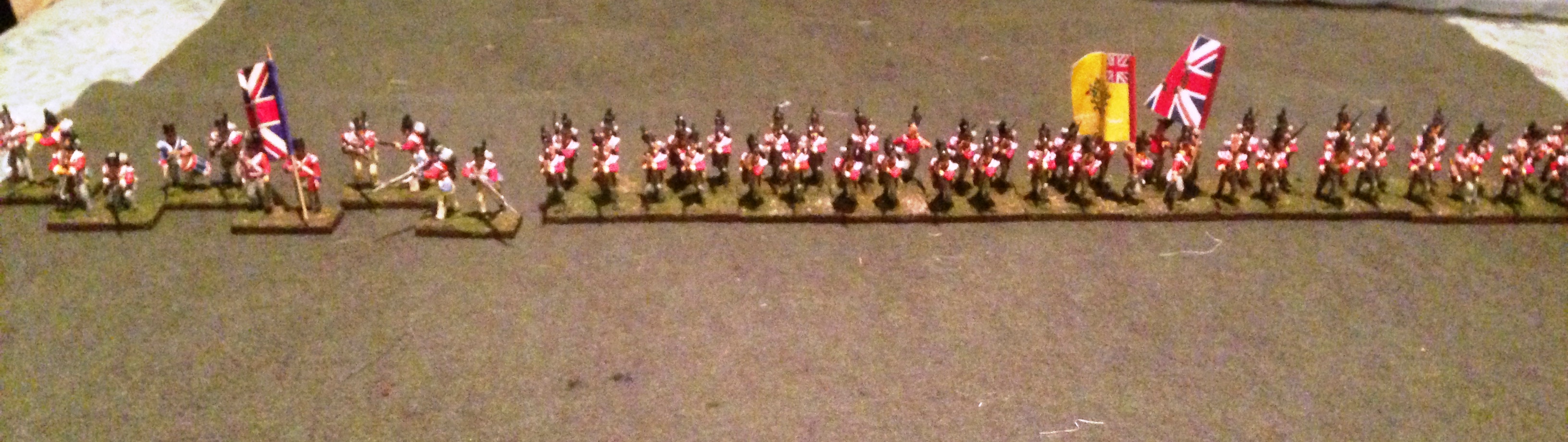
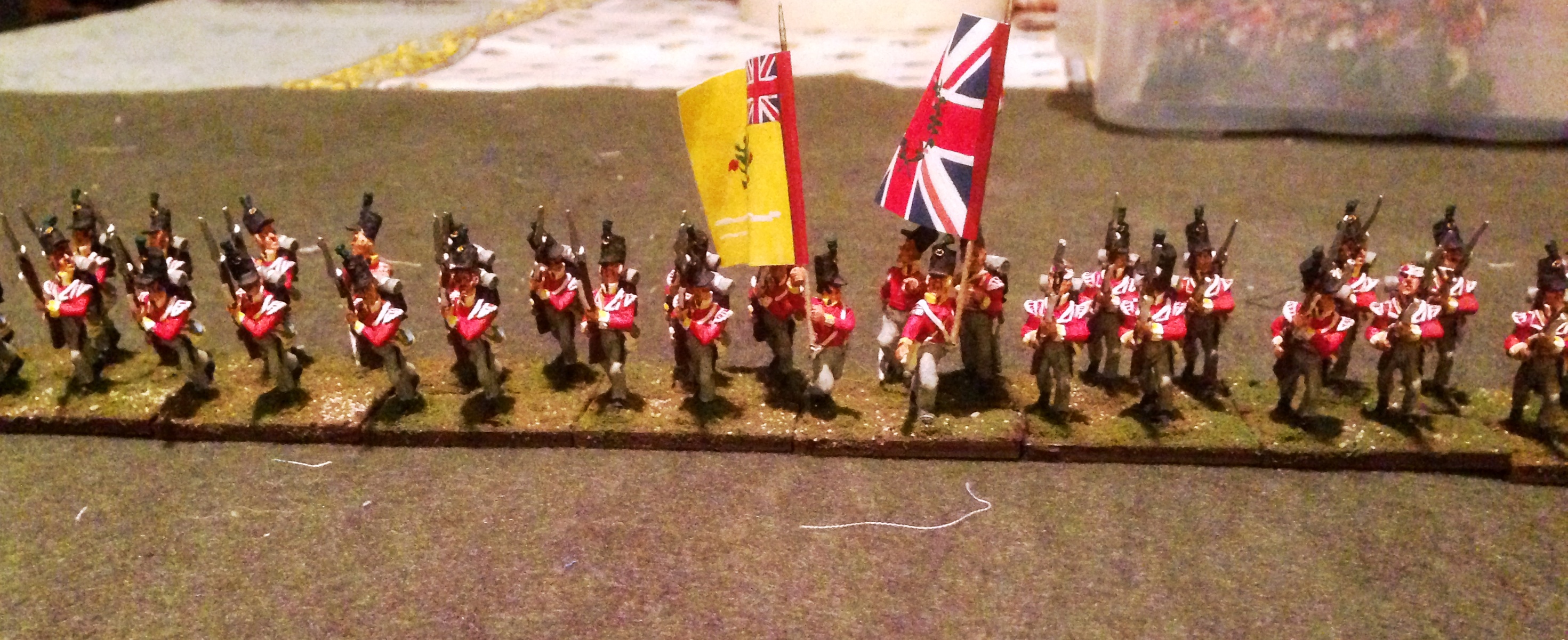
The 85th Regiment is 48 figures, twelve stands.  If I was to extend out the 24 half bases, it would be 36 inches wide.  These are Old Glory figures, traditional, metal 28's

The 85th Regiment is 48 figures, twelve stands. If I was to extend out the 24 half bases, it would be 36 inches wide. These are Old Glory figures, traditional, metal 28’s

I’m probably not going to be quite so disciplined moving forward.  I have some Hundred Years War figures I’m working on, as well as some 28mm Spanish for my War with Spain project.  I have a dozen French knights primed and about half finished.  They’ll contribute to the vanguard division at Poitiers.  I also have the remaining 25 or so figures remaining to paint for the Louisiana Regiment for the Spaniards, and I hope to be done with them in November.

This small unit of converged light infantry is composed of Victrix figures.  They were much easier to work with on the smaller bases.  They actually look kinda nice.

This small unit of converged light infantry is composed of Victrix figures. They were much easier to work with on the smaller bases. They actually look kinda nice.

My goal is to continue working on both these projects until Christmas break.  Sounds like a long time but November 1st is Friday.  Not such a long time.  Then I’ll have to go back to Bladensburg as I ready some terrain pieces and begin play testing.

November is going to be an important gaming month for me.  This weekend, November 2nd is our annual visit to the Museum of Flight.  We won’t be under the SR-71 this year due to a scheduling glitch.  We’re going to be in the Space Center, near the Space Shuttle simulator.  Should be fun.  I’ll be running air racing in the morning and then bombing the Tirpitz in the afternoon with Dave Schueler.

Two weeks later we’re at the Flying Heritage Center in Everett. We reached an agreement with that air museum to host at least one event in their unique space.  I’ll post pictures from both events as we work through them.

Bladensburg and the myth of the rockets

The Battle of Bladensburg was fought under a blazing sun on August 24, 1814. It was a river port town on the East Branch of Potomac River and lies in a valley between two commanding heights to the north and south.  I had the good fortune to visit Bladensburg twice, in 2004 and again in 2012.  It is still a quiet Maryland town that’s seen better days just outside the District of Columbia.  But in 1814 it was a bustling commercial town with warehouses alongside the river trading tobacco, like many other river towns in the Tidewater region.

By the end of of August 1814, many of the waterborne defenses to Washington and Baltimore were gone.  Joshua Barney’s fleet of row gunboats were in ashes.  The naval and land forces commanded by Rear Admiral Cockburn and Major General Robert Ross determined to capture Washington and inflict a humiliating defeat on President James Madison’s government.

Writers across two centuries have spilled many words about the battle that became known as the Bladensburg Races–to denote the speed American militia displayed in departing the battlefield.  My first exposure to this humiliating American defeat came when, as a boy, I read Robert Leckie’s Wars of America, volume 1.  In that book, the journalist historian noted that the American militia were overcome with fear when British rocket troops fired their unreliable missiles at the American defenders and simply fled.  Leckie noted that not even the Zulus at Insandlwana showed more than contempt for these primitive projectiles.

Down through the ages we’ve bought into the notion that the Americans, despite their superior numbers and defensive dispositions, were driven off by a bunch of over-sized skyrockets. Wrong.  Though the Americans held highly defensible ground, their poor dispositions and their lack of training combined with superb British qualities of fire and movement  to doomed the American defense and the nation’s capital. Rocket fire was just a marachino cherry on the sundae.

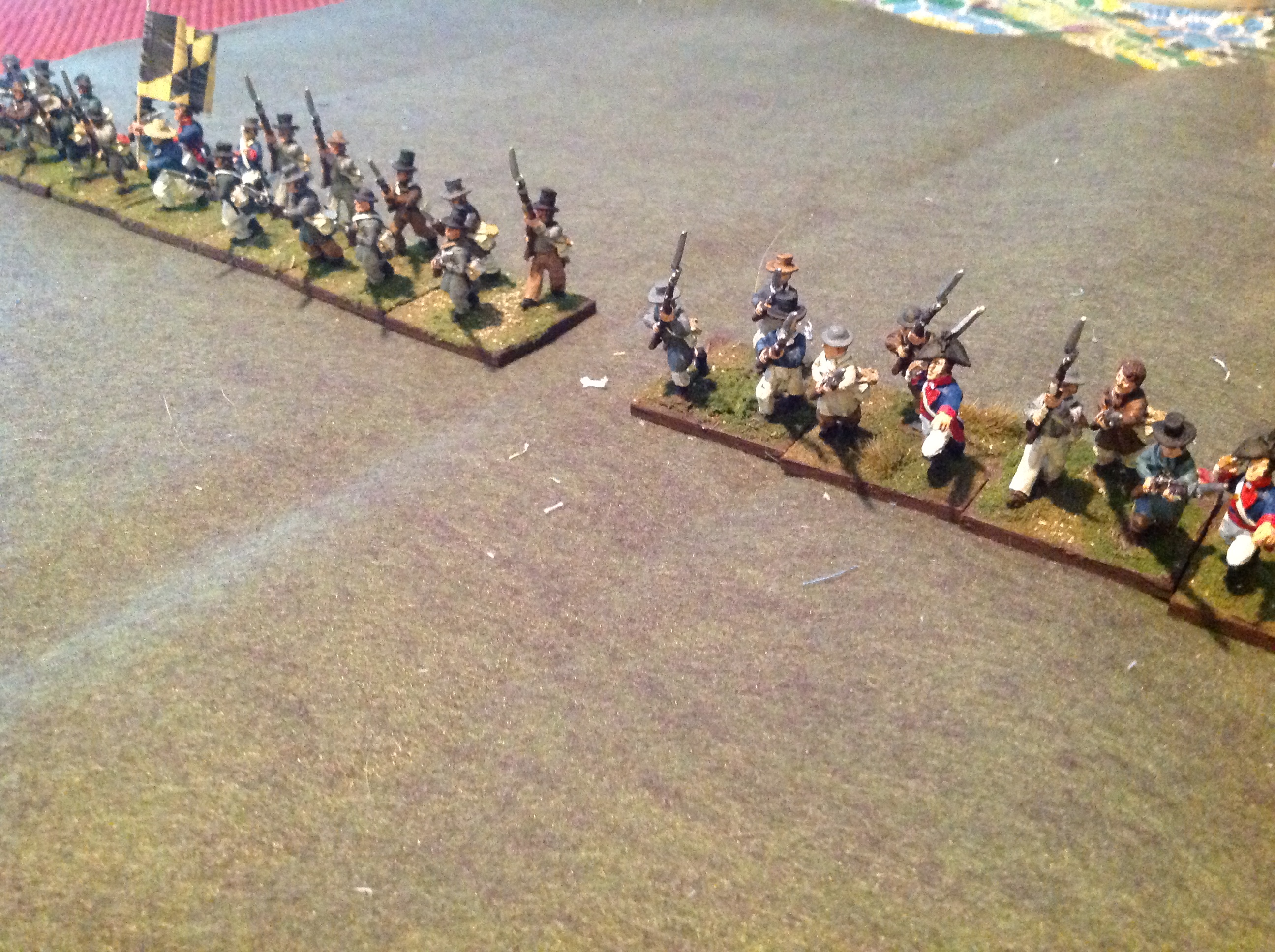
Ragan's and Schutz's regiments of Maryland militia.  That they are un-uniformed represents their general lack of preparedness for action.

Ragan’s and Schutz’s regiments of Maryland militia. That they are un-uniformed represents their general lack of preparedness for action.

First, let’s take a look at the numbers involved in the battle. The Americans numbered some 7, 000 troops, while the British totaled about 4,400.  In addition, the Americans had 18 guns on the battlefield from 6- to 18 pounds, the British had only three light guns that arrived late, plus the 60 or so inaccurate rocket launchers. In game terms the differences become more stark.  The Americans have 72 stands of infantry and 10 sections of artillery.  The British have considerably fewer troops and guns: 54 bases and one section of artillery, plus three sections of rockets.

However, when we break down the armies in terms of quality a vast difference appears between the British and Americans:

Rating/Quality      British bases     American Bases

Elite                        18                        0

Veteran                  35                       9

Trained                    3                       15

Raw                          0                       48

With the exception of Barney’s naval guns, all the American artillery is raw.  Raw troops, infantry or artillery, are likely to shoot poorly, move more slowly and panic under stress. Elite and veteran units are more likely to move faster, accept casualties and shoot better. Add to this, the high quality of the British commanders, the poor quality of the American commanders and the British are much better disposed to move quickly under fire and take advantage of poor American troops.

Though the Americans outnumbered and outgunned the Brits, it’s instructive to examine the battlefield and the American positions.

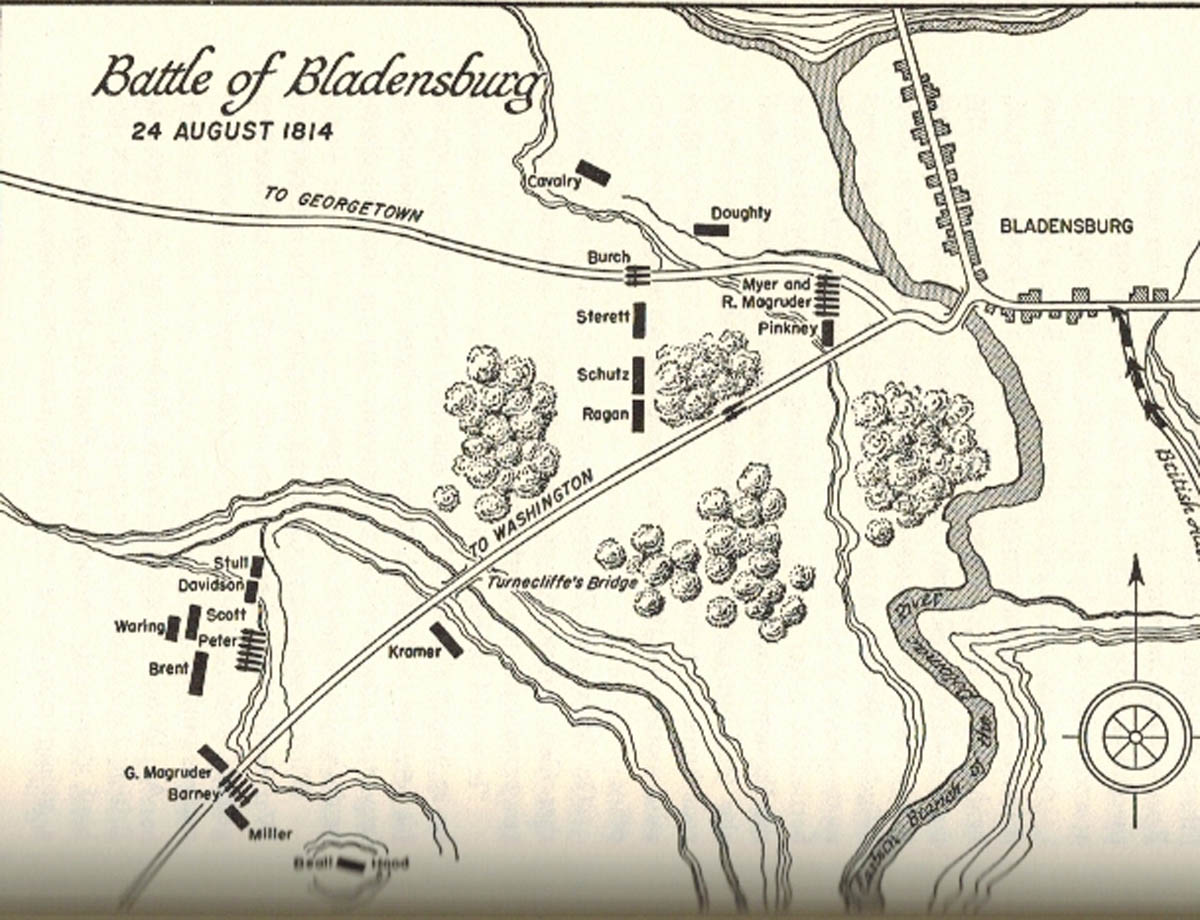
The battlefield is pie-shaped, with the Americans fighting in depth.  The British enter the field across a bridge at the apex of the pie.

A re-run of the Muller map clearly shows the Americans’ position.  The Light Brigade marched straight up the Washington Road, while Brooks’ Brigade works around the American left flank.  Though Barney’s third line inflicted casualties on Thornton’s advance across Turncliffe’s Bridge, they were doomed when Brook’s advanced against his flank from the Georgetown Road.

The American defense is divided between three non-supporting positions.  Facing the bridge over the East Branch are Pinkney’s three stands of raw militia riflemen and three sections of 6-lb artillery behind a poorly constructed earthwork.  Directly behind them, out of supporting musket range is Stansbury’s Maryland militia 23 stand of mostly raw troops and two stands of raw artillery.

The British had to cross a narrow bridge over the East Branch of the river and go through or around the Americans.  However, there were 37 stands of high quality troops to oppose them.  Historically, the light brigade attacked and was driven into the town by heavy fire.  However, when Brooks’ brigade came up in support, they recrossed the bridge and formed skirmish order while Brooks’ brigade moved quickly around the American left flank to the Georgetown Road.  Outflanked and outnumbered, and probably peppered by the annoying rockets, the raw American troops bolted, running away down the Georgetown Road.

It’s unlikely the British even saw the American third line forming on the hillside south of Stansbury’s position.  Eventually Winder would assemble his best troops, Barney’s flotillamen and Miller’s Marines along with semi-trained regulars and raw militia on the high ground blocking the Washington Road.  The Americans 37 stands, mostly raw troops and five sections of artillery held back the Light Brigade for a time, but were flanked out of their positions by Brooks swinging around their left from the Georgetown Road.

American defenses crumbled, despite stubborn resistance by Barney’s troops, and the Americans retreated down the Washington Road.  The road to the capital was wide open.

The British won the Battle of Bladensburg, but the rockets played a very minor role.  The Americans lost because their troops were of generally poor quality, and their disposition was such that their opponents were  were able to fight the Americans in small packets that gave the British qualitative and quantitative superiority against each of the three American lines.

A quick look at the Bladensburg battlefield

I borrowed the map from Charles Muller’s excellent book The Darkest Day so the reader could suffer along with me as I plot some of the challenges of gaming Bladensburg.

The American dispositions require a fairly deep table.  I’m going to try to cram it all on to a 7 1/2′ X 8′ table.

The British enter at the apex of a trianglular road net and must cross the bridge over the East Branch of the Potomac River (the Anacostia.)  Facing the bridge withing a foot will be three sections of artillery and three stands of militia riflemen.  Fifteen inches behind  them are three large battalions of militia infantry and more guns, filling the triangle between the Georgetown and Washington roads before climbing the hill to face the second American position manned by Joshua Barney’s sailors, a few Marines and a host of raw militia.

The challenge is to allow enough space for the British units to maneuver on both sides of the Washington and Georgetown roads and not have them slaughtered by the superior numbers of American cannon. Another challenge is to factor in the poor quality of the American militia, without having them vanish at the drop of a hat.

The battlefield is pie-shaped, with the Americans fighting in depth.  The British enter the field across a bridge at the apex of the pie.

The battlefield is pie-shaped, with the Americans fighting in depth. The British enter the field across a bridge at the apex of the pie.

A Bladensburg OOB

Believe it or not I’m just a few short steps from the finish line on completing my Bladensburg painting.  I may try to make some terrain pieces: possibly some warehouses for Bladensburg town, and a second wooden bridge for the second crossing over the ravine on the Washington D.C. road.  Pictures will follow soon.

Late last week I took a night off from painting and put together an Order of Battle for Regimental Fire and Fury.  It’s my plan to use these rules for our Enfilade game.  Mark used them successfully for Crysler’s Farm and I’ve run Hobkirk’s Hill using these rules. In any case here is what I came up with. Incidentally, Osprey will be issuing a battle book on the Chesapeake Campaign of 1813-14, so I’ll be interested to see if they come up with some numbers.

The Americans have a superior tactical position to the British and vastly outnumber them in artillery.  However, most of the troops, including the guns, are raw, which is a minus both to fire and morale. The British Army is very good, and though they must cross the lower bridge under fire, maneuver quickly, and must take advantage of their superior mobility.  I’ll post a map and some pictures soon.

Americans

C in C General Winder-poor

Pinckney’s Command-poor

Pinckney ‘s Rifles (3 stands)

3/-/2  Raw

Myer and Magruder’s  Maryland artillery

Three  sections light guns-raw

Doughty’s Rifles (smoothbore armed)

3/-/2  Raw

Doughty begins the scenario as independent and must move out of command

Stansbury’s  Brigade-able

5th Maryland  Militia Regt.

9/7/5     Trained

Schutz’s  Maryland Miliitia

7/6/5 Raw

Ragan’s Maryland Militia

7/6/5  Raw

Burch’s Maryland Artillery

Two sections light guns-raw

Winder Arrives with reinforcements on turn one

Scott’s Regulars

6/5/3 Trained

Joshua Barney-Gallant

Miller’s  Marines

3/-/1  Veteran

Barney’s  Flotillamen

6/4/2  Veteran

Barney’s Naval Artillery

One section siege gun, one section heavy gun (move as siege guns)

Turn three arrival

Magruder’s  Brigade–poor

Beal’s Annapolis Militia

6/5/4  Raw

Morrison’s Annapolis Militia

6/5/4  Raw

Kramer’s  Maryland Militia

4/-/3  Raw

Peter’s District artillery

Three sections light guns-raw

Turn four arrival

Smith’s District Brigade—poor

Waring’s  Battalion

4/-/3  Raw

Stull’s  Battalion

4/-/3  Raw

Maynard’s Battalion

4/-/3  Raw

1.        Pinckney’s command  begins behind an earthwork 8” in front of the lower bridge across the Anacostia River.  Myer and Magruder’s  artillery may not fire at targets closer than 4” because their embrasures were poorly constructed.

2.       Stansbury’s  command was recently placed in “improved” positions by Secretary of State Monroe and may not advance until turn seven, or unless personally led by General Winder

3.       Magruders Brigade and Smith’s Brigade may not deploy if they are outside Winder’s command radius

British Order of Battle

Commander in Chief

General Ross-Gallant

Thornton’s Light Brigade-Gallant

Converged Light Infantry

6/4/2  Elite

85th Regiment

12/8/5  Elite

Marine Light Infantry

3/-/1  Veteran


Arriving turn 2

2nd Brigade-Brooks-Able

4th Regiment

8/5/3  Veteran

44th Regiment

8/5/3  Veteran

Royal Marine and Royal Artillery Rocket troops

Three sections rocket artillery

 Arriving turn 5

3rd Brigade-Patterson-Able

21st Regiment

8/5/3  Veteran

3rd Battalion Royal Marines

8/5/3  Veteran

Colonial Marines

3/2/1  Trained

One section light artillery

Turn one begins with the Light Brigade in march column attempting to force the bridge crossing over the Anacostia.  Turn three, the British can discover the ford guarded by Doughty’s pitiful unrifled riflemen.

Plodding toward the finish line

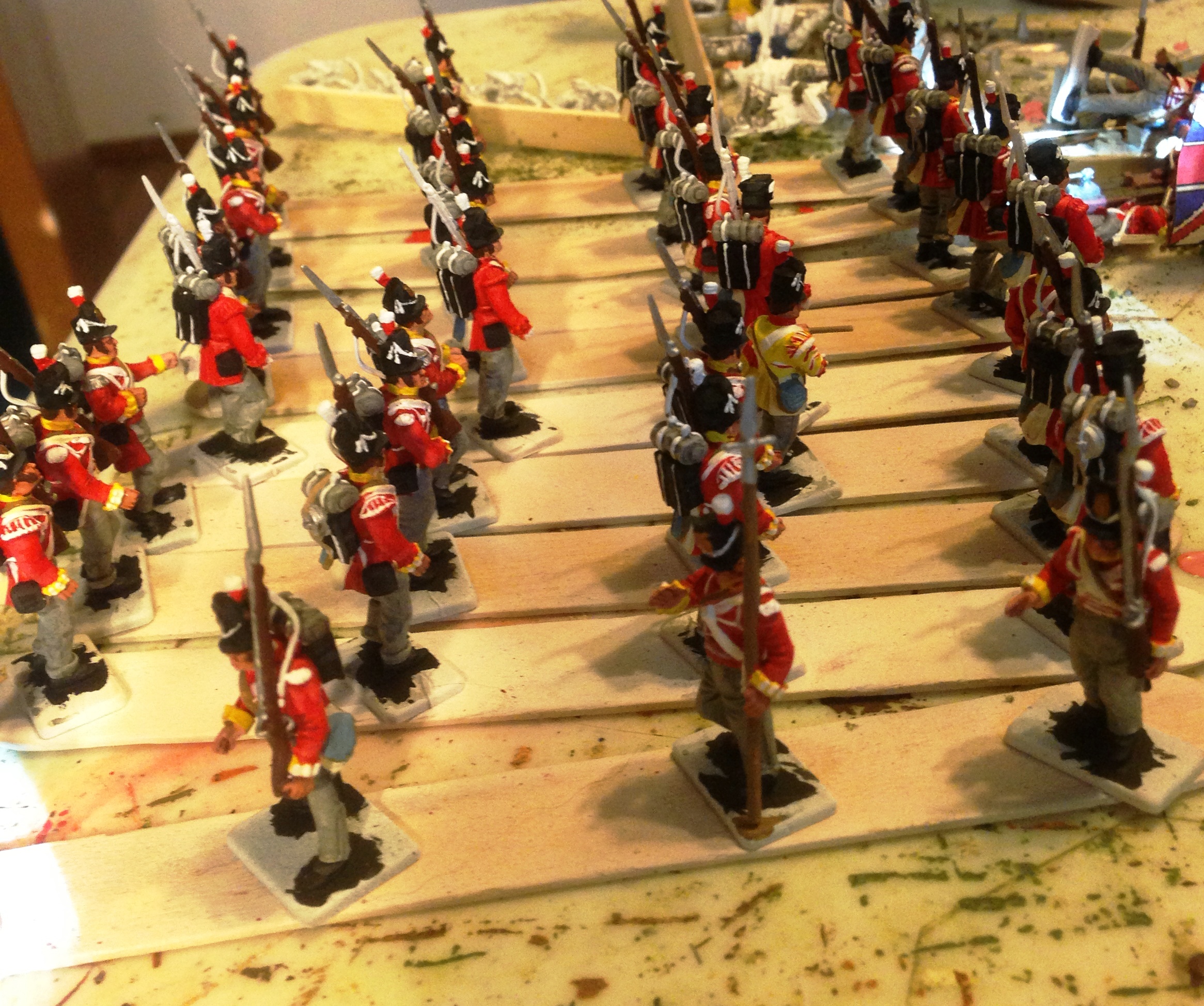
The 44th Regiment waits to be mounted and flagged.  There is an extra stand not quite finished in the middle of my painting sticks.

The 44th Regiment waits to be mounted and flagged. There is an extra stand not quite finished in the middle of my painting sticks.

I’ve been working on just my Bladensburg project since May.  With so many other things I want to do, it’s beginning to feel a little like the Chinese water torture.  Even though I seem to have acquired the September version of this year’s school-directed biological warfare, I’ll likely drag myself into my den for an hour or so painting.  Why?  So I can be free, of course.

I whine, I fuss, I whine and I fuss, but I have been productive.  Here’s what I have painted since Enfilade:

Two-24 figure un-uniformed battalions of Baltimore militia:     48 figures

One-48 figure British light Infantry battalion (85th Bucks L.I.): 48 figures

Three-32 figure British line infantry  (4th, 21st and 44th regts.) 96 figures

This weekend, all things being equal, I will finish Scott’s battalion of U.S. regulars (elements of 12th, 36th, and 38th regts.) 24 figures.

That will leave 24 more of the evil Victrix Brits to assemble and paint, and seven mounted British commanders by Old Glory.  All that will remain of Bladensburg is the playtesting and some terrain making.

Scott's regulars are nearly finished.  I'll probably put an hour or so into painting them tonight, sick or not.

Scott’s regulars are nearly finished. I’ll probably put an hour or so into painting them tonight, sick or not.

On the positive side of all this, I’ve always wanted to do Bladensburg.  Sheer distance between Surrey and Puyallup makes it difficult to playtest it effectively sharing figs with Doug, and it’s a damn fiddly game if the British are to have a chance.  So I’m excited to have the whole kit and kaboodle under my own roof.  Needless to say, when, it’s all over I’ll have painted 225+ figures toward completing the project as well.

Fix Bayonets: Back to the Future

I love Fix Bayonets.  It’s a small gathering hosted by the Fort Steilacoom Historical Association (or something like that,) a preservation group aimed at keeping up the oldest buildings in Western Washington.  Each year Lawrence Bateman and Damond Crump host a modest gathering in one of the original fort buildings and we play a day’s worth of games for a modest entry fee that goes toward the many needs of the maintaining the site.  It’s a nice fundraiser for them and we certainly have a good time.

I was particularly looking forward to yesterday’s event, because I hoped to see an old friend there.  Scott Appleby recently joined the NHMGS Facebook page, and I had my fingers crossed he would be at this event.  I played Fire and Steel Napoleonics with Scott back in the 70’s and 80’s.  But as I gradually became more involved with NHMGS and took on different projects we lost touch.  I hadn’t seen him in twenty years.  So when he came to the event I was thrilled.  It made my day.  A semi-truck could have backed over my hydroplanes, and it still would have been a very good day.

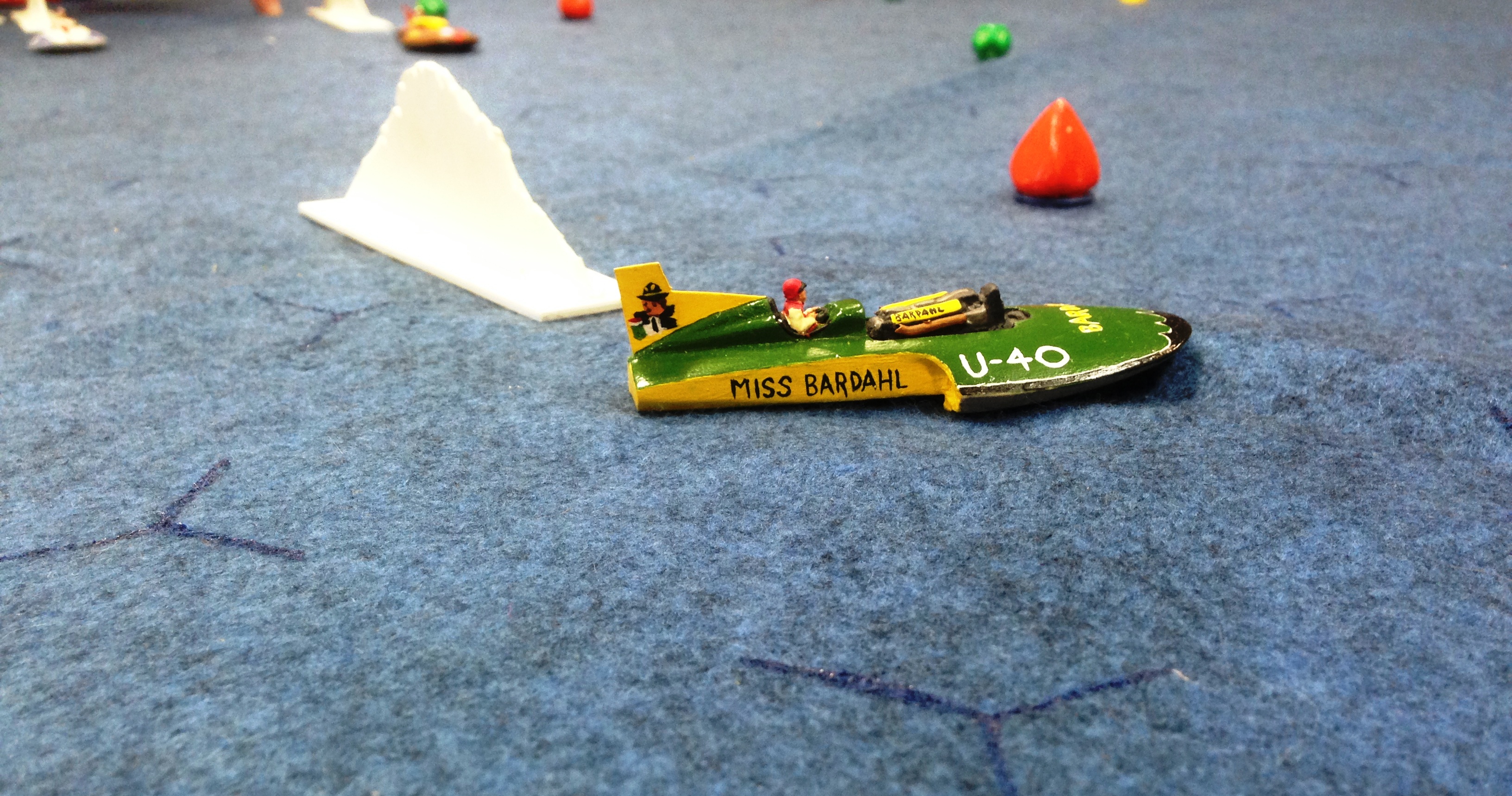
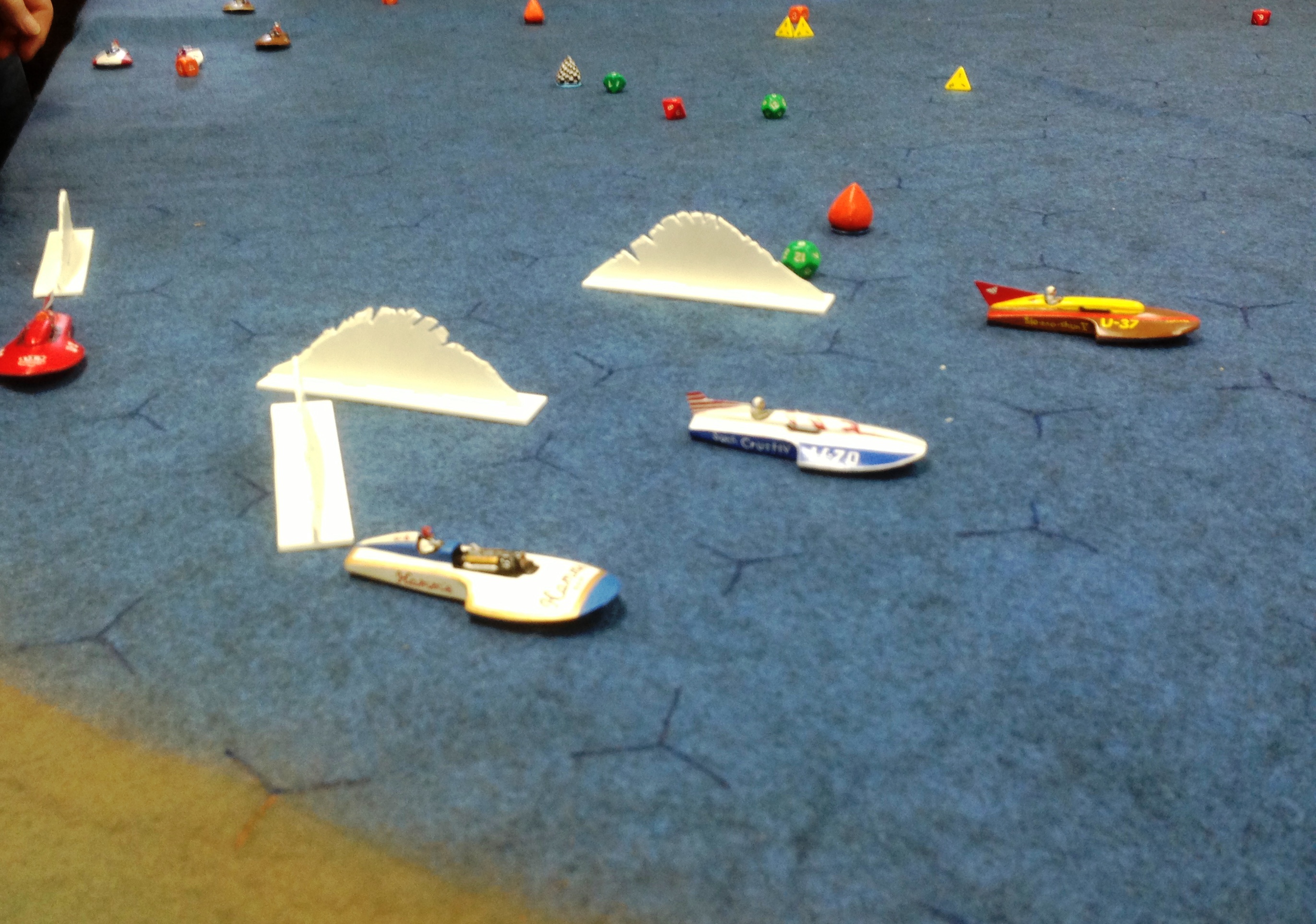
I ran a Thunderboats game in the morning period.  It’s a great game for gatherings like this because after the first twenty minutes it almost runs itself.  It was actually an exciting game because my friend Chris Bauermeister, who always has terrible die rolls in my games, had stupendously good die rolls.  He got off to an early lead in the Miss Bardahl that he never relinquished.  In fact it was never even that close.  Bill Vanderpool and Al Rivers both bought nitrous bottles, used them and both had some interesting moments with flames. There was lots of risk-taking, which makes for a fairly fun game.  I went through an entire deck of event cards-a first.  But, with a lot of risk taking goes a high attrition rate, and four boats did not finish.  Still a lot of fun, as Thunderboats usually is.

Chris Bauermeister rolled a twelve on a 12-sided die on turn one and never looked back.  Miss Bardahl won the race quite comfortably.

Chris Bauermeister rolled a twelve on a 12-sided die on turn one and never looked back. Miss Bardahl won the race quite comfortably.

A look at the also-rans coming into turn one.  Scott Appleby, racing Doug's Hamm's Beer boat didn't survive turn two.

A look at the also-rans coming into turn one. Scott Appleby, racing Doug’s Hamm’s Beer boat didn’t survive turn two.


There some other interesting looking games in the morning session. Scott Williams brought up his Galactic Knights game from Olympia.  Bruce Smith also ran a pre-dreadnought naval game.

We dashed down to Steilcoom to our favorite sandwich shoppe for lunch and I got to talk to Scott and some of the guys a bit longer.  Scott is also a teacher so we talked some shop, as well as about the Huskies.  So it was a good time.

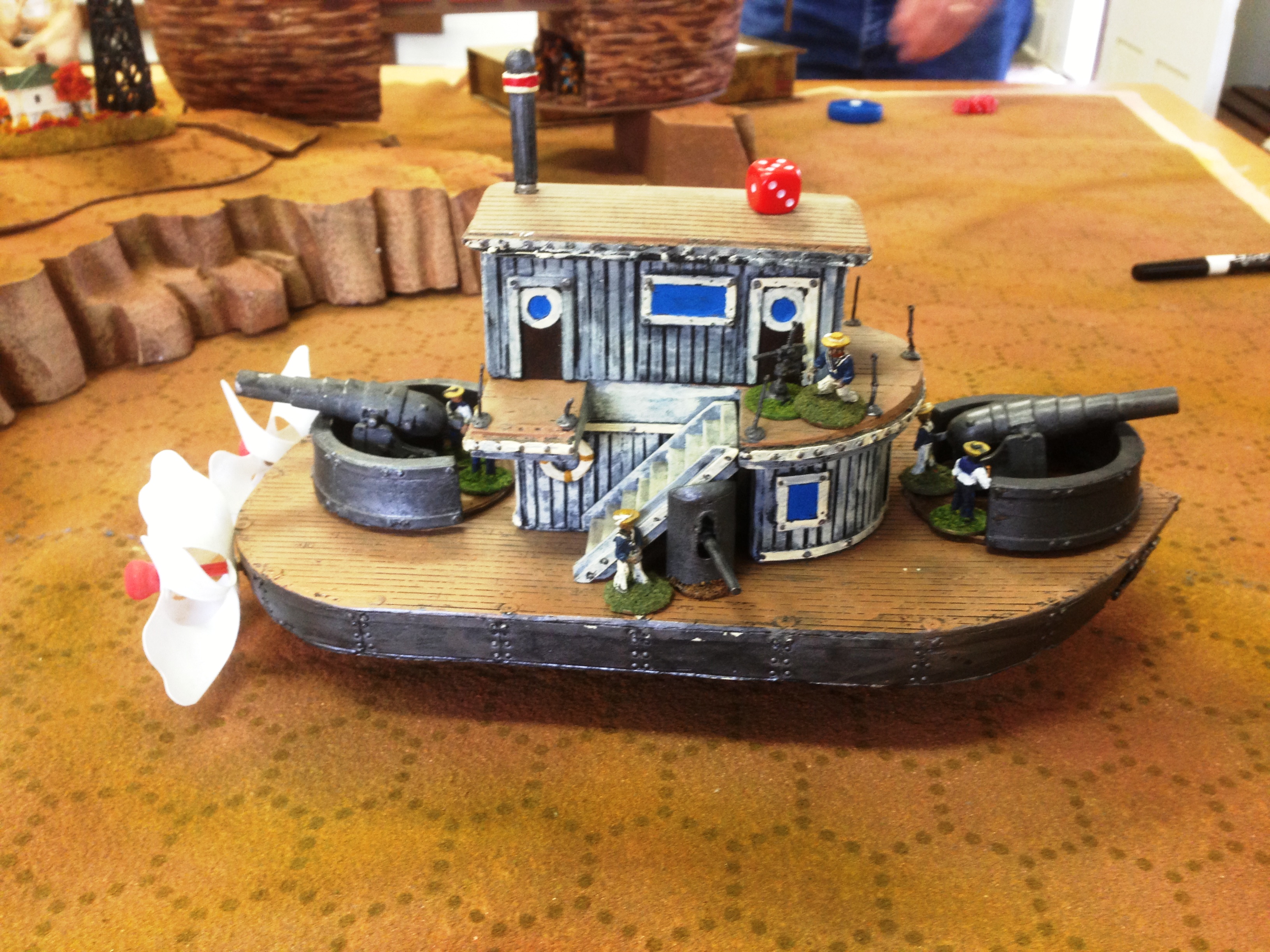
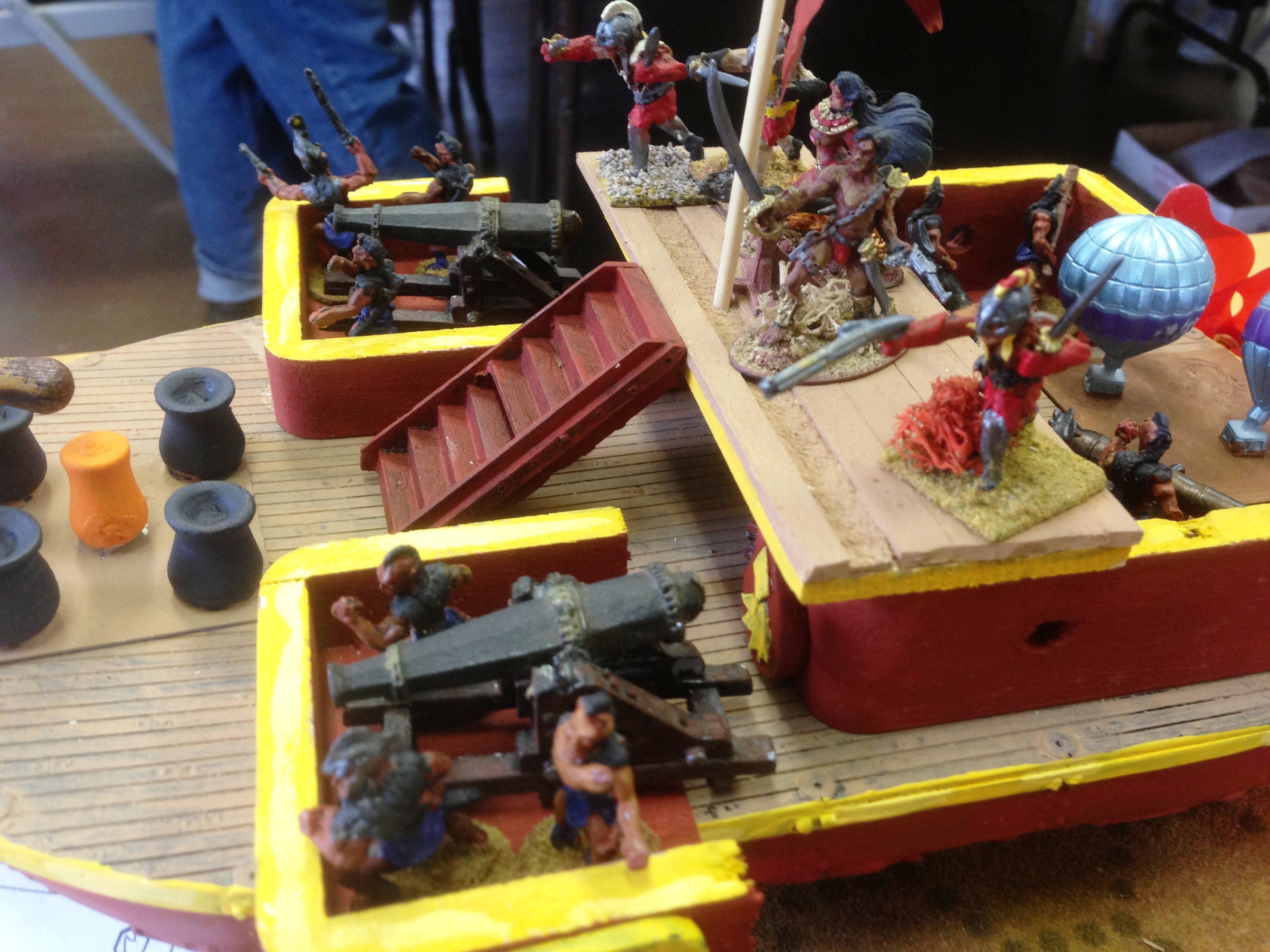
During the afternoon session I decided to play in Hugh Singh’s 28mm Sky Galleons of Mars game. I’m a sucker for SGoM, so it didn’t really take a lot to convince me to play.  Hugh converted  three Stonehouse Miniatures resin gunboats into flying vessels for Mars. He did a really nice job using some Houston’s Guns  and crew for the armament, as well as using some interesting bits for Martian tether mines and fire pots.  Very nice and very serviceable.

Hugh Sing's Austrian gunboat was quite a death dealer at Fix Bayonets

Hugh Sing’s Austrian gunboat was quite a death dealer at Fix Bayonets


I really liked the touches on Hugh's Martian sky galley.  The firepots fore and the tether mines aft are quite nice.

I really liked the touches on Hugh’s Martian sky galley. The firepots fore and the tether mines aft are quite nice.


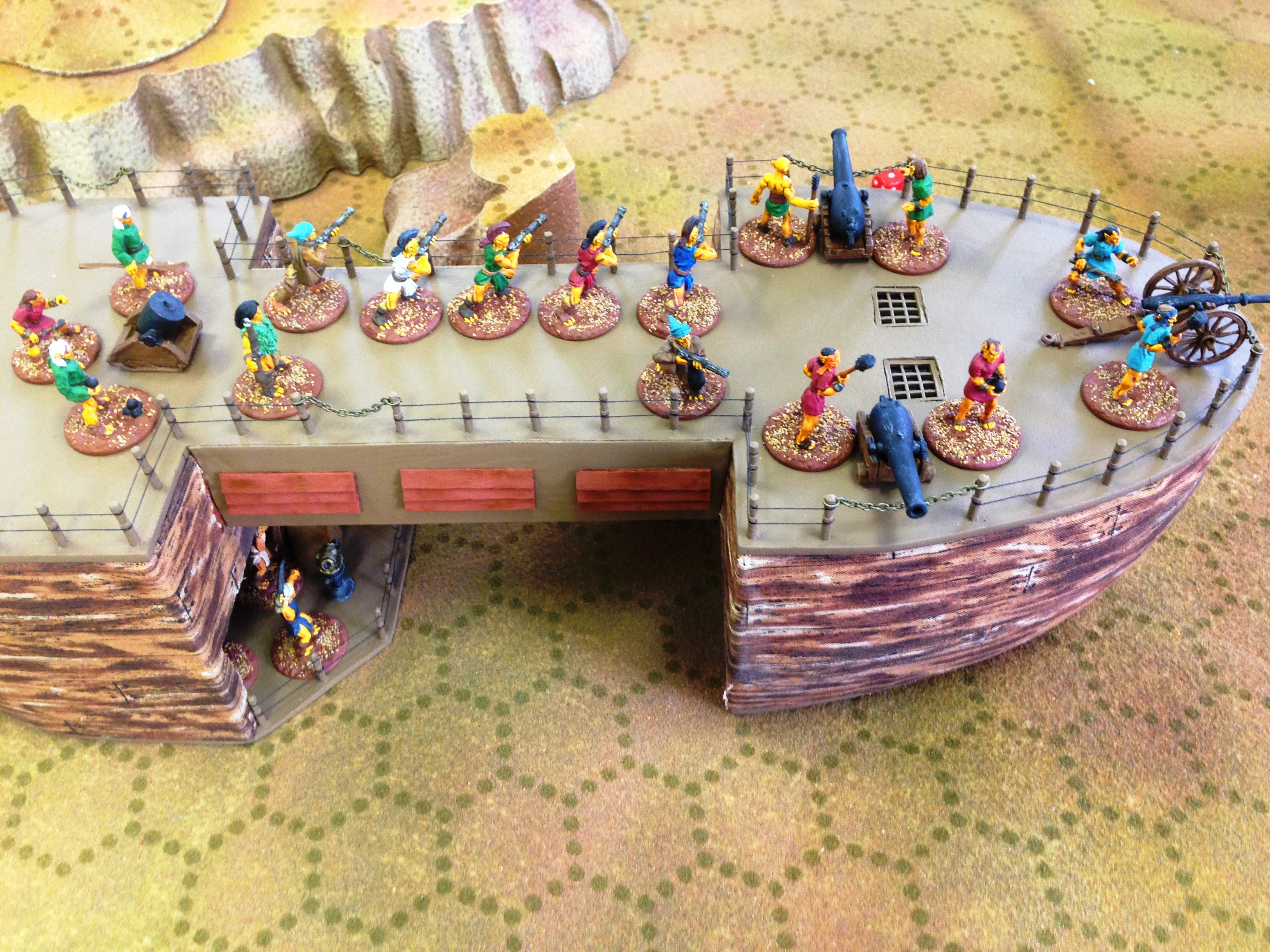
Gene Anderson brought up his vessel from Centralia, a gorgeous (and huge) Endtime screw galley.  Gene constructed the deck and skeleton from plans and covered the hull with planking fabric and coated it with liquid starch.  It looked amazing, and takes its place alongside Mark Waddington’s Aphid and Ranger as examples of superb modeling.

Gene Anderson's Endtime gunboat is an exquisite model.  Constructed using fabric coated with liquid starch, Gene was able to achieve the unique shape of the most common Martian ship.

Gene Anderson’s Endtime gunboat is an exquisite model. Constructed using fabric coated with liquid starch, Gene was able to achieve the unique shape of the most common Martian ship.

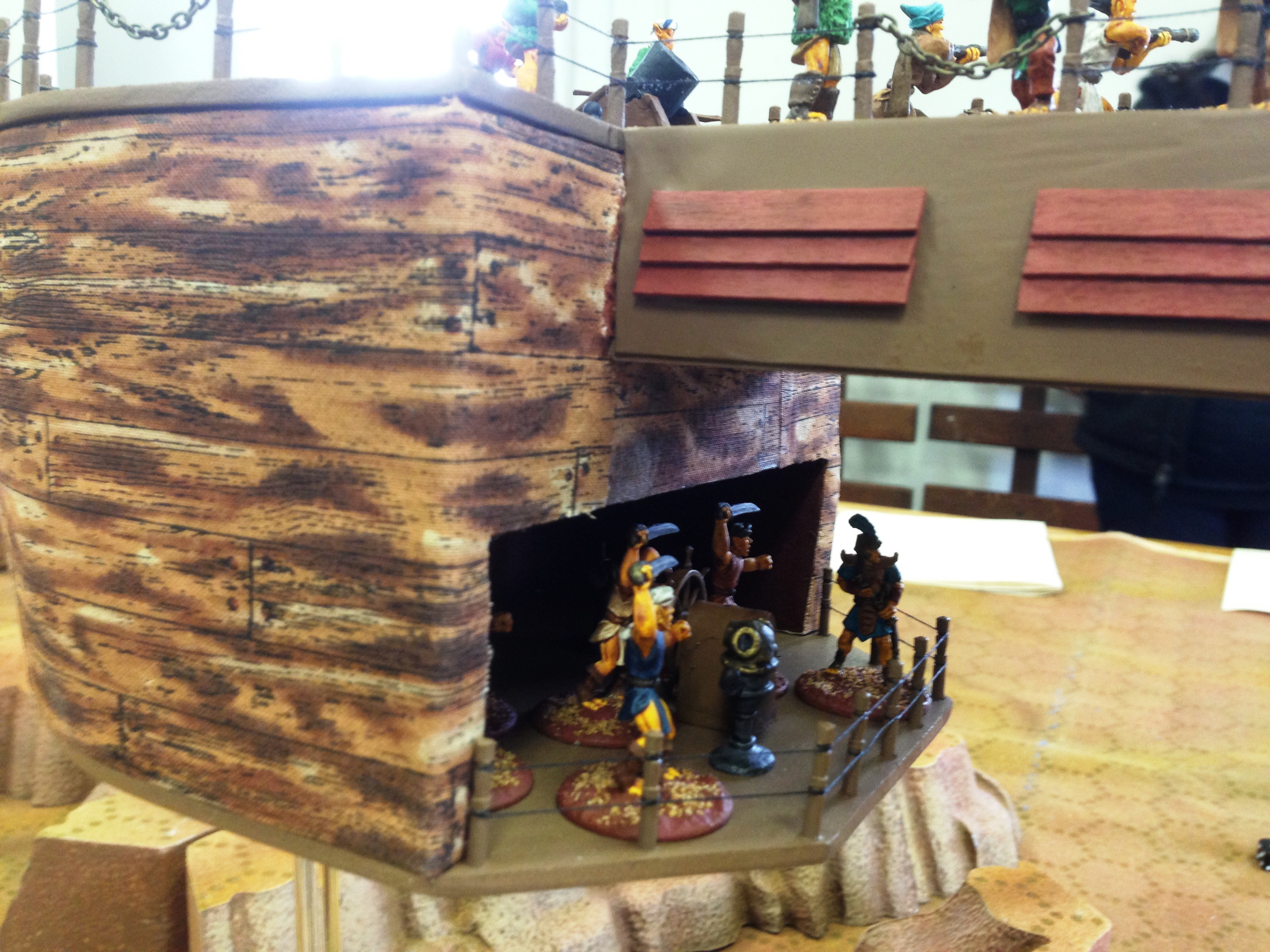
The nicest touch to the Endtime model is Gene's creation of the bridge in the lower hull.  Great work Gene.

The nicest touch to the Endtime model is Gene’s creation of the bridge in the lower hull. Great work Gene.


Unfortunately bad things often happen when a single Martian vessel takes on an Earth gunboat.  I commanded Hugh’s Austrian gunboat with two long 4″ guns.  It was fast enough to keep the bigger Martian craft from closing and with superior firepower, slowly began to pound the Endtime to pieces.  When we decided to call the game, the screw galley lost all but one of its guns and the crew was about 50%.  It was having difficulty maintaining altitude, and with about a third of its turncranks dead, was half the speed of my vessel.  I took only slight damage to my hull and crew.

Word is out that there are plans for a big 28mm Sky Galleons game at Enfilade. That would be pretty to see, but we sure need to plan how to run it. That will require quite a bit of room.

There were some other great games in the afternoon period too.  Chris B. hosted a Cold War armor battle.  Bruce ran a big Korea vs. Japan ancients game with some pretty smooth looking rules. Paul Grandstaff hosted a Check Your Six game.  Bruce Smith ran a very cool looking post-apocalyptic game in a very trashed city.

Everyone seemed to have a good time, and the organizers were pretty happy with the support.  It was an early in, early out kind of day, and I was able to be home by 3:30 to see most of the Huskies game.

The Ol’ Perfesser Explains His Project

One of my projects is the hypothetical conflict between the United States and Spain.  No, not the Spanish American War of 1898, the one that didn’t get fought between say 1795-1810.  Yes, I know, no blood was shed in this conflict, but it could have and nearly was on several occasions.  I shared this project on my old Blogger site (God rest its soul, and thank you Google,) but I took a break from it last year as I focused on other things.  However, as Bladensburg begins to wrap up and I can look forward to other plans, I am drawn back to this project.  I envision this post as one of several that explains a bit about this period, and my thinking around it as potential games using miniatures from the era, so bear with me.  But if you see something interesting here, or have some ideas of your own, let me know.  I’d love to hear about it.

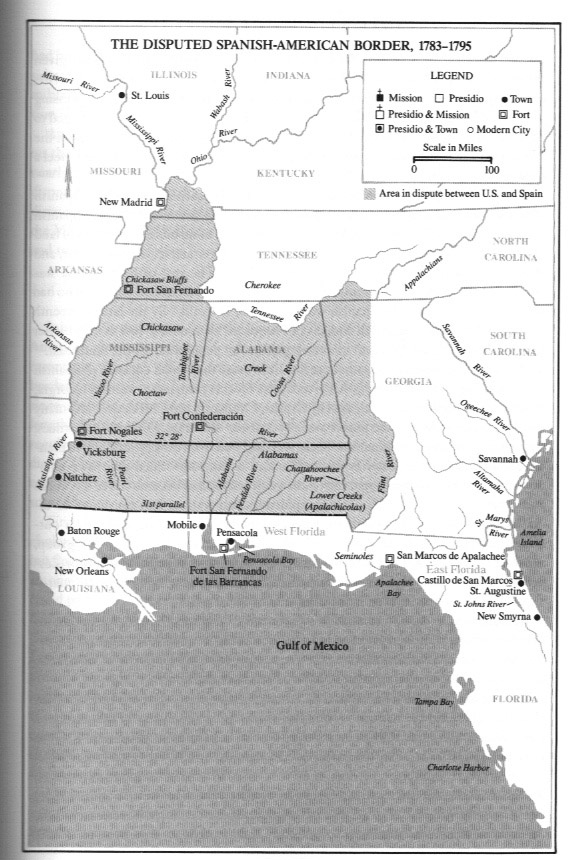
We all know the British, by the terms of the Treaty of Paris that ended the American Revolution ceded its territory south of the Canadas and west to the Mississippi River to the United States.  Unfortunately, that did not include all of the territory on the east side of the Mississippi.  There was still some prime real estate that remained in the hands of that sometime American ally, Spain.  The fortress of Pensacola, the excellent harbor of Mobile, and the real gem, New Orleans, were all controlled by Imperial Spain.

This map shows the disputed territory between the U.S. and Spain 1783-1795.  Map from The Spanish Frontier in North America by David Weber.

This map shows the disputed territory between the U.S. and Spain 1783-1795. Map from The Spanish Frontier in North America by David Weber.

By 1783 the Spanish Empire was more than a little bit rickety.  Unable to compete economically with France and Great Britain, many of the Spanish settlements in the borderlands were weak, and barely able to defend themselves against aggressive Native American tribes such as the Apaches and Comanches.  Spaniards were always a minority in their own provinces, had difficulty attracting settlers, and lacked the resources to entice colonists or adequately maintain defenses.  Though a series of reforms in the 1780’s allowed the Spanish to make peace with their native neighbors, by the late 1790’s the United States, having won their own peace with their northern native enemies, was knocking on the door of the Spanish borderlands.  Lacking a large professional army, Americans frontiersmen frequently penetrated and settled Spain’s frontier, challenging Spanish authority and threatening Spanish rule.

Though the Paris peace of 1783 awarded Spain, as a victorious American ally, the key strongpoint of Pensacola, as well as East and West Forida, they persisted in claims of land in upper Alabama and Mississippi. American settlement and economic development, well beyond the subsistence level in the Ohio River valley, required getting goods to market through Spanish New Orleans. It made that port city a target for war cries from the new west.  Historical face offs at places like Nacogadoches, Natchitoches, and the Burr plot to seize New Orleans, Louisiana and Mexico itself make a hypothetical conflict with Spain seem less like a historical maybe, and more a miracle war didn’t actually happen. Though Spain gradually retreated from its borderlands through a series of diplomatic negotiations until Mexico’s independence finally put an end to Spanish rule in America in 1821, a potential conflict with the United States makes for interesting game possibilities.