Got my painting shoes on

There are times during the school year when my life simply is taken over by forces beyond my control.  Between February 1st and April 15th, it certainly feels like my life is often not my own.  There are newspaper deadlines and yearbook deadlines.  JagWire has its big annual fundraiser with all the bureaucratic hoopjumping and customerservicing that goes with it.  I have to plan for our attendance at the national student journalism convention which involves all the work of getting Congress to pass a law. Add to that, the convention is in Seattle, so I’m somewhat involved in planning and hosting the event and you can see where this is going.

But it’s early Saturday of President’s Day weekend.  I have four days off, and I’m hoping to get a lot of project work done.  Yesterday I sent prints off to our publisher. That’s three consecutive 15 hour days.  Last week I Photoshopped 360+ pics from our Father Daughter Dance fundraiser, and sent them off in over 185 e-mails to some fairly illegible e-mail addresses.  I’ve earned a little down time.

img_0048

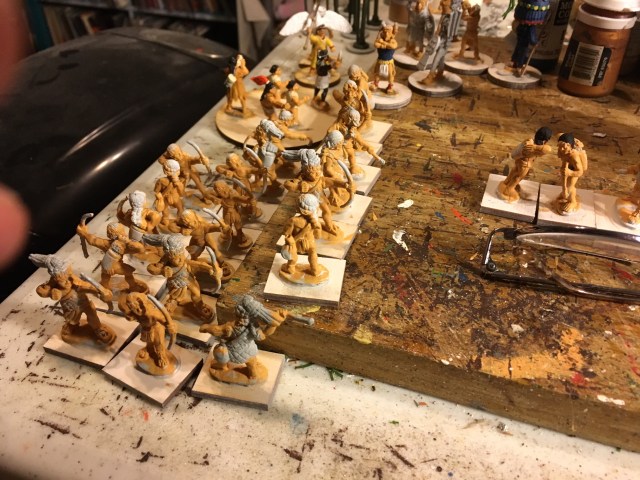
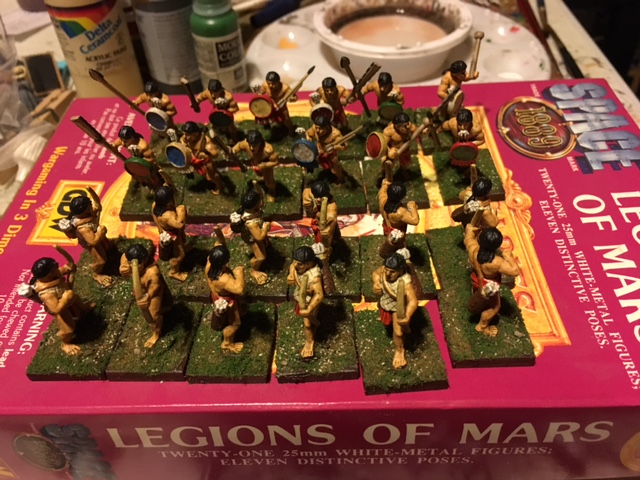
Outpost Tlaxcalan slingers and bowmen.  I like these miniatures.  I have 48 or so of their figures.  They have nice detail, but are a little chunky.  Not quite as good as Eureka, bigger than The Assault Group-but a whole lot easier to work with. a real pleasure.

I’m going to be balancing work between my two big Enfilade projects.  I’ll be continuing work on my Tlaxcalans for my renamed “Foraging Expedition” scenario for Enfilade. I’m now calling it “Craving Corn in Xomilicho.”  It’s been two weeks since our little Drumbeat disappointment.  David and I have messaged each other back and forth, and I hope to do a bit more this weekend.  We’ve agreed on some scenario changes we can work out the next time we get together in March. This weekend, I’m hoping to paint 24 Outpost Tlaxcalan skirmishers and some “mulligan” markers players can use to re-roll one critical die roll for Quetzacoatl Rampant. Pictures Tuesday.

I’ve also begun to work on my second project, my annual doin’s with Dave Schueler.  We’re calling it 13 Days, and it is based on a hypothetical air attack on Cuba during the Cuban Missile Crisis.  I have a really sick fascination with this event.  Mostly it’s based on an admiration for Kennedy and Kruschev, and that they somehow managed to avoid incinerating both countries, when so many others were urging them to do exactly that.  Dave and I tinkered with the basis of a simple game at our Museum of Flight gig in November, and now I’m amping up the stakes with some better scenics, and an actual IRBM battery defended by a SAM site and Soviet-built planes. The American forces will have some period U.S.Navy planes-F-8 Crusaders, A-4B Skyhawks, and F3H Demons to make an attack.  Dave is including an option for early F-4B Phantom II’s in the mix as well.

img_0050

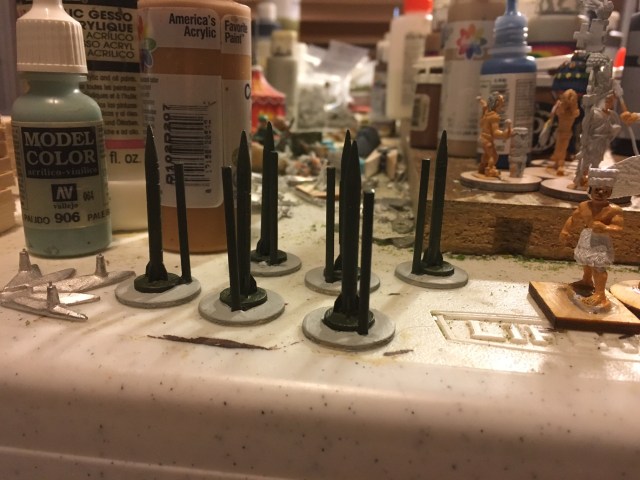
GHQ’s SCUD B’s masquerading as Soviet SS-4’s for my 13 Days project.  Created with bits of dowling and basswood to form the missile launch pads. 

In any case, I’ve built some representative missiles, using the GHQ SCUD B miniatures, sans launchers, to put together simple pads to represent the SS-4 Sandals deployed to Cuba in 1962.  The missiles are mounted on some simple basswood rounds for launch pads, on concrete pads as they would have appeared in Cuba. A piece of dowing serves as an erector. It’s a start.  I’ve ordered lots of visual bits from GHQ.  Russian trucks, fuel bowsers, some buildings and tenting. My big challenge is going to be creating the requisite missile bases and defenses as they were dug out of the Cuban jungle.  More as the work gets done.

I’m hoping, with luck, to not only finish the Tlaxcalan slingers, but also at least get started on some of the 18 Soviet fighters-MiG 15’s, 19’s, and 21’s, I bought from I-94 Enterprises, all the excellent Raiden miniatures, for this project.

Again, updates on Tuesday.


Improbabilities

Imagination.  Historical miniature gaming really should be all about imagination.  I know there will be plenty of you out there who shake your head and think, nah, that’s the other guys, the fantasy and sci-fi dudes. But think about it–40K is about the point system, buy GW’s over-priced very cool looking stuff, line it up and have at it. No, I am a believer in the power of imagination in this hobby.

I especially believe that’s true of projects-which I continue to prove over and over again by doing “the weird stuff,” as my friend Michael Koznarsky calls it. I’m really proud of my weird stuff, whether it is my Lewis and Clark project of 80 figures that morphed into the much larger Americans vs Spanish in Louisiana project of 300+ figures, or my childhood obsession with hydroplanes that turned into the never ending Thunderboats! obsession. Today that creativity is consumed with Quetzacoatl Rampant and using the Lion Rampant rules to foster a game playing Aztecs vs the Spanish and their Tlaxcalan allies. Historical miniatures don’t have to be out of the box.

Likewise, scenario-design also offers opportunities for creativity.  The master of all things scenario making is Dave Schueler.  He is super at creating opportunities for player decision- making to achieve their goals.  Sometimes that is about force structure, sometimes it is about the nature of the mission, sometimes it is about routines that can shape the outcome.  What makes Shoe a master, however, is the choices are available, but never so many or so burdensome that they confuse the players.

So, where is all this silliness going? Yesterday was our annual Drumbeat NHMGS hoo-hah winter gathering in Lake City.  It’s not like Enfilade.  There were only 43 paid attendees at the Lake City Community Center in north Seattle, and no hotels to worry about for a one-day affair.  We rent the space relatively cheaply, and with the number of attendees at ten bucks a throw, we made our rent. February 4th is a little late this year, but timing-wise it really worked out well. There were eighteen games in two game periods, leaving plenty for folks to do.

drumbeat-5

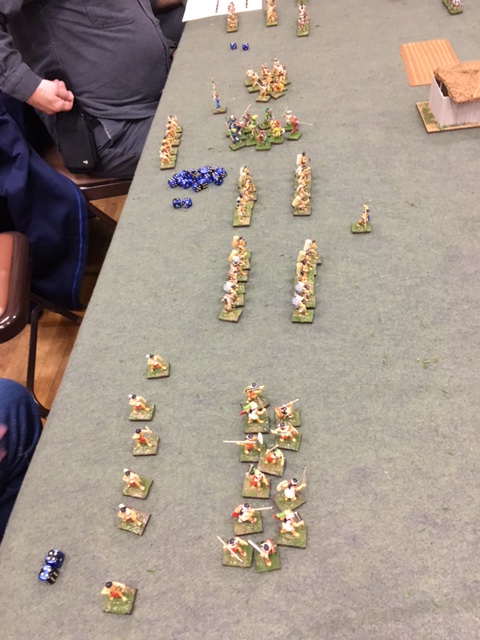
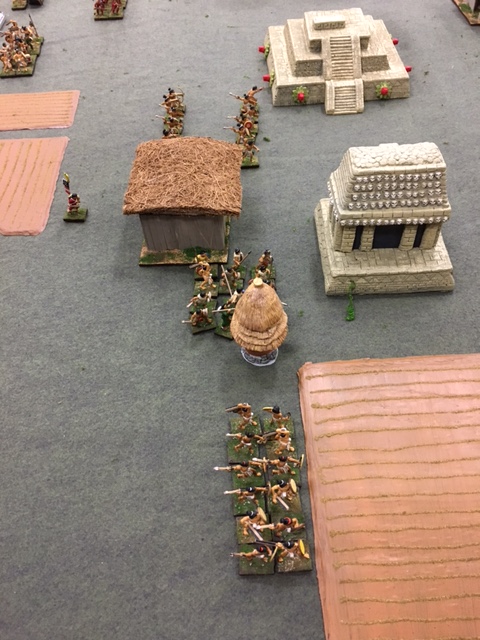
Tlaxcalans line up to advance into Xochimilco in search of food.  Four units of porters in the center of the photo. 

And of course, I was in on hosting games.  David Sullivan and I planned for another Quetzacoatl Rampant playtest of our foraging scenario.  David posted a great review of our January 21st playtest on his blog. This playtest ended in complete disaster for the Spanish and their native allies.  But part of the reason for this was dreadful die rolling by the invaders, and very good die rolling by the Aztecs. We made very minor changes and decided we’d have a better idea for how the scenario worked.

drumbeat-1

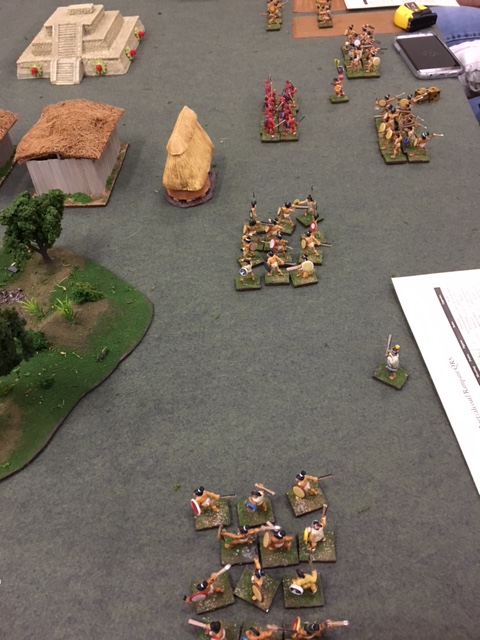
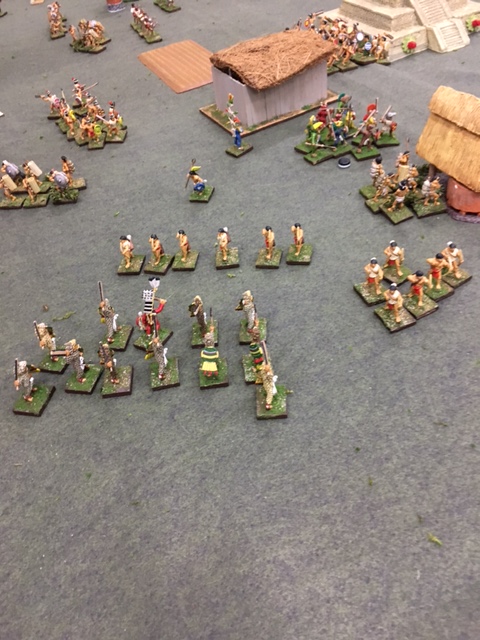
Aztec defenders mass outside of town. 

The chief premise of the scenario requires the Spanish and their allies to forage for food in an Aztec town. They have six units of native bearers.  The bearers can collect food from four permanent supply points located at the four corners of the town. In addition, there are chinampas, or floating gardens that can be expended along the narrow lake shore.  In addition to the bearers, the Spanish began the game with four units of swordsmen, a unit of wardogs, and a unit of arquebusiers.  There were also six units of Tlaxcalan warriors, including two units of skirmishers.

The town is defended.  The game begins with five units of peasant warriors, the defenders of the town, on the outskirts.  They are supported by a unit of veteran warrior suit-wearers and two units of skirmishers. There is also a late arriving unit of Aztec nasties.  They could arrive on the flank or the in the rear of the Spanish.  Their arrival time is certain, but unknown to the Spanish, and composed of two units of knights and three units of veteran warriors

drumbeat-3

Aztec warriors push through town to secure one of the granaries.  The Spanish, obligingly, won’t advance to contest them. 

The scenario is simple.  The Spanish/Tlaxcalans must collect enough food to “feed” every Spanish figure on the board. The Spanish have the option to add more units, but the more units they add, the more food they must collect.  The scenario allows them to add a unit of horse (very nasty), a unit of swordsmen (very nasty), a cannon (could stave off disaster,) a unit of crossbows (meh.) None are required.  All are calculated equally in terms of supply.  The Spanish at Drumbeat, wait for it, drumroll, chose the crossbows.

We got the game set up early and were off to the races. The Spanish were set up in three “retinues.”  Two of those were set up with mostly Tlaxcalans, and the third on the left flank was mostly Spanish. The Spanish/Tlaxcalans began with a couple of units in the town.  The troops along the lakeside quickly grabbed the closest granary and began loading up, while their troops held off the advancing Aztec peasant army.  But on the Spanish left, where the most of the Spanish troops were located, there was the nasty Lion Rampant bugaboo-the Spanish commanders couldn’t muster enough activations die rolls of five or higher to actually move and engage the Aztecs in front of them.  These Aztecs wisely slung their atl-atl’s from a safe distance, inflicting pin-pricks on their enemies, and screaming nya-nya-nya at the Spanish.

drumbeat-8

Things go terribly wrong when the Aztec relief, spearheaded by a unit of Eagle Knights show up in the Tlaxcalan rear.  The corn’s not tasting so good. 

Everything was looking pretty good for the Tlaxcalans until disaster struck on turn five.  The Aztec relief force arrived on the lakeside.  They immediately began slaughtering and sacrificing the Tlaxcalans in front of them.  It was a mess, and because the Spanish were stuck at the other end of the board, there simply wasn’t an answer for the stronger Aztec forces.  They began falling in with the bearers, and that was the end. We called the game after turn eight.

The playtest was a failure. But by  how much?

David and I agreed we needed some major fixes.  The Aztec reinforcements are too strong.  The Tlaxcalans need more guys.  The Spanish should just get the caballeros. We need to revisit the intent and mechanics of the “your beating heart” rule that allows the Aztecs to increase their own courage at the cost of their enemies.  Lots to talk through and work out.

But we can’t do much about bad die rolls.  For two games now, we’ve seen the Spanish roll horrendously.  How much differently would the game have turned out if the Spanish had just average die rolls. It’s challenging to make wholesale changes to scenario when we plan for probabilities that aren’t met. Sigh.

Terrain for “The Foraging Party”

chinampas-the-floating-gardens-of-mexico

In my last post I said I’d been working on a scenario for the Aztec project. So I cobbled together an encounter between the Spanish and their allies when they were most vulnerable: gathering food.

The Spanish will have a relatively small contingent, plus some Tlaxcalan allies, and they will be shepherding a party of foraging porters.  Remember, there are no horses and wagons in Mexico ca. 1520, just guys on foot ordered to schlep what’s needed on their backs.

The scenario will all be points-based.  How much food is gathered versus how many figures, Spanish figures are in the party.  The job of the Aztecs is, of course, to get in the way of all this gathering.

As a result I’ve had to come up with some terrain bits that represent food gathering places. One of the things I’ve done is purchased some of the pieces offered by Acheson Creations. I have tons of Acheson pieces, and never painted one of them.  They are cast in shiny gray resin, and I think I’ve often been intimidated by them.  No more.  I soaked them in soap and water overnight. Brush-primed them in the cold weather with Liquitex gesso, and away we went. Nice pieces, truly.  I ordered them online, and Acheson, even during the holidays, was very fast.  No fuss, no muss.

I kept the painting pretty simple.  Thatching took most of the Cote d’Arms Buff I had left, washed with Vallejo Brown Wash. The terra cotta tubs and hard structures were painted with Ceramcoat Burnt Sienna. The stone work was brushed with Ceramcoat Light Gray, dry-brushed with white and then washed with Vallejo Black Wash. Pretty easy.

These four pieces will be spread out on the board to spread out the forager and the Spanish who have to protect them.  The scenario rules require that foragers spend some turns at these places to gather their food. However, I decided that having four places to gather isn’t enough, so I planned for some chinampas.. These were gardens planted on the extensive lake beds in the Valley of Mexico.  They were created by building structures in the shallows, anchoring them with small trees, and dumping soil from the shallows to create farmable gardens.  When they Spanish first saw them, they were amazed and suggested they were “floating gardens.” Nothing floating about them.

Putting together the chinampas was a bit of a process. I originally planned to use some 1/8″ bass wood cut into 4″ X 3″ pieces  edged with dowling to represent the retaining wooden structure for the soil.  It was a mess and not worth the effort. I also added some ground texture using my go-to basing material, Liquitex Modeling Paste.  Together with the glue, the thin material warped. Bleah.

This required me to make some changes to my approach. Dowling, gone. I applied a thinner coat of modeling paste, which still warped the basswood a bit, but relaxed after drying.  I also bought some thicker, 1/4″ pieces of basswood.  It allowed the beds to look a bit more built-up, and I used my Dremel tool to sand the edges a bit more, including digging a channel through the half way point.

After applying modeling paste and allowing it the requisite hour to dry, I was free to do whatever I wanted.  I had some leftover small Woodland Scenics trees to stick on the corners.  I build corn fields, vegetable rows, whatever my heart desired to get a varied look.  Unfortunately, I did run out of small trees fairly early in the game, but that’s okay.

I’m building eighteen of these for our game on February 4th.  They go pretty fast.  I paint over the wood and modeling paste with Ceramcoat Burnt Umber.  Then dry-brush with Ceramcoat Trail Tan.  And then it’s just up to me, or you. They were handy and pretty inexpensive. About eight bucks for the basswood, and the Woodland Scenics pieces I had and were just sitting around begging to be thrown out in a fit of compulsive neatifying.

Farewell 2016

First, let me thank each and every one of you for taking the time to read whatever nonsense I have to share. I appreciate you taking the time and trouble.  Hopefully there is something here worth reading.

Biggest Surprise of the Year-My rant about Victrix figures, written some three years ago continues to attract the most readers each and every year. I even get comments about an article that is well past its pull-date. Altogether, the Victrix article has received about 900 views.

Runner up–Though I haven’t had a chance to participate, the Olympia guys have been playtesting the Martians using Osprey’s The Men Who Would Be King rules.  Second hand news is that it has gone quite well, and I’m hoping to get in on it soon.

Project of the Year-This is a fairly easy one.  It is the Quetzacoatl Rampant, Aztecs vs. Conquistadors project I’ve worked on with David Sullivan.  I’ve worked pretty steadily on this since June and produced a lot of figures–about 300 or so.  Lately, I’ve had fewer figures and more terrain bits to complete.  But I’ll have to switch back for the first specific scenario I’ve designed. We’ll try this out at Drumbeat on February 4th, and I’ll have more to share then.  Just to be clear, this is an era I’ve always wanted to do, and in fact acquired piles of Revell plastics (1/72) decades ago, but it just never went anywhere.  Daniel Mersey’s Lion Rampant game engine makes this work.  That and David’s mutual a-ha head nod.

I’ve also ordered some GHQ bits to continue working on my 1962 airstrike on Cuba idea.  Expect to see both for Enfilade in May.

For 2017

  • Wrap up the Quetzacoatl Rampant project.  I still have figures to paint, and some terrain pieces to complete, but after devoting so much time to it, I’d actually like to move on.
  • Paint up at least 20 bases (80 figures) of HYW French infantry for my Fire and Fury knock-off for the Hundred Years War. This is a big deal to me.  I picked up a box of Perry plastic French knights and infantry and am hoping these work well.
  • Paint more planes for the Cold War era.  I really enjoy working on these and they paint quickly.  Don’t need a lot of them. My goal is to open up the period 1952-70 to some hypothetical air scenarios.
  • Begin work on a Sudan project using The Men Who Would Be King and Perry’s expansive range for this period.
  • Have some fun and just pick away at projects, whether it is my nearly complete Irish Civil War stuff, my barely moving Dragon Rampant Orcs and Rohirrim, or adding some more ships to my ACW naval fleet.

The Special Smyth Award for Service Above and Beyond the Call of Duty: 

Eureka Miniatures USA is simply the smoothest, slickest supplier I’ve ever encountered, and others could benefit from learning something from Rob Walter.  Never had a problem with an order, and I’ve made many in 2016.  Ordered from him last night (Aztecs, of course,) got the e-mail notification this morning they were in the mail.  Amazing. Its. That. Way. Every. Time.


Sensibility was never one of my long suits

I sat down with Mrs. Smyth, my favorite person in the world, and revealed my momentous decision.  I was going to order all the figures I needed for my Aztec project and put them on my credit card.

I’d just paid off my card from all our summer expenses on the Alaska cruise, so this was kind of a big deal.  I promised to pay it off from my fairly generous allowance, but it meant I had to be good. Record purchases at a minimum, and a planned flight to Mexico was out (yes I’m kidding.)

I told Lorri it would be about $150 with orders to Eureka Miniatures USA and Outpost Wargame Services in the U.K. A hundred fifty bucks.

Dreamer

Two Hundred fifty dollars later, the orders are in.

The Eureka order arrived in no time.  I sent it in on Veterans Day, a holiday, and it got here Monday the 14th.  That’s good service. No it’s better than that. I contacted Rob at Eureka USA about my previous order about being shorted some figures in packs, and he sent along up the “make-up” guys together with the Huaxtecs, slingers, Spanish swordsmen, porters and command figures I ordered. Life is good.

I received an e-mail from Outpost on Sunday.  I’ve purchased Tlaxcalans to fill out the last of my Spanish allies. I needed 48 figures, I ended up with 80.  Hardly anything.  But with shipping and insurance it did add up to 99.75 quid. Supposed to mail tomorrow (Tuesday) so I’m looking forward to it. At least a real person named Jeff contacted me as opposed to the goofball non-human at The Assault Group.

In any case, the two orders will keep me painting for a while.

Rule Changes

I was pleased with the changes in the rules at The Museum of Flight game.  The Aztecs were able to hold their own a bit better.  However, they did become a bit too aggressive around the unit of horse and the war dogs.  I think I will require them to be “fearsome: when charging them.  That will likely make life harder for the Aztecs.  May also allow both units to countercharge, so they will fight with their attack factor too.

Music to Paint To

selling-england-by-the-pound

With mounting concern about space for more record looming, I’d kind of taken a bit of a break from record purchases. Sort of. Temporarily. Sigh. Back off the wagon now.

I picked up a copy of Selling England by the Pound by Genesis. This is the 1973 version of the band that would go on to mega-stardom in the late 70’s and 80’s built around singer/drummer Phil Collins. The Selling England version fronts vocalist and Rock and Roll Hall of Famer Peter Gabriel, though Collins is there and does take a turn at the mictophone. The lead guitarist is Steve Hackett, though Mike Rutherford (Mike and the Mechanics) also play s 12-string and cello. The terrifically talented Tony Banks is on keyboards It is an interesting mix of the kind of English folk music that band its start, with some solid guitar work, and the synth sounds that would become a hallmark of the band.

This is a concept album.  It’s a collection of stories and fables that blend together to become part of a theme. I confess I’ve listened to it only once, which is probably far less than than it deserves.  The first observation, is that, musically, this is a fantastic record. Unfortunately it didn’t fully grab me. In 1973 it was not uncommon to have  to have seven minute plus songs. On Selling England by the Pound there are eight tracks. Of those, four are over eight minutes, and two are over 11 minutes.  Is that the end of the world? No but it is clearly from a rock era, thankfully, gone by, and to truly appreciate them it requires multiple listenings. On the other hand, though the songs are long, they lack the arrogance and bombast of Emerson, Lake and Palmer or Yes at their worst. There is real story-telling happening here, rather than just showing off.

Selling England By the Pound is unquestionably a solid record, but I hesitate to give it my highest marks.  It seems very much a product of its time, But if long, brilliantl-played story songs are your cup of tea, I can’t recommend it highly enough. .

Return to the Museum of Flight

nhmgs-poster

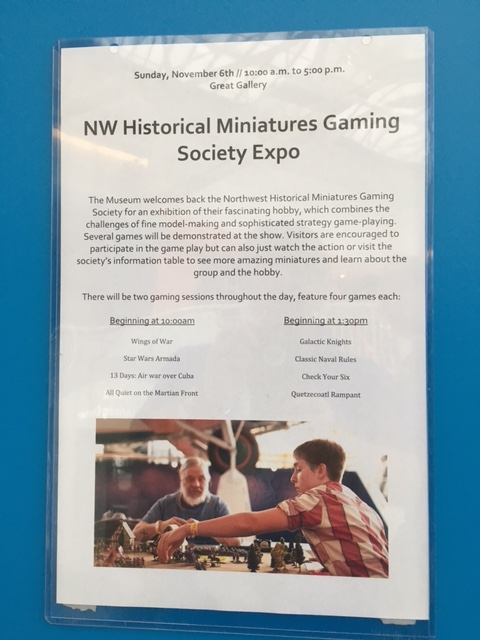
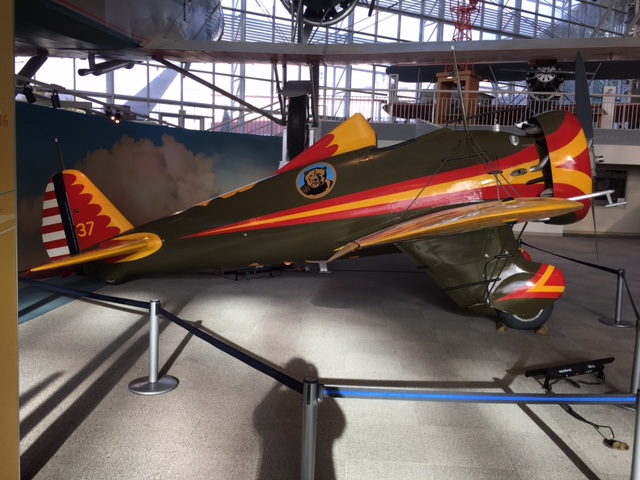
Today, November 6th, was our annual visit to the Museum of Flight.  It is, without question, my favorite game day of the year.  Arranging the details of MoF is my last official duty for NHMGS, and I’m happy to do it. Why am I such a fanatic about this once per year extravaganza? Because I’m running games under an SR-71 spy plane. When I showed up early today to be sure our space was ready to go, I found the Museum set up a new addition to their collection, a P-26A Peashooter not twenty feet from where I’d be running games. It was a good day with some good games, and I couldn’t be more pleased.

peashooter

This is what we’re surrounded by at the Museum of Flight. Gee Bee Z, my table under the SR-71, and an XF8U Crusader prototype. The P-26 was a few steps from my game table and a new exhibit.  Like a game at Safeco Field, there’s never a bad day at the Museum of Flight.

I ran a couple of games. Dave Schueler and I hosted an air game based loosely on the Cuban Missile Crisis.  We used the AirWar C.21 rules by David Manley.  Shoe and I both really like these rules. They are more free form than Get Your 6, and they are also pretty easy to play. The American players were part of an operation against SAM sites protecting the Soviet missile bases in Cuba.  It went well. The Americans had a choice of aircraft types to choose from, including F3H Demons, F-8 Crusaders and A-4 Skyhawks. The Cuban/Soviets had three SA-2 missile launchers, some 57mm light flak, two MiG-19’s and two MiG-17’s chosen from their available defenses.  None of the players had played the game before, and we had a believable interesting outcome. The A-4’s were armed with a mix of “dumb” bombs and Bullpup air to ground missiles. The Crusaders were gun armed and had early Sidewinder missiles, the Demons had early Sparrow III’s and Sidewinders, and were also gun armed. The game featured a lot of failed advanced maneuvers.  Both MiG 19’s were brought down by Sparrows, and there was a great deal of gunfire in the sky, but no planes shot down. The only American plane lost was brought down by 57mm fire.  The Skyhawks strafed the Fansong radar controlling the SAM site, and they successfully bombed a launcher. A good time was had by all.  We’ll play these rules again for sure.


In the afternoon I dragged out my Quetzacoatl Rampant figures and we tried a second playtest of the Conquistadors and Aztecs. I set the two sides too far away from each other, which made for a big waste of time slogging. The game included Tlaxcalan allies who played an important early role in the game.  The Spanish proved to be very nasty, but when the Aztecs could attack, they took a bit of a sting out of the conquistadors.  Anxious to develop some scenarios that make the game more interesting.

Lots of other games. Scott Murphy hosted a Star Wars Armada game.  Lloyd Bowler and the guys from Astoria ran some Wings of War. Scott Williams and Joe Grassman ran a Galactic Knights scenario. Sven Lugar also did double duty, running All Quiet on the Martian Front in the morning, which seemed very popular, and a nostalgic effort at Fletcher Pratt’s naval rules in the afternoon. Paul Grandstaff and Al Rivers ran a Check Your 6 scenario in the afternoon.  We had enough games to keep our guys occupied and managed to squeeze some of the interested public in to some of the games as well.

Super Sabers and more

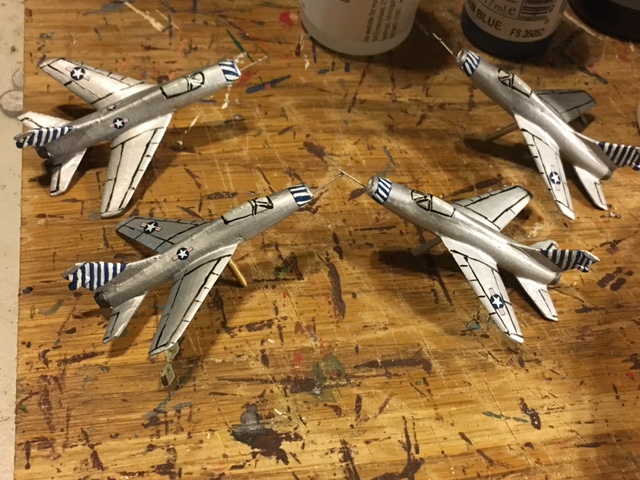
I started preparing planes to paint while I worked through deadline week, and waited for my Aztec order from Eureka Miniatures USA.  As I stated in my last post, I am adding planes to my collection that could have participated in air action during the Cuban Missile Crisis. I have twenty planes altogether, including Navy fighters and attack planes, as well as Soviet piloted MiG-21’s.

I’m beginning with some F-100’s by Scotia Collectair.  They have a nice shape, but nothing special.  Very clean but not much scribing to work with so I have to paint in a lot of the detail.  I wouldn’t mind trying a couple of the Raiden minis, just by way of comparison. These are pretty easy work, with a base silver by Formula P-3.  The blue is Vallejo Prussian blue.  The paint scheme is loosely modeled on the 366th Tactical Fighter squadron from England Air Force Base in Louisiana.  However, by 1962, many of the USAF units are beginning to lose their fancy squadron insignia, according to my Squadron/Signal book on F-100’s.

f-100s

Collectair F-100’s awaiting their full complement of decals. Fun, and relatively easy to paint. 

By 1962 there are still a fair number of Super Sabers in service, mostly as tactical fighters, i.e. fighter bombers, though that role is mostly being taken over by F-105B’s.  There was an incident over Cuba in November 1962, just after the missile crisis, in which F-104’s overflying the island were intercepted by MiG 21’s and were fired on, but no blood, no foul. So, the F-100’s have a role, but air superiority is clearly one they’ve passed on to other planes.

ready-to-paint

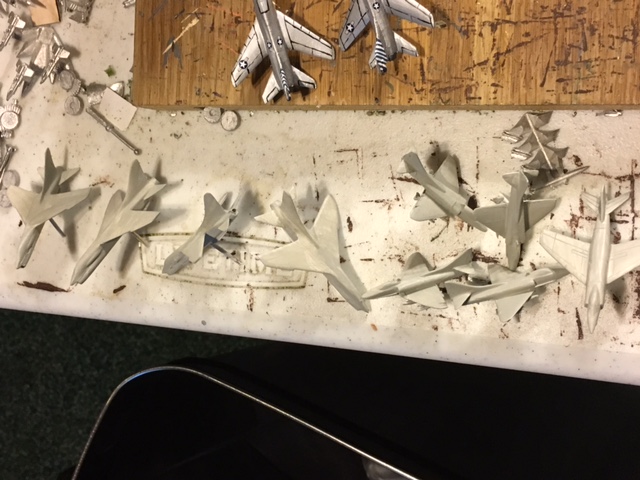
Oh look, a dozen U.S. Navy planes to finish by next weekend. Four each of F-8 Crusaders, F3H Demons, and A-4C Skyhawks.  Not difficult to paint, but lots of them. They’ve gotten their top coat of Light Gull Grey by Testors acrylic. 

This morning, Saturday, I saw Dave’s post that he has a plan for our Museum of Flight scenario for Sunday, November 6th. Yep that’s a week from tomorrow and it includes a fair number of planes I don’t currently have in my arsenal, so the Smyth aircraft production line is underway.  Thankfully there aren’t any evening school commitments for this week . I could have a busy day tomorrow (Sunday) but I think I can squeeze in a couple hours here and there for painting and plunking decals on the F-100s.  I’ve got 20 planes I’d like to have completed for the Museum game, including four MiG -21’s, so I’ll have to give it my best shot.  Will keep you posted.

36

36

Twenty-four peasant Otomi warriors from my Tlaxcalan command, allied to the Spanish.  Not a lot to  them.  They are in their summer dress uniforms, and can’t afford interesting shield patterns that are above their station anyway. 

I’ve painted like one possessed for this Quetzacoatl Rampant project.  I’ve avoided the trap of over-ordering, and I’ve managed to really persevere and stay focused on getting figures done.

But I don’t think I’ve ever done what I did this week.  I began, painted and based 36 Tlaxcallan warriors. Yes, 28’s.  That’s great because it wraps up all the units I currently own as the newspaper heads into its first deadline week-time to paint will be thin from Tuesday to Friday. I do have two more units of Aztecs coming, and they should arrive about the middle of the week, so I’ll have something to do when the paper is done.

Just a few caveats.  They are mostly without clothes.  They aren’t exactly the Grenadiers of the Old Guard.  They are peasants, so their shields are pretty plain. 12 of the them are archers.  No heraldry involved.

Even so, my painted total of figures for this project is currently is about 260.  That’s pretty good given that I didn’t start until just before Enfilade. I’ve also pinned down the final number needed to meet the 72 point force for each side.  Here is what is left to do:

Aztecs: 3 X 12 figure melee units, 2 X 6 figure skirmisher units= 48 figures

Tlaxcallans: 2 X 12 figure melee units, 2 X 12 figure missile units= 48 figures

Spanish: 2 X 6 figure swordsman units= 12 figures

All in all just about 100 figures.  In addition I’ll add some Aztec command figures and bearer figures for scenario making.

On my painting table

Though I expect this will be a pretty light painting week, I’ve assembled ten 1/285th scale planes by Raiden.  I’m fascinated by the Cuban Missile Crisis and keep thinking I’m going to have some sort of scenario breakthrough for some sort of hypothetical bombing or photo recon of sites in Cuba 1962. I’ve got the following lined up

2 X F8 or RF8 Crusaders–did actual photo recon over the IRBM sites in Cuba, one of my very favorite jet fighters

4 X F-100 Super Sabers–Front line USAF fighter of the time. Don’t have any F-105’s to go with them.  They will be in Air Force natural metal

4 X A-4 Skyhawks-early Skyhawks without the lump.  Somebody has to deliver the payload.

2 X F3H-Demons-all weather, all missile armed fighter.  Progenitor of the F4 which was replacing it at this time.

I have a couple more Crusaders and Demons on the way from I-94 Enterprises as well as some new decals. Won’t have these finished in time for the Museum of Flight on November 6th, but I do expect to have them for Enfilade.  Am bugging Dave Schueler for a good scenario.

Music to paint by

rodriguez

I’ve listened to so much good music lately, and I haven’t shared much of it. But one album I picked up used is Cold Fact by the artist Rodriguez for about twenty bucks. It is a re-pressing of a 1970 record released by the Detroit based singer songwriter that sold poorly and the album and performer sank into obscurity. But Rodriguez’s story became the subject of a 2012 documentary called Searching for Sugarman, and the album was reissued.

I decided to give the record a try, and was not disappointed. Think of early Jackson Browne, the good stuff, but probably not quite as consistent.  Critical of the establishment, observations of drug culture,  the best song is definitely “Sugarman” but the rest stand on their own. Worth a listen, but I found it a worthwhile add to my collection.

The feast of St. Crispian and this wargamer’s life.

perry-royal-armouries-agincourt

Alan and Michael Perry’s amazing diorama in the Royal Armoury to commemorate the 600th anniversary of Agincourt. 

October 25th is the anniversary of Agincourt, fought in 1415, 601 years ago.  Agincourt is one of the best remembered of all British battles, one that recalls good King Hal with his tattered band of yeomen drowning a vastly superior French army in a sea of mud, while raining down a storm of arrows that left the French broken, dispirited and leaderless. That’s all hokum of course, according to the new research about the Hundred Years War and this most English of battles.

But this post isn’t to revisit Agincourt and our changing perceptions of the battle, it’s really about me. I don’t claim to know everything about the battle.  In fact, I’m regularly confronted with the fact that I know little.  But learning about Agincourt set me on a road I remain happy to follow: a healthy obsession with the Hundred Years War I play out in reading and miniature wargaming.

the-face-of-battle

My battered 1976 copy of the Face of Battle. It wlll be the last book I ever part with. 

No work influenced my connection to this period more than John Keegan’s 1976 book, the Face of Battle.  Intended to be a look inside battle, from the soldier’s perspective, Keegan devoted about 37 pages to breaking down the experience of archers, men-at arms, and horsemen at the battle.  Drawing from mostly secondary sources, Keegan’s observations were vivid.  Though measured against today’s writing, it may seem wholly incorrect, The Face of Battle drew me into the period and put Agincourt on my list of must do’s.

I read Keegan’s book in 1978, the summer I graduated from college.  It is about this time I also plunged fully into miniature wargaming. Surprisingly, or maybe not, I didn’t leap headlong into the HYW in miniatures.  My friends and I played Napoleonics in 15mm, WRG Ancients, again in 15mm. Later I did George Gush’s Renaissance rules, Lynn Bodin’s Imperialim, my first flirtation with 25mm figures. But no Agincourt.

In 1989 I saw Kenneth Branagh’s Henry V. And then I saw it again.  I bought it on VHS, I have it on DVD.  I can stream it on Netflix. It is not historically accurate, but the words mean so much to me. Whether it is Exeter reminding the Dauphin that young King Henry has matured and will “make your Paris Louvre” shake with gunstones, or the brilliance of the Crispian’s Day address, it still gives me chills. I’ve watched it at least a hundred times. Maybe I’ll watch it today, make it an even 101. If you’ve never watched Branagh at his finest, it’s here for you to view. If you don’t want to become one of his “band of brothers,” check to see if you have a heartbeat.

I began my Hundred Years War project at least 15 years ago.  I have more figures painted for it than any other, and far more unpainted miniatures than for any other period. I’ve hosted skirmish games and chevauchees.  I’ve run naval battles.  My goal is play Poitiers, rather than Agincourt, because the circumstances of the more famous battle are so difficult to recreate on the game table. While I have plenty of unpainted figures, I really want to take advantage of the new Perry plastics, which have the dual virtues of being beautiful AND cheap.

Though I’ve given up on Agincourt as a game, without my exposure to it, the passion that will always inspire me for the period would never have begun. What began with Keegan and Branaugh continues with Jonathan Sumption and Anne Curry, with the superb miniatures by the Perry brothers, and watching my friend Chris Craft roll his beautiful miniatures out on the table to play Verneuil, and of course, Agincourt itself.

Like most wargamers, I am easily distracted.  My interests change with the moment-new rules, new miniatures, what my friends are doing–but my desire to continue with the project, paint what I have and more, find new ways to game the Hundred Years War, will never die.

What’s the point, man?

I met my painting goal for the week.  I polished off the last of my Aztec figures.  I still have 36 Tlaxcallan allies to wrap up, and tonight (Sunday) I’ll start getting them ready to be primed and painted over the next couple of weeks. My goal is to finish the first twelve–all medium quality warriors, leaving a couple dozen peasant types.  That’s like seven or eight points worth of guys.

Points, I hate ’em. I’m a great believer that points systems kill good scenario making. It’s too easy to just throw figures out on the table at the agreed number of points each and have at it. Most game systems have points that guide choices from Hail Caesar to Flames of War, and I don’t like it.

img_0680

img_0679

My two boxes of Aztec warriors.  A total of 15 units so far, with more to come. 

That said, those same point systems can guide building armies and sticking armies in the field because they do offer an insight to relative strengths of the opposing armies.  I do think it’s okay to have unequal sides, especially of scenario rules and game objectives compensate for that inequality.  But  it’s always nice to know, as a scenario designer what you have on the table.

I like the idea of being able to offer six player games for the “Rampant” series, and the same is true for the Aztecs and Conquistadors. So, with my figures all nearly painted it’s time to evaluate where I am.  The rules call for 24 point retinues or commands, which is a good but not hard rule of thumb. This is what I have:

Spanish

4 X  swordsmen @ 6 pts ea =  24 pts

2 X crossbowmen @ 4 pts. ea.= 8 pts

2 X arquebusiers @ 4 pts ea = 8 pts.

1 X Caballeros @ 6 pts ea. = 6 pts.

1 X cannon and crew @ 4 pts = 4 pts

1 X war dog party @ 4 pts = 4pts

The total is 54 points.  I think that’s plenty of Spaniards.  However, I don’t like the mix.  I would like to add another two units of swordsmen because I feel like the number of missile troops is disproportionate. to a historical Spanish force. It just adds to the counter mix and choices players can make.

Add to the Spanish the Tlaxcallan contingent.

1 X Tlaxcallan knight @ 4 pts ea = 4 pts

1 X veteran warriors @ 4 pts ea = 4 pts

4 X skirmisher @ 2 pts. ea = 8 pts.

The total is 16 points.  I’m not sure this organization works out.  David suggested the Tlaxcallans had separate missile units, so the skirmishers may have to be combined for a total of 12 points.  I will add troops to the Tlaxcallans.  They’ll be the Outpost Tlaxcallans, and I will likely add melee troops to bring them up to about 24 points. Ideally I want them to form about 1/3 the points of a Spanish army. The addition of atl-atls or dart throwers gives an extra point to warriors.

Aztecs

3 X warrior knights @ 4 pts ea = 12 pts

4 X veteran warriors @ 4 pts ea = 16 pts

4 X peasant warriors @ 3 pts ea = 12 pts

4 X skirmishers @ 2 pts ea = 8 pts.

The total is 48 points.  That’s not a lot compared to the Spanish and their allies. The Aztecs could add an extra point to each warrior unit for atl-atl and that would bring things up to 59, but still significantly less than 72 points.  Because the Aztecs are fairly generic, that is a good number to shoot for, so I will continue to add units to the Aztecs.

Even though there is a part of me that wants to be done with this project-I have been dogged in my perseverance with this project for the past five months, both with time and dollars, it’s going to take a bit more to finish up

img_0682

Feather suit warriors by Eureka Miniatures.  I like the feathered suits by Eureka.  Good stuff. 

img_0683

Cayman knights by Eureka.  Interesting figs, though almost no source discusses cayman knights.