Giving Airwar 1940 a spin

Back in November I shared my plan to find a new set of air rules to replace the Mustangs rules we’ve played since the past century. I also suggested we’d gotten a leg up from David Manley, author of Airwar C.21. After reading my lament about wishing there was an equivalent version David sent a copy to Dave Schueler who passed them along to me. I read them over and was pretty happy.  They seemed very familiar with some significant differences for the period.  We promised to play them as soon as possible
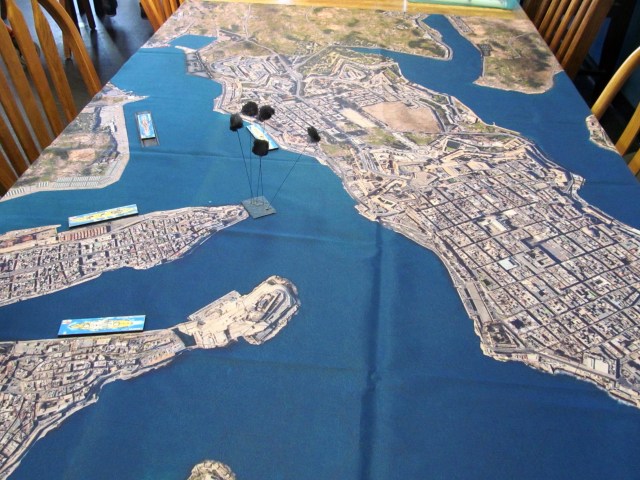
Malta Grand Harbor

Looking down the throat of Valetta’s harbor. We used the 2D Topside Miniatures as targets for the bombers. Game mat is by Tiny Mats in the UK.

As soon as possible always signifies a nebulous future.  But yesterday was the big day.  We planned to schlep my Malta stuff up to Meeples and try an initial game. I hoped to accomplish a few things:

  1. Try out the rules in as painless a manner as possible.  So we agreed an unescorted stream of a dozen Italian bombers would attack targets in Valetta’s Grand Harbor. This would avoid all the complications that would go with dogfighting
  2. The harbor would be defended by some Hurricane I’s and Fulmars.  All eight gun fighters.  It would give us a chance to see how the relatively lightly-armed fighters would do against moderately okay bombers.
  3. I’d get to show off my Valetta mat from Tiny Mats in the UK, as well as some of the zillions of planes I’ve painted for the Malta project.

We got the bombers set up, entering the board from the closed land end of the board.  We grouped them in threes: nine SM-79’s and three Cant Z 1007’s. We mostly followed the auto-bomber suggestions in the rules.
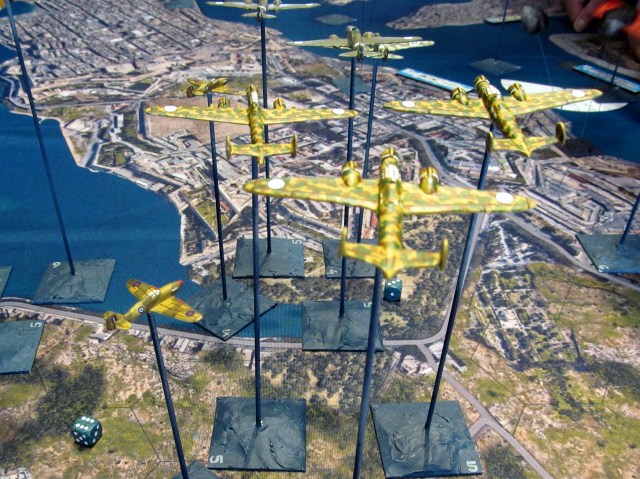
Malta-Italian bombers 2

The bomber stream. Photo taken behind the Cant Z 1007’s. One Scotia bomber and a couple whose maker I can’t quite determine. These follow the three groups of SM-79’s

The game moved pretty quickly.  The bombers had a top speed of eight inches per turn, and the Hurricanes had a maximum closing speed of 11 inches. For the most part the ‘Canes could stay engaged throughout without making any special maneuvers.

The British fighters took plenty of shots at the bombers, but with their rifle bullet armament, they had difficulty inflicting a lot of damage before the bombers reached their target.  One SM-79 was shot down by a combination of fighter attacks and flak. Two more were crippled and dropped their bomb loads early.  A few of the fighters suffered nicks and scrapes, but all made it back to their airfields safely after running out of ammunition. Nine of the bombers made it to their targets, each dropping three bombs.  They needed a “0” to hit on a ten-sided die, and we had Henry, a fellow who joined out game roll the hits and damage.  Henry was oh-for 27.
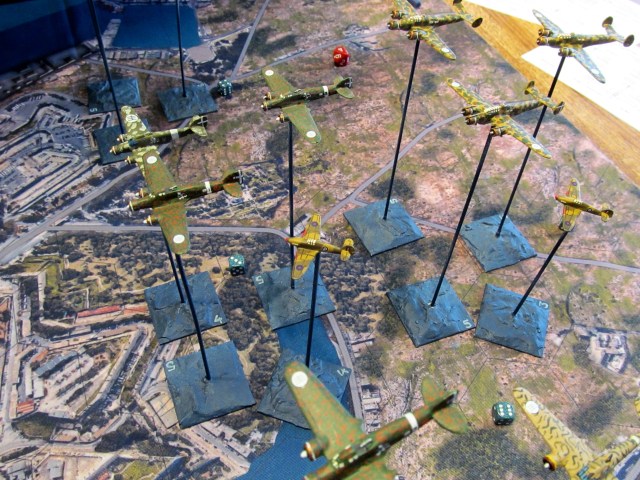
Malta - Hurricane attacks 2

Hurricanes rip into the bomber formation. The Hurricanes are by Raiden Miniatures.

A couple of observations. First, this game was very easy to play and very familiar.  I really liked that.  However, the eight-gun fighters really struggled. All the players (including me, I ran the Fulmars) rolled even average or slightly below, and with the planes rolling so few dice, their chances of doing serious damage was unlikely.  The light/medium .303’s get one die per three guns rounded up.  Heavy machine guns (the Italian bombers) get one die per gun, 20mm cannon (Hurricane IIc’s) get two dice per gun. together with their limited ammunition supply the fighters were between a rock and a hard place.  They could improve their chances by firing extended bursts, but that expended their ammo even more quickly. Really, the Hurricanes could only make four passes before they were done.
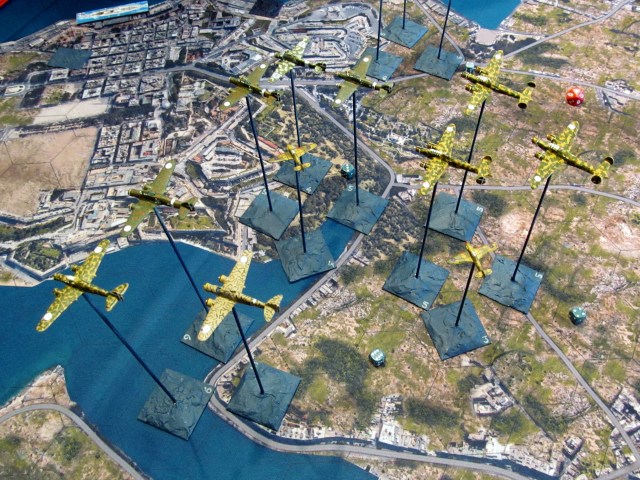
Malta - Hurricane attacks

Another look as the bombers creep closer to their targets.
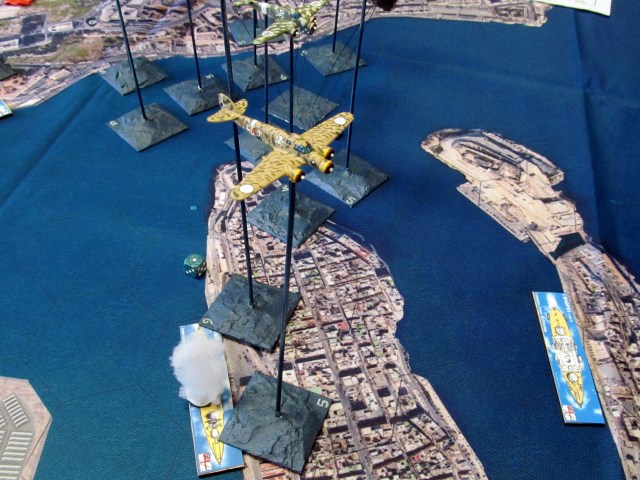
Malta - Bombs Away

The bombers let go of their bomb loads, roll astonishingly badly and come up empty.

We made the decision to change the flak rules a bit.  The 1940 rules were pretty similar to the jet age rules that target individual planes.  Because the WWII bomber flew in closer formations they would be more likely to suffer from the kind of area fire.  So when the bomber formations encountered flak, each plane would have to roll. Only one plane was actually hit, but the damage could be massive. We’re still messing with this a bit.

Overall, however, I really enjoyed the game and the rules. Admittedly, it was only two dimensional without escorting fighters.  But I thought it was a great first time out, and leaves me anxious for more.  Dave and I will be using Airwar 1940 for our attack on the Illustrious scenario we run at Enfilade.

Thanks to David Manley for trusting us with his rules and giving us the opportunity to try them out.


Next on the docket: Dragon Rampant

I’ve gotten a lot done in January.  I finished my six boats for Mad Wet Max, ordered two more and they are currently under construction.  All eight will be ready to go for Drumbeat on March 3rd.  Actually, if all goes as planned they’ll be ready to by this Sunday, but my life is moving into the busy season so we’ll just have to see.

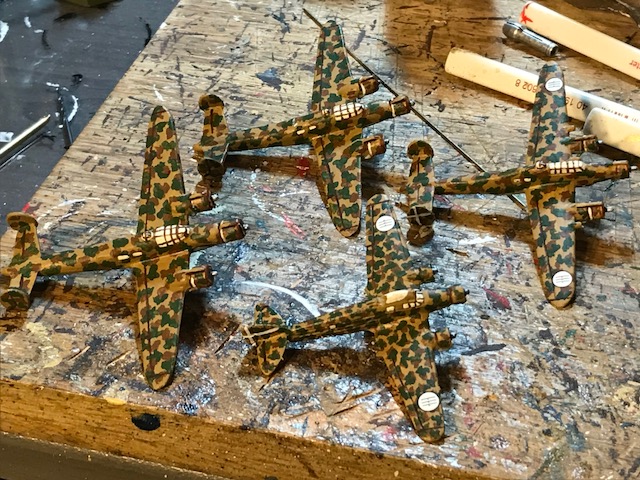
Italian Bombers

The last of my Italian bombers in the middle of getting markings. The three twin tailed bombers are Cant Z1007s. In the foreground, the smaller bomber is a very nice Scotia SM 79.  They were fun to paint.

I’ve also painted a whole lot of planes for Malta.  The WWII Siege of Malta lasted two years and the air battles over the little island went through seven stages, with different planes being introduced throughout the various phases.  I’ve painted 18 British fighters (Skuas, Fulmars, Hurricane I’s and Hurricane IIc’s,) 12 Italian bombers (SM. 79’s and Cant 1007’s,) 18 Italian fighters (Fiat G.50’s, and Macchi SC 200’s) and 10 German bombers (all Stukas) They were fun to fiddle with, and I need more to be ready for phase 1 and 2.  But later, I’m moving on to something else.

Lion Rampant and Dragon Rampant have really taken off.  I think I have Lion Rampant covered with about 600 painted figures. All they need is remounting.  Ugh.  But lots of guys are playing Dragon Rampant, and I don’t really have such a thing.  That’s a lie, but I can’t make myself paint all my GW Lord of the Rings stuff.  No, I don’t know why, I am just not in that mental space.

I’ve been trying to figure out what I can do to build a small army that would be distinct and could take advantage of the unique fantasy experience Dragon Rampant offers.

Dave bought me some of the Eureka Hawkmoon figures for my birthday.  Really kind of a sampler of what was available.  A couple spearmen, some swordsmen, archers and personality figures.  They are all quite nice  The problem was there weren’t enough interesting nasties to make a good Dragon Rampant.  You have to have at least one monster, spellcaster or something magical or you’re just fighting another medieval army.

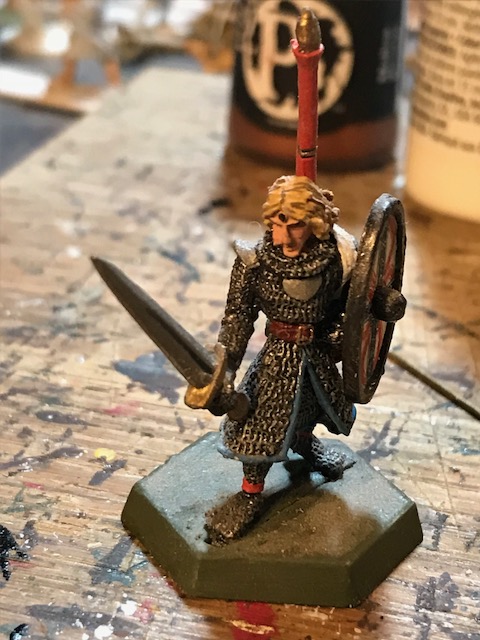
Hawkmoon

This is NOT a Eureka figure, though I have the Eureka figure of Dorian Hawkmoon.  This is one of Citadel’s Eternal Champion set from the 1980’s.  Hawkmoon with sword, shield and flame lance. The black jewel in his forehead identifies him as the Duke of Koln. I ran across these figures last night as I was scrounging through my lead pile, hoping I might find them.  Alan and Michael Perry contributed to the design of these figures.  Trust me, you can tell.  They’re amazing.

Eureka has released it’s second pile of minis for the Hawkmoon range, including mounted (horse) flame lancers.  A flame lance is sort of a cross between a flame-thrower and a beam weapon. That’s cool. So I’ve ordered enough figures to create an army as follows:

1 X 12 figures archers

1 X 12 figures heavy infantry

1 X 12 figures spearmen

1 X 6 figures mounted guardians with flame lance

1 X 6 figures light horse

3 X 1 heroes of the Kamarg

1 Magical cannon with crew

Not a ton of stuff, but it will keep me off the streets for a while.

For those not in the know, Hawkmoon is a hero in Michael Moorcock’s Eternal Champion cycle.  Written in the 60’s and 70’s, I devoured these when I was in my 20’s-the stories of virtually all Moorcock’s protagonists.  Moorcock is described as the anti-Tolkien.  He’s heroes are often less than heroic.  Dorian Hawkmoon is, if anything, probably the most straightforward of Moorcock’s champion, fighting against the forces of Granbretan in a post apocalyptic world.  He serves Count Brass who rules over the Kamarg as the forces of Granbretan savagely conquers the world around them.  Hawmoon goes around the world gathering mystical and mysterious allies arms and delightfully wicked enemies.

Eureka is also making the Granbretan forces too, but I don’t know if I’ll go there.  We’ll see.

Music to Paint By

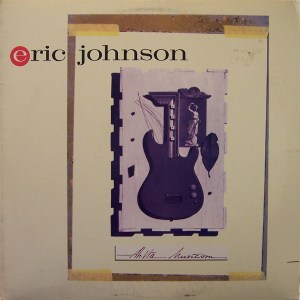
Ah Via Musicom

I think I’ve written about my fondness for the music of Texas guitar genius Eric Johnson.  Johnson has been recording since the mid-80’s but is such a perfectionist he turns out new stuff quite rarely.  I would charcterize his style as a jazz-rock fusion with a occasional country themes thrown in because he’s from Texas.

Johnson’s best known album is Ah-Via-Musicom from 1993.  It is just plain really damn good. He is fast, but melodic, and always just interesting. My favorite song, hell everybody’s favorite song is the instrumental “Cliffs of Dover,” which just leaves me shaking my head wondering how he did that. He leavens his pure white heat with some solid, if fairly tame vocals.  “High Landrons,” “Forty Mile Town,” Righteous,” you could name them all, there are no wasted tracks.

Ah Via Musicom was recorded during the death of vinyl, so the an LP was simply not attainable at any price for a very long time. However, today is the day Friday Music re-released the album on vinyl, and my pre-ordered copy was waiting for me when I came home.  If you’ve heard Johnson’s work before and like it, waste no time.  This record is available on-line from Friday Music

But just to put the icing on the cake, as I was browsing the Seattle concert scene during Christmas break, I checked Johnson’s tour schedule.  Lo and behold, he was coming to Seattle tomorrow night at the Triple Door.  Needless to say I’m going.  Yes Virginia, there is a rock god.


Mad Wet Max Playtest: Beyond Thunderboats

Dave Schueler, Dave Demick, my son Casey and I all met at Meeples today for a playtest of Mad Wet Max. Can’t say we were disappointed.

If you live in Seattle and are looking for a fun, community space to game, I can’t recommend Meeples highly enough.  Love the cafe, and we generally take over a table space for board games or miniature games. We glommed on to a long table about 6′ X 40″, much smaller than the Enfilade table we’ve reserved for the four of us to play on.

A few games of Incan Gold later and after scarffing down some food, we were ready to play the game.  We play MWM on a hex mat.  Our mat has really big hexes.  It was designed for seaplane racing with 1/48th scale planes, so the hexes are about 6′ across. Plenty of room for a boat on a 4″ X 2″ base. However it does provide less space for maneuver and my concern going into the game was that there would be too little.  That turned out not to be a problem.

Mad Wet Max Game

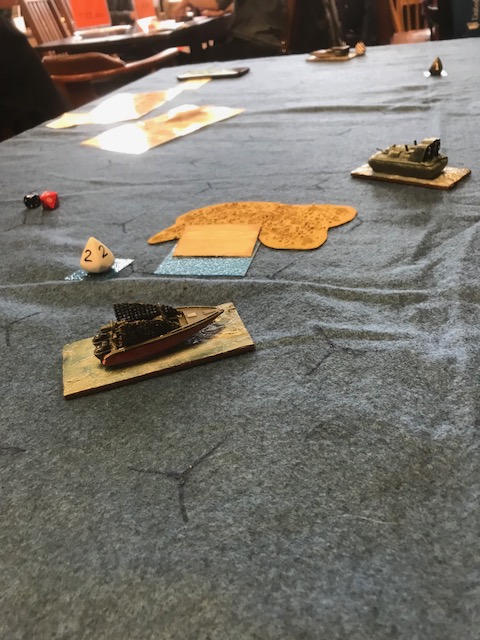
Dave Schueler in Red Scorpion and Dave Demick’s Stag Beetle circle buoy 2 and watch as Casey’s Water Moccasin limps to victory across the table. Alas my Tiger Shark has already slipped beneath the silken waters. The two Daves are separated by a small island with a jump.  The boats are mounted on 2″ X 4″ bases.

Because this game is not simply a circular race course, set up was different.  We set up the board with three numbered buoys plus a buoy representing the finish line. Racers must pass through the hex with each of the numbered buoys three times before crossing the finish line to complete the game.  They may be passed in any order, but no single buoy may be passed consecutively  So for example, a boat may pass buoys 1, 3, 2, but may not pass buoy 2 again without passing a different buoy first. At Enfilade I will have tokens for each of the buoys, and a driver will receive a token each time they pass a buoy that they must display so everyone knows where they are in the race.

Race boats are a bit different than in Thunderboats.  In that game a boat is a boat is a boat, and players spend points on driver quality, re-rolls and strengthening the hull and engines for against risky maneuvers.  In MWM the boats are all armed differently, and can’t be changed.  Every boat starts the game with three hull points  and three engine points.  They receive 16 points to buy the usual Thunderboats stuff, including hull and engine points which WILL be damaged during the course of the game.

We divided the board into sectors, and drivers rolled where they entered the mat.  Seeemed to work well with four.  Might be a bit trickier with eight.  Order of play was also by die roll, because the rules in Thunderboats make the leading boat go first–not the same situation in MWM.

The game turned into quite the scrum, and is hard to describe, except that all drivers quickly tried to line up on a buoy and figure out how to line up on an an enemy .  Casey shot at me on turn one, and I shot as often as I could, however, I didn’t let it distract me from the job of getting to buoys.  The board was cluttered with terrain pieces, including some jumps over shallows a la “Live and Let Die” which kept things a bit interesting.

My boat, Tiger Shark, was the only one with a parascender, a soldier floating on the breeze towed behind my boat.  Parascenders are armed with grenades and mine managed to drop one on Daveshoe’s boat, causing minor hull damage, it was fun.

About an hour into the game, it was clear the players were really starting to figure it out.  The usual Thunderboats stuff of pushing engines and corner to get to the buoys as quickly as possible, with shooting happening incidentally, but not in ways that distracted from player objectives. My last turn I pushed my engine for a 14, ran adjacent to a mine (that’s three rolls to pass), crossed two buoys, made a jump and pushed two corners to make a buoy, all with one hull factor left.  I did great until the last corner push when I had to draw an event card on the die roll, drew a hard bounce, took two points of hull damage and became a sinking obstacle.

That was the turn before Casey, with his stalled engine, made his way across the finish line after passing all three buoys.  It was really fun.  I think all the players passed all three buoys twice and were working their way to the last ticks. Everyone took their shots (shooting happens at the beginning or end of the turn, and each boat can fire one weapon per turn until ammunition runs out.)

Games like this are always aimed at learning about the game system and what if anything needs to change.  That was especially true give the difference between our hex mat and David Manley’s.  We made range changes to reflect this prior to the game.  These seemed to work.  The really nasty weapons in the game weren’t the rockets or parascenders, it was the mines. They affect the hex they are in and all adjacent hexes, and with our sized hexes that’s a lot of space.  Currently there are two boats with a total of four mines in the game.  Plus mortar misses become active mines, and there are four mortar tubes, so a total of eight mines, can be dropped from the six boats currently in service. I will add two more boats and they certainly won’t be mine carriers.  We have enough.

Still lots of risk taking, and lots of fun, and because it’s not linear as Thunderboats! is, many more paths to victory. Hope to try it again in February. Scheduled Mad Wet Max at Enfilade on Friday evening and Sunday morning.  Hope to see some of you there.

Working with Mad Wet Max

Thunderboats! and hydroplane racing are a big part of my gaming life.  Still are.  I’ve run Thunderboats! at every Enfilade for most of the last ten years, and I really hear about it if I decide to do something else. And lo, there will be Thunderboats! at Enfilade 2018 in the very first game period on Friday afternoon.

But we got an interesting tweak on Thunderboats! when David Manley shared his derivation of the racing game, Mad Wet Max on his blog. If you don’t know David, he has designed most of the games Dave Schueler and I work with.  Close Action for WWII coastal actions, Buldogs Away for modern small vessel combat, AirWar C.21 for modern air combat–all David Manley.  He’s also kindly lent us some beta copies of rules, Lord of the Seas for medieval naval warfare, and recently a copy of some WWII air rules similar to AW C21. David’s games, which I admire most for their period feel without opacity or being too fiddly, are on sale at Wargames Vault through A and A Games, or Long Face Games.

In any case, David shared some information regarding his development of Thunderboats! on his blog in August that just looked too cool to ignore. It’s a hydroplaneish combat game. He sent rules on to Dave and I and we hope to give them a try this Saturday at Meeples in West Seattle.

Won’t get into the rules much, at least not until we play them a time or two. Let’s just say the racers have to meet some traveling objectives, and they can use their armaments to prevent their competitors from meeting theirs.

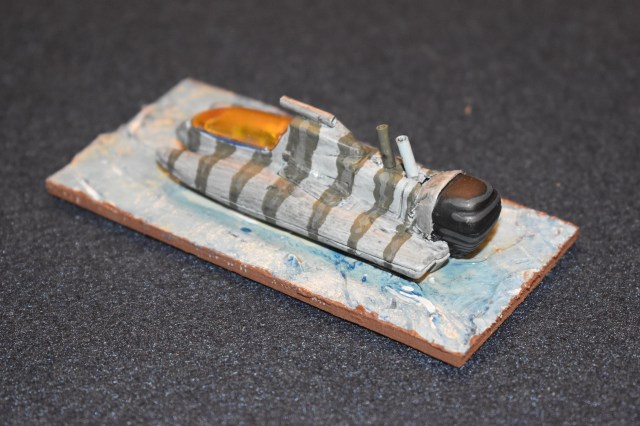
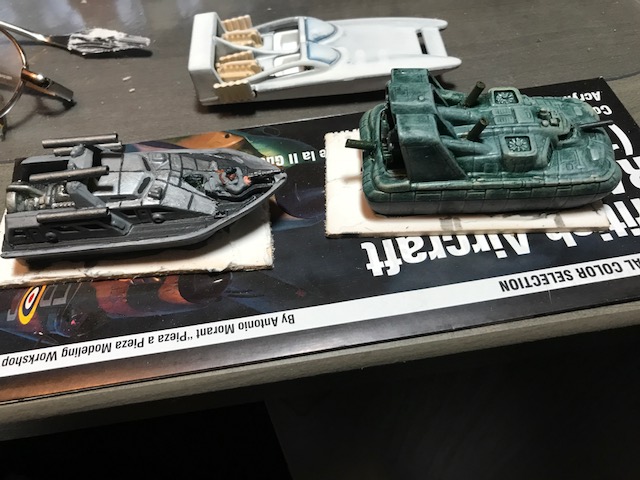
The basis of any boat racing game is, of course, the boats. I ordered some fairly inexpensive Matchbox boats from eBay.  I think I got about 12 boats for $25.  They were two orders with lots of variety.  I chose six of them I wanted to use, and I’m going to get a couple more.  The problem is scale, some of the boats represent something much larger than is intended for the game, so you have to be choosy.  I passed some of my duplicates on to Dave Schueler so he could have some, but I’d like to add a couple more to my six.  Eight boats for Enfilade.

Out of the Blue is armed with a pair of rocket launchers, a machine gun and will tow a parascender behind to drop grenades in boats that are a little too close.

Once I chose my boats I had to modify them.  The first thing I did was use my Dremel tool with sanding disk to strip off all the paint and decals.In some cases, I also made some modifications.  The Tiger Shark had a big tail, which I removed.  All had wheels I cut off.

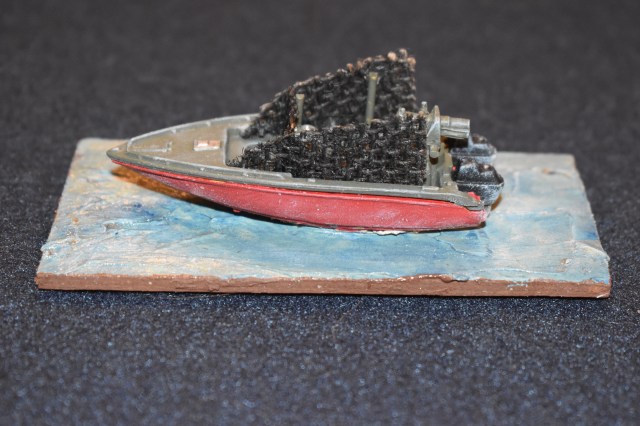
Red Scorpion 1

Red Scorpion is armed with  a short barreled cannon with balky ammunition and a shotgun. It is protected  by mesh armor.

The next step is to determine armament.  Manley included a variety of weapons in his rules, including rocket launchers, mortars, mine droppers, machine guns and small arms. I added the rocket, mortar and mine dropper tubes, and will factor in most of the small arms to the modified Thunderboat! cards. I used simple brass tubing I cut with my Dremel tool, and then sanded the rough edges off. Careful, the tubing heats up quickly. I usually drilled in a small piece of brass wire where I wanted the tubes to go, before slipping them over the wire and gluing in place. That seemed better than drilling gigantic holes for the tubes. For the game, each tube usually has one round.  Once it has fired, it’s gone.  It’s better to spread the armament and ammunition around because there are gun hits in the game rules. For the most part there are 2-4 tubes per boat, and small arms-mgs, shotguns, pistols have 4-6 turns of fire.

Specter is armed with four rocket launchers and a machine gun.

Once the armament was positioned, I primed and painted them.  If you’ve ever seen The Road Warrior, you’ll recall that Max’s adversaries are driving vehicles that aren’t pretty and painted to a high gloss.  I chose paint schemes that aren’t pretty with lots of washing and dry brushing.

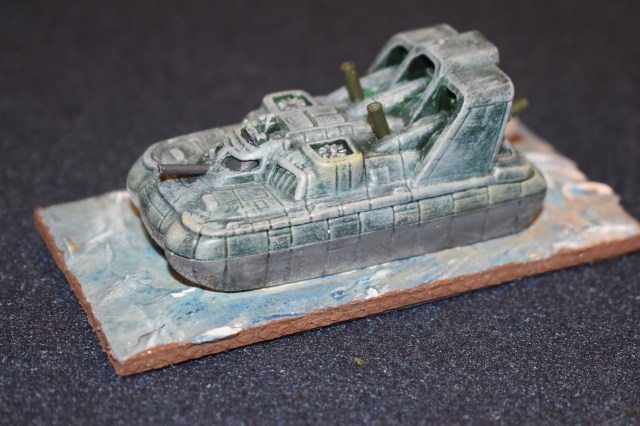
Stag Beetle 1

Stag Beetle is armed with a pair of mortars, a mine dropper, and a machine gun.

I did decide to mount my boats on bases.  Our situation is a bit different than David’s.  He plays on a mat with 2″ hexes, while ours are 5′ hexes.  Boats got to fit in a hex, and the bases seemed fine.  I went with 4″ X 2″ bases.  Some seemed a bit large, other boats barely fit on theirs. I went with 3mm hobby plywood from Michaels after choosing some 3/32 basswood.  I applied Liquitex Modeling paste to the  basswood and it warped badly, so I made the change to plywood. I used Vallejo Pastel Green as my base coat, then washed over it with Dark Prussian Blue, followed by khaki.  Then I drybrushed Ceramcoat Ivory over the top.  Coated the lot with Liquitex acrylic gloss gel, and voila, complete.

Tiger Shark 1

Tiger Shark is armed with a pair of mortars, a rocket launcher, a machine gun, and flies a parasceder

Well almost. David’s boats had some impromptu mesh armor, which I thought was really cool.  I couldn’t quite figure out what he used to make it, but I poked around in a craft store and decided that burlap strips, sprayed black might look okay too. I’ve tried to protect a few of the boats with this material, and kind of like the way it turned out.

The Water Moccasin mounts a pair of rocket launchers, two mine droppers and a shotgun. 

I haven’t written about the parascenders and think I’ll wait until after Saturday’s gathering to show and tell.


You Can Never Have Too Much Stuff

I’ve been trying some new stuff recently.  Maybe you’ve been looking at some of this and are wondering if it’s worth your hard earned bucks.  This is my consumer review based on my experiences, but sometimes it just helps to have another perspective, just in case.

Vallejo Air color

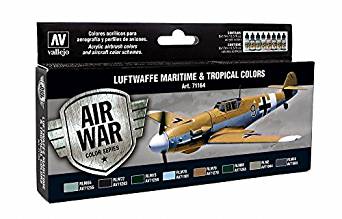
Vallejo Air Colors—I bought a set of these last year for my Cuban Missile Crisis game.  The Modern USAF set of colors.  Eight bottles for about $25. I ordered from Amazon, and actually I ordered the Navy colors, but these worked out fine. Having had success I went on to order the WWII German colors 1942-45, and the German tropical and Mediterranean set, the British tropical and Mediterranean set, and the U.S. in Burma, China and SE. Asia.

First, the cost is about what you’d pay for individual bottles of Vallejo paint, so no big difference there.  I also appreciate that the colors are accurate.  The alternative would be to go to Testor’s Enamels, and I’d do almost anything not to do that.

There is a downside, and that is that these pigments are very fine ground and intended for air brush use. While I have an air brush, I’d never use it on 1/300 scale planes. The colors generally will require multiple thin coats. So, I counsel patience.  Good stuff but a trade-off.

Vallejo Rack

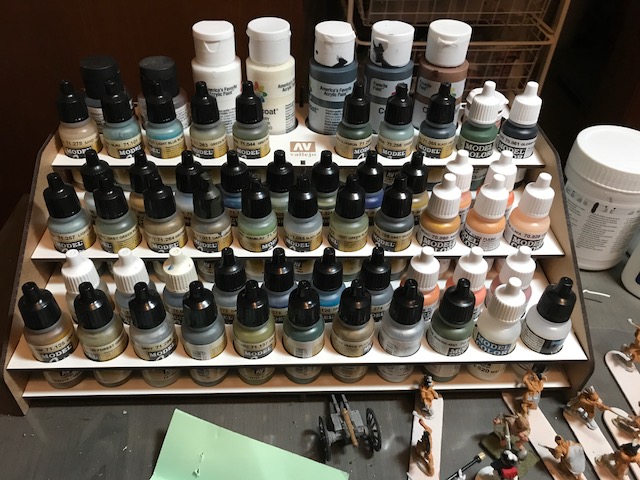
Vallejo Paint Rack—This was a Christmas gift from my wife.  I’d suggested it on my massive list of Christmas choices.  Also available through Amazon for about $20,  it is made of laser-cut plywood.  It had fairly mixed reviews by users, so I was a little concerned about the quality of materials and breakage.

I assembled mine last night with little difficulty in about 15 minutes.  Mine is the center rack, ie rectangle shaped.  I could also add corner racks, but that seems unlikely.  It holds 60 bottles of the dropper style paints—so Vallejo, Reaper, and other paints in this style-as well as space for  eight larger bottles—I keep a few Ceramcoats and the Vallejo washes in them.  There is also a rack for paint brushes, but I’m not currently using that. Paint storage was really getting to be a problem for me, so this seems to offer a solution.

The downside is the size of the rack.  I have a pretty sizable craft desk space, so it should work for me, for others who don’t I can see it being a problem.  As with all organizing solutions, the effectiveness is often determined by whether or not I use it, so that remains to be seen.  But for twenty bucks, it’s worth the gamble to find out.

Tiny Wargames UK Battle Mats—I’ve never purchased a game mat before, but I’ve looked at the Cigar Box mats and others with interest.  One day the Aerial Wargaming Facebook group featured a mat by the British maker Tiny Wargames Battle UK Mats, and I got a bit more interested.  They offered a 20% off Black Friday deal, and I asked Lorri about Christmas, and she went for it. I was very interested in the 6’ X 4’ mat with a screen print of Valetta, Malta harbor. I sent in my order on November 29th, and it arrived within a couple of weeks.
You can judge for yourself by the photo of the harbor, but I think it’s spectacular. So the product is great and so was the service. Not quite sure what material it is printed on, but it feels similar to a table cloth.  If there is a downside, it is the cost.  Even with the savings, including shipping it was about 90 bucks.  To me, it was worth it, you’d have to make your own decision. You can get them with or without a superimposed hex grid.

Tiny Wargames offers mats screenprinted for Pearl Harbor and Taranto Harbor as well as a lot of really interesting, but more generic terrain.  They also offer sizes from 3′ X 3′ to as large as 10′ X 5′.  The bigger the mat the lighter your wallet.

Army Painter Brushes

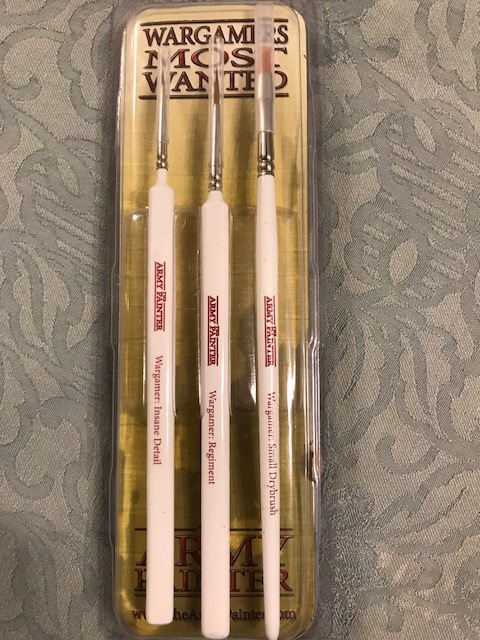
Army Painter brushes-The past couple of years I’ve been in a brush crisis.  I’ve written many times about my fondness for Blick Master Kolinsky brushes.  But after the Kolinsky sable ban of a few years ago, their availability has just fallen off the table, and the cost of Kolinsky brushes has skyrocketed. I keep thinking I should just buy some Windsor and Newton Series 7’s (if I can find them) and shut up about it all. But they are really expensive.

So I’ve resorted to using some of the white-handled Army Painter brushes.  I gotta say I’ve been pleasantly surprised. The two things most important to me in a brush is  they hold a point, and they hold paint.  Generally speaking I find these brushes do that.  A third factor I appreciate is longevity—do I get plenty of use out of them?—and for the most part I do. So, big enough to hold effective quantities of paint, they hold a point, and they don’t lose their points or start falling apart quickly.

I can buy these at my local bricks and mortar stores for five bucksish, or order them in sets for about fifteen dollars. They are made of sable hair and some include some synthetics too. I generally down like synthetics because they lose their shape, and usually quite quickly.  But that doesn’t seem to be a problem with these brushes. The only downside, and this is for the picky-me, is they aren’t categorized by size in a standard way, they are instead, cutesy-named as Regiment, or Insane Detail, when all I’m really looking for is 0, or 1.  If you can set this aside, I’ve found these to be solid brushes and a good value.

A Great Year’s End

My last post of the year as things wind down for 2017.  Mostly good things to report.  Got lots done.  Finished some projects, played some games, though fewer than I’d like.  Tried some new products that I’ll share with you in a few.  But mostly, things just feel positive. I’m healthy, have a wonderful supportive wife, and three great if barky Australian shepherds just kind of round things out.

I wish I was one of those guys who was super organized and kept track of everything I bought or painted.  I always have the best of intentions, but never quite get there.  But here’s what I accomplished in 2017

IMG_0116

The Aztecs and Spanish

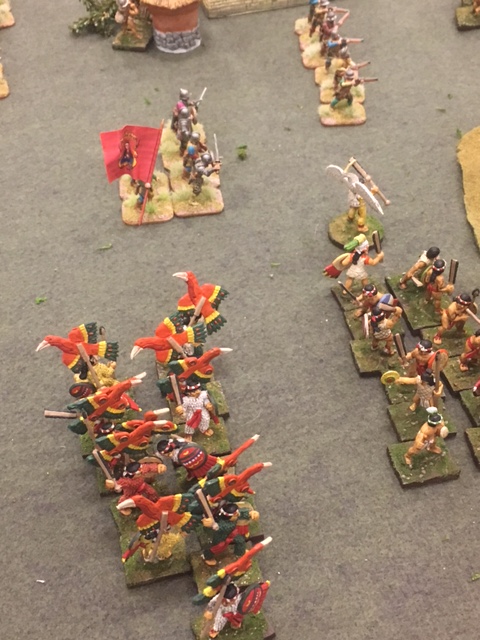
Began this project in 2016, bought and painted 400+ figures.  It is unquestionably my most successful project because I’ve painted every complete unit I own.  Talked about buying some more figures, but never quite got to it.  Now I just need to game with it a bit more.   On the list of things to do for 2018 is to remount the figures in the 3, 2, 1 system.

Cuban Missile Crisis Goes Hot

This was another Enfilade project and one that meant a lot to me.  This is project Dave Schueler and I worked on beginning with a quickie game at 2016 Museum of Flight.  It was a lot of fun.  I really enjoyed painting the planes, but, for me, the piece de resistance was completing the SAM-2 battery. Thanks to George Kettler for all the goodies that really helped me pull this off.

The Big Buy–Dave Smith’s planes

I’ve mentioned this briefly, but it definitely deserves more space. As Enfilade was ending, Dave Smith from North Vancouver offered to sell me his collection of 1/300 airplanes. It is huge, clocking in at over 700 miniatures.  There is a whole lotta stuff, some which I find interesting and some which is less so.  But there are tons of cool planes.  Sometimes the cool planes have to be supplemented with more cool planes.  I paid more than I ever have for any other project, but so far it has been a very fun, very worthwhile investment. I’ve used some of the planes in my Falklands project and more in my current Malta/Mediterranean project. And they will continue to make appearances in my work in 2018 and beyond. Sorry there are just too many stowed in too many places to show.

Argentines Canberras, Skyhawks, Daggers, Pucaras, and Super Etendards.  A Sea Harrier and a Vulcan for the Brits.  What I wouldn’t give for a 1/300 Nimrod.

The Falklands Project

This was one of my must-do air projects. Dave Schueler and I collaborated on a scenario for the Museum of Flight day.  It went okay, but I think the scenario needs another playing or so before Enfilade.  I painted about 50 planes for the project and don’t anticipate needing anymore unless I decide to add a couple of C-130’s or can find a Nimrod maritime patrol bomber.

IMG_0122

America Rampant

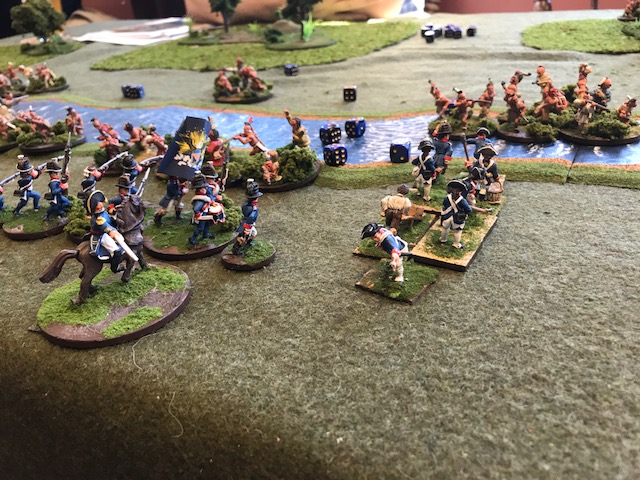
This was a project of mind and will rather than a lot of buying and painting. This was my decision to take all of my Louisiana project and remount it for my own version of The Men Who Would Be Kings. The modification worked, and I could easily play with what I have. I’d also like to add the unpainted miniatures I have and when ready buy some more to refight the Battlle of the Wabash.  I’m projecting that as an Enfilade 2019 game. Haven’t added much yet, but still have two units of Indians on my painting table. That said, I have run three games using the rules, and I also remounted about 450 Americans, Indians and Spanish to the 3-2-1 system.

From left:  Defenders of Malta: Hurricane 1’s and 2C’s, Fairey Fullmars.  A dozen Fiat G.50 fighters.  Eight Italian SM. 79 bombers.  Note the space in both boxes for more planes, lots more.

The HMS Illustrious turns into the Malta campaign

Dave and I really like putting together air battles with purpose, whether that is bombing a ship-the Tirpitz-or an air strike on a land target-Cuban Missile Crisis Goes Hot.  We’ve identified our target this year-the combined German and Italian air attacks in January 1941 against a task force built around the HMS Illustrious intended to escort convoys to Greece and Malta.  We’re definitely on for that, and the planes are pretty much painted, though I may paint a few more just to add to the mix available. That has broadened into a greater interest in painting the planes available for a Malta campaign.  The Italian and German siege of the little island lasted from June of 1940 to October 1942, with lots of aircraft upgrades on both sides, so lots of opportunities to use those planes from the Dave Smith pile o’planes.

What to Expect in 2018?

The first thing you can expect is a lot more of the same.  I have a terrific interest in the Spanish American War range by Miniaturas 1898.  They are gorgeous and the owners have done a great job of supporting their work with historical information, and it is my intention to start acquiring figures maybe in the summer, maybe after Enfilade 2019. More about this project at some future time. But I do have few definite projects to work on for the coming year.

America Rampant and the Wabash I’ve already written about this.  It will take a lot of painting and some additional figures, but it’s a natural culmination of this project.  It’s my chief idea for Enfilade 2019, and it will certainly require some interesting scenario and terrain design for the unique setting.

Mad Wet Max

Mad Wet Max–This is sort an anger management version of Thunderboats.  Miniatures, racing on the water, armed in a sort of post-pretty form.  For the most part I have the miniatures, it’s just making suitable modifications for the game.  Friday night at Enfilade.  Looking forward to some playtests.

More air stuff–Let’s just start with this one truth–I love painting 1/300th airplanes.  There is lots of Malta to continue painting through all six of its phases. Still in the Hurricane and SC 300 phase, but it has far more permutations to go through. I’m also looking at a Downtown Hanoi Vietnam air war campaign.  Starting almost from scratch for a lot of this.

And of course I have zillions of other figures to distract me if I need to do something else, including re-basing all my figures for Lion Rampant.

Have the best of New Years, and I hope you can find enough to keep you busy for the coming year.


Painting the MSD Vulcan

IMG_0730

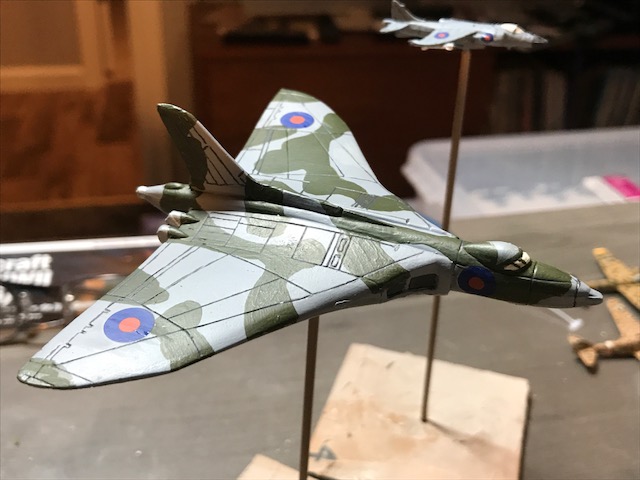
I posted photos of the Vulcan bomber I painted a couple of days ago.  I’ve probably painted upward of 500 1/300 scale planes and the Vulcan was the most interesting and challenging of the lot.

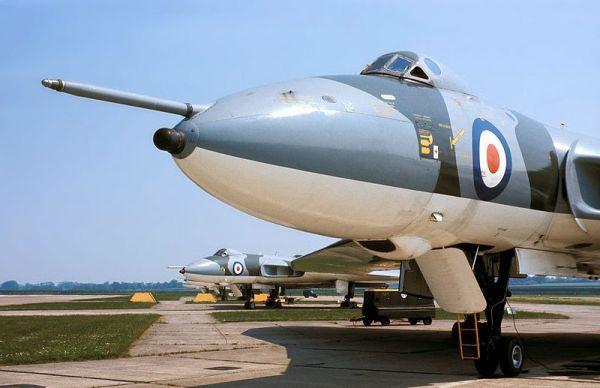
Just some quick background, the Avro Vulcan bomber was a massive Cold War era strategic bomber, designed to deliver nuclear weapons against Soviet-era targets.  Introduced in 1956, it served as the RAF’s strategic air deterrent until its retirement in 1984. Perhaps most famously, the plane starred in the James Bond movie, Thunderball in 1965, hijacked for its two nuclear bombs as a Villiers Vindicator.  Two Vulcans got to play Vindicator roles, though neither eclipsed Sean Connery’s typically wonderful performance as 007.

Thunderball Vulcans

Photo of the Bond “Vindicators.”

I bought a Vulcan to fill in as one of the bombers assigned to the Black Buck raids on the Falklands against Argentine ground targets. The raids were largely ineffective, but c’mon, if there’s a Vulcan out there and doing the Falklands, you gotta have it.  Don’t get me started on why I need a Nimrod.

There are two 1/300 Vulcans available. One is from Ros/Heroics, formerly a Skytrex miniature, acquired a few years ago when the latter company slimmed down its ranges. The other is from MSD.  I was a little leary of the Skytrex model.  Plus at 14 pounds plus 40% to ship to the states, I thought I’d pass. I could get the MSD kit from I-94 Enterprises near Chicago, so I went there instead.

The first thing to notice when popping the plane out of the box is its sheer size.  It is unquestionably the largest plane I own, which includes all the WWII strategic bombers.  Because of its delta wing design it is also quite heavy, which posed some additional problems during painting.

Because I choose to use flight stands demanding a “pinned” bomber, it meant finding a center of gravity and drilling in a piece of brass wire. Once drilled in, I primed the large model.  I used a spray primer, but due to the size of the plane I might have brush primed it to get more even coverage.

The paint scheme is relatively easy.  I basecoated the entire upper surface with Ceramcoat Rain Grey, before adding the Vallejo Olive Green camouflage pattern.  It’s important to be patient and use multiple coats.  The surface area is too large to likely get it right in one swipe.  The lower surface is the somewhat darker Vallejo Neutral Gray.  The metal bits are painted with Testors Aluminum. All the scribing is painted with Ceramcoat Charcoal. This, or a reasonable facsimile of this is what the Black Buck Vulcans wore in 1982.  Earlier versions of the plane were a bit different with lighter rather than darker undersides.

Handling the plane during painting is really challenging.  And what do you do with it between painting sessions?  I found myself constantly painting over surfaces, even though I sprayed them with Dullcoat in between sessions.

IMG_0729

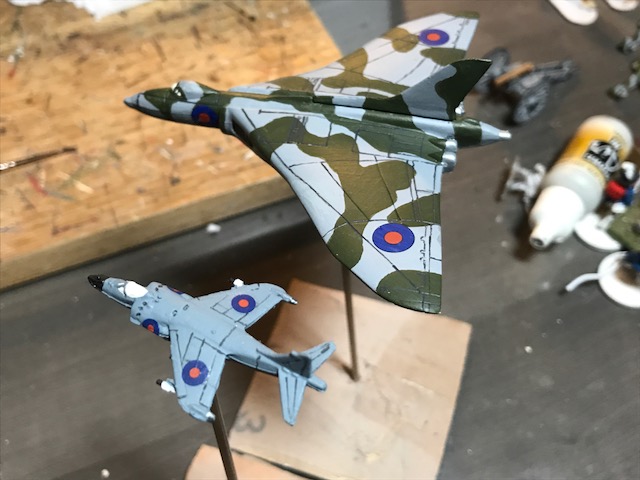
MSD Vulcan alongside a Raiden Sea Harrier.

The model itself is quite clean.  It is well formed and accurately scaled.  The huge tail comes separate and probably should be puttied in place, but as with most such tasks I am too lazy.  The detailing is quite clear, but I do have a significant beef that if the upper and lower surfaces of the plane are to be so well detailed, wouldn’t it be nice to have detail on both sides of the tail?

All in all, it was a fun painting task.  Probably a needless addition to the Falklands pile o’planes, but I’d hate to say the project was finished, and not have a Vulcan in the mix.

Ah-Ha! A plan takes shape

The stuff I’m working on from top left–Indians for the Wabash, about 1/4 done; ten completed Stukas for the Illustrious game; some piles of planes awaiting all kinds of work–Malta-based Hurricane I’s and Macchi 200 Saettas; MSD Vulcan completed and ready to fly across the Atlantic Ocean; nine Italian SM 79 bombers that will take their shot at the Illustrious; four GHG Hurricane IIc’s-nice models.

I am obsessive about knowing what I’m doing.  Most of my wargaming life is built around what games I’m going to host at Enfilade.  Last year, the big deal was the Aztec project I did with David Sullivan.  The year before that it was Lion Rampant.  The year before that it was The Raid on St. Nazaire.

This year is different.  No new big project.  No gazillions of new painted figures to roll out by Memorial Day weekend.  The pressure is officially off.

That doesn’t mean I won’t be doing anything.  I finished my first six Axis planes for the air attack on the HMS Illustrious.  That’s one of the games Dave Schueler and I will be working on for Enfilade 2018.  I’ve already completed the six Fulmars that will be defending the venerable British aircraft carrier.

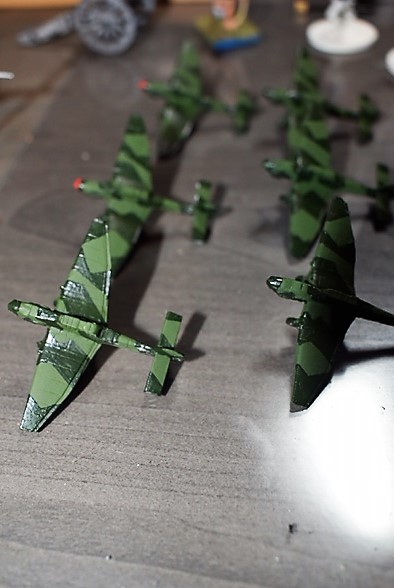
These are Raiden Ju-87B miniatures.  They are one part castings.  Very nice stuff, with lots of detail (but not too much.) They are painted a combination of Vallejo German Camouflage Green and Vallejo Military Green.  The underside is Vallejo Sky Blue from their RAF Mediterranean and Desert Air Colors set. I have four more Stukas that I will paint up in Regia Aeronautica colors.  Pretty much green with a white cross on the tail.

Expect lots more planes from the late 1940-1942 period from the Med.  I have a ton.  I need a lot of Italian SM-79 trimotor bombers for the Illustrious attacks.  I have a load of Italian Breda light bombers and early fighters, such as the Fiat GR 50 that I’ve had forever and need painting. I also have British defenders, including some Hurricane IIc and P-40E Kittyhawks that will be in stone and sand colors.  They should be fun.

But my really big project is one that I touched on last post, and that is The Battle of the Wabash. This 1791 battle in the Northwest Territories (okay, Indiana) was a horrendous massacre of the American army sent out by the Washington administration to conquer the territories for settlers then congregating on the north bank of the Ohio River.  It didn’t turn out well.  It is often known as St. Clair’s Defeat or St. Clair’s Disaster. The 2,000 man force under Arthur St. Clair’s command lost about 900 or so killed, compared to about 275 of Custer’s command at Little Bighorn.

It’s a big ol’, project.  I will use America Rampant, my conversion of The Men Who Would Be King, to this early wilderness period. The Americans have something in the neighborhood of 26 ten figure units.  The Indians, under Little Turtle, have slightly more at 28.  The Americans actually outnumbered the Indian confederation at the battle, but the batches of militia and outposts that were swamped and destroyed at the battle’s outset won’t be represented. There’s lots of fiddling to be done rules-wise, but I’m a long way off from being ready. Lots of terrain to prepare.  That said, this will be my Enfilade 2019 project, so really 18 months out.

I already have eight or so units of Americans painted.  All the American units have ten figures. Two of them are light dragoons, though I believe only one of them is mounted. The Americans also have six cannon, and I have three of them painted.  I believe I am working on native units eight and nine.  All the natives are twelve figure units. I still have lots of unpainted lead, though there will be some additional figures needed to complete the project.

David Sullivan recently posted about his addiction to Daniel Mersey’s projects.  I find myself in concurrence with his views.  They are simply a fun collection of rules. We might be talking past each other in terms of future and ongoing projects, but I do see myself working with David on an ACW version of America Rampant.  We both have zillions of unpainted figures, so I see no reason not to.  I am diverted by that somewhat shinier project at the moment.  But not having the time pressure to get Wabash done instantly means I can also dork around with side painting activities, including some ACW units.

So here is my list of to-do’s:

  • Air Attack on the HMS Illustrious–unknown number of planes, but there will be plenty painted.
  • Remount Aztecs for 1-2-3 system.  That’s a Christmas Break project.
  • Mad Wet Max–more later as WIP
  • New air stands.  Only need a high and low altitude for Airwar C21 and Airwar 1940. I want lots, however, because the game system can handle many more planes.
  • Lots of painted figures–America Rampant, ACW, AWI and Hundred Years War in what ever I feel like order.

New rules to mess around with

Dave Schueler and I have begun lamenting lack of a fairly simple set of air rules. We love AirWar C21, but they are a set of rules for jets. I bumped into David Manley, the author of AW C21 on Facebook.  We’ve had infrequent contact on The Miniatures Page and elsewhere.  He’s also written Action Stations, Iron and Fire, and other rules that I enjoy. Daveshoe has more contact with David than I.

David mentioned he’d written a set of World War II air rules similar to AW C21 he couldn’t get published.  Eventually he offered to let us be playtesters and sent them as e-mail .pdf’s.  We’ve only begun thumbing throught them, but they seem to offer many of the things we like about the jet age rules–hexless, less sltitude emphasis, relative ease of play and the ability to run many planes. More on our progress in the future.


A Plan, half-baked or all baked.

Most of the month of October I spent finishing my Falklands project.  And voila it was so.  Project finished and game run at Museum of Flight. Well, almost mostly done.  There are still some plane types I’d like to have for special scenarios–and because they are just so cool.

Examples, you ask?  Well how about this one.  An Avro Vulcan.  As the Falklands War broke out these behemoths were just on the verge of retirement from the RAF.  But several of the planes made the “Blackbuck” cross-ocean raids on Argentine airfields in the Falklands. I ordered the MSD Vulcan, a mere twenty bucks and costing extra postage because it’s so huge.  Note: an average plane costs between three and six dollars. This is big. I also ordered a S-2 Tracker, the ex-U.S. anti sub planes the Argentines used as AEW aircraft in the war.  I think there is a scenario in that.  The Brits didn’t have an AEW capability which contributed to the siege their ships endured during the war.

Vulcan

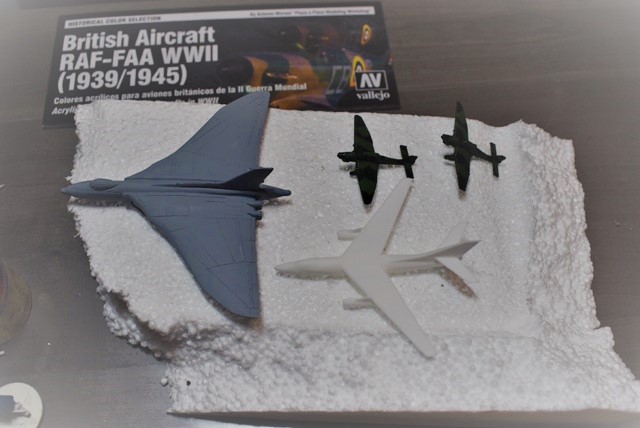
The gray painted Avro Vulcan by MSD miniatures is just really big. A pair of Raiden Stukas are behind the big jet bomber. The white plane behind is a Douglas A-3 Skywarrior in resin by Shapeways. No shrimp.

I’ve also painted some helicopters for both sides and have even more and might even pick up a few I don’t have.

While the Falklands were fun, the big question is what next?  I’ve kind of settled on some projects to work on between November and Enfilade in May.

First up is the for sure air project Dave Schueler and I are working on for the convention–the air attack on the Illustrious in January 1941.  I’ve already completed six Fairey Fulmars for the carrier’s air defenses, and now I am beginning work on the dozen Stukas I’ll be painting.  Well, ten for sure, I also have a pair of C in C Stukas, but they come in many tiny pieces, so I may not get far with them. Illustrious is just a stepping stone into a pile of planes for Mediterranean, and I’m looking forward to painting them.  American Kittyhawks, Spitfires, Hurricane II’s, a host of Italian and German planes.  It will be fun.

Stuka 1 (2)

Raiden Stukas in splinter camouflage for the 1941 air attack on the Illustrious.

Also on my to-do list is to take a long look at David Manley’s wonderful adaptation of the idea behind Thunderboats to a bit more of a Mad Max theme. You can read more about it here. I have managed to acquire the Matchbox boats that will make up the little flotilla for this game.  But I haven’t done anything with the boats yet.  They’ll need some modifications and dirtying up and basing, but I’m not likely to get started until January.  Want to keep the Mediterranean and my other big project firmly in view until then.

That other big project is simply a continuation of my old project America Rampant.  I have a whole bunch of unpainted figures for that, primarily American infantry (Old Glory Wayne’s Legion figures) and Indians from the Old Glory French and Indian Wars range.  How many?  I think enough to paint five units of Americans and at least seven more Indian units.

new jersey

Old Glory Wayne’s Legion infantry that will become the first of four companies of New Jersey 6-month levies. St. Clair’s army was dependent on 6-month enlistees from New Jersey, Pennsylvania, and Maryland.

I recently finished reading William Hoageland’s Autumn of the Black Snake.  Interesting read on the aftermath of the Battle of the Wasbash and forces leading to the Peace of Greenville. It made me look at some of my other books on the Indian War in the Northwest Territory and got under my skin.  I’d really like to shoot to game The Wabash and Fallen Timbers.  I’ll need some more figures to do it at a unit = 50 figures, but there’s no point investing in more when I still have plenty to paint.

Gaming the Wabash would present numerous problems.  It’s huge for TMWWBK.  Terrain is interesting, with lots of it, and the goal for the Americans would have to be simply survive and retreat off the board if possible. But in a game in which the outnumbered Indians (about 1,400 to about 2,000 U.S. troops) have the clear upper hand, it should make for an interesting team game. More later.  I highly recommend John Winkler’s Osprey account, Wabash for a pretty straightforward account of the battle and an order of battle.  I’m busy working on troops that will be one of the four levy companies from New Jersey.

Music to paint by

Bangles all over the place

It’s been a while since I’ve included a little music info.  I think I’ve noted that the eighties music scene kind of passed me by.  But one band I really enjoyed, even thought their shelf life was short, was The Bangles.  The all-girl-group grew out of the folk and punk scene of LA, and became a staple of MTV in the mid-80’s with songs like “Walk Like an Egyptian” and “Eternal Flame.”

But the Bangles were more than their hits.  A listen to their first record All Over the Place gives you an idea of what the band was before their label made Susannah Hoffs leader of the band and set in motion the tensions that would destroy the Bangles after only three albums.

All Over the Place is a record rooted in mid-1960’s pop.  Lots of jangly guitars by Vicki Peterson and Hoffs.  Songwriting and vocal chores are shared among different members of the band. There are plenty of good songs, even if it lacks the hits that will follow on Different Light. “Hero Takes a Fall” and “Live” on side one are particularly good. “Restless” and “He’s Got a Secret” are strong on the B-side.

The record features strong guitar interplay, great lead vocals, and fine supporting harmonies.  It’s fun to listen to, and if it isn’t breathtakingly heavy All Over the Place has a fine pop sensibility, the feature of all great artists from Duke Ellington and Frank Sinatra to the Beatles and REM.


Museum of Flight 2017

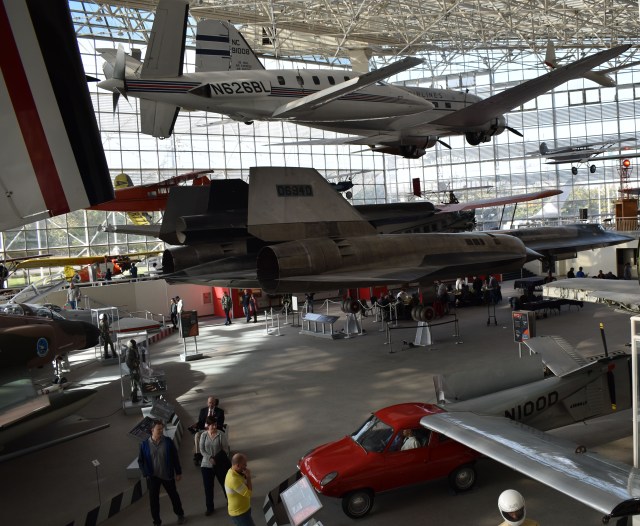
Great Gallery

View out on to the Great Gallery. SR-71 is dead ahead

Sunday marked our 15th year at the Museum of Flight. We hosted seven games and about 35 gamers in what I believe is the best venue anywhere.  I know guys in Houston have gamed on the USS Texas, and that sound cool, and I’m sure there are other great places to game, but this isn’t a one-off, it’s our annual gig, and there simply isn’t anything better than hanging out under the SR-71 on a fall sunny day under the glass roof.

We game under the SR-71. It’s the best game space ever for a small gig like ours.  Not a one-off.  This is where we are EVERY year. 

We divide our time into two game sessions. The morning session featured three great games.  They included Rorke’s Drift in 28mm, hosted by Lawrence Bateman and Damond Crump.  Looked good and the players seemed to have a good time.  The Zulus had successfully overrun the hospital and inflicted a fistful of casualties by the time the session ended.

The second game featured All Quiet on the Martian Front hosted by Dale Mickel.  I was drawn to the massive landship in the game. Very cool stuff.  I think the Martians took it in the shorts in this H.G. Wells inspired game.

The Napoleonic sail game was played across both periods and was hosted by Jeroen Koopman. It was great to see Jeroen-it had been many years. Gorgeous, fully rigged 1/700 miniatures by Triton.  Spectacular.

There were also four games in the afternoon.  Unfortunately, my camera ran out of battery life as I was getting ready to take pictures. Sven Lugar ran an old-fashioned Fletcher Pratt naval game on the 12’ X 5’ table.  It was fun to see the golf tees out marking shell splashes as the players guessed ranges. Scott Murphy ran a Star Wars Armada game with lots of players.  Everyone seemed to enjoy themselves.

Dave Schueler and I ran our Falklands game.  Dave developed a great system that required the Argentines compose their attack force of specific plane types, while the British decided how they would dispose of their defenses. There were some off-board issues to resolve, and the Argentines had the worst of luck, losing four of their nine raiders before even getting to the board. To complicate matters, they targeted the amphibious assault ship HMS Fearless, which was the farthest target to reach and left them open to attacks from Harrier defenders. The surviving A-4’s and Mirages that made it on to the table were under constant attack by Sidewinders and cannon fire, but two made it to the Fearless, only to have one stick of bombs end up as duds, and one lose control of their external system just as they were in bombing range.  Not a good day to take back the Malvinas.

We’ve moved the museum day to Sunday.  The Museum of Flight hosts a lot of Saturday evening fundraising activities.  We get to game for free. So if there is a time conflict, we end up low on the priority scale. We’d have to leave by 3:00 to play Saturdays, so we’ve moved to Sunday which allows us to stay until 5:00. Not optimal, but I’ll take what I can get.

To all my friends on The Miniatures Page who insisted the Etrich Taube was the prettiest plane of WWI, we’re willing to share views of our reproduction with you.  But you have to come to Seattle. 

I’ve included shots of the three morning games as well as some additional snaps of what one can see in the Great Gallery.  It’s a small fraction of what’s available to view in the Museum. The Museum of Flight is sponsored by what used to be our hometown manufacturer, Boeing, so lots of Boeing products on display.

From upper left–Army version of Boeing F-4B fighter; Reproduction of deadly Gee Bee Z racer, used in the movie “Rocketman’; Reproduction of Boeing Model 40B in U.S. Mail service; XF8U-1 prototype Crusader, last of the gunfighters (now how cool is that?); Boeing 80A-1 in Wien Alaska Air colors, a beautiful biplane tri-motor; reproduction of Stinson Model 0; Chinese manufactured MiG 15  (Shenyang J-5.)